R E S E A R C H A R T I C L E
Open Access
Serum thyroid-stimulating hormone levels are
not associated with exercise capacity and lung
function parameters in two population-based
studies
Till Ittermann
1*, Sven Gläser
2, Ralf Ewert
2, Stephan Felix
2,3, Henry Völzke
1,3and Marcus Dörr
2,3Abstract
Background:Thyroid dysfunction has been described to be linked to a variety of cardiovascular morbidities. Through this pathway thyroid function might also be associated with cardiorespiratory function and exercise capacity. So far only few patient-studies with small study populations investigated the association between thyroid dysfunction and exercise capacity. Thus, the aim of our study was to investigate the association of serum thyroid-stimulating hormone (TSH) levels with lung function and cardiopulmonary exercise testing (CPET) in the general population.
Methods:Data from the two independent cross-sectional population-based studies (Study of Health in Pomerania [SHIP] and SHIP-Trend-0) were pooled. SHIP was conducted between 2002 and 2006 and SHIP-Trend-0 between 2008 and 2012. Participants were randomly selected from population registries. In total, 4206 individuals with complete data were available for the present analysis. Thyroid function was defined based on serum TSH levels. Lung function was evaluated by forced expiratory volume in 1 s and forced vital capacity. CPET was based on symptom limited exercise tests on a bicycle in a sitting position according to a modified Jones protocol. Associations of serum TSH levels with lung function and CPET parameters were analysed by multivariable quantile regression adjusted for age, sex, height, weight, use of beta blockers, smoking status, and physical activity.
Results:Serum TSH levels, used as continuously distributed variable and categorized according to the clinical cut-offs 0.3 and 3.0 mIU/L or according to quintiles, were not consistently associated with parameters of lung function or CPET. Conclusions:Our results suggest that thyroid dysfunction is not associated with lung function and cardiopulmonary exercise capacity in the general population.
Keywords:TSH, Hyperthyroidism, Hypothyroidism, Exercise capacity, Lung function, Oxygen uptake, Spirometry, Population-based study, Epidemiology
Background
Thyroid dysfunction has been described to be linked to a variety of cardiovascular morbidities [1]. For hyperthy-roidism associations with atrial fibrillation [2], left ven-tricular hypertrophy [3], carotid atherosclerosis [4,5], and high fibrinogen levels [6] have been reported. On the other hand hypothyroidism is associated with altered lipid metabolism [7,8], endothelial dysfunction [9], and
an overall increased atherosclerotic risk [10]. The associ-ation between thyroid dysfunction and cardiovascular diseases might in part be linked with or paralleled by re-duced lung function which is strongly associated with in-creased cardiovascular morbidity and mortality [11,12]. In fact, evidence for such an association exists. Thus, thyroid dysfunctions are for example associated with pulmonary hypertension [13]. It has also been demonstrated that hyperthyroidism is accompanied by a reduced muscle strength resulting in impaired ventilation under exer-cise [14,15]. Furthermore, it has been demonstrated that the cardiovascular capacity is reduced in hyperthyroid * Correspondence:[email protected]
1
Institute for Community Medicine, Ernst Moritz Arndt University, Walther Rathenau Str. 48, D-17475 Greifswald, Germany
Full list of author information is available at the end of the article
patients, which might be related to a disturbed chron-otropic regulation [16] and can be restored by treat-ment with antithyroid medication [17]. Likewise, also hypothyroid states have been shown to be related to lung function impairment. A link between hypothyroidism and decreased lung function might be explained by al-veolar hypoventilation, decreased inspiratory muscle strength, and decreased respiratory rates [18,19]. In hypothyroid patients it has been shown that treatment with thyroxine results in an improved exercise cardio-pulmonary reserve [20].
So far several patient-studies with small study popula-tions investigated the association of hypo- and hyperthy-roidism with lung function [18,21-26] and exercise capacity [23,27-30]. While most of the patient studies demonstrated significant associations between thyroid dysfunction and lung function [18,22-24,26], results from studies investigating the impact of hyperthyroidism on exercise capacity are inconsistent [23,30]. Kahaly et al. [23] showed a reduced exercise capacity in patients with untreated overt hyperthyroidism, whereas Portella and coworkers did not demonstrate an association be-tween hyperthyroidism and exercise capacity in female patients with subclinical hyperthyroidism [30]. Regard-ing hypothyroidism, one study [27] showed an impaired exercise capacities in patients under long-term levothyr-oxine treatment for nontoxic goiter or differentiated thy-roid carcinoma in comparison to healthy controls. In agreement with this, another study [28] demonstrated reduced exercise capacities in patients with exogenous subclinical hypothyroidism compared to controls, but one-year-change of exercise capacity did not differ among groups of levothyroxine treatment and placebo groups [28]. In line with this, another study reported an association between low free triiodothyronine levels and impaired exercise capacity in patients with heart failure [29].
The discrepancy in results among previous studies in-vestigating associations between thyroid dysfunction and exercise capacity is probably referred to the fact that all those studies were conducted in selected patient popula-tions. Furthermore, it is unclear whether the significant findings between thyroid dysfunction and lung function detected in the patient studies can be extended to the general population, because potential associations of thyroid dysfunction with lung function and exercise capacity has never been analysed in population-based samples. Against this background we aimed to investi-gate the association of thyroid function state as deter-mined by serum thyroid-stimulating hormone (TSH) levels with parameters of lung function and cardio-pulmonary exercise testing (CPET) in two independ-ent population-based studies conducted in Northeast Germany.
Methods
Study population
Analyses are based on data from two independent co-horts of the Study of Health in Pomerania (SHIP), con-ducted in Northeast Germany [31]. In the first SHIP cohort (SHIP-0) 6267 eligible subjects were randomly selected from population registries. Of those, 4308 indi-viduals were examined between 1997 and 2001 (68.8%). Between 2002 and 2006 all participants were re-invited for an examination follow-up (SHIP-1), in which 3300 subjects aged 25 to 85 years took part (1589 men and 1711 women; 83.5% of all eligible subjects). Of those, 1708 individuals volunteered for CPET and spirometry (52.0%).
For the second SHIP cohort (SHIP-Trend-0) 8800 eli-gible subjects were randomly selected from population registries and 4422 individuals aged 20 to 81 years par-ticipated (response 50.3%) between 2008 and 2012. In SHIP-Trend-0 in total 2678 individuals volunteered CPET and spirometry examinations (60.6%). All partici-pants gave informed written consent and both studies followed the recommendations of the Declaration of Helsinki and were approved by the Ethics Committee of the University of Greifswald.
From SHIP-1 and SHIP-Trend-0, we excluded 34 and 146 participants, respectively, with missing data in any of the considered variables. Furthermore, we excluded 22 individuals in SHIP-Trend-0, who weighed more than 120 kg and therefore had to use a recumbent bike for spiroergometry. Measurements from the recumbent bike are not comparable with results from the standard cycle ergometer. In total, our analyses are based on a study population consisting of 4184 individuals (2110 women).
Assessments
Physical activity and smoking status were assessed by computer-assisted personal interviews. Subjects who participated in physical training during summer or win-ter for at least one hour a week were classified as being physically active. Smokers were categorized into three categories (lifetime non-smokers, former smokers, and current smokers). Beta blocker use was defined by the anatomic-therapeutical-chemical (ATC) code C07. Height and weight were measured for calculation of the body mass index (BMI).
by the cut-offs 0.3 mIU/L and 3.0 mIU/L according to Baskin et al. [32]. Furthermore, individuals were classi-fied into five groups according to TSH quintiles.
In both studies, CPET was performed using the same calibrated electromagnetically braked cycle ergometer (Ergoselect 100, Ergoline, Germany) with a physician in attendance according to a modified Jones protocol: 3 min of rest, 1 min of unloaded cycling at 60 rpm, stepwise increases in work load of 16 W/min until symptom-limited or terminated by the physician due to chest pain or ECG abnormalities, and 5 min of recovery [33]. From spirometry we used forced expiratory volume in 1 s (FEV1), forced vital capacity (FVC), and its ratio (FEV1/FVC) to characterize resting lung function [34]. Furthermore, we used the following parameters from
CPET: peak oxygen uptake (peakVO2), oxygen uptake at
anaerobic threshold (VO2@AT), slope of the efficiency
of ventilation in removing carbon dioxide (VE vs. VCO2
slope), oxygen pulse (O2HR), maximum power, and
ex-ercise duration [35].
Statistical analyses
Continuous variables are expressed as median, 25th, and 75th percentile; categorical variables as absolute num-bers and percentages. Serum TSH levels were associated with parameters of CPET and spirometry by median regression adjusted for age, sex, height, weight, beta blocker use, smoking status, physical activity, study (SHIP-1 or SHIP-Trend-0), and time between core examination and CPET examination. Median regression was used, because for some outcomes the residuals were not normally distributed. Participants significantly dif-fered from non-participants of the CPET examination regarding serum TSH levels, age, body mass index, beta blocker use, physical activity, current smoking, and edu-cation [36]. Particularly, participating individuals were younger, had a lower BMI, and were less often smokers and physically inactive than non-participants. To ac-count for these differences we applied inverse probability weights. This procedure gives individuals from groups, which are more likely to drop out, a stronger weight in the analyses compared to individuals from groups with less drop outs. To account for possible non-linear rela-tionships between serum TSH levels or any of the con-founders with the respective outcome multivariable fractional polynomials were tested [37]. A p < 0.05 was considered as statistically significant. All analyses were carried out using Stata 12.1 (Stata Corporation, College Station, TX, USA).
Results
Serum TSH levels were higher in SHIP-Trend-0 than in SHIP-1 (1.14 mIU/L vs. 0.78 mIU/L). Measurements of CPET were comparable among the two studies, but
FEV1/FVC was 5.5% lower in SHIP-Trend-0 than in
SHIP-1. In the pooled population most measurements
of spirometry (FEV1 and FVC) and CPET (peakVO2,
VO2@AT, O2HR, maximum power, and exercise duration)
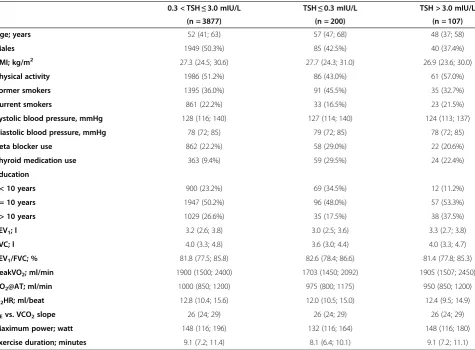
were lower in individuals with low TSH compared to indi-viduals with serum TSH levels in the reference range, while there were substantial differences between individ-uals with high TSH and individindivid-uals with TSH in the refer-ence range only for VO2@AT and O2HR (Table 1).
Serum TSH levels and lung function
Serum TSH levels over the full range were significantly as-sociated with FEV1/FVC in a linear fashion, while there was no association to FEV1and FVC values (Table 2). In comparison to serum TSH levels within the reference range, FEV1, FVC, and FEV1/FVC values did neither differ for low nor for high serum TSH levels. Serum TSH levels within the reference range were significantly associated
with FEV1/FVC, but not with FEV1and FVC values. For
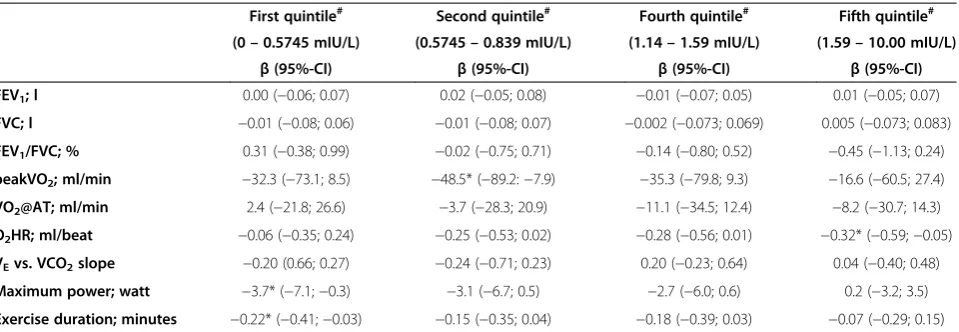
FEV1, FVC, and FEV1/FVC there were no significant dif-ferences between the third and the other TSH quintiles (Table 3).
Serum TSH levels and CPET
Serum TSH levels over the full range were inversely as-sociated with O2/HR in multivariable linear regression,
but there was no association with peakVO2, VO2@AT,
VE vs. VCO2slope, maximum power, and exercise
dur-ation (Table 2). Compared to serum TSH levels within the reference range, CPET parameters did neither sig-nificantly differ for low nor for high serum TSH levels. Likewise, serum TSH levels within the reference range were not associated with any of the CPET parameters. Regression analyses with quintiles of serum TSH levels revealed in total four significant associations to CPET parameters (Table 3). PeakVO2values were significantly lower in the 2nd TSH quintile in comparison to the 3rd
TSH quintile, but peakVo2 values did not significantly
differ between the 1st and the 3rd TSH quintile. Max-imum power and exercise duration values were signifi-cantly lower in the 1st TSH quintile than in the 3rd TSH quintile. O2/HR values were significantly lower in the 5th than in the 3rd TSH quintile.
For sensitivity analysis we excluded all individuals treated with thyroid medication. In this subpopulation regression results did not differ significantly from those in the total population (Additional file 1: Table S1).
Discussion
were found in some sub-analyses of our study might be referred to the problem of multiple testing. The likeli-hood to detect a significant association increases with the number of tests performed. If we assume the Bonferroni corrected p-value threshold of 0.0007, none of the tests
performed in our analysis would be statistically signifi-cant. Furthermore, the detected significant associations at the 0.05α-level do not give a uniform picture. For
ex-ample, FEV1/FVC was related to serum TSH levels over
the full range and serum TSH levels within the reference
Table 2 Association between TSH and parameters of spirometry and cardiopulmonary exercise testing
Model 1 Model 2 Model 3
TSH full range TSH < 0.3# TSH > =3# TSH in the reference range
β(95%-CI) β(95%-CI) β(95%-CI) β(95%-CI)
FEV1; l −0.01 (−0.04; 0.01) 0.06 (−0.06; 0.17) −0.06 (−0.14; 0.02) 0.01 (−0.03; 0.04)
FVC; l −0.003 (−0.034; 0.028) 0.03 (−0.10; 0.17) −0.08 (−0.21; 0.04) 0.02 (−0.03; 0.06)
FEV1/FVC; % −0.35* (−0.65;−0.06) −0.06 (−1.23; 1.12) −0.78 (−2.02; 0.47) −0.48* (−0.91;−0.04)
peakVO2; ml/min 1.2 (−18.1; 20.4) 19.2 (−46.4; 84.8) 3.0 (−98.5; 104.5) 12.9 (−15.4; 41.3)
VO2@AT; ml/min −4.7 (−14.8; 5.5) 14.0 (−19.3; 47.4) −9.3 (−52.0; 33.5) −4.2 (−18.2; 9.9)
O2HR; ml/beat −0.11* (−0.22;−0.01) 0.33 (−0.14; 0.81) −0.31 (−0.88; 0.26) −0.08 (−0.25; 0.08)
VEvs. VCO2slope 0.11 (−0.06; 0.29) −0.44 (−1.08; 0.19) 0.05 (−0.69; 0.79) 0.21 (−0.05; 0.46)
Maximum power; watt 1.3 (−0.1; 2.7) 0.1 (−5.7; 6.0) −0.4 (−11.1; 10.3) 1.9 (−0.1; 3.9)
Exercise duration; minutes 0.02 (−0.08; 0.12) 0.02 (−0.33; 0.37) −0.16 (−0.62; 0.29) 0.07 (−0.07; 0.20)
Median regression adjusted for age, sex, body mass index, beta blocker intake, smoking status, physical activity, study and time between examinations; *p < 0.05;
#
Reference: TSH in the reference range.
Table 1 Characteristics of the pooled study population stratified by serum TSH levels
0.3 < TSH≤3.0 mIU/L TSH≤0.3 mIU/L TSH > 3.0 mIU/L
(n = 3877) (n = 200) (n = 107)
Age; years 52 (41; 63) 57 (47; 68) 48 (37; 58)
Males 1949 (50.3%) 85 (42.5%) 40 (37.4%)
BMI; kg/m2 27.3 (24.5; 30.6) 27.7 (24.3; 31.0) 26.9 (23.6; 30.0)
Physical activity 1986 (51.2%) 86 (43.0%) 61 (57.0%)
Former smokers 1395 (36.0%) 91 (45.5%) 35 (32.7%)
Current smokers 861 (22.2%) 33 (16.5%) 23 (21.5%)
Systolic blood pressure, mmHg 128 (116; 140) 127 (114; 140) 124 (113; 137)
Diastolic blood pressure, mmHg 78 (72; 85) 79 (72; 85) 78 (72; 85)
Beta blocker use 862 (22.2%) 58 (29.0%) 22 (20.6%)
Thyroid medication use 363 (9.4%) 59 (29.5%) 24 (22.4%)
Education
-< 10 years 900 (23.2%) 69 (34.5%) 12 (11.2%)
-= 10 years 1947 (50.2%) 96 (48.0%) 57 (53.3%)
-> 10 years 1029 (26.6%) 35 (17.5%) 38 (37.5%)
FEV1; l 3.2 (2.6; 3.8) 3.0 (2.5; 3.6) 3.3 (2.7; 3.8)
FVC; l 4.0 (3.3; 4.8) 3.6 (3.0; 4.4) 4.0 (3.3; 4.7)
FEV1/FVC; % 81.8 (77.5; 85.8) 82.6 (78.4; 86.6) 81.4 (77.8; 85.3)
peakVO2; ml/min 1900 (1500; 2400) 1703 (1450; 2092) 1905 (1507; 2450)
VO2@AT; ml/min 1000 (850; 1200) 975 (800; 1175) 950 (850; 1200)
O2HR; ml/beat 12.8 (10.4; 15.6) 12.0 (10.5; 15.0) 12.4 (9.5; 14.9)
VEvs. VCO2slope 26 (24; 29) 26 (24; 29) 26 (24; 29)
Maximum power; watt 148 (116; 196) 132 (116; 164) 148 (116; 180)
Exercise duration; minutes 9.1 (7.2; 11.4) 8.1 (6.4; 10.1) 9.1 (7.2; 11.1)
range, but not with TSH quintiles or hypo- and hyperthy-roidism. Likewise, inconsistent findings were detected for
peakVO2, O2/HR, and maximum power. Thus, our
re-sults suggest that there is no evidence of an association between thyroid dysfunction and lung function and CPET in the general population.
Thyroid dysfunction and lung function
There are several small patient studies that investigated putative associations between hypo- or hyperthyroidism with spirometry parameters [18,21-26]. In two of these studies patients with hypothyroidism had lower FEV-1 and FVC values than euthyroid controls [24,26], while in two other patient studies such associations were not de-tected [21,25]. Differences between these patient studies might be related to the low number of included individ-uals and different medical conditions of individindivid-uals in those studies. The studies, which did not detect an associ-ation between hypothyroidism and lung function, consist of individuals with COPD [25] or of individuals with treated hypothyroidism [21], while the studies, which de-tected significant associations, included individuals with untreated hypothyroidism [24,26]. On the other hand, pa-tient studies consistently reported a lower lung function in hyperthyroid patients than in euthyroid controls [22,23,26]. Thus, the findings of the patient studies hypothesize that there might also be an association be-tween thyroid dysfunction, especially hyperthyroidism, and lung function. In our study, however, we did not de-tect a significant association between serum TSH levels and lung function based on a comprehensive set of spir-ometry parameters. An explanation for the lack of a sig-nificant finding might be that the number of individuals with clinically relevant thyroid dysfunction might be rela-tively low as can be seen by the relarela-tively low proportion of thyroid medication intake in individuals with serum
TSH levels outside the reference range. Even though we have no serum free triiodothyronine (fT3) or thyroxine (fT4) levels measured in SHIP-1 and SHIP-Trend-0 to dis-tinct overt and subclinical forms of thyroid dysfunction, findings from SHIP-0, the baseline of SHIP-1, indicate that the prevalence of overt thyroid dysfunctions might be low in our study population. Thus, in SHIP-0 there were only 28 individuals (0.7%) with overt hyperthyroidism and 36 individuals (0.9%) with over hypothyroidism. Hence, the results of our study might argue that lung function is not reduced due to mild forms of hypo- or hyperthyroidism.
Thyroid dysfunction and CPET
With respect to the potential association between hyper-thyroid dysfunction and CPET, the findings of our study are in agreement with a small study [30], in which exercise tolerance of 14 females with subclinical hyperthyroidism did not differ from 15 age-matched apparently healthy controls. In contrast, another study demonstrated a re-duced exercise capacity in 42 patients with untreated hyperthyroidism that was significantly increased 6 months later when euthyroidism was restored by methimazole [23]. Similarly, another study [38] reported a reduced ex-ercise capacity in 15 hyperthyroid patients. Exex-ercise test-ing was repeated in nine of these subjects after treatment with carbimazole, showing markedly improved exercise parameters [38]. The discrepancy between our study and the results of the other two studies [23,38] might be re-ferred mainly to the different study populations. Those studies [23,38] analysed data of patients with subclinical or overt hyperthyroidism and/or the effects of restoration of euthyroidism. In contrast, our analyses are based on a population based sample which is characterized by fewer subjects with clinically relevant hyperthyroid states, which might explain the lack of a significant finding in our analyses.
Table 3 Association between quintiles of TSH and parameters of spirometry and cardiopulmonary exercise testing
First quintile# Second quintile# Fourth quintile# Fifth quintile#
(0–0.5745 mIU/L) (0.5745–0.839 mIU/L) (1.14–1.59 mIU/L) (1.59–10.00 mIU/L)
β(95%-CI) β(95%-CI) β(95%-CI) β(95%-CI)
FEV1; l 0.00 (−0.06; 0.07) 0.02 (−0.05; 0.08) −0.01 (−0.07; 0.05) 0.01 (−0.05; 0.07)
FVC; l −0.01 (−0.08; 0.06) −0.01 (−0.08; 0.07) −0.002 (−0.073; 0.069) 0.005 (−0.073; 0.083)
FEV1/FVC; % 0.31 (−0.38; 0.99) −0.02 (−0.75; 0.71) −0.14 (−0.80; 0.52) −0.45 (−1.13; 0.24)
peakVO2; ml/min −32.3 (−73.1; 8.5) −48.5* (−89.2:−7.9) −35.3 (−79.8; 9.3) −16.6 (−60.5; 27.4)
VO2@AT; ml/min 2.4 (−21.8; 26.6) −3.7 (−28.3; 20.9) −11.1 (−34.5; 12.4) −8.2 (−30.7; 14.3)
O2HR; ml/beat −0.06 (−0.35; 0.24) −0.25 (−0.53; 0.02) −0.28 (−0.56; 0.01) −0.32* (−0.59;−0.05)
VEvs. VCO2slope −0.20 (0.66; 0.27) −0.24 (−0.71; 0.23) 0.20 (−0.23; 0.64) 0.04 (−0.40; 0.48)
Maximum power; watt −3.7* (−7.1;−0.3) −3.1 (−6.7; 0.5) −2.7 (−6.0; 0.6) 0.2 (−3.2; 3.5)
Exercise duration; minutes −0.22* (−0.41;−0.03) −0.15 (−0.35; 0.04) −0.18 (−0.39; 0.03) −0.07 (−0.29; 0.15)
Median regression adjusted for age, sex, height, weight, beta blocker intake, smoking status, physical activity, and time between examinations. *p < 0.05.
#
With respect to hypothyroidism, two studies are avail-able that, in contrast to our study, found consistent associations with exercise capacity. Thus, one study demonstrated lowered exercise capacity in hypothyroid patients under long-time levothyroxine treatment [27]. Another study showed a reduced exercise tolerance in hypothyroid patients with Hashimoto thyroiditis in com-parison to matched controls at baseline but no changes in these patients after one year use of levothyroxine [28]. The results of those studies [27,28] might argue for an impaired exercise capacity only in individuals with overt states of hypothyroidism and/or long-time thyroid hor-mone treatment.
Strength and limitations
Strengths of our study are its population-based design, which allows generalization for the background popula-tion of Northeast Germany, and the large number of in-dividuals included. A limitation is that we were not able to divide hypo- and hyperthyroidism into its overt and subclinical forms due to the lack of free triiodothyronine and free thyroxine levels. However, results from the baseline SHIP examinations, for which these measure-ments were available, indicate that most of the partici-pants with thyroid dysfunction have the subclinical form [39]. Furthermore, there were relevant differences be-tween participants and non-participants of the CPET ex-aminations. We account for these differences in our analysis by applying inverse probability weights.
Conclusions
Our results suggest that thyroid dysfunction is not asso-ciated with lung function and CPET in the general population.
Additional file
Additional file 1: Table S1.Association between TSH and parameters of spirometry and cardiopulmonary exercise testing in individuals without thyroid medication intake.
Competing interests
The authors declare that they have no competing interests.
Authors’contributions
TI carried out the statistical analyses and drafted the manuscript. SG, RE, SF and MD participated in the coordination of the study and drafted the manuscript. HV participated in the design of the study and drafted the manuscript. All authors read and approved the final manuscript.
Acknowledgements
This research work was funded in part by grants from the German Federal Ministry for Education and Research, from the Ministry for Education, Research and Cultural Affairs, the Ministry for Social Affairs of the State Mecklenburg-West Pomerania, and the Kompetenz-netz Asthma/COPD (Competence Network Asthma/COPD). Analyses were further supported by the German Research Foundation (VO955/12-1).
Author details 1
Institute for Community Medicine, Ernst Moritz Arndt University, Walther Rathenau Str. 48, D-17475 Greifswald, Germany.2Department of Internal Medicine B–Cardiology, Intensive Care, Pulmonary Medicine and Infectious Diseases, University Medicine Greifswald, Greifswald, Germany.3DZHK (German Center for Cardiovascular Research), partner site Greifswald, Greifswald, Germany.
Received: 24 January 2014 Accepted: 26 August 2014 Published: 2 September 2014
References
1. Dorr M, Volzke H:Cardiovascular morbidity and mortality in thyroid dysfunction.Minerva Endocrinol2005,30(4):199–216.
2. Auer J, Scheibner P, Mische T, Langsteger W, Eber O, Eber B:Subclinical hyperthyroidism as a risk factor for atrial fibrillation.Am Heart J2001, 142(5):838–842.
3. Dorr M, Wolff B, Robinson DM, John U, Ludemann J, Meng W, Felix SB, Volzke H:The association of thyroid function with cardiac mass and left ventricular hypertrophy.J Clin Endocrinol Metab2005,90(2):673–677. 4. Dorr M, Empen K, Robinson DM, Wallaschofski H, Felix SB, Volzke H:The
association of thyroid function with carotid artery plaque burden and strokes in a population-based sample from a previously iodine-deficient area.Eu J Endocrinol2008,159(2):145–152.
5. Volzke H, Robinson DM, Schminke U, Ludemann J, Rettig R, Felix SB, Kessler C, John U, Meng W:Thyroid function and carotid wall thickness.J Clin Endocrinol Metab2004,89(5):2145–2149.
6. Dorr M, Robinson DM, Wallaschofski H, Schwahn C, John U, Felix SB, Volzke H:Low serum thyrotropin is associated with high plasma fibrinogen. J Clin Endocrinol Metab2006,91(2):530–534.
7. Duntas LH, Mantzou E, Koutras DA:Circulating levels of oxidized low-density lipoprotein in overt and mild hypothyroidism.Thyroid2002,12(11):1003–1007. 8. Ittermann T, Baumeister SE, Volzke H, Wasner C, Schminke U, Wallaschofski
H, Nauck M, Ludemann J:Are serum TSH levels associated with oxidized low-density lipoprotein? Results from the Study of Health in Pomerania. Clin Endocrinol (Oxf )2011,76(4):526–532.
9. Volzke H, Robinson DM, Spielhagen T, Nauck M, Obst A, Ewert R, Wolff B, Wallaschofski H, Felix SB, Dorr M:Are serum thyrotropin levels within the reference range associated with endothelial function?Eur Heart J2009, 30(2):217–224.
10. Biondi B, Klein I:Hypothyroidism as a risk factor for cardiovascular disease.Endocrine2004,24(1):1–13.
11. Schunemann HJ, Dorn J, Grant BJ, Winkelstein W Jr, Trevisan M:Pulmonary function is a long-term predictor of mortality in the general population: 29-year follow-up of the Buffalo Health Study.Chest2000,118(3):656–664. 12. Sin DD, Wu L, Man SF:The relationship between reduced lung function
and cardiovascular mortality: a population-based study and a systematic review of the literature.Chest2005,127(6):1952–1959.
13. Silva DR, Gazzana MB, John AB, Siqueira DR, Maia AL, Barreto SS:Pulmonary arterial hypertension and thyroid disease.J Bras Pneumol2009,35(2):179–185. 14. Ceresini G, Ceda GP, Lauretani F, Maggio M, Bandinelli S, Guralnik JM,
Cappola AR, Usberti E, Morganti S, Valenti G, Ferrucci L:Mild thyroid hormone excess is associated with a decreased physical function in elderly men.Aging Male2011,14(4):213–219.
15. Kahaly GJ, Kampmann C, Mohr-Kahaly S:Cardiovascular hemodynamics and exercise tolerance in thyroid disease.Thyroid2002,12(6):473–481. 16. Kahaly G, Hellermann J, Mohr-Kahaly S, Treese N:Impaired cardiopulmonary
exercise capacity in patients with hyperthyroidism.Chest1996,109(1):57–61. 17. Irace L, Pergola V, Di Salvo G, Perna B, Tedesco MA, Ricci C, Tuccillo B,
Iacono A:Work capacity and oxygen uptake abnormalities in hyperthyroidism.Minerva Cardioangiol2006,54(3):355–362.
18. Martinez FJ, Bermudez-Gomez M, Celli BR:Hypothyroidism. A reversible cause of diaphragmatic dysfunction.Chest1989,96(5):1059–1063. 19. Schlenker EH:Effects of hypothyroidism on the respiratory system and
control of breathing: Human studies and animal models.Respir Physiol Neurobiol2012,181(2):123–131.
20. Mainenti MR, Teixeira PF, Oliveira FP, Vaisman M:Effect of hormone
replacement on exercise cardiopulmonary reserve and recovery performance in subclinical hypothyroidism.Braz J Med Biol Res2010,43(11):1095–1101. 21. Birring SS, Patel RB, Parker D, McKenna S, Hargadon B, Monteiro WR, Falconer
22. Goswami R, Guleria R, Gupta AK, Gupta N, Marwaha RK, Pande JN, Kochupillai N:Prevalence of diaphragmatic muscle weakness and dyspnoea in Graves’disease and their reversibility with carbimazole therapy.Eur J Endocrinol2002,147(3):299–303.
23. Kahaly GJ, Nieswandt J, Wagner S, Schlegel J, Mohr-Kahaly S, Hommel G: Ineffective cardiorespiratory function in hyperthyroidism.J Clin Endocrinol Metab1998,83(11):4075–4078.
24. Ladenson PW, Goldenheim PD, Ridgway EC:Prediction and reversal of blunted ventilatory responsiveness in patients with hypothyroidism.Am J Med1988,84(5):877–883.
25. Terzano C, Romani S, Paone G, Conti V, Oriolo F:COPD and thyroid dysfunctions.Lung2014,192(1):103–109.
26. Valjevac S, Hadzovic-Dzuvo A, Valjevac A, Kucukalic-Selimovic E, Lepara O: Assessment of Lung Dysfunction with Spirometry in Patients with Thyroid Disorders.Acta Inform Med2011,19(1):16–18.
27. Biondi B, Fazio S, Cuocolo A, Sabatini D, Nicolai E, Lombardi G, Salvatore M, Sacca L:Impaired cardiac reserve and exercise capacity in patients receiving long-term thyrotropin suppressive therapy with levothyroxine. J Clin Endocrinol Metab1996,81(12):4224–4228.
28. Caraccio N, Natali A, Sironi A, Baldi S, Frascerra S, Dardano A, Monzani F, Ferrannini E:Muscle metabolism and exercise tolerance in subclinical hypothyroidism: a controlled trial of levothyroxine.J Clin Endocrinol Metab2005,90(7):4057–4062.
29. Fontana M, Passino C, Poletti R, Zyw L, Prontera C, Scarlattini M, Clerico A, Emdin M, Iervasi G:Low triiodothyronine and exercise capacity in heart failure.Int J Cardiol2011,154(2):153–157.
30. Portella RB, Silva JL, Wagman MB, de Oliveira FP, Buescu A, Vaisman M: Exercise performance in young and middle-aged female patients with subclinical hyperthyroidism.Thyroid2006,16(8):731–735.
31. Volzke H, Alte D, Schmidt CO, Radke D, Lorbeer R, Friedrich N, Aumann N, Lau K, Piontek M, Born G, Havemann C, Ittermann T, Schipf S, Haring R, Baumeister SE, Wallaschofski H, Nauck M, Frick S, Arnold A, Junger M, Mayerle J, Kraft M, Lerch MM, Dorr M, Reffelmann T, Empen K, Felix SB, Obst A, Koch B, Glaser S,et al:Cohort profile: the study of health in Pomerania. Int J Epidemiol2011,40(2):294–307.
32. Baskin HJ, Cobin RH, Duick DS, Gharib H, Guttler RB, Kaplan MM, Segal RL, American Association of Clinical E:American Association of Clinical Endocrinologists medical guidelines for clinical practice for the evaluation and treatment of hyperthyroidism and hypothyroidism. Endocr Pract2002,8(6):457–469.
33. Jones NL, Makrides L, Hitchcock C, Chypchar T, McCartney N:Normal standards for an incremental progressive cycle ergometer test.Am Rev Respir Dis1985,131(5):700–708.
34. Koch B, Schaper C, Ewert R, Volzke H, Obst A, Friedrich N, Felix SB, Vogelmeier CF, Schnabel E, Karrasch S, Wichmann HE, Schafer T, Schulz H, Heinrich J, Glaser S:Lung function reference values in different German populations.Respir Med2011,105(3):352–362.
35. Koch B, Schaper C, Ittermann T, Spielhagen T, Dorr M, Volzke H, Opitz CF, Ewert R, Glaser S:Reference values for cardiopulmonary exercise testing in healthy volunteers: the SHIP study.Eur Respir J2009,33(2):389–397. 36. Glaser S, Koch B, Ittermann T, Schaper C, Dorr M, Felix SB, Volzke H, Ewert R,
Hansen JE:Influence of age, sex, body size, smoking, and beta blockade on key gas exchange exercise parameters in an adult population.Eur J Cardiovasc Prev Rehabil2010,17(4):469–476.
37. Royston P, Sauerbrei W:Multivariable Model - Building: A Pragmatic Approach To Regression Anaylsis Based On Fractional Polynomials For Modelling Continuous Variables.The Atrium, Southern Gate, Chichester, West Sussex PO19 8SQ, England: JJohn Wiley& Sons Ltd; 2008.
38. Kendrick AH, O’Reilly JF, Laszlo G:Lung function and exercise performance in hyperthyroidism before and after treatment.Q J Med1988,68(256):615–627. 39. Völzke H, Lüdemann J, Robinson DM, Spieker KW, Schwahn C, Kramer A,
John U, Meng W:The prevalence of undiagnosed thyroid disorders in a previously iodine-deficient area.Thyroid2003,13(8):803–810.
doi:10.1186/1471-2466-14-145
Cite this article as:Ittermannet al.:Serum thyroid-stimulating hormone levels are not associated with exercise capacity and lung function parameters in two population-based studies.BMC Pulmonary Medicine 201414:145.
Submit your next manuscript to BioMed Central and take full advantage of:
• Convenient online submission
• Thorough peer review
• No space constraints or color figure charges
• Immediate publication on acceptance
• Inclusion in PubMed, CAS, Scopus and Google Scholar
• Research which is freely available for redistribution