WORLD BEYOND THE HORIZON
Reconstructing the complexity of the ‘normal’ experience.
by
Simon Bourke BCA (Hons) First Class
Submitted in partial fulfilment of the requirements for the Degree of Doctorate of Philosophy.
University of Tasmania
STATEMENT OF ORIGINALITY:
I certify that the exegesis entitled The World Beyond the Horizon submitted for the Degree of Doctor of Philosophy, University of Tasmania contains no material which has been accepted for a degree or diploma by the University or any other institution, except by the way of research and background information and duly acknowledged in the exegesis. To the best of my knowledge and belief no material previously published or written by another person except where due acknowledgement is made in the text of the exegesis.
Signed:
Name: Simon Francis Bourke
STATEMENT OF AUTHORITY TO ACCESS:
This exegesis may be made available for loan and limited copying in accordance with the Copyright Act 1968.
Signed:
Name: Simon Francis Bourke
ABSTRACT:
To be an artist is not a matter of making paintings or objects at all. What we are really dealing with is the state of our consciousness and the shape of our perception (Irwin in Noë 2000, p. 123).
World Beyond the Horizon explores the way people witness and experience variations of light falling on a landscape. To support the investigation I used the case study of the 1979 Mt Erebus aviation disaster in Antarctica, to explore degraded visual functioning, a condition resulting from variable perceptual experiences formed through the senses.
The landscape of Northern Tasmania was surveyed from the cockpit of an aircraft – the ‘flight view’, where sound recordings and video data were
collected to study the extent to which light conditions may affect the process of perception.
The work of John Constable and Joseph Turner who, through their own art practices, pioneered new ways to depict light in the 1800’s, have been central to my investigation. In his paintings, Constable predicts changing weather
patterns, through time, by referring to the science of meteorology. By contrast, Turner’s paintings are freely abstract, atmospheric and immediate with
recognisable forms disappearing almost entirely, leaving only light, space and natural elements. Constable offers a pictorial forecast of the weather as a pilot would witness it from the ground, where as Turner places himself in the
To experiment with the paradox of reality and illusion and to create the synthetic experience of ‘scientific landscapes’, I designed and built an optical laboratory. The outcomes of this have been presented as a video-sound installation.
Simon Bourke 11 June 2010
ACKNOWLEDGEMENTS:
I express my gratitude to my primary supervisor, Emeritus Professor Vincent McGrath for his consistent creative, critical and constructive insights, which have enhanced the quality of both the visual and written elements of this research.
Dr Troy Ruffels and Dr Deborah Malor were also of help in these areas and I appreciate their assistance.
I extend a special thanks to Evan Starkey for his friendship and support with audio/video engineering and technical matters over the past years.
Thanks also to the co-owners of the Cessna 337 (VH-VMO) and Dr Ian Emmett for his professional services as VFR/IFR Pilot for the flight surveys.
Many other individuals contributed in various ways to the creation and
completion of this project. I acknowledge the support of the following people and thank them for their time and encouragement:
Professor Marie Sierra, Damian Quilliam, Carley Peters, Dr David Sudmalis, Roger Tattersall, Dr Jack Renalds, Carol Searson, Julian Ridgers and Rhonda Davis (Macquarie University).
TABLE OF CONTENTS:
TITLE PAGE
STATEMENT OF ORIGINALITY
STATEMENT OF AUTHORITY TO ACCESS ABSTRACT
ACKNOWLEDGEMENTS TABLE OF CONTENTS
INTRODUCTION How it Started
The Case Study – The Mt Erebus Disaster, Antarctia
CHAPTER 1: THE PROJECT 1:1 The Project Outline
1:2 The Project Aims
1:3 The Research Questions 1:4 The Project Locations 1:5 The Rationale
1:6 Methodology and Processes
1:7 The Visual Experience – Photography and the Three Planes of Movement
1:8 The Sound Experience – The Drone as a Sensory Background 1:9 The Aircraft – (Cessna 337 VH-VMO)
CHAPTER 2: FLIGHT INTO THE WHITE ABYSS 2:1 Human Belief Systems and Mechanisms
2:2 Human Psychological and Mental Sets 2:3 Synthetic Vision – Believing what we See 2:4 Losing the Horizon – True and Artificial
CHAPTER 3: EARTH/RELATIONSHIPS
3:1 Art – Interpretation of Light in the Landscape 3:2 The True and Artificial Horizon
3:3 The Landscape as Seen Through the Artificial Horizon 3:4 The Viewer the Object and the Space Between
3:5 Atmospheric Phenomena 3:6 The Flight View
CHAPTER 4: ART AND COGNITION 4:1 Linking Art and Philosophy
4:2 A Theory of Perception
CHAPTER 5: BODY AND MACHINE IN THE CONTEMPORARY TASMANIAN LANDSCAPE 5:1 The Machine: ‘There’s a Tractor in my Garden!’ 5:2 The Machine as an Extension to the Human Body 5:3 The Body and the Landscape as a Machine
CHAPTER 6: EXPERIENCING THE TASMANIAN LANDSCAPE FROM THE FLIGHT VIEW
6:1 My Perception from the Flight Platform 6:2 Pilot as Artist
CHAPTER 7: WORLD BEYOND THE HORIZON 7:1 The Creative Data
7:2 Experimental Film and Video 7:3 Evolution of the Optical Laboratory 7:4 Re-manufacturing the Landscape
7:5 Testing the Methodology at the World Year of Physics, 2005 Art Prize at the Macquarie University Sydney
7:6 Human Interface Technology
CONCLUSION
REFERENCES
LIST OF FIGURES
APPENDICIES
APPENDIX A: Schematic Diagram for the Project Research Plan APPENDIX B: The Case Study – The Mt Erebus Disaster. 1979 APPENDIX C: The Case Study Philosophy
APPENDIX D: The Project Philosophy
APPENDIX E: Flight Survey and Project Site Map
APPENDIX F: Cessna 337 – Description and Specifications APPENDIX G: Project Media and Publicity
APPENDIX H: Installation Layout – Vision Space Facility
1 INTRODUCTION
How it started
My investigation commenced innocently enough: In 1995 I heard about the European ‘Secret Garden Project’ and their first international album, Songs from a Secret Garden. It included a track called Nocturne, the winning entry of the Eurovision Song Contest for that year. Soon after, I purchased the music-CD. The lyrics of the fourth track, Sigma, written by David Agnew, were a trigger for my memory, bringing back a flood of things relating to my childhood as an 11-year old boy.
Sigma
The wind is your voice The rain is your tears Your burning heart And spirit is my salvation I search for a sign That will set my soul free My heart must be pure So that I can find peace My grief cannot last forever My love will be fulfilled I pray a sign will help me Be all that I can be The wind is your voice The rain is your tears Your burning heart And spirit is my salvation David Agnew, 1995
marrying aspects of a love of flight, my perception of the landscape and the space within it, together with freedom and developments in my own artistic expression. The song also confirmed what I believe; that somewhere within us all is the idea of ‘a secret garden’. I know it as a garden where we can seek refuge in times of sadness and loneliness, or a place to retire in time of happiness or contemplation. In some novellas, the secret garden expounds the concepts of new thought as well as ideas about the healing powers of the mind. As a young boy I found my own secret garden, and even today, it is a place I frequently visit. It was the place where I was to be inspired by nature and its ‘gift of flight’ to human kind. For me, it is a very special place.
When I commenced the project in September 2004, the memories provoked by the song were prominent in my mind. I found myself returning to my secret garden. The project reflects on my life’s experiences, starting at the age of 11 with an ambition of learning to fly. It was not an ambition to idolise or glorify the heroics of flight, but a desire to escape an emotional battle stemming from childhood abuse (from outside my family) at that time. I wanted to rebuild my inner self-worth and to better understand the nature of the world, in particular, the world from the air. It was achieved through knowledge of aviation and the skill of flying an aircraft.
3 feed from my hand. I began to realise that flight could be a means of escape from what I then perceived as the surly bonds of earth and society. I have never forgotten this experience with the eagles and still visualise it today. It has become a primary memory in my life, one I refer to as a ‘mental set’ later in Chapter 1: The Project.
Aviators, throughout the ages, have spoken about escaping from the confines of everyday life to enjoy the freedom of flight.
‘One of the words that appears most frequently in the writings of aviators and their passengers in this period (1920’s-1930’s) when describing the charms of flight is that of escape’ (Whol 2005, p. 281).
At the age of 22, I achieved my ambition of flight, my personal escape from the childhood thoughts, which had continued to bother me. At that time I wrote the following words:
As a child, I would look up from my father’s fields with a fascination of things that flew. I watched the ‘sky artist’ paint with clouds and would wonder beyond the blue. I learnt to fly, and then, understood nature’s gift of flight to mankind.
Simon Bourke, 1972
As an older man, I see this landscape from the ‘eagle’s view’ as I fly over Barega, my childhood home, filming and collecting data for my project (2006-2007).
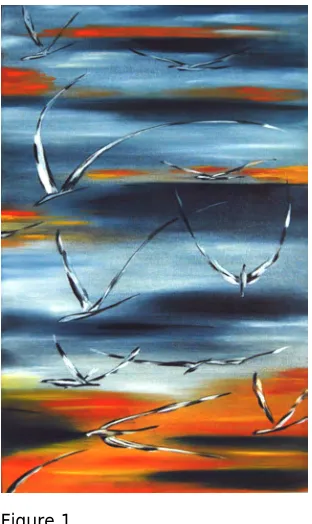
Figure 1
Simon Bourke (1949-)
Principles of Flight – Jonathan Livingston Seagull, 2000 Oil on canvas
84.5x34.5cm.
The other seagulls of the flock only knew the simple facts of the principles of flight. Richard Bach reflects on Jonathan Livingston Seagull’s dilemma in his book:
How much more there is now to living! Instead of our drab slogging forth and back to the fishing boats, there’s a reason to life! We can lift ourselves out of ignorance, we can find ourselves as creatures of excellence and intelligence and skill. We can be free! We can learn to fly! (Bach 2003, p. 17).
I can relate to Richard Bach as a fellow aviator, his love for flight and his homily about self-perfection. Also, Jonathan Livingston Seagull was like the eagle I once knew and befriended, the one who would take my mind to a ‘higher plane of existence’. This idea is reminiscent of an enlightened world found through a perfection of knowledge, in turn leading to a better
5 The secret, Jonathan Livingston Seagull says, ‘is to begin by knowing that you have already arrived…’
Case Study – The Mt Erebus Disaster, Antarctica
The research is informed by a case study (Appendix B), one based on the findings of the 1981 Royal Commission enquiring into the crash on Mount Erebus, Antarctica, of a DC10 aircraft (Flight TE 901) operated by Air New Zealand Limited.
On the 28th day of November 1979 Flight TE 901, carrying out a tourist flight
from New Zealand to Antarctica and back, flew in broad daylight into the lower slopes of Mount Erebus in Antarctica. There were no survivors of the crash and 257 people lost their lives.
Figure 2
Air New Zealand Flight TE 901 Crash Site.
The wreckage made a 600-metre trail across the lower slopes of Mount Erebus.
The Royal Commissioner was The Honourable Peter T. Mahon, Judge of the High Court in Auckland, New Zealand. The findings placed the dominant cause of the disaster as a systemic failure within the aviation company, Air New Zealand. In his report, Mr Justice Mahon stated:
programmed the aircraft to fly directly at Mt Erebus and omitted to tell the aircrew. That mistake is directly attributable, not so much to the persons who made it, but to the incompetent administrative airline procedures, which made this mistake possible (Mahon 1981, p. 157).
The report also took into account the existence of ten factors or circumstances that preceded the disaster.
The tenth factor or circumstance stated that:
(10) The nature of the cloud base in Lewis Bay and the unrelieved whiteness of the snow-covered terrain beneath the overcast combined to produce the whiteout visual illusion (Mahon 1981, p. 158).
In the 1979 event, incorrect co-ordinates (not known to the crew) were programmed into a flight computer, which in turn led the airliner into an environment known as clear air whiteout.
Figure 3
Royal Commissioner Peter T. Mahon at the public hearings of the Royal Commission of Inquiry into the Erebus disaster.
7 …loss of perception is among the main effects of whiteout conditions.
It should also be noted that the cause of this loss is the absence of contrast and texture in a landscape occasioned by the high, diffuse illumination and by high reflection from white surfaces (Vette 1984, p. 259).
The concept of clear air whiteout is discussed in more detail in Chapter 3:1 Art – Interpretation of Light in the Landscape.
For Air New Zealand, ‘It was billed as the flight of a lifetime – a sightseeing tour over the pristine, icy wilderness of Antarctica on an Air New Zealand DC10’ (Lilly 2004).
When the accident happened in 1979 I was living in Hobart, the southern-most capital city of Tasmania. My own aviation profession had just ended due to a medical condition carried over from a flying career in the Royal Australian Air Force. Hobart has always had strong historic and scientific links with Antarctica and I had known about tourist flights conducted by Air New Zealand and Qantas over the previous two years.
This disaster and the events leading up to it have had a significant impact on my current arts practice. In 2005 I created a series of works relating to the final 16 minutes and the crash of Flight TE 901. The image in [Figure 4] Anatomy of an Air Disaster depicts (in a creative way) the aftermath
Figure 4
Simon Bourke (1949-)
Anatomy of an Air Disaster, 2005 Optically generated image, size variable.
A blue sky and the Antarctic landscape is seen though the window openings of the tangled fuselage. It was this landscape which only moments before, aided by a malevolent trick of the Polar light, trapped the crew into believing they were in a different place. The enquiry would establish that the airliner and the crew had different destinations. At the time of the accident it was suggested by investigators that the aircraft must have been flying in cloud at the moment of impact.
9
Figure 5
Photograph taken from right side of the aircraft showing textured cliffs 92 seconds prior to impact: Unknown Passenger Photograph Flight TE 901.
The image [Figure 5] was taken at 2000 feet from the right hand side of the aircraft, 92 seconds and 8.0 nautical miles prior to impact. Sunlight can be seen shining on Cape Bird peninsular. Some cloud shadows are also visible on the Lewis Bay sea ice. The cloud base consists of low-level stratus. It also shows that the pass between Mt Erebus and Mt Bird is free of cloud,
indicating that the main cloud base is above 2500 feet, and possibly just below 2700 feet. It is obvious that a clear outline exists of the textured cliffs of Cape Bird with stratus cutting and forming an artificial horizon across the slopes of Bird. The Cape Bird cliffs were obviously mistaken by the crew for the Cape Bernacchi cliffs on the other side of McMurdo Sound. No doubt this line of demarcation between the base of the cloud and the snow slopes continued around in front of the aircraft toward the other textured cliffs of Cape Tennyson, on their left side shown in [Figure 6].
Figure 6
Photograph taken from left hand side of the aircraft (engine nacelle indicated bottom left) wing showing textured cliffs of Cape Tennyson, 51 seconds prior to impact: Unknown Passenger photograph Flight TE 901.
In general terms this photo shows the textured cliffs of Cape Tennyson, which the crew probably believed was Cape Royds. At this time the aircraft was cruising at 1500 feet and horizontal visibility did not appear to be
reduced, indicating that the aircraft was still below the cloud base. Shadows on the sea ice show the cloud above was of variable density. There are fewer bright patches on the surface of the right of the photo indicating that there was a denser cloud in this area, towards the impact area.
11
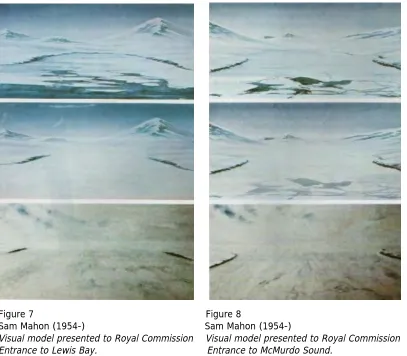
Figure 7 Figure 8
Sam Mahon (1954-) Sam Mahon (1954-)
Visual model presented to Royal Commission Visual model presented to Royal Commission Entrance to Lewis Bay. Entrance to McMurdo Sound.
Back then I asked myself how could this happen; that trained airline pilots and the three other members of the crew had flown an airliner into a
mountain in clear daylight. I was aware of the difficulties of flying in whiteout conditions in Antarctica and other areas where minimal texture and lack of contrast in the landscape creates illusionary experiences. In the early
seventies I had experienced some similar situations in flight simulators when I trained in the Royal Australian Air Force.
In my opinion, pilots and crew experiencing clear air whiteout, as in the case of Flight TE 901, would have entered a state, passing beyond normal
fail. This then extends into a situation where illusion became reality as described in the case study philosophy (Appendix C).
Figure 9
Phil Price (1965-) Momentum, 2009
Air New Zealand Headquarters, Auckland, New Zealand.
On the 23rd October 2009 the sculpture Momentum by Christchurch artist
Phil Price was unveiled at Air New Zealand headquarters in Auckland, New Zealand. The sculpture is a memorial and a focal point for reflection on all the significant events in the national airline’s history.
At the heart of the sculpture is the theme of Momentum, capturing the allure of flight. The sculpture, [the] movement [of which] will be powered by the wind, is an interaction between physical and environmental elements and a reminder of the fragile nature of flight and the dynamics of the forces at play (Ministry for Culture and Heritage, 2009).
13 another perspective, one I had imagined and wished for as a child. The aircraft is the vehicle that allows this to happen. Using the aircraft as an extension to my body, I am able to explore and experience the world, as a bird would see it. The result is a re-manufactured world represented by synthetic vision, discussed further in Chapter 2:3 Synthetic Vision – Believing what we See.
The exegesis is intended to support my project, which is located in the field of practice of video and sound installation practice. My undertaking includes new and subtle differences to perceiving the landscape. There are many artists that have been influenced by viewing the landscape from the air invoking similar states of mind, but none that I know of use my methodology and approach to flying and the ‘flight view’ to achieve this end.
around us. Chapter 6 initiates the development of the project as it places the pilot as artist in the cockpit of the aircraft in an attempt to gain a creative vision of the ‘flight view’ as apart from the normal process of flying a
CHAPTER 1: THE PROJECT
1:1 The Project Outline
World Beyond the Horizon explores ideas of phenomenology relating to light and its effect on shaping perceptions of the contrasting landscapes in Northern Tasmania and Antarctica. The process of investigation is described in the project research plan schematic diagram (Appendix A).
The landscape of Northern Tasmania was surveyed from the cockpit of an aircraft – the ‘flight view’, where sound recordings and video data were
collected as raw material for the project. The intention was to explore ways that I can create an innovative immersive video installation that conveys the sense of personal escape and connection with the landscape while flying. To manipulate and help me explore and with the visual material gathered for my project, I designed and built an Optical Laboratory. From this exercise I have developed a body of work that I consider allows me to bring a moment from my imagination into the real world thus forming the context of the installation – the artwork confirming the research.
project investigates how the viewer interprets variation of contrast and texture caused by atmospheric conditions that change the way light falls on a
landscape. I have investigated the science of phenomena in the context of that which impresses itself upon the observer as being extraordinary – a remarkable event, thing or a particular happening. At the same time, I have considered the term ‘mental set’ as applicable to human perceptual experience – by gaining knowledge through the senses. Wayne Weiten, psychologist and author of the book Psychology, Themes and Variations, summarised the term: ‘a mental set exists when humans persist in problem-solving strategies that have worked in the past’ (Weiten 2004, p. 316). This is a familiar theme in psychology.
The project proceeded on the basis that the action of perception through all the senses, in particular visual and aural, is a highly synthetic process and is
sometimes erroneous as described in the project philosophy diagram (Appendix D). The result of perception can sometimes be far removed from an exact image of the physical world.
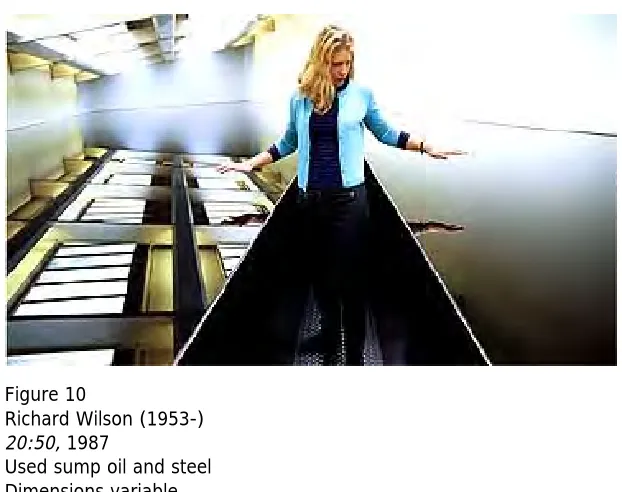
Figure 10
Richard Wilson (1953-) 20:50, 1987
Used sump oil and steel Dimensions variable
British artist, Richard Wilson, demonstrates this in his installation work 20:50, 1987, [Figure 10] at the Saatchi Gallery, London, where he attempts to
disorientate the viewer’s senses. A layer of 2500 gallons of used black sump oil gives an illusion of great depth, and also of emptiness falling away beneath one’s feet. Edging gingerly along the walkway leading into the work there is a feeling as if you are stepping into a void. The strong odour of the oil tends to bring one back to reality and reconstructs the complexity of a ‘normal’
Figure 11
Rescue team approaching the Mt Erebus Crash Site.
‘This is the first photo I took of the crash site as we were approaching the scene for the first time’. Photograph: Stuart Leighton, 1979.
Yet, there was nothing ‘normal’ about the Erebus disaster, and nothing could have prepared young New Zealand police officer, Stuart Leighton, for the tragic scene he experienced on the slopes of Mt Erebus when he arrived as part of a team of eleven Kiwi police personnel involved in the recovery of bodies from the wreckage of Flight TE 901.
My senses were overloaded. There was the sight of bodies and the wreckage of an Air New Zealand plane. This was accompanied by an overpowering smell of kerosene. I just need to get a whiff of it now and I’m instantly back on the mountain side (Leighton 2009).
In this instance, Stuart Leighton’s senses were pushed beyond ‘normal’ sensorial experience – any faint smell of kerosene (aviation turbine fuel) continues to unlock that memory from 30 years previously.
expression through the creative processes of painting, photography and new media. The place where I spent my childhood and my adolescence is where my body formed an understanding for these things, even before I gave them a second thought – they became part of my mental and psychological sets – my past shaping the present.
I have examined links between cognitive science, psychology, human
physiology, phenomenology, climatology and art in exploring the idea of the ‘flight view’. It is a particular place with its own physical constraints and perceptual opportunities, which together condition the observer; it is this construct which has been a driving force within this project. Deliberation has been given as to how phenomenology plays a part when investigating earth-sky relationships associated with the ‘flight view’ and applying it to my creative process. I have questioned ‘what is the creative process’ and considered the philosophy relating to aesthetics in art. ‘There are two fundamental issues in aesthetics – the essential nature of art, and its social importance (or lack of it)’ (Graham 2005, p. 3). The 18th century German philosopher, Immanuel Kant initiated dramatic changes in the field of aesthetics. ‘In the Kantian aesthetic all the emphasis on the mental state of the observer whose imagination may as freely play on nature as on art’ (Graham 2005, p. 29).
I have considered Maurice Merleau-Ponty’s perception of the French artist and Post-Impressionist painter Paul Cezanne (1839-1906). Merleau-Ponty discussed Cezanne’s struggle to deal with the complexity of human visual perception. ‘self-questioning and his struggle to exist as an artist’ (Merleau-Ponty in Johnson 1993, p. 5). His desire was to realise sensation reflected in art by releasing meaning from objects rather than creating stylisations of imposed effect.
he saw them that demanded to be painted, and Cezanne simply expressed what they wanted to say (Merleau-Ponty 1993, p. 71).
For me, Merleau-Ponty’s view is confirmed as I look beyond images and sounds of the realistic landscapes I have captured on film and video. These experiences have served as an entry point to the process of exploring the limits of my
perception. I have created imagery relating to environmental systems that are in concert with my own sensory experience and mental sets, in particular, those of a pilot and the ‘flight view’. Sometimes, the inspiration comes directly from that landscape as my mind explores this particular world, extending the experience. It is my belief that no position or aesthetic, or indeed how one works as an artist, should affect this creative process – it is just a matter of trying to move closer, through a process I have developed of physical representation, to what is in my head.
Holmes Rolston III (1932-) is Professor of Philosophy at Colorado State University. He is best known for his contributions to environmental ethics, science and religion. Rolston’s philosophy questions whether the aesthetic appreciations of landscapes need to be science-based?
He goes on to say:
Aesthetics – this argument continues – is nothing that science can discover on landscapes objectively, independently of persons. Aesthetic experience of landscapes is not some pre-existing characteristic of the landscape that is found, but one that emerges when persons react to landscapes. Landscape is land-scope, land taken into human scope (Rolston 1995, p. 375).
As an artist I strive towards a greater synthesis as I search for the integration and creative unity of things in the world around me. In the early 1900’s, Walter Gropius had a synthetic vision for utopian architecture. He was a lateral thinker who could operate with ease in both the academic and the practical worlds. For Gropius, ‘…synthetic vision was a rare gift in an analytical age of specialization’ (Herbert 1955, p. 1).
Since the early nineties, it has been the aspiration of NASA researchers to give pilots a perfect vision of their surroundings – regardless of weather conditions. In aviation ‘…synthetic vision is a virtual reality display that uses vast
topographical, navigational and meteorological databanks to generate an accurate picture of your surroundings in any condition’ (Flight Safety Australia 2006, p. 54).
With a background in painting and photography, my project has been built upon the creative platform of new media to explore the idea of synthetic processes. This is represented with other synthetic process, one called synthetic vision, which asks what philosophers of art and perception see as reality and illusion. The project is an analysis of the world around me supported by my sensorial perception, in turn controlled by ‘mental sets’. The analysis resulted in a re-manufactured world represented by synthetic vision.
the brain’s reference to life experiences or instruction – what I refer to in this exegesis as a ‘mental set’.
I explore the landscape looking for creative inspiration and moments in time where my mind is encapsulated in the world around me. Sometimes the creative inspiration is there in front of me, as I view it through the lens of a camera or hear it through headphones. This is generally a raw and pure creative
experience and I endeavour to work with it. Sometimes this process is not so fluid. In this case, I have manufactured the experience with the use of models, constructs, optics and manipulated light to convey the feeling and meaning of the idea. I have also designed and constructed a machine named the ‘Optical Laboratory’ partly for this purpose. The Optical Laboratory simulates images from nature. The images created are ephemeral in nature and are transmitted by means of projected light, diffused by glass media, conveying a sense of illusion. The idea is based on nature and the orientation of phenomenology as it applies to clear air whiteout as experienced by the crew of Flight TE 901 in the Mt Erebus disaster.
Throughout the project I have developed a greater understanding of theories relating to my research. It is not about overturning existing relative theories, but rather to subsume them into a more comprehensive way of working applicable to my experience. When Albert Einstein reflected on his time at the Swiss Polytechnic in Zurich, where he studied from 1896 to 1900, he found it “hard to resist the feeling that the soaring, solitary splendour of the Alpine peaks must have influenced his scientific theorizing” (Robinson 2005, p. 38). Later, while living in America, he wrote:
forms a tiny part of our broad view gained by the mastery of the obstacles on our adventurous way up (Robinson 2005, p. 38).
Part of my research has been to investigate and analyse the psychology and philosophy behind this experience. I have approached the project using an analytical philosophy in which a process has evolved, going through a cyclical progression between reality and illusion as shown in the project philosophy diagram (Appendix D). Throughout the installation I have endeavoured to retrieve reality in the presence of an illusory experience and vice versa. This process retrieves ‘mental sets’, elements of past experiences that assist in reconstructing the complexity of the ‘normal’ experience that of a person experiencing an illusion or reality.
1:2 The Project Aims
The aims of the project are to:
• use the Mt Erebus Disaster in Antarctica 1979, involving Air New Zealand Flight TE 901 as a case study in tourist landscape photography from the air and the process of perception (Appendix B);
• study the phenomenon of clear air whiteout experienced in non-familiar landscapes through the eyes of the aircrew (pilots, engineers, observers and cabin crew) and the multi-national contingent of passengers on Flight TE 901, as found in evidence produced by the Royal Commission into the Erebus Disaster;
• develop an understanding of virtual reality practices involving creative synthetic vision projects with human interface technology; and
• present the findings through new media techniques by using synthetic vision and sound processing artwork supported by a written exegesis at a vision-space facility located at the Academy of the Arts, University of Tasmania.
1:3 The Research Questions
The research investigates the following questions:
• in what way can I create an immersive video installation that conveys the sense of personal escape and connection with the landscape that is experienced when flying?
• in what way can I present this so that it is an immersive, experiential work?
As part of the background to the research questions the following enquiry has been carried out:
• is there a difference between reality and illusion in terms of phenomenology (refer Appendix D)?
• can one person’s reality be another person’s illusion?
• could these creative media be used in collaboration with individuals from other disciplines to produce a body of research into synthetic perception? and
• do illusions (e.g., clear air whiteout) experienced in the landscape and those sometimes attributed to cultural mythology (the mythology of Erebus) form a basis for scientific reality relating to landscapes and demonstrated by synthetic perception?
1:4 The Project Locations
Firstly, I have selected the landscape of Northern Tasmania, Australia, for my investigation. For me, this is a very personal landscape, in particular the Mersey Valley and North West coastal areas and farmland. It was the place where I spent my early years (1949-1968). I also have explored the Northern Midlands where I now live (1985-2010).
Lucy Lippard, an internationally known writer in the USA, discusses ‘being
in place’. She claims:
The sense of place, as the phrase suggests, does indeed emerge from the senses. The land, and even the spirit of the place, can be kinetically, or kinesthetically, as well as visually experienced. If one has been raised in a place, its textures and sensations, its smells and sounds, are recalled as they felt to a child’s, adolescent’s, adult body. Even if one’s history there is short, a place can still be felt as an extension of the body, especially the walking body, passing through and becoming part of the landscape (Lippard 1997, p. 34).
Where one spends one’s formative years is a place where the body develops a special ‘resonance’ with the land itself; it exists before you even give it a
Professor Edward Casey (1939-) specialises in phenomenology, philosophical psychology, aesthetics, and the theory of psychoanalysis. Recent research includes investigations into place and space; landscape painting and maps as modes of representation; ethics and the other; feeling and emotion; philosophy of perception (with special attention to the role of the glance); the nature of edges. In his book, Sense of Place, ‘John Constable said, “we see nothing until we truly understand it.” Constable’s words apply above all to the landscape as experienced and sensed’ (Casey 2002, p. 274). I remember the weather and the light at our farm, Barega, the place where I grew up, and the place where I now live in the Northern Midlands of Tasmania. ‘Landscapes are, in the final analysis, placescapes; they are congeries of places in the fullest experimental and
represented sense’ (Casey 2002, p. 271). This sense of place, developed over time, has become an intrinsic part of my research.
The crew of Air New Zealand Flight TE 901 experienced a landscape in another place. Flight crews based in Antarctica (in particular residents of the United States), always undergo an intensive familiarisation program on their first visit and also for subsequent visits. German philosopher and deemed founder of phenomenology Edmund Husserl (1859-1938) believed that experience is the source of all knowledge. Casey refers to Husserl’s belief as follows, ‘…because of its deep-seated ambiguity, we need to scrutinize landscape continually – again and again, as Husserl would put it, until the “thing itself” is finally grasped’ (Casey 2002, p. 274). Therefore the phenomenon of clear air whiteout becomes part of the landscape culture, a ‘normal’ event in nature for flight crew working in this region.
1:5 The Rationale
sometimes erroneous, and together present a far from exact image of the physical world, as happened in the Mt Erebus Disaster. Consideration has been given to phenomenology involving the earth-sky relationship and the space seen between an object and the viewer. These relationships have included loss of visual reference to the horizon and its subsequent effects on human physiology, for example, as one begins to imagine the landscape in the mind as an
anticipated image or sound set, a pre-conceived and perhaps false notion of place develops. The incorporation of sound into the project has allowed the construction of an aurally immersive space through which perception, spatialisation, and abstraction experienced by the viewer.
1:6 Methodology and Processes
My ideas and creative process are informed by the theory and practice of other artists, scientists and philosophers. The use of an aircraft to source material for the project, together with recently acquired expertise in film, video and sound (since 2007) have added to the creative skill base. In 2004, I created the Optical Laboratory, a machine that uses basic principles of the physics of light moving through different media to simulate illusory images similar to those which may reveal themselves in a familiar environment seen under unfamiliar light.
could gain a better understanding of the landscape. The work of American artist, James Turrell is primarily concerned with light and space. At the age of 16 he obtained a pilot’s licence. He received a BA degree in perceptual
psychology in 1965, including the study of Ganzfeld effect (from German for “complete field”) a phenomenon of visual perception caused by staring at an undifferentiated and uniform field of colour (as experienced when flying in white out conditions). The effect is described as the loss of vision as the brain cuts off the unchanging signal from the eyes. Photographer Richard Woldenorf uses the aircraft to gain a view from above, and a flight of discovery unfolds as
landscapes tell us something about their natural history and reveal their
evolution. The idea of reflection, as conveyed in the paintings of American artist, Richard Estes, becomes evident in the night scenes of my work as light from instruments and outside sources are bounced off Plexiglass surfaces of the aircraft. Landscape and culture referenced by artists Patrick Grieve and Ben Nicholson have been an important part of this investigation. And finally, I reviewed some of my earlier works that I consider important in establishing the ‘mental sets’ applicable to this research.
Three artists in particular have influenced the technical and creative processes used in this project. They are Bill Viola, Chris Welsby and Issac Julien. In some cases their work uses multiple channel large screen projections similar to that used in my project, World Beyond the Horizon. Viola is a American
contemporary video and sound artist. He is considered a leading figure in the generation of artists whose artistic expression depends upon electronic, sound, and image technology, the area in which I wish to locate my own work.
image, landscape and the natural world. He has developed special camera systems, which rely on wind speed or tidal action to create sometimes jarring or mysterious film and video installations. These projects often explore the
inherent framing and distancing that occurs as we contemplate the world
around us. His work was an important adjunct in the development of the Optical Laboratory. Isaac Julien is also a British installation artist and filmmaker. One of the objectives of Julien's work, of interest to me, is his capacity to break down barriers that exist between different artistic disciplines, drawing from and commenting on film, dance, photography, music, theatre, painting and
sculpture, and uniting these to construct a powerfully visual narrative on a multi screen format. These artists work is discussed in more detail in Chapter 7:2 Experimental Film and Video.
In relation to the sound component of my project, I investigated the works of musicians and composers such as Arnold Schoenberg, Iannis Xenakis, John Cage, George Crumb and Karlheinz Stockhausen. The aural experience consists of the drone of the aircraft (two engines, the sound pulsating due to beat frequencies) together with other audio inputs as a sensory background to the visual experience.
1) I studied passenger photographs, flight data and flight deck voice recordings retrieved from the Mt Erebus crash site to demonstrate how global tourists and amateur photographers respond to the illusions they experience in the landscape.
3) I created a visual and sound platform of still and projected moving imagery, resulting in an optical and aural illusion simulating these experiences in the landscape.
1.7 The Visual Experience – Photography and three planes of movement
As I analysed photography (both still and video) collected within the project site, I considered visual experiences in a time/space (moving image) environment. These experiences relate to certain stages and procedures of flight and are related to the attitude of the aircraft based on three axes – lateral, vertical and horizontal, the three planes of movement represented by pitch, yaw and roll. These experiences are located within and around the aircraft while moving through space and time. They also influence the perception of the landscape from within the aircraft.
Figure 12
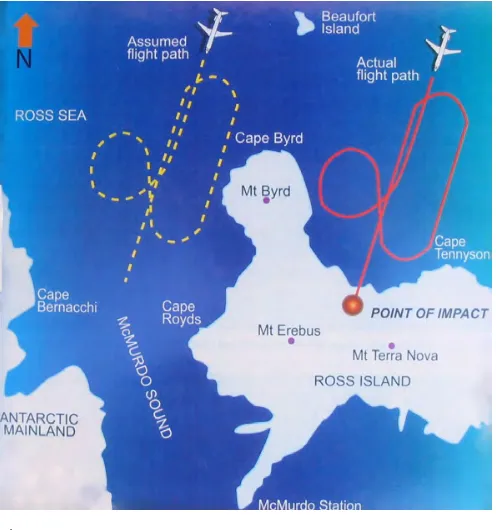
The Last 16 minutes. Flight Path of Flight TE 901
The flight pattern shows the aircraft going through various attitudinal changes. Throughout this period, passengers and crew experienced individual perceptions of the landscape from different locations within the aircraft. Individuals from their own vantage points would have formed different perceptions. Illusions would have been experienced subconsciously. At the same time, sound also supported the senses relating to various configurations of the flight.
The correlation between sound and vision was later revealed when flight data was evaluated from the two black box recorders and from passenger
photography retrieved from the crash site. The three planes of flight (pitch, yaw and roll) [Figure 25] have been used, in the context of Flight TE 901, to
1.8 The Sound Experience – the Drone as a Sensory Background Throughout the process five aspects of sound have been considered. I have simulated pitch, yaw and roll within the context of flight, and structured memory relationships in relation to one another as they relate to sound. The drone of the aircraft is an anchor to the installation, as it continuously reminds the viewer of the presence of a functioning machine moving through time and space. Richard Whol has made a similar comment in his book, The Spectacle of Flight. ‘We should not forget the importance of the sound of the aircraft as a sensory background for the story I tell’ (Whol 2005, p. 6).
Sounds produced in the landscape:
• wind
• heating and cooling of objects
• mechanical sounds
• animals and humans
• rain
• sounds produced while sitting in a static aircraft on the ground.
Mechanical sounds produced in flight:
• engine sounds – synchronous and variable engine speeds
• aural beating (caused by the sound of two propellers moving in and out of synch)
• propeller sounds
• hydraulic, pneumatic and electromechanical systems – undercarriage servo-mechanisms – controlling surfaces, flaps, slots, slats,– elevators and ailerons.
Other sounds produced in flight:
clear air, in moisture, under conditions of cool and warm air, and in turbulent air.
Sounds transmitted from other locations:
• radio transmissions, voice to voice, recorded voice, Morse code signals, Nav/Com signals, and audible alarms.
1:9 The Aircraft (Cessna 337 VH-VMO)
Part of an individual’s ‘mental set’ is established through a process of association. In this case, it is a relationship primarily related to vision and sound, and secondarily to feel and smell. Taste is a small part of it.
In the summer of 2005, while holidaying at St Helens on the East Coast of Tasmania, I heard a familiar sound, one I had remembered from a previous career as a pilot thirty years earlier. The sound I was hearing was part of my mental set. As it become louder, a Cessna 337 aircraft [Figure 13] appeared overhead on its approach to the local airfield. In the seventies, I flew this type of machine.
Figure 13
Cessna 337 VH-VMO at Devonport Airfield. This aircraft was used for the project. Digital Photograph: Simon Bourke, 2006.
I hurriedly drove to the airfield where the aircraft had just landed. There I made myself known to the pilot who soon became interested in my past history in aviation, and in this project. He offered to show me over the aircraft. The wind had swung around to an afternoon sea breeze from the east at about five to seven knots, causing a gentle rocking of the wings as we walked out to the machine. I heard sounds of the breeze over the aircraft surfaces and the
familiar creaking of the Plexiglass windows. Gyros driving the flight instruments were still winding down. Sounds of expanding and contracting metals were heard from under the cowlings as the engines cooled. The 337 had just returned from a flight out into the Tasman Sea for the purpose of
into the Western sky. Shortly after, the familiar thrashing sound of the 337 could not be heard any more.
Figure 14
Kazimir Malevich (1878-1935)
(Suprematist Painting), Aeroplane Flying, 1912 Oil on Canvas.
Collection of the Museum of Modern Art, New York.
The sight of the aircraft rising up and turning as it climbed through the horizon line took me back to my undergraduate years (2001-2003) at art school. It was there I learnt about the Russian Suprematists and their association with flight.
rectangles, rises up from earth, its black elements increase in size as it
approaches the viewer. ‘In these new works Malevich often positions the viewer in the air; here we see the moving plane from above, and as if in stop-time motion’ (Douglas 1994, p. 84). Malevich’s painting had all the elements of the ‘flight view” as I know it. ‘The red horizontal element establishes a reference point, a tipped horizon line, that the plane crosses as it climbs. Malevich
succeeds in creating a sensation of lift and flight without any mimetic illustration of the airplane – a method he called “objectless”’ (Douglas 1994, p. 84). Many of my past experiences in flight stand behind these first Suprematist paintings.
Two days later I left St Helens to return to my home at Devon Hills in the Northern Midlands. The experience of the 337 still haunted me as I revisited memories of the time when I was a pilot. There was a feeling that I had been re-united with an old friend, and one that would partner me on this project. The aircraft I saw at St Helens was, to me, full of ghosts, and memories of flight from the past. Here was an opportunity for my project.
CHAPTER 2: FLIGHT INTO THE WHITE ABYSS
In this chapter I will deal with associations between what is seen and what is believed and their relationship to the flight view experience. I will consider how belief systems and mechanisms may effect how one interprets the landscape by artificial means when all visual reference is lost.
2:1 Human Belief Systems and Mechanisms
I vividly recall the experiences of flight when I first went solo in 1971. Take-off always has it critical moments. The instruments on the flight deck confirm
operational status of the aircraft, while I focus on achieving the critical speed for lift. In the process of mechanically aided flight, the airborne machine goes
through a series of performance sequences until the ultimate sequence is achieved, that of flight. These sequences require a creative objective unity known as interfacing. The process of interfacing machine systems, those of the body, the aircraft and the environment, results in an objective understanding and relationship to human input. Systems can also be considered as an ordered and comprehensive assemblage of facts, principles and doctrines relating to a particular field of knowledge or thought that can be referred to as a system of philosophy. As a child growing up at Barega, I became aware of machine interfacing and associated systems.
Henry George ‘Harry’ Ferguson (1884-1960) was an Irish engineer and inventor noted for his role in the development of the modern agricultural tractor.
Figure 15
The Ferguson System Logo.
This arrangement allowed the weight of the implement (the plough) to be transferred to the rear wheels, increasing traction and allowing the implement (the plough) and the tractor to act in unity. The Ferguson System was not covered by a single patent, but by many that date from 1917 to 1939. The main patent (12.09.17 Patent No.119883) related to Ferguson’s initial idea of the ‘arrangement for direct hitching and controlling the plough, including the first top link’ (The Friends of Ferguson Heritage Ltd 1994). As a result of this device, the load transfer allowed a lightweight tractor to do the work of heavier
tractors. Further developments to the Ferguson System, such as draft control, improved weight transfer and power increased the amount of work the little tractor could do.
Later in life I saw how aircraft systems would also act in unity as a complex machine, one that went through a series of performance sequences until the ultimate sequence, that of flight, was achieved. This unity was later experienced in my creative life – in the role of pilot as artist. Apart from systems in
Such belief systems also played a significant part in the tragic story of Flight TE 901. The passengers had faith in the management of the flight, and in effect placed their own lives on the line. The crew believed in the procedure of the flight as it had been charted, tried and tested before. They believed that the systems put in place would maintain an ordered normal eleven-hour flight. The subsequent investigation and Royal Commission into the Erebus Disaster revealed that all machine systems within the aircraft performed within their required parameters. It was the boundaries of these systems that were
penetrated (in this case, by a systemic failure within the organisation, Air New Zealand) causing unity and order to revert to chaos.
…[as the result of] a navigational error for which the aircrew was not responsible, and about which they were uninformed, an aircraft had flown not into McMurdo Sound but into Lewis Bay, and there the elements of nature had so combined, at a total coincidence of time and place, to translate an administrative blunder in Auckland into an awesome disaster in Antarctica (Mahon 1984, p. 295).
Air New Zealand’s logo ‘Nobody does it better’ had become a sin of hubris, an ancient Greek idea. It was a sin of pride and arrogance that had resulted in fatal retribution and nemesis, one that had involved the failure of a belief system within a company, which in turn had caused a failure between the interface of human, machine and environment.
Even though the final blame was placed with the company, the aviation world was now obliged to examine the interface between flight crews, their machines and the environments they experienced. Perceptual psychology would now play an important part of aviation future.
The interface between the crew, the aircraft and the minimalist Antarctic
aircraft flight computers. Mathematician and computer scientist, Roderic Beaulieu, refers to these computers as ‘thinking machines’ (Beaulieu in Deitz 1991, p. 157). The human errors causing this disaster would have been over-ridden and corrected by the machine. At the same time, pilots frequently express concern that some new technology is taking away the feel of the machine. Beaulieu has also examined the aviation industry’s reliance upon computers and the effect on pilots of new glass cockpit systems and fly by wire technology. He goes on to say: ‘Control systems should preserve the feel of the plane. This has to do with the design of the “human interface” – the systems pilots will use to control the individual aircraft’ (Beaulieu in Deitz 1991, p. 164).
Most of us are secure and protected by what we believe; yet to believe does not necessarily require understanding. That is why most of us fly as part of
everyday life with the knowledge that others have done it successfully before. This idea can extend to the use of machines and their systems interfacing with each other to perform certain functions; simple systems working alongside more complicated ones. As the aircraft gains altitude after take-off, the pilot normally has a visual reference to reality. He sees the landscape below, the natural and the built environments all set out on a geometric grid: the mind is building a reference system. The pilot assimilates what is seen in the visual landscape to what is indicated on the flight instruments. Considering this linkage between the pilot, his instruments and machine and the landscape, I have applied a
hypothesis similar to the utilitarian philosophies of Jeremy Bentham (1748 – 1832). ‘Bentham’s philosophies related primarily to model prison systems. He developed a system of isolation and total surveillance’ (Bozovic 1995, p. 29). Over time other institutions such as schools, hospitals and even modern-day call centres came to utilise this concept.
was Bentham’s idea to ‘… convert the concrete specificity of a particular place into the “generalized function” of being a site’ (Casey 1998, p. 186). Bentham also refers ‘…to the [fact that] “central-inspection principle” and the
panopticon’s “imagery intensity” would be hard to resist in the Eurocentric culture during the seventeenth and eighteenth centuries’ (Casey 1998, p. 186). I have applied Bentham’s idea to the cockpit of an aircraft; a space within a machine – a control centre. The instruments become the eyes of the aircraft, an airborne panoptic carrying out surveillance of machine systems that are located within its structure away from the pilot’s view. At the same time the instruments are monitoring the landscape as we fly over it, in particular in bad weather and in darkness.
The aircraft has its own referencing system, an airborne panoptic comprising of instrumentation that relays the current state of systems within the machine to a central point. The instrumentation also relays information about the aircraft’s relationship to the landscape at any particular time. The information received is intermingled with the pilot’s own sensory referencing. It is a process in which there is a melding of objective reality with non-objective reality. Reference to the objective landscape may be partly lost as the aircraft climbs through partial cloud cover. As visual reference is lost, there is a greater reliance on the aircraft instrumentation system as the pilot’s mind and body become encapsulated within the machine. This reliance becomes a belief system. The pilot has to rely on machine systems, visual and audio references to instruments and signals so that stable flight criteria can be maintained. Due to an understanding and knowledge of these technological systems the pilot believes the required parameters of flight will be achieved in an ordered manner and the final destination will be reached.
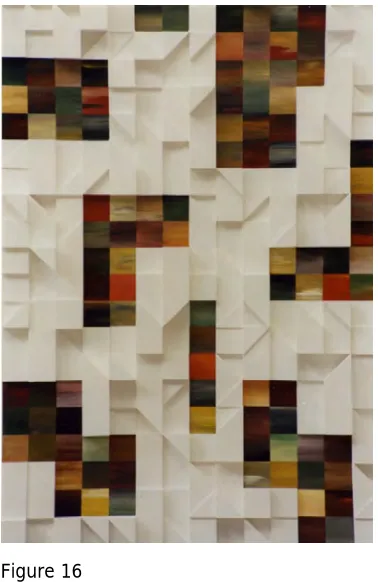
from the objective to the non-objective (subjective) landscape. This is represented in [figure 16].
Figure 16
Simon Bourke (1949-)
On Climb – Passing through 5000 feet, 2002 Wood blocks and acrylic paint.
This work relates to the body, the machine and the environment and the interplay between all three, alluding to flight above broken cloud with
momentary reference to the objective landscape below. The angled 45-degree blocks allude to climbing and descending flight together with emphasising the volumetric shape of clouds compared to the flatness of the landscape as viewed from the ‘flight view’.
(minimal colour and texture) landscape as viewed from an aircraft in flight, particularly as altitude is gained.
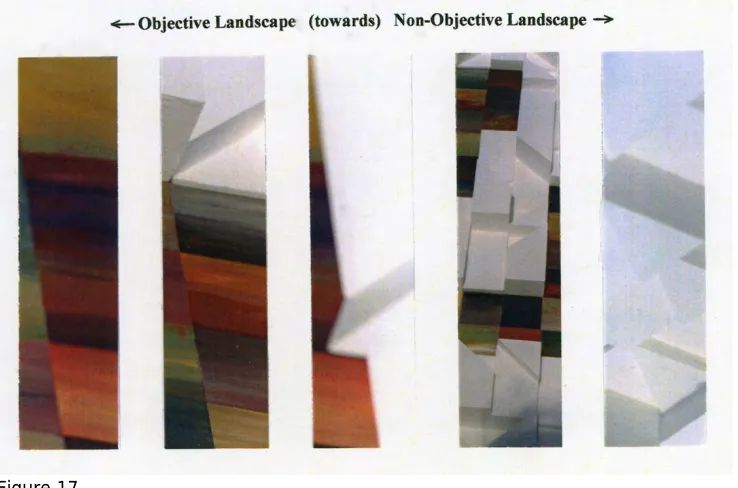
Figure 17
Photographic Analysis
On Climb – Passing through 5000 feet, 2002. Photograph: Simon Bourke 2005.
This idea has been created by the use of another machine, a camera, to
abstract to a greater degree what I believe is already an abstract form of art. An analysis has been made demonstrating a loss of texture in a landscape, similar to that experienced by a pilot flying in cloud or over a minimalist landscape. The loss of form and texture in my art can also be compared with that experienced in Polar regions, in particular the case of Flight TE 901. Sharpness of the
geometric form in the artwork is meant to stimulate one’s thoughts and to aid in the perception of the landscape as one generated by the subjective mind rather than one of reality.
2:2 Human Psychological and Mental Sets
airline. In Australia, Qantas had been carrying out similar charter flights for two years, without incident. There was, in effect, a mental set confirming that the flight would be no different from any other previously conducted by Air New Zealand.
At a personal level, reflecting on the time when I was eleven years old, my first memory relating to flight goes back to the experience with the family of eagles on our farm. That experience was to be my first mental set relating to flight.
A mental set is the brain’s method of establishing a code or shorthand for performance and behaviour under predictable circumstances. Ross Day, then Professor of Psychology at Monash University, Australia, and an expert witness at the Royal Commission into the Mount Erebus disaster, reinforced the
following concept. The brain can be described as a library, a memory storage for earlier life experiences that in turn shape our perception. Mental sets are established all through life and are used to form automatic responses to diverse stimuli. The strength of a set and its resistance to be unlocked is determined by the authority behind the set, and the frequency of repetition and, at times, the number of people sharing the set. Day goes on to say:
A typical primary mental set for a pilot operating a commercial airliner would possibly include:
• childhood experiences
• pre-tertiary and tertiary education
• air force or general aviation training
• aviation science
• navigation, engineering, meteorological and commercial aviation training, and
• crew-loop and simulator training
Specific mental sets attributed to Flight TE 901 were subject to:
• passenger route maps
• Air New Zealand flight magazines
• previous crew discussions
• radio talk-back shows about experiences on past Antarctic flights
• the Antarctic flight plan lodged in the aircraft computer
• visual flight rules applied to the flight
• crew-loop
• map preparation
• the absence of an ‘operations flash’ notification confirming initial flight plan parameters
• all three navigation computers agreeing with input data
• way points for the flight checked, and an
• ‘all OK’ notification and the transponder coding, ‘confirmed’
principle of crew loop would apply i.e. on facing a given situation a crew
member would react according to prior experience. The crew-member would at the same time refer any action taken to his colleagues, who similarly would rely on a common and pooled knowledge base. If it is to be flown safely, the
[image:54.612.113.300.323.588.2]modern jetliner relies not only on the competence of its captain, but a linkage of the minds of other crew present. Airlines sometimes apply the mechanical term ‘fail safe’ to the fully coordinated crew. I believe that British narrative – realist painter Laura Knight (1877-1970) captured that moment where crew loop is critical at the time of take-off in her painting Take Off, 1944 [Figure 18]. At the same time, Night’s painting reveals the cramped quarters endured by the eight-man crew of a British Stirling bomber.
Figure 18
Laura Knight (1877-1970) Take Off, 1944
Captain Gordon Vette, who sat on the Royal Commission, explains the term ‘fail safe’ as a manifestation of the psychological bonding that exists on the flight deck. ‘But aircrew have a more succinct name – they call it ‘the loop’’
(Vette 1984, p. 90).
2:3 Synthetic Vision – Believing what we See
It has been mentioned earlier that perception is a highly synthetic process, and what one may see is far from an exact image of the physical world. Seeing is a process that is sometimes highly erroneous. This is why the term ‘fail safe’ applies to the crew of an aircraft.
It is an accepted medical thesis that the human body’s actions are approximately 80% controlled by sight, always functioning through a
combination of the eyes and the brain. ‘It is to be noted that in man about 80% of responses are visually determined and guided’ (Day in Vette 1984, p. 238). With the human eye ‘believing is seeing’. With the camera ‘seeing is believing’. We are constantly receiving visual input, as we experience an ever-changing picture of the world. The brain processes this information according to an individual’s mental set.
Light falls on [the] eye, but you see with your brain. Although the retina does an unusual amount of information processing for a sensory organ, visual input is meaningless until it is processed by the brain (Weiten 2004, p. 134).
…light must pass through the network of the nerve fibers and cells in the retina before striking the receptors; thus, in a sense, the retina is backwards with respect to light entering the eye (Schlesinger and Groves 1976, p. 158).
How do we repair this image and restore it to its original values? This involves a process in the higher levels of the brain that takes into account an expectation of what an object really is. ‘People make educated guesses about what form could be responsible for a pattern of sensory stimulation’ (Weiten 2004, p. 145). These educated guesses are based on past experience and ‘mental sets’.
From the ‘flight view’, a square field is perceived as a changing trapezoid as the aircraft gains or loses altitude and alters its attitude in relation to the centre of the earth. ‘In visual perception the proximal stimuli are distorted,
two-dimensional versions of their actual, three-two-dimensional counterparts’ (Weiten 2004, p. 145). This is demonstrated in [Figure 19].
Figure 19
Distal and proximal stimuli are often distorted, shifting representations of distal stimuli in the real world.
Cubist painter Juan Gris (1887-1927) demonstrated a similar idea when he rotated the planar field through ninety degrees to achieve a sense of three dimensionality, interrupting the revolution at certain angles to arrest points as seen in The Wash Basin 1912 [Figure 20] and The Bottle of Banyuls 1914 [Figure 21].
Figure 20 Figure 21
Juan Gris (1887-1927) Juan Gris (1887-1927) The Wash Basin, 1912 The Bottle of Banyuls, 1914
Oil on canvas Pasted papers, oil, charcoal, and gouache, and pencil on canvas
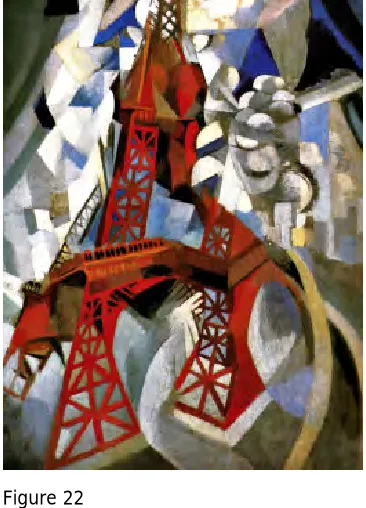
Figure 22
Robert Delaunay (1885-1941) Red Eiffel Tower, 1911 Oil on canvas
‘This new approach is evident not only in Delaunay’s Windows, Disks and Circular Forms but even in his compositions with figures, such as The Cardiff Team and Homage to Bleriot’ (Habasque 1959, p. 144). Contained within all of these works are elements of the new age of aviation introducing a different perception of the world.
Figure 23 Figure 24
Northdown Homestead and paddocks at Northdown Homestead and paddocks at 2000 800 feet 040 degrees and level, climbing. feet, 110 degrees and 30 degree bank to the Digital still: Simon Bourke, 2006. the right and climbing.
Digital still: Simon Bourke, 2006.
At a different level of the brain, incoming information is decoded and interpreted as a meaningful representation of external events. Interpretation involves those higher mental processes collectively called cognition, and in particular involves memory and mental sets.
British psychologist and physiologist Susan Blackmore refers to this as our ‘stream of vision’. Blackmore says that we may go on to develop a theory about what is going on:
One might say as we look around the world, unconscious processes in the brain build up a more and more detailed representation of what is out there. Each glance provides a bit more information to add to the picture. This rich mental representation is what we see at any time. As long as we are looking around there is a continuous stream of such pictures. This is our visual experience (Blackmore in Noe 2002, pp. 19-20).
2.4 Losing the Horizon – True and Artificial
I have mentioned previously that in flight the aircraft has three main types of movement: pitch, yaw and roll [Figure 25]. Think of the three axes fixed relative to the aircraft. The longitudinal axis runs fore and aft through the centre of gravity. The lateral axis runs parallel with a line from wing tip to wing tip and passes through the centre of gravity. The vertical axis runs through the centre of gravity at right angles to the other two axes.
Part of the investigation has been to replicate pitch, yaw and roll, visually and aurally, in the context of artistic expression. I considered the last 16 minutes of Flight TE 901, including its track and descent from 26,000 feet to the impact point on Mt Erebus at 1,500 feet. The flight pattern shows the aircraft going through various attitudes of flight and the three planes of movement.
The attitude of an aircraft is generally determined by reference to the natural horizon or other visual references to the surface of the Earth. If the natural horizon or other surface references do not exist, the attitude of the aircraft must be determined by artificial means from the flight instruments. Sight supported by other senses allows the pilot to maintain orientation. However, during periods of low visibility the supporting senses sometimes conflict with what is seen. When this happens, a pilot is particularly vulnerable to disorientation. The degree of disorientation may vary considerably with individual pilots. The
Federal Aviation Administration Branch of the US Department of Transportation has reported ‘…that during a five-year period, almost five hundred spatial
disorientation accidents occurred in the United States. Tragically, such accidents resulted in fatalities in over ninety percent of the time’ (Federal Aviation
Figure 25
Principles of Flight – The Three Axes
Spatial disorientation to a pilot means the inability to tell which way is ‘up’, sometimes even the ability to tell what is straight ahead. On the ground, a similar phenomenon is experienced driving in heavy fog: there is a tendency to steer to one side simply to maintain a straight course. In flight, surface
horizon or surface reference is common on over water flights, at night, and especially at night in extremely sparsely populated areas, or in low visibility conditions. A sloping cloud formation, an obstructed horizon, a dark scene spread with ground lights and stars, and certain geometric patterns of ground lights can provide inaccurate visual information for aligning the aircraft correctly with the actual horizon.
Figure 26 Figure 27
Cloud forms as seen from flight assuming a Cloud forms as seen from flight indicating a false horizon, 1/3 from the picture base. true landscape horizon, 1/4 from the picture Digital Still: Simon Bourke 2007. base. Digital Still: Simon Bourke 2007.
In these conditions the disoriented pilot may place the aircraft in a dangerous attitude. Other factors that contribute to disorientation are reflections from outside lights, sunlight shining through clouds, and reflections from navigation lights and the anti-collision rotating beacon.
On October 21st, 1978, 20-year-old Frederick Valentich disappeared while
In darker conditions, internal lighting e.g. the instrument panel may reflect onto the Plexiglass surface of the windows and create an illusion of external lights in the sky.
Figure 28
Lights from a night landscape reflecting onto the under-side of the wing of the survey aircraft VH-VMO. Digital Still: Simon Bourke 2007.
As I collected visual and aural data from seven flights (2006-2007) within Northern Tasmania, I began to realize that all the elements of spatial