VOLUME 19 ISSUE 13 FEBRUARY 2015 ISSN 1366-5278
The clinical effectiveness and cost-effectiveness of
telephone triage for managing same-day consultation
requests in general practice: a cluster randomised
controlled trial comparing general practitioner-led
and nurse-led management systems with usual care
(the ESTEEM trial)
John L Campbell, Emily Fletcher, Nicky Britten, Colin Green, Tim Holt,
Valerie Lattimer, David A Richards, Suzanne H Richards, Chris Salisbury,
Rod S Taylor, Raff Calitri, Vicky Bowyer, Katherine Chaplin,
cost-effectiveness of telephone triage for
managing same-day consultation requests
in general practice: a cluster randomised
controlled trial comparing general
practitioner-led and nurse-led
management systems with usual care
(the ESTEEM trial)
John L Campbell,
1
*
Emily Fletcher,
1
Nicky Britten,
2
Colin Green,
2
Tim Holt,
3
Valerie Lattimer,
4
David A Richards,
2
Suzanne H Richards,
1
Chris Salisbury,
5
Rod S Taylor,
1
Raff Calitri,
1
Vicky Bowyer,
6
Katherine Chaplin,
2
Rebecca Kandiyali,
1
Jamie Murdoch,
4
Linnie Price,
1
Julia Roscoe,
6
Anna Varley
4
and Fiona C Warren
1
1
Primary Care Research Group, University of Exeter Medical School, Exeter, UK
2Institute of Health Service Research, University of Exeter Medical School,
Exeter, UK
3
Department of Primary Care Health Sciences, University of Oxford, Oxford, UK
4School of Nursing Sciences, Faculty of Medicine and Health Sciences,
University of East Anglia, Norwich, UK
5
Centre for Academic Primary Care, School of Social and Community Medicine,
University of Bristol, Bristol, UK
6
Department of Health Sciences, Warwick Medical School, University of Warwick,
Coventry, UK
*Corresponding author
Declared competing interests of authors:none
Campbell JL, Fletcher E, Britten N, Green C, Holt T, Lattimer V,et al. The clinical effectiveness and cost-effectiveness of telephone triage for managing same-day consultation requests in general practice: a cluster randomised controlled trial comparing general practitioner-led and nurse-led management systems with usual care (the ESTEEM trial).Health Technol Assess2015;19(13).
Health Technology Assessmentis indexed and abstracted inIndex Medicus/MEDLINE,Excerpta Medica/EMBASE,Science Citation Index Expanded(SciSearch®) andCurrent Contents®/
ISSN 1366-5278 (Print)
ISSN 2046-4924 (Online)
Impact factor: 5.116
Health Technology Assessmentis indexed in MEDLINE, CINAHL, EMBASE, The Cochrane Library and the ISI Science Citation Index and is assessed for inclusion in the Database of Abstracts of Reviews of Effects.
This journal is a member of and subscribes to the principles of the Committee on Publication Ethics (COPE) (www.publicationethics.org/).
Editorial contact: [email protected]
The full HTA archive is freely available to view online at www.journalslibrary.nihr.ac.uk/hta. Print-on-demand copies can be purchased from the report pages of the NIHR Journals Library website: www.journalslibrary.nihr.ac.uk
Criteria for inclusion in theHealth Technology Assessmentjournal
Reports are published inHealth Technology Assessment(HTA) if (1) they have resulted from work for the HTA programme, and (2) they are of a sufficiently high scientific quality as assessed by the reviewers and editors.
Reviews inHealth Technology Assessmentare termed 'systematic' when the account of the search appraisal and synthesis methods (to minimise biases and random errors) would, in theory, permit the replication of the review by others.
HTA programme
The HTA programme, part of the National Institute for Health Research (NIHR), was set up in 1993. It produces high-quality research information on the effectiveness, costs and broader impact of health technologies for those who use, manage and provide care in the NHS.
‘Health technologies’are broadly defined as all interventions used to promote health, prevent and treat disease, and improve rehabilitation and long-term care.
The journal is indexed in NHS Evidence via its abstracts included in MEDLINE and its Technology Assessment Reports inform National Institute for Health and Care Excellence (NICE) guidance. HTA research is also an important source of evidence for National Screening Committee (NSC) policy decisions.
For more information about the HTA programme please visit the website: http://www.nets.nihr.ac.uk/programmes/hta
This report
The research reported in this issue of the journal was funded by the HTA programme as project number 08/53/15. The contractual start date was in November 2009. The draft report began editorial review in November 2013 and was accepted for publication in April 2014. The authors have been wholly responsible for all data collection, analysis and interpretation, and for writing up their work. The HTA editors and publisher have tried to ensure the accuracy of the authors’report and would like to thank the reviewers for their constructive comments on the draft document. However, they do not accept liability for damages or losses arising from material published in this report.
This report presents independent research funded by the National Institute for Health Research (NIHR). The views and opinions expressed by authors in this publication are those of the authors and do not necessarily reflect those of the NHS, the NIHR, NETSCC, the HTA programme or the Department of Health. If there are verbatim quotations included in this publication the views and opinions expressed by the
interviewees are those of the interviewees and do not necessarily reflect those of the authors, those of the NHS, the NIHR, NETSCC, the HTA programme or the Department of Health.
© Queen’s Printer and Controller of HMSO 2015. This work was produced by Campbellet al.under the terms of a commissioning
contract issued by the Secretary of State for Health. This issue may be freely reproduced for the purposes of private research and study and extracts (or indeed, the full report) may be included in professional journals provided that suitable acknowledgement is made and the reproduction is not associated with any form of advertising. Applications for commercial reproduction should be addressed to: NIHR Journals Library, National Institute for Health Research, Evaluation, Trials and Studies Coordinating Centre, Alpha House, University of Southampton Science Park, Southampton SO16 7NS, UK.
Professor Tom Walley Director, NIHR Evaluation, Trials and Studies and Director of the HTA Programme, UK
NIHR Journals Library Editors
Professor Ken Stein Chair of HTA Editorial Board and Professor of Public Health, University of Exeter Medical School, UK
Professor Andree Le May Chair of NIHR Journals Library Editorial Group (EME, HS&DR, PGfAR, PHR journals) Dr Martin Ashton-Key Consultant in Public Health Medicine/Consultant Advisor, NETSCC, UK
Professor Matthias Beck Chair in Public Sector Management and Subject Leader (Management Group), Queen’s University Management School, Queen’s University Belfast, UK
Professor Aileen Clarke Professor of Public Health and Health Services Research, Warwick Medical School, University of Warwick, UK
Dr Tessa Crilly Director, Crystal Blue Consulting Ltd, UK Dr Peter Davidson Director of NETSCC, HTA, UK Ms Tara Lamont Scientific Advisor, NETSCC, UK
Professor Elaine McColl Director, Newcastle Clinical Trials Unit, Institute of Health and Society, Newcastle University, UK
Professor William McGuire Professor of Child Health, Hull York Medical School, University of York, UK
Professor Geoffrey Meads Professor of Health Sciences Research, Faculty of Education, University of Winchester, UK Professor John Powell Consultant Clinical Adviser, National Institute for Health and Care Excellence (NICE), UK Professor James Raftery Professor of Health Technology Assessment, Wessex Institute, Faculty of Medicine, University of Southampton, UK
Dr Rob Riemsma Reviews Manager, Kleijnen Systematic Reviews Ltd, UK
Professor Helen Roberts Professor of Child Health Research, UCL Institute of Child Health, UK
Professor Helen Snooks Professor of Health Services Research, Institute of Life Science, College of Medicine, Swansea University, UK
Please visit the website for a list of members of the NIHR Journals Library Board: www.journalslibrary.nihr.ac.uk/about/editors
Abstract
The clinical effectiveness and cost-effectiveness of telephone
triage for managing same-day consultation requests in
general practice: a cluster randomised controlled trial
comparing general practitioner-led and nurse-led
management systems with usual care (the ESTEEM trial)
John L Campbell,
1*Emily Fletcher,
1Nicky Britten,
2Colin Green,
2Tim Holt,
3Valerie Lattimer,
4David A Richards,
2Suzanne H Richards,
1Chris Salisbury,
5Rod S Taylor,
1Raff Calitri,
1Vicky Bowyer,
6Katherine Chaplin,
2Rebecca Kandiyali,
1Jamie Murdoch,
4Linnie Price,
1Julia Roscoe,
6Anna Varley
4and Fiona C Warren
11Primary Care Research Group, University of Exeter Medical School, Exeter, UK
2Institute of Health Service Research, University of Exeter Medical School, Exeter, UK
3Department of Primary Care Health Sciences, University of Oxford, Oxford, UK
4School of Nursing Sciences, Faculty of Medicine and Health Sciences, University of East Anglia,
Norwich, UK
5Centre for Academic Primary Care, School of Social and Community Medicine,
University of Bristol, Bristol, UK
6Department of Health Sciences, Warwick Medical School, University of Warwick, Coventry, UK
*Corresponding author [email protected]
Background:Telephone triage is proposed as a method of managing increasing demand for primary care. Previous studies have involved small samples in limited settings, and focused on nurse roles. Evidence is limited regarding the impact on primary care workload, costs, and patient safety and experience when triage is used to manage patients requesting same-day consultations in general practice.
Objectives:In comparison with usual care (UC), to assess the impact of GP-led telephone triage (GPT) and nurse-led computer-supported telephone triage (NT) on primary care workload and cost, patient experience of care, and patient safety and health status for patients requesting same-day consultations in general practice.
Design:Pragmatic cluster randomised controlled trial, incorporating economic evaluation and qualitative process evaluation.
Setting:General practices (n=42) in four regions of England, UK (Devon, Bristol/Somerset, Warwickshire/ Coventry, Norfolk/Suffolk).
Participants:Patients requesting same-day consultations.
Main outcome measures:Primary–primary care contacts [general practice, out-of-hours primary care, accident and emergency (A&E) and walk-in centre attendances] in the 28 days following the index consultation request. Secondary–resource use and costs, patient safety (deaths and emergency hospital admissions within 7 days of index request, and A&E attendance within 28 days), health status and experience of care.
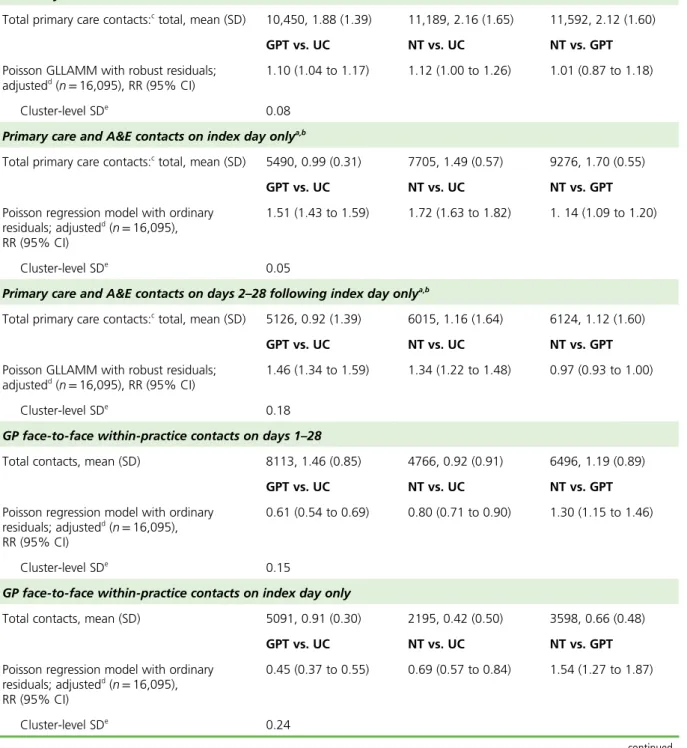
Results:Of 20,990 eligible randomised patients (UCn=7283; GPTn=6695; NTn=7012), primary outcome data were analysed for 16,211 patients (UCn=5572; GPTn=5171; NTn=5468). Compared with UC, GPT and NT increased primary outcome contacts (over 28-day follow-up) by 33% [rate ratio (RR) 1.33, 95% confidence interval (CI) 1.30 to 1.36] and 48% (RR 1.48, 95% CI 1.44 to 1.52), respectively. Compared with GPT, NT was associated with a marginal increase in primary outcome contacts by 4% (RR 1.04, 95% CI 1.01 to 1.08). Triage was associated with a redistribution of primary care contacts. Although GPT, compared with UC, increased the rate of overall GP contacts (face to face and telephone) over the 28 days by 38% (RR 1.38, 95% CI 1.28 to 1.50), GP face-to-face contacts were reduced by 39% (RR 0.61, 95% CI 0.54 to 0.69). NT reduced the rate of overall GP contacts by 16% (RR 0.84, 95% CI 0.78 to 0.91) and GP face-to-face contacts by 20% (RR 0.80, 95% CI 0.71 to 0.90), whereas nurse contacts increased. The increased rate of primary care contacts in triage arms is largely attributable to increased telephone contacts. Estimated overall patient–clinician contact time on the index day increased in triage (GPT=10.3 minutes; NT=14.8 minutes; UC=9.6 minutes), although patterns of clinician use varied between arms. Taking account of both the pattern and duration of primary outcome contacts, overall costs over the 28-day follow-up were similar in all three arms (approximately £75 per patient). Triage appeared safe, and no differences in patient health status were observed. NT was somewhat less acceptable to patients than GPT or UC. The process evaluation identified the complexity associated with introducing triage but found no consistency across practices about what works and what does not work when implementing it.
Conclusions:Introducing GPT or NT was associated with a redistribution of primary care workload for patients requesting same-day consultations, and at similar cost to UC. Although triage seemed to be safe, investigation of the circumstances of a larger number of deaths or admissions after triage might be warranted, and monitoring of these events is necessary as triage is implemented.
Trial registration:Current Controlled Trials ISRCTN20687662.
Contents
List of tables xiii
List of figures xvii
Glossary xix
List of abbreviations xxi
Plain English summary xxiii
Scientific summary xxv
Chapter 1Introduction 1
Scientific background and review of current literature 1
Feasibility of telephone triage 1
Primary care workload 1
Cost 1
Patient experience of care 2
Patient safety 2
Patient health status 2
Rationale for the research 2
Aims and objectives 3
Chapter 2Methods 5
Study design 5
Pilot study 5
Ethical and governance arrangements 5
Patient and Public Involvement 5
Health technologies assessed 6
Triage interventions 6
Core triage processes 6
Areas of flexibility 7
Training practices in the two triage systems 7
Computer decision support in nurse triage 8
Usual care comparator 10
Inclusion and exclusion criteria 10
Practices 10
Patients 11
Recruitment and randomisation procedures 11
Practices 11
Patients 13
Outcome measures 16
Describing practices and patients 16
Primary outcome measure 16
Secondary outcome measures 17
Sample size 18
Feasibility of patient recruitment 19
Trial delivery in participating practices 20
Run-in period 20
Data collection period 20
Data collection and management 21
Clinician Form 22
Patient questionnaire 22
Case note review 22
Blinding 22
Data entry 22
Monitoring intervention fidelity 23
Integrity checks 23
Use of computerised decision support software in nurse-led telephone triage practices 23
Statistical analysis 24
Practice and patient characteristics 24
Primary outcome 24
Secondary outcomes 25
Economic evaluation 26
Aim 26
Method 26
Process evaluation 29
Aims and objectives 29
Methods 29
Data collection 31
Data analysis 32
Chapter 3Results 33
Flow of practices and patient participants in the trial 33
Practices 33
Patients 33
Patient loss to follow-up 36
Describing usual care 36
Practice descriptions and patient demographic characteristics 38
Practice descriptors 38
Patient demographics 38
Clinical outcomes 40
Primary outcomes 40
Additional analyses based on primary outcome 42
Safety outcomes 42
Patient management on the index day 47
Resource use 49
Patient self-reported health status (European Quality of Life-5 Dimensions) 52
Patient experience 52
Case complexity 52
Economic evaluation 54
Estimate of the intervention cost (unit cost) for the triage interventions 54
Economic analyses 59
Process evaluation 68
Structure of the results 68
How the trial was experienced 68
How the telephone triage interventions are implemented in different practice settings 76
How triage was experienced 79
Acceptability of triage 91
Chapter 4Discussion and conclusions 95
Summary of findings 95
Primary care contacts in the 28 days following a same-day consultation request 95
Care on the index day 96
Resource use 97
Economic analysis 97
Safety 98
Patient health status 98
Patient experience of care 99
Research findings in context 99
Workload 99
Safety 100
Patient experience 101
Process evaluation 101
Strengths and limitations 102
Implications for future research 105
Implications for health care 107
Acknowledgements 111
References 115
Appendix 1ESTEEM trial: pilot study report 121
Appendix 2Summary of changes to original ESTEEM protocol 135
Appendix 3Audit Log Sheet 137
Appendix 4Receptionist flow charts 139
Appendix 5Questionnaire for withdrawn practices 143
Appendix 6Covering invitation letters 145
Appendix 7Patient information leaflet 147
Appendix 8Patient questionnaire 153
Appendix 9Receptionist Trial Log Sheet 157
Appendix 10Adverse events reporting procedure 159
Appendix 11Clinician Form 163
Appendix 12Case note review 165
Appendix 13Overview of practice integrity checks 167
Appendix 14Assessment of nurses’use of computerised decision support
software during ESTEEM 169
Appendix 16Availability of patient information throughout the trial, consent
status and initial patient management 179
Appendix 17Practice Profile Questionnaire: additional data 183
Appendix 18Predictors of case note review and questionnaire return 185
Appendix 19Total primary care and accident and emergency contacts within
28 days of index day (primary outcome) across trial arm: per-protocol analysis 189
Appendix 20Interactions between intervention and practice-level variables, and
between intervention and age category/gender/ethnic group, for primary outcome 191
Appendix 21Patient-reported health status (European Quality of Life-5
Dimensions): individual question frequencies 193
Appendix 22Patient experience of care: individual question frequencies 195
Appendix 23Case complexity 197
Appendix 24ESTEEM intervention resource use and cost estimates 199
Appendix 25Data used to estimate staff contact time for triage contact
(source: Clinician Form data) 203
Appendix 26Mean triage contact time by practice 205
Appendix 27Alternative unit costs for general practitioner and nurse consultations 207
Appendix 28Sensitivity analyses using alternative unit costs for
out-of-hours contacts 209
Appendix 29Total number of contacts by consultation type (from case
List of tables
TABLE 1 Sample size calculation 19
TABLE 2 Outcome data, timing of data collection and source of data 21
TABLE 3 Inter-rater reliability of case note review data extraction 22
TABLE 4 Unit cost data (2012) with data sources for the base case 28
TABLE 5 Process evaluation: participating practices by region 29
TABLE 6 Process evaluation participating practice staff 31
TABLE 7 Process evaluation participating patients 31
TABLE 8 Estimate of the proportion of patients seeking same-day consultations
who were ineligible for the trial 36
TABLE 9 Practice Profile Questionnaire 37
TABLE 10 Practice demographics and cluster size coefficient of variation 38
TABLE 11 Baseline patient demographics 39
TABLE 12 Primary outcome measure: total primary care contacts (including A&E)
within 28 days of index consultation request across trial arms 41
TABLE 13 Sensitivity analyses based on the primary outcome 43
TABLE 14 Comparison of safety outcomes based on contacts across trial arms 46
TABLE 15 Patient management on index day 47
TABLE 16 Descriptive summary of individual contact types comprising the
primary outcome and patient-reported use of NHS Direct 50
TABLE 17 Duration of consultations during trial 51
TABLE 18 Patient-reported health status (EQ-5D): ITT analysis 52
TABLE 19 Patient experience of care: ITT analysis 53
TABLE 20 Training and set up schedule for triage interventions 54
TABLE 21 Organisational training for triage interventions, staff attending
TABLE 22 Triage-specific training for triage interventions, staff attending
(mean count by grade) and mean duration of training 55
TABLE 23 Clinician contact time for triage intervention, by intervention type 55
TABLE 24 Unit costs used in estimate of triage intervention costs 56
TABLE 25 Mean cost of per-practice training and software required for triage
interventions, and estimate of mean cost per same-day appointment request 58
TABLE 26 Estimated unit cost for triage interventions per same-day
appointment request 58
TABLE 27 Summary table of sensitivity analyses and impact of different assumptions on estimate of unit cost for triage intervention (for same-day
request) 58
TABLE 28 Description of primary cost data (summary view) and primary analyses
with comparison by intervention 60
TABLE 29 Description of primary cost data (summary view) primary cost analyses
with comparison by intervention type 61
TABLE 30 Secondary analyses and sensitivity analyses against primary cost
analyses, total 28-day cost 62
TABLE 31 Same-day contacts: description of data, base case (detailed view) and
exploratory economic analyses on the same day as appointment request 64
TABLE 32 Same-day contacts: exploratory analysis and costs for primary outcome
contacts on the same day as appointment request 65
TABLE 33 Duration of face-to-face consultations following triage for
ESTEEM patients 66
TABLE 34 Cost–consequences matrix, UC costs and consequences compared with
triage interventions 67
TABLE 35 Overview of the process evaluation practices 69
TABLE 36 Summarising evidence from ESTEEM considered in reference to UC 109
TABLE 37 Summary table of pilot study outcomes against stopping rules 123
TABLE 38 Staff interview participants in the pilot study 131
TABLE 39 Summary of practices and patients for whom CDSS data were available 169
TABLE 40 Average length of call, number of questions, intensity score and
TABLE 41 Patient data availability, intervention status and consent status
through the trial 179
TABLE 42 Baseline patient demographics by availability of case note review data
and return of completed questionnaire 185
TABLE 43 Demographic associations with consent to case note review and
List of figures
FIGURE 1 Practice training structure 9
FIGURE 2 Practice recruitment procedure 12
FIGURE 3 Patient recruitment and consent procedure 14
FIGURE 4 Timeline of interventions 20
FIGURE 5 Consolidated Standards of Reporting Trials diagram 34
FIGURE 6 Patient recruitment by practices 35
FIGURE 7 Primary outcome results by arm 40
FIGURE 8 Redistribution of within-practice workload over (a) the 28-day
workload (primary outcome measure) and (b) the index day 45
FIGURE 9 Summary, by arm, of within-practice patient management on the
index day 49
FIGURE 10 Main trial practice recruitment at end of pilot (July 2010 to
February 2011) 124
FIGURE 11 Flow diagram representing the adverse events reporting procedure
for the ESTEEM trial 159
FIGURE 12a Descriptive flow of Clinician Form timings data for health economics
analysis for GP triage arm 203
FIGURE 12b Descriptive flow of Clinician Form timings data for health economics
Glossary
Contact A consultation within primary care of any of the types specified within the primary outcome (e.g. a consultation with a general practitioner or nurse, face to face or over the telephone, within surgery hours or out-of-hours primary care). All contacts are successfully attended by patients (i.e. excludes patients who do not attend) unless stated in the text.
Did not attend Use of the term‘did not attend’applies to both face-to-face and telephone contacts that are unsuccessful (i.e. patient fails to attend face to face or answer the telephone).
General practitioner face-to-face contact A face-to-face consultation with a general practitioner occurring at the practice within working hours.
General practitioner face-to-face out-of-hours primary care contact An out-of-hours, face-to-face consultation with a general practitioner occurring within a clinic setting (i.e. not a home visit).
Index consultation request The patient’s request for a same-day consultation which served as the patient’s point of entry to the trial and beginning of the 28-day follow-up period.
Index consultation/contact The triage or first management contact following the index consultation request.
Index day The day of the index same-day consultation request.
Per protocol Patients were considered to have been managed per protocol in each trial arm as follows:
l General practitioner triage intervention: patients receiving a general practitioner telephone contact as their first contact on the same day as the index consultation request.
l Nurse triage intervention: patients receiving a nurse telephone contact as their first contact on the same day following the index consultation request.
l Usual care: all patients, as no changes had been made to practices’system for managing same-day consultation requests.
Triage-bookable (appointment) An appointment reserved exclusively for the use of a general practitioner or nurse conducting triage to book for a patient who needs to be seen following the triage consultation.
Triage/first management A triage/first management contact was defined in each trial arm as follows:
l General practitioner triage intervention: a general practitioner telephone contact on the day of the index consultation request.
l Nurse triage intervention: a nurse or general practitioner telephone contact on the day of the index consultation request (recognising that the general practitioners may occasionally assist with
the triaging).
List of abbreviations
A&E accident and emergency
APHO Association of Public Health Observatories
CDSS computerised decision support software
CONSORT Consolidated Standards of Reporting Trials
DMC Data Monitoring Committee
DNA did not attend
EMIS Egton Medical Information Systems
EQ-5D European Quality of Life-5 Dimensions
GLM generalised linear model
GP general practitioner
GPT general practitioner-led telephone triage
HTA Health Technology Assessment
ICC intracluster correlation coefficient
IMD Index of Multiple Deprivation
ISRCTN International Standard Randomised Controlled Trial Number
ITT intention to treat
LSOA lower super output area
NIHR National Institute for Health Research
NT nurse-led (computer-supported) telephone triage
OR odds ratio
PCRN Primary Care Research Network
PCT primary care trust
POM primary outcome measure
PPI Patient and Public Involvement
PSSRU Personal Social Services Research Unit
R&D research and development
RCT randomised controlled trial
REC Research Ethics Committee
RM&G Research Management & Governance
RR rate ratio
SD standard deviation
SF-36 Short Form questionnaire-36 items
Plain English summary
D
emand for primary care has increased in recent years.‘Telephone triage’involves clinicians assessing patients’needs over the telephone, giving advice or arranging an appointment. We compared general practitioner- and nurse-led triage (GPT and NT, respectively) with‘usual care (UC)’for patients seeking same-day GP appointments, examining patterns of patients’service use, safety and experience of care, and UK NHS costs.Forty-two practices participated: 15 (7012 patients) were randomly allocated to NT with computer decision-supported software, 13 (6695 patients) to GPT and 14 (7283 patients) to continue‘UC’. We included all patients who were telephoning and seeking a same-day GP appointment. Patients were asked about their opinion of the system via a postal questionnaire 4 weeks later. We interviewed some patients and staff. Information was collected from the records of patients who gave permission; we documented how often patients were seen over the 28 days following their same-day request.
Sufficient practices and patients took part to give us confidence in our results. Both types of triage increased primary care contacts in the 28-day follow-up, but, overall, triage cost almost the same as UC over the 28 days. Across a range of measures, triage appeared to be safe when compared with UC; there were no significant differences between trial arms in the number of deaths, the number of emergency hospital admissions or the number of accident and emergency department attendances. Patients were slightly less happy with NT than with GPT or UC. Interviews identified that the‘success’of triage depended on individual practice‘culture’, and highlighted the complexity of introducing a major appointment
system change.
Scientific summary
Background
Demands on UK primary care are increasing, prompting an exploration of alternative ways of managing patients in an attempt to respond to government and societal expectations while continuing to deliver safe, high-quality care.
When combined with telephone consultation, it has been proposed that telephone triage improves the management of demand for primary care by providing more rapid access to health-care advice for patients, reducing non-attendance rates and freeing up opportunities for face-to-face consultation.
The majority of previous research relates to models of triage that involve nurses, with little research addressing the impact of general practitioner (GP) telephone triage. To date, there has been no large-scale randomised controlled trial (RCT) comparing the potential benefits and harms of GP- or nurse-led
telephone triage (NT) of patients requesting same-day consultations.
Objectives
The overarching aim of this trial was, in comparison with usual care (UC), to assess the impact of NT- and GP-led telephone triage (GPT) on primary care workload and cost, patient experience of care, and patient safety and health status, for patients requesting same-day consultations in general practice. Specific objectives were to compare the effects on primary care workload and cost, and patient experience of care, patient safety and health status, of (1) NT vs. UC; (2) GPT vs. UC; and (3) NT vs. GPT. We also explored the experiences and views of patients and members of practice staff on the acceptability of telephone triage.
Methods
Design
Pragmatic cluster RCT incorporating economic evaluation and parallel qualitative process evaluation. A preliminary pilot RCT was conducted in six practices to (1) confirm the implementation of GP- and nurse-led triage systems as feasible; (2) confirm the proposed recruitment of practices and refine data collection systems; and (3) confirm the assumed level of clustering of outcomes.
Setting and participants
Forty-two general practices from four regions of England, UK (Devon, Bristol/Somerset, Warwickshire/ Coventry and Norfolk/Suffolk). Participants were consecutive patients (aged≥16 years or<12 years) seeking a same-day face-to-face consultation with a GP. Patients aged 12.0–15.9 years were excluded owing to concerns regarding confidentiality of a mailed questionnaire, as were patients with health-care needs that were deemed too urgent to wait for triage (e.g. difficulties breathing, chest pain) and patients who were unable to communicate in English by telephone.
Randomisation
Interventions
Patients from practices allocated to either of the triage arms who requested a same-day face-to-face consultation with a GP were advised that they would be called by the clinician (GP or nurse using computer decision support software) later that day to discuss their needs and to discuss the most appropriate
management option. The options available included (1) self-care advice; (2) a further within-practice consultation on the same day; (3) a further within-practice consultation on a subsequent day; and (4) referral to another NHS service. Triage practices received standardised training on how to implement triage, although some tailoring of the intervention was permitted to suit local needs. Patients in UC practices were managed following the standard protocols for that practice.
Outcome measures
Our primary outcome measure (POM) is the total number of primary care contacts occurring within a 28-day period following a patient’s same-day consultation request. We defined primary care as including consultations within general practice (including the triage contact), walk-in centres, out-of-hours primary care services and attendance at accident and emergency (A&E). All POM data were collected by trained researchers conducting case note reviews of electronic practice records.
Other process and outcome data were collected to document NHS resource use, appointment
non-attendance and consultation length. Secondary outcomes of patient safety (number of deaths and emergency hospital admissions within 7 days of the index request and A&E attendance at follow-up), NHS resource use and costs, appointment non-attendance and consultation length were collected from case note review and primary care Clinician Forms. Patient-reported health status [European Quality of Life-5 Dimensions (EQ-5D)] and experiences of care (modified English national GP Patient Survey items) were collected by postal questionnaire.
Given the nature of the interventions, it was not possible to blind patients or practitioners to treatment allocation. Although the cluster design of the trial might theoretically allow researchers who are undertaking case note reviews to be blinded, our pilot study showed this was not possible in practice. The data analysis was carried out by a statistician who was blinded to treatment allocation.
Sample size
Based on a previous UK study comparing NT with UC for handling same-day consultation requests, we powered our study to detect a between-arm difference of 1.02 [standard deviation (SD) 0.78] vs. 1.38 (SD 1.79) at follow-up between the triage arms and UC [based on 90% power, intracluster correlation coefficient (ICC) 0.05, two-sided alpha 0.05]. Assuming 47% non-collection of the POM, it was necessary to recruit 7046 patients from 14 practices across each arm to reach our target of 3751 patients per arm for analysis (i.e. a total of 21,138 patients from 42 practices). The pilot study provided confirmation of our assumed ICC of 0.05 (i.e. 0.03, 95% CI 0.00 to 0.08). Furthermore, the pilot study led to a change in the method of patient consent to case note review from written consent (obtained from completed patient questionnaires) to include initial verbal consent obtained from the treating clinician.
Statistical methods
Economic methods
Primary economic (cost) analyses were undertaken using data collected on the POM contacts taking place over 28 days, and conducted from the perspective of the NHS. Economic analyses were conducted in accordance with the statistical methods above. The primary economic analysis estimated the mean cost of care across each of the trial arms, to include triage (where used) and the items in the primary outcome. Analysis was based on a microlevel costing estimate for the triage intervention, and the use of published unit cost data for other elements of resource use. Estimates of the cost associated with triage interventions were based on incremental costs when compared with UC, with any capital costs and/or training costs depreciated/ spread over an appropriate time period in the primary analyses (with other time horizons for these costs explored in sensitivity analyses). Sensitivity analyses were undertaken against the primary analyses to explore the implications of uncertainty in data used and the assumptions made within the primary analyses.
Results
Participating practices (n=42) and patients were well balanced across the three trial arms with respect to key characteristics (practice list size, setting and deprivation; patient age, gender and deprivation). In total, 20,990 patients were eligible for the trial (UCn=7283; GPTn=6695; NTn=7012). POM data were analysed for 16,211/20,990 (77%) participants (UCn=5572; GPTn=5171; NTn=5468). There was some evidence of participation bias, with young adults (aged 16–24 years) being less likely than the reference age group (25–59 years), and women being less likely than men, to have POM data available.
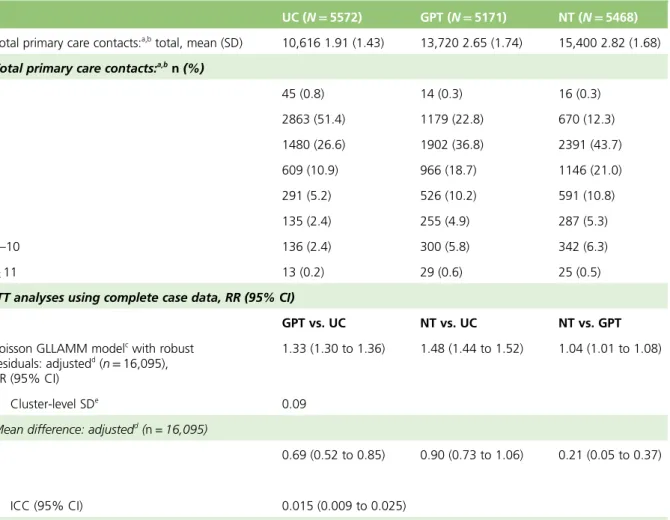
The mean number of POM contacts in the 28-day follow-up period was 1.91 in UC (SD 1.43; total 10,616), 2.65 in GPT (SD 1.74; total 13,720) and 2.81 in NT (SD 1.68; total 15,400). Compared with UC, there was an increase in POM contacts of 33% in GPT [rate ratio (RR) 1.33, 95% CI 1.30 to 1.36] and 48% in NT (RR 1.48, 95% CI 1.44 to 1.52). There was a small increase of 4% in NT (RR 1.04, CI 1.01 to 1.08) compared with GPT.
Triage-arm patients had more diverse patterns of management when compared with UC. For GP face-to-face and telephone contacts combined across the 28-day follow-up period, the RR was 1.38 (95% CI 1.28 to 1.50) in GPT compared with UC, and 0.84 (95% CI 0.78 to 0.91) in NT compared with UC. GP face-to-face contacts decreased by 39% during the 28-day follow-up period in GPT compared
with UC (RR 0.61, 95% CI 0.54 to 0.69) and in NT by 20% compared with UC (RR 0.80, 95% CI 0.71 to 0.90). Following the implementation of triage, no impact was observed on contacts with other services outside of the practice (out-of-hours primary care, walk-in centres or A&E) in either intervention arm.
Changes were also observed in the distribution of estimated patient–clinician contact time on the index day following the introduction of triage. Introducing GPT was associated with a small increase in patient–nurse contact time, whereas introducing NT was associated with both a decrease in patient–GP contact time and a substantial increase in overall patient–nurse contact time.
The estimated health-care costs over the 28-day follow-up were similar across all three arms, at a mean cost of approximately £75 (US$120,€88) per patient.
There was no evidence of differences across the three trial arms with respect to patient safety (patient mortality, emergency hospital admissions and A&E attendance rates) and patient health status did not vary between triage arms and UC, or between GPT compared with NT. NT was somewhat less acceptable to patients than GPT or UC.
Conclusions
We believe ESTEEM to be the first RCT to assess both nurse- and GP-led telephone triage of patients requesting same-day consultations in primary care. The ESTEEM trial achieved its recruitment target of 22,000 patients across 42 general practices in four regions in England.
Contrary to suggestions that triage can reduce primary care workload, we found that both GPT and NT increased the number of primary care contacts in the 28 days following a patient’s same-day consultation request compared with maintaining a UC approach to such requests. Following the introduction of GPT, we observed a redistribution of GP workload from face-to-face to telephone consultations. Following the introduction of NT, we observed a redistribution of workload from GPs to nurses. Triaged patients had more diverse patterns of management than those in UC, possibly indicating more flexible approaches to patient management in the triage arms. There was evidence of increased nurse deployment in both triage arms, with this being substantial following the introduction of NT.
When considering the differing patterns and duration of patient care contacts, both forms of triage were cost neutral to the NHS compared with UC. However, we found no important gains in patients’safety, health status or experience of care with triage.
Our process evaluation identified no strong, compelling or consistent narrative about what works and what does not work when implementing telephone triage in primary care. It did, however, identify key issues on which any practice considering implementing triage might want to reflect before adopting a triage system. These included consideration of issues relating to individual practice culture and capacity, and the forward planning, with the whole staff team, of any major changes in access arrangements.
Our results do not support a definitive policy recommendation to roll out across the NHS either nurse or GP triage for the management of same-day appointments. Triage, whether implemented by a GP or by a nurse using decision support software, should be introduced with full awareness of the whole-system implications arising from the decision to implement such a process. Notwithstanding this, clinician triage of patients seeking same-day consultations may offer advantages in supporting the flexible delivery of patient care, and potentially offers a useful approach in the armamentarium of tools facilitating the delivery of effective NHS primary care.
Trial registration
This trial is registered as ISRCTN20687662.
Funding
Chapter 1
Introduction
Scientific background and review of current literature
Demands on UK primary care are increasing. The introduction of a new General Medical Services contract in 20041was followed by an estimated 25% increase in primary care workload.2For many practices and
staff, addressing this increase in workload has involved an exploration of alternative ways of managing patients, in an attempt to respond to government and societal expectations while continuing to deliver safe, high-quality care.
The introduction of UK NHS walk-in centres, the 24-hour nurse-led telephone advice service NHS Direct and the more recent NHS 111 service, the increased diversity of staff skill mix and the use of remote consultations in primary care all represent organisational responses aimed at increasing the range of services available to patients and improving access to primary health care. When combined with telephone consultation, telephone triage is believed to provide rapid access to health-care advice for patients while freeing up opportunities for face-to-face consultation. Previous research3has demonstrated the utility of
nurse-led telephone triage (NT) of patients requesting same-day appointments in UK general practice. An
‘average’practice (7000 patients) might be expected to manage around 20 patients each day requesting a same-day appointment request, representing around 35% of general practitioner (GP) workload.4
Some research evidence exists regarding the feasibility, workload implications and cost of telephone triage, and patient experience of care, safety and health status following telephone triage. Most evidence derives from models involving nurse triage; less research has been carried out to address the impact of GP telephone triage to date. There have been no large-scale multipractice studies examining the potential value of general practitioner-led telephone triage (GPT) or NT of patients requesting same-day consultations.
Feasibility of telephone triage
Previous studies suggest that around 50% of nurse triage calls in out-of-hours primary care settings may be handled by telephone advice alone.5–8However, such studies have been small or focused solely on
out-of-hours primary care. Use of telephones (fixed or mobile) is now almost universal in the UK,9and recent
years have seen a near quadrupling in the proportion of GP consultations conducted on the telephone.10
Primary care workload
In the short term, telephone triage, whether by doctor or nurse, appears to reduce GP contacts by around 40%,3,11but it could be that this shifting of GP workload may result in the work undertaken by GPs
comprising the more complex cases.12The reduction also appears to be associated with an increase in later
return consultations of a roughly similar magnitude (30%,350%13between 2 and 4 weeks following a
same-day appointment request), in effect smoothing out the peaks and troughs of GP workload that are associated with same-day appointment requests. Although this level of return consultations following triage may raise concerns regarding patient safety, convenience of care and cost-effectiveness, it has been suggested that a proportion of return consultations may be planned routine appointments, resulting from a downgrading of urgency following triage.
Cost
Equivocal results on costs of telephone triage and associated resource service use have been reported across three trials. NHS Direct nurse triage was more expensive than practice nurse triage of patients making same-day consultation requests14but similar costs have been reported elsewhere between
standard management and practice NT of same-day consultation requests.3NT in out-of-hours primary
Patient experience of care
Equivocal results on patient acceptability and satisfaction have been derived from small studies. One study13reported no difference in satisfaction between telephone and face-to-face consultations.
Jiwaet al.11reported that 80% of patients were satisfied with GP telephone management of same-day
consultation requests, and Brown and Armstrong17have suggested that patients who elect to use GP
telephone consultations may do so as an alternative to face-to-face consultations in primary care.
Patient safety
Telephone consultation appears safe and effective.18,19A UK equivalence trial (in which death within 7 days of
contact was the primary outcome) established the safety of out-of-hours primary care NT by experienced nurses using computerised decision support software (CDSS) in comparison with usual care (UC).5This is
supported by work in the UK by the Richardset al.20study, in which audio tapes of nurse triage consultations
to assess decision-making revealed that decision-making was rated by GP or nurse practitioner review to be mostly good, with minimal risk from poor nurse triage decisions. However, one Swedish study19,21noted
that nurses often used self-care advice and also over-rode software-determined recommendations on management. A recent Dutch study22highlighted concerns regarding information-gathering in telephone
triage when delivered without the use of CDSS, relying only on clinical protocols. Studies8,21,23,24have
highlighted the importance of training in the use of CDSS to address patient safety issues. Nurse telephone triage delivered within a framework of national guidelines (but not with CDSS) was judged to be efficient, although some concerns were raised with respect to patient safety.25One study,3adopting a triage system
involving‘computerised management protocols developed by the practice’identified a substantial increase in accident and emergency (A&E) attendance, although actual numbers were small. Although computerised, such a system did not provide CDSS (DA Richards, Institute of Health Research, University of Exeter Medical School, 2008, personal communication) such as is now available within a number of NHS primary care computer systems, and which we propose to examine in this study.26The other trial by Richardset al.14used
CDSS for NHS Direct triage nurses, but not for nurses acting in primary care. A systematic review27of nine
studies of telephone consultation and triage noted that it is unclear if telephone management simply delays visits and thus also the provision of definitive care.
Patient health status
Several randomised studies (but none involving telephone triage) have compared the health status of primary care patients following consultations with a doctor or a nurse by patients with minor problems or after a same-day consultation request. One study28identified no difference in health status [Short Form
questionnaire-36 items (SF-36) scores] between the intervention groups when followed up after 2 weeks. Similar findings have been reported with respect to resolution of patients’symptoms and concerns after 2 weeks,29or in the proportion of patients reporting themselves as‘cured’or‘improved’2 weeks after a
consultation with either a doctor or a nurse.30
Rationale for the research
The four UK-based trials3,5,11,13of primary care telephone consultation and triage have been conducted in
relatively small populations and/or in limited numbers of practice settings (i.e. urban, rural), and most studies examining NT without the use of CDSS, although research undertaken by Lattimeret al.5did
involve out-of-hours primary care nurse telephone consultations using the CDSS‘Odyssey TeleAssess’, provided by Plain Healthcare Ltd. Despite uncertainty about the benefits and costs, many practices operate GPT or NT systems as a way of providing fast access to care for patients and in order to manage practice workload, as demonstrated by the almost fourfold increase in proportion of consultations conducted over the telephone.10As an example, in 2008, the NHS Institute for Innovation and Improvement31promoted
Aims and objectives
The overarching aim of this trial was to assess, in comparison with UC, the impact of NT and GPT
mechanisms on primary care workload and cost, patient experience of care, and patient safety and health status for patients requesting same-day consultations in general practice.
The specific research objectives were as follows:
Pilot and feasibility study To undertake an external pilot randomised controlled trial (RCT) in six practices to:
1. confirm the ability of practices to implement the GPT and NT systems 2. confirm the proposed process for recruitment of practices
3. review the assumed level of clustering of outcomes 4. check data collection systems, and
5. identify potential difficulties in implementing the triage systems.
Main trial To undertake a three-arm pragmatic cluster RCT comparing, for patients requesting a same-day consultation in general practice, the effects on primary care workload and cost, and on patient experience of care, safety and health status of:
i. GPT compared with UC ii. NT compared with UC iii. GPT compared with NT.
Chapter 2
Methods
Study design
Consistent with the Medical Research Council framework for evaluating complex interventions,32a
two-stage mixed-methods study was conducted, comprising an external pilot trial, followed by a definitive cluster RCT. The ESTEEM trial was designed as a pragmatic three-arm, multicentre cluster RCT. Practices were randomised 1 : 1 : 1 to receive GPT, NT or UC as comparators. The main trial included a parallel economic evaluation to examine the cost-effectiveness of the two triage interventions and a process evaluation to assess the intervention acceptability from the perspectives of patients and practice staff.
Pilot study
A 12-month, external pilot cluster RCT and parallel process evaluation was undertaken in six practices across Devon and Bristol. This work informed aspects of the main trial protocol published in 2013.33
We present the methods implemented within the main trial, relating to the triage interventions, practice and patient inclusion and exclusion, practice and patient recruitment, randomisation, and the outcome measures and sample size. A full account of the changes made to the main trial methods can be found inAppendix 2.
Ethical and governance arrangements
Multicentre ethical approval for the study was obtained from South West 2 NHS Research Ethics Committee (REC) in October 2009 (reference 09/H0202/53). Local NHS research governance approvals were obtained from the primary care trusts (PCTs) in Devon, Somerset, North Somerset, Bath and North East Somerset, Bristol, South Gloucestershire, Warwickshire, Coventry, Norfolk, Suffolk and Great Yarmouth, and Waveney. At the time this work was undertaken, PCTs were the main unit of administration of primary care, with a total of 152 PCTs in England, each covering an average population of around 330,000 individuals. PCTs were abolished under major changes to the NHS, introduced in 2012, with clinical commissioning groups taking over former PCT functions. The Research Management & Governance Unit, Devon PCT, acted as the study sponsor. A Trial Management Group and an independent Trial Steering Committee and Data Monitoring Committee (DMC) ensured that the study was conducted within appropriate NHS and professional ethical guidelines. The trial was registered with the International Standard Randomised Controlled Trial Number (ISRCTN) Register (reference 20687662).
Patient and Public Involvement
There were a number of PPI tasks, as listed below, and not all patient representatives wished to contribute to every task over the duration of the study.
i. Most of the patient representatives contributed to the development of study materials in preparation for ethical review before the pilot study began, and then again at the end of the pilot study for use in the main trial. This involved helping to design the patient information sheets, consent forms, topic guides for patient interviews, and patient questionnaire. Comments were obtained through a combination of face-to-face meetings and via e-mail and post.
ii. Advice was also sought on ways to improve patient participation in interviews for the process evaluation. This led to the introduction of an option for telephone interviews during the main trial. iii. (The same) two patient representatives sat on the Trial Steering Committee for the whole period of the
trial and one, if not both, attended every meeting.
iv. A small number of patient representatives contributed to the process of analysing qualitative data from the process evaluation during the pilot study.
v. A small number of patient representatives attended meetings and received postal material during the running of the trial in order to be kept informed of study progress.
vi. All patient representatives were invited to contribute to the dissemination of the study results at the end of the project, by way of providing input to the plain English summary of the trial findings.
Health technologies assessed
Triage interventions
The GPT and NT interventions were complex interventions that involved staff training (clinical and technology based); CDSS to support the delivery of NT; process and organisational change in practices regarding reception activity and appointment system management; and accommodation of patient expectations. Some core elements of triage delivery were common to, and adopted by, all practices in both intervention arms. However, some organisational flexibility was permitted because of the complex nature of the intervention. Full details of the interventions are available from the research team.
Core triage processes
All patients contacting the practice initially spoke to a receptionist. Once the receptionist established that the patient (or a proxy asking on their behalf) was requesting a same-day, face-to-face appointment with a GP, the patient was asked to provide a contact telephone number and was advised that the clinician (GP or nurse, according to the practice’s allocation) would call them back within around 1–2 hours. This timescale was suggested as a guide for practices but was not considered mandatory.
On telephoning the patient (‘index consultation’), the clinician discussed the presenting condition and had a range of management options at their disposal:
i. give the patient self-care advice
ii. book the patient into a‘triage-bookable’face-to-face or telephone appointment with the relevant health professional later the same day
iii. book the patient into a‘triage-bookable’face-to-face or telephone appointment with the relevant health professional on another day
iv. book the patient into any routine appointment available
v. refer the patient to other NHS services where appropriate, including those outside the practice.
Areas of flexibility
Although the core triage processes were specified, practices had some areas of flexibility in implementing triage interventions, in order to accommodate the complexities of individual practice organisation. These models used were informed by individual practices’audits of appointment requests, GP and nurse capacity information, and guidance and training given to practices prior to starting the trial (seeTraining practices in the two triage systems). Flexibility was allowed in terms of the triaging clinician, triage availability, the triaging of babies, and same-day requests for nurse practitioner consultations.
Triaging clinician
Three alternative staffing models emerged regarding which clinician (GP or nurse) delivered the triage: (1) one clinician (GP or nurse) at a time conducted a triage session (on a rotating basis); (2) a number of clinicians (GPs or nurses) conducted triage sessions on the day (on a rotating basis); or (3) in GPT practices only, all of the GPs conducted triage each day, with GPs triaging their own patients to triage-bookable appointments.
Triage availability
Practices were asked to triage all consecutive eligible patients during opening hours to ensure the least disruption and shortest time of trial data collection possible. In the event that limited staff resources prevented triage of all eligible patients each day, practices were permitted to operate triage within specific agreed sessions (‘research window’), amounting to no less than 50% of the week, encompassing all five working days and both mornings and afternoons. These arrangements were agreed with the research team in advance. Practices were advised of the importance of all eligible patients being triaged during an entire session, as opposed to receptionists booking in a set number of triage patients within a session and then‘closing’the triage once the allocated slots were taken. Practices operating triage within‘research windows’had their data collection period extended until the patient recruitment target was reached.
Triaging babies
Practices were advised that babies (i.e.≤2 years of age) were eligible for trial entry according to the inclusion and exclusion criteria, with the parent or guardian identified as the individual who participated in the triage call. As some practices routinely see babies as soon as possible on the same day of the appointment request, it was expected that some practices would opt to book these patients in for a face-to-face appointment rather than add them to a triage list. Although all of the intervention practices were encouraged to offer triage to babies during intervention training, some practices elected to offer face-to-face appointments in line with their existing practice policy. When this happened, the babies were still included in the trial analysis on an intention-to-treat (ITT) basis.
Requests for same-day, face-to-face nurse practitioner consultations
Some practices operated a nurse practitioner-led clinic for acute or minor illnesses, for which the nurse typically managed same-day consultation requests. This request was deemed equivalent to a same-day GP appointment request, as the patient would see a GP if the nurse practitioner was unavailable. Such patients were deemed eligible for trial entry and managed as per the treatment arm allocation.
Training practices in the two triage systems
Role of commercial providers in triage training
6-week period. The CDSS was fully embedded within the Egton Medical Information System (EMIS, Yeadon, Leeds)‘PCS’and‘LV’, and installed as a separate‘stand-alone’window tab to the clinical notes within all other types of practice IT system [e.g. Microtest Evolution (Microtest, Bodmin, Cornwall), Vision (In Practice Systems Ltd, Battersea, London), SystmOne (The Phoenix Partnership, Horsforth)].
Nurses received CDSS training and training in telephone consultation skills. Following this, there was a pretrial period of 1 month during which nurses practised using CDSS in simulated patient scenarios during their daily work. Towards the end of this period, the nurses’use of the system was assessed by Plain Healthcare trainers, with all nurses needing to demonstrate proficiency in its use before being recruited into the trial. It is also important to note that the CDSS is designed to support the nurses’clinical
decision-making; there was no requirement in the trial that the recommended advice the CDSS generated had to be followed.
Computer decision support in nurse triage
Odyssey PatientAssess [www.advancedcomputersoftware.com/ahc/products/odyssey-patient-assess.php (accessed 5 November 2014)] is a UK product, developed to support nurses and paramedics to assess the clinical needs of patients. It is already being used by several out-of-hours primary care and NHS walk-in services, and is also the subject of the Department of Health-funded SAFER1 trial focusing on the care of older people who have called the 999 service following a fall, and the HTA-funded SAFER3 trial focusing on the care of adults who have called the 999 services and are not in need of transfer to an emergency department.34
Odyssey PatientAssess has been evaluated in a number of other RCTs, and its clinical effectiveness and cost-effectiveness in settings other than in-hours general practice is already established. For instance, it has been demonstrated to be safe and cost saving in the long term in one study5,16involving a co-investigator
compared with GP telephone triage in a trial of out-of-hours primary care consultations. That study remains the largest trial of nurse telephone triage to date.5,16Furthermore, in excess of 60% of PCTs
currently commission out-of-hours primary care services that use nurses to triage patients by telephone, supported by Odyssey PatientAssess (Chris Coyne, Plain Healthcare, 2008, personal communication). However, the findings and experience of out-of-hours primary care (providing care for around 10.8 million contacts per year in UK) cannot necessarily be generalised to the very different system providing in-hours primary care and experiencing around 1 million contacts per working day.
Odyssey PatientAssess provides the user with a network of assessment prompts and guided responses relating to over 465 presenting complaints. It allows for multiple symptoms to be evaluated simultaneously, supported by evidence-based frameworks for referral and self-care, with all assessment data remaining visible at all times. It supports the clinician’s judgement and expertise through enhancing normal consultation processes. The clinical database comprises several hundred assessment and examination guidelines and protocols, each linked to triage, treatment and advice guidelines, differential diagnoses, patient information and education. These are maintained by an in-house clinical development team, which reviews the entire clinical content at least annually to ensure that it reflects current best practice, including National Institute for Health and Care Excellence (NICE) guidance.
Overview of practice training
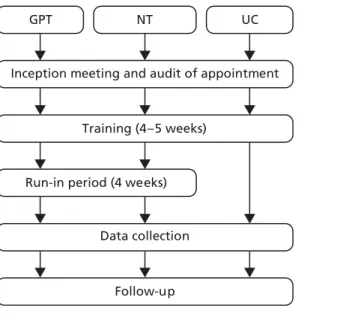
Practices were trained in research procedures and the delivery of triage interventions, following a model (Figure 1) devised during the pilot study. Training was delivered in six stages, and by a combination of Productive Primary Care (GPT and NT only), Plain Healthcare (NT only) and trial researchers (all arms).
‘Triage training’workshops were organised for GPT and NT practices (training components 3–5, described below) and delivered as a package to staff from a number of practices at a central location in each of the recruitment areas. If practices were unable to attend a central training event, the various components were delivered on site at the practice.
1. Inception meeting An initial whole-practice meeting with the trial researcher was held to outline the trial, staff group involvement and timeline of training. The meeting was convened for the practice manager, at least three receptionists, at least two GPs–to include the two GPs identified as clinical leads for the trial–and up to four nurses (NT only).
2. Appointment request audit To assess patient demand for same-day and prebookable appointments, a 1-week audit was conducted by the practice reception team. Capacity information was collated relating to the number of GP and nurse sessions provided per week and the number and typical duration of appointments offered within each session (including the proportion reserved for same-day and prebookable use). The trial researcher provided the reception team with Audit Log Sheets
(seeAppendix 3) and asked them to record all incoming calls each day for a week (Monday to Friday), indicating whether each call was a same-day or prebookable appointment request. The researcher maintained contact with the practice during the first day or two of the audit to ensure that the procedure was followed appropriately.
GPT
Inception meeting
Appointment request audit over 1 week
Triage training Organisational training
GP triage skills
Professional issues and telephone consultation
skills
Research procedures training
Run-in period
Data collection period UC NT
3. Organisational training and guidance in organising the triage system Productive Primary Care trained the practice manager, at least two receptionists, at least two GPs (GPT) and up to four nurses and one GP (NT). The training incorporated advice for the reception teams on how to communicate the introduction of the triage system to patients. Practical guidance on setting up the appointment system to incorporate triage consultation slots and face-to-face appointment slots for the use of the triaging clinician was also given. Using the data collected during the appointment request audit, Productive Primary Care used a spreadsheet (the Appointment Redesign Tool) to estimate the number of
appointments that the practice needed to provide and the proportion that should be‘triage bookable’ based on their previous experience of working with a range of practices. The details of the calculations for these estimates are the intellectual property of Productive Primary Care.
4. GP triage skills In GPT practices, Productive Primary Care delivered training to GPs on how to
communicate the operation of the new triage system to patients, and general guidance for consulting over the telephone. At least two GPs at each practice were required to receive this training and were expected to disseminate the information to their other GP colleagues.
5. Professional issues and telephone consultation skills All nurses at each NT practice who would
undertake triage were required to receive this training. A learning and development adviser from Plain Healthcare presented information and advice on the professional issues that may arise from nurses consulting over the telephone. Guidance on telephone consulting skills, including role-play scenarios, was provided. In addition, nurses received one-to-one remote training from an advisor while they practised using the CDSS on computerised simulated patient scenarios in the weeks leading up to the trial, culminating in a proficiency assessment.
6. Research procedures training Trial researchers provided briefing sessions to practice staff in data collection procedures. Staff groups included the reception team, practice manager, key IT and
administrative staff and the GPs and nurses to be involved in triage or dealing with patients requesting same-day consultations.
Usual care comparator
Practices were asked to continue with their standard consultation management systems for handling same-day consultation requests. UC practices also (1) received training through the inception meeting; (2) performed the appointment request audit; and (3) received the standard research procedures training, as outlined for the intervention arms.
To describe the range of systems that constitute UC, all 42 practices were asked to complete a Practice Profile Questionnaire before randomisation to collect details on their current staffing and appointment system arrangements to manage same-day consultation requests, including the extent to which they already used triage of any sort.
Inclusion and exclusion criteria
Practices