White Rose Research Online URL for this paper:
http://eprints.whiterose.ac.uk/84537/
Version: Accepted Version
Article:
Nan, Y, Zhang, L and Sun, X (2015) Efficient Downlink Channel Estimation Scheme Based
on Block-Structured Compressive Sensing for TDD Massive MU-MIMO Systems. IEEE
Wireless Communications Letters, 4 (4). pp. 345-348. ISSN 2162-2337
https://doi.org/10.1109/LWC.2015.2414933
[email protected] https://eprints.whiterose.ac.uk/ Reuse
Items deposited in White Rose Research Online are protected by copyright, with all rights reserved unless indicated otherwise. They may be downloaded and/or printed for private study, or other acts as permitted by national copyright laws. The publisher or other rights holders may allow further reproduction and re-use of the full text version. This is indicated by the licence information on the White Rose Research Online record for the item.
Takedown
If you consider content in White Rose Research Online to be in breach of UK law, please notify us by
Efficient Downlink Channel Estimation Scheme
Based on Block-Structured Compressive Sensing for
TDD Massive MU-MIMO Systems
Yang Nan, Li Zhang, and Xin Sun
Abstract—In this letter, an efficient channel estimation ap-proach based on the emerging block-structured compressive sensing is proposed for the downlink massive multiuser (MU) MIMO system. By exploiting the channel properties of block sparsity and channel reciprocity in TDD mode, the auxiliary information based block subspace pursuit (ABSP) algorithm is proposed to recover the downlink channels, where the path delays acquired from uplink training is utilized as the auxiliary information. Unlike traditional approaches where the channel estimation overhead is proportional to the number of BS anten-nas, the proposed approach could provide an accurate channel estimation approaching the performance bound while reduce the pilot overhead by nearly one-third.
Index Terms—Massive MU-MIMO, channel estimaion, block compressive sensing.
I. INTRODUCTION
As a promising technology for future communication sys-tems, massive multiuser (MU) multiple-input multiple-output (MIMO) has received more and more attentions [1]. Similar with classical MIMO system, one massive MU-MIMO base station (BS) with lots of antennas serves many single antenna user terminals (UTs) simultaneously. Such that, the spectrum efficiency and data rates could be substantially increased. However, to implement this technique in practice, there are still many issues that need to be properly addressed. For example, the exact channel state information (CSI) is crucial to the massive MU-MIMO system, since it has significant impact on the accuracy of signal detection. As the number of BS antennas increases, the acquisition of CSI becomes challenging due to the large channel matrix that has to be estimated. The downlink channel estimation is even more difficult since the time required to transmit downlink pilot symbols is proportional to the number of antennas at the BS side, which is unaffordable in a massive MIMO system. For this reason, most of the researches avoid the downlink channel estimation and prefer the time division duplexing (TDD) in massive MIMO systems, owing to the channel reciprocity whereby the UTs could use the CSIs estimated from uplink training directly. However, the uplink CSIs could be inaccurate or even outdated for the downlink in fast time-varying channel
Y. Nan is with the School of Electrical and Information Engineering, Beijing Jiaotong University, Beijing, 100044 China e-mail: [email protected].
X. Sun is with the School of Electrical and Information Engineering, Beijing Jiaotong University, Beijing, 100044 China e-mail: [email protected].
L. Zhang is with the School of Electronic and Electrical Engineer-ing, University of Leeds, Leeds, LS2 9JT the United Kindom e-mail: [email protected].
conditions, which will consequentially lead to performance deterioration.
Recently, some researches become aware of this issue. In [2], the authors propose a channel reciprocity based beamform-ing trainbeamform-ing scheme which utilizes the precoded sequence to estimate the effective channel. However, this scheme is not reliable enough since it overly depends on the uplink training. In order to efficiently estimate the downlink channel in massive MIMO systems, the authors in [3] propose a compressive sensing (CS) based channel estimation scheme. However, this scheme only considers systems in frequency division duplex-ing (FDD) mode. To the authors’ best knowledge, the pilot based downlink channel estimation has not been considered in TDD massive MIMO systems.
In this letter, we propose an efficient channel estimation approach under the framework of block-structured CS. This work is inspired by the recently proposed idea of common support in sparse channels [5], whereby the channel impulse response (CIR) between different transmit and receive antenna pairs exhibits sparse block structure. In addition, channel reciprocity in TDD mode enables us to use the path delays estimated from uplink training as an auxiliary information to improve the channel estimation performance in downlink. Therefore, we propose the Auxiliary information based Block Subspace Pursuit (ABSP) method which could acquire the channel parameters with only few pilots1. Compared with con-ventional CS based channel estimation methods, the proposed method could reduce the computational complexity and pilot overhead significantly while providing superior mean square error (MSE) performance.
The rest of the paper is organized as follows. We first describe the massive MU-MIMO system model in Section II. Then the ABSP algorithm is introduced in Section III. Section IV presents the performance analyses of the proposed method. Numerical experiments are presented in Section V. Finally, section VI concludes the paper.
Notations:Throughout this paper, boldface lower and upper case symbols represent vectors and matrices, respectively. OperatorsT,Hand†represent transpose, Hermite and Moore-Penrose matrix inversion, respectively. kxkp and suppK(x) denote theℓp-norm and the largestKelements in the support
of x, respectively.
II. MASSIVE MU-MIMO SYSTEM MODEL Consider a massive MU-MIMO system where the BS is equipped with M antennas and serving a large number Nu autonomous single-antenna UTs (M > Nu). The down-link transmission is organized in OFDM symbols where
Np pilots ti are randomly allocated in N subcarriers. To reduce the pilot overhead, pilots in different transmit an-tennas share the same locations, but each pilot sequence
tm= [tm1 , tm2,· · ·, tmNp], m= 1,2,· · ·, M is unique, in order to distinguish the CIRs corresponding to different transmit antennas. In this letter, we simply generate the pilot sequence by setting tm
i = 1 or tmi =−1 following the identically and independently distributed (i.i.d) random Bernoulli distribution [3].
The CIR vector between theith transmitting antenna and a certain UT can be denoted as hi = [hi(0),· · ·, hi(L−1)]T, where L is the maximum delay spread of the CIR. Due to the sparse nature of MIMO channels [3], there are only K
nonzero or significant elements inhi, andK≪L.
Next, letybe the received pilot sequence after cyclic prefix removal and DFT , then we have
y=
M
X
m=1
diag{tm}FNp,Lhm+w
=
M
X
m=1
TmFNp,Lhm+w
(1)
whereTm=diag{tm} is the diagonal matrix withtmon its main diagonal, FNp,L is the sub-matrix of the N ×N DFT matrix F collecting theNp rows according to tm and first L columns ofF.wrepresents the additive white Gaussian noise (AWGN) with zero mean and variance σ2. Let P denote the
Np×LM matrix as
P= [T1FNp,L T2FNp,L · · · TMFNp,L], (2)
andh= [hT1,· · ·,h T
M]T, then we can rewrite (1) as
y=Ph+w. (3)
A traditional approach to recover the channel hfrom (3) is the least square (LS) method [2], whereby the solution will be obtained asˆh= (PHP)−1PH
y. Note thatNp≪M Lis always satisfied in the massive MU-MIMO system, due to the large number of BS antennas M and limited number of pilotsNp. Thus, equation (3) is underdetermined, where infinite choices of hexist for a giveny. However, since the channel is sparse in nature, the CS based channel estimation methods could be used to recovery the high-dimensional CIR h from the low-dimensional pilot vector y.
TABLE I
PARAMETERS OF COMMUNICATION SYSTEMS
Standard Bandwidth(B) dmax=10CB d= λ
2
CDMA2000 1.25 MHz 24 m 0.15m 3GPP LTE 20 MHz 1.5 m 0.058m
III. ABSP ALGORITHMFORMASSIVE MU-MIMO SYSTEMS
A. Analyses of Block Sparsity and Channel Reciprocity
It is suggested in [4] that two channel taps are resolvable if the time interval of arrival is larger than 101B whereB is the bandwidth of signal. Therefore, it is obvious that the CIRs measured at different antennas share a common support [5] if
dmax
C ≤
1
10B, wheredmax is the maximum distance between two BS antennas andC is the speed of light. In other words, the path delays of nonzero elements in CIRs between different transmit-receive pair are identical while the path gains are distinct, e.g.,
supp(hi) =supp(hj), i6=j, (4)
wheresupp(hi)denotes the support of hi defined as
supp(hi) =
1 h
i(l)6= 0
0 hi(l) = 0
, 0≤l≤L−1. (5)
In Table 1 we summarize the system parameters of two clas-sical communication standards in terms of the bandwidth B, maximum distance dmax and distance between two adjacent antennas d = λ
2 where λ is the signal wavelength [6]. For example, in the 3GPP LTE standard, the maximum distance between two BS antennas of a16×16 array is15d < dmax, which proves the reliability of this assumption2.
Thus, it natureally leads us to exploit the inherent block structure of massive MU-MIMO channels. By rearranging the elements of h as c = [cT
0,· · ·,cTl,· · ·,cTL−1]T with
cl= [h1(l),· · ·, hM(l)]T, we have
y=
l=L−1
X
l=0
Ψlcl+w = Ψc+w, (6)
where Ψ = [Ψ0,· · · ,Ψl,· · · ,ΨL−1], Ψl =
[pl,· · ·,p(M−1)L+l] is a Np × M matrix, where pl is the lth column vector of P. Therefore, based on the assumption of sparse common supports within different CIRs, the channel vectorcshows block sparsity, which could be an additional constrain to solve the underdetermined problem in (3) [10].
So far, most researches solve the channel estimation prob-lems by exploiting the channel reciprocity in TDD massive MIMO systems, assuming the CSIs do not change during an uplink-downlink duration so that the CSIs estimated at the BS in uplink could be directly feedback to the UTs. However, this assumption is sometimes unrealistic in time varying channels where the uplink CSIs could be inaccurate or even outdated for the downlink, resulting in significant performance deterioration [2][3]. In this letter, we adopt a more reliable assumption requiring only the path delays remain unchanged during an uplink-downlink process, while the path gains could be quite different. This assumption is reasonable since the coherence time of path gains is inversely proportional
2For the larger antenna array, e.g. a 40×40 array with the maximum
distance39d > dmax, we can still utilize the property of common support
to the frequency of system carrier, while the coherence time for path delays is inversely proportional to the signal bandwidth [8]. For example, the variation rate of path delay is about 100 times lower than that of the path gains in the digital terrestrial multimedia/television broadcasting (DTMB) system with carrier frequency of 770MHz and signal bandwidth of 7.56 MHz [9].
B. Auxiliary Information based Block-Structured Subspace Pursuit Algorithm
To take practical advantage of block sparsity and channel reciprocity of the massive MU-MIMO channel, we exploit the block-structured CS framework and then propose the ABSP algorithm to improve the accuracy of downlink channel estimation for massive MIMO. Note that the ABSP is similar with the classical subspace pursuit (SP) algorithm [11] but with three main differences:
1) Initial Configuration. In the SP algorithm, the initial
approximation of the support set Γ is set to theK˜ indices of the largest magnitude entries in the matching vectorx= ΨH
y, where K˜ is the approximated channel sparsity, if no prior knowledge of the target signal is available. In the proposed ABSP scheme, by exploiting the channel reciprocity, we can setΓ = ˜Υdirectly, whereΥ˜ is the approximated path delays estimated from the uplink training containing the accurate path delays with overwhelming probabilities. By this way, we use the path delays estimation as auxiliary information to improve the channel estimation performance of SP without any additional overhead.
2) Matching Vector. The matching vector x = ΨHy is
used to determine the support setΓin each iteration. Different from the SP algorithm which calculates the matching vector for only one channel vector, the proposed ABSP exploits the block sparsity and computes matching vector corresponding to all the channel vectors simultaneously and then obtain the joint matching vector as
mBx = [m
B
x (0),· · · , m
B
x (j),· · ·, m
B
x(L−1)], (7)
where mB
x(j) (0 ≤ j ≤ L−1) is the B−order sum of
matching vector xdefined as [10]
mB
x(j) =
M
X
i=1 B
X
r=1
|x(i+jM)|r
(8)
whereB≥1 is an integer.
3) Iteration Number. Compared with the conventional SP
which needs at leastM×Kiterations, the required number of iterations in ABSP is sharply reduced since the path delay is already known. For example, we consider system model with
M = 16, K = 6 and assume kΥ−Υ˜k0 = 1, where Υ is the actual path delays in the downlink channel. Then we can use only one iteration to reconstruct the channel by ABSP algorithm while 96 iterations are required by SP. The main steps of ABSP algorithm is summarized in Algorithm 1.
Algorithm 1
Input: Received pilot sequence y, sensing matrix Ψ,
ap-proximated path delays Υ˜, approximated channel sparsity
K=kΥ˜k0
Initialization:
The initial residualv0=y, the estimated channel matrix
˜c=0,Γ = ˜Υandk= 1
whilekvkk2<kvk−1k2 do
x←ΨHv
k
Γ←Γ∪suppK(m2x)
x←Ψ†Γy
Γ←suppK(m1x) ˜c←Ψ†Γy
vk ←y−ΨH˜c
k←k+ 1
end while
Output: The estimatied CIR matrix˜c
IV. PERFORMANCE ANALYSIS OF ABSP BASED ON MASSIVE MU-MIMO SYSTEM
In this section, we analyze the performance of the proposed ABSP algorithm in terms of the spectral efficiency and com-putational complexity.
A. Spectral Efficiency
From [10], we know that the scales of the required pilots for estimating the CIRs by the block-structured CS method is Np = O(M K +Klog(L/K)), which is a substantial improvement over Np = O(M Klog(L/K)) required by the conventional CS methods. Considering a massive MU-MIMO system with N = 4096, M = 16, K = 6 and
L = 256. The conventional CS method requires at least
Nt = 16×6×log(256/6)≈160 pilots while the proposed ABSP needs only 106 pilots, reducing the pilots by nearly one-third. Moreover, let Np = 128 with some margin, the required pilots by ABSP only occupy3.1%subcarriers of the totalN= 4096subcarriers, with the average pilot occupancy of 0.19% on each antenna. For comparison, the average pilot occupancy of structured CoSaMP is0.3%[3], where channel reciprocity is not taken into account.
B. Computational Complexity
Since the computational complexity of most recovery al-gorithms are proportional to the number of measurements, any reduction in the number of required pilots Np would also reduce the total complexity. In addition, owing to the introduction of auxiliary information, the proposed ABSP algorithm convergents in much faster speed as discussed in Section III-B, which could further reduce the computational complexity. In details, the main computational load on the proposed algorithm is computing the joint matching vector, corresponding a complexity of O(LM +LlogL) in each iteration [10]. Therefore, the overall complexity of ABSP comprising S iterations is O(S(LM+LlogL)), where S =
0 5 10 15 20 25 30 35 10−4
10−3 10−2
10−1
100
SNR(dB)
MSE
[image:5.612.89.255.54.190.2]Traditional method SSP ABSP Exact LS
Fig. 1. MSE performance versus SNR
O(M KNp(L+K2)), which is much higher than the proposed method.
V. SIMULATION RESULTS
In this section, we conduct some simulation studies to investigate the performance of the proposed ABSP algorithm. Consider a massive MU-MIMO system where the number of BS antennas M = 16. The number of total subcarriers in a OFDM symbol is N = 4096, among which Np = 128 pilot subcarriers are randomly placed in the frequency domain. The Rayleigh fading channel with 6-tap multipath and maximum delay spread L = 100is considered. In addition, we assume the channel reciprocity is imperfect where the CIRs of uplink and downlink are not precisely identical.
Firstly, we compare the proposed ABSP with the structured subspace pursuit (SSP) [3] that has already shown to outperfor-m SP in Fig. 2. Meanwhile, the traditional way that utilizes the uplink CIRs directly in the downlink channel recovery (namely traditional method) and the exact least square (LS) channel estimation which perfectly knows the common supportΥare also included for comparison. It can be seen that the traditional method cannot work since the channel reciprocity is imperfect. Moreover, the MSE of the conventional SSP algorithm drops slowly with the increase of SNR and then goes flat when
SN R > 20. On the contrary, the proposed ABSP algorithm achieves good performance close to the exact LS estimation, thanks to the use of auxiliary information.
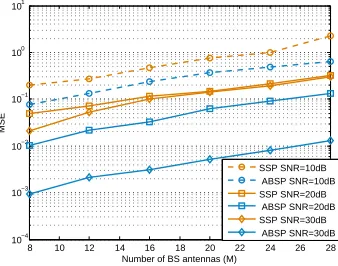
Next, we illustrate the MSE comparison of ABSP and SSP with different number of BS antennas M and SNRs in Fig. 3. From the figure we can see that both of the channel esti-mation methods suffer from performance degradations when
M becomes larger, due to the insufficient number of pilots. However, the proposed ASBP is superior to SSP for all the SNRs, especially when SNR increases from 20 to 30 where ABSP shows a substantial improvement while SSP only reaps little benefit.
VI. CONCLUDING REMARKS
This letter considers the downlink channel estimation for TDD massive MU-MIMO system. By exploiting the inher-ent block sparsity and channel reciprocity, an auxiliary in-formation based block-structured SP algorithm is proposed
8 10 12 14 16 18 20 22 24 26 28 10−4
10−3 10−2 10−1
100
Number of BS antennas (M)
MSE
SSP SNR=10dB ABSP SNR=10dB SSP SNR=20dB ABSP SNR=20dB SSP SNR=30dB ABSP SNR=30dB
Fig. 2. MSE performance versus different number of BS antennas and SNRs
to efficiently solve the pilot overhead problem in downlink training within massive MIMO systems. Theoretical analysis has demonstrated the effectiveness of the proposed method, in terms of spectral efficiency and computational complexity, while simulation results showed its good channel estimation performance in terms of MSE.
ACKNOWLEDGEMENTS
The authors would like to thank the support by ”the Fundamental Research Funds for the Central Universities (2014YJS006)”.
REFERENCES
[1] T. L. Marzetta,Noncooperative cellular wireless with unlimited number of base station antenns, IEEE Trans. Wireless Commun, vol. 9, no. 11, pp. 3590-3600, Nov. 2010.
[2] H. Q. Ngo, E. G. Larsson, and T. L. Marzetta Massive MU-MIMO downlink TDD systems with linear precoding and downlink pilots, Communication, Control, and Computing, 2013 51st Annual Allerton Conference on, pp. 293-298, Oct. 2013.
[3] L. Dai, Z. Gao, Z. Wang, and Z. Yang,Spectrum-efficient superimposed pilot design based on structured compressive sensing for downlink large scale MIMO systems, General Assembly and Scientific Symposium (URSI GASS), 2014 XXXIth URSI, vol. 1, no. 4, pp. 16-23, Aug. 2014. [4] Y. Barbotin, A. Hormati, S. Rangan, M. Vetterli,Estimation of Sparse
MIMO Channels with Common Support, IEEE Transactions on Commu-nications, vol. 60, no. 12, pp. 3705-3716, Dec. 2012.
[5] Y. Barbotin, M. Vetterli, Estimation of sparse MIMO channels with common support, IEEE Trans. Commun., vol. 60, no. 12, pp. 93-100, Dec. 2012.
[6] M. Masood, L. Afify, T. Al-Naffouri, Efficient Coordinated Recovery of Sparse Channels in Massive MIMO, IEEE Transactions on Signal Processing, vol. 63, no. 1, pp. 104-118, Jan. 2015.
[7] W. Ding, F. Yang, et al.,Compressive sensing based channel estimation for OFDM systems under long delay channels, IEEE Transactions on Broadcasting, vol. 60, no. 2, pp. 313C321, June. 2014.
[8] L. Dai, J. Wang, Z. Wang, P, Tsiaflakis, and M. MoonenSpectrum- and energy-efficient OFDM based on simultaneous multi-channel reconstruc-tion, IEEE Transactions on Signal Processing, vol. 61, no. 23, pp. 6047-6059, Dec. 2013.
[9] Error-Correction, Data Framing, Modulation and Emission Methods for Digital Terrestrial Television Broadcasting, Recommendation ITU-R BT. 1306-6, Dec.6, 2011.
[10] R. G. Baraniuk, V. Cevher, M .F. Duarte, and C. HegdeModel-based compressive sensing, IEEE Transactions on Information Theory, vol. 56, no. 4, pp. 1982-2001, Apr. 2010.
[image:5.612.351.520.55.188.2]