This is a repository copy of A comparative study of technological learning and
organizational capability development in complex products systems: Distinctive paths of
three latecomers in military aircraft industry.
White Rose Research Online URL for this paper:
http://eprints.whiterose.ac.uk/139950/
Version: Accepted Version
Article:
Lee, JJ and Yoon, H orcid.org/0000-0003-1423-9808 (2015) A comparative study of
technological learning and organizational capability development in complex products
systems: Distinctive paths of three latecomers in military aircraft industry. Research Policy,
44 (7). pp. 1296-1313. ISSN 0048-7333
https://doi.org/10.1016/j.respol.2015.03.007
© 2015 Elsevier B.V. All rights reserved. This manuscript version is made available under
the CC-BY-NC-ND 4.0 license http://creativecommons.org/licenses/by-nc-nd/4.0/.
[email protected] https://eprints.whiterose.ac.uk/
Reuse
This article is distributed under the terms of the Creative Commons Attribution-NonCommercial-NoDerivs (CC BY-NC-ND) licence. This licence only allows you to download this work and share it with others as long as you credit the authors, but you can’t change the article in any way or use it commercially. More
information and the full terms of the licence here: https://creativecommons.org/licenses/
Takedown
If you consider content in White Rose Research Online to be in breach of UK law, please notify us by
1
Citation Information:
Lee, J. J., & Yoon, H. (2015). A comparative study of technological learning and organizational capability development in complex products systems: Distinctive paths of three latecomers in military aircraft industry. Research Policy, 44(7), 1296-1313.A comparative study of technological learning and organizational capability development in complex products systems: Distinctive paths of three latecomers in military aircraft industry
Joosung J. Lee*
KAIST (Korea Advanced Institute of Science and Technology), Department of Business and Technology Management, 291 Daehak-ro, Yuseong-gu, Daejeon, Republic of Korea
Hyungseok Yoon
De Vinci Research Lab, Pôle Universitaire Léonard de Vinci, 12 Avenue Leonard de Vinci, 92400, Courbevoie, France
*Corresponding author. Tel.: +82 42 350 4914
E-mail addresses: [email protected] (J.J. Lee), [email protected] (H.S. Yoon)
Abstract
This paper identifies different patterns of latecomers’ technological learning in developing complex products systems (CoPS). The experiences of South Korea, China, and Brazil in military aircraft development are compared to explain the learning process in attaining indigenous technological capability. The military aircraft development programs involving international technology transfer agreements have been documented to investigate the technological learning patterns. We find different technology acquisition modes determined by latecomers’ focus of knowledge-base: technological for “make” and production for “buy”. We also find that these modes may influence the process of learning-by-doing. In addition, we find how the role of foreign partners influences technology acquisition mode. Whereas an active role results in production or co-development arrangement, a passive role leads to the vitalization of reverse engineering. We also shed light on the role of government policy initiatives that facilitate technological learning. Lastly, this paper extensively documented the successful technological learning in South Korea’s T-50 and Brazil’s AMX joint venture projects.
Keywords: Complex products systems, Latecomer technological learning, Military aircraft industry, Technology acquisition
1. Introduction
2
mechanism from the beginning of their aircraft industry.
For latecomers, this industry presents special challenges, as it is one of the most technologically intensive and complex industries with a steep learning curve for new entrants (Frischtak, 1994; Smith and Tranfield, 2005). This is the reason why cross-border alliance in aerospace and defense sector is a common behavior and constitutes a significant portion of the partnerships set up in manufacturing industries (Hergert and Morris, 1988; Dussauge and Garrette, 1995; Garrette et al., 2009). Regardless of the challenges and difficulties, latecomers recognize its importance and pursue technological breakthrough with the support of foreign partners. Since the industry involves a wide range of technology, it has a large ripple effect across all industries. In fact, military aircraft industry requires state-of-the-art technology not only confined to aviation engineering, but also across all high-tech disciplines such as mechanical, electronic, computer science, materials, systems engineering, etc. Despite its importance, very little is known about how cross-border technology transfer contributes to successful technological learning in latecomers’ military aircraft industry (Hobday, Rush, Tidd, 2000).
Most of the time, latecomer’s initial learning is limited to performing production work as a subcontractor to major foreign integrators. Later, this is extended into absorption of design and system integration experiences through co-development schemes such as joint venture (Hobday, Rush, Tidd, 2000). However, our strand of literature suggests that this typical pattern of latecomers’ technological learning may differ contingent on the context of countries and industries (Gerschenkron, 1962; Pavitt, 1984; Nelson, 1993; Teece et al., 1997; Kim, 1998). First, the difference is derived from the focus of their knowledge-base influenced by industrial policy prior to the formal embarkation of the industry. Secondly, security-sensitive nature of military aircraft industry influences latecomers’ accessibility to external resources which is reflected in the extent of foreign partners’ role whether it is active or passive (Cho and Lee, 2003; Li, 2010). Thus, we posit that these factors may shape the patterns of technological learning in acquiring indigenous technological capability.
Based on these contextual factors, we identify patterns of technology acquisition mode and major technological advancement made through the cross-border alliance that facilitates knowledge and technology transfer in their respective military aircraft industry (Mowery, 1987; Hergert and Morris, 1988; Dussauge and Garrette, 1995). We also document milestone projects “AMX for Brazil” and “T-50 for South Korea” to shed light on key technological asset and skillset acquired throughout the development stages which has not been addressed in previous studies on latecomers’ technological catch-up in CoPS (Choung and Hwang, 2007; Jun, 2011; Park, 2012). Lastly, we also identify the role of organizational capabilities in orchestrating latecomers’ technological learning in CoPS. Previous literature on CoPS mainly emphasized the role of organizational capabilities in creating similar projects at minimum cost which may not be applicable to latecomers’ cases (Davies and Brady, 2000). In fact, this conventional approach in CoPS with its emphasis on cost-minimization hinders us to address latecomers’ main concern raised by technological barriers throughout the lifecycle of CoPS (Hobday, 1995). Thus, this paper mainly focuses on the technological learning outcomes instead of focusing on economic outcomes of aircraft development programs involving foreign partners. In addition, existing literature on organizational capabilities have been applied at firm-level. However, it is important to note that latecomers’ military aircraft industry involves active participation of government policy makers (King and Nowack, 2003; Cho, 2003). In other words, existing organizational capabilities should be applied at government-level. In fact, three companies including Embraer, KAI, and AVIC for our study are state-owned companies in our analysis time frame. Thus, we find how latecomer government policy initiatives successfully facilitate technological learning.
Our study intends to contribute to the literature in three important aspects. First, while the
conventional studies of latecomers’ technological learning in aircraft industry claim that technological capability is obtained after practicing some production activities, we move beyond this sequence by identifying its
3
projects, South Korea and Brazil gained global recognition for their aerospace technologies. The cases offer practical methods and detailed process of project-based technological learning. Lastly, we clarify the role of the government policy initiatives for CoPS in orchestrating latecomers’ technological learning. We further advance the current operationalization of each capability by applying the recent stream of research in latecomers’ CoPS (Lee et al., 2009; Park, 2012; Choung et al., 2012). By doing so, we find the key success factors of each case from strategic, functional, and project capability-building perspectives.
The remainder of this study is organized as follows. Section 2 begins with the theoretical background by reviewing the streams of literature in latecomers’ technology acquisition strategies and organizational capabilities for CoPS. With the theoretical foundation, an analytical framework is built to examine the technological learning. Section 3 entails methodological approach and process along with brief background information on our cases. Section 4 compares the technology acquisition mode determined according to the focus of knowledge-base and the role of foreign partners. We also document the technological advancement and learning outcome of the three latecomers and the summary of T-50 and AMX joint venture projects. Section 5 provides a summary of the latecomer government policy initiatives to discuss implications, followed by concluding remarks on our theoretical and practical contributions.
2. Theoretical background
2.1. Major determinants of latecomers’ technology acquisition strategy
In the past, literature on latecomers’ technology acquisition strategy focused on cross-border knowledge transfer mechanism. In order to imitate, improve existing technologies, and create new products, latecomers absorb information and know-how by collaborating with foreign partners from advanced countries (Pack and Westphal, 1986; Lall, 1993; Kim, 1999; Ahuja, 2000; Powell et al., 2005). Kim (1997) developed a framework “knowledge transfer mechanisms” which consisted of formal and informal mechanisms and commodity trade to explain latecomers’ learning with foreign support. Based on this theoretical establishment, scholars in latecomers’ technology acquisition and learning highlight the success of East Asian economies with their active learning strategies (Viotti, 2002). In a similar manner, Etzkowitz and Brisolla (1999) investigated the reasons why Brazil of Latin America had fallen behind South Korea of East Asia after an apparent head start. Whereas the former concentrated its resources on indigenous basic research to be thoroughly convinced of technological superiority, the latter focused on reinforcing its production capacities to replicate foreign partners’ manufacturing techniques. In spite of such evidences, the existing studies on latecomers seem to have
accomplished little. The main reason is that most of the studies have conducted national-level analysis which hinders us from considering industry or firm-specific success. In addition, the limitation of the previous literature lies in mainly considering commodities or mass-produced goods. Although CoPS industry requires foreign partners’ assistance just as in commodity and mass-produced goods industries, there are some differences in the extent of higher technological barriers and strategic uncertainties (Cho and Lee, 2003; Li, 2010).
In order to overcome the limitations, we refer to technology acquisition strategies for latecomers’ military aircraft industry identified by Institute for National Strategic Studies (see Saunders and Wiseman, 2011). Acquisition strategies consist of purchase (buy), indigenous development (build), espionage (steal), reverse engineering, co-production, and co-development. For the sake of theoretical clarity and unbiased analysis, we exclude the option of espionage (steal). Given these information sources, we can distinguish between the different strategies that can be employed for latecomers to acquire and develop technology. The theoretical literature that exists on these strategies stresses the choice between internal development and external
4
latecomers with significant resources invested in research and development, “Buy” is preferred by production-oriented latecomers with relatively low technological resources. In general, “Buy” is the most preferred mode of initial acquisition, as most latecomer countries ‘begin with maintenance shops, move next to the assembly of imported planes, and to the manufacture under license of military planes for the local market with some eventually doing subcontract work for major aircraft producers’ (Moxon, 1987; Frischtak, 1994).
These initial acquisition strategies lead us to the subsequent stage of acquisition. Acquisition modes in this stage consist of reverse engineering, co-production, and co-development that are by-product of “Buy” option. In this subsequent stage, the degree of foreign partners’ role determined by the political relationship between knowledge transmitters and receivers is an important factor. For instance, developed countries often restricts export of the sophisticated technology such as avionics and weapon systems due to their strategic concerns or to maintain a technological advantage of their own (Lee, 2008; Saunders and Wiseman, 2011). Consistent with this fact, reverse engineering is preferably adopted by a latecomer with low level of accessibility to foreign knowledge-base which may be reflected in passive role of foreign partner. As a result, reverse
engineering requires an accumulated knowledge base to proactively imitate and add a little modification to the original product. In contrast, co-production and co-development are facilitated when foreign partners show their active role (Kim, 1998; Saunders and Wiseman, 2011). Co-production refers to a contract for latecomers to retain their right to produce copies of a complete aircraft or key components. This deal includes assembly of imported complete knock-down (CKD) kits that may give latecomers an independent production capability. Co-development refers to cooperation in the design stage of aircraft Co-development and latecomers gain design and system integration expertise. The partners typically share the cost and work content. This way, the profit made from selling a new complete aircraft to third parties may be shared by the partners (Saunders and Wiseman, 2011).
2.2. Policy initiatives for technological learning in CoPS
With the introduction of CoPS by Miller, Davies, and Hobday, researchers have focused on the cases of developed economies such as Europe and U.S. One of the main interests in their conventional studies was to understand the organizational capabilities required for the development of CoPS. Organizational capabilities in CoPS have applied ‘dynamic capability’ to explain the importance of mobilizing various resources and technologies for system integrators to meet and satisfy clients’ requirements (Davies and Brady, 2000). In contrast, Chandler (1990) proposed an organizational capabilities framework avoiding a top-down, strategic management view of the firm, by including non-strategic capabilities. Chandler’s work has been extended by Davies and Brady (2000) and Hobday (2005) to understand capabilities required for CoPS. Whereas Chandler (1990) addressed the importance of strategic and functional capabilities for mass-production, Hobday (2005) emphasized strategic and project capabilities for CoPS development.
Accordingly, Davies and Hobday (2005) introduced three organizational capabilities required for CoPS which consisted of strategic capability, functional capability, and project capability. First, strategic capability is defined as an ability to allocate resources and implement long-terms plans for the purpose of maintaining, renewing, and expanding organizational capabilities. The role of leadership in monitoring internal operations and adjusting strategies to a changing environment was emphasized. Secondly, functional capability in CoPS is structured near the technological aspects including designing, engineering, and integrating the diverse knowledge inputs and subsystems. Lastly, project capability is essential in managing relationships with partners in designing and implementing CoPS throughout the project life-cycle (Davies and Brady, 2000).
5
for survival and growth of latecomers’ CoPS. Similarly, Park (2012) identified major capabilities in South Korea’s success as networking, knowledge base, and leveraging policies. Above all, the authors commonly emphasized the importance of acquiring technology from foreign partners through technology licensing, joint development, and joint research agreement. Nevertheless, none of the studies specifically addressed the degree of foreign partners’ role through which latecomers’ technological learning is orchestrated with the development of organizational capabilities.
In addition, organizational capabilities have been mostly applied at firm-level in previous literature. This necessitates observing the role of government in facilitating the development of organizational capability for technological learning. For instance, the rise of latecomer firms should be explained with latecomer governments’ sophisticated sector-specific policy initiatives, as these industrial policy initiatives have a wide-ranging impact on firm-level competitiveness (Ham and Mowery, 1995; Nelson, 1995; Vogel, 1996; King and Nowack, 2003). Also, offset agreements are one of the most prevalent technology transfer modes in military aircraft industry. In fact, when arms sales involve offsets, government policies represent an important environmental factor that needs to be considered by corporate managers (King and Nowack, 2003). This is reflected in the status of latecomer firms engaged in military aircraft industry where most of them are state or government-owned companies. Thus, we examine latecomers’ government policies or initiatives in military aircraft development by applying the organizational capabilities.
2.3. Analytical framework
This study discusses latecomers' technological learning from the perspective that the learning is facilitated by technology acquisition strategies and policy initiatives (See Figure 1). In order to look into latecomers’ technology acquisition strategy, we adopt technology acquisition mode determined by latecomers’ context. The first context is derived from the focus of latecomers’ knowledge-base which is explained by the establishment order of innovation meso-systems for CoPS (Miller et al., 1995; Principe, 2013). In this study, we adopt the supply-side of meso-systems composed of two main groups including the system integrators (aircraft manufacturers) and the innovation infrastructure (government-funded laboratories and universities, the suppliers). In general, latecomers’ military aircraft industry begins by building the innovation infrastructure in the first hand. Depending on the focus of knowledge-base determined by latecomers’ industrial policy, the establishment of innovation infrastructure may vary. On one hand, government-funded laboratories and
universities are established, if latecomers’ focus is on building technological capabilities to generate and manage technological change. On the other hand, suppliers are established, if latecomers’ focus is on the development of production capabilities to produce goods at given levels of efficiency and given input combinations (Bell and Pavitt, 1993; Etzkowitz and Brisolla, 1999). For the second context, we adopt the role of partners in determining the acquisition mode. Whereas an active role of foreign partner results in co-production or co-development agreement, a passive role of foreign partners induces latecomers to focus on reverse engineering (Saunders and Wiseman, 2011). Above all, we posit that technology acquisition modes have an impact on the process of technological learning which is represented by “Learning by doing”. In order to capture the process, we have referred to the value chain of aerospace industry proposed by World Economic Forum (2013) consisting of design & development, logistics, raw materials, component manufacturing, systems integration, assembly, and aftermarket MRO (Maintenance, Repair & Operations). Since we are focusing on the dimensions of
technological learning, we exclude logistics from our analysis. By analyzing milestone projects along with major technological advancement, we figure out the order of activities comprising “Learning by doing”.
6
broad, deep, and integrated knowledge and skills for understanding many diverse elements of aircraft. This initiative is represented in the form of technology policies to build knowledge base and educate human capital (Lee et al., 2009; Park, 2012). Thirdly, the project initiative is represented in the form of an ability to collaborate with various actors in order to orchestrate technological learning and product development in an efficient manner. Since military aircraft development features high-confidentiality and even causes political tension, it is important to select and work with right domestic and foreign partners (Lee et al., 2009; Park, 2012). We refer to government procurement and export policies as well as other relevant policies vitalizing the participation of multiple actors.
Fig. 1. Analytical framework
3. Methodology
7
Our approach is also based on event analysis by focusing on the embarkation of the industry and the technological advancement via cross-border alliance events. This allows us to increase our understanding of latecomers’ key technological advancement through milestone projects with foreign partners (Prencipe and Tell, 2001; Brady and Davies, 2004). However, there are some methodological concerns arising from the fact that our cases show the variance in the technological level of jet fighters. For instance, China produced prototypes of stealth and achieved its status as a producer for 4th generation jet fighters in 2000s. On the other hand, Brazil achieved its indigenous technological capacity to produce only a subsonic ground-attack aircraft in 1984. In addition, South Korea achieved the technological capacity as an indigenous developer by producing a supersonic trainer in 2002.
Fig. 2. Generation of fighters (Tirpark, 2009) and matching of aircraft in this study
Note: The military aircraft development programs in this study focus on the technological learning dynamics in international technology transfer programs for jet fighter development projects. The projects that have carried out in the form of co-production and co-development with foreign partner were selected.
8
the capabilities acquired fully, and led eventually to design civilian aircrafts in the category of CBA (Frischtak, 1994). In fact, between 1997 and 1999, the new family of regional jets (ERJ –145 and ERJ -135) accounted for more than 60 per cent (195 units) of the total of 310 aircraft which has become the most important marketable good for Embraer (Cassiolato et al., 2002). In contrast, the successful development of T-50 have led Korea and KAI to develop and produce other defense-related products ranging from light attack jetfighters (T-50 families) and multirole helicopters “Surion”. In order to conduct case analysis, our approach captures how each country walked through unique paths to become an indigenous developer of military aircraft rather than comparing the results of producing higher generation jet fighters.
The approach may raise some methodological concerns over the definition of “indigenous developer of military aircraft”. However, there are no self-evidently obvious criteria for judging “indigenous developer of military aircraft”. The variation over the term is caused by procurement strategies, acquisition styles and philosophies, technological change, technical uncertainties, and so forth. Therefore, “indigenous military aircraft industry” is simply defined as having technological and production capabilities for indigenous aircraft
development. Measuring their extent with secondary data is extremely difficult. Due to its arbitrary nature, interviews with engineers in product development and project managers of Korea Aerospace Industries (KAI) and Embraer have been conducted. To be more objective, we posited that the mastery of systems integration leads latecomers to achieve their status as indigenous aircraft developers. The reason is that systems integration is a core technological capability for complex product systems which is the most difficult capability to be mastered (Brusoni and Prencipe, 2001; Brusoni et al., 2001; Magnusson et al., 2005).
In addition, our historical and comparative approach also suffers from some limitations for arriving at universal conclusions with a process of verification or falsification (Goldstein, 2002). In fact, there exist variations in the time frame of each case which gives us difficulties to make direct comparisons. Still, it is important to approach the technological learning from evolutionary perspective to understand more in-depth and comprehensive view on the technological learning in military aircraft industry from different institutional background (Phillips and Su, 2009; Su and Hung, 2009). To overcome the methodological issues, we mainly have relied on secondary materials such as government reports and research articles (Goldstein, 2002). These secondary materials have been cross-checked through our interviews with experts. Despite the limitations, our approach offers insights that may be valid in the context of this study.
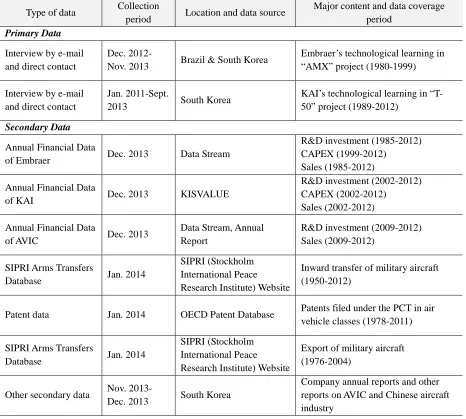
9 Table 1
Data sources for the study
Type of data Collection
period Location and data source
Major content and data coverage period
Primary Data
Interview by e-mail and direct contact
Dec.
2012-Nov. 2013 Brazil & South Korea
Embraer’s technological learning in “AMX” project (1980-1999)
Interview by e-mail and direct contact
Jan. 2011-Sept.
2013 South Korea
KAI’s technological learning in “T-50” project (1989-2012)
Secondary Data
Annual Financial Data
of Embraer Dec. 2013 Data Stream
R&D investment (1985-2012) CAPEX (1999-2012)
Sales (1985-2012) Annual Financial Data
of KAI Dec. 2013 KISVALUE
R&D investment (2002-2012) CAPEX (2002-2012)
Sales (2002-2012) Annual Financial Data
of AVIC Dec. 2013
Data Stream, Annual Report
R&D investment (2009-2012) Sales (2009-2012)
SIPRI Arms Transfers
Database Jan. 2014
SIPRI (Stockholm International Peace Research Institute) Website
Inward transfer of military aircraft (1950-2012)
Patent data Jan. 2014 OECD Patent Database Patents filed under the PCT in air vehicle classes (1978-2011)
SIPRI Arms Transfers
Database Jan. 2014
SIPRI (Stockholm International Peace Research Institute) Website
Export of military aircraft (1976-2004)
Other secondary data Nov.
2013-Dec. 2013 South Korea
10 4. Paths of latecomers’ technological learning
4.1. Determinants and patterns of technology acquisition modes 4.1.1. Knowledge-base and technology acquisition modes
Brazil’s military aircraft industry is well represented by Embraer which is responsible for around 80 percent of the production activity in the sector (Maculan, 2013). In the early years, Brazil adopted industrial policies to raise the level of local technological research rather than focusing on enhancing their production capacities. In a consistent manner, Moxon, one of the first scholars to argue the features special to Embraer’s development paradigm, held that “Embraer had focused on the design and manufacture of airframes, and systems integration and testing. Not that it was never involved in pure assembly operations of both military and civilian planes, or in subcontract work, but these were never the company’s main concern” (Moxon, 1987). Likewise, Brazil's acquisition mode was based on "Make" approach with their focus on technological knowledge. In order to understand the argument, it is important to address the origins of Embraer. After the Second World War, an influential Brazilian military general Carlos de Meira Mattos promoted ideas on enhancing Brazil’s international structure through the modernization of technological and industrial base (Sikkink, 1991). In reflection of his thought, CTA (Aerospace Technical Center) was established in 1945 to coordinate aerospace research activities (See Figure 3). The engineering school “ITA” (Aeronautics Technological Institute) was also established in 1950 with the inspiration of Air Force hero Casimiro Montenegro Filho. In the early years, ITA established international cooperation with MIT (Massachusetts Institute of Technology) and Caltech (California Institute of Technology) to make sure that the aviation sector would engage in self-sustaining R&D. The successful launch of education system at both undergraduate and graduate-level resulted in supporting CTA, the ITA’s umbrella organization, by fulfilling its demand for engineers. More importantly, the first president of Embraer was an engineer graduated from ITA who had spearheaded the development of the very first aircraft prototype “Bandeirante”. Not only the president of Embraer, but most of the engineers and staff of Embraer had been graduates of ITA or researchers at CTA. In other words, Embra, established in 1969, was a natural spin off of the CTA (Maculan, 2013).
11
Fig. 3. The evolution of military aircraft industries in Brazil, South Korea, and China
Source: Modified from Cho (2003), Maculan (2013), Nolan and Zhang (2002)
Note: * The establishment date of Chinese and Brazilian firms may be the same as their entrance into aircraft industry. However, since some of South Korean suppliers’ establishment date does not match their entrance into aircraft industry, we use their entrance years.
Table 2
Stylized differences derived from the origins of latecomer firms in military aircraft industry
Brazil - Embraer South Korea - KAI China - AVIC Origin of firm Research institute and
university
Spunoff as a state -owned company
Multiple suppliers Consolidated as one government-owned company
Multiple suppliers Consolidated as one government-owned company
Innovation ecosystem Concentrated on one location
Moderately dispersed over few locations
Dispersed over multiple locations
Focus of knowledge-base Research Production Production
12
consolidation in aerospace manufacturing to drive economic reform in the late 1990s when Asian economy was under crisis. The three subsidiaries of Korean conglomerates including Samsung Aerospace, Daewoo Heavy Machinery and Hyundai Space and Aircraft were consolidated into KAI (Korea Aerospace Industries).
Although South Korea and China have eventually pursued the national champion model of Brazil, there are some differences in terms of firm status, innovation ecosystem, and focus of knowledge-base (See Table 2). Whereas Embraer was privatized in 1994, AVIC and KAI have remained as government-owned enterprises. In terms of their innovation ecosystem, Brazil’s aerospace industry is concentrated around the single cluster “São José dos Campos”. In contrast, China has its multiple suppliers in a dozen of locations all over China involved with aeronautical maintenance and production work. Their locations include Shenyang and Harbin in the northeast, Chengdu in the southwest, and other facilities around Shanghai, Xian and Taiyuan (Vertesy and Szirmai, 2010). Korea also has its suppliers dispersed over several locations but to a lesser extent. Multiple Korean suppliers were the beneficiary of the Aircraft Industry Promotion Law in 1984 which allowed the new entry of the subsidiaries controlled by Korean conglomerates.
Above all, these differences are reflected in each country’s approach toward research and production activities. In order to empirically validate the difference in their focus of knowledge-base, two firm-level measures have been used. First, R&D intensity is the amount of R&D investment divided by annual sales. As indicated in Figure 4, the average R&D intensity of Embraer from 1985 to 1991 marks 26.5 percent, which is significantly higher than that of AVIC and KAI in 2000s. Before 1985, Embraer’s R&D intensity records 3.8 percent in 1983 and 7.5 percent in 1984 (Frischtak, 1994).1 Even in the 2000s, Embraer focus on R&D activities in both commercial and executive jets. Their R&D goals include reducing fuel efficiency and using bio-fuel as an alternative energy source. Composite material and structures for aircraft wings and fuselage are also Embraer’s key focus in order to reduce the aircraft weight as much as 15 percent. In the case of AVIC, although AVIC is catching up with Embraer in terms of R&D intensity, its R&D intensity is incomparable to that of Embraer in earlier years. KAI shows its insufficient R&D activities with its lowest R&D intensity among the three latecomer firms. This is consistent with Cho (2003)’s observation that the level of know-how related to system integration design, test, and evaluation is poor. Cho (2003) also stressed the weaknesses in avionics and flight control due to the lack of local R&D in these areas.
We have also developed a surrogate measure for production intensity which is the amount of CAPEX (Capital Expenditure) divided by annual sales. In fact, capital expenditures are integral to the operations of most manufacturing companies including aircraft manufacturers within aerospace industry, which must regularly upgrade physical assets (equipment, plant and property, and industrial building and warehouses) or acquire new ones in order to remain competitive (DTI, 2006). Despite the above logic, we admit that there are some limits to this measure, due to the lack of its confirmatory nature. However, we cannot negate the importance of using capital expenditure as a surrogate measure to compare the production intensity of the latecomer firms.
Embraer shows a lower level of production intensity compared to that of KAI (See Figure 5). Nevertheless, it may be inappropriate to claim that Embraer has weakness in production capacity. In fact, Embraer strategically uses risk-sharing partnership for production activities. To sum up, we may assume from our empirical data that the focus of knowledge-base for Brazil has been technological research. In contrast, the foci of East Asian latecomers have been enhancing their production capacity which is consistent with previous literature on industrial policies of Latin America and East Asia.
1 The data on Figure 4 and 5 has limitations, as it does not address military aircraft-specific nor project-specific
13 Fig. 4. R&D intensity of latecomer firms in aircraft industry
Source: Annual reports, KisValue, Frischtak (1994), Goldstein (2002), Casanova et al., (2009)
14 Fig. 5. Production intensity of latecomer firms in aircraft industry
Source: Thompson Datastream, KisValue, Annual Reports
4.1.2. Role of foreign partnership and technology acquisition modes
For latecomers to build a military aircraft, it requires extensive R&D at high costs and reliance on subsequent demand to offset these costs. Relying solely on domestic demand is risky for latecomers, as it is extremely difficult for them to take advantage of economies of scale. More importantly, many latecomer firms in military aircraft industry encounter difficulty in acquiring core technologies. In order to acquire core
technologies, latecomers absorb information and know-how by collaborating with foreign partners from developed countries (Ahuja, 2000; Powell et al., 2005). Since military aircraft industry represents security-sensitive features, various technology acquisition strategies are used by latecomers. In particular, China shows its distinctive strategies in acquiring technology from abroad, as it has been isolated from access to western knowledge-base (See Figure 6). The history of Chinese military aircraft formally dates back to the 1950’s when high political tensions were created by the Cold War. At the time, China essentially had no groundwork to indigenously design and produce military aircraft with its limited industrial capacity and Western countries banned manufacturers from exporting military aircraft to China. As a result, China relied on Russia (Formerly the Soviet Union) and Eastern European countries that were more accommodating than Western countries. In the early stage, China benefited from the Soviet Union, which committed human and financial resources to
transform its communist partner China into a self-sufficient defense partner. For instance, China purchased Soviet fighters in order to arrange co-production agreements and resolve technical constraints (Saunders and Wiseman, 2011).
After the Sino-Soviet split in 1960s, Soviet advisors and its technical assistance withdrew. This resulted in the isolation of Chinese military aircraft industry, as the country lacked relationships with Western countries to access cutting-edge military technologies. This forced China to focus on reverse engineering on aircraft that were previously purchased from the Soviet Union.Since then, access to foreign knowledge-base via formal mechanisms has been limited. However, with Deng Xiaoping’s open policy and reform in the late 1970s with the introduction of 16 Character Policy, China began to enter into a few co-production projects in
15
accessibility to Western technology, China still had a hard time establishing a stable relationship with foreign suppliers which limited itself to licensed production projects with little room to acquire advanced technologies. Not long after partially regaining the access to foreign knowledge-base, China faced economic sanctions stemming from the Tiananmen Square incident in 1989. As a result, China put its efforts to purchase small quantities of advanced fighters and aviation components in the 80s and early 90s. However, the United States and other western countries had no motivation to sell even a small number of fighter aircraft to China, as reverse engineering was the most preferred strategy for China. In order to cope with the circumstance, China adopted a spin-on approach which allowed acquired knowledge on civilian aviation to be adapted to its military
applications. In fact, Chengdu Aircraft Industry’s subcontracting facilities operated both military and
commercial production lines close to one another (Fisher, 2004). Regardless of their hardships, China became capable of producing fourth-generation fighters based on reverse engineering efforts which were the by-product of co-production agreement with the Soviet Union and Russia. This co-production agreement provided China with complete knock-down kits for indigenous production. Although they made limited developments in genuinely new innovative technology, China benefited significantly from “follower’s advantage” through imitation and modification (Saunders and Wiseman, 2011).
In contrast, South Korea and Brazil had stable and favorable collaborations with their Western partners (See Figure 6). For instance, whereas China’s sub-contractors were generally able to contract for Level 3 agreement, South Korea and Brazilian firms were familiar with Level 4 or 5 agreement involving co-financing and co-designing (Nolan and Zhang, 2002). This is consistent with the argument that with the reputation earned from co-production arrangement, a form of co-development scheme such as joint venture project is realized for latecomers (Luo and Tung, 2007). The main difference between Brazil and South Korea’s technology
acquisition lies in the fact whereas the former relied on a number of foreign actors including research institute and universities; the latter was somehow dependent on foreign suppliers. Embraer established a procurement agreement with NASA to transfer information on wing sections and foreign universities for training highly qualified engineers in research skills. Embraer also entered into an agreement with a general aircraft
16 Fig. 6. Import of military aircraft to Korea, Brazil, and China
Source: SIPRI Arms Transfers Database Note: The period over 1950 to 2012
Fig. 7. Technology acquisition strategies adopted by the three latecomers
17
4.2. International technology transfer and latecomers’ technological advancement 4.2.1. China
The first technological advancement in China’s military aircraft extends from 1957 to 1977. The J-6 was the first Chinese-produced product which benefited from licensing agreement made in 1957 and 1959 with the Soviet Union. Through this project, China gained their competence in manufacturing the necessary tooling and assembling the aircraft. However, when Soviet advisors and its technical assistance withdrew after Sino-Soviet split, China had to focus on reverse engineering of aircraft previously purchased from the Sino-Soviet Union. The J-7 program which was a follow-up project of J-6 provided China with opportunities to master reverse engineering to produce a moderate level of fighters without the support of foreign partners (Saunders and Wiseman, 2011). Since the economic reforms in 1978, the rest of the period was marked by enhanced access to Western technology for China. In 1979 China and British defense firm GEC-Marconi entered into a license agreement to produce the J-7II tactical fighter, as well as F-7 with a complete avionic suite. This avionics included radar, weapons-aiming computer and state-of-the art display systems, and marked a huge advance in Chinese military aircraft industry. China also cooperated with Israel starting from 1982 and obtained FBW (Fly-by-wire) technology. Advances in Chinese military aircraft from the late 1970s to the late 1980s primarily resulted from the enhanced exposure to more sophisticated Western technologies. The knowledge acquired by collaborating with these two foreign partners led China to perform reverse engineering in modifying design to accommodate new systems (Saunders and Wiseman, 2011). From 1989 to 2004, China actively pursued acquisitions of advanced aircraft from Russia, Ukraine and Israel using a combination of co-production and reverse engineering to make improvement in design of subsystems and integration of advanced technologies into their own weapon systems. For instance, in 1996 China entered into a licensing agreement of J-11 with Russia which moved up China’s military aviation industry from third-generation to fourth-generation. The terms of the agreement were finalized and China received manufacturing document of the Su-27 along with complete knock-down kits from which they assembled its first two J-11s. In addition to acquisition and coproduction with Russia, China also continued to pursue alliance efforts with Israel. Ukraine also served as an important source for Russian military hardware that China had been unable to procure directly. As a result of all the efforts, China came up with innovations in their own indigenous capacity in building military aircraft (Saunders and Wiseman, 2011).
4.2.2. South Korea
18
4.3.2. The due diligence report generated by Lockheed Martin in 2001 remarked that Korea had reached the technological level to carry out indigenous aircraft development. To sum up, Korea effectively used this subcontracting agreement in the early years to build reputation and credibility, which eventually contributed to attracting investment of Lockheed Martin in T-50 project.
4.2.3. Brazil
In the case of Brazil, the first technological advancement was pursued when Brazil was facing problems with limited knowledge and capacity to manufacture and assemble the first modern Brazilian aircraft prototype “Bandeirante” on an industrial scale. To cope with this issue, Embraer entered into a licensing agreement with an Italian firm “Aermacchi” in 1970 to produce a small jet trainer and fighter “Xavante”. This agreement provided Brazil with opportunities to acquire critical production knowledge in tooling and parts manufacturing, tracing technology and assembly of planes (Ramamurti, 1985). The second technological advancement in production skills of Embraer took place in 1975 with an offset purchasing of forty-nine Tigher II supersonic fighters. As a result, Embraer signed a licensing agreement to produce F-5 fighter parts and components for Northtrop. It was an offset contract Embraer signed in for the construction of a hundred F-5 vertical fins, rudders, wings and belly pylons, against the procurement of fifty F-5. Thanks to the procurement made between the Brazilian Air Force and Northrop, Embraer employees learned how to efficiently implement cutting-edge technologies such as metal-metal bonding, aluminum-magnesium alloy machining and aluminum honeycomb manufacturing. A number of major technologies were learned during the process, including chemical milling, metal-to-metal and structural bonding and the use of composite materials. In addition, the contract also forced the use of numerically controlled machine tools in improving tool design, quality assurance and other production techniques. By the mid-1970s Embraer had acquired significant know-how in aircraft design, manufacturing, commercialization and servicing (Frischtak, 1994; Rodengen, 2009). Embraer also entered into a co-development agreement with Italian aircraft manufacturers, “Aeritalia” and aerMacchi in 1981. The agreement led Embraer to join the development of ground-attack aircraft “AMX” and absorb highly-sophisticated technologies such as computer integration and fly-by-wire technology. The deal also provided Embraer with avionics engineering knowledge that would prove especially useful for Embraer’s future
technological development. By the end of this development project, Brazil became technologically independent and gained strong military aircraft technology to carry out indigenous development programs (Balbinot, 2006; Rodengen, 2009).
4.3. Summary of learning process and milestone projects
Fig. 8. Process of learning-by-doing for the three latecomer countries in military aircraft sector
19
The analysis in previous section led us to understand technological advancement in each country’s military aircraft industry. Based on the analysis, Figure 8 describes the process of learning-by-doing.
Component manufacturing and assembly activities associated with learning-by-doing took place in the second place for all three latecomers. What differentiates one from another is that for Brazil, design and development was emphasized in the early stage which is a bit unusual for latecomers. In contrast, South Korea and China practiced their learning via maintenance, repair, and operations of purchased aircraft. As addressed in the earlier section, the difference is derived from the pattern of establishing knowledge-base influenced by latecomers’ industrial policy. However, all three latecomer countries focus on system integration activities during the last stage of learning-by-doing. In order to focus on this key technological capability “system integration” for CoPS, we have documented milestone projects of Brazil and South Korea that were carried out in the form of joint venture: AMX project for Brazil and T-50 project for South Korea.
4.3.1. AMX of Brazil
Embraer entered into the co-development agreement with the two Italian firms “Aeritália” and “Aermacchi” to co-design and produce AMX in 1980. The project was carried out in the form of joint venture with a share of 46 percent for Aeritália, 24 percent for Aermacchi, and 30 percent for Embraer (Cassiolato et al., 2002). The project was very important for Embraer, as the opportunity to gain knowledge in more advanced technologies was given (Neto, 1991). Indeed, Embraer became the first Brazilian company to adopt and use CAD (Computer-aided Design) system. In addition, the project was fundamental for Embraer to gain experience in managing complex business relations. For instance, Embraer was able to practice and develop expertise in project management and system integration by collaborating with domestic suppliers located in the cluster.
[image:20.595.67.533.494.672.2]The first prototype of AMX flew in May 1984. The production began in mid-1986, and the first thirty-unit batch rolled out in 1988. A second contract was signed in 1988 for Brazil to produce 25 AMX jets. A third production lot was authorized in early 1992. Approximately 190 AMX jets are currently in operation in the Italian and Brazilian Air Forces. In 1999, the AMX-T won a bid to supply Venezuela (Goldstein, 2002). Despite the contributions of AMX project to Brazil’s technological advancement in military aircraft industry, most of the AMX jets were sold to the two participant countries including Brazil and Italy which was never an export success (Cassiolato, 2002).
Table 3
Division of labor for Brazil and Korea’s military aircraft projects Project Participating
firms
Share of labor
Share of
equity Work contents
AMX
Embraer
(Brazil) 30% 30%
Wings and Elevators, Air Intakes, Pylons, Landing Gear, Fuel Tanks, Reconnaissance Pallet, and Installation of Cannons Aeritalia
(Italy) 48% 46%
Central Fuselage, Rudder and Fin, Radome, Fiber-Carbon Components for the Wings and Tail
AerMacchi
(Italy) 22% 24% Front and Rear Fuselage
T-50
KAI (South
Korea) 50% 87%
Prime Contractor, Aircraft Design and Integration, Major Component Fabrication, Mate-Thru-Delivery
Lockheed
Martin (U.S) 50% 13%
Investor and Principle Subcontractor in Full-Scale Development, Flight Control, Avionics, and Wing Development, Technical Assistance
Source: Adopted from Balbinot and Lockheed Martin
20
Aeritalia and Aermacchi would be responsible for producing the fuselage, onboard systems, and carry out the static tests and tests with weapons. The reason why Embraer’s work contents were concentrated on minor parts is that Embraer preferred a strategy whereby its engineers design the aircraft body, wings and tail but use the global supply chain for components (Carrico, 2013). Likewise, Embraer’s philosophy and technological strategy is focused mainly on the essential competencies. In the past, software and technological systems were developed largely within the company, but now they are ordered, purchased or jointly developed (Cassiolato et al., 2002).
4.3.2. T-50 of South Korea
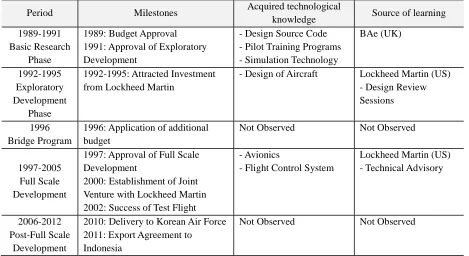
[image:21.595.65.534.350.606.2]In contrast to Brazil’s case, KAI of South Korea designed and manufactured most of the parts with the technical support of foreign manufacturers. During the basic research phase of T-50 project from 1989 to 1991, Korea sought international collaboration made through offset (See Table 4). At the time, Korean defense acquisition regulations specified 30 percent of the purchase price as offset when purchasing weapons. Taking advantage of this situation, Korea was able to receive support from BAe in securing basic knowledge in aircraft design. Korea dispatched 24 engineers to BAe for 14 months. From 1992 to 1995, Korea collaborated with Lockheed Martin in designing T-50. Review sessions were held every three months which fostered the successful transfer of advanced knowledge in aircraft design. Market research activities led by Korean team resulted in forming a joint venture partnership with Lockheed Martin.
Table 4
History of T-50 development of South Korea
Period Milestones Acquired technological
knowledge Source of learning 1989-1991
Basic Research Phase
1989: Budget Approval 1991: Approval of Exploratory Development
- Design Source Code - Pilot Training Programs - Simulation Technology
BAe (UK)
1992-1995 Exploratory Development
Phase
1992-1995: Attracted Investment from Lockheed Martin
- Design of Aircraft Lockheed Martin (US) - Design Review Sessions
1996 Bridge Program
1996: Application of additional budget
Not Observed Not Observed
1997-2005 Full Scale Development
1997: Approval of Full Scale Development
2000: Establishment of Joint Venture with Lockheed Martin 2002: Success of Test Flight
- Avionics
- Flight Control System
Lockheed Martin (US) - Technical Advisory
2006-2012 Post-Full Scale
Development
2010: Delivery to Korean Air Force 2011: Export Agreement to
Indonesia
Not Observed Not Observed
Source: Elaborated from the interview with chief engineer of T-50 project
21
2003, Korean Air Force approved the initial 50 manufacturing plan. With the successful completion of the T-50 development program, Korea entered a post-full scale development phase and Korean Air Force began to receive T-50 aircraft from May, 2010 and operated the new training system. The project was launched in 1997 and, after the first trial flight in August 2002, T-50 succeeded in the supersonic flight in February 2003. A very significant aspect of this project was that the export contract of T-50s to Indonesia were signed in 2011, a $400 million order for sixteen T-50s. Additional twenty-four T-50s have been exported to Iraq as well (Lee et al., 2009; Lee and Chung, 2011).
4.4. Learning outcome
Fig. 9. Cumulative patent applications filed under the PCT in air vehicle classes
Source: OECD Patent Database
In order to measure the learning outcome, we have gathered patent applications filed under PCT by referring to IPC (International Patent Classification) on lighter-than-air aircraft (B64B) and airplanes and helicopter (B64C). We used PCT applications as a relevant measure of learning outcome, as the patent count data reflects technological advancement in aerospace industry (Beaudry, 2001; Winthrop et al., 2002). In fact, since applying for a PCT patent involves considerable costs and time, firms file as a PCT patent applications inventions that they consider as important and deemed to be profitable and applicable in other countries (Noailly and Batrakova, 2010). Many scholars used WIPO data to compare the number of PCT patents in a number of industries throughout various time periods (Jung and Imm, 2002; Hullmann and Meyer, 2003; Noailly and Batrakova, 2010). In their patent analysis, the number of PCT patents owned by Korea in 1990s has also been taken into account.
22
the mid-1990s which in turn helped China retain more sophisticated design capabilities (Saunders and Wiseman, 2011). In a similar context, South Korea entered into a period of full-scale development for T-50 in 1997 with the technical support of Lockheed Martin. Above all, consolidation of existing suppliers into one system integrator in the late 90s for both China and South Korea may have contributed to sharp increase in the number of patents. Not only could patents be proxy measures for technological learning outcome, but export is a good proxy in innovation literature. With the rapid catch-up in generation of jet fighters and quantity-oriented production system, China’s export constantly has grown (See Figure 10). In contrast, Brazil’s growth in export market has been quite modest, since Brazil redirected their strategic focus to commercial aircraft and executive jets in the 1990s. South Korea has exported some products but the amount is incomparable to the former two latecomers. This may have been due to Korea’s relatively late entry into the military aircraft industry compared to Brazil and China.
Fig. 10. Cumulative export of military aircraft by each of the three countries2
Source: SIPRI Arms Transfer
Note: SIPRI TIV is based on the known unit production costs of a core set of weapons and is intended to represent the transfer of military resources rather than the financial value of the transfer (See SIPRI Website: http://www.sipri.org/databases/armstransfers/background/explanations2_default)
2 Owing to the absence of military aircraft export volume at project-level, we have adopted the cumulative
23
Localization rate of parts and components produced and supplied by domestic firms is another important indicator of defense industrial performance (Bitzinger, 2011). South Korea’s KT-1 trainer had a localization rate of only 44 percent, while the localization rate for T-50 advanced trainer/light attack jet was 61 percent (Bitzinger, 2011). In a similar context, the localization rate of China’s J-11 has reached almost 100 percent. Nevertheless, in terms design capabilities; Asian latecomers have not fully developed design and program management skills as evidenced by full-scale program involving global partners (Bédier et al., 2008). As for Brazil, more than half of Bandeirante consisted of imported parts with low localization rate (Casanova et al., 2009). Even after gaining indigenous technological capability, the localization rate of Embraer’s aircraft ranged from 50 to 60 percent which reflects the firm’s strategy of ordering and integrating parts and components produced abroad (Neto, 1991). As a result, Brazil still shows some weakness in local aerospace-manufacturing base (Bédier et al., 2008).
5. Industrial policy initiatives to attain indigenous technological capability
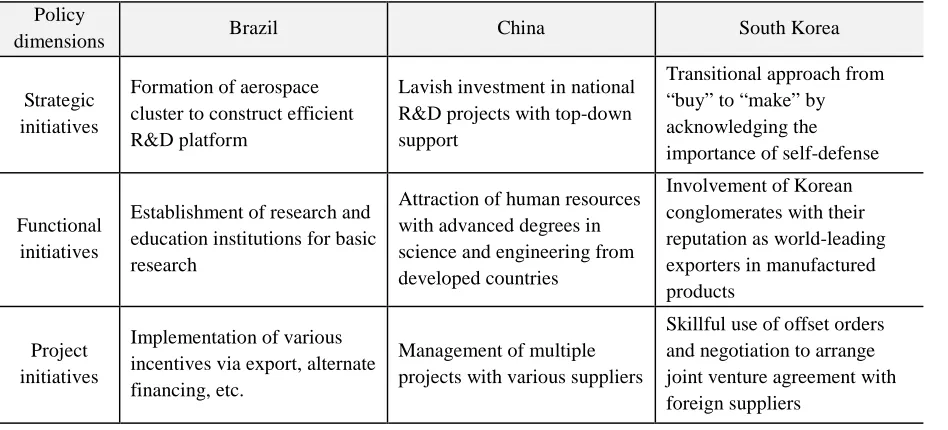
Based on the analysis results, we now examine government policies related to three areas: strategic, functional, and project initiatives. Approaching government policies from these three perspectives will provide groundwork for latecomers’ technological learning in CoPS (See Table 5).
5.1. Strategic initiatives to set national goals
“Although the country has had other initiatives and aircraft factories, it was in São José dos Campos that the modern Brazilian aerospace industry was born.” (Brazilian Aerospace Cluster)
The success of military aircraft industry depends on government support for R&D activities requiring components and parts which may be widely dispersed in terms of both industry and location (Niosi and Zhegu, 2005). In other words, government needs to understand the importance of forming industrial clusters to support the R&D activities in an efficient manner. Successive Brazilian government understood its importance and formed an aerospace cluster in the city of São José dos Campos in São Paulo State. The education and research institutions including CTA, ITA, IPD (Research and Development Institute) and INPE (National Institute of Space Research) were established within the cluster. This group was to have considerable influence on the creation of Embraer later in 1969 which made the cluster region become a hub of aerospace companies.
Although Niosi and Zhegu (2005) found that the role of universities and government laboratories is secondary in aerospace cluster by using the cases of developed countries, we found that the formation of aerospace cluster helped Brazil to concentrate key infrastructure and thereby maximize the agglomeration effect.
“The senior body of China's Communist Party is the Politburo's standing committee. Making up its nine members are eight engineers, and one lawyer.” (Economist, 2009)
Since 2000, China has increased R&D spending roughly 10 percent each year and sustained their commitment even during the crisis period in 2008 and 2009. Such unprecedented efforts in a national innovation initiative are part of China’s national plan “indigenous innovation” to leapfrog into a leadership role in science-based industry worldwide. However, this may not have been possible without recognizing the importance of science and technology in modern day economy. For instance in 2006, President Hu Jintao stated that “In the face of international scientific development and increased international competition, by seeing the development of science and technology as a central thread in the development strategy and actively committing to its progress, China can seize the opportunity for development.” One month after his speech, Chinese government announced the national plan “indigenous innovation” (McGregor, 2010). Likewise, technocrat leadership which recognizes the importance of R&D and makes a lavish investment has been a critical factor for the success of the complex product project at national level.
“T-50 development program was initiated to stimulate Korean aerospace industry and promote its self-defense and own air weapons system.” (Director of Golden Eagle Engineering Research Center)
24
Accordingly, the project goals were set to develop and provide an advanced trainer and key component parts to Korean Air Force. However, policy makers were skeptical about investing in the project. Major issues were Korea’s technological capabilities and inexperienced manpower to develop aircraft. In addition, there were insufficient societal recognition for the development and general consensus favoring the use of purchased aircraft. In response to these issues, new goals and needs were created to persuade decision makers. The new goals and needs included technological, industrial and national security perspectives. First, from a technological perspective, the project goals were to (a) acquire the ability to design the aircraft, (b) establish a data
management system that efficiently secures accumulated technologies through systematic data collection, storage and management (c) maintain and manage manpower, and (d) acquire facilities, equipment, software and other tools required to develop aircrafts. In other words, the goals were created to satisfy the needs of Korean Air Force such as taking advantage of some important components (e.g., canopy and landing gear) during their operations. Secondly, the potential impact of component parts on Korean manufacturing industries was addressed, which would engage a number of industries and firms in Korea and its future aerospace industry. Lastly, from a national security perspective, the outcome of the project that could provide Korea with a firm foundation to pursue self-reliant defense systems was strongly put forward. With visionary leaders’ numerous attempts of persuasion after addressing the needs of stakeholders along with the goals above, Korean
government was able to reach a decision to make a transition in their approach from “buy” to “make” and initiate T-50 development project.
5.2. Functional initiatives to organize for innovation
"ITA is the beginning of everything at Embraer” (Interview with Embraer)
It is important to understand that in latecomers’ setting, the role of universities and research institutions is critical to conducting basic research prior to the embarkation of the industry. For instance, CTA and ITA were created in Brazil to reinforce their strategies to acquire knowledge and self-sufficiency in aviation industry. Most of the first generation aeronautical engineers graduated from ITA went to work for IPD. In other words, groundwork for basic science research should also be prepared in academia which is the basis for applied research. All these institutions have become a part of CTA and played important roles in Brazilian aviation industry.
ITA: Provided high level education and research in aerospace science and technology IPD: Performed R&D in aeronautical engineering, electronics, new materials and mechanics IAE (Institute of Space Activities): Performed space-related R&D
IFI (Institute of Development and Industrial Coordination): Coordinated and supported activities to consolidate and develop Brazilian aerospace industry
“Reverse engineering efforts led China to significant technological advancement that propelled their national defense industry to step forward” (Modified from Saunders and Wiseman, 2011).
Since the early 1950s, China established more than 400 research units to strategically focus on reverse engineering (Liu and White, 2001). Highly skilled Chinese scientists and engineers returned from the U.S. and finally the acquisition of foreign companies enabled China to access foreign technology and link up with global R&D. In addition, engineering and science majors have been the most favored academia in China. Among Chinese university graduates, 30 percent of them receive their first bachelor degree in science and engineering. Meanwhile, that of the U.S. only accounts for 4 percent. This indicates that China is well positioned to compete in advanced technology fields, even if they do not introduce dominant design in the first place (Stewart and Drake, 2011). This fact may also be relevant to explain the challenges that developed countries are facing in their emerging sectors such as energy and advanced materials. The avoidance of engineering careers coupled with the weakening of manufacturing industries and prevalent outsourcing practices hinders firms in developed countries from introducing innovations (Rotman, 2012). In particular, current trends of aviation industry reflect strong needs in integrating radical technologies from other sectors. Still, many firms tend to outsource
25
little chance to gain knowledge in sophisticated technology across diverse sectors. Therefore, it is critical to secure highly-skilled human resources and practice in-house manufacturing efforts in order to prepare for next generation aircraft (Delbridge and Mariotti, 2009).
“T-50 is the first national project supported by private suppliers which resulted in successful collaboration with Lockheed Martin” (Director of Golden Eagle Engineering Research Center)
T-50 is the first national defense project involving a number of private suppliers. There were four major corporations that had previously earned the reputation as world leading exporters in manufacturing. With the participation of these corporations, Lockheed Martin decided to finance 13 percent of the total investment and produce 50 percent of the total work content for T-50 project. Not only the decision to involve private entities was critical in forming a joint venture with Lockheed Martin, but the long-term partnership between Lockheed Martin and Korea over the last 20 years was also a key enabler. In fact, Korea effectively used subcontracting agreement in manufacturing and assembling components in the early years to build reputation and credibility, which contributed to attracting investment of Lockheed Martin in T-50 project.
5.3. Project initiatives to manage innovation
“The government and the Brazilian Armed Force bought roughly a third of Bandeirantes produced before 1980. They usually paid up-front and directly contributed to development expenditures” (Casanova et al., 2009)
Brazilian government put a large amount of effort in helping Embraer with financial, marketing, regulatory and international activities. BNDES (Brazilian Development Bank) provided Embraer’s customers with alternate financing along with export support scheme and tax holidays. In addition, BNDES and other public sector institutions have actively supported the R&D collaboration between Embraer and other research or academic institutions (Goldstein, 2002). The government also imposed a steep increase import duties to foreign aircraft manufacturers operating in Brazil, thereby inducing foreign manufacturers to provide assembly kits to Embraer.
“There are 33 institutes, 9 state-level key laboratories, 30 key aviation science & technology laboratories, 16 state-certified enterprise technology centers and 32 provincial-level enterprise technology centers” (AVIC)
As seen from the consolidation of AVIC, China has a number of suppliers in charge of producing jet fighters. Unlike other countries, multiple development projects have been implemented, thereby producing over 20,000 military aircraft of various types. As evidenced from a sheer number of different types of fighter aircraft produced over time, China shows its strong project capability in integrating various industrial participants in developing jet fighters. In fact, AVIC has become a corporation owning about 200 subsidiaries in 24 provinces and municipalities throughout China.
“We efficiently managed and controlled the project by establishing a platform to collaborate with Lockheed Martin and BAe” (Director of Golden Eagle Engineering Research Center)
26
[image:27.595.67.541.177.392.2]the F-16 from Lockheed Martin. As a result, Lockheed Martin was obligated to transfer design technologies to Korean engineers as part of the offset deal. Lockheed Martin also provided $20 million worth of expenses required for the technology transfer at free of charge, including expenses for software tools, equipment, technical data, technical assistance and personnel payroll .
Table 5
Latecomers’ organizational capabilities for technological learning Policy
dimensions Brazil China South Korea
Strategic initiatives
Formation of aerospace cluster to construct efficient R&D platform
Lavish investment in national R&D projects with top-down support
Transitional approach from “buy” to “make” by acknowledging the importance of self-defense
Functional initiatives
Establishment of research and education institutions for basic research
Attraction of human resources with advanced degrees in science and engineering from developed countries
Involvement of Korean conglomerates with their reputation as world-leading exporters in manufactured products
Project initiatives
Implementation of various incentives via export, alternate financing, etc.
Management of multiple projects with various suppliers
Skillful use of offset orders and negotiation to arrange joint venture agreement with foreign suppliers
6. Conclusions
This comparative case study shows how latecomers’ technological learning should be managed with technology acquisitions strategies and government policies. The authors answer the question by analyzing key technological advancement in developing an indigenous industry in military aircraft. Important gaps in the literature of complex product systems have been identified and addressed by our proposed framework based on theories of technology acquisition strategies and CoPS. The theoretical framework has been supported by presenting the cases of the three latecomers. These results lead us to a discussion of the prevalent ideas in the literature. Both literature in traditional and latecomers’ learning mechanisms may have overlooked the sequence of learning from technological knowledge to production knowledge, as most of the literature focus on the success of East Asian economies. We have identified evidence on latecomers’ shift from technological knowledge to production knowledge and vice-versa, which is contingent on their focus of knowledge base determined by industrial policy. By shedding light on the learning sequence and its antecedent, we also find specific technology acquisition methods in developing aircraft systems.
Whereas “buy” is more aligned with latecomers with production experiences, “make” is preferred by latecomers with the focus on basic research and technological knowledge. From the case of Brazil, we have witnessed the important role played by universities and government research institutes in developing CoPS with a focus on design capability. This phenomenon is similar to the catching-up of Korea and Taiwan in mass-produced goods (i.e. semi-conductor, electric products) that fostered the spin-offs and commercialization of the research outcomes from their universities and government research institutes. However, the institutions of the latter two East Asian countries have focused on production capability. Likewise, exploring the industry-specific success of latecomer countries bears of great importance, as they may show different technological learning patterns.