An Approach to User-Directed Search
in Interactive Problem Solving
A thesis submitted for the degree of Master of Science
of The Australian National University
Qin Yang
April 1991
,
I "
,
I
, I, .1
I l
!
I
~
dL
\-\0~~
S.UU~~
UV RARY~
-¥-1 <+-C) 1"'ONAL ut~ ~~
,
~
Acknowledgements
It has been a most rewarding experience for me to study in the Department of
Computer Science. This is not only because of the academic abilities of the staff
from whom I have learned so much, but also because of an atmosphere of friendship and close co-operation throughout the department fostered by the Head, Robin B. Stanton, which has made the learning very enjoyable.
I am greatly indebted to my supervisor, Prof. Robin B. Stanton, for his constant
support, cheerful encouragement and expert advice in all stages of my research. His
scientific insight and patient guidance have led me into the interesting field of expert
system research and have enabled this research to be accomplished.
I would like to express my gratitude to Dr. Vicki Peterson and Dr. Qing Li for
their helpful comments and suggestions which made the thesis more accurate and
precise. Thanks are due to the programmers, David Hawking, Drew Corrigan and
I van Dean, for their readily available technical assistance.
I should thank my fellow students: Graham Willians, Jason Lan, Seppo Kero-nen, Dan Zhou, Jian Yang, Jimmy Wang, Bill Zhou and Ely Albacea, who have provided so many friendly talks and useful discussions. In particular, I am very thankful to Dharmendra Sharma and James Popple for their kind help whenever it
was requested.
I am very grateful to my close friend, Dr. Gang-Ding Peng, for his constant help
and critical advice. lowe Dr. Adrian Ankiewicz and Stan Jones many thanks for
their friendship and proof-reading of the manuscript.
I wish to thank my parents for their love, encouragement and support.
Finally, my thanks go to the Australian National University for much appreciated
I
t
,
'i
,;
i
, ,
~
11 Acknowledgements
financial support.
1
Declaration
This thesis describes the original work of the
author. Where this work is based on the work
of others, this is clearly indicated in the text.
Qin Yang
-~
,I
,I
"
"
,I
I,
1
Abstract
This thesis studies some problems which are important in establishing interactive
problem solving systems. An interactive problem solving system is characterized
by the intensive interaction between the user and the system. In order to converge
on a solution which satisfies the user, we present a new problem solving scheme -user-directed search (UDS) - where the solution search is directed in a step-by-step
manner by the user. Because of its wide applicability, UDS can be very useful for
many practic~l cases.
The user-directed problem solving is realized by introducing a particular com -munication mechanism between the user and the system. This enables a user to
guide the solution searching in his most preferred directions. Thus the system can
first explore the solutions which are more likely to match the user-desired solution.
We have developed UDS using two different approaches.
In the first approach, additional deduction rules can be created upon the user's request and/or upon changes in practical environments. For this purpose, we have created, in the user interface, an environment which enables a user to add his new
requirements in the form of deduction rules. To improve efficiency, we have used a particular backjump search which can first find, and then backjump to, the point
which contradicts the user's new requirements. To establish the dependency for this
backjumping, we have used assumption-based truth maintenance systems (ATMS)
and KEEworlds in the knowledge engineering environment(KEE).
In the second approach, we have introduced particular variable groups. In this
approach, the user's new requirements are introduced through a scheme in which the
user divides the variable set into several different variable groups. By dividing these
III
!
I
::
I
I
IV Abstract
variable groups according to his choice, a user can effectively control and instruct
the search during the process of problem solving. We have introduced here a scheme
which we call proximal minimum (closeness) change. The proximal minimum change
ensures that, in the direction specified by the user, a closest solution to the previous
one will be found if it actually exists.
In another aspect, in order to improve efficiency of solution search on a
gen-eral basis, we have applied some techniques from Constraint Satisfaction Problems
(CSP) in establishing non-CSP expert systems, e.g. rule-based and frame-structured
expert systems on KEE. We find that these CSP techniques can be used to improve
efficiency by performing consistency checking prior to searching for a solution, which
we call pre-processing. This pre-processing is introduced to eliminate a number of
variable values which are inconsistent with certain unary and binary constraints. In
practical applications, this method can be used to avoid a considerable amount of
useless backtracking. We have developed an independent module for applying CSP
techniques in general purpose programming in KEE. This CSP module provides
KEE with ability to establish more versatile expert systems.
Through case studies of the truck dispatching problem and the word puzzle
prob-lem, we demonstrate how to achieve UDS and how to implement various techniques
which we have presented to improve efficiency in UDS. Some of the advantages of
Contents
1 Introduction
1.1 Expert Systems
1.2 Problem Solving.
1.3 Search Strategies
1.4 Design Goals
..
1.5 Overview of Thesis2 KEE, ATMS, KEEworlds
2.1 KEE
. . .
2.1.1 Knowledge Representation
2.2 Assumption-Based Truth Maintenance System (ATMS)
2.2.1 Deduction Rules and Justifications
2.2.2 Constraints
2.3 KEEworlds ..
2.3.1 Worlds.
2.3.2 Worlds and Forwarding Chaining
2.3.3 Worlds and Justifications. . . . .
3 Constraint Satisfaction Problem Techniques
3.1 Introduction...···
3.2 Constraint Satisfaction Problems Definition
3.3 A Network Representation of a CSP .
3.4 Inconsistency and Consistency . . .
3.4.1 Node Consistency Checking
v 1 1 5 7 8 11 15
16
17
21 22 22 23 2426
26
2929
30 34 3537
I L I" ,
VI Contents
3.4.2
Arc Consistency Checking38
3.4.3
Path Consistency Checking39
3.5
Summary39
4 Implementation of CSP Techniques in
KEE
414
.
1
Introduction41
4
.
2
CSP Representation in KEE42
4.2.1
NODES unit44
4.2.2
ARCS Unit50
4.2.3
PATHS unit54
~
4
.
2.4
BOSS unit.54
4.3
Consistency Checking Implementation in KEE57
clL\\a
~~
4.3.1
NODE.CONSISTENCIES Unit57
4.3.2
ARC.CONSISTENCIES Unit58
S.Uu
4.3.3
PATH.CONSISTENCIES Unit62
4
.
3.4
An Example.63
4.4
Discussion66
5 Two Strategies for User-Directed Search 67
5.1
Introduction67
5
.
2
UDS68
5.3
Backjumping.
69
5.4
Constraint Recording.
.
75
5.5
Variable Classification76
5.6
Comparison of two strategies .80
.
6 Case Study I: Truck Dispatching Problem 83
6.1
Introduction83
6.2
Problem Description85
6.2.1
Static Constraints.85
6.2.2
Dynamic Constraints86
6.3
System Overview87
1
Contents Vll
6.3.1
Flow of Control87
6.3.2
Design Features88
6.4
Knowledge Representation90
6.4.1
Truck Dispatching Knowledge90
6.4.2
Constraint Rules and Dispatching Rules94
6.5
CSP for Data Pre-Processing97
6.6
Constraint-Based Search...
99
I:
6.6
.
1
Constraints and Search .·
100
6.6.2
Rule- Based Reasoning·
101
6.7
Constraint Recording While Searching· 105
6.8
Backjumping for UDS· 107
~ i6.9
Summary...
.
.
..
· 110
7 Case Study II: Crossword Puzzle Problem 111 I I
I
7.1
Introduction . . . . . . . . . . . . . . . . . ....
.
.
· 111
7.2
Problem Description and Knowledge Representation.· 113
I I7.3
Searching Scheme . . . . . . . . . .· 115
7
.
3.1
Deduction Rules for Constraints .· 115
7.3.2
Action Rules for Search...
· 117
7.4
U ser-Directed Search Implementation· 121
7.4.1
Variable Classifying.·
121
7.4.2
Domain Reordering .·
123
7.4.3
Variable Reordering.· 125
7.4.4
Minimum Changes·
126
I I
7.5
CSP Techniques for Filtering.·
128
I
7
.
5.1
Data Pre-Processing·
128
7.5.2
Two Level Filters in UDS· 129
:
7.6
An Example of UDS· 131
7.7
Summary.
.
.
.
..
· 133
8 ' Conclusions and Further Directions 135
I
.-1
Vlll Contents
Appendix 139
1
List of Figures
1.1 A schematic expert system . . . .
2.1 The main packages and facilities in KEE.
2.2 in.new.world creates worlds under an exclusion set.
2.3 A world graph from truck dispatching problem.
3.1 An example backtrack search tree.. . . .
3.2 The constraint network of a graph-colouring problem.
4.1 The representation of NODES unit and its descendants
4.2 ARCS unit and its descendants.
4.3 PATHS unit and its descendants.
2
16
20
25 34 35 45 51 534.4 NAP. CONSISTENCIES unit and its descendants 57
4.5 A constraint satisfaction problem: crossword puzzle. . 63
4.6 (a). The original constraint network for the crossword puzzle. (b).
The constraint network after applying the N APCC module for node
consistency checking. . . . . . . . . . . . .. 64
4.7 (a). The detailed process of performing arc consistency checking.
(b). The constraint network after applying the NAPCC module for
arc consistency checking. . . .
4.8 A solution for a crossword puzzle.
5.1 The algorithm of searching for a possible solution.
5.2 Main control algorithm and UDS1. . . , . . . ..
5.3 An, agorithm for collecting user's new requirements.
- ~
x List of Figures
5.4 Backjumping agorithm of UDS1.. . 74
5.5 Main control Algorithm for UDS2. 77
5.6 The algorithm of searching for a possible solution for UDS2. 79 5.7 Algorithm for UDS2. . . . . . . . . . . . . . . . . 81
5.8 The algorithm of closeness change on the variables in the base group. 82 6.1 The control structure of a truck dispatching system. . 89
6.2 Trucks hierarchy for representing all the trucks. 91
6.3 The constraint network of a truck dispatching problem. 98
6.4 Search spaces, candidate trucks and drivers before and after
perform-~
6.5 ing data pre-processing. The rule hierarchy used for our truck dispatching problem. 103 99cIC
\-\0~~
6.66.7
An example of the information accumulated during searching. 106
An example of backjumping in UDS. . . . . . . . 109
S.Uu
7.1 A crossword puzzle as a constraint satisfaction problem. 114
7.2 The constraint network for the crossword puzzle in Figure 7.1. 114
7.3 The process of searching for a possible solution. . . . . 119 7.4 Rule hierarchy organization for solving a crossword puzzle problem. . 120
7.5 Domain reordering during processing. . . 124
7.6 The cases where only one variable is revised. 126 7.7 The cases where variable Vbl and anyone other variable are revised. 127
7.8 Case where all the variable are changed. 127
7.9 The search tree for the base group. . . . 128 7.10 A possible solution of the crossword puzzle in Figure 7.1. 130
1
List of Tables
4.1 NODES unit and its internal structure.
4.2 NODE1 unit and its internal structure.
4.3 ARCS unit and one of its descendant ARC1 and part of their internal
structure.
. . . .
.
. . . .
.
.
.
.
....
4.4 PATHS unit with one of its descendants, and part of their internalstructure.
. . . .
4.5 BOSS unit and part of its internal structure.
4.6 NODE.CONSISTENCIES unit and its internal structure.
4.7 NODE.CONSISTENCY unit and its internal structure.
4.8 ARC. CONSISTENCIES unit and its internal structure.
6.1 The attributes of Trucks.
6.2 Details of the truck T 4 .. -6.3 The attributes of Drivers . .
6.4 The Relations of Trips.
..
Xl
J
46
48
51
53
55
58
59
59
92
93
93
94
,
I
:
!
'I
I'
II
'I
Xll List of Tables
Chapter
1
Introduction
1.1
Expert Systems
Expert systems are artificial intelligence programs which are designed to achieve, to
a certain extent, human expertise in some specific fields such as industrial design and
manufacture, official administration, financial management, medical diagnosis and
so forth. An expert system can be advantageous in various aspects: it can make
ex-pertise easy to access, store and apply; make problem-solving efficient and effective;
and so on. Principally, an expert system may be designed to employ human
exper-tise in certain related areas of a particular field. However, the demonstrated expert
systems are mainly designed for a specialized area. Many such systems have been
developed since the beginning of 1970s [Waterman 86], [Shapiro 87], [Grimson 87],
[Brachman 90] and [Len at 90].
Human intelligence is essentially characterized by knowledge and the ability to
apply that knowledge to solve many practical problems. Knowledge is based on
both the facts we have observed and experienced and the relations among them we
have found. The ability to utilize knowledge allows us to derive new information
from the knowledge already obtained. To build an expert system is to make an
elec-tronic system to store, apply, and even accumulate, knowledge in a way resembling
a human being. Hence an expert system must incorporate a knowledge base (in
Figure 1.1) to allow human knowledge to be represented, and a knowledge-applying
[image:16.625.30.611.23.832.2]2 Chapter 1: Introduction
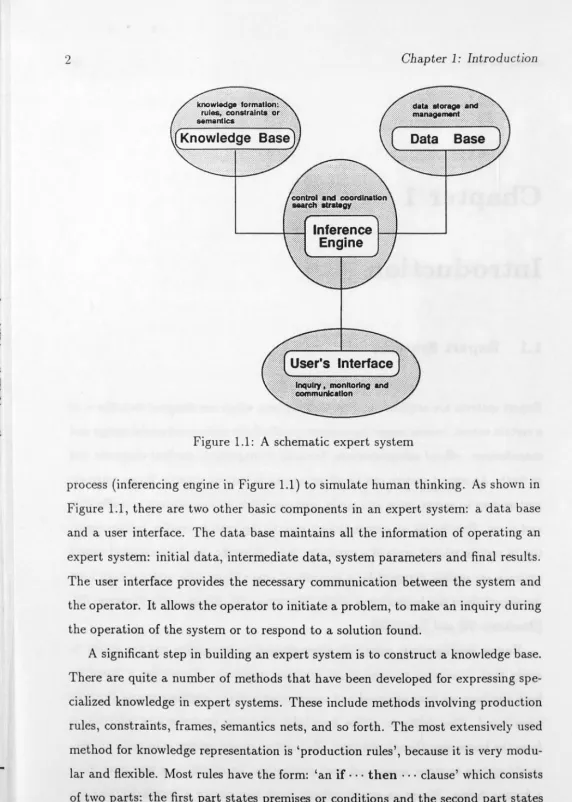
Figure 1.1: A schematic expert system
process (inferencing engine in Figure 1.1) to simulate human thinking. As shown in
Figure 1.1, there are two other basic components in an expert system: a data base
and a user interface. The data base maintains all the information of operating an
expert system: initial data, intermediate data, system parameters and final results.
The user interface provides the necessary communication between the system and
the operator. It allows the operator to initiate a problem, to make an inquiry during
the operation of the system or to respond to a solution found.
A significant step in building an expert system is to construct a knowledge base.
There are quite a number of methods that have been developed for expressing
spe-cialized knowledge in expert systems. These include methods involving production
rules, constraints, frames, semantics nets, and so forth. The most extensively used
method for knowledge representation is 'production rules', because it is very
modu-lar and flexible. Most rules have the form: 'an if· .. then· .. clause' which consists
of two parts: the first part states premises or conditions and the second part states
[image:17.671.2.574.21.822.2]1.1. Expert Systems
rules are called rule-based systems.
Here is an example rule from a truck dispatching problem[Filman 88]:
if: there is a trip to be assigned a driver; and
there is a candidate driver;
then:
assign the driver to the trip;
invoke constraint rules;
3
Another important and powerful knowledge representation method is to use
con-straints. With this method, knowledge, that is, facts and the relations among them,
is expressed as a set of constraints. An expert system problem with the knowledge
formatted into a set of constraints is called a constraint satisfaction problem.
In the truck dispatching problem, examples of constraints include "You cannot
put more on a truck than it can hold" and "A driver needs to have the right licence
to drive a particular truck". An expert system incorporates constraints to express
restrictions on allowable states, values, or conclusions. In fact, some systems derive
their solutions by analysing and satisfying complicated constraints. Generally, these
programs exploit expressions with variables to denote class of objects or relationships
among classes of objects. In addition, they incorporate additional requirements
that constrain the possible value assignments which variables can take. They use
inference rules to determine which variable values can be derived from others.
We can make good use of constraint sets to perform consistency checking (a
detailed description can be found in Chapter 3 and 4) before searching for a possible
solution, so that the search space can be reduced. The development and research in
this area has led up to the current grea~ interest in expert systems.
Different knowledge representation methods have quite different properties Wlii.~
might be advantageous in one case but disadvantageous in another. Thus it is
impor-tant to carefully select a suitable method for a particular expert system application.
Moreover, for some expert systems, part of the knowledge may be best expressed in
one format while other parts are best expressed in others. In particular, in our truck
4 Cbapter 1: Introduction
searching efficiency by establishing a knowledge base with both production rules and
constraint rules.
The inference engine is the heart of an expert system. It is the central software
which controls and coordinates the knowledge base, data base and user interface
and which employs specially selected searching strategies to find solutions to a given
problem. The inference engine works in a way that, after initial 'ignition' - it starts
and will run automatically to find the solution to any problem given by the user.
By using the formatted knowledge, the engine goes through, in a well-controlled
sequence, the rules and constraints stored in the knowledge base and examines this
knowledge with the information given in the data base. The examining process
in rule-based systems is typically pattern-matching. The process in a constraint
satisfaction problem is usually called consistency checking.
The data base is an important part of an expert system because it can maintain
and manage various data such as initial facts of the problem under consideration
and intermediate facts created on the track of inferencing operations. User interface
provides a facility that allows the user to initiate an inquiry, to monitor or guide
the inferencing process and that, in some cases, allows the system to ask the user
about information when it is considered necessary.
To make it easier to establish expert systems, great efforts have been made to
con-struct expert system tools. An expert system tool can be considered as a designated
programming environment which is built on some universal aspects of an expert
sys-tem design. In contrast to the usual programming languages, expert system tools
take facts, rules as their objects and pattern-matching or inference engine as their
control structure. A large number of expert system tools from personal computers
to mainframe computers have been developed in recent years [Benchimol 87]. For
example, expert system development tools such as KEE[Intellicorp 87], Smalltalk
[Goldberg 83], OPS-5 [Brownston 85] and ART [Williams 84] have been made
com-mercially available. The case studies presented in this thesis (see Chapters 6 and 7)
1.2. Problem Solving 5
1.2
Problem Solving
Problem Solving is the central issue in artificial intelligence [Shapiro 87] and [Frenzel 87]. It is a process that involves finding, or constructing, a solution to a problem. The purpose of establishing an expert system is to solve problems requiring a certain kind of expertise. In general, problem solving involves every aspect of an expert system,
because the elements of an expert system: knowledge base, inferencing engine, user interface, and so on, are highly interrelated. Usually, however, problem solving is referred to as a specific process which is guided by a control strategy to search for a feasible solution upon given conditions.
Formally, the process of solving a problem can be defined in the following general form [Shapiro 87}:
Given a domain specification D, find a solution s such that s is a member of a set of possible solutions S and it satisfies the conditions C.
It is very important to effectively and efficiently exploit the information in D, C. The conditions C specify the constraints to the problem under consideration. They can be applied to solution construction in two ways: a posteriori testing which ex -amines candidate solutions and a priori constraining which constrains the generator (and possibly influencing the controller). Thus those candidate solutions which do not satisfy the constraints will be excluded until a,n acceptable solution is found.
Generally, a problem-solving system is designed to search for solutions to a given problem. We may use a variety of search techniques, and may process a plausible solution generator that can enumerate all possible solutions. Then the systems can generate and test all possibilities until an acceptable solution is found. The set of all the possibilities is called the search space and this approach to search is called brute force. Many ordinary problems, such as map coloring, database retrieval for conjunctive queries, Boolean satisfiability and so forth may have search space of astronomical size. Hence specific tools, methods and mechanisms must be introduced to effectively reduce search space to a tolerable dimension. The efficiency of a problem-solver may be improved by a strategy in which some domain values
6 Chapter 1: Introduction
that cannot succeed in the testing are excluded before searching begins.
Problem solving of constraint satisfaction problems ( CSP) can be a good example.
As mentioned above, many expert system tasks can be represented by constraint
satisfaction problems. Some special techniques introduced to solve CSP are based on
eliminating candidate solutions through successively refining value sets of the
vari-ables, that is, on deleting unacceptable values form the domains of all the variables.
The process is carried out by checking the specific constraints so as to eliminate
subsets of the set of candidate solutions that are inconsistent with the constraints.
Following these candidate-elimination steps, the problem solver can proceed to find
a solution using a generate-and-test scheme or one of its variants.
There may exist a number of solutions (the solution space) satisfying given
con-straint sets. In most cases, only one solution, which may not be the best solution, is
enough for a given problem. In design of an expert system, computer time efficiency
(time required to find a feasible solution) and space efficiency (memory required to
store all the relevant information) are of prime concern. Hence, in these
applica-tions, a reasonable solution is accepted by the user, considering that far more effort
might have to be spent in finding the best solution than would be on a re~sonable
solution.
There are many cases where a user may not be satisfied with the solution obtained
to an initial problem for various practical reasons. For example, this situation may
happen in some expert systems work in dynamically changing environments and
where certain changes may occur in tl;te facts or conditions during the problem
solving. A number of questions could be raised in such cases. Is it necessary to
start all over again to search for another solution? Is it possible to make use of the
solution obtained, or, to inherit some information collected during the search of it?
Obviously, it is inefficient to abandon all the information collected and to start
the search from the very beginning. However, knowing how to effectively make use of
the information obtained is not simple because we know that even minor changes to
the facts and/or initial conditions can lead to totally different solutions. Therefore,
1.3. Search Strategies 7
arrive at more efficient ways of dealing with practical problems.
One of our major concerns in this thesis is a focus on some fundamental problems
in interactive problem solving. We will establish a mechanism which enables a user
to guide and direct the solution searching in the most preferred directions and thus
the user-desired solution can be obtained to a problem in the most efficient way.
1.3
Search Strategies
In an expert system, to solve a problem means either to answer a question or to
make a decision based upon certain initial facts. We know that the most important
step of problem solving in an expert system is the search [Shapiro 87] and [Pearl 84].
That is, search is a general problem-solving mechanism in expert systems. When a
knowledge base has been established, search procedures can be implemented. In a
search process, a certain kind of inferencing mechanism is introduced to reference
the knowledge base in a certain orderly way to find the solution. The process of
search is programmed in such a way that it usually examines the facts already in the
knowledge base and collects, at the same time, new facts derived from the search
itself in order to arrive at solutions to a given problem.
There are two basic ways of search: blind search and heuristic search [Frenzel 87]
and [Shapiro 87].
Blind search explores solutions in a way which checks all the possibilities given
by the relevant knowledge as well as the initial conditions. Blind search is inefficient
because it takes considerable amount of time to find a solution. Especially for large
systems, which contain many facts and constraints to be examined, blind search may
lead to combinational explosion. In these cases, blind search seems quite impractical.
However,. blind search is useful for small expert systems where computing time
will not be a problem considering of the small number of possibilities.
In fact, blind
search will usually produce a conclusion and, moreover, it always plays an importantrole in heuristic search where local blind search is used frequently.
Heuristic search is a solution-searching approach which uses various assistant
8 Chapter 1: Introduction
directions which, heuristically, are most likely to lead to a possible solution.
In practical cases, that is, the cases we will discuss, solution search uses a
combi-nation of both blind search and heuristic search in order to achieve proper efficiency
while a reasonable number of facts and constraints are taken into consideration.
1.4 Design Goals
The efficiency of problem solving in expert systems is determined by many different
factors. Among them, search strategy is an essential factor. However, even using the
same search strategy, the efficiency may differ from case to case. Hence there seems
no universal search strategy suitable for all the cases. Then how mayan intelligent
problem solver expect improved efficiency? Here we present some criteria w/,(d!t1t\3
important for a problem-solver to be efficient.
(1) Find and eliminate those paths of search which will finally lead to
~ead
end.Hence, classes of possibilities which will consume useful computing time can
be removed from further consideration.
(2) Record and utilize the reason for a dead-end search so that the same conflict
(l(i~
will not again in the later search. Redundancy in repetitively searching similar
fruitless paths may thus be avoided.
(3) Make use of the results obtained to guide further solution searching.
In this study, we develop an interactive problem solving environment in which the
solution search is accomplished by an interaction between the user and the system.
In this regard, we introduce a new scheme which is called a User-Directed Search
(UDS). This means that the user is allowed to guide and to control the solution
search in the most preferred directions.
Interactive problem solving can provide a very useful scheme on which the
solu-tion search can be conveniently controlled, interrupted and directed. A new solusolu-tion
searching should always be based on the solution obtained plus the addition of
1.4. Design Goals 9
use as possible of the solution obtained in further search. Taking this into consider-ation, we will present· here a new method of interactive problem solving.
In this thesis, we have made considerable efforts to achieve UDS in solution search in the following directions:
1. Closeness change in UDS
In many expert systems, there may exist a number of solutions scattered in the solution space which
G\~~etermined
by the conditions corresponding to a given problem. It can be expected that the particular solution which is explored, and the order in which the solutions are explored will be determined by the search route being taken. It is common that the user may show preference in accepting one solution while declining another. For example, a solution found by the sy~tem may be sent back to the user interface and the user may find it unacceptable, because the solution is structured in a way differing from what he had expected or it conflicts with some conditions which had not been considered beforehand. In cases like this, how can a user find quickly a solution which he is ready to accept?To solve such a problem we will introduce a user-directed mechanism in so-lution search. In particular, a good interface has to be established such that solutions in the solution space will be explored along the user's preferred direc-tions with proximal minimum (closeness) changes from one solution to another.
2. Backjumping in UDS
10
s.
Uc.Chapter 1:' Introduction
We will introduce a backjumping approach and apply it to our interactive
problem solving of a truck dispatching task. Also we will study the case where
dynamic rules can be created upon the user's request based on changes of
practical situations. We will build a special menu where the user's queries
may be input and automatically converted into deduction rules. These new
deduction rules will be referred to in further search. If the user's queries
are his preferred solution pattern, as in the problem of closeness change and
interaction, then the search can be effectively directed along the preferred
directions.
3. Constraint recording
We also study an approach which can find and record the reason for a failed
search. This can then be referred to in order to avoid the same failure in later
search.
4.
CSP
techniques for pre-processingWe employ the CSP techniques to perform consistency checking in advance
of performing the solution searching. This process is called pre-processing.
Pre-processing is used for eliminating a number of potential values which are
inconsistent with corresponding unary and binary constraints. Thus, we will
make effective use of certain restrictions available from a set of constraints
to construct a more limited set of possibilities. We expect that an amount
of useless backtracking search can be avoided by this pre-processing. Some
examples (in chapters 6 and 7) will be introduced to show how the search
space can be considerably reduced and how system performance can be greatly
improved using these CSP techniques. We also make use of CSP to improve
efficiency in realizing UDS.
5. CSP
techniques implementation in KEEKEE [Intellicorp 87] is a very powerful set of tools allowing problem solvers
1.5. Overview of Thesis 11
tools and techniques for building applications to represent and analyze
knowl-edge. These tools are object-oriented programming, truth maintenance,
KEE-worlds, rule system, active values and graphics. However, KEE does not offer
the environment for implementing CSP techniques. Thus, it is inconvenient
for the KEE to handle some problems where CSP techniques are necessary (as
the CSP
techniqu~~re-processing
in our cases here).In this regard, we will implement a prototype CSP module called NAPCC
(stands for Node, Arc, Path Consistency Checking) with the intention of cre
-ating a new environment to apply CSP techniques in KEE for general purpose.
Therefore, such a module would be a convenient tool for the users to apply
CSP techniques in various problem solving cases. Node, arc, path, unary and
binary constraints in CSP will be represented by units and slots in KEE. All of
the procedures and algorithms of CSP techniques built in KEE will be referred
to as CSP module in the following text.
1.5
Overview of Thesis
The rest of the thesis is organized as follows.
In Chapter 2, we give a briefly description of the main features of KEE.
Fur-ther we discuss KEEworlds and ATMS techniques, and use KEEworlds to express
problem solving states.
In Chapter 3, we describe Constraint Satisfaction Problems (CSP). A CSP
con-sists of a set of variables and a set of constraints. Each variable in a CSP is associated
with a finite set of discrete values (domain). Each constraint limits the valueslAlh.·
t~
the variables can take on. Basic techniques of CSP problem solving are node, arc
and path consistency checking.
In Chapter 4, we establish a CSP module in KEE for general purpose
program-ming using CSP techniques. In later chapters we will use this module in various
applications to perform pre-processing and show how the CSP module can be used
12 Chapter 1: Introduction
number of potential values which are inconsistent with corresponding unary or
bi-nary constraints. In practical cases, the a priori constraining should be chosen with respect to both the specific problem to be solved and the specific method selected.
The a priori constraining can improve the search efficiency in two ways:
• Pre-processing before searching. This is achieved by doing consistency
check-ing. It can minimize the candidate values that are inconsistent with C. There
-fore, the search space of the given problem may be reduced .
• Constraint recording during the search. We use constraints to check interme
-diate results. If they conflict with certain constraints, the dead-ends during
search appear. The system stores the reasons for the dead-ends, so that the
same conflicts will not arise again in the continuation of the search. The tree
search efficiency is increased.
In Chapter 5, we present two strategies: (1) backjumping, (2) closeness change, to our interactive problem solving.
In the interactive problem solving, new requirements from the user can be given in the form of constraints. Such constraints are used to realise backjumping. That
is, the search returns to the choice which causes failure and goes further based on the user's requirements. Thus, unnecessary backtracking can be avoided.
Our purpose is to establish a mechanism by which the solution search process
can be effectively guided according to the user's preference. Special precautions
must be taken in regard to making efficient use of the intermediate results obtained
in further solution searching. We introduce here a scheme which we call closeness
cllange which ensures that in the direction specified by the user, a closeness solution
to the previous one will be found if it actually exists.
In Chapter 6, we establish a small system to offer UDS in the truck dispatching
problem by using the techniques developed in Chapters 4 and 5.
In Chapter 7, we will construct a small prototype system in the domain of the
crossword puzzle problem to demonstrate the basic strategies described in Chapters
4 and 5. These include using the CSP module established in Chapter 4 to perform
1.5. Overview of Thesis 13
from one solution to another solution. We will create a simple interface for
user-directed search to make the procedure of solution search more friendly, efficient and
controllable. With the intention of achieving efficiency, we make effective use of the
information and results obtained in order to search further solution.
Chapter
2
KEE, ATMS, KEEworlds
The Knowledge Engineering Environment (KEE) [Intellicorp 87] is one of the main
knowledge system development tools which provide problem solvers with a set of
programming tools and-techniques for building knowledge engineering systems. It
is an advanced hybrid developing environment which incorporates a number of
well-proven artificial intelligence methodologies and techniques. As far as knowledge
representation is concerned, KEE allows an expert system to be constructed with
frame-based representation. It also provides rule-based programming, which allows
the use of various inference mechanisms. Moreover, it provides object-oriented
as-sertion, object-oriented programming, access to LISP, etc. In fact, KEE needs to
be, and is being, improved to meet various requirements from practical expert
sys-tem developments. One major effort made in this thesis study is, for example, to
implant constraint satisfaction problem (CSP) techniques to the KEE environment.
We have used these implanted CSP techniques to improve problem-solving efficiency
in our case studies.
In this chapter, we introduce certain aspects of KEE which are relevant to the
following chapters. Then we describe ATMS and its applications. Also we give a
brief description about KEEworlds. In the following chapters, we will show how to
solve practical problems based on KEE. We have incorporated a set of programming
techniques to develop a paradigm in our interactive problem solver for user-directed
search, and to effectively utilize information generated in the process of
problem-15
I
I
~
dL
\-\c:~~
S.U"16
solving.
2.1
KEE
Chapter 2: KEE, ATMS, KEEworlds
Rule System
Active Values
Object-oriented
Programming
Common Lisp
KEEworlds
[image:31.675.7.559.19.825.2]ATMS
Figure 2.1: The main packages and facilities in KEE.
KEE is actually a large set of well-integrated AI paradigms based on Common LISP
language. It provides a wide variety of programming tools and techniques to
repre-sent and analyze knowledge and to solve knowledge system problems. It includes the
production rules formalism which allows the use of various inference mechanisms,
a frame-based language with inheritance, object-oriented programming paradigms
with message passing, active values, KEEworlds and a truth maintenance system.
The most significant advantage of KEE is that it integrates different programming
methods and tools together. Another advantage is its way of organizing and
aggre-gating knowledge into specific components (unit hierarchy) and of explicitly struc
-turing the reasoning process. The third strong point lies in the power and the
user-friendliness of its interface.
Figure 2.1 illustrates some of the packages and facilities of the KEE system
built on Common Lisp. A higher package is based on the lower level packages and
2.1. KEE 17
2.1.1
Knowledge Representation
Knowledge representation in KEE is essentially based on a hierarchical network of
frames with slot inheritance. Frames in KEE are called as units. The knowledge
representation has the following characteristics:
1. Units can be used to represent objects of a specific problem domain. The
units are grouped into a hierarchy from more general objects, called classes,
to particular objects, called members. This facilitates inheritance of relevant
attributes stored in slots from the higher level to the lower level.
2. A unit is made up of slots created to represent an object's attributes. Slots _ /
can be used to represent two kinds of information: descriptive and procedural
information. There are two kinds of slots: member slots and own slots.
• Member slots are used for information that should be shared by all units
in an object hierarchy .
• Own slots are used to describe and represent attributes and prO-perties of
that slot alone. In other words, an own slot refers to a particular unit's
"own" properties.
3. Slots are composed of facets. Typical facets are inheritance role (controlling
inheritance of slot values), valueclass (restrictions on the type of values a slot
can have), and min. cardinality and max. cardinality (restrictions on the number
of values a slot can have).
4. Units can have a procedural role and can enable behavioural models of objects
and expertise to be built. Such objects are represented by a frame with
meth-ods (procedures) attached to the unit's slots. Objects communicate with each
other by sending messages. When an object receives a message, the message
is interpreted, and the appropriate method is activated. Objects and
mes-sage passing provide a natural way to represent entities in problems involving
complex relationships.
I
I
18 Chapter 2: KEE, ATMS, KEEworlds
5. Reasoning in KEE is based on rules, which are represented as units. The KEE
rule system offers both forward and backward chaining as well as methods by
which the two methods of reasoning may be mixed or linked in various ways.
In summary, knowledge representation is based on two components: facts and
rules.
(1). facts are frames with attributes and methods (in the sense used by
object-oriented languages). Frames are organized into a taxonomy. Frames inherit
proper-ties (attributes) from the frames in the level above. Object-oriented programming is
based on "methods" attached to slots; these are run when the slot receives a message
of the form:
(unitmsg 'unit-name 'slot-name other. args. if. any)
(2). One kind of rules, namely, 'same world action rules', has the traditional
production rule syntax:
If (premised(premise2) ... (premisenl)
then
(actiond (action2) ... (action n2 )
Variables and Lisp function calls are allowed in both premise and action parts.
The variables in a rule begin with a question mark. The variables are bound to
values during the testing of the rule's premises.
An action of a rule consists of:
• deleting a fact;
• adding a fact;
• modifying a fact;
• executing a procedure (Lisp code);
• invoking forward chaining on a different rule class from within forward
chain-mg.
KEE has enhanced the traditional production rule with the addition of new types
2.1. KEE 19
are represented as frames, which make it possible to organize them into a hierarchy
( taxonomy).
The KEE system contains several facilities for building and reasoning within a
knowledge-based system. One facility for reasoning is based on rules. The KEE's
rule system has two components: the rules and the inference mechanisms. Firstly,
we describe the classifications of rules and their applicability. Then we discuss
the mechanism available in the KEE rule system to perform data-direct reasoning
(forward chaining). Here only forward chaining is presented since we employ it in
the later chapters.
Rule Type
There are two types of mles in the KEE rule system: deduction rules and action
rules. Deduction rules are used to establish dependencies between a conclusion
and its premises. Action rules, on the other hand, are used to take actions. For
deduction rules, the truth of the conclusion depends on the truth of the premises. If
the premises become false, the conclusions also become false. For action rules, when
the premises are satisfied, the actions specified in the conclusions are performed.
There are two kinds of action rules: same-world action' rules and new-world
action rules. The same-world action rules correspond to traditional production
rules. They run in a world and perform actions in the same world. The new-world
action rules create a new world in which the actions of the rule are performed.
In other words, a new world action rule makes all the actions in the new world,
while the parent world(s), where the premises were satisfied, remain(s) unchanged.
The syntax difference between same world action rules and new world action rules is
that new world action rules include the key world in. new. world (or in. new. and. world)
which indicates new-world creation. in.new.world is used for rules which represent
mutually exclusive alternative actions or choices. All the worlds created are under
an exclusion set which is indicated by a black square with a cross in it. An exclusion
set represents a set of worlds which are exclusive alternatives. The rules specified
20
set.
Chapter 2: KEE, ATMS, ·KEEworlds
Figure 2.2: in. new. world creates worlds under an exclusion set.
Example:
(if (the node.list of assist is ?nodes)
(equal ?first (car ?nodes))
(the domain of ?first is ?v)
then in.new.world
(the value of ?first is ?v)
The above rule is a simple rule for finding an assignment to a variable in the
crossword puzzle problem. ?nodes, ?first, and ?v are variables. When this rule can
be applied in a given world (tha.t is, the premises of this rule are proven true), say
in world start, an exclusion set is created. Each subsequent applica.tion of the rule
in start causes a new world, which falls under the same exclusion set to be created
(see Figure 2.2). The world nodel-sound and nodel-sails were created by applying
the above rule with two different bindings for ?v, namely, 'sound' and 'sails', and
represent mutually exclusive choices that ?first (bound by node!) might take. This
results in that each node can only be assigned to one value at anyone time. The
worlds that represent different assignment values of the node are mutually exclusive.
If the above two worlds are merged, the resultant world becomes inconsistent. So
merging any two worlds is avoided. Each inconsistent world is indicated by a black
square in it (Figure 2.2). ' We use this kind of rule to control the reasoning and
searching process.
Rules can be expressed either in the English-like form or the prefix-form. They
are represented as units and classified in a hierarchical way like any .other unit.
[image:35.675.11.558.23.810.2]2.2. Assumption-Based Truth Maintenance System (ATMS) 21
organize and select sets of rules for solving specific problems.
Forward Chaining
KEE supports a mixed-strategy approach by allowing both forward and backward
chaining to be applied to the same problem. It allows the user to select a
conflict-resolution strategy from a number of options, including least premise complexity,
greatest premise complexity, least weight, and greatest weight.
Here we explain how forward chaining works because we use forward chaining to
solve our problems. The forward chaining cycles as follows:
1. Evaluating rule premises one by one;
2. Adding rules successfully instantiated to agenda;
3. Selecting an instantiated rule to apply;
4. Taking the actions required by the rule.
This cycle is continued until the agenda is empty.
2.2
Assumption-Based Truth Maintenance System (ATMS)
Truth maintenance is a means of keeping track of beliefs and their dependencies
developed during an inferencing process [McAllester 90]. The KEE system includes
a system called the Assumption-based Truth Maintenance System (ATMS) which
provides facilities for setting up and maintaining dependencies between facts.
De-pendencies between facts set up in the ATMS are called justifications.
A justification consists of two main components:
• justifiers - these are the facts that give evidence for the truth of justificand.
Justifiers are antecedents .
• justificand - this is a fact that is only true while all the justifiers are true.
S.Uc.
22 Chapter 2: KEE, ATMS, KEEworlds
2.2.1
Deduction Rules and Justifications
Justifications can be established by creating and applying deduction rules. A
de-duction rule has the following form:
while (premisel) (premise2) ... (premisenl)
believe (conclusionl) (conclusion2)" . (conclusion n2 )
When a deduction rule is applied in forward chaining mode, one justification for
each conclusion is set up for each set of true instantiated of the premises. All the
premises are justifiers and the conclusion is the justificand.
2.2.2
Constraints
The special fact false can be the conclusion of a deduction rule. Thus, we use
deduction rules to establish the fact false in any world which violates certain
con-straints. Therefore, we use deduction rules to represent constraint rules and detect
contradictions. For example, in the Truck Dispatching Problem there are a number
of constraint rules, such as 'you can't put more on a truck than it can hold'. The
corresponding deduction rule for expressing this constraint is as follows:
(while (the max. weight of ?trip is ?m)
(the truck of ?trip is ?t)
(the weight.capacity of ?t is ?w)
(lisp
(>
?m ?w))believe false)
One of dependencies was created by applying the above deduction rule with
bindings trip.l, 600, T4, 500 for ?trip, ?m, ?t, ?w respectively. This dependency will
be represented by a justification which states that while the facts
(the max.weight of trip.1 is 600)
(the truck oftrip.l is T4)
2.3. KEEworlds 23
the fact false is deduced. That is, when the premises are true in any world, its conclusion false i~ added to that world which thus becomes inconsistent. If the facts in the premises are removed, the conclusions are automatically deleted from the knowledge. The reasoning process ignores inconsistent worlds in further reason -ing. We can use the justifications of contradictory conclusions to determine which assumptions are mutually contradictory. One of the purposes of establishing and maintaining these dependencies is that if a contradiction is detected, we allow back-tracking along the reasoning, changing the assumptions in some way, and reasoning forward from there.
2.3
KEEworlds
KEEworlds is a facility provided by the KEE system to allow representation of alternative states of situations. It is used for modelling and exploring different hypothetical situations which are represented by worlds. For example, in one world, nodel is assigned by 'sound'; in another world, by 'sails'; and so on. We employ KEEworlds and new world action rules for constructing and representing solutions through a step-by-step process, with each new world representing a decision in the search.
Some of the uses of the KEEworlds facility are to:
• tryout different values for 'own' slots in different worlds;
• run rules in worlds, without changing any slot values in the original state of the knowledge base; and
• run reasoning processes, using worlds to record the intermediate stages of the processes.
~---~
S.
I-24 Chapter
2: KEE
,
ATMS, KEEworldsWe shall use worlds to represent the search process. So we give a brief description
of the worlds here.
2.3.1
Worlds
The based structure for modelling the searching process is a directed acyclic graph
of worlds. Each world may be regarded as representing an individual specific action,
or state change. Each successor of a world in the graph models alternative actions.
Figure 2.3 shows an example world graph from a truck dispatching problem.
'+trip.l, trip.2' beside world 0 means that two trips need to be allocated feasible
trucks and drivers.
'+tl
,
t2' and '+dl, d2' means that these candidate trucks anddrivers are available at an initial state. The additions at world 0 produce the initial
state, while the addition and deletion at world 1 represent the action of assigning t1
to trip.1. The addition and deletion at world
2
represents the effect of assigning dlto trip.l, while those at world 3 correspond to the alternative effect of assigning d2
to trip.1. '-trip.l' means that trip.l is removed from the trip list because a truck
and a driver were already assigned to it. '
-tl,
-dl' means that tl, dl are removedfrom the candidate trucks and drivers respectively. The condition of the actions is
tested in the parent world world 1 before world 2 and world 3 were to be constructed.
Only the effects of actions are recorded in the world. Thus, each world corresponds
to a decision point in the search. A branch of the world graph corresponds to a
linear sequence of actions during the course of the search.
A world can contain the following facts:
1. facts inherited from ancestor worlds;
2. direct additions at this world;
3. deductions (performing action part of the rule) from the facts in 1 and 2.
The deduced facts may include the specific fact false, representing a
contradic-tion. A world which contains false or where it can be deduced is an inconsistent
world which represents an inconsistent state of knowledge. We avoid such a world
in further reasoning.
[image:39.674.14.558.20.811.2]---~~-2.3. KEEworlds
world 2
trip. 1 trip. 2
t1
d1
world 0
trip.1 trip.2
world 1
trip.1 trip.2
t1
+driver( trip.1)=d1 -trip. 1
-d1
+
trip. 1) trip. 2.+tl)t2. +d1).d2.
+truck( trip.1)=tl -tl
world 3
trip. 1 trip.2 t1
d2
+driver( trip.1)=d2 -trip. 1
-d2
S.I
26 Chapter 2: KEE, ATMS, KEEworlds
2.3.2
Worlds and Forwarding Chaining
Forward chaining can run new world action rules in a particular world and the
actions of rules can be performed in a new world which is a child of the world. A
world can be used for expressing problem solving states, and these states can be
used for preserving search state during the course of solution searching.
We use new world action rules to search for a solution in a forward chaining
mode. This is a process of finding a sequence of actions from an initial state to
a desired state. Each world created during the course of reasoning represents a
corresponding decision in the search tree.
2.3.3
Worlds and Justifications
In general, problem solving which involves searching leads to the discovery of some
set of beliefs. In such systems, different sets of beliefs are believed at different stages
during the course of problem solving. Each world in KEEworlds is used to express
different points (different sets of beliefs) in the search.
Justifications can be created by deduction rules. Once a justification has been
established, it applies in all the worlds. If a set of facts in a world conflicts with a
set of constraints, the fact false can be introduced into the world. An inconsistent
world is a world that contains the fact false. An inconsistent world is shown with
a black square in it. We can use deduction rules to introduce the fact false into
any world that violates certain constraints. Once a world has become nogood, the
system will ignore it for further consideration. Thus, an inconsistent world expresses
the dead end search in the search tree. When a world becomes inconsistent, any
existing child worlds of that world also become inconsistent.
Thus, because of its many advantages, we use KEE from which we can gain
considerable power and flexibility when constructing a representation of our domain
knowledge and controlling the search process to solve our practical problems.
Fur-thermore, KEE is an open architecture which is an important factor in extending
KEE. This is useful for ensuring KEE's flexibility and ability to evolve. Therefore,
we can extend KEE, which is oriented towards handling of specific AI problems. In
--~---~--2.3. KEEworlds
2
7
Chapter 5, we develop NAPCC package (see Chapter 4) in KEE to realize CSP
tech-niques. Two case studies in Chapters 6 and 7 will take advantage of it to improve
C
elL
P
j
S ..
Chapter 3
Constraint Satisfaction Problem
Techniques
3.1
Introduction
Many artificial intelligence tasks can be described as constraint satisfaction problems
(CSP) [Shapiro 87]. To solve a CSP is to find values for a set of variables which
are subject to a set of constraints given in the problem under consideration. A
constraint may affect one, two or more domains in the problem and thereby restrict
the corresponding variables to take values in a certain range which is generally
smaller than the original range.
In recent years, constraint satisfaction problem solving has received considerable
research interest in artificial intelligence [Dechter 88] and [Minton 90]. The
well-known constraint propagation techniques, originally were advocated by [Waltz 75],
[Mackworth 77] and [Montanari 83]. The usual procedure for solving a CSP is
back-tracking. The most obvious advantage of backtracking is its simplicity and its
uni-versal applicability. The disadvantage is its potential inefficiency. That is, a number
of useless backtracks ('thrashing' behaviour [Mackworth 77]) may exist in a
partic-ular CSP. This means that the search space is larger than necessary for solving the
problem. Thus, some special techniques are introduced for some CSP problems to
yield a smaller search space and to avoid thrashing behaviour. Node, arc, and path
s
.
30
Chapter 3: Constraint Satisfaction Proble!11 Techniquesconsistency checking are considered as useful techniques in this regard. Using these
techniques can have a great effect on reducing the size of the search space. Some
examples will be introduced later to show how the search space can be considerably
reduced by using these
esp
techniques.esp
techniques are useful in many applications. The well-known examples ofap-plication of
esp
techniques are the traditional puzzle-solving problems [Mackworth 87],map-coloring problem [Freuder 78], understanding line drawings [Montanari 74],
electronic circuit analysis [Kelly 82] etc. The applications of
esp
techniques rangefrom database retrieval to scene analysis.
esp
techniques may be used to preventunnecessary search thereby leading to solution strategies that do not require
expo-nential time for particular task domains [Mackworth 77]. We study the application
of
esp
techniques such as node, arc, and path consistency checking to processprimary data prior to solution search. We view this process as pre-processing.
Pre-processing is used for eliminating a number of potential values which are inconsistent
with corresponding unary or binary constraints. Thus, we will take advantage of
some restrictions available from the unary and binary predicates to construct a more
limited set of possibilities. By this pre-processing, we can expect that an amount of
useless backtracking are avoided.
In this chapter, we will first introduce basic definitions of
esp.
Issues in solvinga
esp
by backtracking are discussed. The constraint network for representingesp
is described. Also, the basic techniques used in
esp
to avoid thrashing behaviourare presented. Finally, with an example, we demonstrate how the search space of a
problem is reduced.
3.2
Constraint Satisfaction Problems Definition
Following existing research works on
esp
[Mackworth 87], we perceive theesp
asa set ~f variables and each variable has a domain of values,
V