InTrans Project Reports Institute for Transportation
6-2010
Electronic Construction Collaboration
System—Phase II
Aaron Charles Zutz
Iowa State University, [email protected]
Charles T. Jahren
Iowa State University, [email protected]
Follow this and additional works at:http://lib.dr.iastate.edu/intrans_reports Part of theCivil Engineering Commons
This Report is brought to you for free and open access by the Institute for Transportation at Iowa State University Digital Repository. It has been accepted for inclusion in InTrans Project Reports by an authorized administrator of Iowa State University Digital Repository. For more information, please [email protected].
Recommended Citation
Zutz, Aaron Charles and Jahren, Charles T., "Electronic Construction Collaboration System—Phase II" (2010).InTrans Project
Reports. 86.
Electronic Construction Collaboration System—Phase II
Abstract
During the first year of research, work was completed to identify Iowa DOT needs for web-based project management system (WPMS) and evaluate how commercially available solutions could meet these needs. Researchers also worked to pilot test custom developed WPMS solutions on Iowa DOT bridge projects. At the end of the first year of research, a Request for Proposals (RFP) was developed and issued by the Iowa DOT for the selection of a commercial WPMS to pilot test on multiple bridge projects. During the second year of research, the responses to the RFP issued during the first year of research were evaluated and a solution was selected. The selected solution, Attolist, was customized, tested, and implemented during the fall of 2009. Beginning in the winter of 2010, the solution was implemented on Iowa DOT projects. Researchers worked to assist in the training, implementation, and performance evaluation of the solution. Work will continue beyond the second year of research to implement Attolist on an additional pilot project. During this time, work will be completed to evaluate the impact of WPMS on Iowa DOT bridge projects.
Keywords
Bridges, Construction projects, Data sharing, Electronic data interchange, Highways, Implementation, Information management, Project management, Software, Websites (Information retrieval), Iowa Department of Transportation, Iowa, WPMS, web-based-electronic collaboration
Electronic Construction
Collaboration System—
Phase II
Final Report
June 2010
Sponsored by
About the Institute for Transportation
The mission of the Institute for Transportation (InTrans) at Iowa State University is to develop and implement innovative methods, materials, and technologies for improving transportation efficiency, safety, reliability, and sustainability while improving the learning environment of students, faculty, and staff in transportation-related fields.
Disclaimer Notice
The contents of this report reflect the views of the authors, who are responsible for the facts and the accuracy of the information presented herein. The opinions, findings and conclusions expressed in this publication are those of the authors and not necessarily those of the sponsors.
The sponsors assume no liability for the contents or use of the information contained in this document. This report does not constitute a standard, specification, or regulation.
The sponsors do not endorse products or manufacturers. Trademarks or manufacturers’ names appear in this report only because they are considered essential to the objective of the document.
Non-Discrimination Statement
Iowa State University does not discriminate on the basis of race, color, age, religion, national origin, sexual orientation, gender identity, genetic information, sex, marital status, disability, or status as a U.S. veteran. Inquiries can be directed to the Director of Equal Opportunity and Compliance, 3280 Beardshear Hall, (515) 294-7612.
Iowa Department of Transportation Statements
Federal and state laws prohibit employment and/or public accommodation discrimination on the basis of age, color, creed, disability, gender identity, national origin, pregnancy, race, religion, sex, sexual orientation or veteran’s status. If you believe you have been discriminated against, please contact the Iowa Civil Rights Commission at 800-457-4416 or the Iowa Department of Transportation affirmative action officer. If you need accommodations because of a disability to access the Iowa Department of Transportation’s services, contact the agency’s affirmative action officer at 800-262-0003.
The preparation of this report was financed in part through funds provided by the Iowa Department of Transportation through its “Second Revised Agreement for the Management of Research Conducted by Iowa State University for the Iowa Department of Transportation” and its amendments.
Technical Report Documentation Page
1. Report No. 2. Government Accession No. 3. Recipient’s Catalog No.
Part of InTrans Project 08-325
4. Title and Subtitle 5. Report Date
Electronic Construction Collaboration System—Phase II June 2010
6. Performing Organization Code
7. Author(s) 8. Performing Organization Report No.
Aaron Zutz and Charles Jahren
9. Performing Organization Name and Address 10. Work Unit No. (TRAIS)
Institute for Transportation Iowa State University
2711 South Loop Drive, Suite 4700 Ames, IA 50010-8664
11. Contract or Grant No.
12. Sponsoring Organization Name and Address 13. Type of Report and Period Covered
Iowa Department of Transportation 800 Lincoln Way
Ames, IA 50010
Federal Highway Administration U.S. Department of Transportation 1200 New Jersey Avenue SE Washington, DC 20590
Final Report
14. Sponsoring Agency Code
SPR RB02-008
15. Supplementary Notes
Visit www.intrans.iastate.edu for color PDF files of this and other research reports.
16. Abstract
During the first year of research, work was completed to identify Iowa DOT needs for web-based project management system (WPMS) and evaluate how commercially available solutions could meet these needs. Researchers also worked to pilot test custom developed WPMS solutions on Iowa DOT bridge projects. At the end of the first year of research, a Request for Proposals (RFP) was developed and issued by the Iowa DOT for the selection of a commercial WPMS to pilot test on multiple bridge projects.
During the second year of research, the responses to the RFP issued during the first year of research were evaluated and a solution was selected. The selected solution, Attolist, was customized, tested, and implemented during the fall of 2009. Beginning in the winter of 2010, the solution was implemented on Iowa DOT projects. Researchers worked to assist in the training, implementation, and performance evaluation of the solution. Work will continue beyond the second year of research to implement Attolist on an additional pilot project. During this time, work will be completed to evaluate the impact of WPMS on Iowa DOT bridge projects.
17. Key Words 18. Distribution Statement
bridge—collaboration—construction—web-based No restrictions
19. Security Classification (of this report)
20. Security Classification (of this page)
21. No. of Pages 22. Price
Unclassified Unclassified 74 NA
E
LECTRONIC
C
ONSTRUCTION
C
OLLABORATION
S
YSTEM
—P
HASE
II
Final Report June 2010
Principal Investigator
Charles T. Jahren
Associate Professor, Department of Civil, Construction, and Environmental Engineering Institute for Transportation, Iowa State University
Research Assistant
Aaron C. Zutz
Authors
Aaron C. Zutz and Charles T. Jahren
Sponsored by
the Iowa Department of Transportation and the Federal Highway Administration
(SPR RB02-008)
Preparation of this report was financed in part
through funds provided by the Iowa Department of Transportation through its Research Management Agreement with the
Institute for Transportation (InTrans Project 08-325)
A report from
Institute for Transportation Iowa State University
2711 South Loop Drive, Suite 4700 Ames, IA 50010-8664
TABLE OF CONTENTS
ACKNOWLEDGMENTS ... ix
EXECUTIVE SUMMARY ... xi
INTRODUCTION ...1
Problem Statement ...1
Research Objectives ...1
Implementation of Solution ...1
SUMMARY OF PREVIOUS RESEARCH ...2
PHASE II PILOT PROJECT ...3
Introduction ...3
Web-based Collaboration Technology ...3
Project Results ...3
Conclusions ...6
PHASE III PILOT PROJECTS ...7
Solution Selection ...7
Solution Customization ...9
Solution Testing ...10
User Guides ...10
Solution Implementation ...11
Training ...11
Performance Measurement ...11
Special Contract Provision ...15
Project Archiving ...16
Broadway Viaduct Bridge ...16
Iowa Falls Arch Bridge ...17
I-74 MISSISSIPPI BRIDGE ...17
BRIDGE INFORMATION MODELING ...18
SUMMARY ...19
FUTURE RESEARCH ...20
REFERENCES ...21
APPENDIX A: POST-PROJECT SURVEY ...23
APPENDIX B: POST-PROJECT SURVEY RESULTS ...25
APPENDIX C: ATTOLIST SYSTEM NAVIGATION QUICK START GUIDE ...29
APPENDIX D: ATTOLIST REQUESTS FOR INFORMATION QUICK START GUIDE ...37
APPENDIX E: ATTOLIST SHOP DRAWING SUBMITTAL QUICK START GUIDE ...45
APPENDIX G: PRE-ATTOLIST PROJECT SURVEY RESULTS ...57
LIST OF FIGURES
Figure 1. Project role of survey respondents ...4
Figure 2. The number of times users accessed the site per month ...4
Figure 3. Recommended project size for future implementation ...5
Figure 4. Jackson 108 webpage statistics ...6
Figure 5. Survey respondent project role ...12
Figure 6. Anticipated system usage per week ...12
Figure 7. Respondents anticipating a positive impact from the system ...13
Figure 8. Perceived benefit of learning to use the system ...13
Figure 9. System technological requirements ...14
Figure 10. Overall effect on project management ...14
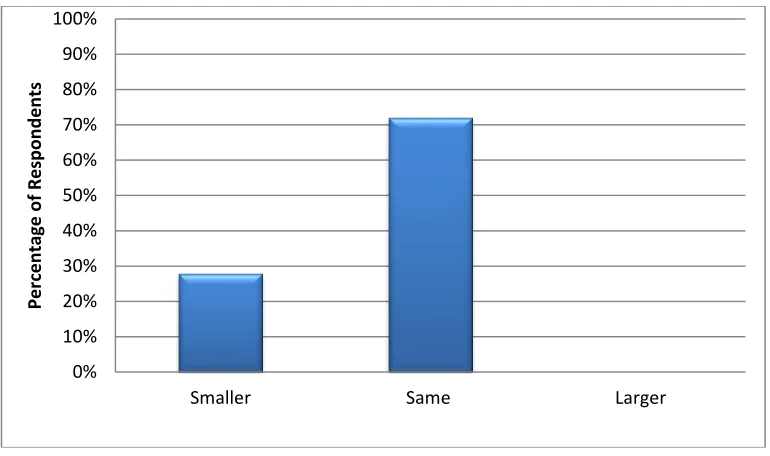
Figure 11. Project size driving implementation ...15
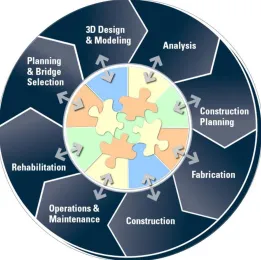
Figure 12. Bridge information modeling concept (Bentley 2014) ...19
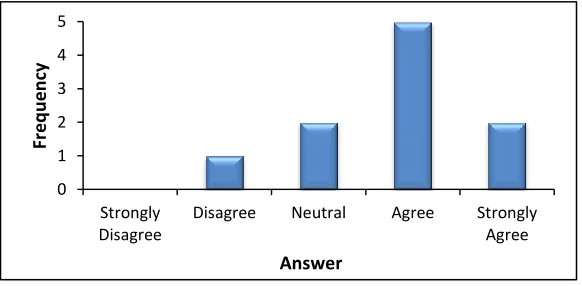
Figure 13. Statement 1: “The project website made the submittal process easier and more efficient for me.” ...25
Figure 14. Statement 2: “The project website made the RFI process easier and more efficient for me.” ...25
Figure 15. Statement 3: “The project website made the RFI process easier and more efficient for me.” ...25
Figure 16. Statement 4: “The project website increased accountability for project participants.” 26 Figure 17. Statement 5: “The project website increased the transparency of document management.” ...26
Figure 18. Statement 6: “The project website decreased the overall cost associated with document management and transmittal of documents.” ...26
Figure 19. Statement 7: “The project website decreased the review time of documents.” ...27
Figure 20. Statement 8: “The project website simplified my job on this project.” ...27
Figure 21. Statement 9: “I would recommend using this project website again on bridge projects.” ...27
Figure 22. Statement 10: “I would recommend using a more full-featured project website to assist project participants in the future.” ...28
Figure 23. Anticipated submittal process effect ...57
Figure 24. Anticipated RFI process effect ...57
Figure 25. Anticipated impact on project information availability ...58
Figure 26. Anticipated impact on accountability ...58
Figure 27. Anticipated impact on document management transparency ...59
Figure 28. Anticipated impact on document management cost ...59
Figure 29. Anticipated impact on project role ...60
LIST OF TABLES Table 1. Survey responses...5
Table 2. RFP timeline ...7
ACKNOWLEDGMENTS
The authors would like to thank the Iowa Department of Transportation (DOT) for sponsoring this research and the Federal Highway Administration for state planning and research (SPR) funds used for this project. The technical advisory committee included the following:
Jim Nelson, Iowa DOT
John Smythe, Iowa DOT
Ahmad Abu-Hawash, Iowa DOT
George Feazell, Iowa DOT
Janet Wasteney, Iowa DOT
Orest Lechnowsky, Iowa DOT
Cherice Ogg, Iowa DOT
Dennis Peperkorn, Iowa DOT
Mark Swenson, Iowa DOT
Kim Powell, Iowa DOT
Wes Musgrove, Iowa DOT
Kelly Popp, Iowa DOT
Charles Lee, Iowa DOT
Joe Jurasic, Federal Highway Administration
Phil Rossbach, HDR, Inc.
Mike LaViolette, HNTB Corporation
Robert Cramer, Cramer and Associates, Inc.
Steve Sandquist, United Contractors, Inc.
EXECUTIVE SUMMARY
Bridge construction projects are becoming increasingly complex as the demand for context-sensitive solutions, aesthetic designs, and accelerated bridge construction becomes more
prevalent. In addition, the Iowa Department of Transportation (Iowa DOT) is entering a phase of design and construction of large border bridges, such as the I-80 (let 2008 for $56 million) and US 34 bridges over the Missouri River and the I-74 bridge over the Mississippi River.
Compared to typical construction projects, these bridges generate more contractor Requests for Information (RFIs), Value Engineering proposals, Requests for Changes, and shop drawings. Management of these submittals is a significant challenge for resident construction engineers and other Iowa DOT staff. In addition, some submittals require cross-departmental and project consultant reviews. Commercially available software exists for managing submittals and project collaboration teams; in-house solutions may also be possible. Implementation is intended to speed construction submittal review time and reduce incidence of delay.
This report contains information on work completed during the second year of research for this project. During the first year of research, researchers worked to identify what the Iowa DOT’s functional needs were for a web-based project management system (WPMS). Simultaneously, researchers worked to evaluate commercially available WPMSs. A comparison of the Iowa DOT’s needs and what was commercially available showed that commercially available systems contained the necessary functionality to meet the needs of the Iowa DOT. In addition to this work, custom solutions were developed with basic functionality and implemented on two bridge projects. These solutions aided project participants, but they also exposed the need for a more robust, full-featured solution.
With the functional needs determined and an awareness of how commercially available solutions could meet these needs, researchers worked with the Iowa DOT to develop and issue a Request for Proposals (RFP) to select a commercial solution to pilot test on Iowa DOT bridge projects. The RFP was developed during the first year of research and issued at the end of the first year of research.
At the start of the second year of research, researchers worked with the Iowa DOT to complete the RFP process begun during the first year of research to select a solution to implement on pilot projects. Working through the RFP process, a vendor, Attolist, LLC (Newforma 2014), was selected to provide a WPMS for two Iowa DOT bridge projects. The software was selected in the summer of 2009 and was provided for the Iowa DOT as part of a Software as a Service
agreement. This agreement allowed the Iowa DOT to rapidly implement the solution with minimal effort.
After the solution was selected, researchers worked with Attolist and the Iowa DOT to make some minor customizations to the solution, test it, and implement it within the Iowa DOT.
After the solution was implemented within the Iowa DOT, researchers worked during the winter of 2010 to train project participants on the system. Along with the training, the solution was loaded for the first pilot project in late winter 2010. Researchers worked with project participants to monitor the solution and provided assistance as necessary after the letting.
During the first two months of use on the first pilot project, the solution performed well. Project participants generally found the solution beneficial and saw benefit in its use as a tool to aid in project management. While the solution generally performed well, there were some issues that researchers worked to resolve. The primary issue related to the intuitiveness of the solution. Many users initially struggled to navigate the solution. These users eventually learned to use the solution, but work will be needed in the future to improve training and the intuitiveness of the solution to help provide a better system for users.
To measure the effectiveness of Attolist and the WPMS on Iowa DOT bridge projects, a preproject survey was issued to project participants. Upon completion of the pilot projects, a postproject survey will be issued to project participants and web statistics will be analyzed to evaluate the effect of the WPMS. This work will continue beyond the second year of research along with the implementation of Attolist on the second pilot project during the summer of 2010.
INTRODUCTION
Problem Statement
Bridge construction projects are becoming increasingly complex as the demand for context-sensitive solutions, aesthetic designs, and accelerated bridge construction becomes more
prevalent. In addition, the Iowa Department of Transportation (Iowa DOT) is entering a phase of design and construction of large border bridges, such as the I-80 (let 2008 for $56 million) and US 34 bridges over the Missouri River and the I-74 bridge over the Mississippi River.
Compared to typical construction projects, these bridges generate more contractor Requests for Information (RFIs), Value Engineering proposals, Requests for Changes, and shop drawings. Management of these submittals is a significant challenge for resident construction engineers (RCEs) and other Iowa DOT staff. In addition, some submittals require cross-departmental and project consultant reviews. Commercially available software exists for managing submittals and project collaboration teams; in-house solutions may also be possible. Implementation is intended to speed construction submittal review time, reduce incidence of delay claims, and free up Iowa DOT staff from project management administrative tasks.
Research Objectives
Moving forward from the first year of research, researchers sought to select and implement a commercially available web-based project management system (WPMS) on pilot projects within the Iowa DOT during the second year of research. By selecting a commercially available
solution, researchers hoped to address some of the issues that arose with the custom solutions developed and implemented during the first year of research.
Specifically, the goal of implementing a commercial solution was to be able to use a solution that could fully manage the shop drawing submittal and RFI processes. This was something that previous solutions had been unable to effectively do. By using a solution that had been
developed and tested extensively in the market place, researchers hoped that the selected solution would be able to more effectively manage project information with minimal customization.
An additional benefit of using a commercial WPMS was related to the timeline required for implementing the solution. With the pilot projects that required the solution having letting dates only six months into the second year of research, it was infeasible to custom develop a solution, test it, and implement it.
Implementation of Solution
At the end of the first year of research, the Iowa DOT, working with researchers, issued a Request for Proposals (RFP) for a WPMS to be used on two bridge pilot projects. During the second year of research, a solution, Attolist, was selected through the RFP process. Upon
the first pilot project was let, the solution was customized, tested, and implemented within the Iowa DOT.
During the second half of the research period, Attolist was implemented on the first pilot project, the US 6 Broadway Viaduct Project in Council Bluffs. Training was also completed for all project participants, and researchers began to measure the performance of the solution. After the conclusion of the second year of research, the solution will be implemented on the second pilot project, the US 65 Iowa Falls Arch Bridge in Iowa Falls.
SUMMARY OF PREVIOUS RESEARCH
During the first year of this project, researchers began their investigation and implementation of web-based collaboration on bridge construction projects within the Iowa DOT. Researchers initially worked to meet the immediate needs of the Iowa DOT by implementing a solution on the I-80 bridge over the Missouri River and subsequently on a bridge in Jackson County. The primary goal of these solutions was to help project participants manage RFIs and shop drawing submittals through the use of a WPMS. A secondary benefit of these solutions was an
improvement in access to contract documents and other project information.
The first implementation of a WMPS occurred on the I-80 bridge over the Missouri River
project. Because of the timing, this project was already in progress and an expedient solution was deployed utilizing the Iowa DOT website to improve access to contract documents for project participants. This solution met the immediate needs, but project participants desired a more full-featured solution that allowed collaboration on submittals and RFIs. Following the I-80 project, a second solution was launched for the US 52 over Mill Creek bridge project in Jackson County. For this project, an expanded solution was implemented that was developed in-house by the Iowa DOT. It also used the Iowa DOT website to improve access to contract documents, and it
included a File Transfer Protocol (FTP) site to transfer documents and used the “Google Groups” application for managing RFIs (Google Groups n.d.). This solution also performed well, but it was not feasible for future projects because of inefficiencies in transferring information between the three systems. Ultimately, project participants desired a full-featured solution tailored to managing RFIs and submittals.
Concurrently, with the first two pilot projects researchers worked to identify the needs for long-term WPMSs and also evaluated commercial solutions to see if they could meet the Iowa DOT’s needs. To investigate the Iowa DOT’s functional needs for a WPMS, interviews were conducted with a wide variety of people—Iowa DOT personnel from multiple offices, contractors,
consultants, suppliers, other state DOTs and owners, and professionals from other construction sectors. To evaluate the functionality of commercial solutions, a search of the Internet was conducted to identify and initially screen the solutions. Follow-up demonstrations were conducted with a dozen vendors to further evaluate the solution’s functionality.
pilot test on two bridge projects. This RFP was issued at the conclusion of the first year of research.
PHASE II PILOT PROJECT
Introduction
The Jackson 108 pilot project was initiated in the fall of 2008 to further test the use of web-based collaboration on Iowa DOT bridge projects. Moving forward from the I-80 bridge pilot project in Council Bluffs, the objective of the Jackson 108 project was to create a web-based collaborative environment for project participants to manage shop drawings, submittals, and RFIs. Using the Iowa DOT’s website and the Google Groups application, project participants were able to
electronically submit, track, review, and distribute project information (Google Groups n.d.). The Jackson 108 project was completed during the fall of 2009, and the evaluation of the project was completed during the second year of research.
Web-based Collaboration Technology
Two technologies were selected for the Jackson 108 project. For electronic collaboration, the system used a combination of the Iowa DOT website and the Google Groups application. (Google Groups n.d.) Using a combination of both of these sites allowed for a simple way to expand upon the functionality offered during the I-80 pilot project.
The first technology used was a project-specific webpage. A publically accessible webpage for the Jackson 108 bridge was set up on the Iowa DOT website
(www.iowadot.gov/jackson108/plans.html). This webpage was used to post the proposal, plans, addendums, special provisions, specifications, plan revisions, vibration monitoring reports, and meeting minutes for the project. The webpage also had a link to upload shop drawings via an FTP site. The drawings that were uploaded to the webpage were manually configured by Iowa DOT employees to appear on the actual project webpage.
To facilitate further collaboration, the “Jackson 108” group was created using the Google Groups application and a link was placed on the Jackson 108 webpage so that the Google Group could be accessed from the home page. The Google Groups application created a password-protected collaborative environment where project participants could upload RFIs for review and exchange ideas on project issues through online discussions. This application was hosted by Google and operated in a manner similar to most message boards on publically accessible web sites. The Google Groups application allowed users to have the option of being notified via e-mail anytime something was posted (Google Groups n.d.).
Project Results
webpage on various aspects of their project responsibilities. It also asked them to rank the impact of the website on the overall management of the project and how web-based collaboration should be used in the future. A copy of the survey given to project participants is shown in Appendix A.
[image:20.612.161.451.334.484.2]Figure 1. Project role of survey respondents
Figure 2. The number of times users accessed the site per month
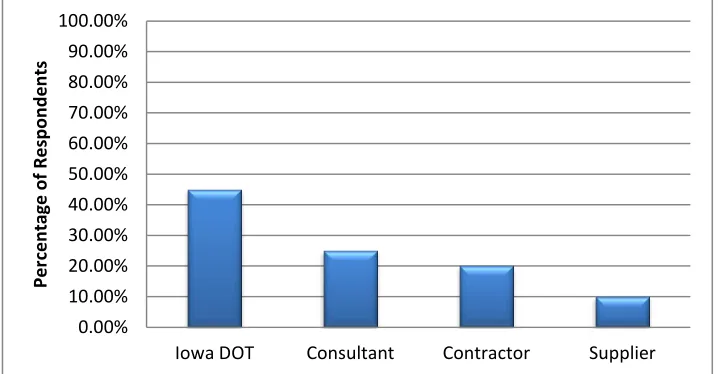
As shown by the bar charts in Figures 1 and 2, there was a wide distribution of site users and frequency of use. Most of the participants were from the Iowa DOT, and most users only
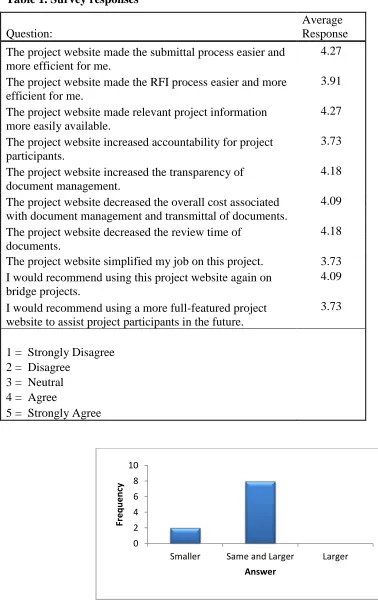
accessed the site a couple of times per month. The average responses to the survey questions are shown in Table 1. Appendix B shows individual graphs for each of the questions shown in Table 1. An analysis that compares averages among questions shows that the site made the most impact by easing the submittal process and making project information more available.
Additionally, respondents found the site made the submittal process more transparent and also helped reduce the cost associated with submitting documents. In terms of future directions, users wanted to implement web-based collaboration in the future, but the desire to have increased functionality was not as intense as it was for the previous project. Figure 3 shows survey responses regarding the most appropriate project size for electronic collaboration
implementation. Most project participants found the $5 million project size appropriate as a threshold for implementing a WPMS.
0 1 2 3 4 5 6
Iowa DOT Consultant Contractor Supplier
Fr e q u e n cy Answer 0 1 2 3 4 5 6
Less than 5 Times per Month
5 to 10 Times per Month
More than 10 Times per Month
Table 1. Survey responses
Question:
Average Response
The project website made the submittal process easier and more efficient for me.
4.27 The project website made the RFI process easier and more
efficient for me.
3.91 The project website made relevant project information
more easily available.
4.27 The project website increased accountability for project
participants.
3.73 The project website increased the transparency of
document management.
4.18 The project website decreased the overall cost associated
with document management and transmittal of documents.
4.09 The project website decreased the review time of
documents.
4.18
The project website simplified my job on this project. 3.73 I would recommend using this project website again on
bridge projects.
4.09 I would recommend using a more full-featured project
website to assist project participants in the future.
3.73
1 = Strongly Disagree
2 = Disagree
3 = Neutral
4 = Agree
5 = Strongly Agree
Figure 3. Recommended project size for future implementation
0 2 4 6 8 10
Smaller Same and Larger Larger
The final portion of the survey included three fill-in-the-blank questions. The first question asked users what they thought worked well on the system. Users responded that the WPMS made it easier to access information, simplified communication, reduced paper usage, decreased response time, and created more transparency in processes. The second question asked users what could be improved on the system. Users said that the e-mail notifications sent to everyone should only be sent to people affected by the information, the FTP site required too much work and needed to be automated, and a feature such as a dashboard to help users track information would be useful. The final question asked what should be changed for future implementations, and the responses showed a desire to implement the improvements sought in the answers to the first question.
[image:22.612.115.498.311.541.2]Beyond evaluating the project using the postproject survey, the statistics from website usage were also evaluated. As shown in Figure 4, the most-viewed feature on the webpage was the “plans” section; this was followed by the “working drawings” section. Features such as the “vibration monitoring” section were viewed relatively infrequently. Trends shown in the web statistics are largely consistent with those in the survey responses.
Figure 4. Jackson 108 webpage statistics
Conclusions
For the Jackson 108 bridge, the combination of the Iowa DOT website and Google Groups application served as an expedient way to pilot test a web-based collaborative environment. The two components of this pilot project did not require a large investment of time to develop and allowed the project participants to electronically submit shop drawings. While the collaborative environment created for the Jackson 108 project worked well, there were aspects of the solution that required additional improvement. Some of the issues included having the inability to keep conversations on Google Groups private, the lack of “ball-in-court” or “dashboard” features to allow participants to know who was working on what, and the inability to control which e-mails
0 100 200 300 400 500 600
Pageviews
participants received from Google Groups. Because of the inability to have private conversations and other issues, not all of the submittals on the project were managed through the Google Groups application (Google Groups n.d.). Another issue with the FTP site was the amount of time Iowa DOT engineers had to spend transferring documents that had been uploaded to the website. The full process of uploading a drawing could take as long as 30 minutes. On large projects with considerable drawings and revisions, this administrative function could become very time consuming. Because of the amount of staff time required to service an FTP site, this approach was not deemed feasible for future projects. Except for the aforementioned issues, the system developed for the Jackson 108 project, while limited in its capabilities, worked well. The limitations of this system, however, would make it impractical for a project where considerably more submittals are processed and more collaboration is required.
PHASE III PILOT PROJECTS
Solution Selection
One of the first tasks completed during the second year of research was the completion of the RFP process initiated during the first year of research. The RFP had been issued during the previous year of research, but all other tasks in the RFP process took place during the second year of research. Table 2 shows the timeline for the selection of the solution using the RFP process. Ultimately, the selected solution would be implemented on two pilot projects, the US 6 Broadway Viaduct Bridge in Council Bluffs and the US 65 Iowa Falls Arch Bridge in Iowa Falls. These two projects would be let in February 2010 and July 2010, respectively. The RFP also indicated the possibility of using the solution on two unnamed additional pilot projects.
Table 2. RFP timeline
RFP to prospective bidders June 29, 2009 Vendor’s final submitted written questions July 10, 2009 Final DOT reply to vendor questions posted
on DOT website July 17, 2009 Bid opening date July 22, 2009 Review submitted vendor proposals July 22–28, 2009 Vendor presentations August 10 and 12, 2009 Recommended award sent to vendors August 13, 2009 Protest of award August 23, 2009 Completion of contract negotiations and
execution of the contract August 25, 2009 Contract begin date September 1, 2009 Customization, set-up, testing, and acceptance
Completed December 31, 2009
with technical questions being answered by the Iowa DOT project managers, Jim Nelson and Kim Powell.
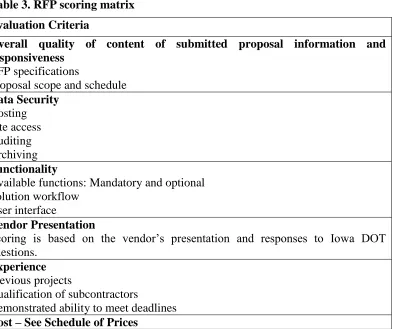
[image:24.612.83.477.221.550.2]Ultimately, 16 vendors submitted proposals. The proposers’ solutions ranged from off-the-shelf to custom-developed solutions. Proposals from the 16 proposers were scored by a five-member selection team using a best-value selection process outlined in the RFP. The top three proposals were shortlisted and invited to present their solutions to the selection team. The scoring matrix used by the selection team, and provided in the RFP, is shown in Table 3. Weights for the different categories were not provided to proposers.
Table 3. RFP scoring matrix Evaluation Criteria
Overall quality of content of submitted proposal information and responsiveness
RFP specifications
Proposal scope and schedule
Data Security Hosting Site access Auditing Archiving Functionality
Available functions: Mandatory and optional Solution workflow
User interface
Vendor Presentation
Scoring is based on the vendor’s presentation and responses to Iowa DOT questions.
Experience
Previous projects
Qualification of subcontractors
Demonstrated ability to meet deadlines
Cost – See Schedule of Prices
The selection team scored the proposals and shortlisted the three proposals with the highest scores. The following firms were shortlisted: Submittal Exchange (Textura 2014), Attolist (Norforma 2014), and Eadoc (Eadoc 2014). Each firm was invited to present their solution in person at the Iowa DOT or remotely via a web conference. Proposers were given one hour for their presentation and half an hour for questions by the selection team.
1. Creating RFIs and submittals 2. Managing user accounts 3. Overall system navigation 4. Workflow functionality 5. System security
6. Training and support 7. Maintenance and updates
Following the presentation, the selection team scored each presentation and added it to the firm’s proposal score to obtain the total score. Attolist, the firm with the highest total score, was
recommended for the award of the contract. Following the RFP timeline, a contract was executed with Attolist on September 1 to provide a web-based collaboration solution for the two pilot projects. There were no protests of the contract award.
Solution Customization
Shortly following the contract execution, a kick-off meeting was held with Attolist to begin customizing and implementing their solution. Key implementation members met with Attolist at this time to work out a timeline for the customizations and implementation. Progress meetings were subsequently conducted monthly per Attolist’s contract to evaluate progress. A timeline was created to complete all customizations to the system by the end of October 2009. This would allow two months to test the customizations and set up the Broadway Viaduct project before it went into use by project participants in January 2010.
As part of Attolist’s proposal, a number of customizations to their solution were included to tailor the solution to meet the needs of the Iowa DOT. These customizations fell into three main categories:
1. Adjusting user terminology 2. Adjusting user functionality
3. Allowing access through the Iowa DOT website
The first customization, adjusting user terminology, was completed primarily to ensure that the terminology used within the solution was consistent with the Iowa DOT’s current terminology. The primary change this required was the replacement of the term “Architect” within the system with the term “Designer.” Previously, Attolist had been used primarily on vertical construction projects; thus the term “Architect” was commonly used throughout the system.
Iowa DOT workflows, act as the intermediary for all RFIs, and have administrative control over the system. Second, some customizations were required to allow the Iowa DOT to continue to jointly review documents along with a third party consultant. Some changes were needed to ensure that central Iowa DOT engineers would have the ability to review shop drawing submittals.
The final part of adjusting the user functionality required changing user permissions within the system to allow the Iowa DOT to collaborate with consultants on project issues without their discussion being visible to the contractor. By completing this customization, the Iowa DOT could move these discussions away from e-mail and still provide the contractor with a single unified answer for project issues.
The last customization to the Attolist system was to allow for access to the system from the Iowa DOT website. This customization was conducted to create an association between the Attolist solution and the Iowa DOT, since the solution was hosted by Attolist. This was accomplished by creating a webpage on the Iowa DOT website for web-based construction collaboration
(http://www.iowadot.gov/bridge/ecpm.html). A log-in page was created at this address that allows system users to log in to Attolist from the Iowa DOT website.
Solution Testing
Upon completion of the customizations, a test project was created within Attolist in order for researchers and the Iowa DOT to test and familiarize themselves with the system. Researchers created multiple virtual users in this test environment to check the navigation of the system, upload documents, and simulate the workflow of documents between the contractor, Iowa DOT engineers, and consultants.
Testing the solution served researchers well because they were able to identify a number of bugs in the customizations that Attolist was able to promptly resolve. By identifying and resolving minor issues in the system prior to releasing the solution for project use, researchers aimed to reduce problems for users and hopefully improve system acceptance among project users.
A secondary benefit from testing the system was that researchers became quite familiar with the system. This allowed them to help examine how to best transfer Iowa DOT processes and workflows into the system. Additionally, based on this familiarity with the system, researchers identified a potential need for user guides to aid project participants in basic functions of the Attolist system.
User Guides
navigation, one for RFIs, and one for submittals. These user guides are shown in Appendices C, D, and E.
After completion of the user guides, Attolist independently released similar user guides as part of a system upgrade. Some of these user guides covered similar material; however, none of them addressed the specific practices and procedures of the Iowa DOT as the guides developed by the researchers did. The user guides produced by researchers were posted on the Iowa DOT web-based construction collaboration webpage as PDF files.
Solution Implementation
After completion of the site-testing program and approval from the Iowa DOT, the project site was set up for the Broadway Viaduct Project. The Iowa DOT uploaded contract documents and researchers worked to determine workflows and final project procedures. This included setting up groups of project participants for reviewing submittals.
Training
As part of Attolist’s contract, three training sessions were included per pilot project. These sessions would be conducted via a web conference and would last approximately half an hour. It was anticipated, based on the user friendliness of the system, that minimal training would be required for users. To ensure that knowledge obtained during training sessions was retained, the goal was to train users within a couple weeks of their need for the system. For this reason, one of the Broadway viaduct training sessions was conducted for the Iowa DOT and the project
consultants approximately three weeks before the project letting. A second training session was conducted for the contractor approximately three weeks after the project letting. The third training session was saved in case additional training or a refresher was required. An additional benefit of conducting two training sessions allowed the trainer to target the different user types within the system. Since the contractor user type does not have the same available functionality, training them with functions only available to the Iowa DOT could serve to confuse them. Training for the Iowa Falls Arch Bridge will be conducted during the summer of 2010.
Performance Measurement
Measurement of WPMS performance on the pilot projects will be conducted mostly in two ways. First, pre- and postproject surveys will be conducted to gauge project participants’ opinions of the system and its perceived benefit. Second, web statistics will be analyzed to quantify the amount of usage that the system received.
Broadway Viaduct Bridge are shown in Figures 5–11. Figures 5 and 6 give some general
[image:28.612.127.486.132.319.2]information on the project roles of the survey respondents and also how much they expect to use the system.
Figure 5. Survey respondent project role
Figure 6. Anticipated system usage per week
0.00% 10.00% 20.00% 30.00% 40.00% 50.00% 60.00% 70.00% 80.00% 90.00% 100.00%
Iowa DOT Consultant Contractor Supplier
Per ce n tage o f R e sp o n d e n ts 0% 20% 40% 60% 80% 100%
Less than 10 10 to 20 More than 20
[image:28.612.126.486.344.526.2]Figure 7. Respondents anticipating a positive impact from the system
Figure 7 summarizes a number of survey questions regarding the effects of the system on the management of the project. In general, most project participants felt that the WPMS would provide benefit in most of the surveyed areas. As shown in the figure, project participants felt that the WPMS could best help in increasing information availability, accountability, and
[image:29.612.114.498.438.663.2]document management transparency. The final column, Project Role, shows that only 45% of the respondents felt that the WPMS would make their job on the project easier. Individual graphs for each of the figures can be seen in Appendix G.
Figure 8. Perceived benefit of learning to use the system
0% 10% 20% 30% 40% 50% 60% 70% 80% 90% 100% Per ce n tage o f R e sp o n d e n ts 0% 10% 20% 30% 40% 50% 60% 70% 80% 90% 100%
Not Worth the Benefits Neutral Worth the Benefits
Figure 9. System technological requirements
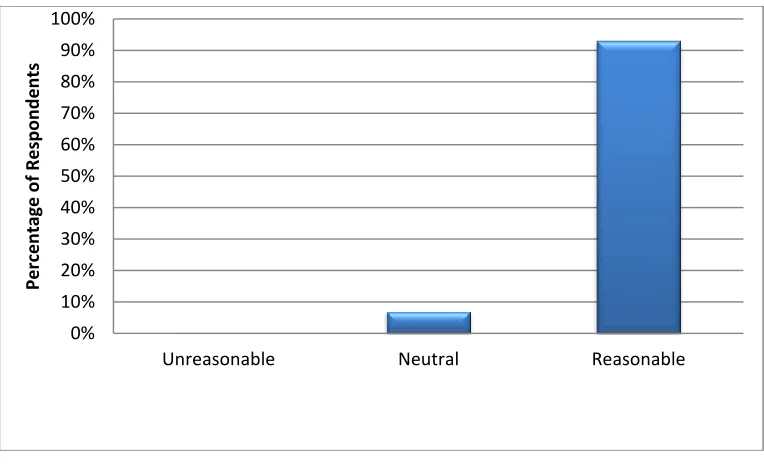
Figure 8 shows that users generally felt that the time required to learn to use the system was well worth the benefit the system provided to them. It is surprising that respondents overwhelmingly selected this response when less than half of the respondents answered that they expected that the WPMS would ease their project responsibilities as shown in Figure 7. Figure 9 shows that
project participants felt the technological system requirements of Internet access, an Internet browser, and an e-mail account were reasonable.
Figure 10. Overall effect on project management
0% 10% 20% 30% 40% 50% 60% 70% 80% 90% 100%
Unreasonable Neutral Reasonable
Per ce n tage o f R e sp o n d e n ts 0% 10% 20% 30% 40% 50% 60% 70% 80% 90% 100%
Worsen No effect Improve
Figure 11. Project size driving implementation
Figures 10 and 11 show that the project participants thought that the $25 million construction cost of the Broadway Viaduct Bridge was sufficient to make the WPMS worth implementing and that the system had potential to improve the project management of the bridge. With 90% of the respondents indicating the WPMS has the potential to improve project management on Iowa DOT bridge projects, the WPMS appears to have initially been well received on the Broadway Viaduct Project.
In the final part of the preproject survey, respondents were asked open-ended questions regarding what they perceived to be the biggest benefit, concerns, improvements, and expected difficulties with the solution. In general, users felt that the benefits of the system would be better
organization and tracking of documents, more rapid flow of information, improved access to information, and increased efficiency. The respondents’ biggest concerns were the time required to learn to use the system, getting the full project team to buy into the solution, and the
availability of computers with Internet access. For the most part, users felt they would need to interface with the system before they could offer suggestions or concerns specific to its use.
The same preproject survey will be issued prior to the Iowa Falls Arch Bridge pilot project. Additionally, upon completetion of each pilot project a similar postproject survey will be issued to the project participants. An analysis will then be completed between the two projects and also between the pre- and postproject surveys to evaluate the impact of the WPMS.
Special Contract Provision
During the first year of research, a draft special contract provision was created for use of the commercially selected WPMS on pilot projects. Some minor changes were made to this special provision after Attolist was selected as the vendor to provide the WPMS. The special contract provision issued for the Broadway Viaduct Project is shown in Appendix H.
0% 10% 20% 30% 40% 50% 60% 70% 80% 90% 100%
Smaller Same Larger
Project Archiving
After both pilot projects are completed, the information stored within Attolist will need to be transferred into the Iowa DOT’s in-house archival system. Attolist provides archived information in a combination format of Excel spreadsheets and pdfs. Additionally, by the time the pilot projects are completed, Attolist may have an offline version of their solution that would allow the Iowa DOT to access project information in the same interface used during the project.
To evaluate the archiving options of project information upon completion of the pilot projects, a task force was formed composed of Iowa State researchers and Iowa DOT engineers and
information technology specialists. The task force was able to determine that, because of the format of the information provided by Attolist, there will be some manual effort required to transfer this information to the Iowa DOT’s internal archiving system. Based on the amount of information created during the two pilot projects and the effort required to automate the
archiving process, it was agreed that it did not make sense to automate the archiving process for the two pilot projects. For a future solution encompassing more projects, however, it will be critical to develop a solution that can automate the transfer of information into the Iowa DOT’s archives.
Broadway Viaduct Bridge
During the winter of 2010 the first pilot project, the Broadway Viaduct Project, in Council Bluffs was let. After the letting, the selected contractor, Cramer and Associates, began to interface with the system. Prior to the letting of the project, researchers had extensively researched project participant needs and also tested Attolist. To monitor the solution and also to aid in the acceptance and performance of the solution, researchers worked with a variety of project participants after the letting to determine how the system was performing and how it could be improved. This was completed through periodic phone conversations and e-mails.
Speaking with the project participants, most of them felt that during the first two months of using the system they found it beneficial and saw quite a bit of potential for it. There were a number of issues, however, that needed to be resolved. One of the issues was the inability of the Iowa DOT and designer project participants to collaborate on the submittals and how the Iowa DOT’s current practices could be most effectively replicated by the Attolist workflow. The second issue that came up was that the system was not as intuitive as the users desired.
The second issue of user friendliness has been a bit more problematic for users. Initially, many users struggled to figure out exactly what they needed to do to submit, view, and review
documents within the system. Additionally, many users were unaware of who could view things within the system and who they were sending information to. While most of the frequent users of the system were able to learn how to effectively accomplish things within the system, occasional users are likely to experience some frustration, and users will likely experience the challenge of climbing a learning curve at the start of the second pilot project.
To help make the solution more user friendly, researchers will be evaluating the most effective way to train system users. Additionally, since many WPMSs were originally designed for vertical construction, the default work flows do not necessarily match how the Iowa DOT manages documents. Work by researchers to help better match system workflows with current DOT workflows should also help simplify the interface for users.
Iowa Falls Arch Bridge
The Iowa Falls Arch Bridge will be let in the summer of 2010. Researchers will work with the Iowa DOT to implement improved training and also to complete performance measurements as on the Broadway Viaduct Bridge. This project will use the same central office Iowa DOT engineers; however, the rest of the project participants will be new to the solution.
I-74 MISSISSIPPI BRIDGE
The design for a bridge to replace the I-74 crossing of the Mississippi in Davenport is currently being completed for the Iowa DOT by consultant Alfred Benesch & Company. As an
infrastructure critical bridge, this two-span suspension bridge along with its approach ramps has considerable complexity. At this point, funding has yet to be secured for the actual construction of the bridge. The final design being completed is a major undertaking with an approximate cost of $50 million.
Because of the size of the project, participants need a solution for managing information. Hanson Professional Services Inc., a subconsultant to Alfred Benesch, uses ProjectWise for this purpose. ProjectWise, from Bentley Systems (Bentley 2014), has historically been used by design firms internally to manage electronic plans and files. Hanson set up ProjectWise as a password-protected site to facilitate the sharing of documents and the management of design issues. The ProjectWise solution allows all of the users to access the design documents. To ensure users are not simultaneously changing plans, however, users must “check out” documents, locking them away from other users before making changes. The system also manages RFIs and project issues and provides a way to share general project information such as plans and specifications.
Use of this site has allowed the designers in Chicago and Iowa DOT personnel in Ames to access documents and collaborate on design issues. Iowa DOT personnel have found the system
tracking. They have found the system to be especially beneficial given the size of the project and the amount of information associated with it.
Although the system has worked well, users have not found it entirely intuitive. Some of the default settings for checking out documents have led to unnecessarily locking documents so they cannot be used by other project participants. In addition, Iowa DOT participants report that the RFI process is somewhat convoluted from their point of view and could be more intuitive.
Overall, the use of ProjectWise has proved beneficial for this project and users asserted that it would be beneficial on future projects. One concern for future projects relates to having a consultant select and host the solution. This has worked well during the design phase of the I-74 project; however, in the future such a policy could lead to the selection of different WPMS solutions for each project the Iowa DOT is managing. This could make it difficult for Iowa DOT personnel because they would need to learn to use a different system for each project.
BRIDGE INFORMATION MODELING
As part of the researchers’ investigation into a WPMS for the Iowa DOT, researchers examined where the future for WPMS technology may lie. One possibility is an integration of a WPMS with other computer systems through technology such as bridge information modeling (BrIM). Currently, in the vertical construction industry building information modeling is gaining wide popularity. It revolves around the idea of using a single 3D model for a project. This model contains all of the building plans and specifications. Furthermore, this model is maintained for the full life cycle of the building. By doing this, all of the information is retained in a single location, and information and history for specific building components can be easily accessed (Autodesk 2014).
Although this technology is quickly gaining popularity in the vertical construction industry, no equivalent exists that has been specifically designed for the horizontal construction industry. One of the premier software providers to the horizontal engineering and construction industry,
Bentley, has developed an idea for BrIM (Figure 12) (Bentley 2014). They have no specific “BrIM” solution currently, however. Ultimately, the development and implementation of a BrIM solution has potential to improve design and construction through improved information sharing. Additionally, BrIM offers a potential for significant improvements in the operational
Figure 12. Bridge information modeling concept (Bentley 2014)
Currently, the Iowa DOT does not use any BrIM technology or 3D modeling for bridges. To obtain a better understanding of the level of current implementation of these technologies in Iowa, researchers spoke to the contractors and suppliers that the DOT regularly interfaces with. The goal was not only to find out if these companies used 3D modeling, but also if they would find it beneficial if a 3D model was provided. Speaking with personnel from two contractors that regularly construct bridges for the Iowa DOT, researchers found that neither one uses 3D
modeling extensively. One contractor had used 3D modeling on a project but opined that for most projects, the benefits would not justify the added expense. This contractor did concede that this technology could be beneficial on a bridge project with complex geometry. Based on
interviews with four suppliers, the results showed that there is a variety of usage levels for 3D modeling. Two suppliers did not use any 3D modeling, one supplier was just starting to use some 3D modeling, and one structural steel supplier was moving toward doing all of its detailing in 3D. Based on these informal interviews, it seems that while 3D may provide some project participants some benefit, in general the response did not indicate that there was an immediate need for 3D modeling on DOT bridge projects. The exception to this may be for bridges that have usual details or complex geometry.
SUMMARY
customizing and testing the Attolist solution for use on the pilot projects. During the second half of the research period, the solution was implemented on the first pilot project, the US 6
Broadway Viaduct Bridge in Council Bluffs.
Since implementing Attolist on the first pilot project, the solution has performed well. Initial performance measurements using preproject surveys showed that users generally accepted the solution and believed that that it could help improve the management of bridge construction projects. Some issues, however, did arise early in the implementation process. The ability to collaborate on submittals required improvement; however, this was easily resolved by using the existing messaging function within the solution. Additionally, users did not find the system as intuitive as they would have expected. Issues regarding the intuitiveness of the solution were dealt with on a case-by-case basis for the first pilot project. Prior to the start of the second pilot project, researchers should be prepared to adjust training and provide help sheets that will make the system more intuitive for project participants. Furthermore, researchers and developers should investigate workflows for documents within the system and make small changes to ensure they are compatible with Iowa DOT workflows.
Overall, Attolist has proved to be an improvement over the pilot project solutions that were initiated during the first year of research. Attolist has addressed early implementation issues and appears to be meeting the project management needs of the Iowa DOT. Such issues have been minor, and most project participants have anticipated the solution to be beneficial. An Iowa DOT engineer commented that so far on the Broadway Viaduct Project management of submittals and RFIs has required 10% of the effort required by the I-80 bridge project, which served as the impetus for this research project.
FUTURE RESEARCH
Research activities beyond the second year will be targeted to assist in the implementation of Attolist on the Iowa Falls Arch Bridge. Work will need to be completed to evaluate how some of the issues on the Broadway Viaduct Project can be addressed. Finally, work will be completed to continue to evaluate the performance of Attolist on all pilot projects.
Beyond continuing the current work, additional investigations about how web-based
REFERENCES
http://attolist.com/
Autodesk. 2014. Die gesuchte seite kann nicht gefunden warden,
http://www.autodesk.de/adsk/servlet/index?siteID=123112&id=9970899 (11 July 2014) Bentley. 2014. Sustaining infrastructure, http://www.bentley.com/en-US/ (11 July 2014) Cho, A. 2009. Ten minutes with the godfathers of bridge information modeling. Engineering
News Record 263 (5): 28–29.
Eadoc. 2014. Compete, collaborative construction management application, http://www.eadocsoftware.com/ (11 July 2014)
Google Groups. n.d., http://groups.google.com/ (11 July 2014)
APPENDIX A: POST-PROJECT SURVEY
Post-Project Survey
Iowa DOT Jackson 108 Project
US 52 over I.C.E. Railroad and Mill Creek
Please answer the following questions based on your experience with the Iowa DOT’s FTP site and Google Groups Application on this project. Your answers are important in helping the Iowa DOT determine how to implementation web-based collaboration solutions in the future. Upon Completion please return this survey to Aaron Zutz, [email protected] you.
Participant Information:
1. What was your role on this project (please circle):
Iowa DOT Employee Consultant Contractor Supplier
2. Approximately how many times per month did you interface with either the FTP site or Google Groups site (please circle):
Less than 5 5 to 10 More than 10
Project Website Experience:
Using similar Iowa DOT bridge projects as a baseline, please respond to the following statements by circling the most appropriate number where:
1 = Strongly Disagree 2 = Disagree
3 = Neutral 4 = Agree
5 = Strongly Agree
1. The project website made the submittal process easier and more efficient for me.
1 2 3 4 5
2. The project website made the RFI process easier and more efficient for me.
1 2 3 4 5
3. The project website made relevant project information more easily available.
1 2 3 4 5
4. The project website increased accountability for project participants.
5. The project website increased the transparency of document management.
1 2 3 4 5
6. The project website decreased the overall cost associated with document management and transmittal of documents.
1 2 3 4 5
7. The project website decreased the review time of documents
1 2 3 4 5
8. The project website simplified my job on this project.
1 2 3 4 5
9. I would recommend using this project website again on bridge projects.
1 2 3 4
10.I would recommend using a more full featured project website to assist project participants in the future.
1 2 3 4 5
11.I would recommend using a project website to assist project participants on projects that are
Smaller Same Size Larger
Please write in answers to the following questions: What has worked well with this system?
What could be improved on this system?
APPENDIX B: POST-PROJECT SURVEY RESULTS
[image:41.612.161.452.300.443.2]Figure 13. Statement 1: “The project website made the submittal process easier and more efficient for me.”
Figure 14. Statement 2: “The project website made the RFI process easier and more efficient for me.”
Figure 15. Statement 3: “The project website made the RFI process easier and more efficient for me.”
0 1 2 3 4 5 Strongly Disagree
Disagree Neutral Agree Strongly Agree Fr e q u e n cy Answer 0 1 2 3 4 5 Strongly Disagree
Disagree Neutral Agree Strongly Agree Fr e q u e n cy Answer 0 1 2 3 4 5 Strongly Disagree
[image:41.612.161.451.505.645.2]Figure 16. Statement 4: “The project website increased accountability for project participants.”
Figure 17. Statement 5: “The project website increased the transparency of document management.”
Figure 18. Statement 6: “The project website decreased the overall cost associated with document management and transmittal of documents.”
0 1 2 3 4 5 Strongly Disagree
Disagree Neutral Agree Strongly Agree Fr e q u e n cy Answer 0 1 2 3 4 5 Strongly Disagree
Disagree Neutral Agree Strongly Agree Fr eq u en cy Answer 0 1 2 3 4 5 Strongly Disagree
[image:42.612.158.454.457.596.2]Figure 19. Statement 7: “The project website decreased the review time of documents.”
Figure 20. Statement 8: “The project website simplified my job on this project.”
Figure 21. Statement 9: “I would recommend using this project website again on bridge projects.” 0 1 2 3 4 5 Strongly Disagree
Disagree Neutral Agree Strongly Agree Fr eq u en cy Answer 0 1 2 3 4 5 6 7 Strongly Disagree
Disagree Neutral Agree Strongly Agree Fr eq u en cy Answer 0 1 2 3 4 5 6 7 Strongly Disagree
[image:43.612.157.455.429.568.2]Figure 22. Statement 10: “I would recommend using a more full-featured project website to assist project participants in the future.”
0 1 2 3 4 5 6 7
Strongly Disagree
Disagree Neutral Agree Strongly Agree
Fr
e
q
u
e
n
cy
APPENDIX C: ATTOLIST SYSTEM NAVIGATION QUICK START GUIDE
Iowa Department of Transportation:
Attolist Quick Start Guide
Web-based Construction Collaboration for Iowa DOT Bridge Projects
System Navigation
Table of Contents:
General Information……….……….Page 3
User Requirements……….………Page 3
Navigation……….….………Page 4
“Project Management”……….………Page 5
“Document Management”……….……….………..Page 6
“Construction Administration”……….………..Page 7
Additional help can be found by clicking the “Help” button in Attolist
General:
Attolist is being pilot tested on select Iowa DOT bridge projects to assist in the management of their construction. The primary role of attolist will be to assist project participants in the management of RFI’s and shop drawing submittals. The site will also be used to manage contract documents and meeting minutes. By utlizing Attolist project participants will be able to electronically submit, review, and monitor construction documents.
User Requirements:
The Iowa DOT will providing user accounts for project participants. In order for participants to utilize the Attolist site they will need a computer with internet access and an email account. Use of the site will be contractually ditacted by the Special Contract Provision for Electronic Submittals. Inorder to get an account project participants can contact the Resident Contruction Engineer. The Attolist website can be accessed through the Iowa DOT webpage at:
Navigation:
Upon logging into attolist a list of projects that the user is part of will be brought up. Individual project information can be accessed using the three tabs in the upper right hand corner of the screen. These tabs allow the user to access information on Project Management, Document Management, and Construction Administration. On the following pages flow charts are given to show what is contained in each area.
Lo.'ltowa Department
•
of
nansportatsonProjects
8 US 6 Broadway Viaduct Bridge Replacement [demo]
Project Management
Action Items [0 open, 1
closed]
Meetings {0]
Milestones {2]
Message Forums
Document Management
Design Phase Documents {7 1
Construction Phase Documents
{~]
S1eet Index {0]
S>ecification Index {0]
S1ared Folders
© 2006-2009 Attolist, LLC-[ build more ] Privacy Policy I Terms of Use I Contact Us
Construction Administration
Submittals {3 open, 8 closed]
RF!s
Field Reports {0]
I •
Project Information
US 6 Broadway Viaduct Council Bluffs, lA
Owner: Iowa DOT
Contractor: Not Specified
VIOW PROJECTS
Design Team Schemmer Architects Engineers Planners
edit oroiect ir.fo >
Project Management:
The Project Management tab is not expected to be used extensively. Meeting minutes will be posted on Attolist, however they will be under the Document Management tab. The headings listed in the chart below show up in Attolist in the left side bar. Not all of the categories will necessarily be used.
Project Management
Action Items Meetings Milestones Message Forums
Team Categories Meeting Types Project Phase Message Categories
Pre-Bid Meetings Bidding General Messages Pre-Construction Meetings Construction Design Team Messages
Weekly Progress Meetings Phone Records
Document Management:
The primary use of the Document Management tab will be for the contract documents. Developmental specifications and special provisions for the project will be listed under the appropriate headers in the Design Phase section. Construction documents will be listed under the Sheet-Spec Index. Additionally meeting minutes will be posted under Reports in the Construction Phase. The headings listed in the chart below show up in Attolist in the left side bar. Not all of the categories will necessarily be used.
Document Management
Design Phase Construction Phase Sheet Index Spec Index Shared Folders
Document Logs Document Logs Same side bar
as "Construction
Phase"
Same side bar as "Construction
Phase"
CAD Files
IDOT References Change Orders (COs)
Construction Documents
Proposal Potential Change Orders (PCOs) Contractor Transfer*
Plans Proposal Request (PRs) Design Team Transfer*
Addendums Revisions (REVs) DOT Team Transfer*
Special Provisions Value Engineering (VE) Development
Specs * May not be
applicable depending on User preferences
Reports
Meeting Minutes
Sheet-Spec Index Sheet-Spec Index