Vol. 2, No. 6, (2014), 149-180
Cross-Linguistic Examination of Spelling
Errors Made by Iranian
EFL Learners
Neda Rahmanifard∗ Department of Foreign Languages Shiraz Branch, Islamic Azad University,Shiraz, Iran
Email: [email protected] Lotfollah Yarmohammadi Department of Foreign Languages Shiraz Branch, Islamic Azad University,
Shiraz, Iran
Abstract. Patterns of spelling errors by EFL learners can reflect poor linguistic competence on different levels. With the purpose of examining factors affecting spelling errors of Iranian EFL learners, the present study aims to investigate writing skills of 465 Iranian high-school female students (mean age = 15.8) attending grades 1, 2, and 3 in Iran. Fifty selected words in each grade according to their textbooks were read to the students. For data analysis, the errors were classified into five major error categories including phonological awareness, knowledge of orthography, vocabulary, morphological and semantic relationships, and mental orthographic images. The content analysis of the data revealed that phonological skills were a strong predictor for spelling skills and pupils were relying on spoken language in deriving the written forms of words. Additionally, different types of spelling errors did not follow any distinct patterns based on the age. On the other hand, patterns of spelling errors for both areas (speaking Persian language at home versus speaking Arabic language at home) experienced similar patterns though at varying percentages.
Keywords: Spelling Errors, Persian language, English language, Or-thography, Phonology.
Received: June 2014; Accepted: August 2014 ∗
Corresponding author
150 N. Rahmanifard and L. Yarmohamadi 1. Introduction
As far as second language acquisition is concerned, both behaviorist psy-chologists and structural linguists believed that native language habits which are acquired during childhood as part of maturational processes interfere with the acquisition of second language habits which are usually quite different from the habits of mother tongue. In other words, sec-ond or foreign language learners will tend to transfer the formal features of their first language (L1) to their second language (L2) (Omidipour, 2014).
Generally speaking, the development of writing in EFL learners is influenced primarily by word-level skills such as word identification and spelling (for a review, see Adams, 1990). It is assumed that word identification and spelling depend on similar skills, namely, phonolog-ical and orthographic processing skills (Gough et al., 1992). Phono-logical processing skills represent the student’s procedural knowledge about grapheme-to-phoneme correspondence rules. They enable read-ers to translate the lettread-ers into their corresponding sounds and then combine the sounds to read words. Furthermore, phonological skills are used to spell words. Phonological skills enable spellers to segment the sounds in words and try to represent the sounds with corresponding let-ters. An EFL learner may segment the phonemes in ‘pat’ as /p/, /ae/, and /t/ and represent each with the corresponding graphemes, p, a, t (Varnhagan, 1995). Orthographic processing skills represent the “ability to form, store, and access the orthographic representations” of words or meaningful parts of words (Stanovich and West, 1989). These skills involve one’s knowledge of the letters in words and their sequence. Or-thographic skills allow the spelling of words from memory.
are highly predictable. Indeed, in a perfectly consistent orthography there would be entirely one-to-one grapheme-to-phoneme and phoneme-to-grapheme correspondences. Languages such as Arabic, Spanish, Greek, Persian, German, and French are examples of consistent orthographies (although the degree and the direction of transparency may differ among them). There are languages, however, where the relation between grapheme and phoneme is not straightforward and each grapheme may correspond to many phonemes and / or each phoneme may be represented by more than one grapheme. For example, the /k/ sound can be represented by k, c, ck, or ch, depending on where it occurs in the word. Another example is the graphemic sequence gh which has three different pronunciations as in though, enough and ghost and the /f/ sound which is represented by different letter combinations as in “affair”, “enough” and “pharaoh”. Be-sides, the English language has more phonemes than graphemes, such as the letter s which can represent the sounds /s/ or /z/. Moreover, the context can greatly influence orthographic information. For instance, an e at the end of a one-syllable word lengthens the preceding vowel and double letters do not often appear at the beginning of words. It is also important to possess some fair morphological knowledge of words and derivatives to become an effective speller in English. The spelling of the suffixes ed for past or s for plural are good examples. Similarly, morphological knowledge helps discover the link between related words, such as ‘signature’ and ‘sign’ despite their formal dissimilarity. In brief, good English spelling requires a complex interaction between phonology, orthography and morphology (Treiman and Cassar, 1997).
152 N. Rahmanifard and L. Yarmohamadi
that do not exist in their L1. This certainly hinders the development of their English spelling and thus word recognition skills. For instance, as Spanish has a smaller set of vowels, especially short vowels, than English, EFL Spanish learners experience difficulty learning short and long-vowel-spelling patterns at the early stages of language acquisition (Zutell and Virginia, 1988).
Reviewing the EFL spelling literature, it was found that there is paucity in studies targeting Arab learners’ spelling in English, espe-cially at the level of secondary and postsecondary education. One rel-evant study was conducted by Al-Jarf (2008). The study aimed at in-vestigating the phonological and orthographic problems that Saudi EFL freshmen students have in spelling English, their second language. With this aim in mind, the researcher asked 36 EFL freshmen students at the College of Languages and Translation, to complete a listening spelling test which required them to fill out 100 blanks in a dialogue. The results showed that the participants exhibited serious spelling difficulty, espe-cially at the phonological level that constituted 63% of the errors. Poor spellers had difficulty hearing and discriminating all or most of the phonemes in a word, hearing and discriminating vowel phonemes and hearing the final syllable or suffix. As for orthographic problems, they included vowel diagraphs, double consonants, silent vowels, consonants and homophones. Al-Jarf (2008) concluded that most of the participants’ weaknesses in spelling English can be attributed to the interference of the mother tongue. In other words, the participants were transferring the Arabic spelling system into English, which led to different spelling errors.
1.1. Learning to read and spell in Persian
Beginning readers of Persian start to read and spell by using diacritics but are gradually encouraged at the beginning of grade 2 to read and spell without using diacritics. The lack of diacritics is generally not a problem for skilled readers (Baluch, 1993). Indeed, the limited evidence shows that skilled readers show no difference in speed and accuracy for high frequency words while low frequency words with short vowels are read more slowly than those with long vowels (Baluch and Besner, 2001). Beginning readers, however, are less accurate on words with short vowels (Baluch and Shahidi, 1991).
Persian orthography is usually viewed as consistent in terms of grapheme to phoneme correspondence rules because each grapheme has a single pronunciation (Baluch, 1993; Baluch and Besner, 1991). Persian orthog-raphy is somewhat unpredictable in terms of spelling due to the existence of certain phonemes represented by more than one grapheme. For exam-ple, the phoneme /s/ can be represented by three different graphemes, (see also Arab-Moghaddam and Senechal, 2001; Baluch and Besner, 1991). The poligraphy of Persian should not have any effect on read-ing because any given letters has the same pronunciation; however, it may affect the spelling of a word because the speller has to select the correct letter from an array of possible letters.
Arab-Moghaddam and Senechal (2001) examined the role of phono-logical and orthographic skills in reading and spelling among bilingual Persian-English children (grade 2 and 3). They showed that orthographic skills were a better predictor of reading than were phonological skills, and that orthographic skills, not phonological skills, accounted for unique variance in Persian spelling. The pattern of strategies used by bilingual Persian-English children in Arab-Moghaddam and Senechal (2001) is similar to that reported for skilled readers (Baluch and Besner, 1991). In addition to relying more on orthographic skills to read and spell Per-sian words, the bilingual PerPer-sian-English children performed well on all tasks (i.e., reading 88%, spelling 77%, phonological skills 86%, and or-thographic skills 95%), which is characteristic of skilled reading (Ehri, 1992).
stud-154 N. Rahmanifard and L. Yarmohamadi
ies showing that beginning readers of consistent orthographic systems rely mostly on phonological skills to read and spell words (Baluch and Shahidi, 1991). It should be noted that in Arab-Moghaddam and Senechal’s study, however, children were bilingual. There is evidence showing that some metalinguistic and cognitive concepts develop differently in bilin-gual children in comparison to monolinbilin-gual children (Lesaux and Siegel, 2003).
In another work, Rahbari et al. (2007) investigated the contribution of phonological and orthographic skills to Persian reading and spelling. They showed that although monolingual Persian children relied both on phonological and orthographic skills, phonological skills were a strong predictor for both reading and spelling. In their works, as expected, children spelled phoneme to grapheme (PG)-consistent words more ac-curately than PG-inconsistent words. So far, rare efforts have been made to critically address the influence of Persian language on the mechanisms of spelling in English Language. Additionally, there are still challenging topics related to the sources of spelling error patterns among EFL learn-ers, which lead to contradictory results such as phonological processing skills or orthography processing skills. Consequently, by conducting a comprehensive survey and analysis of the results, this research attempts to gain more insight about spelling as a process by tracking the patterns of spelling errors and investigating whether or not participants’ language (Persian language) influences the mechanisms of spelling in English Lan-guage. To this end, the following research questions guide the current study:
• What are the causes of producing spelling errors by second lan-guage learners?
• Does the discrepancy between Persian and English orthographies hinder the Persian learners’ acquisition of English spelling?
• Does the grade/age have any effect on language errors made in English writing by Iranian school level EFL learners?
Cross-Linguistic Examination of Spelling ... 155
2. Methodology
2.1 Participants
The population sample, consisting of 465 learners of English, aged 15 to 18 years attending grades 1 to 3 in seven high schools in Shiraz and Mahshahr, Iran (with Persian language as their native language), took part in this survey. They all came from the same school type and were taught with the same syllabus and materials, but by different teach-ers. The participants were female. By the time the test was conducted, they had been learning English for about 3 to 5 years for at least four hours per week. Their exposure to English language was limited to the classroom. All participants who studied in Shiraz spoke Persian language at home while for about 85% of those who attended school in Mahshahr, Arabic was the language spoken at home.
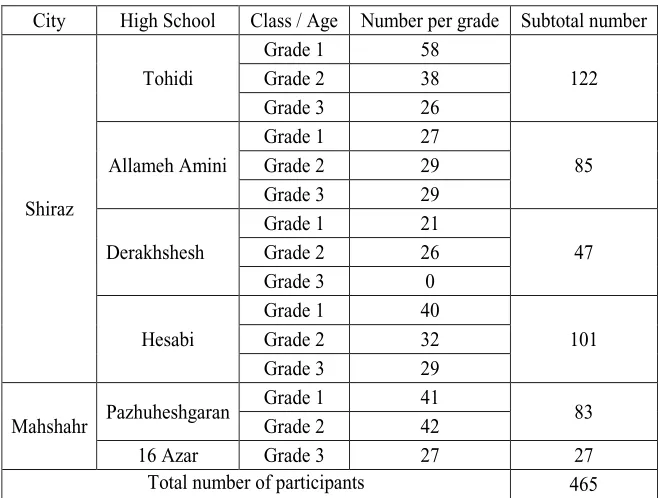
The number of participants per grade and city is presented in Table 1.
Table 1:Total number of samples marked, overall by city, class/age
6 learners’ acquisition of English spelling?
· Does the grade / age have any effect on language errors made in English writing by Iranian school level EFL learners?
· Is the trend of errors made by those whose spoken language at home is Persian similar to the ones who speak Arabic in the house?
2. Methodology 2.1 Participants
The population sample, consisting of 465 learners of English, aged 15 to 18 years attending grade 1 to 3 in seven high schools in Shiraz and Mahshahr, Iran (with Persian language as their native language), took part in this survey. They all came from the same school type and were taught with the same syllabus and materials, but by different teachers. The participants were female. By the time the test was conducted, they had been learning English for about 3 to 5 years
Table 1. Total number of samples marked, overall by city, class / age City High School Class / Age Number per grade Subtotal number
Shiraz
Tohidi
Grade 1 58
122 Grade 2 38
Grade 3 26 Allameh Amini
Grade 1 27
85 Grade 2 29
Grade 3 29 Derakhshesh
Grade 1 21
47 Grade 2 26
Grade 3 0
Hesabi
Grade 1 40
101 Grade 2 32
Grade 3 29 Mahshahr Pazhuheshgaran
Grade 1 41
83 Grade 2 42
16 Azar Grade 3 27 27
Total number of participants 465
2.2 Testing instruments
156 N. Rahmanifard and L. Yarmohamadi 2.2 Testing instruments
The test was elaborated with a four-step procedure which is as follows: 2.2.1 An initial selection of items from grades 1, 2, and 3 text-books
Following Kibbel and Miles (1994), Randall (1997) and Masterson and Apel (2000), in this study, a sample of individual words taken from English textbooks in different grades of high school was collected as done in other studies (e.g., Arab-Moghaddam and Senechal, 2001; Baluch and Shahidi, 1991; Bruck et al., 1997; Juel, 1988). It is essential to mention that for grade 1 the words in review section were utilized. Furthermore, since the tests were taken in November 2014, two lessons of grade 1, 2, and 3 of each textbook that had been taught, were also added to the tests for each grade.
2.2.2 An initial verification of the difficulty level of the items For this purpose, at least three experienced teachers in each grade were asked to rate the items on a 5-point scale (where 1 is easy and 5 is very difficult).
2.2.3 A second selection of easy and difficult items
In this part, based on the teachers’ ratings, for each word an average of rating was obtained. In general, it was supposed that easy items having received a mean rating score of 2 or below while difficult items having received a mean score of 3.5 or above.
2.2.4 Final selection of the words
suggest the optimal sample size, a corpus of 50-100 words would appear to be an appropriate amount to capture patterns of spelling (Masterson and Apel, 2000).
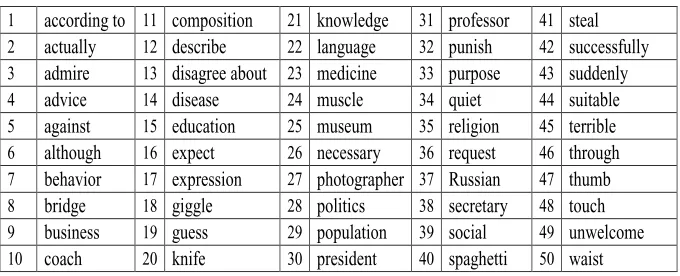
Therefore, a final selection of items within the difficult items was made for each grade because the easy items were nearly at ceiling for accuracy. The final version of the test consisted of 50 words that included one-syllable, two-syllable, and three-syllable words (see Table 2). Within each group of one-, two-, and three-syllable words, some of them were PG-consistent while the others were PG-inconsistent.
Table 2: Final selection of the words:
Table 2 (a):Grade 1
Table 2 (b): Grade 2
8
words that included one-syllable, two-syllable, and three-syllable words (see Table 2). Within each group of one-, two-, and three-syllable words, some of them were PG-consistent while the others were PG-inconsistent.
Table 2. Final selection of the words: Table 2 (a). Grade 1
1 arrive 11 exercise 21 minutes 31 raise 41 think 2 beautiful 12 field 22 necessary 32 raising 42 thirsty 3 breakfast 13 fruits 23 pay attention 33 restaurant 43 tomorrow 4 busy 14 getting late 24 Phone 34 several 44 understand 5 carefully 15 guest 25 Pick 35 sick 45 usually 6 climb 16 house 26 picture 36 sometimes 46 vegetables 7 climbed 17 kitchen 27 piece 37 studies 47 village 8 correctly 18 laugh 28 please 38 swimmer 48 wakes up 9 country 19 leave 29 pretty 39 swimming 49 was 10 difficult 20 library 30 questions 40 their 50 weather
Table 2 (b). Grade 2
1 across 11 build 21 don't worry 31 laugh 41 special 2 admire 12 butcher 22 Enough 32 migration 42 steam engine 3 attractive 13 century 23 Exercise 33 mystery 43 succeed 4 Australian 14 certainly 24 Follower 34 nationality 44 therefore 5 autumn 15 comfortable 25 Foreign 35 necessary 45 thirsty 6 be afraid of 16 creator 26 guidance 36 out of reach 46 thousand 7 be surprised 17 daylight 27 Guide 37 peace be upon him 47 universe 8 believe 18 dialogue 28 honesty 38 prophet 48 weather 9 borrow 19 discover 29 Ideal 39 receive 49 worse 10 brightly 20 distance 30 language 40 snow plow 50 worship
Table 2 (c). Grade 3
1 according to 11 composition 21 knowledge 31 professor 41 steal 2 actually 12 describe 22 language 32 punish 42 successfully 3 admire 13 disagree about 23 medicine 33 purpose 43 suddenly 4 advice 14 disease 24 muscle 34 quiet 44 suitable 5 against 15 education 25 museum 35 religion 45 terrible 6 although 16 expect 26 necessary 36 request 46 through 7 behavior 17 expression 27 photographer 37 Russian 47 thumb 8 bridge 18 giggle 28 politics 38 secretary 48 touch 9 business 19 guess 29 population 39 social 49 unwelcome 10 coach 20 knife 30 president 40 spaghetti 50 waist
8
words that included one-syllable, two-syllable, and three-syllable words (see Table 2). Within each group of one-, two-, and three-syllable words, some of them were PG-consistent while the others were PG-inconsistent.
Table 2. Final selection of the words: Table 2 (a). Grade 1
1 arrive 11 exercise 21 minutes 31 raise 41 think 2 beautiful 12 field 22 necessary 32 raising 42 thirsty 3 breakfast 13 fruits 23 pay attention 33 restaurant 43 tomorrow 4 busy 14 getting late 24 Phone 34 several 44 understand 5 carefully 15 guest 25 Pick 35 sick 45 usually 6 climb 16 house 26 picture 36 sometimes 46 vegetables 7 climbed 17 kitchen 27 piece 37 studies 47 village 8 correctly 18 laugh 28 please 38 swimmer 48 wakes up 9 country 19 leave 29 pretty 39 swimming 49 was 10 difficult 20 library 30 questions 40 their 50 weather
Table 2 (b). Grade 2
1 across 11 build 21 don't worry 31 laugh 41 special 2 admire 12 butcher 22 Enough 32 migration 42 steam engine 3 attractive 13 century 23 Exercise 33 mystery 43 succeed 4 Australian 14 certainly 24 Follower 34 nationality 44 therefore 5 autumn 15 comfortable 25 Foreign 35 necessary 45 thirsty 6 be afraid of 16 creator 26 guidance 36 out of reach 46 thousand 7 be surprised 17 daylight 27 Guide 37 peace be upon him 47 universe 8 believe 18 dialogue 28 honesty 38 prophet 48 weather 9 borrow 19 discover 29 Ideal 39 receive 49 worse 10 brightly 20 distance 30 language 40 snow plow 50 worship
Table 2 (c). Grade 3
158 N. Rahmanifard and L. Yarmohamadi
Table 2 (c): Grade 3
2.3. Data collection procedure
According to Randall (1997) and Kibbel and Miles (1994), 50 selected words in each grade were read to the students followed by the context twice. There were a five-second pause between the first reading of the selected word and its context and the second reading of them. Then, the EFL learners were asked to write down the word in the blanks which they heard. It is essential to mention that all words were pronounced as per Longman dictionary.
2.4. Data analysis
Three experienced teachers of English were recruited as markers. They had over 25 years of teaching experience, mostly at secondary level. Within their group, one was the head of secondary English departments; one had experience of teacher training and of teaching in middle schools, and another was working for an examination board. Before undertaking the main marking, the markers went through an agreement trial. This con-sisted of marking a common set of scripts and then attending a meeting to discuss discrepancies and clarify obscurities in, or misunderstandings about, the instructions. In addition, following the main marking, one of the three markers checked a sample of the mark sheets of each of the other two. In general, satisfactory levels of inter-marker agreement were achieved in the agreement trial, and a high level of accuracy in the main marking The markers were asked to apply a very detailed
ana-8
words that included one-syllable, two-syllable, and three-syllable words (see Table 2). Within each group of one-, two-, and three-syllable words, some of them were PG-consistent while the others were PG-inconsistent.
Table 2. Final selection of the words: Table 2 (a). Grade 1
1 arrive 11 exercise 21 minutes 31 raise 41 think 2 beautiful 12 field 22 necessary 32 raising 42 thirsty 3 breakfast 13 fruits 23 pay attention 33 restaurant 43 tomorrow 4 busy 14 getting late 24 Phone 34 several 44 understand 5 carefully 15 guest 25 Pick 35 sick 45 usually 6 climb 16 house 26 picture 36 sometimes 46 vegetables 7 climbed 17 kitchen 27 piece 37 studies 47 village 8 correctly 18 laugh 28 please 38 swimmer 48 wakes up 9 country 19 leave 29 pretty 39 swimming 49 was 10 difficult 20 library 30 questions 40 their 50 weather
Table 2 (b). Grade 2
1 across 11 build 21 don't worry 31 laugh 41 special 2 admire 12 butcher 22 Enough 32 migration 42 steam engine 3 attractive 13 century 23 Exercise 33 mystery 43 succeed 4 Australian 14 certainly 24 Follower 34 nationality 44 therefore 5 autumn 15 comfortable 25 Foreign 35 necessary 45 thirsty 6 be afraid of 16 creator 26 guidance 36 out of reach 46 thousand 7 be surprised 17 daylight 27 Guide 37 peace be upon him 47 universe 8 believe 18 dialogue 28 honesty 38 prophet 48 weather 9 borrow 19 discover 29 Ideal 39 receive 49 worse 10 brightly 20 distance 30 language 40 snow plow 50 worship
Table 2 (c). Grade 3
lytic marking scheme summarized as below. These instructions, however, were devised especially for this project, and therefore some background explanation is given. In this study, markers were asked to assess the pupil’s spelling on the basis of twenty-five errors in the tests as the max-imum limit of mistakes. The reason for choosing this number of errors is that in APU surveys (Gorman et al., 1991) it had been found that 50% accuracy in each script provided sufficient evidence for reliable assess-ment of detailed analytic categories such as orthography. Additionally, the markers were asked to ignore all of the following:
• punctuation errors, including incorrect use or non-use of hyphen or apostrophe
• incorrect use of upper or lower case letters
•incorrect word division including the past tenses or plural forms, how-ever if past tenses or plural forms are written inaccurately the error should be considered
We were therefore adopting a narrow meaning of ‘spelling error’. Finally the markers should do as follows:
• If the pupil has made no spelling errors in this narrow sense at all, enter ‘00’ in the ‘Error no.’ columns on both the Mark sheet and the Log sheet.
• Otherwise, for each spelling error detected, they should proceed as follows.
◦Allot each error a number and enter it in the Error no. columns on the Mark sheet and Log sheet. Start at 01 and work up.
◦ Where the error-word is illegible or unclear, just allot the error an error number in the “Non coded” column on the marker sheet.
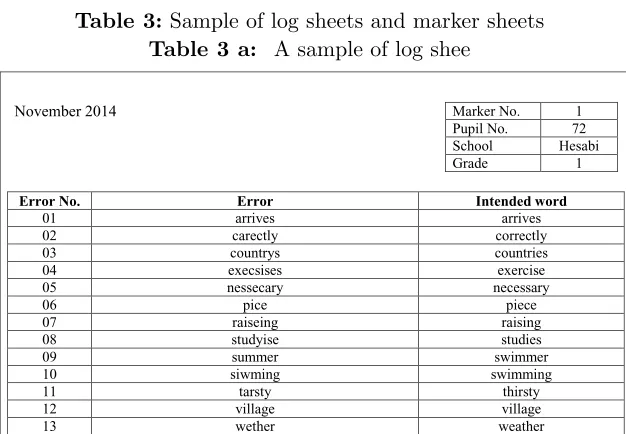
◦If there is more than one error in a word, then number, log and code each error separately. For example, ‘carectly’ for “correctly” contains two errors, the omission of the ‘r’ and the substitution of ‘a’ for “o”. For each codable error, do all of the following:
◦ Transcribe the error-word in the pupil’s spelling in the ‘Error’ column on the log sheet as depicted in Table 3 a.
160 N. Rahmanifard and L. Yarmohamadi
Table 3: Sample of log sheets and marker sheets Table 3 a: A sample of log shee
Table 3b:A Sample of marker sheet 11
Table 3. Sample of log sheets and marker sheets Table 3 a. A sample of log sheet
November 2014 Marker No. 1
Pupil No. 72 School Hesabi
Grade 1
Error No. Error Intended word
01 arrives arrives
02 carectly correctly
03 countrys countries
04 execsises exercise
05 nessecary necessary
06 pice piece
07 raiseing raising
08 studyise studies
09 summer swimmer
10 siwming swimming
11 tarsty thirsty
12 village village
13 wether weather
12
Table 3b. A Sample of marker sheet
Second Category*
No. phon. orth. Voc. Morph. Ment NC
1 1
2
1
3
1
4 1
5 1
6 1 7 1 8 1
9 1 10 1
1 11 1 1
12 1
13 1
14 15 16 17 18 19 20 21 22 23 24 25
Sum 4 5 0 4 2 0
* Phon.: Phonological Awareness, Orth.: Orthographic Knowledge, Voc.: Vocabulary, Morph.: Morphological Knowledge and Semantic Relationships, Ment.: Mental Orthographic Images, NC: Non-coded errors
· Code the error according to categories below:
Like reading, spelling is a written language skill that draws upon an individual’s repertoire of linguistic knowledge, including phonological awareness, and knowledge of orthography, vocabulary, morphological and semantic relationships; and mental orthographic images (Apel and Masterson, 2001; Apel et al., 2004, P-12). Each of these areas of linguistic or “word study”
160 N. Rahmanifard and L. Yarmohamadi
Table 3: Sample of log sheets and marker sheets
Table 3 a: A sample of log shee
• Code the error according to categories below: Like reading, spelling is a written language skill that draws upon an individual’s repertoire of linguistic knowledge, including phonological awareness, and knowledge of orthography, vocabulary, morphological and semantic relationships; and mental orthographic images (Apel and Masterson, 2001; Apel et al., 2004, P-12). Each of these areas of linguistic or “word study” knowl-edge contributes to spelling success (Treiman and Bourassa, 2000) and a deficit in any one of these areas of word study knowledge will man-ifest as a specific pattern of misspelling. Accordingly, in this category by analyzing individual’s spelling errors as per the following sections, we are looking for identifying underlying linguistic deficits among EFL learners. Different parts of this category are as follows:
Phon. (1)Phonological Awareness:
Individuals rely upon the phonological awareness skills of phoneme seg-mentation, sequencing, discrimination, and identification during the spe-lling or “encoding” process. They use phonological segmentation skills when spelling by breaking down words into smaller units-such as syl-lables and phonemes-then linking these smaller units to their written forms. They use sound sequencing skills to map the letters to sounds in the correct order. They use phoneme discrimination and identification skills to perceive differences between speech sounds (e.g., between the short vowel e and short vowel i sounds) and to recognize that a difference in sound signals a difference in meaning (Wasowicz, 2007, P. 1to 3). Orth. (2) Orthographic Knowledge:
162 N. Rahmanifard and L. Yarmohamadi
patterns (e.g., the/k/sound at the beginning of a word is never spelled with the letters ck, cc, lk). (Wasowicz, 2007, P. 1to 3).
Voc. (3)Vocabulary
Individuals use vocabulary knowledge to accurately store and retrieve the correct spelling of words. The knowledge of word meaning is par-ticularly important for the correct spelling of homophone words (e.g., bare and bear). Vocabulary knowledge is also helpful to correctly spell the wh consonant digraph because the /w/ sound at the beginning of question words (what, where, when, why, which) is always spelled with the letters wh. (Wasowicz, 2007, P. 1to 3).
Morph. (4)Morphological Knowledge and Semantic Relationships: Individuals also rely upon their morphological knowledge and knowl-edge of semantic relationships when spelling inflected or derived forms of words (Carlisle, 1995). Specifically, individuals rely upon their knowl-edge of letter- meaning relationships of individual morphemes (i.e., suf-fixes, presuf-fixes, base words, and word roots), their understanding of se-mantic relationships between a base word and related words, and their knowledge of modification rules when adding prefixes and suffixes.
Cross-Linguistic Examination of Spelling ... 163 Ment. (5) Mental Orthographic Images:
Individuals need to develop clear and complete mental representations of previously read words. These mental images of words, also known as mental orthographic images (MOIs), are stored in an individual’s long-term memory after repeated exposure to them in print (Ehri and Wilce, 1982; Glenn and Hurley, 1993). Inadequate MOIs are often formed when individuals use inappropriate reading strategies such as partial cue anal-ysis, a process whereby the student guesses the identity of a word after decoding only the first letter(s) of the word. Clearly and completely developed MOIs allow individuals to quickly recall and correctly spell words and word parts. Individuals must rely upon the mental image of a word when phonological awareness and knowledge of orthography, vo-cabulary, word parts, and related words are not sufficient to correctly spell a spelling pattern within a word (e.g., rope not roap, bucket not buckit, actor not acter). (Wasowicz, 2007, P. 1to 3).
NC (6)Non-coded errors:
The error arises when the word is illegible or unclear, e.g. ‘min’ for “min-utes”.
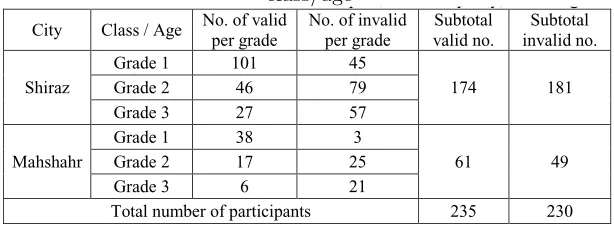
Once marking was completed, the mark sheets were further checked for the greatest possible degree of accuracy in the results. Based on the criterion of maximum 25 errors for accepting the sample for further investigation, samples were divided into two groups valid and invalid as presented in Table 4. Therefore, further investigation on samples based on the abovementioned categories were performed on valid samples (235 samples).
Table 4:Number of valid and invalid samples, overall by city, class/age
15
and knowledge of orthography, vocabulary, word parts, and related words are not sufficient to correctly spell a spelling pattern within a word (e.g., rope not roap, bucket not buckit, actor not acter). (Wasowicz, 2007, P. 1to 3)
NC (6) Non-coded errors:
The error arises when the word is illegible or unclear, e.g. 'min' for ''minutes''.
Once marking was completed, the mark sheets were further checked for the greatest possible degree of accuracy in the results. Based on the criterion of maximum 25 errors for accepting the sample for further investigation, samples were divided into two groups valid and invalid as presented in Table 4. Therefore, further investigation on samples based on the abovementioned categories were performed on valid samples (235 samples).
Table 4. Number of valid and invalid samples, overall by city, class / age City Class / Age No. of valid per grade No. of invalid per grade valid no. Subtotal invalid no. Subtotal Shiraz
Grade 1 101 45
174 181
Grade 2 46 79
Grade 3 27 57
Mahshahr
Grade 1 38 3
61 49
Grade 2 17 25
Grade 3 6 21
Total number of participants 235 230 3. Results and Discussions
In this section, three different scenarios were considered which are investigated in details in the following section:
· Frequency of Errors
· Variation in spelling performance related to age
· Variation in spelling performance related to spoken language at home
3-1- Frequency of Errors
It is possible to identify an individual’s linguistic deficits through spelling error analysis because a specific pattern of misspelling is associated with each specific type of linguistic deficit.
Ment. (5) Mental Orthographic Images:
Individuals need to develop clear and complete mental representations of previously read words. These mental images of words, also known as mental orthographic images (MOIs), are stored in an individual’s long-term memory after repeated exposure to them in print (Ehri and Wilce, 1982; Glenn and Hurley, 1993). Inadequate MOIs are often formed when individuals use inappropriate reading strategies such as partial cue anal-ysis, a process whereby the student guesses the identity of a word after decoding only the first letter(s) of the word. Clearly and completely developed MOIs allow individuals to quickly recall and correctly spell words and word parts. Individuals must rely upon the mental image of a word when phonological awareness and knowledge of orthography, vo-cabulary, word parts, and related words are not sufficient to correctly spell a spelling pattern within a word (e.g., rope not roap, bucket not buckit, actor not acter). (Wasowicz, 2007, P. 1to 3).
NC (6)Non-coded errors:
The error arises when the word is illegible or unclear, e.g. ‘min’ for “min-utes”.
Once marking was completed, the mark sheets were further checked for the greatest possible degree of accuracy in the results. Based on the criterion of maximum 25 errors for accepting the sample for further investigation, samples were divided into two groups valid and invalid as presented in Table 4. Therefore, further investigation on samples based on the abovementioned categories were performed on valid samples (235 samples).
Table 4:Number of valid and invalid samples, overall by city, class/age
Cross-Linguistic Examination of Spelling ... 163
Ment. (5) Mental Orthographic Images:
Individuals need to develop clear and complete mental representations of previously read words. These mental images of words, also known as mental orthographic images (MOIs), are stored in an individual’s long-term memory after repeated exposure to them in print (Ehri and Wilce, 1982; Glenn and Hurley, 1993). Inadequate MOIs are often formed when individuals use inappropriate reading strategies such as partial cue anal-ysis, a process whereby the student guesses the identity of a word after decoding only the first letter(s) of the word. Clearly and completely developed MOIs allow individuals to quickly recall and correctly spell words and word parts. Individuals must rely upon the mental image of a word when phonological awareness and knowledge of orthography, vo-cabulary, word parts, and related words are not sufficient to correctly spell a spelling pattern within a word (e.g., rope not roap, bucket not buckit, actor not acter). (Wasowicz, 2007, P. 1to 3).
NC (6)Non-coded errors:
The error arises when the word is illegible or unclear, e.g. ‘min’ for “min-utes”.
Once marking was completed, the mark sheets were further checked for the greatest possible degree of accuracy in the results. Based on the criterion of maximum 25 errors for accepting the sample for further investigation, samples were divided into two groups valid and invalid as presented in Table 4. Therefore, further investigation on samples based on the abovementioned categories were performed on valid samples (235 samples).
Table 4:Number of valid and invalid samples, overall by city, class/age
Cross-Linguistic Examination of Spelling ... 163
Ment. (5) Mental Orthographic Images:
Individuals need to develop clear and complete mental representations of previously read words. These mental images of words, also known as mental orthographic images (MOIs), are stored in an individual’s long-term memory after repeated exposure to them in print (Ehri and Wilce, 1982; Glenn and Hurley, 1993). Inadequate MOIs are often formed when individuals use inappropriate reading strategies such as partial cue anal-ysis, a process whereby the student guesses the identity of a word after decoding only the first letter(s) of the word. Clearly and completely developed MOIs allow individuals to quickly recall and correctly spell words and word parts. Individuals must rely upon the mental image of a word when phonological awareness and knowledge of orthography, vo-cabulary, word parts, and related words are not sufficient to correctly spell a spelling pattern within a word (e.g., rope not roap, bucket not buckit, actor not acter). (Wasowicz, 2007, P. 1to 3).
NC (6)Non-coded errors:
The error arises when the word is illegible or unclear, e.g. ‘min’ for “min-utes”.
Once marking was completed, the mark sheets were further checked for the greatest possible degree of accuracy in the results. Based on the criterion of maximum 25 errors for accepting the sample for further investigation, samples were divided into two groups valid and invalid as presented in Table 4. Therefore, further investigation on samples based on the abovementioned categories were performed on valid samples (235 samples).
Table 4:Number of valid and invalid samples, overall by city, class/age
Cross-Linguistic Examination of Spelling ... 163
Ment. (5) Mental Orthographic Images:
Individuals need to develop clear and complete mental representations of previously read words. These mental images of words, also known as mental orthographic images (MOIs), are stored in an individual’s long-term memory after repeated exposure to them in print (Ehri and Wilce, 1982; Glenn and Hurley, 1993). Inadequate MOIs are often formed when individuals use inappropriate reading strategies such as partial cue anal-ysis, a process whereby the student guesses the identity of a word after decoding only the first letter(s) of the word. Clearly and completely developed MOIs allow individuals to quickly recall and correctly spell words and word parts. Individuals must rely upon the mental image of a word when phonological awareness and knowledge of orthography, vo-cabulary, word parts, and related words are not sufficient to correctly spell a spelling pattern within a word (e.g., rope not roap, bucket not buckit, actor not acter). (Wasowicz, 2007, P. 1to 3).
NC (6)Non-coded errors:
The error arises when the word is illegible or unclear, e.g. ‘min’ for “min-utes”.
Once marking was completed, the mark sheets were further checked for the greatest possible degree of accuracy in the results. Based on the criterion of maximum 25 errors for accepting the sample for further investigation, samples were divided into two groups valid and invalid as presented in Table 4. Therefore, further investigation on samples based on the abovementioned categories were performed on valid samples (235 samples).
Table 4:Number of valid and invalid samples, overall by city, class/age
Cross-Linguistic Examination of Spelling ... 163
Ment. (5)Mental Orthographic Images:
Individuals need to develop clear and complete mental representations of previously read words. These mental images of words, also known as mental orthographic images (MOIs), are stored in an individual’s long-term memory after repeated exposure to them in print (Ehri and Wilce, 1982; Glenn and Hurley, 1993). Inadequate MOIs are often formed when individuals use inappropriate reading strategies such as partial cue anal-ysis, a process whereby the student guesses the identity of a word after decoding only the first letter(s) of the word. Clearly and completely developed MOIs allow individuals to quickly recall and correctly spell words and word parts. Individuals must rely upon the mental image of a word when phonological awareness and knowledge of orthography, vo-cabulary, word parts, and related words are not sufficient to correctly spell a spelling pattern within a word (e.g., rope not roap, bucket not buckit, actor not acter). (Wasowicz, 2007, P. 1to 3).
NC (6)Non-coded errors:
The error arises when the word is illegible or unclear, e.g. ‘min’ for “min-utes”.
Once marking was completed, the mark sheets were further checked for the greatest possible degree of accuracy in the results. Based on the criterion of maximum 25 errors for accepting the sample for further investigation, samples were divided into two groups valid and invalid as presented in Table 4. Therefore, further investigation on samples based on the abovementioned categories were performed on valid samples (235 samples).
Table 4:Number of valid and invalid samples, overall by city, class/age
Cross-Linguistic Examination of Spelling ... 163
Ment. (5)Mental Orthographic Images:
Individuals need to develop clear and complete mental representations of previously read words. These mental images of words, also known as mental orthographic images (MOIs), are stored in an individual’s long-term memory after repeated exposure to them in print (Ehri and Wilce, 1982; Glenn and Hurley, 1993). Inadequate MOIs are often formed when individuals use inappropriate reading strategies such as partial cue anal-ysis, a process whereby the student guesses the identity of a word after decoding only the first letter(s) of the word. Clearly and completely developed MOIs allow individuals to quickly recall and correctly spell words and word parts. Individuals must rely upon the mental image of a word when phonological awareness and knowledge of orthography, vo-cabulary, word parts, and related words are not sufficient to correctly spell a spelling pattern within a word (e.g., rope not roap, bucket not buckit, actor not acter). (Wasowicz, 2007, P. 1to 3).
NC (6)Non-coded errors:
The error arises when the word is illegible or unclear, e.g. ‘min’ for “min-utes”.
Once marking was completed, the mark sheets were further checked for the greatest possible degree of accuracy in the results. Based on the criterion of maximum 25 errors for accepting the sample for further investigation, samples were divided into two groups valid and invalid as presented in Table 4. Therefore, further investigation on samples based on the abovementioned categories were performed on valid samples (235 samples).
Table 4:Number of valid and invalid samples, overall by city, class/age
Cross-Linguistic Examination of Spelling ... 163
Ment. (5) Mental Orthographic Images:
Individuals need to develop clear and complete mental representations of previously read words. These mental images of words, also known as mental orthographic images (MOIs), are stored in an individual’s long-term memory after repeated exposure to them in print (Ehri and Wilce, 1982; Glenn and Hurley, 1993). Inadequate MOIs are often formed when individuals use inappropriate reading strategies such as partial cue anal-ysis, a process whereby the student guesses the identity of a word after decoding only the first letter(s) of the word. Clearly and completely developed MOIs allow individuals to quickly recall and correctly spell words and word parts. Individuals must rely upon the mental image of a word when phonological awareness and knowledge of orthography, vo-cabulary, word parts, and related words are not sufficient to correctly spell a spelling pattern within a word (e.g., rope not roap, bucket not buckit, actor not acter). (Wasowicz, 2007, P. 1to 3).
NC (6)Non-coded errors:
The error arises when the word is illegible or unclear, e.g. ‘min’ for “min-utes”.
Once marking was completed, the mark sheets were further checked for the greatest possible degree of accuracy in the results. Based on the criterion of maximum 25 errors for accepting the sample for further investigation, samples were divided into two groups valid and invalid as presented in Table 4. Therefore, further investigation on samples based on the abovementioned categories were performed on valid samples (235 samples).
164 N. Rahmanifard and L. Yarmohamadi
3. Results and Discussions
In this section, three different scenarios were considered which are in-vestigated in details in the following section:
•Frequency of Errors
•Variation in spelling performance related to age
•Variation in spelling performance related to spoken language at home 3.1. Frequency of errors
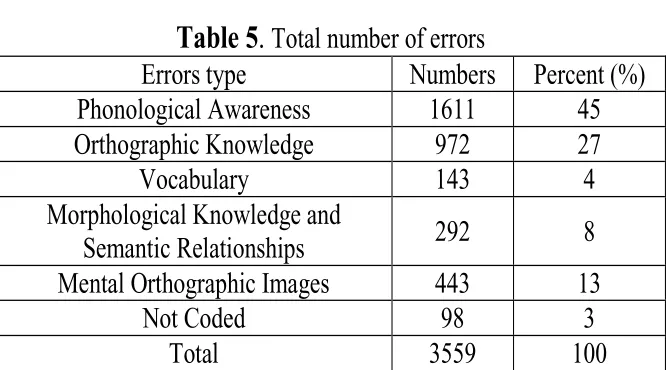
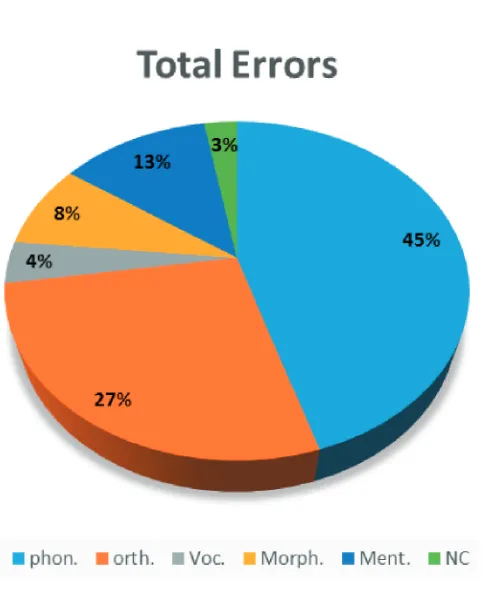
It is possible to identify an individual’s linguistic deficits through spelling error analysis because a specific pattern of misspelling is associated with each specific type of linguistic deficit. Analysis of an individual’s spelling errors reveals underlying deficits in phonological awareness, and in knowledge of orthography, vocabulary, morphological and semantic relationships, and mental orthographic images (Masterson and Mooney, 2006). Total number errors for each group with their percentage are presented in Table 5 and Figure 1.
Table 5. Total number of errors
16
Analysis of an individual’s spelling errors reveals underlying deficits in phonological aware
ness,
and in knowledge of orthography, vocabulary, morphological and semantic relationships, and
mental orthographic images (Masterson and Mooney, 2006). Total number errors for each group
with their percentage are presented in Table 5 and Figure 1.
Table 5. Total number of errors
Errors type
Numbers Percent (%)
Phonological Awareness
1611
45
Orthographic Knowledge
972
27
Vocabulary
143
4
Morphological Knowledge and
Semantic Relationships
292
8
Mental Orthographic Images
443
13
Not Coded
98
3
Total
3559
100
Figure 1. Linguistics deficit as per spelling errors
Cross-Linguistic Examination of Spelling ... 165
-Figure 1. Linguistics deficit as per spelling errors
As it is depicted, 62 percent of all errors belongs to phonological aware-ness, vocabulary, and mental Orthographic Images. In fact, when these skills are weak or underdeveloped, pupils were relying too much on spoken language in deriving the written forms of words; and there-fore spelling is negatively affected in very predictable ways. Typically, individuals with poor phonological segmentation skills deleted letters and syllables, usually omitting letters for less salient phonemes, espe-cially those that occur in internal locations and in unstressed syllables, (e.g., neccery for necessary, teribl for terrible). Individuals with poor sound sequencing skills commonly reversed the sequence of letters when spelling. Letters reversals most commonly occur for liquids and nasals in a word or syllable sequence (e.g., undrestand for understand, bets for
16
and in knowledge of orthography, vocabulary, morphological and semantic relationships, and
mental orthographic images (Masterson and Mooney, 2006). Total number errors for each group
with their percentage are presented in Table 5 and Figure 1.
Table 5. Total number of errors
Errors type
Numbers
Percent (%)
Phonological Awareness
1611
45
Orthographic Knowledge
972
27
Vocabulary
143
4
Morphological Knowledge and
Semantic Relationships
292
8
Mental Orthographic Images
443
13
Not Coded
98
3
Total
3559
100
Figure 1. Linguistics deficit as per spelling errors
166 N. Rahmanifard and L. Yarmohamadi
best). Individuals with poor phoneme discrimination and identification skills are likely to spell distinct vowel sounds with the same letter, (e.g., ricive for receive). Moreover, for those who have trouble applying vocab-ulary knowledge or mental orthographic images confused the spelling of homophone words (e.g., piece for peace) or characterized mental images of words by “legal” substitutions (e.g., fild for field, fruts for fruits), and misspelling of unstressed vowel sounds (e.g., creater for creator).
On the other hand, orthography knowledge has got the next large portion of errors. Individuals whose orthographic knowledge is deficient often spell words incorrectly because they fail to recognize accepted spelling conventions. As such, the misspellings of individuals with or-thographic knowledge deficits are predictably characterized by “illegal” substitutions (e.g., nessecarry for necessary), non-allowable letter se-quences (e.g., pice for pick; cuistion for question), phonetically possible spellings that violate “rules” (e.g., kichen for kitchen; coatch for coach), and violation of word position constraints (e.g., knowlege for knowl-edge). However, even in these cases the problem of relying on spoken language in deriving the written forms of words is completely clear.
At the end, deficits in morphological knowledge and knowledge of se-mantic relationships depict their specific patterns of spelling errors. The misspellings of individuals with these types of deficits are characterized by phonetic spelling of morphemes (e.g., attenssion for attention), and misspelling of modifications when spelling inflected and derived forms of words (e.g., studyes for studies).
3.2. Variation in spelling performance related to age
18
Figure 2 (a)
Figure 2 (b)
Figure 2 (c)
Figure 2. Percentage of errors per number of incorrect words by grade of pupils
18
Figure 2 (a)
Figure 2 (b)
Figure 2 (c)
Figure 2. Percentage of errors per number of incorrect words by grade of pupils
Cross-Linguistic Examination of Spelling ... 167
-Figure 2 (a)
Figure 2 (b)
Cross-Linguistic Examination of Spelling ... 167
-Figure 2 (a)
168 N. Rahmanifard and L. Yarmohamadi
-Figure 2 (c)
Figure 2. Percentage of errors per number of incorrect words by
grade of pupils
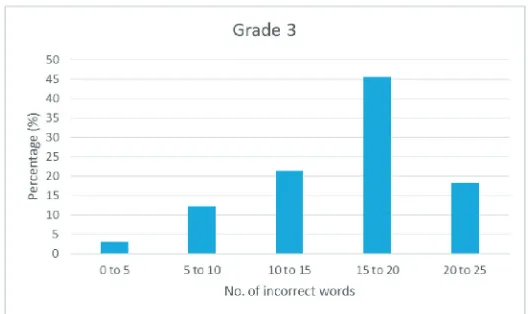
What the figure indicates is that just over 3 percent of pupils aged 16 and 17 made no spelling errors to 5 incorrect words in the tests ex-amined while this percentage for pupils aged 15 is above 20. Over 12 and 17 percent of the older pupils (aged 16 and 17, respectively) and just 27 percent younger ones made no more than ten errors. However, around twenty percent in all groups made ten to fifteen spelling errors in tests. At higher grades the corresponding error proportion was con-siderably higher than those in grade 1. To put this another way: 28 percent of 15-year-olds had got 15 or more words with incorrect spelling while the percentage for grade 2 and 3 were approximately 58 and 64, respectively.
3.2.1. Types of error
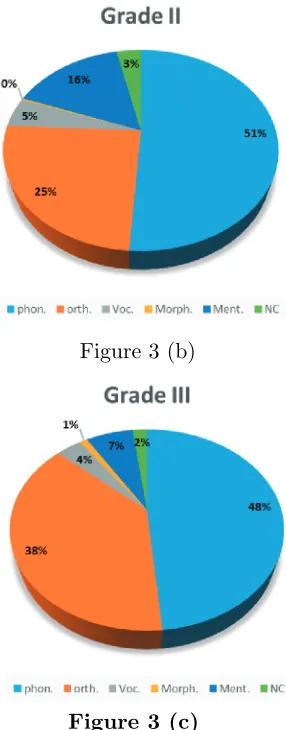
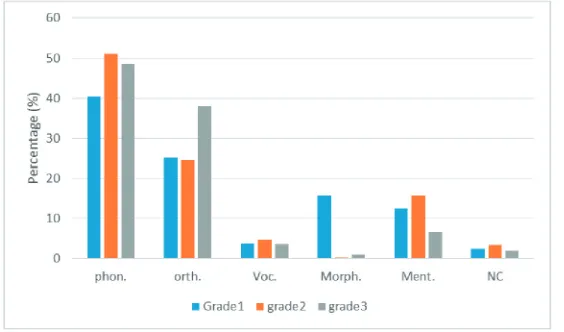
The number of errors per each grade are presented in Table 6 and Figure 3. As it is obvious, for all grades phonological awareness category expe-rienced the greatest percentage of misspelled word followed by orthog-raphy knowledge group. Additionally, vocabulary, mental orthographic images, and non-coded categories have got approximately same percent-age among pupils in different grades. It is also noticeable that 16 percent
18 Figure 2 (a)
Figure 2 (b)
Figure 2 (c)
Cross-Linguistic Examination of Spelling ... 169
of spelling errors among EFL learners in grade 1 belong to morphologi-cal knowledge and semantic relationships group while in grade 2 and 3 this percentage approached to 1 percent.
Table 6. Number of errors as per grade
Figure 3 (a) 19 3-2-1- Types of error
The number of errors per each grade are presented in Table 6 and Figure 3. As it is obvious, for all grades phonological awareness category experienced the greatest percentage of misspelled word followed by orthography knowledge group. Additionally, vocabulary, mental orthographic images, and non-coded categories have got approximately same percentage among pupils in different grades. It is also noticeable that 16 percent of spelling errors among EFL learners in grade 1 belong to morphological knowledge and semantic relationships group while in grade 2 and 3 this percentage approached to 1 percent.
Table 6. Number of errors as per grade
Grade / Age Errors type Numbers Percent (%)
Grade I
Phonological Awareness 723 40 Orthographic Knowledge 449 25
Vocabulary 67 4
Morphological Knowledge
and Semantic Relationships 282 16 Mental Orthographic Images 222 12
Not Coded 46 3
Grade II
Phonological Awareness 577 51 Orthographic Knowledge 279 25
Vocabulary 53 5
Morphological Knowledge
and Semantic Relationships 3 0.2 Mental Orthographic Images 178 16
Not Coded 39 2.8
Grade III
Phonological Awareness 311 48 Orthographic Knowledge 244 38
Vocabulary 23 4
Morphological Knowledge
and Semantic Relationships 7 1 Mental Orthographic Images 43 7
Not Coded 13 2
20
Figure 3 (a)
Figure 3 (b)
Cross-Linguistic Examination of Spelling ... 169
of spelling errors among EFL learners in grade 1 belong to morphologi-cal knowledge and semantic relationships group while in grade 2 and 3 this percentage approached to 1 percent.
Table 6. Number of errors as per grade
Figure 3 (a)
Cross-Linguistic Examination of Spelling ... 169
of spelling errors among EFL learners in grade 1 belong to morphologi-cal knowledge and semantic relationships group while in grade 2 and 3 this percentage approached to 1 percent.
Table 6. Number of errors as per grade
Figure 3 (a)
Cross-Linguistic Examination of Spelling ... 169
of spelling errors among EFL learners in grade 1 belong to morphologi-cal knowledge and semantic relationships group while in grade 2 and 3 this percentage approached to 1 percent.
Table 6. Number of errors as per grade
170 N. Rahmanifard and L. Yarmohamadi
-Figure 3 (b)
Figure 3 (c)
Figure 3. Linguistics deficit as per spelling errors for different grades
A better understanding of these explanations are depicted in Figure 4. As it is explained, an approximate range of 55 to 70 percent of all errors belongs to phonological awareness, vocabulary, and mental Or-thographic Images based on various grades which proved that regardless of pupils’ grades, they were relying too much on spoken language in de-riving the written forms of words; and therefore spelling is negatively
20 Figure 3 (a)
Figure 3 (b)
21
Figure 3 (c)
Figure 3. Linguistics deficit as per spelling errors for different grades
A better understanding of these explanations are depicted in Figure 4. As it is explained, an approximate range of 55 to 70 percent of all errors belongs to phonological awareness, vocabulary, and mental Orthographic Images based on various grades which proved that
regardless of pupils’ grades, they were relying too much on spoken language in deriving the
affected. Furthermore, by considering orthography knowledge, it is de-duced that phonic or ‘sounding-out’ approaches were absolutely common and were utilized among all students in various grades. In general, there was no evidence that pupils of different ages tended to make different types of error. In other words, spelling errors in other types of errors do not follow any distinct patterns.
Figure 4. Comparison of number of errors for different grades
3.3. Variation in spelling performance related to Spoken lan-guage at home
Persian language has lots of similarity with Arabic language. The for-mal or literary form of both languages used for all written texts, is written from right to left and letters within words should be combined when possible. Persian and Arabic languages also use an alphabetic or-thography that consists of thirty-two and twenty eight letters, respec-tively. They mainly represent consonants but also include three letters that correspond to long-vowel phonemes. In both languages, children initially learn to read and write a fully-vowelized orthography in which all the consonants and vowels are represented in the script, including the short-vowel diacritics. This orthography is very easy to phonologically decode because it is extremely reliable in terms of grapheme-to-phoneme correspondence rules. As a consequence, both of these languages are
22
Figure 4. Comparison of number of errors for different grades
3-3- Variation in spelling performance related to Spoken language at home
Persian language has lots of similarity with Arabic language. The formal or literary form of both languages used for all written texts, is written from right to left and letters within words should be combined when possible. Persian and Arabic languages also use an alphabetic orthography that consists of thirty-two and twenty eight letters, respectively. They mainly represent consonants but also include three letters that correspond to long-vowel phonemes. In both languages, children initially learn to read and write a fully-vowelized orthography in which all the consonants and vowels are represented in the script, including the short-vowel diacritics. This orthography is very easy to phonologically decode because it is extremely reliable in terms of grapheme-to-phoneme correspondence rules. As a consequence, both of these languages are consistent orthographic systems (although the degree and direction of transparency may differ among them) in which the relation between grapheme and phoneme is straightforward, and grapheme–phoneme correspondences are highly predictable.
172 N. Rahmanifard and L. Yarmohamadi
consistent orthographic systems (although the degree and direction of transparency may differ among them) in which the relation between grapheme and phoneme is straightforward, and grapheme-phoneme cor-respondences are highly predictable.
Therefore in this section, for the sake of validation and due to the lack of research in particular at secondary levels in Persian language, at first the similarity between the results of pupils attending schools in Mahshahr (speaking Arabic language at home) with those of El-Dakh and Mitchell (2011) is investigated. Then, under the case of similarity, a comparison of the results of pupils attending schools in Shiraz (speaking Persian language at home) with those for whom Arabic was prominently the language spoken at home (Mahshahr schools) is also performed. El-Dakh and Mitchel (2011) showed that the most serious problem with Arab EFL learners is handling vowels, especially short ones. The phe-nomenon that Ryan (1997) describes as the ‘vowel blindness’ of Arab English language learners. The next problem right after the vowels re-ported in their work was the problem of silent letters since silent letters are an English-restricted phenomenon in comparison with the Arabic language. In contrast, the participants had acceptable performance on the application of spelling rules (e.g., crossing the final ‘e’ in verbs before the addition of ‘ing’ or the change of the final ‘y’ after a consonant into an ‘i’ before the addition of ’ed’ for past).
Cross-Linguistic Examination of Spelling ... 173
-Figure 5. Spelling errors for all participants attending schools in Mahshahr
Thus, our results have got a reasonable consistency with those of El-Dakh and Mitchel (2011). Hence, a comparison between the results of pupils attending schools in Shiraz (speaking Persian language at home) with those for whom Arabic was prominently the language spoken at home (Mahshahr schools) is also performed. The errors numbers for each grade and totally between Shiraz and Mahshahr were compared in Figure 6. On the whole, almost the same percentage of error for each group was achieved among which phonological awareness experienced the greatest proportion in each grade and for both cities. In contrast, vocabulary, morphological knowledge and semantic relationships, and mental orthographic images were three less frequent errors among pupils from both cities and in all grades.
Figure 6 (a)
23
‘vowel blindness’ of Arab English language learners. The next problem right after the vowels reported in their work was the problem of silent letters since silent letters are an English-restricted phenomenon in comparison with the Arabic language. In contrast, the participants had
acceptable performance on the application of spelling rules (e.g., crossing the final ‘e’ in verbs before the addition of ‘ing’ or the change of the final ‘y’ after a consonant into an ‘i’ before the addition of ‘ed’ for past)
As it is shown in Figure 5, in our work and among various spelling error patterns the largest category of errors was phonological awareness which mainly consists of vowels, silent letters or involved leaving a letter single that should have been doubled or vice versa. While similar to the findings of El-Dakh and Mitchel (2011), morphological and semantic relationships had got low proportion (around 10 percent) which showed acceptable performance of pupils in this linguistic ability.
Figure 5. Spellingerrors for all participants attending schools in Mahshahr
Thus, our results have got a reasonable consistency with those of El-Dakh and Mitchel (2011). Hence, a comparison between the results of pupils attending schools in Shiraz (speaking Persian language at home) with those for whom Arabic was prominently the language spoken at home (Mahshahr schools) is also performed. The errors numbers for each grade and totally between Shiraz and Mahshahr were compared in Figure 6. On the whole, almost the same percentage of
24
error for each group was achieved among which phonological awareness experienced the greatest proportion in each grade and for both cities. In contrast, vocabulary, morphological knowledge and semantic relationships, and mental orthographic images were three less frequent errors among pupils from both cities and in all grades.
Figure 6 (a)
Figure 6 (b)
Cross-Linguistic Examination of Spelling ... 173
-Figure 5. Spelling errors for all participants attending schools in Mahshahr
Thus, our results have got a reasonable consistency with those of El-Dakh and Mitchel (2011). Hence, a comparison between the results of pupils attending schools in Shiraz (speaking Persian language at home) with those for whom Arabic was prominently the language spoken at home (Mahshahr schools) is also performed. The errors numbers for each grade and totally between Shiraz and Mahshahr were compared in Figure 6. On the whole, almost the same percentage of error for each group was achieved among which phonological awareness experienced the greatest proportion in each grade and for both cities. In contrast, vocabulary, morphological knowledge and semantic relationships, and mental orthographic images were three less frequent errors among pupils from both cities and in all grades.
174 N. Rahmanifard and L. Yarmohamadi
-Figure 6 (b)
Figure 6 (c)
Figure 6 (d)
Figure 6. Linguistics deficit as per spelling errors for different grades between two cities: (a) grade 1, (b) grade 2, (c) grade 3, and (d) total
sum of all grades
174 N. Rahmanifard and L. Yarmohamadi
-Figure 6 (b)
Figure 6 (c)
Figure 6 (d)
Figure 6. Linguistics deficit as per spelling errors for different grades
between two cities: (a) grade 1, (b) grade 2, (c) grade 3, and (d) total sum of all grades
174 N. Rahmanifard and L. Yarmohamadi
-Figure 6 (b)
Figure 6 (c)
Figure 6 (d)
Figure 6. Linguistics deficit as per spelling errors for different grades
between two cities: (a) grade 1, (b) grade 2, (c) grade 3, and (d) total sum of all grades
174 N. Rahmanifard and L. Yarmohamadi
-Figure 6 (b)
Figure 6 (c)
Figure 6 (d)
Figure 6. Linguistics deficit as per spelling errors for different grades
between two cities: (a) grade 1, (b) grade 2, (c) grade 3, and (d) total sum of all grades
24
error for each group was achieved among which phonological awareness experienced the greatest proportion in each grade and for both cities. In contrast, vocabulary, morphological knowledge and semantic relationships, and mental orthographic images were three less frequent errors among pupils from both cities and in all grades.
Figure 6 (a)
Figure 6 (b)
25 Figure 6 (c)
Figure 6 (d)
Figure 6. Linguistics deficit as per spelling errors for different grades between two cities: (a) grade 1, (b) grade 2, (c) grade 3, and (d) total sum of all grades
4- Conclusions
The present study investigated the sources of spelling errors among Iranian EFL learners through the following research questions:
· What are the causes of producing spelling errors by second language learners? · Does the discrepancy between Persian and English orthographies hinder the Persian
learners’ acquisition of English spelling?
Based on the study, it clearly shows that poor spellers had difficulty hearing and discriminating all or most of the phonemes in a word, hearing and discriminating vowel phonemes and hearing the final syllable or suffix. As for orthographic problems, they included vowel diagraphs, double
25 Figure 6 (c)
Figure 6 (d)
Figure 6. Linguistics deficit as per spelling errors for different grades between two cities: (a) grade 1, (b) grade 2, (c) grade 3, and (d) total sum of all grades
4- Conclusions
The present study investigated the sources of spelling errors among Iranian EFL learners through the following research questions:
· What are the causes of producing spelling errors by second language learners?
· Does the discrepancy between Persian and English orthographies hinder the Persian
learners’ acquisition of English spelling?
4. Conclusions
The present study investigated the sources of spelling errors among Ira-nian EFL learners through the following research questions:
• What are the causes of producing spelling errors by second lan-guage learners?
• Does the discrepancy between Persian and English orthographies hinder the Persian learners’ acquisition of English spelling?
Based on the study, it clearly shows that poor spellers had difficulty hearing and discriminating all or most of the phonemes in a word, hear-ing and discriminathear-ing vowel phonemes and hearhear-ing the final syllable or suffix. As for orthographic problems, they included vowel diagraphs, double consonants, silent vowels, consonants and homophones. Thus, it could be concluded that most of the participants’ weaknesses in spelling English can be attributed to the interference of the mother tongue. In other words, the participants were transferring the Persian spelling sys-tem into English, which led to different spelling errors.
Furthermore, two other scenarios were also considered in which the effect of age/grade and the influence of spoken language at home were investigated. The results are as follows:
• At higher grades the corresponding error proportion was consid-erably higher than those in lower grades. The relative error (number of errors per number of participants) for grades 1, 2 and 3 are 11.44, 15.73, and 16.36.
• In general, there was no evidence that pupils of different ages tended to make different types of error. In other words, spelling errors in other types of errors do not follow any distinct patterns.
• Separate analysis of spelling errors for each grade directly implies that pupils were relying on spoken language in deriving the written forms of words.
176 N. Rahmanifard and L. Yarmohamadi
• Due to a great deal of similarity between Persian and Arabic lan-guage, as expected, all error categories were approximately the same for each grade and all grades on the whole in both areas.
5. Implications
It seems valid to deduce from the results reported here that many spelling errors show an over-reliance on phonic strategies, and therefore that there is a need for pupils to improve their visual strategies. One approach would be to emphasize such techniques as ‘Look-Cover-Write-Check’. If spelling lists are used, they should be organized not in terms of sound (through-threw-do-blue-shoe), but according to spelling patterns, e.g. through-thorough-rough.
In order to do this, teachers need not only the visual knowledge of spellings they already possess, but also a more scientific knowledge of the phonemes and graphemes of English and of the relationships between them. This would enable them to pick out in particular words for which no phonic strategy can possibly work and for which no visual partners exist either. Therefore, such words should be learnt as ‘one-offs’, for in-stance of, was, women, straight. Such knowledge would benefit many primary teachers, especially those with particular responsibility for lan-guage, and secondary remedial teachers. Pupils with extreme problems in spelling would still, however, require specialist’s attention.
6. Limitations
There are some restrictions to this work which are as follows:
•The results of this study were confined to only two cities and con-sequently, the outcomes of this work cannot be generalized covering all populations and situations.
• The questionnaire may not be representative of all high school textbooks since it is an artifact of the research design.
In general, error analysis which is significant in understanding language learning, also has limitations. There is a danger in giving too much at-tention to learners’ errors as the teacher tends to become so preoccupied with noticing and correcting errors at the expense of the generation of meaningful language. Error analysis can keep us too closely focused on specific languages rather than viewing universal aspects of language.
7. Suggestions for Further Research
The present study did not account for the effect of L1 background in mixed language background classes because only about 25 percent of participants had Arabic L1 background; the remainders were from Farsi speaking families. Future research on the issue of spelling errors by Ira-nian school level EFL learners may be able to enlighten the effect of L1 background on the types of spelling errors in heterogeneous language background classes. The extension of Sample society is another factor which could be taken into account.
References
[1] Adams M. (1990).Beginning to read: Thinking and learning about print.
Cambridge, MA: MIT Press.
[2] Al Jarf R. (2008).Phonological and orthographic problems in EFL college
spelling. First Regional Conference on English Language Teaching and Literature (ELTL1) at Islamic Azad University, Iran.
[3] Apel, K. and Masterson, J. J. (2001). Theory-guided spelling assessment
and intervention.Language. Speech, and Hearing Services in the Schools,
32, 182-195.
[4] Apel, K., Masterson, J. J., and Niessen, N. L. (2004). Spelling
assess-ment frameworks. Handbook of language and literacy: Developassess-ment and disorder,New York: Guilford Press, 644-660.
[5] Arab-Moghaddam, N. and Senechal, M. (2001). Orthographic processing
skills in reading and spelling in Persian/English bilinguals.International
Journal of Behavioral Development, 25,140-147.
In general, error analysis which is significant in understanding language learning, also has limitations. There is a danger in giving too much at-tention to learners’ errors as the teacher tends to become so preoccupied with noticing and correcting errors at the expense of the generation of meaningful language. Error analysis can keep us too closely focused on specific languages rather than viewing universal aspects of language.
7. Suggestions for Further Research
The present study did not account for the effect of L1 background in mixed language background classes because only about 25 percent of participants had Arabic L1 background; the remainders were from Farsi speaking families. Future research on the issue of spelling errors by Ira-nian school level EFL learners may be able to enlighten the effect of L1 background on the types of spelling errors in heterogeneous language background classes. The extension of Sample society is another factor which could be taken into account.
References
[1] Adams M. (1990).Beginning to read: Thinking and learning about print.
Cambridge, MA: MIT Press.
[2] Al Jarf R. (2008).Phonological and orthographic problems in EFL college spelling. First Regional Conference on English Language Teaching and Literature (ELTL1)