Abstract: In the growing era of technological world, the people are suffered with various diseases. The common disease faced by the population irrespective of the age is the heart disease. Though the world is blooming in technological aspects, the prediction and the identification of the heart disease still remains a challenging issue. Due to the deficiency of the availability of patient symptoms, the prediction of heart disease is a disputed charge. With this overview, we have used Heart Disease Prediction dataset extorted from UCI Machine Learning Repository for the analysis and comparison of various parameters in the classification algorithms. The parameter analysis of various classification algorithms of heart disease classes are done in five ways. Firstly, the analysis of dataset is done by exploiting the correlation matrix, feature importance analysis, Target distribution of the dataset and Disease probability based on the density distribution of age and sex. Secondly, the dataset is fitted to K-Nearest Neighbor classifier to analyze the performance for the various combinations of neighbors with and without PCA. Thirdly, the dataset is fitted to Support Vector classifier to analyze the performance for the various combinations of kernels with and without PCA. Fourth, the dataset is fitted to Decision Tree classifier to analyze the performance for the various combinations of features with and without PCA. Fifth, the dataset is fitted to Random Forest classifier to analyze the performance for the various levels of estimators with and without PCA. The implementation is done using python language under Spyder platform with Anaconda Navigator. Experimental results shows that for KNN classifier, the performance for 12 neighbours is found to be effective with 0.52 before applying PCA and 0.53 after applying PCA. For Support Vector classifier, the rbf kernel is found to be effective with the score of 0.519 with and without PCA. For Decision Tree classifier, before applying PCA, the score is 0.47 for 7 features and after applying PCA, the score is 0.49 for 4 features. For, Random Forest Classifier, before applying PCA, the score is 0.53 for 500 estimators and after applying PCA, the score is 0.52 for 500 estimators.
Index Terms: Machine Learning, Classification, Kernel, Feature, Neighbor, Estimator.
I.
INTRODUCTION
For enabling the patients to treat in advance, the prediction
of particular disease is necessary. Generally the heart disease
Revised Manuscript Received on October 05, 2019.
Rincy Merlin Mathew, Lecturer, Department of Computer Science, College of Science and Arts, Khamis Mushayt, King Khalid university, Abha, Asir, Saudi Arabia.
M. Shyamala Devi, Associate Professor, Computer Science and Engineering, Vel Tech Rangarajan Dr. Sagunthala R&D Institute of Science and Technology, Avadi, Chennai, TamilNadu, India.
Shakila Basheer, Assistant Professor, Department of Information Systems, College of Computer and Information Sciences, Princess Nourah Bint Abdul Rahman university, Riyadh-11671, Saudi Arabia
is affected for the elderly people as per the survey. The heart
disease prediction may help the immobile chronically ill
patients to undergo the medical treatment in advance so as to
save their life. As the symptoms needed to identify the heart
disease is minimum, we are in need of predicting software to
identify the existence of the heart disease. The doctors are
unable to predict the disease by the lack of future symptoms of
the patients. This requires the use of machine learning
techniques for forecasting the future symptoms of the
patients.
The paper is organized in such a way that Section 2 deals
with the related works. Proposed work is discussed in Section
3 followed by the implementation and Performance Analysis
in Section 4. The paper is concluded with Section 5.
II.
RELATED
WORK
A.
Literature Review
The health care industry is now focusing on using the
appropriate technology in the prediction of health diseases.
The diseases like Loco motor disorders and Heart diseases are
using the technology for the detection of existence of the
disease. This helps the doctors in diagnosing to forecast the
disease in advance [1]. Heart is the significant limb which is
equal to brain in the survival of human body. Heart smacks the
blood and move to all the organs of the body for functioning.
The prediction of heart disease still remains as a difficult task
in the medical field. The patient’s medical data is stored in the
database and they are subjected to data mining techniques like
artificial neural Network, Decision tree, Fuzzy Logic,
K-Nearest Neighbor, Naive Bayes and Support Vector
Machine [2].
When the person is suffering from heart disease, the heart
will not be able to drive the desirable blood to other parts of
the body. The non invasive based machine learning
algorithms are used to diagnose the heart disease [3]. The
different constraints of the heart and the body can be used to
forecast the heart disease [4].
The analysis was done for the male patients for the heart
disease prediction using data mining techniques. They have
used the three data mining techniques like Naive Bayes,
Artificial neural network, and the J48 decision tree [5].
Exploration of Neighbor Kernels and Feature
Estimators for Heart Disease Prediction using
Machine Learning
A overall technological review on various feature
selection, feature extraction methods, classification methods
and the performances parameters are examined for predicting
the wine quality [6]-[22].
III.
PROPOSED
WORK
In our proposed work, machine learning algorithms are
used to predict the disease of Heart disease data set. Our
contribution in this paper is folded in five ways.
(i)
Firstly, the analysis of dataset is done by exploiting the
correlation matrix, feature importance analysis, Target
distribution of the dataset and Disease probability based on
the density distribution of age and sex
(ii)
Secondly, the dataset is fitted to K-Nearest Neighbor
classifier to analyze the performance for the various
combinations of neighbors with and without PCA.
(iii)
Thirdly, the dataset is fitted to Support Vector classifier
to analyze the performance for the various combinations of
kernels with and without PCA.
(iv)
Fourth, the dataset is fitted to Decision Tree classifier to
analyze the performance for the various combinations of
features with and without PCA.
(v)
Fifth, the dataset is fitted to Random Forest classifier to
analyze the performance for the various levels of estimators
with and without PCA.
A.
System Architecture
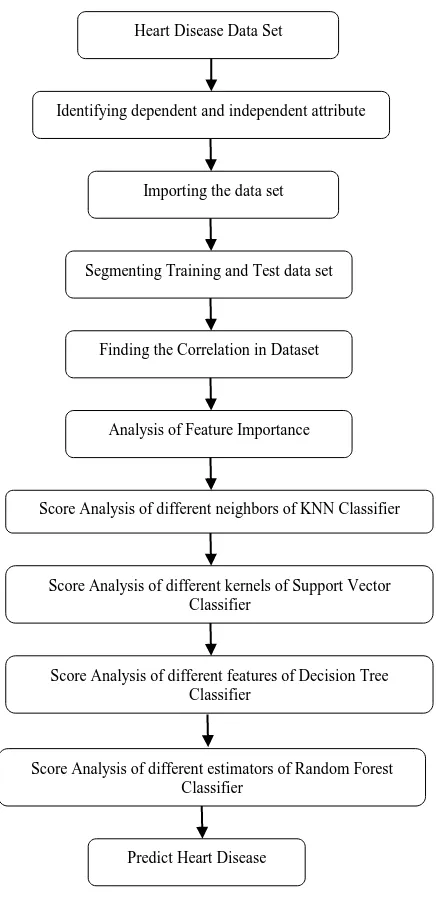
The overall design of this paper is shown in Fig. 1
IV.
IMPLEMENTATION
AND
PERFORMANCE
ANALYSIS
A.
Heart Disease Prediction for Feature Extraction
The Heart Disease dataset extracted from UCL ML
Repository is used for implementation with 13 independent
attribute and 1 diagnosis dependent attribute. The dataset
consists of 779 individual’s data. The attribute are shown
below.
1. Age
2. Sex
3. Chest-pain type
4. Resting Blood Pressure
5. Serum Cholestrol
6. Fasting Blood Sugar
7. Resting ECG
8. Max heart rate
9. Angina
10.
ST depression
11.
Peak exercise ST segment
12.
Number of major vessels
13.
Thal
[image:2.595.310.528.58.510.2]14.
Diagnosis of heart disease - Dependent Attribute
Fig. 1 System Architecture
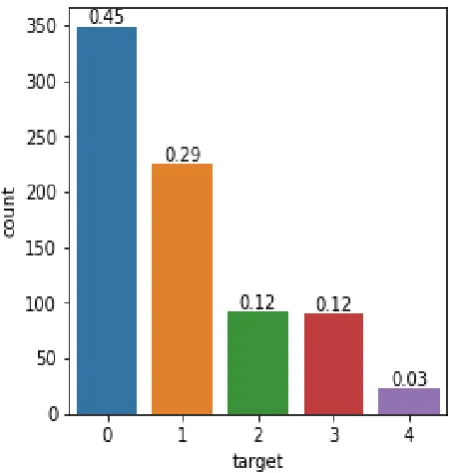
The portrayal of the dependent attribute is shown in Fig. 2.
Fig. 2. Chest Pain Type Distribution
The expansion of the dataset attributes shown in Fig. 3.
Heart Disease Data SetIdentifying dependent and independent attribute
Importing the data set
Segmenting Training and Test data set
Finding the Correlation in Dataset
Score Analysis of different neighbors of KNN Classifier
Predict Heart Disease Analysis of Feature Importance
Score Analysis of different kernels of Support Vector Classifier
Score Analysis of different features of Decision Tree Classifier
[image:2.595.322.530.561.664.2]Fig. 3. Heart Disease Dataset Schema
B.
Performance Analysis
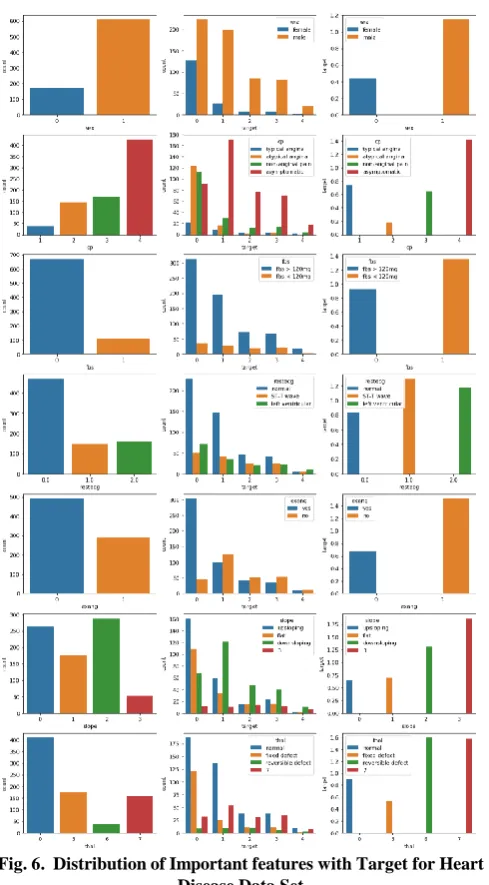
The important features distribution is shown in fig 2. The
relationship between the components of the heart disease
dataset is shown in fig 3. The allotment of the target
dependent attribute of heart disease dataset is shown in fig 4.
[image:3.595.306.553.52.329.2]Fig. 2. Important Features of Heart Disease Data Set
Fig. 3. Correlation Matrix of Heart Disease Data Set
[image:3.595.313.538.364.601.2] [image:3.595.49.291.576.758.2]Fig. 5. Disease Probability and Density Distribution based on Age for Heart Disease Data Set
[image:4.595.48.293.341.784.2]Fig. 6. Distribution of Important features with Target for Heart Disease Data Set
Fig. 7. Target Distribution for Heart Disease Prediction
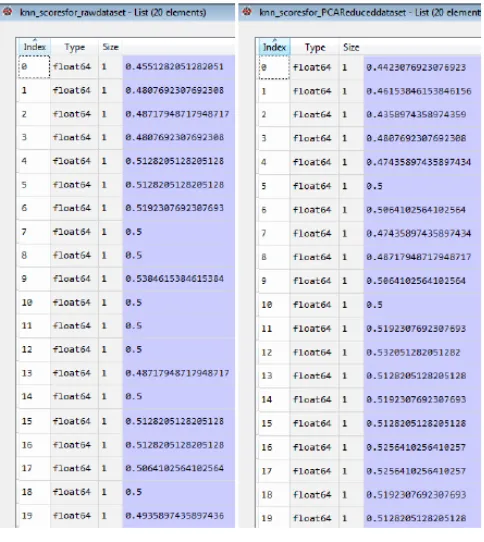
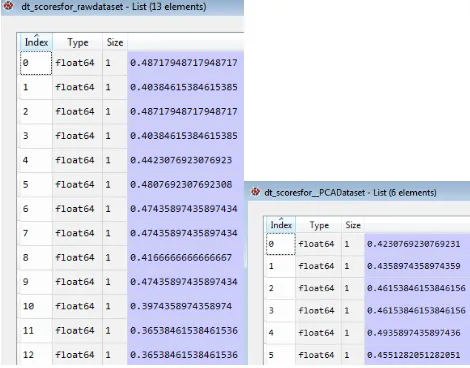
[image:4.595.321.532.343.668.2]Fig. 8. Scores for raw and PCA reduced dataset for KNN Classifier.
[image:5.595.323.526.73.330.2]Fig. 9. RAW Dataset Score Analysis for different K values of KNN
Fig. 10. PCA Reduced Dataset Score Analysis for different K values of KNN Classifier.
The dataset is fitted to Support Vector classifier to analyze the
performance for the various combinations of kernels with and
without PCA. The Raw Dataset and PCA Reduced Dataset
Scores for Support Vector Classifier analysis is shown in fig
11 – Fig 13.
[image:5.595.49.288.339.723.2]Fig. 11. Raw Dataset and PCA Reduced Dataset Scores for Support Vector Classifier.
Fig. 12. RAW Dataset Score Analysis for different Kernels of Support Vector Classifier.
[image:5.595.312.540.426.706.2]The dataset is fitted to Decision Tree classifier to analyze the
performance for the various features with and without PCA.
The Scores for the raw and PCA reduced dataset for Decision
Tree Classifier for different number of features is shown in fig
14 – Fig 16.
[image:6.595.54.291.103.688.2]Fig. 14. Scores for the raw and PCA reduced dataset for Decision Tree Classifier.
Fig. 15. Raw Dataset Score Analysis for different features of Decision Tree Classifier.
Fig. 16. PCA Reduced Dataset Score Analysis for different features of Decision Tree Classifier.
[image:6.595.50.285.122.306.2]The dataset is fitted to Random Forest classifier to analyze the
performance for the various estimators with and without PCA.
The Scores for the raw and PCA reduced dataset for Random
Forest Classifier for different number of estimators is shown
in fig 17 – Fig 19.
[image:6.595.313.540.361.681.2]Fig. 17. Scores for raw and PCA dataset for Random Forest.
Fig. 18. PCA Reduced Dataset Score Analysis for different features of Random Forest Classifier.
[image:6.595.55.283.407.668.2]V.
CONCLUSION
This paper analyzes the parameters in the classification
algorithms. Experimental results shows that for KNN
classifier, the performance for 12 neighbours is found to be
effective with 0.52 before applying PCA and 0.53 after
applying PCA. For Support Vector classifier, the rbf kernel
is found to be effective with the score of 0.519 with and
without PCA. For Decision Tree classifier, before applying
PCA, the score is 0.47 for 7 features and after applying PCA,
the score is 0.49 for 4 features. For, Random Forest Classifier,
before applying PCA, the score is 0.53 for 500 estimators and
after applying PCA, the score is 0.52 for 500 estimators.
ACKNOWLEDGEMENT
Thanks to the Deanship of scientific research princess Nourah
Bint Abdul Rahman University for supporting. This research
was funded by the Deanship of Scientific Research at Princess
Nourah Bint Abdul Rahman University through the fast track
Research Funding Program.
REFERENCES
1. Samir B Patel,” Heart disease prediction using Machine Learning and
Data Mining”, International journal of computer sciences and Engineering, vol 7,2015,pp.129-137
2. V.V.Ramalingam, “Prediction of Heart Diseases Using Machine
Learning”, International Journal of Engineering and Technology, vol. 7,no. 2, 2018.
3. Amin Ul Haq ,”A Hybrid Intelligence System Frame Work for
Prediction of Heart Disease Using ML”, Mobile Information Systems ,article id 3860146,21 pages.
4. Shadman Nashif, ”Heart Disease Detection by Using Machine Learning
Algorithm and a Real time Cardiovascular Health Monitoring System ”, World journal of Engineering and Technology,vol.06 no.04,2018,article id 88650.
5. Poornima Singh ,” Effective heart disease prediction system using data
mining techniques”, International journal of Nano medicine, Issued on 2018 , pp 121-124.
6. R. Suguna, M. Shyamala Devi, and Rincy Merlin Mathew, ” Customer
Churn Predictive Analysis by Component Minimization using Machine Learning”, International Journal of Innovative Technology and Exploring Engineering, vol. 8, no.8, June 2019, pp. 2329-2333.
7. Suguna Ramadass, and Shyamala Devi Munisamy, Praveen Kumar P,
Naresh P, “Prediction of Customer Attrition using Feature Extraction Techniques and its Performance Assessment through dissimilar Classifiers”, Springer’s book series “Learning and Analytics in Intelligent Systems, Springer, , LAIS vol. 3, pp. 613-620, 2019.
8. R.Suguna, M. Shyamala Devi, Rupali Amit Bagate, and Aparna
Shashikant Joshi, “Assessment of Feature Selection for Student Academic Performance through Machine Learning Classification”, Journal of Statistics and Management Systems, Taylor Francis, vol. 22, no. 4, 25 June 2019, pp. 729-739.
9. R. Suguna, M. Shyamala Devi, Rincy Merlin Mathew, “Customer
Segment Prognostic System by Machine Learning using Principal Component and Linear Discriminant Analysis”, International Journal of Recent Technology and Engineering, Volume-8 Issue-2, 30 July 2019. pp. 6198-6203.
10. M. Shyamala Devi, Rincy Merlin Mathew, and R. Suguna,”Attribute
Heaving Extraction and Performance Analysis for the Prophesy of Roof Fall Rate using Principal Component Analysis”, International Journal of Innovative Technology and Exploring Engineering, vol. 8, no.8, June 2019, pp. 2319-2323.
11. Shyamala Devi Munisamy, and Suguna Ramadass Aparna Joshi,
“Cultivar Prediction of Target Consumer Class using Feature Selection with Machine Learning Classification”, Springer’s book series “Learning and Analytics in Intelligent Systems, Springer, LAIS vol. 3, pp. 604-612, 2019.
12. M. Shyamala Devi, Rincy Merlin Mathew, R. Suguna, “Feature
Snatching and Performance Analysis for Connoting the Admittance Likelihood of student using Principal Component Analysis”, International Journal of Recent Technology and Engineering, Volume-8 Issue-2, 30 July 2019.pp. 4800-4807.
13. M. Shyamala Devi, Shefali Dewangan, Satwat Kumar Ambashta, Anjali
Jaiswal, Sairam Kondapalli, “Recognition of forest Fire Spruce Type Tagging using Machine Learning Classification”, International Journal of Recent Technology and Engineering, Volume-8 Issue-3, 30 September 2019.
14. M. Shyamala Devi, Usha Vudatha, Sukriti Mukherjee, Bhavya Reddy
Donthiri, S B Adhiyan, Nallareddy Jishnu, “ Linear Attribute
Projection and Performance Assessment for Signifying the Absenteeism at Work using Machine Learning”, International Journal of Recent Technology and Engineering, Volume-8 Issue-3, 30 September 2019. 15. M. Shyamala Devi, Mothe Sunil Goud, G. Sai Teja, MallyPally Sai
Bharath, “Heart Disease Prediction and Performance Assessment through Attribute Element Diminution using Machine Learning”, International Journal of Innovative Technology and Exploring Engineering, vol. 8, no.11, 30 September 2019
16. M. Shyamala Devi, Rincy Merlin Mathew, R. Suguna, ” Regressor
Fitting of Feature Importance for Customer Segment Prediction with Ensembling Schemes using Machine Learning”, International Journal of Engineering and Advanced Technology, Volume-8 Issue-6, pp. 952 – 956, 30 August 2019
17. R. Suguna, M. Shyamala Devi, Rincy Merlin Mathew, “Integrating
Ensembling Schemes with Classification for Customer Group Prediction using Machine Learning”, International Journal of Engineering and Advanced Technology, Volume-8 Issue-6, pp. 957 – 961, 30 August 2019.
18. Rincy Merlin Mathew, R. Suguna, M. Shyamala Devi, “Composite
Model Fabrication of Classification with Transformed Target Regressor for Customer Segmentation using Machine Learning”, International Journal of Engineering and Advanced Technology, Volume-8 Issue-6, pp. 962 – 966, 30 August 2019.
19. M. Shyamala Devi, Shefali Dewangan, Satwat Kumar Ambashta, Anjali
Jaiswal, Nariboyena Vijaya Sai Ram, “Backward Eliminated Formulation of Fire Area Coverage using Machine Learning Regression”, International Journal of Innovative Technology and Exploring Engineering, vol. 8, no.12, 10 October 2019. (Accepted for Publication)
20. M. Shyamala Devi, Ankita Shil, Prakhar Katyayan, Tanmay Surana,
“Constituent Depletion and Divination of Hypothyroid Prevalance using Machine Learning Classification”, International Journal of Innovative Technology and Exploring Engineering, vol. 8, no.12, 10 October 2019. (Accepted for Publication)
21. Shakila Basheer, Rincy Merlin Mathew, M. Shyamala Devi,
“Ensembling Coalesce of Logistic Regression Classifier for Heart Disease Prediction using Machine Learning”, International Journal of Innovative Technology and Exploring Engineering, vol. 8, no.12, 10 October 2019, pp. (Accepted for Publication)
22. M. Shyamala Devi, Shakila Basheer, Rincy Merlin Mathew,