International Journal of Innovative Technology and Exploring Engineering (IJITEE) ISSN: 2278-3075,Volume-8 Issue-12, October 2019
Abstract: Cloud computing has led to the tremendous growth of IT organizations, which serves as the means of delivering services to large number of consumers globally, by providing anywhere, anytime easy access to resources and services. The primary concern over the increasing energy consumption by cloud data centers is mainly due to the massive emission of greenhouse gases, which contaminate the atmosphere and tend to worsen the environmental conditions. The major part of huge energy consumption comes from large servers, high speed storage devices and cooling equipment, present in cloud data centers. These serve as the basis for fulfilling the increasing need for computing resources. These in turn bestow additional cost of resources. The goal is to focus on energy savings through effective utilization of resources. This necessitates the need for developing a green-aware, energy-efficient framework for cloud data center networks. The Software Defined Networking (SDN) are chosen as they aid in studying the behaviour of networks from the overall perspective of software layer, rather than decisions from each individual device, as in case of conventional networks. The central objective of this paper is dedicated to survey on various existing SDN based energy efficient cloud data center networks.
Keywords : :Cloud Computing, Data Center Networks, Dynamic Consolidation, Energy Efficient, Mininet, Software Defined Networking, Virtual Machine Migration.
I. INTRODUCTION
The emergence of Cloud Computing has dynamically changed the technology perspective of many IT organizations. The feasibility of providing instantaneous access to resources is the main advantage of cloud computing model [1]. These are delivered as services to customers or tenants. The services can of different types namely Software-as-a-Service, Platform-as-a-Service and Infrastructure-as-a-Service. Cloud computing deals with appropriate resource allocation, based on request from customers. The cloud service providers negotiate with customers, without compromising and violating SLA agreements [2].
The clear separation of control plane from the data plane is accomplished by adapting to Software Defined Networking
Revised Manuscript Received on October 10, 2019
B. Pavithra*, Department of Computer Science and Engineering,
Hindustan Institute of Technology and Science, Chennai, India. Email: [email protected]
S. Suchitra, Department of Computer Science and Engineering,
Hindustan Institute of Technology and Science, Chennai, India. Email: [email protected]
S. G. Gino Sophia, Department of Computer Science and Engineering,
(SDN). SDN paradigm aids in managing large-scale, complicated networks by disassociating the control plane from the data plane. This enables the network to adapt to dynamically changing needs and requirements. The energy efficiency in cloud data center networks can be improved with the aid of dynamic consolidation of virtual machines (VMs) using live migration and switching idle nodes to the sleep mode allow cloud providers to optimize resource usage and reduce energy consumption [2].
The cloud computing environments are rapidly growing with much advancement in virtualization, which in turn has created new avenues of requirements for distributed computing and conventional networks [3]. Most of the recent works are related to network virtualization and resource scaling and provisioning techniques are implemented between geographically distributed datacenters encompassing cloud computing environments. There arises a requirement of heavy consolidation of both network resources and computing in order to achieve highest energy efficiency [3].
II. BACKGROUND
With the concept of Software Defined Networking (SDN), even the static environment can respond rapidly to changing business needs and user's requirement. It is directly programmable, with clear isolation from forwarding plane. SDN controllers have centralized intelligence, whereby the network behavior changes dynamically according to real-time applications very quickly.
SDN maintains a global view of network and network appears as a single, logical switch, which can be considered as a logical or virtual entity. Fig.1. Shows the overall architecture of SDN based cloud data network. With the help of automated SDN programs, which are dynamic, gives flexibility to manage, monitor and secure the underlying network infrastructure.
Network Virtualization has become an important aspect of cloud computing [4]. It allows several tenants to access hosts belonging to same data center. In order to provide traffic isolation for these tenants, network virtualization is required, thereby enforcing policies relevant to the tenants’ business needs and also make use of the underlying physical network effectively to reduce traffic and delay. Apart from network virtualization, the concept of server virtualization technologies has contributed to a more dynamic cloud environment [4]. Optimized resource allocation techniques lead to consistent increase in the number of Virtual Machines
SDN Based Energy Efficient Cloud Data Center
Networks
In order to balance server loads, the virtual machines (VMs) migrate across geographically distributed servers [5]. To carry out this, the underlying physical network infrastructure needs to be dynamic to adapt to the ever-changing physical location end-points, in contrast with the static nature of current conventional IP network infrastructure. Data center networks interconnect highly specialized server units that process and store large data amounts with specialized networking technologies. Data centers are typically employed to provide the instantaneous services for commercial and social media applications [6]. Concept of OpenFlow [7], which is based on SDN, is in-built with some dynamic
qualities, which enables server virtualization with avoidance of any kind of client traffic.
OpenFlow built upon SDN, easily exploits the underlying physical network to isolate or decouple data and control planes by means of centralized network intelligence by implementing virtual networks on top physical network [7].
Here, based on tenant’s needs, network resources can be instantly allocated and de-allocated, along with traffic isolation. OpenFlow technology has developed as an eminent solution for many services like virtual machine migration for application flows [8].
Fig.1. Representation of SDN based Cloud Data Network III. REVIEW CRITERIA
S.No. Paper Title Techniques Used Metrics
Considered
Advantage Disadvantage
1 Fine-Grained Energy-Efficient Consolidation in SDN Networks and Devices [1]
Proposes Green
Abstraction Layer (GAL),
which provides
energy-aware capabilities and considers TCP/IP paradigm.
GAL provides stochastic methods to manage the network capabilities and provides with efficient network architecture for consolidation of the available resources, to aid in energy efficient cloud data center networks.
Total offered load, Total network
consumption, Number of active routers and Total active links.
GAL provides
flexibility and offers
API to hide
implementation
details of
energy-saving approaches at underlying layers. Provides energy savings up to 80% total network consumption and high traffic demands are also satisfied.
Needs to consider real-time
International Journal of Innovative Technology and Exploring Engineering (IJITEE) ISSN: 2278-3075,Volume-8 Issue-12, October 2019
2 Joint Virtual Machine and Bandwidth Allocation in Software Defined Network (SDN) and Cloud Computing Environments [2]
Considers an Optimal algorithm for proper provisioning VMs and network bandwidth in a cloud enabled by SDN in ISP networks.
Compares stochastic programming (SP) with
Expected Value
Formulation (EVF) and
method with no
reservation phase.
Number of
reserved VM, Total cost and Mean of VM demand.
It optimally reserves VMs and bandwidth
and thereby
minimizes cost, when demand is known in advance. Varies routers price and enforces VM migration even for relatively low bandwidth prices.
It needs to consider ISP networks that involve other kinds of traffic to carry out other factors like random delay that improves scalability in real time based large-scale
applications.
3 State-of-the-art Energy Efficiency Approaches in Software Defined Networking [3]
Considers four categories of state-of-the-art energy efficiency strategies for SDN as traffic aware, compacting TCAM, rule placement, and end host
aware. Different
approaches for the various categories are considered mainly for energy savings by means of shutting down unused network devices.
Energy savings and network performance.
First to focus on energy savings for SDN with various state-of-the-arts approaches and discusses open issues
and provide
guidelines for future research.
Determining the set of network components to turn on or turn off dynamically without affecting QoS and performance is an NP-hard problem. Needs to consider experimental
comparisons that require developing real measurement metrics.
4 Elastic Tree: Saving Energy in Data Center Networks [4]
Suggests an Elastic Tree based algorithm, which can save up to 50% of energy by dynamically adjusting a set of active networks and able to handle traffic efficiently. Elastic Tree has three
modules namely
optimizer, routing, and power control and
concentrate on
power-aware routing in DCN.
Original network power, Traffic demand, Average traffic utilization, Time and Power consumed by Elastic Tree.
Makes the DCN more robust and saves considerable energy. Introduces energy
proportionality in traditional
non-energy proportional
networks. Provides improvements in energy, performance and robustness.
There is a need for the system to produce a feasible set of network subsets with several policies that can route to all hosts and must scale to a DCN with thousands of servers.
5 ECODANE: A
Customizable Hybrid Test bed for Green Data Center Networks [5]
Proposes a combined physical and virtual tested for energy-aware data center networks. Uses a combined smart sleeping and power scaling algorithm. Proposes a new energy optimization
algorithm named
Rate-Adaptive Topology-Aware
Heuristic (RA-TAH) is presented. Four traffic scenarios are considered as near, far, middle and mix traffic.
Packet loss rate, traffic
percentage, time
and energy
savings percentage.
It achieves testing of different factors
based on
performance, such as
QoS, energy
proportionality, complexity.
RA-TAH algorithm saves up to 35% of energy consumption for up to 16 servers.
6 Energy Efficient Multi- Level Network Resources Management in Cloud Computing Data Centers [6]
Proposes a multi-level Cloud Resource Network Management (CRNM) algorithm takes into account utilization of network bandwidth and focuses on energy efficient network resources management approach. Detects overloaded and under loaded situations for each physical machine in the topology. Average Bandwidth Utilization, cumulative Power Consumption and average Energy Consumption.
Provides optimal
VM placement
without performance degradation.
Energy Consumption for NPA, PA, Greedy, and CRNM policies is compared to find CRNM is most optimal for energy efficiency and saves up to 75% of power consumed.
Needs to concentrate more on developing energy efficient virtual network topologies in DCN and achieve energy saving by thermal aware optimization.
7 Available Bandwidth Measurement in Software Defined Networks[7]
Initiates an approach to measure end-to-end available bandwidth (ABW) in SDN, along with Network Operating System (NOS) to generate a graph representation of the network topology. Different traffic types used are CBR, VBR, and real traffic.
Throughput, Time, Relative errors, Polling periods and Bandwidth.
Provides accurate results compared with existing methods.
Considers network delay, apart from polling rate and accuracy.
Requires SDN to consider different hybrid scenarios of integrating SDN with traditional networks, along with timeliness measurement for real traffic.
8 Software Defined Green Data Center Network with Exclusive Routing [8].
Recommends an
Exclusive Routing (EXR), which a new flow scheduling technique to control and save energy consumed by data center networks (DCN) and gives flow priorities based on flow size and deadline.
Network energy, Flow arrival rate, Mean flow time completion and over-subscription ratio.
Compared to FSR technique, EXR has more intelligence to save considerable energy in DCN and also it requires no update of VM and switches inside physical server. Removes bottleneck active links and
reduces flow
execution time in data center networks and improves the utilization ratio of active switches/links.
Needs to achieve efficient routing in green DCN with different, unknown and random traffic loads, as in case of real time scenario.
9 A Survey on Software-Defined Networking [9]
Data center networking
(DCN) supports
virtualization techniques and recursive DCNs have high scalability to allow large-scale datacenter. SDN proposes with Green networking paradigm,
whereby OpenFlow
switches help in implementing the real test bed environment.
Number of
switches, overall energy
consumption, latency, bandwidth utilization and traffic load.
DCNs are
cost-effective because they require cheaper switches than hierarchical DCNs. Facilitates high-speed
connection and permit low-energy consumption. SDN switching devices are relatively low-cost devices.
SDN switching
International Journal of Innovative Technology and Exploring Engineering (IJITEE) ISSN: 2278-3075,Volume-8 Issue-12, October 2019
10
DROPv2 : Energy Efficiency through Network Function Virtualization [10]
Proposes a novel framework, Distributed Router Open Platform (DROP) for Network Function Virtualization (NFV) through the integration of SDN and IT platforms with routers.
Power management
mechanism, supported by Green Abstraction Layer
(GAL) used for
NFV/SDN platforms.
Time, Offered Load, Number of Flows, Total Consumption and Throughput.
Realistic daily traffic profile is given. Acts as “glue” among different
open-source
networking tools
with DROP's
seamless integration of Linux based application.
Guarantees energy efficiency without affecting network performance.
The XLP evaluation board used with DROP architecture does not have standby capabilities and puts
to sleep the
forwarding elements (FEs).
IV. TOOLS AND METRICS
The various existing techniques with SDN concept for achieving energy efficient cloud data center networks uses various metrics and simulation tools. Most common metrics used to analyze the energy-efficiency and performance of DCN is time taken by servers, throughput, bandwidth utilization, cost and number of traffic flows [8]. These metrics aid in analyzing the performance of cloud data center networks. The load of data center, due to large number of servers, is also taken into consideration for effective utilization of bandwidth, proper load balancing and thereby aid in energy savings of data center [11]. These metrics are analyzed to get efficient DCN with less packet loss, over-subscription ratio and less cost. The energy efficiency in cloud data center networks can be improved with the aid of efficient load balancers such as MODA algorithm as stated in [11][12], which provides better performance in terms of overall cost, time taken and energy efficiency.
The existing techniques make use of various simulation tools like OpenFlow, POX controller and Mininet for implementing the test-bed environment. Mininet is a popular emulator for building SDN based environment [10]. It incorporates various controllers like POX, OpenFlow, OpenvSwitch Floodlight, and NOX. These controllers help in testing various metrics like bandwidth utilization, latency, traffic flows, etc. [15]. The POX controller for SDN provides means to check the environment with large-scale applications. POX controller aids in implementing different topologies in various parameters and runs different applications like hub, switch, load balancer and firewall [16].
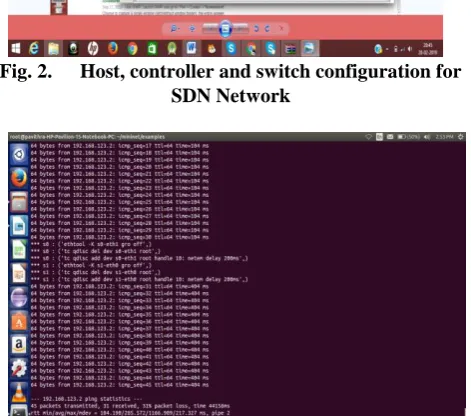
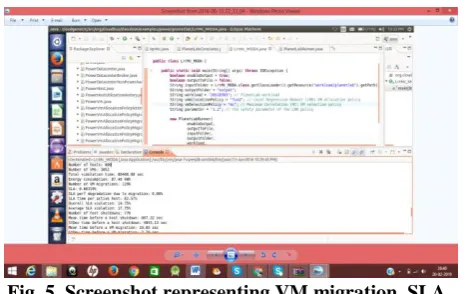
The proposed work makes use of Mininet and Miniedit, a GUI based simulation tool, which enables to edit controller, switches and links. Mininet provides with flexibility to create realistic virtual networks to run real applications on a single machine [17]. Fig. 2, 3, 4 and 5 shows the illustration of the SDN-based Energy Efficient Cloud Data Center Networks.
Fig. 2. Host, controller and switch configuration for SDN Network
Fig. 3. Screenshot representing the number of packets transmitted, received, the time taken and packet loss due
to transmission.
[image:5.595.41.554.49.227.2] [image:5.595.311.547.387.595.2]Fig.4. Screenshot of creating switches and adding hosts and controllers in Mininet
Fig. 5. Screenshot representing VM migration, SLA Violation, Energy consumption, overall time taken for
simulation V. CONCLUSION
Thus, Cloud Computing is a means of ensuring IT organizations to provide ubiquitous on-demand service to customers. The energy efficiency is a major issue in cloud data center networks. Hence, in order to curtail this massive energy consumption, many existing techniques, which are based on the SDN paradigm, provide means to achieve huge energy savings. Energy-aware data centers help to reduce total cost, as well as provides eco-friendly environment. Thus, the main objective of this paper is the prime focus on various existing SDN based energy efficient cloud data center networks with detailed emphasis on the existing features of SDN frameworks. The inference from the various tools and performance metrics are effectively considered to include the common metrics such as VM migration, SLA violation, energy consumption and overall time taken in the proposed work. Most of these existing methods make use of implementing real test bed environment with simulation tools like Mininet, OpenFlow, OpenvSwitch, Floodlight and POX. The main simulation tool used in the proposed work is Mininet, which enables to analyze performance of SDN based DCN and aid in saving the energy consumption for future use. SDN controllers have centralized intelligence, whereby the network behavior changes dynamically according to real-time applications very quickly. SDN maintains a global view of network and network appears as a single, logical switch, which can be considered as a logical or virtual entity. With the help of automated SDN programs, which are dynamic, gives
characteristics of existing methodologies, helps to analyze the most optimal energy efficient techniques and tools available for providing green-aware, energy-efficient cloud data center networks that guarantees considerable energy savings. As part of the future work, a novel energy efficient algorithm which overcomes the drawback of existing SDN based algorithms is proposed to achieve minimum SLA violation, low performance degradation, low cost and maximum energy efficiency.
REFERENCES
1. Chiara Lombardo, Franco Davoli, Raffaele Bolla and Roberto Bruschi,
“Fine Grained Energy-Efficient Consolidation in SDN Networks and
Devices”, IEEE 2015. W.-K. Chen, Linear Networks and Systems (Book
style). Belmont, CA: Wadsworth, 1993, pp. 123–135.
2. Jonathan Chase, Rakpong Kaewpuang, Wen Yonggang, and Dusit
Niyato, “Joint Virtual Machine and Bandwidth Allocation in Software Defined Network (SDN) and Cloud Computing Environments”, IEEE 2014.
3. BeakalGizachewAssefa and OznurOzkasap, “State-of-the-art Energy
Efficiency Approaches in Software Defined Networking”, IEEE 2015.
4. Brandon Heller, SriniSeetharaman, PriyaMahadevan,
YiannisYiakoumis, Puneet Sharma, Sujata Banerjee and Nick McKeon, “Elastic Tree: Saving Energy in Data Center Networks”, Science Direct 2015.
5. Nguyen Huu Thanh, Bui Dinh Cuong , To Duc Thien , Pham Ngoc Nam
, Ngo Quynh Thu and Tran Manh Nam, “ECODANE: A Customizable Hybrid Testbed for Green Data Center Networks”, IEEE 2015.
6. YaserJararweh, Huda Ababneh, Mohammad Alhammouri and Lo’ai
Tawalbeh, “Energy Efficient Multi-Level Network Resources Management in Cloud Computing Data Centers”, IEEE 2015.
7. Péter Megyesi, Alessio Botta, Giuseppe Aceto, Antonio Pescapè and
Sándor Molnár, “Available Bandwidth Measurement in Software Defined Networks”, Science Direct 2016.
8. Dan Li, Yunfei Shang and Congjie Chen, “Software Defined Green Data
Center Network with Exclusive Routing”, IEEE 2015.
9. Wenfeng Xia, Yonggang Wen, Chuan Heng Foh, Dusit Niyato and
Haiyong Xie, “A Survey on Software-Defined Networking”, IEEE 2015.
10. R. Bolla, R. Bruschi , C. Lombardo and S. Mangialardi , “DROPv2:
Energy-Efficiency through Network Function Virtualization”, Science Direct 2015.
11. Pavithra.B, Ranjana.R, “Energy Efficient Resource Provisioning with
Dynamic VM Placement Using Energy Aware Load Balancer in Cloud”,
at the 5th IEEE International Conference on Information Communication
and Embedded Systems (ICICES 2016), February 2016, Electronic ISBN: 978-1-5090-2552-7/$31.00 © 2016 IEEE Xplore Digital Library,
Page no. 1-6, DOI: 10.1109/ICICES.2016.7518919
12. Pavithra.B, Ranjana.R, “A Comparative Study on Performance of
Energy Efficient Load Balancing Techniques in Cloud”, at Cloud”, at the IEEE International Conference on Wireless Communications Signal Processing and Networking (WiSPNET 2016), March 2016, Electronic ISBN: 978-1-4673-9338-6/16/$31.00 © 2016 IEEE Xplore Digital
Library, Page no. 1192–1196, DOI: 10.1109/WiSPNET.2016.7566325.
13. The NOX OpenFlow Controller http://noxrepo.org/wp/.
14. M. Gupta, J. Sommers and P. Barford, “Fast, accurate simulation for
SDN prototyping”, In Proceedings of the second ACM SIGCOMM workshop on Hot topics in software defined networking, pp. 31-36, August 2013.
15. S.H. Yeganeh, et al. “On Scalability of Software-Defined Networking”,
IEEE Communications Magazine, vol.51, no.2, pp.136-141, Feb. 2013.
16. S. Agarwal, M. Kodialam, and T. V. Lakshman, “Traffic engineering in
software defined networks”, in Proc. 32nd Annual, IEEE INFOCOM 2013.
17. http://www.mininet.org
18. https://www.sdncentral.com/sdn-controllers.
19. https://www.opendaylight.org
20. S.H. Wang, P.W. Huang, C.P. Wen, and L.C. Wang, “EQVMP:
[image:6.595.55.290.225.372.2]International Journal of Innovative Technology and Exploring Engineering (IJITEE) ISSN: 2278-3075,Volume-8 Issue-12, October 2019
AUTHORS PROFILE
Ms. B. Pavithra, working as Assistant Professor in the Department of Computer Science and Engineering at Hindustan Institute of Technology & Science, Chennai, India. She received B.Tech degree in 2013 from Anna University and received M.E.degree in Computer Science Engineering (Specialization in Networks) in 2016 from Anna University, Chennai. She has published more than 7 papers in reputed
International Journals and Conferences. Her research areas of interest
include Cloud Computing, Wireless sensor Networks, MANET, Artificial Intelligence and Machine Learning.
Dr.S.Suchitra, received her B.E. degree from the University of Madras, Chennai, India in 1997. M.E. degree from Anna University, Chennai, India in 2009 and received her Ph.D from Anna University, Chennai, India in 2017. She has 21 years of teaching experience and currently she is working as an Associate Professor in the Department of Computer Science and Engineering, Hindustan Institute of Technology & Science, Chennai, India. She has published more than 30 research papers in international journals and conferences. Her research interest is image processing, image retrieval, computer vision, Big Data, Artificial Intelligence, Machine Learning and Deep Learning.
S. G. Gino Sophia received her Master’s degree from Manonmaniam Sundarnar University, Tirunelveli and Bachelor of Engineering from Bharathiyar University, Coimbatore, Tamil Nadu, India. She has published 10 international journals and presented in 5 international conferences. Her areas of interests include image processing, soft computing and fuzzy logic.