COMMISSION OF THE EUROPEAN COMMUNITIES
A STUDY OF THE CONCENTRATION,
PRICES AND MARK-UPS IN THE
DISTRIBUTION OF FOOD PRODUCTS:
VOLUME
1·General approach and methodology for the analysis of price structures
December 1978
COMMISSION OF THE EUROPEAN COMMUNITIES
~A
STUDY OF THE CONCENTRATION,
PRICES AND MARK-UPS IN THE
DISTRIBUTION OF FOOD
PRODUC~
' l
VOLUME 1:
General approach and methodology for the analysis of price structures _
-::/'
by Remo LINDA
I I
COLLECTION STUDIES --:: Evolution of concentration
and Competition Series - no. A24 -::;;;;
J
3
f.~ ~
3g/~sT
o)
+
:r
31. ~-(c
sr o)
A bibliographical slip can be found at the end of this volume
CONTENTS
1.
CHAPTER I:
First stage of the research: inquiry into prices and mark-ups • • •
51. 1.
Criteria for regrouping and classifying data - Relationship
between concentration and prices • • • • • •
• • • • •
141.2.
Series of detailed tables: prices- mark-ups •
491.3.
Comments on the price mark-ups tables
51
2. CHAPTER II
Second stage of the research: power interplay between retailers
and producers. • • • • • • • • • • • • • • •
772.1.
The sets of "atoms of information" •
792.2.
The brands and sizes available ••
• • 1042.3.
The "selective historical series"
• • • 1082.4.
Analysis of shop efficiency • • • •
• 1172.5.
The evolution of concrete price structures for selected products • 120
2.6.
Negative mark-up: "Loss Leading" • • • •
2.7.
Retail buying prices and power interplay
2.8.
Completion of the monographic approach by product: excessive
prices and their causes - and particularly the breakdown of
prices • •
2.9.
Completion of the firm-by-firm monographic approach: national
• 130 • 134
• • • 152
and Local concentration
• • • •
• • • •
• • 161
2.10.
Crucial points of the research •
• 192
APPENDIX ONE:
Dominance structure in 150 selected product markets
• • • • • • • • • • • 203
APPENDIX TWO:
International comparisons of retail prices for some Large consumption
products • • • • • • • • • •
•• 247
COMMISSION OF THE EUROPEAN COMMUNITIES
A STUDY OF THE CONCENTRATION,
PRICES AND MARK-UPS IN THE
DISTRIBUTION OF FOOD PRODUCTS
VOLUME 2:
Retail food prices in the United Kingdom
- an empirical study
THE RESEARCH PROGRAMME: ITS AIMS AND STAGES
CHAPTER ONE
THE FIRST STAGE
The aim of the research
There is one introductory question which obviously demands an immediate answer: why set up this extensive and costly research programme?
We might begin by recalling the general objective of the studies the Commission has undertaken since 1970, namely to inform Parliament as well as public opinion, the inter-ests concerned and the Commission itself of the various patterns of development of concen-tration, competition and prices in the various industries, markets and countries covered by the research.
But is it really necessary to set up such a far-reaching research programme simply to disseminate some fairly straightforward, albeit important economic (and econorno-political) information?
The .studies clearly have a deeper purpose. We must not lose sight of the instrumental and operative nature of the research programme as it relates to the tasks con-ferred on the Commission by Articles 85 (restrictive practices) and 86 (abuse of dominant positions) of the Treaty establishing the European Economic Community.
Article 85
1. The following shall be prohibited as incompatible with the common market: all agreements between undertakings, decisions by association<:: of undertakings and concerted practices which may affect trade between Member States and which have as their object or effect the prevention, restriction or distortion of competition within the common market, and in particular those which:
(a) directly or indirectly fix purchase or selling prices or any other trading conCi tions:
(b) limit or control production, markets, technical develop111ent, or investment;
(c) share markets or sources of supply;
(d) apply dissimilar conditions to equivalent transactions with other trading parties, thereby placing them at a competitive disadvantage;
(e) make the conclusion of contracts subject to acceptance by the other parties of supplementary obligations which, by their nature or according to commercial usage, have no connection with the subject of such contracts.
Article 85 (continued)
3. The provisions of paragraph 1 may, however, be declared inapplicable in the case of:
any agreement or category of agreements between under-takings;
any decision or category of decisions by associations of undertakings;
any concerned practice or category of concerned practices;
which contributed to improving the production or distribution of goods or to promoting technical or economic progress, while allowing consumers a fair share of the resulting benefit, and
which does not:
(a) impose on the undertakings concerned restrictions which are not indispensable to the attainment of these objectives;
(b) afford such undertakings the possibility of eliminating competition in respect of a substantial part of the products in question.
Article 86
Any abuse by one or more undertakings of a dominant position within the common market or in a substantial part of it shall be prohibited as incompatible with the common market in so far as it may affect trade between Member States.
Such abuse may in particular, consist in:
(a) directly or indirectly imposing unfair purchase or selling prices or other unfair trading conditions;
(b) limiting production, markets or technical development to the prejudice of consumers;
(c) applying dissimilar conditions to equivalent.transactions with other trading parties, thereby placing them at a competitive disadvantage;
The fundamental importance of prices - both as a market-regulating mechanism and as a basic indicator of the degree of competition actually prevalent on the market - to Eurcpe' s economy, is beyond dispute. It follc:Ms, then, that the system embcdied in
Articles 85 and 86 rests heavily on the principle of familiarity with and studies of prices; without this familiarity and without these studies the possibility of giving practical effect to Article 85, and more especially to Article 86, would be seriously compranised from the· outset.
Let us at this point quote an important passage from the Introduction to the Commission's Seventh Report of Competition Policy (Brussels/Luxembourg, April 1978,p.l0 in the English version}:
"Market structure have been a priority concern of competition policy during the year 1g77. The work of analysing degree of concentration, competition and price formation has been extended, the object being to highlight the underlying causes of the poor functioning of competition. About a hundred markets have been identified in which the most important undertaking holds more than a half-share. It has also been possible to establish that there is a strong tendency towards concentration in the distribution field and that there are some important price differences for the same product at all levels even on the purely local level.
The Commission has the firm intention of systematically applying Article 86 against undertakings in a dominant position which directly or indirectly impose discriminatory or unfair prices. It is not the Commission's object-ive to set itself up as a price control organization, nor to put an end to price variations which are an essential part of the competitive process, but solely to attack practices which become illegal when they are carried out by undertakings in a dominant position; the reason is the injury which these practices can cause to the user and the consumer.
The Commission considers that the recent Decision in the United Brands case is of great importance for the development of an effective policy regarding the control of abuse of dominant position. The considerations expounded by the Court of Justice have given concrete form to the question of the applicability of Article 86 to abnormal price situations. Though it may remain very difficult to specify in general terms the criteria which enable one to define an unfair price, nevertheless the Court has provided highly valuable pointers which will guide the Commission 1 s work .n
For this very purpose - to bring out the ai~,the salient features and above all the effects of such strategies and practices - the programme includes a set of dynamic and international comparative studies of price structures covering a precise and clearly defined series of products and markets in all Community countries.
Final consumer prices provide the critical "therrrometer" for determining the forJ:Il and structure of each study. The studies should not be seen as an "inquisition", since they require' only the voluntary collaboration of the undertakings themselves. It is in the best interest of every economic operator (consumers as well as undertakings)living and working in the Community to have a more transparent picture of market structures.
Stages of the survey
'Ihe Sixth Report on Corrpeti tion Policy1 stated that the provisional and partial results of the pilot surveys on the structure and evolution of prices and mark-ups in the distribution of processed food products indicated that:
a.
b.
c.
these surveys are of the greatest interest both for assessing the actual working of the competition mechanism and for the information and guidance of consumers and households;
detailed basic data are available which can reasonably be considered indispensable for the continuation and extension of the prices mark-ups surveys;
both the immediate and ultimate targets of the long-term research programme should be expanded and clearly defined as a matter of urgency by incorporating them into a more systematic and complete methodological framework. For a further in-depth extension of the multiple analyses, a distinction should be made between two fundamental stages and aspects of the research:
1) First stage (Chapter One) : survey on prices and mark-ups: aims and criteria of the research programme - computer programming requirements;
11) Second stage (Chapter Two) : thepower interplay between retailers and producers.
Generally speaking, the first stage aims to collect a much greater quantity of detailed information on specific, actual prices and mark-ups, in order to build up a fairly representative picture of "price galaxies" at different levels (final retail prices, buying prices for retailers, etc.,) and of their variations (according to sales point, country, products brand and size) •
In this context, implementation of the first stage calls for an extension of the sample of shops (or sales points) covered by the survey and also a very substantial extension of the sample of products to include more brands and more sizes(packages).
The second stage of research aims at identifying and analysing the forms and effects of interplay between the laws and factors governing variations of the price galaxies mentioned above.
In concrete terms , therefore, the aim will be to analyse the evolution of comp-etition as regards relationships:
(a) (b)
by describing:
Between retailers and consumers; Between retailers and producers;
the salient features of the power relationships underlying the negotiating powers and actual behaviour of the selected major retailers and manufacturers, and
the immediate and ultimate effects of the retail prices paid by the consumer on his freedom of choice and decision.
Clearly, the first stage is the prerequisite basis for the second stage of res-earch, which is based on selection, from arrong the large quantity of atoms of information provided by the first stage, of those elements which are of the greatest significance and value for a more advanced and concentrated analysis.
In fact, the selection operated during the second stage of research has the effects of focusing attention on a more restricted sample of:
(a) (b) (c)
products; retailers; manufacturers.
During the second stage, to be described in Chapter Two, account will have to be taken not only of the quantitative data resulting from computer elaborations but also of all financial, economic and legal information which may be ascertainable.
*
*
*
The present chapter deals more particularly with the following:
(a)
(b)
the tables
(c)
of information required to achieve the targets and goals in relation to our basic problem of jdentifying firstly the relationships exist-ing between structures and behaviour and secondly the practical con-sequences for the practical working of competition;
the more technical and specific commentaries explaining each of the tables covered by the present chapter.
The layout of the chapter is, therefore, as follows:
I
I I
I I I
Series of detailed tables: "Prices mark-ups".
Criteria for regrouping and reclassifying data - Relationships between concentration and price.
l . l
l.l.l.
CRITERIA FOR REGROUPING AND CLASSIFYING DATA - RElATIONSHIPS BEIWEEN CONCENTRATION AND PRICES
The criteria
The new programme lays down a number of criteria for regrouping and therefore comparing and analysing the data collected, which are mainly the selling prices but also
include the buying prices for each specific item covered by the survey.
The 18 criteria adopted are listed below, but it has not yet been possible to apply many of them.
1.1.2. Criterion No.1.: Unit Price
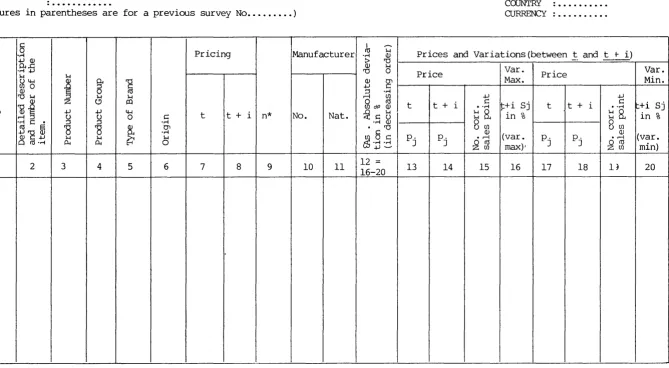
Products are classified according to unit price. This operation assumes prior standardization of brands, sizes and packages for any given product, to enable unit prices comparison of different brands and sizes of the same product. The determination of unit price is fundamental because there are large numbers of own labels and commercial brands, as well as several sizes and packages, not only in each country considered but also at every sales point. In practice, the quality and content of these numerous items are frequently the same and this is why they have to be compared on the basis of unit price. See Tables 1, 8 and 10 compiled from the computer print outs.
1.1.3. Total Price and Unit Price
Labels on packages offered for sale on the shelves of big stores often show:
(a) Total Price;
(b) Weight;
(c) Unit Price;
For other products, the exact quantity sold is sometimes fixed at the express request of the consumer; this applies to fresh meat, vegetables and fresh fish.
Here. two principles will be applied:
I)
II)
when the unit price is displayed, it will be used and not the total price of a given size of weight;
1.1.4.
III) if the price differs substantially according to weight or package
IV)
(e.g. a 240 gramme piece of Finnish Emmenthaler cheese costs Bf.25 per 100 grammes while a 3 kg. block costs Bf.l80 per kilo), two different units of measurement (100 grammes and l kg) will have to be used to show this fact;
in describing the items considered, therefore, the particular size and form will be stated(in our example, blocks of Finnish Emmenthaler cheese in packages of 100 grammes and multiples of 100 grammes or in packages of l kg and multiples of l kg) •
Criterion No.2 the 22 groups of food products, beverages and tobacco
The mass of data obtained by enquiry are classified by "groups of related prod-ucts", i.e. we consider a number of products which are related either by similar manufact-uring processes or by their final use by consumers. On this basis all the products consid-ered - food products, beverages and tobacco - are classified into 22 main groups.
later stage:
A)
The aim is to measure and identify:
differences in price between the shops included in the sample, for each group of products so defined and, in particular,
- differences in price movements between surveys, for each of the above mentioned groups of products, as between the shops included in the sample.
This is a very difficult operation, from which it is intended to compile at a
Several specific price indices for each of the 22 groups of food products, beverages and tobacco, programmed into the computer, as follows:
I) "CON" (canned fish, meat, vegetables and fruit); II) "EI:\JF" (baby foods);
III) "SOU" (soups};
IV) "LEG" {packet vegetables);
V) "EPI" (meat extracts and seasonings); VI) "GRA" (edible oils and fats, margarine);
VII) "BIS" (biscuits, cakes, "bakery products", confectionery and chocolates);
VIII) "FAR" (crispbreads, crackers, cake mixes, flour, salt, sugar and jellies);
IX) "CER" (cereals);
XI) XII)
XIII) XIV)
XV)
XVI)
XVII) XVIII) XIX)
XX) XXI) XXII)
"BOI" (beverages, coffee, tea, soft drinks, mineral waters); "IAI" (dairy and related products, milk, eggs, butter and various
kinds of cheese);
"FRO" (frozen foods, including ice cream);
"SPA" (pasta, spaghetti, macaroni, etc., ready-cooked dishes, pizza, ravioli, spaghetti in sauce and so on);
"BIE" (beer);
"ALC" (alcoholic·beverages: whisky, brandy, Martini, wine etc.,); "CHA" (ham, delicatessen meats, cured meats);
"PAI" (bread);
"FRU" (bananas, pineapples, grapefruit, lemons, oranges, apples, peaches, pears etc.,), i.e. fresh fruit traded internationally on a large scale;
"VIA" (meat, poultry, game) ;
"POI" (fresh fish, shellfish (crustaceans, nnlluscs,etc));1 "TAB" (various brands and types of cigarettes and tobacco).
Criterion No. 2a, setting the storage limit, (shelf life) for each group of prod-ucts is very closely linked with the above classification. At the present stage, however, no return on this point will be required. Later on, it will be covered by the following gradings:
1= no set storage limit; 2= over three years, 3= over one year,
4= over six months, etc.,
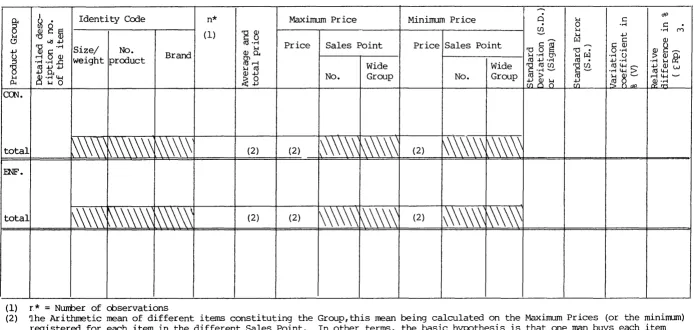
B) ~ general food price index recording changes in the price of a set "basket" rnde up of items included and analysed in the 22 groups of products enumerated above. See Tables 4, 6, 7 and 9 compiled from the computer print outs.
It should be noted that provision has also been made for the alphabetical coding of groups of products which are not food products but are fairly often sold at supermarkets and hypermarkets selling food products: examples are detergents and household cleaning mat-erials.
1.1.5. Calculation of Price Indices
Two alternative criteria can be applied for the computation of price indices:
Either:
a) Start with the unit price for each item (brand and size) of each product (e.g. all varieties, brands and package sizes of "salrron"), then conpute the arithmetic mean for the product concerned on the basis of the unit price (taken from Table 8);
b) then calculate the overall price for each of the 22 groups of products (e.g. one for group "CON", one for group 11
ENF11
, and so on), on the basis of the unit price for each
product computed as described under ( 1
a 1 ) ;
c) calculate the arithmetic mean of the 22 price price indices, corresponding to the overall price for each group of products;
d) finally, compute the above-mentioned overall and mean prices for two different periods, in order to establish the price index.
Or:
a) calculate directly the overall price for each of the 22 groups of products on the basis of the single items taken separately, i.e. on the basis of the total price at each time and,therefore, ignoring the unit prices computed for the various products;
b) compare the above overall prices at two different times in order to establish the corresponding index.
At this stage of the enquiry it is preferable to adopt the second method. Overall and mean prices , and the price variations to appear in Tables 1,2,3,4, 7 and 9 will, there-fore, be calculated directly from the data for each item (each brand and size).
However, for Table 8 which has a special purpose, the first method will be used for stage (a) because the groups covered by this table are not the 22 "groups of related products .. but"single products" only (e.g. 11
Salrron" only and not "CON").
1.1.6. Criterion No.3 type of brand
The data are classified by !~of brand sold to the consumer, namely;
1= manufacturer brand 2= commercial brand
3= own label (i.e. exclusive marketing brand)
1.1.7. Criterion No.4 Origin of Product (imported, home produced, etc.,)
This is defined according to the geographical origin of the product, namely;
1= national product (home-produced goods); 2= imported products;
3= mixed products (the final manufacturing price is made up partly of value added in the country and partly of value added abroad);
4= product of undefined origin.
Tables 3, 4 and 9 contain information classified according to this criterion, to-gether with similar information on the type of brand (see Criterion No.7).
1.1.8. Criterion No. S:Pricing
The code number allocated indicates whether the price for a given brand is a special or a promotional price,namely;
1= normal price of product;
2= special offer as part of an advertising campaign; 3= non-defined methods of pricing.
The information given under "Pricing,. in Tables 1,2,5 and 10, indicates the strategy adopted for any given item (normal price, specialoffer or non-defined method of pricing) • In practice it should be noted that:
1.1.9.
a) It is not always possible to determine whether the price charged is a special price or not;
b) As a rule,some big retailing groups use 11
Special offers" for a limit-ed period, on a plannlimit-ed basis, so that a number of items are at all times offered to the consumer as special offers.
Criterion No 6: Importance of a Product in the Family Budget
The code number allocated indicates whether the product in question is an essen-tial item of consumption or not, namely:
1= product which is an essential item in the pattern of household consumption; 2= product which is a non-essential, or little used item in household consumption. 3= product with variable interest.
be roughly homogenous for all Member States. Table 1 contains a column for tbis entry.
1.1.10. Criterion No. 7. Nationality of Manufacturer or Producer
The code number allocated indicates the nationality of the manufacturer which is that of the country where the decision centre of the group is located.
1= Federal Republic of Germany 2= France
3= Italy 4= Netherlands 5= Belgium
6= United Kingdom 7= Ireland
8= Denmark 9= Greece lO=Spain ll=Portugal 12=Switzerland 13=Austria 14=Sweden
15=United States
In the case of an unprocessed product (e.g. fresh fruit: bananas, lemons, etc.,) the nationality of the producer will be entered, i.e. not the place of origin of the product but the country where the decision centre of the group is located.
a)
b)
c)
The note to the coding sheet (Annex 1) will give full explanatory details for:
identifying the quality and characteristics of the various products;
giving a full picture of the structure of the producing group and its subsid-iaries, as well as of import and export flows generated by the group's activ.ities;
showing the place of origin on production of the product, so that the overall policy of the producing group can be assessed.
There may be cases where the name and location of the manufacturer are not known but the country of origin or production of the product is known (e.g. Hong Kong). The name of the country concerned will be given in the explanatory note referred to above and annexed
to the coding sheet, in which no country name will then be entered.1•
1.1.11. Criterion No. 8: Manufacturing (or producing) Group
The code number allocated identifies the name of the group which manufacturers or distributes (if the manufacturer is not known) the product in question. Code numbers are all-ocated according to nationality (criterion No.7). One hundred code numbers are available for each nationality, except for the United States for which there are 500 numbers. Thus,numbers from 101 to 200 indicate German firms, from 201 to 300 French firms and from 1501 to 2000
American firms. The names of big retailers using awn labels will be followed by the initials
"O.L." and will be numbered from 8000 onwards on the coding sheet.
In the case of a product which is not processed (fresh fruit such as bananas and lemons, etc.,)the name of the producing group will be entered. A detailed note, like that described under the previous point ("10. Criterion No. 7'·')will be attached to the coding sheet.
1.1.12. Criteria Nos.9, 10 and 11 negrees of Concentration
Three different criteria are applied according to the degree of concentration. Taking for exarrple, the index *C
4 (''standard
11
concentration ratio), we shall have four types of structure according to the value of the index, as follows:
- 1
=
red zone (of the overall national structure)- 2
=
orange zone- 3
=
yellow zone- 4
=
green zoneIt will be possible for apply the index *C
4 to at least three different
definit-ions of the 11Structure11 to be considered:
I) II)
III)
at 11
Specific product market11 level (e.g. tinned salmon);
at the level of 11
Combined markets for related products" (f'~.g. tinned fish);
at 11
sub -sector 11
level (e.g. 11
tinned fa:::rl") •
The 11
Standard ration11*C
4 will, as a rule, be higher at the first level and lower at the third.
However, the drop in the cumulative percentage represented by the concentration ration (following the elimination of one or more firms) partially offsets the rise of the index throu:,h the application of the standardizing mechanism (in accordance with the diff-erent hypothesis: (a), (b) and (c)).
1.1.13. Concentration of Manufacturers (or producers) and Working of Competition
Even if the leading firm has a very large share of a particular market or sector (index Cl), e.g. over 40%, it should not be concluded that:
a)
b)
the firm in question has an oligopolistic or even a monopolistic market power;
the firm in question uses this situation to impose excessive prices and thereby earn monopoly profits.
In practice, the manufacturer or producer cannot deal direct with final consumers but has to sell his products to retailers or even wholesalers (importers or exporters in some cases).
His selling price will therefore be determined by his bargaining power in relation to his purchasers. However, as already noted:
1.1.14.
I) there are purchasing groups and large distributing firms (large stores) which have very substantial bargaining power;
II) this bargaining power cannot be simply measured at the level of nat-ional concentration because the strength of these major retailers lies in:
a) the dominant position which they hold over retail sales in certain regions and ~ities;
b) the substantial extent of their centralised cumulative demand, which no ~anufacturer or producer can ignore;
c) their consequent ability to buy enormous quantities from anybody and anywhere.
Relationships between Degree of Concentration and Price Movements
It follows from what has been said that the following information must be avail-able in order to assess the working of competition:
a)
b)
c)
not only the degree of market power held by any one manufacturer or producer; but also selling prices to retailers, i.e. the actual buying prices negotiated by retailers;
Clearly, the problem of assessing the relevance of a price comes back to that of determining a fair price for each market from which any divergence or deviation would
const-itute abuse. While the solution to this problem is no easier that the discovery of the "philosophers' stone", there is nevertheless a "magic key" which can be used {key no.2: international - and interregional - comparison of price movements and of the other magnitudes analysed). This will be discussed in Chapter II.
In practice, by making an international - and interregional - comparison of all the available data, i.e.:
a)
b)
c) d)
comparison of the degrees of concentration for a particular industry in the various countries and, in particu~ar, comparison.of the market share· of each major manufacturer or producer in each country;
comparison of levels of buying prices {producer-manufacturer price) negotiated between the supplier and the buying retailer, in each country and region; comparison of retail price levels;
comparison of the trend of all the above data;
it is at least possible to deduce the regions, countries and products for which positions of dominance or bargaining strength exist, in favour either of certain manufacturers {or prod-ucers) or more particularly for certain big retailers.
a)
b)
c)
d)
1.1.15.
In this respect, it would appear obvious that:
even if there is no automatic relationship between the degree and trend of con-centration on the one hand, and the fixing of "domination prices" and the acquisition of "domination profits" on the other;
it must be known whether or not dominant or even monopoly positions exist before being able to conclude that such domination prices and profits also exist; consequently, the degree of concentration of manufacturers or producers must be analysed before the results of analyses of the movements of the different prices can be interpreted (producers' prices, i.e. buying price for retailers and retail prices);
in particular, this knowledge (and measurement) is essential in order to explain and understand the pricing policy:
of the principal manufacturers or producers; of the principal retailers.
Price Variations and Concentration of Markets Frequency, Extent and Speed of Price Adjustments
"peaceful co-existence" of what is in fact a very small nwnber of large firms.1
The current theory is that, for fear of starting a competitive price war (descr-ibed as "ruinous") these oligopolistic units tend:
a)
b)
to link price levels with the level of a given set of variable costs (full cost
. . 1 ) 2
pr1nc1p e ;
to hold their prices relatively stable and hence to raise or lower their prices as infrequently as possible (Hitch, Hall and Sweezy's hypothesis of the "bent demand curve") 2.
One of the aims of the price and mark up analyses forming the subject of this research programme should be to determine the actual behaviour of big oligopolistic units operatingin highly concentrated markets.
a) b)
In other words, price policy has to be described and analysed:
in the present period of inflationary pressures;
in periods of price controls which are imposed more or less regularly by the countries worst hit by inflation;
In order to assess and measure the impact of such price policies - and of action taken by governments - on the growth and spread of inflation.
In the last analysis, a three sided reciprocal causal relationship has to be
established between:
- market power;
- domination prices and profits inflation;
distinguishing clearly the respective §hares of manufacturers (or producers) and large
retailers in market power, domination profits and responsibility for the triggering and growth of inflation. In particular, more than one hundred questions put to the Research Institutes in Chapter!! of the research programme seek to determine and define all the facts of the
l. See: P.Sylos-Labini, "Oligopolio e progresso tecnico"(Oligopoly and technical progress), Giuffre, Milan 1957 and in particular:Part One,Chapter 1: "L'oligopolio"·{The oligopoly) and Einaudi, Turin 1961.
R. Linda, "Concurrence oligopolistique et planification concurrentielle internationale". (Oligopolistique, corrpetition and international competition planning)in "Economie
Appliquee, Archives of the !SEA 1972, Nos.2-3, Librairie Droz,Geneva, pages 325 et seq. and in particular pages 357 to 369.
problem with which we are concerned.
For a better understanding of the practical importance of this set of problems, it may be helpful to adopt the following working hypothesis, which of course, is not necessarily related in any way to real cases and situations.
Strict price controls are imposed for one year in a country suffering from galloping inflation. The effects of this action might be as follows:
a)
b)
c)
1.1.16.
Working on the premise that two extreme types of structure exist in the country concerned:
(a)
(b)
competitive and more or less atomistic;
unbalanced oligopolistic, because one or two firms have dominant power.
The first effect of government price controls is to discourage new investment by firms operating in both the competitive structure (a) and the unbalanced oligop-olistic structure (b) . This is not necessarily a positive effect. Quite the reverse
The other effects depend on the form and application of price controls: freeze, increases requiring government approval, limitation of the frequency of price changes:
I) Price freeze.
II) Increases subject to prior approval by the relevant government department.
III) Limitation by government of the frequency of increases.
First Hypothesis Price Freeze and its Effects
A price freeze can only be temporary; it penalizes competitive firms and structu-res which by definition tend to keep prices and costs as low as possible. If such firms can no longer adjust their prices to demand conditions and to the constraints imposed by their cost curves, some will go bankrupt and will leave the market, thus increasing the degree of concentration. Against this, a freeze will "upset" the dominant firms much less because their market power has already enabled them to fix their prices at a comfortable, relatively high level. Here again, a price freeze will lead to a greater concentration by favouring the dominant firms and the more concentrated structures.
But this is not sufficient.
First effect of a price freeze: no firm will reduce its prices and this applies particularly to dominant firms, which, in order to hide their profits from the government and the public, will prefer to take on unnecessary administrative and managerial staff with nothing to do and to grant excessive bonuses and rise to their managers, foremen, office staff -~nd wage earners. Wage increases will in particular start a general "follow-my-leader" reaction, which will trigger off wage increases even in sectors and firms where they ~
scarcely be justified on grounds of productivity. This will have two consequences, incompa~
ible with (a} their production pattern and (b) market conditions; and consequently, a further fresh increase in concentration; a fresh impetus is given to the spread of inflation by the artificial and forced increase in labour and production costs: these are known as "cost-push pressures."
This is a vital point which must be strongly emphasised.
The effective, normal working of market mechanisms implies as a "natural and continuing consequence" that prices can fall.
One look around is enough. Competition leads to big price reductions. What else are special offers (Section 8: Criter.ion No.5} and the other promotional measures adopted by the big firms when they can operate in a "competitive environment"? And it would be wrong to ignore the extent and the impact - on the trend of prices and the cost of living - of these special offers and price reductions even when they are only temporary.
However, the most disastrous effect of a price freeze is that it specifically discourages any possibility of price reductions because it must be appreciated that the unhealthiest aspect of inflation is not the rise in prices but the irreversibility of the trend.
In the dialectics of the market economy, prices must vary but the changes should
be "reversible" sometimes upwards and sometimes downwards. Inflation appears when price reductions no longer take place because of a perverse factor such as a price freeze.
It has,however, just been stated that the most disastrous consequence of a price freeze is that it rules out any chance of price reductions. Why? And how?
The answer is simple. We must go back to the main, specific causes of inflation1,
1. '!he four "classical" causes are: a) demand pressures;
b) cost-push pressures, set up mainly by trade union wage claims; c) the expectation cause (anticipating future inflation};
d) international causes, linked with international prices and exchange rates.
On inflation_ proolems and the role of. a Price ~ission, reference .. may be made to the excellent report by Stephen IDfthouse (of Capel -cure Myers Ltd.)" The New Price
which include the "expectation cause". This means that operators in the economy expect and anticipate the future growth of inflation and, therefore, put up their prices in advance even if such an increase is in no way justified by the existing structure of costs and the market.
a) b)
There is no practical difference between:
increasing a price without economic justification;
not reducing the same price ·when existing conditions suggest that there should be a reduction.
When price controls are imposed no firm will reduce its prices precisely because of this expectation cause. Moreover, what more damaging admission can there be of inability to check inflation than the adoption of the desperate measure of a price freeze? When a gov-ernment makes this admission, firms and economic operators know only too well what to do: they hold their selling prices at the highest possible level (or even raise them) so that, whatever happens, they lose nothing and are absolutely sure of not being overtaken by rising
inflation, without thought for the fact that by acting in this way they generate and increase inflation.
But price freezes have an even worse and more disastrous inflationary effect because they trigger off inflationary demand pressures.
Indeed, everyone is very well aware of two essential facts concerning price freezes and this awareness is the knell of doom which condemns such a policy in advance:
1) The price freeze will be lifted one day;
2) The price freeze will be re-introduced some day.
Let us take the first "fact": a measure which is so anti-economic in character it can only be temporary and when the freeze is lifted, prices which have been artificially frozen too long, so that they are squeezed and held down, will leap upwards causing an inflationary explosion.
Hence:
1) large quantities of products which are expected to rise in price must be purchased and held in stock. This means that purchases must cover not only products subject to the price freeze but also others which may be affected by a similar measure and yet others which can be expected to be carried along on the wave of rising inflation.
1.1.17.
couraging demand for productive investment which has already been weakened and hit by the measures taken in connection with the price freeze. Any ob-stacle to productive investment of course constitutes an autonomous, indirect factor which helps to prolong and spread inflation.
3} Even if price reductions were theoretically possible in a highly competitive sector for very special reasons inherent in the workings of the market, it will no longer take place precisely because of the general, inflationary pressure of demand. In the short run, prices are not cut when demand is high. This applies in both competitive and monopoly conditions.
Effects of the Anticipation of a Price Freeze
Everyone is aware of the second essential "fact": once a government has added the price freeze to its arsenal of economic measures, the freeze will be reimposed some day, even after it has first been lifted, whenever the authorities are faced with public anxiety at the growth of inflation ana are left with no other escape hatch.
In these circumstances, a price freeze has a further effect. Even when there is no freeze, firms tend to set their selling prices artificially high. How do they do this? By applying the full cost principle, that is, by adding to a set of variable or direct costs, a fixed margin (q) to cover the firm's overheads and profits. Here the modern theory of oligopolies {propounded by P. Sylos-Labini and others} seems to be confirmed by experience during the present bout of inflation and price controls. But the perverse mechanism inter-venes in the fixing of prices at the stage of calculating direct costs, i.e. the whole set of variable costs. In practice, if the firm has the power to do so, it will not take account of current variable costs but will seek to anticipate the imposition of a new price freeze for a certain time. From this it automatically follows that:
a}
b)
the selling price will have to be high enough to withstand a price freeze of varying length without loss of money;
the probable increase in variable costs, and of wages in particular, will have to
be estimated to allow for the foreseeable rise in the rate of inflation and in particular for the inflationary explosion which will precede, accompany and fol--low the imposition of a price freeze, in accordance with the example we have
just described.
But an even more perverse feature of this perverse mechanism is that this opport-unity of setting excessively and artificially high prices is offered gratis to big firms in particular (manufacturing, distributing or both) with a strang enough market power to impose their prices.
This fixing of prices at an artificially high level will inevitably help:
b) to penalize yet again and as always, firms operating within competitive
structures and under competitive conditions, which, as purchasers, will have to suffer the artificially high prices set by the dominant undertakings and will also be exposed to pressure from trade unions (for higher wages and salaries) , but will not themselves be able to charge artificially high prices (as a hedge against the future growth of inflation) because the machinery of competition in the markets where they operate does not allow them to charge such prices (by
defin-ition of the concept of competdefin-ition itself).
The final result is the disappearance of a number of competing firms and a higher degree of concentration. In other words, the perverse mechanism underlying this perverse process is simple: concentration stimulates inflation and inflation helps to increase concen-tration.
a) b)
The following hypothesis must be checked:
Is not inflation highest in countries with a high degree of concentration? Are not inflation and concentration highest in countries which are currently applying price controls?
In our research programme and more particularly in the set of 140 plus questions listed in Chapter 11, an attempt will be made to test these and other working hypotheses empirically.
1.1.18. Second Hypothesis Increases Subject to Prior Authorization
When a price freeze is lifted, there is generally a price explosion for products to which the freeze applied:
a)
b)
c)
the rate of increase is increased by the fact that everyone knows that he must hurry to make money as much as possible before the next freeze (see Section 19); it is also increased in proportion to the market power of firms to impose such high prices;
it is also increased in proportion to the degree of concentration and non campet-itivity of the sector.
Then, faced with such a catastrophe, which is easily foreseen but no less disastrous for that, the government has no option but to:
i) ii)
introduce a system of prior authorization of price increases; limit by law the frequency with which prices can be changed.
First perversity of the system: immediately a price increase is sanctioned,i.e. in practice a maximum price, this becomes a sole price, which is also by definition the maximum price possible because:
a}
b)
firms able to sell only at a higher price will be forced out of the market thus increasing the degree of concentration of the structure, with all the perverse effects already enumerated;
the most efficient and profitable firms, which could sell at a lower price, are quite happy to align themselves on this maximum price and to increase their
prof-its with government blessing; this of prof-itself will be a co-factor in inflation (see Section 21, however}.
In any event, firms with market power - and therefore operating in concentrated structures - will consistently apply the maximum price which will therefore, tend to become the sole ['rice.
In conclusion: the mechanism of competition will no longer be able to fulfil its role of establishing a system of multiple, differentiated equilibrium prices, fixed at the lowest level possible in the specific individual conditions of the various markets and struc-tures.
Second perversity of the system: in order to obtain prior sanction for price increases, it is clearly in the interests of firms to inflate total variable costs artificially, because this
is the total figure that the authorities will consider in granting price increases, in accor-dance with the full cost principle.
The reasoning is even simpler than its statement: if the authorities approve a rate (q} of 30% on total variable costs, the selling price will be 130 if the original total is over 100 and there will be a gain (gross margin} of 30; but if the total is inflated to 200, permission to sell at 260 will be given and the gain (gross margin} will be 60. And Mr. Palisse would say that it is better to gain 60 than 30.
It is obvious that managers controlling big firms with market power will find it in their interest:
a}
b)
to grant all trade union claims for wage increases, resulting in the common but paradoxical situation that a workman (steelworker, electrician or engineer}gains twice as much as a teacher;
to profit themselves from such increases in two ways: • directly, insofar as their salaries are increased;
1.1.19. Structural prerequisites for competition to operate
The perverse mechanism described above is triggered by the joint action of concentrated (and dominant) oligopolies and price controls imposed by government. In any analysis of modern structures, however, care must be taken to avoid the axiomatic general-isations and traps of economic determinism.
Thus, even in this "perverse mechanism" there are "stops" and canpetition can emerge even with price controls, if certain basic conditions are fulfilled.
In this context, the expression "effective and efficient working of corrpetition" is used simply to describe its most salient and significant effect (and result)namely, the possibility that prices lower than the maximum prices fixed by the authorities may be recorded in certain sectors and markets.
If this is to happen, the heads of certain firms operating in certain markets must of course have the will to compete.
If this spirit of competition is lacking - and it sometimes does not enter the thoughts of managers of certain dominant firms ( both public and private) - very little can be done, but it is still of interest to know:
a)
b)
the conditions which generally tend to inspire this "spirit of competition"; the instruments available to the government to activate and stimulate these competitive factors which will induce firms to compete.
We shall consider exclusively objective structural conditions in which compet-ition can work. They are:
a)
b) c) d)
e)
a)
b)
the presence of numbers of independent economic operators;
the existence of a certain balance of power between economic operators; the existence of highly elastic demand, to bring down prices;
the existence of major economies of scale, both technological and commercial (arising therefore from the structure of the distribution system), and/or of excess production and/or distribution capacity, i.e. unused capacities;
the existence of a compatible, clear and definite legal framework (legal certain-ty) in relation to the working of the market economy.
Brief consideration must be given to these conditions:
plurality of economic operators, and, balance of power
ii)
c) d)
a dominant position is held by a firm which is so powerful that any spirit of competition in other firms is discouraged from the start. It then becomes necessary to determine the critical ceiling of disequilibrium, as measured by the various Linda indices1, because as the qegree of concentration (and imbalance) approaches this ceiling, competition tends to be snuffed out;
the independence of these economic operators must also be ensured and kept under scrutiny, because the conclusion of various types of agreement (specialisation, market-sharing, etc.,) can lead to at least the temporary elimination of the plurality of operators which is obviously the essential pre-condition for
compet-ition to work.
It is clear that the other two conditions -elasticity of demand, and,
economies of scale
-can act as an extremely powerful stimulus to price competition even when prices are ·control-led, always provided the first two conditions (a) and (b) are fulfilled.
The example of special offers by big stores and retail groups speaks for itself. It must again be stressed that government price controls, particularly the fixing of maximum prices, is liable to divert such competitive action, which should naturally be directed to selling prices, towards more modern forms of competition of much less benefit to consumers and to the economy in general, namely;
- advertising;
-very frequent changes in products (brands, packaging, weight, etc.,)
The heartbreaking fact is that even when imposed on a competitive structure, maximum prices fixed by the government by their nature constitute a barrier to price
compet-ition.
Conversely, they are an incentive to modern forms of competition which, as we have stressed, can be a source of inflation and waste, as in the case of advertising and
2
constant product changes .
More accurately, the government assumes the role of price leadership or delegates this role tacitly to the biggest firm in each market, the reference price then being the maxi-mun _ price fixed by the government.
l. "Methodologie", op.cit. Chapters II and VII, section 56 et.seq.and our report "Domination, Concurrence et concentration des marches dans la structure industrielle de la Communaute" published in "La reglementation du comportement des monopoles et des entreprises dominan-tes en droit communautaire", De Tempel, Tempelhof, Bruges 1977, pages 29-109.
e)
Lastly, as regards the last condition, legal framework,
it is quite clear that the fixing of maximum prices introduces an element of uncertainty into that framework. What could be more arbitrary and discretionary than a maximum price - more or less fiscal in nature - which can be fixed or changed at any time by a simple government order?
In these circumstances, it becomes impossible to make any economic forecast for the conditions governing the working (>f the market or for the focmatim of the different equilibrium prices.
The normal market machinery gives way to arbitrary government intervention - and this new form of taxation. This is serious, because the workings of the market can be analy-sed, and interpreted and can, therefore, be evaluated and managed to some extent, whereas the striking power of the authorities is unknown and cannot be evaluated; it cannot be anticip-ated, is formidable and is (too often) affected by pressures from certain dominant pressure
~roups (economic, financial, social, political, etc.,) whose role is even more difficult to evaluate.
It may therefore, be wondered whether the fixing of maximum prices does not amount to an admission that competition does not work and that the government can do nothing about it.
Is this a question of"power" or of "imagination"?
In answer to the second question,we believe that the government in fact has at its disposal many means of activating and stimulating the factors of competition without taking direct action on prices1
a)
b)
c)
the systematic provision of full information to consumers and all economic oper-ators so that they have equal access to knowledge of structures, markets and products;
the liberalisation of international trade in sectors and markets where dominant (or even monopolistic) positions exist at national level;
in general, all measures designed to break down barriers to entry preventing any extension of the oligopolistic arena(e.g. permission to set up new "indepen-dent" large stores, liberalisation of patent laws, banning of exclusive sales contracts, etc •••• );
d)
e) f) g) h)
prohibition or penalisation of the systematic, excessive or abusive use of certain·competitive weapons and strategies, such as advertising or constant product changes, because the introduction of what are represented to be new products and/or models is designed solely to deceive the consumer by preventing him from comparing qualities and prices;
the prohibition or penalisation of the abusive use of patent rights; the banning of certain agreements and practices;
the scrutiny of all mergers, concentrations and acquisitions of holdings; a series of special provisions ("rules and regulations") for all large firms, dominant firms, diversified and multinational groups, requiring the regular supply of information (covering financial and economic data, wages and salaries, investments and prices) to the authorities.1•2•
These are only examples.
Another possible measure, applied directly to prices but with same justification in the theory of competition, is goverDE.ent limitation of the frequency of price increases.
1.1.20. Third Hypothesis Government Limitation of the Frequency of Price Increases
In our view, this is the only form of price intervention which in certain circum-stances may have more advantages than disadvantages from the point of view of competition policy.
It is easy to apply: an order is made under the terms of which every undertaking,
2
operating in a given sector of market, or of a specified size is only allowed to raise its prices every three (or six or nine) months. But every undertaking can:
a) b)
increases.
lower its prices as and when it wishes;
fix the rate of price increase without restriction.
A fixed interval may be ordered for price reductions in the same way as for
As a result the machinery of competition tends to become much more rigid but at the same time much more transparent because:
both governn~nt and consumers ca~ assess price increases more accurately because
l. On these points see the paper read at the Bruges Symposium 1977 already referred to "Damination,concurrence et concentration des marches dans la structure industrielle de la
Communaute", pages 71 to 85.
a)
b)
they take place at pre-determined dates, and
a "red warning signal" flashes, particularly for governments when:
increases are particularly high;
increases are made by big firms holding a dominant position on certain markets.
In this context, the most recent experience would appear to contradict the theory
of the rigidity of oligopoly prices1.
In any country where a special formula is used to restrict the frequency of price
increases by law, the following conditions are observed:
a)
b)
c) d)
e)
i)
ii)
the big firms, which dominate certain markets, miss no opportunity of raising
prices and if the interval between increases is set at, for example, three months,
they will therefore raise their prices regularly every three months;
the increases charged by these big firms are particularly high because they are in
a position to exploit their market power, whereas smaller firms are compelled to
follow, being fully aware that they would not be able to oppose the dominant
power of the big firms or to compete with them;
consequently, the dominant big firms act as price leaders; and
by using their market, big firms tend to increase their profit-earning capacity
because they benefit from economies of scale and are not handicapped by
dis-economies of scale;
conversely, the profit-earning capacity of firms operating within competitive
structures and markets is limited by the existence of this machinery which by its
nature tends to stabilise prices at the lowest possible level.
The purpose of the foregoing argument is to demonstrate that:
the relationship between concentration and price level is very close;
consequently, an active competition policy, aimed at checking excessive
concen-tration, is an essential prerequisite for checkin<j' the grON·th and spread of
inflation.
Once again, we have confirmation of the practical value of our programme of
research which seeks to link the findings of studies on the trend of concentration with
those of studies on the trend of prices and mark-ups.
tend-1.1.21. Concentration of the Machinery of Distribution and Barriers to Entry: Recapitulation
The power of domination is not limited to production or manufacture, but also extends to distribution; in the latter case, however, its effects on competition can be much more serious for the following reasons:
a)
b)
the appropriate geographical dimension for the machinery of retail distribution is local not national;
consequently, any excessive growth of concentration and of dominant power in a city or a region is liable to create a barrier to entry.
The barrier to entry will be greater and more formidable if the big retailer who dominates the market in a city or region also operates in other cities and regions in the
same Member State, because he is then in a position to exert very heavy poNer on producers, manufacturers or wholesalers who are,or wish to become,his suppliers.
The bargaining power considerably increases domination over market outlets (retail sales) by discouraging the entry of potential competitors, who would not be able to buy on such favourable terms.
The combination of all these factors shows clearly that the perverse dialectic of domination and inflation described in the foregoing pages finds very fertile soil in the field of distribution.
The social cost of these barriers to entry can be measured by analysing the act-ual mark-ups applied by big retailers and for this purpose the real buying price paid by such retailers will obviously have to be determined (Chapter II, Section VII).
It has already been noted that the role of governments is to try and break dawn all barriers to entry (Section 21) which, by their nature, interfere with the workings of competition. Criteria for analysing distribution structures - with particular reference to big retailers- will be considered later(Chapter II, Section IX).
1.1.22. Criterion No 15: Regrouping and Classification of Sales Points
1.1.23.
Broad Group of Sales Points
1
2
3
4
5
6
Detailed Categories of Sales Points
HYPERMARKET :50,000sq.ft. or over
06 12 18 24 30 36 42 48 -54 - 60 - 66 - 72 - 78 - 84 - 90 - 96 •
SUPERSTORE : 25,000 sq.ft. to 49,000 sq.ft.
05 11 17 23 29 35 41 47 -53 - 59 - 65 - 71 - 77 - 83 - 89 - 95 •
LARGE SlWERMARKET: 8,000 to 25,000 sq.ft.
04 10 16 22 28 34 40 46 -52 - 58 - 64 - 70 - 76 - 82 - 88 - 94
SUPERMARKET 4,000 sq.ft. to 7,999 sq.ft.
03 09 15 21 27 33 39 45 -51 - 57 - 63 - 69 - 75 - 81 - 87 - 93 .
LARGE SELF-SERVICE:2,000 to 3,999 sq.ft.
02 08 14 20 26 32 38 44 -50 - 56 - 62 - 68 - 74 - 80 - 86 - 92
SMALL SELF-SERVICE:less than 1,999 sq.ft.
01 07 13 19 25 31 37 43 -49 - 55 - 61 - 67 - 73 - 79 - 85 - 91 •
Criterion No. 16 Absolute or Total Price Variations
The increase (or decrease) of the total price of the specific items during the reference period is taken into account. We refer to the following tables:
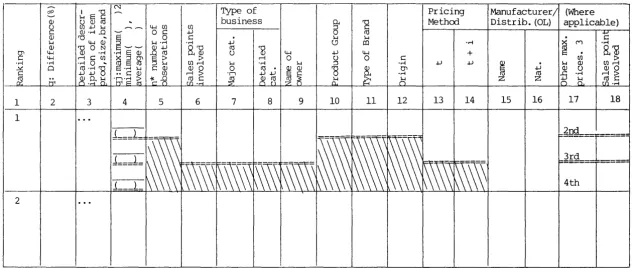
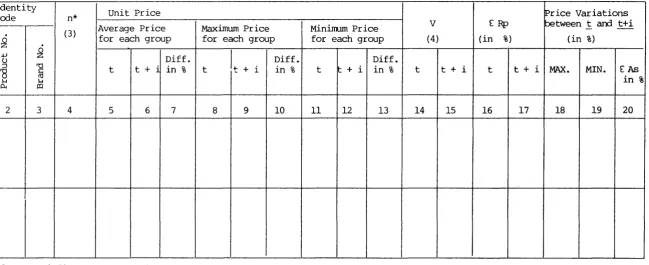
Table 3 is of particular interest. It shows the following types of variation: