This is a repository copy of
Climate variability and vulnerability to climate change: a
review
.
White Rose Research Online URL for this paper:
http://eprints.whiterose.ac.uk/81845/
Article:
Thornton, PK, Ericksen, PJ, Herrero, M et al. (1 more author) (2014) Climate variability
and vulnerability to climate change: a review. Global Change Biology, 20 (11). 3313 - 3328.
ISSN 1354-1013
https://doi.org/10.1111/gcb.12581
[email protected] https://eprints.whiterose.ac.uk/
Reuse
Unless indicated otherwise, fulltext items are protected by copyright with all rights reserved. The copyright exception in section 29 of the Copyright, Designs and Patents Act 1988 allows the making of a single copy solely for the purpose of non-commercial research or private study within the limits of fair dealing. The publisher or other rights-holder may allow further reproduction and re-use of this version - refer to the White Rose Research Online record for this item. Where records identify the publisher as the copyright holder, users can verify any specific terms of use on the publisher’s website.
Takedown
If you consider content in White Rose Research Online to be in breach of UK law, please notify us by
Accepted
Article
This article has been accepted for publication and undergone full peer review but has not
Received Date : 04-Jul-2013
Accepted Date : 14-Mar-2014
Article type : Research Review
Climate variability and vulnerability to climate change: a review
Running head: Climate variability and vulnerability
Philip K Thornton1*, Polly J Ericksen2, Mario Herrero3 and Andrew J Challinor4
1 CGIAR Research Programme on Climate Change, Agriculture and Food Security (CCAFS), ILRI, PO Box 30709, Nairobi 00100, Kenya
2 International Livestock Research Institute (ILRI), PO Box 30709, Nairobi, Kenya
3 Commonwealth Scientific and Industrial Research Organisation, 306 Carmody Road, St Lucia, QLD 4067, Australia
4 School of Earth and Environment, The University of Leeds, Leeds LS2 9AT, UK
Keywords: agriculture, food system, vulnerability, poverty, uncertainty, climate variability,
Accepted
Article
Research Review
* Corresponding author: [email protected], tel +44 131 667 1960 18 March 2014
Climate variability and vulnerability to climate change: a review
Abstract
The focus of the great majority of climate change impact studies is on changes in mean climate. In terms of climate model output, these changes are more robust than changes in climate variability. By concentrating on changes in climate means, the full impacts of climate change on biological and human systems are probably being seriously
underestimated. Here we briefly review the possible impacts of changes in climate variability and the frequency of extreme events on biological and food systems, with a focus on the developing world. We present new analysis that tentatively links increases in climate variability with increasing food insecurity in the future. We consider the ways in which people deal with climate variability and extremes and how they may adapt in the future. Key knowledge and data gaps are highlighted. These include the timing and interactions of different climatic stresses on plant growth and development, particularly at higher
Accepted
Article
the effects of climate variability and extreme events on human vulnerability and food security, particularly in agriculturally-based developing countries facing the challenge of having to feed rapidly growing populations in the coming decades.
Introduction
Climate change has many elements, affecting biological and human systems in different ways. The considerable spatial heterogeneity of climate change impacts has been widely studied; global average temperature increases mask considerable differences in temperature rise between land and sea and between high latitudes and low; precipitation increases are very likely in high latitudes, while decreases are likely in most of the tropics and subtropical land regions (IPCC, 2007). It is widely projected that as the planet warms, climate and weather variability will increase. Changes in the frequency and severity of extreme climate events and in the variability of weather patterns will have significant consequences for human and natural systems. Increasing frequencies of heat stress, drought and flooding events are projected for the rest of this century, and these are expected to have many adverse effects over and above the impacts due to changes in mean variables alone (IPCC, 2012).
In this review, we consider the possible impacts of changes in climate variability on
biological and food systems, with a focus on the tropical and subtropical developing world, where the deleterious impacts of anthropogenic climate change are generally projected to be greatest. These less developed regions of the world already face an enormous food security challenge, with human populations rising unabated throughout the present century
Accepted
Article
climate variability and extremes on biological and agricultural systems at a range of scales, and on human health and nutrition. We then present some new analysis that seeks to link increases in climate variability with increasing food insecurity in the future, before considering the ways in which people deal with climate variability and extremes and how they may adapt in the coming decades. We conclude with a discussion of research gaps in relation to both the biophysical and the socio-economic arenas and what needs to be done to better understand the impacts of climate variability on human vulnerability and food security, ultimately to increase the capacity of farmers in the tropics and subtropics to address climate variability and extreme events.
Climate change, climate variability and extreme events
Accepted
Article
Climate variability already has substantial impacts on biological systems and on the
smallholders, communities and countries which depend on them. The importance of rainfall variability at the national level, for example, is illustrated in Figure 2, which shows the relationship between annual rainfall variability and changes in the gross domestic product and agricultural gross domestic product for three countries of sub-Saharan Africa. In Figure 2, interannual rainfall variability is expressed as the 12-month Weighted Anomaly of
Standardized Precipitation (WASP), calculated from overlapping multi-month sums of standardized precipitation anomalies weighted according to the fraction of mean annual precipitation at the given time of year (from the data library of the International Research Institute for Climate and Society, iridl.ldeo.columbia.edu). This kind of close relationship is likely to be found for many tropical countries that depend heavily on agriculture as an engine for economic development.
Accepted
Article
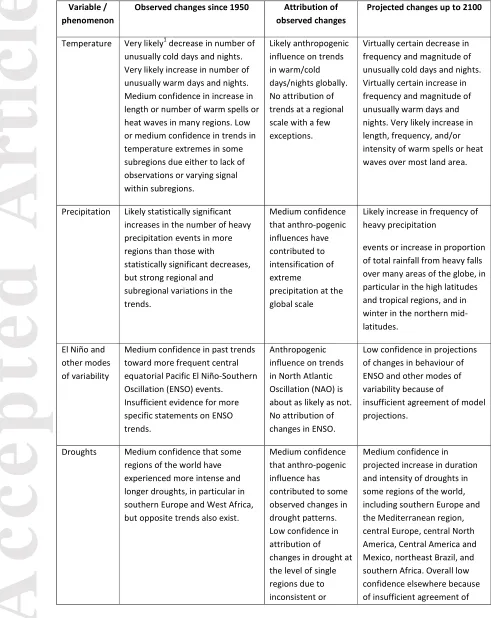
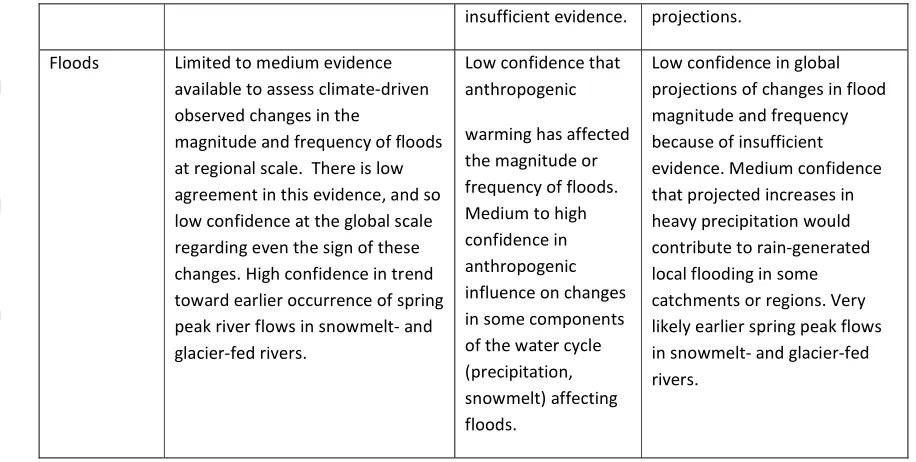
A partial summary of observed changes in some extremes, their attribution, and their future projection, is shown in Table 1, extracted from Table 3.1 in IPCC (2012).
A summary analysis of the numbers of people affected by environmentally-related disasters is given in Raleigh and Jordan (2010) based on data compiled by the Centre for Research on the Epidemiology of Disasters (CRED, 2008). A disaster is entered into the CRED database if at least one of the following criteria is fulfilled: 10 or more people reported killed, 100 or more people reported affected, a declaration of a state of emergency, and a call issued for
international assistance. An aggregated summary of these data is shown in Table 2. Chronic environmental hazards such as drought are not the most common, but they do affect the most people, with impacts on an average across all years of 10 per cent of a country’s population (in low-income states, this increases to 13 per cent of a country’s population). Raleigh and Jordan (2010) note that only in the case of drought is a significant proportion of a state affected. Floods tend to be more localised (for obvious reasons), but may still affect millions of people. The total number of disaster events in each region since 1970 is particularly noteworthy; and since 2000, the average number of events per year is running at more than 380 (Raleigh and Jordan, 2010).
Accepted
Article
countries than it is in developed countries – up to 8% in the most extreme cases. A strong upward trend in overall losses due to climate extremes is indicated since 1980 (Munich Re, 2011), although how these will play out during the course of the current century is highly uncertain; and as yet there is no evidence to link this trend to anthropogenic climate change (Bouwer, 2011). Extreme events may have considerable impacts on sectors that have close links with climate, such as water, agriculture and food security, forestry, health, and tourism, and concomitantly in countries whose economies depend more heavily on such sectors (IPCC, 2012).
Impacts of climate variability and extremes
Biological systems
Accepted
Article
Climate variability and extreme events can also be important for yield quality. Protein content of wheat grain has been shown to respond to changes in the mean and variability of
temperature and rainfall (Porter and Semenov, 2005); specifically, high-temperature extremes during grain-filling can affect the protein content of wheat grain (Hurkman et al., 2009).
At aggregated level as well as at the plot level, rainfall variability is a principal cause of interannual yield variability. For example, Hlavinka et al. (2009) found a statistically
significant correlation between a monthly drought index and district-level yields in the Czech Republic for several winter- and spring-sown crops, each of which has a different sensitivity to drought. Both intra- and inter-seasonal changes in temperature and precipitation have been shown to influence cereal yields in Tanzania (Rowhani et al., 2011). The increases in rainfall variability expected in the future will have substantial impacts on primary productivity and on the ecosystem provisioning services provided by forests and agroforestry systems. Despite the uncertainty surrounding the precise changes, climate variability needs to be taken into account. For example, the impacts of climate change to the middle of this century on crop yields in parts of East Africa may be under-estimated by between 4 and 27%, depending on the crop, if only changes in climatic means are taken into account and climate variability is ignored (Rowhani et al., 2011).
Changes in temperature and rainfall patterns and amounts will combine to bring about shifts in the onset and length of growing seasons in the future. Projected changes in length of the growing period for Africa to the 2090s were estimated by Thornton et al. (2011) for an ensemble of 14 GCMs. A large proportion of the cropping and rangeland area of
Accepted
Article
probability of season failure is projected to increase for all of sub-Saharan Africa, except for central Africa; in southern Africa, nearly all rain-fed agriculture below latitude 15°S is likely to fail one year out of two (Thornton et al., 2011). The robustness of these estimates, in terms of intra-model variability, is particularly low in the Sahel region and in parts of south-western Africa, however (Thornton et al., 2011). In terms of timing of growing season onset, Crespo et al. (2011) demonstrate that it may be possible to adapt to projected climate shifts to at least the 2050s in maize production systems in parts of southern Africa by changing planting dates.
In situations where changes in climate and climate variability may be larger, more fundamental changes may occur, particularly if critical thresholds in temperature and/or rainfall are reached (Gornall et al., 2010). Changes in the nature and timing of the growing season may induce smallholders to grow shorter-duration and/or more heat- and drought-tolerant varieties and crops, for example.
Most domesticated livestock species have comfort zones between 10 and 30 °C; at
Accepted
Article
could be lost by 2030 because of increased drought frequency, the value of the lost animals and production foregone amounting to US$ 630 million (Ericksen et al., 2012).
Craine et al. (2012) found that in a temperate grassland, the effects of drought and high temperatures decline over the season, to the point where climate variability may have minimal impact later in the growing season. Key ecosystem processes are seasonally
sensitive to climate variability, and increased understanding of plant productivity will need to recognise that the timing of climate variability may be just as important as its magnitude (Craine et al., 2012). In both temperate and tropical grasslands, species composition is a key determinant of livestock productivity. As temperature, rainfall patterns and CO2 levels
change, so will the composition of mixed grasslands change. Small climatic changes may affect the dynamics and balance of different grasslands species, and these may result in changes in livestock productivity (IPCC, 2007). The overall effects of changes in
temperature and rainfall and their variability on species composition and grassland quality, however, are still far from clear, and remain to be elucidated (IPCC, 2007).
Droughts in grasslands can also be a predisposing factor for fire occurrence in many regions (IPCC, 2012), and intensified droughts could exacerbate the problem. There is some
evidence that recent years have already seen an increase in grassland fire disasters in parts of China and tropical Asia. In the future, wildfires may be 60 per cent more frequent in much of South America for a temperature increase of 3°C, and in parts of Australia, the frequency of very high and extreme fire danger days could rise by up to 70 percent by 2050 (IPCC, 2012).
Accepted
Article
relationship between crops and livestock in the landscape in many places. In places that will become increasingly marginal for crop production, livestock may provide an alternative to cropping. Such transitions could occur in up to 3% of the total area of Africa, largely as a result of increases in the probability of season failure in the drier mixed crop-livestock systems of the continent; these are projected to increase from the current rate of
approximately one year in 5 to one year in 4 or 3, depending on the combination of emissions scenario and climate model used (Jones and Thornton, 2009).
Changes in climate variability and in the frequency of extreme events may have substantial impacts on the prevalence and distribution of pests, weeds, and crop and livestock diseases. For example, in the past, combinations of drought followed by high rainfall have led to wide-spread outbreaks of diseases such as Rift Valley fever and bluetongue in East Africa and of African horse sickness in South Africa (Baylis and Githeko, 2006). Future increases in the frequency of extreme weather events could allow the expansion of Rift Valley fever northwards into Europe, for example (Martin et al., 2008). In general, the effects of future changes in climate variability on pests, weeds and diseases are not well understood (Gornall et al., 2010).
Accepted
Article
Globally, the negative effects of climate change on freshwater systems, in terms of changes in quantity and distribution, are expected to outweigh the benefits of overall increases in global precipitation due to a warming planet; several parts of the tropics and subtropics, including parts of Central-West Asia, North Africa, Asia and North America, are likely to be
particularly affected by reduced freshwater availability (Rosegrant et al., 2009). It is expected that more than half the world’s population will live in countries with severe water constraints by 2050 (Rockström et al., 2009).
Climate models project increased aridity during the current century over most of Africa, southern Europe and the Middle East, most of the Americas, Australia, and Southeast Asia. There is considerable uncertainty in such results, but the projections are alarming because a very large population may be severely affected in the coming decades. At the same time, precipitation may become more intense but less frequent (i.e., longer dry spells). This has the potential to increase flash floods and runoff, and as a result increase soil erosion, diminish soil moisture, and increase the risk of agricultural drought (Dai, 2011), as well as increasing the potential for crop losses due to flooding and affecting the dynamics of livestock diseases and their vectors, for example.
Food systems, health and nutrition
Accepted
Article
At the local level, Codjoe and Owusu (2011) studied communities in Ghana and showed how extreme climatic events affect rural food production, transportation, processing and storage. Food security in this region could be enhanced by increasing farm-based storage facilities; improving the transportation system, especially feeder roads that link food production areas and major markets; providing farmers with early warning systems; extending credit to farmers; and the use of supplementary irrigation. Some cultural practices, particularly those that prohibit the consumption of certain foods, may reduce the resilience of some individuals and ethnic groups to food system disruptions.
Accepted
Article
countries, displacement and infrastructure damage from extreme events, especially floods, can exacerbate this (although people also often move in response to prolonged drought). If water scarcity increases, this also has an impact on sanitation and health outcomes if clean water is less available (Few, 2007).
Nutrition is correlated with positive health outcomes, and both adequate amount of calories as well as sufficient nutritional diversity and proteins are important. As outlined above, overall availability of food shows some correlation with climate variability. A recent study by Lloyd et al. (2011) builds upon previous work of Nelson (2009) to show clearly that climate change and increased climate variability, through their impact on food production, will have a negative impact on the prevalence of undernutrition, increasing severe stunting by 62% in South Asia and 55% in East and southern Africa by the 2050s. Although nutrition is determined not only by food availability but also access to food as well as nutritional and child care practices, there are almost no studies on these other aspects of nutrition
determinants (Tirado et al., 2010).
Accepted
Article
future climate scenarios with the largest increases in climate volatility rendered Tanzanians increasingly vulnerable to poverty through its impact on the production of staple grains.
At the global level, one of the few studies so far to model climate shocks and their impacts on commodity prices in different regions is Willenbockel (2012). Results are indicative only but interesting nevertheless. For example, a drought in North America in 2030 of a similar scale to the historical drought of 1988 would have a dramatic temporary impact on world market export prices for maize and a strong impact on world market price for wheat. These impacts would feed through to domestic consumer prices, with particularly profound effects in parts of sub-Saharan Africa. For instance, Nigeria depends almost entirely on imports of wheat, and under such a scenario the average domestic price for wheat in the country would spike by 50% above the baseline 2030 price, with potentially substantial impacts on households. The treatment of the impacts of climate variability as opposed to the impacts of slow-onset climate change in global economic models is a heavily under-researched area, particularly how harvest failures in one continent may influence food security outcomes in others.
How may changes in climate variability and extremes affect food security in the future?
Human populations are vulnerable to the impacts of climate change largely because of the socio-economic and political context in which they live. Thus vulnerability to climate change is highly differentiated (O’Brien et al., 2007) across geography, income levels, type of
Accepted
Article
challenge in viewing human vulnerability as the result of multiple and dynamic factors is the need to take a synthetic approach to translate the sectoral impacts of changes in climate and climate variability into consequences for people. Food security is a particularly important developmental outcome that is highly vulnerable to climate change. This vulnerability is a product of climate change impacts on biological systems, affecting food availability, as well as economic and social impacts that affect food utilization, access to food and the stability of food security (Ericksen, 2008).
As noted above, there is only limited information on the potential impacts of climate
variability on food availability at broad scales such as national and regional. For economies that are agriculturally based, Figure 2 suggests that rainfall variability can have substantial effects on agricultural growth at the national level, although that relationship will be modified by many other factors. Links from climate variability to poverty indicators are also not that straightforward to demonstrate. We undertook some new analysis using recent global datasets to try to throw some light on the possible links between climate variability and food security. Herrero et al. (2013) recently generated maps showing global kilocalorie production per capita from edible animal products, including milk and meat from ruminant species (bovines, sheep and goats) and meat and eggs from monogastric species (pigs and poultry). To estimate total kilocalorie production from crops, we used data on crop yields and
Accepted
Article
totals for 2000, and details crops grown in three types of system (irrigated, rainfed
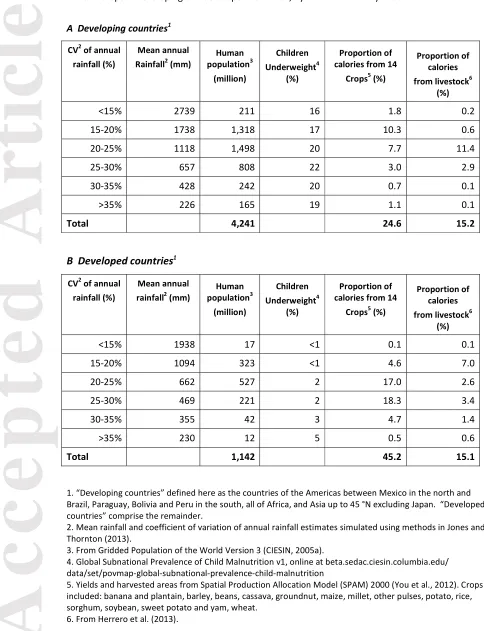
commercial and rainfed subsistence). Multiple cropping is also taken into account. We then calculated total kilocalorie production from both livestock and the 14 crops at a resolution of 5 arc-minutes (gridcells of side about 9 km at the equator). Each gridcell was then stratified on the basis of rainfall variability. To do this, we utilised a weather generator, MarkSim, and methods outlined in Jones and Thornton (2013) to estimate the coefficient of variation (CV) of annual rainfall for the globe, from 100 years of generated daily rainfall data. We estimated the human population in each stratum (CIESIN, 2005a). To relate climate variability to some proxy of food insecurity, we used the subnational data set of CIESIN (2005b) on the
proportion of children under 5 who are underweight for their age, and again estimated the average proportion for each stratum. The human population and children underweight datasets are both for the year 2000. Results are shown in Table 3, split between developing and developed countries. Here we defined the developing countries as those in the Americas between Mexico in the north and Brazil, Paraguay, Bolivia and Peru in the south, all of Africa, and in Asia up to 45 °N excluding Japan. The remainder we classified as developed countries.
Accepted
Article
relationship between rainfall variability and the average prevalence of underweight children seems not to be straightforward: in the developed regions, the value of the food insecurity proxy increases as rainfall variability increases, whereas in developing countries, it increases up to a rainfall CV of 30 per cent and then falls slightly for further increases in rainfall CV. A possible explanation for this is that the higher CV regions, most food is brought in via imports or food aid, for example. Fourth, nearly eight times as many people live in areas of high rainfall variability (with a CV of 30 per cent or more) in the developing countries as they do in the developed countries (407 million compared with 54 million); yet these areas of high rainfall variability in developing countries account for only 3 per cent of all the calories produced, and they also tend to be areas with relatively high child malnutrition. Clearly, many such areas may be targets for the provision of food aid and social safety nets.
Accepted
Article
variability (CV> 30%) in developing countries of more than 230 million to 643 million people (58 per cent), while in the developed countries the number more than doubles from 54 to 112 million.
It is not just rainfall that increases variability in yield. The temperature-related processes reviewed in Section 3.1 also contribute to this. Few climate change impact studies report changes in CV; analysis of those that do shows that increases in CV of more than 50% may not be uncommon from the 2040s onwards (Challinor et al., 2014a).
Even though simplified and with a high degree of uncertainty, our analysis helps to
substantiate the hypothesis of an increase in child malnutrition rates in both developed and developing countries in the future as a result of variability changes, all other things being equal. These increases could be particularly large in sub-Saharan Africa as a result of high population growth rates and relatively large areas with high rainfall variability. Sub-Saharan Africa is already by far the largest recipient of food aid: average annual shipments amount to about 2 per cent of all food consumed. Under many scenarios, the number of food-insecure people in sub-Saharan Africa by 2020 is still likely to be at least 500 million (USDA, 2010), and this is a challenge that will clearly not be made any easier by increases in rainfall and temperature variability.
Responses of vulnerable people
Accepted
Article
adaptive capacity of people, at various levels of decision-making from the individual up to the national and regional. Institutions play a key role in enabling such adaptation. Increases in variability, which are largely unpredictable in the short and long term, will force
institutions (defined loosely as social patterns including organizations) to be more proactive and flexible, qualities that are difficult to foster (Gupta et al., 2012). This applies not only to the national level; for example, Ncube et al. (2012) discuss the example of local government infrastructure in South Africa to provide basic commodities such as water and energy. They found a strong relationship between water and energy demand and rainfall variability, and concluded that local governments will increasingly need to be proactive in planning for adaptation to climate change, because of its influence on their operations and budgets (Ncube et al., 2012).
By focusing on how climate variability might change, we are trying to better characterize what climate change means for vulnerability - a better answer to the question “Vulnerability to what” (Misselhorn et al., 2010). Uncertainty or lack of predictability is considered a real hindrance to planning for adaptation. However, if for example we can explore how sensitive food availability in a given location is to a range of increases in precipitation variation, or what the limits of current institutional arrangements are for dealing with the consequences of increased frequency of extreme events, we can get a clearer definition of the development problem that climate change might exacerbate. This better prepares communities and governments to develop robust adaptation strategies in spite of uncertainty about the precise impacts of climate change.
Accepted
Article
already a considerable literature on the ways in which resilience of agricultural production systems may be increased in the face of climate change, particular under the “climate-smart agriculture” rubric (e.g. FAO, 2010; Thornton et al., 2013). Options range from increasing the efficiency of crop and livestock systems via various components such as soil and nutrient management, water harvesting and retention, improving ecosystem management and
Accepted
Article
There are several ways in which the stability of food systems can be strengthened. These include governments investing in smallholder agricultural production, particularly in downstream activities such as storage, trace, processing and retailing; implementing and scaling up options that help producers to be more resilient to climate volatility, such as the now widespread use of smallholder crop insurance schemes in India and certain other countries; and establishing safety net programmes for the most vulnerable households, such as has been implemented successfully in Ethiopia (Lipper, 2011). Insurance may be an increasingly important way to help smallholders become more resilient, in view of the impacts of climate change on yield variance and the resulting demand for effective risk-reducing measures. Using a microeconomic farm model, Antón et al. (2012) found that area yield and weather index insurance are robust policy options across different scenarios, and are generally cheaper than individual yield insurance. They also found that ex post indemnity payments can be effective in dealing with extreme systemic risk situation and are similarly robust across different scenarios, even with frequent occurrence of extreme events, although they can be costly to implement (Antón et al., 2012).
Accepted
Article
validity of indigenous knowledge concerning climate variability, and seeing how it can be better integrated into formal monitoring systems to enhance its acceptability, thereby increasing smallholders’ resilience to climate variability.
For some communities in marginal areas, climate may decreasingly be the primary concern. Nielsen and Reenberg (2010) present results from northern Burkina Faso that indicate that villagers there are “beyond climate”: current livelihood strategies are increasingly
independent of climate. There as elsewhere, people have engaged in livelihood diversification in attempts to ameliorate the negative impacts of climate variability on agriculture. At some stage, tipping points are reached such that transformative adaptation alternatives may be the only viable options that remain. There are many examples of such changes to livelihood systems, such as substitution of one crop or livestock species for another. In many parts of sub-Saharan Africa, a highly spatially distributed mode of living is prevalent, and clearly it can be a highly effective way of dealing with change and variability. This is intriguingly mirrored in developed-country situations also, in Australian farming households over the last few years that have seen crippling, multi-year drought followed by record flooding, for example. Many such households are developing more spatially
distributed modes of farming and living, whereby multiple priorities and pressures can be accommodated by moving between widely distributed farm businesses, employment and children’s activities (Rickards, 2012). Endurance and accommodating change may be widely valued, but others would challenge this world view and emphasise innovation and the
Accepted
Article
Conclusions: refining the research agenda
Most of the climate change impacts work carried out to date either ignores or downplays variability. On the one hand, this is somewhat understandable. Regarding expected changes in rainfall and temperature variability in the future, there is high uncertainty: IPCC (2012) provides no assessment of projected changes in extremes at spatial scales smaller than for large regions. Indeed, the prognosis for robust quantification in the foreseeable future of changes in weather and climate variability over short temporal and high spatial scales is rather gloomy (Ramirez et al., 2013). But on the other hand, we already know a reasonable amount about how current levels of climate variability have considerable impacts on biological systems and health. While we cannot let limited predictive capability constrain adaptive responses, it does suggest that we will need to become increasingly creative to arrive at actionable answers in response to questions from a wide range of decision makers
Accepted
Article
First, there are still important knowledge and data gaps in our understanding of the effects of climate variability and extreme events on biological systems. With regard to crops, Craufurd and Wheeler (2009) identified several areas, including the need for more information on crop development and temperature by photoperiod interactions at the higher end of the
temperature scale. There are key knowledge gaps with regard to the ways in which climate variability and extreme events may exacerbate multiple stresses for animals and plants, and how these stresses may interact and combine. There are also important knowledge gaps regarding the impacts of climate variability and extreme events on the prevalence, incidence and severity of crop and livestock diseases, and on key agricultural pests and weeds and how their prevalence may change.
Accepted
Article
attitudes to investments and technology adoption. Some work has been done on this (see, for example, Willock et al., 1999; Solano et al., 2000), but more in-depth studies on this topic are needed, because increasing adoption rates of key practices under risk is a significant
challenge, and targeting options to risk management profiles is essential. At the national and global scales, more sophisticated output is needed from global and regional economic models concerning welfare gains and losses arising from different policy action, and how changes in welfare from gradual climate change and climate shocks are differentially distributed among different groups in society, such as producers and urban poor, and men and women (Skoufias et al., 2011).
Third, there is a great need to improve the monitoring of local conditions, not only to provide data and information for improving our understanding and our models, but also to guide effective adaptation (for example, through downscaling climate model output to local situations) and to provide information for yield early-warning systems and
locally-appropriate indices for weather-based crop and livestock insurance schemes. The situation for climate and weather data monitoring in many developing countries is poor and
deteriorating. There is considerable research activity in combining satellite and land-based information to produce long-term, high-resolution weather data sets (for example, Maidment et al., 2013). Such hybrid datasets have considerable potential to ease the weather data problem in some countries, but they are not a replacement for land-based weather
measurement, however, and considerable investment will be needed to improve climate and weather monitoring. Improved monitoring of local food systems (in relation to food
Accepted
Article
health community, to allow for better early warning and anticipatory response in relation to food systems, is a promising model, although it can be costly.
Accepted
Article
expected, rather than focussing on a particular time and expressing uncertainty in other ways, may help forge stronger links between prediction and adaptation (Vermeulen et al., 2013). The effectiveness of the links between different spatial and temporal scales will depend on enhanced understanding, models and monitoring of the impacts of climate change and climate variability on both biological and socio-economic systems and the ways in which they interact within and across scales. Enhancing food security in the less developed countries in the coming decades will need balanced, integrated approaches that encompass changes in variability and extreme events as well as changes in means in quantifying impacts on, and identifying appropriate adaptation of, biological and human systems.
Finally, greater and more effective communication is needed between scientists and decision makers, and between natural and social scientists. Currently, climate information is severely underutilised in supporting decision making, which Weaver et al. (2013) partially attribute to a failure to incorporate learning from the decision and social sciences into climate-related decision support. There is a great deal that can be done on the co-generation of information and its communication in appropriate ways, and in engaging meaningfully with decision makers at local and national policy levels, for example. Participatory scenario development may be one useful tool for facilitating some of these processes (Vervoort et al., 2014), in addition to much stronger links between biological and communications scientists. In general, the top-down and bottom-up approaches identified above rarely meet in the form of integrated analyses. Given what is known about vulnerability to climate, what foci should environmental scientists have? Changes in variability are often more important for
Accepted
Article
(Challinor et al., 2013; Vermeulen et al., 2013). Systematic intercomparison of impacts studies, with coordinated cycles of model improvement and projection, are useful in reducing uncertainty and synthesising knowledge (Challinor et al., 2014b). Observational data to constrain models at a range of scales are central to these endeavours.
Acknowledgements
We thank two anonymous reviewers for helpful comments on an earlier draft. PKT thanks Michael Bell for help with WASP data. The CGIAR Research Program on Climate Change, Agriculture and Food Security (CCAFS) is funded by the CGIAR Fund, AusAid, Danish International Development Agency, Environment Canada, Instituto de Investigação Científica Tropical, Irish Aid, Netherlands Ministry of Foreign Affairs, Swiss Agency for Development and Cooperation, Government of Russia, UK Aid, and the European Union, with technical support from the International Fund for Agricultural Development.
References
Ahmed SA, Diffenbaugh NS, Hertel TW, Lobell DB, Ramankutty N, Rios AR, Rowhani P (2011). Climate volatility and poverty vulnerability in Tanzania. Global Environmental
Change 21, 46-55.
Accepted
Article
Barbier B, Yacouba H, Karambiri H, Zorome M, Some B (2009). Human vulnerability to climate variability in the Sahel: farmers’ adaptation strategies in northern Burkina Faso. Environmental Management 43, 790–803.
Barnett BJ, Barrett CB, Skees JR (2008). Poverty traps and index-based risk transfer products. World Development 36 (10), 1766-1785.
Baylis M, Githeko AK (2006). The effects of climate change on infectious diseases of animals. Report for the Foresight Project on Detection of Infectious Diseases, Department of Trade and Industry, UK Government, 35 pp.
Bouwer LM (2011). Have disaster losses increased due to anthropogenic climate change? Bulletin of the American Meteorological Society, January 2011, 39-46.
Brown A, Milton S, Cullen M, Golding B, Mitchell J, Shelly A (2012). Unified modeling and prediction of weather and climate: A 25-year journey. Bull. Amer. Meteor. Soc., 93, 1865– 1877.
Center for International Earth Science Information Network (CIESIN), Columbia University; and Centro Internacional de Agricultura Tropical (CIAT) (2005a). Gridded Population of the World Version 3 (GPWv3): Population Grids. Palisades, NY: Socioeconomic Data and Applications Center (SEDAC), Columbia University. Available at
Accepted
Article
Center for International Earth Science Information Network (CIESIN) (2005b). Global Subnational Prevalence of Child Malnutrition v1, online at beta.sedac.ciesin.columbia.edu/ data/set/povmap-global-subnational-prevalence-child-malnutrition
Challinor AJ, Ewert F, Arnold S, Simelton E, Fraser E (2009). Crops and climate change: progress, trends, and challenges in simulating impacts and informing adaptation. Journal of Experimental Botany 60, 2775-2789.
Challinor AJ, Stafford Smith M, Thornton PK (2013). Agro-climate ensembles: emerging tools for quantifying uncertainty and informing adaptation. Agricultural and Forest Meteorology 170, 2-7.
Challinor AJ, Watson J, Lobell DB, Howden SM, Smith DR, Chhetri N (2014a). A meta-analysis of crop yield under climate change and adaptation. Nature Climate Change, in press.
Challinor AJ, Martre P, Asseng S, Thornton PK, Ewert F (2014b). Making the most of climate impact ensembles. Nature Climate Change 4, 77–80.
Codjoe S, Owusu G (2011). Climate change/variability and food systems: evidence from the Afram Plains, Ghana. Regional Environmental Change 11 (4), 753-765.
Accepted
Article
Costello A, Abbas M, Allen A, et al. (2009). Managing the health effects of climate change. Lancet 373, 1693-1733.
CRED (Centre for Research on the Epidemiology of Disasters) (2008). EM-DAT: Emergency Events Database. Université Catholique de Louvain, Belgium. http://www.emdat.be/.
Craine JM, Nippert JB, Elmore AJ, Skibbe AM, Hutchinson SL, Brunsell NA (2012). Timing of climate variability and grassland productivity. Proceedings of the National Academy of Sciences 109(9), 3401-3405.
Craufurd PQ, Wheeler TR (2009). Climate change and the flowering time of annual crops. Journal of Experimental Botany 60 (9), 2529-2539.
Crespo O, Hachigonta S, Tadross M (2011). Sensitivity of southern African maize yields to the definition of sowing dekad in a changing climate. Climatic Change 106, 267-283.
Dai A (2011). Drought under global warming: a review. WIREs Climate Change 2011, 45– 65.
Dougill AJ, Fraser EDG, Reed MS (2010). Anticipating vulnerability to climate change in dryland pastoral systems: using dynamic systems models for the Kalahari. Centre for Climate Change Economics and Policy Working Paper No. 32, University of Leeds, UK.
Accepted
Article
Ericksen, de Leeuw J, Thornton PK, Notenbaert A, Cramer L, Jones PG, Herrero M (2012). Climate change in sub-Saharan Africa: what consequences for pastoralism? Pp 71-81 in Pastoralism and Development in Africa: Dynamic Change at the Margins, eds A Catley, J Lind, I Scoones. Earthscan, London.
Few R (2007). Health and climatic hazards: framing social research on vulnerability, response and adaptation. Global Environmental Change 17, 281-295.
Food and Agriculture Organization of the United Nations (FAO) (2001). Food balance sheets: a handbook. Rome, Italy.
Food and Agriculture Organization of the United Nations (FAO) (2010). Climate-Smart Agriculture: Policies, Practices and Financing for Food Security, Adaptation and Mitigation. Rome, Italy.
Gornall J, Betts R, Burke E, Clark R, Camp J, Willett K, Wiltshire A (2010). Implications of climate change for agricultural productivity in the early twenty-first century. Phil. Trans. R. Soc. B 365, 2973-2989.
Accepted
Article
Haines A, Kovats RS, Campbell-Lendrum D, Corvalan C (2006). Climate change and human health: impacts, vulnerability and public health. Public Health 120, 585-596.
Hellin J, Shiferaw B, Cairns JE, Reynolds M, Ortiz-Monasterio I, Banziger M, Sonder K, La Rovere R (2012). Climate change and food security in the developing world: Potential of maize and wheat research to expand options for adaptation and mitigation. Journal of Development and Agricultural Economics 4(12), 311-321.
Herrero M, Thornton PK, Notenbaert A, Wood S, Msangi S, Freeman HA, Bossio D, Dixon J, Peters M, van de Steeg J, Lynam J, Parthasarathy Rao P, Macmillan S, Gerard B,
McDermott J, Seré C, Rosegrant M (2010). Smart investments in sustainable food production: revisiting mixed crop-livestock systems. Science 327, 822-825.
Herrero M, Havlík P, Valin H, Notenbaert AM, Rufino M, Thornton PK, Blummel M, Weiss F, Obersteiner M (2013). Global livestock systems: biomass use, production, feed efficiencies and greenhouse gas emissions. PNAS 110 (52), 20888-20893.
Hlavinka P, Trnka M, Semeradova D, Dubrovsky M, Zalud Z, Mozny M (2009). Effect of drought on yield variability of key crops in Czech Republic. Agricultural and Forest Meteorology 149, 431-442.
Accepted
Article
IPCC (Intergovernmental Panel on Climate Change) (2007). Climate Change 2007: Impacts, Adaptation and Vulnerability. Summary for policy makers. Online at
www.ipcc.cg/SPM13apr07.pdf
IPCC (2012). Managing the Risks of Extreme Events and Disasters to Advance Climate Change Adaptation. A Special Report of Working Groups I and II of the
Intergovernmental Panel on Climate Change. CB Field, V Barros, TF Stocker et al. (eds), Cambridge University Press, Cambridge and New York, 582 pp.
Jones PG, Thornton PK (2009). Croppers to livestock keepers: Livelihood transitions to 2050 in Africa due to climate change. Environmental Science and Policy 12, 427-437.
Jones PG, Thornton PK (2013). Generating downscaled weather data from a suite of climate models for agricultural modelling applications. Agricultural Systems 114, 1-5.
Lenton TM (2011). Early warning of climate tipping points. Nature Climate Change 1, 201-209.
Lipper L (2011). Stability of food security in a green economy environment. FAO/OECD Expert Meeting on Greening the Economy with Agriculture, Paris, 5-7 September 2011. Working Document 3.
Accepted
Article
Lloyd SJ, Kovats RS, Chalabi Z (2011). Climate change, crop yields and undernutrition: development of a model to quantify the impacts of climate scenarios on child undernutrition. Environmental Health Perspectives 119, 1817-1823.
Lobell DB, Bänziger M, Magorokosho C, Vivek B (2011). Nonlinear heat effects on African maize as evidenced by historical yield trials. Nature Climate Change 1, 42–45.
Maidment RI, Grimes DIF, Allan RP, Greatrex H, Rojas O, Leo O (2013). Evaluation of satellite-based and model re-analysis rainfall estimates for Uganda. Met. Apps 20, 308–317.
Martin V, Chevalier V, Ceccato P, Anyamba A, De Simone L, Lubroth J, de La Rocque S, Domenech J (2008). The impact of climate change on the epidemiology and control of Rift Valley fever. Rev. sci. tech. Off. int. Epiz. 27 (2), 413-426.
Meehl GA, Goddard L, Boer G et al. (2013). Decadal climate prediction: an update from the trenches. Bulletin of the American Meteorological Society, e-View. doi:
http://dx.doi.org/10.1175/BAMS-D-12-00241.1
Mills E (2005). Insurance in a climate of change. Science 309, 1040-1044.
Accepted
Article
McMichael AJ, Kovats RS (2000). Climate change and climate variability: adaptations to reduce adverse health impacts. Environmental Monitoring and Assessment 61, 49-64.
McMichael AJ, Woodruff RE, Hales S (2006). Climate change and human health: present and future risks. Lancet 367, 859-869.
Mohammed AR, Tarpley L (2009). High nighttime temperatures affect rice productivity through altered pollen germination and spikelet fertility. Agricultural and Forest Meteorology 149, 999-1008.
Munich Re (2011). TOPICS GEO, Natural Catastrophes 2010, Analyses, Assessments, Positions. Munich Re, Munich, Germany.
NRC (1981). Effect of Environment on Nutrient Requirements of Domestic Animals. Subcommittee on Environmental Stress, National Research Council (NRC). Washington, DC, National Academy Press.
Ncube M, Zikhali P, Musango JK (2012). The impact of climate variability on water and energy demand: the case of South African local governments. Water and Environment Journal, doi:10.1111/j.1747-6593.2012.00323.x
Accepted
Article
Nielsen JO, Reenberg A (2010). Temporality and the problem with singling out climate as a current driver of change in a small West African village. Journal of Arid Environments 74, 464–474.
O’Brien K (2012). Global environmental change II: From adaptation to deliberate transformation. Progress in Human Geography 36 (5), 667-676.
O’Brien K, Eriksen S, Nygaard LP, Schjolden A (2007). Why different interpretations of vulnerability matter in climate change discourses. Climate Policy 7(1), 73-88.
Porter JR, Semenov MA (2005). Crop responses to climatic variation. Philosophical Transactions of the Royal Society B 360(1463), 2021-2035.
Raleigh C, Jordan L (2010). Climate change and migration: emerging patterns in the developing world. Chapter 4 in “Social Dimensions of Climate Change: Equity and Vulnerability in a Warming World”, edited by R Mearns, A Norton. World Bank, Washington DC.
Ramirez-Villegas J, Challinor AC, Thornton PK, Jarvis A (2013). Implications of regional improvement in global climate models for agricultural impacts research. Environmental Research Letters 8, 024018.
Accepted
Article
Rickards L (2012). Critical Breaking Point: the effects of climate variability, change and other pressures on farm households. Report for the Birchip Cropping Group and the Sustainable Agriculture Initiative Platform Australia.
http://www.bcg.org.au/cb_pages/publications.php
Rockström J, Falkenmark M, Karlberg L, Hoff H, Rost S, Gerten D (2009). Future water availability for global food production: the potential of green water for increasing resilience to global change. Water Resources Research 45(7).
Rodríguez LC, Herrero M, Baltenweck I (2011). Community-based interventions for the use and conservation of animal genetic resources: the case of indigenous scavenger chicken production in Benin. Tropical Animal Health Production 43, 961-966.
Rosegrant M W, Fernandez M, Sinha A, Alder J, Ahammad H, de Fraiture C, Eickhout B, Fonseca J, Huang J, Koyama O, Omezzine A M, Pingali P, Ramirez R, Ringler C, Robinson S, Thornton P, van Vuuren D, Yana-Shapiro H, Ebi K, Kruska R, Munjal P, Narrod C, Ray S, Sulser T, Tamagno C, van Oorschot M and Zhu T (2009). Looking into the future for
agriculture and AKST (Agricultural Knowledge Science and Technology). Chapter 5 (pp 307-376) in Agriculture at a Crossroads (eds. BD McIntyre, HR Herren, J Wakhungu, RT Watson), Island Press, Washington DC.
Accepted
Article
Skoufias E, Vinha K, Conroy HV (2011). The impacts of climate variability on welfare in rural Mexico. Policy Research Working Paper 5555, World Bank, Washington DC.
Solano C, Bernués A, Rojas F, Joaquın N, Fernandez W, Herrero M (2000). Relationships between management intensity and structural and social variables in dairy and dual-purpose systems in Santa Cruz, Bolivia. Agricultural Systems 65, 159-177.
Speranza CI, Kiteme B, Ambenje P, Wiesmann U, Makali S (2010). Indigenous knowledge related to climate variability and change: insights from droughts in semi-arid areas of former Makueni District, Kenya. Climatic Change 100, 295-315.
Tall A, Mason SJ, van Aalst M,Suarez P, Ait-Chellouche Y, Diallo AD, Braman L (2012). Using seasonal climate forecasts to guide disaster management: the Red Cross experience during the 2008 West Africa floods. International Journal of Geophysics,
doi:10.1155/2012/986016
Thornton PK, Herrero M (2009). The inter-linkages between rapid growth in livestock production, climate change, and the impacts on water resources, land use, and
deforestation. World Bank Policy Research Working Paper, WPS 5178. Washington, DC: World Bank.
Accepted
Article
Thornton PK, Lipper L, Baas S et al. (2013). How does climate change alter agricultural strategies to support food security? Background paper for the conference “Food Security Futures: Research Priorities for the 21st Century”, 11-12 April 2013, Dublin.
Thurlow J, Dorosh P, Yu W (2011). A stochastic simulation approach to estimating the economic impacts of climate change in Bangladesh. Working Paper No. 2011/86, United Nations University.
Tirado MC, Crahay P, Hunnes D, Cohen M (2010). Climate change and nutrition in Africa with a focus on sub-Saharan Africa. www.sunrayafrica.co.za
UNDESA (United Nations Department of Economic and Social Affairs) (2013). World population prospects: the 2012 revision, medium variant. Online at http://esa.un.org/unpd /wpp/unpp/panel_population.htm
USDA (United States Department of Agriculture) (2010). Food Security Assessment, 2010-20. Report GFA-21, Economic Research Service, Washington DC.
Vermeulen SJ, Challinor AJ, Thornton PK, Campbell BM, Eriyagama N, Vervoort JM, Kinyangi J, Jarvis A, Läderach P, Ramirez-Villegas J, Nicklin KJ, Hawkins E and Smith DR (2013). Addressing uncertainty in adaptation planning for agriculture. PNAS 110 (21), 8357– 8362.
Accepted
Article
Vervoort J, Thornton PK, Kristjanson P, Förch W, Ericksen P, Kok K, Ingram JSI, Herrero M, Palazzo A, Helfgott A, Wilkinson A, Havlik P, Mason-D’Croz D, Jost C (2014).
Challenges to scenario-guided adaptive action on food security under climate change. Global Environmental Change (in press).
Weaver CP, Lempert RJ, Brown C, Hall JA, Revell D, Sarewitz D (2013). Improving the contribution of climate model information to decision making: the value and demands of robust decision frameworks. WIREs Clim Change 4, 39-60.
Willock J, Deary IJ, Edwards-Jones G, Gibson GJ, McGregor MJ, Sutherland A, Dent JB, Morgan O, Grieve R (1999). The role of attitudes and objectives in farmer decision making: business and environmentally-oriented behaviour in Scotland. Journal of Agricultural Economics 50, 286-303.
You L, Guo Z, Koo J, Ojo W, Sebastian K, Tenorio MT, Wood S, Wood-Sichra U (2012). Spatial Production Allocation Model (SPAM) 2000 Version 3 Release 1.
http://MapSPAM.info.
Accepted
Article
Figure captions
Figure 1. The effect of changes in temperature distribution on extremes. Different changes of temperature distributions between present and future climate and their effects on extreme values of the distributions: (a) Effects of a simple shift of the entire distribution towards a warmer climate; (b) effects of an increase in temperature variability with no shift of the mean; (c) effects of an altered shape of the distribution, in this example a change in asymmetry towards the hotter part of the distribution. From IPCC (2012).
Figure 2. The relationship between rainfall variability expressed as the 12-month Weighted Anomaly of Standardized Precipitation (WASP) and growth in GDP and agricultural GDP in three countries in sub-Saharan Africa: (a) Ethiopia, (b) Niger, (c) Mozambique. Data sources: World Bank, data.worldbank.org/indicator and the IRI data library,
iridl.ldeo.columbia.edu/.
Accepted
[image:45.612.32.523.105.723.2]Article
Table 1. Summary of observed and projected changes of five extremes at a global scale (taken from
Table 3.1 in IPCC, 2012).
Variable / phenomenon
Observed changes since 1950 Attribution of observed changes
Projected changes up to 2100
Temperature Very likely1 decrease in number of unusually cold days and nights. Very likely increase in number of unusually warm days and nights. Medium confidence in increase in length or number of warm spells or heat waves in many regions. Low or medium confidence in trends in temperature extremes in some subregions due either to lack of observations or varying signal within subregions.
Likely anthropogenic influence on trends in warm/cold days/nights globally. No attribution of trends at a regional scale with a few exceptions.
Virtually certain decrease in frequency and magnitude of unusually cold days and nights. Virtually certain increase in frequency and magnitude of unusually warm days and nights. Very likely increase in length, frequency, and/or intensity of warm spells or heat waves over most land area.
Precipitation Likely statistically significant increases in the number of heavy precipitation events in more regions than those with
statistically significant decreases, but strong regional and
subregional variations in the trends. Medium confidence that anthro-pogenic influences have contributed to intensification of extreme
precipitation at the global scale
Likely increase in frequency of heavy precipitation
events or increase in proportion of total rainfall from heavy falls over many areas of the globe, in particular in the high latitudes and tropical regions, and in winter in the northern mid-latitudes.
El Niño and other modes of variability
Medium confidence in past trends toward more frequent central equatorial Pacific El Niño-Southern Oscillation (ENSO) events.
Insufficient evidence for more specific statements on ENSO trends.
Anthropogenic influence on trends in North Atlantic Oscillation (NAO) is about as likely as not. No attribution of changes in ENSO.
Low confidence in projections of changes in behaviour of ENSO and other modes of variability because of
insufficient agreement of model projections.
Droughts Medium confidence that some regions of the world have experienced more intense and longer droughts, in particular in southern Europe and West Africa, but opposite trends also exist.
Medium confidence that anthro-pogenic influence has contributed to some observed changes in drought patterns. Low confidence in attribution of changes in drought at the level of single regions due to inconsistent or
Accepted
Article
insufficient evidence. projections.
Floods Limited to medium evidence available to assess climate-driven observed changes in the
magnitude and frequency of floods at regional scale. There is low agreement in this evidence, and so low confidence at the global scale regarding even the sign of these changes. High confidence in trend toward earlier occurrence of spring peak river flows in snowmelt- and glacier-fed rivers.
Low confidence that anthropogenic
warming has affected the magnitude or frequency of floods. Medium to high confidence in anthropogenic influence on changes in some components of the water cycle (precipitation, snowmelt) affecting floods.
Low confidence in global projections of changes in flood magnitude and frequency because of insufficient evidence. Medium confidence that projected increases in heavy precipitation would contribute to rain-generated local flooding in some catchments or regions. Very likely earlier spring peak flows in snowmelt- and glacier-fed rivers.
[image:46.612.69.527.66.297.2]1. Likelihood assessment: virtually certain, 99-100%; very likely, 90-100%; likely, 66-100%; more likely than not, 50-100%; about as likely as not, 33-66%; unlikely, 0-33%; very unlikely, 0-10%; and exceptionally unlikely, 0-1%
Table 2. Population affected by selected disasters (aggregated from Raleigh and Jordan, 2010).
Region Number of disasters 1
Population affected in 2007 (1000s)
Droughts (5%) 2
Extreme temperatures (5%) Floods (45%) Landslides (7%) Waves, surges (<1%) Windstorms (37%)
Americas 1,850 2,264 133 385 10 3 5,224
Africa 928 5,104 333 310 4 28 205
Asia 3,045 43,812 209 9,193 73 369 1,796
Europe 928 1,023 18 88 4 <1 104
Oceania 387 1,206 920 27 2 6 72
1. Number of disaster entries in the Emergency Events Database (EM-DAT), www.emdat.be, for the period 1970-2007.
Accepted
[image:47.612.27.511.90.721.2]Article
Table 3. Proportion of total calorie availability per person per day from livestock products and from 14 food crops in developing and developed countries, by rainfall variability class.
A Developing countries1
CV2 of annual
rainfall (%)
Mean annual
Rainfall2 (mm)
Human population3 (million) Children Underweight4 (%) Proportion of calories from 14
Crops5 (%)
Proportion of calories from livestock6
(%)
<15% 2739 211 16 1.8 0.2
15-20% 1738 1,318 17 10.3 0.6
20-25% 1118 1,498 20 7.7 11.4
25-30% 657 808 22 3.0 2.9
30-35% 428 242 20 0.7 0.1
>35% 226 165 19 1.1 0.1
Total 4,241 24.6 15.2
B Developed countries1
CV2 of annual
rainfall (%)
Mean annual
rainfall2 (mm)
Human population3 (million) Children Underweight4 (%) Proportion of calories from 14
Crops5 (%)
Proportion of calories from livestock6
(%)
<15% 1938 17 <1 0.1 0.1
15-20% 1094 323 <1 4.6 7.0
20-25% 662 527 2 17.0 2.6
25-30% 469 221 2 18.3 3.4
30-35% 355 42 3 4.7 1.4
>35% 230 12 5 0.5 0.6
Total 1,142 45.2 15.1
1. “Developing countries” defined here as the countries of the Americas between Mexico in the north and Brazil, Paraguay, Bolivia and Peru in the south, all of Africa, and Asia up to 45 °N excluding Japan. “Developed countries” comprise the remainder.
2. Mean rainfall and coefficient of variation of annual rainfall estimates simulated using methods in Jones and Thornton (2013).
3. From Gridded Population of the World Version 3 (CIESIN, 2005a).
4. Global Subnational Prevalence of Child Malnutrition v1, online at beta.sedac.ciesin.columbia.edu/ data/set/povmap-global-subnational-prevalence-child-malnutrition