Towards an Authentication Protocol for Service
Outsourcing Over IP Networks
David Lai, Zhongwei Zhang, Hua Wang Department of Mathematics and Computing
University of Southern Queensland Toowoomba, Queensland, 4350
Abstract— When an IP network is unable to provide
users with demanded services, it usually outsources to other networks. Outsourcing will involve the process of authenticating users for services over IP networks. The process can become complex when different networks have different authentication schemes, in which users are required to provide varying sets of information for service authentication. In this paper, we propose a new service authentication protocol by means of which many networks are linked together forming an ad hoc network system. This ad hoc network system will provide an aggregated range of services to users. Individual networks within the system retain their own authentication schemes and the result of user authentication can be relayed to other net-works within the system. We argue that with this protocol, the burden of collecting authentication information and obtaining authentication for each outsourced service is alleviated. We also demonstrate how to construct a service authentication framework and apply the protocol in two case studies.
Keywords— autonomous network, service authenti-cation, outsource service, authentication propagation, authentication token.
I. INTRODUCTION
Within an IP network community, a user needs to register himself with a local network to enjoy all the services available on the network. The range of avail-able services is often one of the determining factors for a user when choosing a network. However, it is difficult for a single network to provide users with all the services they want due to technological and financial limitations. To overcome these constraints the range of services is supplemented by those pro-vided by other autonomous networks. This process of utilizing services provided by other networks is referred to as service outsourcing.
To establish the identity of a user for an out-sourced service, either the user authenticates directly to the target network or server, or the authentication status from a local network can be transmitted to the target network or server. Various approaches to au-thenticate a user have been suggested. For instance, use of ISO X.509 [12] certificates which require a common third party or trust recommendations [6] [7] and trust establishment [1] [2] [8] [3] [9] which requires a common set of trust agents have been pro-posed. A service authentication protocol in which a local network authenticates a user and automatically relays the authentication status to its linked networks with minimum initial set up overheads is desirable. When autonomous networks are linked together for service outsourcing, they form a graph of net-works. In a graph of networks, each arc represents an outsourcing relationship which could can be a one-way or a dual relationship between the requesting network and the targeted network. We will refer to such a graph of networks as the service network
graph (SNG).
to facilitate seamless service outsourcing. Practical and secure authentication methods are required to extend the range of services which a network can provide by outsourcing.
Service outsourcing is not effective if the list of available services, both local and outsourced, is not up to date. When an autonomous network links to an SNG, it should update its list of services with the new services made available through the SNG. Depending on the outsourcing relationship, networks in the SNG may have to update their lists of services also. The updating of services should be dynamic as autonomous networks may attach or detach from an SNG at anytime.
In this paper, we will focus on how to make the service outsourcing process seamless. We propose a service authentication protocol and the associated frame work for seamless service outsourcing.
In section II we identify the major issues of service authentication and related work. In section III a frame work for service authentication over IP networks is proposed. The protocol for establishing service authentication over IP networks is also ex-plained. In section IV we will then look at how to apply the service authentication protocol to service outsourcing. Section V concludes the paper with a discussion on future work.
II. PROBLEMS OFSERVICEAUTHENTICATION
ANDRELATEDWORK
Autonomous networks have their own authentica-tion schemes and sets of authenticaauthentica-tion informaauthentica-tion for their local users. Users must register as local users before they can access the services offered by a network. Service outsourcing involves more than one autonomous network. Without the assistance from the host network users would have to register with multiple networks and maintain multiple sets of authentication information. Even if the networks have the same authentication scheme and the same set of authentication information, users would have to login to different servers for different services.
Kerberos [10] presented a user friendly solution in which users authenticate with a central authen-tication server and the authenauthen-tication status can be propagated to the required servers. With one set of authentication information and one log-in, users will be able to access services available from servers within the same realm.
The problem with this approach is that users have to keep track of the availability of services as they have to specify which server and service they want
to access. Users must maintain an updated list of services available by themselves.
The administrative work involved in setting up realms makes Kerberos semi-static. If autonomous networks attach and detach from an SNG in a dy-namic fashion, we need a more responsive solution. When many autonomous networks form an SNG, the network administrators face a problem of au-thenticating users from other networks which have various authentication schemes and authentication information sets. It is obvious that enforcing a common authentication scheme is not feasible and involves substantial administrative overheads. For instance, when a network links to an SNG and subsequently detaches from the graph, switching to the common authentication scheme and reverting back to the original authentication scheme requires all users of the network to collect and present a different set of authentication information. On the other hand, maintaining a global set of authentication data will fail as networks may link to the graph or detach from the graph at any time. Even worse, some networks may be reluctant to disclose the authenti-cation data for security reasons. As a direct result of this, other networks may not have the authentication data required by the global authentication set. A typical example is the X.500 [11] plan which has never succeeded in producing a global database of named entities.
A solution to this problem is the ISO X.509 [12] recommendation which was published in 1993. Au-thentication in X.509 is based on the secrecy of the private key and the binding of the public key to a user name. For instance, a Certificate Authority (CA) authenticates a user and binds its name and public key in a digital certificate. If a user demon-strates (s)he is the owner of the private key with a corresponding X.509 certificate, then (s)he is the user named in the certificate. This authentication mechanism is built upon the unanimous trust for the Certificate Authority.
Note that an administrator of an autonomous net-work may decide to set up a CA for the netnet-work or empower a third party to run the CA. However, when many autonomous networks form an SNG, they must agree on a common CA to issue all certificates or on CA certificate chaining. We envisage that the workload increases with the number of users involved.
Another approach is to establish a
trust [1] [2] [8] [3] [9]. Trust is the result of
authorized by a network administrator to give trust recommendations [6] [7], the observer becomes a trust agent. The trust is represented by a token and each trust token is signed by the trust agent.
It is reasonable for each autonomous network to have its own set of independent trust agents. A user will be asked to provide trust tokens from a few trust agents. By using the aggregated result [4] of the trust tokens, the server can determine the authentication and authorization status of the user for the requested service.
This way of authentication works fine for indi-vidual networks. However, for an SNG, each au-tonomous network will have its own set of trust agents. Either all the networks adopt the same com-mon set of trust agents or users have to collect trust tokens from different sets of trust agents for services outsourced by different networks.
An approach is to design a service authentica-tion framework which allow autonomous networks to link and detach from an SNG with minimum administrative overhead while retaining their own autonomy, independence and integrity. At the same time, forming an SNG should not introduce extra requirements for users.
Our research aims at a service authentication protocol and the corresponding framework to allow service authentication to be performed at the local network and the authentication status to be propa-gated automatically to other networks in the SNG.
III. PROPOSEDPROTOCOL ANDFRAMEWORK
In this section, we propose a Distributed Net-works Service Authentication Protocol (DNSA) and a framework for the protocol which allows seamless service outsourcing in ad hoc SNG. The concept of SNG is followed by the DNSA protocol.
A. Service Graph
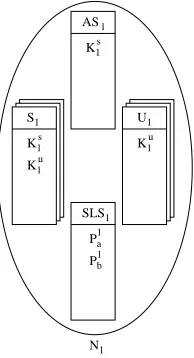
The Distributed Networks Service Authentication framework is based on autonomous networks and SNG. We state our assumptions and define some terms used in the framework in the following para-graphs. An autonomous network is assumed to have a number of local users (U) and the following service providing hosts (S) as shown in Figure 1:
Authentication Server (AS) which authenticates local users,
Server (S) which provides services,
Service Locating Server (SLS) which stores information about local services and outsourced services.
N1 AS1
K1 s
S1
K1s K1 u
SLS1
P1a P1b
U1
[image:3.612.375.472.27.206.2]K1u
Fig. 1. An autonomous network
Next we assume that an encrypted channel authenti-cates statements transmitted via the channel [13]. All communications among autonomous networks and between hosts within the same network are assumed to be encrypted using the symmetric encryption and symmetric encryption and decryption keys. For
instance, Server Key (
) is the encryption and decryption key shared between AS and S while
Session Key (
) is the encryption and decryption key shared between S and U and generated for each log-in session.
Note that the distributed network from which an outsourced service request is initiated is referred to as the request network while the network which provides the actual service is the target network.
Let us have a look at the relationship among
the autonomous networks in Distributed Networks
Service Authentication.
We say that attaches to when:
delegates its authentication authority to .
In which case generates and shares
with
.
provides services to as outsourced
ser-vices of .
Consequently, this is a one-way relationship. As
shown in Figure 2, attaches to and is the
delegator network while is a delegatee network.
In other words, a delegatee network attaches to a delegator network and this is a target network of the delegatee network.
Moreover, and are defined to be mutually
linked when attaches to and also attaches
to . Mutual linking is therefore a dual-way
rela-tionship.
each other in which an attachment is represented by a single-ended arrow and a mutual-link is represented by a double-end arrow as depicted in Figure 2.
N1 N2
[image:4.612.306.540.28.229.2]N3 N4
Fig. 2. A Service Graph
For instance, within Figure 2, each node stands for
an autonomous network ( and ) where
attaches to and .
attaches to .
and are mutually linked.
does not attach or mutually link to any node.
With the Distributed Networks Service Authenti-cation framework in place, we can now proceed to look at the Distributed Networks Service Authenti-cation Protocol.
B. Distributed Networks Service Authentication Pro-tocol
The Distributed Networks Service Authentication Protocol has two distinct operation modes. One is the Network Participation mode (NP mode) in which a network links to another network in an SNG. Another is the User Service mode (US mode) in which a user accesses a local or outsourced service. We will discuss them in the following sections.
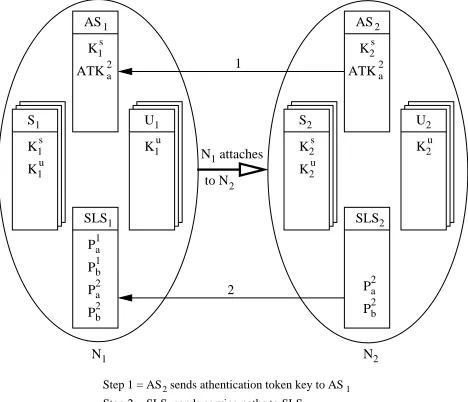
1) Protocol in NP Mode: Let us assume and
are two separate autonomous networks as shown
in Figure 3.
Upon receiving the request from to attach
directly to , generates and sends
to
. also sends information about services
available for outsourcing to in the form of a
Service Path (P). A Service Path is a service locater similar to a URL and represented by a string of network path and costing metrics. An example is
Network Path/Target Network/Server/Service
:
Cost Metrics
where
Network Path/ is optional. Services available
for outsourcing include local services in and
those outsourced by . Both and will
acknowledge the receipt of information to and
respectively. Note that can also request to
attach to and form a mutual link with .
N1
AS1
K1 s
S1 K1s K1u
SLS1
Pa 1
Pb 1
Pa 2
Pb 2
ATK2a U1
K1u K2s K2u
K2 s
Pa 2
Pb 2
ATK2a
K2u N1 attaches
2
to N
Step 1 = AS2 sends athentication token key to AS1
Step 2 = SLS2 sends service paths to SLS1
S
N AS
U
SLS
2
2 2
2
2
1
[image:4.612.116.216.84.203.2]2
Fig. 3. Attaching one network to another network
We will explain how to handle a service request in section III-B.2.
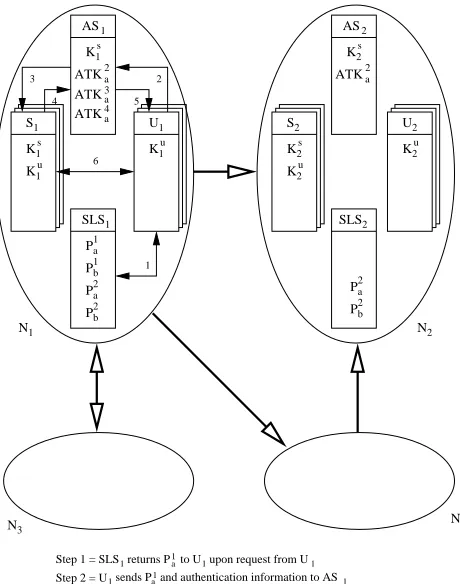
2) Protocol in US Mode: When a local user
in requests a service, it will first query
whether it is available or not. then returns a
message containing a valid service path (
or
for example) plus its cost metrics or “Service not
available” to . If is comfortable with the cost
metrics, the user will authenticate itself to
and
pass along the service path and cost metrics which
will use to determine the path to reach the target
server.
If the authentication is successful, will
gen-erate a session key
. If the service is available
on a local server as indicated by the Service
Path, will encrypt
using encryption key
of server and send it to . acknowledges
the session key
and returns
all service
information for the request. relays the service
information and
to
as shown in Figure 4. If
the local server in does not provide the service,
needs to be outsourced to another network, say
as shown in Figure 5. In this case, retrieves
the authentication token key of ,
and
uses it to encrypt the session key
instead of
using a server encryption key
. The encrypted
session key
together with the service path forms
an authentication token.
On receiving the authentication token from ,
the authentication server in extracts the
from the authentication token. From the service path
that was embedded in the authentication token,
determines if the service is provided locally on
AS1 K1
s
SLS1 Pa1 Pb 1
Pa 2
Pb2 ATK2a
N1
ATKa3
ATKa4 S1
K1s K1u
4
U1
K1u K2s K2u
K2 s
Pa 2
Pb 2
ATK2a
N2
SLS2 K2u U2
S
AS2
2
N4
N3
Step 1 = SLS1 returns Pa1to U1 upon request from U1 1 sends Pa1and authentication information to AS1
Step 2 = U
Step 3 = AS 1 generates and sends Ku 1to S1 using K1s as the encryption key
Step 4 = S1 sends service information to AS1
Step 6 = Service traffic sends Ku1
Service Path = <./S1/service>:<1>
Step 5 = AS1 and service information to U1
1 2 3
5
[image:5.612.50.280.25.317.2]6
Fig. 4. User requesting a local service
is a local service provided by , encrypts
with
and sends it to
as explained before.
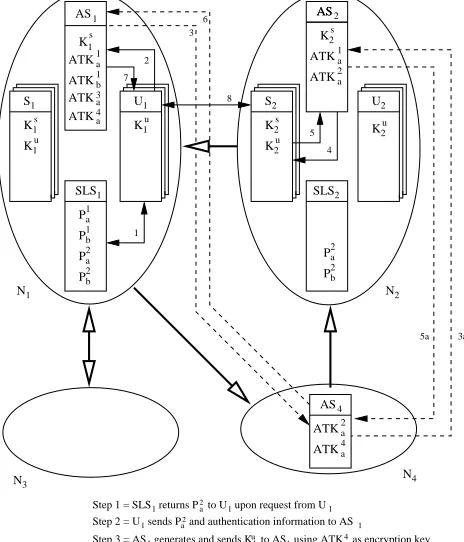
In the case when does not attach directly to
as shown in Figure 6 the service path would indicate
that a target network is only reachable via . In
this case
is passed on from
to via
authentication server in . will encrypt
with
while
will encrypt
with
. Service information returned from
will
follow a similar path but in the reverse order.
IV. APPLICATIONS OF THEDISTRIBUTED
NETWORKSSERVICEAUTHENTICATION
PROTOCOL
In this section, we illustrate the feasibility of the protocol with two case studies as follows.
A. Subnets to Subnets
The autonomous network of domain usq.edu.au
belongs to University of Southern Queensland (USQ). Under this network, a number of subnets are created for individual Faculties. For instance,
a subnet of sub-domain sci.usq.edu.au was
cre-ated for the Faculty of Sciences (FoS) in which
U1 K1u S1
K1s K1u
SLS1 Pa1 Pb 1
Pa 2
Pb2 N1
N3
AS1 K1s
K2u K2s
K2u K2
s
Pa2 Pb2 ATK2a
N2 SLS2 ATK2b S
4 5
AS2
U2
2
N4
Service Path = <N2/S2/service>:<3>
Step 1 = SLS1 returns Pa2to U1 upon request from U1
Step 2 = U1 sends Pa2and authentication information to AS1
Step 3 = AS1 generates and sends Ku1to AS2 using ATKa2as encryption key
Step 5 = S2 returns service information to AS2
Step 6 = AS2 relays service information to AS1 u
Step 7 = AS1 sends service information and K1to U1
1 2 7
ATKa
ATK2a
ATKa3
ATKa4 1
6 3
8
Step 8 = Service traffic
Step 4 = AS2 sends K1uto S2
2as encryption key
[image:5.612.303.540.25.338.2]using K s
Fig. 5. User requesting an outsourced service
probus.sci.usq.edu.au (Probus) serves as a web server and a file server.
We know the subnet of sci.usq.edu.au has no
independent authentication server. Authentication is performed by individual servers using a centralized Light Weight Access Protocol authentication infor-mation repository (LDATA). Staff members of FoS and student enrolled in programs offered by the Faculty are all legitimate users of the subnet. Every
user of the subnet of sci.usq.edu.au has an entry in
LDATA. If a user
from another subnet, say, subnet of
eng.usq.edu.au, wants to create a web site in Probus,
has to register as a local user ofsci.usq.edu.au.
Administrative work involves both user management and network related administration. Here we demon-strate how to use the Distributive Network Service Authentication Protocol to do so.
commu-S1
K1s K1u
SLS1
Pa1 Pb1 Pa2 Pb2 N1
N3
AS1
K1s ATK1a
ATKa4 ATK1b ATKa3
Service Path = <N4/N 2/S2/service>:<5>
U1
K1u
ATK2a ATK4a
N4 Pa2
Pb2 N2 SLS2
K2s
Step 1 = SLS1 returns Pa2to U1 upon request from U1
Step 2 = U1 sends Pa2and authentication information to AS1
Step 3 = AS1 generates and sends Ku1to AS using ATKaas encryption key
4 4
Step 3a = AS4 extracts K1u and forward K1uto AS2 using ATK a2
Step 5 = S2 returns service information to AS2 Step 5a = AS2 relays service information to AS4 Step 6 = AS relays service information to AS4 1
Step 7 = AS1 sends service information and K1uto U1
K2u 2
Ks
1 2 7
8 6 3
5a 3a
AS4 S
4 5 2
AS AS2
Step 8 = Service traffic
Step 4 = AS2 sends K1uto S2using Ks2as encryption key
a 1
ATK2a ATK
K2u
[image:6.612.49.281.32.303.2]U2
Fig. 6. User requesting an outsourced service
nication within the network must be encrypted using symmetric key encryption such as Data Encryption Standard (DES), International Data Encryption Al-gorithm (IDEA) and Rivest Cipher (RC5). Note that communication with the SLS may be in plain text form.
Due to the fact that the servers within the subnets
ofsci.usq.edu.au and eng.usq.edu.au perform service
authentication on their own, and SLS does not exist in both networks, we have to create an AS and a SLS for each network
The functions of an AS include:
1) extracts user account name, password and ser-vice path from an authentication request from a user;
2) uses account name and password for authenti-cation and retrieves the corresponding autho-rization;
3) prepends user account and authorization to service path to form authorized service path (AP);
4) forms authentication token by generating and
encrypting
with ATK of AS in next hop
along the Service Path;
5) receives and extracts session keys from authen-tication tokens and passes them on to local server or AS in next hop as determined by the Service Path;
6) relays service information returned from local servers to AS in other networks;
7) forward service information to local servers or AS in next hop as determined by the Service Path;
8) uses the original LDATA for sci.usq.edu.au as
authentication information repository. The SLS has the following functions:
1) being a Light Weight Access Protocol server; 2) creating a service path for all local services
within the network as
./service ;
3) converting service paths from delegator
net-work from
./net path to S/S/service to
./delegator net/net path to S/S/service ;
Servers in the delegator network need to:
1) open up a service connection with every ses-sion key passed to it from AS;
2) use session key for the connection to commu-nicate with the client program;
3) close a connection when the service session for the connection ends.
While on the delegatee network, the client program: 1) requests user input for service demanded; 2) requests Service Path from SLS;
3) requests user input for authentication informa-tion;
4) passes service path along with authentication information to AS;
5) upon receiving the session key and service information from AS, connects to the server and start the service session.
Note that each subnet may have an AS and an SLS of its own.
B. Autonomous Networks
Let us assume the network sci.usq.edu.au has already been using the Distributed Network Service Authentication Protocol with its own AS and SLS. We describe here how to use the Distributive Net-works Service Authentication Protocol to outsource the service from the ANU network. The procedure is similar to the previous case, i.e. installing an AS
and a SLS on the subnet of sci.usq.edu.au.
Note that the AS will:
1) receive and extract session keys from authen-tication tokens and pass them on to servers within the local network;
2) relay service information returned from local servers to the AS in other networks;
The SLS will:
1) create a service path for all local services
within the network as
./service ;
2) convert the service paths from the delegator
network from
./net path to S/S/service to
./delegator net/net path to S/S/service ;
Finally the client program on our subnet of sci.usq.edu.au will:
1) request user input for simulation parameters; 2) request Service Path for parallel computing
service from SLS;
3) request user input for authentication informa-tion;
4) pass service path along with authentication information to AS;
5) connect to the server and start the parallel computing service session upon receiving the session key and service information from AS.
V. CONCLUSION
A user interested in a service available in a distributed network environment has to establish a trust relationship with a local network first. Each time a service is requested, the network has to authenticate the user before granting the user access to any local or outsourced service. A service authen-tication protocol which relays authenauthen-tication status from local network to target network is required for outsourced services. In this paper, we have de-signed the DNSA protocol which allows autonomous networks to link together, forming an SNG. With this protocol, authentication status is relayed from a request network to a target network without any extra input from the user. Local users of networks adopting the DNSA protocol therefore need only authenticate with its local authentication server. This makes the protocol user-friendly and efficient and alleviates the burden of collecting authentication information and
obtaining authentication for each outsourced service. The extra entity required in the DNSA protocol is only a service locating server which is capable of listing services using service path.
Note that we have not included the granting and revocation of service authorization in DNSA. We will focus on DNSA authorization and security is-sues in the future.
REFERENCES
[1] Beth, T., Borcherding, M., Klien, B. (1994) Valuation of
Trust in Open Networks. Proceedings of the Conference
on Computer Security 1994.
[2] Reiter, M. (1999). Authentication Metric Analysis and
Design. ACM Transactions on Information and System
Security, Vol. 2, No.2.
[3] Kohlas, R., Maurer, U. (2000). Confidence Valuation in a
Public-Key Infrastructure based on Uncertainty Evidence.
Proceedings of Public Key Cryptography 00, Lecture Notes in Computer Science, Vol. 1751.
[4] Abdul-Rahman, A., Halles, S. (1997). A Distributed Trust
Model. Proceedings of New Security Paradigms
Work-shops 1997.
[5] Denning, D. (1993). A new paradigm for trusted systems. Proceedings of 1992-1993 ACM SIGSAC New Security Paradigms Workshop.
[6] Montaner, M., Lopez, B., Rosa, J. L. (2002) Developing
Trust in Recommender Agents. Proceedings of the first
international joint conference on Autonomous agents and multi-agent systems.
[7] Robles, S., Borrell, J., Bigham, J., Tokarchuk, L., Cuthbert, L. (2001) Design of a Trust Model for a Secure
Multi-Agent Marketplace. Proceedings of the fifth international
conference on Autonomous agents.
[8] Abdul-Rahman, A., Hailes, S. (1997). Using
Recommen-dations for Managing Trust in Distributed Systems.
Pro-ceedings of IEEE Malaysia International Conference on Communication ’97 (MICC’97), Kuala Lumpur, Malaysia [9] Abdul-Rahman A., Hailes S. (2000). Supporting Trust in
Virtual Communities. Hawaii Int. Conference on System
Sciences 33 , Maui, Hawaii, January 2000.
[10] The Kerberos Network Authentication Service (V5). In-ternet Engineering Task Force (IETF) and the InIn-ternet Engineering Steering Group (IESG) Porpoised Standard, RFC1510.
[11] X.500 (02/01). International Telecommunication Union ITU-T Recommendations X series. http://www.itu.int/rec/recommendation.asp
[12] X.509 (03/00). International Telecommunication Union ITU-T Recommendations X series. http://www.itu.int/rec/recommendation.asp
[13] Authentication in Distributed Systems: Theory and
Prac-tice Lampson B., Abadi M., Burrows M., Wobber E.
(1992). ACM Transactions on Computer Systems, vol. 10, no. 4.
Acknowledgment: Special thanks to our colleague