This is a repository copy of Surface anisotropy and particle size influence on hysteresis loops in La2/3Ca1/3MnO3 nanoparticles : A simulation approach.
White Rose Research Online URL for this paper: http://eprints.whiterose.ac.uk/109152/
Version: Accepted Version
Article:
Alzate-Cardona, J. D., Ruta, Sergiu Ionel, Chantrell, Roy William
orcid.org/0000-0001-5410-5615 et al. (2 more authors) (2017) Surface anisotropy and particle size influence on hysteresis loops in La2/3Ca1/3MnO3 nanoparticles : A simulation approach. Journal of Magnetism and Magnetic Materials. pp. 451-458. ISSN 0304-8853 https://doi.org/10.1016/j.jmmm.2016.10.108
[email protected] https://eprints.whiterose.ac.uk/ Reuse
Items deposited in White Rose Research Online are protected by copyright, with all rights reserved unless indicated otherwise. They may be downloaded and/or printed for private study, or other acts as permitted by national copyright laws. The publisher or other rights holders may allow further reproduction and re-use of the full text version. This is indicated by the licence information on the White Rose Research Online record for the item.
Takedown
If you consider content in White Rose Research Online to be in breach of UK law, please notify us by
Surface anisotropy and particle size inuence on hysteresis loops in
La
2/3Ca
1/3MnO
3nanoparticles: a simulation approach
J.D. Alzate-Cardona1, S. Ruta2, R.W. Chantrell2,
O.D. Arbeláez-Echeverri1, E. Restrepo-Parra1 1Departamento de Física y Química,
Universidad Nacional de Colombia, Sede Manizales, A.A. 127 Manizales, Colombia.
2Department of Physics, University of York,
Heslington, York YO10 5DD, United Kingdom
Abstract
Thermal and hysteretic magnetic properties of La2/3Ca1/3MnO3 nanoparticles were studied
us-ing Monte Carlo simulations, with emphasis on the inuence of anisotropy. In this work, several nanoparticle sizes ranging from 2.32nm to11.58nm were analyzed and their properties were
I. INTRODUCTION
La2/3Ca1/3MnO3is one of the most studied magnetic compounds mainly because it has
excel-lent magnetic and magnetotransport properties. In particular, it has a robust magnetoresis-tance, which is greater than that found in other magnetic materials such as magnetite and maghemite. Furthermore, it is straightforward to nd compatible compounds of the family LaxCa1−xMnO3, that can present ferromagnetic, paramagnetic charge and orbital ordering
simply by adjusting the stoichiometry, to build stable multilayers with excellent magneto-transport properties [1]. La2/3Ca1/3MnO3 has also a strong chemical stability which make it
easy to correlate the structural, electronic and magnetic properties when they are studied in a systematic way.
It has been recognized that the interesting properties of the compounds in the LaxCa1−xMnO3 family originate from the double exchange between Mn
3+
− O − Mn4+
[2,3]. In these compounds, the double exchange mechanism explains the existence of ferro-magnetism and metallic behavior at low temperatures. According to the double exchange model, the electrons can move between the manganese ions using oxygen, which is paramag-netic, as an intermediary. Consequently, the tunneling takes place between two manganese ions with dierent charge, thus interchanging their valence states (Mn3+
−O−Mn4+
→
Mn4+
−O−Mn3+
). When the proportion of lanthanumxis close to1/3there is a maximum
in the number of Mn3+
ions with one Mn4+
near neighbor, thereby maximizing the number of double exchange interactions. This is why La2/3Ca1/3MnO3 has the highest Curie
tem-perature and the best conductivity in this family; properties which justify special attention from the scientic community [4].
devices, sensors, medical treatments and catalysis [6, 7].
On the nanometric scale magnetic systems, surface eects manifest as low Curie temperature and low saturation magnetization compared with their bulk counterparts [8]. Those traits have attracted the interest of the scientic community for several years.
Kachkachi and Dimian studied the inuence of the particle size and surface anisotropy in the hysteretic properties of spherical nanoparticles by means of the Landau Lifshitz equations [9]. Later, Kachkachi and Mahboub focused on the surface anisotropy and found that the Néel model was more realistic than a transverse anisotropy since it accounts for the loss of nearest neighbors in surface atoms [10]. Mazo-Zuluaga et al. studied the hysteretic properties of magnetite nanoparticles by means of Monte Carlo simulations; they considered nanoparticle sizes ranging from 2nm up to 7nm, considering dierent ratios of surface to
core anisotropy. Their results reveal a strong inuence of the sign and magnitude of the surface anisotropy on the coercive eld [11].
Mahesh et al. performed experiments to study the eects of the particle size on the giant magnetoresistance in La2/3Ca1/3MnO3. They concluded that the magnetoresistance decreases as the particle size increases [12]. Restrepo-Parra et al. studied the inuence of the surface to volume ratio in the magnetic properties of La2/3Ca1/3MnO3 nanoparticles using Monte
Carlo simulations. They showed a direct correlation between the nanoparticle size and the critical temperature [13].
Although the magnetic properties of La2/3Ca1/3MnO3 have been studied, deeper analysis is
required on the inuence of the anisotropy on the magnetic behavior. This work presents a comprehensive study of the inuence of nanoparticle size and surface anisotropy in the thermal, magnetic and hysteretic properties of La2/3Ca1/3MnO3 nanoparticles; furthermore,
the eects of the surface anisotropy on the spins conguration in the low temperature regime are also investigated.
remarks on this work.
II. MODEL AND SIMULATION
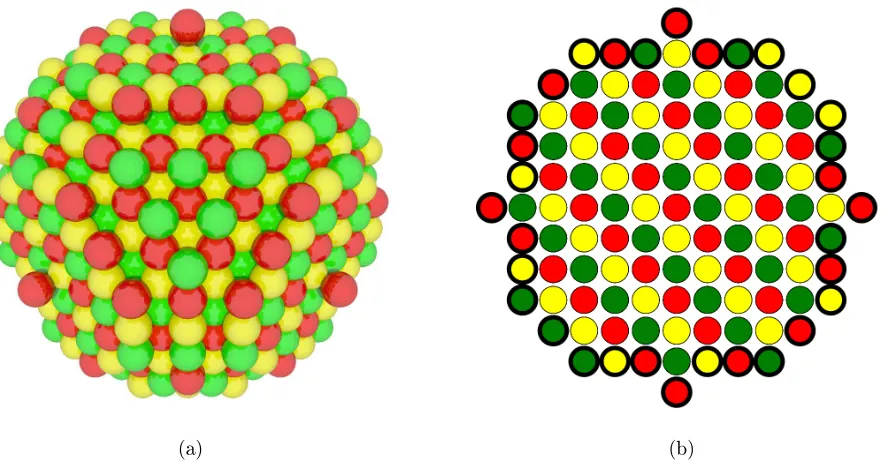
(a) (b)
Figure 1: (Color online) Schematic diagram of a La2/3Ca1/3MnO3 nanoparticle in (a) three
dimensional view and (b) cross section view, with a diameter of 12 ions. There are three types of ions: Mn4+d3
(red), Mn3+eg (green) and Mn3+eg′
(yellow). In the cross section view, the surface atoms are outlined in black.
The manganite La2/3Ca1/3MnO3 is a ferromagnetic compound with a Curie temperature of
260K. The compound has three types of magnetic ions, Mn4+d3
(with a spinS =3/2) which
bonds to Ca2+
ions, Mn3+eg
and Mn3+eg′
(both with a spin S = 2), bonded to La3+ ions.
Figure 1 shows a scheme of the magnetic ions in a12ion diameter manganite nanoparticle.
[image:5.612.87.531.169.406.2]lower coordination number. Each of the magnetic sites are modeled with Heisenberg spins, whereas non magnetic ions (O, Ca and La) are left out of the simulation.
The magnetic behavior of the system is modeled with a Heisenberg Hamiltonian with nearest neighbor exchange interactions, magnetocrystalline uniaxial anisotropy and Néel's surface anisotropy.
H=−X
hi,ji
JijS~i·S~j −Ki
X
i
~ Si·nˆi
2
−hX
i
~
Si·ˆh (1)
where, hiji means sum over the nearest neighbor pairs, Jij is the exchange interaction
constant between the sites labeled i and j, S~i and S~j are the spins of the magnetic sites
labelediand j,Ki is the anisotropy constant,nˆi is the anisotropy axis,his the applied eld
strength and ˆhis a unit vector parallel to the applied eld (this can be translated to energy
units through the relation H =h/µ, where µis the magnetic moment of the Mn ions [15]).
Bond J
meV·link−1
Mn3+eg-O-Mn3+eg′
4.65
Mn3+eg′
-O-Mn4+d3
1.35
Mn3+eg-O-Mn4+d3 7.77
Table I: Values for J considered in the dierent nearest neighbor pair types.
The values of Jij were used in a per interaction type basis, as shown in table I. Those
numerical values were tted by Restrepo-Parra et al. to reproduce the Curie temperature of this manganite (~260K) by adding a multiplicative factor to those found by Uhl and
Siberchicot using density functional theory simulations [13, 16]. Similarly, the magnitude of the spinSi in each site is assigned according to the type of ion as mentioned.
The anisotropy constant Ki takes the valuesKc for ions within the core and Ks for surface
ions. The value of Kc was xed at1.284meV·atom−1, while Ks was treated as a simulation
parameter via the variation of the ratioKs/K
ˆ
ez (the canonical unit vector in thez direction) for the magnetic sites within the core, while
ˆ ni =
P
hjieˆij
P
hjieˆij
(2)
where the sum runs over hji, i.e., the nearest neighbors of the site labeledi andeˆij is a unit
vector parallel to the direction~ri−~rj.
Through the simulations in this study, the applied eld direction ˆh was held constant and
parallel to the uniaxial anisotropy axis ˆez.
In order to compute the equilibrium magnetic properties, the Metropolis Monte Carlo algo-rithm was used in all the simulations. In each spin ip attempt, a random spin was drawn from a uniform distribution over the surface of a sphere. In order to calculate critical tem-peratures, a cooling down routine was used, whereas to compute the hysteretic properties, an hysteresis loop routine was used.
The cooling down routine consisted in taking the system from a high temperature, i.e., a temperature aboveTC, down to a low temperature slightly above0K with a small
tempera-ture step. The state of the system, given by the spin of each magnetic system, was initialized as random spin directions at high temperature. At each temperature step, the system was subjected to 5×10⁵ Monte Carlo steps, of which the rst
105 where taken to allow the
system to reach thermal equilibrium.
The hysteresis loop routine consisted in taking the system from a random spin conguration with a negative saturating external applied eld strength −hsat, up to a positive saturating
external applied eld strength +hsat, and then back to −hsat, with a small and constant
eld step. In each step, the system was subjected to 1×10⁵ Monte Carlo steps, and the
rst 2×10⁴ were discarded to lter out the noise that would arise from the discrete applied
eld strength steps.
Diameter [ions] Diameter [nm] N [ions]
6 2.32 123
8 3.09 257
12 4.63 925
16 6.18 1209
20 7.72 4169
[image:8.612.91.520.75.274.2]30 11.58 14147
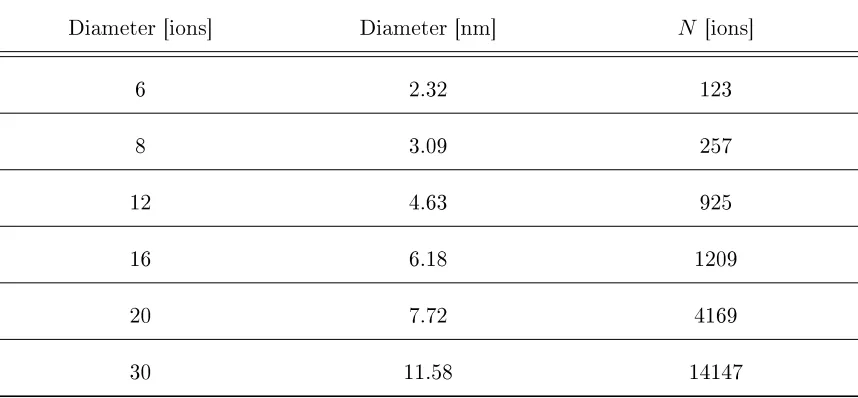
Table II: Sizes of the simulated nanoparticles, associated with their total number of magnetic sites.
The sizes of the simulated nanoparticles ranged from2.32nm (6 ions in diameter) to11.58nm
(30 ions in diameter), the diameter of the simulated systems in ions and nm as well as their total number of magnetic sites, are shown in tableII. The properties of those nanoparticles were compared to the properties of a bulk material. For the simulated bulk material, we considered a cubic system with a linear size of 12 ions (4.63nm) and N = 1728 magnetic
sites. Furthermore, periodic boundary conditions were applied to the bulk system.
The surface anisotropy constant Ks was varied changing the surface to core anisotropy
ratio Ks/K
c; this value was varied using powers of ten, and both positive and negative
sur-face anisotropies were considered. The values of the ratios used follow the relationship
log10(|Ks|/Kc) ={0,1,2,3,4,5}; therefore, ±Ks = 1,10,100, . . . meV·atom−
1 and so on.
From the stored time series, the normalized magnetization and susceptibility were com-puted. The magnetization was normalized to the maximum possible magnetization, that was calculated using the formula:
MS =
X
α
nα
S~α
(3)
where the sum runs over the ion typesα(Mn3+eg, Mn3+eg′
and Mn4+d3),
nα is the number of
ions of typeαin the sample, and S~α
is the spin modulus of the ion of typeα(
2 for Mn3+eg′
and Mn4+d3
). Then the magnetization is computed using a time average,
hMi= 1 MS
Nmax X
t=Ncut M~t
(4)
whereNcut is the number of Monte Carlo steps required to achieve stability,Nmaxis the total
number of Monte Carlo steps and M~t is the magnetization of the system at the time step t. The magnetization of the system was computed as the sum over all sites: M~t = PiS~i.
Furthermore, the susceptibility was evaluated using the formula:
χ= 1
kBT
M2
− hMi2
(5) where, M2 = 1 M2 S Nmax X
i=Ncut M~i
2
(6)
The coercive eld was estimated using linear regression applied to the points that cross the x-axis in the hysteresis loop. Then, the right and left coercive elds were evaluated.
Moreover, the coercive eld was estimated using the equation:
hc =
|hc,right|+|hc,lef t|
2 (7)
where hc,rigth and hc,lef t are the right and left coercive elds in the hysteresis loop.
III. RESULTS AND DISCUSSION
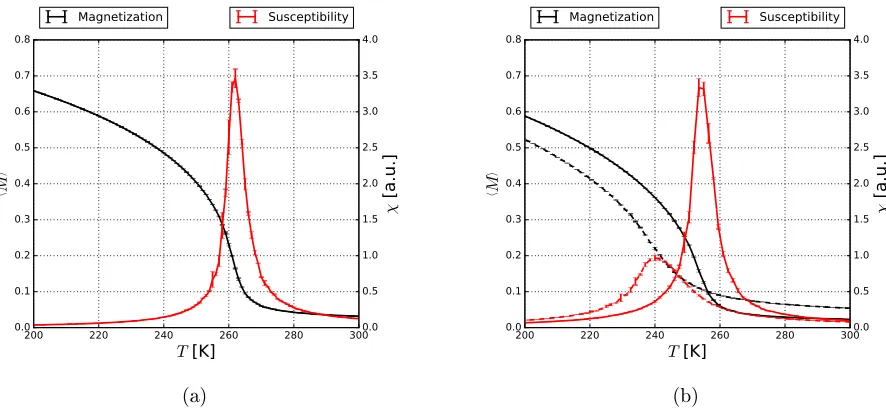
Figure 2a shows the normalized magnetization and susceptibility for a bulk system with a linear size of 21 ions. The peak value of the magnetic susceptibility, also shown in gure
2a, indicates a bulk critical temperature around 260K, which is consistent with other
the-oretical and experimental results [17]. Furthermore, gure 2bshows the magnetization and susceptibility of two nanoparticle sizes. The curves for D = 30 ions show very good
agree-ment with their bulk counterparts, with only a slight reduction of the critical temperature. The lower critical temperature can be attributed to nite size eects. For D= 16ions the
200 220 240 260 280 300 T [K] 0.0 0.1 0.2 0.3 0.4 0.5 0.6 0.7 0.8 hM i Magnetization 0.0 0.5 1.0 1.5 2.0 2.5 3.0 3.5 4.0 χ [a .u .] Susceptibility (a)
[image:10.612.85.528.80.287.2]200 220 240 260 280 300 T [K] 0.0 0.1 0.2 0.3 0.4 0.5 0.6 0.7 0.8 hM i Magnetization 0.0 0.5 1.0 1.5 2.0 2.5 3.0 3.5 4.0 χ [a .u .] Susceptibility (b)
Figure 2: Critical temperature behavior of the bulk La2/3Ca1/3MnO3 system as well as for
nanoparticles. Magnetization and susceptibility for (a) bulk with a linear size of L= 21
ions and (b) a nanoparticles of diameter D= 30ions (solid) and D= 16ions (dashed)
(lines are just a guide to the eye).
Figure 3a shows the critical temperature of La2/3Ca1/3MnO3 nanoparticles as a function
of their diameter. Results show a monotonic increase of the Curie temperature with the nanoparticle diameter, saturating at the bulk Curie temperature,TC = 260K. This behavior
is usually attributed to nite size eects which include surface dominance at low diameters as well as lower average coordination number. As mentioned before the magnetic sites in the surface have a lower coordination number, as their relative population increases for smaller nanoparticles, the average coordination number decreases as well. With a lower average coordination, the magnetic bond density evidently decreases, and so does the amount of energy necessary to break the ferromagnetic ordering. Therefore, we observe a lower critical temperature as the diameter of the nanoparticles decrease. Similar results have been found by Velásquez et al. while studying the pseudocritical behavior of isolated ferromagnetic nanoparticles through the both the variational and Monte Carlo methods, and Iglesias and Labarta while studying the nite size eects on maghemite nanoparticles using Monte Carlo simulations [18, 19]. The surface to core dominance can be characterized using the ratio of the number of ions in the core to the number of ions of the surface, or Nc/N
5 10 15 20 25 30 D
[ions]
140 160 180 200 220 240 260
Tc
[K
]
Ks/Kc= 1
Ks/Kc= 10
2 4 D6
[nm]
8 10 12bulk
(a)
5 10 15 20 25 30
D
[ions]
01 2 3 4 5 6
Nc
/N
s
2 4 D6
[nm]
8 10 12(b)
Figure 3: (a) Critical temperature Tc as a function of the nanoparticle diameter and (b)
dependence of the core to surface ratio, Nc/N
s, with the nanoparticle diameter, as a support
gure (lines are just a guide to the eye).
3b, shows the value of the surface to core ratio for the simulated nanoparticles. Note that this ratio ts a linear trend because the number of ions in the core grows in proportion to the cube of the diameter whereas the number of atoms in the surface grows in proportion to the square of the diameter. The (red) horizontal line in gure3bshows the threshold below which the number of ions on the core is lower than the number of ions in the surface and vice versa.
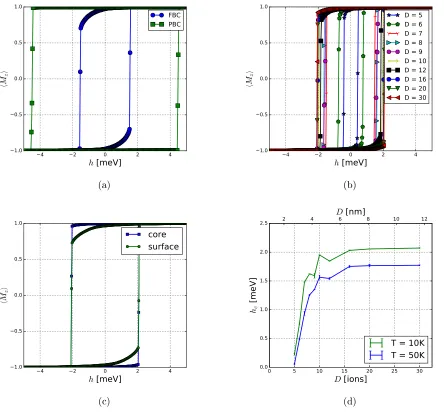
Figure 4a shows the hysteresis loops for dierent kinds of boundary conditions in the same bulk system. From the results one can readily appreciate that the coercive eld of a bulk system with periodic boundary conditions (PBC) is considerably higher than that of the same system with free boundary conditions (FBC). Conversely, when free boundary conditions are applied instead of periodic boundary conditions, the hysteresis loop becomes signicantly rounder. The dramatic change in the coercive eld can be attributed to size eects which are induced once the boundary conditions are relaxed, whereas, the change in the squareness of the hysteresis loop can be attributed to both size eects and the surface anisotropy of the
[image:11.612.83.521.82.287.2]4 2 0 2 4 h
[meV]
1.0 0.5 0.0 0.5 1.0 h Mz i FBC PBC (a)
4 2 0 2 4
h
[meV]
1.0 0.5 0.0 0.5 1.0 hM z iD = 5 D = 6 D = 7 D = 8 D = 9 D = 10 D = 12 D = 16 D = 20 D = 30
(b)
4 2 0 2 4
h
[meV]
1.0 0.5 0.0 0.5 1.0 h Mz icore
surface
(c)0 5 10 15 20 25 30
D
[ions]
0.0 0.5 1.0 1.5 2.0 2.5 hc[m
eV
]
T = 10K
T = 50K
2 4 D6[nm]
8 10 12 [image:12.612.78.522.93.507.2](d)
Figure 4: Hysteresis loops at T = 10K and Ks/K
c= 1 for (a) bulk system using periodic
boundary conditions and free boundary conditions with surface anisotropy, (b) several nanoparticle diameters and (c) core and surface of a nanoparticle with diameter D= 30
ions and, on the other hand, (d) coercive elds for dierent nanoparticle diameters at
T = 10K and T = 50K (lines are just a guide to the eye).
As shown in gure 4b, with increasing diameter of the nanoparticles, their hysteresis loops widen and become more square; the increase in width is monotonic and saturates slightly above h = 2meV. The asymptotic value of the coercive eld for the nanoparticles is, at
free boundary conditions and without surface anisotropy. To summarize, the coercive eld of the nanoparticles saturates to a eld bounded by the coercive eld of a bulk system with free boundary conditions and boundary conditions, gure4a.
The increase in squareness in the hysteresis loops with increasing nanoparticle diameter can be attributed to the increasing dominance of the core for bigger nanoparticles. As shown in gure 4c, in our simulations where the applied eld is parallel to the uniaxial anisotropy axis of the core, the contribution of the core sites to the hysteresis loop is more square than the contribution from the surface as the anisotropy axes of the surface sites are evenly distributed in the range between parallel and perpendicular to the applied eld direction. For this reason, as the diameter increases and so the Nc/N
s ratio, the squared contribution
to the hysteresis loop becomes dominant.
Figure 4d shows the dependence of the coercive eld on the diameter. Results show a monotonic increase in the coercive eld approaching an asymptotic value for particle sizes above D = 4 ∼ 5ions. Although we did not perform simulations below D = 5ions due
to the loss of stoichiometry, it is plausible to speculate that the coercive eld would fall to zero below a diameter in the range between 3 and 5 ions. This result is consistent with the (super)paramagnetic and single domain regimes observed in experimental [20, 21] and theoretical [22] studies. Essentially, below a particle diameter d0 (3 to 5 ions in this case)
the system will be in a (super)paramagnetic regime, whereas above d0 and below a critical
diameter dc (not reached in our simulations) the system will be in a single domain regime,
where the normalized coercive eld increases. Above dc the system enters a multi domain
regime where the normalized coercive eld presents an exponential decrease. To observe this phenomenon, the magnetostatic interaction should be taken into account. See for instance, works by Kolhatkar et al., Sung Lee et al. and Yanes et al. in refs. [2022].
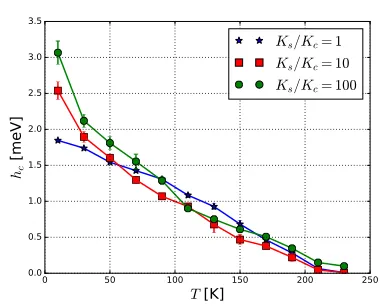
Figure5shows the inuence on the coercive eld of increasing the positive surface anisotropy in a nanoparticle of D = 12 ions as a function of the temperature. Zianni et al. found a
similar behavior for small magnetic nanoparticles, however their results, based on a strong crystalline anisotropy in the surface compared to the anisotropy in the core (Ks/K
c = 10),
0 50 100 150 200 250 T [K]
0.0 0.5 1.0 1.5 2.0 2.5 3.0 3.5
hc
[m
eV
]
[image:14.612.204.395.77.230.2]Ks/Kc= 1 Ks/Kc= 10 Ks/Kc= 100
Figure 5: Temperature dependence of the coercive eld for a nanoparticle with diameter
D= 12 ions andKs/K
c={1,10,100}. The dashed lines are only a guide to the eye for a
better visualization.
in gure 5 feature crossover points; this means that increasing the value of the positive surface anisotropy will increase, or decrease, the coercive eld of a nanoparticle according to the temperature. This is an evidence of the complex temperature dependence of the non-uniformity of the magnetization. Furthermore, all of the curves, Ks/K
c = 1, Ks/Kc = 10 and
Ks/K
c = 100, show a monotonic decrease of the coercive eld; that is the expected behavior,
since, as the temperature increases, the material tends to become paramagnetic with an implied coercive eld of zero.
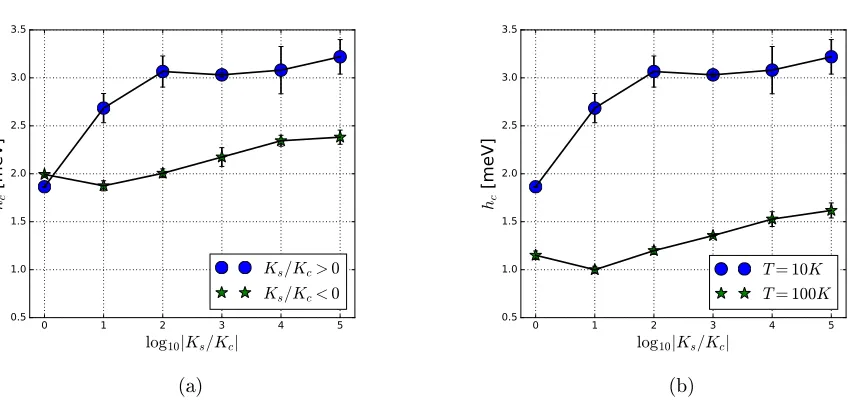
Figure 6a shows the dependence of the coercive eld on the surface to core ratio Ks/K c for
both positive and negative values at low temperature. In both cases, the coercive eld tends to increase with Ks/K
c; however, for the positive, case the magnitude of the increase
is greater. Furthermore, the curve for Ks/K
c > 0 exhibits large error bars; this can be
attributed to the choice in the spin update policy and to dierent magnetization switching paths due to excessive strains in the surface. Iglesias and Labarta studied the inuence of surface anisotropy on maghemite nanoparticles, and found a monotonic increase of the coercive eld as the surface to core anisotropy ratio increased (only for Ks/K
c > 0). The
results of ref [15] are consistent with ours up toKs/K
c = 100after which we nd an apparent
0 1 2 3 4 5 log10|Ks/Kc|
0.5 1.0 1.5 2.0 2.5 3.0 3.5
hc
[m
eV]
Ks/Kc> 0 Ks/Kc< 0
(a)
0 1 2 3 4 5
log10|Ks/Kc| 0.5
1.0 1.5 2.0 2.5 3.0 3.5
hc
[m
eV]
T = 10K T = 100K
[image:15.612.87.520.85.285.2](b)
Figure 6: Coercive eld as a function oflog|Ks/K
c| for a nanoparticle withD = 12, for (a)
dierent signs of the surface anisotropy constant at T = 10K and (b) dierent
temperatures for a positive surface anisotropy constant (lines are just a guide to the eye).
the surface to core anisotropy ratio is modied heavily by the temperature. This is because the non-collinearity is reduced due to the thermal uctuations.
The results shown in gure6bare consistent with the ones shown in gure5. Several features of6bare important to note at both T = 10K andT = 100K. In the case ofT = 10K, there
is a large step upwards in the coercive eld between Ks/K
c = 1 to Ks/Kc = 10 and then a
slightly smaller step upwards in the coercive eld betweenKs/K
c= 10 toKs/Kc = 100 which
can be readily conrmed in gure6bby looking at the three rst points of the coercive eld curve for T = 10K. Similarly for T = 100K there is a small steps decrease in the coercive
eld between Ks/K
c = 1 to Ks/Kc = 10 followed by a small step increase in the coercive
eld between Ks/K
c = 10 to Ks/Kc = 100, as can also be readily conrmed in gure 6b by
investigation of the three rst points of the coercive eld curve for T = 100K.
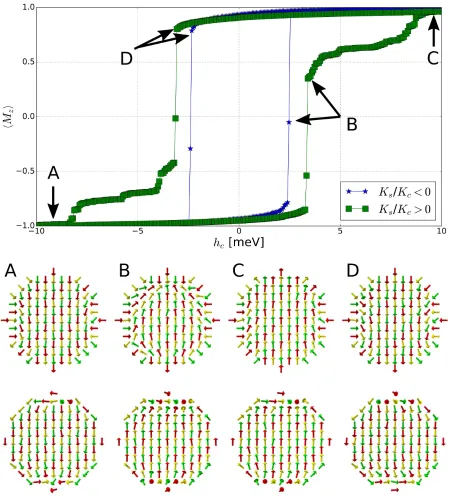
Figure 7 shows dierent spin congurations collected during a hysteresis loop, with the following parameters,Ks/K
c =±10000and T = 10K. We will discuss separately the positive
and negative surface to core anisotropy cases. For Ks/K
c = 10000, the surface ions are
can align to the applied magnetic eld. In this case, depending on the external eld, the spins can align in throttled states 7 (states A, C and D) or states between throttled and hedgehog (state B) with a magnetization close to zero. Furthermore, it is important to note that the dierences between the states at B and C are concentrated in the surface to core interface. In the magnetic conguration at B the interface spins align with the local eld from the shell and core, leading to maximum stability, whereas at point C the magnetostatic eld dominates, maximizing the magnetization. The hysteresis loop for the positive surface to core anisotropy ratio features several jumps in magnetization. These jumps can be attributed to the entire or partial switching of the magnetization of the sites in the surface, due to the external eld; it can be said that the spins on the surface would not change gradually but suddenly. Kachkachi and Dimian show similar hysteresis loops using the Néel model in a generic ferromagnetic material and solving the Landau-Lifshitz equations [9]. They recognize two kinds of point that characterize the hysteresis loops. The rst is named the critical eld, which marks the limit of meta-stability, and the second is called switching eld, or coercive eld, where the projection of the magnetization on the eld direction changes sign.
On the other hand, when the ratio Ks/K
c is negative, the states of the surface spins are
tangential to the surface. Therefore, there are not jumps in the hysteresis loops. In this case, all the states A, B, C and D show an artichoke conguration, and the poles of the artichoke move as the applied magnetic eld varies. Furthermore, when transitioning from the state B to the state C, there are some interface spins that align with the applied eld as well as the surface spins for B and only to the applied for C; however, those spins are not distributed in the sides of the nanoparticle (with respect to the applied eld direction) but in the top and bottom of the nanoparticle. Beyond that, the states also present blocking but only in the top and bottom side of the nanoparticle where a couple of spins are blocked to be perpendicular to the applied magnetic eld direction.
Regarding the anisotropy, gure8shows the possible spin congurations for dierent values of Ks/K
c at low temperature. When the surface anisotropy is negligible in comparison to
spins are blocked radially, but the core spins take a direction such that they compensate the exchange coupling and the uniaxial anisotropy in the±z direction, forming a throttled
conguration, shown in gure 8 (b). As Ks becomes increasingly positive, the spins are
blocked strongly normal to surface and they force to their neighbors to align with them, according to gure8 (c). This causes a net magnetization equal to zero. Furthermore, they can be oriented either inward or outward direction, because this state is twofold degenerate [5]. When the surface anisotropy is negative, the surface spins are oriented in a direction tangential to the surface producing an artichoke conguration, as shown in gure 8 (d). These same congurations were found by Berger et al. [24], who studied the inuence of strong surface anisotropy in ferromagnetic nanoparticles. Similarly, Mazo-Zuluaga et al. [11] studied the magnetic properties of magnetite nanoparticles and showed a strong dierence between positive and negative surface anisotropy, also reporting congurations similar to those found in this work. All of the above eects are most signicant in particles where the surface anisotropy is comparable to the exchange [5,15, 25].
IV. CONCLUSIONS
The eect of the surface anisotropy and particle size on the hysteretic and magnetic be-havior of manganite La2/3Ca1/3MnO3 nanoparticles was studied. Monte Carlo method with
Metropolis algorithm and three-dimensional classical Heisenberg model were used for mod-eling magnetic and hysteretic properties of nanoparticles of La2/3Ca1/3MnO3. Magnetization
and magnetic susceptibility per site were obtained for bulk material in order to reproduce the critical temperature. In the same way, critical temperatures for nanoparticles with dif-ferent size was computed. A shift toward low temperatures ofTc was observed for decreasing
nanoparticle size. This phenomenon is due to the lower number of ions on the surface than the core. Nevertheless, Tc tends toward the bulk transition temperature (260K) with
in-creasing nanoparticle diameter.. The equilibrium spin conguration at extreme values of
Ks/K
c were shown.
Furthermore, the surface to core anisotropy ratio showed almost no inuence on the critical temperature of manganite nanoparticles; however, for very small nanoparticles (D= 5nm)
the inuence of the surface to core anisotropy ratio becomes signicant. Hysteresis loops of nanoparticles were obtaining varying the diameter and Ks/K
diam-eter has strong inuence on the coercive eld, due to the surface anisotropy and the ratio of the number of ions on the surface and the number of ions on the core.
The dependence of the coercive eld on the temperature was computed for dierent values of Ks/K
c. As temperature decreases, Hc increases. This is due to the ferromagnetic order
imposed as the temperature decreases. This and the decrease of thermal activation reduces the possibility of thermally driven transitions leads to the increase of coercivity.
The coercive eld varies with Ks/K
c. However, the system could present blocked states,
or metastable states, which provide dierent pathways of magnetization reversal. For this reason, the exact calculation of the coercivity for an ensemble of such nanoparticles would require averaging over all paths, which is beyond the scope of the current work.
Acknowledgments
The authors gratefully acknowledge nancial support from the Dirección Nacional de Inves-tigaciones of the Universidad Nacional de Colombia during the course of this research under projects 28281 and 23088.
[1] M. E. Gomez, G. Campillo, J. G. Ramirez, P. Prieto, A. Homann, J. Guimpel, N. Haberkorn, and A. Condó, Magnetotransport Properties in Epitaxial Exchange-Biased La2/3Ca1/3MnO3 / La1/3Ca2/3MnO3 Superlattices, IEEE Transactions on Magnetics, vol. 42, no. 10, pp. 2981 2983, 2006.
[2] E. Restrepo-Parra, C. M. Bedoya-Hincapié, F. J. Jurado, J. C. Riano-Rojas, and J. Restrepo, Monte Carlo study of the critical behavior and magnetic properties of La2/3Ca1/3MnO3 thin lms, Journal of Magnetism and Magnetic Materials, vol. 322, no. 21, pp. 35143518, 2010. [3] C. Zener, Interaction between the d -Shells in the Transition Metals. II. Ferromagnetic
Com-pounds of Manganese with Perovskite Structure, Physical Review, vol. 82, no. 3, pp. 403405, 1951.
Metropolis algorithm and Heisenberg model, Journal of Magnetism and Magnetic Materials, vol. 323, no. 11, pp. 14771483, 2011.
[5] Y. Labaye, O. Crisan, L. Berger, J. M. Greneche, and J. M. D. Coey, Surface anisotropy in ferromagnetic nanoparticles, Journal of Applied Physics, vol. 91, no. 10, p. 8715, 2002. [6] J. F. Bobo, L. Gabillet, and M. Bibes, Recent advances in nanomagnetism and spin
electron-ics, Journal of Physics: Condensed Matter, vol. 16, no. 5, pp. S471S496, 2004.
[7] Q. A. Pankhurst, J. Connolly, J. S. K, and J. Dobson, Applications of magnetic nanoparticles in biomedicine, Journal of physics D: Applied Physics, vol. 36, pp. R167R181, 2003.
[8] P. Dey and T. K. Nath, Eect of grain size modulation on the magneto- and electronic-transport properties of La0.7Ca0.3 MnO3 nanoparticles: The role of spin-polarized tunneling at the enhanced grain surface, Physical Review B, vol. 73, no. 21, p. 214425, 2006.
[9] H. Kachkachi and M. Dimian, Hysteretic properties of a magnetic particle with strong surface anisotropy, Physical Review B, vol. 66, no. 17, p. 174419, 2002.
[10] H. Kachkachi and H. Mahboub, Surface anisotropy in nanomagnets: transverse or Néel?, Journal of Magnetism and Magnetic Materials, vol. 278, no. 3, pp. 334341, 2004.
[11] J. Mazo-Zuluaga, J. Restrepo, F. Muñoz, and J. Mejía-López, Surface anisotropy, hysteretic, and magnetic properties of magnetite nanoparticles: A simulation study, Journal of Applied Physics, vol. 105, no. 12, p. 123907, 2009.
[12] R. Mahesh, R. Mahendiran, A. K. Raychaudhuri, and C. N. R. Rao, Eect of particle size on the giant magnetoresistance of La0.7Ca0.3MnO3, Applied Physics Letters, vol. 68, no. 16, p. 2291, 1996.
[13] E. Restrepo-Parra, G. Orozco-Hernández, and J. C. Riaño-Rojas, Monte Carlo simulation of surface anisotropy in La2/3Ca1/3MnO3 nanoparticles, Journal of Magnetism and Magnetic Materials, vol. 344, pp. 4448, 2013.
[14] T. Hotta and E. Dagotto, Theory of Manganites, in Colossal Magnetoresistive Manganites (T. Chatterji, ed.), vol. 1, ch. 5, pp. 207262, Netherlands: Springer Netherlands, 1 ed., 2004. [15] Ò. Iglesias and A. Labarta, Inuence of surface anisotropy on the hysteresis of magnetic nanoparticles, Journal of Magnetism and Magnetic Materials, vol. 290-291, pp. 738741, 2005. [16] M. Uhl and B. Siberchicot, A rst-principles study of exchange integrals in magnetite, Journal
of Physics: Condensed Matter, vol. 7, no. 22, pp. 42274237, 1995.
and the magnetic phase diagram of La1-xCaxMnO3, Physical review letters, vol. 75, no. 18, pp. 33363339, 1995.
[18] Ò. Iglesias and A. Labarta, Finite-size and surface eects in maghemite nanoparticles: Monte Carlo simulations, Physical Review B, vol. 63, no. 18, p. 184416, 2001.
[19] E. A. Velásquez, J. Mazo-Zuluaga, J. Restrepo, and Ó. Iglesias, Pseudocritical behavior of ferromagnetic pure and random diluted nanoparticles with competing interactions: Variational and Monte Carlo approaches, Physical Review B, vol. 83, no. 18, p. 184432, 2011.
[20] A. G. Kolhatkar, A. C. Jamison, D. Litvinov, R. C. Willson, and T. R. Lee, Tuning the Magnetic Properties of Nanoparticles, International Journal of Molecular Sciences, vol. 14, no. 8, pp. 1597716009, 2013.
[21] J. Sung Lee, J. Myung Cha, H. Young Yoon, J.-K. Lee, and Y. Keun Kim, Magnetic multi-granule nanoclusters: A model system that exhibits universal size eect of magnetic coercivity, Scientic Reports, vol. 5, p. 12135, 2015.
[22] R. Yanes, O. Chubykalo-Fesenko, H. Kachkachi, D. A. Garanin, R. Evans, and R. W. Chantrell, Eective anisotropies and energy barriers of magnetic nanoparticles with Néel surface anisotropy, Physical Review B, vol. 76, no. 6, p. 064416, 2007.
[23] X. Zianni, K. N. Trohidou, and J. A. Blackman, Eect of surface anisotropy on the coercive eld of small magnetic particles, Journal of Applied Physics, vol. 81, no. 8, pp. 47394740, 1997.
[24] L. Berger, Y. Labaye, M. Tamine, and J. M. D. Coey, Ferromagnetic nanoparticles with strong surface anisotropy: Spin structures and magnetization processes, Physical Review B, vol. 77, no. 10, p. 104431, 2008.
Figure 7: Hysteresis loops for a nanoparticle with D= 12 ions, T = 10K and
Ks/K
c =±10000with its respective spin conguration in the plane XZ. Upper and lower
Figure 8: Spin conguration for a manganite nanoparticle of diameter D= 12 ions for (a)
Ks/K
c →0, collinear ferromagnetic conguration, (b)Ks/Kc = 100, throttled conguration,
(c) Ks/K