MUIR
Massey University Institutional Repository
Shome, T. (2006). State-guided entrepreneurship: A case study.
(Department of Management and International Business Research
Working Paper Series 2006, no. 4). Auckland, NZ: Massey
University. Department of Management and International
Business.
Massey Author:
Shome, Tony
Research
Working
Paper Series
Department ofManagement and International
Business
2006, no. 4
Tony Shome
Keywords
State-guided entrepreneurship: A case study
Transitional economies Developing economies State-owned enterprises Government-linked companies Singapore
Asian entrepreneurship Temasek
Contact Details
Dr Tony Shome
Department of Management & International Business Massey University (Auckland) Private Bag 102 904
Auckland, New Zealand Ph 64 9 414 0800 ex 9236 Email [email protected]
Copyright
© 2006 Tony Shome
ABSTRACT
The premise that active engagement by the state in business is crucial for small,
developing economies for global competitiveness is based on the assumption that the state has
the wherewithal to support such competitiveness.
This paper advocates the view that governments of developing economies should be
involved in business. While this view goes against the trend of popular and current thinking of
the free market economy and a non-interventionist government, it needs to be recognized that
such ideals are beyond many struggling, developing economies whose space in the global
economy is heavily constricted by the presence of the developed economies.
Using Singapore, more specifically, its government-owned company Temasek Holdings,
as a case study, this paper argues that the concept of state-guided entrepreneurship has been
Hypothesis
State-guided entrepreneurship offers developing economies a competitive edge in
international trade as it provides entities, that are owned by the state, the political
underwriting, the surety of collateral surety and the united global thrust to compete in the
global market.
INTRODUCTION
In an environment of globalization, businesses have been able to chart their own course
to expansion with little need for state support. While this is true of businesses of developed
economies whose dominance in the global economy has been unassailable, developing
economies lag dismally.
The hypothesis of this study is that the global competitiveness of developing economies
can be greatly enhanced with the active engagement of their governments in entrepreneurial
activities based on three paradigms: the political underwriting, the surety of collateral, and a
united global thrust. Collectively, these paradigms support the concept of ‘state-guided
entrepreneurship’.
A definition of state-guided entrepreneurship
In modelling state entrepreneurship, this study offers the theory of ‘state-guided
entrepreneurship’. By definition it is the active and productive engagement of the state in
commerce and entrepreneurial activities. It is a system of harmonization of the state and the
market economy, of government and business, mutually dependent, co-existing both in practice
and responsibility. State-guided entrepreneurship is an adoption system of state bureaucrats who
The earliest and closest reference to ‘state entrepreneurship’ was made by Kingdon
(1984) who actually introduced the term ‘policy entrepreneur’ to describe the officials of the US
federal government whose job was to analyse policy agenda formation, and were motivated to
promote policies in return for some future gain. Osborne and Gaebler (1992) coined the term
‘entrepreneurial government’ to describe how the public sector resorted to innovative
alternatives to raise funds and deliver services when taxpayers, dissatisfied with the performance
of the Reagan administration, refused to pay taxes.
Yu (2001) uses the term ‘state entrepreneurialism’ to describe the functions of
government enterprises and says that when the state plays the role of entrepreneur, it is referred
to as the ‘entrepreneurial state’. He supports the idea of the state’s involvement in business and
cites Lichauco (1988) who argues that the state “as not only the source of economic policy but
also the proprietor, entrepreneur, and operator of industrialized and commercial enterprises”, and
bureaucrats as “entrepreneurial agents of the state”.
Choo (2005) refers to state entrepreneurship as a sub-headline of a section, describing it
as the role of a ‘quasi-entrepreneur’ by assuming the risks of spearheading regionalization in two
specific ways: (1) the regionalization of GLCs and companies set up by statutory boards and (2)
the opening up of overseas business opportunities for private capitalists, and negotiating the
institutional framework for such opportunities to be tapped by these Singaporean firms.” Choo’s
definition is confusing. GLCs are not just an exercise of regionalization. If by statutory boards he
means the EDB or the JTC or the utility boards, none have set up separate companies, rather,
their interests are integrated within the GLCs. Objectives of the GLC are given under “Temasek
Management” following on later in this essay. On point two, governments do generally play a
part in facilitating opportunities for private capitalists through their diplomatic trade services.
But this is hardly “the risks of spearheading” nor in any way entrepreneurial. (Choo also makes
the error of describing GLCs as government-led companies).
Schneider and Teske (1992), agree with Zerbinati and Souitaris (2005), that the
bureaucrat entrepreneur is equally committed to the same goals of wealth creation and as much
The term ‘state entrepreneurship’ (used interchangeably with state-guided
entrepreneurship) and terms that approximate it are not new but they have been used to describe
the government as a facilitator of entrepreneurship (Johannisson, et al.,1989; Yu 2001; Yeung
2002; Zapalska, et al., 2003; Pereira 2004) but not in the way used in this study, that is, the
government (or the state) as an active player of entrepreneurial activities.
Countries among the developing and transitional economies are failing in trying to follow
the prescription of the non-state interventionist ideology of the west and are unlikely to break
into the ranks of the developed countries (Global Monitoring Report 2005, World Bank). But
with the collaboration of their governments, the competitiveness of these economies can be
raised. China, Taiwan, Malaysia and Singapore are a few examples where state-business
partnership has prospered. The emphasis of this study is on the role of the state in international
entrepreneurship, but government business participation needs also to be active in the domestic
market.
The paradigms offered here have some support by Keynes who believes that the state
should play a bigger role in the economy by using its spending power as an investor to stimulate
the economy (Owensby 1988: 87). Keynes says this in the context of domestic business and did
not exactly say that the state should involve itself in running the business. But it is hard to
imagine how one could merely invest without taking an operational position in the business,
especially in the magnitude of the Singapore Government’s investment portfolio of US$60
billion. The Singapore experience in state-guided entrepreneurship is, perhaps, the most
established and can serve as a case study to support the arguments of this study.
Singapore’s experience in state-guided entrepreneurship is a continuation of a
commercial legacy that was learnt from its colonial masters, for in the days of British control, it
had a plethora of government-owned companies in telecommunications, airlines, utilities, ports
and shipyards that had to be cultivated and managed upon independence (Shaw 1989: 18; Tipton
This phenomenon could probably explain why the commercial landscape of post-colonial
cities were inordinately dotted with petty trade of shopkeepers, hawkers, money changers, and
general merchandise companies (Turnbull 1989). Real entrepreneurship, it seemed, roamed only
in the hallowed corridors of the bureaucracy. This experience did little to encourage the
development of private enterprise or free market transition in nascent economies developing
economies
A brief survey of entrepreneurship
Since Knight (1921) and Schumpeter (1934), there have been several seminal
contributors on the subject of entrepreneurship (Cole (1959); McClelland (1961); Drucker
(1970); Casson (1982). Entrepreneurship means many things in different context and there is no
universal way of looking at entrepreneurship either in definition or practice that encapsulates the
holistic diversity of our complex experience in international commerce (Gartner 1990).
Researchers have offered many different definitions (Brockhaus & Horwitz 1986; Sexton &
Smilor 1986; Wortman 1987; Gartner 1988). They range from the creator of organizations,
(Gartner 1988), the innovator who implements change within markets through the carrying out
of new combinations, (Schumpeter 1934), the bearer of risk and uncertainty, (Knight 1921),
resource co-ordinator as bringing together the factors for production, (Say 1971), the
arbitrageur who acts on opportunities (Kirzner, 1999).
The role of entrepreneurship in human economic activity is about getting the right ideas,
the know-how and execution of those ideas for a productive existence. The conceptualization of
entrepreneurship is still evolving going by the great mass of literature produced. The study of
entrepreneurship, complex as it is, is even more challenging in the Asian context as there is still a
paucity of literature on Asian entrepreneurship (Dhaliwal 2002; Kayne and Altman 2005), on
which this study is focused.
There are also new circumstances in entrepreneurship. An example is entrepreneurship by
necessity or ‘necessary entrepreneurship’. This simply means that people who by necessity, the
Mitchell 1997). In developing economies and especially in less developed economies, say
Cowling and Mitchell, necessary entrepreneurship is often the only means of livelihood. More
pertinent to this study is the definitions offered by (Sharma 1999; Heracleous 2001) who
included corporate managers, state and public officers, and institutional and social entrepreneurs
as people who could engage in entrepreneurial activities.
There is another type of entrepreneur, the ‘politician-public entrepreneur typically the
local mayor (often male) or a senior local government official. (Zerbinati and Souitaris 2005). He
is a professional politician who uses his entrepreneurial prowess to build a network of political
support in order to acquire the resources and funding for projects in the city. They promote their
cities to attract businesses that can help to create new jobs; and get businesses also to sponsor
cultural and sporting activities. He is usually motivated by the social recognition he gets by his
successes with businesses and regional politicians. Much like the entrepreneur in the private
sector, the politician-public entrepreneur too banks on creativity and innovation to realize his
vision. Most mayors, according to Zerbinati and Souitaris, are not interested to upgrade their
political careers beyond local government. Rather, they prefer re-election in the same post.
But in almost all of the definitions of entrepreneurship, there is agreement that we are
talking about a kind of behavior that acts on a new opportunity by organizing the resources to its
practical end. At the root of this initiative is the general motivation for new wealth creation, and
all scholars seem to agree that there is an acceptance of risk-taking.
ENTREPRENEURSHIP IN SINGAPORE
Singapore has a strong history of entrepreneurial successes notching consistent high
growth since independence in 1965 but this was not entirely owed to the efforts of private
enterprise, rather, it was the state that played the businessman. Singapore decided that if it was to
maintain its competitive edge in attracting foreign direct investment (FDI), it had to vigorously
increase its export production capacity far beyond its nearest rivals, particularly Malaysia.
Soon after independence in 1965, the Government launched a highly ambitious and
aggressive industrialization programme to attract more foreign investors or multinational
corporations (MNCs). But in its haste to industrialize and to attract foreign investments, the
Singapore Government paid scant attention to the country’s merchant class and the small but
active sector of local manufacturing. As a result Singapore failed to properly nurture its
entrepreneurial potential.
In 1985, in the wake of a recession, the Government resolved that local entrepreneurship
should be encouraged to counter the over reliance on foreign capital, and this was to be done
through a shift in employment culture and an education system that fosters creativity, innovation
and enterprise (The Sub-Committee Report on Entrepreneurial Development, Economic Review
Report 1987). Again in 2001 a government review recommends “ways to strengthen the spirit of
entrepreneurship and innovation in Singapore and to foster the growth and internationalization of
Singapore-based companies, including Government-Linked Companies” (Economic Review
Report 2002). Despite these initiatives, the development of private entrepreneurship was still
slow and remained quite undeveloped. Singapore had by that time some 80,000 small and
medium size enterprises (SMEs) employing about 40% of the total workforce (Shanmugaratnam
2004).
When the current prime minister, Lee Hsien Loong, assumed office in 2004 he was
conscious of the need to revitalize the economy that had been hammered by massive job
redundancies and the threat of several more MNCs looking to relocate to cheaper locations in the
region and to China. As a deputy prime minister in the previous fourteen years and head of the
Monetary Authority of Singapore (MAS), he had overseen the recovery of the economy that was
devastated the 1997 Asian Financial Crisis, the recession in 2001, and the SARS pandemic in
2003. The rocky relations with Malaysia over a number of economic issues added much
uncertainty to the recovery efforts. Added to this was the new security threats following 9/11 and
the US-imposed Iraq War where Singapore was targeted by terrorist groups for its support and
close alliance with the U.S. As national interests took precedence, Singapore consolidated its
hold on its GLCs and investments with a strategy to increase and diversify its portfolio (Temasek
S$90 billion portfolio. Fifty-two percent of its investments were in Singapore, 32 percent in
OECD countries - with a strong Australian bias - and 16 percent in Asia ex-Japan. Over the next
eight to ten years, however, Temasek plans to reduce the proportion of its operating assets in
Singapore to one-third of its portfolio, and to have a third each in Asia and the OECD countries -
both to diversify as well as to seek growth beyond the confines of Singapore's small market.
Singapore had enjoyed an average growth of 6.4% annually from 1965 to 2000 (Statistics
Singapore Newsletter, 2001) but this was seen to be less achievable, according to Lee, in 2005
and beyond. He did not expect continuing high inflows of FDI as cheaper options and geopolitics
worked against Singapore. With this in mind, Lee felt that Singapore should restructure from an
investment-based to an innovation-led economy by boosting private entrepreneurial initiatives
through state-driven entrepreneurship development in 2003. A look at Singapore’s total
entrepreneurship activities (TEA) in the table below shows how Singapore lags behind other East
Asian economies. See following table
Comparison of TEA Global Entrepreneurship Monitor (GEM) Executive Reports (2004)
2000 2001 2002 2003 2004
Hong Kong n/a n/a 3.4 3.2 3.0
Japan 6.4 5.2 1.8 2.8 1.5
Singapore 4.2 6.6 5.9 5.0 5.7
South Korea 13.7 14.8 14.5 n/a n/a
GEM Country Average 12.5 9.9 8.1 8.7 8.4
Number of Participating Countries 21 28 37 41 40
How is entrepreneurship perceived in Singapore?
Singapore has a big population of shopkeepers, hawkers, merchants and petty traders who
are not your stereotypical westernized entrepreneurs. But Singapore’s best known entrepreneurs
have their roots as these very shopkeepers and petty traders, such as old pioneers, C.K.Tang,
‘entrepreneur’ is not loosely applied to these magnates, rather, it is to a relatively recent crop of
highly successful business people who have brought innovation and high value to investments; to
name a few: Sim Wong Hoo of Creative Technology, Ong Beng Seng of Hotel Properties, and
Kartar Singh of Takhral Corp. That seems to be the conventional view of entrepreneurs –
risk-takers of new enterprises, and according to Low (2005), no different to Singapore entrepreneurs,
who, though, are older than their western counterparts. Contrary to Choo (2005), Singapore
entrepreneurs do not generally accept failures as “lesson-learning experience where they pick
themselves up and keep trying until they succeed”, as there is no evidence in the histories of any
successful Singaporean entrepreneurs to support this assumption. In a small, compact city such
as Singapore, there hardly is any space where the fallen entrepreneur can pick up the pieces and
restart incognito.
Entrepreneurship, according to Lee Kuan Yew, Singapore’s first prime minister and now
minister mentor, is, “as a way of thinking and acting that is opportunity-obsessed, holistic in
approach and leadership-balanced … few are born entrepreneurs, and not many will succeed. To
succeed as an entrepreneur one has to have some extraordinary qualities”. (Address on ‘An
Entrepreneurial Culture For Singapore’, at The Ho Rih Hwa Leadership In Asia Public Lecture,
5 February 2002, Singapore Management University).
Clearly, Lee and his government must believe that entrepreneurs can be developed,
because it was on this basis that his government proceeded on the path of state-guided
entrepreneurship.
While there is no disputing that entrepreneurs can be developed, the difficulty with Lee’s
definition is that it throws the entrepreneur into the same basket of established business people
and this brings us right back to a plethora of merchants and petty traders who we do not regard as
stereotypical creators of innovative enterprises. Therefore, entrepreneurs are not the ordinary
business people but, rather, new players with new ideas.
But Lee Kuan Yew also said at the same talk mentioned earlier that, “we did not have
enough entrepreneurs, and those we had, lacked the capital or interest, so Government ministers
undertook the task of starting new venture(s)”. (Address on ‘An Entrepreneurial Culture For
Singapore’, at The Ho Rih Hwa Leadership In Asia Public Lecture, 5 February 2002, Singapore
Management University). Borins (2000) argues convincingly that people can be motivated to
undertake different tasks and he sees no reason why civil servants cannot be entrepreneurially
innovative. But Lee did not think the Government was good at running business. At a
Russia-Singapore Business Forum, he said, “To be successful, economies need to foster more
entrepreneurs, governments cannot run businesses as well as individuals can. Owners of
businesses are profit-driven and they stay up at night worrying about their business. Successful
economies need to foster more of such enterprises.” (Straits Times, 22 March 2006).
Singapore took the path of state-guided entrepreneurship primarily because there was a
lack of entrepreneurial class within its local populace. There are several reasons for this. First,
there is a risk-averse culture in Singapore, and Singaporeans, it seems, have little stomach for
failure. (‘The Singapore Economy: New Directions’. Report of the Economic Committee,
Ministry of Trade and Industry, 1986). The report went on to say that there is a pervasive fear of
failure in any form be it in business or on a job in the ordinary Singaporean. The stigma that is
attached to failures, and the propensity to play safe are characteristics of Singaporeans (Low
2005).
But Singaporeans are high achievers too. The author, D. C. McClelland in his
much-acclaimed publications, The Achieving Society (1961) and the Characteristics of Successful
Entrepreneurs (1987) said in a speech in Singapore that Singaporeans have high ‘achievement
motivation’, this being so because early Singapore Chinese, being migrants, drive themselves
harder than those who stayed behind in China. (Business Times, 16 January 1994). Successive
impressive economic growths and the internationalization of many home-grown enterprises
testify to this. Still, there is a general reluctance amongst the local populace to risk-taking
entrepreneurship and it was left to the state to involve itself in entrepreneurial activities bursting
Second, is the recurring crises: the 1997 Asian Financial Crisis, recessions in 1998, 2001
and 2003, that had greatly impacted on ventures by budding entrepreneurs. The climate of gloom
too caused few takers of the Government’s initiatives of entrepreneurial schemes.
Third, is the influx of MNCs that had been a factor that had stifled entrepreneurial growth
in Singapore (Shanmugaratnam 2004). Singapore has the highest number of MNCs in Asia,
many with Singapore as their regional headquarters and jobs were plentiful. Promising
executives were lured by their bigger remuneration packages, perks, and a modern working
environment that were superior to meagre surroundings of low-budget start-up enterprises. The
presence of the MNCs also did not particularly augur well for local entrepreneurs who were
nudged out of the economy. But the Singapore Government’s own interest in playing the market
too compounded the problem (Clad 1989). The Global Entrepreneurship Monitor (GEM) 2003
Singapore Report reports that only 5% of Singapore’s working population have their own
businesses; in 2001 and 2002 it was 6% and 5.9% respectively. The GEM report too blames the
GLCs and MNCs for the decline and added that Singaporeans’ aversion to risk-taking also
explains the lack of home-grown creativity and innovativeness.
The perceived success of state-entrepreneurship under the stewardship of bureaucrats in
Temasek Holdings lends the view that Singapore has a good model for emulation and that, given
its size and political economy, it has an ideal strategy to advance entrepreneurship both at home
and abroad. There are three fundamental reasons why small states like Singapore have to depend
on the state to drive and manage entrepreneurship endeavours.
First, is Singapore’s flexible and attractive terms for foreign direct investments (FDI).
Singapore sits on the confluence of major sea-lanes, and has throughout its maritime history,
been a meeting place of traders. Many foreign well-known companies were established in
Singapore at the turn of the last century such as Britain’s Borneo Company, Bousteads,
Harrisons Crossfields, Sandilands Butterys, Paterson Simons, the German Behn Meyer, Dutch
Nedlloyd Lines, and KLM (Metcalfe 2000; Huff 1994, 2000). Singapore’s economy, as a hub for
Singapore’s success at attracting foreign investments made FDI a major strategy of its economic
policy.
Second, is that many of the investments, especially in shipbuilding, were only possible
through joint-ventures with the Singapore Government, such as Jurong Shipyard, a partnership
with Japan’s Ishigawa Harima Industries (IHI). This was because of the huge investment that
was required and the extensive use of state resources. The Government also wanted a hand in
management, due to the large workforce shipyards and public services employ, to avoid a repeat
of the turbulent times of the fifties and early sixties when Singapore experienced major industrial
strifes. FDI sees government ownership of businesses as assurance of security for foreign
investments.
Third, is the domination of multinational companies and state-owned enterprises that had
crowded out incipient entrepreneurs. Local entrepreneurs that held any promise of competition
seemed content to be small players and sub-contractors to MNCs. No more so was this evident
than in the construction industry where Japanese construction companies, especially, were
abound, often in partnership with government entities, in major infrastructural projects.
TEMASEK HOLDINGS
The origins of Singapore’s experiment with state-entrepreneurship can be traced to its
period of self-government (1959-1963). British assets were handed over to the Singapore
Government by the Minister of Finance Inc Act in 1959 which empowered state involvement in
business. Having inherited millions of dollars worth of British property plus ownership in joint
ventures drove the Government to decide that state-ownership of assets should be expanded and
managed as a commercial enterprise (Yeung 2002).
Sim Kee Boon, the former Head of the Civil Service, and currently director of Temasek
and several GLCs, recalled, “Two decisions were made: Invite multinational corporations to
enter our market and get the Government involved, to give confidence to the whole
go into - we were even making pyjamas! The objective then was simply job creation. It was an
eclectic and pragmatic policy”. (Straits Times, 3 March 2001). The Singapore Government’s
move into business was initially intended as developmental where state interest in investments
were for economic growth, principally about job creation but because of the faster rate it required
for industrialization and a lack of local entrepreneurs, the government was forced into business
collaboration with foreign companies that went beyond mere developmental objectives (Huff
1994; Pereira 2004). The consequence of that policy was such that the Singapore Government’s
business interests grew quite phenomenally, according to Sim, to some 60% of the GDP by 2000.
What Sim related was, clearly, the quick transition of the government’s developmental policy to
entrepreneurship that was strategized some forty years ago. While both developmental and
entrepreneurial strategies have economic benefits, the latter was evidently about wealth-creation.
Singapore’s experience in government ownership of businesses was not institutionalized
in its present form until 25 June 1974 when Temasek Holdings was formally formed to bring
together the GLCs under one roof; a GLC being a Temasek entity that has at least 20%
government interest. Temasek Holdings is directly accountable to the Minister of Finance
(Ministry of Finance (MOF). The beginnings of Temasek, in fact, started with the Minister of
Finance Act of 1959 which empowers the corporation (MOF) to acquire, purchase, hold,
transfer, dispose or otherwise deal with real assets. Under MOF Inc. there are several operational
holding companies: Temasek Holdings (for commercial entities, including GLCs); Ministry of
National Development (MND Holdings) for certain remnant, but mainly dormant, company
shares; Ministry of Health (MOH Holdings) for hospitals; and the Government Investment
Corporation (GIC), which invests Singapore's reserves. Temasek Holdings is a special registered
company that is exempt from filing financial accounts but is still subject to all the same
requirements of the Company Act as private businesses.
The role of the GIC should be made clear. Its website describes it as, ‘GIC is a global
investment management company established in 1981 to manage Singapore's foreign reserves.
Temasek Holdings, on the other hand, is involved in a variety of investments – manufacturing,
trading, banking, etc., and raises funding in the commercial money market. “The Singapore
operations . . . All our investment and business decisions are taken independently by our own
board and management, based on commercial considerations”, says Gan Chee Yen, Temasek’s
Senior Managing Director of Investments. (Business Times, 30 March 2006).
When Temasek was formed, 36 companies were transferred to its control. Temasek has a
board of nine directors; of the nine, two seats are for official Government representatives - one
for the Permanent Secretary of the Ministry of Trade and Industry (MTI), and one for the
Permanent Secretary of the Ministry of Finance (MOF). Temasek’s first-tier GLCs (i.e., those
GLCs held directly by Temasek) which are listed on the Singapore Exchange account for about
27% of the total market capitalization. Temasek now has interests locally and internationally in
telecommunications, media, financial services, property, transportation and logistics, education,
airlines, food, energy, engineering, shipbuilding, and ordnance.
At the start of its operations, Temasek had S$345 million invested in the 36 companies,
and its job was to monitor the progress of its investments and keep the minister of finance and
the cabinet informed (Yeung 2002: 81). By 1979, the company set up an aggressive plan to seek
out new investments by direct acquisitions or mergers. By 1983, it had increased its portfolio to
S$2.9 billion in 58 companies which had 490 subsidiaries. By the 1990s, many of the GLCs (for
example, Singapore Airlines, Keppel Corporation, Sembawang Holdings and Singapore
Technologies), became blue-chips stock on the Singapore Stock Exchange with extensive
international interests. Other lesser-known interests include international companies such as
Global Crossing, the Hamilton, a Bermuda-based fibre-optic telecommunications network
operator, and the Singapore-based Swissotel hospitality chain, and a 25% share of China
Government-owned, China Aviation Oil. Through Singapore Airlines, it owns 49 percent of
Virgin Atlantic Airways.
As at 31 March 2005, Temasek has ownership stakes with market capitalization of some
S$103 billion spread over 200 companies. (Straits Times, 13 October 2005). Exact and
up-to-date number of GLCs are not known since Temasek is constantly on acquisition sprees: it was,
however, recently reported a further 22 companies or US$7.6 billion (S$12.9 billion) were added
more companies if we consider, one of its companies, Singapore Technologies, alone has 24
subsidiaries. It is also worth noting that 68% of its companies have more than 20% shareholding,
many, in fact, give Temasek controlling interest. (http://www.temasekholdings.com.sg) GLCs
held by Temasek fall into several, often overlapping, categories:-
those that have had initial public offerings (IPOs) and a portion of whose shares trade on
the Singapore Exchange, and those wholly-owned by the Government;
those, publicly traded or not, where the Government possesses a "special" share that
provides for a right of veto over key decisions;
for those that are listed companies, those where the Government retains its status as
majority shareholder, and those where the Government holds a minority of shares;
those with equity participation from local and foreign private sector firms;
those GLCs that were formerly statutory boards which were subsequently corporatized,
and those set up specifically to engage in business as GLCs;
subsidiaries of first-tier GLCs, where that first-tier GLC retains control; and those where
the first-tier GLC has a minority stake;
all of the direct first-tier subsidiaries of Temasek have subsidiaries or associate
companies themselves, some of which may also be public-listed companies. In turn, these
subsidiaries can have third-tier subsidiaries, and so on. There are also cross-holdings
between GLCs, as in the case of SembCorp, which, while a conglomerate on its own, is
held in part by Singapore Technologies. (http://www.temasekholdings.com.sg)
The MOF Inc (through Temasek) retains special voting rights in the GLCs, which gives it the
right to veto any decisions of the board. MOF Inc, in turn, as the sole shareholder of Temasek
Holdings, has the ultimate right of veto over Temasek. MOF Inc also independently holds special
shares in some of the first-tier GLCs, from both listed and unlisted stocks, quite separate
Temasek’s. Why this is done is not clear but one reason we can speculate on is that the MOF
would like certain shares under its direct control for immediate access for surety purposes to
avoid cumbersome share transfers. MOF special shares, however, are the exception, not the rule,
Listed GLCs with special share provisions include Singapore Airlines, Singapore
Technologies Engineering, and Singapore Telecommunications. Unlisted GLCs with special
shares currently include Singapore Technologies; Singapore Power and its subsidiaries; PSA
Corporation (PSA); Media Corporation of Singapore (MCS); and Singapore Post. The articles of
incorporation of Tuas Power, Power Seraya, and Singapore Mass Rapid Transit (SMRT) have
been changed to remove the special share provision. Deputy Prime Minister Lee Hsien Loong
said in Parliament on 14 March 2001 that the Government would give up its special share in
Singtel.
In the 1990s, the Government corporatized several statutory boards into GLCs. These
included the Public Utilities Board, Economic Development Board, National Science &
Technology Board, Productivity & Standards Board, Trade Development Board, Housing and
Development Board, and Jurong Town Corporation. They have been known for a long time to
have engaged in activities that compete with the private sector.
The services in which these GLCs which once held monopolies are now opened to
competition and foreign ownership. Indeed, as Temasek has no qualms about investing in
foreign-government entities, it is not opposed to foreign governments taking similar interest in
the GLCs. GLCs are encouraged to venture abroad where they have since made significant
investments, such the EDB which has stakes in major foreign investments. Through market and
political pressure, the Government has also divested from some GLCs through Initial Public
Offerings (IPOs) on the Singapore Stock Exchange.
Nearly all of the major GLCs are, in fact, majority-owned. It is a known fact that Temasek
would not take on a company of strategic interest without a controlling vote. (Speech by
Temasek CEO Ho Ching, Straits Times, 13 February 2004). Examples of GLCs with respective
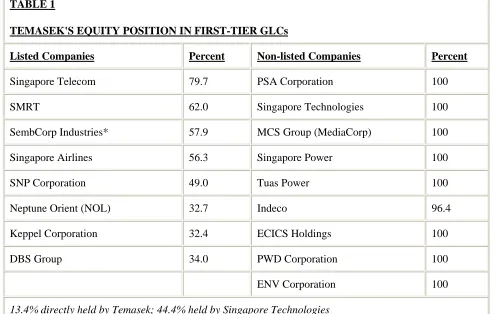
percentages of government ownership are given on Table 1 below
TABLE 1
TEMASEK'S EQUITY POSITION IN FIRST-TIER GLCs
Listed Companies Percent Non-listed Companies Percent
Singapore Telecom 79.7 PSA Corporation 100
SMRT 62.0 Singapore Technologies 100
SembCorp Industries* 57.9 MCS Group (MediaCorp) 100
Singapore Airlines 56.3 Singapore Power 100
SNP Corporation 49.0 Tuas Power 100
Neptune Orient (NOL) 32.7 Indeco 96.4
Keppel Corporation 32.4 ECICS Holdings 100
DBS Group 34.0 PWD Corporation 100
ENV Corporation 100
13.4% directly held by Temasek; 44.4% held by Singapore Technologies
(http://www.temasekholdings.com.sg)
The basic idea of state entrepreneurship rests on the state engaging financially and
operationally in the management of its assets under the umbrella control of holding company,
Temasek Holdings. While the Temasek name is often mentioned in the media and linked to some
acquisitions, it is always one of its GLCs that is actually directly involved, such as the Keppel
Corporation, DBS Bank, or Singtel. Temasek’s role is strategic and oversight, and tries to
distance itself from the operation of the GLCs, says Ho Ching, Temasek’s CEO, “in the
company’s voluntary abstinence from direct involvement in the operational management of
state-owned enterprise is a unique and admirable ownership stance…” (Straits Times, 13
February 2004). Speaking in Parliament in March 2001, Minister of Finance Richard Hu said "I
would reiterate that GLCs operate on a commercial basis; they do not receive any subsidies or
preferential treatment from the Government and are subject to the same regulations and market
Despite its controlling stake, and regardless of whether MOF Inc also has a special
shareholding, Temasek executives also stress that they do not interfere in the day-to-day
operations of the GLCs. In a June 1999 interview in the Straits Times, Temasek's Chairman, S.
Dhanabalan, stated that the purpose of Temasek was “not to control and manage but more to
monitor: Temasek collated all the information of the various government investments and kept
the Minister for Finance and the Cabinet informed about the performances of government
companies”. Of Temasek’s recent acquisition of Thailand’s Shin Corporation where allegations
were made of the intrusion of the Singapore Government, spokesperson Angelina Fernandez of
Singapore’s watchdog MAS said, "Temasek operates like any other company. Even though it is
government-owned, it is not government-directed. The Ministry of Finance does not tell
Temasek what to do.” (Guardian, 24 March 2006).
Temasek management
Temasek Holdings is headed by Ho Ching, wife of PM Lee Hsien Loong. She is an
engineer by profession and had served in senior capacities in the armed forces and as CEO of
GLC, Singapore Technologies, before being recommended to head Temasek by its Chairman, S.
Dhanabalan. Although Temasek comes under the purview of the Minister of Finance, who also
happens to be the prime minister, Ho apparently reports to Dhanabalan. Nonetheless there has
been a lot of disquiet over her appointment despite the sound management and performance she
has brought to the company.
Temasek, which oversees all the GLCs, has 200 staff including 21 managing directors,
each focusing on different areas. Most are young and fairly new to Temasek. Only 4 per cent are
over 50 while 55 per cent are 35 and under. Nearly two-thirds have worked at Temasek for three
years or less. Only 8 per cent have been with it for 10 years or more.
Most have good academic credentials and were hand-picked from government ministries and the
armed forces. The management of GLCs enjoys autonomy not unsimilar to the private sector.
GLCs abide according to the following guiding principles:-
operate fully as for-profit commercial entities, on same basis as private sector companies; need to be world class and globally competitive;
must provide commercial returns, commensurate with risks taken;
free to partner with local and foreign companies in Singapore and abroad; free to raise funds for new investments;
no government procurement privileges; subject to full regulatory regime.
http://www.temasekholdings.com.sg)
On accountability, the Singapore Companies Act confers on privately-held GLCs the
room for opaque accounting. The Act provides for the ‘exempt private company’ (EPC), a type
of company that can do two things other companies may not: it need not file its balance sheet and
profit and loss statements. It may lend money to its own directors and companies, even those in
which its own directors have an interest. And it has directors or their companies who not only
have shares in the GLCs, they are similarly exempt from disclosure.
On transparency, CEO Ho Ching, in her address to the Institute of Policy Studies, said
her company aims to be more transparent, that, “This will be part of a measured process of
opening up and demystifying Temasek”. (Straits Times, 13 February 2004). Shortly after,
Temasek issued its first financial performance. (Business Times, 14 October 2005). Temasek
forays have been profitable according to an unpublished report prepared by Associate Professor
David Ding, head of Nanyang Business School and Professor James Ang of Florida State
University. They say Singapore GLCs are “actually outperforming or at least equalling
non-GLCs in the areas of profitability, efficiency and final returns”. (Far Eastern Economic Review,
November 7, 2002) The report is on 25 GLCs and 204 non-GLCs listed on the Singapore Stock
Temasek’s performance
Data for Temasek are not easily available but as indication of its enormous contribution
to the economy, Statistics Singapore revealed that in 1998, it contributed 12.9% to the GDP.
Considering that the total contribution of locally-controlled companies is 46%, Temasek’s
contribution is not insignificant. (Statistics Singapore Newsletter, March 2001). Despite its huge
investments, its return of investment is not remarkable, admitted Ho Ching. (Economist, 12
August 2004). In 2004 it achieved 13%, But in the year ending March 2005, it returned 16%, at
S$7.6 billion, up from S$7.4 billion a year ago. (Straits Times, 13 October 2005).
It was also reported (Straits Times, 7 February 2006) that Temasek was underperforming
judged by its TSR (Total Shareholder’s Return) by both market value and shareholder’s funds.
TSR by market value considers the dividends received alongside the changes in market value of
a portfolio less net new capital issued. Temasek's shareholder return of 1 per cent over the five
years to 30 March 2005 from its S$103 billion portfolio were considered poor compared with
the Straits Times Index's 2.7% gain of other public stocks over the same period. In defence of
Temasek, the Minister of State (Finance and Transport), Ms Lim Hwee Hua said in Parliament,
“Since its inception, we have received a healthy average annual cash dividend of more than 7 per
cent from Temasek.” (Straits Times, 15 February 2006). However, the Economist, January 28,
2006) reported earlier that “Temasek’s total annual shareholder return has dropped to only 6%
for the past ten years”.
Temasek did not dispute when BloombergNews (cited in the Standard, a China business
paper) reported on 27 January 2005 that Temasek and Nasdaq-listed company, Chartered
Semiconductor Manufacturing, have not made a profit since 2000. Temasek’s 25% shareholding
of China’s Aviation Oil (CAO) came under the spotlight amid a major financial scandal after
CAO lost a massive US$550 million in oil derivates trading that culminated in the conviction of
its CEO and other directors in February 2006.
Temasek had been under pressure to diversify its foreign investments which, with the
newest acquisition in 2006 of Thailand’s Shin Corporation in February, brought its foreign
controversy. The company acquired 49% of Shin Corporation at a price of US$1.88 billion.
Questions were asked if it was too high a price since it was about 15 times the projected earnings
of Shin Corporation for 2006. (Economist, January 28, 2006). Thailand Prime Minister Taksin
Shinawatra, whose family owned Shin Corporation, was bitterly criticized for evading tax on the
sale proceeds. UK newspaper, the Guardian, reported on 24 March 2006 that protestors had
taken to the streets damning Taksin and Singapore, and had brandished placards saying:
"Thailand not for sale" and "Singapore get lost".
The paper added, the Thai opposition leader, Sondhi Limthongkul, accused Singapore of
"economic imperialism", and warned of “serious consequences”. Following a raucous snap
elections and further street protests alleging corruption, finally forced Taksin to step down in
April 2006. Temasek’s public relations machine went out full force to assure the public that all
was well with its investments and that the Government’s relations with Thailand had not been
affected by the turn of political events. With the rapid drop of Shin Corporation’s shares on the
Thai stock market, Temasek had lost about S$1.49 billion. (BloombergNews, 22 March 2006).
On 19 September 2006, Taksin and his government was ousted by a coup d'état by the army and
calls for a commission of inquiry on the Shin Corporation deal with Temasek were made by
Taksin’s opponents. But it is believed no reversal of the deal is envisaged.
Temasek’s failure to bid for Hong Kong Telecom was also attributed to its state
ownership. (South China Morning Post, 19 April 2000). Similarly, some quarters in the UK
voiced their resentment of Singapore Government’s involvement in Temasek when the company
vied aggressively for UK Cunard’s P & O Ports. Singapore’s Port Authority of Singapore’s
(PSA) bid £3.7 billion or S$10.7 billion for P & O Ports was defeated by Dubai World Ports. If
the PSA had won, its purchase of P & O Ports would have been precariously close to PSA’s net
worth. Ironically, UK cynics did not make much of the fact that Dubai World Ports was also
government-owned. Temasek’s Singtel successful bid for Optus Australia in 2001 had a more
tumultuous passage against strong Australian opposition, also for Singtel’s government
ownership; there were allegations that the acquisition of Optus would compromise Australia’s
intelligence since an Optus satellite was leased to Australia’s Defence Ministry. (Sydney
in the telecommunications industry given Optus’s average performance in recent years. Without
the Singapore Government’s link to Singtel, Optus would probably be less enthusiastic about a
bid from the company. Even if Singtel had tried to bid entirely on its own standing, it would have
found it difficult to raise the financing since it did not have a high enough credit rating to attract
funds of the magnitude of the Optus purchase in the international money markets. Nevertheless,
Optus had every reason to rejoice for the high price it could not refuse despite the nagging issue
of its buyer’s government ownership. That the deal went through was little surprise since it was
known all along that the cash-rich Government of Singapore would provide the collateral and
political underwriting for the multi-billion purchase by Temasek. (Straits Times, 26 March
2001). Besides, Temasek was the only credible contender in the bid. Despite its position as a
government entity, Singtel’s credit rating was downgraded from stable to negative by credit
agencies Standard & Poor’s and Moody’s within months of its acquisition of Optus. (Business
Times, 22 August 2002). This was due to a less than optimistic forecast of Optus’s earnings.
One of the most controversial Singapore Government’s overseas investments was the
China-Singapore Suzhou Industrial Park (CSSIP), led by a Temasek company, Keppel
Corporation, in 1994. The project involved the building of an industrial township estimated at
S$30 billion. There were apprehensions over the wisdom of the project and true to doomsayers
predictions, the project incurred massive losses by 2000 despite Temasek having cut its losses
when it sold 30% of its stake in CSSIP to the Jiangsu provincial government a year before
(Yeung, 2002: 223-225). One of the major reasons for the poor performance of the project was
the Jiangsu’s government tie-up and support for a rival industrial park, the Suzhou New District
(SND), which Temasek felt was a conflict of interest as it did not make any sense to the
Singaporeans that its partner in CSSIP was also a competitor in SND. The project was obviously
not without its attendant acrimony when Temasek officially pulled out on New Year’s day in
2001. On 22 March 2006, the Straits Times reported that Temasek’s GLC, the DBS Bank’s bid
for the Korean Exchange Bank hit a snag as Korea’s regulators expressed reservations of DBS
Bank’s links to Temasek. The Korean regulators said the Korean Exchange Bank cannot be
PROVING THE HYPOTHESIS
Factors in favour of the state-guided entrepreneurship model
First, it is the political underwriting. The biggest factor in favour of the model is that it
gives the GLCs an assumed credibility of strength and reputation by virtue of their being
state-owned. Singtel’s purchase of Optus is a case in point where the political backing of the
Singapore Government was taken for granted.
Private enterprises of developing economies are not large and many do not enjoy a huge
reputation in the international market. It would, therefore, be hard put for them to make quick
inroads. To include government involvement in an enterprise is also a matter of expediency and
can cut through cumbersome political red-tape as has been the experience in many emerging
economies, especially in China (Yang 2004). In China, many new enterprises under Deng
Xiaopeng’s ‘Open Door Policy’ in 1979 were not private entrepreneurs but village enterprises
that were run by local governments (McMillan & Woodruff 2002). Such village entrepreneurs,
according to McMillan and Woodruff, benefited from government ownership by having better
access to state banks, the easing of quotas for raw materials, and getting protection against
arbitrary expropriation, and assistance with contract enforcement.
Second, there is the surety of collateral. International financial markets work very much
like insurance companies where the risks of loans are spread out and shared by several
institutions. The quality of the loan instrument is measured by a credit rating that is attached to
the debt. Credit rating agencies whose business is to make scrupulous evaluation of the borrower
apply a rating or a benchmark on the borrower. The lower the rating, the more difficult and more
expensive to raise finance as it also attracts higher interests and financial costs. State-owned
enterprises can raise loans in the market far easier than private ones on the assumption that
repayments of such borrowings will have government guarantees. It is this surety of collateral
that allows state-owned enterprises an advantage and confidence in bidding for mega
Third, is the united global thrust. With government backing, holding companies such as
Temasek, can stitch as many GLCs as they want to, to put together to bid for international
projects. By international standards, Singapore public companies have neither the stature nor the
financial strength to compete. To give a picture of what Singapore companies are up against,
consider this:-
Of the world's 100 largest economic entities, 51 are now corporations and 49 are
countries. Sixteen corporations have sales turnovers larger than Singapore’s GDP. Among them
are seven US corporations, seven Japanese, and two British. (GDP: World Development Report,
World Bank, 2000). Decades of creditable economic management has immunized the Singapore
Government against criticisms and in some cases even held as economic models worthy of
emulation. GLCs as objects of the state-guided entrepreneurship model prosper better than
companies of similar size in the private sector because they have access to more capital and
resources. They can write off losses more easily. Also, by virtue of the fact that GLCs, as
preferred volume buyers, can buy at record prices, can also move the market up artificially.
GLCs have the state to provide them the infrastructure for business that are bigger and better
than the private sector can.
As government-sponsored entities, the GLCs overseas have access to consular exchanges
that can also provide them with the diplomatic cushion for differences. They also have access to
government archives and data bank for quick dissemination of information. An argument for
state-guided entrepreneurship is that the private sector cannot be entrusted for the good of the
country because
they have no role in national welfare and therefore no social responsibility; they are only motivated by profit;
their forecast of future growth is narrowly pegged to shareholder interest;
they have little or no altruistic objectives, and will venture into areas that are not always
Temasek’s staff or ‘entrepreneur-bureaucrats have been shown to be capable and adept at
venturing into new investment opportunities, particularly, in some with high risks where
governments in the post-war era had avoided, e.g. commercial real estate, and near-bankrupt
banks. The Temasek bureaucrats appear to fit in with Schumpeter’s (1934:74) description, who
he says can be entrepreneurs if they
carry out new combinations... we call entrepreneurs not only those ‘independent’ businessmen in an exchange economy who are usually so designated, but all who actually perform the function by which we define the concept, even if they are ‘dependent’ employees of the company, like managers, members of boards of directors and so forth…
It is the carrying out new combinations that constitutes the entrepreneur…. On the other hand our concept is narrower than the traditional one in that it does not include all heads of firms or managers or industrialists who may operate an established business, but only those who actually perform that function.
This also resonates with Shane and Venkataraman (2000) who say that entrepreneurship
is also about innovative actions that need not be about creating wealth.
Factors not in favour of the state-guided entrepreneurship model
Business is high risk and funding of GLCs’ business is taxpayers’ money. Therefore,
losses incurred by GLCs mean depletion of state coffers. Modern business is about market
economy and is positioned according to the supply and demand of goods and services. It allows
a free choice of trade for both the producer and the consumer. This is the cornerstone of
democracy upon which capitalism is built on (Schumpeter 1942; Swedberg 2000). Business is
ideologically impartial and it trades everywhere and with anyone under mutually acceptable
conditions. Whereas, government is inherently ideological and can be caught up in political
differences that can have serious consequences in the relationships of countries. There are fewer
opportunities for the private sector if the government is actively engaged in the market.
Singapore academic, Linda Lim, says, “Temasek's overall rates of return may have been
dragged down by the kinds of things they invested in for national strategy rather than pure
financial return … The role of the state in business has become at best unnecessary and at worst
Economic Review, (7 November 2002) argues that “Temasek must ensure the GLCs are
commercially run and are not asked to do ‘national service’. The Singapore Government should
look radically and creatively at how to introduce the private sector more into its economy . . .
[they should ask themselves] why are we in a particular industry? If we are in it, why can't the
private sector do it?”
State-guided entrepreneurship and the interventionist argument
A recurring objection to Temasek’s forays, as has been mentioned earlier, is its
state-ownership and the ‘parentage’ of its GLCs, but Temasek has had more successes than hindrances
to appear not too worried. But then again, foreign government acquisitions are relatively new and
there seem to be minimum, if not ambiguous, legislative restrictions. However, regional
regulators have baulked at Temasek for tinkering with certain strategic sectors, such as banking,
aviation, energy, telecommunications and defence-related industries. The South Korean
regulations forbidding DBS Bank’s bid for the Korea Exchange Bank because its parent
(Temasek) was not a bank was disputed by Temasek and is a case in point about the ambiguity of
regulations. In 2005, the Indian authorities disapproved a joint bid by Temasek-linked Singapore
Technologies Telemedia and Telekom Malaysia for 48 per cent of mobile phone operator Idea
Cellular, on account of Temasek already having stakes of another Indian operator, Bharti
Tele-Ventures breaching a rule that prohibits ownership of two cellular licences. Temasek was also in
strife in Malaysia when it emerged that it had breached the 5% ownership threshold when it
acquired another bank. (Straits Times, 3 April 2006).
Another concern is about conflict of interest of Temasek’s ‘single presence’, of its
ownership of several competing entities with the same country. An example is Temasek’s partial
acquisition of Standard Chartered Bank, where both have separate banking interests in China,
Indonesia and Thailand.
A factor that argues against state engagement in business is the state’s control of the
competitive process, of its ability to manipulate wages, foreign exchange, and credit control. In
apply special treatment on certain industries it considers more strategically important by high
subsidy or policy intervention (White and Wade 1988 cited in Yu 2001:760). We have to remind
ourselves that government money belongs to the taxpayer and it can seem such an abhorrent idea
for the government to engage in businesses without the same monitoring mechanisms and audit
reporting it requires of publicly-owned companies.
CONCLUSION
This study has attempted to make a case for an entrepreneurship modelling for
developing economies on the basis that these economies need a better way to approach global
competitiveness. Developing economies are in a developmental phase, and social and economic
advisers say that for them to compete effectively they must first be educated and trained with the
right skills. But education and skills alone are not enough if the means to compete are not there
for them. But, some will argue that the means are already there, namely, the trade concessions
that are accorded under the WTO’s provisions of the most-favoured nations (MFN) to poor
economies. However, unless these provisions come with ample state assistance for entrepreneurs,
the situation is not likely to change very much given that there is clearly a dearth of international
entrepreneurs in these economies. So long as global economic supremacy persists in the hands of
G7 countries (USA, UK, France, Japan, Germany, Canada and Italy) and other OECD countries,
the better educated and the entrepreneurial will be enticed by them. Increasing production has
only short-term benefits that do not always translate into increased competitiveness.
Countries such as China and India have their huge GDP output to give them the
competitive edge but are a fair way from achieving the sophistication of the G7 economies. To
sustain their present growth, they have to continue to be the cheap providers of goods and
services to the huge markets of the US, Europe, and Japan. Even so, their phenomenal growth in
recent years have not been possible without extensive state-directed entrepreneurship, especially
in the case of China’s enterprises which are not likely to shed their state ownership any time
soon.
Outside China there are several smaller developing economies with limited resources and
output that have any real opportunity to compete globally, and these are the economies which
would be better off forming business partnerships with their governments, Singapore-style. In
fact this is already happening in Vietnam where its dong moi economic reform encompasses
several state-entrepreneurship initiatives.
State control of business can ensure the productive exploitation of national resources. It
has public accountability and would project a perception of public interest. The state can also
apply for capital from international agencies to help in domestic production. Companies on their
own in these small economies cannot. State-guided entrepreneurship in developing economies
can provide the surety of collateral for government-backed companies. GLCs have state
protection and this means they enjoy a measure of political underwriting. The ability to use
political clout legitimately to get through bureaucratic hurdles is especially important in doing
international business when government-to-government connections can help pave the way for a
smoother run of business.
Finally, the state-guided entrepreneurship model offers GLCs the credentials of assumed
trust and a stature of some size that allows them to be regarded with respectability in the global
arena. This is important for the collective thrust they are able to pull in competing
internationally. In other words, they can bring with them the government and all other related
agencies to give them the impetus and size to compete with bigger rivals.
What we cannot say with certainty is if Singapore’s state-entrepreneurship will last
forever. Purists of the market economy would rather it did not. Singapore is coming under the
increasing glare of the world business community and the continuing criticisms of its
interventionist entrepreneurial policies. These concerns are, of course, not new and the
Government has responded by divesting, albeit limited, its commercial interests. The
Government has been determined to develop entrepreneurship through various initiatives but
there has not been much headway. To say all this has to do with Temasek’s success is probably
correct. So long as the company is making good returns with flow-on benefits to the country, the
ownership. With a steady job market and plenty of good-paying jobs with MNCs, talented
risk-aversion Singaporeans see little incentive risking their hand at business. Call it paternalistic or
the machinations of the nanny-state, some will argue that state-guided entrepreneurship presents
a greater public good.
Singapore’s state ownership of investments offers an assuring hand of protection to
foreign investors, and given its size among the emerging giants of Asia and the vulnerabilities of
geo-politics, its strategy of state-guided entrepreneurship is likely to stay for a long time. The
Singapore experience can be learnt by developing and third world economies as it offers a viable
REFERENCES
Borins S. (2000). Loose cannons and rule breakers, or enterprising leaders? Some evidence about
innovative public managers. Public Administration Review, 60, pp. 498–507.
Brockhaus, R., Horwitz, P. (1982). Encyclopaedia of Entrepreneurship. Texas: Baylor
University.
Clad, J. (1989). Behind the Myth: Business, Money and Power in Southeast Asia. London: Allen
& Unwin.
Choo, S. (2005). Developing an Entrepreneurial Culture in Singapore: Dream or Reality. Asian
Affairs, 36(3), pp. 361-373.
Cowling, M., Mitchell, P. (1997). The Evolution of UK Self-employment: A Study of
government policy and the role of the macro-economy. The Manchester School, 65(4), pp.
427-442.
Dhaliwal, P. (2002). Second/Third Generation Asian Business Entrepreneurs in the UK. Paper
presented at the International Council for Small Business, 47th World Conference, Puerto Rico,
(Luton Business School, Luton University).
Drucker, P. (1970). Entrepreneurship in Business Enterprise. Journal of Business Policy, 1,
1970.
Gartner, W. B. (1988). Who is an Entrepreneur? Is the Wrong Question. American Journal of
Small Business, 12(4), pp. 11-32.
Gartner, W. B. (1990). What are we talking about when we talk about entrepreneurship? Journal
of Business Venturing, 5, pp. 15-28.
Heracleous, L. (2001). State Ownership, Privatization and Performance in Singapore: An
Exploratory Study from a Strategic Management Perspective. Asia Pacific Journal of
Management, 18, pp. 69-81.
Huff, W. (1994). The Economic Growth of Singapore: Trade and Development in the Twentieth
Century. Cambridge: Cambridge University Press.
Huff, W. (2000). Shipping, Monopoly, Monopsony and Business group Organization in
Pre-World War Two Singapore. Asia Pacific Business Review, 17(2), pp. 63-78.
Johannisson, B. and Nilsson, A. (1989). Community entrepreneurs: networking for local
Kingdon, J. (1984). Agenda, Alternatives, and Public Policies. Boston: Little, Brown.
Kirzner, I. (1999). Creativity and/or Alertness: A Reconsideration of the Schumpeterian
Entrepreneur. Review of Austrian Economics, 11, pp. 5-17.
Kayne, J., and Altman, J. (2005). Creating entrepreneurial societies: The role and challenge for
entrepreneurship education. Journal of Asia Entrepreneurship and Sustainability, 1(1), pp. 1-14.
Knight, F. (1921). Risk, Uncertainty and Profit. Boston: Houghton Mifflin Company.
Lichauco, A. (1988). National Economics. Quezon City: Institute for Rural Industrialization Inc.
Low, L. (2005). Entrepreneurship Development in Ireland and Singapore. Journal of the Asia
Pacific Economy, 10, pp.116-138.
McClelland, D.C. (1961). The Achieving Society. Princeton, New Jersey:D. Van Nostrand Co.
McClelland, D.C. (1987). Characteristics of successful entrepreneurs. Journal of Creative
Behavior, 3, pp. 219-233.
McMillan, J., Woodruff, C. (2002). The Central Role of Entrepreneurs in Transition Economies.
Journal of Economic Perspectives, 16(3), pp. 153-170.
Metcalfe, S. (2000). The Structure and Evolution of an Operational Network: The Borneo
Company Ltd 1850-1919. Asia Pacific Business Review, 17(2), pp. 19-38.
Osborne, D and Gaebler, T. (1992). Reinventing Government: How the Entrepreneurial Spirit Is
Transforming the Public Sector. New York: William Patrick.
Owensby, W. (1988). The Economics of Prophets. Grand Rapids, Michigan: William B.
Eerdmans Publishing.
Pereira, A. (2004). State Entrepreneurship and Regional Development. Entrepreneurship and
Regional Development, 16(2), pp. 129-144.
Say, J.B. (1971). A Treatise on Political Economy or the Production, Distribution and
Consumption of Wealth. New York: A. M. Kelley Publishers.
Schumpeter, J. (1934), The Theory of Economic Development. New York: Oxford University
Press.
Schumpeter, J. (1942). Capitalism, Socialism and Democracy. New York: Harper.
Sexton, D. and Smilor, R. (1986). The Art and Science of Entrepreneurship. Massachusetts:
Ballinger.
Schneider, M. and Teske, P. (1992). Toward a Theory of the Political Entrepreneur: Evidence
Sharma, P. (1999). Towards a Reconciliation of the Definitional Issues in the Field of Corporate
Entrepreneurship. Entrepreneurship Theory and Practice, 23(3), pp. 23-45.
Shane, S. and Venkataraman, S. (2000). The promise of entrepreneurship as a field of research.
Academy of Management Review, 25(1), 217–226.
Shaw, Y. (1989) Beyond the economic miracle. Taipei, Taiwan: Kwang Hwa Publishing.
Swedberg, R. (ed.) 2000. Entrepreneurship. Oxford, London: Oxford University Press.
Tipton, F. (1998). The Rise of Asia. London: Macmillan Press.
Turnbull, C. (1989). A History of Singapore, 1819-1988. Singapore: Oxford University Press.
Wortman, M. Jr. (1987). Entrepreneurship: An Integrating Typology and Evaluation of the
Empirical Research in the Field. Journal of Management, 13(2), pp. 259-279.
Yang, K. (2004). Institutional holes and entrepreneurship in China. The Sociological Review
2004, 370–371.
Yeung, H. W. (2002). Entrepreneurship and the Internationalisation of Asian Firms.
Cheltenham, UK: Edward Elgar.
Yu, F. L. T. (2001). Towards a Theory of the Entrepreneurial State. International Journal of
Social Economics, 28(9), pp. 752-766.
Zapalska, A., Perry, G., Dabb, H. (2003). Maori Entrepreneurship in the Contemporary Business
Environment. Journal of Development Entrepreneurship, 8(3), pp. 219-235.
Zerbinati, S. and Souitaris, V. ( 2005). Entrepreneurship in the public sector: a framework of
analysis in European local governments. Entrepreneurship & Regional Development, 17(1), pp.
43-64.
Newspapers, magazines, and addresses
Economic Review Report, 1987, 2002. (Singapore: Ministry of Trade and Industry).
Far Eastern Economic Review.
Global Monitoring Report 2005, World Bank.
Shanmugaratnam, T. (2004), Keynote Address - Entrepreneurship Education - Why it Matters.
Paper presented at the Inaugural Roundtable on Entrepreneurship Education Asia, Singapore. 29
July. (Singapore: Ministry of Trade and Industry).
Statistics Singapore Newsletter, Singapore: Department of Statistics.