European
Investment
Bank
In this issue
EIB FINANCING IN 1978 — up 40% in the Community — increased lending in the
Lomé Convention countries — start of new operations In
the Mediterranean basin p. 1-5
REVUE OF TRENDS ON THE INTERNATIONAL CAPITAL MARKET IN 1978
p. 6-12
UNIT OF ACCOUNT p. 12
BEI-EIB
2 PLACE DE METZ - LUXEMBOURG
n i e
FEBRUARY 1979EIB financing operations in 1978
totalled 2188.3 million u.a.
An increase in financing operations to a total of 2 188.3 million units of account (u.a.) is shown in the European Investment Bank's preliminary figures for 1978.
This is 39.2% up on the 1 571.5 million u.a. provided in 1977 and confirms the continued growth in the Bank's annual lending, which has more than doubled since 1975.
Loans for projects in Community Member Countries amounted last year to 1 966.5 million u.a., up 40.3% on the total lent in 1977 (1 401.3 million). In line with the principal task given to the EIB under the Treaty of Rome, almost three-quarters — 1 457.6 million u.a., an increase of over 50% on the amount the previous year — went to investment in regions which are economically less developed or confronted with industrial conversion problems.
These loans — strongly concen-trated in areas of high unemploy-ment and low income levels — were made for a variety of industrial pro-jects, water supply, sewerage and Irrigation schemes, telecommunica-tions, transport improvements and for electricity and gas supply pro-jects. Southern Italy benefited the most, with almost half the total amount lent for regional develop-ment, but finance was also extended for many projects in other regions, principally Northern England, Scot-land, Wales, the North, East and West of France and in Ireland. At the same time, lending for pro-jects of common interest to several
Member Countries or the Commu-nity as whole, the Bank's other priority role under the Treaty of Rome, rose by more than a third to 662.0 million u.a. * (493.8 million in 1977).
Funds were provided for several important transport schemes, impro-ving links between Member Coun-tries, but most went to a range of energy projects which will help to reduce the Community's depen-dence upon oil imports (they should lead to replacing an estimated 15 million tons per year, roughly equi-valent to 3.5% of present imports).
Development finance provided in countries which have association or cooperation agreements with the Community rose last year by over 30% to 221.8 million u.a. (170.2 mil-lion u.a. in 1977).
More than half of this sum went to investment in African, Caribbean and Pacific countries which are sig-natories to the Lomé Convention. Loans were also made in Portugal, Greece and Turkey, Yugoslavia and, for the first time, in the Lebanon.
Almost 2 000 million u.a. raised on the markets
To finance its lending activities, the EIB stepped up its borrowings in 1978 to a total of 1 949.7 million u.a., raised (mostly through public or private issues) on the international market and on certain national markets, both within and outside the Community; this is neariy 68% more than the 1 161.5 million u.a. raised the previous year.
Action to stimulate investment and employment
The ElB's lending in the Community last year was more than 80% above the level of operations in 1976. Well over a third of all the finance the Bank has provided for investment in Member Countries, since its crea-tion in 1958, has been made avail-able during the last two years alone. This shows the Bank's efforts to respond to the call made by the European Council (Community Heads of State or Government), in March 1977, for the Community to mobilise greater financial resources to combat unemployment, generally sluggish investment and insufficient convergence of national economic performances.
The Bank's work last year was aimed at bolstering resources avail-able for major investment in energy and other infrastructure of key importance in stimulating greater economic activity, while seeking at the same time to give firm support to industrial investment.
The impact on employment made by the projects which the Bank helped to finance can be seen essentially in three ways:
— jobs equivalent to some 620 000 man-years of work, involved in con-struction, plus the supply of neces-sary services and materials;
— the creation of an estimated 11 000 permanent jobs plus the safeguarding of 10 000 more,; mainly in the industrial projects financed by the Bank;
— the long term effects of most infrastructure projects — concern-ing energy, communications and water supplies, for example—which create few permanent jobs directly but which are of fundamental impor-tance if conditions for economic growth are to be improved.
The increase in the ElB's activities was given firm backing by the Mem-ber States in June last year when they decided to double the Bank's subscribed capital to 7 087.5 million u.a.
Main sectors
Over a third of all EIB loans in the Community in 1978 — 721.3 million u.a., up more than 90% on the pre-vious year (379.4 million) — went to energy projects; 540.9 million u.a. concerned electricity production and transmission and 180.4 million u.a.
the development of European oil and gas resources plus pipelines and storage Installations.
Communications Improvements ac-counted for loans totalling 625.6 million u.a. (more than double the previous year's figure, 310 million u.a.); of this, telecommunications attracted 305.2 million u.a., 185.1 million went for road links, 63.9 mil-lion to sea transport, 55.3 milmil-lion for railway development and 1.6.1 mil-lion for air transport.
As in 1977, the Bank lent a sub-stantial sum for water supply, sewerage and irrigation schemes (357 million u.a. against 285.7 mil-lion).
Lending to industry came to 262.6 million u.a. against 426.2 million u.a. in 1977. Demand for loans was low, with the difficult economic climate leading many firms to hold back investment. Some major public enterprises which borrowed large sums in previous years were not borrowers in 1978. An encouraging feature, however, was the amount provided in the form of global loans to intermediary financial institutions which on-lend the funds for small and medium-sized ventures; this reached 99.9 million u.a. against 91.3 million in 1977.
During 1978 credit provided from these global loans, and from others granted previously, totalled 72.2 mil-lion u.a. and helped to finance 155 ventures (in 1977 credit worth 57.8 million u.a. went to 133 ventures). As these smaller projects tend to be labour-intensive, creating many jobs in relation to the scale of invest-ment, they are all the more impor-tant in the present circumstances. Country by country
In Italy EIB lending practically doubled last year to reach 845.1 million u.a. (Lit. 908 700 million), equivalent to 43% of all operations within the Community; over four-fifths went to investment in the Mez-zogiorno.
Energy projects accounted for a total of 328.7 million u.a. Loans were made for the laying of 230 km of gasline in Calabria and Sicily (plus an underwater connection across the Messina Straits), representing the first section in Italy of the Alge-ria-Italy gasline; acquisition of various high technology equipment
to be used for laying this and other pipelines; development of five small
gas and oil fields in the Ionian and Adriatic seas; conversion of deplet-. ed gas fields into storage reser-voirs (Lombardy and Emilia Romag-na) plus interconnecting gaslines. The Bank also helped to finance construction of geothermal power stations in Tuscany; erection of 4 500 km of transmission lines in Sicily, Campania and Apulia; cons-truction of part of the nuclear power station at Montalto dl Castro (La-tium) and a thermal peak load gene-rating unit in Campania.
A total of 252.7 million u.a. went to industrial zone development,, water supplies and irrigation in the South. The projects concerned port works at Cagliari (Sardinia); irrigation of areas near Cagliari and also certain inland zones; transport, sewerage and water recycling facilities in the Augusta-Priolo-Syracuse (Sicily) dustrial areas; water supplies to in-dustrial areas of Naples and Caser-ta (Campania); development and extension of industrial estates at Avellino (Campania), Catania (Sici-ly) and Taranto (Apulia); road ac-cess, water supplies and drainage at the Gela and Ragusa industrial zones (Sicily) and irrigation in Cala-bria. Loans totalling 121.4 million u.a. were made for telecommunica-tions improvements in Sardinia, the Abruzzi, Molise and Latium.
W a t e r supply and sewerage sche-mes, largely to meet present or pro-j e c t e d industrial needs, attracted 174.1 million u.a. with loans provided f o r various w o r k s in the North-East and North-West, Yorkshire, the South-West, the Midlands, South Wales and in the Lothian and Grampian regions of Scotland.
Improved energy supplies ac-counted f o r 116.4 million u.a. with loans f o r construction of a pumped storage hydroelectric power station at Dinorwic, North W a l e s , a thermal power station at Peterhead. Aber-deenshire, the Hartlepool nuclear power station and the U R E N C O gas centrifuge uranium enrichment plant (embracing also German and Dutch interests) being built in Cheshire.
Finance provided for investment in industry totalled 67.4 million u.a. The majority (45 million) is for small and medium-sized ventures; the funds are being made available through a scheme w h e r e b y the regional offices of the Department of Industry in England,, the Scottish Economic Planning Department, the Welsh Office Industry Department and the Department of C o m m e r c e in Northern Ireland act on the ElB's behalf and use the finance provided by the Bank to make loans f o r in-vestment in assisted areas, priority going to ventures making the most impact on employment. The moder-nisation of a copper refinery and expansion of a fertiliser plant, both in Merseyside, and a new soft drinks production and bottling plant, in Glasgow, w e r e also supported by the Bank.
Other loans provided during the year w e n t towards construction of high speed diesel trains f o r the Lon-don-Aberdeen main line, extension of Sumburgh airport in the Shet-lands (the main transit point f o r communications with North Sea oil and gas rigs), and also towards improvements to the telephone system in the Hull area.
In France loans totalled 359.3 mil-lion u.a. (Ffrs 2 038.4 milmil-lion) of which over half (182.3 million u.a.) concerned extension and moderni-sation of the telecommunications networks in the Pays de la Loire and Nord-Pas de Calais.
A total of 98.1 million u.a. w e n t to two energy projects of considerable European importance, the EURODIF uranium enrichment plant being built at Tricastin (Drôme), involving French, Italian, Belgian and other interests, and the NERSA nuclear
power station at Creys-Malville (Isère) w h i c h is developing fast breeder reactor technology, promis-ing great economies in uranium consumption; the NERSA project is being undertaken by a company bringing together French, Italian, German, Belgian, Dutch and British interests.
Loans totalling 55.3 million u.a. w e r e provided f o r construction of road links of European as well as regio-nal importance: the Beaune-Besan-çon section of the A36 Beaune-Mul-house motorway, the final link con-necting the Paris-South East France motorway with the German and Swiss frontiers; the last section (La Turbie-Roquebrune) of the A 8 motorway, running from AixenProvence to Menton on the Italian f r o n -tier; the Fréjus road tunnel, linking France and Italy under the A l p s .
Industry attracted 23.6 million u.a. with loans f o r modernisation of the dairy industry in Brittany. Normandy and the Pays de la Loire, and f o r
modernisation of steelworks in Lor-raine and Nord-Pas de Calais.
Lending in Ireland rose by almost 5 0 % to 117.4 million u.a. ( £ l r 78.5 million), in per capita terms a far higher amount than in any other M e m b e r Country.
Three global loans totalling 14.9 mil-lion u.a. w e r e granted to the Industrial Credit Company and the A g r i -cultural C r e d i t Corporation f o r on-lending to assist small and medium-sized ventures.
To improve conditions for industrial g r o w t h a total of 95.1 million u.a. was lent f o r development of C o r k Har-bour, improved water supplies in the same area and construction of a thermal p o w e r station at Aghada (County Cork), water and sewerage w o r k s in the Dublin area, and f o r several important road schemes designed to improve East-West communications and links with the North. In addition, 7.4 million u.a. went towards the cost of a new car
EIB F I N A N C I N G OPERATIONS IN 1978
Breakdown by p r o j e c t location
Number
Amount (million u.a.) total
%
70
Member Countries
Ordinary operations
Member Countries Belgium
Denmark Germany France Ireland Italy
United Kingdom
1 9 3 9 10 40 23
62.2 106.3 45.5 359.3 117.4 845.1 430.7
2.8 4.9 2.1 16.4 5.4 38.6 19.7
3.1 5.4 2.3 18.3 6.0 43.0 21.9
Total 95 1968.5 89.9 100.0
Financing outside the Community Mediterranean
Greece the Lebanon Portugal Yugoslavia ACP
83.0 3.8 1
1 3 1
20.0 3.0 35.0 25.0
0.9 0.1 1.6 1.2
12 90.9 4.1
Total 18 173.9 7.9
Ordinary operations total 113 2140.4 97.8
Special operations Turkey
ACP
Lomé (risk capital)
Yaounde II (remaining resources)
1 6.3 0.3 18 41.5 1.9
15 25.3 1.2 3 16.2 0.7
ferry which will be operated on routes between Ireland and Great Britain.
In Denmark lending tripled to 106.3 million u.a. (DKr 747.5 million), of which almost half— 51.4 million u.a. — went for improved communica-tions: construction of a stretch of the South Jutland motorway between the Danish-German border and the town of Christiansfeld; acquisition of four freight and tanker vessels for Greenland's coastal and Atlan-tic shipping services; port develop-ment and extension of the car ferry terminal at Renne on the Island of Bornholm.
A loan of 42.5 million u.a. went to convert a generating unit at Asnaes power station (Zealand) to enable it to burn coal instead of oil.
For investment In industry the Bank provided 12.4 million u.a., of which 7.5 million was in the form of two global loans to the State which will be used by the Regional Develop-ment Board to finance small and medium-scale ventures; other loans were for extension of a mineral wool factory, new plant at a factory pro-ducing electric motors and expan-sion of a dairy, all in Jutland.
In Belgium, 62.2 million u.a. (Bfrs 2 500 million) was lent towards con-struction of the third section of the DOEL nuclear power station near Antwerp. In Germany, loans total-led 45.5 million u.a. (DM 115.7 mil-lion). Most of this — 43.2 million u.a. — went for construction of a gas-line system running across Ger-many from the Czechoslovak and Austrian frontiers to the French frontier, designed to biing gas from the USSR and Iran. The Bank also helped to finance construction of a meat products factory in Saar-brücken (Saar) and extension of a pharmaceuticals factory at Cux-haven (Lower Saxony).
Cooperation with E U R A T O M During the year two loans totalling 70.8 million u.a. were signed jointly by EURATOM — the European Ato-mic Energy Community and the EIB for construction of the Mülheim-Käriich (Germany) and Montalto di Castro (Italy) nuclear, power -sta-tions.
These operations were funded from resources borrowed by EURAtOM on the capital markets, the Bank assuring the project-appraisal and
loan management. They are accoun-ted for separately and not included here in the ElB's own lending figures.
Outside the Community:
the Lomé Convention countries Last year saw steady progress in financing activities in the African, Caribbean and Pacific (ACP) coun-tries which have signed the Lomé Convention with the Community. This Convention, together with the Council Decision extending financial aid also to Overseas Countries and Territories (OCT) which are linked to certain Member States, provides for the EIB to lend up to 400 million u.a. from its own resources. In addi-tion the Bank has responsibility for managing resources drawn from the Community's European Develop-ment Fund (EDF) for use as interest subsidies (100 million u.a.) and for various kinds of risk capital assis-tance (101 million u.a.).
In 1978 financing under the Lomé Convention and OCT Decision came to 116.2 million u.a. and the coun-tries involved included 12 in which the EIB had not been active pre-viously. Of the total amount, 90.9 million u.a. came from the Bank's own resources. Loans were made principally to industry, either for individual projects or via global loans to intermediary financing insti-tutions, and for energy projects, details as follows:
— Nigeria: 25 million u.a. in a glo-bal loan to the Nigerian Industrial Development Bank Ltd. to finance medium-scale industrial ventures throughout the country;
— Fiji: 12.5 million for a hydro-electric scheme;
— Kenya: 12 million u.a. for a hydroelectric scheme and 0.1 million u.a. risk capital assistance for a tourism development study;
— Swaziland: 10 million u.a. for development of sugar cane planta-tions and construction of a sugar mill;
— Papua-New Guinea: 7 million u.a. and 1.9 million u.a. in risk capi-tal assistance, both for construction of a palm oil mill;
— Liberia: 7.4 million u.a. for ex-tension of a power station and to assist industrial and tourism ven-tures, via a global loan to the Libe-rian Bank for Development and In-vestment, in which the Bank also
took a 0.3 million u.a. equity partici-pation on behalf of the Community, as a form of risk capital assistance; — the Sudan: 6.5 million u.a. In risk capital assistance for construc-tion of a cotton textile mill;
— Tanzania: 5 million u.a. in the form of a global loan to Tanganyika Development Finance Company Ltd.; — Trinidad and Tobago: 5 million u.a. in the form of a global loan to the Trinidad and Tobago Develop-ment Finance Company Ltd.; — Zaire: 4 million u.a. in risk capi-tal assistance for construction of an oil mill;
— Mali: 3.6 million u.a. risk capital assistance for construction of a rice mill;
— Guyana: 3.2 million u.a. risk capital assistance for development of forestry resources;
— the Congo: 3.1 million u.a. in risk capital assistance for construc-tion of an internaconstruc-tional class hotel; — Zambia: 2.5 million u.a. in the form of a global loan to the Develop-ment Bank of Zambia plus 0.6 mil-lion in risk capital assistance for the DBZ (through an equity participa-tion) and for a feasibility study con-cerning a cementworks;
— the Caribbean region: 3 million u.a. in the form of a global loan to the Caribbean Development Bank which will use the funds to finance investment in member countries of the Caribbean Community;
— Niger: 1.5 million u.a. and 0.9 million in risk capital assistance, both for modernisation of a textile mill;
— the Seychelles: 0.6 million u.a. in risk capital assistance to the De-velopment Bank of Seychelles (in the form of an equity participation) to help finance small and medium-scale ventures;
— Senegal: 0.2 million u.a. in risk capital assistance for a technical study concerning phosphate depo-sits;
— Ivory Coast: 0.2 million u.a. in risk capital assistance for a techni-cal study concerning manioc pro-duction.
from the earlier Yaounde II C o n v e n -tion and Decision extending finan-cial aid to Overseas Countries and Territories:
— Z a i r e : 14 million u.a. for road construction and 1.8 million f o r an oil mill;
— French Guiana: 0.4 million u.a. for construction of a fishing wharf.
The Mediterranean region
The year saw the beginning of a fresh expansion in EIB activities in the Mediterranean region, outside the Community.
Under development finance arran-gements drawn up between the Community and 14 countries in the region, the EIB has agreed to lend up to 983 million u.a. from Its own resources f o r investment projects and to act as agent of the C o m m u -nity in managing certain loans, on special conditions, financed from budgetary resources. The countries are Greece,, Portugal, Turkey, A l g e -ria, M o r o c c o , Tunisia, Sy-ria, Jordan, Egypt, the Lebanon. Malta. Israel and Cyprus, which have all signed Financial Protocols with the C o m -munity, most running up to O c t o b e r 1981. In Yugoslavia financing is provided for projects of common interest to this country and the Euro-pean Community, in line with the joint declaration in Belgrade in D e cember 1976, spelling out c o o p e -ration policy between the two.
It was only late In the year that the majority of the Protocols came into force and further complications arose concerning the legal frame-w o r k needed f o r most lending ope-rations to begin. Despite these delays — beyond the ElB's control — the Bank was nonetheless able to start by lending, from its own resources:
— in Portugal: 35 million u.a. f o r fertilizer production facilities at Bar-reiro and Alverca, equipment f o r production of glass fibre and base materials f o r plastics, also at Bar-reiro, and f o r extension of a cement-w o r k s at Souselas;
— in G r e e c e : 20 million u.a. in the form of a global loan to the Natio-nal Investment Bank f o r Industrial Development which will on-lend the proceeds to finance small and me-dium-scale ventures.
It can be expected that during 1979 the Bank's lending in the
Mediterra-nean region under these Protocols will move ahead at an increasing pace.
A loan of 25 million u.a. was made in Yugoslavia to help finance c o n -struction of parts of the Trans-Yugoslavian Highway, which will constitute the most direct route bet-ween the Community and Greece. Turkey and the M i d d l e East. This loan used up the remainder of the 50 million u.a. which was foreseen f o r projects of common interest (last year 25 million w e n t to exten-sion of the Yugoslav p o w e r grid and connection with other European electricity systems). Under negotia-tions concerning further coope-ration, the EIB could be asked to continue financing operations in Yugoslavia.
In the Lebanon 3 million u.a. was lent towards the cost of extending a p o w e r station near Beirut as part of the «exceptional aid» which the Board of Governors authorised in
November 1977 to help the Lebanon's economic recovery; the exceptional aid is in addition to financing fore-seen under the Financial Protocol between the Community and the Lebanon.
In Turkey, a loan on special c o n -ditions of 6.3 million u.a. was made f o r equipment at the Dalaman paper mill in W e s t e r n A n a t o l i a ; this was provided by the Bank., acting as agent f o r the M e m b e r States, using the final arnount available under the second Community-Turkey Financial Protocol w h i c h came into force in 1973 (under this Protocol 195 million u.a. in special loans have been granted from funds provided by the original six Community M e m b e r States plus a further 25 million in loans from the ElB's own resour-ces).
A resumption of substantial EIB ac-tivity in Turkey is foreseen as soon as ratification of the Third Protocol, signed in 1977, is completed.
EIB F I N A N C I N G OPERATIONS IN THE C O M M U N I T Y I N 1978
Sectoral breakdown
Amount
Number (million u.a.) total
%
Energy, communicationsand other infrastructure 67 1 703.9 86.6
6 4 1 1 8
3 4
241.1 128.7 35.7 29.1 59.5
106.3 120.9
12.3 6.5 1.8 1.5 3.0
5.4 6.2 Energy 27 721.3 36.7
Production Nuclear energy Thermal power stations
Hydroelectric and pumped storage plant Geothermal power stations
Development of oil and gas deposits Transmission
Power lines
Gaslines and oil pipelines
Communications 21 625.6 31.8 Transport
Railways
Roads, bridges and tunnels Shipping and inland waterways Air links
Telecommunications 6 305.2
Water schemes 19 357.0 18.1
Agricultural development 3 74.8 Water catchment, treatment and supply 16 282.2
1 7 6 1
55.3 185.1 63.9 16.1
2.8 9.4 3.3 0.8 15.5
3.8 14.3
Industry
(of which global loans)
28 262.6
(8) (99.9) 13.4
(5.1)
The international capital market in 1978'
The gross amount of funds raised internationally in the f o r m of publicly issued eurobonds, foreign bonds and syndicated bank credits reached a new high in 1978 with a total of 68 700 million European Units of A c c o u n t (abbreviated in this article, as in publications of the European Communities, t o EUA) against 51 800 million EUA in the previous year. The increase occur-red in syndicated bank coccur-redits w h e r e intense compe-tition among lenders was stimulated by the abundant liquidity deriving f r o m the U S balance of payments
deficit. In bond markets on the other hand, the w e a k -ness of the dollar f r o m about the middle of the year onwards, accompanied by rising short-term interest rates on euro-dollar deposits, discouraged longer-term investments In that c u r r e n c y . The decline in new issues denominated in dollars w a s consequently s u b -stantial and greater than c o u l d be c o m p e n s a t e d by an increase in the volume of issues denominated in Deutschemarks, Japanese Y e n and S w i s s f r a n c s . (See Tables 1 and 2, p. 9).
The growth in new loans granted by international syndicates of banks from 29 800 million EUA in 1977 to 49 600 million EUA in 1978. more than half of it in the last six months of the year, is certainly Impressive. A l l o w a n c e should however be made f o r t h e heavier incidence of refinanc-ing in one form or another durrefinanc-ing 1978. Some loans were repaid ahead of schedule and simul-taneously refinanced on terms w h i c h during 1978 moved increasingly in favour of b o r r o w e r s . These opera-tions were negligible in 1977 but rose to no less than 4 000 million EUA during 1978. inflating the sta-tistics of gross lending without any new money being lent. Similariy, the normal refinancing of maturing debt is thought to have increased from 8 800 million EUA in 1977 to 14 300 million last year, accentuating the growth in gross lending without re-presenting additional new money.
A further aspect is the improvement in the balance of payments of some countries which enabled them to repay loans ahead of schedule thus eliminating debts which had been incurred in order to finance deficits in external payments. The major part of such operations was accounted f o r by the United Kingdom and the K i n g d o m of Spain f o r w h i c h identi-fied prepayments amounted to some 1 400 million EUA in 1978. Tak-ing into account these three various operations, net lending in the f o r m of syndicated credits w o u l d be a b o u t 30 000 million EUA in 1978. still appreciably higher than the 21 000 million EUA or so recorded
in the previous year.
T h e b o n d m a r k e t s a) Deterioration during 1978
The steep rise in the volume of new issues of fixed interest securities since 1974 suffered a c h e c k last year. N e w public issues of euro-bonds and foreign euro-bonds, declined f r o m 22 000 million EUA in 1977 to
19 000 million EUA in 1978. Private placings were also affected, falling from 9 300 million EUA in 1977 (of which 3 500 million EUA were euro^ bonds) to 7 200 million EUA in 1978. The net contraction of about 5 000 million EUA in 1978 is In the total of gross new issues and placings; if the probable increase In redemption payments w e r e to be taken into account, the reduction in the f l o w of new capital would be even more marked.
The deterioration in security mar-kets during 1978 occurred from about mid-year onwards. During the first half, issuing activity in the bond market continued at about the same pace as in the previous six-month period,, but it declined sharply dur-ing the second half when the weak-ening of the exchange rate f o r the dollar not only exercised an a d -verse influence on activity on the N e w Y o r k market and the dollar sector of the international market but also disturbed in a more general way international investment f l o w s . A further adverse influence w h i c h developed during the second half of 1978 was a reduction in foreign issues on the Japanese market which found itself obliged to meet increas-ing demand f o r finance emanatincreas-ing from its own national authorities.
b) The currencies
Exchange rate developments cleariy played a large role in the perfor-mance of security markets during the second half of 1978 and over-shadowed the influence of interest rate differentials. O n e of the c o n s e -quences of the heavy depreciation of the U S dollar against most major currencies, particulariy during the second half of 1978, w h i c h induced investors to switch into securities denominated in stronger currencies, has been a widening of the interest rate differential in f a v o u r of invest-ments denominated in dollars. N e w eurodollar bond issues, f o r
exam-ple, which in 1977 offered yields about one and a half percentage points higher than those on Deut-schemark issues, had to offer three and a quarter percentage points more In 1978. A similar widening of the yield differential occurred bet-ween dollar bond issues and foreign Issues in Swiss francs.
A s the chart of average yields on new bond issues indicates (p. 8), yields on issues denominated in d o l -lars, w h e t h e r made in N e w Y o r k or on the international market, w e r e ris-ing much more than those on other securities. Seven or eight-year notes issued in N e w Y o r k by a first class b o r r o w e r in September 1978 w o u l d have had to offer 1.25% more than a year eariier and fifteen to twenty-year bonds w o u l d have had to offer about 0 . 8 % more. Similariy on the international market a twelve-year bond issue in O c t o b e r 1978 by a first-class b o r r o w e r w o u l d have had to offer 9.75% w h i c h was neariy 1.5% higher than on equivalent issues in O c t o b e r 1977. In the eyes of investors, however, the interest rate advantage in subscribing to dollar issues was evidently insuffi-cient to compensate f o r expected foreign exchange losses. To the extent that investors chose to remain in dollars, the appearance of a reverse yield gap in w h i c h , f o r example, interest rates on short-term euro-dollar deposits rose above bond yields, attracted them to the short-term market. A s a result, no public issues of straight bonds w e r e made on the international market after O c t o b e r and, on the U S
ket the only public issues launched during the fourth quarter pf 1978 on behalf of foreign b o r r o w e r s were for Canadians.
A n increase in new issues of float-ing rate notes, in which securities with a specified term to maturity are issued on the bond market in the same way as bonds with a fixed coupon but in which the interest rate is set at a specified margin above some short-term interest rate such as the six-months' London inter-bank offered rate (LIBOR in short),, only partially compensated for the virtual absence during the last quarter of straight bond issues denominated In dollars. Investors remained hesitant over dollar invest-ments even after the introduction on 1 November of measures by the US authorities to strengthen the cur-rency, and when short-term interest rates rose sharply it was evident that the regular adjustments of in-terest rates on floating-rate notes would not compensate quickly enough f o r changes in market c o n -ditions, and floating-rate issues fell to a discount. Some resistance to new Issues of floating-rate notes accordingly developed.
In total new dollar issues fell from 14 400 million EUA in 1977 to 8 600 million last year, a decline of 4 0 % which resulted from a contraction of 4 4 % in international bonds and note Issues and of 3 5 % in foreign issues in N e w York. A s a result, the role of the US dollar in total bond financing was sharply curtailed from 6 5 . 5 % in 1977 to 4 5 . 1 % in 1978. During the fourth quarter of last year, the percentage was even lower (36.8%).
The counterpart of the reduced p r o -portion of international and foreign issues formed by those denominated in dollars is to be found in the increased role played by the sec-tors denominated in Deutschemarks, Swiss francs and Yen.
The proportion of new Deutsche-mark securities in the total of new public bond issues rose from 17.5% to 2 2 . 4 % between 1977 and 1978. During much of the first half of 1978, the demand f o r these securi-ties was strengthened by the chan-nelling of funds into the external Deutschemark market which follow-ed the announcement in December 1977 of the imposition of restrictions on the inflow of foreign funds into the German domestic market.
Bet-ween mid-May and mid-June, how-ever, new issues activity was sus-pended to give the market time to recover from the strain of absorbing a heavier than usual f l o w of new issues. The strain was aggravated by the persistence of b o r r o w e r s in offering relatively low-yielding secu-rities after the development of a more stable relationship, albeit transitory, between the Deutsche-mark and the dollar had reduced much of the former currency's reva-luation potential.
During the second half of 1978. the Deutschemark sector suffered from intermittent pressures which caused yields offered on new issues to rise further. In line with developments in the German domestic market, demand for international bond Is-sues denominated in Deutschemarks weakened in August and September but then improved for a while in O c t o b e r following the introduction of measures in Switzerland aimed at preventing the further appreciation of that currency which had the effect, among others," of turning investors towards Deutschemark securities. The US Government decision to raise $ 10 000 million through issues in foreign currencies, including the Deutschemark and Swiss franc, initially gave rise to some apprehension but investors were quickly reassured as it turned
out that the Deutschemark element of the operations w o u l d be in the form of shorter-dated, 3 and 4-year notes which w o u l d be placed with German institutional investors and w o u l d not therefore compete with security issues aimed at foreign investors. The market in internation-al Deutschemark issues recovered a little towards the end of 1978 but at a higher level of yields; as an example, 6 . 4 % was being offered on ten-year securities issued by top-rated borrowers,, against a low of about 5.3% in A p r i l and somewhat less than 6 % at the end of 1977.
A s was their practice in earlier years, foreign investors concen-trated in 1978 on high-quality Deut-schemark paper with low yields while German investors, mainly pen-sion funds and other institutional investors, preferred higher-yielding issues made by lower-rated sover-eign borrowers. The German insti-tutional investors (who it seems are allowed to include this type of paper In their portfolios) benefited from the yields higher than those in their domestic market. A significant feature in 1978 was the Increased volume of new convertible Deut-schemark issues made by Japanese companies. Investors w e r e attracted by the possibility of converting these securities into Yen-denominated shares, for which prospects of
capi-Note
Unless otherwise stated, the statistics of bond Issues in this article are those of public issues on the international market (of eurobonds) or of foreign public bond issues on national markets.
Eurobond issues are those which are sold through international banking syn-dicates, usually in more than one market including markets outside Europe; they Include all issues to which special monetary clauses are attached (EUA, EURCO, ECU, SDR and other multiple currency issues).
Foreign bond issues are those which are sold on a single national market on behalf of non-resident borrowers by financial institutions of the country concerned. The distinction between eurobond and foreign bond issues Is, however, becoming blurred.
Syndicated credits consist of loans granted by international banking syndi-cates as publicly reported; they are recorded at the time of signature and
not of drawdown.
The classification of developed and developing countries corresponds to that used by the World Bank, i.e. developing countries are mostly those which had an income per head in 1976 of less than $ 2 500 but they also Include a number with a higher income per head such as Greece and Spain.
For the purpose of comparison, amounts in various currencies have been converted in the summary tables into the new European Unit of Account (of which the abbreviation is EUA) consisting of a basket of specific amounts of the currencies of EEC Member States. The rates applied in this article for converting the EUA into the main currencies in use on the international market are as follows:
U S $ DM Sfrs Guilder (Fl) Yen
1977 1978
1 EUA: 1 EUA:
1.132 1.261
2.659 2.564
2.770 2.287
2.796 2.765
tal appreciation were generally good, while for the borrower inte rest rates were lower than on the Japanese market.
The proportion which Swiss franc issues formed of the total of inter national and foreign bond financing rose from 6.3% in 1977 to 10.5% last year. In the eariy part of the year, the primary market was unsettled by the introduction of a ceiling of 35% — subsequently in creased, at the beginning of Octo ber, to 50% — on subscriptions to new foreign Issues on the part of non-Swiss investors. Securities floated by five international long-term financial institutions, however, including the Worid Bank,, EIB and ECSC, were exempted from these ceilings. Capital inflows supplied abundant liquidity and Interest rates fell to very low levels (and were negative for short-term deposits). Foreign borrowers taking advantage of low interest rates did not appear to be unduly perturbed by the ex change risk implied by the appre
ciation potential of the Swiss franc, partly because it was felt that at least an Interim limit to the appre ciation was being approached. The decline In interest rates led towards an increasing number of eariy redemptions of existing bonds with a view to conversion into lower cou pon debt.
Issues denominated in Japanese Yen accounted for 14.4% of total bond financing in 1978, against only 4.8% in the previous year. Conditions moved steadily in favour of bor rowers until May 1978 largely as a result of the introduction of regula tions, in November 1977 and mid-March 1978, restricting the inflow of foreign funds into the Japanese mar ket. The latter measures included the application of a 100% reserve requirement on the increase in bank deposits held by non-residents who were also prohibited from buying Japanese securities with a maturity of less than five years and one month. This induced foreign holders of Yen to turn to bonds Issued by
non-residents, the so-called «Samu rai» bonds. The market suffered, however. In the second half of 1978 because the very large budget defi cit for the current fiscal year neces sitated heavy recourse to bond issues and the market was sa turated with paper from July on wards. At about this time also, foreign investors began to assess the revaluation potential of the Yen less favourably. On the assumption that the exchange value of the cur rency was approaching a plateau,, the enthusiasm of foreigners for holding bonds denominated in Yen waned considerably and contributed to the fall in bond prices which began in July.
There was only one Yen-denomi nated issue on the international mar ket during 1978, the Yen 15 000 mil lion (equivalent to 56 million EUA) raised by the Asian Development Bank In September. These issues are comparatively rare as only inter national financial institutions have so far borrowed In this sector.
Average yields on new bond issues made in selected markets
k ^ ^
s,
—1 p..
1
— • - . . ,
—
·.
V
L-. - ' >»
V*
V \
_^
i^L^
---· —...
4
/
Sw
-S.
—
..^'
·,
• ^
— ^.'
^ ,
•,^
" . ? •
-.,
V
• • ^ , ! ^
V ,
1
• · · · .
<f
·>
• · ·
bn
s
Ν
,· —^ /
-- -- .
'·.,_ 1—
_..··
s-Λ
\ ·«·.
• A
^
X
r
...
L.
^-.'^^^ s,
·. i
'··..
'"^Ί
— ί
\ ,
, *^
,^"
*·**•
'••..^
- y '
<!'
'"..^ »· '
• "
^ •
^ * · '
" " • ·
• · . . V ^ —
'^,
· · . , •
L
-,k^
,»«*'' \ .
./ .;
^ '
/
,^-^, •
y • * •
f^
"'
—.,
- J
V >
- N > ' .
.''
, /
.,^ '
"" ^
. . „
'·
J
7
/
—,
*s ^'~
:-,._
*
·.. ·.,
' ' ^ Ί
—1-Ν
Λ
ι
J
.·· I
L_L
• ' ^ " * M J J A S O N D J F M A . M J J A S O N U J F M A M J J A S O N O
Euro-$ bond market < bonds with maturities
Euro-DM bond marl<et | between 7 and 15 years issued by first class borrowers
bwiss market in foreign Issues I c e
Japanese market In foreign issues "^ Source; EIB
""-— tJS domestic market (long-term Issues by Aa rated public utilities) Source: Salomon Brothers
CURRENCIES US dollars Canadian dollars Deutschemarks Pounds sterling Dutch guilders French francs Swiss francs Japanese Yen Other currencies TOTAL
Table 1 : Eurobond and foreign bond issues and new syndicated credits classified according to currency
(million EUA)
Syndicated credits I s t H .
4822 437 1719
—
30_
—
32 230 7 270 1977 2 n d H .3 625 72 1773 183 27
—
—
64 81 5 825 Eurobonds Total 8 447 509 3 492 183 57—
—
96 311 13 095I s t H . 2 916
—
2 087 226 5—
_
—
243 5 477 1978 2nd H. 1782—
1624—
6 79—
56 286 3 833 Total 4 698—
3 711 226 11 79—
56 529 9 310I s t H . 2 776
—
244—
84—
640 103 24 3 871 1977 2nd H. 3178—
113—
39—
746 848 103 5 027 Foreign Total 5 954—
357—
123—
1386 951 127 8 898 bonds I s t H . 2 557—
234—
187 66 1036 1624 50 5 754 1978 2nd H. 1 338—
312—
24 88 964 1060 186 3 972 Total 3 895—
546—
211 154 2000 2 684 236 9 7261977 1978 I s t H . 2nd H. Total I s t H . 2nd H. Total 12 509 16 098 28 607 23 496 24 642 48138
374 159 9 93 718 159 93 420 23 106 411 84 11 831 107 117 114 64 178 176
56 201
56 377
13258 16506 29764 24221 25 405 49626
TOTAL
I s t H . 2 n d H . Total I s t H . 2nd H. Total 20107 22 901 43 008 28 969 27 762 56 731
437 72 509 — — — 2337 2230 4567 2741 2 347 5 088
159 183 342 249 84 333 114 66 180 298 41 339 9 — 9 66 167 233 733 746 1479 1036 964 2 000 135 912 1047 1624 1172 2796 368 248 616 469 673 1 142 24 399 27 358 51757 35 452 33 210 68 662
Table 2: Eurobond and foreign bond issues and new syndicated credits classified according to borrower
(million EUA) BORROWERS
Eurobonds 1977
I s t H . 2nd H. Total I s t H . 2nd H. Total 1 II III IV. ν Developed countries Borrowers in EEC countries fine. EEC organisations) Otiier developed countries Developing countries OPEC countries Other developing countries Eastern European countries (inc. Comecon organisations) Other International org. (1) Unallocated 6 205 2 499 3 706 890 97 793 43 132
—:
4 631 1711 2 920 1054 86 968 38 102—
10 836 4 210 6 626 1944 183 1761 81 234 4222 19(0 2 3)2 1 062 2(S 847 24 169_
2 842 937 1905 837 299 538—
154 7 064 2 847 4 217 1899 514 1 385 24 323Foreign bonds Syndicated credits 1977 1978
I s t H . 2 n d H . Total I s t H . 2nd H. Total 2728 3296 6024 4782 2677 7 459
603 721 1 324 1 082 67J 1 755
2 125 2 575 4 700 3700 2004 5704
I s t H . 5 398 3 29»
1977 2 n d H .
3 656 2 021
Total 9 054 5 312
I s t H . 9 523 3 907
1978 2 n d H .
9 512 5 425 Total 19 035 9 332 191 88 103 571 133 438 762 221 541 503 208 29J 411 1)5 296 914 323 59) 7 084 2 560 4 524 10 632 3 027 7 605 17 716 J 587 12)29
2107 1635 3 742 5 6)6 4 087 9 703
4 3)4 3186 7 500 8 778 11039 19 817 719 1497 2216 1291 1499 2790 952 1160 2112 884 1 353 110
611 110 668
—
315 119 50 119 365 TOTALI s t H . 2nd H. Total I s t H . 2nd H. Total 14 331 11583 25 914 18 527 15 031 33 558 6 393 4 453 10 846 6 899 7 035 13 934 7 938 7 130 15 068 11628 7 996 19 624 8165 12257 20422 14657 15473 30130 2 745 3 246 5 991 4 737 3 600 8 337 5 420 9 01) )4 431 9 920 11873 21793
762 1535 2 297 1315 1499 2 814 1084 1372 2 456 638 1157 1795
57 611 668 315 50 365 TOTAL 7270 5825 13095 5 477 3 833 9310 3 871 5 027 8 898 5 754 3 972 9 726 13258 16506 29 764 24221 25 405 49 626 24399 27 358 51757 35 452 33 210 68662
>o
Other currencies accounted for only 7.6% of new public issues of euro-bonds and foreign euro-bonds in 1978. Securities denominated in French francs raised an equivalent of 233 million EUA, of which 154 million EUA was in the form of foreign bonds issued on the domestic mar-ket, while the remainder was raised in the euro-franc sector which was reopened with a 10-year issue by the EIB in October after neariy three years of inactivity. The euro-steriing sector weakened consider-ably in 1978; after nine new issues had imposed a severe strain on the market such operations were sus-pended from April onwards. Later in the year prices sagged in the secon-dary market under the influence of rising interest rates on the domestic market; the movement of funds appears to have been mostly In one direction because international issues can receive no direct invest-ment support from British institu-tions. The Dutch Guilder sector weakened in the last quarter of 1978 but, taking the year as a whole, the volume of finance provided, amount-ing to 222 million EUA. was some 23% higher than in 1977. The 214 million EUA raised in the sector denominated in Belgian and Luxem-bourg francs was three times as high as that recorded in 1977. In the market in Austrian schillings a single issue was floated in December by the EIB.
Operations on the primary market denominated in Kuwaiti dinars rose substantially to the equivalent of 333 million EUA in 1978 from 107 million in 1977. A minor volume of financing was provided by bonds denominated in Bahraini dinars. Australian dollars. European Units of Account and Special Drawing Rights. The last of these sectors was tapped by the Swedish Invest-ment Bank in the first such opera-tion since July 1975. The European Unit of Account issues were in the unit which has been in existence since 1961 with a revision to its for-mula In 1973; it is not the basket unit which it is proposed to use in the European Monetary System. c) The borrowers
Countries
During 1978 developed countries remained the major borrowers against public international and foreign bond issues, raising 76.3% of the total of 19 000 million EUA, a percentage which hardly changed from that recorded in 1977. Within this general category, the
percen-tage of borrowing by countries in the European Economic Community, including EEC organisations, which accounted for a little less than one fourth of the total, was also little changed. Among borrowers in the Community. EEC institutions raised 1 722 million EUA. of which 1 302 million consisted of EIB issues (two thirds of the Bank's total borrowing of 1 950 million EUA in 1978, which also included private placings, inter-bank operations and the assignment of participations in EIB loans to third parties). Outside the EEC, the major borrowers in developed coun-tries were Canada and Japan. As In past years, the former country secured the greater part of its financing needs in the US bond market while Japanese borrowers sought finance over a wider field, benefiting in particular from the inte-rest shown by holders in Deutsche-marks in convertible issues by Japa-nese companies.
After rising sharply from 4.5% to 10.5% between 1976 and 1977, the share of non-oil-exporting develop-ing countries in total borrowdevelop-ing in the form of bond issues was un-changed in 1978. Among these coun-tries, the major borrowers were Bra-zil and Mexico both of which have regulariy approached the Internatio-nal bond market for substantial amounts since 1977.
In 1978 oil-exporting countries (OPEC) as a group had the distinc-tion of being able to increase in absolute terms the volume of bond finance they obtained which more than doubled to a total of 837 mil-lion EUA. The bulk of the increase was accounted for by Algeria and Venezuela, both of which recorded relatively large deficits in their ex-ternal trade.
International organisations other than those in the European Econo-mic Community borrowed less in 1978, reducing their share of finance from public bond issues to 8.8% from the 10.7% recorded in 1977. Sectors
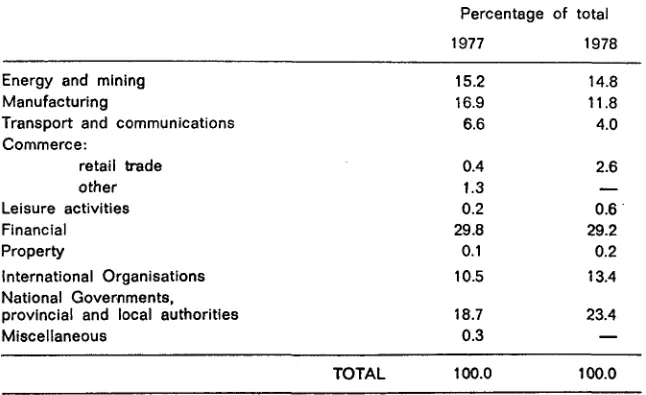
[image:10.588.230.553.581.779.2]A large part of the end-uses of funds raised in bond markets can-not really be identified because of the dominant role played by issuers who are financial intermediaries of one sort or another, such as banks and International financial organisa-tions on the one hand and Govern-ments or local authorities on the other. Neariy all foreign issues of bonds on national markets are made by such borrowers and any classi-fication according to end-use would be meaningless. On the other hand, the portion of new issues made by financial intermediaries on the inter-national market, though still large, is smaller than among foreign issues on national markets. An attempt to classify international issues according to the sector of activity in which the funds will osten-sibly be applied is made in Table 3. There is some evidence that the percentage of funds channelled into financing the «Manufacturing» sec-tor declined quite sharply in 1978 to 11.8% from 16.9% in 1977. A com-paratively large reduction was also recorded by «Transport and Com-munications» which secured only 4 % of the total raised through inter-national public issues in 1978 as against 6.6% in the previous year. The «Energy and mining» sector, which accounted for 14.8% of the market in 1978, maintained more or less the same percentage recor-ded in 1977 and that of «Commerce» remained very low at 2.6%. Because
Table 3: Eurobond issues by sector
Percentage of total
1977 1978 Energy and mining
Manufacturing
Transport and communications Commerce:
retail trade other Leisure activities Financial Property
International Organisations National Governments, provincial and local authorities Miscellaneous
15.2 16.9 6.6
0.4 1.3 0.2 29.8 0.1
10.5
18.7 0.3
14.8 11.8 4.0
2.6
—
0.6 29.2 0.2
13.4
23.4
TOTAL 100.0 100.0
the total finance raised by means of international bond issues declin-ed in 1978. even the maintenance of a share of the market implies a reduction in the absolute amount of funds secured. This applies parti-culariy to the «Financial» category v^/hich again accounted for about 29% of the total. This sector, which consists largely of banks, only main-tained its share of the market by heavy recourse to floating-rate is-sues. Non-American banks were able thereby to secure part of the funds needed for financing syndica-ted loans (most of which are also extended on floating-rate terms) from a less volatile source than the short-term interbank market
The borrowing by «International Organisations» vvhich. on the other hand, remained mostly in the form of fixed-interest securities accoun-ted for a larger portion of funds available in the eurobond market with an increase from 10.5% to 13.4% between the last two years. The African Development Bank, the only international organisation to borrow on floating rate terms, laun-ched a 5-year floating-rate issue in 1978. The sector of «National Go-vernments,, provincial and local authorities» was also able to in-crease its market share from 18.7% in 1977 to 23.4% in 1978. Bearing in mind that there are a number of official or semi-official institutions among the borrowers in the «Finan-cial» category, it seems that official borrowers made more use of the international market during 1978 than the private sector.
Syndicated credits a) Currencies
Unlike its performance on bond mar-kets, the US dollar figured in an overwhelming 97% of credits granted by international banking syndicates. The large deficit in the US balance of payments, which widened seriously in 1977, continued in 1978, adding to worid liquidity and enabling international banking syn-dicates to extend their business in medium and long-term loans deno-minated in dollars. These credits increased by nearly 20 000 million EUA to 48100 million in 1978. Among stronger currencies, the Deutsche-mark was used in only 1.7% of internationally syndicated credits, the share of the Dutch Guilder and Japanese Yen was negligible and the Swiss franc did not figure in any contract recorded during 1978.
The statistics of internationally syn-dicated bank credits, however, do not cover international credits granted by syndicates of banks in a single country in their own currency. Japanese banks, for example, appear to have lent during 1978 the equivalent in Yen of 1 400 million EUA, mostly at a fixed margin above the Japanese prime lending rate. A further area of uncertainty in the statistical coverage of international credits is the extent to which bor-rowers who have currency option clauses in their contracts exercise these options. It is conceivable that at some point a borrower might decide that the interest differential in favour of a low cost but high exchange risk currency and vice versa justified exercising his option. It seems unlikely, nevertheless, that If such additional information were available, the general picture of the dominant role played by the US currency in international credits would be significantly altered. The persistence of high liquidity among lending banks ensured the continuation of strong competition between them. Conditions accord-ingly moved further in favour of bor-rowers who benefited from a lower-ing of interest margins, front-end fees and commitment fees, and from longer maturities and grace periods on new loans. At the end of 1977, the term to maturity was commonly seven years and interest rates on new loans to top-rated borrowers would have been set at margins in the range of 0.75% to 0.875% above the base rate (usually LIBOR). By the end of the first half of 1978, on the other hand, maturities on the majority of new loans had stretched to ten years and interest rate mar-gins were reduced to within a range of 0.5% to 0.625%. At this level, margins appeared to have reached a floor for top-rated borrowers but those on loans to lower-rated bor-rowers from developing countries continued to decline during the second half of 1978. approaching in several cases the margins achieved by borrowers In developed countries. For example, countries with a relatively light external debt like Greece. Tunisia., Morocco and Cyprus were able to secure eight or ten-year loans at interest margins within the range of 0.625% to 1 % . The narrowing of differentials in the margins which borrowers are charged has inevitably reduced one of the means of applying selectivity in lending policy.
The participation of Japanese and
European, especially German, lend-ing banks in syndicated credits increased further in 1978 in the face of a general slackness of demand for business loans in their domestic markets. US banks, on the other hand, in accommodating stronger domestic demand were relucant to participate In some less profitable deals concerning developed coun-tries but remained active in lending to developing countries.
b) The countries of the borrowers It seems clear that the movement of the terms of lending in favour of borrowers elicited a strengthening demand for finance. By no means all the credits were sought for balance of payments reasons, as some seemed to represent genuine development finance.
Developing countries which are not oil exporters remained the largest group of borrowers in the sector of internationally syndicated credits. Though their share in total credits declined slightly from 4 1 % in 1977 to 40% in 1978, these countries bor-rowed substantially more last year, accounting for the equivalent of 19 800 million EUA against 12 100 million in 1977. A few of these coun-tries have had access to bond mar-kets but, as has been the case in recent years, were able to secure a much larger amount of funds through bank credits. Brazil and Mexico alone accounted for 40% of syndicated loans obtained by non-OPEC developing countries. In general, Latin American borrowers were more active than others, with Argentina, Chile, Panama. Bolivia and Costa Rica raising a total of 2 800 million EUA. Outside Latin America, the major borrowers were the Kingdom of Spain, the Philip-pines, Morocco, Hong Kong, Malay-sia and Yugoslavia.
New credits obtained by oil-export-ing countries (OPEC) rose by 34% to 7 500 million EUA In 1978. The aggregate current account surplus in the balance of payments of this group of countries was cut sharply by two thirds in 1978 as the situa-tion of some individual OPEC coun-tries has cleariy deteriorated. Alge-ria,, Venezuela, Indonesia, Nigeria and Ecuador, for example, either moved from surplus into deficit or recorded higher deficits in 1978 and accordingly had to resort to the international market for balance of payments reasons, raising 5 600 mil-lion EUA through syndicated
dits. A m o n g OPEC countries which continued to record a current ac-c o u n t surplus, only the United A r a b Emirates, Iran and Iraq resorted to external b o r r o w i n g on any signifi-cant scale, raising credits amount-ing to 1 330 million EUA in 1978 to provide external finance f o r national development programmes. Iran's b o r r o w i n g was heavy during the first three quarters of 1978 but came practically to a standstill in the last three months of the year f o l l o w i n g the outbreak of political
troubles in that country.
Lending to developed countries not only increased in amount but the percentage of the market which these countries have secured rose from 3 0 % in 1977 to 3 8 % last year. Canada was the major borrower, raising a substantial 4 400 million EUA in 1978, ten times more than in 1977. S w e d e n secured 1 450 mil-lion EUA In 1978, but more than half of this amount represented the refinancing of a loan obtained in 1977.
M o r e finance was channelled to the United Kingdom in the form of syn-dicated credits in 1978 than to other countries in the European Economic Community, but neariy half of the 3 270 million EUA raised by UK b o r r o w e r s consisted of the refinanc-ing on more favourable terms of older loans to the Treasury and Shell Petroleum Ltd. In spite of the spectacular improvement in the balance of payments which showed a very large current account sur-plus, b o r r o w i n g by Italian principals increased four times, reaching 2 375 million EUA in 1978. These funds w e r e almost all new money which was used for financing specific pro-jects or export credits. N e w syndi-cated credits to b o r r o w e r s In France and Denmark increased by about
1 5 % In 1978, to 1 750 million EUA and to 880 million EUA, respectively. W i t h 262 million EUA, b o r r o w e r s in Ireland took 2 7 % less than in 1977, while those in the Netherlands, of w h o m there w e r e none in 1977, raised 750 million EUA last year when the country's balance of pay-ments on current account moved unexpectedly into deficit.
Eastern European countries. Includ-ing C o m e c o n organisations, bor-rowed more In nominal terms while losing ground in relative terms and accounted for only 6 % of total loans. The international organi-sations f o r the most part continued to b o r r o w on fixed-interest terms but the A f r i c a n Development Bank,
f o r the second time in the last two years, obtained a syndicated credit to which a floating-interest rate was attached.
The year 1978 saw a number of sig-nificant changes occur from about mid-year onwards in the internat-ional capital market, which in this context may be taken to include foreign issues on national capi-tal markets. M o s t of these changes were related in one way or another to the persistently heavy balance of payments deficit of the U S A and the ensuing weakness of the dollar in foreign exchange markets. The pro-posals launched at mid-year to intro-duce a European Monetary System as from the beginning of 1979 added, if only temporarily, to the general air of uncertainty that pervaded capital markets in the second half of 1978.
The resilience of bond markets was not quite sufficient to meet the chal-lenges of the year. The contraction In straight bond issues denominated in dollars was compensated neither by an increase in floating-rate issues nor by increases in the volume of issues in other European curren-cies. The hesitant response of bond markets to changing circumstances may be attributed very largely to uncertainty as to the future course of exchange rate relationships bet-ween the currencies in w h i c h capi-tal issues were denominated. O n the other hand, the subdued per-formance of foreign issues on the Japanese bond market during the second half of the year after their surge during the first half reflected changes in financial circumstances in Japan itself.
The counterpart to the afflictions of the bond markets was to be found in the development of internationally syndicated bank credits w h i c h , even allowing for a large volume of repayments of eariier b o r r o w i n g , was very substantial. The proce-dures f o r organising banking syndi-cates, such as securing the parti-cipation of a w i d e r circle of banks in the granting of a loan, seem to have been approaching the tech-nique of arranging private placings. A further feature of 1978 was that the strong competition between syn-dicates, faced with the need to employ a growing volume of liquid funds, tended to reduce the gradation in the terms offered to b o r r o w -ers of different standing. This has encouraged a w i d e r range of bor-rowers to approach a market on which they may obtain finance on
relatively favourable terms but it has also placed a greater respon-sibility f o r the proper exercise of judgement on the part of banks
par-ticipating in the market.
U n i t o f A c c o u n t Below are the values in national currencies of the Unit of A c c o u n t used by the Bank, as at 29 De-cember 1978; these rates are applied the present quarter in preparing financial statements and operational statistics of the Bank:
DM 2.50868 Bfrs 39.6543 £ 0.675274 Lfrs 39.6543 Ffrs 5.75538 Dkr 6.99113 Lit 1 140.06 £ l r 0.675274 Fl 2.71453 US $ 1.37688
Statistics summarising Bank acti-vities in terms of units of account have been based on several dif-ferent conversion rates applied since 1958. This, coupled with the effects of price trends, w o u l d suggest prudence in interpret-ing the significance of figures w h i c h relate to operations ex-tending over many years.
The composition and hence value of the unit of account now used by the EIB is the same as that of the European Unit of A c c o u n t .
EIB-INFORMATION is published periodically by the European Invest-ment Bank in six different languages (Danish, Dutch, English, French, German and Italian.)
Material which appears in EIB-INFORMATION may be freely repro-duced; an acknowledgement would be appreciated and also a clipping of any article published.
2, Place de Metz—Softe postale 2005 Luxembourg
tel. 43 50 11 — telex 3530 bankeu lu Department for Italy: 38, Via Sardegna, 00187 Rome tei. 48 36 51 — telex 621 30 bankeuro
Representative Office in Brussels: 227, Rue de la Loi
B-1040 Brussels
tei. 73521 38 — telex 21721 bankeu fa Liaison Office for the United Kingdom:
23, Queen Anne's Gate, Westminster, London S W I H 9BU tei. 222 2933 — telex 919159 bankeu g
Imprimerle de la Cour Victor Buck, s. à r. I., Luxembourg