Automatic Navigational Trolley Using ZigBee
Technology
Mani Sankar. P1, Satheeshkumar.T2, Praveen Kumar.P3, Karthikeyan.R4, Ramesh. N5
B. E Students, Department of Mechanical and Automation Engineering, Mahendra Engineering College,
Tamilnadu, India. 1,2,3,4
Assistant Professor, Department of Mechanical and Automation Engineering, Mahendra Engineering College,
Tamilnadu, India5
ABSTRACT: A shopping mall is a place where every people using them to get their daily necessities. At the time of
getting their necessities they have to pay, For this payment definitely, they have to get the right product. For selecting the right product we have to know about the product information and expiry date. And the other thing is the trolley,The selected Items are taken into the trolley. For the movement of the trolley, we have to use some manual force and effort. This will also make shopping more difficult. For overcoming this problem we implement the automatic navigational trolley using ZigBee technology along with the billing section to reducing the human effort in the supermarket during purchasing and billing. The navigational trolley movement was controlled by using the accelerometer and the direction commands for the trolley that was given by the mobile controlled application through via Bluetooth. The billing of product that was generally done by using the product manufacturing bar codes. In this project we use the RFID Tag alternative for the manufacturing product code. In future, the RFID Tag will be used as a product manufacturing bar code. When we read the RFID tag it shows the details of the product on the LCD display. If the date of the product is expired it indicates the expired date with the buzzer sound. Finally, all purchasing is finished we have to use the push button for sending the purchasing product details with total amount through the ZigBee wireless communication to pc with the help of RS232.
KEYWORDS: Indicate the date of Expiry; Time Reduction; RFID; Transponder; accelerometer.
I. INTRODUCTION
A Shopping mall is a place where every people using them to get daily necessities like food, clothes, electrical appliances etc. A large number of people using the same mall at the same time, so the customers are difficult to understand the information about the product and the date of expiry. In between the crowd, these are not easy and it takes too much time. The traditional billing is also consumed more time during billing. Day to day life, time is the most important thing so the saving of time is more important
To overcome these problems we have to improve the existing Systems. The common thinking of every human is to develop the technology day by day. As per the human thinking, we have to design the smart trolley for shopping. We implement the automatic navigational trolley using ZigBee technology along with the billing section to reducing the human effort in the supermarket during purchasing and billing. The billing of product that was generally done by using the product manufacturing bar codes. In this project, we use the RFID Tag alternative for the manufacturing product code. In the future, the RFID Tag will be used as a manufacturing product code. Finally, the purchasing is finished the total number of product and the total amount that was transferred to the pc by using ZigBee and RS232.
II. MOTIVATION
Our main motivation of this project is to reduce the timing of billing from the queue, increasing the reliability of the product and implementing the automation in the trolley to reducing the human effort. During weekends and festival times, the use of shopping mart is more important. At the time of shopping, they have to face many problems and the people worrying about their money due to overcrowd.
III.WORKING PRINCIPLE
The whole process of the automatic navigational trolley workings is fully controlled by the microcontroller Atmega328p. The RFID reader, LCD display, switch and push button that was fixed along with the trolley. When the RFID Tag read by the RFID reader the information of items that was shown on the LCD display. The information on items that are found easily and it makes shopping also easy. The LCD display shows the product name, price, total amount, total number of the product. The Battery is used as a power source for these operations.
BLOCK DIAGRAM
Fig.1. Block Diagram
A. Arduino Uno
Arduino/Genuino Uno is a microcontroller board, based on the ATmega328p. this microcontroller has 14 digital input/output pins (of which 6 can be used as PWM outputs), 6 analog inputs, a 16 MHz quartz crystal, a power jack, a USB connection, and ICSP header and a reset button. It contains anything needed to support the microcontroller; simply connect it to a computer with a USB cable or power it with an AC-to-DC adapter or battery to get started. You can tinker with your UNO without worrying too much about doing something wrong, In case of worst scenario you can replace the chip for a few dollars and easy to start over again.
B. Transponder
The Transponder or tag is fixed on to the baggage or product to be tracked in the airport. When this tag comes within the range of the reader or integrator, the tag gets energized. Now, this tag transmits the data to the reader.This data is automatically transferred to the micro-controller for further processing. The time at which the tag is sensed is sent to the micro-controller from the RTC (Real Time Clock). These information are displayed on LCD (Liquid Crystal Display). The same data is sent to the EEPROM (Electrically Erasable and Programmable Read Only Memory), which is used as a backup. It can be store and retrieved.
C. Passive Tag and Reader
Fig.2.RFID Tag Reader
where item tracking is needed or elsewhere security aspects are important. Most tags also carry an unalterable unique electronic serial number and it makes RFID tags potentially very useful in applications.
D. ZigBee
The main part of the ZigBee device Working Group is to bring about the existence of a broad range of interoperable consumer devices by establishing open industry specifications for unlicensed, unbound outermost, control devices requiring the lowest price and lowest power consumption communications between compliant devices anywhere in and around the required range. The specification of ZigBee is a combination of Home RF Lite and the 802.15.4 specification. The spec operates in the 2.4GHz (ISM) radio band - the same band as 802.11b standard, Bluetooth, microwaves and other devices. It is capable of connecting 255 devices per single network. The data transmission rates of up to 250 Kbps at a range of up to 30 meters. ZigBee technology is slower than 802.11b (11 Mbps) and Bluetooth (1 Mbps) but it consumes significantly less power.
General Characteristics
1 Dual PHY (2.4GHz and 868/915 MHz)
2 Data rates of 250 kbps (@2.4 GHz), 40 kbps (@ 915 MHz), and 20 kbps (@868 MHz) 3 Optimized for low duty-cycle applications (<0.1%)
4 CSMA-CA channel access Yields high throughput and low latency for low duty cycle devices like sensors and controls
5 Low power (battery life multi-month to years) 6 Multiple topologies: star, peer-to-peer, mesh
7 Address in space of up to:- 18,450,000,000,000,000,000 devices (64 bit IEEE address)- 65,535 networks 8 Optional guaranteed time slot for applications requiring low latency
9 Fully hand-shake protocol for transfer reliability 10 Range: 50m typical (5-500m based on environment)
Typical Traffic Types Addressed 1 Periodic data
2 Application defined rate (e.g., sensors) 3 Intermittent data
4 Application/external stimulus defined rate (e.g., light switch) 5 Repetitive low latency data.
E. IR Sensing Circuit
Fig.3. IR Sensing Circuit
F. RS232
In telecommunications, RS232is a standard for serial binary data interconnection between a DTE (Data terminal equipment) and a DCE (Data Circuit-terminating Equipment). This serial port was connected with the billing pc system for transferring purchased the bill amount from the trolley to billing pc. This serial transfer the data in between the ZigBee to billing pc
Fig.4. RS 232.
G. ALARM WITH DRIVER CIRCUIT
Fig.5. Alarm Circuit
TABLE I: Alarm Logic Circuit
Voltage Signal from Microcontroller or PC
Transistor Buzzer
1 On on
0 off Off
H. Accelerometer
An accelerometer is a device that measures proper acceleration, the acceleration experienced connective to free fall. Single-axis model and multi-axis model are available to find magnitude and direction of the acceleration as a vector quantity and can be used to sense adjustment, acceleration, vibration shock, and falling. Micromachined accelerometers are increasingly present in portable video game controllers and electronic devices, to detect the position of the device or provide for game input.
Fig.6. Accelerometer
I. BLUETOOTH
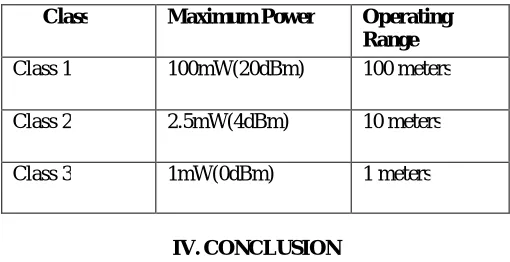
Bluetooth is an openwireless technology standard for exchanging data over short distances (using short wavelength radio transmissions) from fixed and mobile devices, creating personal area networks (PANs) with high levels of security. It was paired with mobile for transfer the command from mobile to trolley Bluetooth receive the command. The command that was given like a remote controller button from the mobile.Bluetooth is a standard communications protocol primarily designed for low power consumption, with a short range (power-class-dependent: 100 m, 10 m, and 1 m, but ranges vary in practice; see table below) based on low-cost transceivermicrochips in each device. Because the devices use a radio (broadcast) communications system, they do not have to be in a line of sight of each other.
TABLE II: Operating Ranges
Class Maximum Power Operating
Range Class 1 100mW(20dBm) 100 meters
Class 2 2.5mW(4dBm) 10 meters
Class 3 1mW(0dBm) 1 meters
IV.CONCLUSION
By means of this paper we intent to simplify the billing process, make it easy & increase the security using of RFID technique. This will take the overall shopping experience next level for the upcoming generation peoples. The easiest way of finding information’s about the product such as product name, price, total amount, total number of product and the important thing expiry date, these all reduce the time and it helps the customer to get more details about the product. This with the help of the final conclusion we can say that
Automatic billing of product by using RFID technology will be more viable in option in future.
The system based in RFID technique is more reliable and more efficient.
Automatic trolley that can be easy to control and make your shopping easy REFERENCES
[1]Satishkamble,Sachin meshram, Rahul thokal. “Developing a multitasking shopping trolley based on RFID technology” , International Journal of Shoft Computing and Engineering (IJJSCE),issue-6 , January 2014.
[2] Zeeshanali, Reenasonkusare, “RFID Based smart Shopping and Billing” International journal of advanced research in computer and Communication Engineering. Issue-12, December 2013.
[3] Dr. P.Muthukannan , Anupriya “Automatic little system using RFID volumeuses 5 October 2013 international journal of advance research in computer science and management studios.
[4] Rajkumar k. Gopalakrishnan, K.Ramesh“intelligent shopping cart”international journal of engineering science and innovative technology (IJESIT) volume 2 thesis 4 july 2013.
[5] Satishkamble, Sachinmeshran, Ragul“Developing multitasking shopping trolley based on RFID technology” international journal of soft computing and engineering (IJSCE) issn2231-2307 volume – 3 usses -6 journal January 2014.
[6] VarshaJalkote,AlayPaltel,VijayaGawande “ futuristic trolley for inter legend billing with amalgamation of RFID and zigbee”, international journal of computer application , international conference on resent trends in engineering and technology- 2013(ICRTE 2013).
[7] J.S AWATI, S.B AWATI “Smart trolley in mega mall” International journal of emerging technology and advanced engineering (ISSN 2250-2459 volume 2 ISSUS marc 2012) [7] Dr.k.v.k.k. Prasad “embedded real time operating system” dreantech publication 2012 edition.
[8] Myngyan Li, Rainer FlakPaper on “multi-domain access control using asymmetric Key based tag reader multi authentication” Dreametic publication 2012 Edition.
[9] D.V.S Chandra Babu, “wireless intelligent billing trolley for supper market” international journal Of advanced research in technology, vol.3, issues 1, August 2012.
[10]Mill Man J and Hawkies C.C. “Integrated Electronics” MCGRAW Hill, 1972.
[12] “THE 8051 MICROCONTROLLER AND EMBEDDED SYSTEM” by Mohammad Ali Mazidi. [13] http://www.atmel.com/