THE SHOCK OF THE NOW
Retail space and the road to nowhere
by
GAVIN CAMPBELL BFA Hons, MFA
Submitted in partial fulfillment
of the requirements for the degree of
Doctor of Philosophy
School of Visual and Performing Arts
University of Tasmania
DECLARATION OF ORIGINALITY
The material contained in this paper is original, except where due acknowledgement is given, and has not been accepted for the award of any other degree or diploma.
STATEMENT OF AUTHORITY TO ACCESS
This thesis may be made available for loan and limited copying in accordance with the Copyright Act 1968.
_______________________________________
ABSTRACT
The project is focused on my interpretation of my workaday experience, my attempt to navigate the many layers of the retail space of the supermarket, and the enigmatic landscape of the suburban environment. My premise is that retail and suburban environments can have a dehumanizing effect on the individual. Elements such as alienation and dislocation move beyond their supermarket and suburban associations to permeate my observations. My work is reflective of this process. The paint appears bleached, having a sterile quality reflecting the effect of the supermarket and suburbs on my emotional state. The fluorescent lights of the supermarket and the white concrete of the suburbs reach out and become part of my imagination, sapping colour and forcing me to rethink the relationship between the built environment and my self. During my time as a worker in the retail environment of the supermarket, I began to experience a questioning process that led me to this investigation. Mentally I had to occupy an expressive space in parallel with my workaday experience. This dual existence of working and observation and interpretation of my workplace, helped me to make sense of the issues around alienation and desolation I experienced in the supermarket. The project allowed me to occupy a point of observation. I realised I had an opportunity to maximise my investigation by developing my ideas in an academic context, and voice my experience and outcomes through painting and writing. Through my art I attempt to make sense of environments that I perceive as being in opposition to my sense of humanity. These spaces challenge my ideals around the relationship between human beings and their environment and I therefore see them as an ideal subject to develop my ideas around sense of place.
I believe contemporary urban spaces can affect a sense of dislocation from society. The products of many modernist artist and writers such as Walter Benjamin’s Arcades Project, John Steinbeck’s Hour of Pearl in Cannery Row and George Orwell’s utopia under Big Brother in 1984, Albert Camus’ The Rebel and John Paul Sartre’s Nausea
ACKNOWLEDGEMENTS
I express my thanks to my supervisors, Emeritus Professor Vincent McGrath, Dr Deborah Malor and Ms Penny Mason for their inspiring support. Their informed guidance and accessibility was invaluable and greatly appreciated. I would also like to thank the School of Visual and Performing Arts for providing a rich and simulating environment in which to carry out the project.
I would like to thank my parents for their ongoing financial and emotional support, without which this project would not have been possible.
TABLE OF CONTENTS
Abstract iii
Acknowledgements iv
List of figures vi
INTRODUCTION 1
CHAPTER ONE: SURVIVAL IN THE DESERT 6
CHAPTER TWO: FORCED CONFESSIONS 44
CHAPTER THREE: GOD SPEED (SIGNIFICANCE) 63
CONCLUSION 99
REFERENCES 104
BIBLIOGRAPHY 107
LIST OF FIGURES
Figure 1 Edward Hopper, New York Office, 1962, 101.6 x 139.7 cm, Collection of the Montgomery Museum of Fine Arts, Montgomery, Alabama, The Blout Collection, (Source: Schmied 1995, pp. 102–103).
Figure 2 Andrew Wyeth, The Mill, oil on canvas, 1959, 36.5 x 57.8 cm, private collection, (Source: Corn 1973,p. 15).
Figure 3 Andrew Wyeth, Weather Side, tempera 1965, 121.9 x 70.5 cm, Mr. and Mrs. Alexander M. Laughlin, (Source: Corn 1975, p. 159). Figure 4 Andrew Wyeth, Wind from the Sea, 1947, tempera 48.3 x 71 cm,
private collection, (Source: Corn 1975,p. 125).
Figure 5 James Whistler, Nocturne in Blue and Green: Chelsea, 1870, oil on panel, 48.2 x 39.8 cm, Tate Gallery, London, (Source: Spalding 1979, p. 52).
Figure 6 James Whistler, Nocturne in Blue and Gold, c 1875, oil on wood, 66.6 x 50.2 cm, Tate Gallery, (Source: Spalding 1979, p. 53).
Figure 7 Edvard Munch, The Scream, 1893, oil on cardboard, 91.4 x 73.7 cm, Nasjonalgalleriet, Oslo, (Source: Hughes 1991 [1980], p. 282). Figure 8 Edward Hopper, Nighthawks, 1942, oil on canvas, 84.1 x 152.4 cm,
The Art Institute of Chicago, Friends of American Art Collection, (Source: Schmied 1995, pp. 56–57).
Figure 9 Edward Hopper, Morning Sun, 1952, oil on canvas, 71.4 x 101.9 cm, Columbus Museum of Art, Columbus, Ohio, Museum Purchase: Howell Fund, (Source: Schmied 1997, p. 79).
Figure 10 Edward Hopper, Rooms By the Sea, 1951, oil on canvas, 73.7 x 101.6 cm, Yale University Art Gallery, New Haven, Connecticut, Bequest of Stephen Carlton Clark, 1903, (Source: Schmied 1995,p. 17).
Figure 11 Edward Hopper, Approaching a City, 1946, oil on canvas, 68.6 x 91.4 cm, The Phillips Collection, Washington DC, (Source: Schmied 1995, p. 101).
Figure 12 Mark Rothko, Untitled, 1957, oil on canvas, 201.9 x 177.2 cm, private collection, Zurich, (Source: Waldman 1978, p. 168).
Figure 14 Mark Rothko, Green, Red on Orange, 1950, oil on canvas, 236.2 x 149.9 cm, courtesy The Pace Gallery (Copyright issues), (Source: Waldman 1978, p.151).
Figure 15 Mark Rothko, Brown and Grey, 1969, acrylic on paper, 157.5 x 122 cm, lent anonymously, (Source: Waldman 1978, p. 261).
Figure 16 Paul Nash, Nocturnal Landscape, 1938, oil, 76.2 x 101.6 cm, Manchester City Art Gallery, (Source: Eates 1973).
Figure 17 Paul Nash, We Are Making a New World, 1918, oil on canvas, 71.1 x 91.4 cm, (Source: Eates 1973).
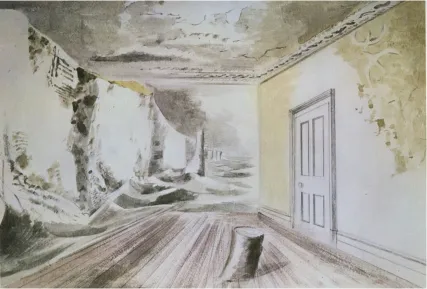
Figure 18 Paul Nash, Environment of Two Objects, 1937, 52.1 x 77.5 cm, Leichester Gallery 1938, Tate Gallery 1948, (Source: Eates 1973). Figure 19 Paul Nash, Empty Room, 1937, watercolour, 37.5 x 55.9 cm, (Source:
Eates 1973).
Figure 20 Callum Morton, Belvedere, 1995, mixed media, dimensions variable, (Source: Art and Australia, vol. 42, p. 582).
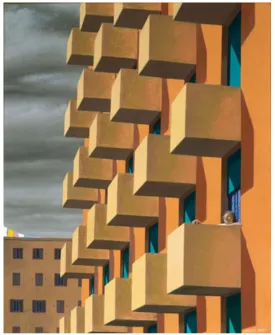
Figure 21 Jeffrey Smart, Holiday, 1970, oil on canvas, viewed 9 Jun 2011, (Source: Australian Fine Art Editions 2011,
<http://www.australianfinearteditions.com/pages/enlargement_artists_
works.php?current=32&workID=53&artistID=3>).
Figure 22 Callum Morton, Farnshaven: Illinois, 2001, digital print, 59 x 84 cm, (Source: Art and Australia, vol. 42, p. 583).
Figure 23 Food aisles, Fred Meyer, Portland, 2000, photographer unknown, viewed 10 June 2006,
<http://.commons.wikimedia.org/wiki/File:Fredmeyer_edit_1.jpg>. Figure 24 Bill Henson, Untitled #2, 2000–2003, type C photograph,
127 x 180 cm, edition of 5,
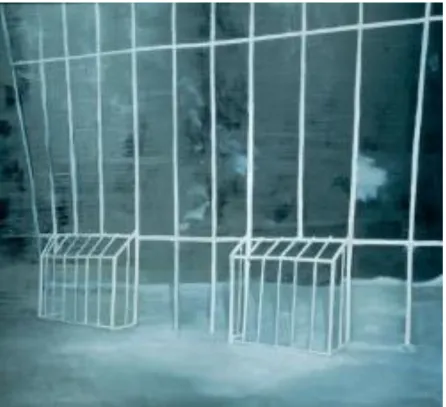
(Source: Roslyn Oxley9 Gallery, viewed 12 May 2011, <http//www.roslynoxley9.com.au/artist/18/Bill_Henson/98>). Figure 25 Gavin Campbell, Untitled, 2006, oil and pencil on canvas, 50 x 60.5
cm.
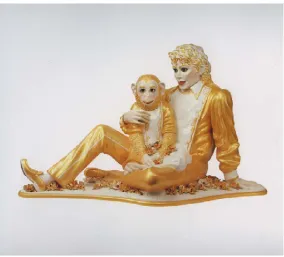
Figure 26 Jeff Koons, Michael Jackson and Bubbles, 1988, 106.7 x 179.1 x 82.5 cm, ceramic, (Source: Caldwell 1993,p.96).
Figure 28 Jeff Koons, New Hoover Convertible, 1980, vacuum cleaner, plexiglass, fluorescent lights, 142.2 x 57.2 x 57.2 cm (Source: Caldwell 1993,p. 49).
Figure 29 Richard Hamilton, Just What Is It That Makes Today’s Homes So Different, So Appealing?, 1956, collage, 26 x 24.8 cm, Kunsthalle, Tubingen, (Source: Hughes 1991, [1980],p. 343).
Figure 30 Richard Hamilton, $he, 1958-61, oil, cellulose and collage on panel, 122 x 81 cm, Tate Gallery, (Source:
<http://www.tate.org.uk/servlet/ViewWork?workid=5829&tabview=i mage>).
Figure 31 Richard Hamilton, Hommage á Chrysler Corp., 1957,
oil, metal foil, and collage on panel, 122 x 81 cm., private collection, (Source: Hamilton 1992,p.74).
Figure 32 Gavin Campbell, Domestic Interior 1, 2010, oil and pencil on canvas, 30.5 x 40.5 cm.
Figure 33 Gavin Campbell, Domestic Interior 2, 2010, oil and pencil on canvas, 30.5 x 40.5 cm.
Figure 34 Luc Tuymans, Within, 2001, oil on canvas 223 x 243 cm, (Source: Saatchi Gallery, viewed 17 May 2011,
<http://www.saatchi-gallery.co.uk/artist/luc_tuymans.htm>). Figure 35 Gavin Campbell, Coke, 2008, oil and pencil on canvas,
50 x 60.5 cm.
Figure 36 Gavin Campbell, Long Life Milk, 2008, oil and pencil on canvas, 30.5 x 40.5 cm.
Figure 37 Luc Tuymans, Dusk, 2004, oil on canvas, 166 x 260 cm, (Source: Art News, viewed 17 May 2011,
<http://.art news.org/luctuymans/?i=8>).
Figure 38 Gavin Campbell, Another Day, 2010, oil and pencil on canvas, 50.0 x 60.5 cm.
Figure 39 Luc Tuymans, Nuclear Power Plant, oil on canvas,
(Source: Friends of Art,viewed 17 may 2011,
<http://www.friendsofart.net/en/art/luc-tuymans/nuclear-plant>). Figure 40 Gavin Campbell, Untitled, 2006, oil and pencil on canvas, 50 x 60.5
cm.
Figure 42 Gavin Campbell, Untitled, 2009, oil and pencil on canvas, 41 x 51 cm. Figure 43 Gavin Campbell, Untitled,2010, oil and pencil on canvas, 50.5 x 60.5
cm.
Figure 44 Gavin Campbell, Cornercopia, (detail) 2009, oil and pencil on canvas, 35.5 x 45.5 cm.
Figure 45 Fiona McMonagle, Up on the Roof, 2010, watercolour and gouache on paper, 100 x 72 cm, (Source: Crawford 2010, p. 171).
Figure 46 Fiona McMonagle, I’m His Because He Deserves the Finest, 2009, watercolour and gouache on paper, 114 x 95 cm,
(Source: Crawford 2010, p. 173).
Figure 47 Jon Cattapan, The Group Discusses, 2002, oil on linen, (Source: The Age, July 2006, viewed 19 May 2011,
< http://www.theage.com.au/news/arts-reviews/the-drowned-world/2006/07/31/1154198048005.html>).
Figure 48 Gavin Campbell, Gone Shopping,2008, oil and pencil on canvas, 50.x 60.5 cm.
Figure 49 Andy Warhol, 200 Campbell’s Soup Cans, 1962, oil on canvas, 182.9 x 254 cm, private collection, (Source: Hughes 1991 [1980],p. 349). Figure 50 Bill Henson, Untitled #74, 2000–2003, type C photograph,
127 x 180 cm, edition of 5,
(Source: Roslyn Oxley9 Gallery, viewed 12 May 2011, <http//www.roslynoxley9.com.au/artist/18/Bill_Henson/98>). Figure 51 Kenyon Cox, Tradition, 1916, oil on canvas, 106 x 165.5 cm, The
INTRODUCTION
I walked from my car to the library to get an enrolment form for my PhD. On the way I passed the empty rectangle of grass where my studio used to be. I kept walking and came across another empty area where my undergraduate studios had been and yet another vacant space where the University’s art school administration building once stood. Being confronted with the strangeness of these vacant spaces I immediately thought that what might seem utterly important and indispensable can also be… nothing. I imagined myself painting in the Master’s studio a few feet off the ground, walking up the steps to the entrance, now just grass and air. Looking at these spaces as I write, I feel like a voyeur, exposing the very essence of each building that no longer exists, just by looking at where it used to be. I can see through it now. It is utterly transparent. This evokes in me a strange mix of grief and freedom, like losing a fair-weather friend; you miss them but you are free. This idea of empty space where something important once existed can evoke a kind of nostalgia; a feeling of
melancholy that seems to contrast with the bold certainty and permanency of the other spaces I am investigating, the retail, supermarket environment and the suburban environment.
occupy my thoughts. It was a feeling of foreverness; that I could exist here forever within this building that seemed so self-confidently established. This permanency comes about because of humankind's perceived need for a particular environment. Many people rely on it as a source of food, employment and shelter, not to mention the sense of security felt in taking your product home to the suburbs and knowing you can go back for more any time. All these survival-based issues give the supermarket a beacon-like quality and no one wants to see the light go out. I see this as a similar thing to death. Human beings live their lives striving forward a little further every day as if death is a myth. We travel faster and faster towards the grave and are in danger of missing the journey. In the same way as the ignoring of death, our minds latch on to the ‘seeing is believing’ philosophy and it seems impossible to imagine that this place so visually loaded and full of people and life could ever die. For me this feeling was magnified because often at work my mind wandered beyond the everyday to actually seeking out this end-day. The grind forced my mind to look for the end of it all. My environment was urging me to ‘speed things up’, while the fluorescent lights continued to light up the faces and faceless products, and so I continued with the word ‘continuum’ still in my mind.
Eight years ago I wrote: ‘I see buildings as people, strong with pride and reluctant to move’. Now, with the relocation of the art school from Newnham to Inveresk, the very building in which those words were written has died. As the wind blows the leaves across the grassy void I think of the contrast between this space and the space of the supermarket. This is a free space where there is no pressure, no demands and no people. Here there is room to feel. My workplace, in which I am now only part-time, is an opposite universe where control is the key. The suburbs, which continue to spread across Australia, lie as a kind of in-between zone, between life and death, where consumers mostly spend their time sleeping. Along with this suburban sprawl creeps the fog of melancholy, the atmosphere which envelops and signifies the in-between of the suburban.
The supermarket environment with its concrete and steel is constantly asserting its foreverness. I can almost imagine it saying to the world, ‘I could never cease to exist, look how strong I am, look how many people I give shelter to. I give them somewhere to go to fill their lives with meaning – I protect them’. It is tempting to believe the concrete giant and one almost does if one spends enough time in its shadow as I have. Because one really knows that it won't exist forever, a kind of scaffold or façade is created to hide its real impermanence. The retail and suburban environments complete with their forever-young complexion occupy my imagination as physical metaphors for humankind’s fear of death and almost universal obsession for all that is young and novel. The content of advertisements for major brands like Coke, KFC and the latest mobile phone are good examples of this. Sexy young people frolicking on the beach refreshing and refueling themselves after a hard half-hour of text
constantly reminded how important it is to stay young and to eat and drink and own the coolest product:
Coca-Cola have found the Holy Grail of marketing. It has managed to embed in our culture such a powerful set of associations and meanings for its product that it can activate parts of the brain its competition cannot reach. We have not so much been brainwashed into drinking Coca-Cola: We have had our brains rewired to want it (Hamilton & Denniss 2005: 42).
I open Chapter One of this paper with product obsession in mind as I critically
examine the milieu of the supermarket in which I once worked. I go on to explore my psychological reaction to this environment, and the kind of art that this reaction leads me to identify with, and create myself. Chapter One is an explanation of my attempt to better understand my work environment and includes research of artists and writers who reflect the ideas around my reaction.
In Chapter Two I examine pre-eminent social commentators such as Walter Benjamin and Christopher Lasch and their critique of what human beings generally accept as ‘progress’, while briefly touching on the history of the supermarket and the suburbs. I investigate Barbara B Stern’s analysis of different methods of advertising,
highlighting their manipulative qualities, while speculating on the growth of drama programs on television. I also investigate Sartre’s and Camus’ ideas on ‘the absurd’, and suggest that contemporary society is often an absurdism; a utopia of the artificial.
Luc Tuymans, Jon Cattapan, Paul Virilio and Jacky Bowring. I include examples of, and explain my own work, in this contemporary context.
CHAPTER ONE: SURVIVAL IN THE DESERT
Retail Culture
Every aspect of retail space is controlled, from the physical environment to the people within its walls. This control fever permeates the air so that if one spends enough time there one breathes in the controlled tension and it becomes part of one. This
environment is a microcosm of society. The boss is the government and the workers are the civilians. Where one sits within this hierarchy is everything. This contrived environment is an in-doors space where the adrenalin generated through risk and creativity has no place. Here the human touch and tenderness are rare and the pressure to perform provides a breeding ground for Machiavellian-style politics. When I am at work it often seems our one little supermarket has the political vicissitudes of ten Canberras.
Probably the most intense feelings I experienced while working at Coleswere due to hearing what co-workers said about me, the content of which usually revolved around my inability to properly do my job. The impact of hearing these types of comments, whether they really were the utterances of co-workers or not, is surprisingly strong, and motivates one to try and change the situation. I variously considered confronting the supposed source of the comments (the response to which is almost always one of denial) or telling the boss (which usually makes things worse), or spreading rumors about the person in question. This latter method was also obviously
suffered a lot for a below-average wage. I had a few coping mechanisms. The main one was keeping in mind what I was going to do when I got home. This helped me get through.
Other coping mechanisms included the placing of objects here and there where no one would really notice, but I knew they were there. This gave me a feeling of power over the institution rather than the other way around. I placed a toy dog high up in the roof beams once; he watched over the storeroom for a year or more until one day he was gone. A bit later I found a rather sinister looking plastic batman mask. I placed it high up on a nail in the storeroom and it looked right at home; an evil looking mask to watch over a grey-brick, lifeless storeroom.
I first experienced the supermarket in a working capacity in 1989 when I worked at Jimmy’s Supermarket in Launceston, which is now Coles. We had pricing guns back then. I fixed the gun to 1989 and using a ladder left the frozen piece of time on the zigzag roof support. I went shopping there in 1994 and it was still there! Now that Coleshave taken over of course it is gone but this gave me a great deal of satisfaction, both the placing of and the endurance of the marker, and I wonder what the
renovators made of it if it was noticed. This behavior is an attempt to gain some power back and also to leave a mark.
challenge painting itself. For these reasons my work is not ‘pretty’. It takes on a reduced quality. I have stripped away most of what one might expect to see in an attempt to give the viewer more space to think, so it is not all done for them. I want to go in the other direction to the visual overload of the supermarket. Some of my work still has an echo of the repetition one finds in retail spaces, but it is so reduced its subtlety is an unmistakable reaction to commerce and mass-production. Sometimes taking away nearly all colour my paintings take on a desert-like quality, giving room for contemplation.
I make art so I can feel less of just another grey brick in the storeroom wall. When I left my 1989 mark in Jimmy’s Supermarket I made sure no one that I knew of ever knew about what I was up to and that was the key: it was something that I had exclusive knowledge of and control over. I thought another way to take some power back might be to write beneventum ad mechanicum (welcome to the machine) in the men’s toilets, but I felt that would be a step down into vandalism. Then I thought I could write it really small in the corner, and wondered, ‘is hard-to-notice graffiti more OK than the in-your-face stuff?’ I dropped the idea, thinking it was getting too
complicated.
Painting the Paradox
reduction process I have polarised the retail into void versus overload, within which my view of suburbia has become an in-between space that links these polarities.
Through painting I have explored my experience of the supermarket. This retail space has many visual, political and emotional layers. These layers could be thought of as the bricks of the building. Within this strata exist even finer layers, which hold everything together: the mortar, the in-between area that connects. The visual layers consist of the absolute plethora of coded imagery one finds in the supermarket based on the product, and the structure and signage which support the product, the shelving and the building itself. The political and emotional layers are more subtle and hidden within and reflected by the immediacy of the visual. They are governed by the structure of the building and the interactions between people within the building.
I investigate the interaction of these layers, the mortar that holds it all together like roots in the soil. To me this is the real superstructure of the space and it consists of a mixing of the layers so that paradoxes begin to emerge. The visuality of the
Deception and Desolation
French social commentator Paul Virilio has built a reputation of having something of a sixth sense when commenting on the realm of social misdirection. In his book Art As Far As The Eye Can See, Virilio (2007: 4) writes, ‘Indeed, through their (often programmed) repetition, a population’s disturbing panic attacks are associated with a depression often masked by the routines of everyday life’. He cites French
philosopher Maurice Merleau-Ponty writing in 1953 that; ‘To obey with our eyes shut is the onset of panic…in this world where denial and morose passions take the place of certainties, people seek above all not to see’ (in Virilio 2007: 4). The routines of everyday life masking depression and the desire not to see are both very much
twentieth-century phenomena, the twenty-first century version of which is even faster and more immediate, based on instantaneity and visual and audio saturation. In
Affluenza (2005)Clive Hamilton and Richard Dennis cite research that highlights the perils of too much time at work:
A researcher at Queensland University of Technology found that the wives of workers who are often away from home for extended periods often experience higher levels of anxiety, stress and depression than the general population, (J Dagge 2002, cited in Hamilton & Denniss 2005: 91).
Closing my eyes to the ubiquitous product and its ordered routine and long work hours was not enough. I had to find another way to make sense of this ‘new artificial’.
taken off the shelf by the customer (processed). The worker must then put another product back on the shelf, and the cycle continues. Having been a part of this cycle it really does seem as though it will continue forever. I view it this way because of the rigidity of the supermarket structure coupled with the assertiveness of the product. Both are very much pushing on one's consciousness (and I would argue, the
subconscious) so convincingly that it is hard to believe it could ever be any other way. It is a space that lends itself to a form of dictatorship in that it knows what is best for the consumer.
Interestingly it was at the time of my deliberations on the retail that my fascination with built and outdoor environments, that embody a used-up quality, reasserted itself. For example, the until recently derelict Launceston General Hospital holds for me an especially strong magnetism. The essence of this type of environment is that it is seen to have no value. This is the very reason I wanted to know more about it. I needed to escape the predictability of the supermarket for a land where interesting things happened, though I wasn’t sure what. I saw the old hospital as a great ocean liner that could transport me away with the charm of its broken windows and blinds, its
corridors full of yesterday’s importance. Because it was no longer operating it gave space for the imagination. The supermarket is the antithesis of this idea. It is so inundated with the relevance of the now there is room for nothing else, especially not a creative energy. Many people would probably see a dilapidated old hospital as a desolate place and a supermarket as lively and worthwhile. But perhaps the opposite is also true. Can we see worth in an environment even though it may not have a tangible monetary value?
The Hour of Pearl
The opening line in T.S. Eliot’s poem The Waste Land, has inverted the conventional idea of spring and the coming of summer. For the people who inhabit the wasteland, winter is a rest from the pain of existence. When everything comes alive in summer time so too do the fundamental frustrations of life – sex and death. Helen Williams in her book TS Eliot: The Waste Land (1973) describes how this inversion…
For me this poem is about the things that human beings need to survive and how their very dependence on these things reminds them of their vulnerability. Water in the poem is one key example of this. It is desirable only in recognition of a terrible need. Eliot’s focus on the anguish of existence suggests to me that he was an artist who had experienced great emotional pain and frustration. I gather from his work that he had known enough pain to make winter more attractive than summer – he needed somewhere else to exist.
This concept of divergence from existing paradigms is more than just an escape: it is a survival strategy, and it is a theme central to my own work. My view has been
polarised because I have felt the despair of long working hours, and many hours not working but dreading it just the same. American writer John Steinbeck (1902 – 1968) wrote many novels in which his characters at once feel a sense of place, such is the richness of the environment he constructs around them, and yet are on a constant search for meaning. Steinbeck grew up in California not far from the Pacific Ocean. In his novel Cannery Row, Steinbeck wrote of the community of Monterey, a
Californian coastal town built on the canning of sardines. His book is about the fringe dwellers of the city and their struggle to live a meaningful existence. His characters include a group of unemployed young men about the town. With these apparent misfits in mind Steinbeck philosophised:
Later in the book one of Steinbeck’s characters, higher up in the social strata and a father figure to the lost boys, watches them from his laboratory window and comments:
Look at them, they are your true philosophers…Mack and the boys know everything that has ever happened in the world and possibly everything that will happen. I think they survive better in this world than other people. In a time when people tear themselves to pieces with ambition and nervousness they are relaxed. All of our so-called successful men are sick men, with bad stomachs and bad souls, but Mack and the boys are healthy and curiously clean (Steinbeck 1949: 106).
Steinbeck sees past the workaday; his unemployed youths are a metaphor for freedom. This looking beyond the grind is further evident in his description of Cannery Row when it is not operating:
Early morning is a time of magic in Cannery Row. In the grey time after the light has come and before the sun has risen, the row seems to hang suspended out of time in a silvery light…the street is silent of progress and business. It is a time of great peace, a deserted time, a little era of rest (Steinbeck 1949: 147).
Steinbeck describes the activities of some of the characters during this time, as if this quiet period has given them room to be human:
The cannery watchmen look out and blink at the morning light. The bouncer at the Bear Flag steps out on the porch in his shirt-sleeves and stretches and yawns and scratches his stomach…it is the hour of pearl – the interval between day and night when time stops to examine itself (Steinbeck 1949: 148).
says, the Row seems to hang suspended out of time. When this occurs, when we get a chance to look at the world without pressure or fear, our feeling for time and therefore life, can be put back into perspective. American painter Edward Hopper (1882–1967) was a master at capturing this reflective type of time. Of New York Office (Fig. 1), author of Edward Hopper: Portraits of America Wieland Schmiedwrites:
Hopper loved to show what is known in theater parlance as the ‘retarded moment.’ The animation of urban life is suspended for a brief moment, haste and unrest come to a standstill revealing the absurdity of the rat race (Schmied 1995: 102).
Figure 1: Edward Hopper, New York Office, 1962.
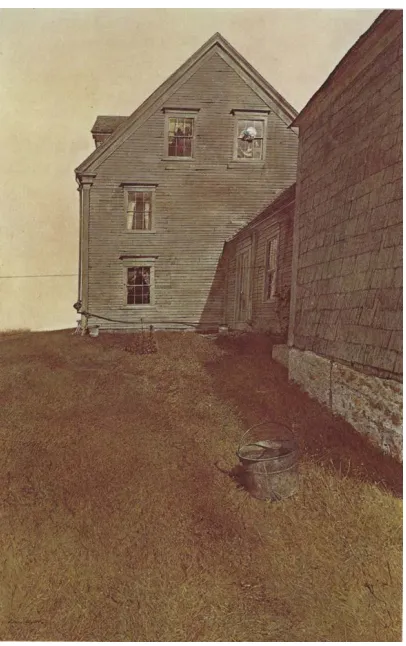
both landscape and rustic interior. I am drawn to his work for its subtle, insightful reservedness. He had a keen feeling for the quiet moments and an ability to find something special in the usually unnoticed and every day. In The Mill (Fig. 2), Wyeth has the power to evoke so much emotion. To me this is one of his best works in that it holds such a strong sense of ‘reality’. The viewer is not given any mod cons in which to withdraw in comfort. The raw coldness of the buildings, bare trees and the flock of birds that care nothing for the observer set up a hard-edged world where only the strong survive. But the reward if one can see far enough, is a harsh, austere beauty that gives the viewer time and space.
Figure 2: Andrew Wyeth, The Mill, 1959.
is why Wyeth was drawn to these spaces: they are everyday but at the same time have a mystical quality. I felt the impact of this surreal otherworldliness around the age of seven, but only now as I have explored my existence through art have I become more aware of what it actually is. Though this quality is at times seemingly indefinable, I have found it can be expressed through painting. It exists as a place of rest as in Steinbeck’s ‘hour of pearl’, where the mind can relax and imagine, unburdened by the pressures of urban and suburban environments. The strong sense of white light in many of Wyeth’s works evokes a sharp clarity which contrasts with their strongly emotional nature. Wyeth puts forward a beautiful, thoughtful world, with a cold sharp edge.
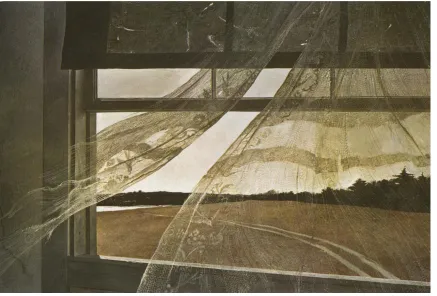
For me Wyeth’s Wind From the Sea (1947)(Fig. 4), along with works such as Her Room (1963),and Off at Sea (1972), share a feeling of absence. Not long ago one was talking to a friend, enjoying their company. One hasn’t moved but they have moved on. One is left with the structure that once surrounded the person, only the window and the breeze for company. Here, the shelters that reflect ourselves have become the focus. The viewer might be encouraged to contemplate someone they hold dear. Wyeth leaves room for my imagination.
Figure 4: Andrew Wyeth, Wind from the Sea, 1947.
James Whistler (1834–1930) was another American painter with the ability to evoke thought through what isn’t there. Frances Spalding, author of Whistler, describes his style as having a:
…startlingly original method of composition, refining his means to the barest essentials. He was one of the first to canvas the idea that the abstract
ingredients of a picture – the lines and shapes, colours and tones – could in themselves be the subject (Spalding 1979: front sleeve).
Whistler painted a series of enigmatic misty nighttime scenes of the River Thames which became famously known as the ‘Nocturnes’ (Figs 5 and 6).
Figure 5: James Whistler, Nocturne in Blue and Green,1871.
The Nocturnes have a slowness that is outside the pace of city life. When I look at these pictures I feel like time is no longer important. What has been done and what needs to be done, these things don’t matter in Whistler’s world. Whistler’s
school once stood. All the critical interactions and goings on, now just wind and grass, or mist over water.
Figure 6: James Whistler,
Nocturne in Blue and Gold, c.1875.
Whistler’s Nocturnes are dream-like, and their strength lies in their strong
It is hard to ignore the psychological problems many people experience being a part of the fast-paced, tension-filled rat race. I would argue most of the anxiety and depression that currently plagues contemporary society can be avoided if we spend more time in the ‘hour of pearl’ and become friends with Mack and the boys from
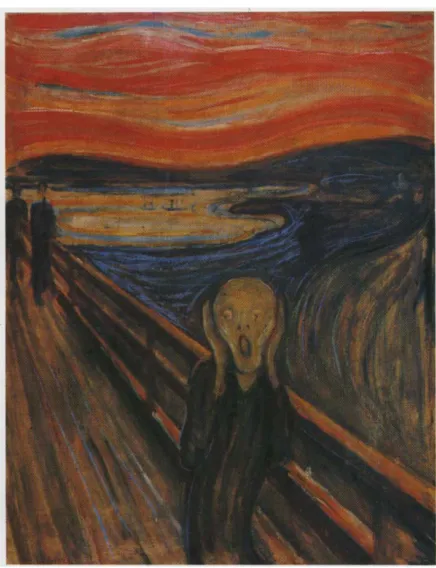
Cannery Row for a while, and in doing so avoiding any resemblance to Edvard
[image:32.595.188.406.455.739.2]Munch’s famous painting, The Scream (Fig. 7). This image is very powerful for me in that it exposes the state of mind I experienced during times of extreme anxiety or depression. The fluid chaos of Munch’s environment curves and distorts until the figure is warped and melded. As Munch’s figure is the prisoner of the hellish landscape of his/her mind, so the environment of the supermarket permeated my consciousness. The walls of the supermarket would shift and develop cracks, as I was unable to comfortably handle the pressure of an eight hour shift, or the idea of having to prop up and support the antithesis of my belief systems.
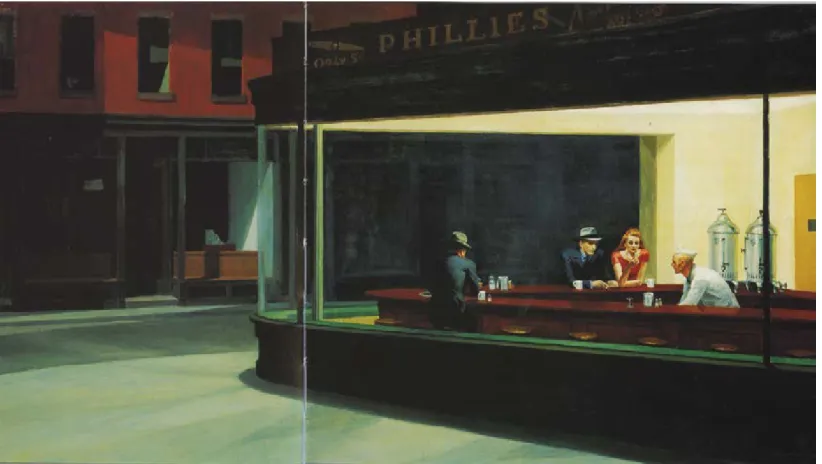
As mentioned earlier, Edward Hopper was also an artist who was drawn towards the idea of Steinbeck’s ‘pearl hour’. Although Hopper is thought of as a realist painter, his ability to imbue space with a dreamy timeless quality through a sensitive rendering of light and shadow speaks more about the human condition than space itself. His works sometimes include a solitary figure in a room or on a street, but this figure would always be dominated by the built environment it occupied. Of perhaps one of his more famous works, Nighthawks (Fig. 8),Hopper is quoted as saying:
[image:33.595.91.502.389.621.2]It was suggested by a restaurant in Greenwich Avenue where the two streets meet. I simplified the scene a great deal and made the restaurant bigger. Unconsciously, probably, I was painting the loneliness of a large city (Hopper, cited in Schmied, 1995: 56).
Figure 8: Edward Hopper, Nighthawks,1942.
device that is all to easy to read and obvious. Thus like Whistler and Wyett, Hopper’s subtlety and power of suggestion are the strengths of his work. The seated figures, facing each other are united in their circle, as if letting go would mean giving in to the ever-present sense of alienation. I imagine myself at the counter. I am part of
something, but still I am alone. Hopper used to great effect the interiors of American houses and hotel rooms to convey his feeling for what it meant to be human, evident in Morning Sun (Fig. 9). As Schmied (1995: 11) describes:
The houses he depicts are American houses…and the people who inhabit them are certainly American – restlessly on the move and tired of being restless, lonely and quietly despairing at their loneliness. There is a timeless quality in the America Hopper depicts.
Figure 9: Edward Hopper, Morning Sun,1952.
Schmied goes on to frame Hopper’s evolution as a painter as moving ‘towards an increasing economy of means, a waiver of extraneous detail, an emphasis on
Figure 10: Edward Hopper, Rooms by the Sea, 1951.
advanced to the line where light meets shadow and marvel as they watch it creep across the wall or floor; thus this work is fleeting and ephemeral, for one knows in a few hours it will be dark, yet it is also eternal – the sun will rise again and again. This binary of the fleeting and the forever mirrors the contradiction of the push and pull of humankind’s need for intimacy and space or even isolation. Hopper put all this in one room. Once again here is an example of what is not there leaving room to be filled by our imagination.
Approaching a City (Fig. 11) is for me one of Hopper’s most contemporary (with our time) pieces. Although painted in 1946 it has a savvy ‘street cred’ feel to it. It is not naïve to the harshness of the modern/contemporary city life. The tunnel represents an impending darkness for all who choose to live there. The starkness of the building facades and the windows stare outward and long for a better life, yet remain tragically immoveable, exemplifying the modern/contemporary metropolis. Even though the sky is blue in this picture one still might feel it is somehow grey.
I am interested in stripping away the hard-sell that covers up what human beings really are. Research suggests many people in urban and suburban environments are losing touch with their dreams and creativity, and are drowning in choices. In my work I investigate what lies beneath/beyond the tension and try and uncover
something closer to ourselves. It is this tension that I am interested in; or rather I am keen on a reduction of this tension. Research suggests that stress gets in the way and distorts an individual’s experience and can lead to a sense of defeatism. It is as if there are too many things claiming to be permanent and important to our lives to the point that many human beings have lost faith in a society that tries to separate us from our money, by whatever means necessary. The bombardment of advertising takes the consumer away from their ability to focus on anything but the stress itself. The eye jumps from one product to the other, paralysing the mind with indecision. The fast pace of modern life leads to a defocusing kind of stress, one that distances the individual from their sense of self and is therefore a move away from nature. I argue human beings have become so busy listening to the plethora of information from technology, and zipping from the suburbs to work and back, that they have lost touch with their bodies and therefore their nature. I also believe that the idea of the body as a natural vessel that can exist on its own is being replaced by conceptualising the body as an appendage to, and dependent on, technology.
value like a machine or a piece of property, ‘dumped into marginality’ (Saul 1997: 35). Saul writes, ‘the larger question that intrigues me is whether or not we can escape this utopian nightmare. Remember, utopia is a word coined by Thomas More in 1516 from the Greek words no [+] place…to live nowhere…to live in a void’(Saul 1997: 35).
Saul contends that human beings live in a world ruled by an ideology and only gods, kings and groups are recognised to have value. Here the individual believes he/she must be self-interested to survive, rather than being disinterested and living for the greater good(Saul 1997: 35). It is interesting that the no+place that I am used to is the nowhere space of a deserted building; but this is just the surface image. In line with Saul’s utopia of corporatist ideology, the supermarket could be conceptualised as a mini stock market: corporatist by nature; a place where people are recognised as being within a group and not as having individual value. This is the real nowhere-place where true desolation is realised, the very heart of nowhere, soulless and devoid of humanism. This is where the paradoxes begin to emerge. In the maelstrom of the visual, political and emotional layers that make up the supermarket I find an unparalleled sense of desolation. In the seemingly used-up wasted space of the abandoned building I find humanity. I focus on this sense of humanity when I am painting and use it in contrast with the artificial that bleeds beyond the supermarket and the suburbs. My work becomes a partial evacuation of culture, a washed out space leaving room for nature and the imagination.
boredom, monotony, repetition and desolation take over I had to invert space. I was forced to leap from the winter of the workaday and the safety of the predictable into the utopia of the romantic, and hope that while being all at sea on my ocean liner I might find it not really a nowhere place.
I see a kind of utopia in the work of one of the pre-eminent post-World War 2
American painters, Mark Rothko (1903–1970). The large size of the work, rather than being imposing, would allow the viewer to almost walk into the space he has created; creating a space that the viewer could access. But what is this space? What it is not is just as important. Rothko has allowed the viewer room for contemplation (Fig 12).
Rothko’s paintings with their hazy edges are like old family photos, minus the family, and that is the key: he has left the room for the viewer to build their own experience. In contrast, a modern space like the supermarket spells it all out. One does not need to contemplate or dream how the space may be filled in terms of person or object. What occupies this space is dictated to us and our minds are passive observers, as if we were watching television. Rothko’s paintings almost always suggest landscape, but with the title Light, Earth and Blue (Fig. 13), he has decided to make certain that the link be made, probably because of the sheer harmony between image and title.
In Green, Red on Orange (Fig. 14), Rothko has painted what I see as a kind of video-still of the ocean. The photographic or video-like nature of Rothko’s work, especially this painting, gives it a sense of nostalgia, as if it were a snapshot of a family outing.
Figure 14: Mark Rothko, Green, Red on Orange,1950.
Somewhere in this nostalgia is a sadness which lies in the background of all of Rothko’s work. This darker state of existence is reflected in the sombre tones of
Figure 15: Mark Rothko, Brown and Grey,1969.
These paintings really are snapshots from another world and remind me of the
photographs taken by the Viking spacecraft on the surface of Mars. The ‘skies’ in the work of this darker period have a brooding quality similar to Francis Bacon’s (1909– 1992) heavy, stage-like background as in his painting Study after Velazquez’s Portrail of Pope Innocent X (1953), and suggest a far distant sun setting on a lifeless, lonely landscape. The view could be from the same planet as English painter Paul Nash’s
Figure 16: Paul Nash, Nocturnal Landscape, 1938.
The desolate war scenes in the work of Nash (1889–1946) are destroyed
Figure 17: Paul Nash, We Are Making a New World,1918.
Nash’s war-torn world turns into a no [+] place, a utopia. The Earth has been rendered barren and lifeless, a no-man’s land, yet it is in this wasteland that there is room for contemplation and a chance to dream of the future and a better world.
Figure 18: Paul Nash, Environment of Two Objects,1937.
Nash’s unique kind of surrealism shows that the less recognisable the object and the less familiar its arrangement the more room the viewer has for imagination to work freely. The neurotically busy aesthetic of the supermarket environment exists at the other end of the spectrum. The imagination is not required in this mire of
predictability. Nash’s nocturnal landscape is the shore my ocean liner is headed for; peaceful, unpredictable and altogether self-confident in its other-worldliness.
Figure 19: Paul Nash, Empty Room, 1937.
I see it this way because I am at once protected and to an extent imprisoned by the built environment. To make money and survive this world of mostly horizontal and vertical straight lines is of great importance to me, whether I want it to be or not. This is a departure from nature and therefore, I argue, a departure from human beings’ understanding of themselves. ‘Who is more contemptible than he who scorns knowledge of himself?’ asked John of Salisbury in 1159, (in Saul: 1997). Saul speculates that we have hijacked the term individualism to mean selfishness. From what I see around me, on television, in the supermarket or department store or in the street I would have to agree with Saul. If the relentless barrage of advertising is anything to go by, one could argue consumers are constantly reminded that the pursuit of personal wealth is everything, and if one isn’t in the race, one is nothing. As this is
selflessness, and that somewhere within it is a desire for a deeper understanding of self; art that does not patronise but as in Rothko’s paintings (one could almost call them ‘doorways’ or ‘thresholds’) leaves room for the viewer to think about and experience the work.
Melbourne-based artist Callum Morton appears to encourage contemplation without being pretentious. Critic Juliana Engberg (2005) describes Morton’s work as,
‘thwarting further information and visual penetration’. Like Rothko, Morton engages the viewer so much so that he/she becomes part of the work. One looks at Belvedere
(Fig. 20), and wonders, who lives there? Because Morton does not freely give information the viewer is undoubtedly thwarted on a visual level, but this creates an opportunity for further contemplation.
Engberg characterises Morton’s work as ‘a blend of high art and kitsch and that he makes us see that the ‘cubic art of modernism has found a new use as a container for consumerist culture: bagless, external, all – and no-place’ (Engberg 2005). Morton achieves a real sense of anonymity in Belvedere in the perfectly spaced, clinically white living spaces, and reminds me of expatriate Australian painter Jeffery Smart’s (b. 1921) high-rises often found in the distant backgrounds of his work (Fig 21). Smart conveys a similar sense of urban dislocation to Morton; that the built
[image:48.595.160.435.346.681.2]environment has stacked city dwellers up like pallets of grocery products, layer upon layer existing in a grid under an ominous dark cloud.
Figure 21: Jeffrey Smart, Holiday, 1970.
Morton has conveyed the feeling of no-place in his digital print Farnshaven, Illinois
(Fig. 22). Engberg describes this image as a meeting of Mies van der Rohe’s
‘International Style’ of architecture (the Farnsworth House) and the consumer. It’s as if the minimalism of modernism and the shallowness of advertising team up to create a space so devoid of anything human no one wants to go there.
Figure 22: Callum Morton, Farnshaven: Illinois, 2001.
Farnshaven, Illinois speaks the annihilation of all things human and the dominance of the commercial. Yet unlike Morton’s image, retail spaces are a buzz of human
activity. Coles, for example, sees 4.5 million customers every week Australia wide. If they are such bad inhuman spaces, why are they so popular? It is important to
employment. Unlike the customer, the worker must mentally adjust to the culture of the environment and the long periods of time spent as part of this culture. People can physically exist in a space but that doesn’t mean they are there mentally. My
experience of the supermarket is exactly this: when I was there for long periods I would have to exist mentally somewhere else in order to survive. If the pain was bad enough my visualization of the future would need to be strong, so like in Morton’s service station I was there but not really there.Here I am talking about work-related psychology rather than the mindset of the shopper, the consumer at the ‘point of sale’. The shopper in the supermarket experiences the shock of the now; the immediacy and visual bombardment of a ridiculous amount of product choice. The following
[image:50.595.94.505.428.703.2]photograph taken in a Fred Meyer supermarket (Fig. 23) demonstrates that consumers have more choice than they need.
This experience is closely linked to the workaday grind; when the consumer enters the supermarket after a hard day’s work they are simply moving from one coded space to another, only to arrive home after shopping to encounter Harvey Norman
advertisements on television. People are constantly reminded to spend money in the environment that is a metaphor for their desperately linear ordered lives. How can one exist in this consumer culture and stay sane? I observe the answer to be that
consumers, at work or at home, don’t actually stay within that space all the time. They can travel somewhere in their mind that is closer to nature in an attempt to reconnect with themselves. There is evidence of this attempt to escape being a global
phenomenon in the increasing popularity of different forms of escapism, the most extreme of which is based on religion and takes its anti-consumerism philosophy to disturbing lengths, such as terrorism’s anti-western doctrine, while others are hijacked by consumerism to an astonishing degree; fundamentalist Christianity in the US, for example. Other forms of escapism such as watching television, playing video games, drinking alcohol and eating at McDonalds paradoxically drive consumerism. The more we try escape, the more we feed the capitalist machine and therefore the more we need to escape. In Affluenza Hamilton and Denniss describe this vicious cycle:
A society that feels anxious, depressed, dissatisfied and inadequate provides fertile ground for the sellers of things that promise to make us happy. And the beauty of it is that when we feel like that we are more likely to spend money anyway (Hamilton & Denniss 2005: 119–120).
Geographer Yi-Fu Tuan has studied in great detail humankind’s need to ‘be somewhere else’. In his 1998 book Escapism, written after a research trip to Disneyland, he writes:
hesitated to dismiss it as a dull, middle-class playground. They prefer the city. But the city is escapist par excellence …(Tuan 1998: xii).
As in Saul’s Unconscious Civilization (1997) Tuan highlights how we humans have created cultures in an attempt to escape nature and therefore be secure, but that very act is a distancing of human beings from themselves, leading to human beings
becoming more insecure, and civilisation more unconscious. There are many different forms of escapism and it is well known that escapism in excess, through alcohol, drugs or movies, has negative effects. Yet there are positive ways to escape, through travel or a good book. My need to escape was mainly driven by a vague knowledge that it is better somewhere else; an undefined feeling that things as they were, that is my existence in retail culture, was to be escaped from. Having no real idea of where to escape to and how to stop the everyday grind, I continued to swim directionless for a long time, but my eyes were always fixed on the stars.
of the collective, but it can drive us to push down and deny our individualism. I am interested in acknowledging our humanism and introducing it into the workplace rather than pretending that the workplace cannot be a humanistic environment. My current workplace for instance, a casino in Launceston, has strong anti-discrimination and anti-harassment policies which seem to go some way to protecting the idea of individuality. The adverse effects I experienced prior to this, in supermarket culture, would not have been so traumatic if anti-discrimination policies had had a stronger presence. The shock I felt from the stress of the nowness and urgency of the retail would have had a supportive culture to land on. Instead I was left to free-fall into downward spiral, product after product flicking by me. I searched the shallow façade of the retail, but it was just that, a façade. It had no depth, nothing to hold on to. It was a visual barrier separating me from my potential self.
Instead of falling forever I found a way to step sideways through art. This empowered me to become a proactive observer of my situation.
CHAPTER TWO: FORCED CONFESSIONS
‘He had won the victory over himself. He loved Big Brother’, (George Orwell, Nineteen Eighty-Four, 1949: 256).
Pain in the Guise of Progress
In 1997 as part of my honours thesis I investigated the development and iconography of suburbia and looked at American sociologist David Popenoe’s book, The Suburban Environment (1977), which focused on the study of the 1951 suburban development of Levittown, Pennsylvania. Popenoe found that unlike European models the car was the dictator of suburban form, and social services such as daycare centres, libraries, retail establishments and schools were severely lacking. To summarise Popenoe’s findings I wrote the following:
Levittown consisted of scattered retail outlets (stores), and one very large retail outlet which was quoted in Popenoe’s book as ‘a huge fortress
surrounded by a sea of cars’. The home and the school were the principal foci and any recreation and leisure time was spent in the home watching television or in the back yard (the front yard was usually occupied by a broken-down automobile). There was also bowling, baseball and bars – all male dominated activities (Campbell, 1997: 5).
The website I visited to investigate the history of the supermarket stated that Kroger took the idea one step further and pioneered the first supermarket surrounded on all four sides by a parking lot. This I believe is the ‘huge fortress’ Popenoe cited. Many would see this apparent step forward, I would argue, as the great leap backwards. Essentially the form of suburbia has changed little since its American beginnings. I grew up in, the suburb of Legana which is north of Launceston. Legana began as a hundred or so houses surrounded by native bush. In the last ten years that bush has been replaced by the low-in-biodiversity suburban backyard of lawn and pretty flowers, the bitumen of the suburban street and of course the supermarket surrounded by cars. Recently I was walking in the tiny amount of so-called bush land left
natural habitat that once existed and a sadness for the structure that has taken its place.
This ‘culture taking over nature’ idea is not new, it is so much a part of who we are that it is just accepted. It is this acceptance or embracing of phenomena such as the suburban swallowing of nature that breeds much of the psychological suffering evident in modern society.Robert Hughes links this condition to arts practice in The Shock of the New stating that:
The sense of natural order, always in some way correcting the pretensions of the Self, gave mode and measure to pre-modern art. If this sense has now become dimmed, it is partly because for most people Nature has been replaced by a culture of congestion: of cities and mass media. We are crammed like battery hens with stimuli, and what seems significant is not the quality or meaning of the messages, but their excess. Overload has changed our art. Especially in the last thirty years, capitalism plus electronics have given us a new habitat, our forest of media (Hughes 1991: 324).
If human beings work in artificial retail environments in crammed cities, devoid of humanism and then go home to suburbia which has its own special kind of desolate quality, then where is nature? Humans have pushed nature beyond the periphery and she has fallen over the edge. All that remains is her hazy reflection in the form of a few lonely gum trees bounded and defined by culture. For me the retail environment and the suburbs mirror each other. Whether one is walking down an aisle or a street, searching for a product or a house number to house a product, the rules of spatial dictation, order and repetition are essentially the same.
Morals and Manipulation
just the store, it’s the surrounding suburbs that go with it. The car’s need for roads determines to a great extent how the suburbs are designed, and the emergence of an environmental form dictated by the car goes hand in hand with a public dictated to by the retail and media giants. I worked in an environment where I was flooded not only by a visual schematic, I also experienced an audio saturation, and became interested in how different forms of advertising function. The physicality of the way people shop today in supermarkets, such as Coles or Woolworths, hypermarkets such as Wal-Mart and retail stores such as Harvey Norman and Myer, harks back to the time before the corner store to the European medieval open market: the streets lined with stalls are now the aisles of the supermarket. This is a physical, spatial link to the past. An equally important psychological link concerning advertising directed at the mass market is the use of metaphor and allegory. In Affluenza Clive Hamilton and Richard Dennis cite Joel S. Dubow (former communications manager for Coca-Cola) in E. Clark’s The WantMakers (1988):
If you think what Pavlov did, he actually took a neutral object, by associating it with a meaningful object, made it a symbol of something else; he imbued it with imagery, he gave it added value, and isn’t that what we try to do in modern advertising? (Hamilton & Denniss 2005: 41).
In her article ‘Medieval Allegory: Roots of advertising strategy for the mass market’ (1998), Barbara B. Stern analyses this use of persuasive allegory in great detail. She investigates the hypothesis that modern advertising methods have their roots in the literature of the Middle Ages. It begins:
…by examining the historical literary convention of allegory, dominant in the Middle Ages and the ‘stories and visions’ in contemporary advertising. Advertising and poetry are similar in literary structure, for both are
very heart of the communicative form used in modern advertising… allegory developed in the early middle ages as an art form with a persuasive purpose: didactic instruction to convey moral lessons to the masses… the metaphorical base employs explicitly stated comparisons in which the reader is told outright that A is B (Stern 1988).
Here I am reminded of the packets of pasta and other generic brands Coles have recently introduced into their supermarkets. Each Colesproduct has on it the image of a happy consumer sampling and endorsing the contents within. The idea is that this marketing device gives the customer a stronger emotional link with the product and is therefore more likely to buy it. The allegory is that ‘A’, the Coles brand, can through advertising be thought of as ‘B’, happiness and satisfaction, and the other brands can’t be as good because there is no happy consumer to be seen. The underlying power of allegory and metaphor in modern advertising is that if you buy this product you are a good person and good things will happen to you. I recall a car advertisement where the guy is hugging his car and the car hugs him back by gently closing its doors on him (much to the surprise of his partner who walks in on the scene). He finds love and affection in his new purchase: A the car is B the companion. ‘Ram it home with volume and repetition’ is also a technique employed by contemporary advertisers. The Harvey Norman advertisements are the prime example of this. As in the high-school playground, ‘bigger’ and ‘louder’ gets the most attention and is therefore the most popular, and to finish the logical sequence, the most ‘right’. This means that buying from the biggest and loudest is an act of supporting the most correct and not challenging the dominant paradigm.
Simulacra and Simulation (1994:6): ‘Baudrillard presents hyperreality as the terminal stage of simulation, where a sign or image has no relation to reality whatsoever, “but is its own pure simulacrum” ’ (Aylesworth 2010) and continues, referring to
Baudrillard’s Symbolic Exchange and Death (1993):
The real, he says, has become an operational effect of symbolic process… “From now on” says Baudrillard, “signs are exchanged against each other rather than against the real” (Baudrillard, 1993,7) so production now means signs producing other signs. The system of symbolic exchange is therefore no longer real but “hyperreal.” Where the real is “that of which it is possible to provide an equivalent reproduction,” the hyperreal, says Baudrillard, is “that which is always already reproduced” (Baudrillard 1993, 73). The hyperreal is as system of simulation simulating itself. (Aylesworth 2010).
Baudrillard’s observations reinforce the notion that the real is being usurped by the hyperreal; that consumers are told through symbols in advertising that A is really B.
Guilt and fear are common emotions targeted by advertisers. The ‘material’ is the new ‘God’, and the fear of God has been replaced by the fear of not keeping up with the Jones’s. Stern writes, ‘In the medieval mind all allegory originated from an
cheese, you would be depriving your children. The ‘mother’ says, ‘Skimp on them? No way!’. Many insurance and telecommunication companies, banks and other profit-based institutions end their advertisements with, ‘Shouldn’t you be with so and so?’ and, ‘Isn’t it time you crossed over to so and so?’. One of the more subtle and
enduring slogans is the two words from Mitsubishi Motors: ‘Please Consider.’ There is a quiet confidence in this soft approach that leaves the consumer wondering what Mitsubishi has to offer, and one might feel a faint sense of guilt if one ignored the offer after being asked so nicely!
A cruder method of advertising involves a childish anthropomorphism: animals take on human qualities to establish empathy. They are easy to remember, especially in the use of ‘man’s best friend’, as in the Home Hardware advertisements on television and radio. Two dogs discuss the products being advertised – one is dominant, the other passive and constantly being reprimanded by the other for making mistakes while they are working. The dog in charge uses the tools correctly and like the handyman and his pesky neighbor from Supercheap Auto, the viewer wants to identify with the one in charge. The personification of animals in advertising works on the same principal as used in children’s programs such as The Muppets (1954–55) and
Humphrey B Bear (1965) and the Looney Tunes (1930) cartoon characters involved in a never-ending battle, as in the Road Runner and the Coyote, Tom and Jerry, or
This method of advertising persists because, like the programs that surround them, they are conveyed in a way that is quickly and easily understood. The rise of drama from the USA such as the CBS, CSI series (2000), and from home such as the Nine Network’s McLeod’s Daughters (2001–09), Sea Patrol (2007), and the Seven Network’s All Saints (1998–2009) reflect the state of mind of the public. The high drama of other people’s problems takes the viewer/voyeur away from their own, if only temporarily. These programs, like the advertisements and current affairs ‘infotainment’, go straight for the jugular, presenting a disturbing mix of romance, accident scenes and murder. They offer something that is missing in the life of the viewer, but when the program is over it’s back to the workaday real life, making real life an absurdity because the real is increasingly becoming confused with the
imagined. These advertisements and programs encourage the viewer to remain passive consumers. One wonders how many people think subconsciously along the lines of, ‘Tonight I can watch relationships develop and break up, accidents and murder, between which I will see Harvey Norman ads, all viewed on my widescreen TV that I bought from Harvey Norman’.
The Absurd
questioning of the merits of mechanisation was beginning. Guerlac (1949: 188) notes Gideon’s reference to, ‘the encounter of the machine with the organic’. Guerlac notes Gideon: ‘…is able to express…the sensible European’s revulsion at American
mechanized bread, his first example of a cultural “devaluation” resulting from
mechanisation’. The word ‘devaluation’ jumped out at me. It is not just a reminder of the fact that quality is lost when mass production occurs, but also of the way human beings have put so much faith in the machine.
Human beings build objects that do their work, only ‘better’, but these objects do not feel. This can only lead to a devaluation of self, in that they revere something that is not conscious and yet mirrors themselves. Humankind has loved the machine (the modern) for over a century and now it loves a new machine (first the post-modern and now the contemporary), this time not as clunky and much faster. Nothing has
changed. We still worship the artificial.
workers’ expectations become transformed. While A is becoming B on the television the viewer’s life becomes the advertisement or the soapie because their real life of work and more work is not a real life, or one could argue an ‘unconscious’ life, as in the afore mentioned Unconscious Civilization (Saul 1997).
The popularity of the so-called ‘reality-television’ show ‘Big Brother’ typifies a society that is unconscious and finds fulfillment in losing their own lives to watching the lives of other people. When I first saw this very surreal program I noticed I was sitting on the couch watching a television show in which people sat on the couch watching a television. ‘Something’s not right here,’ I thought.
French theorist Paul Virilio, author of Art as Far as the Eye Can See (2007), states a concern for human beings losing touch with their compassion and sensitivity. This underlies his ideas on the increase of a desensitised media-fed mass culture, and how this leads to a reduction of quality in arts practice: ‘Once empathy goes, the reality show replaces dance and theatre’ (Virilio 2007: 16). I would like to reaffirm to the reader the essence of my investigation – the search for meaning. If human beings have dropped their gaze to the level of Big Brother on television, does this suggest the concept of meaning in their lives is in crisis? Have they, like Virilio says in the
messages’. One worries for a society whose main diet is so-called reality television, then brainwashing advertisements, then more reality television, the more
advertisements, then a well-lathered soapie. This is what happens when one ignores what it means to be human and becomes product focused. I discovered the following statement by social commentator American Christopher Lasch (1932–1994) in his essay ‘What’s Wrong With the Right?’ (Lasch1987, in England 2011): ‘A child’s appetite for new toys appeal to the desire for ownership and appropriation: the appeal of toys comes to lie not in their use but in their status as possessions’ and: ‘We can carry this analysis one step further by pointing out that the model of ownership, in a society organised around mass consumption, is addiction’ (Lasch 1987, in England 2011). The materiality of contemporary culture indicates human beings rarely grow beyond this status in ownership phenomenon.
On the website Corrupt, Conservation and Conservatism.com, Brett Stevens reviews Lasch’s 1979 book The Culture of Narcissism, and cites the following regarding his idea of the modern narcissist:
Having surrendered most of his technical skills to the corporation, he can no longer provide for his material needs. As the family loses not only its
productive but also its reproductive functions as well, men and women no longer manage to raise their children without the help of certified experts. The atrophy of older traditions of self-help has eroded everyday competence, in one area after another, and has made the individual dependent on the state, the corporation and other bureaucracies (Lasch 1979 cited in Stevens 2008).