0022-538X/95/$04.0010
Copyrightq1995, American Society for Microbiology
High-Titer Packaging Cells Producing Recombinant
Retroviruses Resistant to Human Serum
FRANC¸ OIS-LOI¨C COSSET,1,2YASUHIRO TAKEUCHI,1* JEAN-LUC BATTINI,3
ROBIN A. WEISS,1
ANDMARY K. L. COLLINS1
Chester Beatty Laboratories, The Institute of Cancer Research, London SW3 6JB, United Kingdom,1and
Centre de Ge´ne´tique Mole´culaire et Cellulaire, Centre National de la Recherche
Scientifique (CNRS) UMR106, UCB Lyon-I, 69622 Villeurbanne Cedex,2
and Laboratoire Retrovirus et Transfer Ge´ne´tique, CNRS URA 1157,
Institut Pasteur, 75724 Paris Cedex 15,3France
Received 28 June 1995/Accepted 31 August 1995
Novel retroviral protein expression constructs were designed to retain minimal retroviral sequences and to express dominant selectable markers by reinitiation of translation after expression of the viral genes. HT1080 cells were selected as producer cells for their ability to release high-titer viruses that are resistant to inacti-vation by human serum. Two HT1080-based packaging cell lines which produce Moloney murine leukemia virus cores with envelope glycoproteins of either amphotropic murine leukemia virus (FLYA13 line) or cat endog-enous virus RD114 (FLYRD18 line) are described. Direct comparison with previous retroviral packaging sys-tems indicated that 100-fold-higher titers of helper-free recombinant viruses were released by the FLYA13 and FLYRD18 lines.
Some experimental and clinical gene transfer protocols re-quire the design of gene transfer vectors suitable for in vivo gene delivery (19). Retroviral vectors are attractive candidates for such applications because they can provide stable gene transfer and expression (28) and because packaging cells which produce non-replication-competent viruses have been de-signed (18). However, currently available recombinant retro-viruses suffer from a number of drawbacks. First, such vectors are rapidly inactivated by human serum, which makes them inappropriate for many clinical in situ gene transfer protocols. Second, the current split packaging function systems provide limited titers of infectious retroviral vectors (105to 107
infec-tious units [i.u.] per ml). In these cells, the two helper genomes have been introduced by cotransfection with plasmids encod-ing selectable markers (7, 17, 20). Thus, no direct selection is applied to the packaging genome itself, and helper functions can be lost during passage of the cells in culture (6). Third, while the retroviral vectors prepared from split packaging func-tion cell lines are usually not contaminated by replicafunc-tion- replication-competent retroviruses (RCRs), other types of recombinant retroviruses have been shown to arise spontaneously from such cells (4, 9, 22, 31).
Here, we report the construction of new packaging cell lines designed to overcome these constraints. First, we have previ-ously shown that inactivation by complement in human serum is controlled by the cell line used to produce the virions and by viral envelope determinants (37). We now describe packaging cells that will produce complement-resistant virus using human HT1080 cells and cat virus RD114 envelope. Second, we es-tablished direct selection for expression of packaging functions by expressing selectable marker genes after viral genes by reini-tiation of translation. Finally, the generation of RCRs involves multistep recombinations between vector plasmids and gag-pol
and env genomes provided either by the packaging plasmids (4, 9, 22) or by endogenous retroviral sequences (26, 40). The possibility of generation of such RCRs was therefore reduced by decreasing the viral sequences in the helper constructs. The new packaging cell lines were able to transduce helper-free, human complement-resistant retroviral vectors at titers consis-tently higher than 107i.u./ml.
MATERIALS AND METHODS
Cell lines and viruses.Cell lines A204 (ATCC HTB 82), HeLa (ATCC CCL2), HT1080 (ATCC CCL121), MRC5 (ATCC CCL171), T24 (ATCC HTB 4), Vero (ATCC CCL81), and D17 (ATCC CCL183) were purchased from the American Type Culture Collection. HOS, TE671, and Mv-1-Lu cells and their clones harboring the MFGnlslacZ retroviral vector have been described previously (37). All these cell lines were grown in Dulbecco’s modified Eagle’s medium (DMEM; Gibco-BRL) supplemented with 10% fetal calf serum.
EB8 (1), psiCRE, psiCRELLZ, and psiCRIP (7) cells were kindly provided by O. Danos and J. M. Heard. GP1EAM12 (17) cells were kindly provided by A. Bank. These cell lines and also NIH 3T3 murine fibroblasts were grown in DMEM supplemented with 10% newborn calf serum.
Mv-1-Lu, TE671, and HT1080 cells were transfected by the calcium phosphate precipitation method (29) as described elsewhere (1). CeB-transfected Mv-1-Lu, TE671, and HT1080 cells were selected with 3, 6 to 8, and 4mg of blasticidin S (ICN) per ml, respectively, and blasticidin-resistant colonies were isolated 2 to 3 weeks later. Cells transfected with the various env expression plasmids were selected with phleomycin (CAYLA): 50mg/ml for ALF-transfected cells and 10
mg/ml for AXF-, AF-, and RDF-transfected cells. Phleomycin-resistant colonies were isolated 2 to 3 weeks later.
The production of LacZ pseudotype viruses from replication-competent vi-ruses, amphotropic murine leukemia virus (MLV-A) strain 1504, and cat endo-genous virus RD114 was carried out as described previously (37).
Plasmids.The env gene of pCRIP (kindly provided by O. Danos and J. M. Heard) (7) was excised by HpaI-ClaI digestion. A 500-bp PCR-generated DNA fragment was obtained from pSV2-bsr (kindly provided by F. Hanaoka) (12) as the template and a pair of oligonucleotides (59-CGGAATTCGGATCCGAGCT CGGCCCAGCCGGCCACCATGAAAACATTTAACATTTCTC at the 59end and 59-GATCCATCGATAAGCTTGGTGGTAAAACTTTT at the 39end) with
SfiI and ClaI sites, respectively. This fragment was inserted into the HpaI and ClaI sites of pCRIP by coligation with an 85-bp HpaI-SfiI DNA fragment isolated
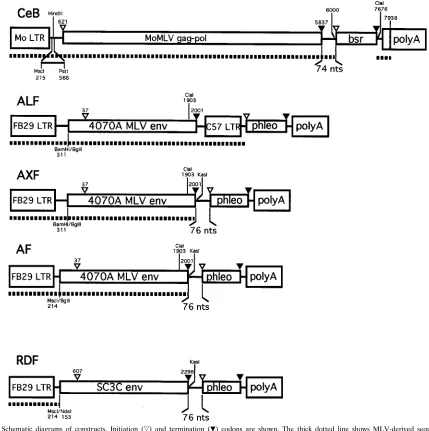
from pOXEnv (kindly provided by S. J. Russell) (27), which provides the end of the Moloney murine leukemia virus (MoMLV) pol gene. The resulting plasmid, named CeB (Fig. 1), could express the MoMLV gag-pol gene as well as the bsr selectable marker, conferring resistance to blasticidin S, both driven by the MoMLV 59long terminal repeat (LTR) promoter.
A series of env expression plasmids were generated by using the 4070A * Corresponding author. Mailing address: Chester Beatty
Laborato-ries, Institute of Cancer Research, 237 Fulham Rd., London SW3 6JB, United Kingdom. Phone: 44 171 352 8133. Fax: 44 171 352 3299. Electronic mail address: [email protected].
7430
on November 9, 2019 by guest
http://jvi.asm.org/
MLV-A env gene (23) and the FB29 Friend MLV promoter (24). In ALF (Fig. 1), a BglII-ClaI fragment containing the env gene was cloned into the BamHI and
ClaI sites of plasmid FB3LPh (1a), which also contained the C57 Friend MLV
LTR driving the expression of the phleomycin resistance (phleo) selection marker (8). A 136-bp env fragment was generated by PCR with plasmid FB3 (10) as the template and a pair of oligonucleotides, 59-GCTCTTCGGACCCTGC ATTC at the 59end (before the ClaI site) and 59-TAGCATGGCGCCCTATGG CTCGTACTCTATAGGC at the 39end, providing a KasI restriction site imme-diately after the env stop codon. This PCR fragment was digested with ClaI and
KasI. A DNA fragment containing the FB29 LTR and the MLV-A env gene was
obtained by ClaI digestion of ALF. The fragments were coligated in
NdeI-KasI-digested pUT626 (kindly provided by Daniel Drocourt, CAYLA). In the
resulting plasmid, named AXF (Fig. 1), the phleo selectable marker was ex-pressed from the same mRNA as the env gene. A BglII restriction site was created after the MscI site at position 214 in the FB29 leader by using a com-mercial linker (Biolabs). An NdeI-BglII fragment containing the FB29 LTR was coinserted with the BglII-ClaI env fragment into NdeI-ClaI-digested AXF plas-mid DNA, resulting in plasplas-mid AF (Fig. 1). AF has a 100-bp-larger deletion in the leader region than AXF.
The RD114 env gene was first subcloned in plasmid Bluescript KS1 (Strat-agene) as a 3-kb HindIII insert isolated from SC3C, an RD114 infectious DNA
clone (kindly provided by S. O’Brien) (25). This env gene was sequenced (EMBL accession number X87829). The 59noncoding sequence upstream of an NdeI site was deleted by EcoRI and NdeI digestion followed by filling-in with Klenow enzyme and self-ligation. From this plasmid, two DNA fragments were obtained: a BamHI-NcoI 2.5-kb fragment and a 63-bp PCR-generated DNA fragment (using 59-CGCCTCATGGCCTTCATTAA at the 59end [before the NotI site] and 59-TAGCATGGCGCCTCAATCCTGAGCTTCTTCC at the 39end), pro-viding a KasI restriction site just after the RD114 env gene stop codon. The PCR fragment was digested with NcoI and KasI. Both fragments were coinserted between the BglII and KasI sites of AF, and the resulting plasmid was named RDF (Fig. 1).
Plasmid pCRIPAMgag2(7) (kindly provided by O. Danos and J. M. Heard) was used for transfection.
Infection assays.Target cells were seeded in 24-multiwell plates (43104 cells per well) and incubated overnight. Infections were then carried out at 378C by plating 1 ml of dilutions of viral supernatants in the presence of Polybrene (4
[image:2.612.91.520.72.503.2]mg/ml; Sigma) on target cells. After 3 h, virus-containing medium was replaced by fresh medium, and infected cells were incubated for 2 days before X-Gal (5-bromo-4-chloro-3-indolyl-b-D-galactopyranoside) staining, performed as pre-viously described (36, 37). Viral titers were determined by counting LacZ-posi-tive colonies as previously described (5). The stability of LacZ pseudotype viruses FIG. 1. Schematic diagrams of constructs. Initiation (É) and termination (ç) codons are shown. The thick dotted line shows MLV-derived sequences. The nucleotide positions of MLV-derived sequences are shown according to Shinnick et al. (33) for CeB (from nt 1 to nt 6000, with deletion of the packaging signal from
BalI [nt 215] to PstI [nt 568] and with some further MoMLV sequences from nt 7676 to nt 7938), Perryman et al. (23) (from nt 1 to nt 311 or 214), and Ott et al. (24)
(from BglII to nt 2001) for ALF, AXF, and AF and Perryman et al. (23) (from nt 1 to nt 214) for RDF. Numbering of the RD114 sequence for RDF (from nt 153 to nt 2298) is as reported (EMBL accession number X87829).
on November 9, 2019 by guest
http://jvi.asm.org/
in fresh human serum was examined by titrating surviving virus after incubation in a 1:1 mixture of virus harvest in serum-free medium and fresh human serum for 1 h at 378C as described before (37).
RT assays.The reverse transcriptase (RT) assays were performed either as described previously (37) or with an RT assay kit (Boehringer Mannheim) following the manufacturer’s instructions but using MnCl2(2 mM) instead of MgCl2.
Nucleotide sequence accession number.The EMBL accession number for the sequence of the RD114 env gene is X87829.
RESULTS
Screening of producer cell lines.We have shown that viral
particles generated with RD114 envelopes are more stable in human serum than virions with MLV-A envelopes and that the producer cell line also controls sensitivity (37). We have also found that viruses produced by certain nonprimate cells are sensitive to human serum because they bear Gal(a 1-3)galac-tosyl sugar on their envelope, which activates complement via ‘‘natural’’ antibodies against this sugar epitope present in hu-man serum (38). We therefore screened a panel of cell lines, mostly of primate origin, for their ability to produce high-titer viruses and for the sensitivity of these virions to human serum. To do this, cells were infected at high multiplicity with LacZ pseudotype viruses of either MLV-A or RD114, and cells pro-ducing helper-positive LacZ pseudotype viruses were estab-lished. Human HT1080 and TE671 and mink Mv-1-Lu cells were found to release high-titer LacZ(RD114) and LacZ (MLV-A) viruses. The LacZ(MLV-A) pseudotype viruses pro-duced by HT1080 cells were more resistant to human serum than those produced by other cells. The titer of these viruses was only fourfold lower following a 1-h incubation with human serum than in a control incubation with fetal calf serum (Table 1). The LacZ(RD114) pseudotype viruses produced by human cells and mink Mv-1-Lu cells were in general stable in human serum (Table 1). These results suggested that HT1080, TE671, and Mv-1-Lu cells provided the best combination of high LacZ virus titers and resistance to human serum, and they were therefore used for the generation of retroviral packaging cells.
Construction of an improvedgag-polexpression vector.An
MoMLV gag-pol expression plasmid, CeB (Fig. 1), was derived from pCRIP (7). Approximately 2 kb of env sequence were removed from pCRIP, and the bsr selectable marker, confer-ring resistance to blasticidin S (12), was inserted 74 nucleotides (nt) downstream of the gag-pol gene. This 74-nt interval had no
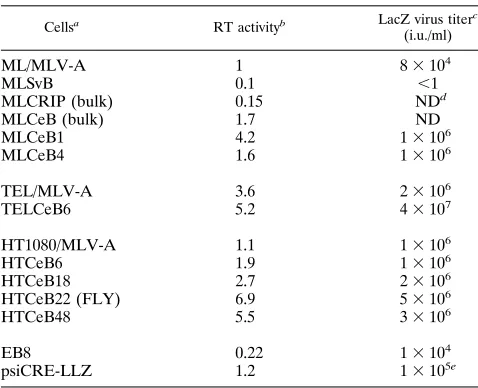
ATG triplets and was thought to provide an optimal distance between the stop codon of the pol reading frame and the start codon of the bsr gene to allow reinitiation of translation (15). Therefore, bsr could only be expressed by reinitiation of trans-lation after the upstream gag-pol gene had been expressed. Consequently, after transfection of CeB into Mv-1-Lu/MFGnls LacZ (ML), TE671/MFGnlsLacZ (TEL), or HT1080 cells, blasticidin S-resistant bulk populations and most cell clones expressed high levels of Gag-Pol proteins, as assessed from the RT activity found in cell supernatants (Table 2). Considerably higher RT activities were found in bulk populations of CeB-transfected ML cells than in bulk populations of ML cells stably transfected with the parental pCRIP construct. Simi-larly, the RT activities of two packaging cell lines generated by using the pCRIPenv2 construct, psiCRE cells (7) and EB8 cells (1), were less than that of CeB-transfected clones (Table 2). Indeed, RT activity in CeB-transfected cell supernatants was higher than that of cells chronically infected by replication-competent MLV-A (Table 2).
To rescue infectious LacZ viruses, MLCeB and TELCeB clones were transfected with ALF DNA, a plasmid designed to express the MLV-A env gene (Fig. 1). Bulk populations of stable ALF transfectants were isolated, and supernatants were titrated by using TE671 cells as targets. Titers of LacZ viruses were higher than in either MLV-A-infected ML or TEL cells or ALF-transfected EB8 cells (Table 2). These data suggested that CeB was an extremely efficient MLV gag-pol expression vector in mink Mv-1-Lu and TE671 cells. We therefore used CeB to derive packaging cells by transfection of HT1080 cells. Forty-one of 49 blasticidin S-resistant colonies had detectable levels of RT; 9 had RT activity higher than that of control MLV-A-infected HT1080 cells (data not shown). Expression of the Gag precursor was confirmed in cell lysates and
superna-TABLE 2. Secreted RT expression
Cellsa RT activityb LacZ virus titerc (i.u./ml)
ML/MLV-A 1 83104
MLSvB 0.1 ,1
MLCRIP (bulk) 0.15 NDd
MLCeB (bulk) 1.7 ND
MLCeB1 4.2 13106
MLCeB4 1.6 13106
TEL/MLV-A 3.6 23106
TELCeB6 5.2 43107
HT1080/MLV-A 1.1 13106
HTCeB6 1.9 13106
HTCeB18 2.7 23106
HTCeB22 (FLY) 6.9 53106
HTCeB48 5.5 33106
EB8 0.22 13104
psiCRE-LLZ 1.2 13105e
a
ML, Mv-1-Lu cells harboring a MFGnlslacZ provirus; TEL, TE671 cells harboring a MFGnlslacZ provirus; /MLV-A, cells chronically infected with MLV-A strain 1504; MLSvB, ML cells transfected with plasmid pSV2bsr alone; MLCRIP, ML cells cotransfected with pCRIP and pSV2bsr.
b
Average of ratios of RT activity relative to that released by ML/MLV-A cells of at least two independent experiments is shown. The standard errors did not exceed 20% of the values.
c
Titer determined on TE671 cells (except as noted) after polyclonal transfec-tion of a plasmid which expresses MLV-A env in MLCeB clones, TELCeB clones, HTCeB clones, and EB8 cells.
d
ND, not done. e
[image:3.612.58.299.83.243.2]Titer determined on NIH 3T3 cells. TABLE 1. Titer and stability of LacZ pseudotypesa
Producer cells
LacZ(MLV-A) LacZ(RD114)
Titer (i.u./ml)
Stability (% of control)
Titer (i.u./ml)
Stability (% of control)
A204 650 ,3 1,200 105
HeLa 9 NDb 2,000 115
HOS 4,500 6 23,000 86
HT1080 2,000,000 26 400,000 129
MRC-5 450 10 1,000 ND
T24 350 ND 1,200 ND
TE671 15,000 2 90,000 38
Vero 260 ND 90 ND
D17 900 ,1 200,000 1
Mv-1-Lu 80,000 1 200,000 120
aTiter was determined on TE671 cells. Stability is expressed as the infectivity of human treated viruses as a percentage of that of fetal calf serum-treated viruses.
bND, not done.
on November 9, 2019 by guest
http://jvi.asm.org/
[image:3.612.315.554.436.630.2]tants of these nine HTCeB clones by immunoblotting with antibodies against p30-CA (data not shown). The four clones with the highest expression of Gag proteins (clones 6, 18, 22, and 48) were infected at high multiplicity with helper-free LacZ pseudotypes bearing MLV-A envelopes [MFGnlslacZ (A)] produced by TELCeB6/ALF (Table 3) and then trans-fected with ALF. Supernatants of bulk, phleomycin-resistant transfectants were assessed for RT activity and LacZ virus titer (Table 2). Clone HTCeB22, named FLY, was found to be the best Gag-Pol producer clone and was used to introduce env expression vectors for the generation of packaging cell lines.
Construction ofenvexpression vectors.A series of MLV-A
env expression plasmids were then generated (Fig. 1). In ALF,
the env gene was inserted between two Friend-MLV LTRs, its expression driven by the FB29 MLV LTR (24). Most of the packaging signal located in the leader region was deleted. This plasmid also expressed the phleo selectable marker (8) driven by the 39LTR. AXF and AF were then designed following the same strategy used for CeB. These two vectors differed only by the extent of deletion of the packaging signal, AF having
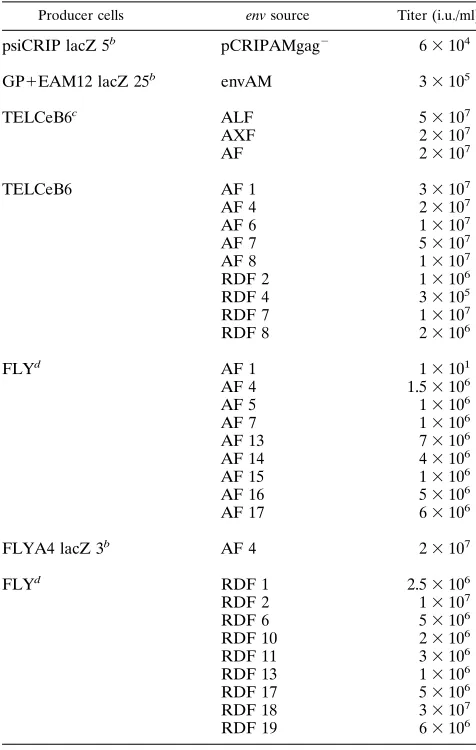
vir-tually no leader sequence. Compared with the pCRIPAMgag2 and pCRIPgag-2 env plasmids expressed in psiCRIP and psi-CRE packaging cells (7), about 5 kb of gag-pol sequence was removed. In addition, the 258-bp retroviral sequence contain-ing the end of the env gene and the beginncontain-ing of U3 found in pCRIPAMgag2and pCRIPgag22 was also removed. For both the AXF and AF plasmids, the phleo selectable marker was inserted downstream of the env gene by positioning a 76-nt linker with no ATG codons between the two open reading frames. phleo could therefore only be expressed by reinitiation of translation by the same ribosomal unit that had expressed the upstream env open reading frame. AF was also used to generate RDF, an RD114 envelope expression plasmid (Fig. 1). After transfection of the env plasmids into TELCeB6 cells (Table 2), bulk populations of phleomycin-resistant colonies were isolated, and their production of LacZ virus was mea-sured (Table 3). ALF gave a titer of 53107LacZ virus i.u./ml,
while the titers with AXF and AF were 23 107 LacZ virus
i.u./ml (Table 3). Titers of 53107and 107LacZ virus i.u./ml
could be obtained with some AF cell clones and RDF clones, respectively.
As AF has minimal virus-derived sequences and was shown to be the safest construct (see below and Table 4), it and RDF were used to generate packaging lines from FLY cells (clone HTCeB22 [Table 2]). Envelope expression of these clones was assayed by interference to challenge with MFGnlslacZ(A) and MFGnlslacZ(RD) pseudotype viruses produced by TELCeB6/ AF-7 and TELCeB6/RDF-7, respectively (Table 3). The cell lines showing the most interference were cross-infected at high multiplicity with these pseudotype viruses to provide MFGnls lacZ proviruses, and supernatants were then titrated on TE671 cells (Table 3). FLY-AF-13 (FLYA13 packaging line) and FLY-RDF-18 (FLYRD18 packaging line) gave the highest productions of LacZ viruses, about 107LacZ virus i.u./ml. The
best MFGnlslacZ producer clones, derived from either psi-CRIP cells (7) or GP1EAM12 cells (17), gave approximately 50-fold-lower titers (Table 3). The LacZ virus titers of the FLY-derived lines shown in Table 3 are lower than those of the best TELCeB6-derived lines after transfection of either AF or RDF (Table 3). However, it should be noted that the LacZ provirus expressed in TELCeB6 cells was obtained after clonal selection but was introduced polyclonally in FLY-derived env-transfected cell clones. When FLY-AF-4 cells (FLYA4 pack-aging line), infected with helper-free MFGnlslacZ(RD), were cloned by limiting dilution, the best clones (e.g., FLYA4lacZ3) were found to produce 20 times more infectious viruses than the bulk population, reaching the range of titers obtained with the best TELCeB6-AF clones (Table 3).
Assays for transfer ofgag-polandenvfunctions.To assay for
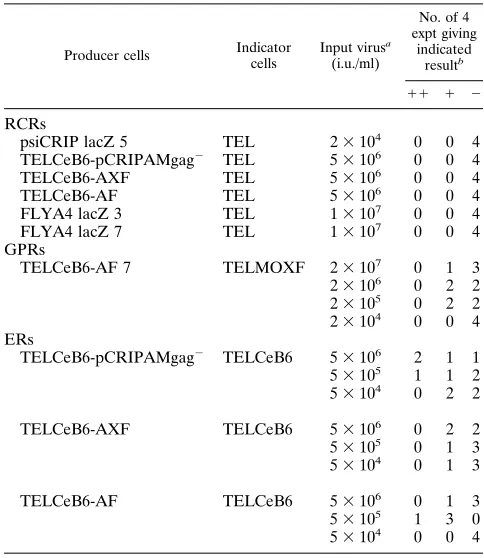
replication-competent viruses, supernatants were used to in-fect TEL cells (a clone of TE671 cells harboring an MFGnls lacZ provirus). Infected cells were passaged for 6 days or longer, and their supernatants were used for infection of fresh TE671 cells. No transmission of LacZ viruses could be de-tected (Table 4), demonstrating that the supernatants of pCRI PAMgag2-, ALF-, AXF-, or AF-transfected TELCeB6 cells were helper-free. A similar absence of replication-competent recombinant retroviruses was demonstrated by using the su-pernatant from a clone of psiCRIP-MFGnlslacZ cells or two clones of FLYA-MFGnlslacZ cells (Table 4).
There have been reports that helper-free retroviral vector stocks may nevertheless contain recombinant retroviruses (replication incompetent) carrying either gag-pol or env genes (4, 9, 16). To assay for such recombinant retroviruses, we attempted to mobilize an MFGnlslacZ provirus from two in-dicator cell lines, which could cross-complement potential re-TABLE 3. Titers following env construct transfectiona
Producer cells env source Titer (i.u./ml)
psiCRIP lacZ 5b pCRIPAMgag2 63104
GP1EAM12 lacZ 25b envAM 33105
TELCeB6c ALF 53107
AXF 23107
AF 23107
TELCeB6 AF 1 33107
AF 4 23107
AF 6 13107
AF 7 53107
AF 8 13107
RDF 2 13106
RDF 4 33105
RDF 7 13107
RDF 8 23106
FLYd AF 1 13101
AF 4 1.53106
AF 5 13106
AF 7 13106
AF 13 73106
AF 14 43106
AF 15 13106
AF 16 53106
AF 17 63106
FLYA4 lacZ 3b AF 4 23107
FLYd RDF 1 2.53106
RDF 2 13107
RDF 6 53106
RDF 10 23106
RDF 11 33106
RDF 13 13106
RDF 17 53106
RDF 18 33107
RDF 19 63106
aAverage titers of at least three independent experiments are shown. The standard errors did not exceed 30% of the titer values. Titers were determined on TE671 cells (LacZ virus i.u. per milliliter).
bBest MFGnlslacZ producer clones.
cBulk populations of env transfectants in TELCeB6 cells. dTitration after bulk infection with helper-free MFGnlslacZ.
on November 9, 2019 by guest
http://jvi.asm.org/
[image:4.612.57.295.83.458.2]combinant viruses. The TELCeB6 line (Table 2), expressing Gag-Pol proteins, was used as the indicator cell line to test for the presence of env recombinant (ER) viruses. The TELMOXF indicator line, expressing MoMLV env glycopro-teins (obtained by transfection of MOXF, a plasmid expressing the MoMLV env gene using the AXF backbone, into TEL cells), was used to detect the presence of gag-pol recombinant (GPR) retroviruses. After passaging for 4 to 8 days, the super-natants of the infected indicator cells were used to infect either human TE671 cells or murine NIH 3T3 cells.
TELCeB6 cells transfected with the various env-expressing constructs, pCRIPAMgag2, AXF, and AF, were compared. Although the supernatants of TELCeB6-AF cells were devoid of replication-competent retroviruses, they were found sporad-ically to transfer gag-pol genomes (Table 4). No GPR viruses could be detected when fewer than 23105virions were used
to infect the indicator cells. Similarly, TELCeB6 indicator cells infected with various helper-free viruses were shown to spo-radically release LacZ virions (Table 4). The number de-pended both on the env expression vector used and on the virus input quantity. Compared with LacZ viruses generated by us-ing the pCRIPAMgag2plasmid, the frequency of detection of the ER viruses was lower for supernatants generated by using AXF and AF constructs (Table 4). For the AF construct when fewer than 5 3105MFGnlslacZ(A) helper-free virions were
used to infect the indicator cells, no ER retroviruses could be detected. From these experiments, it could be estimated that a supernatant produced from TELCeB6-AF cells, containing 107
i.u. of MFGnlslacZ retroviral vector, contained less than one
replication-competent virus and about 100 GPR and 100 ER retroviruses.
Complement resistance and helper-free status of LacZ
vec-tors produced by FLYA13 and FLYRD18 cells. In order to
confirm the resistance to complement and the absence of rep-lication-competent virus in our best packaging lines, MFGnls lacZ(A) and MFGnlslacZ(RD), harvested from FLYA13 and FLYRD18, respectively, after polyclonal transduction of MF-GnlslacZ (Table 3) were tested for stability in fresh human serum and generation of replication-competent virus. The ti-ters of MFGnlslacZ(RD) from FLYRD18 after 1 h of incuba-tion with three independent samples of fresh human serum were 80 to 120% of those in control incubations without serum, while the titers of MFGnlslacZ(A) from FLYA13 were 50 to 90% of control titers (data not shown). No replication-compe-tent virus was detected in the assay described above (Table 4) when 107i.u. each of MFGnlslacZ(A) and MFGnlslacZ(RD)
were tested.
DISCUSSION
We describe novel retroviral packaging cells, called FLY cells, designed for in vivo gene delivery. The retroviral vectors prepared from these cells are not inactivated by human serum and can be obtained at much higher titers, unlike previous vectors.
We found considerable variations between the various cell lines screened for their ability to release type C retroviruses. In addition, few cell lines were able to produce retroviruses that were completely resistant to human serum. By these two cri-teria, human fibrosarcoma HT1080 cells were selected for the construction of packaging cells. Other studies have shown the importance of endogenous retrovirus expression in the gener-ation of recombinant retroviruses from retroviral packaging lines (26, 40). The copackaging of an endogenous genome and a vector can lead to the emergence of recombinant retroviruses (40). Recombination involves template switching during re-verse transcription of such hybrid retroviruses (11), and ho-mologies between the two genomes considerably enhance the frequency of RT jumps (41). Therefore, an ideal packaging cell line should not express endogenous MLV-like (or type C ret-rovirus-like) retroviral genomes which can be packaged by type C Gag proteins (30, 39). In recent studies (23a), we could not detect expression of type C retroviruses in HT1080 cells by PCR analysis with generic primers (32), suggesting that HT1080-derived FLY packaging cells may be safer in this re-spect than those generated from NIH 3T3 cells, which are known to express and package sequences related to type C retroviruses (30).
To generate the FLY packaging cell lines, HT1080 cells were transfected with gag-pol and env expression plasmids designed to optimize viral protein expression. Direct selection for viral gene expression was achieved by expression of a selectable marker gene by reinitiation of translation of the mRNA ex-pressing the viral proteins. This strategy resulted in packaging cell lines capable of producing extremely high-titer viruses. Furthermore, selection for packaging functions can be main-tained in these cells. We also eliminated many unnecessary viral sequences from the packaging constructs to reduce the risk of helper virus generation. The final packaging cells did not produce helper virus, in that no RCR could be detected per 107vector particles, although it must be noted that only a
[image:5.612.56.298.82.361.2]small volume of viral supernatant was assayed. However, it is of concern that recombinant retroviruses expressing either MLV Gag-Pol or Env proteins could be detected. Our data demonstrate that retroviral vector stocks are contaminated TABLE 4. Transfer of packaging function
Producer cells Indicator cells
Input virusa (i.u./ml)
No. of 4 expt giving
indicated resultb
11 1 2
RCRs
psiCRIP lacZ 5 TEL 23104 0 0 4
TELCeB6-pCRIPAMgag2 TEL 53106 0 0 4
TELCeB6-AXF TEL 53106 0 0 4
TELCeB6-AF TEL 53106 0 0 4
FLYA4 lacZ 3 TEL 13107 0 0 4
FLYA4 lacZ 7 TEL 13107 0 0 4
GPRs
TELCeB6-AF 7 TELMOXF 23107 0 1 3
23106 0 2 2
23105 0 2 2
23104 0 0 4
ERs
TELCeB6-pCRIPAMgag2 TELCeB6 53106 2 1 1
53105 1 1 2
53104 0 2 2
TELCeB6-AXF TELCeB6 53106 0 2 2
53105 0 1 3
53104 0 1 3
TELCeB6-AF TELCeB6 53106 0 1 3
53105 1 3 0
53104 0 0 4 a
Number of LacZ virus i.u. used to infect indicator cells. b
Results from four experiments in which indicator cells were exposed to 1 ml of virus in each experiment. The ranges of LacZ virus titers rescued from infected indicator cells are shown for each virus input:11,.100 LacZ virus i.u./ml;1, 1 to 100 LacZ virus i.u./ml;2,,1 LacZ virus i.u./ml. Titers were
determined on TE671 cells for RCRs and ERs and on NIH 3T3 cells for GPRs.
on November 9, 2019 by guest
http://jvi.asm.org/
with such recombinant viruses at about 1 per 105vector
parti-cles. The new FLY packaging cells are safer than, for example, psiCRIP cells, at least for the generation of ER retroviruses in a short-term assay (Table 4), probably because fewer retroviral sequences overlapping the vector were present in our env ex-pression plasmid. Few reports have addressed the question of the characterization of recombinant retroviruses (4, 9). It is possible that such viruses could not be detected in previous packaging cell lines because of low overall titers. Recombinant retroviruses are defective in normal cell culture conditions but are likely to evolve to replication-competent viruses if they are allowed to replicate in cells complementing their expression, such as cocultivated packaging cells (3, 4). They may modify other viruses, such as human immunodeficiency virus or endo-genous viruses, by phenotypic and genetic mixing in gene ther-apy recipients. It will be important for the future development of retroviral packaging systems to eradicate recombinant ret-roviruses, perhaps by removal of viral LTRs from the packag-ing construct.
Consistent with our previous studies (37), LacZ(RD114) pseudotypes produced from HT1080 cells were more resistant to human complement than LacZ(MLV-A) pseudotypes. We therefore decided to use the RD114 env gene to generate recombinant virions with MoMLV cores. We have determined the sequence of the RD114 env gene and found it to be very close to that of baboon endogenous virus, a type C retrovirus (2, 13) with an envelope gene displaying similarities to the external part of type D simian retroviruses. RD114 uses the simian retrovirus receptor on human cells (34, 35), making the FLY packaging cells with the RD114 envelope capable of generating virions with different tropisms. The retroviral vec-tors prepared so far for human gene therapy have used either MLV-A or gibbon ape leukemia virus envelopes, which display many similarities (1) and which use two related cell surface receptors for infection (21). Differences in tissue-specific ex-pression of the MLV-A and the gibbon ape leukemia virus receptors have been reported (14), and it will now be interest-ing to see whether particular cell types can be recognized by RD114 Env-coated retroviral vectors.
ACKNOWLEDGMENTS
This work was supported by the International Human Frontiers Science Program, the Medical Research Council, and the Cancer Re-search Campaign.
We thank Takashi Kamakura and Clive Patience for helpful discus-sions as well as Colin Porter for critical reading of the manuscript.
ADDENDUM IN PROOF
The FLYA13 and FLYRD18 cell lines will soon be available for research purposes from the European Collection of Cell Cultures under ECACC accession numbers 95091901 and 95091902, respectively.
REFERENCES
1. Battini, J. L., J. M. Heard, and O. Danos. 1992. Receptor choice determi-nants in the envelope glycoproteins of amphotropic, xenotropic, and poly-tropic murine leukemia viruses. J. Virol. 66:1468–1475.
1a.Battini, J. L. Unpublished data.
2. Benveniste, R. E., and G. Todaro. 1973. Homology between type-C viruses of various species as determined by molecular hybridisation. Proc. Natl. Acad. Sci. USA 70:3316–3320.
3. Bestwick, R. K., S. L. Kozak, and D. Kabat. 1988. Overcoming interference to retroviral superinfection results in amplified expression and transmission of cloned genes. Proc. Natl. Acad. Sci. USA 85:5404–5408.
4. Cosset, F. L., A. Girod, F. Flamant, A. Drynda, C. Ronfort, S. Valsesia, R. M.
Molina, C. Faure, V. M. Nigon, and G. Verdier.1993. Use of helper cells with two host ranges to generate high-titer retroviral vectors. Virology 193:385–395.
5. Cosset, F. L., C. Legras, Y. Chebloune, P. Savatier, P. Thoraval, J. L.
Thomas, J. Samarut, V. M. Nigon, and G. Verdier.1990. A new avian leukosis virus-based packaging cell line that uses two separate transcomple-menting helper genomes. J. Virol. 64:1070–1078.
6. Cosset, F. L., C. Legras, J. L. Thomas, R. M. Molina, Y. Chebloune, C.
Faure, V. M. Nigon, and G. Verdier.1991. Improvement of avian leukosis virus (ALV)-based retrovirus vectors by using different cis-acting sequences from ALVs. J. Virol. 65:3388–3394.
7. Danos, O., and R. C. Mulligan. 1988. Safe and efficient generation of re-combinant retroviruses with amphotropic and ecotropic host ranges. Proc. Natl. Acad. Sci. USA 85:6460–6464.
8. Gatignol, A., H. Durand, and G. Tiraby. 1988. Bleomycin resistance con-ferred by a drug-binding protein. FEBS Lett. 230:171–175.
9. Girod, A., F. L. Cosset, G. Verdier, and C. Ronfort. 1995. Analysis of ALV-based packaging cell lines for production of contaminant defective viruses. Virology 209:671–675.
10. Heard, J. M., and O. Danos. 1991. An amino-terminal fragment of the Friend murine leukemia virus envelope glycoprotein binds the ecotropic receptor. J. Virol. 65:4026–4032.
11. Hu, W. S., and H. M. Temin. 1990. Retroviral recombination and reverse transcription. Science 250:1227.
12. Izumi, M., H. Miyazawa, T. Kamakura, I. Yamaguchi, T. Endo, and F.
Hanaoka.1991. Blasticidin S-resistance gene (bsr): a novel selectable marker for mammalian cells. Exp. Cell Res. 197:229–233.
13. Kato, S., K. Matsuo, N. Nishimura, N. Takahashi, and T. Takano. 1987. The entire nucleotide sequence of baboon endogenous virus DNA: a chimeric genome structure of murine type C and simian type D retrovirus. Jpn. J. Genet. 62:127–137.
14. Kavanaugh, M. P., D. G. Miller, W. Zhang, W. Law, S. L. Kozak, D. Kabat,
and A. D. Miller.1994. Cell-surface receptors for gibbon ape leukemia virus and amphotropic murine retrovirus are inducible sodium-dependent phos-phate symporters. Proc. Natl. Acad. Sci. USA 91:7071–7075.
15. Kozak, M. 1987. Effects of intercistronic length on the efficiency of reinitia-tion by eucaryotic ribosomes. Mol. Cell. Biol. 7:3438–3445.
16. Kozak, S. L., and D. Kabat. 1990. Ping-pong amplification of a retroviral vector achieves high-level gene expression: human growth hormone produc-tion. J. Virol. 64:3500–3508.
17. Markowitz, D., S. Goff, and A. Bank. 1988. Construction and use of a safe and efficient amphotropic packaging cell line. Virology 167:400–406. 18. Miller, A. D. 1990. Retrovirus packaging cells. Hum. Gene Ther. 1:5–14. 19. Miller, A. D. 1992. Human gene therapy comes of age. Nature (London)
357:455–460.
20. Miller, A. D., J. V. Garcia, N. von Suhr, C. M. Lynch, C. Wilson, and M. V.
Eiden.1991. Construction and properties of retrovirus packaging cells based on gibbon ape leukemia virus. J. Virol. 65:2220–2224.
21. Miller, D. G., and A. D. Miller. 1994. A family of retroviruses that utilize related phosphate transporters for cell entry. J. Virol. 68:8270–8276. 22. Muenchau, D. D., S. M. Freeman, K. Cornetta, J. A. Zwiebel, and W. F.
Anderson.1990. Analysis of retroviral packaging lines for generation of replication-competent virus. Virology 176:262–265.
23. Ott, D., R. Friedrich, and A. Rein. 1990. Sequence analysis of amphotropic and 10A1 murine leukemia virus: close relationship to mink cell focus-forming viruses. J. Virol. 64:757–766.
23a.Patience, C., Y. Takeuchi, F.-L. Cosset, and R. A. Weiss. Unpublished data. 24. Perryman, S., J. Nishio, and B. Chesebro. 1991. Complete nucleotidic se-quence of Friend murine leukemia virus, strain FB29. Nucleic Acids Res.
19:6950.
25. Reeves, R. H., and S. J. O’Brien. 1984. Molecular genetic characterization of the RD114 gene family of endogenous feline retroviral sequences. J. Virol.
52:164–171.
26. Ronfort, C., A. Girod, F. L. Cosset, C. Legras, V. M. Nigon, Y. Chebloune,
and G. Verdier.1995. Defective retroviral endogenous RNA is efficiently transmitted by infectious particles produced on an avian retroviral vector packaging cell line. Virology 207:271–275.
27. Russell, S. J., R. E. Hawkins, and G. Winter. 1993. Retroviral vectors dis-playing functional antibody fragments. Nucleic Acids Res. 21:1081–1085. 28. Samarut, J., F. Flamant, and J. M. Heard. Replication-defective retrovirus
vectors for oncogenic studies. Methods Enzymol., in press.
29. Sambrook, J., E. F. Fritsch, and T. Maniatis. 1989. Molecular cloning: a laboratory manual, 2nd ed. Cold Spring Harbor Laboratory Press, Cold Spring Harbor, N.Y.
30. Scadden, D. T., B. Fuller, and J. M. Cunningham. 1990. Human cells in-fected with retrovirus vectors acquire an endogenous murine provirus. J. Virol. 64:424–427.
31. Scarpa, M., D. Cournoyer, D. M. Muzny, K. A. Moore, J. W. Belmont, and
C. T. Caskey.1991. Characterization of recombinant helper retroviruses from Moloney-based vectors in ecotropic and amphotropic packaging cell lines. Virology 180:849–852.
32. Shih, A., R. Misra, and M. G. Rush. 1989. Detection of multiple, novel reverse transcriptase coding sequences in human nucleic acids: relation to primate retroviruses. J. Virol. 63:64–75.
33. Shinnick, T. M., R. A. Lerner, and J. G. Sutcliffe. 1981. Nucleotide sequence
on November 9, 2019 by guest
http://jvi.asm.org/
of Moloney murine leukemia virus. Nature (London) 293:543–548. 34. Sommerfelt, M. A., and R. A. Weiss. 1990. Receptor interference groups of
20 retroviruses plating on human cells. Virology 176:58–69.
35. Sommerfelt, M. A., B. P. Williams, A. McKnight, P. N. Goodfellow, and R. A.
Weiss.1990. Localization of the receptor gene for type D simian retroviruses on human chromosome 19. J. Virol. 64:6214–6220.
36. Tailor, C. S., Y. Takeuchi, B. O’Hara, S. V. Johann, R. A. Weiss, and M. K. L.
Collins.1993. Mutation of amino acids within the gibbon ape leukemia virus (GALV) receptor differentially affects feline leukemia virus subgroup B, simian sarcoma-associated virus, and GALV infection. J. Virol. 67:6737–6741. 37. Takeuchi, Y., F. L. Cosset, P. J. Lachmann, H. Okada, R. A. Weiss, and
M. K. L. Collins.1994. Type C retrovirus inactivation by human complement is determined by both the viral genome and producer cell. J. Virol. 68:8001– 8007.
38. Takeuchi, Y., C. D. Porter, K. M. Strahan, A. F. Preece, K. Gustafsson, F. L.
Cosset, R. A. Weiss, and M. K. L. Collins.Sensitisation of cells and retro-viruses to human serum by alpha(1-3) galactosyltransferase. Submitted for publication.
39. Torrent, C., T. Bordet, and J. L. Darlix. 1994. Analytical study of rat retro-transposon VL30 RNA dimerization in vitro and packaging in murine leu-kemia virus. J. Mol. Biol. 240:434–444.
40. Vanin, E. F., M. Kaloss, C. Broscius, and A. W. Nienhuis. 1994. Character-ization of replication-competent retroviruses from nonhuman primates with virus-induced T-cell lymphomas and observations regarding the mechanism of oncogenesis. J. Virol. 68:4241–4250.
41. Zhang, J., and H. M. Temin. 1994. Retrovirus recombination depends on the length of sequence identity and is not error prone. J. Virol. 68:2409–2414.