Rochester Institute of Technology
RIT Scholar Works
Theses Thesis/Dissertation Collections
4-2015
Robust Recognition using L1-Principal
Component Analysis
Matthew Johnson
Follow this and additional works at:http://scholarworks.rit.edu/theses
This Thesis is brought to you for free and open access by the Thesis/Dissertation Collections at RIT Scholar Works. It has been accepted for inclusion in Theses by an authorized administrator of RIT Scholar Works. For more information, please [email protected].
Recommended Citation
Robust Recognition using L1-Principal Component Analysis
by
Matthew Johnson
A Thesis Submitted in Partial Fulfillment of the Requirements for the Degree of Master of Science in Computer Engineering
Supervised by
Dr. Andreas Savakis
Department of Computer Engineering Kate Gleason College of Engineering
Rochester Institute of Technology Rochester, NY
April 2015
Approved By:
_____________________________________________________________________________
Dr. Andreas Savakis
Primary Advisor – R.I.T. Department of Computer Engineering
_____________________________________________________________________________
Dr. Sonia Lopez Alarcon
Committee Member – R.I.T. Department of Computer Engineering
_____________________________________________________________________________
Dr. Raymond Ptucha
ii
Dedication
I would like to thank my family, I am forever grateful for your words of encouragement
iii
Acknowledgements
I would like to thank my advisor Dr. Andreas Savakis for his assistance and mentorship
in the process of developing this thesis. I would also like to thank my committee
members Dr. Sonia Lopez Alarcon and Dr. Raymond Ptucha. Additionally I want to
thank my colleagues in the Computer Vision Lab Breton Minnehan and Sriram Kumar,
iv
Abstract
The wide availability of visual data via social media and the internet, coupled
with the demands of the security community have led to an increased interest in visual
recognition. Recent research has focused on improving the accuracy of recognition
techniques in environments where variability is well controlled. However, applications
such as identity verification often operate in unconstrained environments. Therefore there
is a need for more robust recognition techniques that can operate on data with
considerable noise.
Many statistical recognition techniques rely on principal component analysis
(PCA). However, PCA suffers from the presence of outliers due to occlusions and noise
often encountered in unconstrained settings. In this thesis we address this problem by
using 𝐿1-PCA to minimize the effect of outliers in data. 𝐿1-PCA is applied to several
statistical recognition techniques including eigenfaces and Grassmannian learning.
Several popular face databases are used to show that 𝐿1-Grassmann manifolds not only
outperform, but are also more robust to noise and occlusions than traditional 𝐿2
-Grassmann manifolds for face and facial expression recognition. Additionally a high
performance GPU implementation of 𝐿1-PCA is developed using CUDA that is several
v
Table of Contents
Chapter 1 Introduction ...1
Chapter 2 Background ...4
2.1. Principal Component Analysis ... 4
2.1.1 L2-PCA ... 4
2.1.2 L1-PCA ... 7
2.2. PCA Recognition ... 10
2.3. Grassmannian Recognition ... 13
2.4. LBP/LTP Features ... 16
2.5. GPU Acceleration ... 18
2.5.1 General Purpose GPU Computing ... 18
2.5.2 GPU accelerated L1-PCA ... 21
Chapter 3 L1-PCA Recognition ...22
3.1. L1-PCA Algorithm Design ... 22
3.2. Recognition Techniques ... 24
3.2.1 L1-Eigenfaces... 24
3.2.2 L1-Grassmann ... 26
3.2.3 LTP Features ... 27
3.3. CPU Implementation ... 28
vi
Chapter 4 Experimental Results ...36
4.1. Experimental Setup... 36
4.2. Datasets ... 36
4.2.1 Yale Face Database ... 36
4.2.2 AT&T Database of Faces ... 38
4.2.3 Extended Yale Face Database B ... 39
4.2.4 AR Face Database ... 40
4.2.5 Labeled Faces in the Wild Database ... 41
4.2.6 Cohn-Kanade Databases ... 42
4.3. Parameter Selection ... 43
4.4. Accuracy Tests ... 44
4.5. Accuracy State of the Art ... 61
4.5.1 Yale Face Database ... 62
4.5.2 AT&T Database of Faces ... 63
4.5.3 Extended Yale Face Database B ... 63
4.5.4 AR Face Database ... 64
4.6. Speed tests ... 65
Chapter 5 Conclusion and Future Work ...69
vii
List of Figures
Figure 1: Multivariate Gaussian with Two Principal Components ... 4
Figure 2: L1-PCA Toy Example ... 7
Figure 3: First Ten Eigenpictures ... 11
Figure 4: Grassmann Manifold Mapping ... 13
Figure 5: LBP Operator ... 16
Figure 6: LTP Operator ... 17
Figure 7: CPU Architecture (left) vs GPU Architecture (right) ... 18
Figure 8: L1-PCA Algorithm Flow... 23
Figure 9: Eigenfaces from Occluded Dataset ... 24
Figure 10: Rectangular Noise on Yale Dataset ... 25
Figure 11: Recognition using Grassmann Manifolds ... 27
Figure 12: LTP Preprocessing ... 28
Figure 13: CPU Tree Reduction ... 30
Figure 14: GPU Kernel Flow ... 33
Figure 15: GPU Reduction... 34
Figure 16: Min Reduction Kernel ... 35
Figure 17: Yale Face Database Images Across Two Subjects ... 37
Figure 18: Yale Face Database Sample Image from each Subject ... 37
Figure 19: AT&T Database Images Across Two Subjects ... 38
Figure 20: AT&T Database Sample Image from each Subject ... 38
viii
Figure 22: Extended Yale Face Database B Sample Image from each Subject ... 39
Figure 23: AR Face Database Sample Image from each Subject ... 40
Figure 24: AR Face Database Images Across a Subject ... 41
Figure 25: LFW Face Database Images Across Two Subjects ... 41
Figure 26: : LFW Face Database Subjects with at Least 20 Images ... 42
Figure 27: Emotions from the Extended Cohn-Kanade Database ... 42
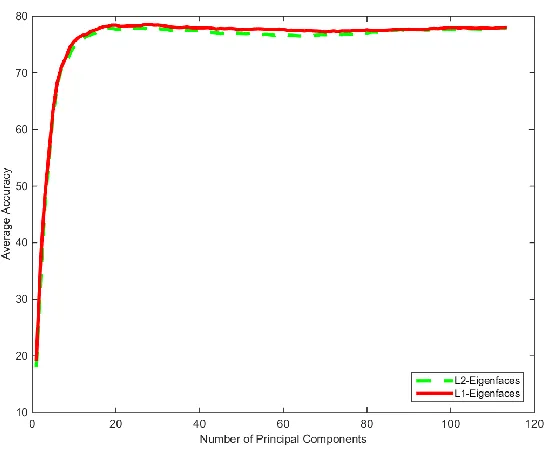
Figure 28: Eigenface Comparison Test Yale Database ... 45
Figure 29: Eigenface Comparison Test AT&T Database ... 45
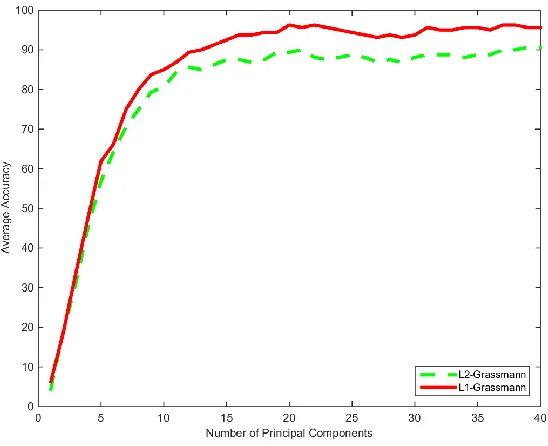
Figure 30: Grassmann Comparison Test Yale Database ... 46
Figure 31: Grassmann Comparison Test AT&T Database ... 46
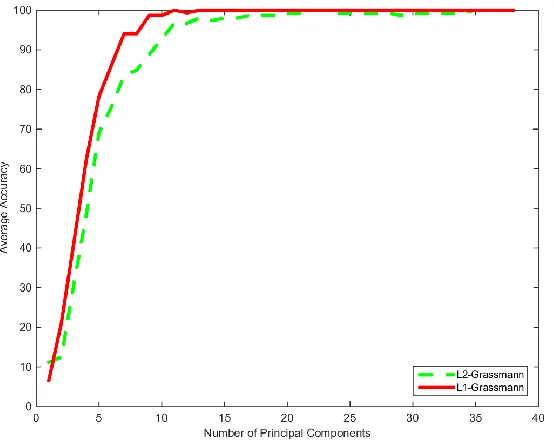
Figure 32: Grassmann Comparison Test Extended Yale B Database... 47
Figure 33: Eigenfaces Comparison Test Occluded Yale Database ... 48
Figure 34: Eigenfaces Comparison Test Occluded AT&T Database ... 48
Figure 35: Grassmann Comparison Test Occluded Yale Database ... 49
Figure 36: Grassmann Comparison Test Occluded AT&T Database ... 49
Figure 37: Grassmann Comparison Test Occluded Extended Yale... 50
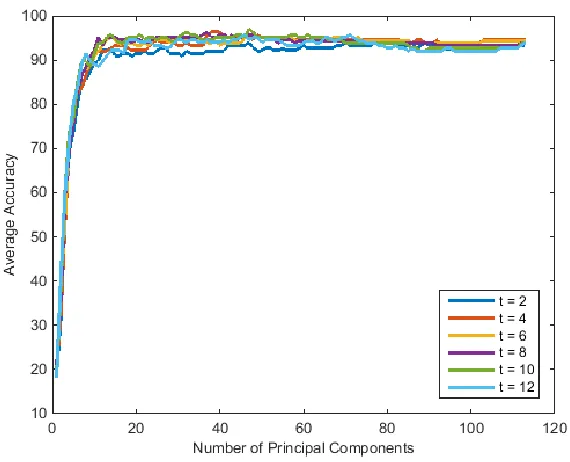
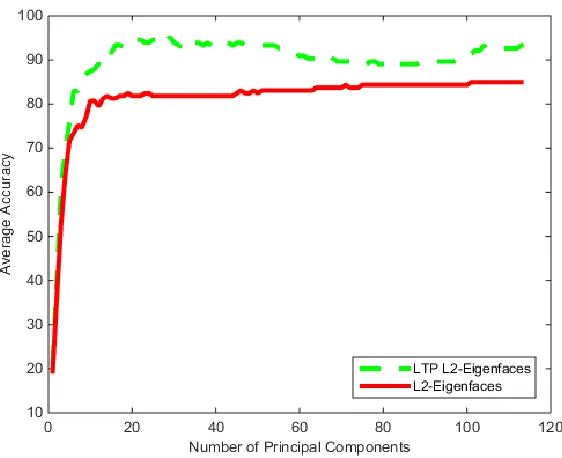
Figure 38: LTP L2-Eigenface t Test for Yale Database ... 51
Figure 39: LTP L1-Eigenface t Test for Yale Database ... 51
Figure 40: LTP Eigenfaces Test Yale Database (t = 2) ... 52
Figure 41: LTP Eigenfaces Test AT&T Database (t = 6) ... 53
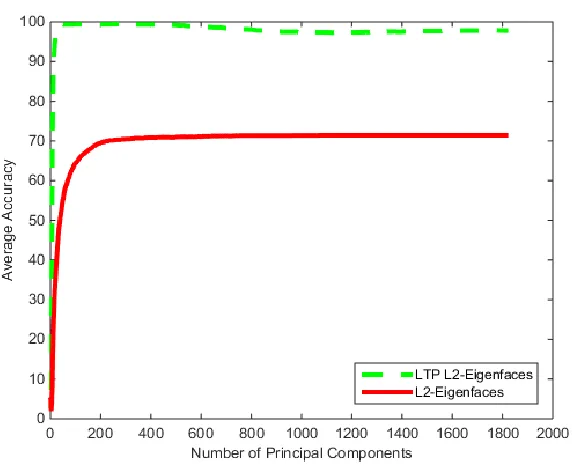
Figure 42: LTP Eigenfaces Test Extended Yale B Database (t = 1) ... 53
Figure 43: LTP Grassmann Test Yale Database (t = 5) ... 54
ix
Figure 45: LTP Grassmann Test Extended Yale B Database (t = 5) ... 55
Figure 46: LTP Grassmann Yale Database (t = 5) ... 57
Figure 47: LTP Grassmann AT&T Database (t = 6) ... 57
Figure 48: LTP Grassmann Extended Yale B Database (t = 5) ... 58
Figure 49: LTP Grassmann AR Database (t = 5) ... 58
Figure 50: LTP Grassmann LFW Database (t = 5) ... 59
Figure 51: LTP Grassmann Cohn-Kanade Database (t = 14) ... 59
Figure 52: LTP Grassmann Extended Cohn-Kanade Database (t = 16) ... 60
Figure 53: LTP Grassmann Comparison on Varying number of Subject Images 61 Figure 54: CPU Timing ... 66
Figure 55: GTX Timing ... 66
Figure 56: Tesla Timing... 67
Figure 57: GTX Speedup ... 67
x
List of Tables
Table 1: Grassmann Distance Metrics ... 15
Table 2: State of the Art Comparison for Yale Face Database ... 62
Table 3: State of the Art Comparison for AT&T Database of Faces ... 63
Table 4: State of the Art Comparison for Extended Yale B Face Database ... 64
xi
Glossary
CPU Central Processing Unit
GPU Graphics Processing Unit
ALU Arithmetic Logic Unit
DRAM Dynamic Random-Access Memory
GPGPU General-purpose Computing on Graphics Processing Units
SIMD Single Instruction Multiple Data
SM Streaming Multiprocessors
SP Streaming Processors
CUDA Compute Unified Device Architecture
BLAS Basic Linear Algebra Subprograms
LBP Local Binary Patterns
1
Chapter 1
Introduction
Recent research has focused on increasing the accuracy of recognition techniques,
however little effort has been devoted to increasing robustness. Applications such as
surveillance often operate in unconstrained environments where subjects may be partially
occluded by objects such as glasses and scarfs. Thus, there is a significant need for face
recognition techniques that are not only accurate, but also robust to noise.
Many recognition techniques today rely on statistical techniques that perform
direct correlation comparisons between the test face and training databases [1]. To
improve performance many techniques relay on PCA to both reduce dimensionality and
determine better feature subspaces. One of the limitations of PCA is its sensitivity to
outliers, as the 𝐿2-norm has the tendency to exaggerate the influence of noise over valid
data. 𝐿1-PCA utilizes the 𝐿1-norm and as a result is more robust to noise. However, there
is no direct solution for 𝐿1-PCA and iterative solutions must contend with the non-linear
search space. As a result of these limitations, researchers have focused on using
suboptimal solutions to speedup 𝐿1-PCA.
Although suboptimal solutions have improved the speed of 𝐿1-PCA, CPU
implementations still struggle with large datasets. Recently researchers have begun to
utilize general purpose graphics processing units (GPGPU) to speedup algorithms that are
too computationally intensive for CPU processing alone. The GPUs single instruction
multiple data architecture achieves large speedups when an algorithm has a high degree
of data level parallelism. Some early work has shown that the CUDA architecture shows
2
Grassmannian learning is an example of a recognition technique that would
benefit from 𝐿1-PCA. The Grassmann manifold has been investigated for variety of
recognition applications, including object, action and face recognition [3], [4]. This
technique maps data subspaces to points on the manifold using PCA. The Grassmann
manifold’s unique geometric structure promotes high class discrimination and
compensates for missing data allowing for great recognition accuracy. However, the
PCA mapping used for Grassmann manifolds is sensitive to outliers and could be
improved with 𝐿1-PCA.
The contributions of this thesis are the following. The first contribution is an
extension of an efficient 𝐿1 principal component algorithm to multiple components that
demonstrates a high degree of robustness to noise. The second contribution is a 𝐿1-PCA
mapping for Grassmann manifolds that can improve accuracy and reduce the effects of
noise in both face and facial expression recognition. The third contribution is an
extension of 𝐿1-Grassmann using local ternary patterns which improves robustness to
variations of illuminations. The final contribution is a high performance implementation
of the 𝐿1-PCA on a GPU using CUDA. This GPU implementation is suitable for
recognition on databases that CPU implementations would not be able to run in a
reasonable amount of time.
This document is organized as follows: Chapter 2 discusses the prior work done
in 𝐿1-PCA and the recognition algorithms used throughout the thesis. Chapter 3 discusses
the how to accelerate proposed 𝐿1-PCA algorithm and details the 𝐿1 versions of the face
and facial expression recognition algorithms. Chapter 4 details the experiments
3
and facial expression recognition algorithms. Chapter 5 provides a conclusion as well as
4
Chapter 2
Background
This chapter outlines related work in recognition, 𝐿1-PCA and high performance
implementations of 𝐿1-PCA. In Section 2.1 the formulation for 𝐿2-PCA is presented and
the previous work on 𝐿1-PCA is discussed. Previous work in recognition is discussed in
Sections 2.2, 2.3 and 2.4. In section 2.5 GPGPU and how others have leveraged the GPU
for accelerating 𝐿1-PCA algorithms is discussed.
2.1. Principal Component Analysis
[image:16.612.244.368.361.488.2]2.1.1 L2-PCA
Figure 1: Multivariate Gaussian with Two Principal Components
Principal component analysis was first introduced by Karl Pearson in 1901 and
has been used in a variety of fields including signal processing, pattern recognition and
computer vision [5]. The goal of principal component analysis is to find a set of M
orthogonal vectors aligned in the directions of maximum variance of the data such that
𝑀 ≤ 𝐷, where D is the dimensionality of the data. Figure 1 shows the first two principal
5
underlying structure of data and allows complex datasets to be represented in a lower
dimensionality.
This set of orthogonal vectors are known as eigenvectors or principal components
and can be represented as the matrix 𝑅 ∈ ℜ𝐷×𝑀 where each column is a principal
component aligned with the direction of maximum variance.
Traditional PCA utilizes the 𝐿2-norm which is defined as
𝑑𝐿2 = ‖𝐯‖2 = √ ∑ 𝐯𝑖2 𝑛−1
𝑖=0
(2.1)
where 𝒗 ∈ ℜ𝑛×1. One way to solve for 𝐿
2 principal components is by finding the set of
vectors 𝑅 ∈ ℜ𝐷×𝑀 that minimize the 𝐿
2-distance between the original signal and its
reconstruction
𝐸2(𝑅, 𝑉) = arg 𝑚𝑖𝑛 ‖𝑋 − 𝑅𝑉‖2 (2.2)
where data matrix 𝑋 ∈ 𝑅𝐷×𝑁, whose columns are data samples such that there are N data
samples and 𝑉 ∈ ℜ𝑀×𝑁 is the coefficient matrix given by
𝑉 = 𝑅𝑇𝑋 (2.3)
without loss of generality, we can assume X is centered such that the set of samples
{𝑥𝑖}𝑖=1𝑁 has zero mean. Using the projection theorem (2.2) can be rewritten as the
following optimization problem
𝑅𝐿2 = arg 𝑚𝑖𝑛 ‖𝑋 − 𝑅𝑅𝑇𝑋‖
2 (2.4)
Traditionally (2.2) is solved by performing eigen-decomposition on the
covariance matrix of X. The covariance matrix describes the relationships between pairs
6
and the off diagonal elements are the covariance between features. The covariance matrix
is given by
𝑆𝑋 = 1
𝑛 − 1𝑋𝑋𝑇
(2.5)
The PCA process minimizes the square error of the reconstruction, and this is equivalent
to maximizing the captured variance [6]. Eigendecomposition finds a set of orthonormal
vectors that diagonalize the covariance matrix. A single principal component can be
solved using the characteristic equation
𝑆𝑋𝑟𝐿2 = 𝜆𝑟𝐿2 (2.6) where 𝜆 is the eigenvalue corresponding to eigenvector 𝑟𝐿2. Since the covariance matrix is symmetric it can be decomposed to
𝑆𝑋 = 𝑅𝐿2Σ2𝑅 𝐿2
𝑇 (2.7)
where Σ2 is a diagonal matrix containing the variance of each eigenvector in 𝑅 𝐿2. Another way to solve for the principal components is to maximize the trace of Σ2 from
(2.7). This in turn maximizes the variance along the diagonal and solves for the
eigenvectors thus it can be rewritten as
𝑅𝐿2 = 𝑎𝑟𝑔𝑚𝑎𝑥 𝑇𝑟𝑎𝑐𝑒(𝑅𝑇𝑆𝑋𝑅) (2.8)
since ‖𝐴‖22 = 𝑇𝑟𝑎𝑐𝑒(𝐴𝑇𝐴) [7], (2.8) can be rewritten into its final form
𝑅𝐿2 = 𝑎𝑟𝑔 𝑚𝑎𝑥 ‖𝑋𝑇𝑅‖2 (2.9)
This reformulation is known as the projection energy maximization. Equations (2.2),
7
2.1.2 L1-PCA
In 𝐿1-PCA we find a set of orthogonal vectors that are aligned in the direction of
maximum variance with respect to the 𝐿1-norm. The 𝐿1-norm of vector 𝒗is given by
𝑑𝐿1 = ‖𝒗‖1 = ∑|𝒗𝑖| 𝑛−1
𝑖=0
(2.10)
The main advantage of the 𝐿1-norm is its robustness to outliers. In 𝐿2-PCA outliers with
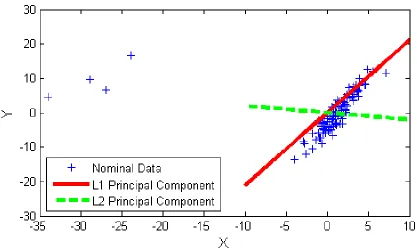
a large norm are exaggerated by the use of the 𝐿2-norm [8]. Figure 2 highlights the effect
[image:19.612.92.509.310.560.2]of outliers on 𝐿2-PCA in a toy scenario.
Figure 2: L1-PCA Toy Example
Outliers (left side), L2-PCA (dotted line) and L1-PCA (solid line)
A multivariate Gaussian was used to generate test points and then four of those points
8
component of the data. As shown in Figure 2, 𝐿2-PCA was heavily influenced by the
outliers, while 𝐿1-PCA offered a more accurate representation of the data. The three
equivalent 𝐿2 optimization problems (2.2), (2.4) and (2.9) can be translated to the 𝐿1
-norm and used to solve for the 𝐿1-principal components [7].
𝐸1(𝑅, 𝑉) = arg 𝑚𝑖𝑛 |𝑋 − 𝑅𝑉|1 (2.11)
𝑅𝐿1 = arg 𝑚𝑖𝑛 |𝑋 − 𝑅𝑅𝑇𝑋|
1 (2.12)
𝑅𝐿1 = 𝑎𝑟𝑔 𝑚𝑎𝑥 |𝑋𝑇𝑅|
1 (2.13)
Under the 𝐿1-norm the above optimization problems are no longer equivalent because the
PCA scalability property does not hold due to the loss of the projection theorem [9].
In [10], Ke et al. use the error minimization in (2.11) to solve for the 𝐿1 principal
components. Ke et al. solves this problem by utilizing alternating convex minimization.
The 𝐿1-norm cost function in (2. 11) is not generally convex, however if R or V is known
then the problem becomes convex [10]. Utilizing this scheme Ke et al. optimizes (2. 11)
by alternating between optimizing R and V using convex minimization.
Several researchers have explored using the 𝐿1 projection energy optimization in
(2.13) for 𝐿1-PCA. In [8], Kwak introduced a suboptimal approach called PCA-𝐿1 that
iteratively solves the energy maximization problem. Kwak’s algorithm solves for a single
eigenvector by using the optimal polarity to iteratively converge to a vector that
maximizes the 𝐿1 projection energy. The remaining eigenvectors are solved for in a
greedy manner by removing the previous eigenvectors contribution from each data
sample as follows
𝑥𝑖(𝑢𝑝𝑑𝑎𝑡𝑒)= 𝑥
9
Kwak’s greedy search algorithm does not guarantee an optimal solution, however it does
guarantee the othronormality of all principal components and that the set of principal
components will maximize 𝐿1 dispersion [8]. The computational complexity of 𝐿1-PCA
with greedy search is 𝑂(𝑀𝑁𝐷𝑇) where T is the number of iterations to converge. The
main issue with Kwak’s solution is that the computational complexity is dependent on the
dimensionality of the data which is equivalent to the number of pixels in an image for
face recognition. In [11], Nie et al. replaced the greedy search method introduced by
Kwak with a non-greedy method. Kwak’s PCA-𝐿1 algorithm is extended to solve for a
set of 𝐿1 eigenvectors simultaneously. The Nie et al. solution does not guarantee
convergence to an optimal 𝐿1-subspace and has the same time complexity as PCA-𝐿1
with greedy search. However Nie et al. has experimentally shown that this non-greedy
approach outperforms the greedy approach on several datasets [11]. In [9], Markopoulos
et al. proves that a single 𝐿1 principal component can be solved for using
𝑟𝐿1 = 𝑋𝑏𝑜𝑝𝑡 ‖𝑋𝑏𝑜𝑝𝑡‖2
(2.15)
where
𝑏𝑜𝑝𝑡 = 𝑎𝑟𝑔 𝑚𝑎𝑥 ‖𝑋𝑏‖2
𝑏 ∈ {±1}𝑁 =
𝑎𝑟𝑔 𝑚𝑎𝑥 𝑏𝑇𝑋𝑇𝑋𝑏
𝑏 ∈ {±1}𝑁
(2.16)
This proof reformulates the 𝐿1 projection energy optimization as a search over a binary
vector. Markopoulos et al. show that the optimal set of 𝐿1 principal components can be
solved by exhaustive searching 2𝑀𝑁 binary matrices of size 𝑁 × 𝑀. Additionally in [9]
Markopoulos et al. show that in the special case 𝑁 ≥ 𝐷 an orthonormal scanning matrix
10
subsequent work, Kundu et al. introduced a fast suboptimal method for the computation
of a single 𝐿1-principal component for real-valued data [12]. This algorithm optimizes
(2.16) using greedy bit flipping. The binary vector is optimized by identifying bits that
negatively contribute to the 𝐿1 projection energy and flipping them. The 𝐿1 projection
energy associated with (2.16)can be written as
𝑏𝑇𝑋𝑇𝑋𝑏 = 𝑇𝑟𝑎𝑐𝑒(𝑋𝑇𝑋) + ∑ 2𝑏
𝑖{∑ 𝑏𝑗(𝑋𝑇𝑋)𝑖,𝑗 𝑗>𝑖
}
𝑖
(2.17)
where i and j vary from 1 to N. From (2.17) Kundu et al. [12] show that the contribution
of the ith bit to the aggregative maximum is given by
𝛼𝑖 = ±4𝑏𝑖∑ 𝑏𝑗(𝑋𝑇𝑋) 𝑖,𝑗
𝑗≠𝑖 (2.18)
This bit flipping is repeated until all bits positively contribute towards the aggregative
maximum or until the maximum number of iterations are reached. This process can be
repeated up to N times using the sign of the columns of the covariance matrix as the
initial values for the binary vectors. The binary vector candidate with the largest
projection energy is determined using (2.16) and the corresponding eigenvector is
obtained from (2.15).
2.2. PCA Recognition
In [13] Kirby et al. showed that principal component analysis could be used to
generate a set of basis features called eigenpictures. In their algorithm they used a set of
face images that was centered such that the eyes of each person were aligned. Next the
11
in the image. A set of eigenpictures is generated by running principal component analysis
(PCA) on the column vectors as shown in Figure 3. PCA discovers the underlying
Euclidian structure in the data and utilizes that to reduce the dimensionality and hopefully
increase class discrimination. These eigenpictures form a basis and are used to transfer
images to a smaller dimensional feature space. Once in feature space direct correlation
comparisons between the test and training images is used to perform recognition.
Figure 3: First Ten Eigenpictures
In [14] Turk et al. coined the term eigenfaces when they applied Kirby’s et al.
eigenpictures to face recognition. Turk et al. starts of by calculating the eigenfaces using
the same procedure as Kirby et al. The eigenfaces are then sorted using their
corresponding eigenvalues from largest to smallest and a subset is formed using the
eigenvectors with the largest eigenvalues. The larger eigenvalues correspond to
eigenfaces that capture more variance and as a result are better basis vectors. This subset
12
projection theorem. Once in face space the Euclidean distance between a test image and a
face class is used for recognition. Unfortunately, traditional eigenfaces are not robust to
large variations in illumination, pose, facial expression and the presence of occlusions.
Numerous extensions to eigenfaces have been proposed to overcome its
limitations. Modular eigenfaces is one such extension that is more robust to occlusions,
variations in illumination and facial expression. Modular eigenfaces was first introduced
by Pentland et al in [15]. Pentland et al in divided both eyes, the nose and the mouth into
sub-images and then ran principal component analysis on each sub-image across the
training set [15]. This results in a set of eigenvectors for each sub-image. Similar to
traditional eigenfaces a subset is formed using the eigenvectors with the largest
eigenvalues for each sub-image. The subsets of eigenvectors is used to transform each
sub-image in the training and test images into an alternate space using the projection
theorem. After that the alternate space weights for each sub-image are concatenated into a
single descriptor. Pattern recognition techniques are then applied to these descriptors to
perform face recognition.
The advantage of modular eigenfaces is that by dividing the image areas with
very different illumination or areas with noise wont effect the other sub-images
projection. In [16] Gottumukkal et al. extended Pentland et al. work by dividing the entire
image into sub-images, instead of only using the eyes and mouth images. By dividing the
entire image only a subset of the sub-images would be affected by the variations in
illumination and as a result would be more robust.
In [17], Yang et al. introduced 2D-eigenfaces, another extension to the traditional
13
This technique utilizes 2D-PCA to calculate eigenfaces using the image covariance
matrix. This matrix can more efficiently capture the relationships between images, as
opposed to traditional PCA which needs to vectorize the image before computing the
covariance matrix. Yang et al. demonstrates that 2D-PCA outperforms traditional PCA,
but requires more eigenvectors [17].
2.3. Grassmannian Recognition
The Grassmann manifold 𝐺(𝑚, 𝐷) strives to reduce the dimensionality of data by
finding a lower dimensional space to represent the data. This is achieved by representing
m linear subspaces of ℝ𝐷 as m points on the manifold. Points on the Grassmann manifold
can be formed from entire datasets, class examples, or a single data point. Data is mapped
onto the Grassmann manifold by forming a dictionary 𝑋 = [𝑥1, … , 𝑥𝑁 ] ∈ 𝑅𝐷×𝑁 whose
columns are data samples, where D is the dimensionality of the data and N is the number
of data samples. From the dictionary X a unit vector representation needs to be generated.
Traditionally this is done using 𝐿2 principal component analysis as shown in Figure 4.
Figure 4: Grassmann Manifold Mapping
14
The Grassmann manifold is naturally a smooth curved surface and as a result
Euclidian distance metrics cannot be directly applied. Several different distance metrics
have been explored for Grassmann manifolds based on principal angles between
subspaces 𝜃 = [𝜃1, 𝜃2, … , 𝜃𝑚 ], where the principal angle between two subspaces is given
using SVD such that
𝑥1′𝑥2 = 𝑈𝑆𝑉′ (2.19)
𝑑𝑖𝑎𝑔(𝑆) = (cos 𝜃1, … , cos 𝜃𝑚) (2.20)
Distance metrics include projection, Binet-Cauchy, max correlation, min correlation,
Procrustes, geodesic and mean distance [3], [18].
In general, metrics that rely on the smallest principal angle tend to be more robust
to noise and less discriminative, while metrics that rely on the largest principal angle tend
to be less robust to noise and more discriminative [19]. The distance between subspaces
can also be calculated by converting the Grassmann manifold to an alternate space using
Grassmann kernel. Projection kernels can be used to create an isometric embedding from
Grassmann space to Hilbert space, which enables the use of Euclidean distance metrics.
From [3], the projection kernel between subspaces 𝑥1, 𝑥2 can be formed using
𝐾𝑝(𝑥1, 𝑥2) = ‖𝑥1′𝑥
2‖𝐹2 (2.21)
where ‖ ‖𝐹 is the Frobenius norm. Projection kernels do not define a direct linear
relationship between subspaces and as a result kernel based methods such as PCA or
LDA are needed for accurate classification [19].
Grassmann manifolds have been investigated for computer vision applications,
such as object, action and face recognition. In [3] Hamm and Lee used Grassmann kernel
15
probability density functions to estimate classes on the Grassmann manifold in [4] and
applied it to activity recognition, affine shape analysis and video based face recognition.
In [18] Shigenaka et al. introduced GD-MSM and GK-SVM, which use the Grassmann
manifold to improve the performance of mutual subspace method and support vector
machines. In [19] Azary introduced Grassmannian Sparse Representations for 3D action
and face recognition.
Table 1: Grassmann Distance Metrics
Metric Name Metric Equation
Projection
𝑑𝑝(𝑥1, 𝑥2) = (𝑚 − ∑ cos2𝜃𝑖 𝑚 𝑖=1 ) 1 2 (2.22) Binet-Cauchy
𝑑𝑝(𝑥1, 𝑥2) = (1 − ∏ cos2𝜃 𝑖
𝑖 )
1
2 (2.23)
Max Correlation 𝑑
𝑝(𝑥1, 𝑥2) = (1 − cos2𝜃1) 1
2 (2.24)
Min Correlation 𝑑
𝑝(𝑥1, 𝑥2) = (1 − cos2𝜃𝑚) 1
2 (2.25)
Procrustes
𝑑𝑝(𝑥1, 𝑥2) = 2 (∑ sin2𝜃𝑖
2 𝑚 𝑖=1 ) 1 2 (2.26) Geodesic
𝑑𝑝(𝑥1, 𝑥2) = ∑ 𝜃𝑖2 𝑚
𝑖=1
(2.27)
Mean Distance
𝑑𝑝(𝑥1, 𝑥2) = 1
𝑚∑ sin2𝜃𝑖
𝑚
𝑖=1
16
2.4. LBP/LTP Features
Large variations in illumination are a challenging test case for many image based
recognition techniques. One solution is to rely on descriptors based on texture rather than
raw pixels. Local binary patterns (LBP) and local ternary patterns (LTP) summarize local
grey-level structure and as a result are resistant to the effects of illumination. In [20],
Ojala et al. introduced LBP for illumination invariant texture classification. In this
technique a binary code is generated for each pixel in an image by comparing the center
pixel to the neighboring pixels. The binary codes are given by the following
𝐿𝐵𝑃 = ∑ 2𝑖𝑠(𝑦
𝑖− 𝑦𝑐) 𝑛
𝑖=0
(2.29)
where 𝑦𝑐 is the center pixel intensity, 𝑦𝑖 is the pixel intensity in the surrounding
neighborhood and s is given by
𝑠(𝑢) = {1,0, 𝑢 ≥ 0 𝑢 < 0} (2.30)
Originally the neighborhood was defined as the 3 x 3 area around the target pixel,
however other patterns have been explored. Figure 5 highlights the encoding process
using a 3 x 3 image patch.
92
50
26
99
60
70
54
12
60
1
0
0
1
1
0
0
1
Threshold
Binary Code:
10011001
17
LBP is highly discriminative on areas with uniform illumination, however areas with
gradual illumination change introduce noise [21]. Tan et al. eliminate this issue by
introducing LTP in [21], which replaces the threshold with a range and the binary code
with a ternary code. Local ternary codes are given by the following
𝐿𝑇𝑃 = ∑ 3𝑖𝑠′(𝑦
𝑖− 𝑦𝑐, 𝑦𝑐, 𝑡 ) 𝑛
𝑖=0
(2.31)
where t is a user specified threshold and s’ is given by
𝑠′(𝑢, 𝑦𝑐 , 𝑡) = {
1, 𝑢 ≥ 𝑦𝑐+ 𝑡
0, 𝑦𝑐− 𝑡 < 𝑢 < 𝑦𝑐+ 𝑡
−1, 𝑢 ≤ 𝑦𝑐− 𝑡}
(2.32)
92 50 26
99 60 70
54 12 60
1 -1 -1
1 1
0 -1 0 Threshold
Ternary Code: 1(-1)(-1)10(-1)01 t=10
1 0 0
1 1
0 0 0
0 1 1
0 0
0 1 0
Binary Code: 01100100 Binary Code: 10010001 1's Pattern -1's Pattern
Figure 6: LTP Operator
For simplicity the ternary code is split into two binary codes and processed separately.
Figure 6 shows this process for a 3 x 3 image patch. To perform recognition LBP/LTP is
18
histograms are then concatenated to form a descriptor and recognition is performed using
pattern recognition techniques.
2.5. GPU Acceleration
2.5.1 General Purpose GPU Computing
Originally GPUs were designed to reduce the computational load of the CPU by
solely processing graphics request. In order to optimize graphics operations GPUs utilize
a single instruction multiple data (SIMD) architecture, which simplifies control logic and
utilizes a large number of simple arithmetic logic units (ALU) to take advantage of data
level parallelism as shown in Figure 7.
In 2007, NVIDIA recognized the potential for heterogeneous CPU/GPU solutions and
released the first general purpose computing on the GPU (GPGPU) API, the Compute
Figure 7: CPU Architecture (left) vs GPU Architecture (right)
DRAM Cache Control Unit
ALU ALU
ALU ALU
19
Unified Device Architecture (CUDA) [22]. CUDA and other GPGPU APIs have allowed
researchers to speedup algorithms that were previously too computationally intensive for
CPUs alone.
In order to maximize the performance of an algorithm on the GPU, the underlying
hardware must be considered. CUDA-capable GPUs are organized into arrays of
streaming multiprocessors (SM). Each streaming multiprocessor is composed of a set of
streaming processors (SP) and connected to a shared block of DRAM called global
memory. Each streaming processor shares control logic, an instruction cache, registers
and another block of DRAM called shared memory. The number of streaming
multiprocessors and streaming processors is important to consider when developing
CUDA applications because they determine the maximum number of threads that can be
run simultaneously. In CUDA threads are organized into 3D blocks which make up a 3D
grid. The dimensionality of each of these 3D block/3D grid structures is application
dependent. At runtime each streaming multiprocessor is assigned a block from the grid
to execute. Each block is broken into groups of 32 threads called warps prior to
execution. Each warp is then run in a serial manner over the streaming processors, this
allows for fast context switching between warps when a stall is encountered.
Another important hardware consideration is memory usage, CUDA-capable
GPUs allow the use of five different types of memory: registers, shared memory, global
memory, constant memory, and texture memory. The bandwidth of the GPU’s global
memory is often a bottleneck in CUDA programs, therefore proper memory usage is
important when developing high performance applications. Threads store local variables
20
Registers are the fastest memory on the GPU, therefore it is important to limit the number
of local variables for high performance applications. Shared memory is a read/write
memory that allows memory sharing across threads in the same block. This is achieved
by local DRAM blocks within each streaming multiprocessor. Overall this allows for
much faster data storage without contributing to the global memory bandwidth. Global
memory is a read/write memory that allows memory access by any thread. All incoming
data and outgoing results must pass through global memory and as a result it is often the
main bottleneck of the GPU. Another form of memory is constant memory which only
allows read operations during runtime. Like global memory constant memory can be
accessed by any thread, however it is highly cached making it much quicker than global
memory. The final memory type is texture memory which is a special read only memory
that has been optimized for texture based operations. Using special hardware built into
the pipeline several common texture functions can be performed automatically including
pixel interpolation and border wrapping. Unlike other forms of memory on the GPU,
texture memory has constant access times for both cache hits and misses which allows for
better scheduling and a 2D cache which gives it greater 2D spatial access.
There are several important design constraints to keep in mind when developing
high performance algorithms in CUDA. Block size is very important design constraint in
GPGPU because it controls how well your program hides memory latency. Generally
block sizes are a fraction of the number of threads that a streaming multiprocessor can
support so that multiple blocks can run on one streaming multiprocessor. The number of
threads in a block should be a multiple of 32, to ensure that only full warps are generated.
21
performance applications. When a conditional branch statement is encountered in CUDA
the diverging threads may need to be stalled until all threads converge. Therefore, to get
good hardware utilization it is important to limit the number of conditional statements. As
a result this reduces hardware utilization. One of the most important keys when working
in CUDA is to be observant of the memory access patterns. In order to reduce overhead
involved with accessing global memory each read has the potential to fetch 64
consecutive bytes. If memory is not coalesced it could take up to 16 reads to fetch the
same number of bytes.
2.5.2 GPU accelerated L1-PCA
There has been a lot of research on how to best utilize GPU resources to speedup
algorithms. However, there has been very little research on how to specifically accelerate
𝐿1-PCA using the GPU. In [2] Funatsu et al. accelerated Kwak’s PCA-𝐿1 algorithm from
[8] using the GPU. Funatsu et al. do not specify which portions of Kwak’s PCA-𝐿1
algorithm they accelerated using the GPU. However, they do utilize CUBLAS, which is
CUDAs optimized BLAS (Basic Linear Algebra Subprograms) library. Funatsu et al.
22
Chapter 3
L1-PCA Recognition
This chapter describes several approaches to recognition based on 𝐿1-PCA. The
design of the 𝐿1-PCA algorithm is discussed in Section 3.1. In Section 3.2 the
implementation of the 𝐿1-Eigenfaces, 𝐿1-Grassmann and LTP preprocessing is outlined.
The CPU implementation of 𝐿1-PCA is specified in Section 3.3. Lastly this chapter
details the 𝐿1-PCA GPU implementation in Section 3.4.
3.1. L1-PCA Algorithm Design
Recent work by Kundu et al. [12] introduced a fast computation for a single 𝐿1
principal component using bit flipping to maximize the 𝐿1 projection energy. The
advantage of the Kundu et al. method is that the complexity is 𝑂(𝑁̃𝑁2) where N is the
number of samples and 𝑁̃ is the number of initializations which are chosen by the user.
Unlike previous solutions this method does not rely on the dimensionality of the data
which makes it ideal for image recognition where the dimensionality is usually the
number of pixels in the image. This method is extended to multiple components using the
greedy search algorithm introduced by Kwak in [8]. Subsequent principal components are
calculated by removing each principal components contribution from the data samples
and utilizing the updated dataset to find the next principal component. This process is
repeated until the desired number of components is reached. The greedy search algorithm
guarantees that the principal components maximize the 𝐿1-dispersion [8]. The overall
algorithm flowchart is shown in Figure 8. The time complexity for the full algorithm is
23 Start Calculate Covariance Matrix Update Data Samples Increment vectorCount False True End False Initialize Binary Vector True Calculate Binary Vector Contributions Increment sampleCount True Update Binary Vector False Set sampleCount to zero vectorCount sampleCount < # data samples
vectorCount < # eigenvectors
All contributions are Positive
24
3.2. Recognition Techniques
3.2.1 L1-Eigenfaces
Much research has been performed to make eigenfaces more robust to variations
in illumination and expression [23], [24], [25]. Utilizing the 𝐿1-norm instead of the 𝐿2
-norm for eigenfaces allows for more accurate recognition on unconstrained or noisy
datasets. Figure 9 shows the first ten eigenfaces generated from a subset of the aligned
Yale Face database [25].
(a.)
(b.)
Figure 9: Eigenfaces from Occluded Dataset
25
Five images from each of the fifteen subjects were randomly chosen, then 30% of those
images were partially occluded using rectangular noise.
Figure 10: Rectangular Noise on Yale Dataset
The first eigenface is on the top left and the tenth is on the bottom right. We observe that
the later eigenfaces capture more noise for both methods, however 𝐿2-eigenfaces seem to
degrade in quality much sooner as illustrated by eigenfaces 8, 9 and 10.
To perform recognition using 𝐿1-eigenfaces the data matrix 𝑋 = [𝑥1, … , 𝑥𝑁 ] ∈
𝑅𝐷×𝑁 needs to be formed such that columns are face image samples or LTP descriptors,
D is the number of pixels or the length of the LTP descriptor and N is the number of
samples. Without loss of generality, we can assume X is centered such that the set of
samples {𝑥𝑖}𝑖=1𝑁 has zero mean. After that the 𝐿
1-PCA algorithm detailed in Figure 8 is
used to calculate the 𝐿1-eigenfaces. The greedy search in the 𝐿1-PCA algorithm ensures
that eigenfaces are presorted via their corresponding eigenvalues from largest to smallest.
It is important to only use a subset of the eigenfaces because the later eigenfaces begin to
capture noise. This subset of eigenfaces is used to transform training and test images into
face space using the projection theorem. Once in face space a one nearest neighbor
26
is arguably one of the simplest classifiers and as a result it is better at highlighting the
disparity between methods.
3.2.2 L1-Grassmann
Subspaces on the Grassmann manifold can be formed from a single data point or
multiple data samples. As a result the Grassmann manifold can be used to make
single-single, single-many or a many-many comparisons. To highlight the advantages of 𝐿1
-Grassmann we perform a many-many comparison where each subspace is composed of
data samples from a single class. This doubles the effect of 𝐿1-PCA by allowing it to
reduce the effect of noise on both training and test images.
To construct 𝐿1-Grassmann manifolds, first dictionaries are formed by sorting all
training images or LTP descriptors and grouping them by the person’s identity for face
recognition or by expression for expression recognition. Each element in the dictionary is
obtained by lexicographic ordering of all the image columns or by LTP preprocessing.
Each class subspace is then mapped onto the 𝐿1-Grassmann manifold by using the 𝐿1
-PCA algorithm detailed in Figure 8 to calculate the principle components for each class.
After that the projection kernel is formed for the training and test set, which projects the
manifold onto Hilbert space. Once in Hilbert space Grassmann PCA is used to reduce the
dimensionality of the data and one-nearest neighbor classification is used for recognition.
27
N
D
q
q
q
PCA
PCA
PCA
D
q
q
q
PCA
1 NN
Figure 11: Recognition using Grassmann Manifolds
3.2.3 LTP Features
Local ternary patterns decode the grayscale structure in images and as a result can
greatly improve accuracy in datasets with large variations in illumination. After
performing LTP on an image traditional methods divide the LTP image into sub-regions
and generate local histograms. These histograms are then concatenated together and used
as a descriptor for the image. This technique reduces the dimensionality of the data by
28
Grassmann manifolds reduce the dimensionality of the data, it can be more advantageous
to apply these techniques to the LTP image, instead of using LTP histograms. The overall
procedure is to run LTP on each image in the dataset to produce an upper and lower
coded image. After that both images are converted to vectors by a lexicographic ordering
of all the image columns, this process is shown in Figure 12. Finally, these vectors are
concatenated into a single descriptor and passed to Eigenfaces and Grassmann for
recognition. 10010110 01110100 11110000 10011010 01110100 ... 10010110 00001111 10101010 11110000 10011010 01110100 ... 10010110 10010110 01110100 11110000 10011010 01110100 10001111 10010110 10010110 01110100 11110000 10011010 01110100 ... 10010110 10010110 01110100 11110000 10011010 01110100 ... 10010110 00001111 10101010 11110000 10011010 01110100 ... 10010110
Figure 12: LTP Preprocessing
Each of the colors in the center images corresponds to a different LTP code
3.3. CPU Implementation
One way to accelerate the 𝐿1-PCA algorithm is to take advantage of the
29
accomplish this the serial operations are vectorized and rewritten as a series of matrix
operations. With this reformulation the goal becomes to optimize the binary matrix 𝐵 ∈
ℝ𝑁̃×𝑁 where each row corresponds to a potential eigenvector. The contributions of each
bit in the binary matrix is solved simultaneously using
𝑄 = 𝐵.∗ (𝐵 𝑆𝑋) − 𝐷 (3.1)
where .∗ is element-wise multiplication and 𝐷 ∈ 𝑅𝑁̃×𝑁 is
𝐷 = [
𝑑𝑖𝑎𝑔( 𝑆𝑋) ⋮ 𝑑𝑖𝑎𝑔( 𝑆𝑋)]
(3.2)
The binary matrix is updated by finding the minimum value in each row of 𝑄 and
flipping the corresponding bits in the matrix 𝐵. To improve performance all minimum
reductions are performed in parallel. This process is repeated until no bit in B contributes
negatively or until the maximum number of iterations are reached. From the optimized
matrix B the optimal binary vector is calculated by finding the row with the maximum
projection energy. The following equation gives the projection energy for each row
𝐸𝑝 = ∑(𝐵.∗ (𝐵 × 𝑆𝑋)):,𝑖
𝑁
𝑖=0
(3.3)
where 𝐸𝑝 ∈ ℝ𝑁̃×1. The optimal binary vector is than determine by performing a
maximum reduction on 𝐸𝑝 to find the largest corresponding projection energy. To ensure
the optimal matrix operation performance the Intel Math Kernel Library which utilizes
Basic Linear Algebra Subprograms (BLAS) was used to implement the algorithm for the
30
3.3.1.1
Reduction Algorithms
One of the most important areas to accelerate is the min and max reductions
because of the large number of reductions used throughout the algorithm. The goal of a
reduction algorithm is to perform an operation over a data vector and return a single
value. This operation is often associative which allows it to be computed in a partially
parallel manner. There are several reduction algorithms that are utilized throughout the
𝐿1-PCA algorithm including the calculation of the minimum contributing bit and the
calculation of optimal binary vector. To ensure high performance Intel’s
parallel_reduce function from the threading building blocks library was used. To
maximize the parallelism in reduction algorithms this function generates a tree structure
by recursively splitting the data vector into subranges until each subrange is no longer
divisible as shown in Figure 13.
Figure 13: CPU Tree Reduction A[10, 19] A[0, 19]
A[0, 9]
A[0, 4] A[5, 9] A[10, 14] A[15, 19]
31
Each node performs the desired operation such as max or min over its range and passes
the result to the parent node. After that the parent node repeats this operation on the
resultant of the child nodes. This process repeats until a single result is obtained through
the root. This structure enables nodes at the same depth to be run in parallel and as a
result accelerates the operation.
3.3.1.2
Parallel Operations
Some of the matrix operations such as binary matrix initialization and
optimization can be implemented more efficiently using custom parallel functions instead
of BLAS functions. To ensure optimal performance Intel’s parallel_forfunction was
used for the custom functions. In a similar manner to the reduction algorithm the data
vectors are recursively split into subranges until each subrange is no longer divisible.
However in this case each subrange is independent and as a result only the leaf nodes
need to be executed. Upon execution each element in a nodes subrange is executed in a
synchronous fashion, however each node is executed in parallel. This methodology
ensures that each thread is performing enough work to hide the latency involved in
launching the extra threads.
3.4. GPU Implementation
For the GPU implementation the vectorized 𝐿1-PCA algorithm discussed in the
CPU section was adapted for the GPU. The algorithm was broken into several smaller
kernels. These smaller kernels allow greater thread control which reduces warp splitting
32
can force the compiler to utilize Global memory for local variables. The main
disadvantage is the additional time needed to launch each kernel, however the extra
launch latency is made up by the better hardware utilization.
To ensure the high performance CUBLAS is used to perform matrix operations on
the GPU. However, several high performance custom kernels were developed to handle
the operations not supported by CUBLAS including sign, calcBitContribution, bitFlip,
elementMultiply, scaleVector, vectorSubtraction, minReduction, maxReduction and
sumReduction. The sign kernel is used to initialize the binary matrix B by calculating the
sign of each element in the covariance matrix in parallel. Positive elements in the
covariance matrix are initialized as +1 and negative elements as initialized as -1. The
calcBitContribution kernel is used to determine how each bit in a vector contributes
toward projection energy, it performs the following operation
𝑓(𝑋, 𝐵, 𝑆𝑥) = 𝐵.∗ 𝑋-D (3.4)
To reduce the effects of the non-coalesced reads associated with the diagonal of 𝑆𝑥, the
diagonal is read once into shared memory, instead of N times into local memory. After
that each thread performs the multiplication and subtraction of a single element in
parallel. The bitFlip kernel is passed the minimum bit contribution for each eigenvector
and its index location. Then using a ternary operator to avoid warp splitting it flips the
bits in the B matrix. The elementMultiply kernel is used when computing the projection
energy to find the optimal eigenvector and performs element-wise multiplication using a
33 Calculate Covariance cublasSgemm Initialize Binary Matrix sign Kernel Calculate Bit Contribution part 1 cublasSgemm Calculate Bit Contribution part 2 calcbitContribution Kernel
Identify Bits to Flip
minReduction Kernel Flip Bits bitFlip Kernel Convergence Check minReduction Kernel Calculate Projection Energy part 1 cublasSgemm Calculate Projection Energy part 2 scaleVector Kernel Calculate Projection Energy part 3 sumReduction Kernel Identify Optimal Eigenvector maxReduction Kernel Generate Eigenvector cublasSgemm Find Normalization Factor cublasSnrm2 Normalize Eigenvector scaleVector Kernel Converged Update Data part 1 cublasSgemm Update Data part 2 cublasSgemm Update Data part 3 vectorSubtract Kernel Did Not Converge
Repeat for each Principal Component
Done Start
Figure 14: GPU Kernel Flow
The scaleVector kernel applies a scalar value to each element in a vector and is used to
normalize eigenvectors. The vectorSubtraction kernel is used to update the data samples
in the greedy search and performs vector subtraction between two vectors or matrices.
Both scaleVector and vectorSubtraction operate using threads for each element in the
vector. The three reduction kernels are designed so that they can compute a single
reduction for a vector or a reduction for each row of a matrix. They are used several times
34
found in Section 3.4.1.1. The rest of the operations are performed by CUBLAS to ensure
high performance, the GPU kernel flow is depicted in Figure 14.
3.4.1.1
Reduction Algorithms
Reduction algorithms are challenging to optimize on the GPU because the number of
threads is reduced with each iteration which results in warp splitting. Furthermore the
reduction operation cannot guarantee coalesced memory access, which greatly hurts
performance. To address these issues a high performance reduction algorithm was
developed for the GPU implementation. First the data vector is divided into power of two
sized blocks, this ensures that operations are reduced by half every reduction cycle.
35
After that data is loaded into shared memory, this is done to reduce memory latency and
alleviate non-coalesced memory problems. Next a reduction cycle is run to reduce the
number of operations in half. A reduction cycle consists of threads equal in number to
half the data performing the desired operation such as max or min. The lower indexed
values and the high indexed values are used as operands to ensure that only coalesced
memory operations occur. The result is then saved in the lower indexed values of shared
memory and the data count is reduced by half. If more than one block is needed the
process is repeated with a new kernel, this is done to ensure synchronization across
blocks and to maintain hardware utilization. This entire process is depicted in Figure 15
and pseudo code is provided in Figure 16. One advantage of this algorithm is that it can
be easily extended to perform multiple reductions on a single matrix in parallel by simply
increasing the number of blocks used to perform reduction.
// Global Variables
// floatMax- the maximum float value
// TILE_SIZE- the number of threads in a 1D block
__global__ void minReduction(float* dIn, int size, float* dOut){ __shared__ float shared[TILE_SIZE]; // initialize shared memory
int dataID = blockIdx.x * blockDim.x + threadIdx.x; // Global memory index
int length = TILE_SIZE; // Number of comparisons for current reduction(power 2)
// load data into shared memory
shared[threadIdx.x] = (dataID < size) ?
dIn[(blockIdx.y*size) + dataID] : floatMax;
__syncthreads();
// perform reduction
while(length > 1){ length = length /2;
if(threadIdx.x < length){
shared[threadIdx.x] = (shared[threadIdx.x + length] < shared[threadIdx.x]) ? shared[threadIdx.x + length] : shared[threadIdx.x];
}
__syncthreads(); }
// write output
if(threadIdx.x == 0){
dOut[(blockIdx.y*gridDim.x)+blockIdx.x] = sharedArray[0];
} }
36
Chapter 4
Experimental Results
4.1. Experimental Setup
For each experiment, the images are converted to greyscale and resized to a final
resolution of 100×90 pixels before performing recognition. Several experiments are run
on occluded versions of various datasets. These datasets are generated by adding
rectangular noise occlusions to 30% of the images in the database. The location of the
rectangular noise is determined randomly, and its size is randomly chosen between 15×15
and 60×60. The noise in the rectangular window consists of normally distributed white
and black pixels.
Eigenface experiments use each test image for single to single classification and
record the average accuracy for a varying number of eigenvectors. For Grassmann
manifold experiments all test images are sorted into their designated class for many to
many classification and the average accuracy for a varying number of Grassmann
eigenvectors is recorded. Each experiments consist of two separate trials of 4-fold cross
validation unless stated otherwise. The accuracies reported are the average accuracies
across both trials.
4.2. Datasets
4.2.1 Yale Face Database
The Yale Face database contains 165 grayscale images of 15 different people
[25]. There are 11 images for each subject and they vary in illumination and facial
37
glasses off, neutral expression, sad, sleepy, wink and surprised. To improve face
recognition accuracy a normalized version of the Yale Face database is used where faces
are rotated, cropped and centered such that the eyes of each subject are aligned [26].
Figure 17: Yale Face Database Images Across Two Subjects
38
4.2.2 AT&T Database of Faces
This AT&T Database of Faces formerly known as the ORL face database contains
400 images of 40 different people [27]. There are 10 images for each subject and they
vary in pose and facial details such as glasses. Images were taken over time and as a
result minor lighting changes occur across subjects.
Figure 19: AT&T Database Images Across Two Subjects
39
4.2.3 Extended Yale Face Database B
The Extended Yale Face Database B contains 2,432 images of 38 different people
[28]. There are 64 images for each subject and they vary in illumination.
Face images vary greatly in illumination across subjects, so much so that at times only a
small portion of the face is visible. To improve face recognition accuracy a close cropped
version of the dataset is used, where each image is cropped to include only the face with
no background or hair.
Figure 21: Extended Yale Face Database B Images Across Two Subjects
40
4.2.4 AR Face Database
The AR Face Database contains 2,600 color images of 100 different people, 50
men and 50 women [29]. There are 26 images for each subject and they vary in
expression, illumination and natural occlusions. Subjects in this dataset utilize scarfs or
large sun glasses to occlude parts of their face making recognition difficult.
41
Figure 24: AR Face Database Images Across a Subject
4.2.5 Labeled Faces in the Wild Database
The Labeled Faces in the Wild database contains 13,233 images of 5749 different
people [30]. Unlike the other database the number of images per subject varies and only
1680 subjects have two or more images. The dataset was generated by running the
Viola-Jones face detector [31] on a large database of images and scaling up the resulting area to
include the background. The LFW face database is a challenging dataset because many
forms of variation are present including variations in pose, lighting, expression,
background, race, ethnicity, age, gender, clothing, hairstyles, camera quality, color
saturation and focus [30]. To improve face recognition accuracy a deep funneled version
of the database is used such that each image is aligned [32].
42
Figure 26: : LFW Face Database Subjects with at Least 20 Images
4.2.6
Cohn-Kanade
DatabasesThe Cohn-Kanade database contains 97 subjects in 228 expression sequences
[33]. The extended Cohn-Kanade database is an expansion of the original Cohn-Kanade
database and contains 118 subjects in 327 expression sequences [34]. Each sequence
varies in the length and begins with a neutral expression and transitions into 1 of 7
expressions including anger, contempt, disgust, fear, happy, sadness and surprise. To
improve recognition accuracy each image is cropped to the face using the landmark
points provided.
Figure 27: Emotions from the Extended Cohn-Kanade Database
43
4.3. Parameter Selection
The maximum number of iterations is used to terminate the eigenvector
optimization process if the algorithm does not converge. The number of iterations
required to optimize the eigenvector is a function of the number of data samples. To
ensure that each binary vector is properly optimized 3N iterations are used. This ensures
that each bit has the chance to be flipped at least three times. In practice most binary
vectors converge in ~2N iterations.
Another important parameter is t which is used to determine the upper and lower
boundaries in the local ternary patterns feature extraction, as shown in (2.32). The
variable t controls how much of the grayscale structure is considered noise. If t is too low,
then LTP captures the noise in smooth areas, however if t is too large LTP does not
capture some of the weaker textures. Some work has been done on picking optimal t
values. In [35] a data adaptive approach was developed that uses Weber's Law and the
central pixel to set t. However, their work was not tested on datasets with variations in
illuminations. In [21] LTP was run extended Yale B and several other datasets with large
variations in illuminations and they found t = 5 is a good threshold for removing
illumination effects. To find the optimal LTP threshold each experiment is repeated for
𝑡 = [1, 20] and the optimal value and its corresponding threshold are reported.
Two parameters that greatly affect the performance of the GPU algorithm are the
main block size and reduction block size. The block size is the number of threads used in
a single CUDA block, to get full GPU utilization the number of threads across all blocks
should be a multiple of 32 so that only full warps are generated. The main block size is
44
reduction block size. The reduction block size has additional constraint; it should be a
power of two so that a full reduction can be performed every reduction cycle. Two GPUs
are used throughout experiments the GeForce GTX 480 and Tesla K20c. The GeForce
GTX 480 can support at maximum 1024 threads per blocks and 1536 threads per
multiprocessor. The optimal main and reduction block size for the GeForce GTX 480 are
768 and 512. The Tesla K20c can support at maximum 1024 threads per blocks and 2048
threads per multiprocessor. The optimal main and reduction block size for the Tesla K20c
are 1024 and 1024.
4.4. Accuracy Tests
In the first two experiments, recognition accuracy was collected from the Yale,
AT&T and extended Yale databases. All data was normalized and centered such that the
mean was zero and the standard deviation was one. Results were collected using a variant
of four fold cross validation that ensured the number of images of a person was the same
for each fold. In the first experiment the 𝐿1-eigenfaces and 𝐿1-Grassmann face
recognition techniques are compared against the 𝐿2 versions on the original databases.
This test ensures that the suboptimal methods utilized to accelerate 𝐿1-PCA do not
negatively affect the recognition accuracy. Twenty five iterations of 4 fold cross