This is a repository copy of Feedback-Based Specification, Coding and Testing with JWalk.
White Rose Research Online URL for this paper:
http://eprints.whiterose.ac.uk/98339/
Version: Accepted Version
Proceedings Paper:
Simons, A.J.H., Griffths, N. and Thomson, C. (2008) Feedback-Based Specification,
Coding and Testing with JWalk. In: Practice and Research Techniques, 2008. TAIC PART
'08. Testing: Academic & Industrial Conference. TAIC PART '08, 29-31 Aug. 2008, Windsor,
UK. IEEE , pp. 69-73. ISBN 978-0-7695-3383-4
https://doi.org/10.1109/TAIC-PART.2008.20
© 2008 IEEE. Personal use of this material is permitted. Permission from IEEE must be
obtained for all other users, including reprinting/ republishing this material for advertising or
promotional purposes, creating new collective works for resale or redistribution to servers
or lists, or reuse of any copyrighted components of this work in other works.
[email protected] https://eprints.whiterose.ac.uk/
Reuse
Unless indicated otherwise, fulltext items are protected by copyright with all rights reserved. The copyright exception in section 29 of the Copyright, Designs and Patents Act 1988 allows the making of a single copy solely for the purpose of non-commercial research or private study within the limits of fair dealing. The publisher or other rights-holder may allow further reproduction and re-use of this version - refer to the White Rose Research Online record for this item. Where records identify the publisher as the copyright holder, users can verify any specific terms of use on the publisher’s website.
Takedown
If you consider content in White Rose Research Online to be in breach of UK law, please notify us by
Feedback-Based Specification, Coding and Testing with JWalk
Anthony J H Simons, Neil Griffiths and Christopher Thomson
Department of Computer Science, University of Sheffield
{a.simons, c.thomson}@dcs.shef.ac.uk
,
[email protected]
Abstract
JWalk is a lazy systematic unit-testing tool for Java, which supports dynamic inference of specifications from code and systematic testing from the acquired specification. This paper describes the feedback-based development methodology that is possible using the JWalkEditor, an original Java-sensitive editor and compiler coupled to JWalk, which helps programmers to prototype Java class designs, generating novel test cases as they code. Systematic exploratory testing alerts the programmer to unusual consequences in the design; and confirmed test results become part of the evolving specification, which adapts continuously to modified classes and extends to subclasses. The cycle of coding, inferring and testing systematically exposes test cases that are often missed in other test-driven development approaches, which rely on programmer intuition to create test cases.
1. Lazy systematic unit testing
Lazy systematic unit testing is a software testing
method based on the two notions of lazy specification, the ability to infer the evolving specification of a unit on-the-fly by dynamic analysis, and systematic testing, the ability to explore and test the unit’s state space exhaustively to bounded depths [1]. Lazy specification is a term coined by analogy with lazy evaluation in functional programming and refers to a flexible approach to software specification, in which the specification evolves rapidly in parallel with frequently modified code. The specification is inferred by a semi-automatic analysis of a prototype software unit. This can include static analysis (of the unit’s interface) and dynamic analysis (of its behaviour), supplemented by limited interaction with the programmer. Systematic
testing refers to a complete, conformance testing
approach, in which the tested unit is shown to conform exhaustively to a specification, up to the testing assumptions [2]. This contrasts with exploratory,
random or other incomplete forms of testing. The aim of systematic testing is to provide guarantees of correctness, once testing is over.
JWalk is a unit-testing tool supporting the lazy
systematic unit testing of compiled classes in Java [3]. It is provided both as a command line utility, and as an API toolkit for integration with other third-party software development tools. It has been integrated experimentally [1] as a plug-in for the IBM Eclipse 3.0 SDK platform [4] and is currently being trialed by Java programming groups at IBM (Hursley) and Accenture (Washington DC), among others [3].
2. The JWalkEditor tool
The current work describes a bespoke integration of
JWalk with a Java-sensitive editor, also developed in
the Java programming language [5]. The JWalkEditor was designed with novice programmers in mind, to support the interactive exploration and testing of class APIs as these were being developed. Similar to other editors like jEdit [6] and Eclipse [4, 7] the JWalkEditor offers Java-sensitive text highlighting and syntax checking. The Java compiler may be invoked from the tool, tracing any compile-time faults back to errors located in the source file. Multiple classes may be developed (in separate tabbed panes) and executed as a system within the same Java runtime environment.
observable behaviour, by presenting the results of exploratory sequences for inspection, or formally test the class’s behaviour with respect to a test oracle, which is created according to the lazy specification method described above.
During validation, the tool may explore all method
protocols (all interleaved orderings of methods), all algebraic constructions (all interleaved state-modifying
methods, followed by every observer-method) or all
design states and transitions (the switch-1 … switch-n
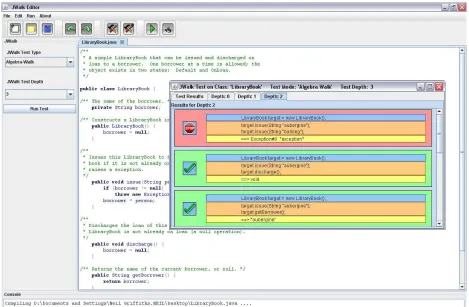
cover). This can be viewed as exploring the test-class according to different models of state abstraction. The first mode can be compared roughly with JCrasher [8] and Rostra’s [9] method-states and the second mode with Rostra’s modifier-states (except that JWalk is not random, but deterministic in its selection of arguments, and detects state-modification empirically, rather than by signature analysis). The design state mode is original to JWalk and utilizes the Cartesian product of state predicate observations as indicators of qualitative states [1]. The results of exploring the test-class are presented to the programmer for validation, as sets of observations, organized by sequence length, in a window containing a tabbed pane for each set (fig. 1).
During formal testing (as opposed to exploratory validation), the tool verifies the outcomes of the same tests semi-automatically against predictions made by a test oracle. The oracle is gradually populated with known correct and incorrect results, as the programmer accepts or rejects key test sequences, using a dialog that presents one sequence at a time. By making a mixture of opportunistic and conservative assumptions,
JWalk predicts further test outcomes, given the initial
results. For example, void methods typically yield no result (but may raise exceptions); and sequences with observer-methods in their prefix are predicted to yield the same result as shorter sequences without the observers. When used incrementally, JWalk predicts over 90% of test outcomes (amortized over test depth; see section 5), allowing significantly large numbers of paths to be tested [1] for minimal human intervention.
3. Feedback-based development method
[image:3.612.72.541.73.380.2]The JWalkEditor supports a novel paradigm for specification, coding and testing, which contrasts both with formal development, and with more recent agile approaches. Formal software development methods
have an initial specification stage, in which the design is specified in a formal language, such as Z or VDM, or using a state-based tool, such as SDL or Statemate. This approach supports fully automated and systematic test generation, using the specification to inform the selection of test cases and determine coverage; but has the extra overhead of developing a specification in the first place; and runs the risk that the software may later evolve independently.
More recently, agile development methods, such as
extreme programming (XP), have advocated a
“test-first” approach [10] in which programmers create tests before writing software, or “test-driven development” [11] in which testing and coding are inter-dependent activities. The tests take the place of a formal specification, encoding the properties that the software must eventually satisfy. This has the advantage that the specification (viz. the test-set) is executable, but the disadvantage that it is developed in a piecemeal way, according to the fallible insights of the programmer, who must constantly update the test-set if the production code is modified (arguably no easier than maintaining the validity of a formal specification w.r.t. evolving code).
The JWalkEditor offers a new approach, in which the programmer is entirely free to prototype the code as they wish; and the tool supports this by “growing” an associated specification, which evolves in step with the code. The specification is in the form of the saved oracle, generated during interactive testing. At first, the tool presents key test cases to the programmer for confirmation (state-modifying sequences, followed by single observations); but later it uses saved results to predict further test outcomes by rule [1]. Whenever a novel test outcome is observed (because it breaks a prediction, or contradicts a previously-saved result), the tool requests another confirmation. Otherwise, it assumes that the existing prediction is still valid (which holds in practice most of the time – see the discussion below; and [1]). In this way, JWalk incrementally builds a bounded, exhaustive model of an algebraic specification. It then generates a more abstract, high-level state-based specification, exploring the test class’s state space, using state-predicate methods in the class’s interface to identify any interesting states.
JWalk acquires the state cover test set (reaching all
states) and from this may generate the transition cover, the switch-1 cover (all method pairs), the switch-2
cover (all method triples), starting from each state.
But the tool also offers something else that is quite valuable, namely an on-the-fly validation of the latest design choices. When the programmer makes a change to the code in the editor, JWalk may immediately
explore the consequences of the latest modification, systematically revealing the effects of novel interleavings of methods and exposing corner-cases (such as testing nullops, or all interleaved observer-methods for their unexpected side-effects), which the programmer might not have fully considered. This experience is somewhat similar to that of model-validation from a partial specification, the approach adopted by model-checking tools such as Alloy [12]. For this reason, it is relevant to consider the
JWalkEditor also as a kind of specification tool, which
helps the programmer to determine dynamically the desired design for the class under development. We call this a “feedback-based” approach to specification, since the programmer may immediately see the consequences of particular design choices.
The cyclic development methodology is extremely habitable, because it capitalizes on what the different parties do best. Programmers are motivated mostly by the creativity of writing new code, and the gratification of seeing this execute, rather than by the process of creating a watertight specification. On the other hand, automated tools are better at performing systematic tasks, such as exploring all method combinations, states and transitions. The process of building confidence in the design is also on a human scale, since the tool presents information gradually to the programmer, showing first the obvious cases, then only presenting interesting novel cases, which could not be predicted.
4. An example of class development
To illustrate the experience of developing code in the JWalkEditor, the following example is given, as an indication of how a typical apprentice programmer might approach the task of providing two classes, related by inheritance. The first class, a LibraryBook, has the following structure:
public class LibraryBook { private String borrower; public LibraryBook(); public void issue(String); public void discharge();
public String getBorrower(); public Boolean isOnLoan(); }
Initially, the programmer codes issue and discharge to set and clear the borrower attribute, and ensures that
isOnLoan returns true when borrower != null. Next, a protocol-walk is performed, which reveals interesting
nullop when the LibraryBook is not on loan, but that
sequences repeating issue violate the business rules of the library. So, he returns to the editor, and inserts a precondition into the issue method, which raises an exception if an attempt is made to issue the
LibraryBook to more than one borrower. Focusing
now on state-modifying sequences, the programmer initiates an algebra-walk (see fig. 1) to confirm that the precondition correctly raises the exception. After this, he may explore algebraic constructions to greater depth, to be assured that it is possible to discharge and then issue the LibaryBook to a different borrower.
At this point, the observed behaviour seems acceptable, so the programmer switches to the
algebra-test mode, in order to build the oracle, and confirms
each presented observation as correct. In order to verify the class more thoroughly, he then selects the
state-test mode, in which JWalk identifies two abstract
design states, the Default state and the OnLoan state, determined from the false and true outcomes of the state predicate isOnLoan. JWalk computes the state cover, and tests all interleaved method sequences, starting in each of these states, to the desired depth. If the depth parameter is 3, this is equivalent to testing the
switch-2 cover [13], which according to Chow’s testing
theory is sufficient to guarantee the correct behaviour of even a poorly implemented test class, containing redundant states and duplicated paths of length 2.
Subsequently, the programmer wishes to extend the behaviour of the LibraryBook, in a subclass called
ReservableBook. This has the structure:
public class ReservableBook
extends LibraryBook { private String requester;
public ReservableBook(); public void reserve(String); public void cancel();
public String getRequester(); public Boolean isReserved(); }
Let us assume that the programmer expects to validate combinations of the state-modifying methods
reserve, cancel and observers getRequester, isReserved
in a similar style to the above. What he may not have anticipated is that methods inherited from LibraryBook interact with ReservableBook’s methods in unexpected ways (he has “tunnel vision”, a common fault).
In algebra-test mode, JWalk imports the existing oracle for the LibraryBook superclass, using this as the basis for the new oracle. The tool exercises reserve and cancel as expected, but does not re-present any of the old mutation sequences that involved only issue and
discharge, which it can predict from the old oracle.
However, previously unseen sequences that interleave
reserve and cancel with the inherited state-modifying
method sequences containing issue and discharge are presented. This is a considerable improvement over regression testing with saved test-sets in JUnit, since it interleaves local and inherited methods in all possible combinations, rather than simply applying the superclass’s test-set as a whole to the subclass, which has been proven to hide introduced faults [2].
At depth 2, the algebra-test interleaves reserve and
issue. At depth 3, getBorrower and getRequester
observe that a book can be reserved by borrower-A and then issued to borrower-B, which violates the library’s business rules again. The programmer is able to reject this outcome, which is logged in the oracle as a known fault. Furthermore, issuing the book should cancel the prior reservation (and does not). At the end of the test cycle, all known faults are listed in a summary. Returning to the editor, the programmer decides to override issue in ReservableBook to ensure that a book is only loaned (a) if it was not reserved, or (b) if the new borrower is the requester who reserved it; and then the prior reservation should be cancelled. Re-compiling the test-class, he re-runs the algebra-test, and this time is only presented with the cases involving the modified code, which he confirms as correct.
Finally, to demonstrate JWalk’s ability to detect interesting high-level states, the state-test mode may be selected. JWalk will detect four abstract design states:
Default, OnLoan, Reserved and OnLoan&Reserved,
named automatically after the boolean product of the predicates isOnLoan and isReserved (which yield false and true in four combinations). JWalk will determine how to reach each of these states and may be directed to verify the switch-n cover. In this test mode, JWalk will predict most test results, either from previously seen cases (during the algebra-test) or by rule-based prediction, identifying equivalence-classes of test sequences, which all map onto canonical sequences with no observers in the prefix. Some longer unseen sequences that start in the more distant states (e.g.
OnLoan&Reserved) will request new confirmations.
5. Experimental Evaluation
The effectiveness of this cyclic feedback-based coding, specification and testing method can be measured in several ways. Firstly, the number of new test-confirmations in each cycle is small, compared to the overall number of automated tests. Table 1 shows the amortized cost of confirmations over test cycles of increasing depth, for the algebra-test mode (a1, a2,
rows marked “con” denote new manual confirmations per depth cycle, while the rows marked “pre” denote automated retests and predictions, which increasingly dominate the state-test results. The level of automation rises from 40% to well over 90%. But even if confirmations are not amortized over test cycles, they still form a small fraction of overall tests executed: 20/138 or 14% for the LibraryBook, and 167/1816 or 9% for the ReservableBook.
Table 1. Amortized user interaction costs
Test class a1 a2 a3 s1 s2 s3
LibBk con 3 5 7 0 0 5
LibBk pre 2 8 18 18 38 133
ResBk con 3 14 56 0 11 83
ResBk pre 6 27 89 36 241 1649
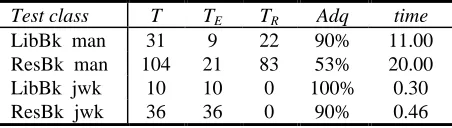
With practice, a programmer can confirm each key test-result in 2-3 seconds, building the oracle at around 25 test cases per minute. This compares favourably against manual testing methods, in which programmers take much longer to think up suitable test cases. Table 2 shows how long it took two developers to test “the transition cover, plus argument equivalence partitions” [14] both manually “man”, and using the tool “jwk” for the same examples. The time column indicates min.sec taken to develop and conduct tests.
Table 2. Speed and adequacy of testing
Test class T TE TR Adq time
LibBk man 31 9 22 90% 11.00
ResBk man 104 21 83 53% 20.00
LibBk jwk 10 10 0 100% 0.30
ResBk jwk 36 36 0 90% 0.46
The test coverage adequacy Adq is expressed as a fraction of effective test cases TE over ideal test cases T that were determined by inspection. The redundant tests TR indicate wasted effort, showing how the manual tester over-compensated, creating duplicated test cases.
JWalk’s coverage was nearly total (100% effective on
state-based criteria, but missing 4 partitions on input-criteria: JWalk does not yet perform full equivalence-partition testing).
The power of JWalk comes from its predictive rules, especially the predictions about sequence equivalence-classes (the observer-prefix elimination case); this is a strong conservative assumption, which always holds (side-effect-free invocations are detected empirically). A weaker opportunistic assumption, such as where
stack.pop() is expected to return void, may not always
hold, and early testing may fail to spot the missing precondition on empty stacks. Violated assumptions are usually detected by longer test-sequences in the next cycle, such as the unexpected result: stack.size()
== -1. The same principle applies to missing overrides
(the case of issue, above), or rare cases of double-faults that happen to map onto the correct result. Testing to depth k+1 usually exposes unwanted states masquerading as expected states in the previous cycle, c.f. Chow’s method [13]. Opportunistic assumptions are so useful in cutting down the number of cases presented to the programmer, that it would be impractical to do without them. Further examples of the test-coverage of JWalk may be found in [14].
Acknowledgement: Thanks are due to Arne-Michael
Toersel (at TaicPart ’07) for test cases used to develop the JWalk beta-2 revision.
6. References
[1] A. J. H. Simons, “JWalk: a tool for lazy systematic testing of Java classes, by design introspection and user interaction”,
J. Auto. Softw. Eng., 14 (4), 2007, 369-418.
[2] A. J. H. Simons, “A theory of regression testing for behaviourally compatible object types”, Softw. Test., Verif.
Reliab., 8(2), 2006, 133-156.
[3] A. J. H. Simons, “JWalk: lazy systematic unit testing”,
http://www.dcs.shef.ac.uk/~ajhs/jwalk/, 2007.
[4] O. Gruber, B. J. Hargrave, J. McAffer, P Rapicault and T. Watson, “The Eclipse 3.0 platform: adopting OSGi technology”, IBM Sys. J., 44(2), 2005, 289-299.
[5] N. Griffiths, “Test-as-you-code Java editor”, BSc dissert., Dept. Comp. Sci., University of Sheffield, 2008.
[6] S. Pestov et al., “jEdit programmer’s text editor”,
http://www.jedit.org/, accessed 8 May 2008.
[7] The Eclipse Foundation, “Eclipse – an open development platform”, http://www.eclipse.org/, accessed 8 May 8, 2008. [8] C. Csallner and Y. Smaragdakis, “JCrasher: an automatic robustness checker for Java”, Software: Practice and
Experience, 34(11), 2004, pp. 1025-1050.
[9] T. Xie, D. Marinov and D. Notkin, “Rostra: a framework for detecting redundant object-oriented unit tests”, Proc.
19th IEEE Conf. Automated Softw. Eng., IEEE, Washington
DC, 2004, pp. 196-205.
[10] K. Beck, Extreme Programming Explained: Embrace
Change, 1st edn. New York: Addison-Wesley, 2000.
[11] ibid., 2nd edn. New York: Addison-Wesley, 2005. [12] D. Jackson, Software Abstractions: Logic, Language
and Analysis, MIT Press, 2006.
[13] T. S. Chow, “Testing software design modeled by finite-state machines”, IEEE Trans. Softw. Eng., 4(3), 1978, 178-187.
[14] A. J. H. Simons and C. D. Thomson, “Benchmarking effectiveness for object-oriented unit testing”, Proc. 1st
[image:6.612.72.298.441.505.2]