This is a repository copy of
Divorce in cooperatively breeding long-tailed tits: a
consequence of inbreeding avoidance?
.
White Rose Research Online URL for this paper:
http://eprints.whiterose.ac.uk/1382/
Article:
Hatchwell, B.J., Russell, A.F., Ross, D.J. et al. (1 more author) (2000) Divorce in
cooperatively breeding long-tailed tits: a consequence of inbreeding avoidance?
Proceedings of the Royal Society B: Biological Sciences, 267 (1445). pp. 813-819. ISSN
1471-2954
https://doi.org/10.1098/rspb.2000.1076
[email protected] https://eprints.whiterose.ac.uk/ Reuse
Unless indicated otherwise, fulltext items are protected by copyright with all rights reserved. The copyright exception in section 29 of the Copyright, Designs and Patents Act 1988 allows the making of a single copy solely for the purpose of non-commercial research or private study within the limits of fair dealing. The publisher or other rights-holder may allow further reproduction and re-use of this version - refer to the White Rose Research Online record for this item. Where records identify the publisher as the copyright holder, users can verify any specific terms of use on the publisher’s website.
Takedown
If you consider content in White Rose Research Online to be in breach of UK law, please notify us by
a consequence of inbreeding avoidance?
B. J. Hatchwell
*, A. F. Russell
{
, D. J. Ross and M. K. Fowlie
Department of Animal and Plant Sciences, University of She¤eld, She¤eld S10 2TN, UK
The decision of whether to divorce a breeding partner between reproductive attempts can signi¢cantly a¡ect individual ¢tness. In this paper, we report that 63% of surviving pairs of long-tailed tits Aegithalos caudatus divorced between years. We examine three likely explanations for the high divorce rate in this cooperative breeder. The `better option’ hypothesis predicts that divorce and re-pairing increases an individual’s reproductive success. However, divorcees did not secure better partners or more helpers and there was no improvement in their reproductive success following divorce. The `inbreeding avoidance’ hypothesis predicts that females should disperse from their family group to avoid breeding with philopatric sons. The observed pattern of divorce was consistent with this hypothesis because, in contrast to the usual avian pattern, divorce was typical for successful pairs (81%) and less frequent in unsuccessful pairs (36^43%). The `forced divorce’ hypothesis predicts that divorce increases as the number of competi-tors increases. The pattern of divorce among failed breeders was consistent with this hypothesis, but it fails to explain the overall occurrence of divorce because divorcees rarely re-paired with their partners’ closest competitors. We discuss long-tailed tits’ unique association between divorce and reproductive success in the context of dispersal strategies for inbreeding avoidance.
Keywords:cooperative breeding; divorce; inbreeding; incest avoidance; long-tailed tit
1. INTRODUCTION
In socially monogamous species, individuals seeking to maximize their ¢tness in a series of discrete reproductive events may have to decide whether to stay with the same partner or ¢nd a new partner for successive breeding attempts (Rowley 1983). Divorce occurs when a pair-bond is broken between breeding attempts despite both members of the pair still being alive, and it can have profound implications for future reproductive success (Black 1996). In birds, the rate of divorce varies widely between and within species (Dhondt & Adriaensen 1994; Enset al. 1996), although the reasons for this variation are not fully understood (Choudhury 1995; Ens et al. 1996). Explanations for divorce include the `better option’ and `incompatibility’ hypotheses in which one or both members of a pair improve their reproductive success by obtaining a higher quality or more compatible partner or a better breeding site (e.g. Rowley 1983; Grant & Grant 1987; Ens et al. 1993; Orrell et al. 1994; Desrochers & Magrath 1996). Alternative hypotheses make no predic-tion about relative reproductive success of individuals before or after divorce. The `musical chairs’ hypothesis proposes that divorce is a side-e¡ect of between-season variation in the order of territory settlement (Dhondt & Adriaensen 1994; Dhondt et al. 1996), while the `acci-dental loss’ hypothesis proposes that divorce occurs due to accidental disruption of a pair-bond coupled with a need to rapidly re-pair (Owen et al. 1988). These explanations are likely to apply to species that leave their breeding areas between seasons, i.e. migratory species. Finally, the
`forced divorce’ hypothesis proposes that divorce occurs when a third party displaces one member of a breeding pair (Choudhury 1995).
There is some empirical support for each of these hypotheses and it is clear that the ecology of a species in£uences the divorce rate (Black 1996). Comparative studies show that mate ¢delity is generally high among long-lived, sedentary species (Ens et al. 1996). These demographic traits are typical of cooperatively breeding bird species (Brown 1987; Arnold & Owens 1998), where long-term pair-bonds may be an important element in family formation (Emlen 1995). Therefore, it is not surprising that many studies of cooperative breeders have reported very low rates of divorce (e.g. Stacey & Koenig 1990; Walters 1990; Marzlu¡ et al. 1996; Russell & Rowley 1996).
In this paper, we report a high frequency of divorce in the cooperatively breeding long-tailed tit Aegithalos caudatus. The musical chairs and accidental loss hypoth-eses are unlikely to apply to this sedentary species, but we consider three other explanations for this species’ high divorce rate.
(a) The `better option’ hypothesis
In long-tailed tits, divorcees might achieve higher reproductive success in two ways. First, they may secure a better partner. Second, in cooperative species where helpers have a positive e¡ect on the ¢tness of breeders, divorce may be a strategy to increase the number of helpers in later breeding attempts if divorcees ¢nd new partners with more potential helpers. Long-tailed tit helpers increase nestling provisioning rates (Hatchwell & Russell 1996) and have a positive e¡ect on breeder ¢tness by increasing o¡spring recruitment (Glen & Perrins 1988; Russell 1999; B. J. Hatchwell, unpublished data).
Proc. R. Soc. Lond.B (2000)267, 813^819 813 ©2000 The Royal Society
*Author for correspondence (b.hatchwell@she¤eld.ac.uk).
(b) The `inbreeding avoidance’ hypothesis
Inbreeding avoidance is generally regarded as a driving force in the evolution of dispersal strategies ( Johnson & Gaines 1990; Weatherhead & Forbes 1994), because of the deleterious e¡ects of inbreeding (Rallset al. 1986; Keller
et al. 1994; Pusey & Wolf 1996; Keller 1998; Koeniget al. 1999). In cooperative species, there is a risk of inbreeding if pairing occurs within an intact family group. This possibility is generally averted because reproduction usually follows dispersal (Brown 1987) and the act of dispersal takes o¡spring away from opposite-sex relatives. However, an inbreeding risk may arise when one parent dies leaving a parent with opposite-sex o¡spring as poten-tial breeders on a territory (Emlen 1995). The ensuing con£ict over who reproduces may result in a non-breeding stalemate (Koeniget al. 1998), in an individual or coalition of one sex evicting the opposite-sex relative(s) (Hannon et al. 1985; Zack & Rabenold 1989; Zahavi 1990), or in apparently voluntary dispersal by one sex (Walters 1990). A similar situation arises when philopa-tric o¡spring (typically males in birds) are reproductive, as in long-tailed tits, and risk pairing with a relative (e.g. their mother). In such circumstances, inbreeding may be avoided by the eviction or voluntary dispersal of one party. This may result in divorce and subsequent re-pairing outside the family group.
(c) The `forced divorce’ hypothesis
Increased competition for partners is predicted to increase the frequency of divorce. In long-tailed tits, the most likely source of competition for partners is from non-relatives within the winter £ocks which represent the main social structure during the non-breeding season.
2. METHODS
The study was conducted at three sites in Yorkshire,UK. One population of 18^35 pairs was studied in the Rivelin Valley (She¤eld) from 1994 to 1998, and two populations of about 35 pairs each were studied in Melton Wood (Doncaster) and Ecclesall Wood (She¤eld) from 1996 to 1998. The study sites comprised mixed woodland, scrub, farmland and gardens.
Long-tailed tits spend the non-breeding season in family groups of 10^15 birds, who occupy a £ock range. Flocks break up in early spring; males occupy part of the £ock range, and females either disperse to other ranges to ¢nd a partner or remain within the £ock range and pair with a male from that £ock. All birds start the season breeding independently in pairs, but nest failure is frequent (Hatchwellet al. 1999), and if a pair fails after early May they may become helpers by moving either individually or together to help another pair care for their o¡spring by feeding nestlings (Gaston 1973; Glen & Perrins 1988). All pairs breeding in each study site were known, and the majority (80^90%) of birds in each population were colour-ringed before breeding started. Pairs were readily identi¢ed during breeding because both sexes build the nest, the male feeds the incubating female on the nest, and both sexes feed the nestlings. Furthermore, paired males and females maintain close contact when foraging (mean distance between partners outside the fertile periodˆ7.2§2.8 m, nˆ24 pairs), and helpers appear only during the nestling period. Therefore, we are con¢dent that we assigned all pairings correctly. We monitored the breeding success of all pairs in the study populations (see
Hatchwellet al. 1999) and observed nests for at least 1 h every 1^3 days throughout the 16-day nestling period to determine the identity of carers. The measure of a breeder’s reproductive success used in this paper was simply whether or not a brood was £edged.
Divorce rates were calculated for pairs that bred in one year and from which both adults were known to be alive in the following year. If a bird bred with a new partner this was scored as a divorce. Those pairs from which both adults survived to the following season and bred together are described as `faithful’. Data for males and females were analysed separately and sample sizes for males and females di¡er in some analyses because in a few cases we were not certain that both members of a pair had bred following their divorce, even though both were known to be alive. We use the notation yearNand yearN+ 1 to describe the breeding seasons before and after divorce, and the ¢rst and second seasons for faithful pairs.
Mate ¢delity was scored in 49 cases for males and 48 cases for females. These totals include six males who were scored twice and one male who was scored three times. Five females are included twice, and one is included three times. These cases raise the potential di¤culty of pseudoreplication, but we have included them for two reasons. First, there was no consistent pattern in the occurrence of divorce for these individuals: six divorced twice, two were faithful twice, and seven divorced in one year and were faithful in another. These are precisely the frequencies expected given a 63% divorce rate (see ½ 3) and the random occurrence of divorce within individuals, so the multiple inclusion of particular individuals was unlikely to bias the results towards either divorce or mate ¢delity. Second, the social and ecological circumstances of an individual vary among seasons and in the following analyses we consider season-speci¢c rather than lifetime factors as predictors of divorce.
Another potentially confounding factor is the use of data from three populations. However, the study sites are within 30 km of each other, are ecologically similar (Russell 1999) and there was no di¡erence between populations in the proportion of birds that divorced between seasons (males: Rivelin 58%,
nˆ31, Melton 64%, nˆ11, Ecclesall 71%, nˆ7; G-test,
Gˆ1.59, d.f.ˆ2, pˆ0.47; females: Rivelin 63%, nˆ30, Melton, 64%, nˆ11, Ecclesall 71%, nˆ7; G-test, Gˆ0.92, d.f.ˆ2,pˆ0.65). Therefore, we have no reason to suspect that selection pressures relating to mate ¢delity di¡ered between sites. Means are given§one standard deviation, except where stated otherwise.
3. RESULTS
Divorce occurred frequently between seasons: 61% (nˆ49) of males and 65% (nˆ48) of females bred with another partner even though their previous partner was known to be alive.
(a) The `better option’ hypothesis
There was no evidence that the new partners of divor-cees were better than their old partners in terms of their previous reproductive success. Divorcees often paired with ¢rst-year birds or with immigrants, assumed to be ¢rst-year birds (table 1). Those divorcees that did pair with a bird who had bred in the study sites in yearNdid not gain a relatively successful partner (table 1), indeed the second partner tended to have been less successful than the ¢rst partner in yearN. It should be noted that 814 B. J. Hatchwell and others Divorce in long-tailed tits
this test assumes that partner quality in year N+ 1 is measurable from their reproductive success in yearN.
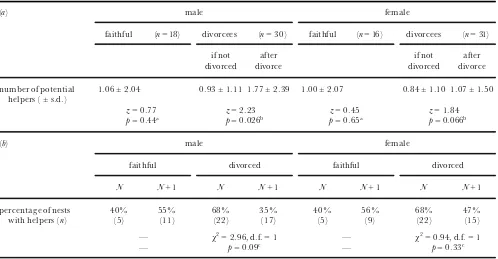
A further prediction of this hypothesis is that long-tailed tits may divorce to obtain more helpers; these are usually ¢rst-order relatives of one parent, most often a brother of the breeding male (Glen & Perrins 1988; Russell 1999; B. J. Hatchwell, unpublished data). In the following analyses, we ¢rst consider the number of potential helpers available to divorced and faithful birds, and then the number of nests at which helpers were observed (the latter depends on a nest surviving to the nestling phase). In each study population, we counted the number of known ¢rst-order relatives of faithful birds, divorced birds and their new partners. If divorcees had remained faithful to their original partner in year
N+ 1 instead of divorcing, they would have had a similar number of potential helpers as those individuals
who were faithful (males pˆ0.44, females pˆ0.65; table 2a), i.e. the absence of potential helpers did not explain divorce. Nevertheless, those birds who did divorce and re-pair tended to increase the number of potential helpers (males pˆ0.026, females pˆ0.066; table 2a) because their new partner often had ¢rst-order relatives nearby. However, divorcees may still not obtain more helpers because following a divorce potential helpers might help at a nest belonging to either divorcee. This is demonstrated by our second analysis using the observed number of nests with helpers. Divorcees were no more likely to have helpers in year N+ 1 than in year
[image:4.553.29.526.95.215.2]N (males pˆ0.09, females pˆ0.33; table 2b), in fact, divorced males tended to be less likely to have helpers following divorce. Furthermore, despite the greater number of potential helpers, divorcees were no more likely to have helpers than were faithful birds in year Table 1. The breeding history in year N of the ¢rst and second partners of divorced long-tailed tits
(Comparing ¢rst and second partners who had bred previously, there was no signi¢cant di¡erence in the proportions of ¢rst and second partners that were successful (males:w2ˆ0.564, d.f.ˆ1,pˆ0.45; females:w2ˆ3.03, d.f.ˆ1,pˆ0.082).)
breeding history in year
Nof partners of
male divorcees female divorcees
partner 1 partner 2 partner 1 partner 2
successful breeder 22 (73%) 8 (27%) 22 (71%) 6 (19%)
unsuccessful breeder 8 (27%) 6 (20%) 9 (29%) 9 (29%)
[image:4.553.29.527.262.521.2]non-breeder (¢rst year or immigrant) ö 16 (53%) ö 16 (52%)
Table 2. The number of (a)potential helpers available to faithful pairs and divorcees, and (b)observed helpers at the nests of faithful and divorced long-tailed tits(see ½ 3(a))
(a) male female
faithful (nˆ18) divorcees (nˆ30) faithful (nˆ16) divorcees (nˆ31)
if not divorced
after divorce
if not divorced
after divorce
number of potential helpers (§s.d.)
1.06§2.04 0.93§1.11 1.77§2.39 1.00§2.07 0.84§1.10 1.07§1.50
zˆ0.77 zˆ2.23 zˆ0.45 zˆ1.84
pˆ0.44a pˆ0.026b pˆ0.65a pˆ0.066b
(b) male female
faithful divorced faithful divorced
N N+ 1 N N+ 1 N N+ 1 N N+ 1
percentage of nests 40% 55% 68% 35% 40% 56% 68% 47%
with helpers (n) (5) (11) (22) (17) (5) (9) (22) (15)
ö w2ˆ2.96, d.f.ˆ1 ö w2ˆ0.94, d.f.ˆ1
ö pˆ0.09c ö pˆ0.33c
N+ 1 (males 35% versus 55%, respectively, G-test,
Gˆ1.01, d.f.ˆ1,pˆ0.31; females 47% versus 56%,G-test,
Gˆ0.18, d.f.ˆ1, pˆ0.67; table 2b). Thus, divorce did not increase the number of helpers at the nest.
The key prediction of this hypothesis is that divorcees should have higher reproductive success in year N+ 1 than in year N. However, the breeding success of divor-cees was signi¢cantly lower in yearN+ 1 than in year N
(table 3), opposite to the predicted pattern. Furthermore, in year N+ 1 divorcees were no more successful than faithful birds were (faithful males 37%,nˆ19,w2ˆ0.00, d.f.ˆ1, pˆ0.97; faithful females 35%, nˆ17, w2ˆ0.13, d.f.ˆ1,pˆ0.71). Therefore, we conclude that divorce did not increase productivity for either sex.
(b) The `inbreeding avoidance’ hypothesis
The annual mortality rate of adult male long-tailed tits is 44% (nˆ121), so the probability of a male partner dying between breeding seasons is high. Philopatric recruitment of male o¡spring is frequent, while that of females is rare ; a total of 250 £edglings have been ringed at our most intensively observed study site (Rivelin Valley), and assuming an equal sex ratio at £edging, male recruitment within the study site was 30% (38 out of 125), while that of females was just 9% (11 out of 125). Male recruits usually breed close to their natal site, so inbreeding is a signi¢cant risk if females that were successful in yearNremain within their family £ock and pair with a male member of that £ock in yearN+ 1. This hypothesis proposes that divorce is a consequence of avoidance of inbreeding between females and their philo-patric sons.
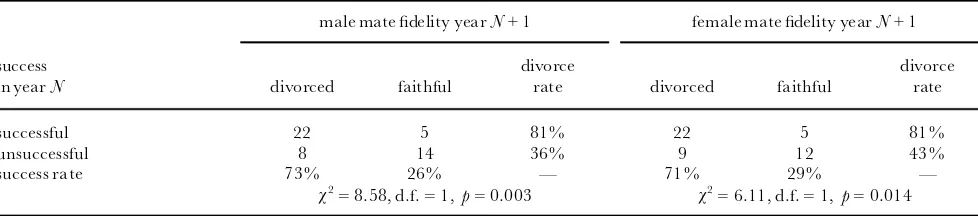
The key predictions of this hypothesis are that females that bred successfully in yearN should divorce, and that they should pair with a male from a di¡erent £ock in year N+ 1. There was a close association between repro-ductive success and mate ¢delity for both sexes. Birds who were successful in year N had a high probability of divorce, whereas those who were unsuccessful had a low
probability of divorce (malespˆ0.003, femalespˆ0.014; table 4). Furthermore, in no cases did divorcing females pair with a long-term male member of their family £ock. These results are consistent with the inbreeding avoidance hypothesis.
(c) The `forced divorce’ hypothesis
For both sexes, divorce was typical when they had helpers in year N (84% divorce, nˆ19 for both sexes), and signi¢cantly less frequent when a pair had no helpers (males 47%, nˆ30, w2ˆ6.91, d.f.ˆ1, pˆ0.009; females 52%,nˆ29,w2ˆ5.30, d.f.ˆ1,pˆ0.02). This association between the presence of helpers in yearNand subsequent divorce might have resulted from helpers forcing the divorce of helped pairs. However, it is unlikely that helpersper sewere responsible for divorces because in just two out of ¢ve cases where a male breeder and an unre-lated female helper survived to year N+ 1 did the male divorce and re-pair with the female helper, and in not one out of the nine cases where a female breeder and an unrelated male helper survived to year N+ 1 did they pair up. Therefore, the observed association of divorce with helpers in yearN is probably a consequence of the close association between divorce and reproductive success reported in the previous section.
Nevertheless, this hypothesis may explain some instances of divorce. Thirty-six per cent of males and 43% of females (table 4) who were unsuccessful in yearN
divorced even though there was no obvious risk of inbreeding. The likely explanation for these divorces concerns a failed breeder’s decision of whether to become a helper. Helping is male biased, but the female partners of helpers usually continue to associate with their partner and join the resulting family £ock. By contrast, failed pairs of which neither member becomes a helper form adult £ocks with other failed breeders who have not helped (Russell 1999; B. J. Hatchwell, unpublished data). We hypothesized that competition for partners (and hence divorce) would be more severe in these adult £ocks 816 B. J. Hatchwell and others Divorce in long-tailed tits
[image:5.553.25.525.81.159.2]Proc. R. Soc. Lond.B (2000)
Table 3. Reproductive success of divorced long-tailed tits in years N and N + 1. Sample sizes are lower in year N + 1 because some birds moved out of the study site for late nests
divorced males divorced females
yearN yearN+ 1 yearN yearN+ 1
percentage successful 73% (nˆ30) 41% (nˆ27) 71% (nˆ31) 25% (nˆ24)
[image:5.553.30.519.195.303.2]w2-tests w2ˆ6.19, d.f.ˆ1,pˆ0.012 w2ˆ11.44, d.f.ˆ1,p50.001
Table 4. Association between reproductive success in year N and mate ¢delity of male and female long-tailed tits in year N + 1
male mate ¢delity yearN+ 1 female mate ¢delity yearN+ 1
success divorce divorce
in yearN divorced faithful rate divorced faithful rate
successful 22 5 81% 22 5 81%
unsuccessful 8 14 36% 9 12 43%
success rate 73% 26% ö 71% 29% ö
than in family £ocks, where most members are juveniles. As expected, most failed pairs from which one or both sexes became helpers were faithful in year N+ 1 (92%,
nˆ12), and a relatively small proportion of failed pairs in which neither sex helped were faithful in year N+ 1 (30%, nˆ10; Fisher’s exact test, p50.005). Furthermore, the new partners of failed, non-helping divorcees had themselves come from failed, non-helping pairs in most cases (67%, nˆ9 cases where status of new partner in year N was known). This di¡erence in divorce rate of failed breeders in adult and family £ocks is consistent with the forced divorce hypothesis.
4. DISCUSSION
To our knowledge, this is the ¢rst documented case of successful breeders being more likely to divorce than unsuccessful breeders. This pattern of divorce does not support the better option hypothesis, but it is consistent with the hypothesis that divorce is a consequence of inbreeding avoidance. There was also some limited support for the forced divorce hypothesis among unsuc-cessful breeders. Our tests of the competing hypotheses are not strictly independent in the sense that the presence of philopatric sons is closely linked to reproductive success. There may also have been confounding e¡ects of group size on divorce rate. This possibility is di¤cult to test directly because £ock size changes through the non-breeding season due to mortality and female dispersal. However, the fact that failed pairs that joined family £ocks were generally faithful (92% partner ¢delity) while breeding pairs in family £ocks usually divorced (table 4) indicates that £ock size per se did not a¡ect divorce rate. An alternative explanation for a higher divorce rate among successful pairs than among unsuccessful pairs is that divorcees are seeking to increase the genetic diversity of their o¡spring, but theory suggests that any advantage accruing from such a strategy is likely to be small (Williams 1975; Brown 1997).
In most monogamous birds, divorce occurs among rela-tively unsuccessful pairs, or is unrelated to previous breeding success (Ens et al. 1996), and the long-tailed tit appears to be unique in showing a higher rate of divorce for relatively successful pairs. Limited evidence for the forced divorce hypothesis was obtained for failed breeders in adult £ocks of non-helpers, but there was no evidence that helpers were responsible for the divorce of successful pairs. This di¡ers from Reyer’s (1986) study of coopera-tively breeding pied king¢shers Ceryle rudis in which helpers often evicted breeding males to pair with the female breeder. However, in contrast to long-tailed tits, the usurping helpers in pied king¢shers are unrelated to either breeder and so are likely to be in more direct con£ict over reproductive status. It should also be noted that although our observation of frequent divorce and re-pairing within adult £ocks of long-tailed tits is consistent with the forced divorce hypothesis, we have no direct evidence of contests over partners in these £ocks, and a similar pattern might emerge from random re-pairing within £ocks of adults.
Our favoured explanation for the frequent divorce of successful pairs is founded on the well-established idea that dispersal strategies are driven, in part, by inbreeding
avoidance ( Johnson & Gaines 1990; Weatherhead & Forbes 1994). In mongamous species, dispersal by one or both sexes usually occurs prior to reproduction, so there is no need for subsequent dispersal (hence divorce) to avoid incest. Among cooperative breeders, reproduction by subordinates within intact families appears to be rare (Reeve et al. 1990; Keaneet al. 1996). Nevertheless, inces-tuous pairing may become a possibility when one breeder dies. In such circumstances, contests over reproductive status among opposite-sex relatives have been frequently reported (e.g. Hannonet al. 1985; Zack & Rabenold 1989; Zahavi 1990; Koenig et al. 1998). These power struggles are usually resolved by the dispersal of one sex, for example, in red-cockaded woodpeckers Picoides borealis
females leave a territory when their partner dies, leaving philopatric sons to attain reproductive status with immi-grant females (Walters 1990). Therefore, a strategy of dispersal to avoid inbreeding is not an unusual feature in cooperative breeding systems. What is remarkable is that in the unusual cooperative breeding system of long-tailed tits, where all philopatric sons are reproductive from their ¢rst year, avoidance of inbreeding may result in a counter-intuitive prevalence of divorce among successful breeders. Moreover, in most cooperative breeding systems, selection for mate ¢delity may be strong because breeding vacancies are limiting (Emlen 1982) and divorce may result in forfeiture of breeding status. By contrast, constraints on independent reproduction by long-tailed tits are weak (Hatchwell et al. 1999), so there may be little cost of divorce in terms of future breeding opportunities. In addition, the adult mortality rate of long-tailed tits is relatively high (Arnold & Owens 1998; Hatchwell 1999), so the opportunity for long-term pair-bonds to develop is limited.
Close inbreeding appears to be rare in long-tailed tits. We have observed just one instance where a female bred with a male from her own nest. In this exceptional case, the juvenile male switched £ock shortly after indepen-dence and was probably perceived as a member of a di¡erent £ock by the female, rather than as a member of her own family. Nevertheless, a low level of inbreeding might be expected in any sedentary species with moderate or high survival and frequent re-pairing. Indeed, inbreeding avoidance may not evolve at all if the costs of avoidance exceed the costs of inbreeding (Waser et al. 1986), as appears to be the case in song sparrows
Melospiza melodia (Keller 1998; Keller & Arcese 1998). The absence of a signi¢cant level of inbreeding in our populations means that we are unable to evaluate its cost, even using the indirect method of Koeniget al. (1999).
survival to the following season. In an unrelated family £ock, there may be a similar number of unrelated adults, but also some unrelated juvenile males who are potential partners in yearN+ 1. Therefore, the best strategy for a successful female to adopt may be to leave her family and join another £ock. The fact that the male partner in year
Nis often alive in yearN+ 1 (hence divorce) suggests that females move away from the family before pair formation in early spring. A third possibility is that recognition errors increase the chance of inbreeding. A successful female has related and unrelated males in her family £ock. The kin-recognition mechanism of long-tailed tits is not yet fully understood (Komdeur & Hatchwell 1999), and it is not known whether recognition cues are speci¢c to individuals or families. In the latter case a female may be unable to discriminate reliably between her philopatric sons and her partner. Therefore, it might pay to adopt a cautious strategy of dispersing to pair with a male from another £ock to reduce the risk of accidental pairing with kin. Long-tailed tits can discriminate between the calls of familiar and unfamiliar individuals (B. J. Hatchwell, unpublished data), but an understanding of whether recognition cues enable discrimination at the level of the individual or the family is critical for our understanding of the options available to individuals wishing to avoid pairing with their relatives.
We thank Tim Birkhead, Dave Richardson and two anonymous referees for their valuable comments on the manuscript, Hallam Golf Club, Yorkshire Water, She¤eld City Council and Doncaster Town Council for permission to watch birds on their land, and Dave Hazard for assistance with ¢eldwork. This work was funded by grants from the Association for the Study of Animal Behaviour, Nu¤eld Foundation, University of She¤eld and the Natural Environment Research Council, for which we are most grateful.
REFERENCES
Arnold, K. E. & Owens, I. P. F. 1998 Cooperative breeding in birds: a comparative test of the life history hypothesis.Proc. R. Soc. Lond. B265, 739^745.
Black, J. M. (ed.) 1996Partnerships in birds: the study of monogamy. Oxford University Press.
Brown, J. L. 1987Helping and communal breeding in birds. Princeton University Press.
Brown, J. L. 1997 A theory of mate choice based on hetero-zygosity.Behav. Ecol.8, 60^65.
Choudhury, S. 1995 Divorce in birds: a review of the hypoth-eses.Anim. Behav.50, 413^429.
Desrochers, A. & Magrath, R. D. 1996 Divorce in the European blackbird: seeking greener pastures? InPartnerships in birds: the study of monogamy (ed. J. M. Black), pp. 177^191. Oxford University Press.
Dhondt, A. A. & Adriaensen, F. 1994 Causes and e¡ects of divorce in the blue tit Parus caeruleus. J. Anim. Ecol. 63, 979^987.
Dhondt, A. A., Adriaensen, F. & Plompen, W. 1996 Between-and within-population variation in mate ¢delity in the great tit. In Partnerships in birds: the study of monogamy (ed. J. M. Black), pp. 235^248. Oxford University Press.
Emlen, S. T. 1982 The evolution of helping. I. An ecological constraints model.Am. Nat.119, 29^39.
Emlen, S. T. 1995 An evolutionary theory of the family. Proc. Natl Acad. Sci.USA92, 8092^8099.
Ens, B. J., Safriel, U. N. & Harris, M. P. 1993 Divorce in the
long-lived and monogamous oystercatcher, Haematopus
ostralegus: incompatibility or choosing the better option?Anim. Behav.45, 1199^1217.
Ens, B. J., Choudhury, S. & Black, J. M. 1996 Mate ¢delity and divorce in monogamous birds. InPartnerships in birds: the study of monogamy(ed. J. M. Black), pp. 344^401. Oxford University Press.
Gaston, A. J. 1973 The ecology and behaviour of the long-tailed tit.Ibis115, 330^351.
Glen, N. W. & Perrins, C. M. 1988 Cooperative breeding by long-tailed tits.British Birds81, 630^641.
Grant, B. R. & Grant, P. R. 1987 Mate choice in Darwin’s ¢nches.Biol. J. Linn. Soc.32, 247^270.
Hannon, S. J., Mumme, R. L., Koenig, W. D. & Pitelka, F. A. 1985 Replacement of breeders and within group con£ict in the cooperatively breeding acorn woodpecker. Behav. Ecol. Sociobiol.17, 303^312.
Hatchwell, B. J. 1999 Investment strategies of breeders in avian cooperative breeding systems.Am. Nat.154, 205^219.
Hatchwell, B. J. & Russell, A. F. 1996 Provisioning rules in cooperatively breeding long-tailed tits Aegithalos caudatus: an experimental study.Proc. R. Soc. Lond. B263, 83^88.
Hatchwell, B. J., Russell, A. F., Fowlie, M. K. & Ross, D. J. 1999 Reproductive success and nest site selection in a coop-erative breeder: e¡ect of experience and a direct bene¢t from helping.Auk116, 355^363.
Johnson, M. L. & Gaines, M. S. 1990 Evolution of dispersal: theoretical models and empirical tests using birds and mammals.A. Rev. Ecol. Syst.21, 449^480.
Keane, B., Creel, S. R. & Waser, P. W. 1996 No evidence of inbreeding avoidance or inbreeding depression in a social carnivore.Behav. Ecol.7, 480^489.
Keller, L. F. 1998 Inbreeding and its ¢tness e¡ects in an insular population of song sparrows (Melospiza melodia). Evolution52, 240^250.
Keller, L. F. & Arcese, P. 1998 No evidence for inbreeding avoidance in a natural population of song sparrows (Melospiza melodia).Am. Nat.152, 380^392.
Keller, L. F., Arcese, P., Smith, J. N. M., Hochachka, W. M. & Stearns, S. C. 1994 Selection against inbred song sparrows during a natural population bottleneck.Nature372, 356^357.
Koenig, W. D., Haydock, J. & Stanback, M. T. 1998 Repro-ductive roles in the cooperatively breeding acorn woodpecker: incest avoidance versus reproductive competition.Am. Nat.151, 243^255.
Koenig, W. D., Stanback, M. T. & Haydock, J. 1999 Demo-graphic consequences of incest avoidance in the cooperatively breeding acorn woodpecker.Anim. Behav.57, 1287^1293.
Komdeur, J. & Hatchwell, B. J. 1999 Kin recognition: function and mechanism in avian societies.Trends Ecol. Evol.14, 237^241.
Marzlu¡, J. M., Woolfenden, G. E., Fitzpatrick, J. W. & Balda, R. P. 1996 Breeding partnerships of two New World jays. In
Partnerships in birds: the study of monogamy (ed. J. M. Black), pp. 138^161. Oxford University Press.
Orrell, M., RytkÎnen, S. & Koivula, K. 1994 Causes of divorce in the mongamous willow tit, Parus montanus, and conse-quences for reproductive success.Anim. Behav.48, 1143^1154.
Owen, M., Black, J. M. & Liber, H. 1988 Pair bond duration and timing of its formation in barnacle geese. InWildfowl in winter (ed. M. W. Weller), pp. 23^38. Minneapolis, MN: University of Minnesota Press.
Pusey, A. & Wolf, M. 1996 Inbreeding avoidance in animals. Trends Ecol. Evol.11, 201^206.
Ralls, K., Harvey, P. H. & Lyles, A. M. 1986 Inbreeding in natural populations of birds and mammals. In Conservation biology: the science of diversity (ed. M. Soule¨), pp. 35^56. Sunderland, MA: Sinauer.
818 B. J. Hatchwell and others Divorce in long-tailed tits
Reeve, H. K., Westneat, D. F., Noon, W. A., Sherman, P. W. & Aquadro, C. F. 1990 DNA `¢ngerprinting’ reveals high levels of inbreeding in colonies of the eusocial naked mole-rat.Proc. Natl Acad. Sci.USA87, 2496^2500.
Reyer, H.-U. 1986 Breeder^helper interactions in the pied king-¢sher re£ect the costs and bene¢ts of cooperative breeding.
Behaviour96, 278^303.
Rowley, I. 1983 Re-mating in birds. In Mate choice (ed. P. Bateson), pp. 331^360. Cambridge University Press.
Russell, A. F. 1999 Ecological constraints and the cooperative breeding system of the long-tailed titAegithalos caudatus. PhD thesis, University of She¤eld, UK.
Russell, E. & Rowley, I. 1996 Partnerships in promiscuous splendid fairy-wrens. InPartnerships in birds: the study of mono-gamy(ed. J. M. Black), pp. 162^173. Oxford University Press. Stacey, P. B. & Koenig, W. D. (eds) 1990 Cooperative breeding in
birds: long-term studies of ecology and behavior. Cambridge University Press.
Walters, J. R. 1990 Red-cockaded woodpeckers: a `primitive’ cooperative breeder. In Cooperative breeding in birds: long-term
studies of ecology and behavior(ed. P. B. Stacey & W. D. Koenig), pp. 69^101. Cambridge University Press.
Waser, P. M., Austad, S. N. & Keane, B. 1986 When should animals tolerate inbreeding?Am. Nat.128, 529^537.
Weatherhead, P. J. & Forbes, M. R. L. 1994 Natal philopatry in passerine birds: genetic or ecological in£uences? Behav. Ecol.
5, 426^433.
Williams, G. C. 1975 Sex and evolution. Princeton University Press.
Zack, S. & Rabenold, K. N. 1989 Assessment, age and proxi-mity in dispersal contests among cooperative wrens: ¢eld experiments.Anim. Behav.38, 235^247.
Zahavi, A. 1990 Arabian babblers: the quest for social status in a cooperative breeder. InCooperative breeding in birds: long-term studies of ecology and behavior(ed. P. B. Stacey & W. D. Koenig), pp. 103^130. Cambridge University Press.