EFFECTIVENESS OF TAILORED EXERCISE PROGRAM
ON LEVELS OF PHYSICAL PERFORMANCE, MOBILITY
AND FALLS EFFICACY AMONG ELDERLY IN A
SELECTED OLD AGE HOME, VELLORE.
M.Sc (NURSING) DEGREE EXAMINATION BRANCH- I MEDICAL SURGICAL NURSING
SRI NARAYANI COLLEGE OF NURSING, VELLORE-55.
A Dissertation Submitted to
THE TAMIL NADU DR. M. G. R. MEDICAL UNIVERSITY,
CHENNAI- 600 032.
In partial fulfilment of the requirement for the degree of
MASTER OF SCIENCE IN NURSING.
CERTIFICATE
This is to certify that this dissertation entitled
³
EFFECTIVENESS
OF TAILORED EXERCISE PROGRAM ON LEVELS OF
PHYSICAL PERFORMANCE, MOBILITY AND FALLS EFFICACY
$021*(/'(5/<,1$6(/(&7('2/'$*(+20(9(//25(´
is a bonafide work done by
Ms. PERSIS ANGELIN.W,
Sri Narayani
College of Nursing, Vellore
±
55, in the partial
fulfilment of the requirement
for award of the degree of Master of Science in
Nursing, Branch I
±
Medical
Surgical Nursing, under my guidance and supervision
during the academic
Period from April 2014-16.
Prof. Mrs. Lalitha Purushothaman, M.Sc., (N), M. Phil.
Administrative cum Liaison Officer,
HOD of Nursing Research Dept,
Sri Narayani College of Nursing,
Thirumalaikodi,
EFFECTIVENESS OF TAILORED EXERCISE PROGRAM
ON LEVELS OF PHYSICAL PERFORMANCE, MOBILITY
AND FALLS EFFICACY AMONG ELDERLY IN A
SELECTED OLDAGE HOME, VELLORE.
Approved by dissertation committee on July 2015
RESEARCH GUIDE:
Prof. Mrs. Sujatha.V, M.Sc.(N).,
Principal and Research Co-ordinator, __________________________ HOD of Community Health Nursing,
Sri Narayani College of Nursing, Vellore-55.
SPECIALITY GUIDE: Mrs.Lydia.G, M.Sc (N)., Research guide,
HOD of Medical and Surgical Nursing, __________________________ Sri Narayani College of Nursing,
Vellore-55.
A Dissertation submitted to
THE TAMIL NADU DR. M. G. R. MEDICAL UNIVERSITY, CHENNAI ±600 032.
In partial fulfilment of the requirement for the degree of MASTER OF SCIENCE IN NURSING.
EFFECTIVENESS OF TAILORED EXERCISE PROGRAM
ON LEVELS OF PHYSICAL PERFORMANCE, MOBILITY
AND FALLS EFFICACY AMONG ELDERLY IN A
SELECTED OLDAGE HOME, VELLORE.
BY 301413033
M.Sc (NURSING) DEGREE EXAMINATION BRANCH-I MEDICAL SURGICAL NURSING SRI NARAYANI COLLEGE OF NURSING,
VELLORE-55.
A Dissertation Submitted to
THE TAMIL NADU DR. M. G. R. MEDICAL UNIVERSITY,
CHENNAI- 600 032.
In partial fulfilment of the requirement for the degree of
MASTER OF SCIENCE IN NURSING.
i
ACKNOWLEDGEMENT
First and above all, I praise Lord, the Almighty for providing me this opportunity, granting me the capability to proceed successfully and his holiness beloved
SRI SAKTHI AMMA, for his abundant grace, which gave me the strength and courage throughout the completion of this dissertation.
I express my sincere gratitude to the Management of Sri Narayani College of
Nursing (SNCON) for the continuous guidance and support. I am grateful to our
Managing Director Dr. N. Balaji, Ph.D., MACE., FIMSA., FACSC., MBA., SNHRC and SNCON, who gave opportunity to conduct the study.
I express my deepest and heartfelt thanks to Prof. Mrs. Lalitha Purushothaman. M.Sc (N), M.Phil., Administrative cum liaison officer, SNCON, who has given me the support and being my role model throughout these years. .
I would like to express my sincere gratitude to Prof. Mrs. V.Sujatha M.Sc (N)., Principal & HOD of Community Health Nursing, SNCON for being source of
encouragement, inspiration and enthusiasm during this dissertation. .
I would like to extend my sincere gratitude to my research guide Mrs. Lydia.G M.Sc(N)., HOD Medical and Surgical Nursing for her guidance and support in my dissertation.
I am also grateful to Prof. Mr. Prabhu T.S M.Sc (N)., HOD Mental Health Nursing for his dedicated help, guidance and continuous support throughout my study.
I express my heartfelt thanks to my Co-guide Mr. Purushothaman.R M.Sc (N)., Associate Professor, Medical and Surgical Nursing for his constant support and guidance
ii Its my privilege to express my gratitude specially to Mr. Sathish MPT., HOD OF physiotheraphy SNHRC for giving his valuable suggestions to my dissertation
and to all teaching staffs, non teaching staffs and library staffs of SNCON for their significant contribution to this study.
I extend my heart felt thanks to tool Validation experts Prof. Mrs. Beulah Premkumar MSc(N)., Ph.D, department of Medical and Surgical Nursing Christian Medical College, Vellore, Prof. Mrs. Anbu Surendra Kumar MSc(N)., department of Medical and Surgical Nursing Christian Medical College, Vellore and Mrs. Devaneethi Stephen MSc(N)., Principal , Mythiri College of Nursing
I extend my thanks to Prof. Mr. S. Muthurathinam, M.Sc., Biostatistics, SNCON for his assistance in statistical analysis and presentation of data in
graphical form. I extend my cordial thanks to Mr. Felix.E B.Sc., M.Ed., D.Com., Assistant Head Master Voorhees Higher Secondary School Vellore, who helped me in
the English editing. I extend my thanks to Prof. Mr. B.G. Thiruinbaezhilan, M.A., M.Phil., Ph.D., Professor, Voorhees College, Vellore, for his suggestions in Tamil editing. I express my gratitude to the trustees , manager and to all the study participants who are residing in old age home at Vellore for their cooperation to my study.
I owe my special thanks to my mentor and Particular thanks to my dearest aunts Mrs. Marie John, Mrs. Vimala Prakasam and Mrs. Beulah Premkumar who have always been helpful to clarify my doubts. My deepest gratitude goes to my family,
Praveena and dearest friends for their unflagging love and unconditional support
throughout my life and studies. Special thanks to my mom ,dad and dearest brother Isaac for their untiring efforts towards my education.
iii
ABSTRACT
INTRODUCTION
Old age is the golden age and often referred to as second childhood. Elderly
require special care during this period.
STATEMENT
Effectiveness of tailored exercise program on levels of physical performance,
mobility and falls efficacy among elderly in a selected old age home, Vellore.
OBJECTIVES :
x To assess the levels of physical performance, mobility and falls efficacy before
tailored exercise program among elderly.
x To assess the effectiveness of tailored exercise program on levels of physical
performance, mobility and falls efficacy among elderly.
x To associate the post tet level of physical performance, mobility and falls efficacy
with the selected demographic variables among elderly
METHODS:
The research design selected was pre experimental one group pre and post test
design. Purposive sampling Technique was adopted to select 30 elderly in old age home.
Descriptive statistics and inferential statistics were used for analysis and interpretation of
iv Results and interpretation:
The study findings revealed that the pre test mean value of physical performance
was 23, elderly mobility was 16, falls efficacy was 28 and after the tailored exercise
program the post test mean value of physical performance was 24.7, and mobility was 17,
falls efficacy 43.7. The paired "t" value of physical performance (3.3) is greater than the
table value (2.76) which was statistically significant at p <0.01 level. The paired "t" value
of mobility (5.3) is greater than the table value (2.76) which was statistically significant
at p <0.01 level. The paired "t" value of falls efficacy (12.7) is greater than the table
value (2.76) which was statistically significant at p <0.01 level proving effectiveness of
tailored exercise program on physical performance, mobility and falls efficacy. 7KHµ&KL
square value of demographic variable of physical performance (history of falls) , elderly
mobility (history of falls, period of falls), falls efficacy (BMI , education, co-morbid
illness) are significant at p <0.05 level.
Conclusion:
The majority of the elderly in old age home had significant improvement in the
levels of physical performance, mobility and falls efficacy through tailored exercise
program.
v
TABLE OF CONTENTS
CHAPTER NO.
CONTENT
PAGE NO.
I INTRODUCTION 1
x Need for the study 6
x Statement of the problem 12
x Objectives of the study 12
x Operational definition 12
x Research hypotheses 14
x Limitation 14
x Conceptual Framework 15
II REVIEW OF LITERATURE 18
III RESEARCH METHODOLOGY
x Research approach 33
x Research design 33
x Setting of the study 33
x Population of the study 34
x Sample technique 34
vi
CHAPTER NO.
CONTENT
PAGE NO.
x Criteria for sample selection 34
x Variables 35
x Demographic tool 35
x Validity and Reliability 38
x Pilot study 39
x Data collection procedure 40
x Data analysis plan 41
IV
DATA ANALYSIS AND INTERPRETATION 43
V
RESULT AND DISCUSSION 70
VI
SUMMARY AND RECOMMENDATIONS
x Summary 76
x Conclusion 79
x Nursing implication 79
x Recommendations 80
vii
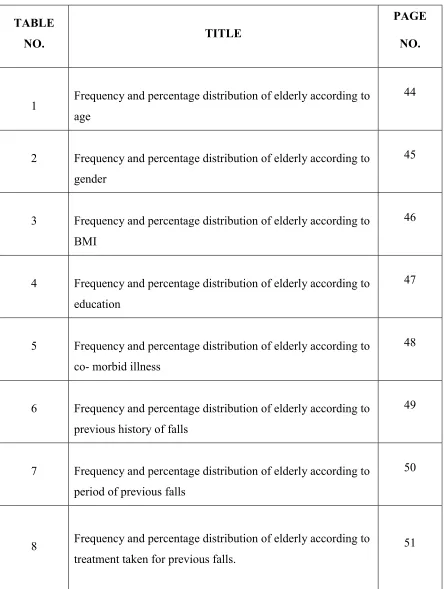
LIST OF TABLES.
TABLE
NO. TITLE
PAGE NO.
1 Frequency and percentage distribution of elderly according to age
44
2 Frequency and percentage distribution of elderly according to gender
45
3 Frequency and percentage distribution of elderly according to BMI
46
4 Frequency and percentage distribution of elderly according to education
47
5 Frequency and percentage distribution of elderly according to co- morbid illness
48
6 Frequency and percentage distribution of elderly according to previous history of falls
49
7 Frequency and percentage distribution of elderly according to period of previous falls
50
8 Frequency and percentage distribution of elderly according to treatment taken for previous falls.
[image:11.612.98.543.134.723.2]viii
TABLE
NO.
TITLE
PAGE NO.
9
Frequency and percentage distribution on levels of physicalperformance 52
10 Frequency and percentage distribution on levels of elderly mobility
53
11 Frequency and percentage distribution on levels of falls efficacy.
54
12 Effectiveness of tailored exercise program on physical performance
55
13 Effectiveness of tailored exercise program on elderly mobility
56
14 Effectiveness of tailored exercise program on falls efficacy.
57
15 Association between post test scores of physical performance
and the selected demographic variable.
58
16 Association between post test scores of elderly mobility and the selected demographic variable
62
17 Association between post test scores of falls efficacy and the selected demographic variable
ix
LIST OF FIGURES.
FIGURE NO. TITLE PAGE NO.
1 Conceptual framework
17
2 Research design
42
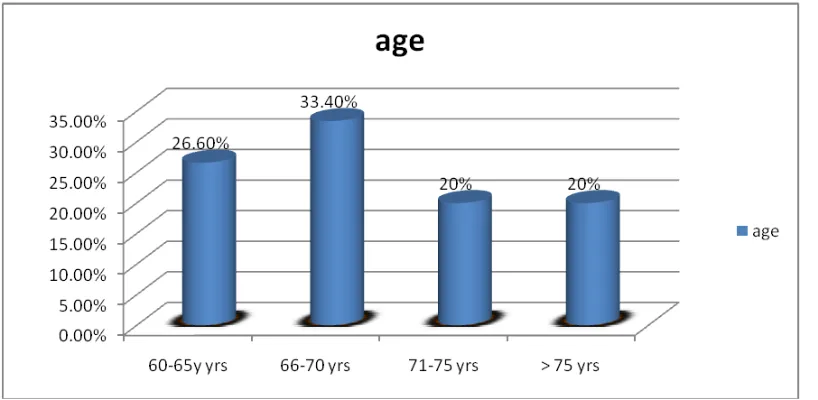
3 Column graph showing percentage distribution of elderly according to age
44
4 Doughnut chart showing percentage distribution of elderly according to gender
45
5 Pie chart showing percentage distribution of elderly according to BMI
46
6 Cone graph showing percentage distribution of elderly according to education
47
7 Column graph showing percentage distribution of elderly according to co- morbid illness
48
8 Column graph showing percentage distribution of elderly according to previous history of previous falls
49
9 Column graph showing percentage distribution of elderly according to period of previous falls
x
FIGURE NO. TITLE PAGE NO.
10 Pie chart showing percentage distribution of elderly according to treatment taken for previous falls.
51
11 Column graph showing distribution of levels of physical performance
52
12 Cone graph showing distribution of levels of elderly mobility
53
13 Column graph showing distribution of levels of falls efficacy
54
14 Column graph showing effectiveness of tailored exercise program on physical performance
55
15 Cone graph showing effectiveness of tailored exercise program on elderly mobility
56
16 Column graph showing effectiveness of tailored exercise program on falls efficacy.
xi
LIST OF APPENDICES
APPENDIX TITTLE PAGE
NO.
A Letter seeking permission to conduct pilot study I
B Letter seeking permission to conduct main study ii
C Letter granting permission to conduct main study iii
D Certificate of validation iv
E Letter requesting participation in the study v
F List of experts for tool validation vi
G Certification of English editing vii
xii
APPENDIX TITTLE PAGE
NO.
I
Data collection instrument -English
Part A -Demographic variables
Part B ± (a) Physical performance scale (b) Elderly Mobility scale
(c) Falls efficacy
ix
J
Data collection instrument ± Tamil Part A -Demographic variables
Part B ± Falls Efficacy
xiv
K
Tailored exercise.
Flexibility, balance and strengthening exercises.
xiii
LIST OF ABBREVATIONS.
ADL Activity Of Daily Living
ANA National Health Services
BBS Berg Balance Scale
BMI Body Mass Index
CI Confidence Interval
CG Control Group
DHGS American Nursing Association
EE Education plus Exercise
EO Exercise Only
FES Falls Efficacy Scale
FGS Dominant Hand Grip Strength
FOF Fear Of Falls
FRT Functional Reach Test
GST Gait Speed Test
xiv MHR Multivariate Hazards Ratio
NHS Fast Gait Speed
OR Odds Ratio
PG Pilates Group
PNFG Proprioceptive Neuromuscular Facilitation Group
PRB Population Reference Bureau
RM Repetition Maximum
RR Rate Ratio
SBT Static Balance Test
SPPB Short Physical Performance Battery
TBI Traumatic Brain Injury
TST Ten Step Test
TUG Time Up and Go Test
UK United Kingdom
WHO World Health Organization
YLD Years Lived with Disability
1
CHAPTER-I
INTRODUCTION
"Even to your old age I am He, and to gray hair I will carry you. I have made, and I will bear; I will carry and I will save".
- PSALM 71:18
Old age is the golden age and often referred to as second childhood. They require special care during this period. Historically societies have reacted to their aged members in a variety of ways. In the time of Confucius (Chinese philosopher) there was a direct correlation between a person's age and degree of respect to which he or she is entitled.
Indian Ashrama system says Youth was considered enjoyment of life, while
old age was considered the age of renunciation and liberation.
Taoism (Chinese philosophy by Lao-Tzu) viewed old age as a epitome of
life. Chinese believed old age was a wonderful accomplishment that deserved a great honor. Recent years have found that the life expectancy of elderly in the society has increased. This made awareness to the government and non government health professionals to take care of elderly health and improve care in holistic approach, So elderly have the opportunity to attain old age and live longer than the previous generations.
2 Compared to developing cRXQWULHV ,QGLD FDQ EH FRQVLGHUHG µ<RXQJ¶ ZLWK D vast majority of working age population. This advantage gives us the time to plan and introduce policy initiatives and programmes to address these issues and prepare the society for this demographic transition. ( Population Reference Bureau PRB-2014) .
In India Population ageing as per 2001 census states that there are 8 crores of elderly people. By 2030 this will reach nearly 20 crores International Longevity Centre India. (2012)
,1',$¶6 SRSXODWLRQ LV OLNHOy to increase by 60% between 2000 to 2050 but the number of elders, who attained 60 years of age will increase three fold. India has around 100 million of at present and it will increase to 323 million in 2050, constituting 20% of total population. United Nation Population Fund Report (2012)
A study in India, which was conducted in seven states, found that around one-fifth of the elderly live alone or with spouses only in both rural and urban areas. 70 per cent of the elderly population are illiterate. In order to realise their right to enjoy the highest attainable standard of physical and mental health, elder persons must have access to age-friendly and affordable information and services that meet their demands. ( Chandrapaul 2012)
3 Growing old is a lonely business anywhere, but more so in Tamil Nadu than elsewhere in the country. The state has the highest number and proportion of elderly people living on their own, especially elderly because they areincreasingly vulnerable with advancing age, do not have the support provided by other family members such as help with household chores and other daily activities. Roughly one out of every 14 people aged over 60 in Tamil Nadu, 7.5% to be precise lives all by himself or herself. (National health mission Tamil Nadu 2011)
Vellore population is39,28,106 and elderly population consist of 20% . In that 12% of the elderly are women and 8% are men. (Vellore population report
2011).
Old age home practices is an western practice which has been adopted in developing countries. Developed countries have more old age homes due to their nuclear family but it is now well established even in the developing countries. There are 850 Old Age Homes in India today. (Directory of Old Age Homes in India,
Help Age India, 2013)
In Tamilnadu there are about 200 old age home where Chennai alone has more than 40 old age homes. There are about 15 old age homes in Vellore which are authorized. ( Tamilnadu portal.org - 2012)
4 Musculoskeletal pain is common among older people due to ageing and is associated with impaired balance and mobility limitations. (National Institute of Ageing 2014)
Elderly are prone to have falls, elderly women have a higher rates of injuries than any other women age group. Approximately 28-35% of people aged of 65 and over, fall each year increasing to 32-42% for those over 70 years of age. The frequency of falls increases with age and frailty. Falls result from many factors that include both extrinsic or environmental factors and intrinsic factors such as muscle weakness, impairment in balance, decline in physical functioning, nutritional imbalance, impairments to the sensory nervous system, disorders of musculoskeletal system and specific diseases, social and behavioral factors. Environmental hazards may also predispose older people to falls. A history of falling is a significant risk factor for future falls. (WHO 2013)
Approximately 30% of people over 65 years of age who live in the community fall each year. Deaths from falls also occur for people over the age of 65 years with one study finding 2 deaths occurring for every 100 fall injury events admitted to acute medical facilities.
5 Studies have been proved that exercise program is being effective in prevention of falls. In the past decade, numerous studies have been conducted to investigate the effectiveness of falls preventive interventions. Exercise plays a major role in preventing falls in elderly.
Beside there are many contributing factors to falls but exercise program plays an vital role in managing physiological factors which contribute to falls. Regular physical activity is also associated with decreased mortality and age-related morbidity in elderly. Exercise training in elderly led to improvement in functional reach, balance and fear of falling.( American Geriatrics Society-2013)
6
NEED FOR THE STUDY
831 Elderly population constitute 11% of the total population of the world. At present 95 million people in India are above the age of 60, by the year 2025 nearly 80 million more will be added to this population. With improved life expectancy rate in our country, it is estimated that as many as 8 million people are currently above the age of 80 years. Changing family value system, economic compulsions of the children, neglect and abuse has caused elders to fall through the net of family care. Homes for the Aged are ideal for elderly people who are alone, face health problems, depression and loneliness. (Population Reference Bureau PRB 2013)
Over 20% of adults aged 60 and over are suffering from a mental or neurological disorder (excluding headache disorders). About 6.6% of all disability among elderly over 60 years are attributed to neurological and mental disorders. These disorders in the elderly population account for 17.4% of Years Lived with Disability (YLDs). The most common neuropsychiatric disorders in this age group are dementia and depression. These mental or neurological disorders affect the physical state of elderly. (World Health Organization 2013)
7 Balance and gait are other key factors. Elderly who have poor balance or difficulty walking are more likely than others to fall. These problems may be linked to a lack of exercise, neurological cause, arthritis, or other medical conditions and their treatments.
Falls don't "just happen," and people don't fall because they get older. Often, more than one underlying cause or risk factor is involved in a fall. A risk factor is something that increases a person's risk or susceptibility to a medical problem or disease.
As the number of risk factors rise, so does the risk of falling. Many falls are linked to a person's physical condition or a medical problem, such as a cataract, Alzheimer's, dementia, hypertension etc. Other causes could be safety hazards in the person's home or community environment.
8 Confusion, even for a short while, can sometimes lead to falls. Some medications can increase a person's risk of falling because they cause side effects like dizziness or confusion. The health problems for which the person takes the medications may also contribute to the risk of falls.
20 to 30 % of people who fall suffer moderate to severe injuries such as lacerations, hip fractures, and head injuries. These injuries can make it hard to get around or live independently, and increase the risk of early death. Falls are the most common cause of traumatic brain injuries (TBI). About one-half of fatal falls among older adults are due to TBI. Most fractures among older adults are caused by falls. The most common are fractures of the spine, hip, forearm, leg, ankle, pelvis, upper arm, and hand. Many people, who fall, even if they are not injured, develop a fear of falling. This fear may cause them to limit their activities, which leads to reduced mobility and loss of physical fitness, and in turn increases their actual risk of falling. Falls are the leading cause of injury deaths among older adults. (National
Centre for injury prevention and control 2012)
Approximately 28-35% of people aged of 65 and over fall each year (2-4) increasing to 32-42% for those over 70 years of age. The frequency of falls increases with age and frailty level. Older people who are living in nursing homes fall more often than those who are living in community. Approximately 30-50% of people living in long-term care institutions fall each year, and 40% of them experienced
recurrent falls. The incidence of falls appears to vary among countries as well. (WHO global report on falls prevention- 2013)
9 A study in the Region of the Americas (Latin/Caribbean region) found the proportion of older adults who fell each year ranging from 21.6% in Barbados to 34% in Chile. (WHO global report on falls prevention - 2013)
In Canada the injury rate of falls increases with age from 35 per 1000 population for people age 65-69 to 76 per 1000 population for people age 80 and over. For ages 65 and older, the rate of fall injuries (serious enough to limit normal activities) was 47.7 per 1000 population. Rates among women exceed those of men for all age groups. These gender differences are statistically significant except for ages 75-79 ( Canadian Association of falls prevetion-2013)
In Britain falls are the commonest cause of accidental injury in older people and the commonest cause of accidental death in the 75+ population. About 6% of falls
in those over 65 result in a fracture, including 1% being of the hip. Having fallen is
the commonest reason for older people to attend the emergency department and for
being admitted to hospital. Injury occurs more commonly in frailer persons and the
nature of the fall affects injury risk and type. Hip fractures predominate after 60 years
of age. (British Geriatrics Society 2012)
In United States three-fourths of deaths due to falls occur in the 13% of the SRSXODWLRQDJH$ERXWRIWKLVDJHJURXSOLYLQJDWKRPHZLOOIDOO at least once each year, and about 1 in 40 of them will be hospitalised. Of those admitted to hospital after a fall, only about half will be alive a year later. Repeated falls and instability are very common precipitators of nursing home admission (Age and ageing 2012)
10 exponentially with age, an incidence rate of 30 percent in persons age 65 and over increases to 50 percent in persons age 80 and over. Twenty to 30 percent of older persons who fall suffer serious injury, such as hip and other fractures, dislocations, subdural haematoma, head injury and other soft tissue injuries. More than 60 percent of people who die from falls are age 75 and over. Those who survive a fall suffer significant morbidity with greater functional decline in activities of daily living (ADLs) and physical and social activities, and are at a greater risk of institutionalisation, than SHUVRQ¶V age 65±74 years. Falls that do not result in serious injury may still have serious consequences for an older person, who may fear falling again, which can lead to reduced mobility and increased dependence through loss of confidence. Multifaceted fall prevention programs which address interacting risk factors for falls have been shown to be successful in reducing falls and fall related injuries in both community dwelling and institutionalised individuals when offered by trained professionals. Implementation of falls prevention programs in developing countries will be challenging in terms of costs, other priorities, and a lack of awareness of the complexity of falls. (WHO global report on falls 2013)
11 Falls form a major problem in country as they increase morbidity and mortality rates. Exercise program forms an effective way in preventing falls in elderly. (Geriatric society of India 2013).
In Vellore about 30% of elderly are admitted to the emergency department due
to falls. Women are admitted more than the male due to the bone degenerative disorder and muscle weakness. (Elderly morbidity report- IOSR journals 2012)
In Sri Narayani Hospital and Research Centre more than 20 elderly are
admittedin Ortho department due to falls. They are mostly presented with fracture of femur and hip fracture. Most of the history reveals that they fall early morning.
Exercise programs reduced falls that caused injuries by 37%, falls leading to
serious injuries by 43%, and broken bones by 61%. Balance exercises, strengthening exercise, Tai chi exercise, endurance exercise, calisthenic exercise, flexibility exercise are some of the exercises for elderly to prevent falls. Balance, strengthening and flexibility exercise are effective and simple to be followed by the elderly in the home care environment. (Harvard Health Publications -2013).
During the clinical posting researcher had personal experience where
12 The purpose of the current study was to determine the impact of a 5 week exercise program (consisting 30 minutes of duration) on physical performance, mobility and falls efficacy.
STATEMENT OF THE PROBLEM:
Effectiveness of tailored exercise program on levels of physical performance, mobility and falls efficacy among elderly in a selected old age home, Vellore.
OBJECTIVES
1. To assess the levels of physical performance, mobility and falls efficacy before tailored exercise program among elderly.
2. To assess the effectiveness of tailored exercise program on levels of physical performance, mobility and falls efficacy among elderly.
3. To associate the post test level of physical performance, mobility and falls efficacy and the selected demographic variables among elderly.
OPERATIONAL DEFINITIONS.
EFFECTIVENESS: It refers to the significant difference in the levels of physical
performance, mobility and falls efficacy before and after tailored exercise program.
TAILORED EXERCISE PROGRAM: It refers to the type of exercises that
13
Flexibility exercise: It refers to theneck rotating, neck stretching, sideways bending
of hip, calf stretching exercise which are done for 8 minutes ( two minutes for each exercise with 6 times each minute).
Strengthening exercise: It refers to sitting to standing, mini squatting, calf raising,
sideways leg lifting, wall pressing by hand, leg extension exercise which are done for 12 minutes. (two minutes for each exercise with 6 times each minute).
Balancing exercise : It refers to sideways walking, simple grapevine, heel to toe
walking, one leg standing, stepping up exercise which are don for 10 minutes ( two minutes for each exercise with 6 times each minute).
PHYSICAL PERFORMANCE: It refers to the ability to perform a physical task in
day today activities assessed before and after the intervention measured by %URZQ¶V Modified physical performance scale.
MOBILITY: It refers to the capability to move in ones environment with ease and
without restriction and walking aids which is measured E\6PLWK¶V Elderly mobility
scale.
FALLS EFFICACY: It refers to the beneficial change of elderly about their
possibility of preventing fall as measured by 7LQHWWH¶V)DOOVHIILFDF\VFale .
ELDERLY: It refers to the persons who are aged 60 and above admitted in selected
Old age home Arcot , Vellore.
OLD AGE HOME: It refers to the place where elderly people are assisted cared and
14 Delimitation:
The study is limited to Elderly who are
x Aged 60 and above.
x Residing at selected old age home.
HYPOTHESES
x H1: There is a significant difference in levels of physical performance before
and after tailored exercise program.
x H2: There is a significant difference in levels of mobility before and after tailored exercise program.
x H3: There is a significant difference in levels of fall efficacy before and after tailored exercise program.
x H4: There is a significant association between post test levels of physical performance and the selected demographic variables.
x H5: There is a significant association between post test levels of mobility and the selected demographic variables.
15
CONCEPTUAL FRAMEWORK
Theory is a set of interrelated concepts that gives a view of a phenomenon that is explanatory and predictive in nature. (Fred N. Kerlinger -1986)
The present study is aimed at helping the elderly to improve their physical performance, mobility and falls efficacy. Hence this study is based on Ernestine Wiedenbach's prescriptive theory (1964). According to Wiedenbach's, the practice of nursing compromises a wide range of services, each directed towards the attainment of one of its three components.
Step I: Identification of need for help :
a)General information: In this theory, it includes to obtain consent and assess the
existing level of physical performance, mobility and falls efficacy among elderly living in old age homes.
b) The central purpose : It refers to what the investigator wants to accomplish. Here
the central purposes are to improve the physical performance, mobility and falls efficacy among elderly.
Step II : Ministering the needed help. It refers to the provision of needed help.
Realities: It refers to physical, physiological, emotional and spiritual factors that
come in play with situation involving the nursing action.
Wiedenbach's defines the five realities which include:
a) AGENT: The person who is providing care to elderly characterized by personal
16
b) RECIPIENT: The recipient is the one who receives nursing action. In the present
study the recipients are the elderly residing in old age homes.
c) GOAL: The goal is the nurse's desired outcome. It is similar to the central purpose
which is to improve physical performance, mobility and falls efficacy .
d) MEANS: They are the activities through which the investigator aims to attain the
goal. It includes skill, techniques, procedures and devices that may be used to facilitate nursing practice. Here it refers to the exercise that is done by the elderly in the presence of the researcher.
e) FRAMEWORK : It refers to the facilities in which nursing is practiced. The
frame work in this study has been considered as old age home in which the study has been conducted.
Step III : Validating that the needed help was met : It refers to the collection of
17 WIED ENBACH'S T H E O RY. Step -1 Identific ation of lev el o f a ctiv it ies ad falls effic acy C en tra l pu rp os e to inc rea se t he phy si ca l pe rf orm ance, m obility and fa ll s e ff ica cy a m ong elde rly . 1. Col lec tio n o f de mograph ic variab le s. Ag e, g ender, BMI , educa tio n, his tory of co-m orbid illn ess , tre atm ent with m edica tio n, his tory of falls, i f y es fr equen cy
, p
erio d a n d tre atm ent t ak en fo r fa ll s. 2. Conduct ing Pr e-t e st . To ass ess th e lev el o f Phy si ca l perf o rm ance, m obili ty and fall s eff ica cy am on g elderly . Step II
- Minister the needed interve
ntions. Reali ti e s. Pre scr ipt ion. Agent: Tail o red exe rc ise inv etig at o r p rog ram . Recipi ent s: fl ex ib il ity, Elder ly of a se lec ted balanc e and
old ag
e hom e, Vel lore . stren g then ing Means : ex ercise s ( tw o Tail o red exe rc ise ti m
es a day
, 3 day
s a prog ram . week
for a p
eriod o f Fram e work: 5 week s.) Maha tm a Gandhi old ag e hom
e , Vel
lor e. Step I II . Valida ti ng the resu lts of ex erc ise prog ram . post tes t in ter p re tati on lev el o f physi ca l per fo rman ce, mobi li ty a nd out com e fal ls e ffi ca cy am on g elderly in M aha tm a Gandhi o ld ag e hom e. Negat iv e outcom e Posi tiv e outcom e Reassessment R eacti onar y acti o n
FIG NO. 2 CONCEPTUAL F
18
CHAPTER II
REVIEW OF LITERATURE.
A literature review is a body of text that aims to review the critical points of knowledge on a particular topic of research. ( ANA -2000 )
Several studies are conducted in relation to tailored exercise program on physical performance, mobility and falls efficacy which needs more focus for the development of future studies. The related literature has been organized under the following headings.
Section (A) Studies related to assessment of Physical performance, Elderly mobility and Falls efficacy.
Section (B) Studies related to effectiveness of tailored exercise program on
Physical performance, Mobility and Falls efficacy among elderly.
Section (A) Studies related to assessment of Physical performance and Elderly
mobility and Falls efficacy.
Yoshida O, Kawamoto (2015) A pre experimental study was conducted on
19 self-maintenance, intellectual activity, social role, standing static balance, 50 foot walk test, climb flight of stairs, turn 360 degree). Subjects consisted of 35 men (mean age+/_standard deviation, 73+/_6.5 years) and 25 women (75+/_7.6 years). Functional capacity decreased with age. In particular, functional capacity was markedly decreased in women at highly advanced ages. Multiple logistic regression analysis of functional capacity showed that significantly independent explanatory variables included younger age, good financial condition, participation in community activities, regular physical exercise, absence of prescription medication, absence of hearing impairment, absence of cognitive impairment and physical independence.
Thomas M. Gill MD(2015) conducted a pre experimental study to assess the
20
Singh DK Pillai SG (2015) conducted cross-sectional study to find the
association between physiological falls risk and physical performance tests among community-dwelling older adults. 100 elderly from old age home in Kuala Lumpur, Malaysia (60 females, 40 males), aged 60 years and above (65.77±4.61), participated in the study. Participants were screened for falls risk using Physical Performance scale. A battery of physical performance tests that include ten-step test (TST), short physical performance battery (SPPB), functional reach test (FRT), static balance test (SBT), dominant hand-grip strength (DHGS), and gait speed test (GST) were also performed. Approximately 13% older adults were at high risk of falls categorized using Physical Performance. Significant differences (P<0.05) df=3 7.82 were demonstrated for age, Ten Step Test, Short Physical Performance Battery, Functional Reach Test between high and low falls risk group. A significant (P<0.01) weak correlation was found between Physical Performance Test and Ten Step Test (r=0.25), Static balance test (r=0.23), Short Physical Performance Battery (r=-0.33), and Functional Reach Test (r=-0.23). Binary logistic regression results demonstrated that Static Balance Test measuring postural sways objectively using a balance board was the only significant predictor of physiological falls risk (P<0.05, odds ratio of 2.12).
Aline Rodrigues (2014) conducted a pre experimental study to determine the
age and gender differences regarding physical performance in the elderly. 60 elderly were selected in Havan (Cuba). The study was assessed using physical performance scale. The results showed that values (mean ± standard deviations and percentiles) for men were greater than women in handgrip streQJWKDQGFKDLUVWDQGWHVWVS ,QFUHDVLQJ DJH OHG WR ERWK JHQGHUV KDYLQJ UHGXFHG SK\VLFDO SHUIRUPDQFH S
21
Mehmet Yanardag (2013) conducted a comparative study on level of
mobility, quality of life, and physical performance of the elderly people living at home and in the nursing homes at Shanghai. The study comprised 50 voluntary elderly participants living in 2 nursing homes and in homes who met the inclusion criteria. Sociodemographic data and medical history of the participants were recorded, and the Elderly Mobility Scale, Barthel Index, and Nottingham Health Profile were administered. The level of mobility of the elderly people living in nursing homes was found to be lower than that of those living at home (P < 0.05 df =4 19.49). Quality of life , level of mobility and physical performance were comparingly decreased than elderly living at homes.
Diane and Niamo (2013) conducted a pre experimental study to assess the
Basic Functional Mobility for Frail. The study included 50 Elderly Persons in (mean age 79.5 years) nursing homes at Shillong. The elderly were observed arm chair, walks 3 meters, turns, walks back, and sits down again. The results indicate that the time score is reliable (inter-rater and intra-rater); correlates well with log-transformed VFRUHVRQWKH%HUJ%DODQFH6FDOHU íJDLWVSHHGU íDQG%DUWKHO,QGH[
RI $'/ U í 6WXG\ FRQFOXGHG WKDW HOGHUO\ KDG OHVV PRELOLW\ DQG SK\VLFDO
performance when they become more elderly.
Teresa M Stefen (2012) conducted a pre experimental study to assess the age
22 Data were analyzed by gender and age (60±69, 70±79, and 80±89 years) cohorts, similar to previous studies. Means, standard deviations, and 95% confidence intervals for each measurement were calculated for each cohort. The measurements (confidence interval CI [2,1]=.95±.97) mean test scores showed a trend of age-related declines for both male and female subjects. The physical performance and mobility decreased with age in the elderly.
Elena M. Andresen (2015) conducted a cross-sectional study to assess the Risk Factors for Falls, Fear of Falling, and Falls Efficacy. The study was conducted among 60 elderly in nursing homesin Pune. Baseline interview, and baseline fear of falling and falls efficacy with risks for falling was assessed. Age was associated with increased risk of falls. Lower-body functional limitations were associated with prior falls, baseline fear of falling, and low falls efficacy, whereas low ability with one-leg stands prospectively predicted fear of falling. The greatest risk for incident falls was having had a prior fall (odds ratio = 2.51), and the greatest risk for fear of falling was having been afraid of falling at baseline (odds ratio = 8.14). Falls, fear of falling, and low falls efficacy are important issues for late-middle-aged as well as older persons.
23 In terms of demographic variables, a greater proportion of women than men reported having a fall in the past 6 months ( Ȥ2
= 27.26, df = 1, p < .001). The proportion of the population who reported a fall also increased with age Compared with the young-old, the old-old (Odds Ratio = 1.8; 95% Confidence Interval = [1.4, 2.2]) had the highest odds of falling, followed by the middle-old (OR = 1.5; 95% CI = [1.2, 1.8]). Based on sex-specific age categories, females who were 80 years and above had the highest prevalence (29.8%) of falling in the last 6 months. A larger proportion of rural residents reported falling compared with urban residents (28.6% YVȤ2 = 27.99,
df = 1, p < .001).
Julie D. Moreland (2014) conducted a systematic Review and meta-Analysis on muscle Weakness and Falls in Older Adults. 50 older adults were in the study aged 65 and above. Studies of institutionalized and community-dwelling subjects were included. The study assessed reliable method of measuring muscle strength, and blinded outcome measurement. Results showed that for lower extremity weakness, the combined Odds Ratio (OR) was 1.76 (95% confidence interval (CI)=1.31±2.37) for any fall and 3.06 (95% Confidence Interval=1.86±5.04) for recurrent falls. For upper extremity weakness the combined OR was 1.53 (95% CI=1.01±2.32) for any fall and 1.41 (95% CI=1.25±1.59) for recurrent falls. Study concludes that Muscle strength (especially lower extremity) should be one of the factors for falls that is assessed and treated in older adults at risk for falls.
24 Incident recurrent falls were Frailty was defined by the presence of three or more of the following criteria. unintentional weight loss, weakness, self-reported poor energy, slow walking speed, and low physical activity. Incident recurrent falls were defined as at least two falls during the subsequent year. Frail elderly were subsequently at increased risk of recurrent falls (multivariate odds ratio = 1.38, 95% confidence interval [CI], 1.02±1.88), hip fracture (multivariate hazards ratio [MHR] = 1.40, 95% CI, 1.03±1.90), any no spine fracture (multivariate hazards ratio MHR = 1.25, 95% CI, 1.05±1.49), and death (multivariate hazards ratio MHR = 1.82, 95% CI, 1.56±2.13). The associations between frailty and these outcomes persisted among HOGHUO\ \HDUV,QDGGLWLRQDVVRFLDWLRQVEHWZHHQIUDLOW\DQGDQLQFUHDVHGULVNRI
falls, fracture, and mortality were consistently observed across categories of BMI, LQFOXGLQJ %0, NJP2. Frailty is an independent predictor of adverse health
outcomes in older elderly , including very elderly and obese .
Section (B) Studies related to effectiveness of exercise program on Physical
performance, Mobility and Falls efficacy among elderly.
Raymond and Arjith Singh (2015) conducted a comparative study to
25 In the comparison among groups, the women in the proprioceptive neuromuscular facilitation group( PNFG) showed a significant reduction in most of the stabilometric parameters evaluated and achieved better Berg Balance Scale score, functional reach test result, and TUG test result than did women in the Control group Sௗௗ :RPHQ LQ WKH 3ilates Group showed significantly better performance on the functional reach test and Time Up Go test than did women in the Control Group Sௗௗ. Significant differences were observed in balance variables assessed between the proprioceptive neuromuscular facilitation group PNFG and Pilates group compared with control group.
Steadman.J (2014) A randomized controlled trail was conducted to evaluate
the effectiveness of balance training programme in improving mobility and wellbeing of elderly people with balance problems. The design used was prospective, single-blind randomized controlled trial and elderly were 199 patients aged 60 years and above, with a Berg Balance Scale score of less than 45. Subjects were given balance training programme for 6 weeks and ten-meter timed walk test and Berg Balance Scale (BBS) were used. BBS showed the following results: intervention ± 33.3-42.7, p=0.001, control ± 33.4-42.0, P<0.0001. The intervention concluded that exercise programmes are significantly essential to improve the balance and mobility in patients with balance problems.
José A. Serra Rexach (2014) conducted a Randomized Controlled Trial
26 and a subsequent 4-week training cessation period (detraining) on muscle strength and functional capacity in participants aged 90 and older. Forty elderly were randomly assigned to an intervention and control group (16 women and 4 men per group). six-week muscle strength exercise intervention focused on lower limb strength exercises of light to moderate intensity and experimental group received no interventions. In the intervention group, 1 Repetition Maximum leg press increased significantly with training by 10.6 kg [95% confidence interval (CI)=4.1±17.1 kg; P=.01]. Except for the mean group number of falls, which were 1.2 falls fewer per participant in the intervention group (95% CI=0.0±3.0; P=.03), no significant training effect on control group was found . So study concluded that Light- to Moderate-Intensity Exercise (strengthening and balancing exercise) improved leg muscle strength.
Barnett A, Smith B, Williams M (2013) A randomized controlled trial was
conducted with a purpose to determine whether community-based group exercise improves balance and reduces falls among elderly . The sample comprised of 163 people aged over 65 years who were randomized into either an exercise intervention group or control group. The intervention subjects attended 23 exercise classes over the month. The results revealed that within the 12 week trial period, the rate of falls in the intervention group was 40% lower than that of control group (Odds Ratio ± 0.60, 95% Confidence Interval 0.36 ± 0.99)). The study concluded that participation in a weekly group exercise programme can improve balance and reduce the rate of falls in at-risk community-dwelling older people.
Campbell , A.J Robertson (2013) A randomized controlled trial was
27 In the study there were women aged 80 years and above living in the community for a period of 8 weeks. Sample consisted of 116 members in exercise group and 117 members in control group. Results revealed that after 1 year of follow up there were 152 falls in the control group and 88 falls in the exercise group(Odds Ratio-0.65,97% Confidence Interval .39-0.98). The study concluded that an individual programme of strength and balance retraining exercises improved physical function and was effective in reducing falls.
Shumway CA, Gruber W (2013) conducted a study to determine the effect
of 2-month exercise program on the prevention of falls in the elderly. Sixty-eight elderly ambulatory volunteers were randomly divided into two groups: the exercise and control groups The exercise training, which consisted of calisthenics, body balance training, muscle power training, and walking ability training 3 days/week. After the 2-month exercise program, the indices of the flexibility, body balance, muscle power, and walking ability significantly improved in the exercise group compared with the control group. The incidence of falls was significantly lower in the exercise group than in the control group (0.0% vs. 12.1%, Pௗ ௗ3). The present study showed the beneficial effect of the exercise program aimed at improving flexibility, body balance, muscle power, walking ability and in preventing falls in the elderly.
Ravinder and Lindsey.C (2012) conducted a study to determine the effects
28 The subjects ranged in age from 62 to 75 years (mean = 68, SD = 3.5). The combined training group exercised three times per week on knee extension and sitting leg press machines, walked briskly for 20 minutes, and performed postural control exercises, which included simple µWDLFKL¶movements. The flexibility training group performed postural control exercises weekly. Measurements of a 6 weeks of exercise training. The mean displacement of the center of pressure in single stance improved 17% in the combined training group and 7% change in the flexibility training group. A repeated-measures analysis of variance revealed that the difference in improvement between the combined training and flexibility training groups was significant at p(ௗௗ) level.
Lukinen H, Lehtola (2012) Conducted a population-based, randomized,
29 After the intervention period, impaired balance was less common in the intervention than in the control subjects; 64 (45%) and 89 (59%) (p<0.05 df-4 19.43). The result showed strengthening and balancing exercise intervention was effective in reducing the falling risk in experimental group than in control group.
Vivian Weerdesteyn (2011) conducted a test to whether Nijmegen Falls
Prevention Program was effective in reducing falls and improving standing balance, balance con¿dence, and obstacle avoidance performance in community-dwelling elderly people. A total of 113 elderly with a history of falls participated in this study (exercise group, n = 79; control group, n = 28; dropouts before randomization, n = 6). Exercise sessions were held twice weekly for 5 weeks. Pre- and post-intervention fall monitoring and quantitative motor control assessments were per- formed. The outcome measures were the number of falls, standing balance, obstacle avoidance performance and balance con¿GHQFH VFRUHV 7KH QXPEHU RI IDOOV LQ WKH H[HUFLVH JURXS GHFUHDVHG E\ LQFLGHQFH UDWH UDWLR ,55 FRQ¿GHQFH LQWHUYDO
(CI) 0.36±0.79) compared to the number of falls during the baseline period and by 46% (Incidence Rate Ratio 0.54, 95% Confidence Interval 0.34± 0.86) compared to WKH FRQWURO JURXS 2EVWDFOH DYRLGDQFH VXFFHVV UDWHV LPSURYHG VLJQL¿FDQWO\ PRUH LQ
the exercise group (on average 12%) compared to the control group (on average 6%). The exercise group also had a 6% increase of balance cRQ¿GHQFH VFRUHV 7KH Nijmegen Falls Prevention Program was effective in reducing the incidence of falls in otherwise healthy elderly.
Ambrose LT, Khan KM (2011) conducted a study to determine the effect
30 The daily exercise, which consisted of calisthenics, body balance training (tandem standing, tandem gait, and unipedal standing), muscle power training (chair-rising training), and walking ability training (stepping), were performed 3 days/week only in the exercise group. No exercise was performed in the control group. Exercise program improved the indices of the flexibility, body balance, muscle power, and walking ability and reduced the incidence of falls compared with non-exercise controls. The incidence of falls was significantly lower in the exercise group than in the control group (0.0% vs. 12.1%, Pௗ ௗ 7KHH[ercise program was safe and well tolerated in the elderly.
Daniel Fedrick (2011) conducted a study to assess the Effective Exercise for
31
R.A. Faulkner (2011) conducted a experimental study to assess the
Relationship between Falls Efficacy and Improvement in Fall Risk Factors in older adults. Fifty-four older adults with atleast one risk factor for falls received balance and strengthening exercise twice weekly plus education once weekly (EE) or balance and strengthening exercise only, twice weekly (EO), for 8 weeks. Education participants with low baseline falls efficacy demonstrated significantly (p<0.05 df=3 18.45) greater improvement in balance and falls efficacy compared to Experimental participants with high baseline falls efficacy. Individuals with one or more fall-risk factors and low falls efficacy may benefit from receiving an intervention that combines exercise with self-efficacy-enhancing education. Falls-efficacy screening may be important for decisions regarding referral to fall-prevention programmes.
Douglas P. Burrows (2010) conducted a randomized controlled trials study to
determine the effects of exercise on falls prevention in elderly and establish whether particular trial characteristics or components of exercise programs are associated with larger reductions in falls in elderly. The study participants were 100 from the nursing homes. Systematic review with meta-analysis compared fall rates in elderly who undertook exercise programs with fall rates in those who did not exercise were included. The pooled estimate of the effect of exercise was that it reduced the rate of falling by 17% (44 trials with 9,603 participants, rate ratio (RR)=0.83, 95% confidence interval (CI)=0.75±0.91, P<.001, I2=62%). The greatest relative effects of
32 aimed to stand with their feet closer together or on one leg, minimize use of their hands to assist, and practice controlled movements of the center of mass) and did not include a walking program. Exercise can prevent falls in older people. Greater relative effects are seen in programs that include exercises that challenge balance, use a higher dose of exercise, and do not include a walking program. Service providers can use these findings to design and implement exercise programs for falls prevention.
Rosendahl E, Gustafson Y( 2010) A study was conducted on the
effectiveness of a high-intensity functional exercise program in reducing falls in residential care facilities. Participants comprised 191 older people, 139 women and 52 men, who were dependent in activities of daily living. Participants were randomized to a high-intensity functional exercise program or a control activity, consisting of 29 sessions over 3 months. The fall rate and proportion of participants sustaining a fall were measured and analyzed using negative binominal analysis and logistic regression analysis, respectively. The exercise group had a lower fall rate than the control group (exercise 2.7% falls per year, control 5.9% falls per year), incidence rate ratio (95% CI) 0.44 (0.21-0.91), p=0.03. The study showed that older people living in residential care facilities, a high-intensity functional exercise program may prevent falls among those who improve their balance.
33
CHAPTER-III
METHODOLOGY
RESEARCH METHODOLOGY:
Methodology refers to the techniques used to structure a study to gather and analyze information in a systematic fashion. ± Polit & Hungler, 2003.
RESEARCH APPROACH:
The research approach used for this study was quantitative approach.
RESEARCH DESIGN:
Pre Experimental research design, one group pretest - post test design.
O1 X O2
O1 - Pretest to assess the levels of physical performance, mobility and falls
efficacy.
X - Tailored exercise program
O2 - Post test to assess the levels of physical performance, mobility and
falls efficacy
SETTING OF THE STUDY:
The study was conducted in a selected old age home Arcot ,Vellore located which
34 POPULATION:
The population selected for the study was the elderly admitted in Mahatma Gandhi Old Age Home Arcot, Vellore.
SAMPLE:
The sample selected for this study was elderly of 60 yrs and above residing in Mahatma Gandhi Old Age Home.
SAMPLING TECHNIQUE:
Purposive sampling technique was used to select the elderly for the study.
SAMPLE SIZE:-
The study included 30 elderly who meet the inclusion criteria.
CRITERIA FOR THE STUDY:-
INCLUSIVE CRITERIA: Elderly who are
x Aged 60 and above.
x Available during the period of data collection..
x Willing to participate.
x Able to verbalize their concern in preventing falls .
35
EXCLUSIVE CRITERIA: Elderly who
x Have neurological disorders.
x Have visual problems
x Have hearing deficits.
x Have gait and movement disorders.
x Use assistive devices for activities of daily living.
x Had undergone surgeries such as orthopedic, abdominal surgeries.
x Had fractures within the last 5 years.
VARIABLES:-
Independent Variables: Tailored Exercise program which includes flexibility,
balance and strengthening exercises.
Dependent Variables : Levels of physical performance, mobility and falls efficacy.
Demographic Variables : Age, gender, BMI, educational status, history of
co-morbid illness, current treatment of illness with medication , history of previous falls, falls frequency, period of fall and treatment taken for previous fall.
DATA COLLECTION METHOD AND TOOL:
Selection of the tool:
36 Standardized tools will be used to assess the physical performance, mobility and falls efficacy before and after intervention.
Based on the objectives of the study, demographic profile, standardized tools was used to assess the physical performance, mobility and falls efficacy.
The tool was divided into two sections : Section A and Section B.
Section A: Demographic profile
This section consists of 10 items pertinent to elderly participant such as age, gender, BMI, educational status, history of co-morbid illness, current treatment for co-morbid illness , history of previous falls, if yes frequency, period of fall and treatment taken for previous falls.
Section B: Structured questionnaire to assess the physical performance, mobility and
falls efficacy of the elderly which had 3 scales namely Physical performance scale, Elderly mobility scale and Falls efficacy scale.
Physical Performance Test consists of 9 items such as standing static
37
Elderly Mobility Scale consists of 7 items such as lying to sitting, sitting to
lying, sitting to standing, standing, gait, timed walk (6 meters) which has a total score of 20. The score 14-20 indicates independent in Activity of Daily Living; score of 10-13 indicates borderline in safe mobility and independence in Activity of Daily Living, below 10 indicates dependent maneuvers and requiring help with basic Activity of Daily Living.
Falls Efficacy Scale consist of 16 items such as cleaning the house, getting
dressed or undressed, preparing simple meals, taking bath or shower, going shopping, getting in or out of chair, walking around in neighborhood, reaching for something above the head, answering to a telephone, walking on a slippery surface, visiting a friend or relative, walking in a crowd, walking on a uneven surface, walking up or down a slope, going out to a social event which evaluates about the possibility of falling based on different daily activities done by the elderly, where the score of 16-19 indicates low concern; score of 20-27 indicates moderately concerned and score of 28-64 indicates high concern of the elderly towards falls.
Intervention: The elderly selected for the study was 30 . The selected 30
38
Tailored exercise program: It includes flexibility, strengthening and
balancing exercises adopted for the purpose of study performed for 30 minutes (3 days in a week) for a period of 5 weeks demonstrated by the researcher.
Flexibility exercise: It refers to the neck rotating, neck stretching, sideways
bending of hip, calf stretching exercise which are done for 8 minutes ( two minutes for each exercise with 6 times each minute).
Strengthening exercise: It refers to sitting to standing, mini squatting, calf
raising, sideways leg lifting, wall pressing by hand, leg extension exercise which are done for 12 minutes. ( two minutes for each exercise with 6 times each minute).
Balancing exercise : It refers to sideways walking, simple grapevine, heel to
toe walking, one leg standing, stepping up exercise which are don for 10 minutes ( two minutes for each exercise with 6 times each minute).
VALIDITY
Validity is the most critical criterion and indicates the degree to which an instrument measures what it is supposed to measure (Polit & Beck 2013).
39 RELIABILITY :
Reliability is defined as the extent to which the instrument yields the same results on repeated measures, concerned with consistency, accuracy, stability and homogeneity.
x The physical performance scale was administered to 6 elderly, using test and retest method to obtain the reliability of the tool. Since the co-efficient correlation is 0.89, the tool was found to be reliable.
x The elderly mobility scale was administered to 6 elderly using, test and retest method to obtain the reliability of the tool. Since the co-efficient correlation is 0.94, the tool was found to be reliable.
x The falls efficacy scale was administered to 6 elderly, using test and retest method to obtain the reliability of the tool. Since the co-efficient correlation is 1 , the tool was found to be highly reliable.
PILOT STUDY PROCEDURE:
$ SLORW VWXG\ LV WKH ZKROH VWXG\ RSHUDWLRQ LQ PLQLDWXUH´ LW UHYHDOV WKH
investigator about the feasibility, weakness, practicability of carrying out the main study. It helps to confirm the duration and to familiarize with administration and scoring of tools.
- ( Barnum 2000)
40 x Confidentiality was assured among study participants. elderly were divided
into two groups A and B. Group has 3 elderly each , in which group A will have interventions on Wednesday , Friday , Monday and group B will have intervention on Thursday, Saturday and Tuesday. Pretest was done on first day using structured interview. Tailored exercise was demonstrated by researcher and it was redemonstrated by the elderly. Tailored exercises were practiced by the elderly under the supervision of the researcher for 3 times in one week.
x One week later Post test was conducted on 7.1.15.
DATA COLLECTION:-
x Ethical clearance from College Research Committee members and written permission from head of institution to conduct the research at Mahatma Gandhi Old age home, Arcot were obtained.
x The main study was conducted from (13.7.15 to 20.8.15). The elderly were informed regarding the research study and informed consent was obtained initially. .
x Tailored exercise was demonstrated by researcher and it was redemonstrated by the elderly under researcher's supervision.
41 Monday, Wednesday, Friday and group B had intervention on Tuesday, Thursday and Saturday. After 5 weeks of tailored exercise program, levels of physical performance, mobility and falls efficacy were assessed.
PLAN FOR DATA ANALYSIS:
Descriptive statistics are useful for summarizing empirical information.
The collected data will be analyzed using descriptive and inferential statistics using the following steps:
x Frequency and percentage of data will be calculated to describe demographic variables with Mean and Standard Deviation.
x Effectiveness of Tailored exercise program on levels of physical performance, mobility and falls efficacy will be analyzed using 3DLUHGµW¶ test.
42
age
[
Research approach: Quantitative research approach.
RESEARCH DESIGN: Pre experimental design.
SETTING OF THE STUDY: Mahatma Gandhi Old age home Arcot, Vellore.
POPULATION: Elderly above 60 years of age.
SAMPLING TECHNIQUE: Purposive sampling technique.
SAMPLE SIZE: 30 elderly.
PRE TEST- Demographic variables, Physical performance, Elderly
mobility, Falls efficacy.
INTERVENTION:
Strengthening, Flexibility and Balancing exercises.
POST TEST- Physical performance, Elderly mobility and Falls efficacy.
DATA ANALYSIS Descriptive statistics:
Frequency, Percentage, Mean, Standard deviation. · Inferential statistics:
µ&KL¶-VTXDUHWHVW3DLUHGµWµWHVW.
[image:60.612.87.564.33.768.2]42 FIGURE 2: SCHEMATIC PRESENTATION OF METHODOLOGY. Inclusion
criteria:
43
CHAPTER IV
DATA ANALYSIS AND INTERPRETATION
Data was obtained on effectiveness of tailored exercises on Physical performance, Mobility and Falls efficacy among Elderly in a selected old age home, Vellore.
The demographic variables and scores of physical performance, mobility and falls efficacy were coded and analyzed. Analysis and interpretation was done with the help of descriptive and inferential statistics to meet the objectives of the study. The data thus collected was analyzed and interpreted.
This chapter includes three sections. The results and analysis are presented in the following order.
ORGANIZATION OF DATA
Section A: Distribution of demographic variables of elderly residing in a
selected old age home, Vellore.
Section B : Frequency and percentage distribution of levels of physical performance,
mobility and falls efficacy among elderly in a selected old age home, Vellore.
Section C : Effectiveness of Tailored exercise among Elderly on Physical
performance, mobility and Falls efficacy.
Section D: Association between the Post test scores of Physical performance,
mobility and falls efficacy and the selected Demographic variables among elderly.
44
Section A:
DISTRIBUTION OF DEMOGRAPHIC VARIABLES OF [image:62.612.127.536.399.599.2]ELDERLY RESIDING IN A SELECTED OLD AGE HOME, VELLORE.
Table 1: Frequency and percentage distribution of elderly according to age.
n = 30
Age No. Percentage (%)
60-65 yrs 8 26.6
66-70 yrs 10 33.4
71-75 yrs 6 20
Above 75 yrs 6 20
Figure 3 s