This is a repository copy of
MHD waves at a spherical interface modelling coronal global
EIT waves
.
White Rose Research Online URL for this paper:
http://eprints.whiterose.ac.uk/10579/
Proceedings Paper:
Douglas, M. and Ballai, I. (2007) MHD waves at a spherical interface modelling coronal
global EIT waves. In: Erdelyi, R. and Mendoza-Briceno, C.A., (eds.) Waves & Oscillations
in the Solar Atmosphere: Heating and Magneto-Seismology. IAU Symposium 247,
September 17-22, 2007, Porlamar, Isla de Margarita, Venezuela. Proceedings of the
International Astronomical Union, 3 (s247). Cambridge University Press , Cambridge , pp.
251-254. ISBN 978-0-52187-4694
https://doi.org/10.1017/S1743921308014944
[email protected] https://eprints.whiterose.ac.uk/
Reuse
Unless indicated otherwise, fulltext items are protected by copyright with all rights reserved. The copyright exception in section 29 of the Copyright, Designs and Patents Act 1988 allows the making of a single copy solely for the purpose of non-commercial research or private study within the limits of fair dealing. The publisher or other rights-holder may allow further reproduction and re-use of this version - refer to the White Rose Research Online record for this item. Where records identify the publisher as the copyright holder, users can verify any specific terms of use on the publisher’s website.
Takedown
If you consider content in White Rose Research Online to be in breach of UK law, please notify us by
Heating and Magneto-Seismology
Proceedings IAU Symposium No. 247, 2007 R. Erd´elyi & C. A. Mendoza-Bricen˜o, eds.
c
2008 International Astronomical Union doi:10.1017/S1743921308014944
MHD waves at a spherical interface
modelling coronal global EIT waves
M. Douglas and I. Ballai
SP2RC, Department of Applied Mathematics, University of Sheffield, Sheffield S3 7RH, UK
email:mark.douglas;[email protected]
Abstract.Energetically eruptive events such as flares and coronal mass ejections (CMEs) are known to generate global waves, propagating over large distances, sometimes comparable to the solar radius. In this contribution EIT waves are modelled as waves propagating at a spherical density interface in the presence of a radially expanding magnetic field. The generation and propagation of EIT waves is studied numerically for coronal parameters. Simple equilibria allow the explanation of the coronal dimming caused by EIT waves as a region of rarified plasma created by a siphon flow.
Keywords.waves, hydrodynamics, Sun: Corona, Sun: oscillations
1. Introduction
It has been known for some time that sudden energy releases (e.g. flares, CMEs, ejec-tae) can generate large-scale, propagating MHD waves in different layers of the solar atmosphere. One of the most-studied large-scale coronal waves is theEIT wave, so-called as they were first observed by the EIT instrument onboard SoHO. EIT waves are often observed as circular fronts propagating away from the site of the associated energy release with speeds of 200–400 km s−1 at an approximately constant altitude (Thompsonet al.
1999). Given the poor time resolution of the EIT instrument, the nature of EIT waves is still a matter of debate. By analysing TRACE data Ballai et al. (2005) showed that EIT waves observed by the EUV instrument exhibit oscillatory behaviour with a period of approximately 400 seconds. In contrast, Attrillet al.(2007) illustrated a model where EIT waves are, in fact, a succession of reconnection events.
Another question about EIT waves is the connection of these waves to other global phenonema. Flares are known to generate high-velocity chromospheric waves (Moreton and Ramsey 1960) called Moreton waves propagating with speeds of 1 000–2 000 km s−1,
considered to be super-Alfv´enic shock waves. Flares also generate MDI waves in the photosphere, with speeds of a few hundred km s−1 (Donea et al. 2006). The precise
relationship between these waves and flares is an open problem.
In this paper we model EIT waves as MHD surface waves in spherical geometry, a natural extension of studies by, e.g. Wentzel (1979); Parker (1978); Edwin and Roberts (1983). A recent review on theoretical approaches of wave propagation under solar condi-tions can be found in Nakariakov and Verwichte (2005); De Pontieu and Erd´elyi (2006); Erd´elyi (2006a,b); Banerjee et al.(2007).
2. Governing equation
We assume an isothermal and ideal atmosphere in hydrostatic equilibrium in spherical geometry with constant density. The radially-directed magnetic field takes the formB0 =
B0(r)ˆer,B0(r) =AB/r2, whereAB is a constant representing the magnetic flux. Since
252 M. Douglas & I. Ballai
the magnetic field is force-free, and there is no gravity, the background pressure must be constant. All perturbations are separable and are expressed as
f(r, θ, φ, t) = ˆf(r)Ylm(θ, φ) exp(iωt), (2.1)
where Ym
l (θ, φ) is the real part of the spherical harmonic and l is the spherical degree.
The linearised equations of ideal MHD can be reduced to the fourth order ODE (Douglas and Ballai 2007):
ˆ vr = c
2 0 ω2 d dr ⎛ ⎜ ⎜ ⎝
ω2−α2 r2
d dr
r2ˆvr+ζ+
ω2v2
A
c2 0
dˆvr
dr β2−ω2
⎞ ⎟ ⎟ ⎠ , (2.2) where
α2 =kr2v2A, β2=kr2(c20+v2A), k2r =l(l+ 1)/r2, and ζ=vA2
d2
dr2
1 r2
d dr
r2ˆvr
.
3. Particular case: the hydrodynamic limit
Equation (2.2) describes the radial velocity perturbations in spherical geometry with a magnetic field∝1/r2. In the particular case of magnetic-free atmosphere the preferential direction of the magnetic field disappears and the propagation of a disturbance becomes homogeneous. In this case,vA →0, so Eq. (2.2) reduces to
ˆ vr+c20
d dr
1 ω2−s2l
1 r2
d dr
r2vˆ
r
= 0, (3.1)
where s2
l =
l(l+ 1)c2 0
/r2 is the squared Lamb frequency. Eq. (3.1) has been solved
by Douglas and Ballai (2007) and the solutions can be expressed in terms of Bessel functions. We can derive the pressure ˆp(r) from the expression of ˆv(r) by considering the radial momentum equation.
Since our goal is to study the propagation of waves along a spherical interface, we consider waves propagating atr=R∗; this surface is defined by a density discontinuity, withρ0(r) =ρiifr < R∗andρ0(r) =ρeotherwise. The solutions of Eq. (3.1) must satisfy
the continuity of radial momentum and of pressure at the interface, together with the requirement of ˆvr(r) being regular at r= 0 and evanescent atr→ ∞. These conditions allow us to derive thedispersion relation for hydrodynamic spherical surface waves at a density discontinuity
(ρi−ρe)(l+ 1)Jl+1
2 (X) +ρeXJl− 1 2 (X)
× ×J
−12−l(Xe) + Jl+1
2 (X)ρiXeJ12−l(Xe) = 0.
(3.2)
Here c0 = (γp0/ρi) 1
2, ce = (γp0/ρe)12, X = ωR
∗/c0, Xe = ωR∗/ce. In the above
ex-pression, Jk(z) is the Bessel function of fractional order k. A simple inspection of the
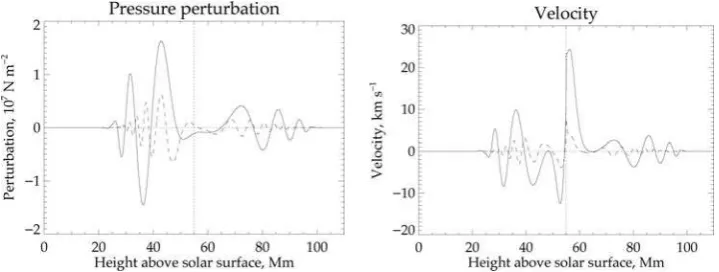
Figure 1.Snapshots of the numerically-calculated spatial solution of Eq. (3.3) for fixedt= 237 s and varying rforl= 500 (solid line),l= 1500 (dashed line) and ρi/ρe = 2. The left-hand plot shows the pressure perturbation,p(r, t), and the right-hand plot shows the velocity perturbation, v(r, t). The horizontal dotted line is the initial undisturbed state and the vertical dotted line represents the location of the initial pressure pulse.
Figure 2.The same as Figure 1, but withr(nott) fixed.ris 8000 km above the interface.
A different view on waves generated by an impulsive source propagating at an interface can be gained by writing the governing equations as the second-order PDE
∂2p
∂t2 −
c2
s
r2
∂ ∂r r
2∂ p
∂r
+c
2
sl(l+ 1)
r2 p= 0, p(r,0) =p0+p∗δ(r−R∗). (3.3)
In Eq. (3.3)p0is the background pressure,p∗is the excess presure at the location of the impulse, which itself isR∗. This equation is solvable and the solutions are given in terms of spherical Bessel functions. Using an explicit finite-difference scheme the variation of pressure perturbation and radial velocity are shown in Figures 1 and 2 for different values ofl and a density ratioρi/ρe= 2.
254 M. Douglas & I. Ballai
The second important conclusion of Figure 1 is that the oscillatory behaviour of waves starts some distance away from the initial pulse; for the quantities used here oscillations start only after approximately 10 000 km, depending onl. According to these results the first stage of a spherical wave consists of a strong shock which decays after some distance and wave-like motion starts to appear. It is most probable that the oscillatory behaviour of EIT waves found by Ballaiet al.(2005) is related to this stage of EIT wave evolution. The temporal variation of the pressure and radial velocity shows a decaying pattern as the signal travels away from the source due to geometrical dissipation. We can also comment on the effect of changing the harmonic degreel; it appears that waves of lower degree travel faster, and that waves of lower degree have far fewer visible wavecrests.
4. Conclusions
Here we have modelled EIT waves as surface waves propagating along a spherical density interface at a constant radius. The highly transcendental dispersion relation for such waves in a field-free atmosphere is derived.
The results of numerical simulations of radial surface waves,generated by a sudden, large pressure pulse excitation, are presented. It was shown that the propagation of these waves either side of the interface is asymmetric, leading to a large pressure gradient across the interface. The oscillatory behaviour of these waves is found not to start until quite some distance away from the impulsive source, and the amplitude of these oscillations exhibits damping. Thus, the dimming seen in observations of EIT waves is explained as evidence of a region of rarified plasma, where the large pressure gradient has evacuated much of the material away.
The present investigation will be extended in the future to include a full magnetic case, which we expect to exhibit much more complex behaviour, and the effects of a finite spherical shell. We also aim to show that MHD waves can be trapped in the low corona.
Acknowledgements
M. D. is grateful to STFC for financial support. I. B. acknowledges the financial support by The Royal Society, The National University Research Council, Romania (CNCSIS-PN-II/531/2007) and NFS Hungary (OTKA, K67746).
References
Attrill, G. D. R., Harra, L. K., van Driel-Gesztelyi, L.et al.2007,Astron. Nachr.328, 760 Ballai, I., Erd´elyi, R. and Pint´er, B. 2005,ApJ (Letters) 633, L145
Banerjee, D., Erd´elyi, R., Oliver, R. and O’Shea, E. 2007.Solar Phys.246, 3 De Pontieu, B. and Erd´elyi, R. 2006,Phil. Trans. Roy. Soc. A364, 383 Donea, A.-C., Besliu-Ionescu, D., Cally, P. S.et al.2006,Solar Phys.239, 113 Douglas, M. and Ballai, I. 2007,Astron. Nachr.328, 769
Edwin, P. M. and Roberts, B. 1983,Solar Phys.88, 179 Erd´elyi, R. 2006a.Phil. Trans. Roy. Soc. A364, 351
Erd´elyi, R. 2006b. in Fletcher, L. and Thompson, M. (eds)SOHO 18/GONG 2006/HELAS I: Beyond the spherical Sun, Sheffield, ESA SP-624, 15.1
Moreton, G. E. and Ramsey, H. E. 1960,PASP 72, 357 Nakariakov, V. M. and Verwichte, E. 2005.LRSP 2, 3 Parker, E. N. 1978,ApJ 221, 368