Toward Securing Cloud-Based Data
Analytics: A Discussion on Current
Solutions and Open Issues
SOMAYEH SOBATI-M.1, AMJAD FAYOUMI2(MEMBER, IEEE) 1
Department of Electrical and Computer Engineering, Hakim Sabzevari University, Sabzevar, Iran (e-mail: [email protected]) 2
Management Science, Lancaster University Management School, Lancaster, UK, LA1 4YX (e-mail: [email protected])
Corresponding author: Somayeh Sobati-M. (e-mail: s.sobati@ hsu.ac.ir).
ABSTRACT
In the last few years, organizations and business professionals have realized the value of data analytics in supporting decision-making. Where several activities are performed on on-line data by different stakehold-ers, such as cleansing, aggregation, analysis and visualization, cloud-based data analytics has become a favored choice for business professionals due to the elasticity, availability, scalability, and pay-as-you-go features offered by cloud computing. However, large amounts of data stored on the cloud are very sensitive (e.g., innovation, financial, legal, customers’ data), and so data privacy remains one of the top concerns for many reasons; mainly those relating to legal or competition issues. In this paper, we review the security and cryptographic mechanisms which aim to make data analytics secure in a cloud environment, and discuss current research challenges.
INDEX TERMS Cloud computing , Data analytics, Data privacy, Query processing.
I. INTRODUCTION
With cloud-based technologies and services flourishing, many organizations have started adopting hybrid Information System (IS) solutions, particularly the multi-hybrid cloud deployment model, where IS services are outsourced and shared with several cloud service providers and integrated with the organization’s on-premises systems. Cloud comput-ing appeals to businesses and organizations because of the wide variety of benefits it offers. The pay-per-use model of cloud computing is very attractive, especially for small and medium enterprises, because it reduces start-up costs [101]. Some cloud outsourcing models go as far as outsourcing a complete business process to a third party Cloud Service Provider (CSP), and they share part of their IS assets through the cloud system [4].
The growth of cloud-based services has made data ana-lytics a feasible reality for organizations [101]. One closely related outsourcing model that has recently emerged is data analytics outsourcing [5], where organizations offer a value-added third party agent access to their heterogeneous, large datasets stored on the cloud in order to perform some analyt-ical tasks and deliver insight to the organization [92]. Data analytics helps businesses and organizations analyze data to gain a fuller understanding of the situation confronting them
and make better decisions [7]. Data analytics outsourcing services, or Data Analytics-as-a-Service (DAaaS), entails storing sensitive data on a remote CSP’s infrastructure, and querying and retrieving data on demand [8]. Data Analytics-as-a-Service is a customizable analytical platform which uses the software-as-a-service (SaaS) cloud-based service delivery model. Different customizable data analytics tools are typically used by companies which are collaborating in an integrated value chain. The companies use DAaaS with the intention of integrating cross-organizational business processes to maximize data-driven value and enable rapid innovation.
honest but curious CSPs [9].
A straightforward solution to the problem of data privacy is to encrypt sensitive data locally in a trusted environment before sending it to a CSP. Encryption protects sensitive data even if the server is compromised. However, encrypting data incurs additional storage costs, and query processing over encrypted data is both non-trivial and costly in terms of computing power in the cloud, and thus money. Moreover, in addition to overheads, the levels of security and functionality are other issues which must be addressed properly. Typically, existing solutions from the literature [10], [11], [12], [13] cannot provide a seamless and complete solution which guar-antees secure cloud data analytics, because they fail to deal adequately with at least one of these issues [14]. Searchable Encryption (SE) allows keyword searches over encrypted documents [93], [94]. However, SE schemes involve a trade-off between security and efficiency.
A common limitation of SE schemes is their prohibitive computational cost. In the context of cloud outsourcing, access control can be achieved by using attribute-based en-cryption (ABE), which enables the deen-cryption of data when a user has certain attributes which satisfy the access structure [95]. However, the main disadvantages of ABE schemes are deficiency and functionality issues. Consequently, choosing an efficient cryptographic scheme with adequate levels of se-curity and functionality for computing analytical queries over encrypted data, which would thus be an effective solution for secure cloud-based data analytics, is still a challenge.
In this paper, we give a comprehensive overview of secure cloud-based data analytics which provides an easy entry point for researchers with no cryptographic background. We introduce a general architecture and system model which will accommodate a wide range of uses of cloud data analytics. This architecture incorporates a specific adversary and se-curity model, and we provide an overview of cryptographic tools for ensuring data privacy with an emphasis on function-ality and efficiency in terms of overheads. We then present and compare practical secure solutions from the literature and identify various security and efficiency issues. A comparative analysis of security, overhead and functionality issues is presented at the end of the article in order to provide a series of guidelines and insights to assist in designing and developing secured cloud-based data analytics with a level of functionality and efficiency which meets user requirements. The rest of the paper is organized as follows: we present our reference system architecture, adversary and security model for cloud data analytics in Section II. We classify the various cryptographic schemes which can be implemented in the reference system for preserving privacy in Section n III. We then review, discuss and compare practical solutions in Section IV, while limitations and unresolved issues are discussed in Section V. Finally, conclusions are drawn in Section VI.
II. ASSUMPTIONS AND REFERENCE MODEL
In this section, we introduce the main actors and their activities in relation to data analytics in the cloud. Then, we describe the ways in which the security of cloud-based data analytics can be compromised. Since we review crypto-graphic approaches for preserving privacy, we define a stan-dard security model to specify the level of security guarantees desired in cloud-based data analytics. Taking an adversary and security model as our basis, we elaborate the system goals which must be achieved in the cloud context
A. ACTORS AND ACTIVITIES IN CLOUD DATA ANALYTICS
A cloud-based data analytics system allows a server to store and query encrypted data on behalf of a user without gaining information about the underlying data.
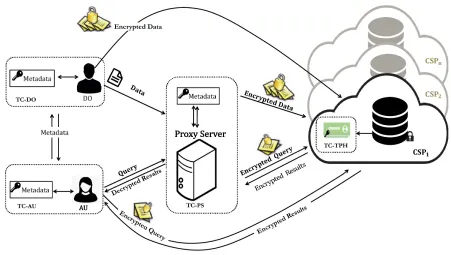
Figure 1 depicts the basic system model and architecture of cloud-based data analytics, which consists of three main entities: the Data Owner, the Cloud Service Provider and Authorized Users.
The Data Owner (DO)is an entity which has a large amount of data to be outsourced in the cloud, and can be an individual user, or a large, small or medium business or enterprise. The Cloud Service Provider (CSP) provides data storage services and computational resources.
Authorized Users (AU):the DO allows the authorized users, which could be other enterprises or individual users, to use the outsourced data. AU can query encrypted data and re-trieve encrypted results and decrypt them to get correspond-ing plaintext.
In a secure cloud-based architecture, a trusted component (TC) must execute confidential tasks such as key manage-ment functions, query rewriting and post-processing, and decryption. The DO and the AU are assumed the TC in some settings (TC-DO and TC-AU in Figure 1). In this setting, the TC must be installed and maintained on each AU and DO separately. To avoid installing the TC in several machines, the TC is set between the client (i.e., the DO or the AU) and the CSP [12], which is called the proxy server (TC-PS in Figure 1). In this setting, the proxy server intercepts client/server communications and performs data/query encryption and decryption on behalf of the user. The proxy server maintains some metadata and the private keys for data encryption and query transformation. Finally, tamper-proof hardware can be embedded at the CSP (TC-TPH in Figure 1), which performs encryption/decryption and query rewriting [15]. The AU also needs to perform a few security tasks like query rewriting and decryption. Typically, the interactions in this architecture are as follows:
1) The DO outsources data to a CSP (or multiple CSPs [16], [17], which are non-colluding with each other or with other external adversaries) in encrypted form while still maintain-ing the capability to query the data efficiently.
2) An AU encrypts a query and sends the encrypted query to the CSP.
FIGURE 1. System architecture for securing cloud-based data analytics
returns encrypted results to the AU. 4) Finally, the AU decrypts the results.
All interactions between the DO/AU and the CSP can be executed through the proxy server, TC-PS, when the TC-PS is the TC.
B. ADVERSARY MODEL
An adversary model specifies an adversary’s ability to threaten security. In cloud outsourcing scenarios, the adver-sary can be either honest but curious (passive), or malicious (active). Honest but curious is a widely-used adversary model for cloud outsourcing scenarios [18], [19], [20], [10], [11], [21]. An honest but curious CSP or insider faithfully com-plies with any service-level agreement (SLA) and stores data, runs computations and queries, and provides results without alteration. However, such CSP may access data and gain information by inferring from queries and results.
A malicious adversary can manipulate data and query results, and even delete stored data, which compromises integrity and availability. Since current known CSPs are well-established companies such as Google or Amazon, it is hard to see the possibility of them behaving maliciously, as this would damage their reputation and have a negative impact on their revenues [22]. Nevertheless, the malicious adversary is taken into consideration in some settings [13], [23]. In this paper, we consider the honest but curious adversary model, i.e., the CSP or insider.
C. REFERENCE SECURITY MODEL
Security model is used to define the security guarantees of an encryption scheme. Basically, an encryption scheme is characterized by Π=(M,C,K,Enc, Dec), whereMis all possible plaintexts,Cis a set of all possible ciphertexts, and Ka set of all possible keys belonging to a key space.Encis a randomized algorithm whereEnc : K × M −→ Cand
Dec is a deterministic algorithmDec : K × C −→ M. For all possible plaintexts, the following property should be satisfied [24].
∀m∈ M, ∀k∈ K: Dec(k, Enc(k, m)) =m.
There are two fundamental types of encryption schemes:
symmetric-keyandpublic-keyencryption. In symmetric-key encryption, the encryption and decryption keys are identical while in public-key encryption there is a key for encryption and another key for decryption. In public-key schemes, the encryption key is publicly available for encryption, but only the authorized users who have access to the decryption key can decrypt ciphertexts. We use PPTto denote the class of algorithms that are in probabilistic polynomial time.
To define the security model of an encryption scheme, the first step is defining a security goal. Then, it must be examined whether this goal can be achieved by an adversary. To this end, an experiment is defined between the adversary and a challenger and the probability that the adversarywins
model. An adversary’sadvantageis a measure of how much more successful it is at winning the experiment compared to the random guess.
For an encryption scheme Π, the following game is de-fined between an adversary A, which tends to break the system and a challenger,C, who receives as input variable
bwhereb ∈ {0,1}. First, the adversary chooses two equal-length plaintexts m0 ,m1 ∈ M. The challenger picks one of two plaintexts, encrypts it and sends the result to the adversary. Then, the adversary should not be able to guess which plaintext is encrypted by the challenger. This model is known as IND-CPA (Indistinguishability under chosen-plaintext attack), which is formalized in the following defi-nition.
An encryption scheme, Π, is IND-CPA if for any PPT adversary A, the probability that A "wins" the following game is negligible.
1) ChallengerCtakes a random keyk
2) AdversaryAchoosesm0,m1∈ Msuch that|m0|= |m1|and sends them toC
3) ChallengerCchoosesb∈ {0,1}uniformly at random and sendscb=Enc(k, mb)toA
4) Aoutputsb0 ∈ {0,1}, and is said towinifb0=b
In other words, if we define theadvantageof the adversary Aas follows.
AdvAcpa,Π =P r[b0=b]−1/2
then, the encryption scheme Π is IND-CPA secure if
AdvAcpa,Π is negligible, i.e., A cannot guess b except with probability close to1/2.
Note that in the above game, the adversary can issue several queries adaptively one after the other in order to simulate the ability of distinguishing multiple ciphertexts encrypted under the same key.
IND-CPA implies that the knowledge of ciphertexts pro-vides no information about the underlying plaintexts for an adversary, i.e., ciphertexts leak no information about the plaintexts.
D. OBJECTIVES OF CLOUD-BASED DATA ANALYTICS
Secure cloud-based data analytics must target the following goals.
• Privacy: Data privacy must be preserved in cloud-based data analytics. Encryption is a promising solution because the adversary and the CSP can access only encrypted data, but ciphertexts may leak some informa-tion and compromise data privacy. Hence, IND-CPA is desired to achieve this in cloud-based data analytics.
• Functionality: Proposed solutions should efficiently support different kinds of analytical workload, i.e., exact match queries (equality checking,GROUP BY,JOIN, DISTINCT), range queries (inequality checking, SORT, ORDER BY), and aggregation queries (SUM, AVG, MIN,andMAX) should be supported efficiently
and effectively [17]. Moreover, computations over mul-tiple columns in a table in a database must be handled. For instance, multiplication of two columns,C =A×
B.
• Efficiency:A secure cloud-based solution should be
ef-ficient in terms of computational, storage, and commu-nication overhead. Computational and storage overhead should be minimized for both the user and the CSP. Basically, in data outsourcing scenarios, it is considered that the user has limited storage and computational resources, thus, that overhead must be diminished as far as possible. At the CSP, the pay-per-use model of cloud computing is a good reason to minimize the total over-head of the system. Communication overover-head implies the number of intermediate results that is transferred to the user for query post-processing.
III. CRYPTOGRAPHIC METHODS
There are two main cryptographic approaches that enable processing over encrypted data without decryption. We de-scribe these cryptographic schemes, which can be imple-mented in practical systems for preserving data privacy in this section.
A. HOMOMORPHIC ENCRYPTION
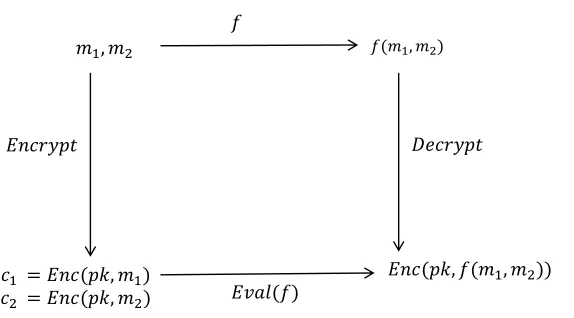
Homomorphic Encryption (HE) allows performing arbitrary arithmetic operations over encrypted data without decryp-tion [25]. HE provides IND-CPA security. Typically, an HE scheme is a scheme with an additional evaluation algorithm,
Eval, to process over encrypted data [26]. The evaluation al-gorithm takes a public key,P k, a function,f, two ciphertexts,
c1 and c2 as inputs and outputs ciphertext c∗ wherec∗ =
Eval(pk, f, c1, c2). In other words, Eval manipulates the encryption of two plaintextsm1andm2,c1=Enc(pk, m1) and c2 = Enc(pk, m2), and outputsEnc(pk, f(m1, m2)) (Figure 2).
If an HE scheme allows performing arbitrary computation, then the scheme is called Fully Homomorphic Encryption (FHE) [25]. FHE allows performing arithmetic operations (+,−,×,÷)over encrypted data without decryption. FHE is a powerful scheme and offers the highest level of security and certainly has a role to play in privacy preserving query processing [27]. FHE scheme is first introduced in [25], followed by other researches to improve the performance of the original scheme [28], [29], [30], [31], [32], [13], [33], [34], [35]. Even though many improvements e.g., reducing encryption key size or eliminating some complicated phases, FHE is prohibitively slow and requires so much computing power that it cannot be used in practice. As a result, building an efficient and usable FHE is still a great challenge.
𝑚1, 𝑚2
𝑐1 = 𝐸𝑛𝑐(𝑝𝑘, 𝑚1) 𝑐2 = 𝐸𝑛𝑐(𝑝𝑘, 𝑚2)
𝐸𝑛𝑐(𝑝𝑘, 𝑓(𝑚1, 𝑚2))
𝑓(𝑚1, 𝑚2)
𝑓
𝐸𝑣𝑎𝑙(𝑓)
[image:5.576.148.435.60.219.2]𝐷𝑒𝑐𝑟𝑦𝑝𝑡 𝐸𝑛𝑐𝑟𝑦𝑝𝑡
FIGURE 2. Homomorphic encryption
while being more efficient and closer to practical implemen-tation. If a PHE scheme allows addition or multiplication, it is referred to as additive homomorphic and multiplicative homomorphic, respectively.
Paillier’s scheme [36] is an example of additive homo-morphic scheme and is currently the most efficient. With Paillier’s scheme, multiplying the encryption of two values is equal to the encryption of the sum of the values, i.e.,
Enc(k, m1)×Enc(k, m2) = Enc(k, m1 + m2), where multiplication is performed modulo some public-keyk[12]. Paillier’s scheme is used in practical solutions [21], [12] to compute SUMandAVGaggregation queries over encrypted data without decryption.
B. PROPERTY-PRESERVING ENCRYPTION
Property-Preserving Encryption (PPE) preserves certain properties of plain- texts on the corresponding ciphertexts, which enables the CSP to compute over encrypted data. Typically, in PPE ideal security is relaxed to provide more efficient solutions [37]. Order-preserving encryption (OPE) and deterministic encryption (DET) are examples of PPE schemes.
1) Deterministic Encryption
Deterministic (DET) encryption encrypts the same plain-text into identical cipherplain-texts, thus the equality property is preserved. DET allows equality checking by encrypting a plaintext into the same ciphertexts when using the same key. Thus:
∀k∈ K,∀m1, m2∈ M, Enc(k, m1) =Enc(k, m2), iff
m1=m2.
DET allows performing SELECTwith equality predicates,
equality JOIN, GROUP BY, COUNT, and DISTINCT
queries [38]. DET is not IND-CPA secure. The following game shows that a DET encryption scheme, ΠDET, is not
IND-CPA secure.
1) ChallengerCchoosesb∈ {0,1}uniformly at random
2) The adversaryAchoosesm0, m1∈ Mso thatm0=
m1=m∗
3) Csendsc∗=Enc(k, m∗)toA
4) Achoosesm00=m∗,m016=m∗
5) Csendsc=Enc(k, m0b)toA 6) Aoutputs0ifc=c∗and1otherwise
Hence,AdvAcpa,Π=1/2, i.e., non-negligible.
As a result, the adversary can learn data duplicates, which leads to information leakage. In order to define the security of DET schemes, the IND-CPA security game is replaced by a new security game, IND-DCPA ( Indistinguishability un-der Distinct Chosen Plaintext Attacks), where the adversary is restricted to pick distinct plaintexts [39]. An encryption scheme,Π, is IND-DCPA if for anyPPTadversaryA, the probability thatA"wins" in the following game is negligible [40].
1) ChallengerCtakes a random key
2) Adversary Achoosesm0andm1 wherem0 andm1 are distinct
3) ChallengerCchoosesb ∈ {0,1}uniformly at random and sendscb=Enc(k, mb)toA
4) Aoutputsb0∈ {0,1}and is said to win ifb=b0
In the other word, considering theadvantage of the adver-sary as follows
AdvdcpaA,Π =P r[b0=b]−1/2
the encryption schemeΠisIND-DCPAsecure ifAdvAdcpa,Π is negligible.
IND-DCPA is weaker than IND-CPA, but they are equiv-alent when the domain of plaintexts contains unique values [41].
2) Order-Preserving Encryption
k∈ K,∀m1, m2∈ M, Enc(k, m1)≤Enc(k, m2), iff
m1≤m2.
OPE allows performing range queries when given encrypted constraints Enc(k, c1) and Enc(k, c2) corresponding to range [c1, c2]. Aggregation queries MIN, MAX, ORDER BY, andSORTcan also be computed directly over encrypted data.
Since OPE is deterministic it is not IND-CPA secure. The security definition of OPE is defined by Boldyreva et al. in [42] which is called IND-OCPA (Indistinguishability under Ordered Chosen Plaintext Attacks). An IND-OCPA secure scheme hides all information about the plaintext values ex-cept the order, which is a minimum requirement for order-preserving property. An encryption scheme, Π, is IND-OCPA if for any PPTadversary A, the probability that A "wins" in the following game is negligible [42].
1) ChallengerCtakes a random key Fori= 1, . . . , q
a) Adversary A chooses mi,0 and mi,1 where |mi,0|=|mi,1|
b) Challenger C chooses b ∈ {0,1} uniformly at random and sendscb =Enc(k, mi,b)toA
wherem1,0, . . . , mq,0are distinct andm1,1, . . . , mq,1 are distinct
andm`,0< mj,0 ↔m`,1< mj,1, 1≤`, j≤ q
c) Aoutputsb0∈ {0,1}and is said to win ifb=b0
In the other word, considering theadvantageof the adver-saryAas follows
AdvocpaA,Π =P r[b0 =b]−1/2
the encryption scheme is IND-OCPAsecure ifAdvAocpa,Π is negligible. OPE is a weaker encryption scheme than DET because in addition to leak data duplicates, it reveals the order of plaintexts.
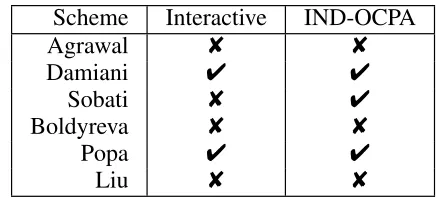
Different OPE schemes are proposed in both the database and cryptography community. OPE is introduced in the database community by Agrawal et al. as a tool to support efficient range queries over encrypted data [43], which maps each value of the plaintext domain to one value in the ciphertext domain. This scheme bears weak privacy pro-tection because the original data values can statistically be estimated by an adversary who has access to ciphertexts [44]. Damiani et al. propose an order-preserving indexing method, which preserves the order of plaintexts over in-dexes [45]. A B+tree index is built over plaintexts and is stored at the CSP in encrypted format. In order to query processing, the encrypted tree must be travelled by the CSP. However, the user should perform a sequence of queries to retrieve nodes, which induces communication overhead. The proposed scheme provides IND-OCPA security, but incurs heavy communication and computation overhead. Sobati-M et al. introduce an order-preserving indexing method, which destroys the frequency distribution of plaintexts [37]. Whilst
the proposed indexing method provides IND-OCPA security, it is efficient in terms of communication and computation overhead. Boldyreva et al. introduce a new OPE with a random mapping that preserves order [42]. The proposed scheme cannot provide IND-OCPA because it leaks at least half of the plaintext bits (i.e., more information than OPE) [46].
Popa et al. introduce the first practical IND-OCPA scheme in the cryptography community, mutable order-preserving encoding (mOPE) [46]. mOPE requires an interactive pro-tocol for query processing. Additionally, mOPE relies on user-defined functions (UDFs) for query processing, which makes it unsuitable for cloud outsourcing. Liu et al. introduce an OPE scheme that randomly splits the original plaintext domain into successive intervals with different lengths [44]. Then, an extended ciphertext domain is selected and split into the same number of intervals. Finally, nonlinear mapping functions map the original plaintexts into ciphertexts in the extended domain. The proposed method partially destroys the distribution of original data and reveals some information about underlying values, which breaks IND-OCPA security.
[image:6.576.307.526.379.478.2]Table 1 shows the comparison between existing OPE schemes. Among all OPE approaches, only Boldyreva’s scheme is implemented in some practical solutions.
TABLE 1. Comparison of OPE schemes
Scheme
Interactive
IND-OCPA
Agrawal
8
8
Damiani
4
4
Sobati
8
4
Boldyreva
8
8
Popa
4
4
Liu
8
8
IV. ENCRYPTION-BASED PRACTICAL SOLUTIONS Building a secure cloud-based analytics system has been discussed briefly in the literature with limited practical con-tribution. Some solutions have nonetheless been proposed. The most important challenge of secure solutions is weak security guarantees or heavy overhead in the systems we review in this section, to the best of our knowledge.
For each practical solution, we explain the main idea, the architecture, how data are organized at the CSP, and query processing. Then, we analyze the advantages and the deficiencies of each solution in terms of security and perfor-mance.
A. BUCKETIZATION
(𝑎)
(𝑏)
[image:7.576.129.438.59.292.2](𝑐)
FIGURE 3. (a) An example of a relationR, (b) partition function used for attributeeid, and (c) the encryption relationRSstored at the CSP [10]
may contain some false-positives. The final result is found by decrypting the data and executing query post-processing at the users.
Bucketization divides data into buckets and provides ex-plicit labels for each bucket [47]. The domain of plaintexts is partitioned into a set of non-overlapping buckets (subsets), with the same size (or maybe different size). A label is defined for each bucket and may or may not preserve the order of values in the original domain. Then, bucket labels are stored along with encrypted values at the CSP. These labels allow equality, range (if preserving order) and join queries at the CSP without decryption. Bucketization-based indexing usually returns false-positives in the result of a query. Thus, query post-processing is needed at the users to filter out false-positives [48].
Any relationRin a database is encrypted in tuple-level and auxiliary indexes, i.e., buckets’s labels, are used by the CSP for query processing. Thus, the relationR(A1, A2, ..., An)is
stored at the CSP as:RS(etuple, AS1, AS2, ..., ASn), where the attributeetuplecorresponds to an encrypted tuple, and each
ASi corresponds to the index for the attributeAi. An example
is shown in Figure 3.
The DO must maintain metadata such as the label of bucket for transforming queries to the appropriate representation on the CSP and performing query post-processing.
In Bucketization architecture, queries are transformed by aquery translatorand a query executor, which both reside with the DO. For query processing, the AU poses the query to the query translator.
Each query is transformed into the server-side and user-side sub-queries,QsandQc, respectively (Figure 4).Qsis exe-cuted by the CSP over encrypted data using corresponding
indexes (AS is).
The result ofQsis sent back to the query executer, which
decrypts the result of Qs and executes Qc to filter false-positives and retrieve the final result (post-processing).
Query execution in bucketization operates as follows.
– Step1.
The AU sends a query Qto the query translator. The query translator rewritesQintoQsandQc. To
this end, the query translator uses some metadata (e.g.,the buckets boundaries) and replaces the plain-text values in the query with bucket boundaries. Then, the query translator sendsQsto the CSP.
– Step2. The CSP executes Qs and returns all
en-crypted records back, whose bucket numbers sat-isfy the query constrains. The encrypted results are sent to the query executor.
– Step3.The query executor decrypts the results and executesQc to eliminate false-positives and sends the final results to the AU.
Bucketization provides efficient query processing while keeping the information disclosure to a minimum. Further-more, query evaluation is often much simpler than crypto-graphic schemes [49].
However, there is a trade-off between security and efficiency. The smaller number of buckets leaks less information and increases security, but induces more false-positives in query results and more computational overhead at the AU.
𝐀𝐔
𝑸𝑺𝑸𝒄
[image:8.576.44.490.72.345.2]𝐂𝐒𝐏
FIGURE 4. Bucketization query workload [10]
form of(ciphertext)||(bucketlabel), e.g., in Figure 3 the ci-phertexts of attributeeidare in the form ofetuple||eidS.
Ad-ditionally, bucketization-based indexing reduces data gran-ularity. All values in a row are encrypted together, which means that all encrypted rows must be shipped back to the AU inducing communication overhead.
B. CRYPTDB
CryptDB is a secure DataBase Management System (DBMS) developed at MIT [12] with both academic [20], [50], [18], [21], [51], [52], [53], [54], [55], [56] and industrial [57], [58], [59], [60], [61] impacts [38], e.g., Google [57] and SAP [58] produced their own CryptDB-inspired solutions. CryptDB aims at providing data privacy guarantees in the face of a compromised server and a honest but curious CSP by data encryption.CryptDB uses a set of encryption schemes based on the queries issued by the AU [38] and adopts different kinds of encryption schemes, i.e., PPE and PHE, which are dynamically adjusted depending on the queries [26]. Encryption in CryptDB is like onion layers that store multiple ciphertexts within each other (Figure 5).
For instance, given two encryption schemes Enc1 and Enc2, the encryption of a valuemis defined as:
c=Enc1(k1,(Enc2(k2, m))).
The outermost onion layers provide the highest level of security, IND-CPA security, whereas the inner layers, provide
more functionality and less security guarantees, e.g., IND-DCPA for DET layer.
Each value in a relation is encrypted independently. Numeric values are maintained in three different onions, OnionEq, OnionOrd, and OnionAdd, which are used for equality checking, range queries, and aggregationsSUMand AVG, respectively. In other words, for each value CryptDB stores three encrypted values at the CSP. At the CSP, query processing is computed using UDFs.
In CryptDB architecture, a proxy server intercepts com-munications between the user and the CSP and applies en/decryption of queries and results (Figure 6).
OPE: order comparison
FIGURE 5. An example of onion encryption layers in CryptDB [12]
[image:8.576.358.481.557.644.2]FIGURE 6. CryptDB architecture [12]
master key and the scheme of the database and uses them for query rewriting. When a query is issued, the proxy dynami-cally peels off onion layers down to a layer corresponding to the given computation. Onion layers are adjusted by sending the related key and updating the columns. Then, the proxy server anonymizes each table and column name and encrypts each constant in the issued query with an encryption scheme corresponding to the requested operation.
Query execution in CryptDB operates as follows.
– Step1.The AU sends a queryQto the proxy. The proxy rewrites Q into Qs operating at the CSP. To this end, the proxy encrypts all constants inQ
adopting the encryption scheme that best suits the operation to be computed [26].
– Step2.The proxy checks if the CSP should be given keys to remove some encryption layers. In this case, the proxy issues an UPDATE query that removes specific layers of encryption, and then sendsQsto
the CSP.
– Step3. The CSP computesQsand returns the
en-crypted results to the proxy.
– Step4.The proxy decrypts the encrypted results and sends the final results to the AU.
For instance, in order to evaluate a range query, each value of an attribute is encrypted using an OPE scheme (first encryp-tion layer). Then, the resulting OPE ciphertexts are encrypted with a randomized encryption (RND) scheme (second en-cryption layer). A randomized enen-cryption scheme encrypts the same values into different ciphertexts using the same key and allows no computation whilst providing the highest level of security, IND-CPA. When a range query is issued, the proxy server sends the decryption key for the second encryption layer to the CSP. The CSP then decrypts the randomized ciphertexts and gets access to order-preserving ciphertexts. Hence, the CSP learns the order of values and evaluates the range query [63] and sends the encrypted values to the proxy server.
CryptDB supports standard SQL queries over encrypted data and needs no change to existing applications.
Basi-cally applications can transparently run on top of CryptDB. However, CryptDB is targeted for transactional workloads. It is not feasible to run analytical workloads over CryptDB [64]. As a result, CryptDB supports only 2 queries out of 22 queries from the TPC-H benchmark.
Some computations are not supported, for instance, com-puting both summation and comparison on encrypted values. Thus, to execute the following query.
Q1 :
SELECT SUM(price) AS total FROM orders
GROUP BY order_id HAVING total >100
CryptDB cannot check iftotal >100at the CSP, be-cause total is encrypted with a PHE scheme, i.e., the Paillier scheme, which does not support order comparison [21].
Complex queries over multiple columns in a relation, for instance, the following query
Q2 :
SELECT SUM(t1.B∗t2.A) FROM T as t1 WHERE
t1.A=t2.B.
cannot be evaluated because multiplication of two encrypted values is not supported in CryptDB.
Moreover, onion layers become an overhead as well as peeling off a layer, especially in the case of big tables. CryptDB performs almost all queries at the CSP with a relatively small overhead in terms of query throughput [12]. However, the throughput is worst for queries that use PHE, such as summations because, in order to compute summa-tions, CryptDB implements modular multiplications at the CSP. Improving the performance of aggregations is important because aggregation is common in data analytics.
CryptDB is unidirectional, i.e., once a column is decrypted to a weaker scheme like DET, it never returns to a higher encryption level [65].
C. MONOMI
MONOMI extends CryptDB’s functionality to support ana-lytical queries [21]. In contrast to CryptDB that focuses on transactional workloads, MONOMI mainly targets analytical workloads [64].
Instead of using the trusted proxy server, MONOMI splits query processing between the CSP and the user. Using user/server query splitting, MONOMI executes as much of the query as is practical over encrypted data at the CSP and executes remaining computations by the user, which decrypts data and processes queries further [66]. To this end, MONOMI introduces an optimized designer and a planner. The designer chooses an appropriate database design based on the target workload. Like CryptDB, MONOMI imple-ments different cryptographic schemes, but unlike CryptDB, there is no onion of encryption. To choose a set of encryption schemes, MONOMI uses an optimizing designer similar to physical designers used by other databases, which takes the kind of computations that are likely to appear in future queries, e.g., SUM for attribute Salary (Figure 7). In other words, the designer can be considered similar to automated index selection and materialized view selection tools.
MONOMI designer is invoked when a database is loaded by the DO. The DO must also provide a query workload
Q1, Q2, . . . , Qn to represent the operations that the AU
will perform over data. Given the user’s inputs, MONOMI designer provides a physical design consisting a set of en-cryption schemes for each relation. For each query Qi i =
1, . . . , n, the designer determines a set of required encryption schemes and invokes the planner to determine how to best executeQigiven the encryption schemes. MONOMI planner
determines different plans by determining for each plan what parts ofQiwould be executed by the AU and what parts at the
CSP. Then, a cost model is used by the planner to estimate the cost of each plan (e.g., execution times). The planner chooses the fastest plan forQi and denotes the corresponding subset
of encryption schemes.
Once the best plan is determined for each query, the designer takes the union of the required encryption schemes and uses them for physical design. Hence, a plaintext value is encrypted using different cryptographic schemes. Further, the planner selects the query execution path for each query given a particular physical design.
In order to execute queries that cannot be computed at the CSP alone, MONOMI partitions query execution across the CSP, which has access only to encrypted data, and the AU, who has access to the decryption keys.
However, query splitting technique cannot be optimal in all situations and depends on data. To choose an optimal splitting, MONOMI models the cost of query execution for each query plan as the sum of execution time at the CSP,
transfer time, and post-processing time at the AU’s side. Then, the lowest-cost plan is chosen.
Query execution in MONOMI consists the following steps.
– Step1. The AU sends a query Q to MONOMI planner. The planner computes different plans
P1Q, P2Q, . . . , P`Q, wherePiQ i = 1, . . . , ` con-sists of three sub queriesQsi,Qei, andQci. The sub-queryQsi is performed by the CSP over encrypted data,Qei asks for retrieving some encrypted data
Re
i = {e1, e2, . . . , en} from the CSP, and Qci
is performed by the AU over retrieved encrypted values,Re
i, after decryption.
For each plan PiQ i = 1, . . . , `, the planner computes a costCiQ=t1+t2+t3wheret1, t2, and
t3are execution times at the CSP, transferring time, and post-processing time by the AU, respectively. Then, a plan with the lowest-cost is selected by the planner. We show the selected plan asPselectQ . The planner sendsQsselectandQeselectto the CSP. – Step2.The CSP computes Qsselect over encrypted
data and returns encrypted results,Rs, to the plan-ner. The CSP also retrieves encrypted values,Re, corresponding to Qe
select and sends them to the
planner, too.
– Step3.The planner sends the resultsRsandReto
the AU. The planner also sendsQc
selectto the AU.
– Step4.The AU decrypts encrypted values inReand
executesQc
selectover unencrypted values. The AU
also decryptsRsto obtain the final results.
Like CryptDB, MONOMI implements PHE [36] for com-puting aggregation queriesSUMandAVG, which is compu-tationally intensive and induces a large ciphertext size. How-ever, large ciphertext size imposes storage cost and affects query processing. Additionally, PHE requires modular multi-plications, which is computationally expensive. To overcome these drawbacks, MONOMI introduces some optimization techniques. To avoid performing separate modular multipli-cations, MONOMI concatenates several plaintext values into a single larger plaintext that will be encrypted as a single value. In this way, MONOMI reduces storage overhead and simultaneously decreases the number of modular multiplica-tions.
Query splitting enables executing more queries with op-timal costs. However, it requires that queries are declared ahead of time by the user, which is not possible for all scenarios, especially for ad-hoc analytical workloads. More-over, it is essential to cut down the bandwidth required to transfer intermediate results and computation and storage resources for the AU for query processing [21], because resources usage at the AU must be minimum for maintaining the benefits of outsourcing.
DO
AU
[image:11.576.77.492.59.348.2]MONOMI Planner
FIGURE 7. MONOMI architecture [21]
operation or partial query processing. For example, when packing multiple values in a column into a single plaintext, a query that updates only a part of the column cannot be executed.
D. SDB
SecureDB (SDB) is a secure query processing system, which allows a wide range of complex queries to be computed by the CSP [67]. SDB introduces a new encryption scheme based on so called secret sharing. In secret sharing, each plaintext value is split into several shares that are stored at
n users’ [68]. One single user has no means to reconstruct the secret, but a subset ofk ≤ nusers can reconstruct the secret [69].
Each plaintext value, mi, is split into two shares, one
kept at the DO, which is referred as item key, mk, and
another at the CSP, which is regarded as ciphertext,me. In
order to reduce data storage at the DO’s side, item keys is considered to be the same for all values. In order to encrypt the plaintext values in an attribute, first a random secret key,
k, is defined. Then, for each row of attribute a random row-id,ri, is defined, too. Then, the row-ids are encrypted by the
secret key k,mk = Enc(k, ri)andmi is encrypted using
encrypted row-id,mk, which is me = Enc0(mk, m). The
values of row-ids are encrypted and stored along with the ciphertexts at the CSP (Figure 8).
The proposed scheme simulates FHE, which leads to a
wide range of queries supported by the CSP. The proposed encryption scheme supports data interoperability , i.e., the output of an operator is used as the input of another operator. SDB computes complex analytical queries over multiple columns in a table using data interoperability. For instance, computing "A + B > 1000k" is possible in SDB, but the same computation is not supported by the other secure systems like CryptDB.
SDB architecture is similar to CryptDB’s in which a proxy server is set between the DO/AU and the CSP.
Query execution in SDB operates as follows.
– Step1.The AU sends a query,Q, to the proxy server. The proxy rewritesQinto sub queriesQsoperating at the CSP andQcwhich is computed at the proxy server.
– Step2.The proxy server executesQcand produces
new secret keys.
– Step3.The proxy server sends the new secret keys andQs to the CSP. Note that the new keys
gen-erated by the proxy are needed for computing the sub-queryQsat the CSP.
– Step4.The CSP computesQs and returns the
en-crypted results to the proxy.
– Step5.The proxy decrypts the encrypted results and sends the final results to the AU.
𝑚 𝑚 𝑚𝑘 𝑚𝑒
𝑚𝑒
𝑚 𝐸𝑛𝑐 (𝑘, 𝑟𝑖 )
[image:12.576.125.459.74.276.2]DO
FIGURE 8. Encryption of attributeAin SDB [67]
C =A+B, the proxy server generates a new keyck using ak andab and sendsck to the CPS. The CSP executes the
UPDATEquery to encryptAandBwith the new key,ck, and
gets new columns A0 andB0, and then adds the encrypted values ofA0andB0.
SDB requires modular multiplication for decryption, which induces heavy computational overhead at the proxy server. Computations at the CSP also consist of modular exponential, which is expensive and affects query processing. While the proposed scheme supports a wide range of queries, there are still some queries that are not supported, e.g., keyword search over encrypted strings.
Security guarantees in SDB is the highest, i.e., IND-CPA security. Yet, IND-IND-CPA reveals no information about the underlying plaintexts, which makes impossible using optimization techniques, e.g., B+tree indexing. As a result, query processing needs scanning the whole database, leading to poor performance. Like CryptDB and MONOMI, SDB strongly relies on UDFs at the CSP for query processing, which makes it unsuitable for cloud-based scenarios because the DO has no permission to create UDFs, e.g., small enter-prises deploy their secure web-based system using the rented database [70].
E. TRUSTEDDB
TrustedDB is an outsourced database prototype that im-plements tamper-proof trusted hardware for secure query processing in the cloud [71]. A secure co-processor (SCPU) such as the IBM 4764/5 [72] is deployed at the CSP’s side to compute query processing over encrypted data. The SCPU provides a secure computation environment. However, SC-PUs are constrained in both computation ability and memory capacity. Hence, data are classified as being either private sensitive or insensitive public [73]. The former are encrypted
and operations are performed inside the SCPU, and the latter are stored unencrypted at the CSP. All sensitive data are encrypted by the DO before uploading to the CSP. The entire database is stored outside the SCPU. Data are encrypted using a symmetric encryption scheme such as AES. Some randomness are also added to ensure IND-CPA security. However, such randomized encryption schemes allow no computation over encrypted data. Sensitive encrypted data that need to be accessed by the SCPU for query processing are pulled in by the SCPU.
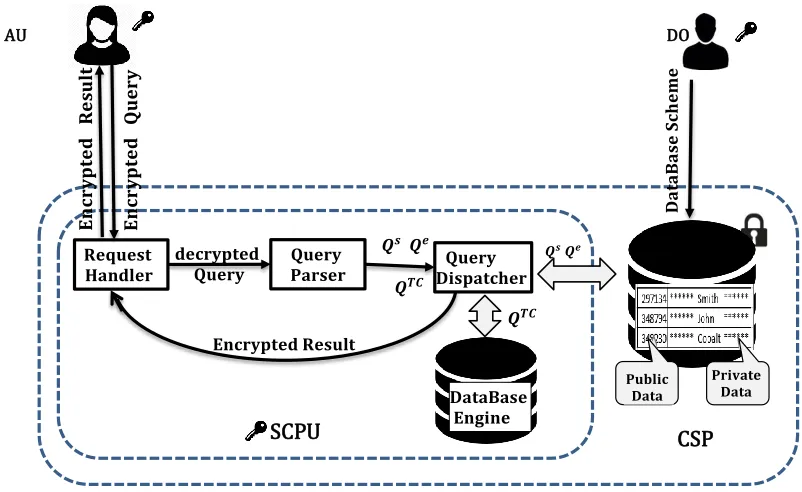
An issued query is rewritten by the AU into two sub-queries, which are executed by the CSP and the SCPU [15]. The SCPU in TrustedDB consists of aRequest Handler, aQuery Parser, and a Query Dispatcherto handle query rewriting (Figure 10).
Query execution in TrustedDB operates as follows. – Step1.The AU encrypts a query using the public
key used by the SCPU and sends the encrypted query to the CSP.
– Step2. The CSP forwards the encrypted query to the SCPU. The Request Handler (RH) receives the encrypted query.
– Step3. The RH decrypts the query and sends the unencrypted query to the Query Parser (QP). – Step4.The QP rewrites the query into three
sub-queries,Qs,Qe, and QT C, and sends them to the
Query Dispatcher (QD).
– Step5.The QD sendsQsandQeto the CSP.
– Step6. The CSP executes Qe and retrieves
re-quested encrypted data,Re, and sends them to the
QD. The CSP also executesQs over unencrypted data and sends the results back again to the QD. – Step7. The QD decrypts data in Re and sends
DO AU
𝐑𝐞𝐪𝐮𝐞𝐬𝐭 𝐇𝐚𝐧𝐝𝐥𝐞𝐫
𝐄𝐧𝐜𝐫
𝐲𝐩𝐭𝐞
𝐝
𝐐𝐮𝐞
𝐫𝐲
𝐝𝐞𝐜𝐫𝐲𝐩𝐭𝐞𝐝 𝐐𝐮𝐞𝐫𝐲
𝐐𝐮𝐞𝐫𝐲
𝐏𝐚𝐫𝐬𝐞𝐫 𝐃𝐢𝐬𝐩𝐚𝐭𝐜𝐡𝐞𝐫𝐐𝐮𝐞𝐫𝐲
𝑸𝒔 𝑸𝑻
𝐏𝐫𝐢𝐯𝐚𝐭𝐞 𝐃𝐚𝐭𝐚 𝐏𝐮𝐛𝐥𝐢𝐜
𝐃𝐚𝐭𝐚 𝐃𝐚𝐭𝐚𝐁𝐚𝐬𝐞
𝐄𝐧𝐠𝐢𝐧𝐞
𝐃𝐚𝐭
𝐚
𝐁𝐚𝐬
𝐞
𝐒
𝐜𝐡𝐞
𝐦𝐞
𝐄𝐧𝐜𝐫𝐲𝐩𝐭𝐞𝐝 𝐑𝐞𝐬𝐮𝐥𝐭
CSP
SCPU
𝑸𝒔 𝑸𝒆
𝑸𝑻𝑪
𝑸𝒔 𝑸𝒆
𝑸𝑻𝑪
𝐄
𝐧𝐜
𝐫𝐲𝐩
𝐭𝐞
𝐝
𝐑
𝐞
𝐬𝐮
[image:13.576.81.482.59.305.2]𝐥𝐭
FIGURE 9. TrustedDB architecture and query processing workload
residing inside the CSPU. After executingQT C, the
final results are re-encrypted by the QD and sent to the RH. Finally, the RH sends the encrypted results to the AU.
Note that the execution of private queries, i.e.,QT C, depends
on the output of public queries, i.e.,Qs, and vice-e-versa.
Using the SCPU and a randomized encryption scheme, TrustedDB simulates FHE, i.e., the security guarantees of TrustedDB is IND-CPA. However, leaving some data unen-crypted at the CSP may compromise the privacy of enunen-crypted sensitive data by linking between them. Moreover, sending encrypted data to the SCPU incurs communication overhead, which affects query processing and results in poor perfor-mance. Sending the final results to the QD, which encrypts the results imposes computation overhead.
F. CIPHERBASE
CipherBase is another solution based on tamper-proof trusted hardware to preserve the confidentiality of sensitive data [20]. A FPGA (Field Programmable Gate Array) is set at the CSP as a trusted component, TC, which computes some computa-tions over sensitive data on behalf of the CSP. Computacomputa-tions are decomposed between the trusted TC and the CSP. Like TrustedDB, the sensitivity of data must be defined by the DO on the scheme definition. Insensitive public data are stored unencrypted at the CSP. Highly sensitive data, e.g.,
Patient.ID, are encrypted using a strong encryption scheme, i.e., an IND-CPA secure scheme. Less sensitive data, e.g.,
Patient.Age are encrypted by a weaker encryption scheme, e.g., a PPE scheme.
Highly sensitive data are shipped to the TC, which are decrypted and processed. In fact, CipherBase simulates FHE
by integrating non-homomorphic encryption schemes (e.g., AES in CBC mode) with trusted hardwares to compute any operation.
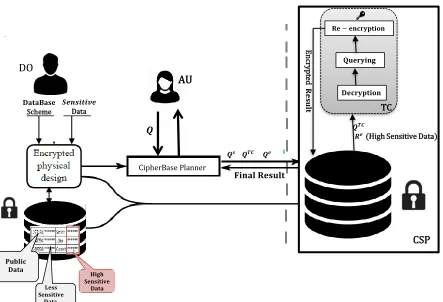
Query processing in CipherBase consists of several round trip between the TC and the CSP. Aquery planner, which resides at the AU’s, is responsible for query re-writing.
The query planner rewrites an issued query into three sub-queries. Among them, two sub-queries are executed by the CSP and the third sub-query is sent to the TC. Query execution in CipherBase operates as follows.
– Step1.The query planner rewrites an issued query,
Q, into three sub-queries , Qs,Qe, andQT C and sends them to the CSP.
– Step2. The CSP executes Qe and retrieves
en-crypted tuples, Re, and sends them along with QT C to the TC. The CSP also computes Qs over
unencrypted data.
– Step3.The TC decrypts all tuples in Re and
exe-cutesQT Cover decrypted data.
– Step4.The TC encrypts the results and ships them back to the CSP.
– Step5. The CSP sends all results consisting en-crypted and unenen-crypted results to the AU. Security guarantees in CipherBase is specified by the DO. The highest level of security achieves when all data are highly sensitive. However, security comes at a cost of poor performance. Specifying some data as less sensitive and insensitive by the DO degrades security guarantees and increases performance. In this case, CipherBase provides the same level of security as CryptDB.
CipherBase Planner
𝐋𝐞𝐬𝐬 𝐒𝐞𝐧𝐬𝐢𝐭𝐢𝐯𝐞
𝐃𝐚𝐭𝐚
𝐏𝐮𝐛𝐥𝐢𝐜 𝐃𝐚𝐭𝐚
𝐇𝐢𝐠𝐡 𝐒𝐞𝐧𝐬𝐢𝐭𝐢𝐯𝐞
𝐃𝐚𝐭𝐚
AU
𝐃𝐚𝐭𝐚𝐁𝐚𝐬𝐞 Scheme
𝑺𝒆𝒏𝒔𝒊𝒕𝒊𝒗𝒆 Data
DO
𝑸𝒔 𝑸𝑻𝑪 𝑸𝒆
TC 𝐃𝐞𝐜𝐫𝐲𝐩𝐭𝐢𝐨𝐧
𝐐𝐮𝐞𝐫𝐲𝐢𝐧𝐠 𝐑𝐞 − 𝐞𝐧𝐜𝐫𝐲𝐩𝐭𝐢𝐨𝐧
𝑹𝒆(High Sensitive Data)
𝑸𝑻𝑪
CSP
𝐅𝐢𝐧𝐚𝐥 𝐑𝐞𝐬𝐮𝐥𝐭 𝑸
En
cr
yp
te
d
𝐑
𝐞𝐬
[image:14.576.41.484.59.361.2]𝐮𝐥𝐭
FIGURE 10. CipherBase architecture and query processing workload
and re-encrypting data in TC, and shipping results back to the CSP. Moving encrypted data between the CSP and the TC incurs communication overhead. Moreover, decryption and re-encryption are also costly in terms of computation. Whilst some optimization techniques are considered to minimize round trips, but the overhead of decryption/re-encryption is still a bottleneck.
G. COMPARISON OF EXISTING SOLUTIONS
In this section, we compare the existing solutions presented in Section IV regarding to overhead, security, trusted com-ponent, and query support features. Table 2 summarizes the features of all solutions, which we discuss below.
1) Communication Overhead
Communication overhead is defined as the number of en-crypted records sent as the result of an issued query. Consider a query Q, the encrypted results that satisfy the query is shown as |Q(e)|. Bucketization induces a communication overhead of |Q(e)| +|Q(f)| where |Q(f)| indicates the number of false-positives. Since MONOMI planner requests retrieving some encrypted values, Rs, the communication
overhead of MONOMI is|Q(e)|+|Q(Rs)|.
Like MONOMI, TrustedDB and CipherBase retrieve some encrypted values,Rs, and send them to the TC. Hence, the communication overhead of TrustedDB and CipherBase is
|Q(Rs)|, which is imposed at the CSP’s side when data are
moved to the TC.
2) Computation Overhead
Computation overhead at the user’s side is defined as the time of decryption,te. Bucketization requires also auxiliary time, tf, to eliminate false positives after decryption. MONOMI
induces an extra time,td, for decrypting encrypted values in Rsand alsot
postfor query processing over decrypted values.
Hence, MONOMI has the largest computation overhead at the user’s side.
At the CSP, computation overhead consists of the required time for query processing over encrypted values, tquery.
CryptDB and SDB sends also an UPDATE query, which induces tquery+tUPDATE computation overhead at the CSP. MONOMI also requires tretrieve for retrieving encrypted
values. Nevertheless, the computation overhead of MONOMI is less than CryptDB and SDB because theUPDATEquery consists of the re-encryption of encrypted values and con-tains expensive modular operations such as modular multi-plication. Computation overhead for TrustedDB consists of
tp for querying public unencrypted data, tretrieve for
re-trieving encrypted private values,tdecfor decrypting private
encrypted data, and tT C for querying data after decryption
inside the SCPU. CipherBase needs also tquery for
TrustedDB, CipherBase incurs less computation overhead because CipherBase needs less data decryption because some computations are computed over less sensitive data without decryption.
3) Security
Security guarantees depend directly on the cryptographic schemes which are used in a solution. Bucketization uses PHE, but cannot provide IND-CPA because the bucket’s labels reveal some information about the encrypted values. Bucketization introduces a trade-off between security and efficiency; for example, when the labels are order-preserving, query processing is more efficient, but at the cost of a lower level of security. In fact, the security level of order-preserving labeling is the same as that of PPE [92].
On the other hand, having a small number of buckets increases security, but triggers more false positives in query results, leading to poor performance and less efficiency. PHE is implemented in CryptDB and MONOMI to provide IND-CPA security; however, security is relaxed to improve the efficiency of query processing [69]. CryptDB and MONOMI implement PPE to support more queries, which discloses IND-CPA security. IND-CPA is guaranteed when no query is executed and the outermost layer of encryption, randomized encryption, has been kept. Once the randomized layer is removed, however, security is degraded to the level of PPE.
The proposed encryption scheme in SDB provides IND-CPA security. However, IND-IND-CPA is no longer guaranteed when a query is executed. After an updating query, the values of a column are transformed in such a way that the query can be executed by the CSP. For instance, in order to execute a GROUP BYfor a column, after updating, the encryption values are equal for the same plaintexts, and so equality leaks, which degrades the level of security to the level of PPE .
Implementing randomized encryption schemes along with the SCPU in TrustedDB guarantees IND-CPA, so TrustedDB offers the same level of security as FHE , but greater effi-ciency. At the same time, leaving less sensitive data unen-crypted at the CSP raises concerns about linking attacks. In linking attacks, the attacker tries to find some information about sensitive data using public unencrypted data, which may compromise data privacy [91]. More importantly, secu-rity is guaranteed as long as the SCPU is not in danger [67]. Similarly, the TC in CipherBase simulates FHE by executing computations inside the TC, and security is guaranteed as long as the TC is not compromised [102]. Yet the level of security required depends on the sensitivity of the data, i.e. highly sensitive data should be encrypted with a strong encryption scheme so that no information will be revealed. Even though CipherBase provides a reasonable security level for highly sensitive data, using PPE schemes for less sensitive data degrades security guarantees.
The vulnerability of PPE to inference attacks is studied in [1]. The authors describe an inference attack directly over en-crypted data. Even if a non-deterministic encryption scheme is used to encrypt data, such an attack can be executed
successfully. The results convincingly illustrate the trade-offs between security, performance and functionality for query processing in a TC.
4) Trusted Component (TC)
The TC is set at the user’s side (the AU and the DO’s side) in Bucketization and MONOMI. CryptDB and SDB rely on TC-PS as the TC. Considering the DO and the AU as a TC eliminates the need of extra components. However, the TC must be installed and maintained on each AU and DO separately. Setting a proxy server adds a new point of attack and induces computational and storage cost, but eliminates the need of installing the TC for each DO and AU. The TC is configured at the CSP (TC-TPH in Figure 1) in TrustedDB and CipherBase. Whilst installing the TC at the CSP minimizes computational burdens for the AU, it needs an agreement with the CSP, which is not always feasible. Moreover, using tamper-proof hardware is still expensive and it is not affordable for small/medium businesses. More im-portantly, installing the TC at the CSP protects data privacy against attackers that compromise the CSP, but not insiders and the CSP who has access to the TC.
5) Query Support
Equality checking, inequality, and aggregation queries are supported in all systems. All those queries are executed on only one column in a table, but SDB handles opera-tions between separated columns, e.g., addition between two columnsAandB,A+B.
Regarding to standard benchmarks, SDB is the only system that supports all TPC-H queries. Bucketization, CryptDB, and MONOMI handle only 2, 4, and 19 out of 22 TPC-H queries, respectively. TrustedDB supports only 4 non-nested queries from TPC-H because non-nested queries are not supported by TrustedDB. CipherBase is designed for OLTP workloads; hence query processing for TPC-H workloads is not discussed.
V. LIMITATIONS AND OPEN ISSUES
A. PRIVACY VS. FUNCTIONALITY
T ABLE 2: Features of practical solutions Queries Computation Communication Cryptographic Schemes R E A M-C Serv er User Serv er User FHE PHE PPE TC Security IND-CP A TPC-H Buck etization
tquer
y te + tf − | Q ( e ) | + | Q ( f ) | 8 4 8 TC-DO TC-A U 8 2 4 4 4 8 CryptDB
tquer
y + tUPDATE te − | Q ( e ) | 8 4 4 TC-PS 8 4 4 4 4 8 MONOMI
tquer
y
+
tretr
iev e te + td + tpost − | Q ( e ) | + | Q ( R s) | 8 4 4 TC-DO TC-A U 8 19 4 4 4 8 SDB
tquer
y + tUPDATE te − | Q ( e ) | 4 8 8 TC-PS 4 All 4 4 4 4 Approaches T rustedDB tp +
tretr
iev
e
//+
tdec
+
tTC
te | Q ( R s ) | | Q ( e ) | 4 8 8 TC-TPH 4 4 4 4 4 8 CipherBase tp +
tquer
y
+
tretr
iev
e
+
tdec
+
tTC
te | Q ( R s ) | | Q ( e ) | 8 4 4 TC-TPH 8 − 4 4 4 8 R: Range queries, E: Equality checking, A: Aggre g ation, M-C: Multi Columns
[image:16.576.211.376.59.770.2]the records from the DET encrypted columns in a database can be decrypted when the adversary possesses statistical information about the plaintexts [62]. Hence, secure systems such as CryptDB and MONOMI sacrifice data privacy for enhancing functionality, i.e., there is a trade-off between a higher level of functionality and less data privacy.
B. PRIVACY VS. EFFICIENCY
Processing over encrypted data is computationally more ex-pensive than original plaintext [76]. The first reason is data expansion. For instance, a 32-bit plaintext is expanded to 256 bits of ciphertext using classic AES+CBC (Cipher-Block Chaining) encryption [18] and 1,024 or more bits long using PHE. Such enormous data expansion induces both storage and computation overhead. The second reason is the nature of operations. In particular, operations at the CSP should not involve any expensive modular arithmetic operation like modular multiplication or exponentiation [77]. Whilst FHE and PHE offer the highest security guarantees, but necessitate modular operation for query processing. Security guarantees are relaxed in PPE to provide more efficiency.
Setting a trusted server like a trusted proxy server in CryptDB induces extra cost, which does not fit cloud data outsourcing. Moreover, since the trusted server has access to the encryption keys and plaintext information, it becomes an appealing target for attackers.
Splitting queries in [10], [21] to be executed partly at the CSP and partly by the AU incurs computational overhead at the end user. In data outsourcing the goal is fully outsourcing computations because the resources for the AU are limited. Moreover, transferring intermediate results to the user in-duces communication overhead. Hence, it is essential to cut down the bandwidth required to transfer intermediate results to the AU and reduce computational overhead at the AU’s side.
Tamper-proof hardware used in TrustedDB and Ci-pherBase is significantly constrained in both computation ability and memory capacity, hence setting such components at the CSP faces major efficiency challenges. A trade-off should be defined between more efficient untrusted main CPU computation and less efficient trusted computations inside the tamper-proof component [71]. Moreover, leaving some data unencrypted at the CSP for the sake of memory capacity limitation may disclose the privacy of encrypted sensitive data.
C. ACCESS PATTERN PRIVACY
Data protection methods, discussed before, guarantee the confidentiality and privacy of the data stored at the CSP. Another security issue in outsourcing scenarios arises when querying data whilst preserving the privacy of access pat-terns. In fact, by observing enough query results the adver-sary could infer about data and data privacy could be com-promised by correlating prior information with frequently queried data [77]. Private access patterns have recently raised the attention of researchers [48]. New cryptographic schemes
are needed that allow the CSP to send items in response a query without knowing which item is being sent.Private In-formation Retrieval(PIR) [78], [79], [80], [81], theoretically enables accessing data items while preventing the CSP to learn anything about query access patterns [82]. The most of current PIR solutions aim at very strong security bounds and remain unsuitable for practical purposes [83]. Deployment of existing PIR protocols would have been orders of magnitude more time consuming than transferring the entire database to the user [84].
Oblivious RAM (ORAM) [85] provides access pattern privacy, too [84]. ORAM allows reading and writing to memory without revealing access pattern to the CSP. ORAM continuously shuffles and re-encrypts data as they are being accessed, thereby completely hiding access pattern [86].
While the idea of relying on ORAM and PIR to enable access pattern privacy is promising, but a key challenge is the efficiency of such schemes.
Another solution could be sending frequently fake queries without taking care with the results [87], [88]. The goal is to mislead the adversary of making valid inference about correlation between hot frequently queried data and other data. Submitting such queries requires more investigation on the way of generating that looks realistic.
D. DATA INTEGRITY
While a passive model is by far the most widely assumed adversary model in the literature, in some scenarios the active model should be considered. Thus, there is also the need to address an active adversary model. In an active model, the adversary has malicious intension and may change or modify the data, results of queries or even in some cases interrupt or cause denial of service. Such threats are aimed at data integrity and availability. Protecting against such an adversary needs more effort by the user to ensure the correctness of data and query results. The results must be demonstrably authentic to ensure that the data has not been tampered with (integrity). The proof of completeness must be carried by the results that allow the user to verify that the CSP has not omitted any valid tuples that match the queries predicate [89] (completeness). Such proof assures that the query is executed with completeness over their entire target data set [77]. For instance, when executing a JOINquery, the user should be able to verify that the CSP returned all matching values.
Authentication and integrity checking along encryption become important in such scenarios. Typically, signature or MAC (Message Authentication Code) is used to allow the user to check the integrity of returned items [90], [23]. However, existing works introduce mechanisms for efficient integrity and authentication checking only for simple queries and they are limited to the queries of some specific kind.
E. HIGH DIMENSIONAL DATA
pa-tient’s sensitive data (e.g. data extracted from disease images) is stored at the CSP. The patient’s data is always stored in the form of high-dimensional vectors [97]. The objective of cloud-based EHRs is to find approximatek Nearest Neigh-bors (KNN)in a privacy-preserving manner, so approximate kNN queries are executed over vectors without any leakage of information about the underlying vectors [96]. Differential Privacy techniques [99], [100] add a great amount of noise to query results, leading to low accuracy and making query results useless. However, encryption cannot be implemented for EHRs due to the heavy computational overhead for high-dimensional vectors [98]. Existing solutions focus on low-dimensional datasets and are unable to handle high-dimensional data [97].
VI. CONCLUSION
In this paper, we discuss data security issues which emerge when organizations outsource both data and data analytics to Cloud Service Providers. We review the security mechanisms which can be used for the deployment of secure cloud-based data analytics services. We focus particularly on cryp-tographic schemes and practical systems which enable the execution of queries over encrypted data without decryption. We highlight the benefits and drawbacks of existing solutions in a cloud computing context and suggest practical solutions. Building practical secure systems is a challenging task because there is a trade-off between privacy and functional-ity/efficiency. Using FHE in practical solutions enables com-puting arbitrary operations , i.e., combining high functional-ity with the highest level of securfunctional-ity, which is promising for cloud-based data analytics. However, the level of efficiency of FHE is still a major problem. PHE schemes on the other hand are more efficient and therefore closer to being practical solutions, but they support partial computations only and cannot provide a completely practical solution with all the desired functionality. In PPE schemes privacy is relaxed to provide greater efficiency, and whilst they provide the same functionality as computing over unencrypted data, their poor level of security is a great challenge. Implementing tamper-proof hardware for secure query processing simulates FHE with greater efficiency, although this is affected by the limited memory capacity of such trusted hardware.
Cryptography cannot simultaneously provide the highest levels of security, efficiency and functionality. It is thus es-sential to specify clearly the objectives of any deployment of cloud-based data analytics and adopt cryptographic schemes which are tailored to those objectives. In future work, we plan to analyze the efficiency of various practical solutions by carrying out different tests with various datasets.
REFERENCES
[1] P. Antonopoulos, A. Arasu, K. Eguro, J. Hammer, R. Kaushik, D. Koss-mann, R. Ramamurthy, and J. Szymaszek. Pushing the limits of encrypted databases with secure hardware. CoRR, abs/1809.02631, 2018. [2] F. Pallas and M. Grambow. Three tales of disillusion: Benchmarking
property preserving encryption schemes. In S. Furnell, H. Mouratidis, and
G. Pernul, editors, Trust, Privacy and Security in Digital Business, pages 39–54, Cham, 2018. Springer International Publishing.
[3] D. Naous, J. Schwarz, and C. Legner. Analytics as a service: Cloud computing and the transformation of business analytics business models and ecosystems. In Proceedings of the 25th European Conference on Information Systems (ECIS), Portugal, June 5-10, 2017.
[4] S. Schulte, C. Janiesch, S. Venugopal, I. Weber, and P. Hoenisch, “Elastic business process management: State of the art and open challenges for BPM in the cloud,” Fut. Gen. Comp. Syst., vol. 46, pp. 36–50, 2015. [5] E. Damiani, S. D. C. di Vimercati, S. Foresti, S. Jajodia, S. Paraboschi,
and P. Samarati, “Key management for multi-user encrypted databases,” in Proc. StorageSS, Fairfax, VA, USA, Nov. 2005, pp. 74–83.
[6] E. Shi, J. Bethencourt, H. T. Chan, D. X. Song, and A. Perrig, “Multi-dimensional range query over encrypted data,” in Proc. IEEE (S&P 2007), Oakland, California, USA, May 2007, pp. 350–364.
[7] M. Golfarelli, S. Rizzi, and I. Cella, “Beyond data warehousing: what’s next in business intelligence?” in Proc. DOLAP, Washington, DC, USA, Nov., 2004, pp. 1–6.
[8] G. Amanatidis, A. Boldyreva, and A. O’Neill, “Provably-secure schemes for basic query support in outsourced databases,” in Proc. WG 11.3 DAS, Redondo Beach, CA, USA, 2007, pp. 14–30.
[9] J. L. D. Jr. and C. V. Ravishankar, “Security limitations of using secret sharing for data outsourcing,” in Proc. DBSec, Paris, France, Jul. 2012, pp. 145–160.
[10] H. Hacigümüs, B. R. Iyer, C. Li, and S. Mehrotra, “Executing SQL over encrypted data in the database-service-provider model,” in Proc. ACM SIGMOD, Madison, Wisconsin, Jun. 2002, pp. 216–227.
[11] H. Hacigümüs, B. R. Iyer, and S. Mehrotra, “Efficient execution of ag-gregation queries over encrypted relational databases,” in Proc. DASFAA, Jeju Island, Korea, 2004, pp. 125–136.
[12] R. A. Popa, C. M. S. Redfield, N. Zeldovich, and H. Balakrishnan, “Cryptdb: protecting confidentiality with encrypted query processing,” in Proc. SOSP, Cascais, Portugal, Oct. 2011, pp. 85–100.
[13] M. Van Dijk, C. Gentry, S. Halevi, and V. Vaikuntanathan, “Fully ho-momorphic encryption over the integers,” in Proc. EUROCRYPT French Riviera, Jun. 2010, pp. 24–43.
[14] R. A. Popa, “Building practical systems that compute on encrypted data,” Ph.D. dissertation, MIT, 2014.
[15] S. Bajaj and R. Sion, “Trusteddb: a trusted hardware based database with privacy and data confidentiality,” in Proc. SIGMOD, Athens, Greece, Jun., 2011, pp. 205–216.
[16] V. Attasena, N. Harbi, and J. Darmont, “fvss: A new secure and cost-efficient scheme for cloud data warehouses,” arXiv preprint arXiv:1412.3538, 2014.
[17] M. A. Hadavi and R. Jalili, “Secure data outsourcing based on threshold secret sharing; towards a more practical solution,” in VLDB 2010 PhD Workshop, Singapore, 2010, pp. 54–59.
[18] A. Arasu, K. Eguro, M. Joglekar, R. Kaushik, D. Kossmann, and R. Rama-murthy, “Transaction processing on confidential data using cipherbase,” in Proc. IEEE ICDE, Seoul, South Korea, Apr., 2015, pp. 435–446. [19] T. Ge and S. B. Zdonik, “Answering aggregation queries in a secure system
model,” in Proc. VLDB, Austria, Sep. 2007, pp. 519–530.
[20] A. Arasu, S. Blanas, K. Eguro, R. Kaushik, D. Kossmann, R. Ramamurthy, and R. Venkatesan, “Orthogonal security with cipherbase,” in CIDR 2013, CA, USA, Jan., 2013.
[21] S. Tu, M. F. Kaashoek, S. Madden, and N. Zeldovich, “Processing ana-lytical queries over encrypted data,” PVLDB, vol. 6, no. 5, pp. 289–300, 2013.
[22] B. K. Samanthula, W. Jiang, and E. Bertino, “Privacy-preserving complex query evaluation over semantically secure encrypted data,” in Proc. ES-ORICS, Wroclaw, Poland, Sep. 2014, pp. 400–418.
[23] M. A. Hadavi, M. Noferesti, R. Jalili, and E. Damiani, “Database as a service: Towards a unified solution for security requirements,” in Proc. IEEE COMPSAC, Izmir, Turkey, Jul., 2012, pp. 415–420.
[24] C. Yildizli, T. B. Pedersen, Y. Saygin, E. Savas, and A. Levi, “Distributed privacy preserving clustering via homomorphic secret sharing and its application to (vertically) partitioned spatio-temporal data,” IJDWM , vol. 7, no. 1, pp. 46–66, 2011.
[25] C. Gentry, “A fully homomorphic encryption scheme,” Ph.D. dissertation, Stanford University, 2009.
[26] F. H. Liu, “Computation over encrypted data,” in Cloud Computing Security: Foundations and Challenges. CRC Press, 2016, pp. 305–320. [27] M. D. Ryan, “Cloud computing security: The scientific challenge, and a
![FIGURE 3. (a) An example of a relation R, (b) partition function used for attribute eid, and (c) the encryption relation RS stored at the CSP [10]](https://thumb-us.123doks.com/thumbv2/123dok_us/9308125.432424/7.576.129.438.59.292/figure-example-relation-partition-function-attribute-encryption-relation.webp)
![FIGURE 4. Bucketization query workload [10]](https://thumb-us.123doks.com/thumbv2/123dok_us/9308125.432424/8.576.358.481.557.644/figure-bucketization-query-workload.webp)
![FIGURE 6. CryptDB architecture [12]](https://thumb-us.123doks.com/thumbv2/123dok_us/9308125.432424/9.576.47.517.87.178/figure-cryptdb-architecture.webp)
![FIGURE 7. MONOMI architecture [21]](https://thumb-us.123doks.com/thumbv2/123dok_us/9308125.432424/11.576.77.492.59.348/figure-monomi-architecture.webp)
![FIGURE 8. Encryption of attribute A in SDB [67]](https://thumb-us.123doks.com/thumbv2/123dok_us/9308125.432424/12.576.125.459.74.276/figure-encryption-attribute-sdb.webp)