JOURNAL OFVIROLOGY, Aug. 1989, p. 3234-3239 0022-538X/89/083234-06$02.00/0
Copyright C) 1989, American SocietyforMicrobiology
A
Unique Enhancer Element for the
trans
Activator
(p4otax) of
Human
T-Cell
Leukemia Virus Type
I
That
Is
Distinct
from Cyclic AMP- and
12-0-Tetradecanoylphorbol-13-Acetate-Responsive
Elements
JUN-ICHI FUJISAWA, MASAMI TOITA,AND MITSUAKI YOSHIDA*
DepartmentofViralOncology, CancerInstitiate, Kaimi-lkebiukuro, Toshima-kai, Tokyo 170, Japan Received 12September 1988/Accepted 10April 1989
Thetransactivator(p4Oax) of human T-cell leukemia virustypeI (HTLV-I)isatranscriptional factor that
activates the long terminal repeat (LTR) of HTLV-I and interleukin-2 receptor ca. We examined the HTLV-I enhancer responsible for tax-mediatedtransactivation and identified(A/T)(G/C)(G/C)CNNTGACG(T/A) asa
plausible tax-responsive element (TRE). The putative TRE in the LTR was found to be different from the elements required for activation by cyclic AMP and 12-0-tetradecanoylphorbol-13-acetate, although these elementsoverlapped each other. The TREwasalsodifferent fromabinding site ofanNF-KB-likefactorthat
wasidentifiedinthe interleukin-2receptorapromoterand humanimmunodeficiencyvirusLTRas aTRE. The
latter resultwas furtherdemonstrated by the failure ofthe NF-KBsequencetocompetewith the TRE of the LTR inaprotein-bindingassay.Thesefindingsindicate thattaxfunction and its cascadecanmodulate activities
ofvarious enhancersequences,which areprobably regulated by distinctDNA-bindingfactors.
Human T-cell leukemia virus type I (HTLV-I) is an
exogenous human retrovirus that is the etiologic agent of adultT-cell leukemia, an aggressive malignancyofmatured
helper T lymphocytes (24, 35). Replication of HTLV-I is regulated at transcriptional (5, 6, 27, 32, 33) and posttran-scriptional (13) levels by itsownproducts, p40.'-' and p271(v
(9, 14), respectively. p40,"' activates in tr-ans the transcrip-tion ofthe HTLV-I genome from the long terminal repeat (LTR) and thus is essential for active expression of viral
genes (3). p40"', also activates a cellular gene for the interleukin-2 receptorax subunit (IL-2RoL [Tac]), which
sug-gests its involvement in leukemogenesis of adult T-cell leukemia. (4, 12, 18, 31).
The HTLV-I LTR contains a transcriptional enhancer,
consistingof threedirectrepeatsof21base pairs (bp),that is responsible for trans activation by p40"',- (7, 23, 30). This
tr-ansactivation is observed in manycell lines of various cell
types, even across species. However, so far there is no
evidence for DNA binding ofp4Of"-". On the other hand, gel retardation and footprinting assaysusingthe LTRsequence
have suggested that cellular DNA-binding proteins are
in-volvedinthistransactivation (1, 8, 21, 22, 29). Furthermore, 21-bprepeatsofHTLV-I have partial homology with known target sequences for activation by cyclic AMP (cAMP) (20) or byAP-2orNF-KB (11, 28). Therefore, itwas speculated
that such cellularfactors might be involved in tirans activa-tion ofthe HTLV-I LTR.
Asequence responsible for tax-mediated tr-anis activation ofthe IL-2Rot gene has been mapped to the same locus as
thatrequired for activation with 12-O-tetradecanoylphorbol-13-acetate (TPA) (4). Furthermore, trans activation of IL-2Rct was recently reported to be mediated through an
NF-KB-like factor (15, 16, 25). However, the 21 bp of the LTRhaslittle significant homology withthe proposedtarget
in the IL-2Rox sequence. To understand the mechanism of
activation of the HTLV-I LTR, we analyzed the target
* Correspondingauthor.
sequence in the 21-bp segment that is required for trans activation of the LTR.
Inthisarticle,wereportanalysisof theenhancersequence
of the 21-bp segment containing responsive elements for tax-mediated triansactivationby using synthetic oligonucle-otides and theirmutants.This tax-responsive element(TRE) is showntobe differentfrom thecAMP-responsive element (CRE)and theNF-KBorAP-2bindingsite both insequence
and inprotein binding in gel retardation assays.
MATERIALS AND METHODS
Cells, transfection, andCATassay. Jurkat and K562 cells
were maintained in RPMI 1640 with 10% fetal calfserum.
PC12 cells were maintained in Dulbecco modified Eagle medium with 10% fetal calf serum and 5% horse serum.
Jurkat and K562 cells were transfected by the
DEAE-dextranprocedure with 5 ,ugofplasmid DNAper 106cells;
PC12 cellsweretransfected bythecalciumphosphate
tech-nique,with 2 ,ugofplasmidDNAplus8,ugof salmon sperm
DNAper5 x 106 cells(6, 7). Fortransactivationbyp40"',
0.5 pLg of tax expression plasmid pRSV55IV (26a), was
cotransfected. In assayswithout trans activation,
pRSV55-neo, which contains the bacterial neo gene, was used. In experiments with drugs, forskolin was added to a final concentration of 10 FsM 12 to 15 h after transfection, and TPA was added at a concentration of 5 ng/ml 25 h after
transfection (that is, 15 h beforecell harvest). After cultiva-tionfor 40h,thecellswereharvested andsubjectedtothree cycles offreeze-thawing and centrifugation to obtain a cell
extract. The chloramphenicol acetyltransferase (CAT) en-zyme activity of this extract was assayed as described
previously (5, 17) under conditions that gave activity as a
linearfunctionof incubation time andproteinconcentration. The assays were repeated at least three times to confirm reproducibility. CAT activitywas defined aspercent acety-lation ofchloramphemicolper60minper100,ugofproteinat
370C.
Plasmid constructions. Aconcatemerof 21 bporitsmutant
3234
Vol.63, No.8
on November 10, 2019 by guest
http://jvi.asm.org/
HTLV-l tr-ans-ACTIVATOR RESPONSIVE ELEMENT 3235 was inserted into a derivative ofpdN55, which contains the
enhancerless HTLV promoter and CAT gene in the down-stream region (8). To facilitate insertion of synthetic oligo-nucleotides into this plasmid, we inserted the polylinker sequence between the XbaI andHindIll sites ofpUC18 at the 5' end of the promoter (-55 bp from the mRNA start site) to construct pUCdN55. pUCdN55 was cleaved by Sall in the polylinker sequence, blunted with Klenow fragment of DNA polymerase I, and used as the vector for cloning synthetic oligonucleotides.
Oligonucleotides were synthesized chemically in an
auto-matic DNA synthesizer (model 381A; Applied Biosystems) and purified by high-performance liquid chromatography. Complementary strands were synthesized to produce stag-gered ends of one or two bases to ensure head-to-tail ligation and wereannealed and phosphorylated by T4 polynucleotide
kinase. After concatenation by T4 DNA ligase, DNA
frag-ments were filled in at both ends with Klenow fragment of DNA polymerase and cloned into the blunted Sall site of
pUCdN55. Plasmids containinganappropriatesize (5-mer to
10-mer) with concatenated oligonucleotides were screened
by size ofinsert and confirmed by DNA sequencing by the Maxam-Gilbert procedure.
Cellextractand gel retardation assay. Whole-cell extracts of HUT102 cells were prepared by the method of Manley et al. (17). A
5-[ig
sample of protein was preincubated in a total volume of 5[LI
of buffer containing 12 mM N-2-hydroxyeth-ylpiperazine-N'-2-ethanesulfonic acid (HEPES; pH 7.5), 0.6 mM EDTA, 0.6 mM dithiothreitol, 60 mM KCI, 12% glyc-erol, and 2.5 pLg of poly(dI-dC) with or without 200 ng ofcompetitor DNA at 25°C for 20 min. Then radiolabeled
oligonucleotide probe (5 x 10⁴cpm; 1 ng) was added; the
mixturewasincubated for 20 min at 25°C and then analyzed
by electrophoresis on a 4% nondenaturing polyacrylamide
gel.
A
-30 -200 -100 +1
II
1 2 3
B domainA domainB domainC e---- ---:
1:AAGGdTC&GACdTCTQCCCdC
2
T:AGGCCQTGACGTGT0CCCCT
3:
AGGdGUTGACOACAAbCCCt
....___:___...
...I....
CRE consensus TGACGTCA NFKB consensus
:GAAATT6CC6
synthetic oligonuclhotide
AU31 R CAT5 }
HTLV-1 LTR
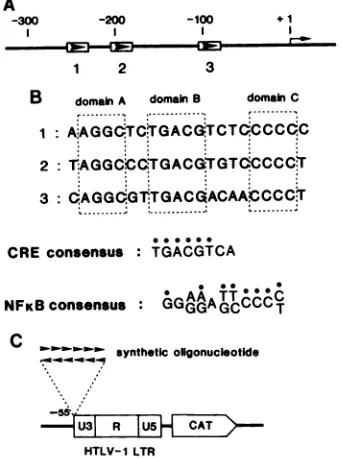
FIG. 1. Alignment oftranscriptionalenhancersofHTLV-Iin the LTRand comparison ofsequences. (A) Alignment of threedirect repeats of 21-bp enhancers in the HTLV-I LTR. Each open box represents a 21-bp unit; arrows indicate orientation. +1 is the cap site. (B) Sequence comparison of the three 21-bp repeats in the HTLV-I LTR. Boxed sequences are those conserved in the three repeats andnamed domainsA,B,and C.Dotsabove theconsensus sequences indicate identical bases in sequence 2 of the 21-bp segment. (C)Plasmid construction with synthetic oligonucleotides for determinationof enhanceractivity.Arrows indicateorientations of the oligonucleotides. The orientation of this insert did not significantly affectthe responseofCATactivity top40"'t. RESULTS
Essential domain for trans activation. trans activation of
the LTRby the viral trans activatorp40"tO isdependent on
21-bpsequencesrepeated three times in the U3 region of the
LTR(7, 23, 30).The 21-bprepeats differ from each other in
a few bases, but each of the repeats is active in trans
activation. Three regions, A, B, and C, were found to be conserved in these repeats (Fig. 1), suggesting their func-tional importance in trans activation. On the basis of this idea, mutations were introduced into these conserved
re-gions ofchemically synthesized 21-bp segments, and their effects on trans activation were analyzed. For analysis,
synthetic enhancer sequences were inserted into an
en-hancerlesspromoterof theHTLV-I LTR,pUCdN55, which had lostmost of the U3 sequence upstreamof-55 (thecap
site is+1), includingall three21-bprepeats.We firstinserted
one copy of the 21-bp segment into -55 of pUCdN55, containingtheCATgeneunder itspromoter, and CATgene
expression in Jurkat cells was measured after 2 days of
transfection. CAT activity in the presence orabsence of a
tax expression plasmid, pRSVSSIV, was used to evaluate activity in trans activation. However, one-copy insertion
gave only severalfold stimulation by tax (data not shown), and this activationwas thoughttobe insufficient for quanti-tative estimation of reduced activity with mutants of the insert. Higheractivation(more than 200-fold) was achieved
by inserting concatemers (five to seven repeats) of the
synthetic oligonucleotides (Table 1). The results of these
assays were not affected significantly by either the copy
number when more than five copies were inserted or the orientation of theoligonucleotides. Therefore, all results of thisstudy should be compareddirectly in thecontext of the sequenceof the oligonucleotidetested.
As reported previously (30), a pentamerof the wild-type
(WT) sequence enhanced CAT expression 250-fold in the presenceofp40,,a (Table 1). Mutant Al, which had substi-tutionsatthefirsttwo nucleotides(positions2and 3 inFig.
1B) in domain A, was also activated by p40fax, whereas mutant A2, which had mutations of the second set oftwo bases (positions 4 and 5) in domain A, was completely
inactive in trans activation. Therefore, at least part of domain A is required fortransactivation.
Mutations in domain B (mutants Bi and B2) completely
abolished tirans activation, which clearly indicated the im-portance ofdomain B. In contrast tothese results, none of the substitution mutations introduced into domain C
(mu-tants Cl, C2, and C3) abolished the response to p40O"X,
although these mutations reduced theactivityto40 to50% of that with the WT (Table 1). These results indicated that sequences in domains A and B are required for trans activation but that domain C is dispensable. Among these
constructions, we noticed variable basal activity without
tax.This observation may reflectmodifiedbindingof various cellular factors to the mutants; however, such variations should not affect ourconclusions with respect totax trans activation because the variation in basal activities was not correlatedtothe
magnitude
oftransactivation(for example,
see resultsformutantsAl and
Bi).
transactivation-responsive sequence. The results described VOL.63, 1989
on November 10, 2019 by guest
http://jvi.asm.org/
[image:2.612.349.520.78.307.2]3236 FUJISAWA ET AL.
TABLE 1. trans activation of the 21-bp repeat and its mutants byp40,"- in Jurkat cells
Strain Sequence"
copies
CATactivity' StimulationNone 1.0 0.8 0.8(<1)d
WT TAGGCCCTGACGTGTCCCCCT 5 0.4 93 230(100)
Substitutionmutants
Al -TC--- 5 0.1 26 260(110)
A2 ---AA--- 6 0.8 2.4 3.0(1)
B1 ---AC--- 5 1.0 1.2 1.2(<1)
B2 ---TG--- 7 0.2 0.3 1.5 (<1)
C1 ________________AA___ 5 0.8 76 95(41)
C2 ---AA-- 6 0.9 83 92(40)
C3 ---AA 6 0.2 100 500(220)
Deletion mutants
zvC14 GTAGGCCCTGACGT 6 0.9 66 73(32)
AC12 AGGCCCTGACGT 10 0.5 69 140(61)
AClO GCCCTGACGT 9 1.7 2.7 1.6(<1)
A\A CCTGACGTGTCCCC 6 0.6 30 50 (22)
"For
the substitution mutants, only substituted bases are shown; -,samebase asinWT.bInconcatemers.
"Expressedin ratiototheactivity ofanenhancerless constructionwithout taxexpression, which showed 29%acetylation ofchloramphenicolper 100 ,igof proteinper 60minat37°C.When activitywashigheroverthe linearresponse, the assay was repeatedwith lessprotein. DetailsaregiveninMaterials and Methods.
dNumbersinparenthesesare percentages.
above suggested thatsequencescontainingdomains A and B were sufficient for tax-dependent enhancer activity. This
ideawas confirmed by studies on deletion mutations.
Dele-tion mutants AC14 (positions -1to13) andAC12(positions 2 to 13), lackingdomain C, were active in trcans activation,
showing 70-to 140-fold stimulation, respectively (Table 1). Therefore, the sequence covering domains A and B is
sufficient fortax-dependent activation.
To confirm that the sequence in domain A is required, deletion mutant AC10 (positions 4 to 13), which lacked the firsttwonucleotides of domain A,wasconstructed. Mutant
AC10wascompletely inactiveintransactivation, supporting the conclusion that the sequence ofdomain A is required.
However, another deletionmutant, AA(positions 6 to 19), showed high activity, although it lacked all of thesequence
indomain A. This unexpected resultcould be explained by concatenation of the oligonucleotide which re-forms TCCC in the region equivalent to AGGC in domain A (Table 1). Constructions with activity contained AGGC (WT), TCCC (AA), and TCGC (Al) at a position equivalent to that of domain A. Therefore, we proposethat theputative consen-sussequenceof the TRE is(A/T)(G/C)(G/C)CNNTGACG(T/ A).
TREandCREaredistinct.Thesequencearound domainB was highly homologous to the DNA element conserved in
the CRE (20). The results presented above suggested that domain B is essential for tax-mediated trans activation. Therefore, we compared the TREdirectlywith the CRE.
For this comparison, we synthesized a standard CRE in the human vasoactive intestinal polypeptide gene
(VIP-CRE) (34)andan 11-bp oligonucleotideof theHTLV-I LTR (LTR-CRE; Table 2) that is highly homologous to the VIP-CRE. Responsiveness to cAMP was first assayed in
Jurkatcells,but the standardconstruction VIP-CRE showed onlyfewfold activation.Therefore,assays werecarriedin a
rat pheochromocytoma cell line, PC12, in which sufficient activation has been demonstrated(34). Aftertransfection of CATconstructscontainingconcatemersof the LTR-CREor
VIP-CRE, the cells weretreated withforskolin, adrugthat elevates the intracellular concentration of cAMP. CAT expression from both the LTR-CRE and VIP-CRE was
activated 20- to 30-fold by forskolin treatment, whereas neither element responded totaxactivation (Table 2). Sim-ilarly, deletion mutant AC10 was inactive in tax-mediated
trans activation but responded to cAMPactivation. These observations clearly indicate that the mechanism of
tax-mediated trans activation is different from that of cAMP-mediated regulation.This conclusionwasalsosupported by the fact that the intact 21-bp (WT) segment was strongly
activatedbyp4OfJ,xbutnot byforskolin. The latter phenom-TABLE 2. transactivation of the21-bp repeat anditsmutantsbycAMP andtaxinPC12cells
No.of CATactivity" Stimulation
Strain Sequence
No:o
copies"
Notreatment +Forskolin +p401'1" Forskolin p4OU,'CNone 1.0 1.2 0.7 1.2(4)' 0.7(2)
WT TAGGCCCTGACGTGTCCCCCT 5 2.7 3.2 110 1.2 (4) 41 (100)
LTR-CRE CCCTGACGTGT 7 0.9 27 1.1 30 (100) 1.2 (3)
VIP-CRE CTGTGACGTCT 7 0.4 6.8 0.2 17 (57) 0.5(1)
AC12 AGGCCCTGACGT 10 2.0 63 79 32 (110) 40 (98)
AClO GCCCTGACGT 9 3.6 20 4.1 5.6 (19) 1.1 (3)
AA CCTGACGTGTCCCC 6 1.3 11 13 8.5 (28) 10 (24)
" In concatemers.
bAssayedinPC12cells and expressed as in Table 1. A value of 1.0 wasequivalentto5.6%acetylation per 100
pg
of protein per 60minat 37°C."Numbersinparenthesesare percentages.
J. VIROL.
on November 10, 2019 by guest
http://jvi.asm.org/
[image:3.612.65.564.607.703.2]TABLE 3. Activation of the 21-bp repeat and its mutants by TPA in K562 cells
CATactivity'
Strain Sequence Stimu
-TPA +TPA lation
None 1.0 2.7 2.7(18)"
WT TAGGCCCTGACGTGTCCCCCT 1.7 27 16 (100) BI ---AC--- 1.7 2.0 1.2 (8) B2 ---TG--- 0.7 0.8 1.1 (7) C1 ---AA--- 2.0 4.0 2.0 (12) C2 ---AA-- 1.7 47 28 (180)
C3 ---AA 1.0 13 13 (81)
A,A CCTGACGTGTCCC 2.0 180 90 (560)
AC14 GTAGGCCCTGACGT 1.0 3.7 3.7 (23)
"See footnotes to Table 1 for details. A value of 1.0 represents 6.0% acetylationper 100 ,ug of protein per 60min at 37C.
"Numbers in parentheses are percentages.
enon is not well understood, since the WT 21-bp segment contained a sequence that could response to cAMP. Some sequencesaround the essential element may elicit a suppres-sive effect specific to CRE-mediated activation.
Mutant AXC12, containing domain A, and the LTR-CRE (domain B) were activated by both tax and cAMP (Table 2). Therefore, domain A did not interfere with the function of the LTR-CRE, and thus the TRE and CRE are not mutually exclusive. Similar results were observed with mutants zA
and AvC14 (Table 2), although their activation by cAMP was less effective.
Comparison of the TRE and TPA-responsive sequence. Activation of gene expression by the tumor promoter TPA was reported to be mediated by a factor binding to the AP-2 or NF-KB site. The HTLV-I 21-bp enhancer showed some homologies to the AP-2 (11) and NF-KB sites (15, 28). To determine the relationship of the TRE to the element re-quired for TPA stimulation, TPA stimulation of various mutants was tested in a premyeloid cell line, K562 (10), in which the WT 21-bp segment was stimulated about 20-fold by TPA(Table 3).
Substitution mutations in domain B completely inacti-vated theresponsiveness to TPA as well as top4O"'- (Table 3). Therefore, domain B is also essential for TPA stimula-tion. Mutant Cl, which had a two-base substitution in domainC in the region most proximal to domain B (positions 17 and 18), also showed no TPA stimulation (Table 3) but was strongly
trans
activated byp40I"-v.
Similar results were observed with mutantC14, inwhich domain Cwas deleted.Therefore, the sequence required for TPA stimulation is
apparently different from that of the TRE. In contrast, the
LTR-CRE (positions 5 to 15), in which the WT sequence from positions 5 to 18 was regenerated by concatenation (Table 3), was strongly activated by TPA treatment but was not trans activated by p4O"'-V. This observation again indi-cates that the TRE is different from the TPA-responsive sequence. Thus, the mechanisms for p40"'t--mediated and TPA-mediated activation are notidentical.
Protein binding to the TRE. The results described above demonstrated that the TRE is different from the sequence required forTPAstimulation. For direct demonstration ofa protein binding to the TRE, we analyzed the
enhancer-binding protein by a gel retardation assay. When a
32p_
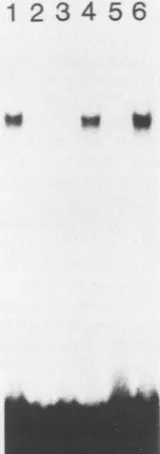
labeled WT 21-bp segment was incubated with awhole-cell extract of HUT102 cells, a major retarded band was de-tected. Formation of thisband was significantly reduced by thepresenceofanexcess(about200-fold) ofthe same21-bp
1
2 3 4 56
e
_wFIG. 2. Gel retardation assay of the TRE-binding protein. A
32P-radiolabeled WT 21-bp HTLV-I enhancer was incubated with
HUT102cell extract in the absence (lane 1) or presenceof oligonu-cleotidesascompetitors: WT(lane2); Al (lane 3); B2(lane4); C2 (lane 5); andNF-KB-binding fragment oftheIL-2Rcxgene(lane 6). The sequenceofthe IL-2R(x fragmentwasACGGCAGGGGAATC TCCCTCTCC. TheDNA-proteincomplexesformedwereanalyzed by gelelectrophoresisas described in Materials and Methods. segment or its substitution mutants Al and C2 (Fig. 2) but not ofmutant B2, which contained substitutions in domain B. Theseobservations indicated that this band represented specific protein bindingto DNAsequencecontaining domain B. On the basis of the tax-dependent activities of these mutants, weconcluded that thisprotein bindingwas
associ-ated with tr-alns activation by p40f..v in HUT102 cells. We
observed similar results withextractsfrom otherinfected or noninfected cell lines such as MT-2 andJurkat, apparently
indicatingthecellularoriginof thisenhancer-bindingfactor.
These observations are consistent with previous observa-tions byotherinvestigators. (1, 21, 22).
If this protein is identical to an NF-KB or NF-KB-like factor involved in activation ofIL-2Rox geneexpression (15,
16,25), efficient competitionbytheNF-KB-bindingsequence should be seen. However, even when a large excess of the NF-KB-bindingDNAfragment (23bp)from theIL-2Rcx gene was added, formation of the retarded band wasnotaffected
(Fig.2). The fragment of IL-2R(xwasconfirmedtobeactive
in bindingof TPA-induced NF-KB (datanot shown).
There-fore, it is concluded that a protein factor involved in TRE
binding in the HTLV-I LTR is different from the factor
involved in trans activation ofthe IL-2R(x gene. DISCUSSION
Inthispaper,wehaveproposed theexistenceofaTREin the HTLV-I LTR:
(A/T)(G/C)(G/C)CNNTGACG(T/A).
Concatemers of5 to 10 units of the
oligonucleotide
were used tocomparep40t(-I-dependent
enhanceractivities,since multiplecopiesoftheunitsconferred muchhigheractivities in response to tralns activation byp40"'-.
(23, 30). The WT 21-bp segment contains a CRE-like sequence in the middleon November 10, 2019 by guest
http://jvi.asm.org/
[image:4.612.400.480.82.309.2]3238 FUJISAWA ET AL.
domain
B,
flankedby
G+C-rich domains Aand C onthe5' and 3'sides,
respectively. Thus,
concatenation of some deletion mutantsregenerated
theoriginal
or a similarcon-figuration
of 21bp. Taking
theseproperties
intoconsider-ation,
wetentatively
conclude that the TRE encompassesdomainsAand B inthe
21-bp repeated
sequence. Consistentwith this sequence
requirement,
the adenovirus E2 pro-moter,which wasshowntobe activatedby p40"",
containsa
repeated
sequenceof TGGCGCTGACG thatalmostcom-pletely
matches thedefined consensussequenceof the TRE(2).
The TREis differentfrom sequences
required
for activa-tionby
cAMPand TPA: the CRE in the21-bp
repeatcovers the 3' end ofdomain A and domain B. On the otherhand,
TPAstimulationseemsto
require
the3'region
ofdomainA,
domain
B,
and the 5'region
of domain C. These resultssimply
suggesttheinvolvement of differentfactorsor mech-anisms of stimulationby
these agents. Eachresponsive
sequencewasidentified indifferent cell lines
(Jurkat, PC12,
and
K562); however,
atleast the TRE sequence should bedirectly compared
with those forcAMP and TPA stimulation becausetaxactivationwasobserved in all of these cell lines. In such acomparison,
it may benoteworthy
that these sequencesresponsible
for differentsignals
share domain B in 21bp.
Thisfinding
could beexplained by
thepossibility
that similarproteins
or the same factor butwith differentmodi-fications or
complex
formation is involved in activation oftheenhancer in the
21-bp
segmentby cAMP, TPA,
andtax.p401(Jx
hasrecently
been demonstrated to activatetran-scription
of theIL-2Rcx (Tac)
gene and the LTR ofhumanimmunodeficiency
virusthrough
induction ofanNF-KB-likefactor
(15,
16, 25, 31).
The sequences of21-bp
repeats in domains B and C havepartial
homology (8
of 11bases)
with the consensus sequence for NF-KBbinding.
Therefore the HTLV-Ienhancerwasexpected
tobeactivatedby
thesame element as that for NF-KB.However,
theresponsive
se-quenceTRE,
defined in thiswork,
is different from theNF-KB-binding
sequence.Furthermore,
theNF-KBconsen-sus sequenceofthe IL-2Ra gene did not compete with the TREin the LTR in
protein binding
inagel
retardation assay. These observationsclearly
indicate that the factor involved intransactivationof the21-bp
segmentisdifferent from thatinvolved in activation of the IL-2Ra gene or the human
immunodeficiency
virus LTR. This conclusion is also con-sistent with the notion that the LTR andIL-2ROL
havedifferent
cell-type
specificities
of transactivation;
transactivation oftheHTLV-I LTR isobservedina
variety
of celltypes even across
species,
but activation of IL-2Ro isobservedin
only
afew cell types(12, 18). However,
it is stillpossible
thatanNF-KB-like
factor is involved in activationof the LTR
by interacting
withanundefined sequence otherthanthe
21-bp
segment.Since the sequences ofthe LTR and
IR-2Rc responsible
fortax transactivationare
different,
other sequences may beresponsible
in other genes, such as thegranulocyte-mac-rophage
colony-stimulating
factor gene(19), simian virus 40early
genes(8,
26),
and theIL-2gene(12),whichareknown to be activatedby
p4Ofat.
Therefore,
p40tix
may be able to modulate the activities of severalenhancer-binding proteinsby modifications,
complex formation,
or induction of denovo
synthesis, resulting
in the activation of many genesindirectly.
Forexamination of thispossibility,
characteriza-tion of21-bp binding
proteins
should be of interest,espe-cially
inlight
of the interaction with thep4Of(Jx
protein ofHTLV-I.
ACKNOWLEDGMENTS
Wethank T.Akizawa, S. Sakuma,and T. Takeda for oligonucle-otidesynthesis, Y. Hirayamafor cellculture,and K.Nagashimafor initial workonthegel retardation assay.
This work was supported in part by a grant-in-aid for Special Project Research, Cancer-Bio-Science,from theMinistryof Educa-tion, Science and Culture of Japan.
LITERATURECITED
1. Altman,R.,D.Harrich,J.A.Garcia,and R. B. Gaynor. 1988. Human T-cell leukemia virus types I and II exhibit different DNase Iprotection patterns.J. Virol.62:1339-1346.
2. Chen,I.S.Y.,A.J. Cann,N. P.Shah,and R. B.Gaynor. 1985. Functional relationship of HTLV-1 x and adenovirus ElA proteins in transcriptional activation. Science 230:570-573. 3. Chen, I. S.Y.,D.J. Slamon,J.D.Rosenblatt,N. P.Shah,S. G.
Quan, and W. Wachsman. 1985. The gene essential for HTLV replication. Science 229:54-58.
4. Cross, S. L., M. B. Feinberg, J. B. Wolf, N. J. Holbrook, F. Wong-Staal, and W.J. Leonard. 1987.Regulationof the human interleukin-2 receptor alpha chain promoter: activation of a
nonfunctional promoterby the transactivator gene of HTLV-1. Cell49:47-56.
5. Felber, B. K., H. Paskalis, D. Kleinman-Ewing, F.Wong-Staal, and G. N. Pavlakis. 1985. The pX protein of HTLV-1 is a
transcriptional activator of its long terminal repeat. Science 229:675-679.
6. Fujisawa, J.-I., M. Seiki, T. Kiyokawa, and M. Yoshida. 1985. Functional activation of the long terminal repeat of human T-cell leukemiavirus type Iby a trans-acting factor. Proc. Natl. Acad. Sci. USA82:2277-2281.
7. Fujisawa, J., M. Seiki, M. Sato, and M. Yoshida. 1986. A transcriptional enhancer sequence of HTLV-1 isresponsiblefor transactivation mediated by p40x of HTLV1. EMBO J. 5: 713-718.
8. Fujisawa,J., M. Seiki, M. Toita, S. Miyatake, K. Arai, and M. Yoshida. 1988. Cell-line specific activation ofSV40 transcrip-tional enhancer by p4014x of HTLV-1. Jpn. J. Cancer Res. 79:800-804.
9. Hidaka, M., J. Inoue, M. Yoshida, and M. Seiki. 1988. Post-transcriptionalregulator (rex) of HTLV-1 initiates expression of viral structuralproteinsbut suppressesexpression of regulatory proteins. EMBO J. 7:519-523.
10. Holbrook, N. J., J. D. Luethy, and J. Kin. 1987. Transient expression of foreign genes in lymphoid cells is enhancedby phorbol ester. Mol. Cell. Biol. 7:2610-2613.
11. Imagawa, M., R. Chiu, and M. Karin. 1987. Transcriptional factor AP-2mediates inductionby two different signal-transduc-tionpathways: protein kinase C and cAMP.Cell 51:251-260. 12. Inoue, J., M. Seiki, T. Taniguchi, S. Tsuru, and M. Yoshida.
1986. Induction of interleukin 2 receptor gene expression by p40"encodedbyhuman T-cellleukemia virus type I. EMBOJ. 5:2883-2888.
13. Inoue, J., M. Yoshida,and M.Seiki.1987.Transcriptional(p40X) andpost-transcriptional(p27x-ll) regulators are required for the expressionandreplicationof human T-cellleukemia virustype Igenes. Proc. Natl. Acad. Sci. USA 84:3653-3657.
14. Kiyokawa, T., M.Seiki, S. Iwashita, K. Imagawa, F. Shimizu,
and M. Yoshida. 1985. p27x-111 proteins encoded by the pX sequence of human T-cell leukemia virus type I. Proc. Natl. Acad.Sci. USA 82:8359-8363.
15. Leung, K., and G. J. Nabel. 1988. HTLV-1 transactivator induces interleukin-2 receptor expression through an NF-KB-like factor. Nature(London)333:776-778.
16. Lowenthal, J. W.,E.Bohnlein,D.W. Ballard, and W. Greene. 1988. Regulation of interleukin 2 receptor ax subunit (Tac or CD25 antigen) gene expression: binding of inducible nuclear proteins to discrete promoter sequences correlates with tran-scriptional activation. Proc. Natl. Acad. Sci. USA 85:4468-4472.
17. Manley, J. L.,A. Fire, M.Samuels,and P. A.Sharp. 1983. In vitrotranscription;whole cell extract. Methods Enzymol. 101: 568-582.
J. VIROL.
on November 10, 2019 by guest
http://jvi.asm.org/
18. Maruyama, M., H. Shibuya, H. Harada, M. Hatakeyama, M. Seiki, T.Fujita, J. Inoue, M. Yoshida, and T. Taniguchi. 1987. Evidence foraberrant activation of the interleukin-2 autocrine loop byHTLV-I encoded byp40\andT3/Ti complex triggering. Cell 48:493-500.
19. Miyatake, S., M. Seiki, R. D.-W. Malefijt, T. Heike, J.-I. Fujisawa, Y. Takebe, J. Nishida, J. Shlomai, T. Yokota, M. Yoshida, K.-I. Arai, and N. Arai. 1988. Activation of T cell-derived lymphokine genesin T cells and fibroblasts; effects of human T cell leukemia virus type I p40x protein and bovine papilloma virus encoded E2 protein. Nucleic Acids Res. 16: 6547-6566.
20. Montminy, M. R., K. A. Sevarino, J. A. Wagner, G. Mandel,
and R. H. Goodman. 1986. Identification of a cyclic AMP responsive element within the rat somatostatin gene. Proc. Natl. Acad. Sci. USA 83:6682-6686.
21. Nyborg, J. K., W. S. Dynan,I.S. Y. Chen, and W. Wachsman. 1988.Binding of host-cell factors to DNA sequences in the long terminal repeat of human T-cell leukemia virus type 1: implica-tions for viral gene expression. Proc. Nati. Acad. Sci. USA 85:1457-1461.
22. Park, R. D., W. A. Haseltine, and C. A. Rosen. 1988. A nuclear factor is required for transactivation of HTLV-1 gene expres-sion. Oncogene3:275-279.
23. Paskalis, H., B. K. Felber, and G. N. Pavlakis. 1986. Cis-acting sequences responsible for the transcriptional activation of a
human T-cell leukemia virus type I constitute a conditional enhancer. Proc. Nat]. Acad. Sci. USA 83:6558-6562.
24. Poiesz,B.J., R. W. Ruscetti, A. F. Gazdar, P. A. Bunn, J.D.
Minna, andR. C. Gallo. 1980. Detection and isolation of the C retrovirus from fresh and culturedlymphocytesofapatient with T cell lymphoma. Proc. Natl. Acad. Sci. USA 77:7415-7419. 25. Ruben,S., H.Poteat, T.-H. Tan,K. Kawakami,R. Roeder,W.
Haseltine,andC. A. Rosen. 1988.Cellulartranscription factors andregulation of IL-2 receptor gene expression by HTLV-1tax
gene product. Science 241:89-92.
26. Saito, S., M. Nakamura, K. Ohtani, M. Ichijo, K. Sugamura, and Y. Hinuma. 1988. trons-Activation of the simian virus 40 enhancerby apXproductof human T-cell leukemiavirustype I.J. Virol. 62:644-648.
26a.Seiki, M., J.-I. Inoue, M. Hidaka, and M. Yoshida. 1988. Two cis-acting elements responsible for posttranscriptional trails-regulation of gene expression of human T-cell leukemia virus type I. Proc. Natl. Acad. Sci. USA 85:7124-7128.
27. Seiki, M., J. Inoue, T. Takeda, and M. Yoshida. 1986. Direct evidence that p40x of human T-cell leukemia virus type I is a
tranls-acting transcriptional activator. EMBO J. 5:561-565. 28. Sen, R., and D. Baltimore. 1986. Multiple nuclear factors
interact with the immunoglobulin enhancer sequences. Cell 46:705-716.
29. Shah,N.P., W.Wachsman,A.J. Cann, L.Souza, D. J. Slamon, and I. S. Y. Chen. 1986. Comparison of the tuanis-activation capabilities of the human T-cell leukemia virus type I and ll proteins. Mol. Cell. Biol. 6:3626-3631.
30. Shimotohno, K., M. Takano, T. Teruuchi, and M. Miwa. 1986. Requirement of multiplecopies of a 21-nucleotide sequence in the U3regions of human T-cell leukemia virus type I and type II long terminal repeats fortr-anis-actingactivation of transcription. Proc. Natl. Acad. Sci. USA 83:8112-8116.
31. Siekevitz, M.,M. B.Feinberg,N.Holbrook, F.Wong-Staal,and
W. C. Greene. 1987. Activation of interleukin 2 and interleukin 2receptor(Tac) promoterexpression by the traltis-activator (tlt) geneproduct of human T-cell leukemia virus type I. Proc. Natl. Acad. Sci. USA84:5389-5393.
32. Sodroski, J. G., C. A. Rosen, W. C. Goh,and W. A.Haseltine. 1985. A transcriptional activator protein encoded by the x-lor region of the human T-cell leukemia virus. Science 228:1430-1434.
33. Sodroski, J. G., C. A. Rosen, and W. A. Haseltine. 1984. Tri-its-acting transcriptional activationof the long terminal
re-peatof humanTlymphotropicviruses in infected cells. Science
226:177-179.
34. Tsukada, T., J. S. Fink, G.Mandel,and R. H.Goodman. 1987. Identification of a region in the human vasoactive intestinal polypeptide generesponsible for regulation bycyclic AMP. J. Biol. Chem. 262:8743-8747.
35. Yoshida, M., I. Miyoshi, and Y. Hinuma. 1982. Isolation and characterization ofretrovirus from cell lines of human adult T-cell leukemia and its implication in the disease. Proc. Natl. Acad. Sci. USA 79:2031-2035.