
AS-EKF: a delay aware state estimation technique
for telepresence robot navigation
Barnali Das, Gordon Dobie and Stephen Gareth Pierce
Dept. of Electronic and Electrical Engineering, University of Strathclyde, Glasgow, UK.
{barnali.das, gordon.dobie, s.g.pierce}@strath.ac.ukAbstract—State estimation in dynamical telepresence systems is very important in real-world applications as the true state of the robot is unspecified and sensors provide only a sequence of noisy measurements. In this research, we proposed a new technique of state estimation using delayed sensor measurements of a Telepresence robot for real-time navigation. An Augmented State Extended Kalman Filter (AS-EKF) is introduced to estimate the true position of the robot. The proposed algorithm was successfully tested in a real-environment experimental framework using a state-of-the-art differential-drive telepresence robot. Our results show improvements of an average of more than 34% when compared to traditional EKF.
Index Terms—State estimation, EKF, augmented state, telep-resence, robot navigation, time delay.
I. INTRODUCTION
A telepresence system is a set of technology which offers human operators to feel as if they are present to give the appearance of being present, at a place other than their true location. Telepresence allows the human operator to control and navigate a mobile robot around the remote environment and physically interact with their audiences through video conferencing [1]. As the mobile robot is controlled by a human operator through a communication network in a remote site, the human operator should know the robot’s orientation to control the robot smoothly.
Telepresence robots suffer significant challenges during navigation in the remote site mainly due to communication time delays [2]. If time delays are not duly compensated to estimate the correct robot pose, the human operator may cause an accident by crashing obstacles. This is due to inaccurate recognition of the robot pose by the remote operator.
In this work, we proposed a Bayesian approach to model the time delay using state estimation techniques that are useful for non-linear telepresence robot navigation. Filtering method [3], such as the Extended Kalman Filter (EKF) is commonly used to acquire an estimation of the true states from noisy measurements. However, when a filtering processor is connected to a sensor through a network, there exists a fundamental communication time delay.
Moreover, if raw sensor data require post-processing, in order to update states of the dynamical system, additional post-processing time is needed, resulting in a delay between the acquisition of a measurement and its availability to the filter. In such occasions, EKF only algorithms are not adequate for true robot state estimations. Therefore we propose a new
technique by augmenting past states that consider above-mentioned delays.
If the time delay is known, the past state can be pre-dicted applying backward prediction of the current state. Bar-Shalom [4], [5] proposed an optimal and sub-optimal algorithm for delayed measurement. In the case of a non-linear system, it needs modifications for state estimation. Larsen et al. [6] introduced a method based on extrapolation of a delayed measurement to present time using past and present estimates of the Kalman Filter. An extension algorithm is proposed in [7] that interpolating a delayed measurement minimizes the computational time even for significant time delays.
State augmentation is also used in time delayed measure-ments. Delayed measurements directly correct the past state and a new prediction of the current state is then obtained from the corrected past state. Challaet al. [8] presented a Bayesian solution to the out of sequence measurement (OOSM) problem and provided approximate, implementable algorithms for both cluttered and non-cluttered scenarios involving single and multiple time-delayed measurement. Van Der Merwe et al.
[9] applied the sigma point Kalman Filter instead of EKF to the augmented technique to fuse latency lagged observations for non-linear estimation and multiple sensors fusion. Choiet al. [10] proposed a state estimator by modelling uncertain delay as a probabilistic density function combined with the Augmented State Kalman Filter.
However, the majority of these algorithms reported simula-tion only results that neither considered a real environment nor the techniques were applied on a real robot. In this paper, we proposed the technique of state estimation using delayed sensor measurements of a real-world differential-drive telepresence robot navigation.
This work incorporates navigation error such as dead reck-oning which is observed in differential drive robots. Our experimental design includes raster scan based path-planning as a representative scenario for differential-drive telepresence robots. The contributions of this work include:
state-of-the-Figure 1. Flow diagram of the proposed algorithm
art differential-drive telepresence robot in the real-environment experimental framework.
An overall flow diagram of the proposed algorithm is shown in Figure 1. To the best knowledge of the authors, the proposed Bayesian approach is first of its kind in compensating delays in differential-drive telepresence robot navigation.
II. PROPOSED METHODOLOGY
In order to propose the delay aware state estimation tech-nique, firstly we recall the traditional filter equations which are then used in developing the augmented state-based approach as described in the following subsections.
A. Filter equations for state estimation
In this research, Extended Kalman Filter (EKF) [3], [11] was used to estimate the true robot state from noisy sen-sor measurements. The process governed by the non-linear stochastic difference equation with estimating the state vector
x∈Rn
xk+1 =f(xk, uk, wk). (1)
The measurement equation withz∈Rmis represented by
zk=h(xk, vk). (2)
The non linear function f(·) in Eq. (1) relates to the state at time step k to the state at step k + 1. The non linear function h(·) in the measurement Eq. (2) relates the state
xk to the measurement zk. xk+1 represents the actual state
vector including the previous state xk, an control input uk
and the process noisewk.zkrepresents the measurement state
vector including the state xk and the measurement noise vk.
The random variables wk and vk represent the process and
measurement noise respectively.QandR are the process and measurement noise covariance respectively. Complete set of Extended Kalman Filter estimation equations can be expressed as:
Time update equations (Prediction):
ˆ
x−k+1=f(ˆxk, uk,0). (3)
Pk−+1=AkPkAkT +WkQkWkT. (4)
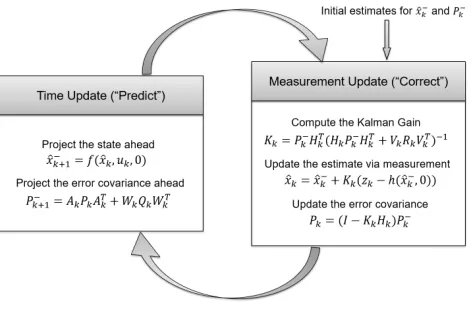
In the Extended Kalman filter, the time update equations represents the state and covariance estimates from the time step k to the time step k+ 1. Ak and Wk are the process
Jacobians at stepk, andQk is the process noise covariance at
stepk.
Measurement update equations (Correction):
Kk =Pk−H T
k(HkPk−H T
k +VkRkVkT)
−1. (5) ˆ
xk = ˆx−k +Kk(zk−h(ˆx−k,0)). (6)
Pk = (I−KkHk)Pk−. (7)
In the Extended Kalman Filter, the measurement update equations correct the state and covariance estimates with the measurement. Hk and Vk are the measurement Jacobians at
step k, and Rk is the measurement noise covariance at step
[image:2.612.132.480.46.192.2]k. The Figure 2 shows all estimation equations of Extended Kalman Filter.
Figure 2. Basic operations of Extended Kalman Filter.
In an ideal case considering no time delay in the system, in a single time occurrence, when sensor measurement data arrives its coincide with another measurement data at the same time step available in a filter as shown in Figure 3.
[image:2.612.314.551.451.606.2]Figure 3. Ideal measurement data.
Figure 4. Delayed measurement data.
In such cases, the measurement equation should be redefined as [7],
zk=h(xk−τ, vk−τ), (8)
whereτ is assumed time delay.
B. Proposed technique for state estimation
When sensor measurements are corrupted by the time delay, the current state cannot be directly corrected using the current measurement, since a delayed sensor measurement is actually carrying information about a past measurement state. There-fore, the past measurement state corresponding to a delayed measurement should be determined before using the delayed measurement during the state estimation. The current state also needs to be corrected after correcting the appropriate past state. In this work, we have proposed a technique to use Augmented State Extended Kalman Filter (AS-EKF) for state estimation with delayed measurements as depicted in Figure 1.
We augmented the past measurement states into several augmented state vectors. The current measurement state which also contains information of the past measurement state di-rectly corrects the augmented state vector. In this way, in a delayed system, we can determine the corresponding past state in the augmented state vector. After that, the past state is updated using the delayed measurement data and the current state is simultaneously corrected in the augmented state vector. For one time step delay, the prediction equation is modified as
"
xk+1
xk #
= "
f(xk, uk, wk)
xk #
, (9)
where
xTk+1 xTkT
is the augmented state vector. The measurement equation is
zk =h
0 I
"
xk+1
xk #
, vk !
, (10) whereI is the identity matrix, the current measurementzk
can be used to updatexT k+1 xTk
T
.
For multistep delays, the prediction equation can be defined as
x0k+1=
f(xk, uk)
I 0 0 0 0 . .. 0 ...
0 0 I 0
xk, wk (11)
≡f(x0k, uk, w
0
k),
where x0k is the augmented state vector defined by
xTk xTk−1 · · · xTk−nT
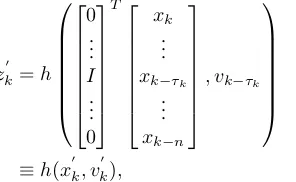
and n is the maximum number of delayed time steps. The measurement equation can be rewritten as
z0k=h 0 .. . I .. . 0 T xk .. .
xk−τk
.. .
xk−n
, vk−τk (12)
≡h(x0k, v
0
k),
where τk represents the time delay, which is less than n,
andI is placed at the corresponding time stepk−τk.
If the time delay τk is given, the augmented state vector
can be estimated recursively via the EKF algorithm. In the prediction stage, state prediction is carried out by the predic-tion equapredic-tion (Eq. (11)). The error covariance is propagated by the Jacobian of the prediction model and the process noise covariance(Q). The measurement update stage or mea-surement model is based on the prediction model and the error covariance (Eq. (12)). The Jacobian of the measurement model and the measurement noise(R)are needed to obtain the Kalman gain(K).
The AS-EKF is implemented in the augmented state vector using prediction and measurement update stages of EKF algo-rithm. The proposed technique provides a better and consistent state estimation for delayed telepresence robot navigation systems.
III. RESULTS ANDDISCUSSIONS
A. Experimental framework
To demonstrate and evaluate the performance of the pro-posed state estimator, we have built an experimental frame-work implementing some research elements with a com-mercially available telepresence robot. The major functional components and toolsets being used in this experiment are depicted in Figure 5 followed by a brief description.
We have used Beam+1 robot (a state-of-the-art market leading telepresence robot) in our experiments due to its telep-resence capability and control through WiFi communication.
[image:3.612.52.302.590.715.2]Figure 5. The experimental framework.
ROS2 is used to navigate and control the robot. Several ROS packages that solve basic robotics problems including pose estimation, localisation in a map and mobile navigation were used in this work which includes several commands for launching nodes, introspecting topics and publishing control actions as a host to the Telepresence robot. Using ROS commands we instructed the robot to navigate following the predefined trajectory, monitored its progress, controlled it along the way, and received feedback when it has succeeded (or failed). A ROS driver rosbeam3 (a ROS node to access the hardware) was used for the experimental purposes. The original driver was modified and installed in our Beam+ robot to communicate with the host computer.
We captured robot’s navigation data using Vicon motion capture system4. We have attached retroreflective markers on the robot to represent it as a rigid body. Vicon cameras were used to record the movement of the robot. They operate in three dimensions and tend to have high resolution and high accuracy.
The proposed state estimation algorithm was implemented in a Linux based computer as a host computer. The host computer connects the Telepresence robot using ROS driver and sends ROS control command to the robot to form a raster-scan navigation path and receives 3D positional data of the navigation captured by the Vicon motion cameras through WiFi.
All the experiments were carried out in the real environment framework using all the research elements. We assumed that there is an amount of time difference between sending a control command and the moment when the measurement data enters into the estimator. Therefore, we can not predict the actual pose of the robot. The proposed algorithm can solve the problem by estimating the true state/position of the robot.
2www.ros.org/core-components/ 3https://github.com/xlz/rosbeam 4https://www.vicon.com/
B. Evaluation
We have evaluated the proposed algorithm considering only delayed robot navigation measurement. It is worth noting that the proposed approach is unique and therefore there is no existing state-of-the-art method to directly compare with. In evaluating our approach we consider the traditional EKF as the base line and show comparative improvements using the proposed approach.
The robot velocity was assumed to have white Gaussian noise and the measurement data was also corrupted by the sensor noise. As the Beam+ telepresence robot is also a differential-drive robot, it has produced an enormous amount of dead-reckoning errors during navigation. In a differential-drive mobile robot, incremental odometry errors are usually caused by kinematic imperfections of the robot [12]. Using the UMBMark method we have measured the dead-reckoning accuracy of the robot to find out the variance in the robot navigation and modelled it in the proposed algorithm. We have captured actual robot path using Vicon cameras which has a low variance (3.58mm2) as reported in a previous work [13]. The Vicon captured positional data is also used as the noisy measurement by introducing random white noise.
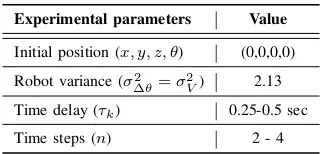
During the experiments, we have considered several aug-mented states (n ∈ [2,4]) with different time delay and evaluated the performances of the proposed estimator. The parameters used in the experiments are listed in the Table I.
Table I
PARAMETERS USED IN THE EXPERIMENT.
Experimental parameters Value
Initial position (x, y, z, θ) (0,0,0,0) Robot variance (σ∆2θ=σ2V) 2.13 Time delay (τk) 0.25-0.5 sec Time steps (n) 2 - 4
All the experiments were carried out in the AS-EKF based experimental framework to obtain the robot’s actual position. The proposed AS-EKF algorithm successfully estimated the robot’s position during navigation and compensated the robot’s current position from the noisy measurement data as described before and shown in Figure 6.
The estimated robot path produced from the AS-EKF sys-tem was compared with the absolute robot path to evaluate the navigation performance. The errors were calculated in terms of root mean square error (RMSE) for the individual assumption of τ values. Two sets of results were obtained, one using traditional EKF filter and the other with the assumption of delayed measurement incorporated in the Augmented State EKF model. The navigation performance with traditional EKF is shown in column 1 of Figure 6 for τk = 0.25 &τk = 0.5,
Traditional EKF,τk= 0.25 τk= 0.25, n= 2 τk= 0.25, n= 3 τk= 0.25, n= 4
[image:5.612.53.563.50.280.2]Traditional EKF,τk= 0.5 τk= 0.5, n= 2 τk= 0.5, n= 3 τk = 0.5, n= 4
Figure 6. Robot navigation using traditional EKF with delayed measurements & improvements using AS-EKF forn= 2,3,4.R1:τk= 0.25,R2:τk= 0.5.
Figure 7. RMSE values for traditional EKF and AS-EKF consideringn∈
[2,4]forτk= 0.25andτk= 0.5.
The results represented that proposed AS-EKF based algo-rithm provides better state estimation compared to traditional EKF. The experimental output produced a more accurate result with increasing the number of state vector with considering delayed measurements. The quantitative RMSE values are shown in Figure 7 which indicate improvements of 22.20%
to45.03%.
IV. CONCLUSIONS
In this paper, state estimation of a telepresence robot with delayed navigation measurement was presented. Extended Kalman Filter combining with Augmented State Extended Kalman Filter has successfully implemented, estimating the actual position of the robot and modelling the time delay
in the robot navigation. The AS-EKF based estimated robot path was compared with the traditional EKF based robot path to evaluate the improvement in navigation performance. The proposed methodology was experimentally tested and verified in the real-environment experimental setup with a state-of-the-art commercially available telepresence robot. To the best knowledge of the authors, the proposed AS-EKF based algorithm is first of its kind to estimate robot pose in compensating measurement delays in a differential-drive telepresence robot navigation.
ACKNOWLEDGEMENT
We acknowledge the support of a university PhD studentship at the University of Strathclyde, Glasgow, UK and PPS UK Ltd.
REFERENCES
[1] K. M. Tsui, M. Desai, H. A. Yanco, and C. Uhlik, “Exploring use cases for telepresence robots,” inProceedings of the 6th international conference on Human-robot interaction. ACM, 2011, pp. 11–18. [2] R. Held and N. Durlach, “Telepresence, time delay and adaptation,”
Pictorial communication in virtual and real environments, pp. 232–246, 1991.
[3] S. Thrun, W. Burgard, and D. Fox,Probabilistic Robotics (Intelligent Robotics and Autonomous Agents). The MIT Press, 2005.
[4] Y. Bar-Shalom, “Update with out-of-sequence measurements in track-ing: exact solution,” IEEE Transactions on Aerospace and Electronic Systems, vol. 38, no. 3, pp. 769–777, Jul 2002.
[5] Y. Bar-Shalom, H. Chen, and M. Mallick, “One-step solution for the multistep out-of-sequence-measurement problem in tracking,”IEEE Transactions on Aerospace and Electronic Systems, vol. 40, no. 1, pp. 27–37, Jan 2004.
[6] T. D. Larsen, N. A. Andersen, O. Ravn, and N. K. Poulsen, “Incorpo-ration of time delayed measurements in a discrete-time kalman filter,” inProceedings of the 37th IEEE Conference on Decision and Control, vol. 4, Dec 1998, pp. 3972–3977.
[image:5.612.60.279.321.502.2][8] S. Challa, R. J. Evans, and X. Wang, “A bayesian solution and its approximations to out-of-sequence measurement problems,”Information Fusion, vol. 4, no. 3, pp. 185 – 199, 2003.
[9] R. Van Der Merwe, E. A. Wan, and S. Julier, “Sigma-point kalman filters for nonlinear estimation and sensor-fusion: Applications to integrated navigation,” in Proceedings of the AIAA Guidance, Navigation and Control Conference, 2004, pp. 16–19.
[10] M. Choi, J. Choi, and W. Chung, “State estimation with delayed mea-surements incorporating time-delay uncertainty,”IET Control Theory and Applications, vol. 6, pp. 2351–2361(10), October 2012.
[11] G. Welch and G. Bishop, “An introduction to the kalman filter,” Tech. Rep., 1995.
[12] J. Borenstein and L. Feng, “Umbmark: A benchmark test for measuring odometry errors in mobile robots,” in Mobile Robots X, vol. 2591. International Society for Optics and Photonics, 1995, pp. 113–125. [13] R. Summan, S. Pierce, C. Macleod, G. Dobie, T. Gears, W. Lester,
![Figure 7. RMSE values for traditional EKF and AS-EKF considering n[2 ∈, 4] for τk = 0.25 and τk = 0.5.](https://thumb-us.123doks.com/thumbv2/123dok_us/1335110.87284/5.612.53.563.50.280/figure-rmse-values-traditional-ekf-ekf-considering-tk.webp)
