City, University of London Institutional Repository
Citation
: Agamah, Simon (2016). Evolutionary combinatorial optimisation for energy
storage scheduling, and web-based power systems analysis using PHP. (Unpublished Doctoral thesis, City, University of London)This is the accepted version of the paper.
This version of the publication may differ from the final published
version.
Permanent repository link:
http://openaccess.city.ac.uk/15837/Link to published version
:
Copyright and reuse:
City Research Online aims to make research
outputs of City, University of London available to a wider audience.
Copyright and Moral Rights remain with the author(s) and/or copyright
holders. URLs from City Research Online may be freely distributed and
linked to.
Evolutionary Combinatorial Optimisation for
Energy Storage Scheduling, and Web-based Power
Systems Analysis using PHP
By
Simon Unekwu Agamah
Thesis submitted for the degree of
Doctor of Philosophy
School of Mathematics, Computer Science, and Engineering
City, University of London
1
Table of Contents
Table of Contents ... 1
List of Figures ... 6
List of Tables ... 10
List of Symbols ... 11
List of Abbreviations ... 12
Acknowledgements ... 14
Declaration ... 15
Abstract ... 16
1 Introduction ... 17
1.1 Background... 17
1.1.1 Background: Energy Storage System Scheduling for Peak shaving and load-levelling 17 1.1.2 Background: Web-based Power Systems Analysis using PHP ... 20
1.2 Thesis Objectives ... 22
1.3 Outline of the Thesis ... 23
1.4 Contribution ... 25
1.5 List of Author’s Publications ... 26
2 Electrical Energy Storage Systems Management and Scheduling: Related work and Literature ... 28
2.1 Introduction ... 28
2.2 Electrical Energy Storage Systems Review – types, functions and roles ... 28
2.2.1 Roles of Energy Storage Systems ... 29
2.2.2 Classification of Energy storage system technologies by functions ... 33
2.3 Peak shaving and Load-levelling functions of ESS ... 35
2
2.5.1 Set-point control ... 39
2.5.2 Dynamic Optimal Power Flow ... 43
2.5.3 Dynamic Programming and Artificial Intelligence methods ... 47
2.5.4 Demand Response and tariff-based Methods ... 49
3 Application of Combinatorial optimisation methods to Energy Storage System Scheduling ... 51
3.1 Introduction ... 51
3.2 Problem Definition ... 51
3.3 Allocating ESS capacity from a search space using a subset sum algorithm ... 54
3.4 Scheduling ESS allocation in demand profile using the Bin Packing Problem and solutions ... 60
3.4.1 Charging ESS using solution of demand profile bin packing problem ... 61
3.4.2 Discharging ESS as bin packing problem ... 65
3.4.3 Obtaining solution from merging Charge and Discharge schedules ... 69
3.5 Application of Genetic algorithm optimisation ... 72
3.5.1 Fitness function definition and ranking by score ... 74
3.5.2 Populating a generation and evaluating fitness ... 75
3.5.3 Crossover ... 75
3.5.4 Mutation ... 76
3.5.5 Selection and Elimination ... 77
3.5.6 Termination ... 77
3.6 Summary... 77
4 Web-based Power Systems Analysis: Related work and Literature ... 78
4.1 Introduction ... 78
4.2 Power systems representation fundamentals ... 79
4.3 General Power Systems Analysis and programming: requirements and languages . 80 4.4 Web-based Power Systems Analysis using a 3-tier framework ... 84
4.5 Commercial and open source software for web-based PSA ... 88
4.5.1 NEPLAN 360 ... 88
3
4.5.3 MATLAB based Systems: SimPowerSystems, MATPOWER and others ... 90
4.6 Web-based PSA in previous research work ... 91
4.7 Power systems studies theory and fundamentals ... 93
4.7.1 Power Flow Study ... 93
4.7.2 Fault study: Short Circuit Capacity and Systematic Fault Analysis ... 101
4.8 Mathematical Modelling Requirements in PSA computing language... 106
5 PHP application library for web-based power systems analysis... 107
5.1 Introduction ... 107
5.2 Advantages and Disadvantages of using a PHP simulation engine for Power Systems Simulation ... 107
5.2.1 Advantages of using PHP for a power systems simulation library ... 107
5.2.2 Disadvantages of PHP for power systems analysis ... 109
5.3 2-tier framework for web-based simulation using PHP ... 111
5.4 Extending the functionality of PHP to handle Power Systems Simulation concepts 113 5.4.1 Matrix operations ... 114
5.4.2 Complex Number and Vector Operations ... 115
5.5 Electrical Network definition in PHP ... 115
5.6 System architecture of PHP library for power systems analysis ... 119
5.7 Power flow solution in PHP using classical Newton-Raphson method ... 120
5.8 Balanced Symmetrical 3-phase fault computation methodology ... 124
6 Evolutionary combinatorial optimisation for Energy storage scheduling: Case Studies, Results and Discussion ... 127
6.1 Introduction ... 127
6.2 Case Study: Riverside Community, Stirling, Scotland UK ... 128
6.2.1 Background ... 128
6.2.2 Test Data and Source ... 129
4
6.3 Case Study and algorithm verification comparative analysis: Combinatorial
optimisation algorithm compared to set-point control in household demand smoothening
134
6.3.1 Background ... 134
6.3.2 Test data and source ... 134
6.3.3 Results and Discussion ... 135
6.4 Case Study and comparative analysis: Leighton Buzzard smart network storage project 136 6.4.1 Background ... 136
6.4.2 Test data and source ... 139
6.4.3 Results and Discussion ... 140
6.5 Case study and comparative analysis: Household demand scheduling with second-use EV batteries and tariff-driven demand response ... 147
6.5.1 Background ... 147
6.5.2 Test data and source ... 147
6.5.3 Results and discussion ... 150
6.6 Summary... 154
7 Web-based Power Systems Simulation using PHP: Tests, Results and Discussion ... 156
7.1 Power flow study using Newton-Raphson method: Tests and Results ... 157
7.1.1 Test data ... 157
7.1.2 Results and Discussion ... 157
7.2 Balanced Short Circuit Fault study ... 162
7.2.1 Summary ... 165
8 Conclusions and recommendations for future work ... 168
8.1 Energy storage system scheduling for peak shaving and load-levelling ... 168
8.1.1 Summary of findings ... 168
8.1.2 Significance of findings ... 170
8.1.3 Limitations of this study and recommendations for future work... 171
8.2 Web-based power systems analysis using PHP ... 172
5
8.2.2 Significance of findings ... 174
8.2.3 Limitations of this study and recommendations for further work ... 175
Appendix A. Test data for evolutionary combinatorial optimisation algorithm ... 176
6
List of Figures
Figure 2.1. Electrical Energy storage systems classification by energy type ... 29
Figure 2.2. Roles of energy storage systems according to frequency and duration of use ... 31
Figure 2.3. Grid-scale battery storage array in Kilroot, Ireland ... 32
Figure 2.4. A Maslow Smart Energy Storage household unit ... 33
Figure 2.5. Categories of Energy Storage System technologies according to discharge time and system ratings ... 35
Figure 2.6. Original Demand Profile with no peak shaving and load levelling has wide margin between peak and trough demands ... 36
Figure 2.7. Demand Profile after Peak shaving without load-levelling showing lower peak demand ... 36
Figure 2.8. Demand profile after load levelling without peak shaving showing smaller peak-trough demand margin and less variation in demand ... 36
Figure 2.9. Demand profile after load levelling with peak shaving showing smaller peak-trough demand margin and less variation in demand ... 37
Figure 2.10. Possible outcomes of electricity demand forecasts ... 39
Figure 2.11. Simple Closed-loop system for set-point control in real-time ESS scheduling ... 40
Figure 2.12. Set-point control example reducing demand over a 24 hour period using two different set-points ... 41
Figure 2.13. Flowchart for calculating set-point reference value for demand smoothening algorithm ... 42
Figure 2.14. Architecture for off-line and on-line for scheduling based on aggregated forecast ... 43
Figure 2.15. Heat rate curve and fuel cost curve used for generator cost function in optimal power flow problem ... 44
Figure 2.16. Two generator model of ESS ... 46
Figure 2.17. Active-Reactive Optimal Power Flow using electricity prices and wind power generation. ... 47
Figure 2.18. Active-Reactive Optimal Power Flow with search algorithm to determine best charging and discharging periods in an ESS ... 47
Figure 2.19. Business-as-usual (left) and Smart (right) charging in a residential area (8,000 properties) driven by charging of 5,000 EVs when people return from work ... 50
Figure 3.1. Allocation of ESS capacity from subset sum filter and random number generator 55 Figure 3.2. Decision tree for subset sum generation with augmentation threshold ... 56
7
Figure 3.4. Flowchart for solution to subset sum problem for ESS energy distribution
framework ... 58
Figure 3.5. Normalization and discretization of demand profile into bins for the bin-packing algorithm ... 60
Figure 3.6. Charge scheduling of ESS units using bin-packing algorithm ... 62
Figure 3.7: Flowchart for charging ESS using bin-packing algorithm ... 63
Figure 3.8. Discharge scheduling of ESS units using bin-packing algorithm and inverse transform ... 65
Figure 3.9. Flowchart for discharging ESS using a solution to the bin-packing problem ... 67
Figure 3.10. Charge and discharge schedules are merged to obtain final demand profile ... 69
Figure 3.11. Process diagram for combinatorial optimisation algorithm ... 69
Figure 3.12. Flowchart for complete process of scheduling ESS using subset sum and bin packing algorithms ... 71
Figure 3.13. Populating, scoring and ranking a generation for crossover and elimination ... 75
Figure 3.14. Crossover operation to possibly produce fitter schedules from top scoring pair . 76 Figure 3.15. Mutation operation to produce a possibly fitter schedule and seek global optima ... 76
Figure 4.1. A simple 3-bus power system consisting of a generator, transformers and loads .. 80
Figure 4.2. System Architecture for a general purpose ... 84
Figure 4.3. World Wide Web (WWW or Web) interaction between Server and Client computers ... 85
Figure 4.4. 3-tier architecture for Web-based Power Systems Analysis ... 88
Figure 4.5. NEPLAN 360 Graphical User Interface ... 89
Figure 4.6. InterPSS High Level Architecture ... 90
Figure 4.7. MATLAB deployment for web applications using the compiler SDK ... 91
Figure 4.8. Web-based Power systems analysis architecture from Chen and Lu ... 92
Figure 4.9. Typical bus of a power network ... 95
Figure 4.10. 2-bus network single line diagram ... 96
Figure 4.11. 2-bus network with current injection and line flows ... 101
Figure 4.12. Typical bus of a power system ... 103
Figure 4.13. Typical bus of a power system with Thevenin equivalent impedances ... 104
Figure 5.1. 2-tier architecture for web-based power systems analysis using PHP ... 112
Figure 5.2. Module functions and interactions for PHP WBPSA library ... 113
Figure 5.3. Sample 3-bus network to be defined in XML ... 116
Figure 5.4. System Architecture for PHP WBPSA library ... 120
Figure 5.5. Flowchart for Newton-Raphson Power Flow study in PHP WBPSA library ... 123
8
Figure 6.1. Quantitative comparative analysis methodology ... 127
Figure 6.2. Original Riverside demand profile after conversion to PU and scaling ... 130
Figure 6.3. Inverted Riverside demand profile after mirror transform for discharging ... 130
Figure 6.4. 6-block scenario ESS charge and discharge schedule. ... 131
Figure 6.5. 11-block scenario ESS charge and discharge schedule. ... 132
Figure 6.6. 20-block scenario ESS charge and discharge schedule. ... 132
Figure 6.7. Comparison of different scenarios of energy block numbers and normal operation on algorithm completion. ... 132
Figure 6.8. Representative average demand profile for household in Denmark in spring ... 135
Figure 6.9. Representative average demand profile for household in Denmark in spring after horizontal mirror transform ... 135
Figure 6.10. Comparative analysis of combinatorial optimisation method and demand tracking set-point ... 136
Figure 6.11. Single line diagram of Leighton Buzzard distribution network substation ... 138
Figure 6.12. Leighton Buzzard capacity violations on two occasions ... 138
Figure 6.13. Base case and results of Set-point, GACO7 and GACO10 algorithms... 142
Figure 6.14. Demand shape evolution after application of GACO algorithm with 7 ESS units (GACO7) and 15000 generations ... 142
Figure 6.15. Demand shape evolution after application of GACO algorithm with 10 ESS units (GACO10) and 15000 generations ... 143
Figure 6.16. Evolution of peak demand after GACO algorithm ... 144
Figure 6.17. Evolution of demand margin showing improvement in load-levelling after application of GACO ... 145
Figure 6.18. ESS power demand for set-point control, GACO7 and GACO10 ... 145
Figure 6.19. ESS State of Charge for set-point control, and final GACO7 and GACO10 ... 146
Figure 6.20. Time of Use Tariffs for Case study and comparative analysis ... 149
Figure 6.21. Summer Demand using Algorithm to dispatch ESS in different energy block configurations ... 151
Figure 6.22. Winter demand using algorithm to dispatch ESS in different energy block configurations ... 151
Figure 6.23. Comparison of Demand Response scheme, 21 Block CO and Base case in Summer ... 152
Figure 6.24. Comparison of Demand Response scheme, 21 Block CO and Base case in Winter ... 153
Figure 6.25. Relative summer characteristics for case study and comparative analysis ... 153
9
Figure 7.1. Timing of power systems simulation scripts in milliseconds on a logarithmic scale
in base 10 ... 158
Figure 7.2. Server Memory Allocation for functions (in kB) ... 159
Figure 7.3. Average short circuit script execution times ... 163
10
List of Tables
Table 3.1. Heuristics for solving bin-packing problem ... 61
Table 4.1. Power flow study bus classification by quantities ... 94
Table 5.1. Matrix Initialization in PHP using Math_Matrix class ... 114
Table 5.2. Complex number and Vector definition in PHP ... 115
Table 5.3. Electrical network definition in PHP power systems analysis library ... 117
Table 5.4. PHP Classes for Newton-Raphson power flow solution ... 121
Table 5.5. PHP Classes for balanced 3-phase short circuit fault study ... 124
Table 6.1. Results of Combinatorial Optimisation algorithm for scheduling ESS in Riverside community ... 131
Table 6.2. Case Study Network and Computation Parameters ... 140
Table 6.3. Results Summary and Comparison ... 141
Table 6.4. Parameters for comparison in case study ... 148
Table 6.5. Battery Specifications for case study ... 149
Table 6.6.Summer characteristics for case study and comparative analysis ... 153
Table 6.7. Winter characteristics for base case and test scenarios ... 154
Table 7.1. PHP server software specification ... 156
Table 7.2: Average Script Execution Time Per iteration (over 5 requests, in seconds) ... 158
Table 7.3: Server Memory allocation (in kB) – average for Jacobian matrix formation, power mismatch vector and step solution ... 159
Table 7.4. Average short circuit script execution times (in seconds) ... 163
Table 7.5. Average short circuit script memory consumption (in kilobytes) ... 163
Table A.1. Riverside household count by occupancy type ... 176
Table A.2. Winter daily electricity demand in Riverside community by household type in kW ... 176
Table A.3. Riverside demand data after conversion to PU and scaling... 177
Table A.4. Representative average demand in a household in Denmark in spring ... 177
Table A.5. Leighton-Buzzard hourly demand used for tests in original and scaled PU values ... 178
11
List of Symbols
Evolutionary Combinatorial Optimisation Formulation
i,j Index variables
t Time step duration
ti Time interval i
Di Demand in interval i
Dp Peak demand
F1 Peak shaving objective
DL Peak-trough Demand margin
F2 Load-levelling objective
b Number of bins
E Energy Storage System Capacity
P Energy Storage System rated power
µ Energy Storage System efficiency
C Network firm capacity
K Finite set of numbers to be searched for a target sum
ki Element i in set K
s(ki) Integer representing size of element ki
m Target sum
xi Coefficient for element size to show if element kiis included in solution (1 or 0)
S Schedule string in Genetic Algorithm
Sia:b Schedule string i from point a to b
O Offspring schedule string
ε Tolerance for subset sum cardinality
Power Systems Studies theory
V Voltage magnitude
δ Voltage Angle
P Real power
Q Reactive power
I Current
Y Admittance Matrix
yij Element ij of admittance Matrix
Z Impedance Matrix
zij Element ij of impedance Matrix
θ Angle of polar form admittance in radians
ε Tolerance for Newton-Raphson solution
S Apparent power
12
List of Abbreviations
ANM Active Network Management
BESS Battery Energy Storage System
BF Best Fit
BP Bin-Packing
BPA Bin Packing Algorithm
CAES Compressed Air Energy Storage
CO Combinatorial Optimisation
COM Component Object Model
DG Distributed Generation
DLC Direct Load Control
DNO Distribution Network Operator
DP Demand Profile
DR Demand Response
DSR Demand Side Response
ESS Energy Storage System
EV Electric Vehicle
FF First Fit
GACO Genetic Algorithm Combinatorial Optimisation
GCP Grid Connection Point
HHVM Hiphop Virtual Machine
HTML Hypertext Mark-Up Language
HTTP Hyper Text Transfer Protocol
HV High Voltage
JSP Java Server Pages
KCL Kirchoff’s Currenbt Law
KVL Kirchoffs Voltahe Law
LV Low Voltage
13
NF Next Fit
NR Newton Raphson
PHP PHP: Hypertext Pre-Processor
PHS Pumped Hydro Storage
PSA Power Systems Analysis
PU Per-Unit
SDK Software Development Kit
SNG Synthetic Natural Gas
SOC State Of Charge
SONI Systems Operator Northern Ireland
SPC Set-Point Control
SS Subset-Sum
SSP Subset Sum Problem
STOR Short Term Operating Reserve
TSO Transmission System Operator
WBPSA Web-Based Power Systems Analysis
WBS Web Based Simulation
WF Worst Fit
WWW World-Wide Web
14
Acknowledgements
Several people have contributed to this thesis through their support, guidance, and unshaking
belief in my ability to handle the stresses that come with studying and working
simultaneously. I would like to express my gratitude to them.
My parents, Engr. Simon Onu Agamah and Mrs. Christiana Amichi Agamah, have fully
sponsored my education up to this advanced level. Without their financial support the
completion of this thesis would not be possible. I cannot thank you enough.
My supervisor, Dr. Lambros Ekonomou, has been a mentor and a guide throughout the time
I’ve spent as a student in City University. His experience, motivation, and supervision made
the burden of research work much lighter. It has been a pleasure to work with you.
My colleagues at PanicGuard have always been supportive of my efforts during my education
and part-time work at the company. I sincerely appreciate your encouragement.
My utmost gratitude goes to my family – my parents, and my siblings Stephanie, Elva and
Valentine for their love and moral support throughout the time I was working on my research
and getting used to life in London. Most especially to Valentine who always lent a listening
ear and encouraged me whenever I complained about the struggles of working and studying.
15
Declaration
No portion of the work referred to in this thesis has been submitted in support of an
application for another degree or qualification of this or any other university or other institute
of learning. The author hereby grants powers of discretion to the City University London
librarian to allow this thesis to be copied in whole or in part without further reference to the
author. This permission covers only single copies made for study purposes, subject to normal
16
Abstract
Two research areas are covered in this thesis: the formulation of a novel evolutionary
combinatorial optimisation algorithm for energy storage system (ESS) scheduling, and
web-based power systems analysis (WBPSA) using PHP programming. An increase in electricity
demand usually calls for reinforcement of the network equipment to handle the new load and
network operators sometimes postpone or avoid this reinforcement by using ESS to store
electrical energy when network usage is low and release it to be used in the grid during
periods of high demand. The ESS operation must be scheduled to be effective and there are
several scheduling methods that depend on energy generation data, flexible time-of-use tariffs
or closed loop set-points. This thesis proposes a method that uses only historic or forecasted
demand data which is also a requirement for other methods. The methodology formulates an
electricity demand profile and ESS as a combination of the one-dimensional bin packing
problem and the subset sum problem and solves them heuristically with specific modifications
and transformations to obtain viable schedules. The schedules may then be optimised further
using genetic algorithm optimisation. Comparative analyses with other algorithms and case
studies using real-world data are used for verification. The algorithm is shown to be effective
and has some advantages when compared to other existing algorithms; hence it can be used in
scenarios where other methods are not applicable. On the second topic the thesis explores
web-based power systems analysis platforms and shows that most use a web server primarily
as an interface for exchanging requests and results between a front-end web browser and
specialised back-end computation software written in a general programming language. A
web server runs programs written in scripting languages such as PHP, which is the most
popular web server programming language. Recent versions of web scripting languages have
the computational capabilities required for power systems analysis and can handle the task of
modelling networks and analysing them. This provides an opportunity for a slimmer 2-tier
framework in which the web server also acts as the computation layer. The requirements for
general power systems modelling are discussed and a methodology for realising web-based
simulation using PHP programming is developed. Some of the modelling functions are
handled natively in PHP and some require the use of extensions. The results show that using
PHP for simulations can result in simpler access to power systems analysis functions in
websites and web applications. The memory consumed by the PHP library developed is seen
17
1
Introduction
1.1 Background
1.1.1 Background: Energy Storage System Scheduling for Peak shaving and
load-levelling
Recent forecasts suggest that the electricity demand of regions like the UK are expected to
double by 2050 due to the uptake of new electrical loads such as electric vehicles (EVs), heat
pumps which convert energy from the ground or air to heat, home electronics such as mobile
phones, robots and other forms of demand growth such as construction of multi-use buildings
with high electricity demand [1] [2]. In other regions such as developing countries there is
also demand growth as mobile phones and other electrical appliances become more ubiquitous
in electricity supply networks which are not as resilient as the networks in developed
countries. This growth in demand presents challenges to electricity network operators at all
levels of the networks in these regions. Even without the growth in demand the network
operators face challenges in maintaining the networks within financial and technical
constraints [3].
Electricity networks consist of three operational levels: Generation, Transmission and
Distribution. The main parameter used to distinguish these different levels is the voltage at
which the electric power is transmitted [3]. Electrical energy is first generated by converting
other forms of energy such as chemical, mechanical or heat energy to electricity by Generator
operators at a medium voltage. Using transformers the voltage is increased or “stepped-up” to
a high voltage (HV) to minimise energy losses in transmission lines and cables as the power is
transferred to consumers and load centres. The Transmission System Operator (TSO) is
responsible for maintaining the frequency of the electrical power within defined tolerance
limits by balancing the demand from the load centres and the supply from the generators using
a number of balancing services [4]. TSOs are also responsible for the electricity transmission
equipment at the HV level. Electrical equipment at load centres and consumer premises
usually do not operate at the HV level and therefore the electrical power is passed through a
different set of “step-down” transformers before entering the medium voltage (MV) and low
voltage (LV) networks of industrial, transport and residential end-users which is known as the
distribution network. Distribution Network Operators (DNO) have an obligation to maintain
the safety and reliability of LV and MV networks, connect new customers, and to extend and
upgrade existing networks to meet changing needs [5] and are therefore responsible for
18
demand) limits which is referred to as their “firm capacity” to avoid power cuts and system
blackouts.
To meet the demand growth generators may simply ramp up their output or increase their
generation capacity, however when using conventional methods and fossil fuels this increase
in generation is directly associated with an increase in CO2 emissions. In the context of
environmental concerns in more developed countries and regions like Europe with low carbon
targets [1][6] the conventional approach will not be suitable.
The TSOs and DNOs also face challenges as a result of the continuous increase in demand
exceeding installed firm capacity and network congestion as a result of customers demanding
electricity concurrently during peak periods – the most relatable peak period being when
several customers are getting ready for work and school in the mornings or returning from
work in the evenings
The conventional approach to resolving these peak demand violations of network capacity is
to reinforce the network by including more lines and transformers or replacing equipment to
have higher tolerance ratings. In the worst cases as is prevalent in developing countries the
problem is resolved by simply taking some customers off the network intermittently in an
exercise known as “load shedding” or “rolling blackouts” [7][8]. The problem with
conventional reinforcement is that it can be costly in terms of finances and logistics – the
operators will need to buy new equipment, dig up new tunnels for cables, etc. and this upgrade
may also lead to addition of underutilised capacity. In most cases the demand increases only
in terms of the peak and not in terms of the total energy demand, which makes it difficult to
justify network reinforcement in economic terms [9]. Load shedding is the worst option as it
leads to widespread customer dissatisfaction and utility companies not fulfilling their
obligations.
For these reasons cost-effective and efficient methods of resolving these issues must be
explored to make efficient use of existing generation and network capacity. One of the
solutions that is proposed by several reports and industry experts is the use of energy storage
systems in the operation of the electricity networks as a tool for reshaping demand [1], [2],
[9], [10]. Electrical energy storage systems (ESS) are devices or systems that convert
electrical energy to a form that can be stored and then converted back to electrical energy
when it is required [3].
ESS are currently in use for different applications as indicated in [11] including power quality
improvement, electricity supply reserve, backup power for protection devices in electrical
19
to the grid as distributed generation (DG). The uses of ESS that are related to the problem
regarding peak demands exceeding network capacity are peak demand reduction (or shaving),
load levelling and demand time shifting. These concepts are identifiable from their names;
peak demand reduction means reducing the magnitude of peak demand, load levelling refers
to flattening the demand profile to reduce the margins between peak and trough demands
thereby making the demand more predictable and improving the efficiency of generators, and
demand time shifting means moving the time a certain magnitude of demand occurs to a
different time in a given period.
Energy Storage Systems may be used to shift loads to periods of lower demand and reduce the
peak demand by storing energy when the demand on the network is low and releasing the
stored energy for use when the demand is high. Customers may also use ESS to reduce their
energy bills in markets with flexible tariffs and incentives such that electricity is less
expensive during off-peak periods thereby providing benefits for the network operators and
the customers.
One of the main challenges posed by the inclusion of ESS in an electrical system is the
violation of constraints inherent to the system. Charging the ESS may cause overloading of
equipment and lines, thereby violating thermal constraints and power limits; discharging them
may cause over-voltage faults [12]. There are also limitations in storage capacity, and the
strong link between times of energy storage and availability of energy at other times – also
referred to as the inter-temporal nature of storage [12] which simply means energy cannot be
used from ESS unless it was stored previously. Thus the full benefits that can be obtained
ESS may not be realized because their contribution will always be curtailed at certain points.
As a result of these challenges ESS operations have to be scheduled as part of Active Network
Management (ANM) schemes to maximise the benefits that are obtainable. ANM refers to
devices, systems and practices that operate pre-emptively to maintain networks within
accepted operating parameters [13]. ANM that includes devices with inter-temporal effects
remains an open problem [12] and to include ESS in a network or electrical system effectively
a plan must be developed in the form of an algorithm to select the optimal future charging and
discharging periods based on historic information or a forecast.
ANM is also enabled with the rise of the “smart grid” which may be described as the existing
grid with a communications layer to improve visibility of usage at all levels. Previously
network operators could only collect information at their primary and secondary substations
from where electricity is distributed to customers [14]. With the use of smart meters they can
collect real time information with increased granularity and that can improve forecasts,
20
The focus this research in the area of electrical network management and consumer electricity
utilisation is in the application of energy storage systems to achieve peak shaving and load
levelling. To achieve these concepts and effectively operate the network within limits a
scheduling methodology must be applied. A novel scheduling methodology is developed and
presented in this thesis.
1.1.2 Background: Web-based Power Systems Analysis using PHP
Engineers must follow logical steps to study a physical system; the first step is to define the
model, which requires hypotheses and simplifications; the model is then formalized into
equations, and finally, the equations have to be solved either in a closed form or numerically
[15]. In the same manner the first stage of building an electrical network for the generation,
transmission and distribution of electricity is the planning and design stage. The operation of
the electrical network must be established by representing the physical model of the network
using conceptual and mathematical models. Evaluations and analyses must be made to
ascertain the future system performance, safety, reliability and scalability [16].
Using these mathematical models calculations may be performed to understand the manner in
which components of the network will interact with each other in transient and steady states
and the condition of the network if a fault should occur. The process of analysing the
operation of a physical model without assembling it is known as Simulation, which is defined
as the representation of the behaviour or characteristics of one system through the use of
another system, especially a computer program designed for the purpose [17].
These calculations and analyses may be done completely on paper using mathematical
principles however as the system size increases it becomes more difficult to maintain the
accuracy of solutions and they also take longer. Computers have been used for decades to
carry out these calculations using simulation and modelling software [18] and they have
several advantages over humans in terms of speed, accuracy and the complexity of problems
they can be used to solve.
The simulation software deployment on computers has traditionally been in the form of
computer programs which are run on software installed on personal computers or on a local
network of interconnected computers. With the growth of information and communications
technology and the internet which connects computers in different geographical locations,
web-based simulation (WBS), analysis and remote control via a web browser interface such as
Microsoft Internet Explorer™, Google Chrome™, Mozilla Firefox™ is increasingly
becoming relevant [19][20]. There are several advantages to providing software over the
21
models for providing software-as-a-service (SaaS). A scenario where WBS is useful is in
collaboration among teams with members in different locations; models may be accessed over
the internet and modified real-time.
The traditional approach of deploying power systems simulation software using desktop
applications is because of the features of the programming languages used to develop them.
The programming languages used for building simulation software are powerful general
purpose languages such as C++ and Java and scientific programming languages such as
Matlab [15]. These programming languages were not designed to be used for creating web
pages and web sites and as a result cannot be used for web-based simulation without using an
interface.
The programming language used for developing the front end of websites which is used by
visitors of websites through web browsers is HyperText Markup Language (HTML). HTML
is used for creating static pages which are documents that are sent to the users’ computers
from remote computers known as “web servers” when the web server internet address is
accessed from the web browser [21]. HTML is suitable for information that doesn’t change,
however to create dynamic pages that are updated according to changing events on the web
server other languages such as PHP: Hypertext Preprocesser (PHP) [22] and Active Server
Pages .NET (ASP.NET) [23] are used. These are programming languages that are used to
write modular applications known as “scripts” which are not standalone programs but must be
interpreted by software residing on the web server. They are therefore known as web server
scripting languages.
To perform simulation over the web the remote computers usually have the simulation
“engine” which carries out the calculations and analysis written in the general purpose
programming language such as Java or C++ and communication between the simulation
engine and the web user is done via the web server running the web server scripting language.
When a request is made by the user to access the remote model, the request is processed
through web server scripts and received in the simulation engine, and the results are sent back
through the web server scripts to the user. This creates a 3-tier architecture consisting of web
browser – web server – simulation engine [24].
The 3-tier architecture is used for web-based power systems simulation and analysis
(WBPSA) because most of the simulation software packages are written in general
programming languages – as the IEEE open source task force on power systems analysis
software [25] indicates, and also because earlier versions of web server scripting languages
did not have the mathematical functions and features for performing the types of calculations
22
As web and internet usage for delivering software has grown recent versions of web server
scripting languages have also evolved to have features for general purpose programming [26].
They also have more add-ons and packages created by third party developers that are being
used to extend the capabilities of the programming languages beyond their core functionality.
This presents an opportunity to develop more complex applications in web server scripting
languages and possibly reduce the need for a 3-tier architecture, which requires more server
resources and has several points of failure, to a 2-tier architecture consisting of web browser –
web server.
PHP is the most used web server scripting language [27], [28] and more recent versions of the
language have tools that may be used for WBPSA such that it serves as the simulation engine
without communicating with software written in a general purpose programming language.
There are several advantages in using this approach including a slimmer architecture, fewer
points of failure and ease of deployment in existing websites.
PHP has never previously been used for developing power systems simulation and analysis
software and there are several challenges regarding the conversion of mathematical models to
software models that can run accurately and efficiently in PHP. There are also challenges in
identifying and providing functionality which is not available in the PHP core language but
are requirements for power systems simulation and analysis. The structure of the PHP library
for WBPSA, the programming methodology and rules guiding the interactions of internal
components representing principles for power systems studies must be defined. This thesis
presents a novel methodology developing a software library for web-based power systems
analysis using PHP.
1.2 Thesis Objectives
Several methodologies and algorithms have been formulated and some are already in use for
scheduling ESS in Active Network Management schemes at the distribution level or at the
consumer level. The majority of these algorithms depend on generation prices, end-user
time-of-use tariffs and energy prices. Such approaches, however, have failed to address the
limitation in the data available to the distribution network operator (DNO) or consumer, and
the amount of influence they have over these parameters. Furthermore, some of these
approaches can also be computationally complex.
The data the DNO and consumer usually have full control over is limited to the demand
profile information (forecast or historic) and the ESS parameters. However, the determination
of ESS schedules with only these data is technically challenging because of the nonlinear
23
scheduling algorithm which is applicable to any network or profile are closed loop set-point
control (SPC) which switches on storage at given demand set-points similar to a thermostat,
and heuristic methods. SPC is usually based on real-time control and therefore does not take
into account future events which may lead to suboptimal solutions globally; it is also
vulnerable to short-term spikes in demand.
This indicates a need to provide simple but efficient heuristic options for DNOs and
consumers to schedule storage effectively using the data available to them. Therefore, the
objective of this thesis on the topic of ESS for peak shaving and load-levelling is as follows:
i. Formulate a methodology or algorithm to generate optimal schedules for dispatching
ESS at distribution network or consumer level for peak shaving and load-levelling
using only the demand profile and ESS parameters.
ii. Verify the algorithm by comparative analysis with other algorithms and in case
studies with a focus on robustness, versatility, and adaptability to any network with
these parameters provided.
On the subject of web-based Power Systems Analysis using PHP the key challenge is in
identifying the concepts required for defining and modelling Electrical Systems and the
availability of functions for these concepts in PHP. Because most studies in the field of
WBPSA have only focused on 3-tier architectures there is a paucity in analytical tools and
application libraries that can be deployed easily on a web server for PSA, and the use of PHP
for this purpose has not been investigated.
Therefore on the research topic of Web based power systems analysis the objectives of this
thesis are as follows:
i. Identify the fundamental concepts required for general power systems analysis in any
programming language and the availability of core functions or third-party libraries
for modelling these concepts in PHP
ii. Develop an application library for realizing general power systems analysis in a
web-based 2-tier framework using PHP and benchmark its performance and accuracy using
standard networks as test cases
1.3 Outline of the Thesis
In arranging the content it was of utmost importance to the author that the progression of ideas
in both areas is recognisable and continuous to the reader. Therefore the overall structure of
24
the background, objectives, outlines the structure, and the contribution of the work. The
remaining sections are structured as follows:
The second and third chapters are on the literature and methodologies of ESS scheduling in
previous works and the proposed algorithm;
Chapter 2 presents a review of relevant literature and existing methodologies in ESS scheduling highlighting their strengths, vulnerabilities and gaps in research. The
reviews will show the parameters required for optimisation in each method and
provide a synopsis of their approach, assumptions and results.
In Chapter 3 the problem of ESS scheduling is defined clearly by way of equations and illustrations as a combination of the bin-packing and subset sum problem for
finding the best placement for energy storage in a demand profile. The constraints are
shown and a proposed novel methodology for scheduling is formulated using
heuristics such that several viable schedules are produced and then further optimised
using Genetic Algorithm optimisation.
The fourth and fifth chapters are on the topic of Web-based Power Systems analysis;
Chapter 4 reviews previous research literature in WBPSA, and software currently being used to deliver PSA on the web with emphasis on the programming languages
used and their software architecture. It also covers the fundamental concepts and
requirements for general power systems analysis focusing on power flow and short
circuit studies.
Chapter 5 covers the development of the PHP library for power systems analysis including the description of the functions for creating a model of a network and its
elements as PHP objects, and the functions for executing load flow and short circuit
power systems studies.
The sixth and seventh chapters are for tests and results of the formulated methodologies in the
preceding chapters, and the final chapter presents the conclusions drawn from each topic.
Chapter 6 presents the comparative analysis and case studies used to test and verify the combinatorial optimisation method for ESS scheduling. Four cases will be
examined, in each case the base case of the demand profile is compared to the results
after the algorithm has been applied. The research data in this thesis is drawn from
25
installation of Energy storage systems in an existing network, and a demand profile
generator based on a model of historic energy consumption in a distribution network.
The results are discussed at the end of each study.
Chapter 7 presents tests carried out to verify the accuracy of the PHP power systems library and measure its performance. A number of standard test cases are used for the
studies to confirm the accuracy of the results of computations. The computation time
and memory required by the library for each of the major operations in the power
systems studies are also measured. The impact of the operations on the computing
resources is discussed.
Chapter 8 presents the conclusions and further research recommendations starting with the ESS scheduling algorithm. The potential impact on the smart grid and the
author’s view on the future of storage are discussed. The conclusions from the
development of the PHP power systems analysis library are also presented, the likely
users of the library and the possibilities for further development in the area of
web-based power systems analysis.
1.4 Contribution
The ESS scheduling algorithm for peak shaving and load-levelling will contribute to existing
knowledge and practices in the following ways:
i. This study provides new insights in power systems algorithm design by extending the
use of the bin-packing algorithm and subset sum algorithm to power systems studies.
The bin-packing algorithm is used in other industries, for example in logistics for
loading shipping containers, and in computing for optimising data storage on hard
drives. This is the first time an electricity demand profile is being viewed as a set of
distinct containers and energy storage as a sum of smaller items to be packed or
removed from those containers. Any new development in these adapted algorithms
will also imply an improvement in the performance of the ESS scheduling algorithm.
ii. Using this method Distribution Network Operators will have full control of the set of
parameters required to integrate ESS in a regulated or deregulated market scenarios
without compromising on effectiveness. This was not the case previously as more
parameters and assumptions are required for other methods. The DNO may now apply
26
networks operating within limits and maximise the utilisation of existing equipment to
postpone costly network reinforcement.
iii. At the consumer level, the algorithm may be applied to flatten demand, reduce
consumption during peak tariff periods and make savings in energy cost. By using this
method the demand profile at the consumer level will also have less variation and
cannot lead to new peak demands for the DNO to supply as a result of the time-of-use
tariffs.
The PHP power systems library makes important contributions to power systems simulation in
the following ways:
i. The library introduces slimmer architecture that requires fewer computational
resources and has fewer points of failure. 3-tier architectures require computing
environments to be configured for the simulation engine and for the web server.
This library uses only the web server environment.
ii. The library will allow websites that have been built using PHP to embed power
systems models for various purposes with significantly less difficulty. For
example, a network model operating an experimental algorithm may be published
directly to a PHP website and actively operated by peer reviewers to view how
conditions of the network are affected by changing parameters. This will represent
an improvement in results presentation as authors will no longer be confined to
presenting results as static tables and charts and tables. To achieve this in the
present form of WBPSA will require licensing fees for the commercial packages,
significant programming skills and more internet computing resources for the
simulation server.
1.5 List of Author’s Publications
The following publications have produced based on the work presented in this Thesis.
Journal Publications
1. Simon U. Agamah, Lambros Ekonomou, A Heuristic Combinatorial Optimization
Algorithm for Load-levelling and Peak Demand Reduction using Energy Storage
Systems, International Journal of Energy and Environmental Engineering,
27
2. Simon U. Agamah, Lambros Ekonomou, Energy Storage System Scheduling for Peak
Demand Reduction using Evolutionary Combinatorial Optimisation, Energy
Conversion and Management, ECM-D-16-04307, 2016, Under Review.
3. Agamah S., Ekonomou L., Peak demand shaving and load-levelling using a
combination of bin packing and subset sum algorithms for electrical energy storage
system scheduling, IET Science, Measurement and Technology, DOI
10.1049/iet-smt.2015.0218, 2016.
Conference Publications
1. Agamah S., Ekonomou L., A PHP application library for web-based power systems
analysis, 9th IEEE European Modelling Symposium on Mathematical Modelling and
Computer Simulation, Madrid, Spain, pp. 353-358, 2015.
Book Chapters
1. Agamah S., Ekonomou L., A methodology for web-based power systems simulation
and analysis using PHP programming, Electricity Distribution, Energy Systems
Series, Springer-Verlag Berlin Heidelberg, pp. 1-25, 2016, DOI
28
2
Electrical Energy Storage Systems Management and Scheduling:
Related work and Literature
2.1 Introduction
This section provides a background on Electrical Energy Storage Systems which are referred
to as Energy Storage Systems (ESS) in the context of this thesis. The review will provide
information on the types of Energy storage systems, roles and functions of energy storage
systems and the current state of development. The current methods used to schedule the
charging and discharging of ESS will be reviewed and their strengths and weaknesses will be
assessed.
2.2 Electrical Energy Storage Systems Review – types, functions and roles
Electrical Energy storage systems (ESS) are devices or systems that convert electrical energy
to a form that can be stored and then converted back to electrical energy when it is required
[3]. Energy storage has been essential for providing reliable energy supplies for centuries,
from stockpiles of coal and uranium to reservoirs of gas and water. Advances in material
science allow for storing higher energy densities in forms that are rechargeable i.e. in a
manner that the energy may be used and replenished up to a certain amount. Energy can be
stored in several forms: thermal, chemical, gravitational mechanical, and in electromagnetic
fields before being converted to its end use as electricity or heat [6].
Electrical Energy storage systems may be classified according to various parameters such as
their technology, energy form, energy capacity, power density, duration of use, frequency of
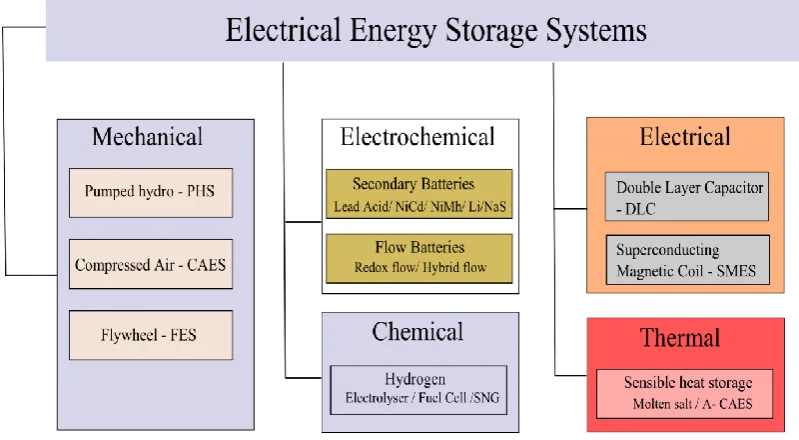
use and functions. Figure 2.1 shows a classification of electrical energy storage systems
according to energy form as mechanical, electrochemical, thermal, chemical and electrical
[11]. This shows the different ways in which electrical energy may be stored for use at a
different time or location, and the various devices used in storing energy.
ESS capacity is defined in terms of the maximum amount of power that can be drawn from
them or used to charge them, known as the rated power. The energy capacity is defined in
terms of the amount of current that can be drawn from them over the period of an hour in
Ampere-Hour unit (Ah) or the amount of power they can supply over the period of an hour in
29
Figure 2.1. Electrical Energy storage systems classification by energy type
2.2.1 Roles of Energy Storage Systems
The roles played by ESS are largely dependent on a number of factors including the duration
of use, frequency of use and the amount of energy they can store. The roles that are played by
ESS may vary from the viewpoint of electricity network operators, consumers and electricity
generators. Figure 2.2 shows how the frequency and duration of use impacts the different
roles.
Electricity Network Operator roles for energy storage are as follows [11]:
1. Time Shifting
When electricity is supplied to consumers there is usually a gap between the amount of energy
used during the periods of highest demand known as the peak periods, for example when
people get ready for work and use their boilers around the same time, and the periods of lower
demand known as off-peak periods, for example at night when users demand is low as most
consumers are asleep. The peak usually increases annually and as a result the installed
capacity of the distribution lines and other used to supply electricity to consumers must be
reinforced. ESS allows electricity distribution network operators to store energy during
off-peak periods and then use the energy during the off-peak periods to bridge the demand gap. This
shift in the time of use of energy that is stored is known as time shifting. Efficient time
shifting results in peak demand reduction and load-levelling, which is a “flattening” of
30 2. Power Quality
Electricity utilities including transmission and distribution network operators have a mandate
to maintain supply power voltage and frequency within a set tolerance. They maintain power
frequency within the tolerance by adjusting the output of generators or changing the settings
of equipment such as transformers, which control the ratio of voltages on the side of the
supplier and the consumer. ESS may be used to provide these functions by either charging or
discharging to increase the demand at the consumer side or reduce it from the viewpoint of the
supplier.
3. Network Congestion reduction to defer reinforcement
Congestion on an electricity network occurs when many consumers demand electric power at
the same time through the same equipment. If the electricity demand instantaneously exceeds
a certain amount failure may occur. ESS may be used to postpone the reinforcement of
network equipment to prevent failure. Utility companies may install ESS at appropriate
substations and along with time shifting strategies postpone reinforcement of the network.
4. Isolated grids
Some locations do not have direct access to supply lines from the wider electricity grid and
must therefore operate as islanded networks. ESS may be used to increase the penetration of
renewable energy in such networks, for example in [29] ESS is used to increase the use of
wind energy in the Shetlands, UK. ESS are also used to increase demand to match the supply
of diesel generators on such islanded grids to provide stable electricity supply.
5. Emergency power supply for protection and control equipment
The set of equipment that provides protection for other equipment in electricity networks need
a reliable power source. Batteries are used as an emergency power supply for the equipment in
31
Figure 2.2. Roles of energy storage systems according to frequency and duration of use
The ESS used by utilities are usually large scale and may take up a lot of space. In some cases
such as Pumped Hydro Storage (PHS) and Compressed Air Energy storage (CAES) the
geographical features of the installation location are used as an advantage. PHS may take
advantage of a mountainous terrain to pump water up to tanks on mountains during off-peak
periods and run it down through turbines along the slope of mountainside to generate
electricity during peak periods. Compressed air may be stored in caverns and used to run gas
turbines for electricity generation. In the case of large scale battery energy storage they are
usually installed in interconnected arrays with each unit being about the size of a shipping
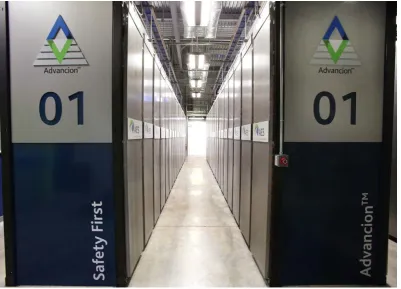
container. Figure 2.3 shows a section of a 10MW AES Advancion energy storage array in
Ireland consisting of 53,000 batteries arranged in 136 nodes. The Kilroot array balances
supply and demand and support the All Island transmission grid via System Operator Northern
Ireland (SONI). The Advancion array also enhances power supply, enables more efficient
dispatch of existing generation assets, and increase the ability to integrate renewable power
32
Figure 2.3. Grid-scale battery storage array in Kilroot, Ireland
ESS are also used by consumers for different functions including time shifting, energy
independence and backup power supply. Recently there has been an increase in the
penetration of ESS in consumers’ homes and business premises as a result of incentives such
as the Feed-in-Tariff [31] in the UK where small-scale renewable generation is subsidised, and
as a result encouraged the uptake of solar and wind generation in homes. The excess energy
generated by these renewable sources is either exported or stored. Manufacturers and suppliers
have also moved to provide small-scale energy storage to consumers, devices such as the
Moixa Maslow™ [32] shown in Figure 2.4 are about the size of a boiler unit and can provide
up to 10kWh of storage connected behind the electricity meter and usually also to a solar
energy installation. Cost saving is also achieved by consumers taking advantage of flexible
time-of-use tariffs where energy prices are lower during off-peak periods
The roles of energy storage systems for consumers are as follows [11]:
1. Time shifting and Cost-savings
Consumers may use energy storage to take advantage of time-of-use tariffs that price
electricity differently for peak and off-peak periods. Consumers may store energy when it is
less expensive during the off-peak periods and use it during the peak periods when it is more
33 2. Emergency power supply
ESS may be used to provide backup power supply for equipment such as fire sprinklers and
emergency lighting in the event of power failure. ESS are also useful in medical and
manufacturing industries for processes that require constant power supply. In regions with
weak power network infrastructure ESS may be used to provide electricity to appliances
during short-term outages.
3. Mobility and mobile appliances
ESS are used in electric vehicles (EV) as sole power sources or in hybrid configurations
alongside internal combustion engines. EV batteries are also expected to be used to supply
power to households or back to the electricity grid in concepts known as vehicle-to-home
(V2H) and vehicle-to-grid (V2G). The most common and widespread application of ESS is in
mobile devices such as mobile phones, laptop computers and tablet computers. ESS provide
power to these devices and enable consumers to use them for long periods without a wired
[image:35.595.269.388.382.559.2]connection to a power supply point.
Figure 2.4. A Maslow Smart Energy Storage household unit
2.2.2 Classification of Energy storage system technologies by functions
Based on the roles of energy storage described previously the main functions of ESS are:
i. Provision of uninterruptable power supply (UPS)
34 iii. Transmission and distribution grid support
iv. Load shifting
v. Bulk power management
The existing technologies for ESS are able to provide these functions differently depending on
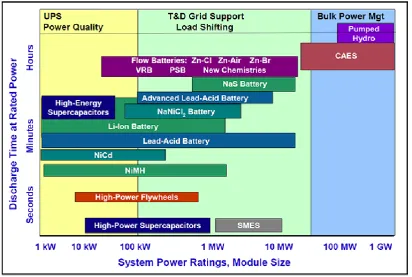
their rated power, energy content and the nominal discharge time. Figure 2.5 shows the
different existing technologies and the functions they are usually used for according to these
factors. Most ESS are modular with the exception of Compressed Air Energy Storage and
Pumped Hydro systems which are dependent on geographical factors, therefore a higher
capacity may be realized by combining several units. The main restrictions on capacity for
modular units will be economic i.e. cost per kW or cost per kWh [11].
Using discharge time to categorize the technologies, they may be classified into short
discharge time, medium discharge time and long discharge time.
1. Short discharge time – seconds to minutes, energy-to-power ratio less than 1
These include Double-layer capacitors (DLC), superconducting magnetic energy storage
(SMES), and flywheel energy storage (FES). These have a capacity of less than 1kWh for a
system with a power of 1kW.
2. Medium discharge time – minutes to hours , energy-to-power ratio of between 1
and 10
These include FES, electrochemical ESS i.e. batteries including Lead-acid (LA), Lithium Ion
(Li-ion) and Sodium Sulphur (NaS) batteries. Batteries have advantages in the kW – MW and
kWh – MWh range compared to other technologies including high energy density, fast
charging behaviour and long life. Their typical discharge times are up to several hours. A
system of rated power 1kW may have between 1kWh to 10kWh capacity.
3. Long discharge time – days to months, energy-to-power ratio of greater than 10
These include hydrogen (H2) and synthetic natural gas (SNG) systems.
It can be concluded that no single universal storage technology is superior to all other storage
systems, and their suitability depends on the purpose. The focus of this thesis is in Time
shifting applications at consumer level or distribution grid level, particularly in peak demand
reduction and in load-levelling. Therefore the technologies that will be suitable will be in the
35
current technologies that exist and are best suited for this purpose from Figure 2.5 are battery
[image:37.595.124.537.119.396.2]energy storage systems and high energy super capacitors.
Figure 2.5. Categories of Energy Storage System technologies according to discharge time and system ratings
2.3 Peak shaving and Load-levelling functions of ESS
As stated in the roles of ESS, time shifting is used by network operators and consumers to
manage network operation and to reduce the cost of energy bills using energy storage. Among
the time-shifting operations to resolving problems surrounding network congestion and firm
capacity limits are Peak shaving and load levelling. The benefits of peak shaving and load
levelling include improved system reliability – as the system will always operate within limits,
and also deferment of reinforcement when demand increases.
These related concepts are illustrated in Figure 2.6 – Figure 2.9 where the abscissa shows the
time periods and the ordinate shows the magnitude of electric power demand measured at a
load point. The effects of peak shaving and load levelling are shown as either reducing the
demand from the original peak demand point (peak shaving) or increasing the lowest demands
so they are closer to the peak demand and the margin is reduced (load-levelling) or performing
36
[image:38.595.198.461.74.195.2]Figure 2.6. Original Demand Profile with no peak shaving and load levelling has wide margin between peak and trough demands
Figure 2.7. Demand Profile after Peak shaving without load-levelling showing lower peak demand
[image:38.595.194.465.254.383.2] [image:38.595.195.465.425.565.2]