Copyright X 1993, AmericanSociety forMicrobiology
Sequences
Downstream of the RNA Initiation Site
Regulate
Human
T-Cell
Lymphotropic
Virus
Type
I
Basal
Gene Expression
FATAH KASHANCHI, JANETF.DUVALL, PAUL F. LINDHOLM, MICHAEL F. RADONOVICH,
ANDJOHN N. BRADY*
Laboratory ofMolecular Virology, National CancerInstitute, Bethesda, Maryland20892 Received 11September 1992/Accepted 22 January 1993
Sequenceswhich control basal human T-celllymphotropicvirustype I(HTLV-I) transcriptionprobablyplay
an important role in initiation and maintenance of virus replication. We have identified and analyzed a
45-nucleotide sequence(downstreamregulatoryelement1 [DRE 1]) attheboundaryof theR/U5 regionof the
long terminal repeat which is required for HTLV-I basal transcription. The basal promoter strength of constructs that contained deletions in theR/U5 regionof the HTLV-Ilongterminalrepeatwereanalyzed by
chloramphenicolacetyltransferaseassaysfollowing transfection ofJurkatT cells. Weconsistentlyobserveda
10-fold decreaseinbasal promoteractivitywhensequencesbetween +202 to +246weredeleted. Byreverse
transcriptase polymerase chain reaction RNA analysis, we confirmed that the drop in chloramphenicol
acetyltransferase activitywasparalleled byadecrease in the level ofsteady-stateRNA. DRE 1did notaffect the level of
Tax,
transactivation.Usingagelshiftassay,wehavepurifiedahighlyenriched fraction thatcouldspecifically bind DRE 1. This DNA affinity column fraction contained four detectable proteins on sodium dodecylsulfate(SDS)-polyacrylamidegel electrophoresis: p37, p50, p60,andplO0.Theaffinitycolumn fraction stimulated HTLV-I transcription approximately 12-fold in vitro. No effect was observed with the human immunodeficiency virusoradenovirus majorlate promoters. Followingrenaturation oftheproteinsisolated froman SDS-containing gel, p37,but not the otherprotein fractions,wasabletospecifically bindtoDRE1.
Replication of human T-cell lymphotropic virus type I (HTLV-I) is regulated at the transcriptional and posttran-scriptional levels byviralgene products, p40w
(Tax,)
and p27' (Rex1) (1, 11, 13, 15, 17, 42).The Tax1transactivator positively regulates expressionof viral mRNAs and several cellular growth regulatory genes and cytokines includingc-sis, c-fos, interleukin-2 (IL-2), IL-2Ra,
granulocyte-mac-rophagecolony-stimulating factor, vimentin, proenkephalin, and PTHrP (12, 21, 22, 28, 36, 40, 44, 46). The Rex1 gene
product regulates the expression and transport of singly-splicedandunsplicedviral mRNAs which encodethe struc-tural geneproducts Gag, Env, and Pol. Recently, twonew
viral mRNAs which code for two previously unidentified proteins,Tof andRof,have been identified(8). Thefunction oftheseproteins remainstobe established.
The 5'-U3 region of the HTLV long terminalrepeat(LTR) contains important elements needed for Tax1 transactiva-tion. The21-bprepeatelements(TRE-1)confer Tax1
respon-siveness andfunction in eitherorientation,andtwoor more
of these elements confer Tax1 responsiveness to
heterolo-gous promoters (5, 30, 35, 39). A second Tax1-responsive element(TRE-2)is located between thetwoproximal 21-bp repeats at-117to -163 and isabindingsite forSP1, TIF-1, Ets, and Myb (3, 4, 14, 26, 32). Sequences downstream of the RNAinitiation site, encompassingthe Rregion and the 5' portion of the U5 region, have also been shown to be important for HTLV-I gene expression. Nakamura et al. reported that a 136-bp fragment (+104 to +240) increased the level of HTLV-I gene expression (31). Consistent with
thisreport,Seikietal.reportedthatsequencesbetween +32
and +266 elevated mRNAsynthesis (38). The downstream
*Corresponding author.
elementwasorientationindependentbutwaseffectiveonly when itwaslocated betweenthetranscription initiationsite and thetranslation initiatorsite. The downstreamregulatory
sequence was not Tax1 responsive. A distinct regulatory element, describedbySeikietal. (38), whichmayfunction
as an RNAelement, is located between +266 and +347.
Downstreamregulatoryelementshavebeen showntoplay
an importantrole in thepositive andnegative regulationof several viral and cellulargenes(7, 9, 16, 20, 25, 27, 29, 34, 43, 45, 47). For example,inthe adenovirus (Ad)type5 ElA promotera10-fold reduction inthesteady-state RNA levelis
observed in response to a single-base deletion 399
nucle-otides downstream of thetranscription startsite(34). Inthe bovine leukemia virus promoter, deletion of a positive
control element ina250-bpsegmentdownstreamoftheRNA start site reduces gene expression by 87% (9). When this
250-bp position-dependent sequence was inserted
down-streamof thetranscriptionstartsiteofasimian virus40 early
promoter,chloramphenicol acetyltransferase (CAT)activity increased 60-fold. Incontrast totheupstreambovine leuke-miavirusenhancer,the250-bpdownstreamelement is active in both bovineleukemia virus-infected and uninfectedcells, suggestingarole for cellular factors(9).In thec-mycgene,a
downstream transcription modulator is required for tran-scription from the c-myc P2 promoter. The modulator is orientation dependent and promoter specific, increasing transcription from thec-myc P2promoter andsimian virus 40upstream early promoter (pSVE2) but notthe c-myc P1 promoterorthe simian virus 40downstream earlypromoter (pSVE1) (47).Inminute virus ofmice,adownstream365-bp
element (DPE) is essential for basal transcription from the P38promoter(20).
In thework described in thisreport,wehaveanalyzedthe effect of the RIU5 region and characterized 45 bp that is
2894
on November 9, 2019 by guest
http://jvi.asm.org/
needed for Tax1-independent basal transcription. Using a gel shift assay, we have purified a highly enriched protein fraction that could specifically bind DRE 1. This DNA affinity column fraction contained four proteins detectable onsodium dodecyl sulfate-polyacrylamide gel electrophore-sis (SDS-PAGE): p37, p5O, p60, and plOO. This protein fractionstimulatedHTLV-I transcription approximately 12-fold in vitro. One of these proteins, p37, was able to
specificallybindto DRE 1.
MATERIALSANDMETHODS
Plasmid constructs. Primers were synthesized with 5'
BglII-X7hoIand 3' BglIIsites. Afterpolymerase chain reac-tion (PCR) amplification, the DNAwascleaved withBglII, purifiedon a1.5%agarosegel, and electroeluted in 1x TAE buffer at 50 Vfor 2 to 3 h. After ethanol precipitation,the DNA was ligated into the unique BglII site (0/4380) in pCAT3M. Each construct contains a single XhoI site for analysis and cloning. The positivenumbers (dl+15, dl+42,
dl+70, dl+102, dl+157, dl+202, dl+220, dl+246, and
dl+262) indicate the length of DNA included in each con-struct downstream of the +1 start site.
Transfections and CAT assays. Jurkat T cells were har-vested at the mid- to late log phase, washed once in
phosphate-buffered saline (PBS) without
Mg2e
or Ca ,pelleted, and resuspended in RPMI 1640at aconcentration
of 107 cells per 250 ,u. Then 20 ,ug of each plasmid DNA construct and 250 pl of cells were mixed, transferred to electroporation vials, and electroporated at 250 V and a capacitance of 800,uF.Thetransfected cellswereincubated for 10 minonice, platedoutin 10-cmdishescontaining 10 ml of RPMI 1640plus 10% FCS,100 U ofpenicillinperml, 100
jig
of streptomycin per ml, and 2 mM L-glutamine, and incubated at 37°C. At 24 h later, cells were harvested,washed once in PBS (without
Ca2+
orMg2+),
and resus-pended in 150 pl of 0.25 M Tris (pH 7.8). After three freeze-thawcyclesandcentrifugationfor 5 minat4,000rpm(DuPont Sorvall RT6000 tabletop
centrifuge),
the 150pul
of supematantwastransferredto Eppendorftubes and heated for 5 minat65°C.The supernatantwascentrifuged
again
for 5minandtransferredto a newEppendorftube. CAT assays werethen performedwithapproximately 30 p,gofprotein.
Jurkat whole-cell and nuclear extracts. For whole-cell extract preparations, we used amodification of the proce-dure ofManleyetal. (24).Thefollowingstepswereused. (i)
Jurkat Tcellswereharvested at 1,000rpm
(DuPont
Sorvall RT6000 tabletop centrifuge) and 4°Cfor 10 min in culture media. (ii) After harvesting, the pellet was resuspended in 0.5 volume of coldPBS, mixedwell, counted, andpelleted as above. (iii) The cells were then washed twice in 0.1 volume of cold buffer A(10 mM N-2-hydroxyethylpipera-zine-N'-2-ethanesulfonic acid [HEPES; pH7.9]
at4°C, 1.5mM MgCl2, 10mM KCI,0.5 mM dithiothreitol
[DTT])
andpelleted as above. (iv) After
being centrifuged,
the washedcellpelletwas
resuspended
in20,ulof cold buffer C(20
mM HEPES [pH 7.9], 25% [vol/vol] glycerol, 0.42 MNaCl, 1.5mM
MgCl2,
0.2mM EDTA, 0.5 mMphenylmethylsulfonyl
fluoride, [added fresh, stock in
isopropanol],
0.5mM DTT[added fresh], 0.1% Nonidet P-40) per 107cells, incubated for 10 minonice,vortexed for 10 s, and
centrifuged
at10,000
rpm for 10 min in a microcentrifuge.
(v)
Thelysed
cellsupernatantwasretained,dilutedwith 80pl of cold modified bufferD (20 mMHEPES [pH7.9], 20% [vol/vol] glycerol,
0.05 M
KCl,
0.2 mMEDTA, 0.5mMphenylmethylsulfonyl
fluoride,0.5 mMDTT)per107cells, and storedat
-70°C
as100-pul aliquots.
Protein concentrations were determinedprior
tostorage.Nuclear extracts were prepared by following steps (i)
through (iii)
above. The washed cellpellets
were thenresuspended
in 20pul
of cold bufferA-0.1% Nonidet P-40 per107 cells,incubatedonice for 10min,mixed
briefly (10 s) by
vortexing,and
centrifuged
at10,000
rpmat4°C
for 10 minina
microcentrifuge.
The supernatantwascarefully
removedand
discarded,
and the nuclearpellet
wasresuspendedin 15,ulofcold buffer C without Nonidet P-40 per 10 cells. After a15-min incubation onice with intermittent
vortexing (5 s),
the mixturewas
centrifuged
in amicrocentrifuge
as above. Thenuclear supernatantwasretained,
diluted with 75pul
of coldmodifiedbuffer D per107cells,
and storedat-70°C
as100-pA
aliquots.
Protein concentrations were determinedprior
tostorage.Fractionation of nuclear extracts. Jurkat Tcells
(approxi-mately
3 x10¹⁰)
atthemid-tolatelog phase
ofgrowth
wereused as startup material for
purification
steps. We used modified buffer Dtoeitherequilibrate
columnsordialyze
theproteins
afterchromatography.
Band shiftanalysis
wasusedas the detection methodto monitor the
protein
ofinterestduring
purification
steps. Allchromatography
steps wereperformed
at4°C
with a flow rate ofapproximately
0.5ml/min.
Nuclear extracts wereprepared by
theprocedure
indicated in the
previous
section.Approximately
288 mg ofprotein
was recovered from the nuclear extract and wasloaded onto a
Sephadex
G-25 column(bed volume,
10ml,
medium;
Pharmacia),
and a total of 89 mg was recoveredfrom the
flowthrough. Next,
the recovered extract wasloaded onto a
Sephacryl
S-200sizing
column(bed
volume,
40
ml, high
resolution,
Pharmacia).
Werecovered atotalof35 mg, whichwasloadedonto afast
protein
liquid
chroma-tography
(FPLC)
Mono-Sion-exchange
column(bed
vol-ume, 10
ml;
Pharmacia),
and theflowthrough
whichcon-tained the
activity
(15
mgtotal)
was loadedonto anFPLC-DNA
affinity
column(18).
The DNAaffinity
column wasprepared by
using
CNBr-activatedSepharose
CL-2B(2
ml ofresin)
attached to 200pug
ofgel-purified
double-strandedoligonucleotide (DNA
sequence of +188 to +262 of the HTLV-IR/U5
region).
A40-ml lineargradient
ofKCl(0.05
to 1
M)
in buffer D was used to elute 1-ml fractions. The fractionswerethenconcentratedtoapproximately
0.1ml in amicroconcentrator(Centricon 10;
Amicon)
anddesaltedona
Sephadex
G-25spin
column(Pharmacia). Highly
enrichedfractionswere
assayed
for band shiftactivity,
andfractions 13 to 18(elution
atapproximately
0.2 to0.25 MKCl)
weredialyzed against
buffer D and used for in vitrotranscription
analysis (2).
Atotal of 19pug
ofprotein
wasrecovered fromDNA
affinity
columnpooled
fractions 13to 18.Gel retardation
analysis.
Theoligonucleotide probe
waslabeled with
[.y-32P]ATP
by
using
T4 kinase enzyme. A12.5-ng
portion
of the labeledoligonucleotide
wasincubatedwith 7.5 ,ug ofJurkat whole-cellextractand 3 ,ug of double-stranded
poly(dI-dC)-poly(dI-dC)
ingel
shiftbinding
buffer(10
mM Tris[pH
7.5],
40 mMNaCl,
1 mMDTT,
1 mMEDTA)
for 20 min at24°C.
Forcompetition
studies,
300or600 ng ofunlabeled
oligonucleotide
was added to the incu-bation mixture. Afterincubation,
DNA-protein
complexes
were
analyzed
on a 4% nativeacrylamide gel
with 0.25xTBE asthe
running
buffer.Protein renaturation. Pooled fractions 13 to 18 from the
DNA
affinity
chromatography
column wereseparated by
preparative
SDS-PAGE(10%
polyacrylamide
separating
gel),
and theproteins
werevisualizedby
using
0.3 MCuCl2
(26).
Proteins of various molecularweights
were excisedon November 9, 2019 by guest
http://jvi.asm.org/
from the gel and destained with three 10-min changes of a buffer containing 0.25 M Tris hydrochloride (pH 9) and 0.25 MEDTA.Proteins were passively eluted from the gel slices in 2 ml of buffer containing 50 mM HEPES (pH 7.9), 0.1 mM EDTA, 0.1% SDS, 5 mM DTT, and 150 mM NaCl by incubation overnight at room temperature with gentle rota-tion. The eluate was precipitated with 4 volumes of acetone
(-20°C)andcentrifuged for 30 min at 10,000 rpm in an HB-4 rotor.Thepelleted precipitate was washed with80% acetone (-20°C) and centrifuged again to collect the precipitate. The pellet was resuspended in 200 ,ul of X50 buffer (20 mM HEPES [pH7.9], 20% glycerol, 50 mM KCl, 1 mM EDTA, 1 mM DTT, 0.5 mMphenylmethylsulfonylfluoride) contain-ing 6 Mguanidine hydrochloride. The samples were dialyzed overa48-h period at 4°C against a 2,000-fold excess of X50 buffer. Renatured proteins were stored at -70°C for subse-quentanalyses.
Reverse transcription and PCR
analysis.
Total-cell RNA washarvested bylysis with 4 M guanidinium isothiocyanate, and the lysate was centrifuged for 18 h at 36,000 rpm in a Beckman SW55Ti rotor at 18°C. The RNA was harvested, ethanol precipitated, and quantitated by measurement of A260.Aliquots of cellular RNA were then reverse transcribed with 3' antisense primers specific for either the HTLV-I CAT or cellular actin gene. For HTLV-I RNA analysis, a15-nucleotide primer, 5'-CTGGATATTACGGCC-3', lo-cated immediately adjacent to thePvuII site in the CAT gene was utilized. The reverse transcription reaction was per-formedwith 400 mM deoxynucleotides and 400 U of mouse mammarytumor virusreversetranscriptase (RT) for 1 hr at 37°C aspreviously described (44). The reverse-transcribed products were then subjected to PCR in the presence of 1 pmol of 5' sense and 3' antisense primers, 200 mM deoxy-nucleoside triphosphates, and 2.5 U of Taq polymerase in a buffercontaining 50 mM KCI and 1.5 mM MgCl2. Samples were subjected to 40 cycles of amplification consisting of
denaturationfor 1 min at 94°C, primer annealing for 1 min at 53°C, and polymerization for 2 min at 72°C. Two sets of
primers were used in the same test tube for each PCR
amplification.One setof primersamplified HTLV-I-specific mRNA, and the other set amplified actin-specific mRNA. First-strand cDNA synthesis was performed with 5'-CTG GATATTACGGCC-3' primer at thePvuII site of the CAT gene,and PCRamplificationwasperformed with + 1 to + 15 of HTLV-I sequence5'-GGCTCGCATCTCTCC-3'. The use ofasingle set of primers to amplify all HTLV-I RT samples eliminates the hybridization variability and efficiency of multiple primers. An actin-specific sequence served as an internal test control and was defined by 5'-TTCTACAAT
GAGCTGCGTGT-3' and 5'-GCCAGACAGCACTGTGT TGG-3' sense and antisense primers, respectively. The
amplified 636-bp actin signal was detected by an internal 40-base probe, 5'-ACTACCTCATGAAGATCCTCACCGA
GCGCGGCTACAGCTT-3'. Aliquots (50
[lI)
of the PCR products were loaded onto 1.2% agarose gels andelectro-phoresed. The gels were then soaked in 1 M NaOH-1.5 M NaCl for 15 min and neutralized for 30 min prior to Southern blotting. The gels were blotted onto nitrocellulose overnight, dried, baked, prehybridized, and probed with either CAT or actin probes (approximately 300 ng of
32P-end-labeled
probes).
ForRNA5'-end analysis, primer extension reactions were
performed with a
[.y-32P]ATP-end-labeled
antisense primer(approximately2 x
106
cpm),5'-TGTAACGGCGCAGAAC-3', positioned 263 bases downstream of the RNA initiation site. Then 5 p,g of RNA, isolated from transfected or
untransfected Jurkat T cells, was added to each reaction. The conditions for the reverse transcription reaction are described above. Products were phenol-chloroform ex-tracted and analyzed on a denaturing acylamide-urea gel next to a sequence reaction from either M13mpl8 or the HTLV-I CAT plasmid.
Invitro transcription: unfractionated extracts. The in vitro transcription buffer contained 10 mM HEPES (pH 7.9), 50 mM KCl, 0.5 mM EDTA, 1.5 mM DTT, 6.25 mM MgCl2, and 8.5% glycerol. The DNA template pU3R-CAT was linearized with HindlIl and added to a concentration of 13.2 ,ug/ml (200 ng per reaction). pAdML was linearized with BamHI and added at a concentration of 13.2 ,ug/ml (200 ng per reaction). HeLa whole-cell extracts, prepared as de-scribedpreviously (24), were added to a final concentration of 2.4 mg/ml (40 ,ug per reaction). Oligonucleotide affinity fraction 16 was titrated over aconcentration range of 160 to 1,120 ng per reaction. Nucleoside triphosphates in water were added to a final concentration of 500 ,uM unless otherwise stated. Transcription reactions were terminated by theaddition of 20 mMTris-HCl (pH 7.8), 150 mM NaCl, and 0.2% SDS. The quenched reactions were extracted with phenol-chloroform, chloroform and precipitated with 2.5 volumes of ethanol and 0.1 volume of 3.0 M sodium acetate. Following centrifugation, RNA pellets were resuspended in 12 ,ul of formamide denaturation mix containing xylene cyanol andbromophenol blue, heated at90°C for 3 min, and electrophoresed at 400 Vin a 4%polyacrylamide gel (acry-lamide/bisacrylamide ratio, 19:1) containing 7 M urea (pre-run at 200 V for 30min) and 1 x TBE. Gels were exposed to KodakX-Omat XR-5 film at -70°C withintensifying screens for autoradiography.
RESULTS
RIU5region of HTLV-I isimportant for basal transcription. We have constructed a series of 3' deletion mutants and inserted them upstream of the CAT gene in pCAT3M. This was done by using an identical 5' primer and different 3' primers to amplify the fragment of interest by PCR (see Materials and Methods). The resulting nine constructs con-tained intact U3sequences and a varying number of bases at the R and U5 regions of the HTLV-I LTR (Fig. 1A). After the fragments were subcloned into the CAT vector, the plasmids were electroporated into Jurkat T cells at the mid-to late log phase ofgrowth and CAT assays wereperformed with equalamounts of protein lysates (30 ,ug) (Fig. 1B).The wild-type construct (-450 to +262) is functional in Jurkat T cells and can be transactivated by HTLV-I Tax1 (Fig. 1B, lanes 1 and 2). Incontrast, constructs that include sequences from -450 to +202 have very little basal activity (lanes 3 to 8). The basal transcription was increased 10- to 20-fold when downstream sequences +203 to +262 were present in the HTLV-Ipromoter (lanes 9 to 11). The R/U5 region regula-tory element, required for basal transcription, was named downstreamregulatory element 1 (DRE 1). This basal tran-scription was independent ofTax1 transactivation (data not shown).
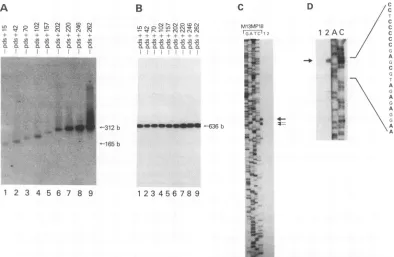
We next analyzed mRNA expression in cells transfected with the 3' deletion constructs. RNA was isolated and subjected to RT and PCR amplification. Two sets of primers were used in each reaction, one set to amplify
HTLV-I-specific sequences and the second to amplify actin-HTLV-I-specific mRNA as an internal control. It is important to note that a single set of PCRprimers was used to amplify all HTLV-I RTsamples to avoid quantitative hybridization variability in
on November 9, 2019 by guest
http://jvi.asm.org/
A
XVC
400 300
P:pU3Rl
Ir'.[11l3 TATA
II -T
200 '00 0 1o0
L3 R
'-C c
20 U 5
pas 1
i ppds 42
pds-70 pds 02
pds 57S
pOs 202
i pdsp 220
--2
pos-246
1- pcis-2621
B -Tax,
Cl
22i
-Tax
LO N
+
a2
N
21 r2
C) Q LO
N co N
224 N
En n r
*---00000
1 2 3 4 5 6 7 8 9 10 I1 12
ion 988 262 3.7 6.1 45 4.0 23 2.0 20.4 367 3B8 : FIG. 1. Downstreamdeletionmutantsof the HTLV-Ipromoter.
(A) 3' deletion constructs of the HTLV-I promoter were madeby PCRamplification. Subsequently, the DNA fragmentswere cloned
into pCAT3M. All constructs contained intact U3 sequences and
various sequences of the Ror R/U5 region. (B) CAT assaysof 3' HTLV-I deletion mutants in Jurkat T cells. Lane 1 represents a
positive control with the intact HTLV-I promoter cotransfected with
Tax,
expressionvector. All other transfectionswere done inthe absence of
Tax,.
CAT assays wereperformed as described inMaterials andMethods.
the PCR. The PCRs were divided in half, run on agarose
gels, Southern blotted, and hybridized with either CAT or
actin probes. Consistent with the results of the CAT assay,
RNAexpression levels of plasmids pds+220 (Fig. 2A, lane 7), pds+246 (lane 8), and pds+262 (lane 9) were increased
compared with those ofdeletion mutants pds+157 (lane 5) and pds+202(lane6).Asacontrol, the levels ofactinmRNA
in these RT-PCRs was measured, and similar amounts of actin-amplified mRNAwere observed (Fig. 2B).
For RNA5'-end analysis,primerextensionreactionswere
performed with a
[y-32P]ATP-end-labeled
antisense primer(approximately2x 106cpm), 5'-TGTAACGGCGCAGAAC-3', which includes HTLV-I sequences +248 to +263
down-stream of the RNA initiation site. Then 5
,ug
of RNA, isolated from transfected or control untransfected Jurkat Tcells, was added to each primer extension reaction. In a
parallel reaction, DNA dideoxy sequence reactions were
performed on a single-stranded
M13mpl8
DNA or adena-tured double-stranded HTLV-I DNA template. In the
HTLV-I
DNA dideoxy sequence reaction, the same +248 to+263 oligonucleotide used for primer extension ofRNA was used. Electrophoretic analysis of the primer extension prod-ucts resulted in the appearance of one major DNA band(Fig. 2C, lane 1, and D, lane
2).
Analysis of the primerextensionproducts demonstrated that the major product was 263bases in length and corresponded to the authentic RNA initiation
site previously identified for HTLV-I (Fig. 2C and D). The minor primer extension products of 255 and 258 bases, as
well
shorter products, were not reproduciblydetected in the primer extension analysis and most probably. reflect incom-plete extension products. No primer extensionproduct was detected following incubation with the RNA from control Jurkat cells (Fig. 2C, lane 2; and D, lane 1), demonstratingthe specificity of the primer for HTLV-I RNA.
Jurkat nuclear extracts contain a protein(s) which
specifi-cally
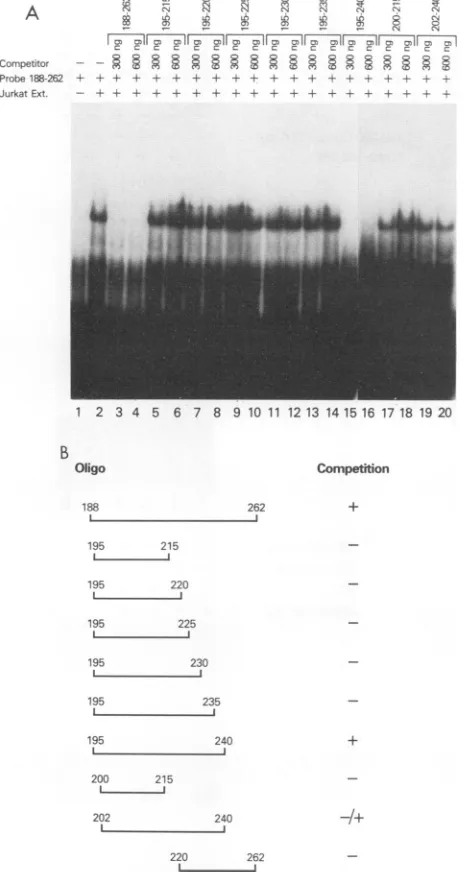
interacts with DRE 1. In light of the requirement for downstream sequences for HTLV-I basal transcription, we were interested in identifying a transcriptional regulatoryprotein(s) which interacted specifically with this control region. An oligonucleotide was synthesized by using HTLV-I sequences +188 to +262 to analyze the DRE 1-binding protein(s) via a band shift assay. Using Jurkat nuclear extract, we demonstrated protein binding to oligo-nucleotide +188 to +262 (Fig. 3A, lane 2). The specificityof this gel shift complex was demonstrated by competition
analysis. Binding was inhibited by the addition of a 30- to 60-fold excess of cold specific competitor(lanes 3 and4). To determine the nucleotide specificity of binding, a series of oligonucleotides containing various sequences between +188 and +262 were synthesized and assayed for specific competition (lanes 5 to 20). Interestingly, ofall the oligonu-cleotide competitors used, only the sequences from + 195to +240 were able to specifically compete (lanes 15 and 16).
Oligonucleotide +202 to +240 wouldcompete only athigher
concentrations (data not shown), which indicates that se-quences from + 195 to +202 were needed for efficient bind-ing. A summary of the gel shift competition results is presented in Fig. 3B.
Purification and characterization of a protein(s) that inter-acts with DRE 1. To purify the sequence-specific DNA-binding protein(s) that interacted withDRE 1, we subjected Jurkat nuclear extracts to successive rounds of column chromatography on Sephadex G-25, Sephacryl S-200, FPLC Mono-S, and FPLC DNA affinity columns. After each round, the fractions were analyzed by band shift assay. Specific binding was observed with columnfractions eluting
at approximately 0.2 to 0.25 M
KCI
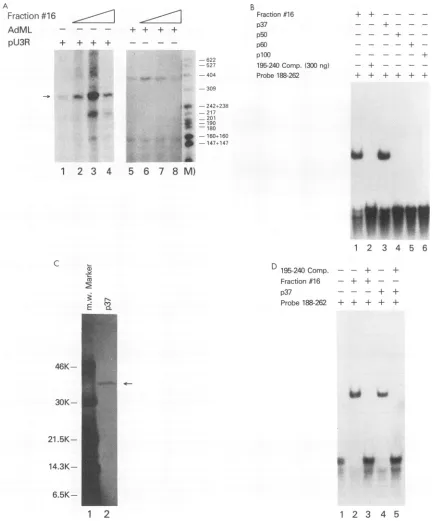
from the DNA affinitycolumn. Using the 0.23 M KCl fraction from the DNA affinity column, fraction 16, weperformed in vitro
transcrip-tion assays to check for functranscrip-tional activity. The results of these experiments demonstrate thatfraction 16 could
specif-ically transactivate the HTLV-I LTR (Fig.4A, lanes 1to
4).
The concentration of the template DNA, pU3R-CAT, was kept low (200 ng) so that very littletranscriptionwas seenin the absence of any transactivator. The transactivation was concentration dependent. When160 ng ofprotein was added to the in vitro transcription assay,no increasein the level of HTLV-I transcription was observed (lanes 1 and 2). As the concentration of fraction 16 was increased to 480 ng, a significant increase in HTLV-I transcription was observed (lane 3). When the amount of fraction 16 was further increased, 1,120 ng per reaction, no increase in HTLV-I transcription was observed (lane 4). The specificity of frac-tion 16 was assayed by using the adenovirus major late (AdML) promoter in parallel reactions. No increase in basal
-F1
on November 9, 2019 by guest
http://jvi.asm.org/
[image:4.612.64.297.78.417.2]A
B
N 1- N 0 CD N It r, cs - CN C14
+ + - + + + -t + +
cn on ua vt )(A V) uw u)
V0 - V0 -0 'a -c -0 -0
a a a a a a a a a
Csr-CN o) CO C
LO C1 o)oL )NrO S o
+ + +-t + +-t-+
4-a 4-a 4-a 4-aaa a a a
-636b
-312 b
-165 b
1 2 3 4 5 6 7 8 9 123456789
C
M13MP18
T-C 2
GATC92
I
t
AWW
k
_
-I.
4;;
D
1 2AC
.!:'U
o.;
4-c /c /I c / c / c
/ c
/ c
/ G
A G
C
G
T
A G
A
G
A
G
G
[image:5.612.112.506.76.333.2]A A
FIG. 2. RT-PCRanalysisof RNAfollowingtransfection of JurkatT cellswith HTLV-I deletionmutants.(A)TheHTLV-Ideletionmutant
plasmidswereelectroporated,andRNA washarvested24 h later. RT-PCRamplification ofthe RNA wasperformedasdescribedinMaterials and Methods.The PCRproductswere run on aagarosegel and Southern blottedwithCAT-specific probe. (B) Control RT-PCR analysis of actinmRNA.(CandD) Primer extension analysisoftheHTLV-I RNAinitiation site.RNA fromtransfectedand control cellswasincubated with anHTLV-I-specific[y-32P]ATP-end-labeled antisenseprimer (-2 x 10⁶cpm), 5'-TGTAACGGCGCAGAAC-3', positioned 263 bases downstream ofthe RNAinitiation site.Then5 pg of RNA, isolated from transfected oruntransfected Jurkat Tcells,wasaddedtoeach reaction. Theconditions for thereverse transcription reaction aredescribed in Materialsand methods. Productswerephenol-chloroform extracted andanalyzed on adenaturingsequencegelnext to a sequencereaction from either theM13mp18(C)ortheHTLV-ICAT(D) plasmid.Boldface lettersdenote nucleotidesofHTLV-IDNAthatarepresentin A and C sequenceladders.
activity wasobserved when the DNAaffinity column frac-tionwasaddedtoinvitrotranscriptionreactionscontaining
the AdML promoter (lanes5 to8).
Fraction 16wasmade up of fourdetectable bandsby silver stain. These four proteins,
p37,
p50,p60,
and plO0, were excised from the gel, renaturedand analyzedby band shift assay.Of these fourproteins, only purified p37(Fig. 4C)was abletobind theprobe(+188to+262) (Fig.4B, lanes 3to6).Thebindingspecificityof p37wasanalyzed by using the set ofoligonucleotides depicted in Fig. 3Bascompetitors. The p37 band shift could specifically be competed out by the +195 to +240oligonucleotide(Fig. 4D, lanes 4 and 5; data notshown). Itwasfound that p37 and fraction 16 both have thesamespecificityin band shift assay.
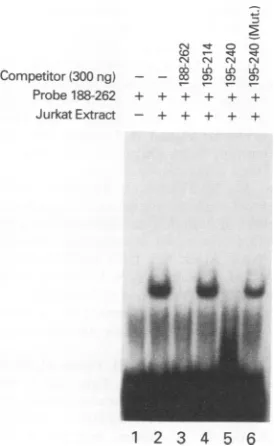
Finally, we analyzed the effect of protein binding to oligonucleotides containing point mutations (Fig. 5). The selection of this site for point mutagenesis is discussed below. An oligonucleotide was synthesized from +195 to +240, containing five base point mutations at the following positions: +204 (C to A), +205 (T to G), +210 (C to A), +213
(C to A), and +216 (G to A). Band shift analysis was performed to determine whether this oligonucleotide could compete for p37 binding (Fig. 5). The wild-type +195 to +240oligonucleotidecompeted forbinding (lane 5), but the five-base point mutant was unable to effectively compete
(lane 6). Taken together, these results suggest that p37
specifically binds to DRE 1 and may in fact allow higher basaltranscription from the HTLV-Ipromoter.
DISCUSSION
Several reports have indicated that therearetwo
indepen-dent types of transcription control elements in the LTR responsible for maximum geneexpression.Elements of one type,characterizedbyregulatorysequencessuchasTRE-1 or TRE-2, are located upstream fromthe core promoterin the U3 region and are responsible for transactivation by Tax1. Another type of element is present inafragment of 300
bp derived from the R and 5' half of the U5 region. The function of this second element doesnot require Tax1. In
addition, no extensive homology was found in sequences between the R/U5 fragment and the U3 fragment of the HTLV-I LTR.Thesestructuraland functionalproperties of
thesecond domain suggest that it isaunique control element for gene expression distinct from the Tax1 responsive ele-ment (31, 33). The R regions in the LTRs of HTLV-I and BLVare considerably longer (228 bp) than those of other retroviruses (13to 100bp).These longerRregions maybe duetotheacquisition of sequencestoenhance gene expres-sion.
Inthis study, the effect of sequencesat the 3' end ofthe
regionthat arerequired for basal transcriptional activity has beenanalyzed. The sequence that allows maximal detection of the reporter CAT enzyme is from +202to +246. DRE1is functional in several different cell types, includingJurkat T cells and HeLa cells. Therefore, the factor(s) that binds to this sequence and regulates basal transcription ofHTLV-I
on November 9, 2019 by guest
http://jvi.asm.org/
n !.i .C, 4
N cl, N
1;1 .5 cl,
12 .2 1-1 .2.
-7=. 71
= E = = Z: := Z:
§ R § A .14 R R (16 41 z
--r - -r - --t- - -j- - - -
-A
Competitor -
-Probe 188-262 - t
JurkatExt. - t
1 2 3 4 5 6 7 8 9 10 11 1213 1415 16 17 18 19 20
B
Oligo Competition
188 262
195 215
195 220 195 225
L ..
195 230 195 235 195 240
200 215 202 240
+
-1l+
220 262
-FIG. 3. Band shift analysis of the protein(s) that binds to the
HTLV-IR/U5 DRE 1.(A)Anoligonucleotide containingsequences from +188 to +262 relative to the HTLV-I RNAtranscriptionsite
was used as aprobe. Thespecificity of thegel shift complexwas
checkedby competitionwitheither thesamecoldcompetitor (lanes 3 and4)orother sequences between +188 and +262(lanes5to20). (B) Summaryofthe band shiftassayspresentedinpanelA.
may be constitutively expressed in most cell types. A specific and stable band shift complex was detected with
sequencesfrom +195 to +240. Incontrast, sequencesfrom +195to +235 and +202to +240 either failedtocompeteor
competed poorly. The results suggest that sequences +195 to +202 and +235 to +240areimportantfor thespecificand stable interaction of cellular proteinswith DRE 1. In addi-tion, specific point mutations at bases +204, +205, +210, +213, and +216 inhibited protein binding. Thus, the inter-action ofp37, and possibly other cellularproteins such as
pSO, p60,
andplOO,
with this regulatory sequence may becomplex and require extensive regions of the 45-nucleotide regulatory element.
When the DRE 1 DNA-binding factor was purified from Jurkat Tcells, we found that a protein of approximately 37 kDa was sufficient to give the proper band shift, which could be specifically competed out by cold competitor (+195 to
+240). This protein was excised out of a denaturing poly-acrylamide gel, renatured, and used for band shift analysis. Itis important to note that although gel-purified p37 could specifically bind DNA, the protein did not increase HTLV-I basaltranscriptionin vitro. We detected increased HTLV-I transcription only from the DNA affinity column fraction 16, whichcontainedfour partially purified proteins. The inabil-ity of p37 to increase transcription could be due to several factors, including improper folding during renaturation to a
protein conformation that is not transcriptionally active. In
addition,it ispossible that p37 is the DNA-binding subunit of a multisubunittranscription complex and requires proteins suchasp50,
p60,
orplOOtoestablish a competent transcrip-tionalcomplex.Our presentanalysis demonstrates that the DNA sequence element DRE 1, which was defined through functional in vivotranscription experiments, coincides with a binding site foracellular transcription factor. Furthermore, addition of the DRE 1DNA-bindingfractionto aninvitrotranscription assayresults in thespecific stimulation of HTLV-I transcrip-tion. We cannot, however, ruleout the possibility that the
regulatory sequencedoes not contain anoverlapping RNA
regulatoryelement. Precedents from HIV argue for caution, since several published reports on the HIVTAR element
originallyassumed the presenceofaDNAelement. Exper-imental procedures to unambiguouslydelineate RNA
regu-latorysequences arecurrently inprogress.
The HTLV-I LTR sequence +195 to +240 was scanned
against the GenBank data base for homology to other
transcriptional regulatoryelements. The strongest sequence
homologywas a15-base match(100%)from +202to+217of the HTLV-I Rregiontothebindingsite for human
transcrip-tion factor TFIIIA in the 5S rRNA gene H4 (5'-CAAGC AGGGTCAGGC-3').Itisinterestingthat human TFIIIA has a molecular mass of approximately35 kDa and binds to a
51-bp
region (+45 to +96) inthe transcriptionallyactive5Sgene(10, 19, 37).TFIIIAhasanumberof nucleotidecontact sites inthe 51-bp regionof the5S gene. Interestingly, base substitutionmutation ofthesecontactnucleotides in DRE 1 leadsto aloss ofp37protein binding.Twoindependentlines ofinvestigation, however,suggestthatp37isnotthe classic
TFIIIA. In vitro gel shift analysis showed that purified XenopusTFIIIA failedtobindtothe DRE 1oligonucleotide. Although humanTFIIIAwould be a moresuitable control for these binding studies, cloned human TFIIIA is not available. Inaddition, when antiserum toXenopus TFIIIA wasused, noreactivityof thepurifiedp37wasdetected ina Westernimmunoblotanalysis. The fact thatnotall antibod-ies to Xenopus TFIIIA cross-react with human TFIIIA, however, complicatestheinterpretation ofthe latter exper-iment. Itispossible that theDRE1-specific factor isoneof severalproteinswithinaTFIIIA-likefamily, regulatingbasal promoter activityof the HTLV-I promoter. It is also
possi-ble that other transcription factors are required for the functional interaction of TFIIIA with the HTLV-I LTR.
Previously, it has been demonstrated that polymerase II transcription factors, such as TFIID and
octamer-binding
factor,function inapolymeraseIII
transcription
unit(6,
23, 41). Itisinterestingtospeculate thattheopposite
mayalso be true,i.e.,thatclassicpolymeraseIIItranscription
factorsn
I
c
88 .rl
- .El
Fu-- 7--1 F7-Iz Z. E
4- + + -1- + +
0
F.
LI) In =7F-=.-z
§ 9
4-- + -I
on November 9, 2019 by guest
http://jvi.asm.org/
[image:6.612.65.297.80.516.2]#16
.t
.1
+--3 VW+ +
-~~~~ 4m~~~~~4r~.
B
622
-527
-404
-309
Fraction #16 p37
p50 p60
p100
195-240Comp. (300ng) Probe 188-262
+ +
_-_-0~~~~~~~
)~~~~~..
242+238 217
201
-190
-180 160+160 147+147
.-__d
ivL
1 2 3 4 5 6
C (0)
D 195-240Comp.
Fraction#16 p37
Probe 188-262
-- +
+ +
46K
30K
21.5K-
14.3K-
6.5K-1 2 1 2 3 4 5
FIG. 4. Analysis ofDNAaffinityfraction 16. (A) Invitrotranscription analysiswithfraction 16 and eitherpU3R(HTLV-I) orAdML
promoters. Transcriptionreactionsweresetup as described in Materials and Methods. Increasingamounts of theoligonucleotide affinity chromatographyfraction(160ng,lanes 2 and5;480ng,lanes 3 and6; 1,120ng,lanes4and8)wereadded totranscriptionreactions.Following
a60-min incubationat30°C,the[32P]UTP-labeledRNAtranscriptswerepurifiedandanalyzedonadenaturing4%acrylamide-urea gel.The
HTLV-I-andAdML-specific transcriptswere285 and 375bases, respectively (arrows). (B)Band shiftanalysisofp37, pS0, p60,andplO0 isolated from anSDS-polyacrylamide gel. Fraction 16 from the oligonucleotide affinitycolumnwas denatured andelectrophoresed on an
SDS-gel.Subsequently,aportionof thegelwasstained; regionsof thegel containingp37,p50,p60,andplO0 wereexcised;andproteinswere
elutedand renaturedasdescribed in Materials and Methods. Analiquotof eachprotein samplewasthen incubatedwith the +188 to +262 oligonucleotide probe, andtheband shiftcomplexeswereanalyzed byelectrophoresisinaneutralgel.Lane1,whichserves asthepositive control,wasincubatedwith fraction 16. (C)Thepurityofp37wasanalyzed bySDS-PAGE.m.w.,molecularmass. (D) Specificityofp37 binding tothe DRE1 regulatory sequence. Band shift competition assays wereperformed todetermine the specificityofthe interaction
betweenp37andDRE 1.The DRE 1 probewasincubatedaloneorin thepresenceofa25-foldexcessof coldoligonucleotide competitor.
A
Fractior
AdML pU3R
A-A
ow "O
10
on November 9, 2019 by guest
http://jvi.asm.org/
[image:7.612.94.529.82.603.2]Competitor ng)
eN < 0 0 N (N eN N
OX L6 Lin Lf
x m m a)
+ + ++
1 2 3 4 5 6
FIG. 5. Mutational analysis of DRE 1. The wild-type probe (+188 to+262)wasincubated alone(lane 2)orwitha25-foldexcess
(300 ng)ofacompetitor oligonucleotide containingsequencesfrom
+188 to +262(lane 3),+195 to +214(lane 4),or+195to+240(lane 5) orthe +195 to +240five-base mutantcontainingbase
substitu-tionsat +204(CtoA),+205(TtoG),+210(CtoA),+213(CtoA),
and +216(GtoA) (lane 6).
may be functionally activein apolymerase II transcription unit. This possibility awaits further careful analysis and
attention by directly testinghuman TFIIIAprotein and its possibleinteraction with thepolymerase IIHTLV-IDRE 1 sequence.
ACKNOWLEDGMENTS
We thankthe members of theLaboratoryof MolecularVirology
forhelpfuland constructive discussions and AlanWolffefor gener-ously providing purified XenopusTFIIIA.
ADDENDUM INPROOF
We have obtained apartialcDNAdone foraproteinthat
binds to DRE 1. The clone was obtained from a Jurkat
cDNAlibrary by using32P-labeled +195to+240
oligonucle-otide. This clone has been sequenced and resembles an
inverted CCAAT box binding protein. We are currently pursuing afunctionalassaythatwouldexplore the possibil-ityof this factor's involvement in HTLV-I basal
transcrip-tion.
REFERENCES
1. Ahmed,Y.F.,G.M.Gilmartin,S. M.Hanly,J.R.Nevins,and W. C.Greene. 1991. The HTLV-I Rexresponseelement medi-atesanovel form of mRNApolyadenylation.Cell64:727-737. 2. Bohan, C. A., F. Kashanchi, B. Ensoli, L. Buonaguro, K.
Boris-Lawrie,andJ.N.Brady. 1992.Analysisof Tat transacti-vation ofhumanimmunodeficiencyvirustranscriptioninvitro. GeneExpression2:391-408.
3. Bosselut, R.,J. F. Duvall, A. Gegonne, M. Bailly, A. Hemar,
J.N.Brady,andJ.Ghysdael. 1990.Theproductof the c-ets-1 protooncogene and the related Ets2 protein act as
transcrip-tional activators of the long terminal repeat of human T-cell leukemiavirus,HTLV-I. EMBO J. 9:3137-3144.
4. Bosselut, R.,F.Lim, P.-C. Romond, J. Frampton, J. N.Brady, andJ.Ghysdael. 1992. Myb proteinbinds to multiple sites inthe human T-celllymphotropicvirustype1long terminal repeatand transactivates LTR-mediated expression. Virology 186:764-769.
5. Brady, J.,K.-T. Jeang, J. Duvall, and G. Khoury. 1987. Identi-fication of p4Ox-responsive regulatory sequences within the human T-cell leukemia virus type I long terminal repeat. J. Virol. 61:2175-2181.
6. Carbon,P., S. Murgo, J.-P. Ebel, A. Krol, G. Tebb, andI. W. Mattaj. 1987. A common octamer motif binding protein is involvedinthetranscription ofU6 snRNA by RNA polymerase II and U2snRNAbyRNApolymeraseII.Cell51:71-79. 7. Charnay, P., R. Treisman,P. Mellon, M.Chao,R.Axel, and T.
Maniatis. 1984. Differences in human a- and 3-globin gene expression in mouse erythroleukemia cells: the role of intra-genicsequences.Cell38:251-263.
8. Ciminale, V., G.N.Paviakis,D. Derse, C. P. Cunningham, and B. K. Felber. 1992. Complex splicing in the human T-cell leukemiavirus (HTLV) familyofretroviruses: novel mRNAs andproteins produced by HTLVtypeI. J.Virol.66:1737-1745. 9. Derse, D., andJ.W.Casey. 1986.Twoelements in the bovine leukemia virus longterminal repeat thatregulate gene expres-sion.Science 231:1437-1440.
10. Emerson, B. M., and R. G. Roeder. 1984. DNA sequences and transcription factor interactionsof active and inactive formsof mammalian5 S RNA genes. J.Biol. Chem. 259:7926-7935. 11. Felber,B.K.,H.Paskalis,D.Kleinman-Ewing,F.Wong-Staal,
and G. N. Pavlakis. 1985. The pX protein of HTLV-1 is a transcriptional activator of its long terminal repeat. Science 229:675-679.
12. Fujii, M., P. Sassone-Corsi, and I. M. Verma. 1988. c-fos promoter trans-activationby thetaxl protein of humanT-cell leukemia virus type I. Proc. Natl. Acad. Sci. USA 85:8526-8530.
13. Fujisawa, J., M.Toita,T.Yoshimura, and M.Yoshida. 1991. The indirect association of human T-cell leukemia virus tax proteinwith DNAresultsintranscriptionalactivation. J.Virol. 65:4525-4528.
14. Gitlin, S.D.,R. Bosselut,A.Gegonne,J.Ghysdael, andJ. N. Brady. 1991. Sequence-specific interaction ofthe Etsl protein withthelongterminal repeatofthe humanT-lymphotropic virus typeI.J. Virol. 65:5513-5523.
15. Hanly,S.M.,L. T.Rimsky,M.H.Malim, J.H.Kim,J.Hauber, M. DucDodon,S.-Y.Le, J.V.Maizel,B. R.Cullen,and W. C. Greene. 1989. Comparative analysis of the HTLV-I Rex and HIV-1 Revtrans-regulatoryproteins and their RNA response elements.Genes Dev.3:1534-1544.
16. Hultmark, D., R.Klemenz,and W.J.Gehring. 1986. Transla-tional andtranscriptional controlelements inthe untranslated leaderof the heat-shockgenehsp22.Cell 44:429-438.
17. Inoue, J. N.,M.Yoshida,and M. Seiki. 1987. Transcriptional (p40))andpost-transcriptional
(p27'-11')
regulatorsarerequired for the expression and replication of human T-cell leukemia virus type 1 genes. Proc. Natl. Acad. Sci. USA 84:3653-3657. 18. Kadonaga, J. T., and R. Tjian. 1986. Affinity purification ofsequence-specificDNAbinding proteins.Proc.Natl. Acad. Sci. USA 83:5889-5893.
19. Klevit,R.1991.Recognition ofDNAby Cys2, His2zincfingers. Science253:1367, 1393.
20. Krauskopf, A., 0. Resnekov,and Y.Aloni. 1990. Acis
down-stream elementparticipatesin regulationof in vitro transcrip-tion initiatranscrip-tionfromtheP38 promoterof minute virusof mice. J. Virol. 64:354-360.
21. Leung, K.,andG. Nabel. 1988. HTLV-1 trans-activatorinduces interleukin-2 receptorexpression throughanNF-kB-likefactor. Nature(London)333:776-778.
22. Lilienbaum, A.,M.D.Dodon,C.Alexandre,L.Gazzolo,andD. Paulin.1990. Effect of human T-cell leukemia virus type ITax protein on activation of the human vimentin gene. J. Virol. 64:256-263.
23. Lobo,S.M., J. Lister,M. L.Sullivan,and N. Hernandez.1991. The cloned RNApolymeraseIItranscriptionfactorIID selects
on November 9, 2019 by guest
http://jvi.asm.org/
[image:8.612.110.247.75.298.2]RNApolymeraseIIItotranscribethe humanU6 gene invitro. Genes Dev.5:1477-1489.
24. Manley, J. L., A. Fire, A. Cano, P. A. Sharp, and M. L.Gefter. 1980. DNA-dependent transcription ofadenovirus genes in a solublewhole-cell extract. Proc. Natl.Acad.Sci. USA 77:3855-3859.
25. Mansour, S. L., T. Grodzicker, and R.
Toan.
1986.Downstream sequences affect transcription initiation from the adenovirus major latepromoter.Mol. Cell. Biol. 6:2684-2694.26. Marriott,S.J., P. F. Lindholm, K. M. Brown,S. D. Gitlin, J. F. Duvall, M. F. Radonovich, and J. N. Brady. 1990. A 36-kilodalton cellular transcription factor mediates an indirect interaction of human T-cell leukemia/lymphoma virus type I Tax1 witharesponsiveelementinthe virallongterminal repeat. Mol.Cell. Biol. 10:4192-4201.
27. Merrill, G. F., R. M. Harland, M.Groudine, and S. McKnight. 1984. Geneticandphysicalanalysisof thechicken tkgene.Mol. Cell. Biol. 4:1769-1776.
28. Miyatake, S., M. Seiki, M. Yoshida, and K.I.Arai. 1988. T-cell activation signals and human T-cellleukemiavirus type I-en-codedp40" protein activatethe mousegranulocyte/macrophage colony-stimulating factor gene through a common DNA ele-ment. Mol. Cell. Biol. 8:5581-5587.
29. Mondesert, G., C. Tribouley, and C. Kedinger. 1992. Identifica-tionofanovel downstream binding protein implicated in late-phase-specificactivation of theadenovirusmajor latepromoter. NucleicAcids Res.20:3881-3889.
30. Montagne, J., C. Beraud, I. Crenon, G. Lombard-Platet, L. Gazzolo,A.Sergeant,and P. Jalinot. 1990.Taxl induction ofthe HTLV-1 21 bp enhancer requires cooperation between two cellularDNA-binding proteins. EMBOJ.9:957-964.
31. Nakamura, M., K.Ohtani,Y.Hinuma, and K.Sugamora.1988. Functionalmapping of the activity of theRregionin the human T-cell leukemia virus type I long terminal repeat to increase geneexpression. VirusGenes 2:147-155.
32. Nyborg, J. K., M. H. Matthews, J. Yucel, L. Walls, W. T.Golde, W. S.Dynan, and W. Wachsman. 1990. Interactionof host cell proteinswiththehuman T-cellleukemia virus type-I transcrip-tionalcontrolregion.J. Biol. Chem. 265:8237-8242.
33. Ohtani, K., M. Nakamura, S. Saito, T. Noda, Y. Ito, K. Sugamura,andY.Hinuma.1987. Identification oftwodistinct elements inthelong terminalrepeatofHTLV-1responsible for maximumgeneexpression. EMBOJ. 6:389-393.
34. Osbourne, T. F.,D. N.Arvidson, E. S. Tyau, M. Dunsworth-Browne, and A. J. BerL 1984. Transcription control region within the protein-coding portion of adenovirus ElA genes. Mol.Cell.Biol.4:1293-1305.
35. Paskalis, H., B. K. Felber, and G. N. Pavlakis. 1986. Cis-acting sequences responsible for the transcriptional activation of
hu-manT-cell leukemia virus type I constitute a conditional
en-hancer. Proc. Natl. Acad. Sci. USA 83:6558-6562.
36. Ratner, L. 1990. Regulation ofexpression of the c-sis proto-oncogene. Nucleic Acids Res. 17:4101-4115.
37. Seifart, K. H., L. Wang, R. Waldschmidt, D. Jahn, and E. Wingender. 1989. Purification of human transcription factor IIIA and its interaction with a chemically synthesized gene encodinghuman 5 SrRNA. J. Biol. Chem. 264:1702-1709. 38. Seiki, M.,A.Hikikoshi,and M. Yoshida. 1990. TheU5sequence
is acis-acting repressiveelementforgenomicRNAexpression ofhuman T-cell leukemia virustype1.Virology176:81-86. 39. Shimotohno,K., M.Takano,T.Teruuchi, and M. Miwa. 1986.
Requirementofmultiple copiesof a21-nucleotide sequence in theU3regionsof humanT-cellleukemia virus type 1 andtype 2longterminalrepeatsfortrans-actingactivation of transcrip-tion.Proc. Natl. Acad. Sci. USA83:8112-8116.
40. Siekevitz,M., M. B. Feinberg, N. Holbrook, F.Wong-Staal,and W.C.Greene. 1987. Activation of interleukin 2 andinterleukin 2 receptor(Tac)promoterexpressionbythe trans-activator(tat) geneproductofhuman T-cell leukemia virus,typeI. Proc. Natl. Acad.Sci. USA 84:5389-5393.
41. Simmen, K. A., J. Bernues, H. D.Parry,H.G.Stunnenberg, A. Berkenstam, B. Cavallini, J. M. Egly, and I. W. Mattaj. 1991. TFIID is required forin vitro transcription of the human U6 genebyRNApolymeraseIII. EMBO J. 10:1853-1862. 42. Sodroski, J. G., C. A. Rosen, and W. A. Haseltine. 1984.
Trans-actingtranscriptional activation of the long terminal re-peat of human Tlymphotropic virusesininfected cells.Science 226:177-179.
43. Stenlund, A., G. L. Bream, and M. R. Botchan. 1987. A promoterwithaninternalregulatorydomainis partof the origin ofreplication in BPV-1. Science 236:1666-1671.
44. Tendler, C., S.Greenberg,W. Blattner, A. Manns, E. Murphy, T.Fleisher, B. Hanchard, 0. Morgan, J. Burton, D. Nelson, and T. Waldmann. 1990. Transactivation of interleukin 2 and its receptorinducesimmuneactivationinhumanT-cell lymphotro-pic virustypeI-associatedmyelopathy: pathogenic implications andarationale forimmunotherapy.Proc.Natl. Acad. Sci. USA 87:5218-5222.
45. Theill, L. E., 0. Wiborg, and J. Vuust. 1987. Cell-specific expression ofthe humangastrin gene: evidencefora control element located downstream of theTATAbox.Mol.Cell.Biol. 7:4329-4336.
46. Watanabe, T., K. Yamaguchi, K. Takatsuki, M. Osame, and M. Yoshida.1990.Constitutiveexpression ofparathyroid hormone-related protein gene in human T-cell leukemia virus type I (HTLV-I) carriers and adultT-cellleukemiapatients thatcanbe trans-activatedby HTLV-Itaxgene.J. Exp.Med. 172:759-765. 47. Yang, J. Q., E. F.Remmers, and K. B. Marcu. 1986. The first
exon of the c-myc proto-oncogene contains a novel positive control element.EMBO J. 5:3553-3562.