Int. J. Electrochem. Sci., 7 (2012) 8299 - 8308
International Journal of
ELECTROCHEMICAL
SCIENCE
www.electrochemsci.orgStudy on Surface Corrosion Behavior of Non-Charge-Discharge
LiMn
2O
4in LiPF
6-based Electrolyte
Ningning Wu1, 2,*, Bo Feng2, Daojun Yang2, Jianhong Liu2, Wenhuai Tian1 1
Institute of Material Science and Engineering, University of science and technology, Beijing 2 CITIC Guoan Mengguli Power Science and Technology Co., LTD,
Beijing *
E-mail: [email protected]
Received: 16 July 2012 / Accepted: 16 August 2012 / Published: 1 September 2012
The surface corrosion behavior of non-charge-discharge LiMn2O4 spinel in LiPF6-based electrolyte at elevated temperature is investigated. The change of non-charge-discharge LiMn2O4 spinel after soaking into 1.0 mol L-1 LiPF6-based electrolyte at 55 ℃ for 10-30 days were studied with XRD, SEM, EDS, ICP and AC impedance. Compared with the pristine LiMn2O4, the chemical corroding reaction occurred in the soaking process, a fresh solid film formed on the non-charge-discharge LiMn2O4 surface, the lattice parameter of the corroded material decreased and the amount of dissolved Mn increased in electrolyte, which resulted in the impedance increased, the cycling performance and the discharge capacity of LiMn2O4 decreased. In this paper, we also conjectured the compounds of solid film, because of the chemical corroding reaction, the solid film is mainly composed of LiF and manganese fluoride.
Keywords: non-charge-discharge LiMn2O4; corrosion; solid film
1. INTRODUCTION
consumption of the electrolyte, degradation or changes of electrode components like conducting agents, binder, corrosion of current collector[2]. Indeed, these processes take place at same time and cannot be analyzed separately from each other. Recently, many research groups studied the mechanism of capacity fade in the LiMn2O4 battery [3-5], and proposed many available strategies for performance improvement of cycle and calendar life during an elevated temperature operation, which results in the increased lifetime of LiMn2O4 battery [6-8]. But the researchers are often ignore the effect of cathode surface film on the battery capacity fade, a considerable increasing of interfacial impedance was attributed to the cathode of lithium-ion battery [9][10]. Especially for LiMn2O4 battery, manganese dissolution would adversely affect the battery life, so the cathode interface film is very important. Now, few reports studied the surface corrosion behavior of non-charge-discharge LiMn2O4 in LiPF6-based electrolyte at elevated temperature.
In this study, we focused on the chemical corrosion behavior of non-charge-discharge LiMn2O4 spinel in LiPF6-based electrolyte at 55℃ and evaluated the effect of the electrochemical performance. Scanning electron microscope (SEM), X-ray diffraction (XRD), inductively coupled plasma atomic emission spectrometry (ICP-AES), Energy-dispersive X-ray spectroscopy (EDS) and AC impedance were used to analyze the surface morphology, structure, composition and impedance of the non-charge-discharge LiMn2O4 during before and after soaked. A possible compound of solid film on the soaked LiMn2O4 at 55 0C was conjectured.
2. EXPERIMENTAL
2.1. Experimental scheme
The LiMn2O4 spinel powder and LiPF6-based electrolyte(1.0 mol L-1 LiPF6 dissolves in a mixture of ethylene carbonate (EC), ethyl methyl carbonate (EMC) and dimethyl carbonate (DMC) (1:1:1, v/v)) are supplied separately by CITIC GUOAN Mengguli (MGL) and Kunlun Chem. The non-charge-discharge LiMn2O4 spinel powder is dried at 120 ℃ under vacuum over 24 h and then cooled off. The 50 g powder and 100 g LiPF6-based electrolyte are sealed under vacuum in an aluminum plastic composite bag. Then the bag with LiMn2O4 spinel powder and electrolyte were placed into an oven maintained at a constant temperature of 55 °C for 10, 20, 30 days at 55 ℃. After stored several days ,the soaked powder is filtered (filter membrane pore size is 0.35μm) and washed with anhydrous DMC (99.98%) four times to remove residual electrolyte solvent and LiPF6 salt followed by vacuum drying 48h at room temperature..
2.2. Testing method
The structural changes of the soaked powder are analyzed by X-ray diffraction (XRD) using Cu Kα radiation (λ = 1.5406 Å) (D8 Advance, Bruker/German) with a scan speed of 2◦ min−1 between 10 and 90◦ at an applied potential of 40 kV and current of 40 mA. The step size is 0.02◦, the divergence slit and anti-scatter slit is 0.6 and 8.0 mm separately. The surface morphology of the powders is observed by scanning electron microscopy (SEM, S-4800 microscope, Hitachi, Japan). Fourier transform infrared (FT-IR) spectroscopy of the samples is performed within wave number range 4000– 400 cm-1 by using MAGNA-IR 560 from Nicolet of America. The composition of filtrate is analyzed using inductively coupled plasma mass spectrometry (ICP-MS, ELAN-DRC Ⅱ, PerkinElmer/America). AC impedance (EIS) is done by using the ZAHNER-IM6eX electrochemical workstation (Germany) at room temperature. The measurements are performed with 5 mV perturbation amplitude in the range from 200 kHz to 50 mHz in automatic sweep mode from high to low frequencies. Cycle life of the coin cells are tested using LAND CT2001A (5 V/10 mA).
3. RESULTS AND DISCUSSION
3.1 Analysis of the powders morphology and components
(a) (b)
[image:3.596.64.533.381.731.2]
(c) (d)
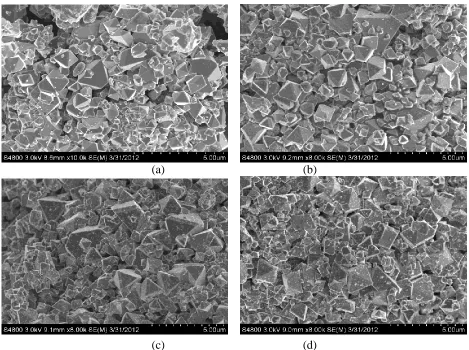
Figure 1. SEM of non-charge-discharge LiMn2O4: (a) pristine LiMn2O4, soaked at 55℃ for 10 (b), 20
[image:4.596.180.418.569.733.2]
The morphology of soaked powders was analyzed by SEM. Fig.1 (a) shows the pristine powder with a sharply and definitely shape of the spinel, and the surface is smooth. Fig.1 (b), (c), (d) shows the soaked materials at 550C for 10, 20, 30 days respectively, which exhibit a fresh solid layer on the particle surface and the film is getting thicker with the stored time extended.
Table 1. Concentration of Mn ions in the electrolytes of different soaking time at 55℃
0 day 10 days 20 days 30 days
Mnμg (L-1) 63.6 899.5 1060.2 1814.5
The filtrated electrolytes after soaking spinel powders are analyzed using ICP-MS. The concentration of Mn ion increases when prolonging the soaking and storing time at 550C (Tab. 1), which attributed to the dissolving reaction of LiMn2O4 in electrolyte. Hence, the depositing reaction of Mn ions is simultaneous with the dissolving reaction. The dissolved Mn ions will worsen the cycling performance and storage behavior of batteries using the LiMn2O4 spinel as cathode.
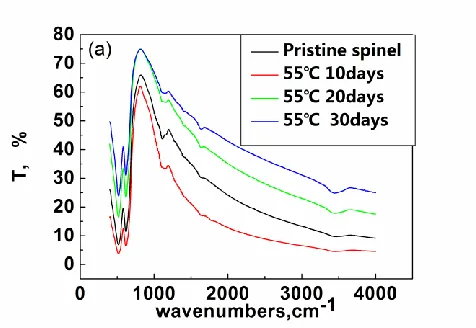
Moreover, FT-IR spectra of pristine LiMn2O4 and soaked LiMn2O4 are tested (shown in Fig.2) in order to analyze components of the solid layer on the soaked LiMn2O4 powders. For bare LiMn2O4, the vibrations of the Mn-O and Li-O bands are located at about 615 cm−1, 512 cm−1 and 1100 cm−1, respectively [11-13]. The corroding reaction occurs and the solid products deposit on the surface of powders when LiMn2O4 is soaked in LiPF6-based electrolyte at 550C. The absorption peaks of Mn(Ⅲ)-O and Li-Mn(Ⅲ)-O of soaked LiMn2Mn(Ⅲ)-O4 have a blue shift compared with the pristine spinel sample (Tab. 2), due to the forming of a solid layer on the surface of LiMn2O4 particles. The absorption peaks of Mn-O and Li-O of soaked LiMn2O4 are about the same value. Hence, it is reasonable to conclude that the chemical corroding reaction occurs mainly in the early days of the soaking process. The absorption peaks at about 1640 cm−1 and 3444 cm−1 are assigned to C=O and O-H vibrations. Some Liand Mn organic compounds with C=O and O-H groups deposit on LiMn2O4 powders soaking into electrolyte for 20 and 30 days at 55 0C.
Tab. 2. Location of the FT-IR absorption peaks
Mn(Ⅲ)-O Mn(Ⅳ)-O Li-O C=O O-H
Pristine spinel 517.80 619.05 1108.89 / /
55℃,10 days 518.61 619.05 1152.28 / /
55℃,20 days 518.77 619.05 1153.24 1638.26 3444.30 55℃,30 days 518.77 619.05 1153.24 1641.15 3442.37
3.2 Analysis of the solid layer on the soaked LiMn2O4 powders
The 10 g pristine LiMn2O4 powder and 10 g the soaked powder in LiPF6-based electrolyte at 55 0
C for 30 days are washed separately with 100 ml deionized water under ultrasonic waves for 2 h. Fig.3 shows the SEM of the soaked LiMn2O4 powder after being washed: (a) pristine LiMn2O4, (b) soaked at 55℃ at 30days. Compared with the no washing particle (Fig.1 (a)), the pristine LiMn2O4 after being washed have small changes with a sharply and definitely shape of the spinel, the surface is smooth. As LiMn2O4 soaked at 550C for 30days, the solid layer on the particle surface seems to have been dissolved, and the surface becomes rough. The deionized water after washing the non-charge-discharge LiMn2O4 powder was analyzed using ICP-AES method. The concentrations of Li and Mn ions increase sharply in the deionized water. The date was shown in Tab. 3. It reveals that the solid layer is mainly composed of some Mn and Li compounds. Mn and Li ions can dissolve from the LiMn2O4 powders when it is chemically corroded in LiPF6-based electrolyte at 550C, and deposit on the particles.
(a) (b)
[image:5.596.71.530.471.668.2]
Table 3. Metal ion concentrations in the filtrates
Samples Li (mg L-1) Mn (mg L-1)
Pristine spinel
Spine of being soaked 30 days
210.2 402.5
0.0778 185.2
[image:6.596.164.426.263.462.2]For elucidating the compounds of solid film, the EDS was used. Fig. 4 shows the EDS of LiMn2O4 spinel powder soaked at 550C for 30 days. The EDS results show that the material component of solid film on the particle surface is a compound composed of Mn, O and F.
Figure 4. EDS of LiMn2O4 spinel powder soaked at 55℃ for 30 days
LiPF6 → LiF ↓ +PF5 ↑ (1)
PF5 + H2O → 2HF + POF3 (2)
2LiMn2O4 + 4HF→ 3λ-MnO2 + MnF2 + 2LiF + 2H2O (3)
3.3 XRD analysis of non-charge-discharge LiMn2O4
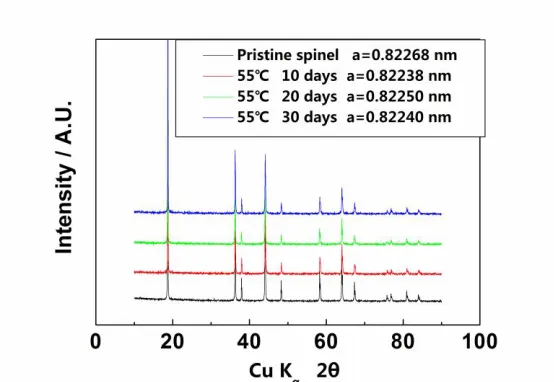
[image:7.596.160.437.418.609.2]Fig. 5 shows the X-ray diffraction of spinel powders before and after being soaked. The data are analyzed with TOPAS software of Bruker. All the peaks in the XRD patterns of the LiMn2O4 were indexed as the spinel phase (JCPDS: 35-0782). These results indicate that the LiMn2O4 retains its spinel structure after being soaked. No additional peak in soaked cases is observed, yet the lattice constants (a) decrease compared with the pristine spinel powder. The change of lattice constant is caused by the Mn3+ ions dissolution from the spinel structure [15, 16]. The radius of Mn3+ is longer than that of Mn4+. The lattice constants will decrease when Mn3+ dissolves from the LiMn2O4 [17]. This change of the LiMn2O4 structure makes Li-ion diffusion more difficult and charges transfer resistance increase. However, the lattice constants of soaked LiMn2O4 are about the same value, which does also prove that the chemical corroding reaction occurs mainly in the early days of the soaking process.
Figure 5. XRD patterns of pristine spinel and soaked powders
3.4 Analysis of the electrochemical impedance spectra
frequency range indicates the resistance of solid layer (RSL), the electron resistance (Re) and charge
transfer resistance (Rct). The inclined line in the low frequency represents the Warburg impedance (ZW)
[18-20]
, which is associated with lithium ion diffusion in the cathode LiMn2O4 particles. In this work, the RS values are almost the same throughout the experiments due to the same electrolyte and fabrication parameters, and they are around 5-8 Ω and much smaller than the Rct values. The RSL and Rct values for
[image:8.596.170.423.254.444.2]the LiMn2O4 cathodes increase with the stored time extended. It can be attributed to the increasing of fluoride which results from dissolvable reaction of LiMn2O4 in electrolyte. The decrease of LiMn2O4 lattice constant maybe also make the charge transfer reaction at the electrode/electrolyte interface more difficult.
[image:8.596.119.479.530.631.2]Figure 6. EIS of LiMn2O4/Li coin cells
Table 4. The impedance spectra parameters of LiMn2O4/Li coin cell
Pristine spinel
55 ℃, 10
days
55 ℃, 20
days
55 ℃, 30
days
RS (Ω) 6.027 3.929 4.831 7.626
RSL (Ω) 14.5 86.6 97.9 117.9
Re (Ω) 84.0 20.2 15.2 2.2
Rct (Ω) 90.8 98.9 103.2 105.2
3.5 Cycling performance of LiMn2O4 (before and after being soaked) /Li coin cell
[image:9.596.165.437.119.295.2]
and Mn3+ ions (origin of capacity) dissolving into electrolyte from the LiMn2O4 structure. These results agree with those from the analysis of XRD and EIS.
Figure 7. Cycling performance of LiMn2O4 (before and after being soaked) /Li coin cells (3.0-4.35 V, 55 0C)
4. CONCLUSIONS
In this work, the surface corrosion behavior of non-charge-discharge LiMn2O4 spinel in LiPF6-based electrolyte at elevated was investigated. The discharge capacity and cycling performance of the LiMn2O4 after soaked decreased. The reason was studied with XRD, SEM, EDS, ICP and AC impedance. LiPF6 salt is known to decompose slightly into LiF and PF5 species which can further hydrolyze with traces of water to give more HF. The HF corrodes the LiMn2O4, and accelerated at elevated temperature. The chemical corroding reaction occurred in the soaking process, a fresh solid film formed on the LiMn2O4 surface, the lattice parameter of the corroded material decreased and the amount of Mn3+ ions dissolving into electrolyte, which result of the film resistance on the surface of LiMn2O4 and the charge transfer resistance increase. The compound of solid film is mainly composed of LiF and manganese fluoride.
ACKNOWLEDGMENTS
This work was supported by a grant from the National High Technology Research and Development Program of China (No. 2011AA11A230).
References
1. J.M. Tarascon, D. Guyomard, J. Electrochem. Soc, 138 (1991) 2864
2. J. Vetter, P. Nov´ak , M.R. Wagner , C. Veitb, K.-C. M¨oller, J.O. Besenhard, M. Winter, M. Wohlfahrt-Mehrens , C. Vogler , J. Power Sources, 147 (2005) 269–281
3. K. Edstrom, T. Gustafsson, J.O. Thomas, Electrochimica Acta, 50 (2004) 397
5. K.Y. Chung, W.S. Yoon, K.B. Kim, B.W. Cho, X.Q. Yang, J. Applied Electrochemistry, 41 (2011) 1295
6. P. Barloux, J. M. Tarascon, F. K. Shokoohi, J. Solid State Chem, 94 (1991) 185 7. D.H. Jang, Y.J. Shin, S.M. Oh, J. Electrochem. Soc, 143 (1996) 2204
8. D.J. Lee, K.S. Lee, S.T. Myung, H. Yashiro, Y.K. Sun, J. Power Sources, 196 (2011) 1353
9. D.P.Abraham, R.D.Twesten, M.balasubramanian, I.Petrov, J.McBreen, K.Amine, Electrichem. Commun, 4 (2002) 620-625
10.C.H.Chen, J.Liu, K.Amine. Electrichem.Commun, 3(2001)44-47. 11.Z.S. Zheng, Z.L. Tang, Z.T. Zhang, Electrochemistry, 4 (2001) 433-438
12.A. Rougier, K.A. Striebel, S.J. Wen, T.J. Richardson, R.P. Reade, E.J. Cairns, Appl. Surf. Sci. 134 (2002) 107–115
13.C.M. Julien, M. Massot, Materials Science and Engineering, B97 (2003) 217-230 14.K. Xu, Chem. Rev., 104(2004) 4303-4417
15.G.G. Amatucci, C.N. Schmutz, A. Blyr, C. Sigala, A.S. Gozdz, D. Larcher, J.M. Tarascon, J. Power Sources 69 (1997) 11
16.S. Komaba, N. Kumagai, T. Sasaki, Y. Miki, Electrochemistry, 69 (2001) 784 17.S. J. Hong, S.H. Chang, C.H. Yo, Bull. Korean Chem. Soc., 20 (1999) 53
18.Q.C. Zhuang, T. Wei, G.Z. Wei, Q.F. Dong, S.G. Sun, ACTA CHEMICA SINICA, 67 (2009) 2184 19.F. Gao, Z.Y.Tang, Electrochimica Acta, 53 (2008) 5071
20.L. Wang, J.S. Zhao, X.M. He, J. Gao, J.J. Li, C.R. Wan, C.Y. Jiang, J. Electrochem. Soc., 7 (2012) 345