Rochester Institute of Technology
RIT Scholar Works
Theses
Thesis/Dissertation Collections
7-2006
Bound
Michelle Griffith Perlich
Follow this and additional works at:
http://scholarworks.rit.edu/theses
This Thesis is brought to you for free and open access by the Thesis/Dissertation Collections at RIT Scholar Works. It has been accepted for inclusion
in Theses by an authorized administrator of RIT Scholar Works. For more information, please contact
Recommended Citation
Rochester Institute
ofTechnology
A
thesis
submittedto the
faculty
ofThe College
ofImaging
Arts
andSciences
In candidacy for
the
degree
ofMaster
ofFine Arts
Bound
By
Approvals
Chief Advisor:
L=e=o=nM==d~U~rS~o
___
L_e_o_n
__
a_rd
__
U
__ r_s_o ___
/
Date:
/J;..s
T
I
.;loo,
Associate Advisor
:
Juan CMlos Caballero-Perez
/
Date
:
§
-l
-
WOG
Juan Carlos Caballero-Perez
Associate Advi
s
or:
Michael
Rogers
Michael Rogers
/
Department Chairperson:
Julia Galloway /
Date
:
Cf/tt/oG
I, Michelle Griffith Perlich,
hereby
grant permission to the Wallace Memorial Library of
R.I.T.
to
reproduce my these in whole or part. Any reproduction will not be for
commercial use or profit.
Michelle Griffith Perlich
Signed
Date
W;
I
;;zIJ,)
Table
ofContents
Approval
ii
Introduction
1
Historical Development
ofFinger Rings
2
Materials for
theConstruction
ofFinger Rings
6
Influences
andInspirations
10
Conclusion
24
Bibliography
25
Introduction
There
neverhas been
a civilizationin
whichthe
members of variousranks of
society
did
not adornthemselves,
alwaystrying
to
enhancetheir
image.
People have
presented gifts ofjewelry
in
orderto
expresslove,
affection,
respect andfriendship,
andthey
have
wornjewelry
themselves to
demonstrate
both
affluence and power.It
canbe
saidthat throughout
history,
power and ornamentation are often one and
the
same.Because I
feel
that
finger
rings arethe
mostimportant form
ofbody
ornamentation,
I
choseto
fabricate
a series of rings asmy
project.Fingers
rings are one of
the
few
pieces ofjewelry
that
cannotbe
coveredup,
andhands
are one ofthe
first
things
a person notices whenhe
or she meetssomeone.
In
addition,
hands
tell
astory
about people'slives,
asdo
the
ringsthey
wear:The
kind
of workthey
do,
whetherthey
arewealthy
oreducated,
their
maritalstatus,
and more.This
paper containsfour
major sections.The
first
sectionfocuses
onthe
historical
development
ofthe
ring
andhow
the
finger ring in every
erahas
reflectedthe
function
and aesthetics ofits
time.
The
second partdelves
into
the
different
materialsI
have
chosento use,
andwhy I
selectedthem.
includes
adetailed
explanation ofthe
eleven rings shownin my
thesis
project.
The
conclusion summarizeshow
my
art reflectsmy
aesthetic.Historical Development
of
Finger Rings
Finger
ringshave
been
traced
back
to
3500 B.C. Over
the
past5500
years,
ringshave been
usedfor
the
symbolictransfer
of power or as anindicator
ofrank,
used as aseal,
given as atoken
oflove
or as adiplomatic
credential,
utilizedto
indicate
religiousfaith
orto
drive away
misfortune,
and
looked
upon as abadge
of political allegiance.In
the
Roman
Empire,
the
number of rings on a man'sfinger indicated
his
professional status and success.In
the
middle andlater
eras ofRoman
civilization, the types
of ringsthat
were worn were governedby
law. Iron
rings were worn
by
ordinary
people;
gold rings were reservedfor
those
ofhigh
civil ormilitary
rank.Later,
gold rings were permittedto
freeborn
citizens,
silverto
freemen,
andiron
to
slaves.The Romans
also used poisonrings
for
assassination or suicidein
case of captureby
the
enemy.Signet
rings were employed asearly
asthe
second millenniumB.C.
in Egypt
and are still populartoday.
Signets hold
first
placeamong
ringsmade
to
serve apracticalpurpose.At
atime
whenthe
art ofwriting
wasknown
to
only
afew,
signetringsbore
adistinguishing
mark orbadge
that
could
be
impressed
onclay
or waxto
authenticate correspondence.Signets
wereessential
for
governmentandcommerce,
andwere used onpractically
all
documents
in
tenth-through
twelfth-century
Europe.
Wedding
ringshave
alsobeen
animportant
part ofhuman
history
for
much of
its
existence.The wedding ring first became
popularin Christian
Europe
during
the
seventh century.Wedding
ringshave
alwaysbeen
placedon
the
fourth finger
ofthe
left
hand,
because in
earliesttimes
it
wasbelieved
that
a vein ranfrom
the
heart
directly
to that
finger.
Wearing
aring
onthat
finger
wouldbring
yourlover
closerto
yourheart.
Wedding
ringstoday
follow
the
sametradition,
and we still wearthem
onthe
samefinger.
During
the
fourteenth
century,
European
men and women wore ringsto
show rank.In many
cases a person ofwealthcouldbe
seen withasmany
as
fifteen
rings onboth
the
upper andlower
portions ofthe
fingers. Colored
stones set
in
metal werethe
most popular style.Rubies
werethe
mostexpensiveof all
stones,
according
to
Benvenuto
Cellini: "A
ruby,
for
instance,
[the
size]
offive
grains ofwheatand with asfine
afire
as youcould
wish,
wouldbe
worth800
scudi,
and an emerald ofthe
same size andbeauty
would run about400.
Similarly,
adiamond
wouldbe
worth100
scudiand no
more,
while a sapphire wouldfetch
about 10."(A
scudo was a goldThe
techniques
ofthe
goldsmith were at ahigh
point: rings were madeas
artworks,
andthere
werebarely
any bare
spotsto
be found
onthem.
Jewelers
ofthe
fourteenth century
wereknown for
the
complexity
oftheir
creations,
using
chasing
andenameling
to
showform
anddepth.
By
1600,
the
great age ofthe
goldsmith was over andhis
placehad
been
taken
by
stone cutters and setters.Many
ringsfeatured
multiple stonesinstead
ofjust
one ortwo.
Shanks became just
a simple circle placedbelow
the
stones.Mourning
ringshave been
usedfor
centuries,
but
they
became especially
popular after
Queen Victoria had
one madeto
commemorateher
husband,
Prince
Albert,
afterhis death.
Moreover,
ringswere
becoming increasingly
affordable,
sothat
middle-class people couldhonor
their
loved
ones upondeath. These
rings wereoften
designed
before
someone'spassing,
then
left
to
afamily
member ordear friend.
They
weredecorated
withsymbols of
mourning
andremembrance,
suchasthe
weeping
willow,
broken
name of
the
departed
andhis
orher birth
anddeath
dates.
One
particularly
interesting
style ofmourning
jewelry
is
the
locket
ring: oftenthis
containedthe
hair
ofthe
deceased. The
one shownhere
is
aring
that
has
a whiteenamelmemorial urn outlinedwith
amethysts;
the
enameled shankis
inscribed
"AB OB MAY 19
1755
IF I FORGET THEE". When
the
ring
is
removed
from
the
wearer'sfinger,
it
reveals a secretdoor
that
conceals acompartment
filled
withthe
loved
one'shair.
The
rings ofthe
nineteenthcentury
wereamazing in
their
size anddetail.
They
sometimes containedhundreds
ofstones,
and coveredthe
entirebottom
portion ofthe
finger.
Jewelers had begun mass-producing
ringsfrom
stock patterns:
For
the
first
time
in
history,
rings were notjust for
the
very
wealthy.
Since
almost anyone could own aring, the
very
richneededto
wearever
larger
and more elaborate ringsto
showtheir
status.The American Heritage
Dictionary
defines
"ring"as
(1)
"A
circularobject,
form,
line
orarrangement with avacantcenter",
or(2)
"A
smallcircular
band,
generally
madefrom
precious metal and often set withjewels,
worn on a
finger."
My
definition
is simply "a
small objectintended
to
adornone or more
fingers
ofthe
hand."No
matterhow
they
aredefined,
finger
rings continueto
reflectthe
communication
just
as much as conceptualthinking.
The
ring
today
is
therefore
an expression ofthe
living
world.The
finger
ring has
been
aform
ofsocial, political,
and religiousexpression,
but in
all casesthese
objects were created with an obviousconcern
for
achieving
apleasing
appearance.An
almostuniversal andfundamental
need ofhuman
beings
is
the
desire
to
stand outin
acrowd,
andby
virtue ofits
beauty
andexpressiveness, the
finger
ring
furthers
this
urge.Finger
rings
today
are given and wornto
mark or remind us ofhappy
events such as
marriage, graduation,
birthdays,
a specialtrip,
retirement,
andso on milestones
that
we are proud of andwantthe
worldto
know
about.Materials for Construction
of
Rings
Gold
I
have
chosenfour
metalsthat
I
believe convey
astrong
messagein
allof
my
rings:gold,
stainlesssteel,
titanium,
and aluminum.When combining
these materials,
it is
notjust
the
amalgamation oftwo
different
coloredmetals,
but
rathera modern materialconfronting
the
oldest metalin
the
history
of mankind.It
is
not clear whofirst
discovered
gold,
but
several mineshave
been
researchers
to
believe
that
ancientEgyptians
werethe
first
to
extract goldand
to
use precious metalsfor
making jewelry.
It
is believed
that the
Egyptians
wholived
nearthe
Red Sea
andthe
Valley
ofDaghbeg
werethe
first
goldsmiths.Remnants
oftools
andditches
suggest
that
workers ground quartzcontaining
goldinto
afine
powder.Water
wasthen
addedto
help
dissolve
the
deposits. This
mixture wouldthen
be
pouredinto
squarebasins
to
trap
the
gold sediment andleave it for
collecting.
Although
gold wasvery
commonin
ancientEgypt,
the
use ofit
wasreserved
for
the
nobility.Egyptians
referredto
gold asthe
skin orflesh
ofthe gods,
andbecause
ofits
color,
gold wasassociated withthe
sun.Gold
became
the
metal of choicefor
jewelry
notonly because it
wasrelatively
easy
to manipulate,
but
moreimportantly,
it
showed rankwhen worn.Gold
is
the
most malleable andductile
of all metals.It
is
so malleablethat
one ounce of gold canbe hammered into
athin,
translucent
waferthat
will cover more
than
100
squarefeet
andbe just five
millionths of aninch
thick.
One
thousand
ofthese
sheets wouldbe
neededto
makethe
sameGold is
also one ofthe
heaviest
metalsknown. Its
specificgravity
is
19.3,
which meansit
weighs19.3
times
as much as an equal volume ofwater.
One
cubicfoot
of gold weighs1,206
pounds.The
value of goldhas fluctuated considerably
overthe
years.In
1792,
the
U.S.
Congress
adopted abimetal
standard(gold
andsilver),
withgold'svalue set at
$19.30
pertroy
ounce.This
remainedessentially
unchangeduntil
1834,
whenthe
price of gold was raisedto
$20.76.
It
stayed atthat
price
for
the
next100
years.It
was not until1934
that
President
Roosevelt
devalued
the
dollar
by
raising
the
price of goldto
$35
anounce.Today,
the
price of gold
is approximately
$625
perounce,
anincrease
ofnearly 20
times
its
pricein 1934.
Stainless Steel
A French
scientist,
Leon
Gillet,
first invented
rustless steelin 1904. It
was
first
manufacturedfor
usein
gunbarrels,
but Gillet quickly
changedthe
name
to
stainless steelin
orderto
makehis
new product moreappealing
when
selling knife blades.
Today
there
aredozens
of grades of stainlesssteel.
For my
project,
I
have
chosento
use#316
stainless,
a medical gradeThe
noncorrosive and rust-resistant properties ofstainless steelrevolutionized
industry,
andit became
anessential materialin food
production,
medicalequipment,
andtransportation.
The
surface of stainless steel resists oxidation athigh temperatures,
making
the
sterilization of medicalinstruments
possible.The
chromiumin
the
steel mates with oxygenin
the
atmosphereto
form
aninvisible,
highly
protective
film
of chrome oxide onthe
surface ofthe metal,
which preventsrust or oxidation
from
occurring.Titanium
Rev. William
Gregor
ofEngland first discovered
titanium
in its
impure
form in 1791. It
waslater
namedtitanium
afterthe
Titans,
the
sonsof
the
gods ofthe
sky
andthe
earthin Greek
mythology.It
was not until1910
that titanium
was manufacturedin its
pureform
by
anAmerican
chemistnamed
M. A.
Hunter.
What
makes titaniumso superiorto
many
otherindustrial
materialsis
its
strength,
light
weight,
andcorrosion resistance.Titanium
can alsowithstandextreme
temperatures
and canbe fabricated into
avariety
of parts.Aluminum
Aluminum
wasdiscovered
in
1746,
but
not usedfor fabrication
until1825.
Aluminum is
anaturally
occurring
element,
but is
neverfound
by
itself in
nature.Aluminum
is
alsothe
most abundant metallic elementfound
on
earth;
practically
all rock contains some aluminumin
the
form
of silicateminerals.
In
the
1
800s,
aluminum wasthe
most sought-after(and
thus
the
mostexpensive)
metal,
even morethan gold,
because it is difficult
to
separatealuminum
from
the
other materialsfound
withit. Public
monumentsemploy
aluminum
to
showrank and status:it is
usedonthe
roof ofthe
Washington
Monument in
Washington,
D.C.
Influences
and
Inspirations
When
talking
aboutthe
influences
orinspirations
for my
work,
it is
impossible
notto
include my background. I
comefrom
avery
conservativefamily
that
valuedfunction
andserviceability
morethan
beauty
andaesthetics.
I
grewup
onthe
Oregon
coast,
andthere
was not aday
that
wentby
whenmy
motherdid
nottake
meto the
beach,
whichbecame
a secondhome
for
me.I
amboth
calmedby
the
movement and rhythm ofthe waves,
and
terrified
by
the
remorselessintensity
ofthe
sea.My
father
owned and worked a commercialfishing
boat,
withhis
major
income
coming
from
crabbing.During
the
spring
and summermonths, the
yard atmy
house
wasfilled
withhundreds
of crabpots,
andmy
brother
andI
spent our summersrepairing
the
holes in
the
wires causedby
last
season'sfishing.
One
couldsay
that this
wasmy first
experience withmetalsmithing;
it
could alsobe
whereI
acquiredmy love for
geometricshapes.
My
father's
boat is extremely
functional,
but
withinthat
utility
there
is
beauty. The
mast,
a25-foot-tall
pole,
acts as ahigh
pointto
workfrom.
Hanging
from
the
mast are crabblocks
andtrolling
poles.Crab blocks
arelarge
pulleys with motors attachedthat
allowthe
crab potsto
be
raisedfrom
the
seafloor
andbrought back
into
the
boat.
Trolling
poleslower
during
rough weather
to
help
stabilizethe
boat. All
these
items have
cables andwires attached.
The
beauty
andefficiency
ofthis
arrangementhas strongly
influenced my
aesthetictoward
designs
of a moreindustrial
nature,
andcemented
my belief
that
jewelry
shouldnotjust be
displayed,
but
shouldbe
worn and used.
My
understanding
offunctional
structureshas led
meto
admire cablebridges like
the
Golden Gate
bridge,
located in
the
San
Francisco
Bay,
andthe
Brooklyn
Bridge
in
New York. The Golden
Gate bridge is
my
favorite
artwork.
What I
find
moststriking
areits
geometricshapes and
the
industrial
cables
holding
it together,
how
it flows
withthe
bay
and
the
surrounding
hills,
and
how it
functions
as a conduitfor 150,000
carsto
pass overthe
bay
every
day.
Construction began
onthe
Golden Gate bridge
onJanuary
5, 1933,
and
it
was completed onMay
28,
1937. It
wasdesigned
and engineeredby
Joseph B.
Strauss,
the
son ofnoteworthy
artistRaphael
Strauss. Joseph
Strauss
wasbora in
Cincinnati,
Ohio in 1
870
and receivedhis engineering
degree from
the
University
ofCincinnati. He
died only
ayear afterthe
completion of
his
magnificentbridge.
Returning
to
his
other greatlove,
poetry,
Strauss
composed versefor
the occasion, exulting,
"At
last,
the
mighty
task
is
done."
Other
publicworks,
like
the
Eiffel Tower in
Paris,
have
shown methat
a shape asbasic
asthe triangle
canbe
used with repetitionto
create oneof
the
mostrecognizable artworks of ourtime.
The Eiffel Tower
wasbuilt
for
the
1889 International Exhibition in Paris. Until
1930,
the tower
wasthe
world's
tallest
building
at300
meters.The
tower
was almosttorn
down
in
1909,
but
was savedbecause
ofits
antenna,
usedfor
telegraphy
atthe
time.
Painters from
the
Futurist
movement
like
Dumchamp
andMaelvich,
whoboth
usedgeometry
to
depict
space,
time,
andmovement,
have
been integral in
forming
my
aesthetic.Marcel
Duchamp
was a master atdepicting
afigure in
severalmoments at once.
His
output was smallbut
controversial,
andhe
exerted astrong influence
ontwentieth
century
avantgarde art.
Born
onJuly
28,
1887
in
Blainville,
France,
he
wasthe
brother
of artistRaymond
Duchamp
andhalf brother
to
painterJacques
Villon.
He
usedrhythmiclines in
orderto
move
the
viewer's eyesthrough
the
picture.The
picture shownhere
is
Nude
Descending
aStaircase (1912).
Painters from
the
Renaissance
will alwaysbe
held
in my highest
regard.
When I
think
ofthe
years(in many
cases)
spent oncreating
a singlepainting,
andthe
convictionit
musthave
taken to
completethese works,
it
makes me respect
these
artists allthe
more.Today
welive in
a world ofinstant
gratification.If
a piece of arttakes
a weekto produce, that
seemslike
much
too
long
atime.
This is
disheartening
to
me.Rogier
vander Weyden
took three
years(1452-55)
to
completehis
masterpiece,
Altarpiece of
theSeven Sacraments. The finished
triptych
measures
78-3/4" x
38-1/4"
(center
piece)
and46-7/8"24-3/4"
(each
wing).Van
der Weyden had
aremarkable
ability
to
capture
three-dimen
sional space on a
flat
plane.
This
nave,
with allthe
gothic arches andbeams
shows offhis
talent
for making
atwo-dimensional form
seemthree-dimensional.
This
unusual arrangement ofthe
seven
sacraments,
which appearsimultaneously
within onesetting,
is
whatappeals
to
me.Furthermore,
eventhough the
painting is
quitedetailed
andpresents a
lot
ofinformation,
I
feel
a stillness and quietude whenI
examineit. Although
I
have
no religiousbackground,
I feel
more groundedwhenlooking
at sacred paintingsfrom
the
early
Renaissance.
Finally,
I
am alsohighly
influenced
by
the
metalsmiths ofthe
1960s.
For
the
first
time
in
two
hundred
years,
metal again wasthe
focus
or mostimportant
part ofthe
rings createdduring
that
era.The
artists markedtheir
individuality by
expressing
themselves
in
metal, the
designs
being
influenced
by
the
stonesbeing
used,
but
notrelying solely
onthem.
I
wantmy
workto
be
touched
andembraced,
but
mostimportantly,
worn.
Therefore
they
mustbe primarily inventive
and engaging.I
choseto
use softer
finishing
onmy
rings,
like sandblasting
and scratchtexturing,
to
give
the
rings
a moretactile
quality
andto
makethe
geometriclines
morewelcoming.
Almost
allthese
rings physically
stand ontheir
own:I
createdthem that
way
deliberately
because
the
rings
in
this
series are sculptures andare meant
to
be
viewedfrom
all angles.In
addition,
I
desired
that these
rings
be loved
even whenthey
are notbeing
worn.Instead
ofplacing
them
in
abox,
I
wishto
have
them
displayed
for
everyoneto
see.I
wantto
moveaway from
the
impersonal setting
of stones and pearlsand make
the
metalthe
important
component ofthe
work.The
uses of stonesand pearls represent
the wearer,
or ratherthe
emotionsthe
wearer goesthough
overthe
course ofhis
orher
life.
These
rings
all speak aboutmy
owndesire
to
be
setfree from my
past,
but
atthe
sametime to
feel
safe and protected andto
realizethat
having
ahome
(whether
good orbad)
is better
than
having
noneat all.I feel
allthe
rings verbally
communicatethis
tension though the
uses of metal.I
choseto
use stainless
steel,
titanium,
andaluminum,
allthree
ofwhich are cold andhard
metals associated withindustrial
uses,
hard
to
workwith,
and notemployed
to
makejewelry. These
metalshave been
softenedslightly
by
the
use of gold
just
enoughto
makethem
engaging.Gold
is
the
most "human"of
the metals,
offering serenity
and approachability.Looking
back
though
the
history
ofart,
goldis
almost always paired witha god orgods,
heaven,
or rewards we will
receive, thus
invoking
feelings
of warmth andhome.
Figure
1,
Beach,
is
the
first
ring
I
createdin
the
series.It
is
made of18k
gold,
nickelsilver, glass, sand,
and pearls.Since it
wasthe
first
ring
I
constructed,
it is
possibleto
seehow my ideas
and aesthetics evolved overthe
course ofthe
year.I decided
to
use1 8k
gold and nickel silvertogether
because using
a metal withalot
of value andcombining it
with avery
inexpensive
metalbrings up
the
question of whetherthe
value ofthe
pieceis
due
to the
price ofthe
material orbecause
ofthe
craftsmanship
and artistry.I
completedthis
ring by
cutting
out adie
from
Plexiglas,
then
hydraulically
forming
eachside,
then
finally
soldering
the two
surfacestogether.
This left
the
ring
with ahollow
center,
whichis
filled
withtwo
glass
tubes
containing
sand.The
sandis from
abeach in
Brookings,
Oregon
that
my
mothertook
usto
every
day
whenI
wasa child.
This
beach holds
many
happy
memoriesfor
me.There
arethree
pearls set on
the
inside
of
the
ring,
sothat
whenthe
ring is
being
wornthe
wearer'sfingers don't
touch the metal,
just
the
pearls.Of
allthe
rings in
the series, this
oneholds
the
mostmeaning for
me,
andit is my favorite. Not because it is
aesthetically better
then the
others(in
fact,
to
meit is
one ofthe
least
pleasing
to
the eye),
but
ratherbecause it holds
feelings
ofhappiness
andbliss,
an emotionI didn't
oftenfeel
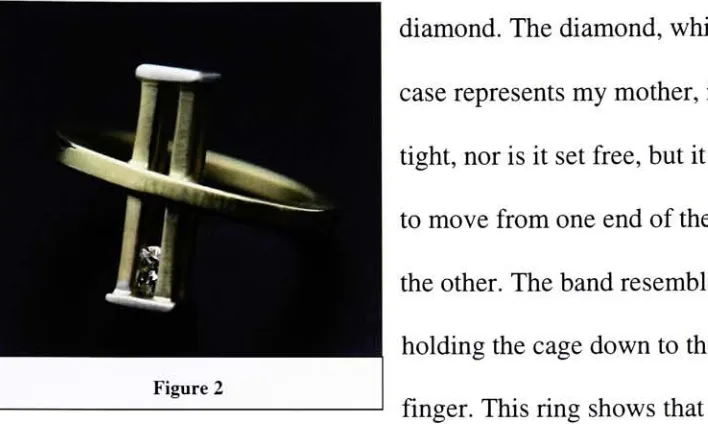
as a child.The ring I
callBound
(Figure
2),
is
constructedfrom 18k
gold,
nickelsilver,
and a singlediamond. These
materials camefrom my
mother'sengagementring.
She is
stillmarried,
but I
never remember atime
when shewore
this
ring. This
ring
is
madeby
taking
the
oldband
androlling
outthe
gold
into
thin
square wire andcrafting
a cage out ofit
that
houses
the
diamond. The
diamond,
whichin
this
case represents
my
mother,
is
notheld
tight,
noris it
setfree,
but
it is
allowedto
movefrom
one end ofthe
cageto
the
other.The
band
resembles aband
holding
the cagedown
tothe
wearer'sfinger. This
ring
showsthat to
be
bound
to
someone else canbe exceedingly
comforting.Figure
3
showsTrapped,
whichis
fabricated from 18k
goldrectangularwire andplatinum with atanzanite stone.
The
overallfeeling
ofthis
ring
is
that
being
trappedcansurprisingly
beautiful. The
stone,
which representsthe wearer,
is held
in
placeby
moving
thetop
two
bars
overuntil
the
stone can nolonger
comefree. I
madethe
choice
to
setthe
stonein
this
mannerto
givethe
appearance
that the
walls arecaving in
aroundthe
[image:22.534.51.405.74.286.2]person.
For
the
first
time
in
this
seriesI
left
anopening
that
servestwo
purposes:to
givethe
[image:22.534.339.492.393.656.2]viewer's eyes a chance
to rest,
andto
allowthe
Figure 3
stone
(person)
a possible route of escape.I
believe
that
we alwayshave
achoice,
evenif
the
options are not always appealing.The
use ofstrong
geometric shapes reflect
the
influence
that
industrial bridges
andbuildings
have had
on me.Figure4
Figure 4
setsthe tone
for
the
rest ofthe
series.Instead
ofusing
primarily
goldwith accents ofother
metals,
I
switchedto
stainlesssteel,
titanium,
and aluminum asthe
rootmetal.Dwelling
is
manufactured of stainlesssteel,
1
8k
gold and a
sapphire,
formed in
the
basic
geometric shape of a
square,
with a smallhole in
the
bottom
for
a possible route of escape.The
top
ofthe
ring
has
a smalltrack that
allowsthe
sapphireto
movefrom left
to
right. The making
ofthis
ring brought up
sometechnical
difficulties;
I
had
problemsgetting
the
stainless steel and
the
goldto
soldertogether.
I
switchedto
aflux
that
contained
fluoride
andfrom
that
point onI
had
no problemgetting
the
solderto
flow.
Figure
5,
titled
Constrained,
is
assembled of stainlesssteel,
18k
gold,
and pearls.
Its rudimentary
parallelogram shapeillustrates
afeeling
ofsubstance and
dominance,
whilethe
gold wirethat
flow
though the
middleFigure5
introduces
a suggestion ofmovement.
There
aretwo pearls,
one
that
is fixed
onthe
inside
andthe
otherthat
is
free-floating
onthe
wire on
the
outside.Constrained
really
showshow
protectedthe
pearl on
the
inside is
comparedto
the
vulnerability
ofthe
outside pearl.Figure
6,
titled
Guarded,
is
constructed of aluminum and18k
goldwith
the
outside shapeofa wedge.The
difficult
part ofthis
ring
wasconnecting
the
goldto the
inside
ofthe aluminum,
since you cannot solderthe two together.
My
solutionwasto
bore
holes in
the
aluminum andrivet
the
goldin
place.
This
ring
again capturesthe
sense ofsafety
and comfortthere
is in
being
guarded and
bound
to
something
else.Figure
7, Embraced,
is
created withtitaniumand a pearl.
The
titanium
is
anodizedwith
12
voltsto
produce adeep
purple effectto
reflectthe
purpleundertones of
the
pearl.This
ring
differs
slightly
from
the
restfor
two
[image:24.534.56.452.51.263.2] [image:24.534.92.482.383.624.2]Figure 7
reasons:
first,
it
does
notstandon
its
own,
andsecond,
whenthe
ring
is
worn
it is
the
finger
that
constricts
the
pearl anddoes
notallowit
to
be
released.
Figure
8,
titled
Sanctuary,
is
madefrom
stainless steel and18k
gold,
shaped
in
a squarewithtwo
smalllegs
thatstartto
form
a circlecoming
offthe
bottom
ofthe
ring. I
chosethese
two
shapesto
symbolizehow
aperson'ssurroundings can change
from something
harsh
(square)
to
something
gentle(circle).
There
aretwo
identical
goldstraps,
one onthe
inside
andthe
otheronthe
outsideofthe
ring.These
arein
placeto
illustrate
the
feeling
that
whenyou are
inside
all you wantto
do
is
getout,
but
once you are onthe
outside allyouFigure 8
can
do is
aspireto
getback
in,
remembering how
goodit
was. [image:25.534.235.468.375.610.2]Figure 9
Figure
9, Confined,
is
completed withstainless
steel,
sterling
silver,
18k
gold, glass,
and
diamonds.
The basic
shape ofthe
ring
is
asquare,
with a small rectangularfoot
onthe
bottom,
that
raisesthis
ring just
enoughto
giveit
alighter
feeling.
The
top
portionboasts
asterling
silver rectangle with a small windowthat
exposes a glasstube
filled
with26
diamonds
that
are allfree-floating. I
chosethat
number
to
representthe
number of yearsI
have felt
confinedin my
ownlife.
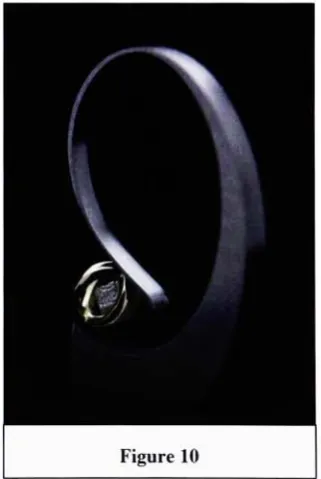
Figure
10,
Ensnared,
is
madeoftitanium,
1
8k
gold,
and a rawdiamond. This
ring
wasdeveloped
withtitanium, because
this
is
the
only
metalwiththe
strengthto
hold up
to the thin
swirl patternI
neededto
illustrate
the
feeling
ofonly
alittle
bit
holding
youdown. At
the
base
ofthe
ring
is
a small goldcircular cage
that
holds
anuncutdiamond.
[image:26.534.321.482.365.605.2]Figure 11
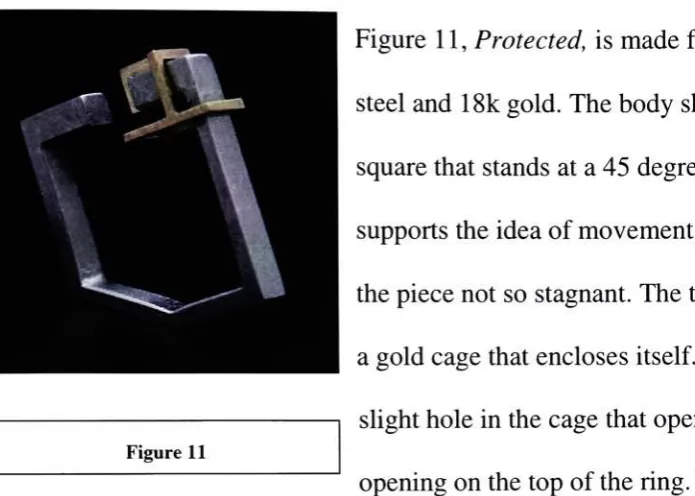
Figure
11,
Protected,
is
madefrom
stainlesssteel and
18k
gold.The
body
shapeis
a squarethat
stands at a45 degree
angle.It
supportsthe
idea
ofmovement,
and makesthe
piece not so stagnant.The
top
cornerhas
a gold cage
that
enclosesitself.
There
is
a slighthole in
the
cagethat opensinto
the
opening
onthe
top
ofthe
ring. This
givesthe
viewerthe
hope
ofbeing
liberated.
Conclusion
The
rings
I
have
createddon't just
tell
my story
andthe
way I feel
about
the
world aroundme,
but
ratherthey
reflectto the
human
story:Finding
ourfundamental
needfor
comfortin
being
bound
andrealizing
that
the
cages webuild for
ourselves are more aboutsecurity
than
constriction.The
common connectionthat
links
all ofmy
ringsis
thatthe
artificial cagesthat
hold humans from
being
limitless
arevery
small,
and we can alltranscend them
if
we choose.In
conclusion,
we all seek refugein
confinedsurroundings and
dwellings
andfind
ourselves more athome there,
eventhough
bound,
than
wedo
whenwe arefree
and alone.Bibliography
Finger
Rings
James
Fenton,
Diana
Scarisbrick,
Martin
Henig
University
ofOxford
Ashmolean
Museum, Oxford,
2003
Historic
rings:Four
Thousand
Years
ofCraftsmanship
Diana Scarisbrick
University
ofOxford
Ashmolean
Museum, Oxford,
2004
The Power
ofGold:
History
ofObsession
Peter L. Bernstein
John
Wiley
andsonsInc.,
2000
A
Short
History
ofTwentieth-Century
Technology
Trevor I. Williams
Oxford
University
Press,
2002Rings-
Symbols
ofWealth,
Power
andAffection
Diana Scarisbrick
Harry
N. Abrams Inc.
Publishers, London,
1993Northern Renaissance Art
James Snyder
Prentice Hall Inc.
andHarry
N.
AbramsInc., London,
1985The Complete Book
ofHeraldry
Stephen Slater
Anness
Publishing,
New
York, NY.,
1999
The
Cubist Epoch
Douglas Cooper
Phaidon Press
Inc.,
New
York,
NY. 1971
History
oftheWife
Marilyn Yalom
Harper
Collins
Publishers,
2001
Engineering
in
History
Richard Shelton
Kirby,
Sidney
Withington,
Arthur Burr
Darling,
Frederick Kilgour
Dover
Publication
Inc.,
New
York,
NY. 1990
History
ofJewelry
Joan Evans
Dover Publication
Inc.,
New
York,
NY. 1970
Amulets
andSuperstitions
E.A. Wallis Budge
Oxford
University
Press, London,
1930
History
ofPrecious Metals From
theEarliest Times
to thePresent
Alex Del Mar
Elex Del
Mar,
New
York, NY.,
1901
The Role
ofMetals in Ancient Greek
History
Michail Yu Treister
E.J. Brill Inc.
Leiden, Netherlands,
1996The Eiffel Tower
Luccien
Herve,
Barry
BergdollPrinceton
ArchitecturalPress,
NewYork,
NY.2003
Ancient Egypt
aSocial
History
B.G.
Trigger,
B.J.
Kemp,
D.
O'conner,
A.B. LloydCambridge
University
Press,
London,
1983Modern Art 1851-1929 Capitalism
andRepresentation
Richard R. Brettell
Oxford
University
Press, Oxford, NY.,
1999
Jan Van
Eyck-The
Play
ofRealism
Craig
Harbison
Reaktion
Books
Ltd., London,
1999