Risk information source preferences in construction workers
Calvin Burns,
Department of Human Resource Management, University of Strathclyde
Stacey Conchie,
Department of Psychology, University of Lancaster
Introduction
Many researchers have investigated the determinants of workers‟ risk-taking /
unsafe behaviours as a way to improve safety management and reduce accidents but there
has been a general lack of research about workers‟ risk information seeking behaviours or
their source preferences for risk information. It is important to understand workers‟ risk
perceptions and how they are affected by information from different sources because
workers tend to underestimate risks which can increase the likelihood of accidents and
injury through unsafe behaviours (Powell, 2007; Zohar and Luria, 2004).
The aim of this study was to investigate risk information source preferences in
construction workers. Construction is an appropriate industry to study source preferences
for occupational risk information as it is one of the most hazardous industries worldwide.
Compared to other industries, the construction industry experiences some of the highest
annual rates of workplace deaths, accidents and injuries (European Agency for Safety and
Health at Work, 2013a; UK Health & Safety Executive, 2013a; US Department of Labor
BLS, 2013). Part of the reason for these high rates is the unique characteristics of the
industry. These include a largely transient, project-based workforce, constant time and
cost pressures, and a relatively high number of young, migrant, and subcontracted
construction industry). Construction workers though usually have immediate or fast
access to risk information from supervisors, workmates, and (on some projects and in
some countries) safety officers or safety managers (Dingsdag, Biggs, & Sheahan, 2008;
Melià, Mearns, Silva, & Lima, 2008). Together, these characteristics create climates
defined by fragmented safety attitudes and risk perceptions, and high levels of risk-taking
amongst some groups.
Proximity to Source of Risk Information
Johnson‟s (1996) theory of local information fields provides a good starting point
for understanding construction workers‟ source preferences for risk information.
According to this theory, local information fields encompass the sources of information
to which an individual is exposed on a daily basis. Through regular contact, individuals
develop a preference towards these sources following a process of familiarity or
normative behaviour. In the construction industry, local information fields would likely
comprise supervisors, workmates, and safety managers. Of these different occupational
groups, Johnson‟s theory suggests that supervisors and workmates are likely to be the
preferred sources of risk information as these groups engage with workers on a daily
basis. Consequently, workers are likely to approach supervisors and workmates for risk
information and advice as a matter of routine behaviour.
Immediate or fast access to a source of risk information, however, may not always
affect information seeking. Savolainen (2008) demonstrated that individuals can be
selective about the source to which they respond irrespective of how quickly they can
approach that source. Mearns and Reader (2008) found that workers‟ safety behaviours
were in the same local information field. Melià et al. (2008) reported similar findings in
relation to the Spanish construction industry, where workers‟ perceptions of risk were
influenced more strongly by supervisors‟ responses to risk, than workmates (but the
organizational response was a stronger influence on risk perceptions than supervisors‟
response). Lastly, Dingsdag et al. (2008) showed that Australian construction workers‟
safety attitudes were influenced relatively more by supervisors and safety managers than
by workmates. These findings have been explained in terms of safety climate (members‟
shared attitudes and perceptions about risk which inform the role behaviours that are
rewarded and supported in the organization; Zohar & Luria, 2004). They may also reflect
workers‟ source preferences (i.e. the sources that workers are most likely to approach for
information and presumably by which their behaviour will be most influenced).
Cross-Cultural Factors
There are a large number of foreign transient workers in the construction industry
who often struggle with the English language (Sinclair et al., 2008) and this may affect
their risk information seeking behaviours. Aronsson (1999) found that contingent
workers reported a greater lack of work environment knowledge than permanent workers
and perceived themselves to be disadvantaged with respect to the training and education
needed to do their jobs. Burt et al. (2008) found that foreign transient construction
workers often experience difficulties in understanding safety documents which are not
translated into their native language unless an interpreter communicates that information.
Communicating about and seeking information on occupational risk in the construction
The influence of national culture on risk perceptions has been reflected in a
growing number of studies (e.g., Helmrich & Merritt, 1998; Mearns & Yule, 2009). An
example of this within the construction industry comes from Spagenberg, Baarts,
Dyreborg et al., (2003), who found that Danish construction workers experienced more
accidents than Swedish workers despite both being on the same site. The differences
between these groups were accounted for by differences in education, training,
organizational commitment, economic interest, and safety attitudes. Spagenberg et al.
(2003) concluded that nationality per se does not influence risk perceptions and
behaviour, but the factors to which it relates to does. Support for their conclusion was
later offered by Mearns and Yule (2009) who provided evidence that national culture is
secondary to the influence of organizational culture, especially when the latter is strong.
To date the role of cross-cultural factors on risk information seeking behaviours remains
largely unexplored.
Trust in Source of Risk Information
Trust has long been known to affect whether a risk is accepted or not. It is often
presented as a psychological state in which one person (trustor) chooses to rely on
another person (trustee) in a risky situation based upon positive expectations of the
trustee‟s behaviour or intentions (Rousseau et al., 1998). It is widely accepted that these
expectations are domain-specific and that in the context of occupational risk, expectations
about another‟s safety-related behaviours and safety-related intentions are particularly
important (Conchie, Donald, & Taylor 2006). In most cases, a trustor‟s expectations
about a trustee relate to the trustee‟s trustworthiness, which is indicated through a number
In a previous study of UK construction workers, Conchie and Burns (2009) found
that the HSE and safety managers were the most trusted sources of occupational risk
information (compared to project managers, supervisors, and workmates) and the most
influential in shaping workers‟ risk-related behavioural intentions. They also found that
workers‟ trust in an information source was relatively stable and did not change
significantly depending on the occupational risk that the source was communicating
about (e.g., workers reported that they trusted the HSE just as much to communicate
about back pain as site transport). Trust in risk information from the project manager,
safety manager, HSE, and workmates was found to be based on perceptions of the
source‟s accuracy while trust in risk information from supervisors was found to be based
on their demonstrations of care. Their findings have implications for safety campaigns
because they suggest that while workers trust the sources that develop these campaigns
(HSE, and perhaps safety managers), they have relatively less trust (but not necessarily
distrust) in those sources that deliver those safety campaign messages (project managers
and supervisors). While trust in risk information sources in occupational settings has
started to be investigated, the role of source preference for risk information on trust
remains unclear.
Current Study
The aim of this study was to investigate risk information source preferences in
construction workers. Previous research about risk information source preferences has
tended to focus on industrial / technological hazards and risks amongst the general public
(e.g., Jungermann, Pfister, & Fischer, 1996). To our knowledge, this is the first study to
As discussed earlier, the information seeking literature suggests that source proximity
is an important factor in determining information source preference. Local Information
Field theory (Johnson, 1996) predicts that construction workers will show a relatively
stronger preference for risk information from proximal sources like supervisors and
workmates, than from sources like project managers, safety managers, or government
bodies (i.e., UK Health and Safety Executive). Recent findings about construction
workers‟ trust in sources of occupational risk information (Conchie & Burns, 2009)
suggest that source expertise (based on perceptions of accuracy) may also be an
important factor in determining risk information source preference. Source expertise has
been found to be important for laypeople‟s source preferences for information about
industrial / technological risks. For example, Jungermann et al. (1996) found that
residents local to a chemical plant preferred to receive information about hazards and
their health consequences from environmentalists, but preferred to receive information
about how to act after an accident from the fire department. Their study and others
(Frewer et al., 1996; Warner et al., 1973) suggest that proximity alone is an insufficient
basis for source preference. Rather, proximity is likely to combine with, or be superseded
by, how much expertise a source is assumed to have about a specific risk. Thus, we
investigated whether occupational risk information source preference was risk
independent (i.e. whether construction workers prefer to receive occupational risk
information from proximal sources like supervisors and workmates regardless of the
nature of the risk or the source‟s expertise regarding that risk, or if they discriminated
Lastly, we sought to extend the methods used to investigate information source
preferences. Previous research about risk information source preferences (e.g.,
Jungermann et al., 1996) has focused only on people‟s most preferred source. In this
study, we examined how workers ranked a source in terms of how much that source was
preferred relative to other sources to deliver information about a specific risk. This
method allowed for a more detailed picture of risk information source preference than
Method
Participants and Procedure
We collected data from 106 frontline construction workers who were recruited
from a large, single building site within the UK. This study was conducted at the same
site as our previous study (Conchie & Burns, 2009) after data from that study had been
collected. Research access was co-ordinated through the on-site safety officer once
permission to conduct the study from the School of Psychology‟s ethics committee at the
University of Liverpool was granted. Available workers were selected through
opportunity sampling, such that the on-site safety officer identified groups of workers
who were available to take part in the study1. These workers were approached by the
second author and asked to participate in a study on risk communication within the
construction industry (if they had not taken part in our previous study). All of the
workers who were approached agreed to participate. They were given a participant
information sheet which assured them of anonymity and confidentiality along with the
ranking exercise. They completed the ranking exercise on-site during working hours and
once they completed the ranking exercise, they returned it directly to the second author
who was there at the time.
All of the workers were male and collectively were employed by a number of
different contracting companies. Together the sample represented a range of trades, with
the largest groups being labourers (25%), bricklayers (12%), electricians (11%), scaffold
workers (9%), fitters (7%), steel and plate fitters (6%), and welders (5%). Other trades
represented by one or two workers included plasters, painters, plumbers and banksmen.
Sixteen percent of workers did not disclose their trade.
Ranking Exercise
The source from which workers preferred to receive information about a range of
risks was measured using a ranking exercise. Specifically, workers were asked to rank
five occupational sources according to how much they preferred each one to deliver
information about eight different risks. A rank of five was given to the source from which
workers most preferred to receive risk information, a four to the next preferred source,
and so on until they arrived at the least preferred source to which they assigned a rank of
one. In doing this, all sources were assigned a rank from “1” to “5” for each of the eight
risks. The procedure of assigning a rank to all information sources, rather than assigning
a rank to the most preferred source only, had the advantage of providing information on
the relative position of each source in terms of worker preference.
The five sources that workers were asked to rank were the UK HSE, Safety
manager, Project manager, Supervisor, and Workmates. These occupational groups have
been identified as key agents in shaping workers‟ attitudes and perceptions toward safety
in a range of industries including construction (Cox and Cox, 1991; Hayes et al., 1998;
Melià et al., 2008; Seo et al., 2004). The eight risks were Asbestos, Back pain, Site
transport, Working at heights, Slips/trips, Bad housekeeping, Site-specific risk (i.e., risks
that are specific to the building site surveyed), and Job-specific risk (i.e., risks that are
specific to the nature of the worker‟s job). The first six of these risks are specific risks
which have been identified by regulatory agencies to be relevant to the construction
European Agency for Safety and Health at Work, 2013b; UK Health and Safety
Executive, 2013b). The two general measures of risk (site-specific and job-specific) were
included to offer a more general overview of risk information source preferences and to
capture any risks that were not listed, but which may be salient to the workers.
Correspondence Analysis
Data were analysed using a correspondence analysis. This is an exploratory
technique similar to principle components analysis, but for categorical data. It presents a
simplified representation of the relative associations between rows and columns of a
contingency table as points in a biplot. In this study, the biplot represents the distance
between a source and risk, which is interpreted as the relative preference to receive
information about a specific risk from a specific information source (relative to the other
risks and information sources). A small distance between a source and a risk implies that
workers prefer that specific source to deliver information about that specific risk more
than about other risks (for a more detailed explanation of Correspondence Analysis see,
Greenacre, 1993).
It should be noted that other approaches like Analytical Hierarchy Process (Saaty,
1980) could have been used in this study. This approach is common in studies of risk in
complex systems, but we chose to adopt a simple ranking procedure because it easier for
the workers to complete and more consistent with the approaches taken in the literature
on risk information sources (e.g. Jungermann et al., 1996). Lastly, the findings from the
subsequent Correspondence Analysis (i.e. biplot shown in Figure 1) allow for a more
Results
Table 1 shows the summed rank score for each of the five information sources for
each of the eight risks. These scores are based on a sample of 101 workers as five
workers were withdrawn from the analysis due to missing data. Each summed rank
score was calculated by multiplying the number of participants who ranked the
information source as most preferred by 5 (the score used to denote the most preferred
source) and added to the number of participants who ranked the information source as
second most preferred (after multiplying this number by 4), and so on. For example, the
summed rank score of 345 for Back Pain and Supervisor was calculated as follows:
(22*5) + (28*4) + (29*3) + (14*2) + (8*1)
INSERT TABLE 1 HERE
Table 1 shows that Supervisor was ranked as the most preferred information
source, followed by Safety Manager and then Workmates, HSE, and finally Project
Manager. To test if these source preferences were significantly different,
Related-Samples Wilcoxon Signed Rank Tests were conducted on the summed source ranks (a
summed source rank was created for every participant by adding together the rankings for
that source across the eight different risks). The results show no significant difference
between Supervisor and Safety Manager, or between Workmates, HSE, and Project
Manager. However, they do show significant differences between supervisors and
workmates (Z = 5.74, p < .001), HSE (Z = 4.71, p < .001) and project manager (Z =
workmates (Z = 4.68, p < .001), HSE (Z = 4.88, p < .001) and project manager (Z =
-6.56, p < .001). These results suggest the existence of two distinct groups for preferred
risk information source, with supervisors and safety managers being the most preferred
sources to deliver risk information.
A closer inspection of the summed rank scores in Table 1 reveals some variation
in this overall trend. For example, workers expressed a preference for information about
asbestos from the HSE over Supervisor, and almost equal preference for information
about Job-Specific Risks from Project Manager as Safety Manager. In order to
investigate the pattern of information preferences, a correspondence analysis was
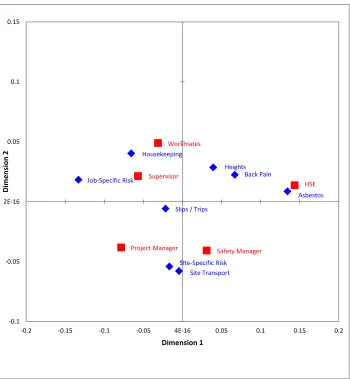
conducted using the data in Table 1. A test of independence between the rows (i.e. risks)
and columns (i.e. information sources) revealed a significant relationship;χ2(28) = 94.09,
p < .001. The resulting biplot depicts the relationship between row (risk) and column
(information source) data.
INSERT FIGURE 1 HERE
The two-dimensional biplot displayed in Figure 1 accounts for 91.02% of the
inertia (i.e. total variance); the first dimension accounts for 75.46% and the second
dimension accounts for 15.56% of the inertia. Along the most important first dimension
(which can roughly be considered risk speciality), Safety manager and HSE are the only
column points to the right of the origin, which as above suggests the existence of two
distinct groups for preferred risk information source. Similarly, Heights, Back pain, and
are more specialised than the other risks. Along the second dimension (which can
roughly be considered location-specific), Safety manager and Project manager are the
only column points beneath the origin, with HSE slightly above the origin, and
Workmate and Supervisor further above the origin. This suggests a division between
front-line workers, the HSE (regulator), and managers as information sources. Similarly,
Site transport and Site-specific risks are the only row points below the origin, which
suggests a differentiation between site-specific and more generalised risks.
Further consideration of the biplot suggests a pattern of source preferences
according to the nature of the risk. For example, workers show a relative preference for
Supervisor and Workmates (sources with whom they presumably interact frequently) as
sources of information about job-specific risks and housekeeping (everyday risks with
which supervisors and workmates have experience / presumable expertise). Similarly,
workers show a relative preference for Safety Manger (a source with whom they
presumably interact less frequently) for site-specific risks and site transport (risks for
which site safety managers have specialised knowledge). Lastly, workers express a
relative preference for the HSE (a source with which they presumably interact less
frequently still) for information about asbestos and back pain (risks about which the HSE
has specialised knowledge but which may be perceived as more risky due to higher levels
of uncertainty and unknown variables). The results suggest that workers‟ source
preferences are not generic (i.e. workers choose their preferred source based on the risk
being considered) and that source expertise is more important than source proximity in
Discussion
The aim of this study was to investigate risk information source preferences in
construction workers. Specifically, we investigated whether occupational risk
information source preference was risk independent. In general, construction workers
rated supervisors and safety managers as their most preferred sources of risk information.
A correspondence analysis though suggested that workers‟ risk information source
preference is risk dependent and might be driven by source expertise. For example, for
information about asbestos, workers expressed a preference for information from the UK
HSE. Essentially, workers expressed a preference to receive information from those
sources they regard as having the most expertise, or experience, with a particular risk.
The suggestion that source expertise is important in decisions regarding source
preferences is consistent with previous research on the general public‟s perceptions of
industrial / technological hazards and risks. For example, Jungermann et al. (1996) found
that laypeople preferred to receive different types of information about the risks of a
chemical plant from different sources (e.g., the company was the preferred information
source about what is produced and which products are manufactured, but environmental
groups were the preferred source for information about health risks and potential
accidents). Our findings show that this effect is consistent even when the relative rank
position of a source is considered. Unlike Jungermann et al. (1996), we examined how
workers ranked a source in terms of how much that source was preferred relative to other
sources, instead of just focusing on the most preferred source.
Our findings have important practical implications for the role of safety managers
have focused on the role of safety managers in shaping workers‟ safety behaviours.
Previously, we found that a similar sample of construction workers rated the HSE and
safety managers as the most trusted information sources for the same risks2 and that they
were the most influential sources in shaping construction workers‟ risk-related
behavioural intentions (Conchie & Burns, 2009). In this study, we found that supervisors
and safety managers were overall the most preferred sources of risk information. Given
that safety managers are one of the most trusted information sources (and that trust in an
information source is risk independent; see Conchie & Burns, 2009), they may be able to
increase their influence on workers‟ risk-related behavioural intentions by consulting
workers‟ preferred risk-dependent sources of information (e.g. the HSE for asbestos) and
citing that source when they communicate with workers about that risk. Although the
full extent of safety managers‟ influence is currently unknown, we expect them to have
multiple influences on workers‟ safety behaviours, which in some situations, will be at
least comparable to that documented from supervisors and an organisation‟s safety
climate (e.g. Mearns & Reader, 2008; Melià et al., 2008).
Our findings also have implications for trust building within high-hazard
organisations. The leading model of trust in organisations (Mayer et al., 1995) suggests
that a person‟s perceived trustworthiness is based on perceptions of ability, benevolence,
and integrity. Trust is widely acknowledged to be domain-specific and with respect to
occupational safety, Conchie et al. (2006) found that expectations about a person‟s
safety-related behaviours and safety-related intentions are important determinants of
trust. Previously, we found that construction workers‟ trust in risk information from the
2 Conchie and Burns (2009) only investigated four risks (back pain, heights, slips/trips, and site
project manager, safety manager, HSE, and workmates was based on the source‟s
accuracy (Conchie & Burns, 2009). Given our current findings that construction workers
appear to prioritize source expertise in determining information source preference, it may
be possible to build trust with respect to safety in project managers, safety managers, and
workmates by encouraging them to talk about the risks for which they are the preferred
information sources more frequently. For example, if workers talk about housekeeping (a
risk for which they are the preferred source of information) more frequently during safety
meetings or shift briefings, this may allow them opportunities to also demonstrate their
care and concern for their fellow workers‟ safety (i.e. benevolence) and their
safety-related behavioural intentions (i.e. integrity). This may lead to an increase in trust for
those workers through more positive perceptions of their benevolence and integrity,
which as per Mayer et al. (1995) are important factors of trustworthiness. This may also
lead to a more positive safety culture within the organisation as trust is the foundation of
an effective safety culture (Burns, Mearns, & McGeorge, 2006).
This study has provided an important first step in investigating risk information
source preferences in an occupational setting. It is still unclear though whether workers
who communicate with their preferred source of risk information form more accurate
perceptions of risk than workers who communicate with a non-preferred source. It is also
unclear whether workers who learn through experience or through passive risk
communication form more accurate perceptions of risk than workers who actively seek
out risk information. Research in non-industrial areas has taken a slightly different
approach and focused on risk perceptions as they relate to internal and external searching
Internal searching refers to situations in which an individual uses memory or
recall (e.g., experience or vicarious reinforcement). The safety literature makes reference
to types of internal searches in which workers may engage. For example, studies have
shown that individuals do not engage with published material about risk or safety
warnings if they consider themselves to be experienced (Duijne et al., 2008; Lehto &
Foley, 1991; Wright et al., 1982). In these cases, individuals are more likely to draw on
their own experiences and rely on internal search strategies for estimating risk. This may
lead though to biased perceptions of risk through melioration bias (underestimating the
likelihood of a negative event occurring to oneself), rare-event bias (underestimating the
occurrence of a low-frequency event), and optimism bias (the tendency to perceive others
as being at greater risk than oneself).
External searching refers to an individual‟s purposeful behaviour that seeks to
collect information about risk from an external source. Although our decision to use
human sources in the current study was an informed one, the importance of non-human
sources (e.g. the internet, or articles in newspapers or trade magazines) should not be
overlooked and should be considered in future work. Dwyer (1991) noted that multiple
subcontractors working laterally and vertically creates problems for construction safety
systems like who is responsible for workers‟ safety and how a single system can be
implemented in a fragmented climate. This lack of clarity is strengthened by the fact that
smaller subcontractor companies name the individual worker as his / her own safety
officer (Eakins, 1992; Holmes & Gifford, 1997), which may be quite different to the
be distant, impersonal and possibly hostile. Under these conditions, workers may find
non-human sources of information more useful.
Future research should also investigate how risk perceptions change as a result of
new information from preferred and non-preferred information sources. Risk perception
is analogous to a Bayesian decision process (Liu et al., 1998). In a Bayesian decision
process, an individual‟s risk perception is assumed to vary with the information at any
given time. A person‟s risk perception depends on weightings of prior beliefs and new
information as it becomes available. Studies of occupational risk (e.g., chemicals; Viscusi
& O‟Connor, 1984) and environmental risk (e.g., radon; Smith & Johnson, 1988) support
modified forms of Bayesian learning models to describe how individuals use information
to revise their risk perceptions. Investigating the role of new information from a preferred
information source in a Bayesian learning model versus the role of information from a
non-preferred information source would have important implications for educating
workers about risk.
While this study has provided an important first step in investigating risk
information source preferences in an occupational setting, it is not without limitations.
One limitation is that the sample was recruited from a single building site, which may
limit the generalizability of the results. To mitigate this, the ranking exercise focused on
information sources available to construction workers on most types of construction sites
(e.g., buildings, roads) and on risks to which construction workers are exposed globally.
Thus, we expect that our results are representative of construction workers in general.
information source preference in other industries is unclear and should be explored in
References
Aronsson, G. (1999). Contingent workers and health and safety. Work, Employment & Society, 13(3), 439-459.
Burns, C., Mearns, K., & McGeorge, P. (2006). Explicit and implicit trust within safety culture. Risk Analysis, 26, 1139-1150.
Burt, C., Chmiel, N., & Hayes, P. (2008). Implications of turnover and trust for safety attitudes and behaviour in work teams. Safety Science, 47, 1002-1006.
Conchie, S.M., & Burns, C. (2009). Improving occupational safety: Using a trusted information source to communicate about risk. Journal of Risk Research, 12(1), 13-25.
Conchie, S.M., I.J. Donald, and P.J. Taylor. (2006). Trust: Missing piece(s) in the safety puzzle. Risk Analysis, 26, 1097–1104.
Cox, S. and Cox, T., (1991). The structure of employee attitudes to safety: A European example. Work and Stress, 5, 93-106.
Dingsdag, D. P., Biggs, H. C. and Sheahan, V. L. (2008). Understanding and defining OH&S competency for construction site positions: Worker perceptions. Safety Science, 46, 619-633.
Duijne, F. H., Aken D. V., & Schouten, E. G. (2008). Considerations in developing complete and quantified methods for risk assessment. Safety Science, 46, 245-254.
Dweyer, T. (1991). Life and death at work: Industrial accidents as a case of socially produced error. Plenum, New York.
Eakins, J. (1992). Leaving it up to the workers: Sociological perspectives on the management of health and safety in small workplaces. International Journal of Health Services, 22, 689-704.
Engel, J. F., Blackwell, R. D., & Miniard, P. W. (1999). Consumer behaviour (5th ed.). Dryden Press, Chicago.
European Agency for Safety and Health at Work (2013a). Construction. Available at
http://osha.europa.eu/en/sector/construction (accessed 1 March 2013).
European Agency for Safety and Health at Work (2013b). Tackling major hazards and
risks. Available at
Frewer, L. J., Howard, C., Hedderley, D. and Shepherd, R. (1996). What determines trust in information about food-related risks? Underlying psychological constructs. Risk Analysis, 16, 473-485.
Greenacre, M. J. (1993). Correspondence analysis in practice. Academic Press; London.
Hawkins, D. I., Best, R. J., & Coney, K. A. (1998). Consumer behaviour: Implications for marketing strategy (7th Ed.). Irwin Inc, Chicago.
Hayes, B. E., Perander, J., Smecko, T. and Trask, J. (1998). Measuring perceptions of workplace safety: Development and validation of the work safety scale. Journal of Safety Research, 29, 145-161.
Helmreich, R. L., & Merritt, A.C. (1998). Culture at work in aviation and medicine: National, organizational and professional influences. Ashgate: Aldershot.
Holmes, N., & Gifford, S. M. (1997). Narratives of risk in occupational health and safety: Why the „good‟ boss blames his tradesmen and the „good‟ tradesman blames his tools. Australian and New Zealand Journal of Public Health, 21, 11-19.
Johnson, J. D. (1996). Information seeking: An organizational dilemma. Westport, CN: Quorum Books.
Jungermann, H., Pfister, H. R. and Fischer, K. (1996). Credibility, information preferences and information interests. Risk Analysis, 16, 251-261.
Lehto, M. R., & Foley, J. P. (1991). Risk-taking, warning labels, training, and regulation: Are they associated with the use of helmets by all terrain vehicle riders? Journal of Safety Research, 22, 191-200.
Lingard, H. and Rowlinson, S. (2005). Occupational Health and Safety in Construction Project Management. Spon Press, New York.
Liu, S., Huang, J., & Brown, G.L. (1998). Information and risk perception: A dynamic adjustment process. Risk Analysis, 18, 689-699.
Mayer, R. C., Davis, J. H., & Schoorman, F. D. (1995). An integrative model of organizational trust. Academy of Management Review, 20, 709-734.
Mearns, K., & Reader, T. (2008). Organizational support and safety outcomes: An un-investigated relationship? Safety Science, 46,388-397.
Meliá, J. L., Mearns, K., Silva, S. A. and Lima, L. (2008). Safety climate responses and the perceived risk of accidents in the construction industry. Safety Science, 46, 949-958.
Powell, C. (2007). The perception of risk and risk taking behavior: Implications for incident prevention strategies. Wilderness and Environmental Medicine, 18, 10-15.
Rousseau, D. M., Sitkin, S. B., Burt, R. S., & Camerer, C. (1998). Not so different after all: A cross-discipline view of trust. Academy of Management Review, 23, 393-404.
Saaty, T.L., (1980). The analytical hierarchy process: Planning, priority setting resource allocation. McGraw-Hill: New York.
Savolainen, R. (2008). Everyday information practices: A social phenomenological perspective. Lanham, Maryland: The Scarecrow Press.
Seo, D. C., Torabi, M. R., Blair, E. H. and Ellis, N. T., (2004). A cross validation of safety climate scale using confirmatory factor analytic approach. Journal of Safety Research, 35, 427-445.
Sinclair, A., Hill, D. and Tyers, C. (2008). Irish and Non-Irish National Construction Workers: Research on differences in approach to health and safety at work. Health and Safety Authority (Ireland).
Smith, V.K., & Johnson, F.R. (1988). How do risk perceptions respond to information? The case of radon. The Review of Economics and Statistics, 70, 1-8.
Spangenberg, S., Baarts, C., Dyreborg, J., Jensen, L., Kines, P., & Mikkelsen, K.L. (2003). Factors contributing to the difference in work related injury rates between Danish and Swedish construction workers. Safety Science, 41(6), 517-530.
UK Health & Safety Executive (2013a). Health and safety in the construction industry. Available at http://www.hse.gov.uk/construction/index.htm (accessed 1 March 2013).
UK Health and Safety Executive. (2013b). The High 5. Available at
http://www.hse.gov.uk/pubns/indg384.pdf (accessed 1 March 2013).
US Department of Labor, Bureau of Labor Statistics (2013). Census of Fatal
Occupational Injuries Summary, 2011. Available at
Viscusi, W.K., & O‟Connor, C.J. (1984). Adaptive responses to chemical labeling: Are
workers Bayesian decision makers? The American Economic Review, 74,
942-956.
Warner, E. S., Murray, A. D. and Palmour, V. E. (1973). Information needs of urban residents. Washington, DC.
Wright, P., Creighton, P., & Threlsall, S. M. (1982). Some factors determining when instructions will be read. Ergonomics, 25, 225-237.
Table 1: Summed rank score of preferred risk information source for eight risks
Supervisor Safety Manager Workmates HSE Project Manager
Asbestos 325 356 254 344 236
Back Pain 345 366 277 297 230
Site Transport 354 381 246 258 276
Heights 370 352 268 289 236
Slips / Trips 358 364 279 250 264
Housekeeping 394 343 293 231 254
Job-Specific Risks 399 310 286 213 307
Site-Specific Risks 359 380 249 251 276
Figure 1: Two-dimensional plot of Source x Risk correspondence analysis of employees‟ ranked source preferences
Project Manager Safety Manager Supervisor
Workmates
HSE
Back Pain
Asbestos
Site Transport Heights
Job-Specific Risk
Housekeeping
Slips / Trips
Site-Specific Risk
-0.1 -0.05 2E-16 0.05 0.1 0.15
-0.2 -0.15 -0.1 -0.05 4E-16 0.05 0.1 0.15 0.2
Di
m
e
n
si
on
2