END-OF-LIFE DISPOSAL CONCEPTS FOR LIBRATION POINT
AND HIGHLY ELLIPTICAL ORBIT MISSIONS
Camilla Colombo1, Francesca Letizia2, Stefania Soldini3, Hugh Lewis4, Elisa Maria Alessi5, Alessandro Rossi6, Massimiliano Vasile7, Massimo Vetrisano8, Willem Van der Weg9, Markus Landgraf10
Libration Point Orbits (LPOs) and Highly Elliptical Orbits (HEOs) are often se-lected for astrophysics and solar terrestrial missions. No guidelines currently ex-ist for their end-of life, however it is a critical aspect to other spacecraft and on-ground safety. This paper presents an analysis of possible disposal strategies for LPO and HEO missions as a result of an ESA study. The dynamical models and the design approach are presented. Five missions are selected: Herschel, Gaia, SOHO as LPOs, and INTEGRAL and XMM-Newton as HEOs. A trade-off is made considering technical feasibility, as well as the sustainability context and the collision probability.
INTRODUCTION
Libration Point Orbits (LPOs) and Highly Elliptical Orbits (HEOs) are often selected for as-trophysics and solar terrestrial missions as they offer vantage points for the observation of the Earth, the Sun and the Universe. Orbits around L1 and L2 are relatively inexpensive to be reached from the Earth and ensure a nearly constant geometry for observation and telecoms, in addition to advantages for thermal system design. On the other hand, HEOs about the Earth guarantee long dwelling times at an altitude outside the Earth’s radiation belt; therefore, long periods of uninter-rupted scientific observation are possible with nearly no background noise from radiations. No guidelines currently exist for LPO and HEO missions’ end-of-life; however, as current and future missions are planned to be placed on these orbits, it is a critical aspect to clear these regions at the end of operations. Orbits about the Libration point or Earth-centred orbits with very high apogee lie in a highly perturbed environment due to the chaotic behaviour of the multi-body dynamics1; moreover, due to their challenging mission requirements, they are characterised by large-size
1
Marie Curie Research Fellow, Department of Aerospace Science and Technology, Politecnico di Milano, Italy. Email: [email protected].
2
PhD candidate, Astronautic Research Group, University of Southampton, UK. 3
PhD candidate, Astronautic Research Group, University of Southampton, UK. 4
Senior Lecturer, Astronautic Research Group, University of Southampton, UK.
5 Postdoctoral Reserach Fellow, IFAC-CNR, Via Madonna del Piano 10, Sesto Fiorentino, Italy. 6 Senior Lecturer, IFAC-CNR, Via Madonna del Piano 10, 50019 Sesto Fiorentino, Italy. 7
Professor, Advanced Space Concepts Laboratory, University of Strathclyde, Glasgow, UK. 8
PhD candidate, Advanced Space Concepts Laboratory, University of Strathclyde, Glasgow, UK. 9
PhD candidate, Advanced Space Concepts Laboratory, University of Strathclyde, Glasgow, UK. 10
Mission Analyst, ESA/ESOC, Darmstadt, Germany.
spacecraft. Therefore, the uncontrolled s/c on manifold trajectories could re-enter to Earth or cross the protected regions. Finally, the end-of-life phase can enhance the science return of the mission and the operational knowledge base.
In this paper, a detailed analysis of possible disposal strategies for LPO and HEO missions is presented as a result of an ESA/GSP study. End-of-life disposal options are proposed, which ex-ploit the multi-body dynamics in the Earth environment and in the Sun–Earth system perturbed by the effects of solar radiation, the Earth potential and atmospheric drag. The options analysed are Earth re-entry, or injection into a graveyard orbit for HEOs, while spacecraft on LPOs can be disposed through an Earth re-entry, or can be injected onto trajectories towards a Moon impact, or towards the inner or the outer solar system, by means of delta-v manoeuvres or the enhancement of solar radiation pressure with some deployable light reflective surfaces. On the base of the op-erational cost, complexity and demanding delta-v manoeuvres, some disposal options were pre-liminary analysed and later discarded such as the HEO disposal through transfer to a LPO or dis-posal through Moon capture2.
The paper presents the dynamical models considered for each disposal design: in the case of HEOs the long term variation of the orbit is propagated through semi-analytical techniques2, con-sidering the interaction of the luni/solar perturbations with the zonal harmonics of the Earth’s gravity field. In the case of LPOs the Circular Restricted Three Body Problem4 (CR3BP) or the full-body dynamics is employed for the Earth re-entry option and the transfer towards the inner or the outer solar system, while the coupled restricted three-body problem5 is used for the Moon dis-posal option. The approach to design the transfer trajectories is presented. In order to perform a parametric study, different starting dates and conditions for the disposal are considered, while the manoeuvre is optimised considering the constraints on the available fuel at the end-of-life.
Five ESA missions are selected as scenarios: Herschel, GAIA, SOHO as LPOs, and INTEGRAL and XMM-Newton as HEOs. For each mission the disposal strategies are analysed, in terms of optimal window for the disposal manoeuvre, manoeuvre sequences, time of flight and disposal characteristics, such as re-entry conditions or the hyperbolic excess velocity at arrival in case of a Moon impact. In a second step, a high accuracy approach is used for validating the op-timised trajectories. Finally, a trade-off is made considering technical feasibility (in terms of the available on-board resources and ∆v requirements), as well as the sustainability context and the
collision probability in the protected regions. General recommendations will be drawn in terms of system requirements and mission planning.
SELECTED MISSIONS
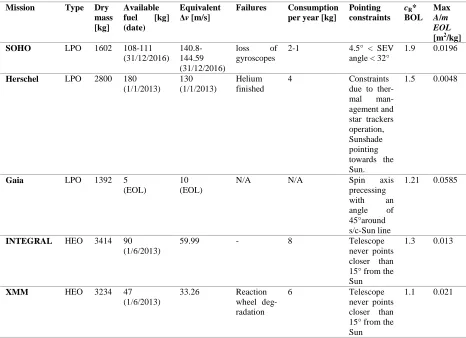
The selected missions for the detailed analysis of disposal strategies are Herschel (past), SOHO (current) and Gaia (current) in the LPO-class and INTEGRAL (current) and XMM-Newton (current) in the HEO-class.
Mission constraints
Table 1. Missions constraints.
Mission Type Dry
mass [kg]
Available fuel [kg] (date)
Equivalent
∆v [m/s]
Failures Consumption
per year [kg]
Pointing constraints
cR*
BOL Max A/m EOL [m2/kg]
SOHO LPO 1602 108-111
(31/12/2016) 140.8-144.59 (31/12/2016)
loss of gyroscopes
2-1 4.5° < SEV angle < 32°
1.9 0.0196
Herschel LPO 2800 180
(1/1/2013) 130 (1/1/2013)
Helium finished
4 Constraints
due to ther-mal man-agement and star trackers operation, Sunshade pointing towards the Sun.
1.5 0.0048
Gaia LPO 1392 5
(EOL)
10 (EOL)
N/A N/A Spin axis
precessing with an angle of 45°around s/c-Sun line
1.21 0.0585
INTEGRAL HEO 3414 90
(1/6/2013)
59.99 - 8 Telescope
never points closer than 15° from the Sun
1.3 0.013
XMM HEO 3234 47
(1/6/2013)
33.26 Reaction wheel deg-radation
6 Telescope
never points closer than 15° from the Sun
1.1 0.021
Mission scenario
The initial conditions considered for SOHO and Herschel, displayed in Table 2, were selected through comparison with the ephemerides provided by the JPL HORIZONS system6. T is the or-bit period in adimensional units. In the case of Gaia mission, a Lissajous oror-bit was computed (see Figure 1) and the corresponding unstable invariant manifold4, in order to match the in-plane and out-of-plane amplitudes.
Table 2. Initial conditions selected for simulating the behaviour of SOHO and Herschel. Non-dimensional units, synodic reference system centred at the Sun – Earth + Moon bary-centre.
Mission Orbit LP T x y z vx vy vz CJ
SOHO Halo
South L1 3.0595858 0.9888381 0 –0.0008802 0 0.0089580 0 3.0008294
Herschel Halo
a) b)
Figure 1. Lissajous orbit selected to simulate the evolution of Gaia. Synodic reference system centred at the Sun – Earth + Moon barycentre. A) 3D representation and b) y-z pro-jection.
The dynamics of HEO with high apogee altitude is mainly influenced by the effect of third body perturbation due to the gravitational attraction of the Moon and the Sun and the effect of the Earth’s oblateness. For the analysis of HEO disposal the suite PlanODyn was developed2, to propagate the Earth-centred dynamics by means of the averaged variation of the orbital elements in Keplerian elements. The perturbations considered are solar radiation pressure, atmospheric drag with exponential model of the atmosphere, zonal harmonics of the Earth’s gravity potential up to order 6, third body perturbation of the Sun and the Moon up to degree 4 of the Legendre polynomial. The code was successfully validated against the ephemerides of INTEGRAL mission from NASA HORIZONS6, and of XMM-Newton mission, given by ESA7.
HEO DISPOSAL THROUGH EARTH RE-ENTRY
HEO missions can be disposed in a definite way through re-entry into the Earth’s atmosphere. This can be achieved by exploiting the natural long-term perturbations to the orbit due to the in-teraction between luni-solar perturbation and the J2 effect, as explained in Ref. 2.
The disposal strategy to re-entry is designed considering a single manoeuvre performed during the natural orbit evolution of the spacecraft. The variation in orbital elements ∆kep due to an im-pulsive manoeuvre at time t is computed through Gauss’ planetary equations written in finite-difference form as
( )
(
m , m,)
kep G kep t f
∆ = ∆v (1)
where f is the true anomaly at which the manoeuvre is given and m ∆v the velocity change de-fined by its magnitude, in-plane and out-of-plane angles. The new set of orbital elements after the manoeuvre kepd
( )
d m
kep =kep t + ∆kep (2)
is propagated for the available interval of time to perform the disposal with PlanODyn. Then, the evolution of the perigee altitude hp
( )
t , starting from the deviated condition in Eq. (2), isminimum perigee altitude that the spacecraft reaches within the allowed available time span for re-entry ∆tdisposal. Due to the natural oscillation of the orbit because of perturbations, the effect of the disposal manoeuvre will be different depending on the time is applied. Therefore, different dates for the disposal manoeuvre were selected within a wide disposal window. For each initial condition corresponding to a certain time, the manoeuvre magnitude ∆v and direction (α and
β ) and the point on the orbit where the manoeuvre is performed f were determined through m
global optimisation. Any reached altitude below 50 km is accepted and the total ∆v is minimised.
In the following only INTEGRAL disposal through Erath re-entry is presented as from the analy-sis, XMM re-entry resulted unfeasible with the available on-board fuel over a time period of 30 years.
INTEGRAL
INTEGRAL orbit future evolution was predicted until 2029. The interval ∆tdisposal considered for the disposal design is from 2013/01/01 to 2029/01/01. The maximum ∆v available for the manoeuvre sequences is estimated to be 61.9 m/s in 2013/01/01 as in Table 1.
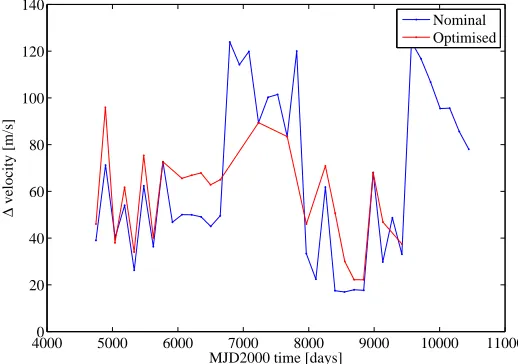
Within the considered ∆tdisposal, re-entry below 50 km is possible with ∆v as little as 40 m/s, as visible in Figure 2 that shows the required ∆v for Earth re-entry as function of the time the manoeuvre is performed between 2013/01/01 and 2028/08/07 (blue line). The disposal solutions can be grouped in four families because they present similar dynamics behaviours, in terms of evolution of orbital elements following the manoeuvre. The best solutions belongs to family 1, which have a re-entry in 2028, with a v∆ between 27 and 73 m/s (depending on the year and month the manoeuvre is given between 2013 and the first half of 2018). Family 2 disposal op-tions, instead, need a higher ∆v to be given between the second half of 2018 and the first half of 2021 to reach the minimum perigee between 2019 and 2020 (quicker re-entry). Colombo et al. showed the dependences on the different families of re-entry conditions upon the orbital elements with respect to the main disturbing body, i.e., the Moon3. The optimal manoeuvre allows increas-ing the amplitude of the oscillations in anomaly of the perigee measured with respect to the Earth-Moon plane and then in eccentricity, so that the eccentricity can be increased up to the critical eccentricity:
(
)
crit = −1 Earth + p, re-entry
e R h a
In particular, when the nominal eccentricity is low, the re-entry manoeuvre tends to further decrease it; as a consequence, the following long term propagation will reach a higher eccentric-ity, corresponding to a re-entry. In this case the manoeuvre is more efficient (i.e., lower ∆v is
re-quired as in family 1). On the other side, when the nominal eccentricity is high, the re-entry ma-noeuvre aims at further increasing it, so that the target minimum perigee is reached after a rela-tively shorter time2.
of-fer the most favourable final conditions. A two-step optimisation was performed. The first opti-misation step consists in running a broad search in true anomaly with a step of 1 degree to obtain the optimal conditions, which possibly lead to re-entry by applying the nominal ∆v manoeuvre
computed in Eq. (1). The second optimisation step applies a quasi-Newton method to re-enter the spacecraft below 150 km by optimising the ∆v manoeuvre performed at the identified optimal
initial condition. In Figure 2 the refined solutions are shown with a red line. Especially for the best re-entry conditions, there is a very good agreement between the nominal solution and the refined solution. There are cases for which the magnitude of the manoeuvres is in the order of 60 m/s which is the maximum available ∆v for INTEGRAL. In the worst cases, instead, an
addi-tional delta-v in the order of 20-30 m/s with respect to the nominal manoeuvre is required.
40000 5000 6000 7000 8000 9000 10000 11000
20 40 60 80 100 120 140
MJD2000 time [days]
∆
velocity [m/s]
[image:6.595.172.431.230.412.2]Nominal Optimised
Figure 2. Required ∆v to de-orbit INTEGRAL. The blue line refers to the nominal solu-tions, the red lines to the optimised solutions.
HEO DISPOSAL THROUGH INJECTION INTO A GRAVEYARD STABLE ORBIT
Another option that is investigated for HEO is a transfer into a graveyard orbit. The existence of long-term stable orbits can be investigated, where the evolution of the orbital elements due to natural perturbation is limited. Such orbits can be chosen as graveyard orbits.
XMM
XMM-Newton mission is planned to be disposed after 2016. The interval ∆tdisposal considered
for the disposal design is from 2013/01/01 to 2033/11/25 and for each starting date analysed a graveyard orbit was designed with the requirement to be stable for 30-year period. The maximum
v
∆ available for the manoeuvre sequences is estimated to be 40.5 m/s in 2013/01/01 considering a year consumption of 6 kg, a specific impulse of 235 s and the current propellant mass shown in Table 1. However, a higher upper bound on the ∆v, equal to three times the available ∆v in 2013/01/01 (estimated to be 122 m/s), was set in the optimisation procedure.
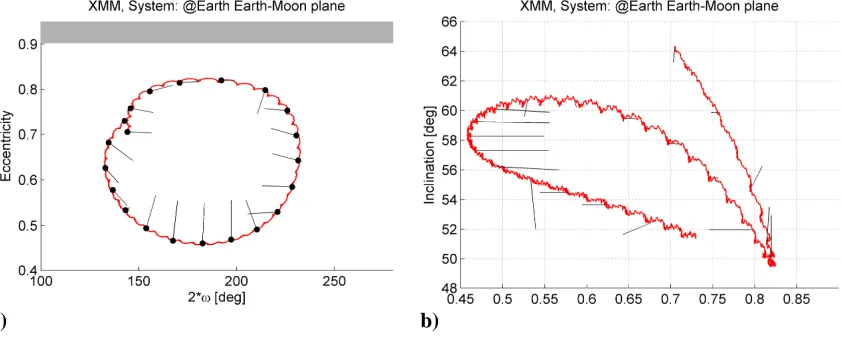
Figure 3 shows the optimal manoeuvre for a transfer into a graveyard orbit for each starting time analysed (i.e., black dots in Figure 3a). The manoeuvre is represented in the phase space of eccentricity, inclination and anomaly of the pericentre with respect to the Earth-Moon pane. As it can be seen the manoeuvre aims at moving the orbit towards the centre of the libration loop in the eccentricity-ω phase space. The magnitude of the manoeuvre is always close to the maximum bound set and from Figure 3a is very clear that, a higher ∆v would allow reaching a more stable orbit. However, the new graveyard orbit reduces at least the oscillations in eccentricity, prevent-ing the spacecraft from an uncontrolled re-entry within the 30-year period. Indeed, it was verified that, after the manoeuvre is performed, the minimum perigee remains above 4000 km.
a) b)
Figure 3. XMM graveyard disposal manoeuvres between 2013 and 2033: Phase space evolution in the eccentricity-2ω-inclination phase space (Earth-Moon plane) a) 2ω -eccentricity and b) -eccentricity-inclination. Red: nominal predicted orbit, black lines: ∆v manoeuvres. The shaded area indicates eccentricities beyond the critical eccentricity for re-entry (at perigee altitude of 50 km).
LPO DISPOSAL THROUGH EARTH RE-ENTRY
Herschel and SOHO
[image:7.595.93.514.342.511.2]fore-seen end-of-life for SOHO. For this, SOHO orbit is assumed to be periodic in the synodic CR3BP reference frame with period equal to 178 days.
A differential correction procedure is implemented to match in position the actual LPO to the unstable invariant manifold of the LPO computed from the initial conditions in Table 2. The ac-tual initial condition for the nominal mission is transformed into a non-dimensional synodic Sun – Earth + Moon reference system and is propagated through the equations of motion correspond-ing to the CR3BP for a time interval between 1 and 30 days. Afterwards, the spacecraft injects into the unstable manifold which leads to re-entry. The variational equations of the CR3BP are propagated together with the equations of motion. A Newton's method is applied to correct the initial velocity of the LPO in the CR3BP frame. In turn, this results in changing the initial veloc-ity of the LPO in the real ephemerides model. The initial condition on the unstable manifold is chosen as the one which minimises such manoeuvre. In particular, changing the time of flight to get to the manifold modifies both the required manoeuvre and the point reached on the manifold. In principle, another manoeuvre would be required to join the manifold also in velocity, but in practice this is not needed. Indeed, the CR3BP allows understanding how to move towards the Earth and, in a second stage, the new initial condition obtained through the differential correction is propagated in a realistic dynamical model accounting for Sun, Earth, Moon and all the planets from Mercury to Pluto, solar radiation pressure, atmospheric drag below an altitude of 2000 km (exponential model), 10 x 10 geopotential if the distance with respect to the centre of the Earth is less than 200 000 km. Whenever an orbit gets to an altitude lower than 100 km in less than a year, the re-entry angle is evaluated as
sin tan
1 cos
e f e f
φ
=+
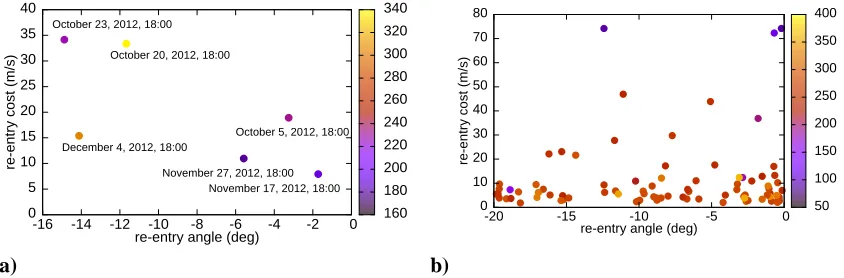
where e is the eccentricity and f the true anomaly. Several re-entry solutions are obtained and the ones associated with an initial manoeuvre smaller than 150 m/s and a re-entry angle in between 0 and -20 degrees are selected. Note, however, that even if re-entry angles with higher magnitude are possible. If the re-entry is designed within the CR3BP dynamical model, then the angle ob-tained for a given transfer is function of the initial phase of departure from the LPO and the shape of the trajectory; however, when the re-entry is designed in the full model, this correspondence is broken. Two factors seems to be responsible for this: the initial manoeuvre and the solar radiation pressure, which, indeed, can modify significantly the trajectories. The re-entry velocity is always about 11.06 km/s at 100 km of altitude.
October 23, 2012, 18:00 October 20, 2012, 18:00
October 5, 2012, 18:00
November 17, 2012, 18:00 November 27, 2012, 18:00 December 4, 2012, 18:00
-16 -14 -12 -10 -8 -6 -4 -2 0 re-entry angle (deg)
0 5 10 15 20 25 30 35 40
re-entry cost (m/s)
160 180 200 220 240 260 280 300 320 340
-20 -15 -10 -5 0
re-entry angle (deg) 0
10 20 30 40 50 60 70 80
re-entry cost (m/s)
50 100 150 200 250 300 350 400
[image:9.595.88.510.90.229.2]a) b)
Figure 4. Re-entry feasible solutions. A) Herschel mission: the colour bar refers to the to-tal time of flight (days) from the libration point orbit to the Earth. B) SOHO mission: the colour bar indicates the starting date on the LPO for the re-entry (years from J2000).
Gaia
The procedure developed for Gaia is slightly different with respect to the one applied for SOHO and Herschel as Gaia cannot re-enter naturally2, since the minimum distance to the Earth without performing any manoeuvre is about 50 000 km. The nominal orbit was assumed to be a Lissajous quasi-periodic orbit (see Figure 1) propagated for about 6 years, to account for the 5.5 years of nominal duration of the mission, plus 6 months to perform the re-entry phase. As at the time of the study, Gaia had not launched yet, two initial epochs for the first point on the Lissajous orbit were assumed, namely 24/12/2013 and 23/01/2014 to reflect the options for the mission launch.
A differential correction method was applied to compute the manoeuvre which allows the re-entry (rather than inserting the spacecraft into the unstable manifold as in the case of Herschel and SOHO). The equations of motion and the corresponding variational equations describing the full dynamical model are used. The re-entry can take place towards the end of the mission; start-ing from the LPO point on 28/03/2018, or, in the second launch scenario, about 1 month later. Each state from this epoch on was propagated for 365 days through the full dynamical model. Note that, the presence of other forces apart from the gravitational attraction of Sun and Earth + Moon causes the spacecraft to naturally leave the libration point orbit onto the unstable invariant manifold. A differential correction procedure was applied to each point of the trajectory discre-tised with 1 day-step, to change the velocity along the tangential direction in order to get to Earth. Figure 5 shows the optimal solutions in terms of cost and re-entry angle. As expected, the op-timal manoeuvres are given in correspondence of a point of the leg of the manifold which repre-sents an apogee of the associated osculating orbit. However, this is not a sufficient condition to obtain a ∆v less than 150 m/s. Nevertheless, in some cases the manoeuvre is nearly zero; it turns
a) b)
Figure 5. Optimal solutions for Gaia re-entry in terms of re-entry cost and re-entry angle
for c A m*R =0.0696 m2/kg, with initial epoch on the LPO on 24/12/2013. The colour bar
re-ports (a) the initial epoch of the re-entry trajectory (year from J2000) and (b) the total time of transfer (days).
LPO DISPOSAL TOWARDS A MOON IMPACT
Disposal options via lunar surface impact and mission extension by capture into lunar orbit were studied in the coupled restricted three-body problem5,9.
In order to approximate the trajectory in 4-body dynamics, trajectories legs deriving from the unstable invariant manifolds leaving the LPO in the Sun – (Earth + Moon) CR3BP and the stable manifolds of a LPO around L2 in the Earth – Moon CR3BP are connected into a single trajectory. The Sun – (Earth + Moon) CR3BP has as primaries the Sun and the Earth – Moon barycentre. Connection between the two models is accomplished via the use of a Poincaré section where the two phase spaces must intersect. The initial orbital phases α0SE and α0EM
of both CR3BPs control the geometry of the connection. This can be reduced to a single parameter α0=α0EM −α0SE as only the relative phasing between Sun-Earth and Earth-Moon systems is necessary10.
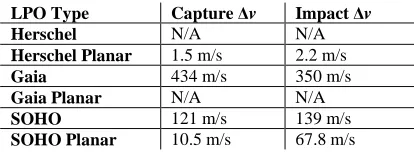
A study was undertaken to create a map of conditions near the L2 libration point which come from the Sun – Earth system and lead to a longer duration quasi-periodic orbit about the Moon or an impact on the lunar surface11. The resulting set of initial conditions, their corresponding orbit lifetime, and their category of decay (i.e., impact or exit via libration points) serves as the basis of designing transfers from Sun – Earth libration point orbit towards the Moon. The Sun – Earth LPO unstable manifold and the trajectory arcs flowing towards chosen lunar target states are computed once and stored. Once this is completed, the transformation of the lunar target state arcs from Earth-Moon to Sun – Earth synodic barycentric reference frame can be quickly per-formed for the entire domain of the orbital phasing angle α0. The lowest possible propellant cost was sought for a number of LPOs (see
Table 3. Overview of lowest propellant cost solutions expressed in m/s in the coupled CR3BP.
LPO Type Capture ∆v Impact ∆v
Herschel N/A N/A
Herschel Planar 1.5 m/s 2.2 m/s
Gaia 434 m/s 350 m/s
Gaia Planar N/A N/A
SOHO 121 m/s 139 m/s
SOHO Planar 10.5 m/s 67.8 m/s
Then, an investigation of the possibility to impact the Moon is pursued based on the actual ephemeris information. Using a full body model, a global optimisation routine is used to intro-duce a perturbation on the LPO at a given date, the direction and magnitude is selected such that the spacecraft proceeds towards the Moon and impacts upon its surface. It should be noted that although lunar surface impact is achieved here by using a single manoeuvre, a second manoeuvre at a later date will likely be necessary to serve as trajectory correction manoeuvre, or to aim the spacecraft at a particular region on the lunar surface. Note that, with respect to the design in the CR3BP, here a larger manoeuvre is used to depart from the LPO as opposed to a small perturba-tion in order to bring the spacecraft from the LPO towards the Earth along the flow of the unsta-ble manifold.
In addition to ranking solutions based on characteristics such as time of flight and ∆v cost, a
metric named the C3 value may also be used12, using the orbital elements of the spacecraft state just before impact as:
(
)
2 2
2
3 2
1 1
1
2 2 2 2
v
C e
r h a
µ µ µ
ε
= = − = − − = − (3)
The C3 value provides an indication of the robustness of the transfer: the lower the value, the more ballistic the capture at the Moon is, and thus the more robust the transfer is in case of con-tingencies. In the case of missing the lunar surface, a trajectory with low C3 value will be quasi-captured by the Moon allowing for further small manoeuvres to impact the spacecraft upon the lunar surface. This value is useful as another parameter to compare one particular transfer with another.
Herschel
Herschel disposal through Moon impact was designed from 01/08/2009 to 01/02/2013. An overview of the solutions found for Herschel is shown in Figure 6, which shows the date of de-parture from the LPO on the x-axis and the time of flight and the C3 value before lunar surface impact on the y-axis. Each solution is colour-coded according to the ∆v cost to bring the
[image:11.595.193.400.172.248.2]3500 4000 4500 50 60 70 80 90 100 T [MJD2000]
ToF [day] ∆ v [m/s]
32.79 35 40 45 50 55 60 65 70 75 80 85 90 95 99.62
3500 4000 4500
−0.5 0 0.5 1 1.5 2 2.5 3 T [MJD2000] C 3 [km 2/s 2] ∆ v [m/s] 32.79 35 40 45 50 55 60 65 70 75 80 85 90 95 99.62
a) b)
Figure 6. A) Time of flight and b) C3 value to impact the Moon as a function of the time
of departure from the Herschel LPO in MJD2000. Solutions are colour-coded according to
the ∆v cost in m/s.
SOHO
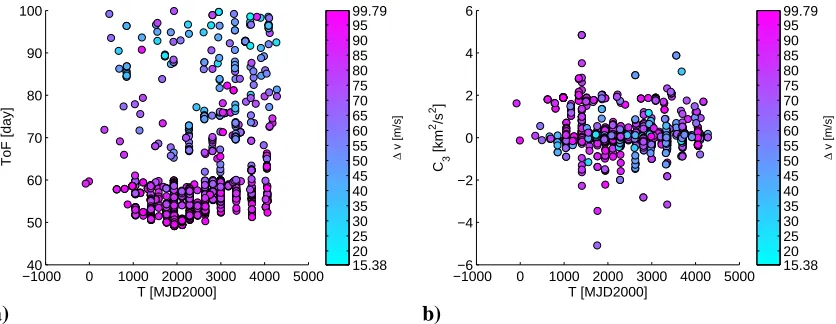
The dates considered for the analysis of disposal manoeuvres for SOHO to Moon impact are from 26/09/1998 to 01/01/2012. Such window does not correspond to the disposal window; how-ever, it is appropriate to study the behaviour of the solution space and the required ∆v. Figure 7
shows the solutions for SOHO.
−100040 0 1000 2000 3000 4000 5000 50 60 70 80 90 100 T [MJD2000]
ToF [day] ∆
v [m/s] 15.38 20 25 30 35 40 45 50 55 60 65 70 75 80 85 90 95 99.79
−1000−6 0 1000 2000 3000 4000 5000 −4 −2 0 2 4 6 T [MJD2000] C3 [km 2/s 2] ∆ v [m/s] 15.38 20 25 30 35 40 45 50 55 60 65 70 75 80 85 90 95 99.79
a) b)
Figure 7. A) Time of flight and b) C3 value to impact the Moon as a function of the time
of departure from the SOHO LPO in MJD2000. Solutions are colour-coded according to
the ∆v cost in m/s.
Gaia
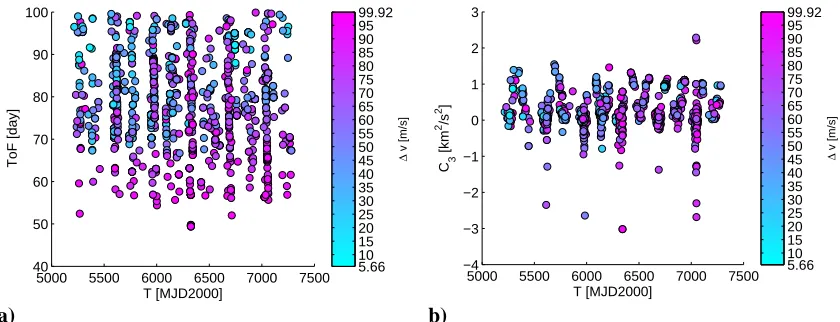
[image:12.595.93.510.91.257.2] [image:12.595.92.510.404.566.2]5000 5500 6000 6500 7000 7500 40 50 60 70 80 90 100 T [MJD2000]
ToF [day] ∆ v [m/s]
5.66 10 15 20 25 30 35 40 45 50 55 60 65 70 75 80 85 90 95 99.92
5000 5500 6000 6500 7000 7500 −4 −3 −2 −1 0 1 2 3 T [MJD2000] C3 [km 2/s 2] ∆ v [m/s] 5.66 10 15 20 25 30 35 40 45 50 55 60 65 70 75 80 85 90 95 99.92
a) b)
Figure 8. A) Time of flight and b) C3 value to impact the Moon as a function of the time
of departure from the Gaia LPO in MJD2000. Solutions are colour-coded according to the
∆v cost in m/s.
LPO DISPOSAL TOWARDS THE INNER OR THE OUTER SOLAR SYSTEM
Another option is to dispose the spacecraft away from the Earth exploiting the CR3BP dynam-ics, and then ensuring it does not return to Earth. This strategy was first proposed by Olikara et al.13. This concept can be effectively explored in the CR3BP, where the energy of spacecraft is directly related to the zero velocity surfaces of the system. If the energy of the spacecraft is brought to the appropriate level, the zero velocity surfaces will be closed around the Earth pre-venting movement from and to it. If the zero velocity surfaces are closed when the spacecraft is outside the interior region near the Earth the spacecraft will not return to the Earth. The amount of
∆v necessary is computed from the Jacobi constant. The spacecraft in its LPO can be placed on
one of the unstable manifold legs that flow from the LPO. One branch will lead towards the inner solar system, while the other towards the outer solar system. As the spacecraft moves away from the LPO, the ∆v to change the Jacobi constant can be computed at any time along any point of the
manifold as ∆vreq = vactual −vreq were vactual is the actual velocity of the spacecraft along the manifold and the required velocity can be determined from
(
)
2 2 2 2 2 2 1
2
req J closed
S E
v x y z x y C
r r
µ µ
−
= + + = + + + −
ɺ ɺ ɺ
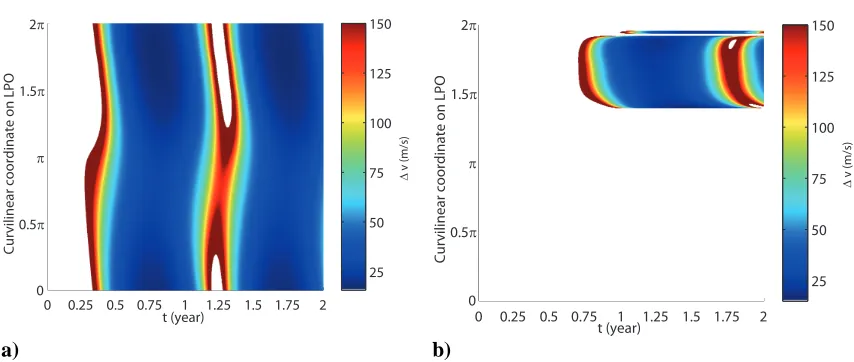
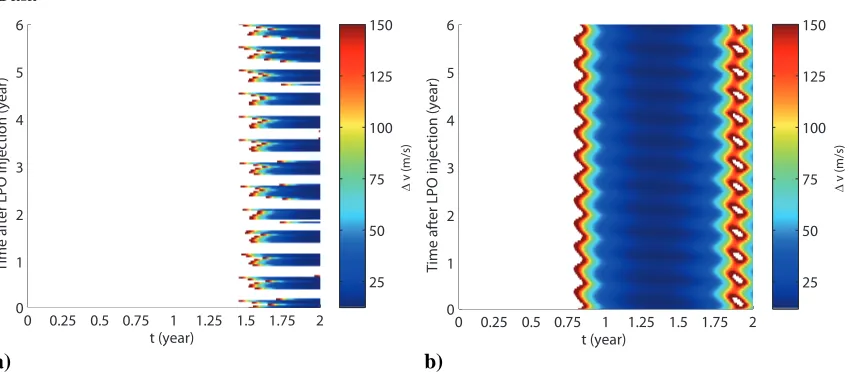
This procedure was applied to study SOHO, Herschel, and Gaia disposal. For a period of 2 years after leaving the LPO, the ∆v to close the surfaces of Hill is computed for both branches of
unstable manifold. In the following sections a value for the ∆v can be read for each plot based on
[image:13.595.89.509.94.255.2]Herschel
0 0.25 0.5 0.75 1 1.25 1.5 1.75 2 t (year)
∆
v (m/s)
25 50 75 100 125 150
0
π
Curvilinear coordinate on LPO
2π
1.5π
0.5π
0 0.25 0.5 0.75 1 1.25 1.5 1.75 2 t (year)
∆
v (m/s)
25 50 75 100 125 150
0
π
Curvilinear coordinate on LPO
2π
1.5π
0.5π
[image:14.595.88.513.94.279.2]a) b)
Figure 9. ∆v cost for Herschel mission to close the surfaces of Hill as function of the time after departure from the LPO and position of departure on the LPO. Disposal towards a) the inner solar system and b) the outer solar system.
SOHO
0 0.25 0.5 0.75 1 1.25 1.5 1.75 2 0
π
t (year)
Curvilinear coordinate on LPO
∆
v (m/s)
25 50 75 100 125 150 2π
1.5π
0.5π
0 0.25 0.5 0.75 1 1.25 1.5 1.75 2 t (year)
∆
v (m/s)
25 50 75 100 125 150
0
π
Curvilinear coordinate on LPO
2π
1.5π
0.5π
a) b)
[image:14.595.87.514.356.537.2]Gaia
0 0.25 0.5 0.75 1 1.25 1.5 1.75 2 0
1 2 3 4 5 6
t (year)
Tim
e a
fter LPO injection (year)
∆
v (m/s)
25 50 75 100 125 150
0 0.25 0.5 0.75 1 1.25 1.5 1.75 2 0
1 2 3 4 5 6
t (year)
Tim
e a
fter LPO injection (year)
∆
v (m/s)
25 50 75 100 125 150
[image:15.595.91.516.98.284.2]a) b)
Figure 11. ∆v cost for Gaia mission to close the surfaces of Hill as function of the time af-ter departure from the LPO and position of departure on the LPO. Disposal towards a) the inner solar system and b) the outer solar system.
LPO DISPOSAL TOWARDS THE OUTER SOLAR SYSTEM THROUGH SOLAR RADIATION PRESSURE
In previous section, it was investigated the LPO End-Of-Life (EOL) disposal which aims to close the Hill’s curves to prevent the spacecraft’s Earth return. Olikara et al.13 proposed a similar study that includes a sensitivity analysis on the effectiveness of using the restricted three-body problem as an approximation of the spacecraft’s dynamics. The closures of the zero-velocity curves are performed with a traditional ∆v manoeuvre and the curves can be closed either at L1 or in L2. Thus, the spacecraft can be confined inside the solar system (L1 closure) or outside the Sun-Earth system (L2 closure).
In this section, an alternative propulsion option is investigated to perform a quasi propellant-free manoeuvre that closes the zero-velocity curves enhanced by Solar Radiation Pressure (SRP). The manoeuvre is performed through the deployment of a sun-pointing and auto-stabilised reflec-tive structure that allows the change in the overall energy of the system. Note that, in this case, the energy is augmented rather than decreased as in the traditional case, because the acceleration of SRP is now included in the dynamics and it is sensitive to the area-to-mass ratio of the space-craft. Therefore, the deployment of an EOL reflective area changes the shape of the potential function by increasing the energy of the system. The effect of the deployed sun-pointing EOL area is in shifting the position of the collinear Libration points along the x-axis, therefore the clo-sure of the Hill’s curves occur at the so-called pseudo Libration-point (SL). However, due to the constrains in the acceleration of SRP, the spacecraft is always confined to stay on the right side of the pseudo Libration point; thus, SRP can be exploited only when the LPO disposal is toward the outer Sun – Earth system or, in other words, when the closure is performed at SL2 14. This strat-egy was studied for Herschel, Gaia and SOHO. After the injection of the spacecraft onto the un-stable trajectory, thanks to a ∆v manoeuvre (quasi propellant-free strategy) from a starting point
of the periodic orbit, the minimum EOL area required to close the Hill’s curves in SL2 is found through numerical optimisation.
Figure 12 shows the results in the case of Gaia in term of required area-to-mass and equivalent
quantifies changes in the energy of the system14. This makes easier to compare this strategy with the traditional propulsion-based strategy. From our analysis, spacecraft’s similar to Gaia requires a minimum of 10 m-span (i.e., square flap) of additional area from its original 69 m2 sunshade to perform the closure at SL2. Instead, Herschel and SOHO require a delta area of 28.64 m-span and 20.65 m-span, respectively. Ikaros mission demonstrated the deployment of a 20-m span of a squared sail; therefore, spacecraft similar to Gaia can potentially be more likely to use an EOL device.
Current studies are aimed at including the effect of the Earth’s eccentricity into the design of the EOL area, in order to determine an area margin that prevent the opening of the zero-velocity curves due to perturbations related to the full-body dynamics.
a) b)
Figure 12. Gaia disposal through SRP. A) Required area-to-mass ratio for the closure of the Hill’s curves and b) equivalent ∆v.
DISPOSAL STRATEGIES TRADE-OFF
Based on the analysis on the selected mission, some preliminary guidelines for future and cur-rent missions can be drawn. As a general output of this study:
− Mission extension can be seen as sustainability of the whole program. HEO and LPO missions without a planned end-of-life disposal are not sustainable if seen in the framework of the fu-ture exploitation of HEO and LPO regions. Moreover, by optimising the disposal phase of the mission, the same or slightly higher mission cost could allow extra output from the scientific and operational point-of view. End-of-life disposal strategies should be seen as an extension of the mission.
− On the other hand, it should be considered that the cost of the disposal is not only the addi-tional delta-v, but also the operations, and the resources required to maintain the mission team; moreover, the extension of a mission is subjected to several constraints such as budget and geo-return. Some of them, such as mission constraints and disposal requirements have been taken into account in the present study: Some strategies were discarded based on the opera-tional cost they would require, however this should be estimated more precisely.
proposed in this study are in strict relation among them as it is possible to transfer from one leg to another.
HEO
XMM perigee is much higher than INTEGRAL and this makes more difficult a disposal through re-entry. Predicting the future, it is more likely to expect more missions with high perigee to be outside the radiation belt. This means that more scenarios such as LPO or high perigee HEO are expected and the trade-off between a safe environment for observations and a good configura-tion for disposal should be considered. This issue highlights the importance to plan in advance the disposal strategy; indeed the exploitation of luni-solar perturbation can decrease the required ma-noeuvre for re-entry. However, due to the long period for the natural oscillations, the mama-noeuvre should be planned in advance. Through the gravitational of the Moon, HEO can also inject to transfer orbits which reaches LPO in the Earth – Moon and the Earth – Sun system. Therefore, in general, HEO and LPO missions should not be considered as separate classes, rather general guidelines should be adopted. This is also valid for other classes of missions; for example, HEOs, during re-entry interact with the MEO environment. Moreover, other kind of HEOs should be studied, such as Molniya type orbit and disposal orbit for launcher upper stages, which are quite common and have a stronger interaction with the MEO and LEO environment. As disposal strategies, re-entry should be preferred over graveyard orbit injection, as a definite and sustain-able solution.
LPO
There are several considerations to take into account when choosing between impacting a spacecraft from LPO upon the Earth’s or Moon’s surface. For the missions analysed, LPO trans-fer towards a Moon impact or an Earth re-entry have similar propellant costs. The former are generally characterised by a shorter time-of-flight than Earth-re-entry options, which may lead to savings in operating the spacecraft. Disposal through Moon impact may be more difficult from a navigation point of view; however, specific re-entry angles at the Earth should be targeted so that the last phase of the trajectory is over inhabited zones. Direct Earth re-entry solutions exist; there-fore, uncertainties on the ground area can be reduced with respect to re-entry from MEO and LEO.
To reduce operational costs for Moon impact disposal it is advised to use as much propellant as available (whilst still leaving a reserve for trajectory corrections) when leaving the LPO. This not only reduces the total transfer duration, but limits the time spent in the vicinity of the LPO, where motion is more chaotic and harder to control.
Disposal towards the inner or the outer solar system with delta-v manoeuvre to close the Hill regions are generally feasible as they require low delta-v budget. However, the problem of such disposal option is that the spacecraft maintains a 1:1 resonance with the Earth and may return in several years. For this reason, an additional ∆v should be taken into account to consider the effect
of perturbations on the long-term evolution of the orbit. The option of LPO disposal towards the outer solar system through solar radiation pressure is not feasible for current spacecraft, but could be implemented on future spacecraft as it is a no-cost solution, as long as the reflective area on-board the spacecraft can be further extended at the end-of-mission. After the device deployment, the disposal can be completely passive if the devised is self-stabilised to be Sun-pointing attitude. It is expected that if the device is deployed further from the starting LPO, the area-to-mass re-quirements would be decreased.
CONCLUSION
This paper proposes a series of end-of-life disposal strategies for Highly Elliptical Orbits and Libration Point Orbits. Some mission scenarios are analysed, namely INTEGRAL and XMM-Newton as HEO and SOHO, Herschel and Gaia as LPO. An evaluation of disposal strategies for each of mission scenario is presented. In addition, where possible, a parametric analysis is per-formed that allows defining optimal disposal strategies as a function of the orbital parameters and the delta-velocity. A further study will aim at analysing the influence of the orbit characteristics and spacecraft parameters on the effectiveness, safety, feasibility and sustainability of the dis-posal. In light of the objective of sustainability it appears reasonable to postulate a permanent re-moval of the hardware from the space environment as a main objective for the end of life strat-egy. For HEO missions this can be achieved by a controlled or semi-controlled re-entry into the Earth atmosphere. For LPO missions, the feasibility of a controlled re-entry to the Earth depends on the operational orbit and the spacecraft capabilities at EOL. If a re-entry is not possible, a permanent removal from the space environment can be achieved by lunar impact. If such a dis-posal is performed in line with a sustainable conduct of avoiding heritage sites and sites of high scientific interest it can be considered more sustainable than the semi-permanent solution of using a parking orbit.
ACKNOWLEDGMENTS
C. Colombo acknowledges the support received by the Marie Curie grant 302270 (SpaceDe-bECM - Space Debris Evolution, Collision risk, and Mitigation). The authors acknowledge the use of the IRIDIS High Performance Computing Facility, and associated support services at the University of Southampton, in the completion of this work. This work was initiated as part of a study for the European Space Agency named “End-Of-Life Disposal Concepts for Lagrange-Point and Highly Elliptical Orbit Missions” (Contract No. 4000107624/13/F/MOS). The authors would like to acknowledge the ESA staff K. Merz and I. Carnelli.
REFERENCES
1 Canalias E., Gomez G., Marcote M., Masdemont J. J., "Assessment of mission design includ-ing utilisation of libration points and weak stability boundaries", European Space Agency, the Advanced Concepts Team, Ariadna Final Report (03-4103a), 2004 [Last assessed 12 Decem-ber 2013].
2 Colombo C., Letizia F., Alessi E. M., Landgraf M., "End-of-life Earth re-entry for highly el-liptical orbits: the INTEGRAL mission", The 24th AAS/AIAA Space Flight Mechanics Meeting,
3 Colombo C., Alessi E. M., Landgraf M., "End-of-life Disposal of spacecraft in Highly ellipti-cal Orbits by Means of Luni-Solar Perturbations and Moon Resonances", Sixth European Conference on Space Debris, ESA/ESOC, Darmstadt, Germany, 22-25 April 2013.
4 Jorba A., “Numerical computation of the normal behaviour of invariant curves of n-dimensional maps”, Nonlinearity, Vol. 14, pp. 943-976, 2011, doi: 10.1088/0951-7715/14/5/303.
5 Koon W. S., Lo M. W., Marsden J. E., Ross S. D., “Low energy transfer to the Moon”,
Celes-tial Mechanics and Dynamical Astronomy, Vol. 81, n. 1-2, pp. 63-73, 2001.
6 Jet Propulsion Laboratory, “Horizons Web-Interface”. [Online]. Available: http://ssd.jpl.nasa.gov/horizons.cgi [Last accessed: 09/12/2013]
7 Mertz K., Personal communication (email), 2 July 2013
8 Colombo C., Lewis H., Letizia F., Soldini S., Gössnitzer L., Alessi E. M., Rossi A., Dimare L., Vasile M., Vetrisano M., Van der Weg W., McInnes C., Macdonald M., Landgraf M., "End-of-life disposal trajectories for libration point and highly elliptical orbit missions", The
64th International Astronautical Congress, 2013, Beijing, China, IAC-13.A6.P.24.
9 Castelli R., “On the Relation Between the Bicircular Model and the Coupled Circular Re-stricted Three-Body Problem Approximation”, Nonlinear and Complex Dynamics, pp. 53-68, Springer New York, 2011.
10 Fantino, E., Gomez, G., Masdemont, J. J., Ren, Y., “A note on libration point orbits, tempo-rary capture, and low-energy transfers”, Acta Astronautica, pp. 1038-1052, 2010.
11 Van der Weg W., Vasile M. "Earth-Sun L1 and L2 to Moon Transfers Exploiting Natural Dy-namics", The 64th International Astronautical Congress, 2013, Beijing, China, IAC-13.C1.8.6.
12 Van der Weg W. J., Vasile M., “Contingency and recovery options for the European Student Moon Orbiter”, Acta Astronautica, Vol. 94, n. 1, 2014, pp. 168-183.
13 Olikara Z., Goméz G. and Masdemont J. J., “End-of-life disposal of libration point orbits spacecraft ”, The 64th International Astronautical Congress, IAC-13.C1.82, Beijing, China,
23-27 September, 2013.
14 Soldini S., Colombo C., Walker S., Landgraf M., “Libration-Point Orbit missions disposal at the end-of-life through solar radiation pressure”, 2nd International Academy of Astronautics Conference on Dynamics and Control of Space Systems, (DYCOSS),