City, University of London Institutional Repository
Citation
: Pratt, R.A.L (2010). On Becoming a Reflexive Practitioner. (Unpublished
Doctoral thesis, City, University of London)This is the accepted version of the paper.
This version of the publication may differ from the final published
version.
Permanent repository link:
http://openaccess.city.ac.uk/17886/Link to published version
:
Copyright and reuse:
City Research Online aims to make research
outputs of City, University of London available to a wider audience.
Copyright and Moral Rights remain with the author(s) and/or copyright
holders. URLs from City Research Online may be freely distributed and
linked to.
City Research Online: http://openaccess.city.ac.uk/ [email protected]
On Becoming a Reflexive Practitioner
Rebecca Anne Louise Pratt
Research thesis submitted in fulfilment of the requirements for the Professional
Doctorate in Counselling Psychology.
Department of Psychology City University
Table of Contents.
Index of Appendices... 5
List of Figures... 6
Acknowledgements... 7
Declaration... 8
Section A – Preface... 9
Section B – Research... 15
Quest for Balance: A Grounded Theory Approach to the Adult Only Child Experience Abstract ... 16
Chapter One – Introduction... 17
Overview ... 17
1.1. The stereotype ... 17
1.2. Possible explanations for the stereotype ... 18
1.3. Implications of the stereotype ... 19
1.4. Birth order research ... 20
1.5. Siblings research... 22
1.6. Quantitative research ... 24
1.7. Qualitative research ... 28
1.8. The only child in the media ... 30
Chapter Two – Methodology... 32
Overview. ... 32
2.1. Development of the Research Question ... 32
2.2. Qualitative Methodology... 33
2.3. Qualitative Methodology and Counselling Psychology ... 35
2.4. Grounded Theory Methodology ... 36
2.5. Grounded Theory Methodology and Counselling Psychology ... 38
2.6. Epistemological Underpinnings ... 39
2.8. Appropriateness... 41
2.9. Reflexive Statement ... 42
Chapter Three – Research Methods and Design... 49
Overview ... 49
3.1 The Process... 49
3.2. Ethics ... 50
3.3. Sampling and Participants ... 51
3.4. The Interview ... 54
3.5. Memo writing ... 55
3.6. Use of Literature... 56
3.7. Quality Control... 57
Chapter Four – Data Analysis... 60
Overview ... 60
4.1. Initial Coding... 60
4.2. Memos and Diagrams... 69
4.3. Focused Coding ... 72
4.4. Theoretical Sampling ... 73
4.5. Development of Core categories and Sub categories ... 73
4.6. Saturation... 75
Chapter Five – Theoretical Model and Category Formation... 76
Overview ... 76
5.1. The Model ... 76
5.2. Core Category – Aloneness ... 78
5.2.1. Major Category – Need for Space ... 79
5.2.2. Major Category – Self-sufficiency ... 80
5.2.3. Major Category – Loneliness ... 82
5.3. Core Category – Encountering Others ... 84
5.3.1. Major Category – Effortful... 85
5.3.2. Major Category – Control ... 87
5.3.3. Major Category – Connection/ Disconnection ... 89
5.5. Impacting Factors ... 92
5.5.1. Stereotypes ... 92
5.5.2. Parents ... 93
5.5.3. Societal Changes ... 94
Chapter Six – Discussion... 96
Overview ... 96
6.1. Solitude... 96
6.2. Socialisation ... 98
6.3. Self Reliance and Self Sufficiency ... 100
6.4. Normalising and Witnessing ... 102
6.5. A Homogeneous Group ... 102
6.6. Wider Societal Changes ... 103
6.7. Relating the Model to the Therapeutic Relationship... 104
6.8. Wider Issues ... 107
6.9. Limitations of the Research... 109
6.10. Implications for Counselling Psychology ... 110
6.11. Future Research Directions ... 111
6.12. Reflections on the Process as Researcher and Only Child ... 112
6.13. Conclusion... 112
References ... 114
Appendices ... 129
Section C – Professional Practice... 135
Difficulties with Interpersonal Relationships and Conditions of Worth ... 136
Process Report: Transparency and Process Identification within a Person-Centred Therapeutic Relationship... 149
Section D – Critical Literature Review... 167
Index of Appendices
Flyer... 130
Preliminary Interview Schedule ... 131
Consent Form ... 132
Initial Handwritten Cluster Diagrams for Interview Two and Three ... 133
List of Figures
2.9.1. Journal Extract ... 45
3.1.1. The Grounded Theory Stages... 49
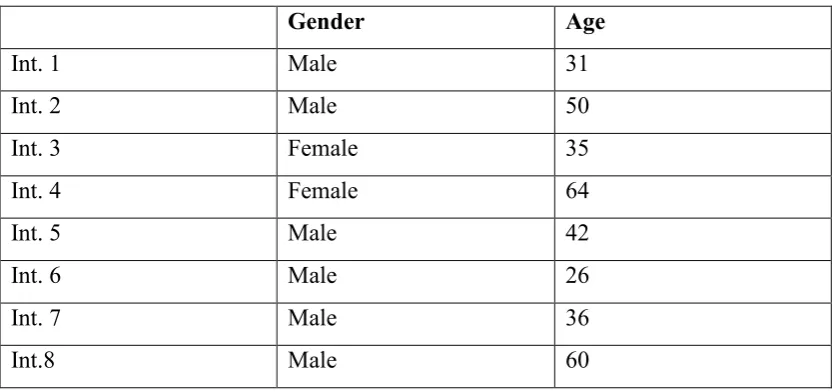
3.3.1. Participant Demographics ... 53
4.1.1. Extract from Interview One... 61
4.1.3. Extract from Interview Two ... 64
4.1.4. Memo Extract – Societal Changes ... 65
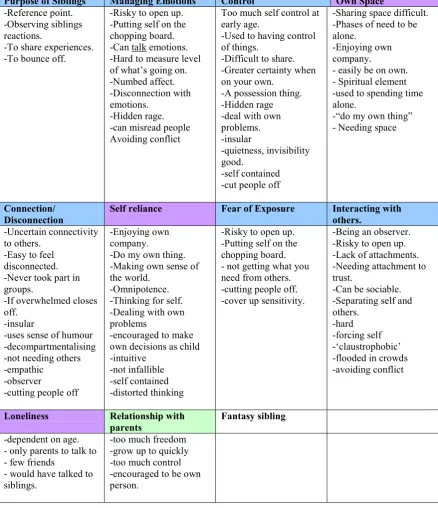
4.1.5. Low-level categories from Interview Two ... 66
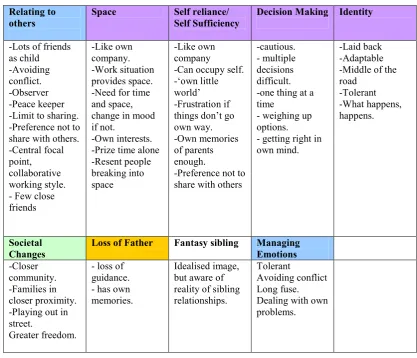
4.1.6. Low-level categories from Interview Three ... 67
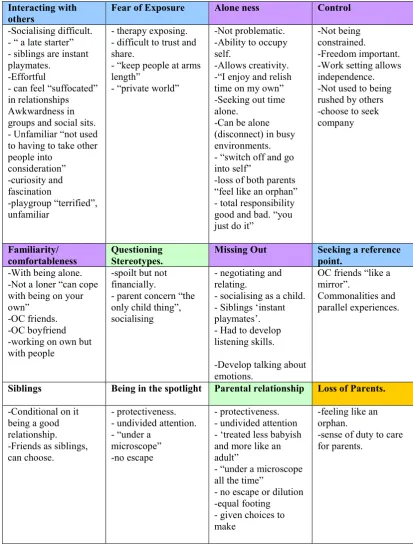
4.1.7. Low-level categories from Interview Four... 68
4.2.1. Memo Extract – Needing Space ... 69
4.2.2. Memo Extract – Time Alone... 71
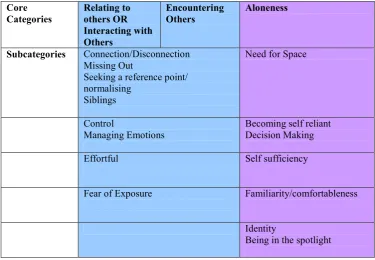
4.5.1. Developing core categories ... 74
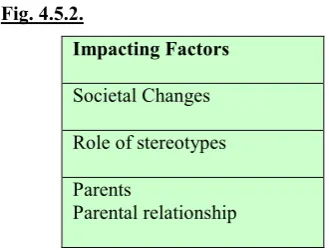
4.5.2. Impacting factors ... 75
City, University of London Northampton Square London EC1V 0HB United Kingdom
T +44 (0)20 7040 5060
THE FOLLOWING PARTS OF THIS THESIS HAVE BEEN REDACTED FOR
COPYRIGHT REASONS:
Quote from Albert Szent-Gyorgyi)………15
Quote from Gilliand, James and Bowman, 1989………..166
THE FOLLOWING PARTS OF THIS THESIS HAVE BEEN REDACTED FOR
DATA PROTECTION REASONS:
Acknowledgements.
I would first like to thank all of my research participants for giving me their time
and allowing me an insight into their personal experiences of being an only child.
To Susan my research supervisor, who has probably been more of a support than
she realises. On the practical side, thanks to the “G.T. Gang”, Eva, Louise and Sarv
(even though she defected to the dark side of IPA!) whose constant support and
guidance has been invaluable. On a more personal note, thanks to my parents for
their unending support, both emotional and financial throughout my prolonged
academic life. And last, but not least, to my good friend Ayasha who has helped me
through a very difficult time in my life and put up with the mound of paperwork and
Declaration of Powers of Discretion
I grant powers of discretion to the University Librarian to allow this thesis to be
copied in whole or in part without further referral to the author. This permission
covers only single copies made for study purposes subject to normal conditions of
Section A - Preface
“He who would know the world, seek first within his beings depths;
he who would truly know himself, develop interest in the world”
Overview.
The purpose of this section is to summarise each of the elements included in
this portfolio, research, professional practice and critical literature review. I will
then move on to explain the thread that runs throughout the pieces linking the
portfolio together.
The Research.
In our society the numbers of what have been named ‘beanpole’ families
(those made up of only one child), has increased and is expected to continue doing
so (Carvel, 2003). According to a British only child website, recent figures in the
press, report that the numbers of families in western societies with one child are
estimated at 17% in Britain and that last year there were 300,000 more households
with one child than in the year 2000. The trend continues across Europe, with
similar figures in Germany and Portugal (www.beinganonly.com). However, these
only children will be born into a society where there are many ‘taken-for-granted’
beliefs, as to what they are like, spoilt, unsociable and selfish (Laybourn, 1994;
Sifford, 1989). These assumptions and preconceptions appear to be stronger and
more negative for only children rather then other birth order positions.
Much of the existing research on the only child appears to have focused on
disproving the stereotypes. In order to achieve this, it has predominantly relied on
quantitative methodologies to make comparisons between only children and those
with siblings, in relation to cognitive and personality development. The overall
findings are that there is in fact, very little difference between the two groups.
Though this is interesting research, it does not further our knowledge of the actual
experiences of the only child and in particular the only child as an adult. In order to
change this, more recent research has begun to recognise the potential of using
qualitative methods to focus on the subjective experience. Sorensen (2008) used a
narrative approach to look at the experiences of female adult only children. Overall
she presents the experience as being different and that only children do miss out by
not having siblings.
The impetus for this research was the strong message that something was
co-researchers. On a personal level (I am an only child) this interested me as it did not
resonate with my own experiences. As I am also a counselling psychologist in
training, I was interested on a professional level, to further our knowledge about the
only child for when we encounter them in the therapy room; due to the increasing
numbers of only children this will be happening with greater frequency. The
decision was made to adopt Grounded Theory Methodology (Glaser & Strauss,
1967) for the study as this was most appropriate to address the research question. I
wished to move on from the narrative approach of Sorensen, which sort to give a
voice to the unheard only child, in order to look at the social processes within the
adult only child experience.
Client Case Study and Process Report
These two pieces provide examples of my clinical work with a single client
that I have named Anne (all identifiers have been changed to preserve client
anonymity) and are a reflection of my development within the person-centred
approach. The personal and professional journeys I have taken through the training
have caused me to move beyond the work of Carl Rogers and include the more
recent work of Rennie (2007) and Mearns and Cooper (2006). I have therefore
sought to develop a more experiential focus; allowing myself to work in the here
and now with my clients and ultimately move beyond surface observation to work
at relational depth. This has only been possible by developing a greater degree of
reflexivity through training and supervision, than was present in the initial stages of
my training. These early experiences with clients were full of trepidation and
caution, as there was a greater focus on acquiring techniques, resulting in a lack of
‘naturalness’ with clients. However, as time has progressed, I have been able to
bring more of myself into the therapy room and am much more congruent in the
relationship. Greater transparency has been important and I am more willing and
able to share my felt responses with my clients when it is appropriate to do so.
The critical literature review.
This explores the literature around the use and non-use of therapist
self disclosure and it becomes evident that there are many similarities on how and
when it can be used. The discussion then moves on to clarify the varying
definitions that exist and how this can make comparing studies difficult. The
research has been dominated by quantitative, analogue designs, which limits their
usefulness in relation to a real therapy context. Few studies have used qualitative or
mixed designs in order to explore real therapy sessions. The ones that have, found
that self-disclosure had the main effect of strengthening the alliance between
therapist and client. A consistent point is also made regarding a need for the
therapist to possess a high degree of reflexivity, in order to decide when it is
appropriate to make a disclosure, that is to say, when it would be beneficial for the
client and not serving a need within the therapist.
The Thread.
The thread that runs throughout the portfolio is my own process of
developing as a reflexive practitioner.
In a therapy session I am sometimes required to lead, at other times it is the
client, but for most of the journey we walk side by side as I hold the lantern to shine
the way. It is a collaborative process where I learn as much about myself as the
client does about herself. Ultimately what I have learnt is that being a therapist is
not a separate part of my identity, it is not a persona I put on when I walk through
the door and drop after fifty minutes. This has been noted to be common within
many trainee therapists (Mearns & Cooper, 2005). I have found that as I have
become more comfortable in the therapy room, I have begun to develop a greater
fluidity to my approach, being able to draw on a range of internal and external
resources. I have been able to develop in my clinical work and the person centred
approach, as previously stated and learn more about what appears to be on the
surface a simple approach to understanding the complexities of working at varying
depths with a client.
Through the research, I have learnt much about how adult only children
experience the world and how they construct relationships with others. As I have
engaged in this process it has also been necessary for me to reflect on my own
experiences as an only child; an aspect of my identity that I had not previously
have found particularly challenging which link to my personal experiences of being
an only child. I have been required to open up and expose more of myself then I
have ever done before in regard to personal therapy and clinical supervision. In
particular I have needed to reach out to others for guidance and move away from
the ‘self sufficient role’ that I have commonly adopted. As an only child I feel that
I have always engaged in a high degree of self-reflection but this has previously
been an internalised process. It has become necessary for me to vocalise these
processes and risk exposing myself to others. With regard to the strengths that I
bring as an only child, colleagues have often commented on the calmness and
containment I bring to the work. Being able to distance myself from others has
been useful and can be seen as necessary for self-preservation as a therapist
(Wheeler, 1997). David Mearns (an only child) has also commented on these
aspects of the only child experience and writes of the part of him that can exist in
‘total isolation’ (2005, p.148) and it is this part that enables him to remain calm in
fearful situations and to contain large amounts of distress.
As I have learnt more about myself, it has enabled me to have more to offer
to my clients. I now have much greater awareness of how the therapeutic encounter
evolves, and emotions and associations are stimulated in the therapist. Also how
similarities and differences arise between client and therapist, which can enhance or
paralyse the process (Kantrowitz, 1997). Anderson and Goolishian (1992) stress
how the therapist takes on the ‘not knowing position’ to facilitate the process but
that this requires openness, willingness to let go of prior experiences and the
development of a strong knowledge base. Wheeler (1997) highlights
self-awareness and possessing sufficient personal insight as being key parts of therapist
competence. The importance of developing self-awareness is also linked to the
literature review relating to therapist self disclosure. This highlights its strength,
when used appropriately, in strengthening the therapeutic alliance. This is
significant as previous research as found that a strong therapeutic alliance is a key
predictor for a positive outcome in psychotherapy (Roth and Fonagy, 2005).
Consequently by learning more about myself I have been able to develop as a
therapist. Alongside this greater personal insight has been the acquisition of new
skills and building a solid theoretical knowledge base from which to interact with
As you will also see I have selected quotes for each of the sections within
the portfolio, beginning with the quote by Rudolf Steiner. This quote in particular
relates strongly to the experience of the only child and the balance that they attempt
to achieve between knowing the internal and external world. On a personal level, it
relates to the depth of reflection I have been encouraged to engage in through
training and it certainly has heightened my interest in the world of experiences
around me. Throughout my life I have spent a considerable amount of time reading
all sorts of books (no choice, no siblings!). However it can still surprise me how
much the words of someone else can speak to me and crystallise my experiences,
even though we might be separated by centuries of history or different cultures.
Further quotes, relate to the research process itself, and to the wider therapeutic
endeavour.
Within this preface I hope to have presented the significance of the reflexive
Section B – Research
Abstract.
Research into the world of the only child has been dominated by the
existence of the enduring stereotype of the spoilt and lonely child. This has resulted in a wide range of studies that vary in opinion and have tended to polarise the experience from a negative and damaging one, moving to a more positive and advantageous one. A literature review highlighted the dominance of quantitative methods, used to make comparisons between the personality and behaviour of only children and those with siblings. The majority of this research showed that there was very little difference between the two groups. The impetus for this current study was that very few other studies had utilised a qualitative approach to gain a greater understanding of the only child experience without making comparisons to the sibling experience. In addition to this, it was seen to have a wider relevance to the counselling psychology community, since research had demonstrated that therapists were not immune to making assumptions about only children. Principally that they are considered to be more likely to have problems due to their birth order status. In order to explore further these experiences, with the intention of
Chapter One - Review of Literature.
Overview.
Within this chapter I intend to set the scene for my research regarding
only children. For the purpose of this study, I have used the term only
child/children to refer to individuals who do not have biological siblings and who
did not have any other children living in their childhood home. Firstly the origins
and pervasiveness of the only child stereotype will be considered and the
implications of this on only children and their parents. I will then move on to
discuss existing literature. As I eventually made the decision to use Grounded
Theory Methodology (see Chapter Two), I felt it would also be useful to state here,
that there are disagreements relating to when a review of the literature should take
place. This will be expanded on within Chapter Two but it is perhaps necessary to
say that the literature that I read before starting data collection was used to identify
sensitising concepts. Further areas of relevant research were identified during the
analysis process and served to refine categories and will be discussed in Chapter
Six.
1.1. The Stereotype.
Only children have been routinely described as dysfunctional from the
beginning of the last century. Fenton (1928) quoted psychologist and educationalist
G. Stanley Hall as saying that, "being an only- child is a disease in itself [...]
because of the undue attention he demands and usually receives, we commonly find
the only-child jealous, selfish, egotistical, dependent, aggressive, domineering, or
quarrelsome" (p. 547). Bohannon too in the late 1890’s pronounced that only
children were unhealthy, nervous, below average scholastically, socially immature,
selfish and over-indulged (Stein, 1995). The list of adjectives used to describe the
only child is quite exhaustive and includes the following: "spoiled," "self-centred,"
"maladjusted," "selfish," "immature," "perfectionistic," "unfriendly," and "rigid"
(Day, 1991; Feiring & Lewis, 1984; Gee, 1992; Leder, 1991; Nachman &
Thompson, 1997; Nyman 1995; Sifford, 1989). Thompson (1974) depicts only
attention-seeking and dependent on others, temperamental and anxious, generally unhappy
and unlikeable, and yet somewhat more autonomous than a child with two siblings"
(pp. 95-96). Many of these characteristics would form part of a persistent
stereotype of only children, which is still readily referred to over a century later.
Therefore, it is with this stereotype, that I feel I have an appropriate place to begin.
I would propose that due to the strength of this stereotype, anyone that reads this
piece of research would have already accessed their assumptions about the only
child. Perhaps it is one or all of these different characteristics that come to mind;
spoilt, lonely, socially disadvantaged, high achiever, selfish.
Stereotypes are partial, biased and inadequate and can prevent the observer
from gaining a real perception of how someone really is, (Lippmann, 1922 cited in
Wetherell 1996). According to Synder and Uranowitz (1978), people are more
likely to remember information about a person that is consistent with their
stereotype. In addition to this, the stereotypes can influence how individuals
perceive a situation (Duncan, 1976). Later research into stereotyping goes beyond a
social cognition perspective, to see stereotyping as serving a social and political
purpose. A powerful example of this would be the stereotyping of African races as
inferior in order to justify the slave trade.
1.2. Possible Explanations for the Stereotype.
It has been suggested, that from the start, the label of ‘only’ child carries
negative connotations, in that it is generally used to indicate a lack of something.
However, Laybourn (1994) includes in her work the French translation of only
child, ‘enfant unique’ to refute this, as unique means both ‘sole/only’ and
‘unrivalled/unparalleled’. However few people consider a one-child family to be
ideal, with the main disadvantage being related to character traits, e.g.. self
centeredness (Veenhoven & Verkuyten, 1989). The stereotype of the only child
extends across cultures as research in China has demonstrated (Chen, 1986).
Another explanation for the negative view of only children is offered by
referring to our basic survival instincts. In order for a species not to become
extinct, it is necessary for them to keep reproducing and therefore not be left open
to attack. Therefore having only one offspring is a risky proposition and the human
highlight the importance of maintaining the negative stereotype in order to keep the
numbers of children up and thus form a stable population.
These ideas could be supported by looking at our social history. When we
were a farming culture before mechanisation, a larger family was an advantage, as it
provided more labour to work on the land. This became less important as we
moved to industrialisation. The need for an increased population continued into the
late 19th Century and early 20th Century as a larger population was linked to increased economic growth and ultimately a nation’s increased political power.
Throughout the 1920’s and 1930’s there was an increase in the number of only
children, which caused some countries such as the USSR, Germany and Italy, to
start actively promoting larger families. An increased population was seen to
provide economic, political and military strength. The fall of France in the Second
World War, has been attributed to a decline in its population by some historians
(Laybourn, 1994). This led to government calls for larger families to revitalise the
country after the war, which was encouraged by wage supplements and cash
benefits. Towards the 1950’s in the U.K. birth rates were dropping again and a
royal commission was set up in 1949 to advise on how to reverse the trend. This
argued for better childcare provision, investment in state education and cash
handouts for parents of larger families (Brockes, 2006). It can easily be seen that
stressing any positives of having an only child, would not be advantageous for
Society as a whole. Since the ‘baby boom’ of the 1950’s and 1960’s, birth rates are
now in decline across Europe. In the UK 1 in 5 women reach the end of their fertile
life with no children, compared to 1 in 10 in the 1940’s. (ESRC).
1.3. Implications of the Stereotype.
In reference to individual psychology, Laybourn (1994) notes the occurrence
of generalising behaviour in relation to the only child experience. This appears in
the form of linking any difficulties experienced throughout life to the lack of
siblings. In contrast, she suggests that when we look at the sibling experience, we
are more likely to particularise, meaning that difficulties are put down to parental
mishandling not linked to sibling status.
According to Social Identity Theory, developed by Tajfel and Turner in
(e.g. only children), their sense of self-esteem then becomes linked to the fortunes
of that group (Hogg and Abrams, 1988). Consequently, if only children internalise
the predominantly negative stereotypes about their ‘group’, then this is likely to
have negative effects on their self-esteem and self-concept (Mancillas, 2006).
Some researchers have identified the pressure placed on parents to have more than
one child, as due to the strength of the idea that not providing siblings will damage
their child in some way (Falbo and Polit, 1986; Veenhoven and Verkuyten, 1989).
This could result in unnecessary tension within a household and even put children at
greater risk of abuse and pathological development (Veenhoven and Verkuyten,
1989). Research has also found that parents of one child have been stereotyped as
being less socially acceptable, more self-centred, less friendly and good natured
than those that had more then one child (Polit, 1978). Parents have also commented
on the tightrope they are required to walk between healthy attention and
overindulgence and that they are also frequently met with the criticism that they are
selfish for only having one child (Hawke & Knox, 1978). More recent figures from
the U.S. stated that only 3% of American adults think that one child is the ideal
family size, even though there is an upward trend in the number of single-child
families (2004). Baskett (1985) asked adults to state their beliefs about a child
based on their sibling status. The findings show that more positive ratings were
given to oldest children than youngest or only children. It is suggested that these
opinions might actually affect the child’s development, causing them to self fulfil.
Mancillas (2006) also noted that stereotypical thinking about only children exists
across different populations and cultures. Due to its widespread nature, research
psychologist Thompson suggests that it has become a "cultural truism" – rarely
questioned or challenged (Blake, 1981, p. 43).
1.4. Birth Order Research.
Much birth order research argues that the ordinal position of a child and
the specific experiences related to this family position, determine a child's
behaviour and personality as an adult. Early research tended to either exclude only
children entirely or include them in the categories of first-born or last-born children
(Polit & Falbo, 1987). However, as time progressed, more interest developed into
states that whereas the presence of siblings was described as resulting in the
development of both positive and negative characteristics, it was argued that being
the only child in a family had only negative consequences on development (Falbo,
1977)
It was in the 1930’s that Alfred Adler formally developed his theory of
Individual Psychology and birth order effects. In this he proposed that birth order
was a significant factor in personality development and later interpersonal
relationships. In regard to particular birth order characteristics, he said of “only
children” and significantly older first borns, that they are likely to be spoiled due to
parental overindulgence and ‘pampering’. In addition to this, Adler hypothesized
that only children in particular, would remain frozen at a developmental age where
they thought the world revolved around them, due to the lack of ‘dethronement’ by
a second birth (Eishens, 1998; Warner & Baumer, 2003).
Sulloway (2007) suggests that the only child represents a ‘controlled
experiment’ due to the lack of sibling effects. He places them as in an intermediate
position between first and later borns on most aspects of personality, but that they
resemble first borns particularly in their conscientiousness and high academic
achievement. Due then to this ‘non’ position, they are able to occupy a variety of
niches.
The interest in possible birth order effects has played a significant role in
sustaining the negative stereotype since the beginning of the last century (Stewart,
2004). There is some evidence that first borns score higher on intelligence
measures but other effects are unclear. Ernst and Angst (1983) conducted a review
of published research and concluded that birth order does not appear to have strong
influence in moulding personality. Also in one of the largest studies conducted on
the effect of birth order on the ‘big five’ personality traits, data from a national
sample of 9,664 subjects found no association between birth order and scores on the
NEO PI-R personality test (Jefferson, Herbst, & McCrae, 1998). However findings
are variable due to different research designs and longitudinal changes and it is
unlikely that a definitive answer will be given as to their significance, but it is
equally unlikely that interest in birth order will diminish, due to its widely accepted
status in society (Herrera, Zajonc, Wieczorkowska & Cichomiski, 2003).
There have been several studies that have focused on people’s perception
a list of pre-selected adjectives and asked them to rate each birth order position.
Only children were rated most academic, spoiled and least likeable; interestingly,
this study was repeated by Musun-Miller (1993) using parent participants with the
same results. What was equally important with this latter study was that parents
continued to hold a negative view of a hypothetical only child, even when they had
rated their own only child more positively. This would imply that due to the
persistence of negative beliefs they exist even among parents of only children
(Mancillas, 2006). The findings of a more recent study by Herrera et al. (2003)
was consistent with the earlier examples; college students yet again viewing the
only child as the most disagreeable birth order position. A further study by Nyman
(1995) demonstrated how only children ranked their own birth order position in the
same way that others viewed it – negatively. He asked 139 undergraduate and
graduate students to list three adjectives, which described each birth order position
and to then rate these as having positive or negative connotations. The familiar
characteristics of ‘lonely’, ‘selfish’ and ‘spoiled’ were present, but alongside these
were more positive descriptors of ‘independence’, ‘sociableness’ and
‘responsibility’. There is also research suggesting that mental health clinicians hold
similar beliefs and assumptions regarding the negative impact of being an only child
(Stewart, 2004). This all has implications for children and parents who may
internalise this pervasive negativity affecting self concept and parenting decisions.
1.5. Siblings Research.
According to the research, siblings can make different types of
contribution to development within the family structure, both direct and indirect
(Brody, 2004). If we firstly consider the view of ‘siblings as resources’, this posits
that older siblings adopt a teaching and care-giving role. This process of teaching
encourages them to take on other people’s perspectives and balance their
self-concerns with the needs of others’ (Maynard, 2002; Zukow-Goldring, 1995). The
Confluence Model (Zajonc & Markus, 1975) puts forward the view that as the
number of children in a family increases, the intellectual environment decreases.
Though this may then support the view that being an only child is advantageous due
to the undivided adult attention they receive, they add a further component, that
Sulloway, 2007). Therefore only children as well as last borns are considered to be
at a disadvantage as they “do not [have the opportunity to] serve as intellectual
resources to their siblings…” (Zajonc & Markus, 1975 pp. 82-83). Overall, the
research findings on the intellectual ability of only children are varied, showing
both lower level scores to those achieved by first borns (Zajonc & Sulloway, 2007)
and higher level scores (Falbo & Poston, 1993).
However there does need to be a balance, where the care-giving demands
are too great, the school performance of older siblings can be compromised
(Marshall et al., 1997). In homes where there is a high level of conflict, having
sibling support has been shown to act as a buffer to stress, though there was no
similar association found in low conflict homes (Caya and Liem, 1998, Jenkins,
1992). Siblings also make indirect contributions to development, such as where
younger children’s language development is facilitated by observing older siblings
interactions with parents and also motor development in the way of modelling
behaviours such as walking (Berger & Nuzzo, 2008). Additionally, the parents
experience with an older child can influence their parenting of younger children. In
a longitudinal study Brody, Kim, Murry, and Brown (2003) found that a mother’s
self-esteem increased with an older child who was academically and socially
competent, with this having a positive effect on their parenting strategies for
younger children, leading to higher levels of self-control and lower levels of
behavioural problems. This would therefore suggest that the opposite would be
true, that negative characteristics of an older child would affect the parent’s
psychological well-being, causing greater levels of tension and leading to less
positive parenting of the younger child (Brody, 2004). Siblings have also been
shown to be part of the socialisation process, in that they provide a safer testing
ground for relationships. Mueller and Vandell (1995) discuss research pertaining to
children without older siblings initiating significantly less interactions with peers,
instead there was greater teacher directed behaviour and solitary play than peers
with older siblings. This would be quite a natural finding; it does not say that
children without siblings are unable to interact with peers, just that they do it to a
lesser extent.
Undoubtedly siblings do play a significant role in a child’s development,
however does this mean that having a sibling is inherently better then not having
the home, but development is still influenced most by the child and
parent-parent relationship. This is supported by research that found that if the mother-child
relationship was a very close one, then the first child could develop a hostile
relationship with their new sibling; on the other hand if the relationship was
confrontational, they then tended to be especially friendly to the new arrival (Dunn
& Kendrick, 1982 cited in Durkin, 1995). Additionally, if we place greater weight
on the resource dilution model (Blake, 1981; Downey, 2001), this states that
parental resources such as time, finances, and energy are finite. Therefore, as the
number of children in a family increases, the resources received by any one child
decreases. This model would therefore suggest that being an only child is
advantageous, as they are the sole recipients of parental resources. Overall then, if
we consider the research as a whole, it would suggest that the sibling relationship
can provide both a positive and negative impact on development.
1.6. Quantitative Research
Academic Ability and Personality.
The question, ‘are they different?’ is what has driven much of the published
research relating to only children and this appears to be in response to the negative
view of the only child presented in early psychological research. The bulk of
research conducted since the 1970’s has been U.S. based and involved a key
researcher, Dr Toni Falbo, an educational psychologist at the University of Texas.
She has conducted various studies alone and working collaboratively, as well as
several quantitative reviews of only child studies in order to gain a larger picture on
the development of only children (Falbo, 1984; Falbo, 1978; Falbo and Cooper,
1980). In 1986, along with Denis Polit, she conducted a review of five hundred
only child studies, using meta-analyses, examining a range of social and personality
attributes (Falbo and Polit, 1986). Their analysis showed that the only significant
difference between only children and those with siblings was a higher score on
achievement, motivation and self-esteem. A further review in 1988 of 74 studies,
found that only children scored higher in all types of ability test, with a particular
advantage on verbal ability tests (Polit & Falbo, 1988). Studies of achievement
than children from larger families, possible reasons for this being parental
expectations, greater financial resources and the uninterrupted relationship with
parents (Polit & Falbo, 1988; Falbo, 1983). These similarities in performance are
supported by further cross-cultural research from the Netherlands (Veenhoven and
Verkuyten, 1989) and Korea (Doh and Falbo, 1999).
Social Relationships.
In relation to the social skills of only children, Falbo (1979) found that only
children did report having fewer friends and belonging to fewer clubs than those
with siblings. However when this was explored further, it appeared that this
difference was due to the only child forming a different type of social network, as
they reported having a comparable amount of close friends and leadership roles in
the clubs that they did attend (1979). In other more recent studies of pre-school and
elementary level children, no differences were observed in social behaviour or
social competence, measured by number and quality of close friendships (Zheng &
Colombo, 1989; Kitzmann, Cohen & Lockwood, 2002). Riggio (1999) found
similar results with adult only children where no difference was found in terms of
social skills or social competence as measured with the Social Skill Inventory.
Ann Laybourn, in her book `The Only Child: Myths and Realities` (1994),
cites a 1977 study by Hawke and Knox, who interviewed 50 married only children
about what they felt were the effects of not having siblings on their marital
relationships (Hawke and Knox, 1977). Although the majority said that there had
been no effect, just over a third said that they had experienced problems when it
came to compromising, expecting too much attention, or were torn between parents
and spouse. However as a control group was not used, these problems may be
present in all marital relationships to a greater or lesser degree. This would be an
example of the tendency to generalise, assigning all difficulties to not having a
sibling. Other research relating to marriage, using much larger sample sizes,
suggests that only children do marry later and are likely to have their first child
later. They are less likely to have large families (Gee, 1991), but they are not more
likely to have had a previous marriage than to those with siblings, once other factors
have been controlled for, such as parent’s educational and social backgrounds
Parental Relationships.
Veenhoven and Verkuyten (1989) investigated the well being of only
children and found that within families where the father was unemployed, female
only children reported less life satisfaction and lower self esteem then peers with
siblings or male only children.
Many only children are also likely to have older parents and therefore the
possibility that they will have to care for them at an earlier stage in life is more
realistic. Contrasting views exist on how the only child copes with caring for sick
or ageing parents. One view is that this is the only child’s “greatest dread”, having
to take on sole responsibility as there are no siblings to share it with (Pitkeathley &
Emerson, 1994). Roberts and Blanton (2001) also found that caring for elderly
parents and being the sole survivor of a family were particular concerns. However
other research suggests that at these times, sibling rivalry and resentment can lead to
more arguments and greater distress (Lewis & Meredith, 1988; Levin, Sinclair &
Gorbeck, 1989).
The One Child Policy in China.
In China the increase in only children began to raise concerns in the 1980’s,
as research found them to be more likely to have personality and social behavioural
problems, leading them to become more egocentric (Guo, 2000). Chinese
psychologists feared that the rise of the “little emperors”, as they became to be
known, would go against the collectivist values of Chinese society. In the late
1980’s as the only child became the norm, parents encouraged their only children to
participate in pre-schools and day care, which reflected a more collectivist attitude
(Guo, 2000). Recent studies have now shown there to be little difference between
only children and those with siblings. In the early 1990’s, Falbo focused her
research on China, investigating the implications for personality development of the
one-child policy. Falbo’s extensive research has shown similar results to studies
conducted in the West. One 1993 study involved a sample of 1000 school children
from four provinces in China and compared “only children” to those that were first
verbal tests, but there were no significant effects on personality differences (Falbo
and Poston, 1993). However, more recent research does suggest that only children
experience parental overindulgence and a pressure to achieve academically, in order
to live the life that was not available to their parents due to the constraints of the
Cultural Revolution (Fong, 2006). This is causing wider problems as China is
unable to provide the lifestyle that this generation of only children desire and there
has been reported an increase in anxiety and depression; the leading cause of death
for 20 to 35 year olds is now suicide (Clark, 2008). It is difficult to make too many
comparisons between the experiences of only children in China, to those in the
West, as there are undoubtedly effects that are particular to their culture and society.
Summary
As I have demonstrated, research has been fairly limited in its breadth of
exploration. The impetus for much of the previously discussed research appears to
be an attempt to rebuke negative constructions of ‘only child’ traits. Throughout
this literature search, the identified focus of the bulk of studies has been on the
personality attributes and social abilities of young only children and adolescents.
This highlights a particular lack of research into the more developed personality
traits of adult only children, how do they interact with others in work environments
for example. In addition to this narrowed focus, researchers have also
predominantly relied on the use of quantitative methodologies, which although very
appropriate for some purposes (e.g. identifying academic abilities) allows only
limited exploration of the overall experience of being an only child.
Sorensen (2008) offers an interesting critique of the research on only
children and highlights the evidence of wider political motivations behind it. In
China the increase in only children is part of a government policy to reduce the size
of the population, therefore it would be beneficial to stress the lack of difference in
relation to only children and those with siblings. In relation to the U.S., where the
vast amount of only child data originates, she stresses the over positivising of the
experience. The reason for this is the cultural context, the only child epitomises the
American ideal, in that they are successful, independent and self sufficient, they are
In relation to the question ‘is there a difference?’ there seems to be a
division in opinion between the likes of Falbo and Laybourn on the one side and
Sorensen and Pitkeighley and Emerson on the other.
1.7. Qualitative Research
As has been stated, there is very little qualitative research relating to only
children. A researcher that has sought to remedy this is Bernice Sorenson, a UKCP
registered psychotherapist. In her recently completed doctoral research, entitled
‘Not special but different: The female adult only child experience’, she has adopted
qualitative methods to explore the world of the adult only child (Sorenson, 2005).
Using a phenomenological heuristic method, she has sought to explore narrative
accounts collected by several different means (e.g. unstructured interviews with
female only children, adult only child workshops, interviews with therapists, the
researcher’s own experiences of being an only child). As Sorenson notes, much
research has focused on making comparisons between only children and those with
siblings, which feeds into the belief that a difference exists and creates ‘us’ and
‘them’ thinking (www.onlychild.org.uk). In her research she wanted to move away
from these comparisons and explore the inter-subjective world of the only child.
Her findings were that the vast majority of only children experience a sense of
something missing in their life, that they do experience themselves as being
different and that there is a strong feeling of separateness (2008).
I also include reference to an interestingly titled book by Pitkeathley and
Emerson ‘The Only Child: How to Survive Being One’ (2005). The authors
conducted interviews with sixty only children and use extracts from these
interviews throughout the book. This book, from the start, presents the idea that
being an only child is a struggle. In their introduction, the author’s state that they
are only children themselves and writing the book helped them in ‘coming to terms’
(2005, p.4) with the experience. The concept of survival is continued with the
provision of a ten-point survival guide for only children and additional guidance for
partners on how to live with them. They state that all interviewees had expressed
strong negative feelings about the experience and although some did express happy
experiences, the overarching theme was a sense of regret, which they illustrate with
a sister” and “Of course it’s a life sentence – it never gets better.” What is unclear
when considering this book, is what type of analysis was conducted; there are no
details on any aspect of the research process, which makes it impossible to assess its
trustworthiness. However there is the clear expression that there are differences in
the only child experience and that there are only children that feel they are at a
disadvantage by not having a sibling.
Another piece of research was conducted in the U.S. by Roberts and White-
Blanton (2001) which used thematic analysis of twenty in-depth interviews with
young adults that revealed four main themes:-
Having no sibling relationships - Most participants commented that they were not upset by the lack of siblings and they were pleased that they did not have
to compete for resources or parental affection. On the whole they enjoyed time
alone but if there was tension in the family they missed the support of siblings.
Also some expressed a tendency to become self-isolating.
Closeness of the child and parents relationship – The majority were thankful for the close parental bond. Some did feel a pressure to succeed and felt
that the undiluted attention of parents had affected their development, manifested
itself in a desire to control situations and people. Others felt that they had not been
given enough self-responsibility.
Being a ‘small adult’ – Being predominantly in adult company was
associated with increased maturity. This could be experienced in a negative way in
that they found it difficult to interact with their own peer group.
Ageing Parents - This arose as a main concern for all interviewees. Some regretted that they would never be an auntie or uncle and also felt the pressure to
produce grandchildren.
Summary.
These are important pieces of research, as they move beyond making
exploration of the experience. The work of Sorensen, and Pitkeighley and Emerson
suggest that the only child experience is indeed different and that there are
particular disadvantages in an only child’s ability to relate to others due to not
having siblings and the resulting concentration of the parental relationship.
However they do not reiterate the view that being an only child is a ‘disease’ and
something to be avoided at all costs. On another level however, do these findings
demonstrate how deeply ingrained negative constructs are in our Society, when
referring to what being an ‘only child’ means? The picture is not a clear one and
there appears to be much variation in the findings, which would suggest that more
research would be welcomed.
1.8. The Only Child in the Media.
In the last few years more and more articles are appearing in the media
relating to only children and there is a common theme of loneliness and aloneness
with titles such as “Only the Lonely” and “Sole Survivors” ( Blinkhorn, 2005;
Brockes, 2006; Patrick, 2006). Other articles have included first hand accounts by
only children such as article in the Guardian newspaper (V, 2002) discussing
relationship difficulties for only children. The author suggesting neither friendships
nor intimate relationships are taken lightly by only children, and are therefore are
‘under constant scrutiny for being ‘real’, love and relationships are constantly
tested’ (2002). This increased interest would support the statistical data that there is
an increasing number of one child families in the U.K. There have been newspaper
articles, radio programmes and also advice in parenting magazines about how to
prevent your child from being ‘lonely’. (Practical Parenting Oct 2006).
There is also an increasing amount of parenting texts targeted at parents of only
children such as ‘Parenting an Only Child: The Joys and Challenges of Raising
Your One and Only’ (Newman, 2001); ‘The Seven Common Sins of Parenting an
Only Child’ (White, 2004); ‘The Future of Your Only Child: How to Guide Your
Child to a Happy and Successful Life’ (Pickhardt, 2008). This increase is also
interesting in that a similar rise has not occurred in relation to published research,
with the majority of texts making reference to previous studies conducted in the
1980’s and 1990’s. If the titles of these articles and texts are considered, then they
To conclude if we consider the pervasiveness of existing stereotypes,
previously limited and varied research literature and the greater focus on the only
child within the media, then further exploration of the only child experience would
be beneficial. The aim is therefore to move the discussion from whether it is good
or bad to focusing on the experience. The next chapter will focus on the
Chapter 2 - Methodology
Overview.
Within this section I intend to present the initial research questions and to
outline the chosen methodology. I intend to consider qualitative methods and their
relevance to psychology and counselling psychology in particular. The issues
around providing ‘quality’ in qualitative research will also be explored. I will then
move on to discuss Grounded Theory Methodology (GTM) and its epistemological
underpinnings at greater depth, as this was the methodology adopted for this piece
of research.
2.1. Development of the Research Question.
By embarking on the journey to become a counselling psychologist, it has
been necessary to engage in a continuing process of self reflection. This has led me
to become interested in what makes me who I am, as both person and therapist;
through personal therapy I have become more aware of how my only child status
impacts on different parts of my life and particularly how I relate to those around
me. It is my personal interest into how I perceive myself and how I relate to the
world around me, that is the impetus for this research, along with informal
dialogues with other individuals, both only and non-only children, from adolescence
to adulthood. Mills, Bonner and Francis (2006) discuss the need for a researcher to
have a particular connection to a chosen research area, which can sustain them
through what can be an arduous process. Consequently an interest in systematically
exploring the experiences of other adult only children developed. After conducting
a brief review of the existing literature for the purpose of the research proposal, it
was evident that only children and particularly the adult only child, were a
somewhat neglected group in research terms. The bulk of the research stems from
the United States and it contains a predominance of quantitative studies of
children’s individual intellectual and social development (Falbo &Polit, 1986) this
has most commonly entailed comparative studies with children who have siblings.
Alongside this, the literature highlights the existence of a strong only child
Interestingly in the US, there has been a push for developing a more positive
construction of the only child, with an emphasis placed on advantages. In other
parts of the world, the only child continues to be constructed as selfish, spoilt and
lonely, it’s general status being considered disadvantageous. What is clear though,
is a significant increase in general interest about the only child experience,
particularly highlighted by the increase in media coverage. The work of Sorensen
in the UK, has used a qualitative methodology in order to enrich our understanding
of the female only child experience (2005) and has then, more recently been
extended to develop an only child matrix of experience, that demonstrates the
intertwined nature of the social and psychological aspects of growing up an only
child (2008). I intended to move on from this point and extend our knowledge
further, by conducting a systematic analysis of the perceived experiences of only
children. The aim of this was to develop a model that was grounded in the data
(only child narratives), which offered a conceptualisation of how only children
construct their relationships with the world around them. The broad research
question which acted as a starting point, but would become further developed as a
result of the research process itself and my own reflections (Strauss and Corbin,
1998) was “How do adult only children make sense of the world around them?”.
2.2. Qualitative Methodology.
Within Psychology there is an ongoing debate between the use of
quantitative and qualitative methods. Scientific, quantitative methods remain well
established within the discipline of psychology. Positivism forms the
epistemological underpinning of quantitative methodology and holds that there is a
single, knowable external reality and that through hypothetico-deductive method, it
can be observed and quantified. However, during the 1960’s and 1970’s, a period
of crisis (Spears, 1997) arose around the role of interpretation, meaning and the
nature of psychology being a ‘human science’. As Parker (1993) points out,
psychology is a complicated subject due to its subject matter, namely, human
individuals. Researchers are part of what they are studying, whether they choose to
recognise this or not. Consequently, they are not unbiased observers, detached from
there is the circular nature of knowledge, the source of theories being everyday
accounts and experiences, these theories are then used in peoples everyday accounts
of themselves and their lives. The ‘crisis’ highlighted several problematic issues
with regard to experiments, such as ecological validity, demand characteristics and
important ethical considerations; these are problems that in practice are virtually
impossible to overcome. It was from this ‘crisis’ that a call for a more qualitative
methodology could be heard. Perhaps the inevitable outcome of the ‘crisis’ for
some was to turn in the direction of language. Psychologists looked to their
colleagues in sociology and anthropology, where attention was turning to semiotics
and ethnomethodology, with an emphasis placed on researchers entering the world
of their participants. This was an idea that was somewhat antithetical to the
traditional view in psychology, where there was a boundary placed between the
expert who observed and the subject. Sampson (1991) argued that the adoption of
an ethnomethodological approach would lead to the ‘democratisation of
psychology’; in that a dialogic relationship would develop between the ‘researcher’
and ‘researched’. In Sampson’s words:
“…we not only learn about ‘them’, but a great deal about ‘us’ as well.”
Other researchers have taken this argument further. Fine (1992) talks of ‘working
the hyphen’ in order to engage with power relations endemic to the ‘researcher’ and
‘researched’ relationship. By this she proposes that the ‘self’ and ‘other’
relationship, is impossible to disentangle, and therefore it is necessary to:
“…probe how we [the researcher] are in relation with the contexts we
study…”
Qualitative analysts do not seek to make universal assumptions and do not
believe in a fixed external reality; rather they place the importance on understanding
how individuals operate within a wider social context. Here, the inclusion of
context relates to the overall meaningfulness of human experience deriving from
what social and linguistic conventions occur in specific contexts. The approach
enables the researcher to look at how people make sense of their own actions and
develop universal truths, strive to build meaningful ‘local knowledges’ (McLeod,
2003).
As Willig (2001) highlights, researchers can use qualitative methodologies
in varying ways, depending on their epistemological stance, however, a ‘shared
concern’ is that of meaning. The focus is generally on the ‘how’ and ‘what’, rather
then the ‘why’ and ‘whether’, the aim not being hypothesis testing but generation
and exploration (Finlay, 2006). In order to achieve this purpose a different set of
‘data’ is required and is in the form of words, rather then numbers; interviews,
newspaper articles and literary texts are most commonly used. Interviews used to
collect qualitative data can vary from the use of a structured interview schedule, to a
more open format and they allow a more flexible approach, offering a deeper
exploration of experience under observation. The purpose is to gain an
understanding of the subjective experience of the interviewee in relation to the
research area. It is an interactive process where meanings can be clarified during
the interview by both party’s, allowing the researcher and interviewee to create a
shared understanding.
2.3. Qualitative Methodology and Counselling Psychology.
The adoption of qualitative methods within Counselling Psychology has
been quite slow; though there is now a greater recognition of their usefulness. The
advantages of qualitative methods are that they are highly consistent with the values
of Counselling Psychology, particularly acknowledging the importance of
understanding the subjective world of the client, their individual experiences,
feelings and meanings (Strawbridge & Wolfe, 2003). This would suggest that
knowledge generated by these means would consequently be perceived as more
credible and relevant to practitioners. They would also find using the methods akin
to the counselling process, in that empathy, genuineness and acceptance is required
to develop good relationships with informants and the gathering of rich data
(McLeod, 2003). This strong link with counselling psychology is particularly
emphasised by a special issue of the Journal of Counseling Psychology, that aimed
to promote the use of qualitative and mixed method approaches. There was a call
for greater flexibility of methods, in order to counter the risk of bifurcation, which
(McMullen as cited in Havercamp, Morrow & Ponterotto, 2005). Pluralism of
methods could occur in two ways, firstly by using both qualitative and quantitative
approaches in the same study. Secondly, by combining and adapting different
qualitative techniques in response to the particular field of inquiry (McLeod, 1996).
Human experience is not fixed and there is an unending amount of variation
possible, by adopting a more flexible attitude to research, we can then ‘respect the
reflexive nature of the human subject’ (Blumer as cited in Reicher, 2000). In
relation to this, Denzin and Lincoln (2000) put forward the notion of researchers as
‘bricoleurs’ (jack of all trades), in that they bring together a variety of tools,
techniques and materials or develop new ones in order to construct their bricolage
(a pieced together solution). This emphasises the creativity that qualitative methods
offer researchers in trying to understand the meanings behind the experiences and
problems that clients present with.
Many have suggested that embracing qualitative methodology will move
knowledge and understanding forward within the discipline. However, Ponterotto
(2005) expresses his concern, that there is evidence of a lack of understanding
relating to the philosophical underpinnings of qualitative methodology. He warns
that this could lead to a ‘post positivising’ of methods. Examples of this, would be
the inclusion of literature-driven interview questions or the use of apriori categories
for analysis purposes. In relation to the publication of qualitative studies, they have
often been judged using the criteria of validity and reliability attributed to
quantitative methodology (Reicher, 2000; Smith, 2003). An additional publishing
issue, is the difficulty for researchers in deciding how to present the richness of a
qualitative study, where there is limited space available to present the voice of the
participants. Lastly, it is also important to recognise that the umbrella of qualitative
methodology is a large one and it encompasses a range of methods and varying
epistemologies that highlights the need for the researcher to be clear and transparent
about what stance they take.
2.4. Grounded Theory Methodology
GTM is widely used in qualitative research and has been called the ‘market
leader’ (McLeod, 2001), with research in the 1990’s showing that two out of three
as cited in Charmaz and Bryant, 2007). However, as Dey (2004) stresses, there is
not one single, unified GTM, in reality there are different interpretations. It can
therefore be described as a neutral analytical process, which fits well within either
positivist or constructivist paradigms (Urqhart & Fernandez, 2006).
The approach was developed by Glaser and Strauss in the 1960’s in
response to the dominance of quantitative methods. At this time, qualitative
methods were often considered to be unscientific, due to their unsystematic nature
and subjectivity. Consequently they were often seen as no more than a preliminary
stage of quantitative research and not given recognition in there own right. Glaser
and Strauss developed a systematic approach that had at its core a focus on new
theory development, which would be grounded in the data. It offered a means to
systematically collect data that could be interpreted through a clearly delineated
process, providing verification and validation. Above all, the developed theory
would be useful in advancing knowledge and be applicable to practice (Glaser &
Strauss, 1967). The theory would evolve during the actual research process by
means of the researchers’ simultaneous involvement in data collection and analysis.
An enabling feature of this was theoretical sampling, which is the “purposeful
selection of a sample according to the developing categories and emerging theory”
(Goulding, 1998, p.66). The researcher must therefore remain open to possible
changes in direction and should continue this process until theoretical saturation is
reached; where “gathering fresh data no longer sparks new theoretical insights, nor
reveals new properties of these core theoretical categories” (Chamaz, 2006 p.113).
However, as Strauss and Corbin (1998) state, in reality this will often be heavily
influenced by outside factors, such as funding or course deadlines. Therefore it is
perhaps more appropriate to see saturation as a ‘goal rather then a reality’ (Willig,
2001).
The other fundamental feature of GTM, which is used in conjunction with
theoretical sampling is the constant comparative method (Glaser and Strauss, 1967).
This involves comparing like for like, to look for emerging patterns and themes,
exploring the similarities and differences within and between your data and guiding
future data collection. Therefore data collection and analysis occur simultaneously,
an important part of the methodology, as it means emerging concepts drive
sampling and these are tested for ‘fit’ (Strauss and Corbin, 1998). While also