1 Determinants of changes in sedentary time and breaks in sedentary time among 9 and 12 year
old children.
X Janssena*, L Basterfieldb,c, KN Parkinsonb,c, M Pearcec, JK Reillyb, AJ Adamsonb,c, JJ Reillya. a
School of Psychological Sciences and Health, University of Strathclyde, Glasgow, Scotland. b
Institute of Health & Society, Newcastle University, Newcastle upon Tyne, cHuman Nutrition Research Centre and Institute of Health & Society Newcastle, Newcastle University, Newcastle upon Tyne
*Author for correspondence Dr Xanne Janssen, Physical Activity for Health Group, School of Psychological Sciences & Health, University of Strathclyde, Glasgow, Scotland, G1 1QN. [email protected]
Word count abstract: 221 Word count main text: 3447
2
Abstract
Purpose: The current study aimed to identify the determinants of objectively measured changes in sedentary time and sedentary fragmentation from age 9- to age 12 years.
Method: Data were collected as part of the Gateshead Millennium Birth Cohort study from September 2008-August 2009 and from January 2012-November 2012. Participants were 9.3 (±0.4) years at baseline (n=508) and 12.5 (±0.3) years at follow-up (n=427).Sedentary behaviour was measured using an ActiGraph GT1M accelerometer. Twenty potential determinants were measured, within a socio-ecological model, and tested for their association with changes in sedentary time and the extent to which sedentary behaviour is prolonged or interrupted (fragmentation index). Univariate and multivariate linear regression analysis were conducted.
Results: Measurements taken during winter and a greater decrease in moderate-to-vigorous intensity physical activity (MVPA) over time were associated with larger increases in sedentary time
(seasonality β: -3.03; 95% CI: -4.52, -1.54; and change in MVPA β: -1.68; 95% CI: -1.94, -1.41). Attendance at sport clubs was associated with smaller increases in sedentary time (-1.99; -3.44, -0.54). Girls showed larger decreases in fragmentation index (-0.52; -1.01, -0.02).
3
1.
Introduction
Both habitual sedentary time (defined as time spent sitting or lying while retaining an energy expenditure lower than 1.5 METs)(Sedentary Behaviour Research Network, 2012) and the fragmentation of sedentary behaviour (the extent to which sedentary behaviour is prolonged or interrupted) have been reported to have important independent effects on all-cause mortality and cardio-metabolic health in adult life (Chastin et al., 2015; Katzmarzyk et al., 2009; Owen et al., 2010; Proper et al., 2011; van der Ploeg et al., 2012). The evidence on the association between sedentary time and health outcomes in children remains limited and inconclusive. However, evidence has emerged that sedentary time may have short-term health effects in childhood and adolescence independent of moderate-to-vigorous physical activity (MVPA) (Cliff et al., 2013; LeBlanc et al., 2012; Mitchell et al., 2012; Tremblay et al., 2011). In addition, sedentary time tracks into adulthood (Biddle et al., 2010) and sedentary time and sedentary fragmentation may have longer-term health impact through influences on adult sedentary behaviour independent of MVPA (Tremblay et al., 2010). Increased effort is therefore being expended on research, clinical, and policy interventions aimed at reductions in sedentary time, and/or the promotion of breaks in sedentary behaviour in children, adolescents, and adults. Sedentary behaviour is probably modifiable by environmental/policy changes (Neuhaus et al., 2014; Salmon et al., 2011; Tremblay et al., 2010), but this is a relatively new field with a dearth of interventions to date, and limited basic data upon which to design interventions, particularly in children and adolescents. There is therefore an urgent need for new observational research in order to provide a sound, evidence-informed, basis for future research and policy interventions directed at sedentary behaviour in children and adolescents.
Identifying determinants is central to evidence-informed planning of research or policy interventions (Bauman et al., 2012). A recent systematic review by Uijtdewilligen et al (2011) reported a lackof high-quality evidence on the determinants of objectively measured sedentary behaviour, and sedentary fragmentation, in children and adolescents. It recommended new longitudinal studies of
accelerometer-measured sedentary behaviour, and provided recommendations to ensure that such studies provide high quality evidence (Uijtdewilligen et al., 2011). The main aim of the present study was therefore to identify the determinants of objectively measured sedentary time and sedentary fragmentation across the child to adolescent transition from the ages of 9y to 12y.
2.
Methods
2.1.
Cohort study details4 representative of northeast England (Basterfield et al., 2011a; Parkinson et al., 2011). For the current study all parents and children who had not opted out previously were sent an information pack inviting them to take part in another round of data collection. Baseline measures were taken when children were 8-9y of age (from here on referred to as 9y; n 828 received information pack) and when children were 11-12y (from here on referred to as 12y; n 810 received information pack). At age 9y 592 parents and their children decided to take part and at age 12y 508 families took part. The study was approved by the University of Newcastle Ethics Committee. Informed written consent was obtained from the parent/main caregiver of each child, and children provided their assent to participation.
2.2. Objective measurement of sedentarytime and sedentaryfragmentation
Sedentary behaviour measures (ActiGraph accelerometry) were taken at age 9y (Basterfield et al., 2011a; Basterfield et al., 2008; Basterfield et al., 2012) and at age 12y. Accelerometry measures and protocols used in the GMS have been described in detail elsewhere (Basterfield et al., 2011a; Basterfield et al., 2008).In brief, participants were asked to wear the ActiGraph GT1M (ActiGraph Corporation; Pensacola USA) on a waist belt during waking hours for 7 days. In this cohort 3 days of accelerometry with 6 hours per day provides acceptable reliability (Basterfield et al., 2011b)and so a minimum wear time of 3 days and 6 hours per day was defined as necessary for inclusion, though in practice the typical accelerometer wear times were much higher than this (and are described below). Participants completed activity diaries on which they recorded the times they started wearing the monitor in the morning, took it off at night and any additional times they had to take it off (e.g. for a bath or shower). Data were collected in 15 second epochs and non-wear time was identified in conjunction with participant accelerometry diaries and deleted manually. In this cohort (King et al., 2011; Pearce et al., 2012), as in other UK studies (Rich et al., 2012) small but significant seasonal differences in objectively measured sedentary behaviour have been observed, and so measures were made at the same time of the year at baseline and follow up (Basterfield et al., 2011a; Basterfield et al., 2012).
5 above 25 counts per 15 seconds (i.e. 100cpm) in order for a break in sitting to be registered. This definition of a break has been previously used in the adult literature (Healy et al., 2008; Healy et al., 2011). Time spent in MVPA was also calculated using a cut point of 800 counts per 15 seconds (i.e. 3200cpm) (Puyau et al., 2002). Outcome variables were calculated using a custom made Excel 2010 VBA macro (Microsoft Inc., Redmond, WA; available on request via the corresponding author).
Sedentary time was expressed in absolute terms (minutes per day) when describing the magnitude of daily sedentary, but in the analyses was expressed as a % of wear time to minimise variation in sedentary time due to wear time. Sedentary fragmentation was expressed using the fragmentation index (Alghaeed et al., 2013; Chastin and Granat, 2010; Chastin et al., 2012). The fragmentation index is a continuous variable which is calculated by dividing the number of bouts of sedentary behaviour by daily hours of sedentary behaviour, removing the influence of total sedentary time. The fragmentation index provides a simple single measure of whether an individual accumulates their sedentary time in many short bouts or in a smaller number of longer bouts (Alghaeed et al., 2013; Chastin and Granat, 2010; Chastin et al., 2012). A greater fragmentation index indicates that time spent sedentary is more fragmented (interrupted).
2.3. Potential determinants of changes in sedentary time and sedentary fragmentation
For the study of the determinants of changes in both sedentary time and fragmentation of sedentary time between 9y and 12y, the data were obtained for 20measures of potential determinants derived from the literature (King et al., 2011), most measured objectively/ with valid and reliable tools as recommended (Uijtdewilligen et al., 2011), and including all five of the categories of determinant derived from a socio-ecological model as recommended (Hinkley et al., 2012; Sallis et al., 2000; Uijtdewilligen et al., 2011). These categories have been described in detail elsewhere (King et al., 2011), but in brief consisted of:
a. a demographic and biological domain (7 items: gender; age; body mass index (BMI);
socioeconomic status based on area (SES); maternal age; maternal BMI; parent outside of the family home);
b. a psychological domain (1 item: interest in sedentary behaviours);
c. a behavioural domain (3 items: time spent on electronic devices; change in time spent in objectively measured moderate-to-vigorous intensity physical activity (MVPA); attendance at sports clubs); d. a social-cultural environmental domain(4 items: parenting rules in relation to sedentary
behaviour/screen time; parental modelling of sedentary behaviour/screen time; parent enjoyment of sedentary behaviour/screen time; parent daily sedentary behaviour/screen time).
6
2.4. Statistical analysis and study power
Model building started with univariate analyses. Factors associated with outcomes in the univariate analyses at p<0.10 were entered into intermediate models per domain. Last, a final model was constructed including all factors associated with the outcomes in the intermediate models at p<0.10. Final models were run with and without adjustments for baseline values of sedentary time and sedentary fragmentation.
3.
Results
3.1. Characteristics of study participants
At baseline 592 accelerometers were given out of which 514 (86.8%) contained valid data (i.e. ≥ 6 hours per day on 3 days or more). At follow up 508 accelerometers were given out of which 365 (71.8%) contained valid data and were included in the analysis. Missing data were due to not meeting the wear time criteria, software failure, lost accelerometers, not returning the corresponding diary and one child was ill during the recording period. SES was slightly lower in those not providing valid follow up data. However, no significant differences were found between baseline values between those included and excluded. On average, participants had valid data on 6.0 days (SD 1.2 days) and 5.9 days (SD 1.3 days) at baseline and follow up, respectively. Mean accelerometer wear time was 11.3 h (SD 1.2 h) at baseline and 12.0 h (SD 1.4 h) at follow up.
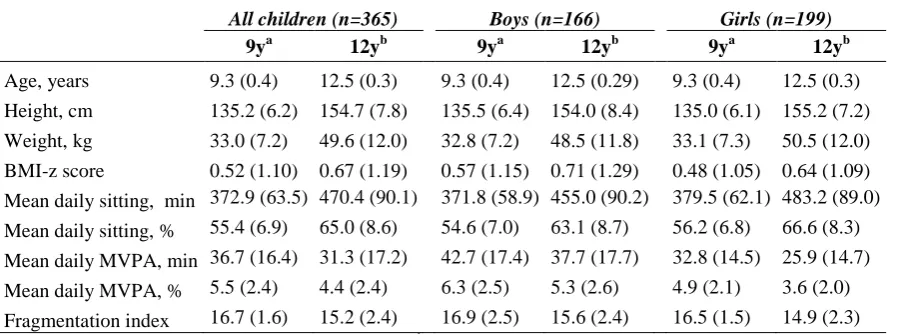
Characteristics of study participants are summarised in Table 1. Daily sedentary time averaged approximately 373 min/day (SD 64 min/day) at age 9y and 470 min/day (SD 90 min/day) at age 12y. Sedentary fragmentation reduced significantly over the 3 year period, from a fragmentation index of 16.7 (SD 1.6) at baseline to 15.2 (SD 2.4) at follow-up.
3.2. Determinants of sedentary time
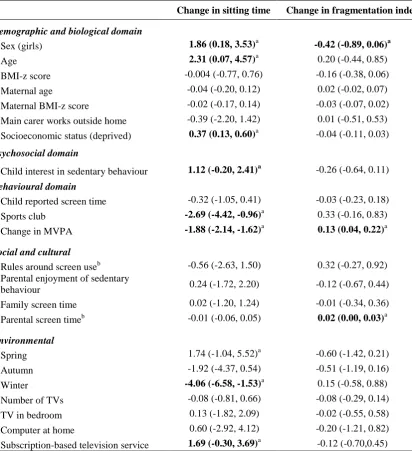
Results of the univariate analyses are shown in Table 2. Girls showed a significantly larger increase in percentage of time spent sedentary compared to boys, as did children who had access to pay TV. Children who attended a sports club showed a smaller increase in the percentage of time spent sedentary. At the univariate level associations were also found between age (larger increases in
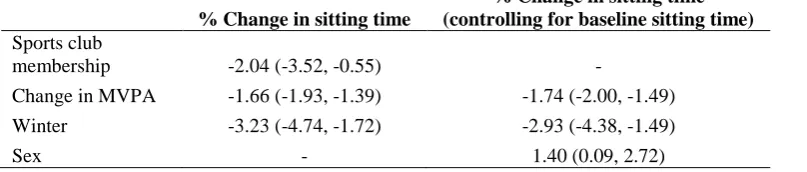
7 summer) remained significant without adjustment for baseline levels. Change in MVPA, seasonality and sex remained significant after adjustment for baseline levels (Table 3).
3.3. Determinants of sedentary fragmentation
Results of the univariate analyses are shown in Table 2. Boys showed a smaller decrease in sedentary fragmentation compared to girls. Larger decreases in MVPA were associated with larger decreases in fragmentation index and higher levels of parental screen time at age 9y were associated with smaller decreases in fragmentation index. In the final model parental screen time and change in MVPA were found to be associated with sedentary fragmentation. However, after adjusting for baseline values only sex remained significant (Table 4).
4.
Discussion
4.1. Main study findings and implications
The present study found that of the 20 potential determinants of sedentary time, four were significantly associated with changes in sedentary time between age 9 and 12 years (i.e. sex, attendance at sport clubs, change in MVPA and seasonality). Of 20 potential determinants of sedentary fragmentation, sex was the only factor significantly associated with changes in sedentary fragmentation over time.
Of those variables significantly associated with changes in sedentary time some may be considered as potentially modifiable (change in MVPA, attending sport clubs) and so might be prioritised for interventions, and others non-modifiable factors (seasonality, sex) and so could be useful to indicate high risk periods or groups as targets for change in sedentary time. No modifiable factors were found to be associated with sedentary fragmentation after adjustment for baseline values. Baseline values of sedentary fragmentation appeared to have a big influence on fragmentation at age 12y and therefore targeting these behaviours even earlier might be necessary.
8 study suggests possible additional benefits via possible effects on influencing more favourable changes (smaller age related increases ) in sedentary behaviour.
4.2. Comparisons with other studies
As noted above, a recent systematic review (Uijtdewilligen et al., 2011) reported a dearth of
‘determinant’ evidence for changes in sedentary behaviour in children and adolescents (determinant analysis requires a longitudinal design, unlike analysis of correlates), even less evidence exists on the changes in objectively measured sedentary time and sedentary fragmentation. To our knowledge, only one study examined determinants of change in sedentary time to date, but it did not focus on overall sedentary time and so is not directly comparable with the present study: Atkin et al. (2013a) examined the association between several potential determinants and after school and weekend sedentary time in 10y old children. They reported lower maternal screen time, lower SES and less restrictions on outside play to be associated with smaller increases in after school and/or weekend sedentary behaviour over one year (Atkin et al., 2013a). None of these variables were found to be determinants of changes in sedentary time in the current study. The differences between the results reported by Atkin et al. (2013a) and the current study may have been due to the different time periods of sedentary behaviour examined (i.e. afterschool/weekend versus daily sedentary time), as well as the longer period follow up in the current study. In our previous cross-sectional study of the ‘correlates’ of sedentary behaviour (defined using the 1100cpm Reilly et al cut-point which measures sitting but is not restricted to sitting time) in the same cohort at age 6/7y we found 7 correlates of sedentary behaviour at baseline: sedentary behaviour at age 6/7y was significantly higher among girls, in winter compared to summer, in children with older mothers, in the overweight and obese, in those whose parents did not model physical activity, and in those who did not commute actively to school (King et al., 2011). Two of those ‘correlates’ (i.e. sex and seasonality) were determinants of changes in sedentary time from age 9 to age 12y using the analyses in the present study. However, maternal age and parental modelling appeared to be less of an influence on change in daily sedentary time. Baseline levels of both sedentary time and sedentary fragmentation were moderately correlated with changes in these behaviours. This may indicate that levels of sedentary time are established early in life and affect sedentary time and sedentary
fragmentation later in life. Therefore, it may be worth examining determinants of sedentary behaviours even earlier in life in future studies.
4.3. Study strengths and limitations
9 determinants of sedentary behaviour in children and adolescents. We also attempted to comply with the recommendations for maintaining study quality as outlined by Uitdewilligen et al. (Uijtdewilligen et al., 2011) that is we had >10 participants per determinant; we considered the scale of sample attrition (which was relatively low); we used measures of potential determinants which had been validated where possible, or which were known with confidence (King et al., 2011), and we had high quality, objective, measures of the two outcome variables of sedentary time and sedentary fragmentation.
The present study also had a number of limitations. The sample size for the present study was fixed by the size of the GMS cohort, with >500 at age 8/9y and >400 at age 11/12y. However, age-related longitudinal changes in habitual sedentary time by accelerometry in GMS have been large, even between successive waves of the cohort two years apart (Basterfield et al., 2011a; Basterfield et al., 2012), and the main between group differences in these variables (greater increases in girls, and in the overweight and obese) have been readily detectable (Basterfield et al., 2011a). The GMS cohort is similar in size to the recent Iowa (Kwon et al., 2012) study which also described clear age-related increases in sedentary time during childhood and adolescence. For the determinants of sedentary time and fragmentation analyses the present study exceeded the criterion for study power suggested by Uijtdewilligen et al. (2011) of at least 10 participants per potential determinant. The percentage of variance explained by our determinants in the final models for changes in sedentary time and fragmentation index from 9-12y were 41.0% and 10.0%, respectively, leaving a large amount of variance unexplained. However, for physical activity at least, studies which use objective measures of behaviour typically have a lower % of variance explained than those which use subjective measures (King et al., 2011; McMinn et al., 2008). It is also likely that there are a number of determinants which we did not measure (e.g. pubertal stage, sleep), or did not measure very precisely in the present study, reducing our ability to explain variance in the change in sedentary time and sedentary fragmentation. How accurately our measure of sedentary behaviour is, is also unclear, and evidence on validity is not entirely consistent at present (Davies et al., 2012; Fischer et al., 2012; Hart et al., 2011; Kozey-Keadle et al., 2011; Lyden et al., 2012; Martin et al., 2011; Ridgers et al., 2012). Finally, the generalizability of our findings to other samples and setting needs to be established by comparison with future studies.
5. Conclusion
A number of potential determinants of sedentary behaviour across late childhood were identified in the current study. Two of these determinants, sport club attendance and MVPA, could be used within intervention studies aiming to decrease the marked increase in sedentary time with increasing age between ages 9 and 12 years, whereas our finding related to the winter season could be used to target interventions as period during which the largest increases in sitting over time appear. Research
10 Acknowledgements
This work was supported by grants from the Scottish Government Chief Scientist Office (grant
CZH/4/484 and CZH/4/979), the UK National Prevention Research Initiative, and Gateshead PCT. The cohort was first set up with funding from the Henry Smith Charity and Sport Aiding Medical Research for Kids. We appreciate the support of Gateshead Health National Health Service Foundation Trust, Gateshead Education Authority, and local schools. We thank members of the research team for their effort. We especially thank the families and children who participated in the Gateshead Millennium Study.
Conflict of Interest Statement
11 REFERENCES
Alghaeed, Z., Reilly, J.J., Chastin, S.F., Martin, A., Davies, G., Paton, J.Y., 2013. The influence of minimum sitting period of the Activpal™ on the measurement of breaks in sitting in young children. PLOS ONE 8:e71854.
Atkin, A.J., Corder, K., Ekelund, U., Wijndaele, K., Griffin, S.J., van Sluijs, E.M., 2013a. Determinants of change in children’s sedentary time. PLOS ONE 8:e67627.
Atkin, A.J., Ekelund, U., Møller, N.C., Froberg, K., Sardinha, L.B., Andersen, L.B., Brage, S., 2013b. Sedentary time in children: influence of accelerometer processing on health relations. Med Sci Sports Exerc 45:1097-104.
Basterfield, L., Adamson, A.J., Frary, J.K., Parkinson, K.N., Pearce, M.S., Reilly, J.J., 2011a. Longitudinal study of physical activity and sedentary behavior in children. Pediatrics 127:e24-e30.
Basterfield, L., Adamson, A.J., Parkinson, K.N., Maute, U., Li, P., Reilly, J.J., 2008. Surveillance of physical activity in the UK is flawed: validation of the Health Survey for England Physical Activity Questionnaire. Arch Dis Child 93:1054-58.
Basterfield, L., Adamson, A.J., Pearce, M.S., Reilly, J.J., 2011b. Stability of habitual physical activity and sedentary behavior monitoring by accelerometry in 6-to 8-year-olds. J Phys Act Health 8:543-7.
Basterfield, L., Pearce, M.S., Adamson, A.J., Frary, J.K., Parkinson, K.N., Wright, C.M., Reilly, J.J., 2012. Physical activity, sedentary behavior, and adiposity in English children. Am J Prev Med 42:445-51.
Bauman, A.E., Reis, R.S., Sallis, J.F., Wells, J.C., Loos, R.J., Martin, B.W., 2012. Correlates of physical activity: why are some people physically active and others not? The Lancet 380:258-71. Biddle, S.J., Pearson, N., Ross, G.M., Braithwaite, R., 2010. Tracking of sedentary behaviours of young
people: a systematic review. Prev Med 51:345-51.
Chastin, S., Granat, M., 2010. Methods for objective measure, quantification and analysis of sedentary behaviour and inactivity. Gait Posture 31:82-86.
Chastin, S.F., Egerton, T., Leask, C., Stamatakis, E., 2015. Meta-analysis of the relationship between breaks in sedentary behavior and cardiometabolic health. Obesity 23:1800-10.
Chastin, S.F.M., Ferriolli, E., Stephens, N.A., Fearon, K.C., Greig, C., 2012. Relationship between sedentary behaviour, physical activity, muscle quality and body composition in healthy older adults. Age Ageing 41:111-14.
Cliff, D.P., Okely, A.D., Burrows, T.L., Jones, R.A., Morgan, P.J., Collins, C.E., Baur, L.A., 2013.
Objectively measured sedentary behavior, physical activity, and plasma lipids in overweight and obese children. Obesity 21:382-85.
Davies, G., Reilly, J.J., Paton, J.Y., 2012. Objective measurement of posture and posture transitions in the pre-school child. Physiol Meas 33:1913-21.
Fischer, C., Yıldırım, M., Salmon, J., Chinapaw, M.J., 2012. Comparing different accelerometer cut-points for sedentary time in children. Pediatr Exerc Sci 24:220-28.
Hart, T.L., Ainsworth, B.E., Tudor-Locke, C., 2011. Objective and subjective measures of sedentary behavior and physical activity. Med Sci Sports Exerc 43:449-56.
Healy, G.N., Dunstan, D.W., Salmon, J., Cerin, E., Shaw, J.E., Zimmet, P.Z., Owen, N., 2008. Breaks in Sedentary Time Beneficial associations with metabolic risk. Diabetes Care 31:661-66. Healy, G.N., Matthews, C.E., Dunstan, D.W., Winkler, E.A., Owen, N., 2011. Sedentary time and
cardio-metabolic biomarkers in US adults: NHANES 2003–06. Eur Heart J 32:590-97.
Hinkley, T., Salmon, J., Okely, A.D., Hesketh, K., Crawford, D., 2012. Correlates of preschool children's physical activity. Am J Prev Med 43:159-67.
12 King, A.C., Parkinson, K.N., Adamson, A.J., Murray, L., Besson, H., Reilly, J.J., Basterfield, L., 2011.
Correlates of objectively measured physical activity and sedentary behaviour in English children. Eur J Pub Health 21:424-31.
Kozey-Keadle, S., Libertine, A., Lyden, K., Staudenmayer, J., Freedson, P.S., 2011. Validation of wearable monitors for assessing sedentary behavior. Med Sci Sports Exerc 43:1561-67. Kwon, S., Burns, T.L., Levy, S.M., Janz, K.F., 2012. Breaks in sedentary time during childhood and
adolescence: Iowa Bone Development Study. Med Sci Sports Exerc 44:1075-80.
LeBlanc, A.G., Spence, J.C., Carson, V., Connor Gorber, S., Dillman, C., Janssen, I., Kho, M.E., Stearns, J.A., Timmons, B.W., et al., 2012. Systematic review of sedentary behaviour and health indicators in the early years (aged 0–4 years). Appl Physiol Nutr Metab 37:753-72.
Lyden, K., SL, K.K., Staudenmayer, J.W., Freedson, P.S., 2012. Validity of two wearable monitors to estimate breaks from sedentary time. Med Sci Sports Exerc 44:2243-52.
Martin, A., McNeill, M., Penpraze, V., Dall, P., Granat, M., Paton, J.Y., Reilly, J.J., 2011. Objective measurement of habitual sedentary behavior in pre-school children: comparison of activPAL With Actigraph monitors. Pediatr Exerc Sci 23:468-76.
McMinn, A.M., Van Sluijs, E.M., Wedderkopp, N., Froberg, K., Griffin, S.J., 2008. Sociocultural correlates of physical activity in children and adolescents: findings from the Danish arm of the European Youth Heart study. Pediatr Exerc Sci 20:319-32.
Mitchell, J., Pate, R., Beets, M., Nader, P., 2012. Time spent in sedentary behavior and changes in childhood BMI: a longitudinal study from ages 9 to 15 years. Int J Obes 37:54-60.
Neuhaus, M., Healy, G.N., Fjeldsoe, B.S., Lawler, S., Owen, N., Dunstan, D.W., LaMontagne, A.D., Eakin, E.G., 2014. Iterative development of Stand Up Australia: a multi-component intervention to reduce workplace sitting. Int J Behav Nutr Phys Act 11:21.
Owen, N., Healy, G.N., Matthews, C.E., Dunstan, D.W., 2010. Too much sitting: the population-health science of sedentary behavior. Exerc Sports Sci Rev 38:105-13.
Parkinson, K.N., Pearce, M.S., Dale, A., Reilly, J.J., Drewett, R.F., Wright, C.M., Relton, C.L., McArdle, P., Le Couteur, A.S., et al., 2011. Cohort profile: the Gateshead Millennium Study. Int J Epidemiol 40:308-17.
Pearce, M.S., Basterfield, L., Mann, K.D., Parkinson, K.N., Adamson, A.J., 2012. Early predictors of objectively measured physical activity and sedentary behaviour in 8–10 year old children: the Gateshead Millennium Study. PLOS ONE 7:e37975.
Proper, K.I., Singh, A.S., Van Mechelen, W., Chinapaw, M.J., 2011. Sedentary behaviors and health outcomes among adults: a systematic review of prospective studies. Am J Prev Med 40:174-82.
Puyau, M.R., Adolph, A.L., Vohra, F.A., Butte, N.F., 2002. Validation and calibration of physical activity monitors in children. Obesity Research 10:150-57.
Reilly, J.J., Coyle, J., Kelly, L., Burke, G., Grant, S., Paton, J.Y., 2003. An objective method for measurement of sedentary behavior in 3‐to 4‐year olds. Obesity Research 11:1155-58. Rich, C., Griffiths, L.J., Dezateux, C., 2012. Seasonal variation in accelerometer-determined sedentary
behaviour and physical activity in children: a review. Int J Behav Nutr Phys Act 9:49. Ridgers, N.D., Salmon, J., Ridley, K., O’Connell, E., Arundell, L., Timperio, A., 2012. Agreement
between activPAL and ActiGraph for assessing children’s sedentary time. Int J Behav Nutr Phys Act 9:7.
Sallis, J.F., Prochaska, J.J., Taylor, W.C., 2000. A review of correlates of physical activity of children and adolescents. Med Sci Sports Exerc 32:963-75.
Salmon, J., Arundell, L., Hume, C., Brown, H., Hesketh, K., Dunstan, D.W., Daly, R.M., Pearson, N., Cerin, E., et al., 2011. A cluster-randomized controlled trial to reduce sedentary behavior and promote physical activity and health of 8-9 year olds: The Transform-Us! Study. BMC Public Health 11:759.
13 Tremblay, M.S., Colley, R.C., Saunders, T.J., Healy, G.N., Owen, N., 2010. Physiological and health
implications of a sedentary lifestyle. Appl Physiol Nutr Metab 35:725-40.
Tremblay, M.S., LeBlanc, A.G., Kho, M.E., Saunders, T.J., Larouche, R., Colley, R.C., Goldfield, G., Gorber, S.C., 2011. Systematic review of sedentary behaviour and health indicators in school-aged children and youth. Int J Behav Nutr Phys Act 8:98.
Uijtdewilligen, L., Nauta, J., Singh, A.S., van Mechelen, W., Twisk, J.W., van der Horst, K., Chinapaw, M.J., 2011. Determinants of physical activity and sedentary behaviour in young people: a review and quality synthesis of prospective studies. Br J Sports Med 45:896-905.
14 Tables
Table 1. Participant characteristics with valid measures at both time points (mean ± SD).
All children (n=365) Boys (n=166) Girls (n=199)
9ya 12yb 9ya 12yb 9ya 12yb
Age, years 9.3 (0.4) 12.5 (0.3) 9.3 (0.4) 12.5 (0.29) 9.3 (0.4) 12.5 (0.3) Height, cm 135.2 (6.2) 154.7 (7.8) 135.5 (6.4) 154.0 (8.4) 135.0 (6.1) 155.2 (7.2)
Weight, kg 33.0 (7.2) 49.6 (12.0) 32.8 (7.2) 48.5 (11.8) 33.1 (7.3) 50.5 (12.0) BMI-z score 0.52 (1.10) 0.67 (1.19) 0.57 (1.15) 0.71 (1.29) 0.48 (1.05) 0.64 (1.09)
Mean daily sitting, min 372.9 (63.5) 470.4 (90.1) 371.8 (58.9) 455.0 (90.2) 379.5 (62.1) 483.2 (89.0) Mean daily sitting, % 55.4 (6.9) 65.0 (8.6) 54.6 (7.0) 63.1 (8.7) 56.2 (6.8) 66.6 (8.3)
Mean daily MVPA, min 36.7 (16.4) 31.3 (17.2) 42.7 (17.4) 37.7 (17.7) 32.8 (14.5) 25.9 (14.7) Mean daily MVPA, % 5.5 (2.4) 4.4 (2.4) 6.3 (2.5) 5.3 (2.6) 4.9 (2.1) 3.6 (2.0)
Fragmentation index 16.7 (1.6) 15.2 (2.4) 16.9 (2.5) 15.6 (2.4) 16.5 (1.5) 14.9 (2.3) a
15 Table 2. Univariate analyses of determinants associated with change in sitting time and sitting time
fragmentation β (95% CI).
Change in sitting time Change in fragmentation index
Demographic and biological domain
Sex (girls) 1.86 (0.18, 3.53)a -0.42 (-0.89, 0.06)a
Age 2.31 (0.07, 4.57)a 0.20 (-0.44, 0.85)
BMI-z score -0.004 (-0.77, 0.76) -0.16 (-0.38, 0.06)
Maternal age -0.04 (-0.20, 0.12) 0.02 (-0.02, 0.07)
Maternal BMI-z score -0.02 (-0.17, 0.14) -0.03 (-0.07, 0.02)
Main carer works outside home -0.39 (-2.20, 1.42) 0.01 (-0.51, 0.53)
Socioeconomic status (deprived) 0.37 (0.13, 0.60)a -0.04 (-0.11, 0.03)
Psychosocial domain
Child interest in sedentary behaviour 1.12 (-0.20, 2.41)a -0.26 (-0.64, 0.11)
Behavioural domain
Child reported screen time -0.32 (-1.05, 0.41) -0.03 (-0.23, 0.18)
Sports club -2.69 (-4.42, -0.96)a 0.33 (-0.16, 0.83)
Change in MVPA -1.88 (-2.14, -1.62)a 0.13 (0.04, 0.22)a
Social and cultural
Rules around screen useb -0.56 (-2.63, 1.50) 0.32 (-0.27, 0.92)
Parental enjoyment of sedentary
behaviour 0.24 (-1.72, 2.20) -0.12 (-0.67, 0.44)
Family screen time 0.02 (-1.20, 1.24) -0.01 (-0.34, 0.36)
Parental screen timeb -0.01 (-0.06, 0.05) 0.02 (0.00, 0.03)a
Environmental
Spring 1.74 (-1.04, 5.52)a -0.60 (-1.42, 0.21)
Autumn -1.92 (-4.37, 0.54) -0.51 (-1.19, 0.16)
Winter -4.06 (-6.58, -1.53)a 0.15 (-0.58, 0.88)
Number of TVs -0.08 (-0.81, 0.66) -0.08 (-0.29, 0.14)
TV in bedroom 0.13 (-1.82, 2.09) -0.02 (-0.55, 0.58)
Computer at home 0.60 (-2.92, 4.12) -0.20 (-1.21, 0.82)
16 Table 3. Final multivariable model for association between determinants and change in sitting time (β, 95% CI).
% Change in sitting time
% Change in sitting time (controlling for baseline sitting time) Sports club
membership -2.04 (-3.52, -0.55) -
Change in MVPA -1.66 (-1.93, -1.39) -1.74 (-2.00, -1.49)
Winter -3.23 (-4.74, -1.72) -2.93 (-4.38, -1.49)
Sex - 1.40 (0.09, 2.72)
17 Table 4. Final multivariable model for association between determinants and change in fragmentation index, (β; 95% CI).
Change in fragmentation index
Change in fragmentation index (controlling for baseline fragmentation index)
Sex -0.52 (-1.01, -0.02)
Parental screen timeb 0.02 (0.0, 0.03)
Change in MVPA 0.11 (0.01, 0.21)
18 Online Supplement 1. Correlations between sitting time, fragmentation index and MVPA
FI, fragmentation index
Sitting time y9 %
Sitting time y12 %
Change in sitting time %
FI y9 FI y12 Change in FI MVPA y9 %
MVPA y12 %
Sitting time y9, % -
Sitting time y12, % 0.478 -
Change in sitting time, % -0.369 0.640 -
FI y9 -0.631 -0.302 0.233 -
FI y12 -0.416 -0.773 -0.454 0.403 -
Change in FI 0.0407 -0.573 -0.642 -0.329 0.732 -
MVPA y9, % -0.578 -0.331 0.156 0.204 0.301 0.158 -
MVPA y12, % -0.237 -0.676 -0.508 0.092 0.378 0.321 0.408 -