Article
Investigating Motor Competence in Association with
Sedentary Behavior and Physical Activity in 7- to
11-Year-Old Children
Anoek M. Adank1,2,*, Dave H.H. Van Kann1,3, Joris J.A.A. Hoeboer4, Sanne I. de Vries4, Stef P.J. Kremers3 & Steven B. Vos1,2
1 School of Sport Studies, Fontys University of Applied Sciences, Eindhoven, The Netherlands; [email protected]; [email protected]
2 Department of Industrial Design, Eindhoven University of Technology, Eindhoven, The Netherlands; [email protected]
3 Department of Health Promotion, Nutrition and Translational Research Institute Maastricht (NUTRIM), Maastricht University, Maastricht, The Netherlands; [email protected];
4 The Hague University of Applied Sciences, Research group Healthy Lifestyle in a Supporting Environment, The Hague, The Netherlands; [email protected]; [email protected]
* Correspondence: [email protected]; Tel.: +31-6-226-177-31
Abstract: Children’s motor competence (MC) has declined in the past decades, while sedentary behavior (SB) has increased. This study examined the association between MC and physical activity (PA) levels among primary schoolchildren. Demographics, body height and weight, MC (Athletic Skills Track) and PA levels (ActiGraph, GT3X+) were assessed among 595 children (291 boys, mean age = 9.2 years, SD = 1.1). MC was standardized into five categories: from very low to very high. PA levels were classified into sedentary behavior (SB), light physical activity (LPA), and moderate-to-vigorous physical activity (MVPA). Mixed model analyses were conducted with PA levels as dependent variables and MC as the independent variable, while adjusting for age, gender, and BMI z-score on the individual level. Additional moderation analyses between covariates and MC and PA levels were also conducted. A negative association between MC and SB (β = -3.17) and a positive association between MC and MVPA (β =1.41) were found. The strength of both associations increased as children expressed lower or higher levels of MC. Increased age and being a girl were significant predictors of higher levels of SB and lower levels of MVPA. Non-overweight children spent significantly more minutes in MVPA compared with overweight children. No moderating effects of BMI, gender, and age were found on the association between MC and PA levels. MC is an important correlate of both SB and MVPA, particularly for children with very high or low MC. Developing and improving children’s MC may contribute to spending less time in SB and more time in MVPA, particularly for high-risk groups, i.e. children with low MC. Moreover, addressing MC development and PA promotion simultaneously might create positive feedback loops for both children’s MC and PA levels.
Keywords: motor competence; sedentary behavior; moderate-to-vigorous physical activity; primary schoolchildren; accelerometer
1. Introduction
Physical activity (PA) and sedentary behavior (SB) are important health determinants. Sufficient regular PA has positive effects on physical and psychological well-being [1], while excessive SB is associated with negative health outcomes [2,3]. PA and SB patterns in childhood lay the foundation for a healthy lifestyle in adulthood [4,5]. Inactive children and adolescents have a greater likelihood of becoming physically inactive adults than active children, emphasizing the importance of increasing PA and limiting SB among children. Nevertheless, children’s physical inactivity and
sedentary lifestyles are still increasing worldwide [6]. Similar to children in other countries, 45% of the Dutch primary schoolchildren do not meet the World Health Organization’s recommendation of at least 60 minutes of moderate-to-vigorous physical activity a day [7].
Socio-ecological frameworks of health behavior, such as the Environmental Research framework for weight Gain prevention (EnRG framework) [8], consider PA and SB to be a result of an interaction between individual and environmental factors. From this ecological viewpoint, motor competence (MC) can be affected by environmental factors, e.g. physical education (PE) lessons, and forms an individual predictive variable for PA and SB. Studies by De Meester et al. [9] and Lubans et al. [10] support this hypothesis by showing positive associations between children’s level of MC and the time children spent in PA. Motor competence is ideally learned and developed during childhood [11], yet declines in children’s MC have been reported over the last years [12,13].
According to the concept of physical literacy [14], physical competence (including MC) and engagement in PA are interconnected key elements for the development of active lifestyle patterns. This suggests a reciprocal relationship between MC and PA; children with high MC are more likely to participate in PA than children with low MC, and vice versa [15,16].
The impact of the relationship between MC, PA, and SB might be influenced by a set of individual demographic variables. First, children’s weight status is recognized as a strong correlate of PA and SB. Overweight and obese children have higher levels of SB [17] and lower levels of PA than children with a normal weight [18]. In addition, BMI and MC are negatively associated [10]. Non-overweight children perform better on locomotor skills than overweight children [19]. Gender differences have also been found in PA and SB. Girls are more sedentary than boys [17] and spend less time on MVPA than boys [20-22]. Age is also a confounder in the relationship between MC, MVPA, and SB. Older children spend more time in sedentary activities [23-25] and engage in PA for shorter times than younger children [22,26-28], independently of their MC.
Increased insight into the relationship between MC, PA, and SB and moderating effects of important demographic variables (i.e. BMI, gender, and age) on this association is necessary to develop strategies that enhance healthy lifestyles in children. However, studies addressing this relationship are scarce, particularly considering daily time spent in SB.
Therefore, the purpose of this study was to investigate the association between primary schoolchildren’s MC, daily PA, and SB as well as studying the potential moderating effects of BMI, gender, and age on the relationship between MC and PA, and MC and SB, respectively.
2. Materials and Methods
For the current study, baseline data were taken from the SALTO study. The SALTO study focused on the relationship between PE characteristics and daily SB and PA among primary schoolchildren. It included 10 primary schools in Eindhoven and Maastricht, two cities in the southern part of the Netherlands (over 200,000 and 100,000 citizens, respectively). Schools were recruited in collaboration with two local school boards. The selection criteria were ‘socio-economic status (SES) of the neighborhood in which schools are located’ and ‘an equal number of schools with and without specialist PE teachers’. First, schools in Eindhoven with specialist PE teachers were recruited, followed by comparable schools (based on SES) without specialist PE teachers in Maastricht.
Children in grade 4 (aged 7-9) and grade 6 (aged 9-11) were invited to participate in the SALTO study. Data collection took place between May and July 2017. The children were verbally informed about the content of the SALTO study by researchers during school visits. The parents were asked to provide written informed consent for their children’s anthropometry and PA measurements. All children were invited to take part in the measurement for MC during a regular physical education (PE) lesson. The SALTO study obtained ethical approval from the Ethical Research Committee of Fontys University of Applied Sciences (reference number FCEO 24-03 Adank).
Children who did not provide complete data on all variables, e.g. due to invalid accelerometer data or absence during measurements, were excluded from the analyses.
Physical activity and sedentary behavior
Accelerometers (ActiGraph GT3X+; 30 Hz; 10sec Epoch) were used to objectively measure daily SB and PA. Participating children were equipped with an accelerometer during classroom visits conducted by a researcher and research assistant. The researcher checked that the children wore the elastic belt with the accelerometer positioned on the right hip. Children were instructed to wear the accelerometer for seven consecutive days, except during water-related activities and when asleep. The parents received written information about the accelerometer.
The collected data were analyzed using the ActiLife software, version 6.10.4. Evenson’s cut-off points [29] were used to categorize PA into three levels: SB (<101 counts per minute (CPM), LPA (101-2295 CPM), and MVPA (>(101-2295 CPM). Choi’s [30] wear time validation criteria were applied; a valid school day was defined as the provision of at least 480 minutes of valid wear time between 6am and 11pm. The first measurement day was deleted to prevent equipment reactivity [31]. Children providing at least three valid school days of PA data were included for further analyses.
Anthropometry
Children’s body height was measured using a SECA portable stadiometer (model 213; SECA, Germany). Body weight was measured using a calibrated portable electronic scale (model 803; SECA, Germany). A trained research assistant carried out these measurements in a separate section during a PE lesson. For standardization, all children wore light clothes (shorts and t-shirt) and no shoes. BMI z-scores were calculated using a Dutch reference population to standardize for age and gender [32] and were classified by weight status according to the 2007 recommendations [33], resulting in four categories (underweight (BMI z-score ≤ -1.65), healthy weight (-1.64 ≤ BMI z-score ≤ 1.03), overweight (1.04 ≤ BMI z-score ≤ 1.64), and obese (BMI z-score ≥ 1.65)).
Motor Competence
The Athletic Skills Track (AST) was used to assess children’s MC. MC in the current study is defined as the degree of skilled performance in a wide range of motor tasks as well as the movement coordination and control underlying a particular motor outcome [34]. The AST is a feasible, valid and reliable assessment tool for measuring MC that can easily be incorporated in PE [35,36]. The track is an obstacle course consisting of seven fundamental motor skills tasks: balancing, bunny hopping, hopping, walking on the hands and feet, running, rolling, and clambering. The track differs in task complexity for grade-4 children (AST-2) and grade-6 children (AST-3) and should be completed as fast as possible.
The measurement took place during a PE lesson. The class was divided into three groups. A trained research assistant demonstrated and explained the AST to the group (8-10 children). After this instruction, the children were asked to practice running the track three times. During this try-out, the children received feedback from the research assistant as necessary. The children then individually performed the track as quickly as possible, while the research assistant measured the time with a stopwatch. The individual raw completion scores (time in 0.1 seconds) were recorded. Time scores were standardized, in conformance with the age- and gender-specific AST norm scores, ranging from 1 (far below average skills) to 5 (way above average skills) [36].
Procedure
Statistical analyses
Data were analyzed using SPSS Statistics, version 24 (IBM Corp., Armonk, NY). PA levels were converted into daily share of time spent in SB, LPA, and MVPA during school days. Share of time spent in SB, LPA, and MVPA during school days was the dependent variable. Standardized FMS scores, gender, age, and BMI z-scores were considered independent variables. For all analyses, the statistical significance was set at p < .05.
Descriptive statistics were calculated for demographic variables, MC, SB, LPA, and MVPA outcomes. Independent samples t-tests were used to compare the outcomes between boys and girls, between grade-4 and grade-6 children, and between non-overweight and overweight children. Mixed-model analyses were conducted to understand the association between the independent variables and PA levels (SB, LPA, and MVPA). School was specified as a random intercept to correct for a nested structure of the data within schools. On a second level, individual characteristics were included to examine the association between MC on PA levels while correcting for age, gender, and BMI z-scores. The standardized MC scores were recoded into dummy variables. The baseline category was MC3 (normal level of motor competence).
Additionally, moderation analyses were conducted to test potential different associations between MC and PA levels by including interaction terms of MC*gender, MC*age, and MC*BMI z-score. Stratified analyses were conducted in case of a significant interaction of terms.
3. Results
In total, 595 children (mean age = 9.2, SD = 1.1) provided complete data on all variables. The sample was equally distributed among boys (N = 291) and girls (N = 304). There was a slight overrepresentation of grade-4 children (N = 323 / 54%).
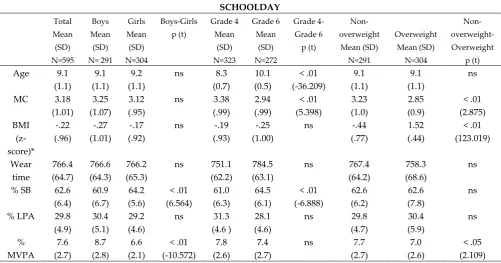
The mean score for MC was 3.18 (SD = 1.01, range 1-5). A total of 18% (N = 104) of the sample scored below average (score 1 or 2), and 30% (N = 178) scored above average (score 4 or 5). No gender difference was found for MC. The mean score was significantly higher in grade-4 children than in grade 6-children. Overweight children scored significantly lower on MC than non-overweight children (Table 1).
For BMI z-scores, there were no significant gender differences nor differences between grade-4 and grade 6-children found (Table 1). Based on BMI z-scores, 6.9% of the children were underweight, 8.1% were overweight, and 3.2% were obese.
The mean accelerometer wear time on a school day was 766 minutes (SD = 64.7). Children were sedentary for 480 minutes (SD = 66.6) on a school day. They spent 228 minutes (SD = 40.7) of the time in LPA and 58 minutes (SD = 21.0) in MVPA. Gender differences were found for SB as well as for MVPA. Girls spent significantly more minutes a day in SB than boys (492 min versus 467 min) and fewer minutes in MVPA than boys (50 min versus 67 min). Children in grade 4 showed significantly lower levels of sedentary behavior than grade-6 children (458 min versus 506 min). Overweight children spent significantly less time in MVPA compared to non-overweight children (Table 1).
Mixed-model analyses were conducted for SB, LPA, and MVPA separately and only included main effects as none of the included interaction terms, i.e. MC*sex, MC*age, and MC*BMI z, were significant (Table 2).
Regarding SB, children who scored below average (score 1 or 2) spent significantly more time in SB than children with an average score (score 3). Moreover, children with an extremely high score on MC (score 5) spent significantly less time in SB than those who had a normal score (score 3). Age (older) and gender (girl) also significantly predicted time spent in SB. The strength of the association between MC and SB increased when children expressed higher and lower MC (scores 5 and 1; Figure 1).
between age and LPA. Boys spent more time in LPA than girls. The higher the BMI z-scores of children, the more time children spent in LPA.
Children with low MC (score 1 or 2) spent less time in MVPA than other children. Compared with children who had average MC, children with very high MC spent significantly more time in MVPA. Boys spent more time in MVPA than girls during a school day.
Table 1. Descriptive characteristics (mean and standard deviation); total and stratified by gender and grade. SCHOOLDAY Total Mean (SD) N=595 Boys Mean (SD) N= 291 Girls Mean (SD) N=304 Boys-Girls p (t) Grade 4 Mean (SD) N=323 Grade 6 Mean (SD) N=272 Grade 4-Grade 6 p (t) Non-overweight Mean (SD) N=291 Overweight Mean (SD) N=304 Non- overweight-Overweight p (t) Age 9.1
(1.1)
9.1 (1.1)
9.2 (1.1)
ns 8.3
(0.7) 10.1 (0.5) < .01 (-36.209) 9.1 (1.1) 9.1 (1.1) ns
MC 3.18
(1.01)
3.25 (1.07)
3.12 (.95)
ns 3.38 (.99) 2.94 (.99) < .01 (5.398) 3.23 (1.0) 2.85 (0.9) < .01 (2.875) BMI (z-score)* -.22 (.96) -.27 (1.01) -.17 (.92)
ns -.19 (.93)
-.25 (1.00)
ns -.44 (.77) 1.52 (.44) < .01 (123.019) Wear time 766.4 (64.7) 766.6 (64.3) 766.2 (65.3)
ns 751.1 (62.2)
784.5 (63.1)
ns 767.4 (64.2)
758.3 (68.6)
ns
% SB 62.6 (6.4) 60.9 (6.7) 64.2 (5.6) < .01 (6.564) 61.0 (6.3) 64.5 (6.1) < .01 (-6.888) 62.6 (6.2) 62.6 (7.8) ns
% LPA 29.8 (4.9)
30.4 (5.1)
29.2 (4.6)
ns 31.3 (4.6 )
28.1 (4.6)
ns 29.8 (4.7) 30.4 (5.9) ns % MVPA 7.6 (2.7) 8.7 (2.8) 6.6 (2.1) < .01 (-10.572) 7.8 (2.6) 7.4 (2.7)
ns 7.7
(2.7)
7.0 (2.6)
< .05 (2.109) *compared with the Fifth Dutch growth study [32]. MC = motor competence; wear time duration is expressed
Table 2. Associations between MC, BMI z-score, age, gender and percentage of time spent in SB, LPA and MVPA on an average school day.
Data (N = 622) % SB % LPA % MVPA
Beta (95% CI) p Beta (95% CI) p Beta (95% CI) p
Age 1.46 (1.02 ̶ 1.90) <.01 -1.42 (-1.76 ̶ -1.08) <.01 -0.04 (-.23 ̶ .14) ns BMI-z score -.26 (-.73 ̶ .21) ns 0.37 (-.01 ̶ .74) <.05 -0.11 (-.31 ̶ .08) ns Gender (ref = female) -3.25 (-4.15 ̶ -2.35) <.01 1.19 (.49 ̶ 1.89) <.01 2.06 (1.69 ̶ 2.44) <.01 Motor Competence (ref = average)
Very low 3.17 (1.28 ̶ 5.05) <.01 -1.75 (-3.21 ̶ -.29) <.05 -1.41 (-2.19 ̶ -.63) <.01
Low 1.97 (.44 ̶ 3.49) <.05 -1.15 (-2.34 ̶ .03) ns -0.81 (-1.44 ̶ -.18) <.05
High -0.45 (-1.71 ̶ .81) ns 0.08 (-.90 ̶ 1.06) ns 0.37 (-.16 ̶ .89) ns
Very high -1.72 (-3.18 ̶ - .27) <.05 0.56 (-0.57 ̶ 1.69) ns 1.16 (.56 ̶ 1.76) <.01 Ref = referent; SB = sedentary behavior; LPA = light physical activity; MVPA = moderate-to-vigorous physical
activity; FMS= fundamental movement skills; BMI = Body Mass Index.
Figure 1: Associations (standardized β) between MC and % time spent in SB and between MC and % time spent in MVPA
4. Discussion
This study examined the associations between motor competence, sedentary behavior, and physical activity. In line with previous studies [10,37-40], MC was positively associated with time children spent in MVPA. Interestingly, our results revealed an even stronger negative association between MC and SB.
Although studies on the relationship between MC and SB are scarce, existing studies found similar patterns to those in the current study [41-43], underlining the importance of sedentary behavior in relation to current declines in children’s MC. The impact of MC on SB and MPVA varied across levels of MC (figure 1). Higher or lower levels of MC had stronger impacts on SB and MVPA in comparison with normal levels of MC. The association between MC and SB was stronger than the association between MC and MVPA.
Our findings indicate the need to focus on children’s MC as a factor that influences not only time children spent in MVPA but also sedentary time. It suggests that improvement in children’s MC, especially for those who have low MC, could be a promising strategy in reducing SB and increasing the time children spend in MVPA. The cross-sectional design limited the opportunity to test causality
-2.00 -1.50 -1.00 -0.50 0.00 0.50 1.00 1.50 2.00 2.50 3.00 3.50
very low low high very high
st
andardi
zed
β
Motor Competence Level
Associations between MC and PA-levels
% MVPA
in the relationship between MC and SB and MVPA, respectively. Nevertheless, a reciprocal association between MC and PA levels could be hypothesized [12,14]. Reducing time spent in SB and increasing time spent in MVPA could positively affect children’s MC [14], which offers a new opportunity to decrease the negative trend in children’s MC [12,44].On the contrary, increasing MC has the potential to decrease levels of SB and increase levels of PA. According to a systemic view, it is recommended to focus on both behaviors simultaneously to optimize conditions in which positive feedback loops can result in sustainable behavioral improvements. Yet, school-based PA programs proved that it is challenging to reach sustainable effects on PA [45], so it would be better to focus on increasing MC to initiate a positive feedback loop [46], e.g. through high-quality physical education lessons. Alongside developing MC, PA promotion and SB reduction remain crucial to initiate the positive feedback loops.
Contrary to expectations, no moderating effects of BMI, age, and gender were found on the relationship between MC and SB, and MC and PA. There were, in line with previous studies [23,27,47], quite strong significant gender differences in sedentary time and time spent in LPA and MVPA. Girls spent more time in SB than boys, and boys engaged longer in MVPA than girls. This finding stresses the need to develop effective interventions specifically targeting girls’ SB and MVPA.
Contrary to findings in other studies [22,26-28], which showed that older children are less active than younger children, we found no difference in time spent in MVPA between grade-4 and grade-6 children. This could be explained by the time at which age differences in MVPA are manifest. It is possible that MVPA differences are clearer from the age of 11 [48,49]. However, we found a positive correlation between age and SB in line with other studies [23-25]. In general, older children go to bed at a later time, and this extended duration of waking hours might be responsible for this finding, i.e. more television watching, computer gaming, and using social media, while not affecting MVPA (e.g. sports) behaviors.
In contrast to studies by Da Costa et al. and Keane et al. [17,18], we found no significant relationship between BMI and SB and between BMI and MVPA. It is possible that BMI as a predictor for SB and MVPA changes with age. Perhaps BMI differences between children and their impact on SB and MVPA become stronger and more apparent in adolescence. Our relatively small sample size of overweight children (N=67 children; 11.3%) could also have impacted the lack of significant association in the current study.
5. Conclusions
This study demonstrates a positive association between MC and MVPA and an even stronger association between MC and SB in children aged 7-11 years. Although reciprocal associations between MC and PA levels are still unclear, MC should receive more attention as a potential, crucial factor to counter the alarming declines in PA and increase of SB among children. We emphasize the prominent role physical education in primary schools should play in developing and improving children’s MC. In line with the reciprocal view, PA-supportive and SB-inhibiting activities are needed in addition to MC development to optimize PA development in children.
6. Patents
Author Contributions: conceptualization, A.A. and D.V.K; methodology, A.A. and D.V.K.; investigation, A.A. and D.V.K.; data curation, A.A and D.V.K.; writing—original draft preparation, A.A., D.V.K. and S.V.; writing— review and editing, S.K., J.H. and S.D.V. All authors read and approved the final manuscript.
Funding: This research was funded by the Netherlands Organisation for Scientific Research (NOW), grant number 023.011.063.
Acknowledgments: We are grateful to all schools and children participating in this study. Further, we would like to thank all research assistants for their help during data collection, in particular Jeremy van Wissen (Maastricht Sport) and Robin de Louw (Fontys University of Applied Sciences).
Conflicts of Interest: The authors declare that they have no competing interests.
References
1. Weggemans, R.M.; Backx, F.J.G.; Borghouts, L.; Chinapaw, M.; Hopman, M.T.E.; Koster, A.; Kremers, S.; van Loon, L.J.C.; May, A.; Mosterd, A., et al. The 2017 Dutch Physical Activity Guidelines. Int. J. Behav. Nutr. Phys. Act. 2018, 15, 58, doi:10.1186/s12966-018-0661-9.
2. Owen, N.; Sparling, P.B.; Healy, G.N.; Dunstan, D.W.; Matthews, C.E. Sedentary Behavior: Emerging Evidence for a New Health Risk. Mayo Clin. Proc. 2010, 85, 1138-1141, doi:10.4065/mcp.2010.0444.
3. Hoare, E.; Milton, K.; Foster, C.; Allender, S. The associations between sedentary behaviour and mental health among adolescents: a systematic review. Int. J. Behav. Nutr. Phys. Act. 2016, 13, 108, doi:10.1186/s12966-016-0432-4.
4. Jones, R.A.; Hinkley, T.; Okely, A.D.; Salmon, J. Tracking physical activity and sedentary behavior in childhood: a systematic review. Am. J. Prev. Med. 2013, 44, 651-658, doi:10.1016/j.amepre.2013.03.001. 5. Telama, R. Tracking of Physical Activity from Childhood to Adulthood: A Review. Obesity Facts 2009, 2,
187-195.
6. Hallal, P.C.; Andersen, L.B.; Bull, F.C.; Guthold, R.; Haskell, W.; Ekelund, U. Global physical activity levels: surveillance progress, pitfalls, and prospects. Lancet 2012, 380, 247-257, doi:10.1016/S0140-6736(12)60646-1. 7. Burghard, M.; Knitel, K.; van Oost, I.; Tremblay, M.S.; Takken, T. Is our Youth Cycling to Health? Results From the Netherlands’ 2016 Report Card on Physical Activity for Children and Youth. J. Phys. Act. Health
2016, 13, S218-S224, doi:10.1123/jpah.2016-0299.
8. Kremers, S.P.; de Bruijn, G.-J.; Visscher, T.L.; van Mechelen, W.; de Vries, N.K.; Brug, J. Environmental influences on energy balance-related behaviors: A dual-process view. Int. J. Behav. Nutr. Phys. Act. 2006, 3, 9, doi:10.1186/1479-5868-3-9.
9. De Meester, A.; Stodden, D.; Goodway, J.; True, L.; Brian, A.; Ferkel, R.; Haerens, L. Identifying a motor proficiency barrier for meeting physical activity guidelines in children. J. Sci. Med. Sport 2018, 21, 58-62, doi:https://doi.org/10.1016/j.jsams.2017.05.007.
10. Lubans, D.R.; Morgan, P.J.; Cliff, D.P.; Barnett, L.M.; Okely, A.D. Fundamental Movement Skills in Children and Adolescents. Sports Med. 2010, 40, 1019-1035, doi:10.2165/11536850-000000000-00000. 11. Wormhoudt, R.; Savelsbergh, G.; Teunissen, J.; Davids, K. The Athletic Skills Model; Routledge Abingdon,
United Kingdom, 2018.
13. Tester, G.; Ackland, T.R.; Houghton, L. A 30-Year Journey of Monitoring Fitness and Skill Outcomes in Physical Education: Lessons Learned and a Focus on the Future. J. Adv. Phys. Edu. 2014, 4(3), 11, doi:10.4236/ape.2014.43017.
14. Roetert, E.P.; Ellenbecker, T.S.; Kriellaars, D. Physical literacy: why should we embrace this construct? Br. J. Sports Med. 2018. doi:10.1136/bjsports-2017-098465.
15. Loprinzi, P.D.; Davis, R.E.; Fu, Y.-C. Early motor skill competence as a mediator of child and adult physical activity. Prev. Med. Rep. 2015, 2, 833-838, doi:https://doi.org/10.1016/j.pmedr.2015.09.015.
16. Engel, A.C.; Broderick, C.R.; van Doorn, N.; Hardy, L.L.; Parmenter, B.J.J.S.M. Exploring the Relationship Between Fundamental Motor Skill Interventions and Physical Activity Levels in Children: A Systematic Review and Meta-analysis. Sports Med. 2018, 48, 1845-1857, doi:10.1007/s40279-018-0923-3.
17. Da Costa, B.G.G.; Da Silva, K.S.; George, A.M.; De Assis, M.A.A. Sedentary behavior during school-time: Sociodemographic, weight status, physical education class, and school performance correlates in Brazilian schoolchildren. J. Sci. Med. Sport 2017, 20, 70-74, doi:https://doi.org/10.1016/j.jsams.2016.06.004.
18. Keane, E.; Li, X.; Harrington, J.M.; Fitzgerald, A.P.; Perry, I.J.; Kearney, P.M. Physical Activity, Sedentary Behavior and the Risk of Overweight and Obesity in School-Aged Children. Pediatr. Exerc. Sci. 2017, 29, 408-418, doi:10.1123/pes.2016-0234.
19. Okely, A.D.; Booth, M.L.; Chey, T. Relationships between Body Composition and Fundamental Movement Skills among Children and Adolescents. Res. Q. Exerc. Sport 2004, 75, 238-247, doi:10.1080/02701367.2004.10609157.
20. Foweather, L.; Knowles, Z.; Ridgers, N.D.; O’Dwyer, M.V.; Foulkes, J.D.; Stratton, G. Fundamental movement skills in relation to weekday and weekend physical activity in preschool children. J. Sci. Med. Sport 2015, 18, 691-696, doi:https://doi.org/10.1016/j.jsams.2014.09.014.
21. Slykerman, S.; Ridgers, N.D.; Stevenson, C.; Barnett, L.M. How important is young children's actual and perceived movement skill competence to their physical activity? J. Sci. Med. Sport 2016, 19, 488-492, doi:https://doi.org/10.1016/j.jsams.2015.07.002.
22. Telford, R.M.; Telford, R.D.; Olive, L.S.; Cochrane, T.; Davey, R. Why Are Girls Less Physically Active than Boys? Findings from the LOOK Longitudinal Study. PLoS One 2016, 11, e0150041, doi:10.1371/journal.pone.0150041.
23. Ishii, K.; Shibata, A.; Adachi, M.; Nonoue, K.; Oka, K. Gender and grade differences in objectively measured physical activity and sedentary behavior patterns among Japanese children and adolescents: a cross-sectional study. BMC Public Health 2015, 15, 1254, doi:10.1186/s12889-015-2607-3.
24. Pearce, M.S.; Basterfield, L.; Mann, K.D.; Parkinson, K.N.; Adamson, A.J.; Reilly, J.J. Early predictors of objectively measured physical activity and sedentary behaviour in 8-10 year old children: the Gateshead Millennium Study. PLoS One 2012, 7, e37975, doi:10.1371/journal.pone.0037975.
25. Wang, C.; Chen, P.; Zhuang, J. A National Survey of Physical Activity and Sedentary Behavior of Chinese City Children and Youth Using Accelerometers. Res. Q. Exerc. Sport 2013, 84, 2.
26. Farooq, M.A.; Parkinson, K.N.; Adamson, A.J.; Pearce, M.S.; Reilly, J.K.; Hughes, A.R.; Janssen, X.; Basterfield, L.; Reilly, J.J. Timing of the decline in physical activity in childhood and adolescence: Gateshead Millennium Cohort Study. Br. J. Sports Med. 2017. doi: 10.1136/bjsports-2016-096933
27. Trost, S.G.; Pate, R.R.; Sallis, J.F.; Freedson, P.S.; Taylor, W.C.; Dowda, M.; Sirard, J. Age and gender differences in objectively measured physical activity in youth. Med. Sc.i Sports Exerc. 2002, 34, 350-355. 28. Van Kann, D.H.H.; Kremers, S.P.J.; de Vries, N.K.; de Vries, S.I.; Jansen, M.W.J. The effect of a
school-centered multicomponent intervention on daily physical activity and sedentary behavior in primary school children: The Active Living study. Prev. Med. 2016, 89, 64-69, doi:https://doi.org/10.1016/j.ypmed.2016.05.022.
29. Evenson, K.R.; Catellier, D.J.; Gill, K.; Ondrak, K.S.; McMurray, R.G. Calibration of two objective measures of physical activity for children. J. Sports Sci. 2008, 26, 1557-1565, doi:10.1080/02640410802334196.
30. Choi, L.; Liu, Z.; Matthews, C.E.; Buchowski, M.S. Validation of Accelerometer Wear and Nonwear Time Classification Algorithm. Med. Sci. Sports Exerc. 2011, 43, 357-364, doi:10.1249/MSS.0b013e3181ed61a3. 31. Dössegger, A.; Ruch, N.; Jimmy, G.; Braun-Fahrländer, C.; Mäder, U..; Hänggi, J.; Hofmann, H.; Puder, J.J.;
32. Schönbeck, Y.; Talma, H.; van Dommelen, P.; Bakker, B.; Buitendijk, S.E.; HiraSing, R.A.; van Buuren, S. Increase in Prevalence of Overweight in Dutch Children and Adolescents: A Comparison of Nationwide Growth Studies in 1980, 1997 and 2009. PLoS One 2011, 6, e27608, doi:10.1371/journal.pone.0027608. 33. Barlow, S.E. Expert Committee Recommendations Regarding the Prevention, Assessment, and Treatment
of Child and Adolescent Overweight and Obesity: Summary Report. Pediatrics 2007, 120, S164.
34. D'Hondt, E.; Deforche, B.; De Bourdeaudhuij, I.; Lenoir, M. Relationship between Motor Skill and Body Mass Index in 5- to 10-Year-Old Children. Adapt. Phys. Act. Q. 2009, 26, 21-37.
35. Hoeboer, J.; Krijger-Hombergen, M.; Savelsbergh, G.; De Vries, S. Reliability and concurrent validity of a motor skill competence test among 4- to 12-year old children. J. Sports Sci. 2018, 36, 1607-1613, doi:10.1080/02640414.2017.1406296.
36. Hoeboer, J.J.A.A.M.; Ongena, G.; Krijger-Hombergen, M.; Stolk, E.; Savelsbergh, G.J.P.; de Vries, S.I. The Athletic Skills Track: Age- and gender-related normative values of a motor skills test for 4- to 12-year-old children. J. Sci. Med. Sport 2018, 21, 975-979, doi:https://doi.org/10.1016/j.jsams.2018.01.014.
37. Barnett, L.M.; Lai, S.K.; Veldman, S.L.C.; Hardy, L.L.; Cliff, D.P.; Morgan, P.J.; Zask, A.; Lubans, D.R.; Shultz, S.P.; Ridgers, N.D., et al. Correlates of Gross Motor Competence in Children and Adolescents: A Systematic Review and Meta-Analysis. Sports Med. 2016, 46, 1663-1688, doi:10.1007/s40279-016-0495-z. 38. Castelli, D.M.; Valley, J.A. Chapter 3: The Relationship of Physical Fitness and Motor Competence to
Physical Activity. J. Teach. Phys. Educ. 2007, 26, 358-374.
39. Fisher, A.; Reilly, J.J.; Kelly, L.A.; Montgomery, C.; Williamson, A.; Paton, J.Y.; Grant, S. Fundamental movement skills and habitual physical activity in young children. Med. Sci.Sports Exerc. 2005, 37, 684-688. 40. Cohen, K.E.; Morgan, P.J.; Plotnikoff, R.C.; Callister, R.; Lubans, D.R.J.I.J.o.B.N.; Activity, P. Fundamental
movement skills and physical activity among children living in low-income communities: a cross-sectional study. Int. J. Behav. Nutr. Phys. Act. 2014, 11, 49, doi:10.1186/1479-5868-11-49.
41. Wrotniak, B.H.; Epstein, L.H.; Dorn, J.M.; Jones, K.E.; Kondilis, V.A. The Relationship Between Motor Proficiency and Physical Activity in Children. Pediatrics 2006, 118, e1758-e1765, doi:10.1542/peds.2006-0742. 42. Lopes, L.; Santos, R.; Pereira, B.; Lopes, V.P. Associations between sedentary behavior and motor
coordination in children. A. J. Hum. Biol. 2012, 24, 746-752, doi:doi:10.1002/ajhb.22310.
43. Hardy, L.L.; Reinten-Reynolds, T.; Espinel, P.; Zask, A.; Okely, A.D. Prevalence and Correlates of Low Fundamental Movement Skill Competency in Children. Pediatrics 2012. 130(2), e390-8. doi:10.1542/peds.2012-0345.
44. Barnett, L.M.; Hardy, L.L.; Lubans, D.R.; Cliff, D.P.; Okely, A.D.; Hills, A.P.; Morgan, P.J.; Physical Activity and Sedentary Behaviour Stream of the Australasian Child and Adolescent Obesity Research Network. Australian children lack the basic movement skills to be active and healthy. Health Promot. J. Austr. 2013,
24, 82-84, doi:10.1071/HE12920.
45. Verjans-Janssen, S.R.B.; van de Kolk, I.; Van Kann, D.H.H.; Kremers, S.P.J.; Gerards, S.M.P.L. Effectiveness of school-based physical activity and nutrition interventions with direct parental involvement on children’s BMI and energy balance-related behaviors – A systematic review. PLoS One 2018, 13, e0204560, doi:10.1371/journal.pone.0204560.
46. Stodden, D.F.; Goodway, J.D.; Langendorfer, S.J.; Roberton, M.A.; Rudisill, M.E.; Garcia, C.; Garcia, L.E. A developmental perspective on the role of motor skill competence in physical activity: An emergent relationship. Quest 2008, 60, 290-306.
47. Verloigne, M.; Lippevelde, W.; Maes, L.; Yıldırım, M.; Chinapaw, M.; Manios, Y.; Androutsos, O.; Kovacs, E.; Bringolf-Isler, B.; Brug, J.; De Bourdeaudhuij, I. Levels of physical activity and sedentary time among 10- to 12-year-old boys and girls across 5 European countries using accelerometers: an observational study within the ENERGY-project. Int. J. Behav. Nutr. Phys. Act. 2012, 9, doi:10.1186/1479-5868-9-34.
48. Telford, R.M.; Telford, R.D.; Cunningham, R.B.; Cochrane, T.; Davey, R.; Waddington, G. Longitudinal patterns of physical activity in children aged 8 to 12 years: the LOOK study. Int. J. Behav. Nutr. Phys. Act.
2013, 10, 81, doi:10.1186/1479-5868-10-81.
49. World Health Organization (WHO). Physical activity in adolescents. In Health Behaviour in School-aged Children Study 2013-2014, World Health Organization - Europe Vol. Factsheet, 2016 March 15.
51. Konstabel, K.; Veidebaum, T.; Verbestel, V.; Moreno, L.A.; Bammann, K.; Tornaritis, M.; Eiben, G.; Molnár, D.; Siani, A.; Sprengeler, O., et al. Objectively measured physical activity in European children: the IDEFICS study. Int. J. Obes. 2014, 38, S135, doi:10.1038/ijo.2014.144 https://www.nature.com/articles/ijo2014144#supplementary-information.
52. Brittin, J.; Frerichs, L.; Sirard, J.R.; Wells, N.M.; Myers, B.M.; Garcia, J.; Sorensen, D.; Trowbridge, M.J.; Huang, T. Impacts of active school design on school-time sedentary behavior and physical activity: A pilot natural experiment. PLoS One 2017, 12, 1-13, doi:10.1371/journal.pone.0189236.
53. Kriemler, S.; Meyer, U.; Martin, E.; van Sluijs, E.M.F.; Andersen, L.B.; Martin, B.W. Effect of school-based interventions on physical activity and fitness in children and adolescents: a review of reviews and systematic update. Br. J. Sports Med. 2011, 45, 923.
54. Hegarty, L.M.; Mair, J.L.; Kirby, K.; Murtagh, E.; Murphy, M.H. School-based Interventions to Reduce Sedentary Behaviour in Children: A Systematic Review. AIMS Public Health 2016, 3, 520-541, doi:10.3934/publichealth.2016.3.520.