Copyright0 1973 AmericanSocietyforMicrobiology Printed in U.S.A.
Relationship Between
Replication of
Simian
Virus
40
DNA
and
Specific
Events of the
Host
Cell Cycle
JACQUELINE PAGES, SIMONE MANTEUIL, DOMINIQUE STEHELIN, MARC FISZMAN, MARIA
MARX, AND MARC GIRARD
Unite de Physiologie des Virus, Institut de Recherches Scientifiquessurle Cancer, B.P.n° 8,94800
Villejuif, France
Received forpublication31January 1973
Therelationship between replication of simian virus 40 (SV40) DNA and the
variousperiods of the host-cell cyclewasinvestigated in synchronized CV1 cells.
Cells synchronized througha double excessthymidine procedure were infected
with SV40atthebeginningorthe middle ofS,orinG2. The first viral progeny
DNA molecules werein all instances detected approximately 20hafter release
from the thymidine block, independent of the time of infection. The length of the
early, prereplicative phase of the virus growth cycle thereforedependeduponthe
period of the cell cycleatwhich thecellswereinfected. Infection withSV40was
alsoperformedoncells obtainedinearly G1through selective detachment of cells
in metaphase. As long asthe cells were in G,atthe time of infection, the first
viral progeny DNA molecules were detected during the S period immediately
following, whereas if infection took placeoncethecells had enteredS,noprogeny
DNA molecule could be detected until the Speriod of thenextcellcycle. These
resultssuggestthatthe infected cell hastopassthroughacriticalstagesituated
in lateGIorearly S beforeSV40 DNAreplication caneventually be initiated.
Currentknowledgeofthe biochemicalevents
which occur during the replication cycle of
simianvirus 40 (SV40) inpermissive host cells
(for areview,see 18)hasbeenobtainedthrough
the use of either resting orrandomly growing cell cultures. Depending upon which of these
systems was used, even at multiplicities of
infection high enough to insure the efficient infection of all the cells in the culture, large variations have been found, both in the
dura-tion ofthe overallvirusgrowth cycle, andinthe
length of the early period preceding onset of
viral DNAreplication (28).
Similar observations have been reported in
thecase ofpolyoma virus (43, 44).Also,
experi-ments performed with inhibitors ofDNA
syn-thesis have shown that replication of the
polyomavirus genome isapparently delayed in
cells which are infected in the vicinity ofthe S phase (3, 4, 23).
Thepresentstudywas, therefore,undertaken
to ascertain whether arelationship mightexist
between the different periods of the host-cell
cycle and thetime course ofSV40 DNA
replica-tion.
MATERIALS AND METHODS
Cells and virus. Subcloned epithelioid CV1 cells
(28)weregrown withoutantibiotics inEagleminimal
essential medium (MEM) supplemented with 10%
tryptosephosphateand1%glucose(MCVj) towhich
5%calfserum wasadded. Infectionswere performed
with 0.2 ml of therequired dilution ofastock ofthe
largeplaquestrain ofSV40,ataninputmultiplicityof
40 to60PFU per cell. After 90minofadsorptionat37
C, thecell monolayers were rinsed twice with a few
milliliters, then overlaid with5 ml of theappropriate
medium and incubatedat37C under 5% CO2.
Cellsynchronization. Synchronization atthe
be-ginning ofSby theexcessthymidineprocedure (6, 14,
30,49)wasperformedoncells seededat1.5 x 105cells
per 5-cm plastic petri dish (Greiner, France). The
cellswereoverlaidwith5ml ofMCV,supplemented
with antibiotics (100 U ofpenicillin and 0.1 mg of
streptomycin per ml) and 5% calfserum. One day
afterseeding, the monolayers were rinsed twice with
MEM, then overlaid with 5 ml of MEM
supple-mented with 1% calfserum, antibiotics, and 7 mM
thymidine (blocking medium). After 15 to 16 h of
incubation at 37C, the cells were washed twice with
MCV, supplemented with 5% calf serum, then
in-cubated under5 ml ofMCV,supplemented with 5%
calf serum, antibiotics, and10-' Mdeoxyadenosine,
99
on November 10, 2019 by guest
http://jvi.asm.org/
deoxyguanosine, and deoxycytidine (unblocking me-dium). Nine to 10 h later, the cells were again blocked
with excessthymidine for an additional 15 to 16 h.
Release from the second thymidine block was
per-formed as above and was taken as zero time of the
experiment. In some experiments, dialyzed calf serum
wasused in the various media.
SynchronizationinG l was obtainedby the method
ofselectivedetachment of cells in metaphase (33, 34,
42) on randomly growing cells seeded in 2-liter glass
Roux bottles. Inanattemptto increasethe yield of
metaphase cells, use of colcemid was tested (11, 39).
This procedure gave rise to numerous giant cells in
whichreinitiation of DNA synthesis occurred without
intervening mitoses. The difficulty of obtaining large quantities of viable mitotic cells was finally met by
first submitting cell cultures in 2-liter glass Roux
bottles to the double synchronization procedure with
excess thymidine as described above, then washing
them with MEMforsuspension culture(SM)
supple-mented with 5% calf serum, and allowing the cells to
proceed tometaphase in SM supplemented with 5%
calf serum, antibiotics, and 10-' M deoxyadenosine,
deoxyguanosine, anddeoxycytidine.Ten to 12 hlater,
cellshaving reached metaphase were detached from
their support through shaking of the bottles. The
resulting cell suspension (2.5 x 10⁵- 5x 10⁵ cells per
ml) wasdiluted in prewarmedunblocking medium to
a finalconcentration of 3 x 10⁴ to 6 x 10⁴ cells per ml,
and 5-ml samples were seeded into plastic petri
dishes. Seedingwastakenas zerotime ofthe
experi-ment.The great majority of the cells attached to the
plastic support within 1hafterseeding.
Labeling of DNA. Labeling of the DNA was
performed with 4 qCi oftritiated thymidine per ml
(20-25 Ci/mmol, C.E.A., Saclay). At the end of the
labeling period, the medium was withdrawn, the cell monolayers were washed twice with ice-cold phos-phate-buffered saline (PBS) and overlaid with 1 ml of
0.1 M Tris-hydrochloride, pH 7.4, 0.002 M EDTA,
0.6%sodiumdodecyl sulfate(SDS).Selective
extrac-tion of viral DNA was performed according to Hirt
(22) except where otherwise noted. Determination of
radioactivity in both extraction pellet
(high-molecular-weight DNA) and supernatant fluid
(low-molecular-weight DNA) and analysis of viral DNA molecules
through sucrose gradient centrifugations were
per-formed aspreviously described (17, 28).
Countingof cells. Cellsweredetached from their
support with 2 ml oftrypsin-EDTA (0.005% trypsin
and 1.8 x 10⁻⁴M EDTA), and countedina
hemato-cytometer. Fordetermination of mitotic index, cells
were arrested inmetaphase through theuseof 0.1 ug
of colcemid per ml in SM supplemented with 5%
dialyzed calf serum. Metaphase-arrested cells were
selectively detachedfrom theirsupportthrough
gen-tle pipetting and countedasabove.
RESULTS
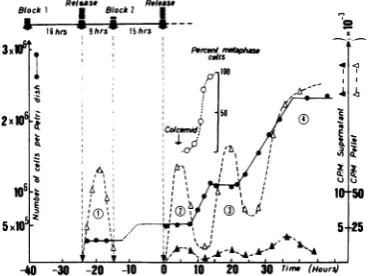
Typical results obtained with the double thymidine block procedure are illustrated in
Fig.1.Release from the secondthymidineblock
resulted in a series of successive S periods
(labeled 2, 3, and 4 as indicated in Fig. 1) in
between which the cell population doubled
(closed circles). The firstdoublingof the
num-ber of cells per petri dish required 4 to 5 h.
Colcemid arrest of cells in metaphase showed
thatmore than 95% of the cells entered mitosis
within that time (inset to Fig. 1). Percentage of
synchronization,ascalculatedby the method of
Engelberg (13), was thereforeover50%. In this
and other experiments, duration of S periods
number 2 and 3 was approximately 8 and 10 h,
respectively. It has been commonly observed
that synchronization by excess thymidine
re-sults in ashortening of the cell generation time
(2, 8, 14,26, 31,40). As can be seen in Fig. 1, the
interval separating S phases number 2 and 3
was only 16 h, whereas the generation time of
randomly dividing cultures is 24h.
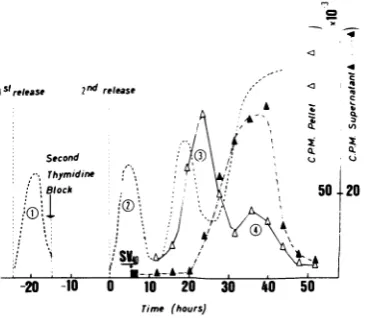
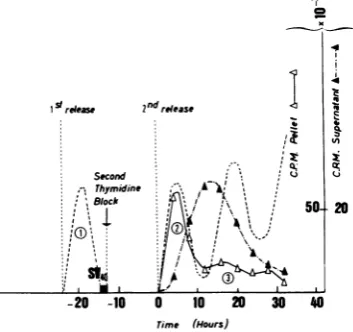
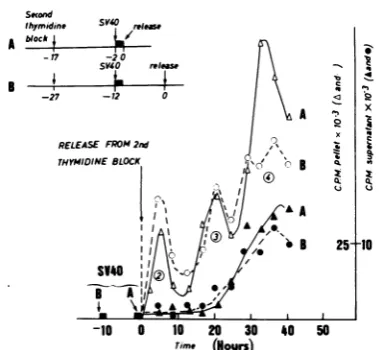
Cells synchronized as above were infected
with SV40atthe followingstagesoftheircycle:
beginning of S (Fig. 2), middle of S (Fig. 3), and
G2(Fig. 4). Infection with SV40 usually resulted
inalag of approximately 2 h in the timingofthe
various S phases, which can probably be
ac-counted for by the 90-min adsorption period,
andby the time further required for withdrawal
of the nonadsorbed virus and rinsing of the
plates. In no case did infection with SV40
Release Release Block g Block2 3
6hns lOhrs3 15hrs
~I
Io20
-lCol¶mo.1
el0I0 525
(D~~~4
FIG. 1. Synchronization by double excess
thymi-dine. Subclone CV1 cells were synchronized by
excess thymidine. The rate of DNA synthesis was
followed through successive4-h pulse labelings with
4i.Ci of tritiated thymidine per ml. Radioactivity was
determined through selective extraction (22) in both
high-molecular-weight DNA (i\) and
low-molecular-weight DNA(-). Each point represents the
trichlor-acetic acid-precipitable radioactivity recovered from
one petri dish.Similar results were obtained with 2-h
pulse labelings (notshown). Counting of cells(-) was
performed after detachment with trypsin and EDTA.
Determination of percentage of metaphase cells (0)
was as described in Materials and Methods.Numbers
1 through 4 refer to the successive S phases.
on November 10, 2019 by guest
http://jvi.asm.org/
[image:2.495.274.460.376.514.2]1st release 2,,d release
Secctondoel ttebgnigo .Clssnho
Thymidine
ecs tAdx
wihublockigmdu,adicbtda37CTh 50120
25 10 K A"
-20 -10 10 20 30 U0 50 rimew (Hours)
FIG 2 Timecourse ofSV40 DNAreplicationupon
infectionofcellsatthebeginningofS. Cells
synchro-nizedbyexcessthymidineasdescribedforFig.1were
infected atzerotime with 0.2 mlofSV40(U).At the end oftheadsorptionperiod, the cells wereoverlaid
withunblockingmedium,and incubatedat37C. The
rateofDNA synthesiswasfollowed asdescribedfor
Fig.1. Thedashedline,takenfrom Fig.1, represents
the rate of high-molecular-weight (nuclear) DNA
synthesisinuninfectedcontrolcells,and numbers1to
4 refer to the successive S phases in such cells.
Symbols: A, high-molecular-weight DNA; A;
low-molecular-weight DNA.
rime (hours)
FIG. 3. Timecourseof SV40 DNAreplicationupon infection of cells in the middle of S. Cells
synchro-nizedasdescribed for Fig. 1wereinfected withSV40
4.5h afterreleasefrom the secondthymidineblock.
At the end of the adsorption period, the cells were
overlaidagain with unblocking medium and further
incubatedat 37C. Determination ofradioactivity was
asdescribedforFig. 2.
s4 OfLFvwA'rn,
prevent the normal occurrence of S periods
number 2 and 3, irrespective of the time at
which the cells had been infected. However, in
all three experiments, S phase number 4 was
- .rTr .W... 'I In...- . ,I
DNA synthesis occurs only at late stages of _SV40 multiplication (28). Similarly, while
mi-toses occurred normally in the infected cells
between S phases number 2 and 3, none were
detected after S period number3 (not shown). Radioactivityinthe Hirt extraction superna-tant fluids started increasingatapproximately
20 h after release from the second thymidine
block(closedtriangles, Fig. 2-4). Analysisofthe labeled material throughsucrose gradient
cen-trifugation at both neutral and alkaline pH
showed that this increase correspondedto
label-ing ofsupercoiled SV40 DNAcomponent I. In
all three experiments, the first progeny viral DNAmoleculesweredetectedatthesametime, corresponding approximately tothemiddleofS phase number3.Therefore, the earlier the cells
were infected after releasefrom the thymidine block, the more delayed was the onset of
re-plication of SV40 DNA. In the three
experi-ments, viral DNA synthesis lasted
approxi-mately from the end of S phase number 3 to
thatof S phasenumber 4.
To show that these results were not due to
differentdegreesofadsorptionorpenetrationof the virus, synchronized cells were infected at
different stages of their cycle with tritiated thymidine-labeled purified SV40 virions. Mul-tiplicityofinfectionwasadjustedto50PFUper
cell by appropriate dilutionofthe labeledvirus
stock with nonradioactive virus. At the endof
the 90-min adsorption period, the cells were
rinsed three times with PBS, detached from
their support through treatment with trypsin and EDTA, centrifuged, and both the cell number in the sample and the cell-associated
Stnd
sirelease 2 reease
Seco_ . _
thyrmidinl
Io-1lock 500
-20 -10 0 10 20 3U Time(Hours) FIG. 4. Timecourseof SV40DNAreplication upon
infection of cells in G2. Cells synchronized as
de-scribed for thepreceding figures were infected with
SV40 9 h after release from the second thymidine
block (see details in the legends to the preceding
figures).
inhibited.Thisagrees with theobservation that
in
rafrdomly
growing cells inhibition ofcellular101
on November 10, 2019 by guest
http://jvi.asm.org/
[image:3.495.55.235.77.233.2] [image:3.495.51.235.366.525.2]TABLE 1. Influence ofthe various periods of the cell
cycle onadsorption of SV40
Inputvirus
Periodofthecellcycle adsorbedper
3x 10' cells
Gl 12.0
Beginning ofS 12.0
7.5
S 10.5
11.0
G2 6.8
6.3
M 5.3
4.6
Metaphasecells insuspension 16.4
17.25
aTritiated thymidine-labeled virus was used to
infect a series ofduplicate petri dishes of
synchro-nized cellculturesatthe variousindicatedperiodsof
their cycle (see text). Input counts per minute per
petri dish was 29,000. Cells in Gl were obtained
through seeding of metaphase cells. They were
in-fected 1h afterseeding.BeginningofS referstocells
takenimmediatelyafterrelease fromasecond
thymi-dineblock,and M referstocells blocked inmetaphase
through the addition of0.1 sg ofcolcemid per ml.
Metaphase cells in suspension wereobtained through
the use of low-calcium medium and infected while
kept in suspension bygentle agitation in a 37 C water
bath.
trichloroacetic acid-precipitable radioactivity
weredetermined.As canbeseen inTable1, the highest percentage ofadsorption wasachieved
with metaphase cells in suspension and the
lowest with metaphase cells under colcemid.
Variations between G1, S, and G2 were,
how-ever, much less significant, being at the most
twofold. This difference is probably meaning-less when related tothehigh input multiplicity
of infection usedthroughouttheseexperiments.
Moreover, had actualmultiplicitiesofinfection
played a role in the results of Fig. 2 to 4,
differences should have been noted between the three cultures, both regarding the duration of
viral DNAsynthesis, andthe overall amount of
viral DNA synthesized per culture (28). This
wasobviouslynotthe case. A 25 to 30% decrease
in the average rate of viral DNAsynthesiswas
observed in the culture infected inG2 (Fig. 4),
but this was not found in later experiments.
Variations in the extent of virus adsorption to
cells at different stages of their mitotic cycle
were, therefore,apparently negligible.A similar
conclusion has been reached in the case of
polyoma virus, which was shown to adsorb
equally well to BHK cells through the various
periods oftheir cycle (1).
Thepossibility was next investigated that the
treatment of the cells with excess thymidine
might have rendered them temporarily unable tosustainthereplicationoftheviralgenome. In
order todemonstrate that this was not the case,
cells were synchronized once only with thymi-dine, infected with SV40, then synchronized
againthrough excessthymidine overnight.
Fig-ure 5 showsthatremoval ofthe second
thymi-dine blockresulted in the immediate initiation
of viral DNAreplication, thus confirming that,
uponinfectionofcellsinG2, onsetofviralDNA
replication occurs during the S period of the
following cell cycle. Theimmediatetriggering of
viral DNA synthesisuponremovalofthe
thymi-dine block (Fig. 5) suggests that theearlyviral
genes were expressed underexcess thymidine.
This hypothesis was strengthened by the
ob-servation that at least 80% of the blocked infected cells were positive forT antigen at the time when theblockwasreleased (notshown). The resultsofFig.5 also showthatblocking of
cells with excess thymidine does not preclude
the replication of SV40 DNA during the cell
cycle which follows removal ofthe block. The delay in onset of viral DNA synthesis in the cultures infected at the beginning or in the
middle ofS (Fig. 2 and 3),cannottherefore be attributed to inability of the infected cells to
Streease 2ndrelease
20
Time (Hours)
FIG. 5. Timecourseof SV40DNAreplicationupon
infection of cellsatthe endof S phase number1.Cells
synchronized once only with excess thymidine were
allowedtoproceedthroughS,infectedwithSV40(-),
then blocked again under excess thymidine. Upon
releasefrom the secondthymidineblock,host cell(A)
and viral (A) DNA syntheses werefollowed as
de-scribedin the legendstothepreceding figures.
on November 10, 2019 by guest
http://jvi.asm.org/
[image:4.495.273.450.428.594.2]replicate viral DNA atthis time of theircycle.
Suchadelaymightreflectthe timenecessary
forthesynthesisoftheearly viralgeneproducts
which are known toberequired for the initiation
of viral DNA synthesis (41). On this basis, it could be argued that in the case of the cells infected at the beginning of S (Fig. 2), and a
fortiori ofthose infected in the middle of Sorin
G2(Fig.3and4), the cellswerenolongerinthe appropriate period of the S phase when suffi-cientsynthesis ofearlyviralproteins hadfinally occurred. This hypothesiswastested by infect-ingcellsatthebeginning of SasforFig. 2.Part of theculturewasthemimmediately unblocked (curves A, Fig. 6), whereas another part was
maintained underexcessthymidineforan addi-tional10htoallow timeforthe expressionofthe early viralgenes (curves B, Fig. 6). Viral DNA replication inculture B still didnotbeginuntil S phase number3.Itwas, therefore, delayed by
10 h by comparison with that in culture A. Appearance ofT antigen was, however, identi-cal inboth cultures (notshown). Thissuggests
thatthedelay inculture Bwas notduetolack ofsynthesisofearlyviralproteins.Expressionof theearlyviralgenes,albeitmandatory, doesnot seemsufficienttopromotethe initiationofviral DNAsynthesis.
To further demonstrate this point,
synchro-nized
CV,
cells infected atthe timeofS phasenumber2 wereartificially prevented from enter-ing S phase number 3 through arrest in
meta-phase bytreatment with0.1 ug ofcolcemid per
ml (11, 39). Under these conditions, S phase number 3 was prevented to the extentof80%.
Inhibition of viral DNA replication was also
80%, but the appearance of T antigen was not
appreciably inhibited (datanot shown). Colce-mid addedto randomly growing, SV40-infected cells had no effect on the replication of SV40
DNA once it was already under way. These
results,therefore,leadtosuggestthatthe initia-tionofSV40 DNAsynthesis is under controlof
cellulareventsassociated with the normalonset ofthe host cellS phase.
The time course ofviral DNA synthesis in
cells infected during
GI
was also investigated. Since the double excess thymidine procedure used abovewasnotveryappropriatefor obtain-ing cells inG1
(see Fig. 1), the procedure ofselective detachmentofcells in metaphase (33,
34, 42) was used instead. Figure 7 shows that
the seeding ofcells in metaphasewas followed by a 6-h lag before synthesisofDNA could be detected. Mitosesbegan 18 h afterseedingand
lastedforapproximately6h. Cellssynchronized by this procedure were infected with SV40 1 h
afterseeding, i.e., atthe beginningof
G1
(insetSCond
Ihymidine relente A
_17 -20
SV40 release
-27 -12 0
X
x
t
[image:5.495.249.439.74.249.2]-10 0 10 20 30 40 50 Time (Hours)
FIG. 6. Effect of the temporary prevention of
cellu-lar DNAsynthesis in cellsinfectedatthebeginningof
an Speriod. Cells blocked for the second time with
excess thymidinewereinfected withSV40after15 h
under blocking medium. The virus stock used was
diluted with blockingmedium to insure that no cell
DNA synthesis would occur during the adsorption
period.Asillustratedbythediagramin the top part of
the figure, part of the cells was then immediately
unblocked (A), whereas another part was further incubated for 10 h under blocking medium before
release (B).Synthesis of cellular and viral DNA (open
and closed symbols, respectively) was followed as
describedbefore. Symbols: A and A, culture A; 0 and
0, culture B. Note that, in order to superpose the
successive S periods in both cultures, the actual time
coursefor culture B has been shifted by 10 h, zero
time for both experiments being taken as that of
unblocking, and not asthat ofinfection.
to Fig. 7). Contrary towhatwasobserved with cells infectedduringSorG2,onsetofviral DNA replication in these cells was not postponed until the next cell cycle, but occurred between the hour 10and20afterseeding, i.e., duringthe S phase immediately after infection. Here again, most ofviral DNA synthesis took place
after cellular DNA synthesis, but the first
progeny viral DNA molecules were detected
whenthe cells werestill in S. Notethatin this experiment replication of viral DNA was fol-lowed during 15 h only, although it actually lasted for approximately 30 h. Use of cells
obtained in GI upon arrest in metaphase
through the use of colcemid and detachment
from the glass in low-calcium medium yielded
similarresults (datanot shown).
It was verified that, in this system also,
infection at the beginning ofS would result in
postponing the onset of viral DNA replication
byonecellcycle.Tobetter distinguish between
the successive S periods, the cells which had
on November 10, 2019 by guest
http://jvi.asm.org/
-10 0 10 20 30 rime(Hours)
FIG. 7. Time course of SV40 replication upon
in-fectionof cells in G1. Metaphase cells were seeded in
petri dishes at zero time. Both the rate of cellular
DNA synthesis (A) and the number of cells per dish
(0) were then followed (lower panel). Part of the cell
monolayerswereinfectedwithSV401hafterseeding
(U) and the rate of viral DNA synthesis (A) was
determined bysucrosegradient analysis of the Hirt
extraction supernatantfluids(upperpanel).
been seeded while in metaphase were further synchronized through treatment with excess
thymidineatthe endofG1 (Fig. 8). Durationof
the
GI
periodwas10to12hinthisexperiment(inset toFig. 8).Cellswereinfectedateither2,
6,or10.5h afterseeding (samplesA, B, andC, respectively), then overlaid with blocking
me-dium until hour24. Onset of viral DNA
replica-tion in these three cultureswas found tooccur
during the S phase immediately after the
re-lease from the thymidine block, and the time
courseofviraldevelopmentwasidenticalinthe
three cultures, independent of the time of
infection. Controlcellssynchronizedinparallel
were infected with SV40 immediately before removal of thethymidine block, thenallowedto
proceed through S. SV40 DNA replication in
these cells did not occuruntil theSphaseofthe
next cellcycle (Fig. 8,sample D).
DISCUSSION
Thepresentstudy demonstratesthatthe time
courseofSV40 DNAsynthesis isrelatedtothe
particularstage of thecellcyclewhen infection
occurs, and that duration of the early,
pre-replicative phase of the virus growth cycle
varies widely, depending upon the timing of
infection withregardtothe hostcell Sphase.In
cells infectedatthebeginningormiddleofS,or
in G2, initiation of viral DNAsynthesisalways
took place at the same time of the host cell
cycle, namely,the middle of the S period of the
nextcellcycle. In cells infected at the beginning
ofG1, viral DNAsynthesis was initiated at some
stage of the next S period. The onset of viral
DNAreplication, with respect to the timing of
C.P.M.
x10-3-Conftrol
-0
-10
Thymidine S4
blockABC
-30 Rel o Hours
_ r 10 20 __ 30
x
I
A
x10 / 0
0.~~~~~.
30
[image:6.495.267.453.140.412.2]Timeafterseeding
(Hours)
FIG. 8. Permissiveness of cells infected at various
times of G 1. Metaphase cells were detached and
seeded (1.6 x 10⁵ cells perpetri dish). Overall DNA
synthesis was followed by a series of successive 2-h
pulselabelings with4tiCiof tritiated thymidine per
ml. At the endof eachlabeling period,the cells were
lyzedwithSDS,andtrichloroaceticacid-precipitable
radioactivity was determined (open circles, inset to
the figure). In another part of the culture, cellular
DNA synthesis was temporarily prevented through
incubation inblockingmedium beginning at 8 h after
seeding. Excess thymidine was removed at 24 h, and
cellular DNAsynthesiswasfollowed by a series of 3-h
pulse labelings with tritiated thymidine (A) as
de-scribed in the legend to the preceding figures. Cells infected with SV40 at 2 and 6 h after seeding (A and
B, respectively) were also blocked at 8 h. Cells
infected at 10.5 h after seeding (C) were blocked
immediately at the end of the adsorption period. A
fourth series of cellswere infected with SV40 at the
timeofreleasefrom thethymidineblock (D). Arrows
labeled A to D refer to thetime ofinfection in the
respective cell cultures. ViralDNAsynthesis in these
four cultures wasfollowedasdescribed in thelegend
toFig.2(A).The timecourseof viralDNAreplication
in cultures B andCwasidenticaltothatin cultureA.
Therefore, only one line was drawn for the three
cultures.
on November 10, 2019 by guest
http://jvi.asm.org/
the hostcellcycle,occurred, therefore, with the shortest delay in cells whichhad been infected during
GI,
and with the longest in cells whichhad beeninfected atthe beginning ofS. In all
cases, however, duration of the replicative
phase of the virus growth cycle was identical,
independent of the time of infection. Most of viral DNAsynthesistook placefollowing cellu-lar DNA synthesis and lasted for 25 to 30 h. Infection with SV40 did not interfere with the normal progression of the cell through the successiveperiodsofitscycle,atleast until viral DNAreplication waswell underway.
The fact that the first progeny SV40 DNA
moleculeswere always detected at atimewhen the cell wasin anS periodraises the question of whether cell DNA synthesis isrequiredfor the
onsetofviralDNAreplication. Asanargument
in favor of its necessity comes the fact that
infection with SV40 induces cellular DNA
syn-thesis in resting AGMK or CV1 cell cultures,
whether contact-inhibited (16, 20, 25, 27,32)or
X-irradiated(16, 48). Similar observations have been made with polyoma virus (12, 15, 24, 45, 47).Yet, resting culturesof atleastonecell line ofBSClcellsare notinducedtosynthesizeDNA
upon infection with SV40 (16, 32), although
they fully support the growthofthe virus. On the one hand, it is worth noting that the time
course of SV40 multiplication in
BSC,
cells isdelayed by about 20h as compared tothat in
AGMK orCV1 cells (32). This could be dueto
the fact that virusproductioninthe former has
to wait for a small level of cellular DNA synthesis, whichis toolimitedtobe detected by overall incorporationoflabeled thymidine into bulk DNA. On the other hand, the possibility
remains that what is required forthe onset of
SV40 DNA replication is not cellular DNA synthesis per se,but rathersomecellularevent
related to, and usually followed by, cellular DNAsynthesis. The necessityforsuchanevent
couldaccount both forthe lack ofinduction of
cellular DNA synthesis in SV40-infected
BSC,
cell cultures andforits occurrence inother cell lines. It would also account for the results
reported here with synchronized
CV,
cells.Of particular significance, in this respect, is the observation that synchronized cells which
hadalreadypassed the end of G1 at thetime of
infectionwere unabletopromote the initiation
ofSV40 DNAsynthesisuntil their nextmitotic
cycle, even ifenoughtime wasprovided for the
expressionoftheearly viral genes before
allow-ing the cells toproceed through S. This clearly
shows that cellular DNAsynthesiswas notthe
key determinant in this case. Lack of
compe-tence ofcells infected after
G1
was neither dueto impaired adsorption of the virus, nor to any
intrinsic inability of the cellstosustain
replica-tion of the viral genome at that time oftheir
cycle. Theseobservations, taken together with
the fact that cells infectedduring G1 were able
topromote the initiation ofSV40 DNA
replica-tion at some stage of their next S phase, i.e.,
within the same mitotic cycle, could best be explainedbyassuming that the infected cell has
topassthroughacriticalstagesituatednearthe end of G1ortheverybeginning ofS, in orderto
gain competence for the eventual initiation of
viral DNA synthesis. This hypothesis would explain why SV40 DNA synthesis was
post-poned by as much as one cell cycle in cells whichwereinSatthe time of infectionandwas
suppressed when cells infected during an S period wereprevented from entering theirnext
mitotic cycle through arrestin metaphase. It has recently been demonstrated that the yield ofpolyoma virus from infected Balb/3T3 cells,as measured48h afterinfection, depends
onthestage inthe cellcyclethatthe cells have
reached whentheyareinfected, andismaximal for cells which are infected at, or near, the
beginningof
GI
(44).Previous observations had also shown that the time course of polyomavirus DNAsynthesisdependeduponthetiming
ofinfection withregardtothe host cell Sphase (3,4, 23). Thesimilaritybetweenthese observa-tions and thosereported here for SV40 leadsto
suggest that a critical stage of the host-cell
cycle, situated near the end of G1 or the very
beginning of S, might also be required in the
case of polyoma virus for the infected cell to
eventually begin replicating viral DNA. This
hypothesis might, moreover, explain why
divid-ing cells seem to offer the most favorable environment for the replication of polyoma
virus(43) aswellasforthat of SV40 (28), since
the criticalstageof the hostcell cycle might be expected to occurmorequickly inthe majority ofa dividingcell population than in confluent cell cultures in which the arrest of metaboli
processes hastobe overcome.
The critical stage of the host cell cycle, as
defined here, didnot apparently correspond to
the time when viral DNA synthesis was
initi-ated, since the first SV40 progeny DNA mole-cules wereusuallynot detected before approxi-matelythe middle of an S period. Itcould thus
be that the cell-controlled event which occurs
at the critical stage determines only the
per-missiveness of the cell to the later replication
of the viral genome. However, since the first
roundorrounds ofSV40DNAreplication might
wellescapedetectionthrough labeling with
thy-midine, and since zero time ofreplication
can-not be inferred from the early kinetics of
ac-cumulation of DNA component I (28), actual
on November 10, 2019 by guest
http://jvi.asm.org/
onset of viral DNA synthesis might occur
earlierthan was detected. Itis notclear,
there-fore, whetherinitiation ofviral DNA synthesis
occurredatthe time of the critical stage, or at alater time of the Speriod. Onsetofviral DNA synthesis was usually detected earlier, with
respect to the host cell S phase, in cells
syn-chronized by excess thymidine than in those synchronized by mitotic detachment. Whether
this reflects the possible disturbance
intro-duced in the rhythm ofthe host cell cycle by
either or both synchronization procedure(s) is
unknown.
Thenatureofthe cell-controlledeventwhich
occurs at the time of the critical stage and
eventuallytriggers the initiation ofSV40DNA
replicationisstillobviouslyamatter of specula-tion. On the one hand, it could be any ofthe
numerous events which are known to occur
immediately before S in noninfected cells and whichmight beakeytocellularDNAsynthesis and cell proliferation. The most important
among these are the induction of several
en-zymes (forareview, see37and 46), the
synthe-sis of acidic chromosomal proteins (5, 35-38),
that of histones and histone messenger RNA (7), and alterations in the level ofboth
adeno-sine 3':5' cyclic-monophosphate (9, 10, 29, 50)
and of guanosine 3'-5' cyclic-monophosphate
(19). The great number ofvariables warrants
further investigation before a clear picture of
the sequential events which lead to cellular
DNA synthesis in animal cells can be drawn
andtheirpossibleroleinpromoting SV40DNA
replication experimentally tested.
'On
the other hand, one should not overlookthe possibility that the cellular event which is requiredforthe initiation ofSV40DNA replica-tion isthe formation ofspecific initiation sites
in the cell. Results from
previous
studieshaveled to the hypothesis that SV40 DNA
replica-tion in
CV,
cellsoccurson a limitednumber of sites (28). The critical event which seems tocontrol thepermissivenessoftheSV40-infected
cell might therefore be connected with the binding of parental SV40 DNA to specific replicationsites inside thecell,or toits
integra-tioninto the host-cellchromosomes(21).
Exper-iments aimed at testing these different
hy-pothesesarein progress.
ACKNOWLEDGMENTS
We thank Arnold Levine for helpful discussion, and Josette Merlino, Louise Marty, Daniele B6nichou, and
Frangoise Suarez for their expert and devoted technical
assistance.DominiqueStehelin was astagiaire de la Direc-tion des Recherches et Moyens d'Essais, and Maria Marx holds afellowshipfrom theLigue Nationalecontrele Cancer. This investigation was supportedinpartbytheDelegation Generale a la Recherche Scientifique et Techniqueand in
partbythe Commissariat al'Energie Atomique.
LITERATURE CITED
1. Basilico,C., and G. Marin. 1966.Susceptibilityofcells in different stages of the mitoticcycletotransformation bypolyoma virus. Virology 28:429-437.
2. Bello, L. J. 1968. Synthesis of DNA-like RNA in synchro-nized cultures of mammaliancells. Biochim. Biophys. Acta 157:8-15.
3. Ben-Porat, T., and A. S. Kaplan. 1967. Correlation between replication and degradation of cellular DNA in polyoma virus infected cells. Virology 32:452-464. 4. Ben-Porat, T., A. S. Kaplan, and R. Tennant. 1967.
Effect of 5-fluorouracil on the multiplication of a virulent virus (pseudorabies) and an oncogenic virus (polyoma). Virology 32:445-456.
5. Bhorjee, J. S., and T. Pederson. 1972. Non histone
chromosomal proteins in synchronized HeLa cells. Proc. Nat. Acad. Sci.U.S.A. 69:3345-3349.
6. Bootsma, D., L. Budke, and 0. Vos. 1964. Studies on synchronousdivision of tissue culture cells initiated by
excessthymidine. Exp. Cell. Res. 33:301-309. 7. Borun, T. W., M. D. Scharff, and E. Robbins. 1967.
Rapidly labeled,polyribosome-associated RNA having the properties of histone messenger. Proc. Nat. Sci. U.S.A. 58:1977-1983.
8. Bostock, C.J., D. M. Prescott, and J. B. Kirkpatrick. 1971.Anevaluationofthe doublethymidine block for synchronizing mammalian cells at the G ,-border. Exp. Cell Res. 68:163-168.
9. Burger, M. M., B. M. Bombik, B. McL. Breckenridge, and J. R. Sheppard. 1972. Growth control and cyclic alterationsofcyclic AMP in the cell cycle. Nature. N. Biol. 239:161-163.
10. Byron, J.W. 1972. Evidence for a,3 adrenergic receptor initiating DNA synthesisinhaematopoYetic stem cells. Exp. CellRes. 71:228-232.
11. Doida, Y., and S. Okada. 1967. Synchronization of L 51784cellsbysuccessive treatmentwith excess thymi-dine and colcemid.Exp.Cell Res. 48:540-548.
12. Dulbecco, R., L. M. Hartwell, and M. Vogt. 1965. Induction of cellular DNAsynthesisby polyoma virus. Proc. Nat.Acad.Sci.U.S.A. 53:403-410.
13. Engelberg, J. 1961. A method of measuring the degree of synchronization of cell populations. Exp. Cell Res. 23:218-227.
14. Galavazi, G., and D. Bootsma. 1966. Synchronizationof
mammalian cells in vitro byinhibition ofthe DNA synthesis.Exp.Cell Res. 41:438-451.
15. Gershon, D., P. Hausen, L. Sachs, and E. Winocour. 1965. On the mechanism of polyoma virus-induced synthesisofcellular DNA. Proc. Nat. Acad. Sci.U.S.A. 54:1584-1592.
16. Gershon, D., L. Sachs, and E. Winocour. 1966. The induction of cellular DNA synthesis by simian virus
40 in contact-inhibited and X-irradiated cells. Proc. Nat. Acad.Sci. U.S.A. 56:918-925.
17. Girard,M., D.Stehelin,S. Manteuil and J. Pages. 1973. Aspectsoftheencapsidationofsimianvirus 40 deoxyri-bonucleic acid. J. Virol. 11:107-115.
18. Green, M.1970.Oncogenicviruses.Annu. Rev. Biochem. 39:701-756.
19. Hadden, J.W., E. M.Hadden, M. H.Haddox, and N. D. Goldberg. 1972. Guanosine 3':5'-cyclic monophos-phate: a possible intracellular mediatorofmitogenic influences in lymphocytes. Proc. Nat. Acad. Sci. U.S.A. 69:3024-3027.
20. Hatanaka,M.,and R.Dulbecco.1966.InductionofDNA
synthesis by SV40. Proc. Nat. Acad. Sci. U.S.A. 56:736-740.
21. Hirai, K., and V. Defendi. 1972.Integration ofsimian
virus 40deoxyribonucleic acid into the deoxyribonu-cleic acidofpermissivemonkey kidney cells.J. Virol.
9:705-707.
22. Hirt, B.1967.Selectiveextraction ofpolyomaDNA from
infectedmousecells. J. Mol. Biol.26:365-369.
on November 10, 2019 by guest
http://jvi.asm.org/
23. Kaplan, A. S., and T. Ben-Porat. 1968. Metabolism of
cells infected withnuclear DNAviruses. Annu. Rev. Microbiol. 22:427-450.
24. Kasamaki, A., T. Ben-Porat, and A. S. Kaplan. 1968.
Polyoma-induced releaseof inhibition ofcellular
DNA-synthesis caused by iododeoxyuridine. Nature (Lon-don)217:756-758.
25. Kit, S.,R. A.DeTorres,D.R.Dubbs,and M. L.Salvi.
1967. Inductionofcellulardeoxyribonucleic acid
syn-thesis by simian virus40.J. Virol. 1:738-746.
26. Lawrence, W. C. 1971. Evidence for arelationship
be-tweenequineabortion (herpes)virusdeoxyribonucleic acid synthesis and theSphaseoftheKBcellmitotic cycle. J. Virol. 7:736-748.
27. Levine, A. J. 1971. Induction of mitochondrial DNA
synthesis inmonkey cells infected by simian virus40
and(or)treated withcalfserum.Proc.Nat.Acad. Sci.
U.S.A.68:717-720.
28. Manteuil, S.,J.Pages,D.Stehelin,and M.Girard. 1973.
Replication ofsimianvirus40deoxyribonucleic acid: analysis of the one-step growth cycle. J. Virol. 11:98-106.
29. Otten, J., G. S.Johnson, andI.Pastan. 1971.CyclicAMP
levels in fibroblasts: relationship to growthrate and
contact inhibition ofgrowth. Biochem. Biophys.Res.
Commun.44:1192-1198.
30. Puck, T. T. 1964. Phasing, mitotic delay and
chromo-somal abberations in mammalian cells. Science 144:565-566.
31. Rao, P. N., and J.Engelberg. 1966.Effectsof tempera-tureonthemitotic cycleof normalandsynchronized
mammaliancells,p.332-352.In I.L.Cameronand G.
M.Padilla(ed.),Cellsynchrony. Academic Press Inc.,
New York.
32. Ritzi,E., and A. J. Levine. 1970.Deoxyribonucleic acid replicationinsimian virus40-infected cells.III.
Com-parison of simian virus 40 lytic infection in three
differentmonkeycelllines. J. Virol.5:686-692.
33. Robbins, E., and P.I.Marcus.1964.Mitotically
synchro-nizedmammaliancells:asimple methodforobtaining large populations. Science 144:1152-1153.
34. Robbins, E., and M. Scharff.1966.Somemacromolecular
characteristics ofsynchronizedHeLacells,p.353-374.
In I. L. Cameron and G. M. Padilla (ed.), Cell synchrony.Academic Press Inc., New York.
35. Rovera, G., and R.Baserga. 1971. Early changesinthe synthesis ofacidicnuclear proteinsin humandiploid fibroblasts stimulatedtosynthesize DNA bychanging
themedium.J. CellPhys.77:201-211.
36. Rovera, G., R. Baserga, and V. Defendi. 1972. Early increaseinnuclearacidicproteinsynthesisafterSV40 infection.Nature. N. Biol. 237:240-241.
37. Stein,G., and R. Baserga. 1972. Nuclear proteins and the cell cycle, p.287-330.InG. Klein and S. Weinhouse (ed.), Advances in cancerresearch, vol 15.Academic Press, Inc.,New York.
38. Stein, G. S., and T. W. Borun. 1972. The synthesis of acidic chromosomal proteinsduring the cell cycle of HeLa S-3 cells. I. The accelerated accumulation of
acidic residual nuclear protein before the initiation of DNAreplication. J. Cell Biol. 52:292-307.
39. Stubblefield, E. 1968. Synchronization methods for mam-maliancellcultures,p.25-43. In D. M. Prescott(ed.), Methods in cell physiology. Academic Press Inc., New York.
40. Studzinski, G. P., and W. C. Lambert. 1969.Thymidine
as asynchronizingagent. I.Nucleic acid andprotein
formation in synchronous HeLa culturestreatedwith
excessthymidine. J. Cell Physiol. 73:109-117.
41. Tegtmeyer, P. 1972. Simian virus 40 deoxyribonucleic acid synthesis: the viral replicon. J. Virol.10:591-598.
42. Terasina, T., and L. J. Tollmach. 1963. Growth and nucleic acidsynthesisinsynchronously dividing
popu-lations of HeLa cells. Exp. Cell Res.30:344-362. 43. Thorne, H. V. 1973. An investigation of factors
influenc-ing the susceptibilityofBalb-c 3T3 cellstopolyoma virus. J. Gen.Virol. 18:153-162.
44. Thorne, H. V. 1973. Cyclic variation in thesusceptibility ofBalb-c 3T3 cells topolyoma virus. J. Gen. Virol. 18:163-169.
45. Vogt,M., R. Dulbecco, and B. Smith.1966.Inductionof
cellular DNAsynthesis bypolyoma virus.III.Induction
in productively infected cells. Proc. Nat. Acad. Sci. U.S.A. 55:956-960.
46. Watson,J. D. 1971. TheregulationofDNA synthesisin
eukaryotes,p. 1-46.In D. M.Prescott, L.Goldstein, and E.McConkey (ed.), Advancesincellbiology, vol.
2.Meredith Corp., New York.
47. Weil, R., M. R. Michel, and G. K. Ruschmann. 1965.
Inductionofcellular DNA synthesisby polyoma virus. Proc.Nat.Acad. Sci. U.S.A.53:1468-1475.
48. Werchau, H., G. Maas,H.Westphal, and R. Haas.1967.
Untersuchungen uiber den Nucleinsaurestoffwechsel
von affennierengewebe-Kulturzellen nach infektion
mitSV40. III.Untersuchungen zum mechanisms der
virusbedingten DNS-synthesesteigerung. Arch.
Ge-samteVirusforch.21:265-275.
49. Xeros, N. 1962. Deoxyriboside control and synchroniza-tionofmitosis.Nature (London) 194:682-683.
50. Zimmerman, J. E., and K. Raska. 1972. Inhibition of
adenovirus type 12 induced DNA synthesis in G,
arrested BHK 21 cells by dibutyryl-adenosine cyclic 3':5'-monophosphate. Nature N. Biol. 239:145-147.
on November 10, 2019 by guest
http://jvi.asm.org/