City, University of London Institutional Repository
Citation: Bergeron, M. (2010). Structured polyphonic patterns. (Unpublished Doctoral
thesis, City University London)This is the accepted version of the paper.
This version of the publication may differ from the final published
version.
Permanent repository link: http://openaccess.city.ac.uk/id/eprint/12097/
Link to published version:
Copyright and reuse: City Research Online aims to make research
outputs of City, University of London available to a wider audience.
Copyright and Moral Rights remain with the author(s) and/or copyright
holders. URLs from City Research Online may be freely distributed and
linked to.
City Research Online: http://openaccess.city.ac.uk/ [email protected]
Mathieu Bergeron
Submitted for Examination of Doctor of Philosophy
Department of Computing
City University London
United Kingdom
I am infinitely indebted to my supervisor Darrell Conklin for his sustained enthusi-asm and patience – and for his considerable help with the content of this dissertation and administrative matters.
I also wish to thank Christos Kloukinas and Alan Marsden for kindly accepting to examine this dissertation. I am especially proud and touched that my work has been reviewed by Dr Marsden. His book on musical time was my first contact with the field of music informatics: it provided the spark that initiated my research project and constant inspiration as I revisited – and keep revisiting – the book.
I thank my colleagues of the Music Informatics research group at City University: Tillman Weyde, Jens Wissmann, Kerstin Neubarth, Aline Honingh, Ruben Hille-waere, Michael Rausch and ´Edouard Gilbert. I will keep fond memories of many work sessions, reading group meetings, retreats... and teatime chats. Additional thanks to Christina Anagnostopoulou for her generous comments and encourage-ments early on.
I am also grateful to City University and FQRNT (Le Fonds qu´eb´ecois de la recherche sur la nature et les technologies) for their financial support.
Finally, I wish to thank Katherine Elliott for kindly accepting to proofread this dissertation.
* * *
On a more personal note, I want to warmly thank Lise and Roger who supported me greatly – and in many ways – throughout my doctoral studies. I will particularly remember their swift encouragements at the beginning of the process and their inextinguishable patience at the end.
1.1 Computational musicology . . . 4
1.2 Motivating examples . . . 8
1.3 Aim and objectives . . . 10
1.4 Summary . . . 11
1.5 Outline . . . 11
2 Polyphonic music 14 2.1 Music notation . . . 15
2.2 Computer representations . . . 20
2.3 Abstractions . . . 22
2.3.1 Temporal relations . . . 22
2.3.2 Musical relations . . . 25
2.4 Motivating patterns . . . 28
2.5 Requirements for a polyphonic pattern language . . . 33
2.6 Summary . . . 35
3 Related work 36 3.1 Expressive and precise approaches . . . 36
3.2 Restricted or approximate approaches . . . 45
3.2.1 Vertical approaches . . . 53
3.2.2 Graph approaches . . . 54
3.2.3 Geometric approaches . . . 55
3.2.4 Sequential approaches . . . 56
3.3 Summary . . . 57
4 Structured Polyphonic Patterns 58 4.1 Source . . . 58
4.2 Components . . . 61
4.3 The SPP language . . . 62
4.4 Interpreting SPP patterns . . . 67
4.5 Feature definition rules . . . 71
4.6 Querying musical sources . . . 72
4.7 Matching algorithm . . . 73
4.8 Summary . . . 74
5 Musicological queries in SPP 75 5.1 Overview . . . 75
5.2 Sources . . . 77
5.3 User-defined features . . . 81
5.4 Queries . . . 85
5.4.1 Compensated leap . . . 88
5.4.2 Block chord . . . 91
5.4.3 Parallel fifth . . . 94
5.4.4 Suspension . . . 97
5.4.5 Counterpoint . . . 99
6.3 From Humdrum to H . . . 109
6.3.1 Well-formedness . . . 110
6.3.2 Interpretation . . . 111
6.4 SPP and SPPseq . . . 112
6.5 Comparing languages . . . 113
6.5.1 R subsumes H and SPP . . . 113
6.5.2 H does not subsume SPP . . . 113
6.5.3 SPP does not subsume H . . . 114
6.5.4 H and SPP subsume SPPseq . . . 115
6.6 Summary . . . 119
7 Discussion 120 7.1 From requirements to SPP . . . 120
7.2 Beyond n-part polyphony . . . 123
7.3 Motivating SPP semantics . . . 124
7.4 Pattern matching efficiency . . . 126
7.5 Mock SPP GUI . . . 132
7.6 Suitability of SPP for data mining . . . 133
7.7 Suitability of SPP for musicology . . . 135
7.8 Summary . . . 138
8 Conclusion 142 8.1 Summary and contributions . . . 142
A.1 Overview . . . 145
A.2 Glossary . . . 149
B User-defined features 152 C Notation 158 D Matching algorithm 161 E Prolog implementation 166 F Additional tables and figures 170 F.1 Features . . . 170
F.2 Queries . . . 171
F.3 Musical excerpts for Chapter 5 . . . 173
F.4 Musical excerpts for Chapter 6 . . . 200
F.5 Musical excerpts for Chapter 7 . . . 206
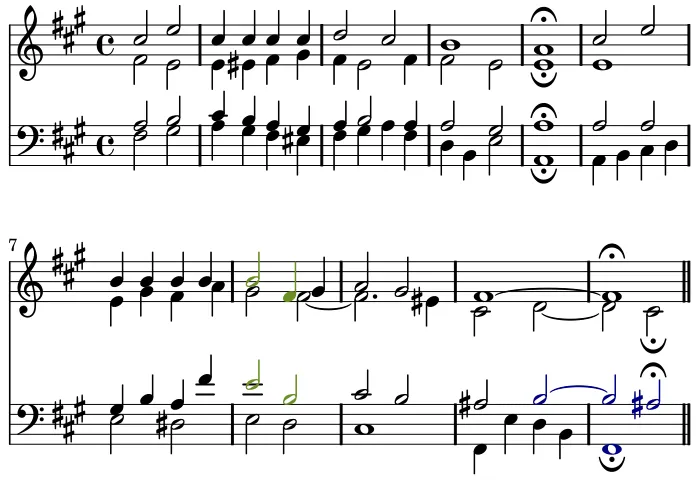
1.2 Bach chorale harmonization BWV 323. Two polyphonic patterns are highlighted: a parallel fifth in the eighth bar and a suspension in the final bar . . . 9
2.1 First five bars of the tenor voice of BWV 323 . . . 15 2.2 First five bars of the tenor voice of BWV 323 in piano-roll notation . 16 2.3 First two bars of BWV 323 . . . 17 2.4 Illustration of the concept of sequence of layers . . . 18 2.5 Bars three to five of BWV 323 . . . 19 2.6 The first two bars of BWV 323 as different mixtures of sequences and
layers . . . 21 2.7 Examples of monophonic transposition and transformation. a) and
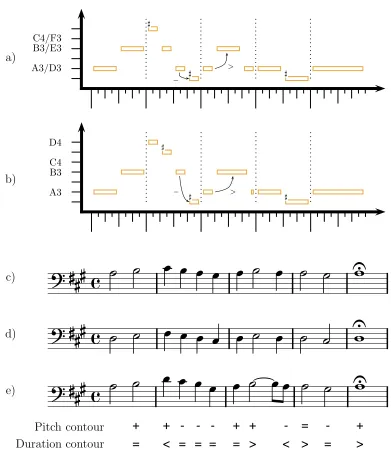
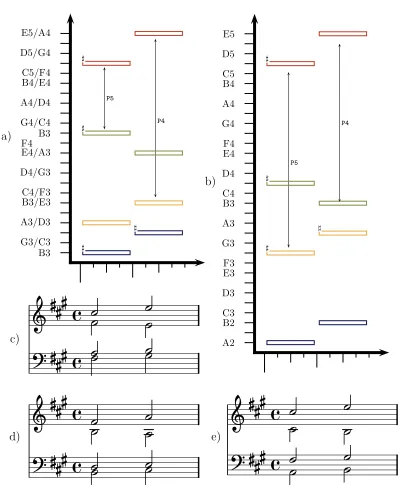
c): first five bars of the tenor voice of BWV 323; a) and d): transposed by a fifth down; b) and e): transformed while conserving pitch and duration contours . . . 27 2.8 Examples of homophonic transposition and transformation. a) and c):
2.10 Final bar of BWV 323. The suspension pattern is highlighted. Every
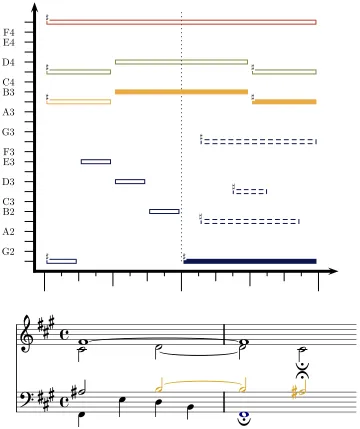
dashed note added to the piano-roll would also form a suspension . . 32
3.1 Prolog encoding of four notes forming a parallel fifth pattern . . . 38
3.2 Prolog definition of the four temporal relations considered in this dissertation . . . 38
3.3 The parallel fifth pattern in Prolog. Reproduced and adapted from Fitsioris and Conklin (2008) . . . 39
3.4 Final bar of BWV 323 in Humdrum/kern encoding . . . 40
3.5 Final bar of BWV 323 in Humdrum/kern encoding after the prepro-cessing required for the execution of a suspension query . . . 41
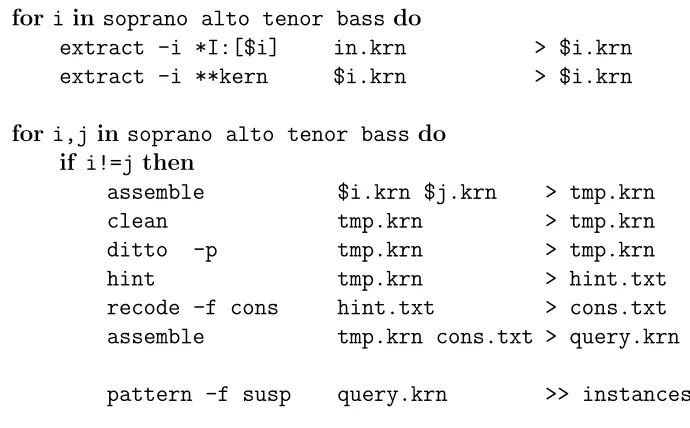
3.6 Execution of a Humdrum suspension query . . . 42
3.7 SPP encoding of four notes forming a parallel fifth pattern . . . 43
3.8 Parallel fifth pattern inSPP . . . 44
3.9 Suspension pattern in SPP . . . 44
3.10 Example of an SPP feature definition rule . . . 45
3.11 Overview of the information involved in the SPP suspension and parallel fifth patterns. Patterns are shown in capitals. Features that are already present in the source are shown in bold. Features that are added to the source using SPP feature definition rules are shown initalics . . . 46
4.1 SPP encoding of BWV 304, bar 21 . . . 60
5.1 Overview of the queries developed in this chapter. Queries are shown in capitals. Features that are already present in the source are shown in bold. Features that are added to the source using SPP feature definition rules are shown in italics . . . 76
features of Table 5.4 are shown. Features shown in figures 4.1 (page 60) and 5.2 are omitted . . . 83 5.5 Frame-conditioned probabilities of melodic intervals in Bach chorales,
Symphony no.40, Chopin and folk songs. Only intervals occurring over at least 1% of m temporal relations are considered . . . 84 5.6 Examples of compensated leaps: a) BWV 273 bar 5 in the soprano
voice; b) BWV 349 bar 13 in the alto voice; c) BWV 297 bar 3 in the tenor voice; and d) BWV 277 bar 1 in the bass voice. The excerpts are shown in piano-roll notation in figures a) F.3 on page 173; b) F.4 on page 174; c) F.5 on page 175; and d) F.6 on page 176 . . . 91 5.7 Examples of blocked I/i chords: a) BWV 292 bar 1; b) BWV 335
bar 4; c) BWV 415 bar 1; and d) BWV 438 bar 8. The excerpts are shown in piano-roll notation in figures a) F.7 on page 177; b) F.8 on page 178; c) F.9 on page 179; and d) F.10 on page 180 . . . 93 5.8 Examples of parallel fifths: a) BWV 263 bar 6; b) BWV 301 bar
3; c) BWV 323 bar 8; d) BWV 355 bar 15; and e) BWV 361 bar 12. The excerpts are shown in piano-roll notation in figures a) F.11 on page 181; b) F.12 on page 182; c) F.13 on page 183; d) F.14 on page 184; and e) F.15 on page 185 . . . 96 5.9 Examples of suspensions: a) BWV 259 bar 8; b) BWV 390 bar 12; c)
BWV 393 bar 7; and d) BWV 285 bar 1. The excerpts are shown in piano-roll notation in figures a) F.16 on page 186; b) F.17 on page 187; c) F.18 on page 188; and d) F.19 on page 189 . . . 98 5.10 Examples of passing tones: a) BWV 253 bar 4; b) BWV 395 bar 9; c)
5.11 Examples of two-voice counterpoint patterns: a) BWV 277 bar 3; b) BWV 285 bar 9; c) BWV 380 bar 3; and d) BWV 418 bar 7. The excerpts are shown in piano-roll notation in figures a) F.24 on page 194; b) F.25 on page 195; c) F.26 on page 196; and d) F.27 on page 197 . . . 102 5.12 Examples of three-voice counterpoint patterns: a) BWV 374 bar 7;
and b) BWV 398 bar 11. The excerpts are shown in piano-roll nota-tion in figures a) F.28 on page 198; and b) F.29 on page 199 . . . 102
6.1 A hierarchy of polyphonic pattern languages . . . 105 6.2 Temporal networks for the following patterns: a) dislocated chord, b)
parallel fifth, c) suspension, d) layered passing tones, and e) tritone resolution. The network d) can be expressed in SPP but not in H. The network e) can be expressed in H but not in SPP . . . 106 6.3 Examples of dislocated V7 chords: a) BWV 285 bar 15; and b) BWV
318 bar 13. The excerpts are shown in piano-roll notation in figures a) F.30 on page 200; and b) F.31 on page 201 . . . 107 6.4 Examples of layered passing tones: a) BWV 255 bar 2; and b) BWV
320 bar 19. The excerpts are shown in piano-roll notation in figures a) F.32 on page 202; and b) F.33 on page 203 . . . 107 6.5 Examples of embellished tritone resolutions: a) BWV 257 bar 2; and
b) BWV 315 bar 13. The excerpts are shown in piano-roll notation in figures a) F.34 on page 204; and b) F.35 on page 205 . . . 108
7.1 Suspension pattern in Chopin Waltz Op.64 Nr.2, bars 9 and 10 . . . . 124 7.2 Comparing Humdrum and SPP against sources with an increasing
number of events. Results are averaged over 1000 sources with 10 voices and an instance density of 0.1 . . . 128 7.3 Comparing Humdrum and SPP against sources with an increasing
number of voices. Results are averaged over 500 sources with 10000 events and 1000 instances . . . 128 7.4 Comparing Humdrum and SPP against sources with an increasing
7.6 Comparing Humdrum andSPP preprocessing and matching times for a counterpoint query of varying sequence length. Results are averaged over 10 sources with 4 voices and 10000 events . . . 130 7.7 Comparing Humdrum and SPP preprocessing and matching times
for a counterpoint query of varying layer size. Results are averaged over 10 sources with 8 voices and 5000 events . . . 131 7.8 The effect of ill-ordered literals in a Prolog query. Results are averaged
over 1000 sources with 10 voices and an instance density of 0.1 . . . 131 7.9 The suspension pattern in a mockSPP GUI . . . 132 7.10 Developing the suspension pattern in a mock SPP GUI . . . 139 7.11 Transforming the suspension pattern into a block chord pattern in a
mock SPP GUI . . . 140 7.12 Examples of the rising fourths canon pattern: a) BWV 278 bar 8
between tenor and alto; b) BWV 328 bar 43 between bass and tenor; The excerpts are shown in piano-roll notation in figures a) F.36 on page 207; and b) F.37 on page 208 . . . 141 7.13 Examples of a two-voice module: a) BWV 328 bar 33 between bass
and alto; b) BWV 382 bar 9, also between bass and alto; The excerpts are shown in piano-roll notation in figures a) F.38 on page 209; and b) F.39 on page 210 . . . 141
F.1 Frame-conditioned probabilities of scale degrees in Bach chorales, Symphony no.40, Chopin and folk songs . . . 170 F.2 Frame-conditioned probabilities of harmonic intervals in Bach chorales,
F.6 BWV 277 (bar 1) with a highlighted compensated leap pattern . . . . 176
F.7 BWV 292 (bar 1) with a highlighted I/i block chord pattern . . . 177
F.8 BWV 335 (bar 4) with a highlighted I/i block chord pattern . . . 178
F.9 BWV 415 (bar 1) with a highlighted I/i block chord pattern . . . 179
F.10 BWV 438 (bar 8) with a highlighted I/i block chord pattern . . . 180
F.11 BWV 263 (bar 6) with a highlighted parallel fifth pattern . . . 181
F.12 BWV 301 (bar 3) with a highlighted parallel fifth pattern . . . 182
F.13 BWV 323 (bar 8) with a highlighted parallel fifth pattern . . . 183
F.14 BWV 355 (bar 15) with a highlighted parallel fifth pattern . . . 184
F.15 BWV 361 (bar 12) with a highlighted parallel fifth pattern . . . 185
F.16 BWV 259 (bar 8) with a highlighted suspension pattern . . . 186
F.17 BWV 390 (bar 12) with a highlighted suspension pattern . . . 187
F.18 BWV 393 (bar 7) with a highlighted suspension pattern . . . 188
F.19 BWV 285 (bar 1) with a highlighted suspension pattern . . . 189
F.20 BWV 253 (bar 4) with a highlighted passing tone pattern . . . 190
F.21 BWV 395 (bar 9) with a highlighted passing tone pattern . . . 191
F.22 BWV 262 (bar 2) with a highlighted passing tone pattern . . . 192
F.23 BWV 436 (bar 1) with a highlighted passing tone pattern . . . 193
F.24 BWV 277 (bar 3) with a highlighted two-voice counterpoint pattern . 194 F.25 BWV 285 (bar 9) with a highlighted two-voice counterpoint pattern . 195 F.26 BWV 380 (bar 3) with a highlighted two-voice counterpoint pattern . 196 F.27 BWV 418 (bar 7) with a highlighted two-voice counterpoint pattern . 197 F.28 BWV 374 (bar 7) with a highlighted two-voice counterpoint pattern . 198 F.29 BWV 398 (bar 11) with a highlighted two-voice counterpoint pattern 199 F.30 BWV 284 (bar 15) with a highlighted dislocated chord pattern . . . . 200
F.31 BWV 318 (bar 13) with a highlighted dislocated chord pattern . . . . 201
3.1 Overview of existing polyphonic pattern approaches . . . 47
4.1 Different types ofSPP patterns and their basic interpretations . . . 64
5.1 Overview of the four corpora considered in this dissertation . . . 78 5.2 Frame-conditioned probabilities of thest and sw temporal relations . 79 5.3 Basic features of source encodings . . . 79 5.4 Examples of user-defined features . . . 82 5.5 Frame-conditioned probabilities of the main polyphonic patterns
an-alyzed in this chapter . . . 85 5.6 The polyphonic patterns of this chapter expressed inSPP . . . 87 5.7 The three most frequent melodic sequences in Bach chorales and their
respective frame-conditioned probabilities. The frame-conditioned probability of the compensated leap pattern is also presented . . . 90 5.8 The three most frequent four-part chords that use three scale degrees,
as found in Bach chorales, and their frame-conditioned probabilities. Also, the two most frequent four-part chords that use four scale de-grees and their frame-conditioned probabilities . . . 92 5.9 Major chord with the root as the lowest note and its frame-conditioned
probability with respect to all block chords. The following lines show the three most frequent permutations and their frame-conditioned probabilities with respect to other possible permutations . . . 94 5.10 Most and least frequent parallel intervals and their frame-conditioned
A.1 Interpretation of absolute pitches in scientific notation in terms of frequency . . . 146 A.2 Basic musical concepts . . . 149 A.3 Examples of durations in common music notation . . . 150 A.4 Musical concepts about texture . . . 150 A.5 Musical concepts about pitch relations . . . 151 A.6 Musical concepts about style . . . 151
B.1 Features that encode properties of a single event . . . 152 B.2 Features that encode melodic properties: relations of the current
event with its direct predecessor . . . 153 B.3 Definition rules for features that encode melodic properties (Table B.2)153 B.4 Features that encode harmonic properties: relations of the current
event with an overlapping event in some other voice x . . . 154 B.5 Definition rules for features that encode harmonic properties (Table B.4)155 B.6 Features that encode complex properties: relations between more
than two events . . . 156 B.7 Definition rules for features that encode complex properties (Table B.6)157
C.1 Syntax and meaning of SPP sources and components . . . 158 C.2 Syntax and meaning of SPP patterns . . . 159 C.3 Syntax and meaning of SPP feature definition rules . . . 160 C.4 Syntax of R and H . . . 160
F.2 Minor chord with the root as the lowest note and its frame-conditioned probability with respect to all block chords. The following lines show the three most frequent permutations and their frame-conditioned probabilities with respect to other possible permutations . . . 172 F.3 Polyphonic embellishments and their frame-conditioned probabilities . 172
This dissertation presents research concerned with the representation and retrieval of patterns in music. The notion of pattern (motif, regularity) is very common in science – including computer science – and various other human activities, including music. This chapter establishes the larger context of the current research, states its aim and objectives and offers an overview of the dissertation.
Patterns The world we live in is filled with regularities, whether manufactured by living agents – like us – or emerging from the interaction of inanimate matter. Describing those regularities requires a capacity forabstraction, a process by which the central characteristics of an object are highlighted and the details forgotten. Applying this process typically unifies different objects under the same description. This description, whether free-floating or explicitly written down in some notation, is what the current dissertation considers as a pattern. The inverse of abstraction consists of identifying objects that embody a particular pattern. We call this process
(e.g. consonants and vowels are thought to occur in all spoken languages), and cognitive biases such as the “primacy effect” (the tendency to recall more easily the initial elements of a sequence).
These patterns are often constituents of more complex laws or principles. In themselves, they do not explain a phenomenon, but can act as building blocks to-wards the concise formulation of an explanation (and possibly render the discovery of the explanation more likely). That is, the patterns concern the surface of things – what is directly observable – but constitute a first constructive step towards a deeper understanding.
Of course, it is a question of interpretation whether some fact truly lies on the surface or perhaps only appears as a consequence of some prior abstractions or indi-rect observations (vowels, for example, seem reasonably close to “diindi-rect experience”, where the double-helix structure of DNA relies on quite a few prior abstractions – about atoms and how they interact for example – and indirect observations involv-ing sophisticated instruments). When thinkinvolv-ing about patterns, it is important to be clear from the start about the “level of abstraction” at which we are working. The basic representation of the world one starts with before applying the process of abstraction, we call the source. Instances of a pattern are part of that source. The case of music is no exception and one has to carefully establish what one means by “the musical surface” (or musical source) in order to discuss the idea of musical pattern.
Figure 1.1: Written music
Written music The research presented here, however, is concerned with the sur-face of music. We obtain a clear definition of what that sursur-face is by building on the long tradition of written music: the transcription of a musical piece using a specialized graphical notation. Figure 1.1 shows a musical melody written as note symbols, with time flowing from left to right. The reader can listen to the melody by playing the first track of the accompanying CD. Written music depends on quite a few prior abstractions, namely those behind the idea of the musical note, which is based on a discretization of the elementary dimensions of the musical sound: pitch (how “high” or “low” the sound is), loudness, duration and timbre (the “texture” of the sound; what makes a trombone sound different than a guitar).
In addition, an estimation of the background structures is often notated in writ-ten music: for example, time signature, key signature, orchestration, and chords. Whether or not the estimation is accurate (i.e. whether or not it corresponds to what musicians and listeners “have in mind” while the music is played) is sometimes unclear. However, as the information is available in written music, it is considered in this dissertation as part of the musical source.
Patterns in music Contrary to other art forms (e.g. literature, painting), music usually does not refer to concepts that are meaningful on their own (see Nattiez, 1990, for a in-depth discussion). Perhaps as a consequence of this, a common theme in music theory is that a piece of music acquires meaning through the recurrence of similar passages. In the words of Meredith (2006), “a number of influential mu-sic analysts and mumu-sic psychologists have stressed that discovering the important repetitions in a passage of music is an essential step towards achieving a rich under-standing of it”.
In this viewpoint, the notion of pattern is based on musical expertise. The occurrences of a pattern can be presented in written music, and the relation between the occurrences discussed, but an exact definition of the pattern is not required. It is assumed to exist in the mind of a competent reader or listener.
For example, Schubert (2007) isolates various patterns in the written transcrip-tion of pieces by the sixteenth century Italian composer Palestrina. The patterns are classified according to how they are formed and Schubert discusses how they influence the larger structure of the pieces. Intuitively, the instances of the various patterns are clearly related, and it is hence not necessary to formally account for the variations exhibited from one instance to the other (e.g. a different melody, or some added notes).
Another example of this viewpoint on musical patterns is the work of Gjerdingen (2007) on the pedagogical tradition of Partimento. Gjerdingen discusses patterns that were used as templates. The student would learn how to create elaborations of the basic patterns, and how to combine them in interesting ways. Gjerdingen retraces examples of such patterns, and how they were used in real musical pieces. Again, the instances of the patterns are clearly related, even if they exhibit significant variations and elaborations.
Both Schubert (2007) and Gjerdingen (2007) discuss patterns that they have patiently isolated by hand. In the future, one can imagine that computer tools will help to make this task less cumbersome. These tools would however need to approximate the musical expertise that musicologists exhibit and this is a goal that computer music research has yet to reach (although some progress has been made towards it).
In the current dissertation, we focus instead on musical patterns that are easily amenable to a formal, computational representations. Such patterns could still be useful for traditional musicology as discussed and exemplified in Section 7.7. How-ever, their main use lies is in computational musicology, where the analysis of large amount of data is crucial, and automated techniques necessary.
1.1
Computational musicology
Computing and music Because of the versatility of computers, computational techniques are applied to problems in many different fields. In return, computing has grown wider and wider, developing many new techniques. Music is no exception to that trend and provides many challenges for computer scientists. Applications of computers to music abound: for example, sound synthesis, computational composi-tion and analysis, visualizacomposi-tion, and music pedagogy. The idea of musical patterns is often at the heart of such music processing tools.
A large portion of computational approaches to musical patterns focus on the retrieval of musical sources (Downie, 2003). In this view, the representation of the source and its regularities does not have to be intelligible. There does not need to be a clear representation of the pattern since the product is a search engine meant to interact with the user at a very high level. This point of view is discussed and reviewed further in Chapter 3 when looking at existing computational approaches to patterns in music.
generally tailored for very specific tasks: for example, extracting the melodies (or voices) when they are not clear from notation (Cambouropoulos, 2006), segment-ing melodies into phrases (M. T. Pearce and Wiggins, 2008), explorsegment-ing the possible hierarchical organization of a given melodic phrase (Marsden, 2005), extracting the underlying chord sequence of a piece (Khadkevich and Omologo, 2009), performing some analysis on that chord sequence (Pachet, 2000), and finding the key of the piece (Hu and Saul, 2009).
Humdrum There are also some general “fact gathering” approaches. This cor-responds to the idea of pattern matching: the expert user writes down what he or she considers as a key pattern and the computer searches for that exact pattern in a musical source, returning every instance. Typically, the user then analyzes the results in order to gain some deeper understanding of the musical source under examination. This is the point of view taken in the current dissertation. It was pioneered by musicologist David Huron, who developed Humdrum (Huron, 1999), the only general approach to polyphonic patterns to enjoy some lasting success.
Humdrum was developed in the late 1980s and has been used in many compu-tational musicology projects. For example, pattern matching in Humdrum can be used to test hypotheses about music or musical styles. Jan (2004) establishes a link between the styles of Mozart and Hayden by showing that particular patterns can be found in selected works of both composers. Huron (2001a) analyzes the data gath-ered by matching several manually crafted patterns to support an argument about the perceptual independence of concurrent melodies. Huron (2001b) uses a similar empirical point of view to refine and criticize Alan Forte’s analysis of Brahms’s opus 51, No.1. Huron formally encodes patterns discussed by Forte and then proceeds to search for these patterns in other compositions by Brahms. The result is a measure of the salience of the patterns that Alan Forte identified, i.e. how representative they are of Brahms’ opus 51, No.1.
and compare large quantities of patterns and gather facts from the results of these comparisons.
Most of the modern approaches to musical patterns focus on the simpler, re-stricted case of monophonic music. Figure 1.1 is typical of monophonic music: it contains a single melody, easily represented as a sequence of notes. This simplifies temporal relations and, in general, the definition of patterns.
Some approaches consider the full polyphonic case, but without the generality of Humdrum (these are reviewed in Chapter 3). In the polyphonic case – reasonably the general case for western music – many melodies unfold at the same time. There cannot be a single structure – such as a sequence – to capture every piece of music. In addition, the temporal relations are more complex. Section 1.2 introduces some challenges that polyphonic music and polyphonic patterns entail.
Of all the recent work on musical patterns, we are particularly inspired by the the work of Darrell Conklin and his viewpoint method. A viewpoint is a user-defined function that abstracts from the musical surface by recording only some of the available information, in some musically relevant way. In addition, viewpoints can be combined in an elegant modular way to capture progressively more complex musical notions. Over the years, the method has enabled the formal expression of many musical concepts and has been applied to many computational musicology projects (Conklin and Witten, 1995; Conklin and Anagnostopoulou, 2001; Conklin, 2002, 2010, 2008).
For example, Conklin (2008) revisits the analysis of Huron (2001b). Rather than specifying the patterns by hand, Conklin develops a method where patterns are discovered automatically and compared for salience. The result is twofold: i) the salience of Forte’s patterns is empirically validated, but more importantly ii) the work shows that Forte’s patterns can be discovered without prior knowledge and with only a few reasonable assumptions about what constitutes a musical pattern.
discovery of patterns that are distinctive (Conklin, 2010): very general, yet over-represented in one corpus with respect to some comparison corpora. This is done through the notion of feature set (Conklin and Bergeron, 2008): a representation of music where a musical event is described by a set of viewpoint/value pairs – called features by Conklin and Bergeron (2008). The representation supports subsumption in a straightforward way: a pattern component is more general if it is subset of more specific pattern components.
Although the current dissertation is focused on pattern matching, our approach is designed to eventually support subsumption and pattern manipulation (this is discussed in Chapter 7). Our motivation is to build on the work of Conklin, in particular by extending it to the general case of polyphonic music, as it has been mainly applied to the restricted case of monophonic music. We achieve this by extending to polyphony the idea of viewpoint – called user-defined features here – and the notion of feature set. We focus on giving this extension a clear syntax and semantics. The result is something that was yet to be achieved: a method that is as general as Humdrum for polyphonic pattern matching but also conducive to music data mining. Section 1.3 details the objectives that we set out to achieve in this modernization effort of Humdrum and extension of Conklin’s work to polyphony.
1.2
Motivating examples
We examine two examples in order to better explain the challenges that polyphonic patterns can entail. Figure 1.2 shows a chorale melody harmonized by J.S. Bach, in common music notation. Two well-known polyphonic patterns are highlighted: a parallel fifth and a suspension. The reader can listen to this musical piece by playing the second track of the accompanying CD. The detailed explanation of common music notation is deferred until Chapter 2, which contains an overview of what a musical source contains and of the common abstractions over such a source. It suffices to say here that, as in the case of monophony, the spatial orientation of note symbols (e.g. ♩) indicates timing. In addition to notes that follow one another
spatially and temporally, notes that are aligned vertically occur at the same time, concurrently (with the exception that every note in the top portion of the figure occurs before the notes of the bottom portion).
7
Figure 1.2: Bach chorale harmonization BWV 323. Two polyphonic patterns are highlighted: a parallel fifth in the eighth bar and a suspension in the final bar
every instance of the parallel fifth pattern with a high degree of confidence in the results. In addition, the approach is easy to generalize and – for lack of existing com-petitors to Humdrum – we consider it to be a complete pattern matching approach in this dissertation.
The second pattern is a suspension. Contrary to the parallel fifth pattern, this pattern is common in western tonal music. It is part of a large collection of pre-scribed patterns called polyphonic embellishments. Using the Humdrum toolkit, Huron (2007) analyzed their occurrences in Bach chorales. Embellishments were marked up manually, allowing for maximum flexibility of interpretation. It is also possible to develop a polyphonic pattern that captures suspensions, as shown by Bergeron and Conklin (2008). This is a rigid definition, but it has the advantage of precision: results are definite facts about the source being queried.
As pointed out by Bergeron and Conklin (2008), the suspension pattern is in-teresting to consider as it further illustrates the level of sophistication required to capture polyphonic patterns, especially regarding temporal relations. The second note of a suspension must occur as the first note already sounds (in Figure 1.2, that first note is displayed with two note symbols linked by atie; indicating that the note sounds continuously over the transition from one symbol to the other). Similarly, the third note of the pattern must occur while the second note is sounding. This tem-poral relation of “starting while” is generally not supported by existing approaches to polyphonic patterns. In addition, the suspension pattern requires us to measure pitch distance in an abstract way, by classifying distances in two categories: conso-nances and dissoconso-nances (again, these notions are explained in Chapter 2). Although it is quite common in music theory to use the dissonance and consonance concepts rather than “concrete” intervals, most existing approaches to polyphonic patterns do not support this level of abstraction.
1.3
Aim and objectives
The general aim of the current research is to create a modern pattern matching method for polyphonic music, in particular one that satisfies the following objectives:
1. Full support for written polyphonic music 2. Expressive and precise
6. Conducive to music data mining
1.4
Summary
To summarize, the current dissertation circumscribes the idea of pattern by defining the following four concepts:
1. Source: the data in which patterns are to be identified. This dissertation considers written polyphonic music
2. Abstractions: the kinds of simplifications that enable the identification of reg-ularities in the source. This dissertation focuses on temporal relations, while supporting important musical relations
3. Pattern language: a way to write down those abstractions, for example as a set of constraints. This dissertation develops such a language and gives it a clear syntax and semantics.
4. Pattern matching: a mechanism to quickly and efficiently identify the instances of a particular pattern in a given source. This dissertation provides an efficient matching algorithm for the pattern language it develops.
We consider polyphonic patterns that have the level of sophistication of the parallel fifth and suspension. We consider and compare three main approaches to polyphonic patterns: i) a relational pattern language inspired by Fitsioris and Conklin (2008), ii) Humdrum, and iii) the current approach, Structured Polyphonic Patterns (Bergeron and Conklin, 2008).
1.5
Outline
It also introduces the common abstractions found in music theory and sketches a set of requirements for a polyphonic pattern language. Those requirements can be seen as a refinement of the objectives stated in Section 1.3. We see that polyphony is a difficult case in music and a challenge for computational musicology.
In Chapter 3, we present a review of existing computational approaches to pat-terns in polyphonic music. We see that only two approaches are comparable to the current research in terms of the requirements stated in Chapter 2: Humdrum and relational patterns. These are compared to the current approach in terms of ex-pressiveness in Chapter 6 and in term of efficiency in Chapter 7. Other approaches generally lack expressiveness and cannot represent important musical abstractions with precision. In particular, they could not return every instance of the parallel fifth and suspension patterns discussed here and throughout the dissertation.
Chapter 4 gives the formal presentation of the approach we develop: Structured Polyphonic Patterns (SPP). It also defines a pattern matching algorithm. Chap-ter 5 applies the approach to a corpus of chorale harmonizations by J.S. Bach. The chapter can be read as a tutorial toSPP. We show how to use the method for musi-cological queries ranging from very simple to complex encodings of music-theoretical notions of style. To add some perspective to the results, we compare our main cor-pus with three corpora: a Mozart symphony, a collection of piano pieces by Chopin, and a collection of folk songs containing more than 8000 pieces – in addition to its size, demonstrating scalability of the method, that latter corpus is interesting as it shows thatSPP is also usable for monophony. Examining several corpora allows us to establish that some polyphonic patterns constitute salient properties of a corpus: they are over-represented in one corpus by comparison to the others.
In Chapter 7, we motivate the semantics of SPP by discussing alternative se-mantics. We discuss the efficiency of SPP matching and compare it to Humdrum thoroughly. We see that SPP is a constructive step towards an approach to music data mining for the polyphonic case. The conclusion of this dissertation summarizes the contributions of the current research. In particular, Chapter 8 argues that the
SPP matching method satisfies the high-level objectives stated in this introduction and the requirements elaborated in Chapter 2.
Polyphonic music
Figure 2.1: First five bars of the tenor voice of BWV 323
2.1
Music notation
As stated in Chapter 1, the current dissertation considers written music as the source from which musical patterns are extracted. In particular, we consider the common music notation developed in the western musical tradition. For western music, this constitutes a sound abstraction of what the musical phenomenon is. As Marsden puts it: “common music notation has evolved over centuries of use by performers and composers, and so can be regarded has having proved its fitness in use” (Marsden, 2000, p.119).
In the common music notation, a piece of music is written down by drawing
note symbols (e.g. ♩) over a staff (five horizontal lines). Figure 2.1 illustrates this
process along with other basic features of music notation: the clef (at the far left of the staff), the key signature (the three sharp symbols ♯ next to the clef), the
time signature (the symbolC next to the key signature), andbar lines (vertical lines subdividing the staff into bars).
The placement of note symbols in Figure 2.1 reflects two important dimensions of music: the pitch of the notes and their unfolding in time. The vertical placement of a note indicates its pitch, with only a discrete number of pitches expressed: notes have to be drawn either on a staff line or between staff lines (with additional staff lines being added when necessary; for example to “support” the third note of Figure 2.1). The notated pitch of a note prescribes whether it shall sound high (like a female voice) or low (like a male voice). The horizontal placement of a note indicates when it shall be played, with time flowing from left to right.
nota-A3 B3 C4
♯
♯ ♯
Figure 2.2: First five bars of the tenor voice of BWV 323 in piano-roll notation
the pitch dimension. These are discussed in Appendix A.
Similarly, the duration of notes in common music notation is slightly indirect, as it is represented by the shape of the note symbols: for example, for two beats, and ♩ for one beat. Abeat corresponds to the time elapsed between two taps of the foot
when following the tempo of a piece of music. Table A.3 in Appendix A presents some of the most common note shapes and their durations.
In the musical example of figures 2.1 and 2.2, the notes appear one after the other in sequence. This is the typical alignment for a musical part or voice: the notes that are played by the same instrument. When only one such part appears, the music is said to have a monophonic texture (literally, a one-voice texture).
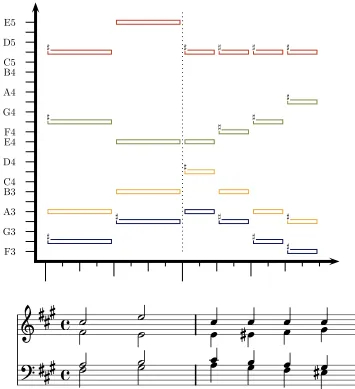
The common music notation also accommodates pieces of music having multiple parts. Consider, for example, the musical excerpts of Figure 2.3. Two staves are used to help differentiate the parts. In addition, each staff holds respectively two parts, one with notes pointing upwards and the other with notes pointing downwards. In the piano-roll notation, we use different colors to distinguish the parts.
Figure 2.3 is an example of another well-known musical texture calledhomophony. It is characterized by the presence of multiple parts that all unfold in lockstep. As is clear from the piano-roll notation, there are, at any given time, four notes that start at the same time and have the same duration.
F3 G3 A3 B3 C4 D4
E4F4
G4 A4 B4 C5 D5 E5
♯ ♯ ♯ ♯
♯ ♯ ♯
♯ ♯ ♯
♯ ♯ ♯
♯ ♯
♯
[image:40.595.139.494.211.600.2]
z }| { Sequence of layers
time
layer 1 layer 2 layer 3 layer 4 layer 5
Figure 2.4: Illustration of the concept of sequence of layers
on a guitar. Every block chord would be considered as a layer where many musical events unfold at the same time. In the remainder of this dissertation, we use the phrase “sequence of layers” to refer to such cases where many layers appear one after the other sequentially in time. Figure 2.4 illustrates the meaning of the phrase.
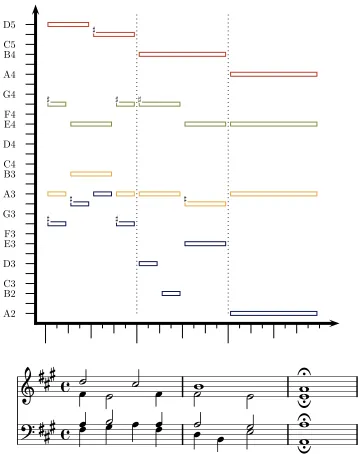
Most music for multiple parts is not purely of homophonic texture (but some frag-ments or inner parts frequently are). When the parts are not unfolding in lockstep, the resulting texture is called polyphony. Consider for example Figure 2.3. Again, the common musical notation exhibits two staves, each respectively two parts. The parts sometimes unfold in lockstep (as in the last bar), but mostly do not.
A2 B2 C3 D3
E3F3
G3 A3 B3 C4 D4
E4F4
G4 A4 B4 C5 D5
♯ ♯
♯
♯ ♯
♯
♯
♯
[image:42.595.139.497.180.634.2]
2.2
Computer representations
The representation of written music has attracted significant interest over the years. Many file formats exists to store musical data on a computer: e.g. ESAC, DARMS, and MIDI (Selfridge-Field, 1997). As these have different motivations, they can often differ widely. The well-known MIDI format, for example, is a binary file format designed to transfer information from controllers (such as keyboards and touchpads) to synthesizers. It is not designed for manual edition or to transcribe a piece in common notation (although it is often used for this purpose). Some formats are designed to imitate notation, such as MusicXML (Good, 2001) and Humdrum (Huron, 1999) and aim at supporting as many features of common music notation as possible. Other formats are designed to quickly transcribe melodies and are restricted to monophonic music, e.g. ESAC.
The representations also differ significantly in how they represent pitch and du-ration or, in general, how they accommodate the concepts of music theory discussed in Section A.1. Most representations, however, have some notion of structure. In MIDI, MusicXML and Humdrum, parts can be specified. In Humdrum, one can even specify how parts appear and disappear as the piece unfolds.
hor-Sequence of layers C♯ F♯ A F♯ , E E B G♯ , C♯ E C♯ A , C♯ E♯ B G♯ , C♯ F♯ A F♯ , C♯ G♯ G♯ E♯ Structures C♯ F♯ A F♯ , E E B G♯ ,
[C♯, C♯, C♯, C♯] [E, E♯, F♯, G♯] [C♯, B, A, G♯] [A, G♯, F♯, E♯]
[image:44.595.128.517.98.305.2]
Figure 2.6: The first two bars of BWV 323 as different mixtures of sequences and layers
izontal lines, the homophonic excerpt discussed in the previous section could be expressed in many different ways. Figure 2.6 presents three such ways: i) as lay-ered sequences, where the individual parts are encoded as sequences and the four sequences are put in a layer; ii) as a sequence of layers, where the chords that the parts form by unfolding in lockstep are encoded as layers and put in a sequence and iii) as a mixture of both approaches, where the first bar is encoded as layered sequences and the second bar as a sequence of layers. The latter scheme shows how layers and sequences can be embedded freely. When such a free mixture of sequences and layers is used, we simply refer to this organization as structured.
(by allowing the overlap between the after-beat of the first object and the upbeat of the second, if any); no overlap (by adding space between the objects to avoid overlap, if any);elide (by clipping the after-beat and upbeats to avoid overlap); and
overlap (forcing the overlap of after-beat and upbeat). Similarly, many possibilities are provided for the joining of two objects as a layer: regular (where the first beat of the first object is simply aligned with the first beat of the second object, without altering durations); and multiple ways to stretch the second object so that both objects have the same durations, e.g. by holding the last note, by padding with rests, by stretching the durations, by cycling or clipping the musical content.
In this dissertation, we focus on a simple interpretation of structures. In par-ticular only four temporal relations are considered. The idea of using structures to express temporal relations has some history (see Marsden, 2000, chap.3, p.85-87). This is the central idea behind the SPP method developed in this dissertation. It allows us to bring the well-known sequence/layer paradigm into the realm of musical patterns, by allowing layers and sequences to encode abstractions over the musical source. Note that Marsden (2000, chap.4) also discusses how structures can repre-sent durations, an idea that is not pursued here.
2.3
Abstractions
The notion of polyphonic pattern developed in this disseration is based on abstrac-tions over the musical source. We consider two types of abstracabstrac-tions: temporal relations and musical relations. The temporal relations are inspired by the musical textures and existing music representations. Musical relations stem from music the-ory and are closely related to notions of music notation such as the representation of pitch.
2.3.1
Temporal relations
Linear time Linear time implies that there is a single past and single future. In contrast, branching time allows more than one past or more than one future (or both). Circular time removes the notion of past and future as every time point keeps occurring again and again. The notion has been applied in music to describe rhythm (Toussaint, 2010) and chord sequences (Pachet, 2000).
Unbounded time Unbounded time implies that there is no definite end of time. This does not mean that time extends infinitely, but simply that one cannot know in advance the extent of time. This is necessary to represent music as the length of musical pieces varies and cannot be bounded by some constant. In contrast, finite time possesses a clear beginning and end. It can be sufficient, for example, when representing rhythmic patterns of a known length.
Dense time In a dense time texture, any amount of time can be subdivided into a smaller amount. By contrast, a discrete time texture supports subdivisions only to a point, i.e. there is some smallest amount of time which cannot be subdivided. This does not mean that a dense texture can accommodate arbitrary subdivisions, however. A texture that supports arbitrary subdivisions is described as continuous. The difference is reminiscent of rational numbers and real numbers: rational numbers allow for infinite subdivision of the number 1, for example, but some subdivisions are not representable as ratios, e.g. the golden section.
Temporal relations With events that extend in time, one can adopt the full range of temporal relations that are commonly defined to relate periods of time (Allen, 1983; Marsden, 2000, chap.3). We use a slightly different strategy here and focus on four temporal relations that we propose as particularly relevant for musical events. These are inspired by the musical texture discussed earlier. In the case of monophony, the events are aligned in a sequence. Every event directly follows its predecessor. This is the “meet” relation: an event a meets with b, written m(a,b), if the offset of a coincides with the onset ofb.
In homophony, the m temporal relation appears as well. In addition, events overlap in time and, in particular, start at the same time. This is the “start together” relation: two events a and b start together, written st(a,b), if they share the same onset.
In polyphony, the m and st relations can still occur. In addition, there are cases where events overlap in time without starting together. To capture such cases, we introduce two temporal relations: an “overlap” relation that simply states that two events unfold together at some point in time and the “starts while” relation that specifies which of the overlapping events starts first and which starts second (assuming that they do not start together). More precisely, i) two events a and
b overlap, written ov(a,b), if there is some point in time where both events are unfolding and ii) an event a starts whileb is unfolding, writtensw(a,b), if the onset of a occurs after the onset ofb but before its offset. Notice that the sw is “strict”: it implies that events do not start together. This is mainly justified by the need to precisely represent the suspension pattern which is characterized by the fact that the notes forming the pattern do not start at the same time (see Section 2.4 below). Using a “dot” notation to refer to the onset and offset of events, the four temporal relations we consider can be defined as follows:
Temporal relation Holds when
m(a,b) a.offset=b.onset st(a,b) a.onset=b.onset
sw(a,b) a.onset> b.onset and a.onset≤b.offset ov(a,b) there is a timet such that:
a.onset ≤t ≤a.offset and b.onset ≤t≤b.offset
b
st(a, b) covers
a s b
b
a a “starts” b
b s a a
b
b “starts” a
a = b a
b
a “equals” b
sw(a, b) covers
b o a
b
a b “overlaps with” a
a d b a
b
a “during”b
a f b a
b
a “finishes” b
ov(a,b) covers all the cases above (and their inverse), except a mb
Using the shorthand notation of Allen (1983), their expression is as follows (the suffix iexpresses the inverse relation):
Temporal relation Disjunction of period relations
st(a, b) a[s si =]b sw(a, b) a[oi d f] b
o(a, b) a[s si = o oi d di f fi]b
Notice that the temporal relations that we define are not specific about the end of the events.
2.3.2
Musical relations
Monophony For monophonic music, the notion of musical pattern has been ex-plored in depth in recent years (see Cambouropoulos et al., 1999, for an overview). A strong consensus emerged that an approach to monophonic patterns must at least capture the notion of transposition. A melodic sequence is transposed if it starts on a different pitch than the orginial but preserves the distance between any two subse-quent notes. Consider, for example, the monophonic excerpts of Figure 2.7. Melody d) is the transposition downward of melody c) by the interval of a perfect fifth (P5
or seven units in the piano-roll notation). The distance between subsequent notes stays the same, e.g. in both cases the first and second notes are separated by the interval of a major second (M2or two units in the piano-roll notation). Appendix A explains the music-theoretic notion of interval and the values it can take.
Transposed melodies are usually considered to be equivalent to the original and listeners will remember and recognize a transposed melody as easily (Dowling and Harwood, 1986, chap.4). There is also evidence that a listener will easily recognized melodies that preserve the same contour but not necessarily the same exact intervals. Furthermore, listeners cannot easily distinguish between the transposed instances and the contour-preserving instances (Dowling and Harwood, 1986, chap.4, p.134). Figure 2.7 b) and e) present such a transformed melody. For pitch, the contour simply refers to how a note is higher, lower or equal to its predecessor. For duration, the contour refers to how a note is shorter, longer or equal to its predecessor.
The importance of contour calls for a slightly more subtle view of musical re-lations, even for the simple monophonic case. Rather than considering only trans-position, many different relations of a note with its predecessor may be considered. The viewpoint method introduced by Conklin and Witten (1995) is perhaps the most developed around that theme. It would assign each note with a value – called feature value by Conklin and Bergeron (2008) – for different viewpoints – called features by Conklin and Bergeron (2008). This is illustrated by Figure 2.7 e). Every musical excerpt that is assigned the same sequence of feature values is considered as an instance of the same pattern.
A3/D3 B3/E3C4/F3 − > ♯ ♯ ♯ a) A3 B3 C4 D4
− ♯ > ♯
[image:50.595.137.528.166.618.2]♯ b)
c)
d) -= -< = > + >
-= + = + < + = + > -= -= e) Pitch contour Duration contour
Homophony and polyphony For homophonic and polyphonic music, the need for flexibility is understandingly greater than for monophonic music. Even if many approaches to polyphonic patterns still consider transposition alone (see Chapter 3), it is perhaps even more apparent for polyphony that patterns are very diverse and require great care in their representation. Consider the musical excerpts of Fig-ure 2.8. Excerpt d) is the transposition downwards of excerpt c) by the interval of a perfect fifth (P5).
Figure 2.8 b) and e) depicts a transformation of the original excerpt that is likely to be considered as very similar, both perceptually and in terms of music-theoretic notions. Intervals between notes that sound together – harmonic intervals – are slightly more subtle than melodic intervals. Harmonic intervals obey the principle of octave equivalence (one of the three musical universals according to Dowling and Harwood, 1986, p.4): pitches separated by more than one octave are still considered to form intervals ranging from the unison (no interval) to the seventh. In particular, the interval of an octave is assimilated with the unison. Such octave-equivalent intervals are called compound intervals. Compound intervals are used to define the parallel fifth pattern introduced in Chapter 1. A parallel fifth pattern cannot be captured by transposition as it needs to encompass both the instances where fifths are repeated and where twelfths (an octave plus a fifth) are repeated.
The compound interval is the default interval in this dissertation. However, it is sometimes useful to include octaves in the notion of intervals. We call these
non-compound intervals. To name non-compound intervals, one simply continues to count units after seven: an octave is an eighth, an octave plus a second is a ninth, and so on.
Consonance Harmonic intervals are typically classified into two categories: con-sonant and discon-sonant. The latter incite motion where the former are more restful (Piston, 1941). The suspension pattern introduced in Chapter 1 relies on this no-tion. Again, it cannot be captured by transposition, as intervals can vary from one suspension to another.
2.4
Motivating patterns
P5 P4 B3 G3/C3 A3/D3 B3/E3C4/F3 D4/G3 E4/A3 F4 B3 G4/C4 A4/D4 B4/E4C5/F4 D5/G4 E5/A4 ♯ ♯ ♯ ♯ a) P5 P4 A2 B2 C3 D3 E3F3 G3 A3 B3 C4 D4 E4F4 G4 A4 B4 C5 D5 E5 ♯ ♯ ♯ ♯ b)
c) d) e)the same time, this illustrates the need for such precise relations and how challenging it can be to capture a polyphonic pattern.
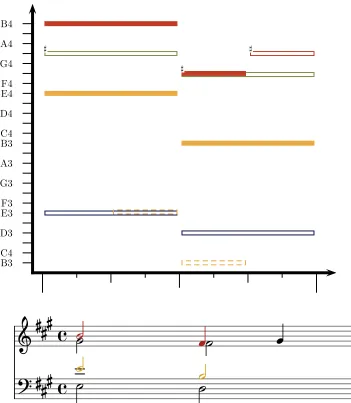
Parallel fifth Consider the parallel fifth of Figure 2.9. We can think of a parallel fifth as a sequence of two layers. The first layer contains two notes, which form the diatonic interval of a perfect fifth. The second layer also contains two notes, which also form the diatonic interval of a perfect fifth. From the instance of Figure 2.9, a parallel fifth pattern can be developed by applying the following abstractions. First, we must capture cases where the fifth is compound, e.g. where two diatonic intervals of a twelfth are repeated.
Then, in the instance, the first and second layers both contain notes in the soprano and alto voices. In the pattern, these can be any two voices. The fact that the voices stay the same from the first layer to the second must however be enforced. Finally, both layers exhibit an st (start together) temporal relation in the in-stance of Figure 2.9. This is not the general case for a parallel fifth, however. Following Fitsioris and Conklin (2008), we consider that the cases where the first layer exhibits an ov (overlap) temporal relation are also valid instances. Conse-quently, the pattern must express both theovand sttemporal relations. Figure 2.9 illustrates a case requiring the ov with dashed notes in the piano-roll notation.
Suspension The suspension pattern requires the same amount of sophistication. Consider, for example, the suspension of Figure 2.10. The pattern can be seen as layered sequences. In the instance, the top sequence hold two notes while the bottom sequence holds a singleton (theF♯at the bottom of Figure 2.10). Again, the pattern must abstract the fact that the instance occurs between the tenor and bass voice and express that a suspension can occur between any two voices. At the heart of the suspension is the idea that the singleton note introduces a dissonance and that the final note of the pattern resolves that dissonance to a consonance. In the instance, the dissonance is the diatonic interval of a perfect fourth (between theF♯in the bass voice and the Bin the tenor voice) and the consonance is the diatonic interval of a major third (between the F♯ in the bass voice and the A♯ in the tenor voice). The pattern must abstract away from a particular pair of intervals and simply specify that a dissonance is followed by a consonance.
B3 C4 D3 E3 F3 G3 A3 B3 C4 D4 E4 F4 G4 A4 B4
♯♯
♯ ♯
[image:54.595.142.493.196.599.2]G2 A2 B2 C3 D3 E3 F3 G3 A3 B3 C4 D4 E4 F4
♯ ♯
♯
♯
♯ ♯ ♯ ♯
♯ ♯
[image:55.595.140.500.188.617.2]
express the suspension in every case, a pattern language must support the sw (start while) temporal relation. As we will see in Chapter 3, many existing approaches to polyphonic patterns were not designed to support this relation and hence cannot represent the suspension pattern.
2.5
Requirements for a polyphonic pattern
lan-guage
Equipped with the musical concepts introduced in this chapter, we can refine the six objectives stated in Chapter 1. The result is precise enough to form a set of requirements for a polyphonic pattern language.
Requirement 1: Fully support n-part polyphony This is mainly a require-ment about how musical data is encoded. In particular, the following must be satisfied:
• Encode musical events in an unrestricted way, i.e. the source should not be restricted to a monophonic or homophonic texture
• The source encoding should support an unlimited number of parts. Each musical event must belong to a part
Requirement 2: Expressive and precise The expressiveness requirement can be refined as follows:
• The pattern language should express at least the four temporal relations in-troduced in this chapter: m, st,sw, and ov
• For every expressible pattern, the approach should return every instance of that pattern that exists in the source
• Every instance should precisely match the temporal and musical relations that the pattern expressed
The expressiveness and precision requirements can be reformulated using our motivating examples: the approach should be able to express and retrieve every parallel fifth and suspension in a corpus of polyphonic music.
Requirement 3: Clear syntax and semantics This requirement is two fold:
• Temporal and musical relations can be written down in a simple and unam-biguous way
• The meaning of a pattern can be easily inferred from the syntax
Requirement 4: Flexible A flexible approach supports many different queries:
• The approach should include a mechanism to define musical relations
• The approach should support the definition of queries in a modular way: it should be possible to refine a query by adding a relation or slightly expanding its structure
Requirement 5: Easy to use and efficient This requirement is mainly qualita-tive. We argue, for example, that ease-of-use is increased by a clear syntax, especially if it reflects the temporal relations enforced by the pattern. Regarding efficiency, we argue that the pattern matching algorithm should have a linear or log-linear time complexity with respect to the number of musical events. This is discussed in detail in Chapter 7.
the pattern matching language we propose is a good candidate language for such an application.
2.6
Summary
Related work
This chapter discusses the existing computational approaches to the gen-eral task of querying polyphonic music data. With respect to the require-ments for a polyphonic pattern language elaborated in Chapter 2, three approaches deserve more attention: i) relational patterns, ii) Humdrum and iii) Structured Polyphonic Patterns. In particular, these approaches are both expressive enough to represent the parallel fifth and suspension patterns discussed so far and precise enough to retrieve the exact list of all the instances of such patterns. Other approaches are either too re-strictive as for example they cannot express the swtemporal relation, or are not precise enough as for example they use some kind of approximate pattern matching algorithm that is not guaranteed to retrieve all the in-stances of a pattern. We provide a classification of these approaches according to their underlying principles. For example, a number of ap-proaches stem from the concept of vertical layers discussed in Chapter 2.
3.1
Expressive and precise approaches
temporal relation is expressed but not thesw (start while) temporal relation, which is essential in expressing the suspension pattern. This is circumvented in some approaches (Huron, 1999; Dubnov et al., 2003) by using a continuation marker, a special symbol that indicates that some note in a layer does not start as the layer starts but is rather the continuation of some previously sounding note. In SPP, the concept of layer is extended in a different way, by using an onset modification operator. Rather than expressing the continuation of a musical note, it simply states that some note starts before the beginning of the layer. The issue of expressiveness with respect to temporal relations is formally analyzed in Chapter 6.
The other key property that relational patterns, Humdrum andSPP all possess is a precise matching algorithm that returns exactly all the instances of a pattern. This is very important for the kinds of applications that this dissertation considers, for example the testing of a musicological hypothesis or the gathering of facts about music. An approximate matching algorithm has other advantages however, and is suitable for other motivations reviewed in Section 3.2.
3.1.1
Relational patterns
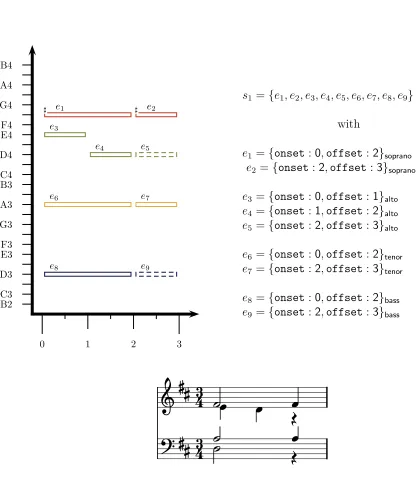
Using the logic programming language Prolog, Fitsioris and Conklin (2008) search for every instance of the parallel fifth pattern in Bach chorale harmonizations. A representation for polyphonic music is developed encompassing both basic informa-tion about musical events and a series of relainforma-tions that the events form. For example, Figure 3.1 shows the basic information of four notes: a, b, c, d. The statements concerning notea are simply read as follows: the onset ofa is0, the offset of ais 2, the pitch of a is B4, and a belongs to the soprano voice. Note that for readability, we adapted the representation of Fitsioris and Conklin (2008) and made it more consistent with the nomenclature of the current dissertation.
onset(a,0). onset(c,2).
offset(a,2). offset(c,3).
pitch(a,’B4’). pitch(c,’F4#’).
voice(a,soprano). voice(c,soprano).
onset(b,0). onset(d,2).
offset(b,2). offset(d,4).
pitch(b,’E4’). pitch(d,’B3’).
voice(b,tenor). voice(d,tenor).
Figure 3.1: Prolog encoding of four notes forming a parallel fifth pattern
temporal relation holds between event AandBwhen the offset ofAisXand the onset of B is alsoX. Theov (overlap) temporal relation is specified through four cases, by reusing the definition of the st and sw temporal relations.
m(A,B)
:-offset(A,X), onset(B,X).
st(A,B) :-onset(A,X), onset(B,X).
sw(A,B) :-onset(A,X), onset(B,Y),
offset(B,Z),
X > Y,
X <= Z.
ov(A,B) :- st(A,B). ov(A,B) :- st(B,A). ov(A,B) :- sw(A,B). ov(A,B) :- sw(B,A).
Figure 3.2: Prolog definition of the four temporal relations considered in this disser-tation
Once temporal relations and musical relations are given a definition, the parallel fifth pattern is expressed by the rule shown in Figure 3.3. Again, the query is adapted from Fitsioris and Conklin (2008) to make it more consistent with the notation used in this dissertation. It can be read as follows: the notesA,B,C,Dform a parallel fifth if the following temporal relations are satisfied: A and B overlap; A meets C and B
st(C,D), interval_nc(A,B,I), voice(A,X), interval_nc(C,D,I), voice(C,X),
voice(B,Y), voice(D,Y), not(X=Y).
Figure 3.3: The parallel fifth pattern in Prolog. Reproduced and adapted from Fitsioris and Conklin (2008)
Dis the same, even in the non-compound representation where octaves are explicitly taken into account (interval_nc(A,B,I) andinterval_nc(C,D,I)). Finally, there are some constraints that are included to make the query completely precise: the fact that the pitch ofCis higher than that ofD(higher(C,D)) ensures that a parallel fifth is matched only once and constraints about voicing such asvoice(A,X) ensure that the fifth is repeated by the same two voices.
Although Fitsioris and Conklin (2008) develop a single query, we can easily see how the approach could support many other queries. Logic programming languages such as Prolog are often used as generic query languages (De Raedt, 2002). The advantage of such an approach is its expressiveness. As Prolog is a general pro-gramming language, any discrete dataset can be represented and any computational query executed. In practice, however, an approach based on a logic programming language will focus on data that has a certain structure and on queries that are expressed using a limited set of relations. This is why we prefer to refer to this approach as relational patterns.
the search space to explore is very big. Using SPP as a “tighter” approximation of the relevant search space to explore seems a promising avenue of research. This issue is further discussed in Section 7.6.
3.1.2
Humdrum
Humdrum (Huron, 1999) is centered around the representation of musical pieces as formatted text files. A Humdrum file contains multiple columns, called spines, one for each part of the piece it encodes. Consider for example Figure 3.4 showing the final bar of Bach chorale BWV 323 as a Humdrum file.
**kern **kern **kern **kern
*I:[soprano] *I:[alto] *I:[tenor] *I:[bass] *k[f#c#g#] *k[f#c#g#] *k[f#c#g#] *k[f#c#g#]
*M4/4 *M4/4 *M4/4 *M4/4
[1f# 2c# 2A# 4FF#
. . . 4E
. [2d [2B 4D
. . . 4BB
= = = =
1f#] 2d] 2B] 1FF#
. 2c# 2A# .
Figure 3.4: Final bar of BWV 323 in Humdrum/kern encoding
Time flows from top to bottom in a Humdrum file: each line can be considered as a layer. Any two tokens appearing on the same line are considered to start together. For example, the fifth line of Figure 3.4 encodes a layer where the soprano voice sounds a F#, the alto voice a C# and the tenor and bass voice respectively a A# and F#. The following line shows how a continuation token “.” is used in Humdrum to represent the polyphonic texture: the bass voice now sounds an E
while all other voices are still sounding the same pitch. The particular encoding of pitches and durations can vary in Humdrum. The encoding of absolute pitches as letters and durations as numbers is called the kern encoding. Other symbols of Figure 3.4 include comments regarding the encoding used, voice names, key and time signatures (lines one to four), bar lines (line nine) and the opening and closing of ties [/] (e.g. line seven and ten).