This is a repository copy of
Towards Formal Verification of Computations and
Hypercomputations in Relativistic Physics
.
White Rose Research Online URL for this paper:
http://eprints.whiterose.ac.uk/86607/
Version: Accepted Version
Proceedings Paper:
Stannett, M.P. orcid.org/0000-0002-2794-8614 (2015) Towards Formal Verification of
Computations and Hypercomputations in Relativistic Physics. In: Durand-Lose, J. and
Nagy, B., (eds.) Machines, Computations, and Universality. Machines, Computations and
Universality 2015, 09-11 Sep 2015, Famagusta, North Cyprus. Lecture Notes in Computer
Science, 9288 . Springer Verlag (Germany) .
https://doi.org/10.1007/978-3-319-23111-2_2
[email protected] https://eprints.whiterose.ac.uk/ Reuse
Unless indicated otherwise, fulltext items are protected by copyright with all rights reserved. The copyright exception in section 29 of the Copyright, Designs and Patents Act 1988 allows the making of a single copy solely for the purpose of non-commercial research or private study within the limits of fair dealing. The publisher or other rights-holder may allow further reproduction and re-use of this version - refer to the White Rose Research Online record for this item. Where records identify the publisher as the copyright holder, users can verify any specific terms of use on the publisher’s website.
Takedown
If you consider content in White Rose Research Online to be in breach of UK law, please notify us by
Towards Formal Verification of Computations
and Hypercomputations in Relativistic Physics
Mike Stannett
University of Sheffield Department of Computer Science
Regent Court, 211 Portobello Sheffield S1 4DP, United Kingdom
Abstract. It is now more than 15 years since Copeland and Proudfoot introduced the termhypercomputation. Although no hypercomputer has yet been built (and perhaps never will be), it is instructive to consider what properties any such device should possess, and whether these re-quirements could ever be met. Aside from the potential benefits that would accrue from a positive outcome, the issues raised are sufficiently disruptive that they force us to re-evaluate existing computability theory. From a foundational viewpoint the questions driving hypercomputation theory remain the same as those addressed since the earliest days of computer science, viz.what is computation? andwhat can be computed?
Early theoreticians developed models of computation that are indepen-dent of both their implementation and their physical location, but it has become clear in recent decades that these aspects of computation cannot always be neglected. In particular, the computational power of a distributed system can be expected to vary according to the spacetime geometry in which the machines on which it is running are located. The power of a computing system therefore depends on its physical environ-ment and cannot be specified in absolute terms. Even Turing machines are capable of super-Turing behaviour, given the right environment.
1
Introduction
The term hypercomputation refers to the study of physical or abstract systems which are potentially capable of behaviours which cannot be simulated by recur-sive means. The term was introduced by Copeland and Proudfoot (1999) as a more accurate replacement for the term ‘super-Turing’ used by Stannett (1990a; 1990b; 1991) and Siegelmann (1995) to describe certain types of putative hy-percomputational system. Although no hypercomputer has yet been built (and perhaps never will be), it is instructive to consider what properties any such device should possess, and whether these requirements could ever be met.
physics and the properties of physical materials. Moreover, because physical de-vices exist in space and time, their computational power can depend both on when and where they are located. In particular, spacetime structures can boost the power of computational systems, but can also constrain and reduce their power. Similarly, an algorithm’s run-time complexity is not an absolute prop-erty but depends on the spacetime trajectory being followed by the machine(s) on which it is running.
1.1 Geometrical Boosting of Computational Power
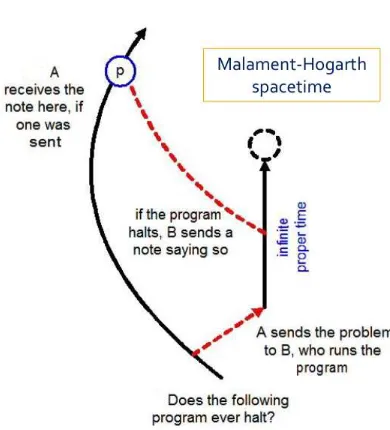
[image:3.612.212.407.371.586.2]A well-known strategy for boosting computational power is to exploit the prop-erties ofMalament-Hogarth (M-H) spacetimes (Etesi and N´emeti, 2002). These are spacetimes containing a pointpand a future-pointing semi-infinite worldline w not passing through p, such that every pointxof wcan be joined topby a future-pointing timelike path which has finite proper length (Fig. 1). We refer to the pair (w, p) as anM-H structure in what follows.
The following lemma shows that all Σ0 1 and Π
0
1 sets become decidable in
M-H spacetime using just two Turing machines, provided they can communicate at least once.
Lemma 1. Let S be any set in Σ0 1 or Π
0
1. Then S can be decided in M-H
spacetime by a system comprising two computers capable of communicating once.
Proof. We show that anySinΠ0
1 can be decided in M-H spacetime (theΣ 0 1case
follows by complementarity). SinceSis inΠ0
1 we can writeS ={x| ∀y.R(x, y)},
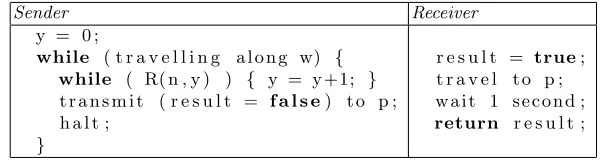
whereRis recursive. To decide whethern∈S, we run the programsSender and Receiver shown in Fig. 2.
Sender Receiver
y = 0 ;
while ( t r a v e l l i n g a l o n g w) {
while ( R( n , y ) ) { y = y +1; }
t r a n s m i t ( r e s u l t = f a l s e) t o p ; h a l t ;
}
[image:4.612.156.458.268.348.2]r e s u l t = true; t r a v e l t o p ; w a i t 1 s e c o n d ; return r e s u l t ;
Fig. 2.The programsSender (running onTS, which is capable of sending at most one message toReceiver) andReceiver (running onTR, which is capable of receiving and acting upon at most one message fromSender) co-operate to decide the undecidable set S in the context of an M-H structure (w, p). The two machines are initially co-located at some point on the worldline w. The 1-second delay is to avoid ambiguity as to whether Receiver returns result before or after executing Sender’s assignment instruction atp.
Supposen6∈S, i.e.¬∀y.R(n, y). Then there exists someyfor which the test R(n, y) fails. Letymin be the smallest suchy. Then
– The machineTS travels alongw, a trajectory which allows it infinite
execu-tion time (since it has infinite proper length). Consequently,Sender eventu-ally encounters and fails the testR(n, ymin), transmits the instruction “result
=false” top(along a trajectory of finite proper-length), and terminates.
– Receiver sets result to true, then travels to pwhere it encounters and ex-ecutes the instruction sent there bySender settingresult to false. It waits one second and then returns the value ofresult, i.e.false.
Now suppose conversely thatn∈S. Then
– Sender never exits the loop testingR(n, y) and never issues the instruction setting result to false. It runs forever without terminating (its trajectory alongwensures that this is possible).
In either case, the system eventually returns a value, and the value returned
correctly reports whether or not n∈S.
Lemma 1 shows that spacetime geometries can boost computational power, and that this does not require the introduction of ‘unphysical’ constructs like in-finite precision observations or new types of machine. The machines used for this hypercomputation are simply Turing machines – indeed, Receiver is so simple that TR could arguably be replaced by an essentially trivial 2-state automaton
with no loss of power to the system as a whole. Notice, however, that a single ma-chine acting alone cannot exploit the boosting effect of M-H structures, because this relies on splitting the system into two parts, one of which can run forever in a period of time that appears finite to the other. Notice also that spacetime geometries can be considerably more complicated than those considered here, and that structures can be envisaged which allow decidability at all levels of the arithmetic hierarchy (Hogarth, 2004) and beyond (Welch, 2006).
1.2 Geometrical Reduction of Computational Power
Spacetime geometry can also constrain and reduce computational power. For example, consider a computer traversing a closed timelike curve (CTC) or ‘time loop’. Suppose the computer’s clock shows that each circuit of the CTC is long enough for it to executeN instructions. Since the computer and all of its compo-nents return to their initial spacetime locations (and hence their initial machine states) after every N instructions, the number of steps executable by a CTC-traversing Turing machine is necessarily bounded, and all CTC-located programs must be reversible (Stannett, 2013). Indeed, it is only possible to run a fully con-trolled program if the temporal length of the CTC is an exact integer multiple of the program’s runtime, since it will not otherwise return to its initial state on completion of each circuit.
1.3 Geometrical Effects on Computational Complexity
The possibility of M-H spacetimes also has implications for computational com-plexity. A simple adaptation of the distributed computation outlined in Lemma 1 allows the result produced by any program to be obtained within a fixed time period, viz. precisely one second longer than it takesReceiver to reachp. In M-H spacetimes, all programs have constant run-time complexity. (Similarly, CTCs can be use to transmit results ‘into the past’, thereby allowing program results to be obtained more quickly than would otherwise be the case.)
2
Modelling Relativity Theory in Isabelle/HOL
Since a spacetime might potentially contain a combination of ‘normal’ regions, M-H structures and CTCs, the question “what can be computed” has no absolute answer but depends on local and global geometric properties, the number of machines available, their relative spacetime trajectories during computation, and the availability of suitable communication channels. This is a question we would like to investigate in more detail, but we are hampered by the informal yet detailed nature of many proofs in relativity theory (and physics in general). The issue is particularly relevant because the black hole observed at the centre of our own galaxy Milky Way is potentially of the right type to be a habitat for M-H structures (Genzel et al., 2003), and while such structures are obviously beyond our current technological capabilities to exploit, the mere possibility of their existence is enough to warrant a re-evaluation of the extent to which abstract computability and complexity theory give an accurate account of what is actually possible in the physical universe.
In 2012 we joined forces with researchers at the R´enyi Institute of Mathe-matics in Budapest, who have spent many years developing versions of relativity theory expressed in first order logic – our goal is to express the Hungarian theories in Isabelle/HOL (Nipkow, 2014) so as to allow machine-assisted inves-tigation of various key hypotheses concerning the possibilities for computation and hypercomputation in relativistic physics (Stannett and N´emeti, 2014). In this section we briefly describe the Hungarian approach, and show how it can be translated with relative ease into machine-readable form.
2.1 First-Order Relativity Theory
The approach adopted by Andr´eka, N´emeti and the Hungarian team is to for-mulate a collection of related relativity theories in first-order logic (FOL), using axioms that are as simple and transparent as possible (Andr´eka et al., 2004). Our own starting point is the translation of the Hungarian axioms and theorems into machine-readable format suitable for use with the Isabelle/HOL proof assistant (Nipkow, 2014).
For example, special relativity is represented as a theorySpecRelbased on
just four physical axioms:
– AxPh
Each inertial observer considers the speed of light to be positive, and the same in every spatial direction. Moreover, photons can be emitted in or arrive from any spatial direction.
– AxEv
All observers inhabit the same universe, i.e. they consider the same events to take place (though possibly at different locations or times).
– AxSelf
– AxSym
Whenever observers consider two events to be simultaneous, they agree as to the spatial distance between those two events – this allows observers to calibrate their rulers relative to one another.
The underlying theory has two basic sorts:quantities andbodies. Quantities are used to express distances and times, and are assumed to satisfy the axioms of a field. Bodies inSpecRelincludeinertial observers andphotons, which are
identified by predicates, e.g. IObs(b) is true if and only if bodyb is an inertial observer, and likewise P h(b) indicates whether b is a photon. Central to all of the Hungarian versions of first-order relativity theory is theworldview relation, W, whereW(m, b, x) means that observermconsiders body bto be present at locationx.
These constructs are generally sufficient to allow the axioms to be specified. For example, we can use the field axioms to define functions space2
and time2
giving the (squared) spatial and temporal distances between two events (Fig. 3), and these in turn let us writeAxPhas
IOb(m)→(∃v.((v >0)∧(∀xy.(
(∃p.(P h(p)∧W(m, p, x)∧W(m, p, y))) ↔(space2
xy= (v∗v)∗(time2
xy))))))
In words: each inertial observer is associated with a positive speed v with the property that whenever any photon is considered by m to pass through two locationsxandy, the (squared) speed associated with the straight line joining these points isv2
.
class Lines = Quantities + Vectors + Points begin
. . .
fun space2 :: "(’a Point)⇒(’a Point)⇒’a" where "space2 u v
= (xval u - xval v)*(xval u - xval v) + (yval u - yval v)*(yval u - yval v) + (zval u - zval v)*(zval u - zval v)"
fun time2 :: "(’a Point) ⇒(’a Point)⇒’a" where "time2 u v = (tval u - tval v)*(tval u - tval v)"
The translation into Isabelle/HOL format is now straightforward, viz.
class AxPh = WorldView + assumes
AxPh: "IOb(m)
=⇒(∃v. ( (v > (0::’a))∧(∀x y . ( (∃p. (Ph p∧W m p x∧W m p y))
←→(space2 x y = (v * v)*(time2 x y)) ))))"
This is an essentially verbatim translation of AxPh. It assumes that various
WorldViewconstructs of Fig. 4 are in place, including the inherited definitions ofspace2andtime2.
record Body = Ph :: "bool" IOb :: "bool"
class WorldView = SpaceTime + fixes
(* Worldview relation *)
W :: "Body⇒Body⇒’a Point⇒bool" ("_ sees _ at _") . . .
Fig. 4.A body can be a photon and/or an inertial observer. We do not require that the body should only be one or the other, because this is a theorem that can be proven from the axioms. The worldview relation is a predicate defined on two bodies and one location, and introduces the notationa sees b at xas shorthand forW a b x. It inherits basic definitions from the classSpaceTime.
Two other first-order variants of relativity theory are also relevant here. The theory AccRel represents a kind of halfway-house: bodies can be accelerated
(non-inertial), but we do not as yet include Einstein’s Equivalence Principle relating acceleration to gravity. Adding an axiom representing the latter leads
to GenRel, the first-order theory of general relativity. The use of the record
construct in Isabelle/HOL is especially useful in this context, as it allows us to extend some of our definitions very easily. When reasoning in SpecRel, for
example, we assume that bodies are either photons or inertial observers. When we come to define AccRel we can simply extend theBody record to include a
Choosing the axioms as simple as possible allows us to investigate the extent to which different axioms can be weakened without losing physical realism. For example, while AxPh says that each observer considers the speed of light to
be constant, there is no assumption that different observers agree as to what this speed is (this is instead proven as a theorem). Similarly, there is no axiom declaring the sets of photons and inertial observers to be disjoint; this is another theorem. On the other hand, the drive for simplicity is not without cost. For example, the reader may be wondering whyAxPhrefers to thesquaredspeed of
light. This is because FOL is not powerful enough to characterise the fieldRof
real numbers; for example, there are fields which satisfy precisely the same first order theorems asRbut which admit infinite values and infinitesimals (Robinson,
1996; Goldblatt, 1998). Similarly,Rsatisfies various additional field axioms that
are not always needed for the theorems we wish to prove; in particular we do not generally assume the Euclidean axiom (that all positive quantities have square roots) because, as AxPhshows, we can redefine concepts using squared values
instead. This can add significantly to the work involved in stating theorems and developing their proofs.
Nonetheless, the approach has several advantages from a computational point of view. Consider, for example our Isabelle/HOL description of basic spacetime constructs. This is a 836-line file giving definitions, axioms and proofs relating to quantities, vectors, points, lines, planes and cones. This file took approximately 4 person-weeks to construct and verify, but now that it is in place the sparse nature of our assumptions and constructs means that relatively little additional work is required when moving from the special (SpecRel) to the accelerated (AccRel)
or general (GenRel) first-order theories of relativity. The main difficulty lies not
in translating the underlying axioms and theorems, but in generating verifiable proofs.
2.2 Generating Verifiable Proofs
Automated theorem provers are extremely useful tools, but they are also unfor-giving. For example, in our proof of Lemma 1 we wrotethe Σ10 case follows by
complementarity, assuming that the reader would have sufficient mathematical competence to infer the following argument:
– ifS is a Σ01 set, it can be writtenS ={x| ∃y.R(x, y)} for some recursive
predicateR.
– this can be rewrittenS={x| ¬∀y.¬R(x, y)}.
– this is the complement of the setS′={x| ∀y.¬R(x, y)}.
– the predicateR′≡ ¬R(x, y) is recursive becauseR is recursive.
– consequentlyS′={x| ∀y.R′(x, y)} is aΠ0 1 set.
– consequently (as proven)S′ is decidable in M-H spacetime.
– and henceS≡N\S′ is decidable in M-H spacetime.
to be expressed in readable form if we were to attempt a machine-verification of our proof.
As our machine verification of theSpecReltheorem “no observer can travel
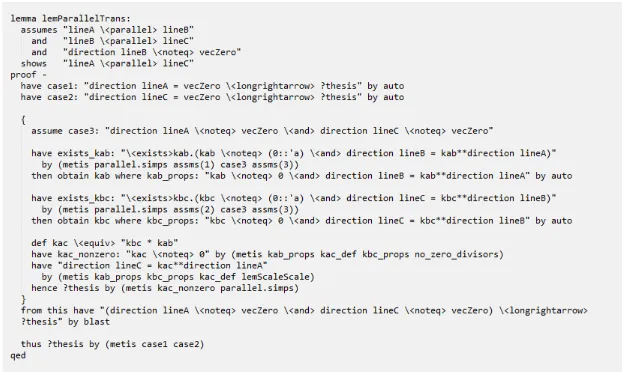
[image:10.612.151.462.246.432.2]faster than light” reveals, this problem of abbreviated reasoning is just as pro-nounced when discussing proofs relating to physical theories. Indeed, the bulk of the work involved choosing sensible descriptions of what we mean by geomet-rical terms likeline,plane andcone. For example, while a mathematician would accept that two lines that are both parallel to a third line must be parallel to each other, this required detailed proof within Isabelle/HOL (Fig. 5).
Fig. 5.Isabelle/HOL proof that if two lines are both parallel to a third line, then they are also parallel to each other.
Having constructed all of the ‘background’ theory, translating the Hungar-ian proof that observers cannot travel faster than light into Isabelle/HOL form became a relatively straightforward – though still extremely time consuming – process of writing down the major steps in the proof, and then carefully filling in every possible gap in the reasoning until complete verification was achieved.
3
Next Steps
Although we have had promising results modellingSpecRel, including the first
known machine verified proof of the statement “no observer can travel faster than light”, the time involved in constructing these proofs means we have yet to make comparable progress developing Isabelle/HOL verification systems for theorems inAccRelor GenRel. Our ultimate goal is to provide indisputable
Conjecture 1. Computation in standard Euclidean spacetime means Turing computation.
Conjecture 2. Computation in M-H spacetimes verifiably includes super-Turing computation.
Bibliography
Andr´eka, H., Madar´asz, J.X., N´emeti, I.: Logical analysis of relativity theories. In: Hendricks, et al. (eds.) First-Order Logic Revisited, pp. 1–30. Logos Verlag (2004)
Copeland, J., Proudfoot, D.: Alan Turing’s forgotten ideas in computer science. Scientific American pp. 99–103 (Apr 1999)
Etesi, G., N´emeti, I.: Non-Turing computations via Malament-Hogarth space-times. Int. J. Theor. Phys. 41, 341–370 (2002)
Genzel, R., Schoedel, R., Ott, T., Eckart, A., Alexander, T., Lacombe, F., Rouan, D., Aschenbach, B.: Near-infrared flares from accreting gas around the super-massive black hole at the Galactic Centre. arXiv:astro-ph/0310821 (2003) Goldblatt, R.: Lectures on the hyperreals: an introduction to nonstandard
anal-ysis. Springer-Verlag (1998)
Hogarth, M.: Deciding arithmetic using SAD computers. British Journal for the Philosophy of Science 55, 681–691 (2004)
Milner, R.: Communicating and Mobile Systems: The Pi Calculus. CUP (1999) Nipkow, T.: Programming and proving in Isabelle/HOL (Aug 2014),
http://www.cl.cam.ac.uk/research/hvg/Isabelle/dist/Isabelle/ doc/prog-prove.pdf
Robinson, A.: Non-standard analysis. Princeton University Press (1996) Sangiorgi, D., Walker, D.: The Pi-Calculus: A Theory of Mobile Processes. CUP
(2003)
Siegelmann, H.: Computation beyond the Turing limit. Science 268(5210), 545– 548 (Apr 1995),http://dx.doi.org/10.1126/science.268.5210.545 Stannett, M.: Super-Turing computation. Seminar presentation,
De-partment of Computer Science, University of Sheffield (1990a), http: //www.researchgate.net/publication/258848388_1990_Super-Turing_ Computation
Stannett, M.: X-machines and the halting problem: Building a super-turing ma-chine. Formal Aspects of Computing 2(1), 331–341 (1990b),http://dx.doi. org/10.1007/BF01888233
Stannett, M.: An introduction to post-Newtonian and super-Turing computa-tion. Tech. Rep. CS-91-02, Department of Computer Science, University of Sheffield (1991), http://www.researchgate.net/publication/236852111_ An_Introduction_to_post-Newtonian_and_super-Turing_computation Stannett, M.: Computation and spacetime structure. International Journal of
Unconventional Computing 9(1–2), 173–184 (2013)
Stannett, M., N´emeti, I.: Using Isabelle/HOL to verify first-order relativity the-ory. Journal of Automated Reasoning 52(4), 361–378 (2014),http://dx.doi. org/10.1007/s10817-013-9292-7