This is a repository copy of Evidence for two attentional components in visual working memory.
White Rose Research Online URL for this paper: http://eprints.whiterose.ac.uk/84473/
Version: Accepted Version
Article:
Allen, RJ, Baddeley, AD and Hitch, GJ (2014) Evidence for two attentional components in visual working memory. Journal of Experimental Psychology: Learning, Memory, and Cognition, 40 (6). 1499 - 1509. ISSN 0278-7393
https://doi.org/10.1037/xlm0000002
[email protected] https://eprints.whiterose.ac.uk/
Reuse
Unless indicated otherwise, fulltext items are protected by copyright with all rights reserved. The copyright exception in section 29 of the Copyright, Designs and Patents Act 1988 allows the making of a single copy solely for the purpose of non-commercial research or private study within the limits of fair dealing. The publisher or other rights-holder may allow further reproduction and re-use of this version - refer to the White Rose Research Online record for this item. Where records identify the publisher as the copyright holder, users can verify any specific terms of use on the publisher’s website.
Takedown
If you consider content in White Rose Research Online to be in breach of UK law, please notify us by
Running head: Serial visual memory and attention
Evidence for two attentional components in visual working memory
Richard J. Allena Alan D. Baddeleyb, & Graham J. Hitchb
a
University of Leeds, UK, bUniversity of York, UK.
Correspondence concerning this article should be addressed to Richard Allen, Institute of
Psychological Sciences, University of Leeds, LS2 9JT, United Kingdom. E-mail:
Abstract
How does executive attentional control contribute to memory for sequences of visual objects,
and what does this reveal about storage and processing in working memory? Three
experiments examined the impact of a concurrent executive load (backward counting) on
memory for sequences of individually presented visual objects. Experiments 1 and 2 found
disruptive concurrent load effects of equivalent magnitude on memory for shapes, colors, and
colored shape conjunctions (as measured by single-probe recognition). Crucially, these
effects were only present for items 1 and 2 in a 3-item sequence; the final item was always
impervious to this disruption. This pattern of findings was precisely replicated in Experiment
3 using a cued verbal recall measure of shape-color binding, with error analysis providing
additional insights concerning attention-related loss of early-sequence items. These findings
indicate an important role for executive processes in maintaining representations of earlier
encountered stimuli in an active form alongside privileged storage of the most recent
Evidence for two attentional components in visual working memory
Research primarily using simultaneously presented arrays has shown substantial negative
impacts of executive load on the recognition and recall of visual objects (e.g. Allen, Baddeley
& Hitch, 2006; Dell’Acqua & Jolicouer, 2000). It is likely that executive control is also
important during the encoding of sequences and their retention in working memory.
Furthermore, by analogy with studies of verbal STM, it is possible that the impact of
executive load may vary depending on serial position, potentially throwing light on the
underlying cognitive processes. We investigate this by studying the effect of an executive
load on the retention of sequences of shapes, colors and bound objects.
The use of simultaneous presentation of all to-be-remembered (TBR) items in the
majority of recent studies examining visual memory (e.g. Luck & Vogel, 1997; Wheeler &
Treisman, 2002) is sensible in that information from visual scenes involves parallel
presentation of an array of objects and features. However, for anything other than brief
presentations, processing quickly becomes sequential with a series of eye-movements being
used to pick off crucial features of the array. Furthermore, naturalistic perception often
involves changing scenes that are inherently sequential. If, as in verbal memory, sequential
order of processing were important, then it would be valuable to take this into account. A
useful alternative in this case is sequential stimulus presentation. Though memory for
simultaneous and sequential displays is likely to involve similar mechanisms, the former
method compresses these into a single, limited time period, meaning that it is often not able
to draw clear distinctions between the possible operations of different components. In
contrast, for an object sequence, each item is encoded in turn before being retained while
subsequent items are then presented. Examination of performance for items at each position
in a sequence thus provides the opportunity to identify separable processes contributing to
proved informative, with serial recall favoring primacy and free recall recency, an effect that
is particularly marked with auditory presentation (e.g. Conrad & Hull, 1968; Murdock, 1966).
Sequential presentation might be similarly informative for visual working memory
In a classic series of studies, Phillips (1974; Phillips & Baddeley, 1971; Phillips &
Christie, 1977a;b) demonstrated short-term forgetting of visual matrix patterns. When a
sequence of patterns was presented and then probed using the change detection method,
Phillips and Christie (1977a) found a recency effect of one item, with all other items detected
at a much lower level (though still above chance). These results were attributed to separable
contributions of long-term memory (LTM) and visual short-term memory. However, this
explanation is unlikely to apply to other observations of recency effects (e.g. Allen et al.,
2006; Parmentier, Tremblay, & Jones, 2004) where the repeated re-use of items from the
same limited experimental set on each trial renders LTM uninformative (Endress & Potter,
2013). This leaves open the possibility that differential performance across a sequence
reflects different components operating within working memory. In particular, it may be that
the most recently encountered item retains a privileged status in working memory, being
temporarily retained in a relatively automatic manner without the need for additional
executive support, as is found in verbal STM where recency is unaffected by a concurrent
load, unlike earlier items (Baddeley & Hitch, 1974). In contrast, limited resources for
executive control may be important in ensuring earlier items in the sequence remain
accessible and are protected against potential interference, as suggested by Engle’s (2002)
approach to working memory. We investigated this question across three experiments by
combining serial presentation with an executively demanding concurrent task (backward
counting). We predicted that, for all stimulus conditions, an irrelevant attentional load would
reduce performance on earlier items in the sequence. The crucial issue is whether this load
resistant. Observation of the latter pattern would indicate two separable components in visual
working memory; an early component reliant on executive resources alongside relatively
privileged and automatic storage of the most recent item.
We examined this question in the context of memory for features such as shape and
color, and the bindings between these constituent elements. Previous research using
simultaneously presented arrays has revealed substantial effects of concurrent executive load
on recognition accuracy that were equivalent in magnitude for features and their conjunctions
(Allen et al., 2006; see also Allen, Hitch, Mate, & Baddeley, 2012). These findings were
interpreted as indicating that feature binding is relatively automatic, with the episodic buffer
component of working memory possibly acting as a passive recipient of the products of lower
level processes linked to perception (Baddeley, Allen, & Hitch, 2011). However, these
conclusions were based solely on studies using simultaneously encountered arrays. When
serial presentation was used (without manipulating concurrent load), Allen et al. (2006)
found a recency effect with equivalent recognition performance in feature and binding
conditions at the final position and poorer performance at earlier positions, with bindings
more likely to be forgotten than features. These data suggested that bound representations are
particularly fragile and susceptible to overwriting by subsequent stimuli. Building on this, it
is possible that retaining a sequence of bindings places greater reliance on executive control,
which manifests itself as a pattern of ‘fragility’ for early items, consistent with Wheeler and
Treisman’s (2002) suggestion that maintenance of bound information is particularly
attention-dependent. Thus, while memory for bindings would not be especially sensitive to an
increased executive load in the case of simultaneous arrays, they would in the case of serial
presentation. In contrast, if memory for serially encountered bindings is no more demanding
of executive resources than memory for serially encountered features, we would observe
result of concurrent load. Experiments 1 and 2 examined these issues by comparing memory
for colors, shapes, and color-shape binding using a single-probe recognition procedure, while
Experiment 3 focused solely on binding using cued recall.
Experiment 1
This first study aimed to explore the role of executive resources in retaining a sequence of
features (colors, shapes) and their conjunctions (colored shapes), using the single-probe
recognition procedure previously implemented in studies of visual feature binding (e.g. Allen
et al., 2006, 2012; Brown & Brockmole, 2010; Wheeler & Treisman, 2002). The substantial
impact of a demanding concurrent task that has been previously observed across all trial
types on this measure was again anticipated, reflecting the broad contribution of
modality-independent executive resources to visual working memory (e.g. Morey & Cowan, 2004,
2005). Exploration of how these effects change over time was then performed, through
analysis of performance levels on target-present trials probing each position in the sequence.
If encoding and storage always requires executive support, recognition accuracy at all
positions in the sequence should suffer from increased concurrent load. However, if these
resources are only important for retention in the face of disruption and updating from
incoming stimuli, concurrent task effects should be limited to earlier sequence positions, with
the final item potentially being stored ‘cost-free’.
The comparison of feature and binding conditions enabled an examination of
performance across serial positions and the contribution of executive support to sequential
working memory in each case. Based on previous findings using sequential presentation (e.g.
Allen et al., 2006), we expected to observe a larger recency effect for binding relative to
feature memory. If retaining a series of bound objects is particularly reliant on executive
condition relative to the feature conditions. In addition, if it is particularly the retention of
bound objects, in the face of further to-be-encoded stimuli, that requires executive support
(e.g. Fougnie & Marois, 2009; Wheeler & Treisman, 2002; Wolfe, 1999), binding should
show particularly large concurrent task effects at earlier positions in the sequence, as indexed
by target trials probing those positions. In contrast, if all visual memory representations
(regardless of the requirement to retain conjunctional information) draw on executive support
for their retention (e.g. Cowan, Saults, & Morey, 2013; Johnson, Hollingworth, & Luck,
2008; Morey & Bieler, 2012), we would find similar larger concurrent task effects at earlier
sequence positions for color, shape, and binding memory.
Method
Participants
There were 24 participants (8 males; 16 females) in this experiment, all students at the
University of Leeds (mean age 20.7 years, range 18-29). They took part for course credit or a
small honorarium.
Materials
All stimuli measured approximately 1.6cm2 and were presented on a grey background.
Stimuli were drawn from the study by Allen et al. (2012; see that paper for shape outlines and
RGB values), and consisted of a set of 8 shapes (arch, chevron, circle, cross, diamond, flag,
star, triangle) and 8 colors (blue, brown, green, purple, red, turquoise, white, yellow).
Combinations of these shapes and colours were used as stimuli and test probes in the
‘binding’ condition. In contrast, in the color condition, stimuli were presented and tested
using a noncanonical “blob” shape, while the shape condition always used black shape
dimension matched the procedure used in Allen et al. (2006), and Experiment 1 of Allen et al.
(2012).
Design and Procedure
The experiment used a 3x2 repeated measures design, manipulating stimulus condition
(color; shape; binding) and concurrent task (articulatory suppression, AS; backward counting,
BC), with each of the resulting six conditions performed in separate blocks. Condition order
was counterbalanced across participants, with all those of a particular concurrent task
condition performed together. There were 52 trials within each block (4 practice trials, and 48
test trials).
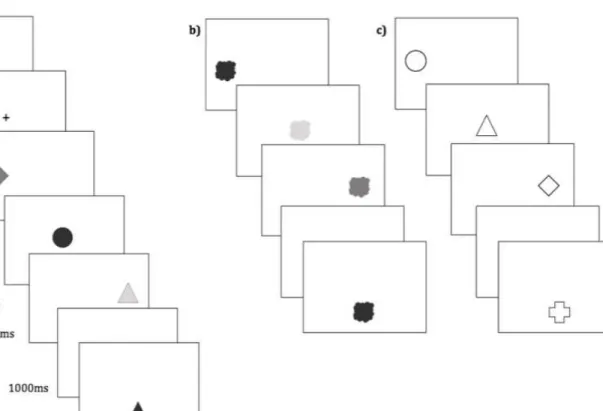
Trial procedure is illustrated in Figure 1. Three-item sequences were used in this and
subsequent experiments, based on pilot work indicating this to be the optimal length to avoid
floor and ceiling effects. Each trial commenced with the 2s presentation of a randomly
generated two-digit number (between 20 and 99) in the centre of the screen. Participants were
instructed to either repeatedly articulate this start number (the AS condition) or count
backwards in decrements of 2 from this start point (BC), until presentation of the test probe.
This number was then replaced with a central fixation cross (500ms), followed by the
to-be-remembered sequence. Objects were presented serially for 250ms each, with a blank screen
250ms inter-stimulus interval (ISI). They were presented in left-right order at locations along
a horizontal row centred at the position of the fixation cross with approximately 3cm
separating the location of each object on screen. The three-item sequence was then followed
by a blank-screen retention interval of 1s.
The test probe was then presented at lower screen centre. Following Allen et al.
(2006, 2012), participants were required to judge whether this color, shape, or color-shape
conjunction had been present in the sequence, with participants required to press “z” on the
keyboard in order to record a correct response. Within these 24 target trials, each of the three
serial positions was cued 8 times during each block. On the remaining 50%, the probe was a
lure item that had not been present (requiring a “/” keypress response). For the shape and
color feature conditions, this lure probe consisted of a shape or color drawn from the
experimental set that was not part of the sequence on that trial. For the binding condition, the
features of the lure probe were always part of the presented sequence, but were drawn from
different objects. Thus, accurate performance in the feature conditions only required memory
for the relevant features themselves, while the binding condition crucially required memory
for how features were combined. Target and lure trials were randomly intermixed within each
block. The test probe remained on screen in until participants made their key-press response,
with accuracy emphasized over speed.
Results
In the backward counting task, participants recorded a mean number of 4.02 steps (SE = .17)
for color, 4.01 (SE = .17) for shape, and 4.04 (SE = .16) for binding, with a repeated
measures ANOVA showing no effect of stimulus condition, F (2,46) = .14, MSE = .04, p =
.87, np2 = .01. Error rates were very low (< .03 in all conditions), and there was again no
effect of stimulus condition, F (2,46) = .02, MSE = .01, p = .98, np2 = .00.
Recognition accuracy is reported as corrected recognition1 (hits-false alarms)and is
displayed in Figure 2. A 3x2 repeated measures ANOVA revealed significant effects of
stimulus condition, F (2,46) = 121.94, MSE = .02, p < .001, np2 = .84, and concurrent task, F
(1,23) = 56.46, MSE = .02, p < .001, np2 = .71. However, the condition by task interaction
was not significant, F (2,46) = 1.13, MSE = .02, p = .33, np2 = .05. Thus, accuracy was
effect relative to simple suppression, but the latter effect was equivalent across color, shape,
and binding. This overall analysis was followed up by comparing each of the feature
conditions with binding, in sets of 2x2 ANOVAs, to establish whether concurrent task
interacted with stimulus condition in these more focused comparisons. For both color vs.
binding and shape vs. binding, the stimulus condition by concurrent task manipulation was
not significant (p = .77 and p = .32 respectively).
Performance on target-present trials was then separately analyzed as a function of
serial position, to explore how performance varied across positions in the sequence. Mean
performance accuracy for each stimulus condition under conditions of AS and BC is
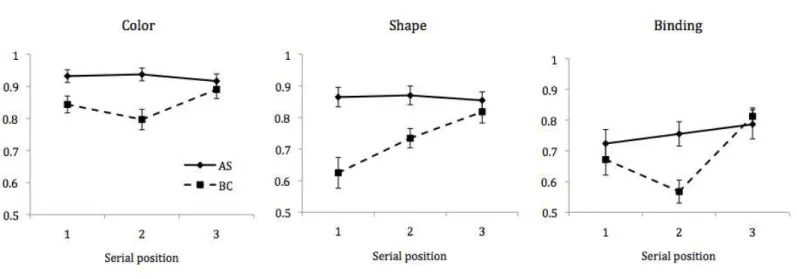
displayed in Figure 3. An overall 3x2x3 ANOVA revealed significant effects of stimulus
condition, F (2,46) = 41.69, MSE = .03, p < .001, np2 = .64, concurrent task, F (1,23) =
29.98, MSE = .03, p < .001, np2 = .57, and serial position (SP), F (2,46) = 4.69, MSE = .05, p
< .05, np2 = .17. There were also significant interactions between stimulus condition and SP,
F (4,92) = 4.28, MSE = .02, p < .01, np2 = .16, concurrent task and SP, F (2,46) = 8.69, MSE
= .02, p < .01, np2 = .27, and the three-way interaction, F (4,92) = 2.83, MSE = .02, p < .05,
np2 = .11. The stimulus condition by concurrent task interaction was not significant (p = .09).
Planned comparisons examining concurrent task effects at each SP revealed significant
differences (Bonferroni-Holm adjusted) between AS and BC conditions at positions 1, t (23)
= 2.60, p = .032, and 2, t (23) = 4.49, p < .001, for color, but not at position 3 (t < 1).
Similarly, for shape, there were effects of BC at position 1, t (23) = 4.15, p < .001, and
position 2, t (23) = 3.68, p = .002, but not position 3 (t < 1). Finally, there was a significant
effect of BC at position 2, t (23) = 4.71, p < .001 for binding, though not for positions 1 or 3
(t < 1).
While recognition accuracy was the primary dependent variable in this experiment,
latency data were also analyzed. These revealed similar patterns to the accuracy data, with no
indication of any speed-accuracy trade-offs.
Discussion
The central focus of the present study is to examine how executive attention supports
memory for a series of visual objects, across different positions in the sequence. In line with
there being two potential components to serial memory, concurrent task interacted with serial
position, with effects of backward counting only emerging on the first two positions in the
sequence. There were no impacts of counting on the final sequence position in any of the
three stimulus conditions. This would suggest that modality-independent executive resources
are important in retaining items encountered early in a sequence, while the most recently
encountered item in the environment is retained in working memory without such a cost, at
least for a brief period of time.
This experiment also aimed to establish whether memory for a series of feature
conjunctions is more dependent on executive resources than is memory for the individual
features. Overall analysis of target and lure trials provides a clear indication that this is not
the case; although increased concurrent load during sequence presentation had substantial
negative impacts on all stimulus conditions, this was no larger for binding than for color or
shape memory. However, it should also be noted that accuracy across the serial positions
showed a slightly different profile in the binding condition, with larger load effects at the
middle serial position. While this may indicate a genuine vulnerability of bound object
representations at mid-sequence positions when executive processes are withdrawn, it is
important to establish whether this pattern is sufficiently robust to be replicable. Experiment
Finally, it should be noted that examination of performance in the articulatory
suppression conditions reveals a generally reduced recency advantage relative to those
previously observed (e.g. Allen et al., 2006). This is likely attributable to the use of
three-item sequences in this study (thus enabling the addition of the key concurrent task
manipulation), as opposed to sequences of four items in the final experiment reported by
Allen et al. (2006). Nevertheless, as in that study, a larger recency effect for binding relative
to feature memory is still observable in the present experiment, as reflected by the interaction
between stimulus condition and serial position.
Experiment 2
The primary aim of this experiment was to establish the reliability of the key patterns
observed in Experiment 1. Thus, we explored whether concurrent executive load during
sequence encoding would cause equivalent disruption to memory for individual features and
their conjunctions, and whether this disruption was limited to the first two items in the
sequence, leaving memory for the final item unaffected. Experiment 2 was a replication of
the first study, with the exception that to-be-remembered stimuli were identical in all
conditions. In Experiment 1 (and in all experiments in Allen et al., 2006), items in the shape
and color conditions only varied on a single feature dimension. This allows for a greater
focus on the relevant dimension, and minimizes the possibility of any irrelevant shape-color
binding influencing performance, but has the potential disadvantage that stimuli in feature
and conjunction conditions vary in their appearance. Allen et al. (2012) examined feature
memory within simultaneously presented arrays under conditions in which non-tested
dimensions were held constant (Experiment 1) or were varied (Experiment 2) and found
similar load effects in each case. However, it is important to examine whether the outcomes
from Experiment 1 in the present series replicate when to-be-remembered sequences are
Method
Participants
There were 24 participants (6 males; 18 females) in this experiment, all students at the
University of Leeds (mean age 21.42 years, range 18-28). They took part for course credit or
a small honorarium.
Materials, Design, and Procedure
The same materials, design, and procedure as Experiment 1 were used again in this
experiment, with the exception that both color and shape varied during the presentation phase
for all stimulus conditions. Therefore, participants encountered sequences of three different
colored shapes, and were required to focus on color only, shape only, or the conjunctions of
these features, depending on the stimulus condition. As in Experiment 1, test probes
consisted either of non-canonical color ‘blobs’ (in the color condition), unfilled shape
outlines (in the shape condition), or colored shape conjunctions (binding), with participants
required to decide whether these individual features or feature combinations had been present
during the stimulus sequence they had just experienced. This procedure closely resembles the
method used by Brown and Brockmole (2010) and Allen et al. (2012, Experiment 2), though
with serial instead of simultaneous target presentation.
Results
For backward counting, participants recorded a mean number of 4.68 (SE = .21) steps for the
color condition, 4.66 (SE = .21) for shape, and 4.65 (SE = .21) for binding, with a repeated
measures ANOVA showing no effect of stimulus condition, F (2,46) = .11, MSE = .07, p =
.90, np2 = .01. Error rates were very low (< .03 in all conditions), and there was again no
Recognition accuracy is displayed in Figure 4. A 3x2 repeated measures ANOVA
revealed significant effects of stimulus condition, F (2,46) = 37.90, MSE = .03, p < .001, np2
= .62, and concurrent task, F (1,23) = 42.32, MSE = .05, p < .001, np2 = .65. However, the
condition by task interaction was not significant, F (2,46) = 1.35, MSE = .01, p = .27, np2 =
.06. This overall analysis was followed up by comparing each of the feature conditions with
binding in separate 2x2 ANOVAs. For both color vs. binding and shape vs. binding, the
stimulus condition by concurrent task manipulation was not significant (p = .91 and p = .20
respectively).
Performance on target trials was then separately analyzed as a function of serial
position. Mean performance accuracy for each stimulus condition under conditions of AS and
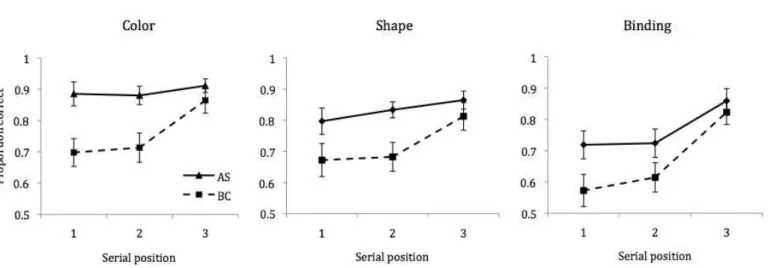
BC is displayed in Figure 5. An overall 3x2x3 ANOVA revealed significant effects of
stimulus condition, F (2,46) = 12.80, MSE = .03, p < .001, np2 = .36, concurrent task, F
(1,23) = 33.80, MSE = .04, p < .001, np2 = .60, and SP, F (2,46) = 22.10, MSE = .03, p <
.001, np2 = .50. There was also a significant interactions between concurrent task and SP, F
(2,46) = 5.66, MSE = .02, p < .01, np2 = .20. The stimulus condition and SP interaction was
not significant although somewhat marginal, F (4,92) = 2.17, MSE = .02, p = .08, np2 = .09,
with trends towards larger recency effects in the binding condition, relative to feature
memory. The interaction between stimulus condition and concurrent task, and the three-way
interaction, were not significant (p = .61 and p = .89 respectively). Planned comparisons
examining concurrent task effects at each SP revealed significant differences
(Bonferroni-Holm adjusted) between AS and BC conditions at positions 1, t (23) = 4.34, p < .001, and 2, t
(23) = 4.46, p < .001, for color, but not at position 3, t (23) = 1.40, p = .175. Similarly, for
shape, there were effects of BC at position 1, t (23) = 2.63, p = .03, and position 2, t (23) =
significant effect of BC at position 1, t (23) = 3.00, p = .012 for binding, though not for
positions 2, t (23) = 2.18, p = .117, or 3 (t < 1).
As in Experiment 1, analysis of response latency data revealed patterns that were
similar to accuracy, with no evidence of any speed-accuracy trade-offs.
Discussion
This experiment replicated the outcomes of Experiment 1 in all key aspects of the
study overall; concurrent load effects were again only reliably observed on the first two
positions in the sequence, with memory for the final item impervious to this disruption. Thus,
executive resources are reliably important in retaining all but the terminal item in a sequence
of visual stimuli. This would fit with Experiment 1 in suggesting that it is not the initial
encoding or very brief (1s) retention of objects that is reliant on executive support, but their
maintenance in the face of subsequent stimuli. In addition, the disruptive effects of
concurrent load were statistically equivalent across all stimulus conditions, including feature
and binding memory. Thus, regardless of whether to-be-remembered sequences of single
features only vary on the relevant dimension (Experiment 1) or are allowed to vary slightly in
both color and shape (Experiment 2), they show equivalent reliance on executive resources to
feature conjunction memory.
The outcomes from these two experiments were therefore extremely similar overall,
with concurrent task effects emerging on earlier but not final items. We also again observed
somewhat larger recency effects in the binding condition, relative to the single feature
conditions (as in Allen et al., 2006). However, the profile of concurrent task effects on
binding across sequence positions does slightly vary between experiments, with significant
effects only at position 2 in the first experiment, and position 1 in the second (after
binding conditions were identical in the two experiments. One possibility is that it reflects
varying strategy use (e.g. focusing on certain items in the sequence) between different groups
of participants.
Experiment 3 was therefore designed to clarify how executive load impacts on
memory for binding at different points in a sequence. To do so, we extended the exploration
to a different testing procedure, and explored forms of response error produced by
participants and associated implications for the nature of forgetting.
Experiment 3
The first two experiments used single-probe recognition in order to compare sequentially
presented feature and binding memory. While this is an appropriate method for such an
overall comparison, it is less suited to a fine-grained examination of binding performance
across positions in the sequence. Such an analysis is only possible for 50% of the
implemented trials, as target-absent lure trials are made up of features recombined from
different points in the sequence(in the binding condition). The binary nature of the yes/no
recognition response is also not particularly informative, as incorrect responses provide no
further information about why errors were made. Therefore, Experiment 3 examined feature
binding only, and replaced recognition with a cued recall task based on Ueno, Mate, Allen,
Hitch, and Baddeley (2011). In this method, participants are presented at test with a feature
cue, and are required to recall the corresponding feature from the other dimension that it was
paired with during presentation. This method still critically requires memory for the binding
between features for an accurate response, and has been successfully used to examine the
effects of to-be-ignored (TBI) suffixes on binding memory (Ueno, Mate, et al., 2011). It also
has the advantages of providing more data points per serial position (as all trials can be
limited to the likelihood of guessing correctly from the number of items in the experimental
pool).
Importantly, paradigms such as cued recall enable the opportunity to analyze types of
error, thus potentially providing further insights into the mechanisms of forgetting across
sequences and as a result of concurrent load. For example, Ueno, Mate, et al. (2011) found
that a to-be-ignored suffix (following a simultaneous target array) led to reduced cued recall
accuracy through an increase in the erroneous recall of non-presented features (possibly
reflecting overwriting of target representations), as opposed to recall of features from other
presented objects (reflecting binding errors). In contrast, using a precision-based
reconstruction measure of color-orientation binding (following serial presentation),
Gorgoraptis, Catalao, Bays, and Husain (2011) observed increased binding errors at early
sequence positions. However, no previous studies have examined the forms of error pattern in
sequentially encountered binding tasks under attentional load conditions. Therefore, this third
experiment provides new information about the forms of forgetting induced by withdrawal of
executive resources during sequence presentation.
Method
Participants
There were 26 participants (2 males; 24 females) in this experiment, all students at the
University of Leeds (mean age 19.3 years, range 18-21). They took part for course credit or a
small honorarium.
Materials, Design, and Procedure
Stimuli from Experiments 1-2 were used again in this experiment, which manipulated
counterbalanced across participants). There were 51 trials (3 practice and 48 test trials) in
each of the concurrent task blocks. Within each trial block, there were 24 ‘color-probe’ trials
and 24 ‘shape probe’ trials (see below), and for each of these trial types, each of the 3 serial
positions was probed 8 times (providing a total of 16 trials for each serial position, in each
concurrent task block). All probe-type and serial position trials were randomly intermixed.
The experimental session began by presenting participants with the sets of 8 colors
and 8 shapes, and familiarizing them with the labels to be used at recall. The presentation
method in each trial was identical to Experiments 1-2, with articulatory suppression or
backward counting (in 2s) performed from prior to the fixation cross, through to presentation
of the test probe. This consisted of a color- or shape-probe, with participants required to
verbally recall the feature from the other dimension that was part of the same object during
that sequence. Probes consisted of the color blobs and shape outlines used in the previous
experiments, and were presented at lower screen centre until participants made their verbal
response and pressed the space bar to move on to the next trial. Participants were encouraged
to provide a guess rather than no response, with all backward counting and cued recall
responses recorded by the experimenter.
Results
For backward counting, participants recorded a mean number of 3.97 (SE = .02) steps, with
an error rate of .004.
Responses were categorized as correct or incorrect, based on whether the recalled
feature was part of the same object as the probe feature. Comparison of color- and
shape-probe trials revealed a significant difference, with participants somewhat more accurate when
recalling colors in response to shape probes, than recalling shape names on color probe trials,
present study, and probe type did not interact with any other factor (F < 1 in all cases), color
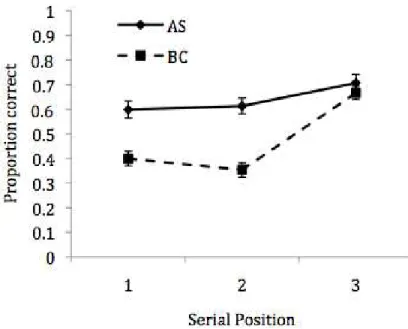
and shape probe trials were collapsed together. Mean proportional accuracy is displayed in
Figure 6, as a function of concurrent task and serial position. Erroneous responses were then
categorized as within-sequence confusions (recall of another feature from the presented
sequence), extra-sequence intrusions (recall of a feature from the wider experimental set),
extra-experiment intrusions (recall of a shape or color not featured in the experiment) or
omissions (no response), following Ueno, Mate, et al. (2011). Rates of extra-experiment
intrusions and omissions were very low (< .02 of all responses) and so will not be reported or
analyzed further. Within-sequence confusion and extra-sequence intrusions errors are
displayed in Figure 7, as a function of concurrent task and serial position.
Accuracy
For mean proportion correct, a 2x3 repeated measures ANOVA revealed significant effects of
concurrent task, F (1,25) = 54.17, MSE = .02, p < .001, np2 = .68 and serial position, F (2,50)
= 35.66, MSE = .02, p < .001, np2 = .59. In addition, the task by position interaction was
significant, F (2,50) = 10.33, MSE = .02, p < .001, np2 = .29. Comparisons of concurrent task
effects at each SP indicated significant differences (Bonferroni-Holm corrected) between AS
and BC conditions at positions 1, t (25) = 5.28, p < .001, and 2, t (25) = 8.72, p < .001, but
not at position 3 (t < 1).
Errors
Within-sequence confusions. Within-sequence confusions can be interpreted to reflect
binding errors between different objects in a given sequence. A 2x3 repeated measures
ANOVA revealed significant effects of concurrent task, F (1,25) = 10.19, MSE = .02, p < .01,
np2 = .29, and serial position, F (2,50) = 12.29, MSE = .02, p < .001, np2 = .33. The task by
Further comparisons (Bonferroni-Holm corrected) revealed significant effects of BC relative
to AS at position 2 only, t (25) = 4.59, p < .001; there were no significant differences at the
first, t (25) = 1.79, p = .26, or final (t < 1) positions in the sequence. Chance guessing rate for
this error type (based on guessing limited to the experimental set) was (sequence
length-1/experimental set-1) .29. Comparison of each concurrent task/SP error rate with this rate
revealed that only serial position 2 under backward counting produced a confusion rate above
that expected by chance.
Extra-sequence intrusions. Extra-sequence intrusions (recall of non-presented features from
the wider experimental set) can be viewed as a guessing response, and might reflect
overwriting/loss of the probed item’s representation from memory. A 2x3 repeated measures
ANOVA revealed significant effects of concurrent task, F (1,25) = 28.21, MSE = .01, p <
.001, np2 = .53, and serial position, F (2,50) = 14.77, MSE = .01, p < .001, np2 = .37. The
task by position interaction was again significant, F (2,50) = 5.29, MSE = .01, p < .01, np2 =
.18. Further comparisons (Bonferroni-Holm corrected) revealed significant effects of BC,
relative to AS, at position 1, t (25) = 3.94, p = .003, and position 2, t (25) = 6.54, p < .001,
while there was no effect at the final position in the sequence, t (25) = 1.04, p = .31.
Discussion
This experiment served to clarify and explore further the issues highlighted in Experiments
1-2. The primary outcome was that, while backward counting had substantial negative impacts
on this cued recall measure of visual WM, these effects were very clearly limited to the first
two positions in the presented sequence. Thus, when using a method that allows for more
data points per serial position, we were able to obtain a clear pattern of attention-related
final item. This basic pattern of concurrent task effects extends the core findings from
Experiments 1 and 2 to a different testing procedure.
The cued recall method also allowed an analysis of incorrect responses, which were
divided into those reflecting loss of the whole representation (extra-sequence intrusions) or a
confusion between the features of two items in a sequence, i.e. a binding error
(within-sequence confusions). Concurrent load led to a substantial increase in intrusion errors, but
only at the first two sequence positions, suggesting much of the load effects on accuracy were
the result of losing whole items. As participants were encouraged to guess rather than provide
no response, this error type can be interpreted as reflecting overwriting or representation loss
of the whole item (followed by a guessing response based on the experimental item pool),
and would account for the general reduction in recognition accuracy for all conditions in
Experiments 1 and 2. In contrast, errors reflecting confusion or binding problems within the
sequence were only significantly increased, and only above chance, at the middle position in
the sequence. Such a response might be characterized as reflecting a binding error, that is an
incorrect pairing of features from two objects (see also Gorgoraptis et al. (2011), and may
reflect a role for executive resources in preventing conjunction errors emerging between
temporally adjacent items in a sequence.
General Discussion
While previous research has shown that visual working memory is reliant on executive
support, it has not always been straightforward to specify how this might operate. Sequential
presentation enables an examination of changing processes over time and activity, and
therefore optimizes the chances of successfully localizing the impact of withdrawing
executive resources. Within this context, we examined the effects of a verbal concurrent load
experiments found that backward counting disrupted performance, consistent with a range of
previous findings indicating a key role for internally oriented, executive resources in visual
memory (e.g. Allen et al., 2006, 2012; Brown & Brockmole, 2010; Morey & Cowan, 2004,
2005; Morey & Bieler, 2012). Critically, analysis of load effects on target trials in the
recognition paradigm used in Experiments 1 and 2, and all trials in the cued recall procedure
used in Experiment 3, only revealed reliable disruption of memory for the first two items in a
sequence, with no effects on final item recognition or recall. While recency effects have
previously been observed in visual memory (e.g. Allen et al., 2006; Broadbent & Broadbent,
1981; Parmentier et al., 2004), the key outcomes in the present work lie in the interaction
between the serial position functions observed under simple suppression and backward
counting, and the absence of load effects at the final sequence position. This is a reliable and
consistent pattern of effects that emerges across different stimulus conditions and testing
methods and is not attributable to simple floor or ceiling effects.
These findings suggest a two-component view of memory for visual object sequences
that can be applied to performance variation across serial positions, with particular regard to
the emergence of recency effects and the role of executive control resources. Specifically,
they suggest that accessible retention of items that were encountered earlier in the sequence is
dependent on executive control, while the most recently encountered item is retained in a
relatively automatic and cost-free manner. It is useful to speculate how this might operate.
When each new item is encountered in the environment, it can automatically gain access to
working memory without the need for executive resources. Storage in conscious awareness
may be provided by a component such as the episodic buffer (Baddeley, 2000; Baddeley,
Allen, & Hitch, 2011). As previously noted (Baddeley, 2012), the episodic buffer may be
analogous to the focus of attention as described by Cowan (e.g. 2005), and indeed we use this
helps highlight and build on the similarities between these approaches, though we would
interpret our findings within the context of the multicomponent framework. Oberauer and
Hein (2012) have recently differentiated between a broad focus of attention capable of
holding around four chunks of information and a narrow focus that selects a single chunk at a
time, while Gilchrist and Cowan (2011) have argued for a single focus of attention that can
hold more than one chunk simultaneously. Both approaches propose that the most recently
encountered item in a sequence will always be encoded into and retained in the active focus
of attention, thus supporting accurate performance (see also McElree & Dosher, 1989, 2001),
a suggestion that clearly fits with our current findings. Furthermore, Gilchrist and Cowan
(2011) also note that the probability of an item from earlier in the sequence being retained
within this focus will vary. We suggest that this crucially depends on the availability and
attribution of executive control resources.
Thus, as presentation of a sequence progresses, each item in turn passes through two
phases of processing. Each will briefly benefit from automatic storage within the focus of
attention. As visual memory is dynamic and constantly subject to updating in response to
changes in the environment, temporary representations are vulnerable and subject to
disruption caused by incoming information (e.g. Makovski, Sussman, & Jiang, 2008;
Rensink, 2000, 2002). Continued maintenance of such representations within the focus of
attention in the face of subsequent stimuli will then require executive resources. If this
support is not available (e.g. if executive attention is allocated to another task), or is instead
directed to the retention of other items, early sequence items are likely to be displaced. This
displacement might lead to forgetting of the whole item (Gajewski & Brockmole, 2006), or
either of the constituent features (Cowan et al., 2013), with either situation increasing the
probability of participants making a guess response, as indicated by the increase in
privileged and cost-free storage in visual working memory, at least for a brief period,
reflecting an absence of further environmental interference and overwriting (see also Cowan,
2011). Under this approach, while we might accept the Oberauer and Hein (2012) distinction
between broad and narrow attentional foci, we would suggest that a) the latter is capable of
holding more than one chunk of information (as claimed by Gilchrist & Cowan, 2011), and
that b) while earlier items need executive resources in order to avoid displacement, the last
item is stored for free. Thus, more than one item can be retained within focused attention, but
the requirement for executive control in this maintenance process depends on where in a
stimulus sequence each item was encountered.
The current findings and theoretical interpretation can be usefully linked to the
taxonomy of attention recently set out by Chun, Golomb, and Turk-Browne (2011). This
describes separable but interactive forms of attentional control, differentiating between
modality-independent executive resources that are internally oriented and cognitive in nature,
and externally oriented attention that is directed towards, modulates, and can be captured, by
external stimuli. Chun et al. place working memory at the interface between these forms of
attention. In line with this, our present account describes how both might contribute to the
processing of visual sequences, and how this impacts on working memory. Specifically, the
focus of attention, possibly within the episodic buffer, would represent the intersection
between new stimuli in the external environment that can be automatically encoded and
retained, and internally oriented cognitive control that is required to prevent older items from
being displaced and lost.
If executive control is only required to protect existing representations from new
input, this begs the question of why substantial effects of concurrent tasks have previously
emerged on simultaneously presented target arrays (e.g. Allen et al., 2006, 2012), given that
absence of subsequent environmental interference). One possibility is that cost-free encoding
and/or storage within the focus of attention is limited in capacity; concurrent registration and
retention of multiple items would therefore require executive resources to enable accurate
recognition or recall performance. Indeed, Makovski et al. (2008) have demonstrated how
orienting attention to an individual item within a multi-stimulus array increases protection for
that item from subsequent external interference. However, further research will be required to
explore the various constraints that operate on controlled and cost-free storage functions
across contexts.
The absence of any overall interaction between stimulus condition and concurrent
task in Experiments 1 and 2 supports the claim that memory for visual feature bindings is no
more reliant on executive resources than memory for the individual features (Allen et al.,
2006, 2012). The current study extends this to serial presentation, and also observes impacts
of backward counting at earlier sequence positions that are broadly equivalent for feature and
binding memory. Therefore, evidence indicating a particular loss of binding as a result of
subsequently encountered stimuli (e.g. Allen et al., 2006; Ueno, Allen, et al., 2011; Ueno,
Mate, et al., 2011; Wheeler & Treisman, 2002) is not specifically attributable to the
withdrawal of executive resources, which are important in maintaining accessibility of early
items regardless of whether the individual features or their conjunctions need to be retained
for the purposes of the task. Such findings instead reflect a greater fragility of bound
representation, with information critical to supporting binding memory at retrieval being
more likely to be lost when further items are encountered (as again indicated in the larger
recency patterns for binding in the present study). Subsequent work should attempt to specify
more closely the factors, both internally and externally oriented (Chun et al., 2011), that may
However, it is also noteworthy that an increase in within-sequence confusion errors
(i.e. incorrect recall of a feature from a different item in the sequence) as a result of
concurrent load was observed in the final experiment. Such a response may reflect a binding
error, that is, an incorrect pairing of features from two different objects (Gorgoraptis et al.,
2011; Pertsov, Dong, Peich, & Husain, 2012). This load-related increase was limited to trials
cueing the middle item in the sequence, and it was only this position at which the error rate
was elevated significantly above chance, suggesting that binding errors are more likely to
occur between adjacent items in the sequence. This might also help explain why the binding
condition showed particular disruption at the middle sequence position as a result of
backward counting in Experiment 1 (though this was not replicated in Experiment 2). Thus,
the features of different objects are somewhat more likely to become confused when
executive control is directed elsewhere, indicating that it does have a role in maintaining
within-object cohesion. However, the absence of broader interactive effects in Experiments 1
and 2 suggest this is not a large enough source of disruption to cause increased binding
problems overall, or to claim that executive attention is always critical to binding.
In summary, our studies suggest two components in serial visual working memory.
One principally involves the final item and appears to be automatic and impervious to
executive disruption. A second, involved in the maintenance of earlier items, is sensitive to
executive load, with the influence of load being broadly equivalent for individual features
References
Allen, R.J., Baddeley, A.D., & Hitch, G.J. (2006). Is the binding of visual features in working
memory resource-demanding? Journal of Experimental Psychology: General, 135,
298-313.
Allen, R.J., Hitch, G.J., Mate, J., & Baddeley, A.D. (2012). Feature binding and attention in working
memory: A resolution of previous contradictory findings. The Quarterly Journal of
Experimental Psychology, 65 (12), 2369-2383.
Baddeley, A. D. (2000). The episodic buffer: A new component of working memory? Trends in
Cognitive Sciences, 4(11), 417-423.
Baddeley, A.D. (2012). Working memory: Theories, models, and controversies. Annual Review of
Psychology, 63, 1-29.
Baddeley, A.D., Allen, R.J., & Hitch, G.J. (2011). Binding in visual working memory: The role of
the episodic buffer. Neuropsychologia, 49, 1393-1400.
Broadbent, D.E. & Broadbent, M.H.P. (1981). Recency effects in visual memory. The Quarterly
Journal of Experimental Psychology, 63, 2067-2079.
Brown, L. A., & Brockmole, J. R. (2010). The role of attention in binding visual features in working
memory: evidence from cognitive ageing. The Quarterly Journal of Experimental Psychology
Section A: Human Experimental Psychology, 33 (1), 1-15.
Chun, M.M., Golomb, J.D., & Turk-Browne, N.B. (2011). A taxonomy of external and
internal attention. Annual Review of Psychology, 62, 73-101.
Conrad, R., & Hull, A. J. (1968). Input modality and the serial position curve in short-term
memory. Psychonomic Science, 10 (4), 135-136.
Cowan, N. (2011). The focus of attention as observed in visual working memory tasks: Making
sense of competing claims. Neuropsychologia, 4 9(6), 1401-1406.
Cowan, N., Blume, C. L., & Saults, J. S. (2013). Attention to attributes and objects in working
memory. Journal of Experimental Psychology: Learning, Memory, and Cognition, 39 (3),
731
Dell’Acqua, R., & Jolicoeur, P. (2000). Visual encoding of patterns is subject to dual-task
interference. Memory & Cognition, 28, 184-191.
Endress, A.D., & Potter, M.C. (2013). Large capacity temporary visual memory. Journal of
Experimental Psychology: General.
Engle, R.W. (2002). Working memory capacity as executive attention. Current Directions in
Psychological Science, 11, 19-23.
Fougnie, D., & Marois, R. (2009). Attentive tracking disrupts feature binding in visual working
memory. Visual Cognition, 17, 48-66.
Gilchrist, A.L. & Cowan, N. (2011). Can the focus of attention accommodate multiple, separate
items? Journal of Experimental Psychology: Learning, Memory, & Cognition, 37 (6),
1484-1502.
Gajewski, D. A., & Brockmole, J. R. (2006). Feature bindings endure without attention: Evidence
from an explicit recall task. Psychonomic Bulletin & Review, 13, 581-587.
Gorgoraptis, N., Catalao, R.F.G., Bays, P.M., & Musain, M. (2011). Dynamic updating or working
memory resources for visual objects. The Journal of Neuroscience, 31 (23), 8502-8511.
Johnson, J. S., Hollingworth, A., & Luck, S. J. (2008). The role of attention in the maintenance of
feature bindings in visual short-term memory. Journal of Experimental Psychology: Human
Perception & Performance, 34, 41-55.
Luck, S.J., & Vogel, E.K. (1997). The capacity of visual working memory for features and
Makovski, T., Sussman, R., & Jiang, Y.V. (2008). Orienting attention in visual working memory
reduces interference from memory probes. Journal of Experimental Psychology: Learning,
Memory, and Cognition, 34 (2), 369-380.
McElree, B., & Dosher, B. A. (1989). Serial position and set size in short-term memory: The
time course of recognition. Journal of Experimental Psychology: General, 118, 346–
373.
McElree, B., & Dosher, B. A. (2001). The focus of attention across space and time.
Behavioral and Brain Sciences, 24, 129–130.
Morey, C. C., & Bieler, M. (2013). Visual short-term memory always requires general
attention. Psychonomic Bulletin & Review, 20 (1), 163-170.
Morey, C. C., & Cowan, N. (2004). When visual and verbal memories compete: Evidence of
cross-domain limits in working memory. Psychonomic Bulletin and Review, 11, 296-301.
Morey, C. C., & Cowan, N. (2005). When do visual and verbal memory conflict? The importance of
working memory load and retrieval. Journal of Experimental Psychology: Learning, Memory
and Cognition, 31, 703-713.
Murdock, B.B. (1966). Visual and auditory stores in short-term memory. The Quarterly Journal of
Experimental Psychology, 18 (3), 206-211.
Oberauer, K., & Hein, L. (2012). Attention to information in working memory. Current
Directions in Psychological Science, 21(3), 164-169.
Pertsov, Y, Dong, M.Y., Peich, M-C., & Husain, M. (2012). Forgetting what was where: The
fragility of object-location binding. PLoS One, 7 (10), 1-12.
Phillips, W.A. (1974). On the distinction between sensory storage and short-term visual memory.
Perception & Psychophysics, 16 (2), 283-290.
Phillips, W.A., & Christie, D.F.M. (1977). Components of visual memory. The Quarterly Journal of
Experimental Psychology, 29, 117-133.
Phillips, W. A., & Christie, D. F. M. (1977). Interference with visualization. The Quarterly
Journal of Experimental Psychology, 29(4), 637-650.
Rensink, R.A. (2000). The dynamic representation of scenes. Visual Cognition, 7, 17-42.
Rensink, R.A. (2002). Change detection. Annual Review of Psychology, 53, 245-277.
Ueno, T., Allen, R.J., Baddeley, A.D., Hitch, G.J., & Saito, S. (2011). Disruption of visual feature
binding in working memory. Memory & Cognition, 39, 12-23.
Ueno, T., Mate, J., Allen, R.J., Hitch, G.J., & Baddeley, A.D. (2011). What goes through the gate?
Exploring interference with visual feature binding. Neuropsychologia, 49, 1597-1604.
Wheeler, M.E., & Treisman, A. (2002). Binding in short-term visual memory. Journal of
Experimental Psychology: General, 131, 48-64.
Wolfe, J. M. (1999). Inattentional amnesia. In V. Coltheart (Ed.), Fleeting memories:
Cognition of brief visual stimuli (pp. 71–94). Cambridge, MA: MIT Press/Bradford
Footnote
1. Data were also analyzed using both d’ and A’ for Experiments 1 and 2. These analyses
produced identical patterns to those revealed by H-FA, and so only the latter will be reported
Author’s note
We would like to thank Melissa Adams, Rachel Woodall, Emma Coates, and Heather Parr for
Figure captions
Figure 1. Illustration of procedure in Experiment 1, showing the binding condition (a), and
corresponding example stimuli series for color (b) and shape (c) conditions (not to scale). All
displays used a grey background.
Figure 2. Mean accuracy (hits-false alarms) in Experiment 1, with standard error
Figure 3. Mean hit rates as a function of serial position for the color, shape, and binding
conditions
Figure 4. Mean accuracy (hits-false alarms) in Experiment 2, with standard error
Figure 5. Mean hit rates as a function of serial position for the color, shape, and binding
conditions
Figure 6. Mean proportion correct in Experiment 3
Figure 7. Rates of within-sequence confusion errors and outside-sequence intrusion errors in
Figure 1.
Hkiwtg"3
0 0.1 0.2 0.3 0.4 0.5 0.6 0.7 0.8 0.9 1
Color Shape Binding
A
cc
u
ra
cy
(
H
it
s-F
A
)
AS BC
Figure 2. Hkiwtg"4
Figure 3. Hkiwtg"5
0 0.1 0.2 0.3 0.4 0.5 0.6 0.7 0.8 0.9 1
Color Shape Binding
A
cc
u
ra
cy
(
H
it
s-F
A
)
AS BC
Figure 4. Hkiwtg"6
Figure 5.
Hkiwtg"7
Figure 6.
Hkiwtg"8
Figure 7.
Hkiwtg"9