Not Distinguished from Progressors by the Clonal Composition of
HIV-Specific CD8
ⴙ
T Cells
Daniel Mendoza,aCassandra Royce,aLaura E. Ruff,bDavid R. Ambrozak,bMáire F. Quigley,b,cThurston Dang,dVanessa Venturi,d David A. Price,b,cDaniel C. Douek,bStephen A. Migueles,aand Mark Connorsa
HIV-Specific Immunity Section, Laboratory of Immunoregulation, National Institute of Allergy and Infectious Diseases, National Institutes of Health, Bethesda, Maryland, USAa; Vaccine Research Center, National Institute of Allergy and Infectious Diseases, National Institutes of Health, Bethesda, Maryland, USAb; Institute of Infection and
Immunity, Cardiff University School of Medicine, Cardiff, Wales, United Kingdomc; and Computational Biology Group, Centre for Vascular Research, University of New
South Wales, Kensington, Australiad
To better understand the qualitative features of effective human immunodeficiency virus (HIV)-specific immunity, we examined
the TCR clonal composition of CD8
ⴙT cells recognizing conserved HIV p24-derived epitopes in HLA-B*5701-positive
long-term nonprogressors/elite controllers (LTNP/EC) and matched progressors. Both groups displayed oligoclonal
HLA-B5701-restricted p24-specific CD8
ⴙT-cell responses with similar levels of diversity and few public clonotypes. Thus,
HIV-specific CD8
ⴙT-cell responses in LTNP/EC are not differentiated from those of progressors on the basis of clonal diversity or
TCR sharing.
U
nderstanding natural immunologic control of human
immu-nodeficiency virus (HIV) may provide important insights for
the development of vaccines and immunotherapies. Rare
long-term nonprogressors/elite controllers (LTNP/EC) maintain
dura-ble restriction of HIV replication without antiretroviral therapy
(25). Evidence suggesting that HIV-specific CD8
⫹T cells mediate
this control (13) includes a dramatic overrepresentation of the
HLA-B*5701 allele (8, 12, 19, 21, 29, 33, 37) and a CD8
⫹T-cell
response focused on HLA-B5701-restricted peptides (11, 29).
Similarly, LTNP/EC rhesus macaques are enriched for the Mamu
B*08 or B*17 alleles (22, 43) and lose control of simian
immuno-deficiency virus (SIV) replication following antibody-mediated
CD8
⫹T-cell depletion (9). HIV-specific CD8
⫹T cells in
LTNP/EC also show a greater capacity to suppress HIV replication
or kill autologous HIV-infected CD4
⫹T cells than those of
pro-gressors (14, 27, 28, 30, 37). Collectively, these data suggest that
greater HIV control in LTNP/EC than in progressors is likely
me-diated by qualitative differences in their CD8
⫹T-cell responses.
It has been speculated that favorable HLA molecules may select
for a diverse repertoire of T-cell receptor (TCR) clonotypes
capa-ble of limiting HIV mutational escape (5, 17, 18, 20, 23, 38).
Fa-vorable HLA molecules might preferentially select for “public
clonotypes” (10, 34, 38–40), which are shared among multiple
individuals and may constitute particularly effective CD8
⫹T-cell
responses (1, 2, 15). In the present study, we compared for the first
time the clonalities of CD8
⫹T cells targeting the same
immuno-dominant HIV epitopes in HLA-B*5701
⫹LTNP/EC and in
pro-gressors to better understand qualitative features of an effective
HIV-specific CD8
⫹T-cell response.
Subjects signed institutional review board-approved informed
consent forms and were categorized as LTNP/EC or progressors as
previously defined (28, 29). Three progressors who had had
ele-vated HIV RNA levels (
⬎
10,000 copies/ml) prior to initiating
an-tiretroviral therapy (ART) donated peripheral blood
mononu-clear cells (PBMC) while receiving ART yet had persistently
detectable viremia due to erratic compliance with their regimens
(Table 1). PBMC were stained with HLA-B5701 tetramers
com-plexed to the HIV Gag p24 epitopes ISPRTLNAW (IW9; amino
acids [aa] 147 to 155), KAFSPEVIPMF (KF11; aa 162 to 172), or
QASQEVKNW (QW9; aa 308 to 316) (Beckman Coulter, San
Di-ego, CA) and then surface stained with antibodies to CD3, CD8,
CD57, CD25, CD27, CD28, HLA-DR, CD45RO, CD57, and
CCR7 (BD Biosciences, San Jose, CA) prior to flow cytometry
analysis (16, 28). Tetramer-positive CD8
⫹T cells were also sorted
at
⬎
98% purity by flow cytometry, and all expressed TCR
gene
products were amplified and characterized without bias using a
nonnested template-switch-anchored reverse transcription-PCR
(RT-PCR) (6, 35). Medians and correlations were analyzed using
the Wilcoxon two-sample test and the Spearman rank method,
respectively. The Bonferroni method was used to adjust
P
values
for multiple testing. Clonotypic diversity was assessed by the
stan-dardized number of clonotypes, which accounts for differences in
the number of TCR sequences obtained per sample, and
Simp-son’s diversity index, which accounts for the clonal dominance
hierarchy and varies between 0 (minimal diversity) and 1
(maxi-mal diversity) (41).
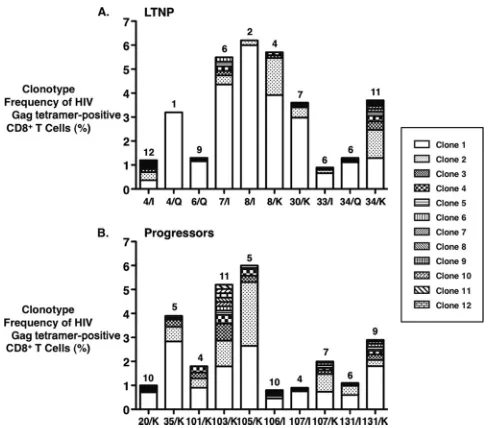
Between 0.8 and 6.2% of CD8
⫹T cells from 7
HLA-B*5701-positive LTNP/EC (10 specificities) and 8 progressors (10
speci-ficities) (Table 1) stained positively with at least one HLA-B5701/
p24 tetramer (Fig. 1A and B and data not shown). No significant
differences were observed between LTNP/EC and progressors
within the tetramer-positive populations regarding activation
sta-tus, costimulation, antigen exposure, or homing (CD25,
HLA-DR, CD27, CD28, CD45RO, CD57, or CCR7 expression) (P
⬎
0.5
for all comparisons; data not shown). The predominant
pheno-type of HLA-B5701/p24 tetramer-positive CD8
⫹T cells was
Received2 December 2011 Accepted9 January 2012
Published ahead of print25 January 2012
Address correspondence to Mark Connors, [email protected].
Copyright © 2012, American Society for Microbiology. All Rights Reserved.
doi:10.1128/JVI.06982-11
on November 7, 2019 by guest
http://jvi.asm.org/
CD25
⫺CD27
⫹CD45RO
⫹CCR7
⫺CD57
⫹/⫺in both groups (data
not shown), consistent with previous reports (4, 7, 16, 32).
In analyses of the clonotypic composition of HLA-B5701/p24
tetramer-positive cells, a mean of 65 clones were examined for
each sorted specificity, representing
⬎
1,000 TCR sequences (6,
36). Overall, the immunodominant B5701-restricted HIV p24
epitope-specific CD8
⫹T-cell populations in both groups were
oligoclonal, comprising a median of 6.5 clonotypes (range, 1 to
12) per specificity (Table 2 and Fig. 1A and B). Only the
QW9-specific cells of LTNP/EC 4 were monoclonal (Table 2). These data
are consistent with previous observations in chronic human viral
infections (6, 23).
To analyze repertoire diversity, subject 107’s IW9-specific TCR
repertoire (18 TCRs) and subject 101’s KF11-specific repertoire
(14 TCRs) were excluded due to low numbers of sequences. The
remaining data were standardized for sampling differences (41).
There were no significant differences between LTNP/EC and
pro-gressors in either the standardized numbers of epitope-specific
clonotypes per repertoire (P
⬎
0.5) (Fig. 2A) or Simpson’s
diver-sity index (P
⫽
0.31) (Fig. 2C) for the IW9- and KF11-specific
repertoires. QW9-specific repertoires were omitted from the
comparisons since they were only detected in the LTNP/EC group
(n
⫽
3) (Fig. 2B and D). Additionally, there were no significant
correlations between HIV RNA levels and either the number or
diversity of CD8
⫹T-cell clonotypes per repertoire (P
⬎
0.5 for all
correlations; data not shown).
We next examined whether there were public TCR clonotypes
shared between these patients or with prior reports (10, 38, 44).
Only 2 public clonotypes were identified in LTNP/EC that were
not shared with patients in this study but that had previously been
reported in two progressors (Table 2) (44). In progressors, only
two sequences were shared between two individuals and one was
previously reported (Table 2) (44). Thus, public clonotypes were
not a dominant feature of the repertoires of either LTNP/EC or
progressors.
[image:2.585.42.542.78.312.2]Collectively, these data suggest that the large differences in
im-munologic control between HLA-B*5701-positive LTNP/EC and
progressors are unlikely to be mediated by differences in the TCR
TABLE 1Patient characteristics
Patient type and no.
HLA class I allele(s)
Yr of diagnosis
No. of T cells (cells/l)
Viral load (copies/ml) Tetramer(s)a
A B C CD4⫹ CD8⫹
LTNP/EC
4 1,31 8,57 6,7 1985 943 1,012 ⬍50 IW9, QW9
7 1,2 57 6 1985 325 342 ⬍50 IW9, KF11
33 2,30 13,57 6 1995 1,334 1,557 ⬍50 IW9
34 1,2 8,57 6,7 1989 1,523 1,111 ⬍50 KF11, QW9
30 31,74 51,57 7,16 1990 306 747 ⬍50–58 KF11
6 11,30 52,57 7,12 1986 737 998 ⬍50–152 QW9
8 11,23 44,57 4,6 1985 490 1,033 ⬍50–567 IW9, KF11
Progressors (untreated)
35 2,3 57 6,7 2000 1,144 1,220 1,800 KF11
20 1 52,57 6,12 1985 1,068 1,091 25,017 KF11
106 3,30 18,57 5,18 1986 420 1,382 24,564 IW9, KF11
131 2,11 35,57 4,6 1989 421 1,082 76,038 IW9, KF11
107 3 40,57 3,7 1987 405 1,418 90,130 IW9, KF11
Progressors (treated)
105 2,80 8,57 2,7 1990 616 1,026 2,473 KF11
101 1,31 51,57 6,15 1986 419 992 3,421 KF11
103 2,11 55,57 3,6 1991 653 1,130 3,968 KF11
aHLA-B5701/HIV Gag p24 tetramers. IW9, ISPRTLNAW (positions 147 to 155); KF11, KAFSPEVIPMF (162 to 172); QW9, QASQEVKNW (308 to 316).
FIG 1Clonal composition of HLA-B5701/HIV Gag p24 tetramer-positive CD8⫹ T-cell populations in LTNP/EC and progressors. (A and B) Summary data show-ing the frequencies of each TCR clonotype (Table 2) relative to the frequencies of the corresponding HLA B5701/HIV Gag p24 tetramer-positive CD8⫹T cells in 7 HLA-B*5701-positive LTNP/EC (A) and 8 HLA-B*5701-positive progressors (B). Three HLA-B5701/HIV Gag p24 tetramers containing B57 bound to one of three immunodominant Gag p24-derived epitopes (I, IW9; K, KF11; and Q, QW9) were used to stain and sort antigen-specific CD8⫹T cells for clonotypic analysis. Results for two different specificities are shown for patients 4, 8, 34, 107, and 131. The numbers above each stacked bar denote the total number of clonotypes for the depicted epitope-specific CD8⫹T-cell population.
on November 7, 2019 by guest
http://jvi.asm.org/
[image:2.585.41.287.408.622.2]TABLE 2HLA-B5701-restricted HIV Gag p24-specific CD8⫹TCRrepertoiresa
aI, K, and Q represent HLA-B5701-restricted CD8⫹T-cell repertoires specific for Gag epitopes IW9, KF11, and QW9,
respectively, for a given patient. Public clonotypes were defined as identical TCRamino acid sequences observed in more than one individual with reference to an extensive database, including both previously reported and unpublished sequences. Sequences in gray are public clonotypes that are also found in prior reports. Clonotypes shared between patients in this report are shown in color. TRBV, TCRvariable allele; CDR3, complementarity-determining region 3; TRBJ, TCRjoining allele.
on November 7, 2019 by guest
http://jvi.asm.org/
repertoire of immunodominant HIV-specific CD8
⫹T-cell
popu-lations. We observed similar clonotype numbers and diversity in
these cohorts regardless of viral load or specificity. The trend
to-ward greater TCR polyclonality in progressors than in LTNP/EC
might be explained by the recruitment of a more polyclonal
re-sponse in the context of higher viral loads in the former group.
In prior work, it has been suggested that greater clonal diversity
within the HIV-specific memory CD8
⫹T-cell repertoire may
me-diate superior control of HIV (17, 18, 24, 38). It has been further
proposed that protective HLA class I alleles might mediate their
effect through thymic deletion of fewer self-reactive clones,
pro-viding a more diverse naïve repertoire (20). In either case, it is
hypothesized that greater clonal diversity might mediate superior
control through improved recognition of peptide variants.
How-ever, many prior studies did not include true LTNP/EC and did
not compare responses within a given HLA and specificity (17, 18,
24, 38). In addition, differences in TCR contact residues within
targeted epitopes, suggesting differential abilities to contain
non-anchor position variation, have not been observed between
B*5701-positive LTNP/EC and progressors (3, 26, 31). Therefore,
if TCR clonal diversity were an important parameter
differentiat-ing LTNP/EC from progressors, some detectable difference in
clonality between these groups would be expected, considering
the vast differences in their capacity to control HIV replication.
It has also been suggested that LTNP/EC may possess public
clonotypes that preferentially contain HIV (10, 34, 44).
Public-clonotype HIV-specific CD8
⫹T cells with high functional avidity
that could be particularly efficacious might be selected in multiple
individuals (15). However, we did not observe significant
num-bers of public clonotypes in either LTNP/EC or progressors, in
contrast to prior results in which a single clonotype was found in
the KF11-specific responses of 3 HLA B*5701-positive donors (10,
44). Furthermore, we previously detected no differences between
LTNP/EC and progressors in the avidities of gamma interferon
(IFN-
␥
)-secreting HIV-specific CD8
⫹T cells responding to
cog-nate peptides (26, 27). Selection of Gag-specific public clonotypes
in the rhesus macaque-SIV infection model has been observed to
correlate inversely with subsequent viral load (34). However, these
studies were conducted during acute SIV infection. It is likely that
the forces governing public clonotype selection in acute lentiviral
infection or vaccination may differ from those involved in chronic
HIV infection. It remains possible that additional study of
HIV-specific CD8
⫹T-cell clonotypes in the setting of acute infection or
vaccination (42) may further our understanding of immunologic
control of HIV and other chronic viral infections in humans.
ACKNOWLEDGMENT
This research was supported by the Intramural Research Program of the National Institute of Allergy and Infectious Disease, NIH.
REFERENCES
1.Almeida JR, et al.2007. Superior control of HIV-1 replication by CD8⫹ T cells is reflected by their avidity, polyfunctionality, and clonal turnover. J. Exp. Med.204:2473–2485.
2.Almeida JR, et al.2009. Antigen sensitivity is a major determinant of CD8⫹T-cell polyfunctionality and HIV-suppressive activity. Blood113: 6351– 6360.
3.Bailey JR, Williams TM, Siliciano RF, Blankson JN.2006. Maintenance of viral suppression in HIV-1-infected HLA-B*57⫹elite suppressors de-spite CTL escape mutations. J. Exp. Med.203:1357–1369.
4.Champagne P, et al.2001. Skewed maturation of memory HIV-specific CD8⫹T lymphocytes. Nature410:106 –111.
5.Davenport MP, Price DA, McMichael AJ.2007. The T cell repertoire in infection and vaccination: implications for control of persistent viruses. Curr. Opin. Immunol.19:294 –300.
6.Douek DC, et al.2002. A novel approach to the analysis of specificity, clonality, and frequency of HIV-specific T cell responses reveals a poten-tial mechanism for control of viral escape. J. Immunol.168:3099 –3104. 7.Ellefsen K, et al.2002. Distribution and functional analysis of memory
antiviral CD8⫹T cell responses in HIV-1 and cytomegalovirus infections. Eur. J. Immunol.32:3756 –3764.
8.Flores-Villanueva PO, et al.2001. Control of HIV-1 viremia and protec-tion from AIDS are associated with HLA-Bw4 homozygosity. Proc. Natl. Acad. Sci. U. S. A.98:5140 –5145.
9.Friedrich TC, et al.2007. Subdominant CD8⫹T-cell responses are in-volved in durable control of AIDS virus replication. J. Virol.81:3465– 3476.
10. Gillespie GM, et al.2006. Strong TCR conservation and altered T cell cross-reactivity characterize a B*57-restricted immune response in HIV-1 infection. J. Immunol.177:3893–3902.
11. Goulder PJ, et al.1996. Novel, cross-restricted, conserved, and immuno-dominant cytotoxic T lymphocyte epitopes in slow progressors in HIV type 1 infection. AIDS Res. Hum. Retroviruses12:1691–1698.
12. Han Y, et al.2008. The role of protective HCP5 and HLA-C associated polymorphisms in the control of HIV-1 replication in a subset of elite suppressors. AIDS22:541–544.
13. Hersperger AR, Migueles SA, Betts MR, Connors M.2011. Qualitative features of the HIV-specific CD8⫹T-cell response associated with immu-nologic control. Curr. Opin. HIV AIDS6:169 –173.
14. Hersperger AR, et al.2010. Perforin expression directlyex vivoby HIV-specific CD8⫹T-cells is a correlate of HIV elite control. PLoS Pathog.
6:e1000917.
15. Iglesias MC, et al.2011. Escape from highly effective public CD8⫹T-cell clonotypes by HIV. Blood118:2138 –2149.
16. Jagannathan P, et al.2009. Comparisons of CD8⫹T cells specific for human immunodeficiency virus, hepatitis C virus, and cytomegalovirus reveal differences in frequency, immunodominance, phenotype, and interleukin-2 responsiveness. J. Virol.83:2728 –2742.
FIG 2Comparison of HLA-B5701/HIV Gag p24 tetramer-positive CD8⫹ T-cell repertoire diversities between HLA-B5701-positive LTNP/EC and pro-gressors (A to D). Two diversity measures, the standardized number of clono-types (A and B) and Simpson’s diversity index (C and D), were estimated for a standard sample size of 29 TCRsequences per repertoire. Simpson’s diversity index accounts for both the variety of amino acid sequence clonotypes and their clone sizes, ranging in value from 0 (minimal diversity) to 1 (maximal diversity). Horizontal lines indicate the median values. Squares, circles, and triangles represent the HLA-B5701-restricted HIV Gag p24-derived epitopes IW9, KF11, and QW9, respectively.
on November 7, 2019 by guest
http://jvi.asm.org/
[image:4.585.44.283.64.274.2]17. Kalams SA, et al.1996. T cell receptor usage and fine specificity of human immunodeficiency virus 1-specific cytotoxic T lymphocyte clones: analy-sis of quaanaly-sispecies recognition reveals a dominant response directed against a minor in vivo variant. J. Exp. Med.183:1669 –1679.
18. Kalams SA, et al.1994. Longitudinal analysis of T cell receptor (TCR) gene usage by human immunodeficiency virus 1 envelope-specific cyto-toxic T lymphocyte clones reveals a limited TCR repertoire. J. Exp. Med.
179:1261–1271.
19. Kloosterboer N, et al.2005. Natural controlled HIV infection: preserved HIV-specific immunity despite undetectable replication competent virus. Virology339:70 – 80.
20. Kosmrlj A, et al.2010. Effects of thymic selection of the T-cell repertoire on HLA class I-associated control of HIV infection. Nature465:350 –354. 21. Lambotte O, et al.2005. HIV controllers: a homogeneous group of HIV-1-infected patients with spontaneous control of viral replication. Clin. Infect. Dis.41:1053–1056.
22. Loffredo JT, et al.2007. CD8⫹T cells from SIV elite controller macaques recognize Mamu-B*08-bound epitopes and select for widespread viral variation. PLoS One2:e1152.
23. Lopes AR, et al.2003. Greater CD8⫹TCR heterogeneity and functional flexibility in HIV-2 compared to HIV-1 infection. J. Immunol.171:307– 316.
24. Meyer-Olson D, et al.2006. Fluctuations of functionally distinct CD8⫹ T-cell clonotypes demonstrate flexibility of the HIV-specific TCR reper-toire. Blood107:2373–2383.
25. Migueles SA, Connors M. 2010. Long-term nonprogressive disease among untreated HIV-infected individuals: clinical implications of un-derstanding immune control of HIV. JAMA304:194 –201.
26. Migueles SA, et al.2003. The differential ability of HLA B*5701⫹ long-term nonprogressors and progressors to restrict human immunodefi-ciency virus replication is not caused by loss of recognition of autologous viral gag sequences. J. Virol.77:6889 – 6898.
27. Migueles SA, et al.2002. HIV-specific CD8⫹T cell proliferation is cou-pled to perforin expression and is maintained in nonprogressors. Nat. Immunol.3:1061–1068.
28. Migueles SA, et al.2008. Lytic granule loading of CD8⫹T cells is required for HIV-infected cell elimination associated with immune control. Immu-nity29:1009 –1021.
29. Migueles SA, et al.2000. HLA B*5701 is highly associated with restriction of virus replication in a subgroup of HIV-infected long term nonprogres-sors. Proc. Natl. Acad. Sci. U. S. A.97:2709 –2714.
30. Migueles SA, et al. 2009. Defective human immunodeficiency virus-specific CD8⫹T-cell polyfunctionality, proliferation, and cytotoxicity are not restored by antiretroviral therapy. J. Virol.83:11876 –11889.
31. Miura T, et al.2009. HLA-associated viral mutations are common in human immunodeficiency virus type 1 elite controllers. J. Virol.83:3407– 3412.
32. Papagno L, et al.2002. Comparison between HIV- and CMV-specific T cell responses in long-term HIV infected donors. Clin. Exp. Immunol.
130:509 –517.
33. Pereyra F, et al.2008. Genetic and immunologic heterogeneity among persons who control HIV infection in the absence of therapy. J. Infect. Dis.
197:563–571.
34. Price DA, et al.2009. Public clonotype usage identifies protective Gag-specific CD8⫹T cell responses in SIV infection. J. Exp. Med.206:923–936. 35. Price DA, et al.2005. Avidity for antigen shapes clonal dominance in CD8⫹T cell populations specific for persistent DNA viruses. J. Exp. Med.
202:1349 –1361.
36. Quigley MF, Almeida JR, Price DA, Douek DC.2011. Unbiased molec-ular analysis of T cell receptor expression using template-switch anchored RT-PCR, p 10.33.1–10.33.16.InColigan JE, et al (ed), Current protocols in immunology. John Wiley and Sons, New York, NY.
37. Saez-Cirion A, et al.2007. HIV controllers exhibit potent CD8⫹T cell capacity to suppress HIV infectionex vivoand peculiar cytotoxic T lym-phocyte activation phenotype. Proc. Natl. Acad. Sci. U. S. A.104:6776 – 6781.
38. Simons BC, et al.2008. Despite biased TRBV gene usage against a dom-inant HLA B57-restricted epitope, TCR diversity can provide recognition of circulating epitope variants. J. Immunol.181:5137–5146.
39. Turner SJ, Doherty PC, McCluskey J, Rossjohn J. 2006. Structural determinants of T-cell receptor bias in immunity. Nat. Rev. Immunol.
6:883– 894.
40. van Bockel DJ, et al.2011. Persistent survival of prevalent clonotypes within an immunodominant HIV gag-specific CD8⫹T cell response. J. Immunol.186:359 –371.
41. Venturi V, Kedzierska K, Turner SJ, Doherty PC, Davenport MP.2007. Methods for comparing the diversity of samples of the T cell receptor repertoire. J. Immunol. Methods321:182–195.
42. Venturi V, et al.2011. A mechanism for TCR sharing between T cell subsets and individuals revealed by pyrosequencing. J. Immunol.186: 4285– 4294.
43. Yant LJ, et al.2006. The high-frequency major histocompatibility com-plex class I allele Mamu-B*17 is associated with control of simian immu-nodeficiency virus SIVmac239 replication. J. Virol.80:5074 –5077. 44. Yu XG, et al.2007. Mutually exclusive T-cell receptor induction and
differential susceptibility to human immunodeficiency virus type 1 muta-tional escape associated with a two-amino-acid difference between HLA class I subtypes. J. Virol.81:1619 –1631.
on November 7, 2019 by guest
http://jvi.asm.org/