Creative Emotional Reasoning Computational Tools Fostering Co-Creativity in Learning Processes
www.c2learn.eu
C
2
LEARN LEARNING DESIGN FOR CER
C
2LEARN PROJECT DELIVERABLE NO. D2.2.2
Authors: Kerry Chappell, Anna Craft, Christopher Walsh, The Open University, England.
Co-author of the section on ‘C2Learn practice’: Pavlos Koulouris, Ellinogermaniki Agogi, Greece.
Dissemination level: Public
The C2Learn project has been supported by the European Commission through the Seventh Framework Programme (FP7), under grant agreement no 318480 (November 2012 – October 2015). The contents of this document do not represent the views of the European Commission and the Commission cannot be held responsible for any use which may be made of the information contained therein. Responsibility for the information and views set out in this document lies
DOCUMENT IDENTITY
Project category Details
Deliverable code D2.2.2
Full title C2Learn Learning Design for CER
Work package WP2 ‘C2Learn Methodology’
Task T2.2 ‘Learning Design for CER’
Consortium partners leading OU
Consortium partners contributing EA, UEDIN (some support from SGI, BMUKK, UoM, NCSR-D)
DOCUMENT HISTORY
Version Date Handling partner Description
1.0 Across March 2014 OU Feedback from consortium
partners about role of LD via circulated Table of Contents.
2.0 Early April OU Completed draft
2.1 Mid April OU Revised draft with
feedback from consortium. Revisions made on basis of feedback.
3.0 22 April OU Final draft of D2.2.2,
feedback received from consortium and report delivered to EA.
4.0 23 April EA Final draft of D2.2.2
CONTENTS
Figures in the document ... 5
Tables in the document ... 5
Abbreviations used ... 6
Executive summary ... 8
1 Introduction ... 9
1.1 An integrated gameful design ... 9
1.2 Brief overview of contents ... 12
2 Overall goals of C2Learn ... 13
2.1 C2Learn co-creativity conceptual framework ... 13
3 C2Learn practice ... 18
3.1 What C2Learn practice could look like ... 19
3.2 How C2Learn practice manifests in the C2Space ... 23
3.2.1 The Creative Thinking Element ... 24
3.2.2 The Social Engagement Element ... 26
3.2.3 The Ethics and Impact Awareness Element ... 30
3.2.4 The Wider Picture Element (the picture of change)... 31
3.3 How C2Learn practice manifests via currently available game prototypes/tools ... 32
3.3.1 C2Learn practice in 4Scribes ... 33
4 How the consortium is moving toward designing the C2Space with the learning goals in mind .... 39
4.1 Next steps for C2Learn learning design ... 39
Figures in the document
Figure 1: The architecture of the playful experiences or C2Experiences in C2Learn ... 11
Figure 2: How the gameful design of C2Space fits together (reproduced from the ‘additional deliverable’) ... 11
Figure 3: C2Learn Co-creativity Conceptual Framework ... 14
Tables in the document
Table 1: Four interwoven elements of C2Learn practice ... 21Table 2: The Creative Thinking Element ... 24
Table 3: The Creative Thinking Element formalized ... 25
Table 4: The Social Engagement Element... 26
Table 5: The Ethics and Impact Awareness Element ... 30
Table 6: The Wider Picture Element ... 31
Abbreviations used
A) Abbreviated names of the project consortium partners
Abbreviation Explanation
EA Ellinogermaniki Agogi, Greece (coordinator)
UEDIN The University Of Edinburgh, UK
OU The Open University, UK
NCSR-D National Center For Scientific Research "Demokritos", Greece
UoM Universita ta Malta, Malta
SGI Serious Games Interactive, Denmark
BMUKK Bundesministerium Für Unterricht, Kunst Und Kultur, Austria
B) Other abbreviations in alphabetical order
Abbreviation Explanation
C2Learn Acronym of the project (full title: Creative Emotional Reasoning Computational Tools Fostering Co-Creativity in Learning Processes)
CER Creative Emotional Reasoning
DLT Diagrammatic Lateral Thinking
DoW Description of Work (Annex I of the Grant agreement no. 318480)
EC European Commission
ELT Emotive Lateral Thinking
Abbreviation Explanation
ICT Information and Communications Technologies
LDS Living Dialogic Space
LT Lateral Thinking
M# #th month of the project (M1=November 2012)
PT Possibility Thinking
SLT Semantic Lateral Thinking
TEL Technology-Enhanced Learning
Executive summary
C
2Learn at a glance
C2Learn (www.c2learn.eu) is a three-year research project supported by the European Commission through the Seventh Framework Programme (FP7), in the theme of Information and Communications Technologies (ICT) and particularly in the area of Technology-Enhanced Learning (TEL) (FP7 grant agreement no 318480). The project started on 1st November 2012 with the aim to shed new light on, and propose and test concrete ways in which our current understanding of creativity in education and creative thinking, on the one hand, and technology-enhanced learning tools and digital games, on the other hand, can be fruitfully combined to provide young learners and their teachers with innovative opportunities for creative learning. The project designs a learning context with game elements which includes an innovative C2Space incorporating diverse computational tools, the use of which can foster co-creativity in learning processes in the context of both formal and informal educational settings. The C2Learn environment is envisioned as an open-world ‘sandbox’ (non-linear) virtual space enabling learners to freely explore ideas, concepts, and the shared knowledge available on the semantic web and the communities that they are part of. This innovation is co-designed, implemented and tested in systematic interaction and exchange with stakeholders following participatory design and participative evaluation principles. This happens in and around school communities covering a learner age spectrum from 10 to 18+ years.
About this document
Deliverable 2.2.2 is the second of the two public versions of the document; the first was delivered in Month 9 and this one in Month 18 of the three-year project. Similarly to D2.2.1, and D2.1.1 Interim, this document explicates the key concepts and principles relating to C2Learn’s Learning Design. Developed by the OU team working closely with feedback from other consortium members, it sets out the over-arching theoretical frame of the project which encompasses Creative Emotional Reasoning (Deliverable 2.1.2) and its practical application in relation to the project’s learning approach. Deliverable 2.2.2 is structured in three parts. The first considers the overall goals of the
C2Learn gameful design encompassing a ‘playful’ digital gaming and social networking environment or "Co-creativity space" (C2Space). The C2Space exemplifies students’ and teachers ‘playful’ experiences or what they do:
free exploration of ideas, concepts, and ‘shared’ knowledge
opportunities to engage in creative problem-finding and problem-solving
opportunities to be assisted by the system (Creativity Assistants)
The second part addresses what the C2Space looks like in practice utilising the affordances of currently available examples of game prototypes and digital tools. The third part documents what will occur next in how the consortium is progressing in designing the C2Spaceencompassing a digital gaming and social networking environment, with the learning goals in mind. Inevitably as the parts of
1
INTRODUCTION
Deliverable 2.2.2 seeks to set out the overall Learning Design for C2Learn. This introductory note aims to remind readers that C2Learn aims to design a playful learning system and/or experience that provides innovative opportunities for co-creativity. To do this C2Learn integrates ‘playful’ elements of gameful design, or the transposition of game mechanisms and affordances in non-gaming contexts, to intrinsically motivate desired user behaviours and increase the pleasure of use and/or experiences in the C2Space. C2Learn also achieves this by combining a range of educational contexts and orchestrations, with specialist tools enacted through core micro-activities through gameful design in the project’s C2Space. In these spaces learners will engage ‘playfully’ with co-creative, non-linear thinking triggered through embedded challenges. This introduction sets out the elements of the deliverable which combines goals and associated tools, gameplay and then the strategic future evolution of these by the consortium.
1.1
AN INTEGRATED GAMEFUL DESIGN
C2Learn is conceptualised as an integrated gameful design encompassing a digital gaming and social networking environment which we refer to as the C2Space where classroom-based educational scenarios provide a framework in which affordances possible in digital games are used to help deepen students’ relationships with real-life contexts through action and play. The C2Space allows students to draw on their gaming literacy to interact creatively and collaboratively with each other. The C2Space is designed to leverage games’ deeply satisfying properties (e.g. agency, emotion, and immediate feedback) by providing students with ‘playful experiences’, or C2Experiences where they autonomously and collaboratively: explore; face and overcome challenges; play games to assist them in reaching their goals; connect with others by engaging in fun and meaningful activities: and evidence compassion and shared values or put forth new ideas that required other students to imagine new ideas; to shift from ‘what is’ to new possibilities of ‘what might be’. In this journey they are assisted by each other and artificial intelligence or Co-Creativity Assistants that interact with the students (and/or teachers) to:
enable them to use mechanisms of creative thinking
use their imagination (embodied through a wide range of activities including the arts, technology, sports, etc) to break with ordinary classifications and to perceive openings in the taken-for-granted;
propose them resources, routes, strategies;
inform/alert them; and
expedite tasks and processes and facilitate concentration on collaborative creative thinking. Engaging game affordances including feedback, agency, emotion and relevant challenges, over gamified elements such as points, levels, and rewards or badges drawn upon in a non-game framework, are better suited for C2Learn because they motivate students and increase their intrinsic motivation and capacity for active learning in a way which is more sympathetic to the wider goal of WHC. This is achieved through playful C2Experiences—as opposed to game—orientated strategies. This intentional stance addresses the widely theorised critique of gamification within game studies which argues such game oriented strategies provide primarily extrinsic reward motivators (Nicholson, 2012a1) that rely on operant conditioning (rewards, points, limited meaning). Extrinsic motivators lower the potential for fostering creativity (Amabile, 1998a, 1998b) and co-creativity. By employing gameful design, C2Learn’s Learning Design aims to increase intrinsic motivation by paying careful
1
attention to the match between task and learner and the careful construction of learning groups (Amabile, 1988a, 1988b). Although undertaken in business contexts, Amabile’s studies reveal the importance of diversity of perspectives in any effective co-creative teamwork and are frequently applied in other contexts including the classroom. Forming groups or teams with diverse talents and ways of working, is an important aspect of the teacher’s role. As well as diversity, teams must share excitement over their (shared) goal/s. They must show collaborative willingness to support and help one another through difficulties and they must acknowledge unique perspectives brought by others in the team. In addition to this, leaders of a creative process (which in C2Learn might include students as well as teachers), must be ready to acknowledge new and useful ideas, as a culture of negative evaluation, and one where high quality individual and group contributions are not actively and consistently valued, seriously undermines motivation toward creativity and thus kills creativity. Amabile shows through her work that modelling creativity through behaviours that encourage collaboration and communication and which acknowledge the value of perseverance also, is an important aspect of leadership of co-creativity. The intention in C2Learn is to capitalise on gameful design to encourage the features of co-creativity. This is because C2Learn understands people enjoy playing games because they are having fun, in control and can potentially affect the gameworld through their meaningful choices and decisions. They play games because they are challenging and filled with clear goals and they are so enjoyable that winning is irrelevant, what is relevant are the pleasurable and playful experiences.
Engagement in C2Learn, then, attends to intrinsic motivation by providing elements of game design in the C2Space through ‘playful’ activities that spark deep attention, motivation and curiosity. Our intention is to harness students’ motivation and engagement through enjoyable learning and a goal-oriented approach that is enhanced by Wise Humanising Creativity (WHC) outcomes discussed further in Section 2 of this document. The analogue and digital aspects of gameful design in the context of C2Learn will be informed by educational scenarios, appropriate for a range of contexts and learners, and addressing specific learning objectives, and further contextualise this project’s careful and creative criticality in relation to the act of game design.
The core educational scenarios of C2Learn are in development through collaboration with the school communities involved in the project and provide a content framework in which the innovative technologies and practices of the project are deployed. Through the scenarios, which reflect user expectations and requirements, the learning design and game design elements are applied in concrete activities in educational settings. They also provide a range of example contexts which may inspire others to develop future scenarios for use of the project’s resources beyond the life of the project, reflecting learning goals in other educational contexts. As the Additional Deliverable, produced April 2014, entitled ‘Overview of the C2Learn approach: cohesion and consistency in the project puts it, “In the long term, educational scenarios are provided to teachers and learners as open-ended tools encouraging them to develop their own designs of C2Learn activity, outside the pilots and beyond the end of the project” (p12).
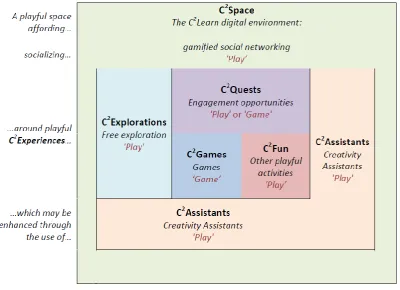
Figure 1: The architecture of the playful experiences or C2Experiences in C2Learn
At this point of the project, the gameful design of the C2Space is in parallel development, as the game design and game and tool development teams work alongside those involved in piloting material and pedagogical approaches with students and teachers. Figure 2 shows how the elements of the overall gameful design of C2Space are intended to relate to one another through an overall playful space which offers playful challenges, explorations, games and other ‘fun stuff’, supported by creativity assistants (AI agents).
[image:11.595.93.494.441.731.2]Through development activities in the first stage of the project, a range of possible scenarios have been developed iteratively with core user communities in Austria, England and Greece with D 5.3.1 having recently reported the most up-to-date developments in this area and D5.3.2 due to update on the latest progress. The current pilots each use one or more existing scenarios in which to embed the game affordances both analogue and digital. The pilots will allow the further development of these scenarios. However, ultimately the project outcomes may need to leave open the potential for new users to develop their own appropriate scenarios, perhaps driven by localised curriculum needs in which to use the project resources and it is hoped that the piloting will offer insight into how C2Learn might support end users in doing this.
The computational tools for CER (non-linear thinking techniques that foster co-creativity) are in development by NCSR-D, and the educational contexts for the scenarios being explored. CER is divided into three distinct, yet interrelated, kinds: [1] Semantic [2] Diagrammatic and [3] Emotive. The possibilities of the C2Learn game prototype are under close discussion between all partners with University of Malta (UoM) and Serious Games Interactive (SGI) taking a lead with D 4.4.1 recently reporting the latest developments. As a result of on-going discussions, the C2Learn Environment’s relevant game paradigms have been presented in D4.4.1, with a detailed analysis of workflow within an educational scenario, and a description of how and when the use of a game ‘intervention’ makes sense. This workflow is further elaborated using two game design examples: (1) a hypothetical example, ‘creativity dominoes’; and (2) ‘creative cards’. This learning design document, reflects and builds on the second of these game design examples.
1.2
BRIEF OVERVIEW OF CO NTENTS
Deliverable 2.2.2 is divided into three parts.
The first part of D2.2.2 considers the overall goals of the C2Space encompassing a digital gaming and social networking environment, in other words addressing what it will enable students and teachers to do. It presents the integrated perspectives of OU (WHC) and UEdin (CER) explicating how the theoretical map translates into the analogue and digital environment.
The second part addresses what C2Learn practice (C2Experiences) could look like in the C2Space. This section provides greater insight into how creative thinking, social engagement, ethics and impact and wider change might manifest in C2Learn, as an active process of change guided by compassion (i.e. close and active awareness of the needs and hopes of others2) and reference to shared values derived from users’ collaborative thinking, shared action and gameplay within a Living Dialogic Space to foster Wise Humanising Creativity (WHC) through CER’s set of core creative learning tools that will support the manifestation of WHC. This information is paramount in order to inform the future C2Learn
learning experiences and the affordances it will need to foster co-creativity.
The third part documents how the consortium is progressing in designing the C2Space with the learning goals in mind through two parallel sets of activity: the C2Learn Co-Development Teams comprising teachers and pupils working to generate and critically evaluate the educational scenarios, computational tools, pedagogical approach and assessment strategy within the piloting activity; and the C2Learn Consortium Partners working to develop and refine the analogue and digital C2Space, the gameful design and C2Experiences, the computational tools, pedagogical approach and assessment strategy.
2
2
Overall goals of C
2Learn
What the C2Space and experience will enable students and teachers to do.
2.1
C
2LEARN CO-CREATIVITY CONCEPTUAL FRAMEWORK
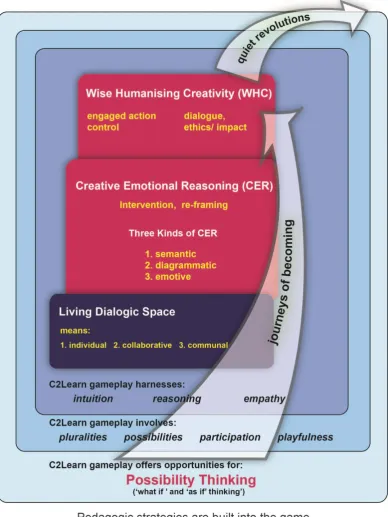
The goal of C2Learn is to foster co-creativity through Creative Emotional Reasoning (CER, theorised by UEDIN) and generating Wise, Humanising Creativity (WHC, theorised by OU). The intention is that the tools and strategies of CER are harnessed to generate WHC activity between participants in the C2Space with its elements of game design, CER has been explained in deliverable D2.1.1 with sub-elements more fully developed in D2.1.2; in this deliverable we add to this a brief explanation of WHC. OU and UEDIN teams have conceptualised how WHC3 and CER4 might best be theoretically inter-related in order to represent conceptually what the C2Learn experience will enable students and teachers to do in terms of fostering their co-creativity. The clearest way to show this was felt to be through a diagrammatic representation illustrated in Figure 3 below. The explanatory text5 leads the viewer through the key enabling features of the co-creativity conceptual framework from the edge of the figure to the centre. It culminates in a clear explanation of the ‘what’ of co-creativity defined in terms of the interrelationship between WHC and CER which emerges at the centre of the figure.
In the text, which follows Figure 3, a brief summary of the key components of WHC is given. These are further explained using concrete educational examples, in the second part of the document.
3
See Chappell K., Craft A., Rolfe L. & Jobbins, V. 2012, ; Chappell K. 2008; and Craft A. 2008.
4
For a definition and analysis of CER, as well as an exposition of tis theoretical foundations, see Deliverable 2.1.1: Creative Emotional Reasoning.
5
This figure illustrates ‘how’ co-creativity is fostered within C2Learn and ‘what’ that co-creativity is. Co-creativity within C2Learn is novelty which has emerged through shared ideas and actions and which involves participants taking into account the impact of that novelty. Co-creativity will be fostered in C2Learn by:
Possibility Thinking (PT)6. PT is ‘what if’ and ‘as if’ thinking and will be inherent in multiple elements of the C2Learn framework hence its representation around or underneath the other elements.
The 4P’s7. The presence within and outside the C2Space of pluralities (opportunities for learners to experiment with multiple pluralities of places, activities, personal identities, and people), possibilities (opportunities for possibility thinking, transitioning from what is to what might be, co- constructing with others through the C2Learn experience, designing, editing, extending and exploring content), participation (opportunities for learners to take action, make themselves visible on their own terms, and act as agents of change) and playfulness (opportunities for users to learn, create and self-create as active and connected users in their emotionally rich, virtual and actual play-worlds).
The C2Space’s capacity to harness intuition, reasoning and empathy within and outside the gameworld.
Living Dialogic Spaces8 (LDS) being embedded in the C2Space and also present in the game affordances to offer users high participation and shared control, individually, in collaboration and/or as part of a communal endeavour. Within and outside the C2Space interactions will therefore offer a new ‘space’ for debate and difference, openness to action, working ‘bottom up’, and different modes of idea exchange. This will happen through creative learning conversations. The purpose of these is to flatten hierarchies, reposition users in different roles and allow spaces that promote a sense of equality through ‘listening’ to other users and even allow users to change their mind by identifying with the space of dialogue. The creative potentials offered by such a dynamic dialogic environment will be fully exploited by brainstorming activities, which propel and structure CER’s non-linear thinking techniques.
Alongside and within these enabling features of the C2Space, teacher, facilitator (potentially including students in this role) and the game’s Creativity Assistant will pedagogically value learner agency, stand back, offer time and space and where appropriate ‘meddle in the middle’9. These pedagogies are implicit across the enablers and are therefore indicated at the top of the figure as the context within which the C2Learn activity takes place.
All of the above will enable C2Learn co-creativity, shown as emerging from the centre of the figure. This has two related components:
Wise Humanising Creativity (WHC)
Creative Emotional Reasoning (CER)
WHC will occur in C2Learn as an active process of change guided by compassion (i.e. close and active awareness of the needs and hopes of others10) and reference to shared values derived from users’ collaborative thinking, shared action, gameplay and social interaction. WHC will manifest in four intertwined ways shown in the highlighted box within the WHC section of the graphic. Users will:
6
See Craft, A., 2010
7
See Craft, A. 2011
8
See Chappell, K., & Craft, A. 2011.
9
See Craft, A., Chappell, K., Rolfe, L., & Jobbins, V. 2012.
10
Generate, explore and enact new ideas with a valuable impact on the community, discarding other ideas that lack such potential (ethics and impact);
Pose questions, debate between new ideas, find ways to negotiate conflict or to go in a different direction to others if conflict is not resolved (dialogue);
Take charge of different parts of the creative process, understanding the rules of the system11 and how decisions have consequences, making decisions around new ideas and taking action(s)12 through various scenarios and/or quests (control); &
Be immersed in the game and its environment, and possibly addicted to gameplay and/or the interactive drama played out in the gameworld and in real-world spaces. Such immersion will sometimes lead to taking risks and generating surprising individual or collaborative ideas (engaged action).
Such activity is co-creative because it is about new ideas which are captured or selected because they are valuable to the community, and are generated with shared control in an immersed dialogic learning context which encompasses the C2Space, fostering ethical awareness arising from the experience and action.
Over time, noticeable changes in users’ dispositions, even small incremental personal changes, will result from their WHC. This is because there is a core reciprocal relationship within WHC between creativity and identity in which as creators make, they are also being made. And so users undertake journeys of becoming13. This is represented on the figure as an embedded on-going process from the ‘how’ of the enablers of co-creativity to the ‘what’ of the co-creativity.
It should be noted that, whilst WHC and its journeys of becoming, as a highly applied concept, may appear to share principles in common with pedagogic approaches such as problem-based learning (PBL), challenge-based learning or discovery learning, which foreground learner-initiated activity as well as collaboration, it is distinct as a concept. Originally developed in McMaster University Medical School in Canada, Problem-Based Learning (PBL) encompasses a “collaborative, constructivist, contextualised learning and teaching approach” (Ribeiro, 2011: 2) founded on the belief learning involves forging new knowledge. The goal of PBL is for students to gain increased understanding of: ‘‘flexible knowledge, effective problem-solving skills, self-directed learning (SDL) skills, effective collaboration skills, and intrinsic motivation” (Hmelo-Silver, 2004: 235). PBL requires students to take responsibility for their own learning; this in turn encourages students to gain the skills necessary for them to become lifelong learners (ibid.).
Whilst not actually directly focused on creativity, PBL is oriented toward creative activity as Margetson (in Boud and Feletti, 1991: 45) details, in that it:
encourages open-minded, reflective, critical and active learning;
pays due respect to both student and teacher as persons with knowledge, understanding, feelings, and interests in a shared educational process;
acknowledges that knowledge is complex and changes as a result of responses by communities of persons to problems they perceive in their worlds.
WHC by contrast is directly focused on creativity, i.e. the generating of original and valuable outcomes through individual, collaborative and communal activity, with close attention to the ethical and social benefits of such creativity. And although some writing in the PBL field (eg Engel, in Boud &
11
See Walsh, C.S. 2010.
12
See Apperley, T., and Walsh, C.S. 2012.
13
Feletti, 1991) do emphasise the way that it reframes learning, it nevertheless is often discussed as a pedagogic approach. WHC is focused on learning rather than on pedagogy. A further distinction between PBL and WHC is that when PBL addresses creativity it does so in the goal-focused way that is inherent in approaches defined by specific ‘problems’. WHC takes a less problem-focused approach. As such it has more space inherent within it for emergent creative ideas and possibilities.
CER can be best understood as a core manifestation of the more comprehensive creativity framework of WHC. It is an umbrella term and refers to:
a principled, unifying theory of non-linear thinking techniques that foster co-creativity
and the theory’s implementation within C2Learn’s computational tools.
Premised on a notion of creativity as an intervention resulting in reframing, CER’s set of core creative learning tools support the manifestation of WHC. They do this by providing methods for the disruption of established routines and patterns. Hence CER’s positioning in the box emerging from the centre of the WHC box.
By embedding CER’s creativity enablers (i.e. the different techniques implemented in C2Learn’s computational tools) within WHC we seek an organic fusion that will provide
WHC with additional structured techniques taking advantage of and further enabling WHC’s creativity opportunities: and
CER with much needed ethical and cultural dimensions and the most appropriate conditions for fulfilling its potential.
As CER heavily relies on brainstorming activities structuring the core parts of the CER techniques, there is a particular relation with LDS. LDS’ flattened hierarchies and open space of dialogue are an ideal environment within which to embed and evolve these brainstorming techniques, providing the opportunity to experiment with dynamic group management methods.
Ultimately, WHC, with CER’s set of core creative learning tools support the manifestation of WHC making this the ‘what’ of C2Learn’s co-creativity. This fuels the potential for quiet revolutions14. Hence the quiet revolutions arrow emerging from the top right hand corner of the figure. Such revolutions aim to be critical, yet ethically grounded and align personal with wider values. A quiet revolution has the potential to be a form of collaborative and collective endeavour that assumes commitment to excellence and engaged involvement by adults and children alike.
C2Learn co-creativity, then, which seeks to foster quiet revolutions, will be fostered in a an environment designed with game elements using analogue and digital techniques including challenges, feedback, points, levels, rewards integrated within classroom practice informed by a scenario based context with close attention to the delicate balance between intrinsic and extrinsic motivation. We aim to harness students’ motivation to challenge ‘what is’ and to generate, by working with others, ‘what might be’.
14
3
C
2Learn practice
In Section 2, we presented ideas on how WHC and CER are theoretically inter-related in order to represent conceptually what the C2Learn experience will enable students and teachers to do in terms of fostering their co-creativity. The diagram and accompanying explanatory text helps the viewer understand how ‘journeys of becoming’ can lead to ‘quiet revolutions’ through the 4Ps: pluralities; possibilities; participation and playfulness.
This section of the document provides greater pedagogical insight into what types of activities need to occur in C2Learn, as an active process of change guided by compassion (i.e. close and active awareness of the needs and hopes of others) and reference to shared values. This is derived from users’ collaborative thinking, shared action, gameplay and social interaction (within a LDS) to foster WHC through CER’s set of core creative learning tools support the manifestation of WHC.
Ultimately, C2Learn is about fostering co-creativity in learning. Learners, individually as well as mainly collaboratively and also communally, come up with novelty, new ideas. These new ideas:
Have emerged through asking ‘what if’ and ‘as if’ questions and through the use of disruptive techniques resulting in re-framing;
Have emerged from shared ideas and actions in an immersed dialogic rather than hierarchical environment; and
Are captured or selected because they matter to the community and have a valuable impact on it.
Learners take into account the impact of that novelty on the individual, collaborative and communal dimensions of their community.
From an educator’s point of view, C2Learn co-creativity is mainly about collaborative and communal creative processes in analogue and digital learning contexts designed with game elements, and about creative outcomes generated and shared with others; learners are collaborators and co-creators within their groups and their wider communities, without though forgetting their own wishes, interests, and needs. In some instances co-creativity will also manifest through the users interaction with artificial intelligence embedded within the C2Space.
Learners are motivated to be creative not just for the sake of creativity in isolation (‘I am being creative on my own and don’t care if the others value this or not’); rather, they are motivated co-creators because they recognize the value of their creativity for themselves and the others. They also have an interest in getting others to recognize and appreciate their creative activity, since the real value of this creativity materializes mainly in the group and the community through dialogue, action, immersion and being in control and not merely within the creator.
C2Learn co-creativity is not bound to any specific subject area in the curriculum. What is more, fostering this co-creativity does not involve the teaching of factual knowledge. Co-creativity is rather a learner disposition within school and within the digital game environment, cutting across the curriculum and other learner competences and conditions.
C2Learn co-creativity, after all, is about changing pedagogy and learning, unleashing learners’ and teachers’ creative potential, revolutionising education. This has been illustrated very clearly in the ‘Impact’ section of Part B of the DoW (B3.1.2.2 Scientific Impact from the Pedagogical Perspective).
and implementing changes, feeling, understanding and responsibly managing the usefulness and impact of novelty on themselves and the others - being intrinsically motivated to do these things through gameplay and interacting with other users and the machine.
In addition, a C2Learner actively helps to make all this a playful experience in which everyone is having a good time, relaxing and letting themselves ‘immerse’ in an activity which is more of a game and less of a lesson, considering it fun but at the same time important to them and the others. This playful experience, which has digital gameplay inherent within it, will involve challenges, quests, consequences and, we anticipate, a trajectory.
Finally, reflection on their co-creativity is important to C2Learners. They reflect on the value and impact of their creativity, as well as on how they and the others may be changing little by little during this adventure, what this change looks like, what has enabled it and where it is taking them next.
The C2Learn teacher intervenes as little as possible in learners’ co-creative process, standing back, observing, enabling and facilitating as well as getting alongside students to share ideas as a co-learner or ‘meddler’ when appropriate, rather than instructing.
Clearly, then, learning for C2Learn co-creativity in some of its aspects is intrinsically different from what might in some classrooms be ‘conventional’ learning aimed at the transmission of knowledge rather than ‘construction’ of knowledge which is what C2Learn co-creativity assumes (although many classrooms in Europe as well as around the world foreground a transmission approach). The view of learning seen in terms of construction, informed by learners’ own and social dialogic engagement draws on Piagetian and Vygotskian theory that has influenced pedagogy worldwide in the last fifty years. With a social constructivist foundation, the learning model in C2Learn is aimed at affording unlimited, self-sustained discovery of new possibilities and one’s own and others’ creative potential. It emphasizes personal and shared meaning-construction and is skeptical of models that are primarily or solely reward based (and hence are not tied to a solely ‘gamified’ approach that implies a behaviourist learning model, operated as it is on reward-based behaviours which whilst playful are focused on winning through reward).
It is important to acknowledge that C2Learn co-creativity may well draw not only on the C2Space elements designed specifically for the project but also may encompass existing co-creative games such as Minecraft and SecondLife (and many more). What will be needed for these are scenarios teachers can use that also require students to engage in co-creative activities. It is important to remember that many teachers already use games for teaching and might want to share gameplay practices and experiences that have the potential to foster co-creativity, even WHC. This is dependent on the teachers own interest and skill, but for teacher who enjoys playing, for example, Civilization, they may find it worthwhile to give their students the task of designing a mod (modification) for playing a historical conflict. We believe the C2Space will allow teachers to playfully author scenarios they can use with commonly available games. It will also be important, as detailed above, that teachers’ other existing interests and skill sets, (e.g. ways to provoke the imagination such as the arts, ways to inspire such as interests in sports) are actively afforded space within C2Learn in order that the environment fully integrates within teachers’ existing practice and passions rather than being seen as an ‘add-on’.
3.1
WHAT C
2LEARN PRACTICE COULD LOOK LIKE
C2Learn practice can be seen as an ensemble of four interwoven elements:
possibilities of ‘what might be’, provides a foundation of opportunities for the intervention and reframing involved in creative emotional reasoning and the ethical impacts, dialogue, control and engaged action of wise humanizing creativity. Together this generates shared change. In C2Learn co-creativity, possibility thinking is integrated with Creative Emotional Reasoning in which learners generate new ideas together through the use of disruptive techniques for semantic, diagrammatic and emotive lateral thinking which results in reframing.
which involves:
B. The social engagement element via a ‘Living Dialogic Space’ defined by flattened hierarchies enabling dialogue, and the use of brainstorming activities which together enable individual, collaborative and communal thinking. This occurs through immersion in the C2Space and collaboration with fellow users, both the inside and outside.
which fosters:
C. The element of Ethics and Impact Awareness: in other words generating novel and valuable ideas evaluated by students for their ethical impact, and selecting and enacting ideas because they matter to the community and have a valuable impact on it. Involvement in this ethical dimension has the effect of both forming and being formed through dialogue ie co-creative outcomes via Wise Humanizing Creativity
which all occurs in the context of:
D. The element of the wider picture of change (‘Journeys of Becoming’ and ‘Quiet Revolutions’ via cyclical developments between creativity and identity) through gameplay and social engagement in the C2Space over time where users make their decisions about consequences and impact wisely. Thus over time, cyclical developments between creativity and identity occur. Learners enable change and reflect on change in longer periods of co-creative activity.
The characteristics of student behaviours in C2Learn co-creativity and identified by the project team as the co-creativity evaluation criteria, are evident as students foster new, valuable ideas through:
Accepting and generating intervention and reframing
Attending to the ethics and impact of ideas
Involvement in dialogue
Being in control
Engaged action – being immersed in the experience
Examples are presented below of what learners and teachers typically do in each of the elements of co-creativity, and of how game affordances and social networking technologies can help to facilitate and further empower them to engage in C2Learn’s co-creativity.
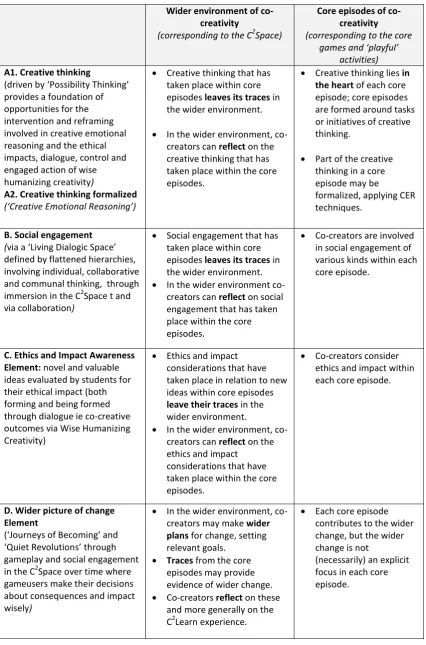
Table 1: Four interwoven elements of C2Learn practice
Wider environment of co-creativity
(corresponding to the C2Space)
Core episodes of co-creativity
(corresponding to the core games and ‘playful’
activities) A1. Creative thinking
(driven by ‘Possibility Thinking’ provides a foundation of opportunities for the intervention and reframing involved in creative emotional reasoning and the ethical impacts, dialogue, control and engaged action of wise humanizing creativity)
A2. Creative thinking formalized (‘Creative Emotional Reasoning’)
Creative thinking that has taken place within core episodes leaves its traces in the wider environment.
In the wider environment, co-creators can reflect on the creative thinking that has taken place within the core episodes.
Creative thinking lies in the heart of each core episode; core episodes are formed around tasks or initiatives of creative thinking.
Part of the creative thinking in a core episode may be
formalized, applying CER techniques.
B. Social engagement (via a ‘Living Dialogic Space’ defined by flattened hierarchies, involving individual, collaborative and communal thinking, through immersion in the C2Space t and via collaboration)
Social engagement that has taken place within core episodes leaves its traces in the wider environment.
In the wider environment co-creators can reflect on social engagement that has taken place within the core episodes.
Co-creators are involved in social engagement of various kinds within each core episode.
C. Ethics and Impact Awareness Element: novel and valuable ideas evaluated by students for their ethical impact (both forming and being formed through dialogue ie co-creative outcomes via Wise Humanizing Creativity)
Ethics and impact considerations that have taken place in relation to new ideas within core episodes leave their traces in the wider environment.
In the wider environment, co-creators can reflect on the ethics and impact
considerations that have taken place within the core episodes.
Co-creators consider ethics and impact within each core episode.
D. Wider picture of change Element
(‘Journeys of Becoming’ and ‘Quiet Revolutions’ through gameplay and social engagement in the C2Space over time where gameusers make their decisions about consequences and impact wisely)
In the wider environment, co-creators may make wider plans for change, setting relevant goals.
Traces from the core episodes may provide evidence of wider change.
Co-creators reflect on these and more generally on the C2Learn experience.
Each core episode contributes to the wider change, but the wider change is not
Overall, the core episodes of co-creativity are typically characterized by ‘playful’ activity and a faster pace, while the wider co-creativity experiences (C2Experiences) affords a slower pace of taking stock of the activity that has occurred in the core episodes and of the overall experience. This is likely to involve classroom based reflection on the outcomes of the analogue and digital gameplay, which Nicholson (2012b15) argues is vital in designing environments with game affordances. He notes that debriefing can occur within the roles assumed during the learning or outside of these entirely but that there needs to be some form of recording of the debriefing. He emphasizes the need for debriefing to enable the expression of feelings as well as enabling engagement with experience and what was learned (each student relating their own perspectives to those of others), consideration of how to apply what was learned in new contexts, and planning next steps. As he puts it, ‘one of the powerful aspects of debriefing is that it allows each participant to take what he or she internalized from the activity, share it with others, and learn from others… while challenging it can be …valuable to bring in other viewpoints and to let the learner know that his or her thoughts will be shared with others’ (ibid p5). Such reflective and collective debriefing is in keeping with the learning design of C2Learn and might be led by students themselves considering the extent to which they have achieved co-creativity.
Notes to teachers will need to include suggestions on how such reflective activity has been and might be further integrated within the C2Space and reviews of learning. Notes to teachers will also of course need to contain strategies for using C2Learn’s core elements to help student people feel more in control of their lives and futures and capable of changing them (agency). The C2Space does not set goals for students and teachers. Rather, it lets them choose goals that challenge them and are important to the community.
15
3.2
HOW C
2LEARN PRACTICE MANIFESTS IN THE C
2SPACE
This section details how C2Learn practice manifests in the C2Space. It is divided into four tabulated sub-sections which correspond to the four different elements of C2Learn practice identified above in 3.1:
The Creative Thinking Element (1 + 2)
The Social Engagement Element
The Ethics and Impact Awareness Element
The Wider Picture Element
3.2.1
THE CREATIVE THINKING ELEMENT
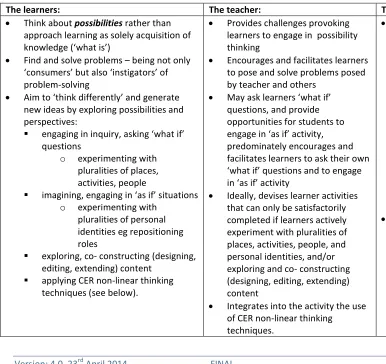
A1 ‘Possibility Thinking’ (PT) [image:24.842.76.462.179.543.2]Provides a foundation of opportunities for the intervention and reframing involved in creative emotional reasoning and the ethical impacts, dialogue, control and engaged action of wise humanizing creativity
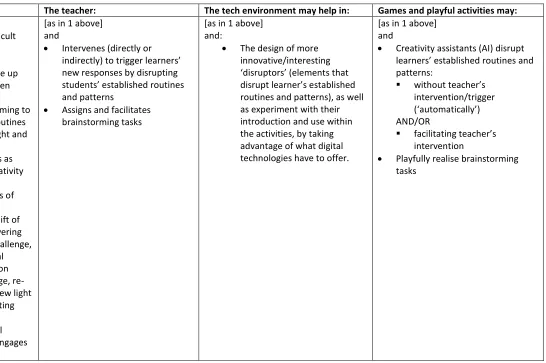
Table 2: The Creative Thinking Element
The learners: The teacher: The tech environment may help in: Games and playful activities may:
Think about possibilities rather than approach learning as solely acquisition of knowledge (‘what is’)
Find and solve problems – being not only ‘consumers’ but also ‘instigators’ of problem-solving
Aim to ‘think differently’ and generate new ideas by exploring possibilities and perspectives:
engaging in inquiry, asking ‘what if’ questions
o experimenting with pluralities of places, activities, people
imagining, engaging in ‘as if’ situations o experimenting with
pluralities of personal identities eg repositioning roles
exploring, co- constructing (designing, editing, extending) content
applying CER non-linear thinking techniques (see below).
Provides challenges provoking learners to engage in possibility thinking
Encourages and facilitates learners to pose and solve problems posed by teacher and others
May ask learners ‘what if’ questions, and provide opportunities for students to engage in ‘as if’ activity, predominately encourages and facilitates learners to ask their own ‘what if’ questions and to engage in ‘as if’ activity
Ideally, devises learner activities that can only be satisfactorily completed if learners actively experiment with pluralities of places, activities, people, and personal identities, and/or exploring and co- constructing (designing, editing, extending) content
Integrates into the activity the use of CER non-linear thinking techniques.
Providing the learner with a digital space which intuitively affords problem-finding and problem-solving and foregrounds exploration of possibilities and perspectives: Navigating through
challenges
Addressing and posing challenges
Providing instant feedback Encouraging/motivating
learners to keep thinking differently and address challenges creatively (e.g. through game affordances)
Keeping track of the possibility thinking activities so that learners can reflect on them both in their efforts to address the challenges, as well as in their evaluation of the experience afterwards.
Facilitate to learners to get involved in playful exploration of a given possibility space, or co-construct a new possibility space, e.g. by:
Presenting them with ‘what if’ questions and ‘as if’ environments
Requiring them to pose their own ‘what if’ questions and to engage in ‘as if’ environments Requiring them to explore
and co- construct (designing, editing, extending) content Provide peer feedback Enabling/enhancing the
A2. Creative thinking formalized: ‘Creative Emotional Reasoning’ (CER)
[image:25.842.214.760.141.504.2]Application of non-linear thinking techniques which consist in interventions resulting in reframing
Table 3: The Creative Thinking Element formalized
The learners: The teacher: The tech environment may help in: Games and playful activities may:
Address given challenges (problems, dilemmas, difficult issues)
Reframe these problems, dilemmas, issues and come up with new responses to given situations:
Engage in activities aiming to disrupt established routines and patterns of thought and action
Create new analogies as building blocks of creativity Actively experiment
recombining elements of creative challenge Actively facilitate a shift of
perspective, by uncovering aspects of creative challenge, going beyond material provided by description (elements) of challenge, re-casting challenge in new light (as whole/re-formulating elements)
Generally, uses CER lateral thinking techniques and engages in brainstorming tasks
[as in 1 above] and
Intervenes (directly or indirectly) to trigger learners’ new responses by disrupting students’ established routines and patterns
Assigns and facilitates brainstorming tasks
[as in 1 above] and:
The design of more innovative/interesting ‘disruptors’ (elements that disrupt learner’s established routines and patterns), as well as experiment with their introduction and use within the activities, by taking advantage of what digital technologies have to offer.
[as in 1 above] and
Creativity assistants (AI) disrupt learners’ established routines and patterns:
without teacher’s intervention/trigger (‘automatically’) AND/OR
facilitating teacher’s intervention
3.2.2
THE SOCIAL ENGAGEMENT ELEMENT
[image:26.842.86.768.149.460.2]Via a ‘Living Dialogic Space’ defined by flattened hierarchies, involving individual, collaborative and communal thinking, through immersion in gameplay and social networking via collaboration in the C2Space.
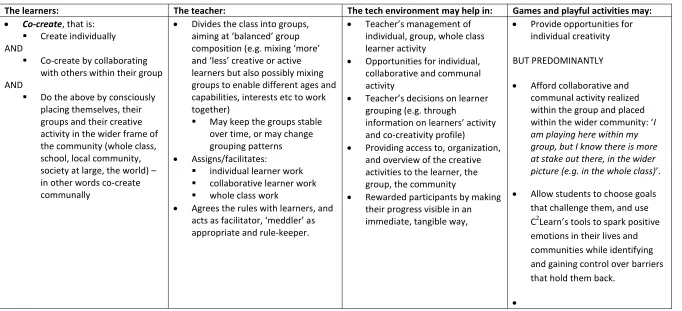
Table 4: The Social Engagement Element
The learners: The teacher: The tech environment may help in: Games and playful activities may:
Co-create, that is: Create individually AND
Co-create by collaborating with others within their group AND
Do the above by consciously placing themselves, their groups and their creative activity in the wider frame of the community (whole class, school, local community, society at large, the world) – in other words co-create communally
Divides the class into groups, aiming at ‘balanced’ group composition (e.g. mixing ‘more’ and ‘less’ creative or active learners but also possibly mixing groups to enable different ages and capabilities, interests etc to work together)
May keep the groups stable over time, or may change grouping patterns
Assigns/facilitates:
individual learner work collaborative learner work whole class work
Agrees the rules with learners, and acts as facilitator, ‘meddler’ as appropriate and rule-keeper.
Teacher’s management of individual, group, whole class learner activity
Opportunities for individual, collaborative and communal activity
Teacher’s decisions on learner grouping (e.g. through
information on learners’ activity and co-creativity profile)
Providing access to, organization, and overview of the creative activities to the learner, the group, the community
Rewarded participants by making their progress visible in an immediate, tangible way,
Provide opportunities for individual creativity
BUT PREDOMINANTLY
Afford collaborative and communal activity realized within the group and placed within the wider community: ‘I am playing here within my group, but I know there is more at stake out there, in the wider picture (e.g. in the whole class)’.
Allow students to choose goals that challenge them, and use C2Learn’s tools to spark positive emotions in their lives and communities while identifying and gaining control over barriers that hold them back.
The learners: The teacher: The tech environment may help in: Games and playful activities may:
Engage in dialogue and
negotiation: Pose questions Debate between ideas Promote dialogue and
respect of different viewpoints within their group, encouraging their peers to voice their ideas Actively negotiate conflict
and seek alternate paths, going in a different direction if conflict is not resolved although accepting sometimes conflict is not commensurable
Are generally prepared to change their mind in the space of dialogue.
Enables and facilitates learner dialogue and debate, by assigning relevant tasks:
E.g. sets challenges, poses questions and dilemmas to learners which afford different viewpoints and debate.
Encourages all learners to express their opinion and critique in a variety of forms.
When conflict occurs, allows it to be openly expressed and negotiated by the learners: Encourages learners to seek
alternative paths and be prepared to change their mind.
Keeping track of the dialogue and negotiation activities (e.g. of their timing and subject, and of their results) so that learners can reflect on them both in their efforts to discuss and negotiate, as well as in their evaluation of the experience afterwards.
Although dialogue and
negotiation will expectedly take place predominantly face-to-face in the classroom, hosting such activities online (e.g.
asynchronously and at a distance) is an option too.
Use the motivational power of posing debatable challenges and dilemmas
Encourage the expression and consideration of different viewpoints
Enable the expression and management of conflict in a ‘contained’ /safe manner, e.g. through opening up ways to explore alternate paths, but also allowing conflict to be
The learners: The teacher: The tech environment may help in: Games and playful activities may:
Are in control:
Take charge and leading roles during different phases of the creative process
Share control/leadership with others, in a context of equality and flattened hierarchies
Understand the rules of the system underlying the challenges facing them and their group Understand how
decisions around new ideas have consequences Make decisions around
new ideas Instigate action.
Designs ways to manage leadership within learner groups, aiming to avert domination by one or more individuals (including themselves s teacher) while encouraging individual initiative
Agrees the rules with the learners
May set learners the task to decide about leadership in their group
May design a mandatory rotation of leadership into the tasks, or may allow for (individual or joint) leadership to emerge from the interaction Seeks to live out a flattened
hierarchy where they engage with students as their equals; this means both standing back to observe carefully how students are responding and also stepping forward alongside students to ‘meddle in the middle’ as a collaborator as appropriate
Encourages and facilitates each learner group to explore the challenges and systemic relations underlying their immediate task, and the possible consequence of decisions that the group will make
Ensures decision making and subsequent action is an integral part of the learner task.
Expecting learners to take and lead initiatives (rather than just exposing them to teacher-instigated activity)
Reflecting/representing social relations in the environment so as to make leadership and flattened hierarchies transparent to the learners; this includes the teacher’s role
Keeping trace of leadership, decision making and action activities so that learners can reflect on them both in their efforts to address the challenges, as well as in their evaluation of the experience afterwards.
Involve (changing) leadership roles, or leadership negotiation quests
Emphasize equality of
opportunities within the group
Involve exploration of what is lying behind a given challenge or situation, including hidden consequences
The learners: The teacher: The tech environment may help in: Games and playful activities may:
Make themselves visible on their own terms:
Have control of their own identity and image to others Have an interest in getting
their creative activity and/or creative outcomes
appreciated and valued by the others
Facilitates the learners to become aware of being in charge of their own image to others
Designs peer/group/community evaluation into the activities, so that learners can ‘promote’ their creative solutions to others and peers can co-evaluate their creativity
Enabling control of personal identity representation, and peer/group/community evaluation, in a social-network-style fashion
Offers students opportunities to be visible through avatar and expression of this
Enabling students to
engage/disagree/challenge with one another/each other to gain feedback during the digital element of the game (gameplay)
Engage in playful action, alone and together with the others: Immerse themselves in the
experience of the creative process
Facilitate immersion in the experience of the creative process for the rest of the group
Are willing to take risks and/or leave their ‘comfort zone’ (thus possibly generating surprising individual or collaborative ideas)
Learn, co-create and self-create as active and connected users in
emotionally rich, virtual and actual play-worlds.
Emphasises the playful nature of the activity (as opposed to the formality of a ‘lesson’)
Withdraws from the stage as much as possible, becoming an observer and facilitator of the play (possibly also a co-player or ‘meddler’ at times at the same time as retaining the teaching agenda)
Allows space for learners to take risks outside ‘comfort zones’, by encouraging the generation of surprising ideas and avoiding criticism of unconventional thought
Enacting a playful, game-like experience of the wider activity (i.e. beyond, between, around the core games and playful activities)
Helping learners feel as users engaged in a longer-term challenge and not just within the core games and playful activities
Providing game-like triggers and information, such as gauges, scores, etc.
Foregrounding solutions/ creations that the groups and community evaluate as
interestingly surprising (rewarding those taking the risk to leave ‘comfort zones’)
Keeping trace of the activities so that learners can reflect on them in their evaluation of the experience afterwards.
3.2.3
THE ETHICS AND IMPACT AWARENESS ELEMENT
[image:30.842.85.764.152.427.2]Novel and valuable ideas evaluated by students for their ethical impact (both forming and being formed through dialogue ie co-creative outcomes via Wise Humanizing Creativity)
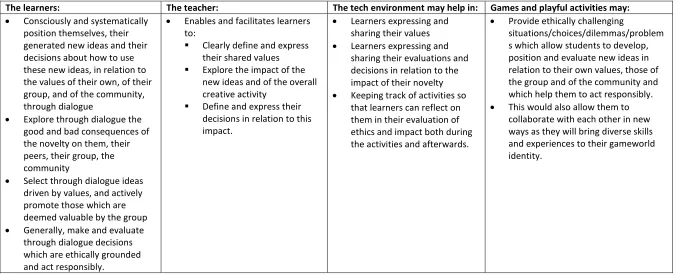
Table 5: The Ethics and Impact Awareness Element
The learners: The teacher: The tech environment may help in: Games and playful activities may:
Consciously and systematically position themselves, their generated new ideas and their decisions about how to use these new ideas, in relation to the values of their own, of their group, and of the community, through dialogue
Explore through dialogue the good and bad consequences of the novelty on them, their peers, their group, the community
Select through dialogue ideas driven by values, and actively promote those which are deemed valuable by the group
Generally, make and evaluate through dialogue decisions which are ethically grounded and act responsibly.
Enables and facilitates learners to:
Clearly define and express their shared values Explore the impact of the
new ideas and of the overall creative activity
Define and express their decisions in relation to this impact.
Learners expressing and sharing their values
Learners expressing and sharing their evaluations and decisions in relation to the impact of their novelty
Keeping track of activities so that learners can reflect on them in their evaluation of ethics and impact both during the activities and afterwards.
Provide ethically challenging
situations/choices/dilemmas/problem s which allow students to develop, position and evaluate new ideas in relation to their own values, those of the group and of the community and which help them to act responsibly.
3.2.4
THE WIDER PICTURE ELEMENT (THE PICTURE OF CHANGE)
[image:31.842.93.764.150.353.2]‘Journeys of Becoming’ and ‘Quiet Revolutions’ via cyclical developments between creativity and identity, through digital gameplay and engagement in the social networking environment over time where gameusers make their decisions about consequences and impact wisely
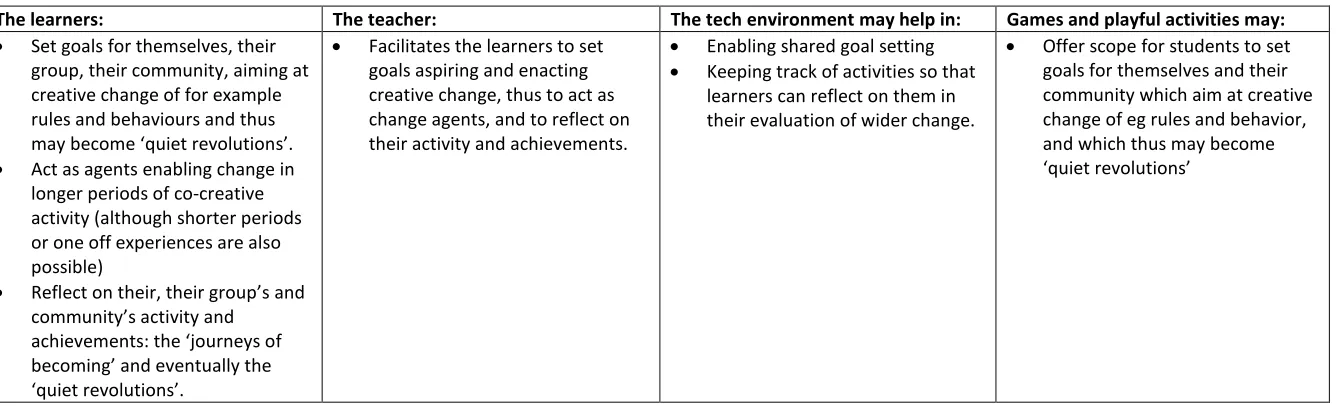
Table 6: The Wider Picture Element
The learners: The teacher: The tech environment may help in: Games and playful activities may:
Set goals for themselves, their group, their community, aiming at creative change of for example rules and behaviours and thus may become ‘quiet revolutions’.
Act as agents enabling change in longer periods of co-creative activity (although shorter periods or one off experiences are also possible)
Reflect on their, their group’s and community’s activity and
achievements: the ‘journeys of becoming’ and eventually the ‘quiet revolutions’.
Facilitates the learners to set goals aspiring and enacting creative change, thus to act as change agents, and to reflect on their activity and achievements.
Enabling shared goal setting
Keeping track of activities so that learners can reflect on them in their evaluation of wider change.
3.3
HOW C
2LEARN PRACTICE MANIFESTS VIA CURRENTLY AVAILABLE GAME
PROTOTYPES/TOOLS
In order to fully foster co-creativity, and prevent C2Learn becoming ‘locked down’ in tight scenario-based activities, games and tools will need to be embedded within a wider ‘learning design unit’ which allows for the space and flexibility necessary for LDS, co-creativity and ultimately journeys of becoming, within the classroom and beyond it. Whilst we are still working as a consortium on what exactly the C2Space will be like that will structure this ‘learning design unit’, we can, in the meantime, offer insight into how C2Learn practice might manifest via C2Experiences . This is presented using the four elements table from section 3.1, adapted to give examples for this game prototype.
This builds on the Interim Deliverable 2.2.1, which stated learning goals and indicators simply in terms of the five categories of co-creativity. Having further articulated C2Learn practice in this new version of the deliverable in terms of the four elements of Creative Thinking, Social Engagement, Ethics and Impact Awareness and the Wider Picture (which incorporate the previous five categories of co-creativity), we can state the learning goals and indicators more fully. Using the same tabulated format as in Section 3.1 we articulate below how C2Learn practice manifests in the four elements via one example (4Scribes) of the available game prototypes and tools, and what indicators of co-creativity might be apparent. The format of the Table in 3.1 has been adapted so as to include the C2Space and teacher activity in the wider environment of co-creativity column; this is because these two are the main contributors to fostering co-creativity. The games and playful activities and learner activity have been included in the core episodes of co-creativity column because these are the two main places where co-creativity will manifest.
The 4Scribes example which follows, is situated within ‘Rescue’ - one of the Scenarios which is in development. In this scenario, students are presented with the dilemma that following a crash of some kind (e.g. aeroplane, space mission, boat), there is a lifeboat/ escape pod available that can take a certain number of people (e.g.10) and there are more people than that (e.g.11 or 12) who need to rescue themselves or be saved. Through the 4Scribes narrative game the students need to create the story of who is saved and how.
3.3.1
C
2LEARN PRACTICE IN 4SCRIBES
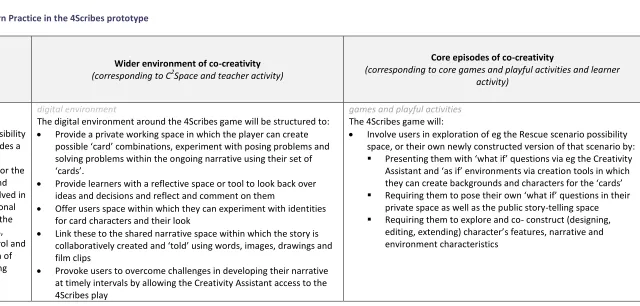
Table 7: C2Learn Practice in the 4Scribes prototype
Wider environment of co-creativity (corresponding to C2Space and teacher activity)
Core episodes of co-creativity
(corresponding to core games and playful activities and learner activity)
A1. Creative thinking
(driven by ‘Possibility Thinking’ provides a foundation of opportunities for the intervention and reframing involved in creative emotional reasoning and the ethical impacts, dialogue, control and engaged action of wise humanizing creativity)
digital environment
The digital environment around the 4Scribes game will be structured to:
Provide a private working space in which the player can create possible ‘card’ combinations, experiment with posing problems and solving problems within the ongoing narrative using their set of ‘cards’.
Provide learners with a reflective space or tool to look back over ideas and decisions and reflect and comment on them
Offer users space within which they can experiment with identities for card characters and their look
Link these to the shared narrative space within which the story is collaboratively created and ‘told’ using words, images, drawings and film clips
Provoke users to overcome challenges in developing their narrative at timely intervals by allowing the Creativity Assistant access to the 4Scribes play
games and playful activities
The 4Scribes game will:
Involve users in exploration of eg the Rescue scenario possibility space, or their own newly constructed version of that scenario by: Presenting them with ‘what if’ questions via eg the Creativity
Assistant and ‘as if’ environments via creation tools in which they can create backgrounds and characters for the ‘cards’ Requiring them to pose their own ‘what if’ questions in their
private space as well as the public story-telling space Requiring them to explore and co- construct (designing,
teacher activity
Once the rules of 4Scribes gameplay are established the teacher will mainl