Local bleaching thresholds established by remote sensing techniques
vary among reefs with deviating bleaching patterns during the 2012
event in the Arabian/Persian Gulf
Dawood Shuail
a, Jörg Wiedenmann
a, Cecilia D'Angelo
a, Andrew H. Baird
b, Morgan S. Pratchett
b,
Bernhard Riegl
c, John A. Burt
d, Peter Petrov
e, Carl Amos
a aCoral Reef Laboratory, Ocean and Earth Science, University of Southampton, SO143ZH Southampton, UK b
ARC Centre of Excellence for Coral Reef Studies, James Cook University, Townsville, Queensland 4811, Australia c
National Coral Reef Institute, Nova Southeastern University, Fort Lauderdale, Florida 33314-7796, USA dCenter for Genomics and Systems Biology, New York University Abu Dhabi, Abu Dhabi, United Arab Emirates e
Regional Organization for the Protection of the Marine Environment (ROPME), 13124 Safat, Kuwait
a b s t r a c t
a r t i c l e i n f o
Article history:
Received 18 December 2015
Received in revised form 6 February 2016 Accepted 1 March 2016
Available online 10 March 2016
A severe bleaching event affected coral communities off the coast of Abu Dhabi, UAE in August/September, 2012. In Saadiyat and Ras Ghanada reefs ~40% of the corals showed signs of bleaching. In contrast, only 15% of the corals were affected on Delma reef. Bleaching threshold temperatures for these sites were established using remotely sensed sea surface temperature (SST) data recorded by MODIS-Aqua. The calculated threshold temperatures var-ied between locations (34.48 °C, 34.55 °C, 35.05 °C), resulting in site-specific deviations in the numbers of days during which these thresholds were exceeded. Hence, the less severe bleaching of Delma reef might be explained by the lower relative heat stress experienced by this coral community. However, the dominance ofPoritesspp. that is associated with the long-term exposure of Delma reef to elevated temperatures, as well as the more pris-tine setting may have additionally contributed to the higher coral bleaching threshold for this site.
Crown Copyright © 2016 Published by Elsevier Ltd. This is an open access article under the CC BY license (http://creativecommons.org/licenses/by/4.0/).
Keywords: Coral bleaching Threshold temperature Extreme environment Coral reefs Zooxanthellae Symbiodinium Global change
1. Introduction
Warm water coral reefs are among the most productive and biologi-cally diverse ecosystems on Earth. Many of these reefs are in decline due to the impact of a variety of global and local stressors (Sheppard, 2003, Baker et al., 2008, Logan et al., 2014, van Hooidonk et al., 2013, D'Angelo and Wiedenmann, 2014). Among them are heat stress episodes during which temperatures exceed a regional threshold and induce the often fatal breakdown of the coral/alga symbiosis which manifests as coral bleaching (Baker et al., 2008, Goreau and Hayes, 1994). The globally highest bleaching thresholds are found among corals of the southern Arabian/Persian Gulf, hereafter IRSA (Inner ROPME Sea Area) where they survive peak temperatures above 35 °C (Coles, 2003; Sheppard et al., 1992). However, also these corals can fall victim to bleaching and coral bleaching linked to unusually warm temperatures has been shown to affect the IRSA at least since 1996 contributing to a substantial loss of coral cover (Riegl and Purkis, 2015; Riegl, 2002). The variability of bleaching susceptibility observed among different species resulted in shifts of the coral community structure in the aftermath of bleaching events in the IRSA (Riegl and Purkis, 2015).
The IRSA is a shallow basin at high latitude and therefore, the thermal properties of the waterbody, respond quickly to local factors. Rapid
cooling by winds (Thoppil and Hogan, 2010; Cavalcante et al., 2016) or preferential heating/cooling in shallow areas or regions protected by headlands is common (Riegl and Purkis, 2012). Correspondingly, small-scale excursions of thermal stress with consequent variation in the verity of coral bleaching and mortality events have been observed. A se-vere bleaching event recorded in 2007 off the Iranian coast (Baker et al., 2008) was absent or had negligible impact in the south-eastern IRSA. Bleaching was observed in 2013 in Qatar, but not in eastern Abu Dhabi (B. Riegl pers. obs.). In general, coral stress events in the northern IRSA (Iran) often do not coincide with those in the southern IRSA, and the Western IRSA (Kuwait, KSA, Bahrain) appears to have suffered fewer, or at least differently-timed, events than the south-eastern IRSA. Hence, strong regional variability in the frequency and severity of bleaching events seem to be characteristic for the region.
Bleaching events are frequently characterized by high variability. On an individual level, the within-colony bleaching response can strongly vary depending on light exposure (Coles and Jokiel, 1978; Brown et al., 1994; Hoegh-Guldberg, 1999). Further variability can also arise from the bleaching susceptibility of different zooxanthellae clades/spe-cies (Baker, 2001; Pettay et al., 2015). Among them, the year-round prevalent algal partner of corals in the southern IRSA,Symbiodinium thermophilum, can be considered to be one of the most
thermo-http://dx.doi.org/10.1016/j.marpolbul.2016.03.001
0025-326X/Crown Copyright © 2016 Published by Elsevier Ltd. This is an open access article under the CC BY license (http://creativecommons.org/licenses/by/4.0/). Contents lists available atScienceDirect
Marine Pollution Bulletin
tolerant symbionts (D'Angelo et al., 2015; Hume et al., 2015). Marked regional variability is commonly encountered during bleaching events and may be caused by small-scale water-dynamics andflow patterns (Nakamura and Van Woesik, 2001; Davis et al., 2011), by greater adap-tation/acclimatization due to previous stress episodes (Brown et al., 2002; Guest et al., 2012) or by differences in the species assemblage of the affected sites (Marshall and Baird, 2000). The onset of bleaching is often not synchronous across several, even nearby, reefs and neither is the severity or the effects of bleaching (Baker et al., 2008). Additional stressors, such as the disturbance of the nutrient environment, can have significant impacts on bleaching susceptibility (Wiedenmann et al., 2012; D'Angelo and Wiedenmann, 2014). In this context, the mean water column productivity, besides mean temperatures, was the best predictor of the variability of coral reef recovery across the Indo-Pacific (Riegl et al., 2015). Also, local adaptions to environmental factors other than temperature can have strong influences on the temperature tolerance of corals. D'Angelo et al. have shown that IRSA corals are char-acterized by a pronounced local adaptation to the high salinity of their habitat and that their superior heat tolerance is lost when they are exposed to normal oceanic salinity levels (D'Angelo et al., 2015). Global warming will expose the world's reef to positive temperature anomalies with increasing frequency (Logan et al., 2014). The prerequisite for knowledge-based coral reef management that aims to regionally miti-gate the effects of climate change is a thorough understanding of how local factors modulate the response to temperature stress. Therefore, we set out to identify the causes for local differences in bleaching sever-ity observed among coral communities in the southern IRSA off the coast of Abu Dhabi. Since remote sensing platforms offer valuable
tools to reconstruct environmental conditions prevailing during coral reef disturbance events (Andréfouët et al., 2014), we used satellite data to establish the local bleaching thresholds in the study sites.
2. Material and methods
2.1. Measuring SST using remote sensing products
[image:2.595.133.473.364.718.2]The SST (°C) data was extracted from the Aqua\Terra Ocean Color 3 (OC3) Moderate Resolution Imaging Spectroradiometer (MODIS) imag-ery downloaded from the NASA ocean color data website (http:// oceancolor.gsfc.nasa.gov/) and by the Regional Organization for the Protection of the Marine Environment (ROPME) archived in Kuwait. MODIS data are recorded by two instruments. Thefirst is integrated in the Terra satellite (MODIS-Terra) and launched in December, 1999. The second instrument is installed on the Aqua satellite (MODIS-Aqua), and was launched in May, 2002. Both satellites are in sun-synchronous orbits: Terra crosses the equator in a descending node at 10:00, and Aqua crosses in an ascending node at 12:00 noon. Satellite imagery was used for the periods between February, 2000 to December, 2014 (MODIS Terra) and from July, 2002 to December, 2014. (MODIS Aqua). Level-2 images were used for which the sensors were calibrated, geo-located with atmospheric corrections and bio-optical algorithms had been applied. Temperatures were determined for 1 km2areas cov-ering the study sites, the highest spatial resolution provided by the MODIS product. Images were analyzed using the SeaWiFS Data Analysis System (SeaDAS) software program Version 7.2 and VISAT BEAM soft-ware Version 4.10.3. Images in which the SST signal was affected by
cloud cover or high amounts of dust in the air were excluded from the analysis. The time of recording of the respective imagery was extracted fromfile names.
2.2. Reconstruction of daily temperature maxima in situ
In situwater temperature timeseries were recorded at ~7 m depth for the Saadiyat and Delma sites using Hobo temperature loggers (Tempcon, UK) at hourly intervals from January to December, 2013. Using this data set and data from August 2014, typical daily temperature variations were calculated by averaging the corresponding hourly values for the last week of August, commonly one of the hottest weeks of the year. This temperature record revealed considerable vari-ations of the temperature over the course of the day with temperatures differing byN0.25 °C between the early morning hours and the daily temperature maximum at ~17:00 (Supplementary Fig. 1).
2.3. Reconstruction of daily temperature maxima using remote sensing data
[image:3.595.35.283.76.129.2]The recording times of the analyzed MODIS Terra and Aqua imagery show considerable deviations due to the differentflight paths of the sat-ellites. Terra data were recorded between 09:30–11:45 (median 10:50) whereas Aqua images were taken in the period 12:05–14:20 (median 13:50). The Terra data provide values that can be ~ 0.15 °C below the daily SST maximum due to their early recording time. By contrast, MODIS Aqua records close to thein situtemperature maximum and its data are therefore best suited to reconstruct the SST of the IRSA. To verify this method, we selectedN250 pairs of MODIS-Aqua values and correspondingin situmeasurements (14:00 data points), from days distributed over all seasons of 2013. Then, the corresponding tempera-ture values were plotted against each other and the coefficient of deter-mination (R2) for a linear regressionfit was calculated (Supplementary Fig. 2b–c).
2.4. Calculation of bleaching threshold temperatures
The MODIS-Aqua SST data set was used to calculate the local thresh-old temperature of coral bleaching, defined as the temperature 1 °C higher than the highest monthly mean temperature (Glynn and D'Croz, 1990). Since the SST peaks are mostly in August in the southern IRSA (Supplementary Fig. 2), we used this period to determine the highest 4-weekly mean temperature using the Aqua data set for the years 2002 to 2014. However, since temperatures are also high in the first two weeks of September, the period from 15th August to 15th Sep-tember was analyzed for comparison.
2.5. Field surveys
Coral communities were surveyed at three sites in the southern IRSA in UAE, Delma (latitude 24.5208/longitude 52.2781), Saadiyat (lat. 24.599/long. 54.4215) and Ras Ghanada (lat. 24.8481/long. 54.6903) (Fig. 1). At each of these sites, bleaching was recorded along three rep-licate transects during the period from 17th to 19th September, 2012. Transects were arranged radially around a central origin, extending for 10 m with 120 degrees separating each transect. Corals were classified to genus level on the basis ofVeron (2000), with taxonomic updates fromBudd et al. (2012). The genus of juvenile corals (b5 cm diameter) within a 1 m wide band were included in the dataset. The analysis of adult corals was restricted toPlatygyraspp. andPoritesspp. as these corals were represented in large numbers in all sites.Poritesspp. were represented by species with massive growth forms (Porites cf. lutea, lobataandharrisoni). Underwater color scales were used to assign the degree of bleaching to three categories: 1) Bleached: The whole colony was white, 2) Partially bleached: Larger parts of the colony (N20%) lost their normal color and 3) Unbleached: The colonies showed their typi-cal variety of colors.
Chi-square statistic (χ2) was used to test whether the percentage of bleached, partially bleached and non-bleached coral colonies recorded in August 2012 in Delma, Saadiyat and Ras Ghanada was region-specific.
3. Results
3.1. Local temperature thresholds of coral bleaching
[image:3.595.69.523.522.710.2]Using the MODIS Aqua data, the local threshold temperatures for coral bleaching (defined as 1 °C above the long-term average of the mean temperature of the 4 hottest weeks of each year) was calculated
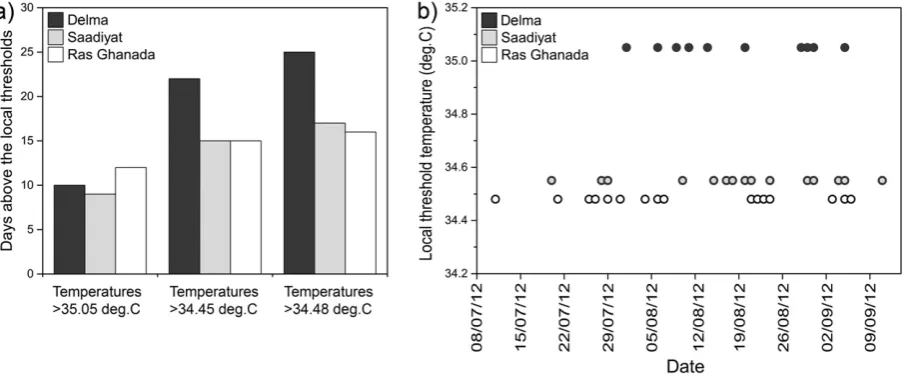
Fig. 2.Variations in heat stress exposure during the 2012 bleaching event in the southern IRSA reconstructed from MODIS-Aqua imagery. a) Number of days during which the site-specific bleaching threshold temperatures (Delma: 35.05 °C, Saadiyat 34.55 °C, Ras Ghanada: 34.8 °C) were exceeded in each of the study sites. b) Days at which the site-specific local bleaching threshold was exceeded in the corresponding study sites, indicating also the length of the positive temperature anomaly.
Table 1
Calculated bleaching threshold temperatures for the hottest weeks of the year. Delma Saadiyat Ras Ghanadah Bleaching threshold temp.
(01–31 Aug. 2002–2014) 34.99 34.55
a 34.37
Bleaching threshold temp.
(15 Aug.–15 Sept. 2002–2014) 35.05 34.53 34.48 a
for the time period 2002–2014. Comparably high threshold tempera-tures were obtained for the 4 weeks of August and for the period from the 15th of August to the 15th of September, signifying the length of
[image:4.595.105.503.53.208.2]time over which IRSA corals are exposed to elevated temperatures (Table 1). Our analysis revealed marked differences in the local temper-ature history of the study sites which are reflected in bleaching
[image:4.595.130.473.297.726.2]Fig. 4.Representative photographs of corals from the bleaching categories used in this study. (Image credits: J. Wiedenmann).
threshold temperatures ranging from 34.48 °C (Ras Ghanada) over 34.55 °C (Saadiyat) to 35.05 °C (Delma) (Supplementary Fig. 2,Table 1).
In summer 2012, the number of days during which temperatures exceeded 35.05 °C was comparable for the three sites (Fig. 2a). Around Delma reef, temperatures above 34.48 and 34.55 °C were recorded more frequently than for the other two sites within the same time period. However, due to the site-specific deviations of the bleaching threshold temperatures, the three locations showed considerable differences in the number of days during which their regional thresholds were exceeded (Fig. 2b). Specifically, coral communities had to endure above-threshold temperatures for 16 days in Ras Ghanada reefs and for 15 days in Saadiyat reefs. In contrast, in Delma Island reefs, the tem-peratures were higher than the local bleaching threshold for only 10 days (Fig. 2). Also, the period of time between thefirst and the last day at which the threshold temperatures were exceeded was longer in Saadiyat and Ras Ghanada compared to Delma. These data suggest that similar relative heat stress levels were experienced by corals in Saadiyat and Ras Ghanada and that these were higher than in Delma.
3.2. Site-specific severity of the 2012 bleaching event
We surveyed three coral reef sites in the southern IRSA to document the bleaching event that took place in August/September 2012. The three sites revealed pronounced differences in the abundance of genera and genus richness of juvenile corals (Fig. 3a). The overall abundance of juveniles was similar in Saadiyat and Ras Ghanada and numbers were higher than in Delma. Species richness of juvenile corals decreased from Ras Ghanada to Saadiyat and Delma, withPoritesspp. becoming in-creasingly dominant. Similarly, the number of adultPoritesspp. and Platygyraspp. recorded along the transects was higher in Ras Ghanada and Saadiyat than in Delma (Fig. 3b).
Within the sites, corals of the same taxonomic group were affected to variable degrees by bleaching, ranging from unaffected to partially bleached and completely bleached (Fig. 4). Partially bleached corals
lost their pigmentation often in the upper, most light-exposed parts of the colonies.
In Ras Ghanada and Saadiyat reefs,N40% of the analyzed corals (juvenile and adultPorites, adultPlatygyra) were affected by bleaching (Fig. 5). An exception were juvenilePoritesamong which no partially bleached individuals were encountered in Ras Ghanada and the overall percentage of colonies showing signs of bleaching was accordingly lower. In all analyzed groups, between 20 and ~30% of the corals were completely bleached in Saadiyat and Ras Ghanada. By contrast, the corals in the Delma site were less affected and no more than 15% of the corresponding groups showed signs of bleaching. For both species, statistical analysis identified the lower bleaching severity in Delma as a significant site-specific effect (Supplementary Table 3).
Similar bleaching levels were observed for the combined numbers of recorded juveniles from other species (Supplementary Fig. 3). It has to be noted, however, that the data for Delma reef need to be considered with caution due to low number of non-Poritesspp. juveniles encoun-tered in this site.
4. Discussion
We studied three sites in the IRSA that experienced different levels of bleaching during the 2012 bleaching event with the purpose to estab-lish potential causes for the patchiness of bleaching that is frequently observed during mass bleaching events. Bleaching levels for two com-mon taxa,Poritesspp. andPlatygyraspp., were analyzed. Additionally, we recorded the site-specific degree of bleaching among juvenilePorites spp. and other less abundant corals.
Reefs in Saadiyat and Ras Ghanada were severely affected by bleaching whereas corals in Delma showed little or no signs of bleaching despite their relatively close geographic proximity and exposure to a comparable temperature regime in August–September, 2012. This trend was comparable for all the monitored species and developmental stages.
Since light exposure is known to promote heat-stress mediated bleaching (Coles and Jokiel, 1978; Brown et al., 1994, 2002; Hoegh-Guldberg, 1999; Fitt et al., 2001), the observation, that partial bleaching of adult colonies was frequently found in the upper part of the colonies, suggests that light stress was also influential in 2012 bleaching event.
In Ras Ghanada, a higher percentage of adultPoritesspp. showed signs of bleaching compared to juveniles from the same taxon. This ob-servation is in line with previous studies that found that juvenile corals were less affected by bleaching than adults (Mumby, 1999; Nakamura and Van Woesik, 2001; Loya et al., 2001). However, this trend was not observed in the other sites where comparable numbers of adults and juveniles suffered from bleaching.
[image:5.595.35.285.427.715.2]A possible explanation for the different bleaching susceptibility across the three study sites is that the local bleaching threshold of ~ 35 °C at Delma reef is ~ 0.5 °C higher than in the other sites. Conse-quently, the corals experienced less relative heat stress, indicated by the smaller number of days during which the local bleaching threshold was exceeded. Still, the threshold temperature was exceeded for 10 days at Delma with little effect on the corals, setting this site among the most temperature tolerant reefs of the world (Riegl et al., 2011, 2012). The resilience of Delma reef is further underlined by the fe-cundity of its corals in the aftermath of the 2012 bleaching event which was significantly higher compared to those from Saadiyat and Ras Ghanada reefs (Howells et al., 2016). Previous observations from else-where found massivePoritesspp. to be among the taxa with a high survival rate after bleaching events (Loya et al., 2001; Sheppard and Loughland, 2002). Therefore, the dominance of massivePoritesspp. at Delma (Burt et al., 2011) that is reflected by the species composition of juvenile corals presented in this study, may be considered as an addi-tional potential reason for the excepaddi-tional heat tolerance of this reef site (Marshall and Baird, 2000; Loya et al., 2001). Also, the history of Fig. 5.Site-specific severity of bleaching. Comparison of the percentage of the total
increased temperature stress levels in Delma may have increased the bleaching threshold of the community by a long-term selection of more resilient genotypes and/or acclimatization of corals (Brown et al., 2002). Furthermore, Delma reef is situated ~50 km off the coast in a relatively pristine environment whereas the other two sites are under the direct influence of a densely populated urban area and in-tense coastal construction (Sale et al., 2011; Van Lavieren et al., 2011). Since the water quality, in particular the nutrient levels, can affect bleaching thresholds (Wooldridge, 2009; Wiedenmann et al., 2012; D'Angelo and Wiedenmann, 2014), the influence of the water chemistry at the different sites should be investigated as another potential cause for the observed differences in their bleaching tolerance.
5. Conclusions
Different bleaching threshold temperatures and the composition of the coral communities at the study sites offer likely explanations for the“patchiness”of the 2012 bleaching event in the southern IRSA, but other parameters such as the water quality and light stress should also be considered. Our results suggest that the bleaching threshold of the Porites-dominated Delma site is only 0.5 °C higher than in the more di-verse Saadiyat and Ras Ghanada sites. Hence, a long-term increase of the mean temperature of the hottest weeks in the same order of magnitude may lead to a considerable loss of coral diversity in the latter reefs.
Acknowledgment
The study was funded by NERC (Grant no. NE/K00641X/1 to JW) and the European Research Council under the European Union's Seventh Framework Program (FP/2007–2013) ERC Grant Agreement no. 311179 to JW and a scholarship by the Public Authority for Education and Training of the State of Kuwait to DS. We are grateful to NYU Abu Dhabi Institute for supporting the 2012/2013field workshops during which data for this study were collected. We also thank Tropical Marine Centre (London) and Tropic Marin (Wartenberg) for sponsoring the NOCS Coral Reef Laboratory and acknowledge NASA Ocean Biology (OB.DAAC) for Sea-viewing Wide Field-of-view Sensor (SeaWiFS) Ocean Color Data. We extend our appreciation to ROPME for the access to their remote sensing database.
Appendix A. Supplementary data
Supplementary data to this article can be found online athttp://dx. doi.org/10.1016/j.marpolbul.2016.03.001.
References
Andréfouët, S., Dutheil, C., Menkes, C.E., Bador, M., Lengaigne, M., 2014.Mass mortality events in atoll lagoons: environmental control and increased future vulnerability. Glob. Chang. Biol. 21, 195–205.
Baker, A.C., 2001.Reef corals bleach to survive change. Nature 411, 765–766. Baker, A.C., Glynn, P.W., Riegl, B., 2008.Climate change and coral reef bleaching: an
eco-logical assessment of long-term impacts, recovery trends and future outlook. Estuar. Coast. Shelf Sci. 80, 435–471.
Brown, B.E., Dunne, R.P., Goodson, M.S., Douglas, A.E., 2002.Experience shapes the sus-ceptibility of a reef coral to bleaching. Coral Reefs 21, 119–126.
Brown, B.E., Dunne, R.P., Scoffin, T.P., Letissier, M.D.A., 1994.Solar damage in intertidal corals. Mar. Ecol. Prog. Ser. 105, 219–230.
Budd, A.F., Fukami, H., Smith, N.D., Knowlton, N., 2012.Taxonomic classification of the reef coral family Mussidae (Cnidaria: Anthozoa: Scleractinia). Zool. J. Linnean Soc. 166, 465–529.
Burt, J., Al-Harthi, S., Al-Cibahy, A., 2011.Long-term impacts of coral bleaching events on the world's warmest reefs. Mar. Environ. Res. 72, 225–229.
Cavalcante, G.H., Feary, D.A., Burt, J.A., 2016.The influence of extreme winds on coastal oceanography and its implications for coral population connectivity in the southern Arabian Gulf. Mar. Pollut. Bull. 105, 489–497.
Coles, S.L., 2003.Coral species diversity and environmental factors in the Arabian Gulf and the Gulf of Oman: a comparison to the Indo-Pacific region. Atoll Res. Bull. J1–J19. Coles, S.L., Jokiel, P.L., 1978.Synergistic effects of temperature salinity and light on the
thermatypic coralMontipora verrucosa. Mar. Biol. 49, 187–195.
D'Angelo, C., Wiedenmann, J., 2014.Impacts of nutrient enrichment on coral reefs: new perspectives and implications for coastal management and reef survival. Curr. Opin. Environ. Sustain. 7, 82–93.
D'Angelo, C., Hume, B.C.C., Burt, J., Smith, E.G., Achterberg, E.P., Wiedenmann, J., 2015. Local adaptation constrains the distribution potential of heat-tolerantSymbiodinium from the Persian/Arabian Gulf. ISME J. 1–10.
Davis, K.A., Lentz, S.J., Pineda, J., Farrar, J.T., Starczak, V.R., Churchill, J.H., 2011. Observa-tions of the thermal environment on Red Sea platform reefs: a heat budget analysis. Coral Reefs 30, 25–36.
Fitt, W.K., Brown, B.E., Warner, M.E., Dunne, R.P., 2001.Coral bleaching: interpretation of thermal tolerance limits and thermal thresholds in tropical corals. Coral Reefs 20, 51–65.
Glynn, P.W., D'Croz, L., 1990.Experimental evidence for high temperature stress as the cause of El Niño-coincident coral mortality. Coral Reefs 8, 181–191.
Goreau, T.J., Hayes, R.L., 1994.Coral bleaching and ocean "hot spots". Ambio 23, 176–180. Guest, J.R., Baird, A.H., Maynard, J.a., Muttaqin, E., Edwards, A.J., Campbell, S.J., Yewdall, K., Affendi, Y.A., Chou, L.M., 2012.Contrasting patterns of coral bleaching susceptibility in 2010 suggest an adaptive response to thermal stress. PLoS One 7, 1–8. Hoegh-Guldberg, O., 1999.Climate change, coral bleaching and the future of the world's
coral reefs. Mar. Freshw. Res. 50, 839.
Howells, E.J., Ketchum, R.N., Bauman, A.G., Mustafa, Y., Watkins, K.D., Burt, J.A., 2016. Species-specific trends in the reproductive output of corals across environmental gra-dients and bleaching histories. Mar. Pollut. Bull. 105, 532–539.
Hume, B.C.C., Angelo, C.D., Smith, E.G., Stevens, J.R., Burt, J., Wiedenmann, J., 2015. Symbiodinium thermophilumsp. nov., a thermotolerant symbiotic alga prevalent in corals of the world's hottest sea, the Persian/Arabian Gulf. Sci. Rep. 5, 8562. Logan, C., Dunne, J.P., Eakin, C.M., Donner, S.D., 2014.Incorporating adaptive responses
into future projections of coral bleaching. Glob. Chang. Biol. 20, 125–139. Loya, Y., Sakai, K., Nakano, Y., Woesik, R. Van, 2001.Coral Bleaching: The Winners and The
Losers 122–131.
Marshall, P.A., Baird, A.H., 2000.Bleaching of corals on the Great Barrier Reef: differential susceptibilities among taxa. Coral Reefs 19, 155–163.
Mumby, P.J., 1999.Bleaching and hurricane disturbances to populations of coral recruits in Belize. Mar. Ecol. Prog. Ser. 190, 27–35.
Nakamura, T., Van Woesik, R., 2001.Water-flow rates and passive diffusion partially ex-plain differential survival of corals during the 1998 bleaching event. Mar. Ecol. Prog. Ser. 212, 301–304.
Pettay, D.T., Wham, D.C., Smith, R.T., Iglesias-Prieto, R., LaJeunesse, T.C., 2015.Microbial in-vasion of the Caribbean by an Indo-Pacific coral zooxanthella. Proc. Natl. Acad. Sci. U. S. A. 112, 7513–7518.
Riegl, B., 2002.Effects of the 1996 and 1998 positive sea-surface temperature anomalies on corals, coral diseases andfish in the Arabian Gulf (Dubai, UAE). Mar. Biol. 140, 29–40.
Riegl, B.M., Purkis, S.J., 2012.Coral reefs of the gulf: Adaptation to climatic extremes in the world's hottest sea. Coral Reefs of the Gulf, pp. 1–4.
Riegl, B., Purkis, S., 2015.Coral population dynamics across consecutive mass mortality events. Glob. Chang. Biol. 21, 3995–4005.
Riegl, B., Glynn, P.W., Wieters, E., Purkis, S., d'Angelo, C., Wiedenmann, J., 2015.Water col-umn productivity and temperature predict coral reef regeneration across the Indo-Pacific. Sci. Rep. 5, 8273.
Riegl, B.M., Purkis, S.J., Al-Cibahy, A.S., Abdel-Moati, M.A., Hoegh-Guldberg, O., 2011. Pres-ent limits to heat-adaptability in corals and population-level responses to climate ex-tremes. PLoS One 6, e24802.
Riegl, B.M., Purkis, S.J., Al-Cibahy, A.S., Al-Harthi, S., Grandcourt, E., Al-Sulaiti, K., Baldwin, J., Abdel-Moati, A.M., 2012.Coral bleaching and mortality thresholds in the SE Gulf: highest in the world. Coral Reefs of the Gulf. Springer, pp. 95–105.
Sale, P.F., Feary, D.a., Burt, J.a., Bauman, A.G., Cavalcante, G.H., Drouillard, K.G., Kjerfve, B., Marquis, E., Trick, C.G., Usseglio, P., Van Lavieren, H., 2011.The growing need for sus-tainable ecological management of marine communities of the Persian Gulf. Ambio 40, 4–17.
Sheppard, C.R., 2003.Predicted recurrences of mass coral mortality in the Indian Ocean. Nature 425, 294–297.
Sheppard, C.R., Loughland, R., 2002.Coral mortality and recovery in response to increas-ing temperature in the southern Arabian Gulf. Aquat. Ecosyst. Health Manag. 5, 395–402.
Sheppard, C.R., Price, A.R.G., Roberts, C.J., 1992.Marine Ecology of the Arabian Area. Pat-terns and Processes in Extreme Tropical Environments. Academic Press, London. Thoppil, P.G., Hogan, P.J., 2010.A modeling study of circulation and eddies in the Persian
Gulf. J. Phys. Oceanogr. 40, 2122–2134.
van Hooidonk, R., Maynard, J.A., Planes, S., 2013.Temporary refugia for coral reefs in a warming world. Nat. Clim. Chang. 3, 508–511.
Van Lavieren, H., Burt, J., Feary, D.A., Cavalcante, G., Marquis, E., Benedetti, L., Trick, C., Kjerfve, B., Sale, P.F., 2011.Managing the growing impacts of development on fragile coastal and marine ecosystems: Lessons from the Gulf. Policy Report of the United Nations University—Institute for Water, Environment and Health, pp. 1–100. Veron, J.E.N., 2000.In: Stafford-Smith, M. (Ed.)Corals of the World 1–3. Australian
Insti-tute of Marine Science, Townsville, Australia (1382 pp.).
Wiedenmann, J., D'Angelo, C., Smith, E.G., Hunt, A.N., Legiret, F.-E., Postle, A.D., Achterberg, E.P., 2012.Nutrient enrichment can increase the susceptibility of reef corals to bleaching. Nat. Clim. Chang. 3, 160–164.