First principles based multiparadigm modeling of electronic
structures and dynamics
Thesis by
Hai Xiao
In Partial Fulfillment of the Requirements
for the Degree of
Doctor of Philosophy
California Institute of Technology
Pasadena, California
2015
©2015 Hai Xiao
To the memory of my grandma Ding-Xiang and grandpa Yong-Chu
and
Acknowledgments
I wish to thank my advisor, Prof. Bill Goddard, for his constant support and guidance over the past
six years. I appreciate very much the flexibility Bill offered me in both choosing research topics and
working pace, as well as the broad knowledge of theory, modeling, and experiments he shared with
me, and the key ideas he proposed that greatly sped up my research progress.
I would like to thank other group members I have collaborated with: Julius T. Su, Jamil
Tahir-Kheli, Andr´es Jaramillo-Botero, Patrick L. Theofanis, Sergey V. Zybin, Wei-Guang Liu, Qi An, and
Sijia Dong. Additionally, I have also enjoyed in our group chatting and friendship with Mu-Jeng
Cheng, Sha Yao, Wei-Guang Liu, Qi An, Yi Liu, Ted Yu, Himanshu Mishra, Fan Liu, Lianchi Liu,
Tingting Zhou, Vaclav Cvicek, Ho-Cheng Tsai, Tao Cheng, Sijia Dong, and Jos´e Mendoza-Cortes.
It’s quite a pleasure being a member of this big family.
I would like to thank my committee members, Prof. Harry Gray, Prof. Rudy Marcus, and
Prof. Nate Lewis, for constructive comments and discussions on my candidacy, proposals, and thesis.
I would also like to thank my candidacy committee chair, Prof. Aron Kuppermann, who is not with
us any more, for his caring about both my research and life in the early stage of my graduate student
life.
I would love to thank all my friends, though it’s too big a list to put here, for helping me get
through rough times and enriching my life these years.
Finally I would like to thank my parents for unconditional love and support, and I wish to thank
my wife Ying. Ying and I have been together for more than ten years, and I dread to think what
my life would be without her. I would very much love to dedicate this thesis to her and our beloved
List of Abbreviations
QM quantummechanics BO Born-Oppenheimer PES potential energysurface MD moleculardynamics HF Hartree-Fock
UHF unrestrictedHartree-Fock VB valencebond
GVB generalizedvalencebond TDHF time-dependentHartree-Fock DFT density functionaltheory
TDDFT time-dependentdensityfunctionaltheory KS Kohn-Sham
GKS generalizedKohn-Sham XC exchange and correlation LDA localdensity approximation GGA generalizedgradientapproximation meta-GGA meta-generalizedgradient approximation AO atomicorbital
MO molecularorbital
HOMO highest occupiedmolecularorbital LUMO lowestunoccupiedmolecularorbital VBM valenceband maximum
CBM conductionbandminimum VBO valenceband offset
USPP ultrasoftpseudopotential PAW projectoraugmented-wave BSSE basis setsuperpositionerror PBC periodicboundaryconditions IP ionizationpotential
EA electronaffinity
AEP averageelectrostaticpotential EOS equationofstate
ZPE zeropointenergy TS transition state eFF electronforcefield
FSG floatingsphericalGaussian EOM equationsofmotion
GHA-QM Gaussian Hartree approximated quantum mechanics
AMPERE angular momentum projected effective core pseudopotential
MAD mean absolutedeviation MRD mean relativedeviation RMSD rootmean squaredeviation GA geneticalgorithm
Abstract
Electronic structures and dynamics are the key to linking the material composition and structure
to functionality and performance.
An essential issue in developing semiconductor devices for photovoltaics is to design materials
with optimal band gaps and relative positioning of band levels. Approximate DFT methods have
been justified to predict band gaps from KS/GKS eigenvalues, but the accuracy is decisively
de-pendent on the choice of XC functionals. We show here for CuInSe2 and CuGaSe2, the parent
compounds of the promising CIGS solar cells, conventional LDA and GGA obtain gaps of 0.0–0.01
and 0.02–0.24 eV (versus experimental values of 1.04 and 1.67 eV), while the historically first global
hybrid functional, B3PW91, is surprisingly the best, with band gaps of 1.07 and 1.58 eV.
Further-more, we show that for 27 related binary and ternary semiconductors, B3PW91 predicts gaps with
a MAD of only 0.09 eV, which is substantially better than all modern hybrid functionals, including
B3LYP (MAD of 0.19 eV) and screened hybrid functional HSE06 (MAD of 0.18 eV).
The laboratory performance of CIGS solar cells (>20% efficiency) makes them promising
can-didate photovoltaic devices. However, there remains little understanding of how defects at the
CIGS/CdS interface affect the band offsets and interfacial energies, and hence the performance of
manufactured devices. To determine these relationships, we use the B3PW91 hybrid functional of
DFT with the AEP method that we validate to provide very accurate descriptions of both band gaps
and band offsets. This confirms the weak dependence of band offsets on surface orientation observed
experimentally. We predict that the CBO of perfect CuInSe2/CdS interface is large, 0.79 eV, which
would dramatically degrade performance. Moreover we show that band gap widening induced by
Ga adjusts only the VBO, and we find that Cd impurities do not significantly affect the CBO. Thus
we show that Cu vacancies at the interface play the key role in enabling the tunability of CBO. We
predict that Na further improves the CBO through electrostatically elevating the valence levels to
decrease the CBO, explaining the observed essential role of Na for high performance. Moreover we
find that K leads to a dramatic decrease in the CBO to 0.05 eV, much better than Na. We suggest
that the efficiency of CIGS devices might be improved substantially by tuning the ratio of Na to K,
with the improved phase stability of Na balancing phase instability from K. All these defects reduce
A number of exotic structures have been formed through high pressure chemistry, but applications
have been hindered by difficulties in recovering the high pressure phase to ambient conditions (i.e.,
one atmosphere and room temperature). Here we use dispersion-corrected DFT (PBE-ulgflavor) to predict that above 60 GPa the most stable form of N2O (the laughing gas in its molecular form) is a
1D polymer with an all-nitrogen backbone analogous tocis-polyacetylene in which alternate N are bonded (ionic covalent) to O. The analogoustrans-polymer is only 0.03–0.10 eV/molecular unit less stable. Upon relaxation to ambient conditions both polymers relax below 14 GPa to the same stable
non-planartrans-polymer, accompanied by possible electronic structure transitions. The predicted phonon spectrum and dissociation kinetics validate the stability of thistrans-poly-NNO at ambient conditions, which has potential applications as a new type of conducting polymer with all-nitrogen
chains and as a high-energy oxidizer for rocket propulsion. This work illustratesin silico materials discovery particularly in the realm of extreme conditions.
Modeling non-adiabatic electron dynamics has been a long-standing challenge for computational
chemistry and materials science, and the eFF method presents a cost-efficient alternative. However,
due to the deficiency of FSG representation, eFF is limited to low-Z elements with electrons of
predominant s-character. To overcome this, we introduce a formal set of ECP extensions that
enable accurate description ofp-block elements. The extensions consist of a model representing the
core electrons with the nucleus as a single pseudo particle represented by FSG, interacting with
valence electrons through ECPs. We demonstrate and validate the ECP extensions for complex
bonding structures, geometries, and energetics of systems withp-block character (C, O, Al, Si) and
apply them to study materials under extreme mechanical loading conditions.
Despite its success, the eFF framework has some limitations, originated from both the design of
Pauli potentials and the FSG representation. To overcome these, we develop a new framework of
two-level hierarchy that is a more rigorous and accurate successor to the eFF method. The fundamental
level, GHA-QM, is based on a new set of Pauli potentials that renders exact QM level of accuracy for
any FSG represented electron systems. To achieve this, we start with using exactly derived energy
expressions for the same spin electron pair, and fitting a simple functional form, inspired by DFT,
against open singlet electron pair curves (H2 systems). Symmetric and asymmetric scaling factors
are then introduced at this level to recover the QM total energies of multiple electron pair systems
from the sum of local interactions. To complement the imperfect FSG representation, the AMPERE
extension is implemented, and aims at embedding the interactions associated with both the cusp
condition and explicit nodal structures. The whole GHA-QM+AMPERE framework is tested on H
Contents
Acknowledgments iv
List of Abbreviations v
Abstract vii
List of Figures xi
List of Tables xiii
1 Introduction 1
References . . . 2
2 Accurate description of electronic structures for semiconductors from DFT 3 2.1 Fundamental band gap from KS/GKS scheme in DFT . . . 4
2.2 Choice of basis sets and ECPs for periodic calculations . . . 6
2.3 Key ingredients in XC functionals for performance . . . 8
2.4 Benchmark on a set of 27 binary and ternary semiconductors . . . 11
2.5 Concluding remarks . . . 15
Appendix . . . 15
References . . . 21
3 Predicted roles of defects in band offsets and energetics at CIGS Solar Cell interfaces and implications for improving performance 27 3.1 Methodology for calculating band offsets from interface modeling . . . 28
3.2 Band offsets at pristine CIGS/CdS interfaces . . . 31
3.3 Bulk structures of defect CIGS . . . 33
3.4 Roles of defects in band offsets and energetics at CIGS/CdS interfaces . . . 36
3.5 Concluding remarks . . . 38
Appendix . . . 39
4 Formation of the –N(NO)N(NO)– polymer at high pressure and stabilization
at ambient conditions 49
4.1 Search for extended solid phases of N2O under high pressures . . . 50
4.2 Transitions between molecular, ionic, and polymer phases of N2O . . . 51
4.3 Relaxation of polymer phases to ambient conditions . . . 54
4.4 Kinetic stability of the non-planar N2O polymer at ambient conditions . . . 59
4.5 Concluding remarks . . . 60
Appendix . . . 61
References . . . 63
5 Development of ECP for eFF to extend application to high-Z elements 67 5.1 Formulation of ECP models in eFF . . . 69
5.2 Performance of optimized eFF-ECP parameters . . . 72
5.2.1 Al and Si withs-sECP . . . 73
5.2.2 C withs-pECP . . . 75
5.2.3 Oxygen withs-pECP . . . 78
5.2.4 Silicon carbide with combineds-sands-peFF-ECP . . . 80
5.3 Conclusions . . . 81
References . . . 82
6 Gaussian Hartree approximated QM with angular momentum projected effec-tive core pseudopotential 85 6.1 Exact QM energies of same spin FSG electron pair . . . 86
6.2 Symmetric and asymmetric scaling factors for same spin Pauli potential . . . 90
6.3 Design of opposite spin Pauli potential . . . 93
6.4 The AMPERE extension . . . 97
6.5 Concluding remarks and future work . . . 101
Appendix . . . 101
A. Series expansions of ∆T, ∆Cee, and ∆Cne . . . 101
B. A hybrid scheme to construct opposite spin Pauli potential . . . 102
C. Integrals involved in energy evaluation with AMPERE . . . 105
D. Numerical implementation of AMPERE (pair eff ecp.h) in LAMMPS . . . 108
List of Figures
2.1 The band structure and DOS of CuInSe2 calculated with B3PW91. . . 9
2.2 The band structure and DOS of CuGaSe2calculated with B3PW91. . . 10
3.1 Illustration of the computation of band offsets for the CuInSe2/CdS (110) interface. 30
3.2 The CuInSe2/CdS (112) polar interface model and the calculated band alignment. . 32
3.3 The interface models and calculated band alignments of CuIn0.75Ga0.25Se2/CdS. . . 33
3.4 DOS of Cu-rich CuInSe2 shows the dominance of Cu 3din the valence region. . . 34
3.5 The lowest energy model crystal structures for Cu5In9Se16 and CuIn5Se8. . . 35
3.6 The interface models and calculated band alignments of Cu5In9Se16/CdS and CuIn5Se8
/CdS. . . 36
3.7 DOS of Cu-poor CuIn5Se8shows the dominance of Se 4pin the valence region. . . . 37
3.8 The interface models and calculated band alignments of Na2Cu3In9Se16/CdS, K2Cu3In9Se16
/CdS and CdCu3In9Se16/CdS. . . 38
4.1 Illustration of crystal structures and chemical formulations of a single chain for planar
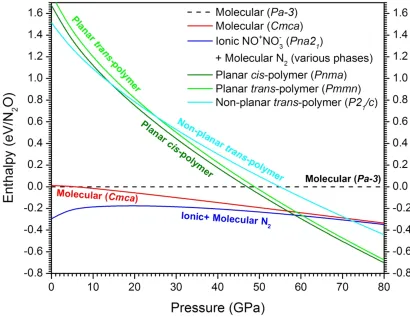
cis-polymer and planartrans-polymer. . . 51 4.2 Ground state enthalpy as a function of pressure predicted for various phases of N2O. 52
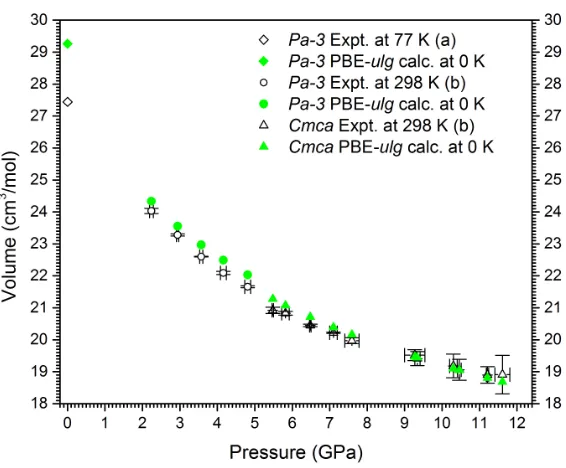
4.3 Comparison between PBE-ulgcalculated and experimental EOSs for molecular phases of N2O. . . 53
4.4 Illustration of the orthorhombic crystal structure of ionic NO+NO−3 with space group
P na21. . . 54
4.5 The effect of quantum ZPE and temperature (entropy) on the transition pressure to
polymer phasePc. . . 55
4.6 Phonon spectra for polymer phases of N2O predicted at 80 and 0 GPa. . . 56
4.7 Illustration of crystal structure and chemical formulation of a single chain for
non-planartrans-polymer. . . 57 4.8 Band gap and neighboring N–N bond length difference predicted as functions of
4.9 Total and partial electronic DOSs calculated with B3PW91 for planarcis- andtrans
-polymers at 80 GPa. . . 58
4.10 Reaction path calculated for dissociation of the model oligomer. . . 59
4.A1 EOSs for various phases of N2O at ground states. . . 61
4.A2 TS calculated for dissociation of an isolated periodic infinite chain of the non-planar polymer. . . 61
5.1 eFF aims at long term and large scale non-adiabatic MD simulations. . . 68
5.2 Illustration of distances used in the two functional types of ECP. . . 70
5.3 Comparison of cluster bond energies for different AlnH3nclusters. . . 74
5.4 Crack tip velocity versus reduced load for{111} fracture from eFF-ECP, compared to experimental, ReaxFF+Tersoff simulations, and DCET and EDIP data. . . 75
5.5 Mechanism of local field-induced ionization. . . 76
5.6 Gallery of molecules with conjugate double bonds. . . 77
5.7 Comparison of various methods on the binding curve along the dispersionc axis of graphite. . . 78
5.8 Illustration of electronic excitation-induced desorption of hydrogen from a passivated diamond slab. . . 79
5.9 Open shell like representation of lone pairs in eFF-ECP. . . 79
6.1 Comparison of different energy contributions upon antisymmetrization for total ener-gies of triplet H2 system. . . 88
6.2 Comparison of different energy contributions upon antisymmetrization for optimizing electron wavefunctions of triplet H2 system. . . 89
6.3 Benchmark of eFF, GHA-QM with and without scaling. . . 90
6.4 Performance of symmetric scaling factor functions. . . 92
6.5 Performance of asymmetric scaling factor functions. . . 92
6.6 Fitting of opposite spin Pauli potential against open singlet H2at B3LYP level. . . . 94
6.7 Performance of GHA-QM on the open singlet and triplet H2 systems. . . 95
6.8 Performance of GHA-QM on symmetric stretching inD∞hH3 andD4hH4. . . 96
6.9 Performance of GHA-QM on asymmetric stretching inD∞h H3 andD4h H4. . . 96
6.10 Decomposition of valence FSG wavefunction into core-centered orbitals with various angular momenta. . . 98
6.11 Performance of GHA-QM+AMPERE on the dissociation curve of H2molecule. . . . 100
6.B1 Performance of fitting of prefactors on open singlet H2 at UHF level. . . 103
List of Tables
2.1 Comparison of the performance of pruned and optimized basis sets on structures and
band gaps of CuInSe2, CuGaSe2, and CdS. . . 7
2.2 Predicted band gap and lattice parameters for CuInSe2 chalcopyrite crystal from
various levels of XC functionals. . . 9
2.3 Predicted band gap and lattice parameters for CuGaSe2 chalcopyrite crystal from
various levels of XC functionals. . . 10
2.4 Predicted band gaps (eV) for 27 semiconductors with B3PW91 (MAD = 0.09 eV). . 12
2.5 Predicted lattice parameters (a/˚A) for 9 binary semiconductors with B3PW91 (MRD
= 1.9%). . . 12
2.6 Predicted lattice parameters for 18 ternary semiconductors with B3PW91 (MRD =
2.2%). . . 12
2.7 Predicted band gaps (eV) for 27 semiconductors with B3LYP (MAD = 0.19 eV). . . 13
2.8 Predicted lattice parameters (a/˚A) for 9 binary semiconductors with B3LYP (MRD
= 3.1%). . . 13
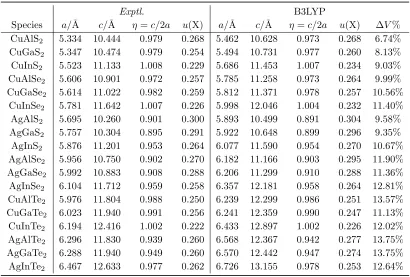
2.9 Predicted lattice parameters for 18 ternary semiconductors with B3LYP (MRD =
3.6%). . . 13
2.10 Predicted band gaps (eV) for 27 semiconductors with HSE06 (MAD = 0.18 eV). . . 14
2.11 Predicted lattice parameters (a/˚A) for 9 binary semiconductors with HSE06 (MRD
= 1.6%). . . 14
2.12 Predicted lattice parameters for 18 ternary semiconductors with HSE06 (MRD = 2.0%). 14
3.1 Convergence of interface thickness (d), interfacial energy (σ), VBO (∆Ev), and CBO
(∆Ec) with respect to number of layers of each side (L) and the interface-interface
distance (D) for CuInSe2/CdS interfaces parallel to (110) and (112). . . 31
3.2 Fluctuations in calculated CBO values from using core levels of different elements. . 32
3.3 Relative energies (∆E) in meV/atom of all possible configurations within a√2×√2×1 supercell for Cu5In9Se16phase calculated with B3PW91. . . 35
3.4 Relative energies (∆E) in meV/atom of low energy configurations for CuIn5Se8phase
5.1 eFF-ECP parameters optimized for a few 2ndand 3rd rowp-block elements. . . . 72
5.2 Comparison of eFF-ECP, all electron eFF and DFT calculations on aluminum hydrides. 73
5.3 Comparison of eFF-ECP and eFF on geometries of carbon-containing molecular and
bulk systems. . . 76
5.4 Performance of eFF-ECP on geometries of various molecules with oxygen atom(s). . 80
5.5 Carbon s-p functional form parameters in the SiC-ECP force field and Silicon s-s
parameters from Ref. [8]. . . 80
5.6 Silicon Carbide training set and optimization results using thes-pform ECP for Carbon. 81
6.1 Fitted parameters for asymmetric scaling factor functions. . . 91
6.2 Fitted parameters forEbase
Chapter 1
Introduction
There is no doubt that MO and VB theory play a pivotal role in shaping chemists’ understanding
of chemistry, and elegant models and concepts have been derived, such as resonance, hybridization,
VSEPR theory, Walsh diagram, ligand field theory, and frontier MO theory, to name but a few.
Electronic structure, as a more generalized term, naturally covers the concepts ranging from orbital
and bonding of finite molecules to bands and DOS of extended phases, and thus provides a bridging
concept between chemistry and material science. Such crossing has lead to insightful perspective
and delicate understanding (see, e.g., [1] and [2]). Modern computational modeling techniques have
enabled accurate quantitative description of electronic structures, which is the key to unveiling the
relationship between chemical composition and material functionality. The first half of this thesis
(Ch. 2–Ch. 4) is devoted to such research, in which predictions were made for the dependence of
de-vice performance on underlying material composition and the formation of novel functional material,
through understanding the electronic structures by using DFT methods. As a preliminary, Ch. 2
discusses the physical significance of HOMO (VBM) and LUMO (CBM) from approximate DFT,
and then elaborates on our choices of methodology based on benchmark calculations. Subsequently,
Ch. 3 presents our appreciation of CIGS solar cell performance via modeling of band offsets across
the CIGS/CdS interfaces, and Ch. 4 proposes a novel N2O polymer, with alternating single and
double bonds along the all-nitrogen backbone, which is formed under high pressures and stabilized
by conformational relaxation at ambient conditions, and its electronic structure transition associated
with structural change is discussed in details.
Accurate first principles methods such as DFT are currently capable of handling up to thousands
of atoms, but for practical consideration, very large scale and long term simulations, inevitable under
many scenarios such as amorphous and liquid phases, biomolecules, and phase transitions etc., are
mostly employing empirical force field methods. Among these methods, ReaxFF[3] in particular is
termed as first principles based, in the sense that its underlying functional forms are inspired by
QM ideas and its parameters are fitted against database constructed with first principles methods.
in terms like bond order and coordination, and the absence of explicit electron densities leads to
problems (though solvable with extra effort) in phenomena like lone pairs, polarization, and charge
variation. Besides, under certain circumstances such as high velocity shock and extreme conditions
(high temperatures in particular), the electronic dynamics (propagation) is significantly involved
and should be taken into account. The eFF method[4], originally developed in our group, provides
the suitable first principles based framework to address the above issues, and the second half of
this thesis (Ch. 5–Ch. 6) is then devoted to our effort to improve it. Ch. 5 describes our very
early work in extending the application of eFF method to high-Z elements by developing an ECP
extension for it, while more importantly, Ch. 6 presents our very recent development of the new
GHA-QM+AMPERE framework that is a more rigorous and accurate successor of the eFF method.
The above-mentioned two parts on modeling of electronic structures and dynamics complete
this thesis, and the variation in levels of theory involved, from hybrid XC functionals and dispersion
correction of DFT to eFF and GHA-QM+AMPERE methods, endows it with a multiparadigm
char-acter. Therefore, this thesis is ultimately titled as “First principles based multiparadigm modeling
of electronic structures and dynamics”.
References
[1] Hoffmann, R. (1988)Solids and Surfaces: A Chemist’s View on Bonding in Extended Structures. (VCH Publishers, Inc., New York).
[2] Burdett, J. K. (1995)Chemical Bonding in Solids. (Oxford University Press, Inc., New York). [3] van Duin, A. C. T, Dasgupta, S, Lorant, F, & Goddard, W. A. (2001) ReaxFF: A reactive force
Chapter 2
Accurate description of electronic
structures for semiconductors from
DFT
The contents presented in this chapter are based on H. Xiao, J. Tahir-Kheli and W. A.
God-dard, III, “Accurate Band Gaps for Semiconductors from Density Functional Theory”,
J. Phys. Chem. Lett.2011,2, 212-217.
An essential issue in developing semiconductor devices for photovoltaics is to design materials with
desirable characters of electronic structures, ranging from such simple properties as appropriate
band gaps and proper positioning of band levels relative to other participating members (dopants
and interfacing materials, etc.), to convoluted aspects like good-natured band curvatures and
wave-functions for efficient transport of photo-excited species (excitons and charge carriers). Accurate
theoretical modeling of electronic structures for semiconductors stands as a powerful tool for
unveil-ing the correlation of relevant features and functionalities to the underlyunveil-ing material compositions
and structures, and thus plays an indispensable role in both improving the performance of current
devices and conceiving novel photovoltaic materials.
DFT[1–3] proves an extremely valuable theoretical framework as elegant compromise between
computational efficiency and accuracy, and various levels of approximate XC functionals have
demon-strated extensively predictive power for energetics, structures, and dynamics of systems, ranging from
0D finite molecules to 3D periodic solids. However, the XC functionals at LDA and GGA levels,
traditionally and exclusively used in the solid state physics community, suffer from serious
underes-timation of band gaps for semiconductors and insulators, and even qualitatively wrong prediction
of metallic states for some small band gap (<∼1 eV) systems, while the hybrid functionals, being the superior standard choice in the quantum chemistry community from early on, have recently
gained popularity in modeling of periodic systems, largely owing to growing evidence that shows
This chapter describes our work[4] on benchmarking the performance of DFT methods on band
gaps of semiconductors relevant to photovoltaic applications. The theoretical background for using
the KS/GKS orbital energy gap as a prediction of fundamental band gap is outlined in Sec. 2.1.
Sec. 2.2 discusses the choice of basis sets and ECP and describes the computational details for
our periodic calculations. Sec. 2.3 determines the best XC functionals by comparing performance
of various levels of XC functionals on CuInSe2 and CuGaSe2, and Sec. 2.4 benchmarks B3PW91,
B3LYP, and HSE06 over a set of 27 binary and ternary semiconductors.
2.1
Fundamental band gap from KS/GKS scheme in DFT
Although orbitals and associated eigenvalues (orbital energies) in the KS/GKS scheme have been
widely discussed for their interpretative power within qualitative MO theories and approximation
to such physical observables as IP[5–10], strictly speaking, KS/GKS orbitals are by construct
so-lutions to the one-electron equations for artificial non-interacting system used to approximate the
exact ground state, and thus have no rigorous physical significance in general[11]. However,
simi-lar to Koopmans’ theorem[12] in HF theory, which relates the eigenvalue of HOMO εHF
HOMO as an approximation to the first IP I, i.e., εHF
HOMO ≈ −I, it has been proven[13, 14] that in DFT, the HOMO eigenvalue fromexact KS theory (exact XC functional) is precisely the negative of IP, i.e.,
εKSHOMO =−I, provided that the KS effective local potential vanishes at infinity. Furthermore, it was shown recently[15, 16] that the LUMO with its eigenvalue in KS/GKS scheme carries as much
information on electron addition (associated energy as EA) as the HOMO does on electron removal.
Such relations set up the theoretical background of DFT’s ability to predict an important figure,
the difference between IP and EA, which defines the chemical hardnessη with a prefactor of 1/2 for
finite species[17], or the fundamental band gapEg for periodic systems, as
Eg=I−A= [E(N−1)−E(N)]−[E(N)−E(N+ 1)] = ∂E ∂N N+δ
− ∂E
∂N N−δ
(2.1)
where E andN are the total energy and number of electrons, respectively. The last step in (2.1)
is valid, provided that E is a series of straight lines interpolating values at integer N’s, and such
character is shown to be possessed by the exact energy functional[13, 18], and also ostensibly by the
approximate XC functionals (including the nonlocal HF exchange functional in GKS scheme) for
periodic systems imposed by the translational symmetry[19]. According to the conventional density
functional analysis[20, 21], (2.1) can be further evaluated as
Eg=εKSLUMO−ε KS
where ∆XC=v (+) XC −v
(−) XC ≡
δEXC[ρ]
δρ N+δ
− δEXC[ρ]
δρ N−δ
is the functional derivative discontinuity
of XC energy with respect to the density (this term is non-vanishing for the exact case), which apparently prevents direct prediction of Eg using the KS orbital energy gap in DFT. While a
more recent perspective, analyzing E as a functional of one-electron potential vs and N (the
so-called potential functional formalism)[22, 23], elaborates (2.1) in various types of approximate XC
functionals[15, 16], and for the two cases we are interested in,
Case A KS scheme whereEXCis an explicit and differentiable functional ofρonly (e.g., LDA and GGA)
Case C GKS scheme where EXC is an explicit and differentiable functional of the first order non-interacting density matrix, and the nonnon-interacting reference system has a nonlocal GKS
potential (e.g., HF calculations)
both simplify (2.1) into, with the orbitals{φi} as the only minimizer,
Eg=ε
KS/GKS LUMO −ε
KS/GKS
HOMO (2.3)
which is still consistent with (2.2) from the conventional density functional analysis, because for Case
A, the approximate XC functionals render a vanishing ∆XC (in contrast to the unknownexact XC functional), and for Case C, the discontinuity of ∂ρ
∂N distributes contribution of ∆XC to eigenvalues
of the minimizer{φi}. (2.3) justifies rigorously the use of KS/GKS orbital energy gap as a direct prediction of the fundamental band gap for commonly used XC functionals (LDA, GGA, and hybrid
functionals), with the accuracy dictated by the levels of approximations employed, although it must
be borne in mind that (2.3) does not hold for theexact XC functional, if ever known.
Now the question is what level of approximation should be chosen for practical use in prediction
of fundamental band gaps with sufficient accuracy for certain materials, and recent analysis of total
energy for fractional charges[15, 19, 24] offers some theoretical insights: conventional DFT XC
functionals such as LDA and GGA result in convex curves (lower energies) for fractional charges
in-between integer numbers of electrons, in contrast to the straight lines given by the exact case, while the HF theory renders concave curves (higher energies); such incorrect features originate from
the tendency of underlying approximations to delocalize/localize electrons, which is thus termed as
delocalization/localization error; the convex/concave curves are forced into straight lines in periodic
systems by the imposed translational symmetry, which follow the initial slopes of the original curves,
leading to underestimated/overestimated fundamental band gaps. This analysis constitutes the
theoretical foundation for the superiority of hybrid functionals, which include both GGA and HF
components, and thus the delocalization and localization errors cancel out, to a certain extent, but
Indeed, it has been demonstrated by benchmark calculations on quite a range of materials[4, 25–
29] that including some exact HF exchange in the global and screened hybrid functional schemes leads
to dramatically improved prediction of band gaps, and among these efforts our work[4] was originally
motivated by the study of properties of the CIGS class of solar cells, pioneered by the National
Renewable Energy Laboratory (NREL), with efficiencies as high as 20.3%[30]. The heterojunction
in these devices is betweenn-type CdSe and ap-type alloy of CuGaSe2 and CuInSe2 (with atomic
ratios, Cu/(In+Ga) = 0.80-0.92 and Ga/(In+Ga) = 0.30-0.35). The important issues here are the
magnitude of the direct band gap and the offsets in the band states at the interfaces as a function
of composition. We were disappointed to find that the PBE and PW91 of GGA level lead to a band
gap for CuInSe2ofEg= 0.01 eV (LDA leads to zero band gap) compared to the experimental value
ofEg = 1.04 eV. Moreover, the popular B3LYP hybrid functional (which obtains the correct band
gap of 2.0 eV for La2CuO4[27]) leads to Eg = 0.95 eV, which is too small by 9%. This led us to
explore the performance of other DFT methods, and further show that the historically first hybrid
density functional, B3PW91, leads to substantially better prediction of band gaps for the binary
and ternary semiconductor compounds that are of interest in photovoltaics.
2.2
Choice of basis sets and ECPs for periodic calculations
Conceptually, plane wave basis sets are the best choice for periodic calculations, in a few respects:
orthogonality (free of linear dependency), completeness (straightforward to improve the quality),
no dependence of nuclear positions (no associated Pulay forces[31]), and infinite periodicity (PBC
in nature and no BSSE), among others. In practice, however, plane wave basis sets demand extra
efforts: one is the necessity of pseudopotentials for the atomic core region (even for light elements
like H), due to the formidable number of plane waves required to sufficiently approximate the sharp
electron density in the vicinity of nuclei; another is the complexity for evaluating HF exchange due
to its nonlocal nature, and the computation is 102-103 times slower than with the localized
atom-centered Gaussian type basis sets, making the modeling of even medium-sized systems (∼102atoms) extremely expensive. Therefore, for hunting the best among XC functionals, including hybrid ones,
for practical use (see Ref. [32] and Ch. 3), all calculations were performed using the CRYSTAL
package[33], which employs atomic Gaussian type basis sets for periodic systems.
For heavy elements, angular-momentum-projected nonlocal ECPs[34–37] were used to replace
the core electrons, for both reducing the computational cost and, more importantly, incorporating
implicitly scalar relativistic effects. SOC was not explicitly treated, which can be important in
determining band gaps for certain heavy systems[38, 39], and thus here band gaps are averaged over
the spin-orbit levels through ECPs. The specific choice of ECPs and basis sets are summarized
• for Cu, Ag, Zn, Cd, Ga, and In we used the shape-consistent[40, 41] fully relativistic SBKJC small core ECPs with double zeta basis sets[42]
• for As and Sb we used the energy-consistent[43] fully relativistic Stuttgart small core ECPs[44] with cc-pVDZ basis sets[45]
• for Se and Te we used the SBKJC large core ECPs with double zeta basis sets[42] augmented by one d polarization function[46]
• for Al, P, and S we used the all-electron 6-31G(d) basis sets[47]
The difference between small and large core ECPs is whether electrons in the second outmost main
shell are explicitly treated, e.g., for Ga, 21 electrons (3s23p63d104s24p1) are explicitly included in
the calculations, with the small core ECP representing the Ne(1s22s22p6) core, while Se is described
with only 6 electrons (4s24p4), with the large core ECP representing the 1s22s22p63s23p63d10core.
All basis sets were modified slightly by setting any exponents more diffuse than 0.10 to this value
(see Appendix for detailed modification in basis sets). This pruning procedure is necessary in order
to minimize linear dependency and improve numerical instability for crystalline calculations using
molecular basis sets[29]. Ideally, exponents and coefficients in these molecular basis sets should be
re-optimized in crystalline calculations. Table 2.1 lists the comparison of performance with pruned basis
sets as described above, to with basis sets optimized for crystalline calculations (see Ch. 3 Appendix
and Ref. [32]), and both structures, including lattice parameters and internal degree of freedom
u(Se), and band gaps improve only marginally. The main advantage for using crystal-optimized
basis sets is to speed up the calculations, due to more contracted exponents, and this becomes more
appreciable for larger systems, while the pruned basis sets provide a quick and reliable choice for
extensive benchmark purpose.
Table 2.1. Comparison of the performance of pruned and optimized basis sets on structures and band gaps of CuInSe2, CuGaSe2, and CdS.
CuInSe2 CuGaSe2 CdS
basis sets a/˚A c/˚A u(Se) Eg/eV a/˚A c/˚A u(Se) Eg/eV a/˚A Eg/eV
pruned 5.909 11.899 0.229 1.07 5.729 11.234 0.255 1.58 5.933 2.55
optimized 5.879 11.809 0.226 1.04 5.693 11.192 0.252 1.54 5.930 2.56
Exptl. 5.781 11.642 0.226 1.04a 5.614 11.022 0.259 1.67b 5.811 2.58c a
Ref. [48]. bRef. [49]. cRef. [50].
For optimizing bulk structures, the reciprocal space was sampled by Γ-centered Monkhorst-Pack
2.3
Key ingredients in XC functionals for performance
In order to determine whether any of the common methods for DFT could provide sufficient accuracy,
we considered a series of XC functionals for band calculations on the CuInSe2 and CuGaSe2
chal-copyrite crystals. This included, at various levels of approximations climbing “Jacob’s ladder”[52]:
• LDA: SVWN[53, 54]
• GGA: BLYP[55, 56], PW91[57], PBE[58]
• meta-GGA: M06-L[59]
• global hybrid GGA: B3PW91[60], B3LYP[61], PBE0[62], BHLYP[63], and screened hybrid GGA: HSE06[64–66]
• global hybrid meta-GGA: M06[67]
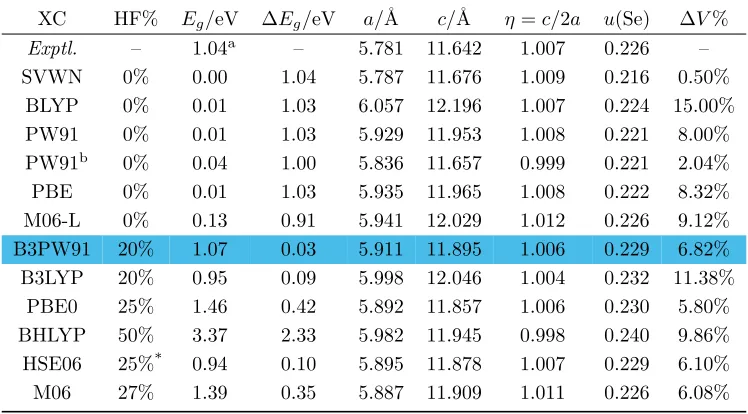
Tables 2.2 and 2.3 show that the original hybrid scheme of Becke, B3PW91[60], leads to the
low-est errors in the band gaps, with values that are 0.03 eV larger for CuInSe2and 0.09 eV smaller for
CuGaSe2. The B3PW91 calculated band structures and DOS are shown in Fig. 2.1 and 2.2,
predict-ing correctly the direct band gap type for both CuInSe2 and CuGaSe2. In contrast, LDA(SVWN)
leads to a zero band gap for CuInSe2, while the GGA methods (PW91, PBE, and BLYP) lead to
a gap of only 0.01 eV (99 to 100% error!), though the non-hybrid meta-GGA (M06-L) improves
slightly with a value of 0.13 eV. Both the global hybrid B3LYP and screened hybrid HSE06 lead
to too low a gap by 0.09 and 0.10 eV for CuInSe2 and 0.27 and 0.20 eV for CuGaSe2, while PBE0
leads to gaps that are too large (by 0.42 eV for CuInSe2 and 0.35 eV for CuGaSe2).
From Tables 2.2 and 2.3 we see that:
(1) The calculated band gaps increase with the percentage of HF exchange, as pointed out by Yang
et al[19]. Including exact exchange brings in increased localization of the electronic states, which neutralizes the delocalization error of accompanying conventional XC functionals, and
is clearly the key ingredient in obtaining accurate band gaps. The higher tier of “Jacob’s
ladder”, meta-GGA, indeed improves over GGA on band gaps, yet slightly, and the derived
hybrid meta-GGA, M06, does not perform better than hybrid GGAs, most likely because the
percentage of HF exchange is not optimal here.
(2) B3PW91 is better than the most popular hybrid functional B3LYP for both lattice parameters
and band gaps. Kresseet al. observed this also on metals[69]. The explanation may be that B3LYP underestimates the correlation energy of the uniform electron gas by about 30%, while
B3PW91 was designed to be exact for this limit. This suggests that the periodic
Table 2.2. Predicted band gap and lattice parameters for CuInSe2chalcopyrite crystal from various levels of XC functionals. Here η = c/2a is the tetragonal distortion, and u(Se) is the internal degree of freedom. HF% is the percentage of mixed HF exchange. ∆Egand ∆V% are the absolute and relative errors in band gap and volume, respectively, compared to experiment.
XC HF% Eg/eV ∆Eg/eV a/˚A c/˚A η=c/2a u(Se) ∆V%
Exptl. – 1.04a – 5.781 11.642 1.007 0.226 –
SVWN 0% 0.00 1.04 5.787 11.676 1.009 0.216 0.50%
BLYP 0% 0.01 1.03 6.057 12.196 1.007 0.224 15.00%
PW91 0% 0.01 1.03 5.929 11.953 1.008 0.221 8.00%
PW91b 0% 0.04 1.00 5.836 11.657 0.999 0.221 2.04%
PBE 0% 0.01 1.03 5.935 11.965 1.008 0.222 8.32%
M06-L 0% 0.13 0.91 5.941 12.029 1.012 0.226 9.12% B3PW91 20% 1.07 0.03 5.911 11.895 1.006 0.229 6.82% B3LYP 20% 0.95 0.09 5.998 12.046 1.004 0.232 11.38%
PBE0 25% 1.46 0.42 5.892 11.857 1.006 0.230 5.80% BHLYP 50% 3.37 2.33 5.982 11.945 0.998 0.240 9.86% HSE06 25%* 0.94 0.10 5.895 11.878 1.007 0.229 6.10% M06 27% 1.39 0.35 5.887 11.909 1.011 0.226 6.08% aRef. [48]. bresults from Ref. [68], using plane wave basis sets with USPP.
*
screened HF exchange.
[image:23.612.142.504.410.653.2]Table 2.3. Predicted band gap and lattice parameters for CuGaSe2chalcopyrite crystal from various levels of XC functionals. Here η = c/2a is the tetragonal distortion, and u(Se) is the internal degree of freedom. HF% is the percentage of mixed HF exchange. ∆Egand ∆V% are the absolute and relative errors in band gap and volume, respectively, compared to experiment.
XC HF% Eg/eV ∆Eg/eV a/˚A c/˚A η=c/2a u(Se) ∆V%
Exptl. – 1.67a – 5.614 11.022 0.982 0.259 –
SVWN 0% 0.24 1.43 5.589 11.135 0.996 0.243 0.13%
BLYP 0% 0.02 1.65 5.852 11.589 0.990 0.250 14.25%
PW91 0% 0.10 1.57 5.729 11.358 0.991 0.248 7.31%
PW91b 0% 0.14 1.53 5.609 11.147 0.994 0.244 0.95%
PBE 0% 0.10 1.57 5.735 11.366 0.991 0.248 7.61%
M06-L 0% 0.62 1.05 5.769 11.277 0.977 0.254 8.04% B3PW91 20% 1.58 0.09 5.729 11.234 0.981 0.255 6.14% B3LYP 20% 1.40 0.27 5.812 11.371 0.978 0.257 10.57%
PBE0 25% 2.02 0.35 5.714 11.184 0.979 0.255 5.12% BHLYP 50% 3.96 2.29 5.810 11.206 0.964 0.265 8.89% HSE06 25%* 1.47 0.20 5.718 11.192 0.979 0.255 5.33% M06 27% 1.91 0.24 5.728 11.204 0.978 0.255 5.81% aRef. [49]. bresults from Ref. [68], using plane wave basis sets with USPP.
*
screened HF exchange.
[image:24.612.105.468.410.653.2](3) The correlation plays a role in predicting structures. LYP renders the worst results, and PW91
is the best among GGA correlation.
(4) Our PW91 results are comparable to those using plane wave basis sets with USPP, validating
the accuracy of the Gaussian basis sets used here.
2.4
Benchmark on a set of 27 binary and ternary
semicon-ductors
To further evaluate the accuracy of B3PW91 for band gaps of semiconductors, we considered a test
set of 27 semiconductors comprising ternary compounds with chalcopyrite structure (currently of
great interest for photovoltaic applications) and binary semiconductors with the zinc-blende
struc-ture (such as CdS) that are also important solar cell materials. Note our test set considers only
direct band gap semiconductors. The results are shown in Table 2.4. We see that B3PW91 yields a
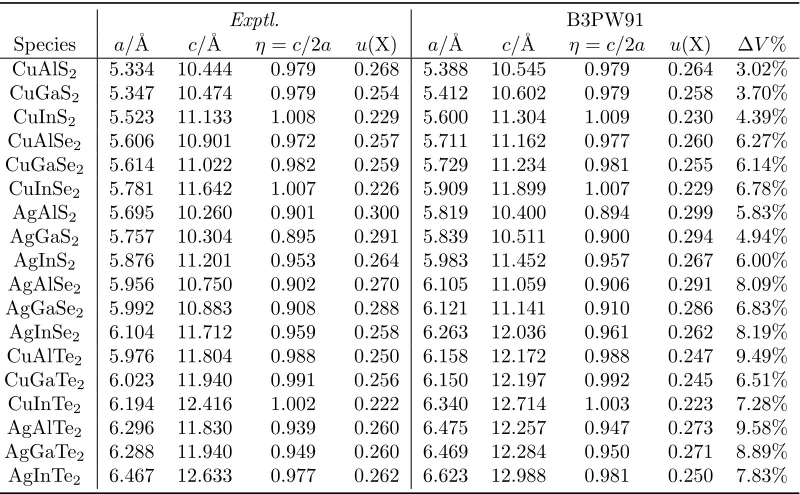
MAD = 0.09 eV for band gaps. Moreover, Tables 2.5 and 2.6 show that B3PW91 leads to accurate
lattice parameters, with MRD = 2.2%. Generally, B3PW91 is better than B3LYP, which gives MAD
= 0.19 eV for band gaps, and MRD = 3.4% for lattice parameters (Tables 2.7, 2.8, and 2.9).
Prior calculations[25–29] have shown that the incorporation of (global or screened) HF exchange
can improve the accuracy of DFT band gaps, and the most prominent success is from the screened
hybrid functional family of Heyd-Scuseria-Ernzerhof (HSE)[64–66] that is derived from the global
hybrid functional PBE0 (which includes 25% HF exchange). To validate HSE, Scuseria et al.[29] proposed the SC/40 test set of unary and binary compounds. They showed that the older HSE03
functional gives MAD = 0.26 eV over the SC/40 set. They rationalized this increased accuracy
by comparison with results from TDDFT calculations[70]. Among the SC/40 set are 9 binary
semiconductors that are also in our test set. Comparing HSE03 (Table 2.10) and B3PW91 (Table
2.4) for this common set, we find that B3PW91 leads to MAD = 0.08 eV, which is significantly
better than MAD = 0.27 eV from HSE03. Furthermore, we performed the benchmark calculations
over our 27-semiconductor set with the newer HSE06, which leads to MAD = 0.18 eV (Table 2.10),
twice that of B3PW91, although the lattice parameters are slightly better with MRD = 2.0% (Tables
2.11 and 2.12). It appears that the HSE screening of long-range HF exchange reduces the 25% HF in
PBE0 to something approaching the hybrid level of 20% HF in B3PW91, which probably provides
a better mixing ratio for semiconductors of∼1–4 eV band gaps. A complication with HSE is that the screening parameter is generally system dependent[70]. Thus in HSE, additional effort must
be made to hunt for the optimum choice for each specific system. With B3PW91, no such system
Table 2.4. Predicted band gaps (eV) for 27 semiconductors with B3PW91 (MAD = 0.09 eV).
Species Exptl. B3PW91 Species Exptl. B3PW91 Species Exptl. B3PW91 InP 1.42a 1.68 CuAlS2 3.46b 3.47 AgAlSe2 2.55c 2.60 InAs 0.41a 0.41 CuGaS2 2.50d 2.47 AgGaSe2 1.82b 1.65 InSb 0.23a 0.30 CuInS2 1.55b 1.60 AgInSe2 1.24e 1.24
ZnS 3.84a 3.75 CuAlSe
2 2.65f 2.55 CuAlTe2 2.06g 2.25 ZnSe 2.83a 2.73 CuGaSe
2 1.67f 1.58 CuGaTe2 1.25g 1.34 ZnTe 2.39a 2.28 CuInSe
2 1.04e 1.07 CuInTe2 1.00h 1.14 CdS 2.58a 2.55 AgAlS
2 3.60i 3.50 AgAlTe2 2.35j 2.12 CdSe 1.85a 1.84 AgGaS
2 2.70k 2.60 AgGaTe2 1.36j 1.21 CdTe 1.61a 1.67 AgInS
2 1.87b 1.87 AgInTe2 1.04j 1.09
a
Ref. [50]. bRef. [71]. cRef. [72]. dRef. [73]. eRef. [48]. fRef. [49]. gRef. [74].
hRef. [75]. iRef. [76]. jRef. [77]. kRef. [78].
Table 2.5. Predicted lattice parameters (a/˚A) for 9 binary semiconductors with B3PW91 (MRD = 1.9%).
Species Exptl. B3PW91 Species Exptl. B3PW91 Species Exptl. B3PW91
InP 5.869 5.944 ZnS 5.345 5.458 CdS 5.811 5.933
InAs 6.058 6.159 ZnSe 5.669 5.754 CdSe 6.077 6.217
InSb 6.479 6.584 ZnTe 6.103 6.212 CdTe 6.483 6.643
Table 2.6. Predicted lattice parameters for 18 ternary semiconductors with B3PW91 (MRD = 2.2%). X = S, Se, Te inu(X).
Exptl. B3PW91
Table 2.7. Predicted band gaps (eV) for 27 semiconductors with B3LYP (MAD = 0.19 eV).
Species Exptl. B3LYP Species Exptl. B3LYP Species Exptl. B3LYP
InP 1.42a 1.32 CuAlS
2 3.46b 3.37 AgAlSe2 2.55c 2.52 InAs 0.41a 0.00 CuGaS
2 2.50d 2.26 AgGaSe2 1.82b 1.50 InSb 0.23a 0.00 CuInS
2 1.55b 1.47 AgInSe2 1.24e 1.15 ZnS 3.84a 3.53 CuAlSe2 2.65f 2.47 CuAlTe2 2.06g 2.09 ZnSe 2.83a 2.52 CuGaSe2 1.67f 1.40 CuGaTe2 1.25g 1.12 ZnTe 2.39a 2.01 CuInSe2 1.04e 0.95 CuInTe2 1.00h 0.99 CdS 2.58a 2.36 AgAlS2 3.60i 3.40 AgAlTe2 2.35j 1.98 CdSe 1.85a 1.68 AgGaS
2 2.70k 2.43 AgGaTe2 1.36j 1.02 CdTe 1.61a 1.47 AgInS
2 1.87b 1.76 AgInTe2 1.04j 0.94
aRef. [50]. bRef. [71]. cRef. [72]. dRef. [73]. eRef. [48]. fRef. [49]. gRef. [74].
h
Ref. [75]. iRef. [76]. jRef. [77]. kRef. [78].
Table 2.8. Predicted lattice parameters (a/˚A) for 9 binary semiconductors with B3LYP (MRD = 3.1%).
Species Exptl. B3LYP Species Exptl. B3LYP Species Exptl. B3LYP
InP 5.869 6.015 ZnS 5.345 5.520 CdS 5.811 6.004
InAs 6.058 6.245 ZnSe 5.669 5.820 CdSe 6.077 6.289 InSb 6.479 6.681 ZnTe 6.103 6.290 CdTe 6.483 6.726
Table 2.9. Predicted lattice parameters for 18 ternary semiconductors with B3LYP (MRD = 3.6%). X = S, Se, Te inu(X).
Exptl. B3LYP
Species a/˚A c/˚A η=c/2a u(X) a/˚A c/˚A η=c/2a u(X) ∆V% CuAlS2 5.334 10.444 0.979 0.268 5.462 10.628 0.973 0.268 6.74% CuGaS2 5.347 10.474 0.979 0.254 5.494 10.731 0.977 0.260 8.13% CuInS2 5.523 11.133 1.008 0.229 5.686 11.453 1.007 0.234 9.03% CuAlSe2 5.606 10.901 0.972 0.257 5.785 11.258 0.973 0.264 9.99% CuGaSe2 5.614 11.022 0.982 0.259 5.812 11.371 0.978 0.257 10.56%
Table 2.10. Predicted band gaps (eV) for 27 semiconductors with HSE06 (MAD = 0.18 eV). Previous results using HSE03[29] are also shown where available which leads to MAD = 0.27 eV.
Species Exptl. HSE06 HSE03* Species Exptl. HSE06 Species Exptl. HSE06 InP 1.42a 1.59 1.64 CuAlS
2 3.46b 3.29 AgAlSe2 2.55c 2.41 InAs 0.41a 0.41 0.39 CuGaS
2 2.50d 2.32 AgGaSe2 1.82b 1.50 InSb 0.23a 0.34 0.29 CuInS2 1.55b 1.45 AgInSe2 1.24e 1.08
ZnS 3.84a 3.55 3.42 CuAlSe
2 2.65f 2.38 CuAlTe2 2.06g 2.07 ZnSe 2.83a 2.56 2.32 CuGaSe
2 1.67f 1.47 CuGaTe2 1.25g 1.23 ZnTe 2.39a 2.12 2.19 CuInSe
2 1.04e 0.94 CuInTe2 1.00h 1.01 CdS 2.58a 2.32 2.14 AgAlS2 3.60i 3.31 AgAlTe2 2.35j 1.93 CdSe 1.85a 1.66 1.39 AgGaS
2 2.70k 2.42 AgGaTe2 1.36j 1.08 CdTe 1.61a 1.51 1.52 AgInS
2 1.87b 1.68 AgInTe2 1.04j 0.94
*results from Ref. [29]. aRef. [50]. bRef. [71]. cRef. [72]. dRef. [73]. eRef. [48].
f
Ref. [49]. gRef. [74]. hRef. [75]. iRef. [76]. jRef. [77]. kRef. [78].
Table 2.11. Predicted lattice parameters (a/˚A) for 9 binary semiconductors with HSE06 (MRD = 1.6%). Pre-vious results using HSE03[29] lead to MRD = 1.1%.
Species Exptl. HSE06 HSE03* Species Exptl. HSE06 HSE03* Species Exptl. HSE06 HSE03* InP 5.869 5.928 5.909 ZnS 5.345 5.446 5.432 CdS 5.811 5.919 5.896 InAs 6.058 6.141 6.120 ZnSe 5.669 5.745 5.707 CdSe 6.077 6.204 6.152 InSb 6.479 6.566 6.535 ZnTe 6.103 6.205 6.150 CdTe 6.483 6.630 6.568 *
results from Ref. [29].
Table 2.12. Predicted lattice parameters for 18 ternary semiconductors with HSE06 (MRD = 2.0%). X = S, Se, Te inu(X).
Exptl. HSE06
2.5
Concluding remarks
In summary, we show that the B3PW91 hybrid functional provides accurate band gap predictions
for semiconductors of∼1–4 eV band gaps (MAD = 0.09 eV) while also leading to accurate lattice parameters. Thus we recommend B3PW91 combined with standard molecular Gaussian type basis
sets as a practical choice for investigating electronic structures in semiconductor devices. This
should provide the basis for more accurate predictions of band offsets at semiconductor interfaces
and more accurate positioning of impurity levels in the band gaps for the design of photovoltaic,
thermoelectric, and other new semiconductor systems.
Appendix
This appendix lists, with the CRYSTAL14 input format, all ECP and pruned basis sets (see
discus-sions in Sec. 2.2) used for periodic calculations in this chapter.
Al 13 5
0 0 6 2.0 1.0
13983.1000000 0.00194267 2098.7500000 0.0148599
477.7050000 0.0728494 134.3600000 0.2468300 42.8709000 0.4872580 14.5189000 0.3234960 0 1 6 8.0 1.0
239.6680000 -0.00292619 0.00460285
57.4419000 -0.0374080 0.0331990
18.2859000 -0.1144870 0.1362820
6.5991400 0.1156350 0.3304760
2.4904900 0.6125950 0.4491460
0.9445400 0.3937990 0.2657040
0 1 3 3.0 1.0
1.2779000 -0.2276060 -0.0175130
0.3975900 0.00144583 0.2445330
0.1600950 1.0927900 0.8049340
0 1 1 0.0 1.0
0.1000000 1.0000000 1.0000000
0 3 1 0.0 1.0
0.3250000 1.0000000
P 15 5
0 0 6 2.0 1.0
19413.3000000 0.0018516 2909.4200000 0.0142062 661.3640000 0.0699995 185.7590000 0.2400790 59.1943000 0.4847620 20.0310000 0.3352000 0 1 6 8.0 1.0
339.4780000 -0.00278217 0.00456462
81.0101000 -0.0360499 0.03369360
25.8780000 -0.1166310 0.13975500
9.4522100 0.0968328 0.33936200
3.6656600 0.6144180 0.45092100
1.4674600 0.4037980 0.23858600
0 1 3 5.0 1.0
2.1562300 -0.2529230 -0.01776530
0.7489970 0.0328517 0.27405800
0.2831450 1.0812500 0.78542100
0 1 1 0.0 1.0
0.1000000 1.0000000 1.00000000
0 3 1 0.0 1.0
S 16 5
0 0 6 2.0 1.0
21917.1000000 0.0018690 3301.4900000 0.0142300 754.1460000 0.0696960 212.7110000 0.2384870 67.9896000 0.4833070 23.0515000 0.3380740 0 1 6 8.0 1.0
423.7350000 -0.0023767 0.0040610
100.7100000 -0.0316930 0.0306810
32.1599000 -0.1133170 0.1304520
11.8079000 0.0560900 0.3272050
4.6311000 0.5922550 0.4528510
1.8702500 0.4550060 0.2560420
0 1 3 6.0 1.0
2.6158400 -0.2503740 -0.0145110
0.9221670 0.0669570 0.3102630
0.3412870 1.0545100 0.7544830
0 1 1 0.0 1.0
0.1171670 1.0000000 1.0000000
0 3 1 0.0 1.0
0.6500000 1.0000000
Cu 229 7 INPUT
19.0 1 3 2 0 0 0
23.2906000 -4.0027600 -1
2.6205900 3.3246500 -2
7.8108200 224.3233000 0
6.6332400 -180.3047000 0
51.1573400 3.4213000 -2
14.7340600 105.7012600 0
0 1 4 8.0 1.0
83.4200000 -0.0048290 -0.0082840
7.9700000 -0.6447990 -0.3218950
5.6000000 0.2652400 0.6181330
1.9320000 1.1897910 0.7221840
0 1 2 1.0 1.0
2.8660000 -0.0747740 -0.0005410
0.1319000 1.0170370 1.0000580
0 1 1 0.0 1.0
0.6874000 1.0000000 1.0000000
0 1 1 0.0 1.0
0.1000000 1.0000000 1.0000000
0 3 4 10.0 1.0
65.8000000 0.0255970 18.8200000 0.1486090 6.5380000 0.4117860 2.3480000 0.6055070 0 3 1 0.0 1.0
0.7691000 1.0000000 0 3 1 0.0 1.0
0.2065000 1.0000000
Zn 230 7 INPUT
20.0 1 3 2 0 0 0
24.8870500 -3.9164800 -1
2.7915900 3.4308200 -2
8.3267600 244.3163400 0
7.0965100 -199.4271100 0
75.7060300 4.1147300 -2
16.0762700 118.2993600 0
0 1 4 8.0 1.0
113.5000000 -0.0042800 -0.0074290
8.3080000 -0.8202320 -0.4326050
6.3320000 0.4250060 0.7234510
2.1460000 1.1980770 0.7272170
0 1 2 2.0 1.0
2.9060000 -0.0823560 -0.0230010
0.1623000 1.0215740 1.0028240
0 1 1 0.0 1.0
0 1 1 0.0 1.0
0.1000000 1.0000000 1.0000000
0 3 4 10.0 1.0
65.9900000 0.0276530 19.8100000 0.1587940 6.9450000 0.4209710 2.5430000 0.5852770 0 3 1 0.0 1.0
0.9165000 1.0000000 0 3 1 0.0 1.0
0.3264000 1.0000000
Ga 231 7 INPUT
21.0 1 3 2 0 0 0
26.7430200 -3.8736300 -1
3.4653000 4.1247200 -2
9.1113000 260.7326300 0
7.8932900 -223.9600300 0
79.9935300 4.2003300 -2
17.3911400 127.9913900 0
0 1 4 8.0 1.0
113.9000000 -0.0017110 -0.0080460
9.1550000 -0.8230360 -0.3574320
6.6330000 0.4586180 0.6637940
2.2780000 1.1618170 0.7136190
0 1 2 3.0 1.0
2.1230000 -0.1455060 -0.0962610
0.1939000 1.0511470 1.0175730
0 1 1 0.0 1.0
0.8818000 1.0000000 1.0000000
0 1 1 0.0 1.0
0.1000000 1.0000000 1.0000000
0 3 4 10.0 1.0
70.4300000 0.0288770 21.0500000 0.1662530 7.4010000 0.4277760 2.7520000 0.5704100 0 3 1 0.0 1.0
1.0260000 1.0000000 0 3 1 0.0 1.0
0.3907000 1.0000000
As 233 9 INPUT
23. 0 2 4 6 2 0 28.725122 370.114025 0
6.7676810 9.3492960 0
45.3310640 99.1421030 0
44.7674150 198.3078800 0
19.5390900 28.3830730 0
18.9734710 56.8714640 0
51.0571520 -18.4851450 0
50.1513400 -28.1135300 0
16.1089360 -1.2238950 0
14.6722230 -1.3457650 0
3.8519270 0.1017570 0
3.8135020 0.1703380 0
11.9405840 -0.7752300 0
17.7611600 -2.1572590 0
0 0 6 2.0 1.0
2542.8100000 0.0011370 381.1690000 0.0060550 40.2342000 0.0841250 16.1217000 -0.4052850 3.2018900 0.7129260 1.4209600 0.4733760 0 0 6 2.0 1.0
2542.8100000 -0.0003900 381.1690000 -0.0021900 40.2342000 -0.0268530 16.1217000 0.1368780 3.2018900 -0.3204570 1.4209600 -0.3373910 0 0 1 0.0 1.0
0 0 1 0.0 1.0
0.1167350 1.0000000 0 2 6 6.0 1.0
99.5349000 0.0038570 24.1195000 -0.0851010 5.8419600 0.4047620 2.5601000 0.5314780 1.0930800 0.1840120 0.3184240 0.0057640 0 2 6 3.0 1.0
99.5349000 -0.0007720 24.1195000 0.0199410 5.8419600 -0.1072100 2.5601000 -0.1722590 1.0930800 0.0087610 0.3184240 0.5697440 0 2 1 0.0 1.0
0.1009720 1.0000000 0 3 6 10.0 1.0
113.5090000 0.0119800 36.8872000 0.0795440 13.6893000 0.2367550 5.3896400 0.4015340 2.0804600 0.4066860 0.7375680 0.1731620 0 3 1 0.0 1.0
0.3078000 1.0000000
Se 234 3 INPUT
6.0 1 2 2 2 0 0
2.0935600 -5.5849800 -1
20.5564400 13.2808100 -2
3.1549000 51.0001100 0
2.5849500 1.7964000 -2
2.5852600 30.4378700 0
1.3829000 2.4000100 -2
1.4267100 6.5994800 0
0 1 4 6.0 1.0
3.711000000 0.05574400 -0.00601400 1.586000000 -0.51052000 -0.12144700 0.533900000 0.48075500 0.45260700 0.208500000 0.81029200 0.66975100 0 1 1 0.0 1.0
0.100000000 1.00000000 1.00000000 0 3 2 0.0 1.0
1.709860600 0.99541800 0.552825300 1.00000000
Ag 247 7 INPUT
19.0 1 3 3 2 0 0
9.0169600 -8.4466900 -1
1.5174000 6.2063400 -2
3.2308800 -56.8262400 0
4.8274700 92.4017300 0
1.2169900 3.7563700 -2
3.1861500 -80.9533500 0
4.0534900 118.8680100 0
22.9402000 3.4089500 -2
6.2662700 57.1051300 0
0 1 4 8.0 1.0
63.5600000 -0.0007310 -0.0042340
6.3900000 1.3927360 0.0612760
5.0220000 -2.8731020 -0.3387460
1.7890000 2.0173610 1.1908320
0 1 2 1.0 1.0
2.4510000 -0.0725390 -0.0498300
0.1561000 1.0213580 1.0065160
0 1 1 0.0 1.0
0.6871000 1.0000000 1.0000000
0 1 1 0.0 1.0
0.1000000 1.0000000 1.0000000
0 3 3 10.0 1.0
1.2330000 0.6812940 0 3 1 0.0 1.0
0.5057000 1.0000000 0 3 1 0.0 1.0
0.1900000 1.0000000
Cd 248 7 INPUT
20.0 1 3 3 2 0 0
9.8132500 -8.6986400 -1
1.6047600 6.5693400 -2
3.3772700 -59.3639500 0
5.0887600 93.5961000 0
1.2517100 3.6786300 -2
3.4259200 -104.5069400 0
4.2141500 145.6731600 0
22.3533700 3.3309400 -2
6.7540800 62.0661600 0
0 1 4 8.0 1.0
63.3800000 -0.0004640 -0.0048740
6.7140000 2.2928770 0.1896300
5.6020000 -3.9028840 -0.4918720
1.9710000 2.0846040 1.2135010
0 1 2 2.0 1.0
2.6960000 -0.0648660 -0.0533380
0.1758000 1.0196610 1.0071020
0 1 1 0.0 1.0
0.7689000 1.0000000 1.0000000
0 1 1 0.0 1.0
0.1000000 1.0000000 1.0000000
0 3 3 10.0 1.0
15.5100000 0.0120650 2.9410000 0.3701680 1.3790000 0.6807600 0 3 1 0.0 1.0
0.5782000 1.0000000 0 3 1 0.0 1.0
0.2300000 1.0000000
In 249 7 INPUT
21.0 1 3 3 2 0 0
10.5898700 -8.8403100 -1
1.7388300 6.9012400 -2
3.6280600 -68.4831900 0
5.3027000 101.7727200 0
1.4304500 3.9855400 -2
3.7444700 -129.7859400 0
4.4767900 171.9048700 0
29.1607200 3.4924400 -2
7.2656600 68.2781600 0
0 1 4 8.0 1.0
71.7600000 0.0007330 -0.0045130
7.6540000 1.0897810 0.0316150
5.6160000 -2.7310890 -0.3380060
2.1040000 2.1128440 1.2134640
0 1 2 3.0 1.0
2.6100000 -0.0996900 -0.1103170
0.1901000 1.0312300 1.0139000
0 1 1 0.0 1.0
0.8410000 1.0000000 1.0000000
0 1 1 0.0 1.0
0.1000000 1.0000000 1.0000000
0 3 3 10.0 1.0
17.1600000 0.0148930 3.1270000 0.3881350 1.4750000 0.6626390 0 3 1 0.0 1.0
0.6452000 1.0000000 0 3 1 0.0 1.0
0.2754000 1.0000000
Sb 251 9 INPUT
16.3308650 281.0715810 0
8.5565420 61.7166040 0
14.4703370 67.4573800 0
13.8161940 134.9335030 0
8.4249240 14.7163440 0
8.0927280 29.5185120 0
14.8863310 35.4478150 0
15.1463190 53.1434660 0
5.9082670 9.1792230 0
5.5943220 13.2402530 0
14.4449780 -15.3668010 0
14.4492950 -20.2961380 0
0 0 6 2.0 1.0
371.5840000 0.0015910 26.5392000 -0.0416840 16.6213000 0.2733430 7.7355100 -0.7676850 1.8923400 0.8994960 0.9104310 0.4313870 0 0 6 2.0 1.0
371.5840000 0.0006540 26.5392000 -0.0109620 16.6213000 0.0938330 7.7355100 -0.3040090 1.8923400 0.5084090 0.9104310 0.3392390 0 0 1 0.0 1.0
0.2442310 1.0000000 0 0 1 0.0 1.0
0.1000000 1.0000000 0 2 5 6.0 1.0
16.0509000 0.0921570 10.2621000 -0.2755590 2.4283200 0.6586400 1.0336000 0.4668920 0.2594400 0.0285110 0 2 5 3.0 1.0
16.0509000 -0.0253130 10.2621000 0.0797960 2.4283200 -0.2420940 1.0336000 -0.1486050 0.2594400 0.5489440 0 2 1 0.0 1.0
0.1000000 1.0000000 0 3 5 10.0 1.0
45.4785000 0.0032590 18.5114000 -0.0054970 3.9160000 0.2799530 1.7148200 0.5127510 0.6973190 0.3328720 0 3 1 0.0 1.0
0.2304000 1.0000000
Te 252 3 INPUT
6.0 2 3 3 2 0 0
0.9484700 -3.9598400 -1
3.9468200 -13.4287100 -1
3.4940000 12.9566500 -2
1.2147700 -47.4588200 0
1.3353000 72.7751400 0
1.3739400 8.4792100 -2
1.2776100 -39.4068400 0
1.2842500 51.9367300 0
3.6661800 11.5466300 -2
0.9318900 11.2377600 0
0 1 4 6.0 1.0
2.364000000 0.08717900 -0.00398200 0.976900000 -0.77682600 -0.23690000 0.464700000 0.56325000 0.40146700 0.177100000 0.92605300 0.79317900 0 1 1 0.0 1.0
0.100000000 1.00000000 1.00000000 0 3 2 0.0 1.0
References
[1] Hohenberg, P & Kohn, W. (1964) Inhomogeneous electron gas. Phys. Rev.136, B864–B871. [2] Kohn, W & Sham, L. J. (1965) Self-consistent equations including exchange and correlation
effects. Phys. Rev.140, A1133–A1138.
[3] Kohn, W. (1999) Nobel lecture: Electronic structure of matter-wave functions and density
functionals. Rev. Mod. Phys.71, 1253–1266.
[4] Xiao, H, Tahir-Kheli, J, & Goddard, W. A. (2011) Accurate band gaps for semiconductors from
density functional theory. J. Phys. Chem. Lett.2, 212–217.
[5] Kohn, W, Becke, A. D, & Parr, R. G. (1996) Density functional theory of electronic structure.
J. Phys. Chem.100, 12974–12980.
[6] Baerends, E. J & Gritsenko, O. V. (1997) A quantum chemical view of density functional
theory. J. Phys. Chem. A 101, 5383–5403.
[7] Savin, A, Umrigar, C, & Gonze, X. (1998) Relationship of Kohn-Sham eigenvalues to excitation
energies. Chem. Phys. Lett.288, 391–395.
[8] Stowasser, R & Hoffmann, R. (1999) What do the Kohn-Sham orbitals and eigenvalues mean?
J. Am. Chem. Soc.121, 3414–3420.
[9] Baerends, E. J. (2000) Perspective on “Self–consistent equations including exchange and
cor-relation effects”. Theor. Chem. Acc.103, 265–269.
[10] Chong, D. P, Gritsenko, O. V, & Baerends, E. J. (2002) Interpretation of the Kohn-Sham
orbital energies as approximate vertical ionization potentials. J. Chem. Phys.116, 1760–1772. [11] Koch, W & Holthausen, M. C. (2001)A Chemist’s Guide to Density Functional Theory, Second
Edition. (Wiley-VCH, Weinheim).
[12] Koopmans, T. (1934) ¨Uber die zuordnung von wellenfunktionen und eigenwerten zu den
einzel-nen elektroeinzel-nen eines atoms. Physica 1, 104–113.
[13] Perdew, J, Parr, R, Levy, M, & Balduz, J. (1982) Density-functional theory for fractional
particle number: Derivative discontinuities of the energy. Phys. Rev. Lett.49, 1691–1694. [14] Levy, M, Perdew, J, & Sahni, V. (1984) Exact differential equation for the density and ionization
energy of a many-particle system. Phys. Rev. A30, 2745–2748.
[15] Cohen, A. J, Mori-S´anchez, P, & Yang, W. (2008) Fractional charge perspective on the band
[16] Yang, W, Cohen, A. J, & Mori-S´anchez, P. (2012) Derivative discontinuity, bandgap and lowest
unoccupied molecular orbital in density functional theory. J. Chem. Phys.136, 204111. [17] Parr, R. G & Pearson, R. G. (1983) Absolute hardness: Companion parameter to absolute
electronegativity. J. Am. Chem. Soc.105, 7512–7516.
[18] Yang, W, Zhang, Y, & Ayers, P. (2000) Degenerate ground states and a fractional number
of electrons in density and reduced density matrix functional theory. Phys. Rev. Lett. 84, 5172–5175.
[19] Mori-S´anchez, P, Cohen, A. J, & Yang, W. (2008) Localization and delocalization errors in
density functional theory and implications for band-gap prediction. Phys. Rev. Lett. 100, 146401.
[20] Perdew, J & Levy, M. (1983) Physical content of the exact Kohn-Sham orbital energies: Band
gaps and derivative discontinuities. Phys. Rev. Lett.51, 1884–1887.
[21] Sham, L & Schl¨uter, M. (1983) Density-functional theory of the energy gap. Phys. Rev. Lett.
51, 1888–1891.
[22] Yang, W, Ayers, P, & Wu, Q. (2004) Potential functionals: Dual to density functionals and
solution to thev-representability problem. Phys. Rev. Lett.92, 146404.
[23] Heaton-Burgess, T, Ayers, P, & Yang, W. (2007) Spin-potential functional formalism for
current-carrying noncollinear magnetic systems. Phys. Rev. Lett.98, 036403.
[24] Cohen, A. J, Mori-S´anchez, P, & Yang, W. (2008) Insights into current limitations of density
functional theory. Science321, 792–794.
[25] Seidl, A, G¨orling, A, Vogl, P, Majewski, J, & Levy, M. (1996) Generalized Kohn-Sham schemes
and the band-gap problem. Phys. Rev. B53, 3764–3774.
[26] Muscat, J, Wander, A, & Harrison, N. M. (2001) On the prediction of band gaps from hybrid
functional theory. Chem. Phys. Lett. 342, 397–401.
[27] Perry, J, Tahir-Kheli, J, & Goddard, W. A. (2001) Antiferromagnetic band structure of
La2CuO4: Becke-3–Lee-Yang-Parr calculations. Phys. Rev. B63, 144510.
[28] Perry, J, Tahir-Kheli, J, & Goddard, W. A. (2002) Ab initio evidence for the formation of
impurityd3z2−r2 holes in doped La2−xSrxCuO4. Phys. Rev. B 65, 144501.
[29] Heyd, J, Peralta, J. E, Scuseria, G. E, & Martin, R. L. (2005) Energy band gaps and lattice
[30] Jackson, P, Hariskos, D, Lotter, E, Paetel, S, Wuerz, R, Menner, R, Wischmann, W, & Powalla,
M. (2011) New world record efficiency for Cu(In,Ga)Se2thin-film solar cells beyond 20%. Prog.
Photovoltaics19, 894–897.
[31] Pulay, P. (1969) Ab initio calculation of force constants and equilibrium geometries in
poly-atomic molecules. Mol. Phys.17, 197–204.
[32] Xiao, H & Goddard, W. A. (2014) Predicted roles of defects on band offsets and energetics at
CIGS (Cu(In,Ga)Se2/CdS) solar cell interfaces and implications for improving performance. J.
Chem. Phys.141, 094701.
[33] Dovesi, R, Saunders, V. R, Roetti, C, Orlando, R, Zicovich-Wilson, C. M, Pascale, F, Civalleri,
B, Doll, K, Harrison, N. M, Bush, I. J, DArco, P, Llunell, M, Caus`a, M, & No¨el, Y. (2014)
CRYSTAL14 User’s Manual. (University of Torino, Torino).
[34] Goddard, W. A. (1968) New foundation for the use of pseudopotentials in metals. Phys. Rev.
174, 659–662.
[35] Kahn, L. R & Goddard, W. A. (1972) Ab initio effective potentials for use in molecular
calculations. J. Chem. Phys.56, 2685–2701.
[36] Melius, C. F & Goddard, W. A. (1974) Ab initio effective potentials for use in molecular
quantum mechanics. Phys. Rev. A10, 1528–1540.
[37] Kahn, L. R, Baybutt, P, & Truhlar, D. G. (1976) Ab initio effective core potentials: Reduction
of all-electron molecular structure calculations to calculations involving only valence electrons.
J. Chem. Phys.65, 3826–3853.
[38] Peralta, J. E, Heyd, J, Scuseria, G. E, & Martin, R. L. (2006) Spin-orbit splittings and energy
band gaps calculated with the Heyd-Scuseria-Ernzerhof screened hybrid functional. Phys. Rev. B74, 073101.
[39] Kim, Y.-S, Hummer, K, & Kresse, G. (2009) Accurate band structures and effective masses for
inp, inas, and insb using hybrid functionals. Phys. Rev. B80, 035203.
[40] Durand, P & Barthelat, J.-C. (1975) A theoretical method to determine atomic pseudopotentials
for electronic structure calculations of molecules and solids. Theor. Chim. Acta 38, 283–302. [41] Christiansen, P. A, Lee, Y. S, & Pitzer, K. S. (1979) Improved ab initio effective core potentials
for molecular calculations. J. Chem. Phys.71, 4445–4450.
[42] Stevens, W. J, Krauss, M, Basch, H, & Jasien, P. G. (1992) Relativistic compact effective
potentials and efficient, shared-exponent basis sets for the third-, fourth-, and fifth-row atoms.
[43] Dolg, M, Wedig, U, Stoll, H, & Preuss, H. (1987) Energyadjusted ab initio pseudopotentials
for the first row transition elements. J. Chem. Phys.86, 866–872.
[44] Metz, B, Stoll, H, & Dolg, M. (2000) Small-core
multiconfiguration-Dirac-Hartree-Fock-adjusted pseudopotentials for post-d main group elements: Application to PbH and PbO. J. Chem. Phys.113, 2563–2569.
[45] Peterson, K. A. (2003) Systematically convergent basis sets with relativistic pseudopotentials.
I. Correlation consistent basis sets for the post-d group 1315 elements. J. Chem. Phys.119, 11099–11112.
[46] Labello, N. P, Ferreira, A. M, & Kurtz, H. A. (2005) An augmented effective core potential
basis set for the calculation of molecular polarizabilities. J. Comput. Chem.26, 1464–1471. [47] Francl, M. M, Pietro, W. J, Hehre, W. J, Binkley, J. S, Gordon, M. S, DeFrees, D. J, & Pople,
J. A. (1982) Selfconsistent molecular orbital methods. XXIII. A polarization-type basis set for
second-row elements. J. Chem. Phys.77, 3654–3665.
[48] Shay, J. L, Tell, B, Kasper, H. M, & Schiavone, L. M. (1973) Electronic structure of AgInSe2
and CuInSe2. Phys. Rev. B7, 4485–4490.
[49] ShoShirakata, ShigefusaChichibu, & ShigehiroIsomura. (1997) Room-temperature
photore-flectance of CuAlxGa1−xSe2 alloys. Jpn. J. Appl. Phys. 36, 7160–7161.
[50] P¨assler, R. (1999) Parameter sets due to fittings of the temperature dependencies of fundamental
bandgaps in semiconductors. Phys. Stat. Sol. B 216, 975–1007.
[51] Monkhorst, H. J & Pack, J. D. (1976) Special points for Brillouin-zone integrations.Phys. Rev. B13, 5188–5192.
[52] Perdew, J. P & Schmidt, K. (2001) Jacob’s ladder of density functional approximations for the
exchange-correlation energy. AIP Conf. Proc.577, 1–20.
[53] Slater, C. J. (1974) Quantum Theory of Molecules and Solids, Vol. 4. (McGraw-Hill, New York).
[54] Vosko, S. H, Wilk, L, & Nusair, M. (1980) Accurate spin-dependent electron liquid correlation
energies for local spin density calculations: a critical analysis. Can. J. Phys.58, 1200–1211. [55] Becke, A. D. (1988) Density-functional exchange-energy approximation with correct asymptotic
behavior. Phys. Rev. A38, 3098–3100.
[56] Lee, C, Yang, W, & Parr, R. G. (1988) Development of the Colle-Salvetti correlation-energy
[57] Perdew, J. P, Chevary, J. A, Vosko, S. H, Jackson, K. A, Pederson, M. R, Singh, D. J, &
Fiolhais, C. (1992) Atoms, molecules, solids, and surfaces: Applications of the generalized
gradient approximation for exchange and correlation. Phys. Rev. B 46, 6671–6687. erratum. (1993)48, 4978.
[58] Perdew, J. P, Burke, K, & Ernzerhof, M. (1996) Generalized gradient approximation made
simple. Phys. Rev. Lett.77, 3865–3868. erratum. (1997)78, 1396.
[59] Zhao, Y & Truhlar, D. G. (2006) A new local density functional for main-group
thermo-chemistry, transition metal bonding, thermochemical kinetics, and noncovalent interactions. J. Chem. Phys.125, 194101.
[60] Becke, A. D. (1993) Densityfunctional the

![Table 2.10. Predicted band gaps (eV) for 27 semiconductors with HSE06 (MAD = 0.18 eV).Previous results using HSE03[29] are also shown where available which leads to MAD = 0.27 eV.](https://thumb-us.123doks.com/thumbv2/123dok_us/13380.907/28.612.88.491.443.717/table-predicted-semiconductors-previous-results-using-shown-available.webp)