EUROPEAN COAL AND STEEL COMMUNITY EUROPEAN ECONOMIC COMMUNITY EUROPEAN ATOMIC ENERGY ·coMMUNITY
COMMISSION
REPORT
on the
Development of the Social Situation
in the Community
· in 1971
(Addendum to the " Fifth General Report on the Activities of the Communities" in accordance with
article 122 of the Treaty of Rome)
CONTENTS
Introduction 7
A~Qutiine of activities by the Commission of the European
Communities in the social field in 1971 15 .
B-Development' of the Social Situation in the Member · States in 1971
. Chapter !-Employment
ChaP,ter IT-Vocati-onal Guidance and Training
... I
Chapter Til-Industrial Relations ·
Chapter IV _:.Labour Conditions and Law
Chapter V-Wages and Asset Formation
Chapter VI-Housing
. ' ;
Chapter VII-Family Problems
' . :
Chapter VIII-Social Services
. '
Chap~er ., IX-Social Security
0haP.ter. X -'-Safety, Health and Hygiene at Work
XI-Health Protection
C~apier
C.-S~atistical
AppendixAppendix 1-Population,
Employme~t,
UnemploymentAppendix 2-Working Hours
Appendix 3-Wages
Appendix 4-Housing
Appendix 5-Social Security · ·
Appendix 6...,--Industrial Accidents
47
49
68
86
113
131
151
166
177
189
209
220
239
241
255
263
275
283
307
'·
\
INTRODUCTION
1971 was dominated by employment problems. Trade and monetary trends upset the rate of expansion and the J.evel of employment. In prac-ticailly none of the Community's peripheral regions structural unemploy-ment was reduced and this gave rise to the problem of Community solidarity expressed in the Treaties.· This is one of the reasons why in June 1971 the Italian Government submitted to the Coi.mciJ. a Memorandum on Employment in the-Community.
At ·present the services of the Commission are examiningtheltalian Memorandum; they are also watching closely the effects of the American measures on employment in the Community.
Finally, the Commission is glad about the renewal of the European Social Fund in 1971 and concerning the setting up in March 1971 of the Standing Committee on Employment whose main object is to facilitate the coordination of employment policies of the Member States by harmonizing them with obj~tives of the Community.
This is ~he reason why the Commission decided- to devote this Intro-duction of the. Report to the problem of employment, whose importance will have a leading place in the cares of the Community as the outline of the Economic and Monetary Union becomes clearer.
..
Other problems generally requiring bolder Community decisions than , those adopted during the first period of integration are outlined in the brief introductions to. each chapter so as ;to enable a critical study to b¢
made of the_present situation and to skefch out the immediate ou1!look.
I
. The Commission starts from the idea that fuii employment and better · employment, i.e. qualitative employment the best suited to collective
being and to personal promotion const>itutes one of the. major aims of society. In order to achieve this, itis convinced tha~ a voluntary and con-certed effort is nece.ssary.
The
struct~re
as well asth~
level or nature of_ employmentar~
sub-]ected to a process or rapid changes. The events of this evolution as regardsboth the rate and the distribution of its effects .can. no JoQger be held in check at national· level without upsetting the harmonious and. balanced progress of the whole which represents the inain purpose of integration ..
II
Evolution in employment is affected by a number of factor5 partly connected with the running -of the Common Market:
(i) The implementation of an integrated market and the increased com-petition it has caused have meant a number of structural changes in the industrial field.
The removal or lessening of major obstacles to internal exchanges has stimu1lated and re-oriented many activities according to a new distri-bution of work in the Community and their different ·elements are increasingly correlated. The distribution of advantages and drawbaefs of this reorientat1on being diversified, it would be fair that adequate Community compensations be found when these difficulties are ~nked
with integration.
( ii). World competition has increased and the setting up of the Common Ex_terior Tariff has contributed to the common repe~ssions on t employment. Certain industrial sectors_ face new difficulties, others, and particu~arly those with a high technical content of-requiring large outlets have know a considerable spurt but have thus become partie-.,; uiarly sensitive to ·international trade trend and to the instabi-lity of
the market.
'l A new distribution of work; at World level this time, wirll result from this course .. Its consequences on ·employment in the Community must be examined and, as far as posSiible foreseen in view of the delays in re-orientating activities and re-adapting rationally the Iabour force. (i,ii). The implementationof the intewated market and increased
competi-.. tion at world level have modified the nature and speeded up the rate of technological progress thus affecting deeply the evolution of employ-ment.
On· the -·one. haDd, an appropriate--common .industrial policy.. would. · · · better distdbute the benefits.·oHhis.progress through the,creatiori of. a "larger number of- employments in the peak sectors. which, in the long run, constitute the necessary bases for the economic. and social oevelopment of the Community. _·,on the other hand, 'measu-res for . the h,arinonization of vocational training at ·comi:riunity'"level; woUld ·
facilitate the qualitative adaptation of ·the labopr forc;e to this indus" trial po1ic( - · · · ·· '! • 1 • •
(iv) The continuous increase in the.level.of well-being inside the Com-· munity has altered, in recent years, the character and composition of private consumption .. Demarid has been increasingly for high quality
pro~]JC!:s, durable goods and services.
New. employments have thus .. been created amongst others. in the
bra~che.s of tour-is.m, of senAdng and more generilly
1n
the large •. users of labour force wh~lst oth~r br~ches have witnessed a_ decrease:~sometimes quite sharp,_ of th!!ir strength. ·_ · · · ·
( v) Multinationa'l
C!)mpani~s. ~~e~t
anin~reasing l~U~n~e
ori
the en11Jloy-ment market through investen11Jloy-ments; the pladng''o( thei~ orders, their localisation and their interna>l changes. . ·' ·-, t. . . . . . . .
In the absence·
of:
any adjustment-factor at Co~munity level, there . is a risk of bemg confronted by a series of. divergent at-tempts to . · ··.regulate this evolution by Member Countries; · ···:·'···· III
... -.!
..
·". Other: phenqmena affect em.ploy~~nt and th!!ir _consequence. C?DnOt
be ch~ked at _nationaUevel: .,. ·
(i) ·Monetary uncertainty, one q£ the· sttlient features of 1971,'si:r6ngli, . i'nfluenced movements of capital, trade and' economiC life. as a whole.
It slowed down investmef,lts and sales an~ tht.eatened employment, It is important to·-note that.
this
instability ~as que''partly:tci imbal-. imbal-. ances caused through the evolutions mentioned:·previous•lyimbal-.· . :: .( ii) Decisions taken or announced since the 15th of August 1971 by the · American Government have a bearing on employment. The conclu-sion of an agreement in December 1971 on reaHgnment of monetary parities an<l the abolition of certain. protectionist measures are certainly very important deeds. However, it 1s dear that the volume and structure of international trade have
a
marked influence on the levels of productivity and activity, influence which is unequally spread · amongst the nations, the regions and the sectors.Without 'an active employment policy ' at Community level, the Member States run the risk of reacting in different ways and of creating thus imbalanced levels; this danger is .all the greater when trade trend is uncertain.
IV .
During the second half of 1971 in most of the Member States a noticeable increase in· the number of unemployed was recorded. In the
who~e Coqununity their number exceeded 2.1 million at the end of 1971 against about 1.7 million at the end of 1970, in spite of persistent infl.ation.
Unfilled vacancies followed a reverse trend going from 843 000 at the end of 1970 to a little over 600 000 at the end of 1971.
. In· the light of the prospects outlined for 1972 and in the absence of any overall Community action, a worsening of the situation is to be feared. What counts will be the measures which wiH be taken to face increas-ing unemployment, the size and distvibution of which depend on the willingness and ability to act.
Moreover, it is feared that in the present state of things, a slowing down in the migration movement and dismissals of foreign workers will
cause the return of these workers to their countries of origin thereby worsening the position of the latter. Such an export of unemployment is not an acceptable:! solution but ori the contrary, it would bring about new difficulties and could be justified neither in a social spirit nor in a Com-munity spirit, especia:lly where citizens of the Member States are concerned.
Pressure on the employment situation thus runs the risk of becoming still more acute in the Community peripheric regions or ~n those with a sirigle industry, particularly sensitive to a redistribution of activities, to a change in the conditions of competition and to modern,ization of structures. The Community must, therefore, face important specific unemployment and under-employment.
If it. is. trqe that .most of the intra-Co~munity. migrations have their origins in these ~egions, it is no less true JhM these rp.igratioqs offer only a temporary solution which is insufficient and humanly:. U:nsatisfactory; the real problem can be .solved in accordance :with "equality in progress" only .. with the cooperation of . rat~o.nal and adequat(! transfers of resources in
industrial capital. and investments.
It' may even be said that migrations have in some instances made more difficult the pursuit of solutions better suited· for unfavouted regions by upsetting 1ocal; investme1;1ts and industrialization, particulat1ly, through the departure of the younger arid more dynamic .members.
v
Faced with . this delicate employment situation,· it is essential to complete and coordinate at Community level national measures. which otherwise could only be insufficient, inadequate or i;;ven contradictory •. T:he measures to be taken cannot be limited to overaLl short-term. 1nterventipns but must also include structural aspects which, not: having been applied in time, worsen the effects on employment ·of trade tr~nds movements.
:The stronghold of fuJ:l and better employment caMs for integral action at allle.vels. The volume and structure of employment depend on different complementary. and inter-related policies. ' ..
The t:ommisslon has not been inactive in front of .these findings. It
has.· presented .to the Counoil proposals of industci~l, agricultural and regionaJ poliCies and it is to be hoped that a quick decision will be taken
on .these. . · . ·
The Third Medium-term Economic Poiicy Programme ·has shown· the importance 'which ~mployment problems will have inside the Community during the years ahead .. They inust instigate an intensification at nati9nal and Community levels of appropriate. ~tructural policies ~to be· p~· irito operation in the shortest poss[ble time since results will not.,beimmediate.
.
.It is. with this determination. of promo~ing an overall and integrated policy thftt t~e Commission presented in its "Preliminary, Guidelines. for a Community Social Policy Programine" proposal~ on., employment ~o be carried out during the first. stage of the Economic .and Mon(;t_ary Union for improving the true situation. of the employment market, mitldng the data
·comparable and harmonizing the methods of forecasting at Community level, for improving levels of qualifications, and absorbing structural under-·etnployment and.:unemployment.
VI
. The Community already disposes of efficient instruments for imple-menting this policy, the most recent are the Standing Committee on Em-ployment and the renewed European Soci~l Fund. A third i:s likely to be added in the near future: the Programme of Activities at Community Level aimed at in the geneml orientations for vocational training considered by the Council in July 1971.
, These instruments encourage concertation, coordination, financial solidarity and a converging eVolution on living and working conditions.
The European Social Fund, a catalyser at Community level with the means it has been given can contribute usefuHy to the implementation of an active employment policy.
This contribution would be still more efficacious if, as is provided for, this instrumef).t should be entrusted with particuJar missions when the employment situation is affected or is threatened by measures taken by. the Council in the. framework of common poli.des or· by actions agreed by common accord to further the fulfilment of the Community's objectives.
The Sooial Fund, wh~J.st compensating for its part the adverse effets of economic growth, must concentrate it~ main actiV'ity to the furtherance of ;qualification and its adaptation to technological evolution, al.so to the ent~ or re-entry of po~entiallabour forces in the economic activity.
The success of thi.s miss-ion implies that public and private initiatives sh~ be taken, partly financed by the Fund and that they be "orchestrated" in .~he Member States as elements of a concerted and coorci;Qated policy at Community ·level ev~ry time it seems ·rational tQ do so. . · · . .
To have their full meani.ng these initiatives must be integrated in .a specific programme aimed at remedying causes of instabiJity which affect employment and give place to an "activity" i.e. a concerted action to select, . organize and implement as coherencly as possible with the h~lp of the · interested parties, the means of professional quaH.Hcation.
. . An effort in the s~me ·chlreccion must be made to .develop research on qualification, pedagogy and didactiC. means and also to make aviilable' resuJts obtained ih these subjects· by European re~earch and. -information centres or institutes.
Coticeived and applied in this ;ay from 1972, activities of the European Social Fund could contribut~ as much th,rough thoughts and experiences as through . finanCial contributions and common choice of a strategy of qua:lificatior;t at the -service of an overall development.
· The efficacity of. the Fund depend~ not only· on ni~dhg the needs of its ·specific mission; it
Is
also: clbsely ·linhd With the fulfilment of a Com~muni ty · region~'! policy. . . · . . - · ·. · ' , . -~;
If this] policy is oriented tOwards satisfying real needs of popUJiabions; it must allow; in partichlar, a· better check on migration. Already now !a
common action in favour of migrant workers is essentiru .. An important improvement in 'professional tr~ining of those workers al'obg the lines. of the "Preliminary Guidelines for a Community Sodal·Policy Programme" is made possible through the Fund. · .. _
.
··...::VII
....
. \
· In con~lusion,· the :integration proces·s has given-~ Europe~ln dimension
t~ employment probl~ vested in their'economic ,and s~al ·cont~ts arid; therefore, to their appr<;>priate solutions. · · · · 0 ·
.
. .
' ' . :' ' ' . '
,
' ,_!:·:
The connection between the numerous problems and the different
policies linked With thefu is an irreversible fact. · ·
. ..
E~ohomic
and.M~netary
Union woulq bea~m~st m~ningles~)f:·the
Community did not put in- practice, besides. a coordination of general eco-nomic policies', efficient policies. to ~orrect structUral, sectoral, ~ocial and. regional. imbalances.· · ·For its part, ·th·e Commission is ready tc;i seek.
With
Members~~tes
the means of planning the new' impetus andof
better 'sharing oui: acil~ity in a spirit of soloidarity of the Community. ',. · · · · · ··13
A-Outline of activitie,s .
. .·.by
the Commission of the European Communities
in
the social £eld
in
1971
GENERAL
1. The previous year's progress on the social front was consolidated
in 1971.. .
One OUltstooding development was the reform of the European Social
FUnd,
the implemencing lirrangements for which were adopted by theCouncil, thus affording the Community a fresh means of aotion com-merisumte with the probl~ to be ,tackled. Equipped with this weapon, it will be in .a position to take steps beforehand ·to promote full and "better" (i.e. more efficient) employment in the regions and sectors m diff.iculcles,
and deal with 'the 'social problems mvol ved by COmm'Ui111ity po1ioies-a point of :the utmoot irriport:a;nce for the furtherance of these polici~, ~peoially
with the impe.nding economic and monetary union of an enlarged Europe. Employment, lin both !its qoontitamive and qualitative aspeots, remains
an
issue very much· to the fore. Accordingly,· among the more notable events of the year, we .should class the initia:l meetings of the St:a:ndi:ng Committee on Employmoot, which serves as a forum for conoorted action betWeen the Cotmcil, the Commission and the two sides of iindustty. Alsopart a:nd pa.roe1, of the process of institu1ling a fu11-soale forward policy on employment are ,the Gene:t1aJ Guidelines on Tl"ai.ni:ng adopted by the Counoil
on 26 July, oo the basis of which 'it ~s .intended to estabLish a Community action progtattnme to be cOnducted ilii. oonjunotion with the redevelopment
and readaptation opemtions and the work of gJobaJ,-sectoral and regional employment foreoos:ti;ng. · Another evetllt oon.nected With employment policy was the. European conference on occupational rehabilitation and placing in employment of physically-hW.dicapped persons, which highlighted at Com-munity level a problem of steadily-growing urgency. The strictly sooiaJ aspects of ,this matJter are especially important inasmuch as they are coming , to ooncem directly larger
and
larger numbers of people, by reason ·more partioolarly ofdanger
on
the roads.. .. . . .
AnOther im.portall!t decision w1s
~
on 14 June, when the Council adopted a new regu,lation on the principle of coordinatmg sooia:l security schemes for migrant workers,the
implementing regulal!Jion heing then hllid before lit in July. Thi:s wtill mean that a si.tThplimed and improved set of · armngements oan be :introduOOd lin place of those et present in. force: as ·a result, not <mly should. seveml mi:Llion Community nallionals be better off, but it d.s Likely that ·the whole body .of mlgroot workers wiLl .be drown into the process of social betterment as well, and grounds given for wholesomere£leo1li.on ,ailJ. .l'O'lm.<l. on the comparative achnantages of the socirul security systems.
As conceJ:I!'Ls safety and health, 1971 saw the adoption of a •thitd research programme on health in mines, to run for £ive years, and a reseatth programme on mine fires and' underg.round combustion. On 21 June the Council also approved a oliive-ywr Euratom .research and tra.i:n1ng progromme deaLing with biology and health protection.1
2. A report entiled "Preliminary Guidelines for
a:
Community Social Policy Programme"2 was dispatched by the Commission to the Council, theParliament, the Economic and SociaJ. Comm1ttee, the ECSC Consultative ColD.fl'llittee and the two sides of industry. It was principally intended to provide much food for thought in order to enable a connected plan of action to be progressively worked out for arriving by stages at the "dose concerting" of Member States' social .policies oal1ed for by the Hague Conference of .December 1969,3 in conjunction with the phased
establish-moot of economic and monetary union. In ~t ·the Commission, taking ~ts
stand on the paramount objects of society-full and better employment, greater sociall justice and a higher quality of life---outilined an assortment · of high-priority operations it considered should form the basis of a Com-munity social programme to be put in hand in the liirst stage of the advance
towards economic and monetacy Uttl!ion. ·
The progrwnme would include the establishment of a true free-mOvement-based common market for employment, progressive ironing-out of structural un-and ·under-employment, upgrading of •the staht:s of working women, 'better safety and health ronditrions both on ,and. off the job, enooi.Wltgelllent of the .absorption of handicapped persons into normal
working Life, ·the insti~on of a European soaiaJ. hudget, and active coopem-tiori by ·the two sides of industry.
. The Guidelines £igur00 prominently in extensive debates and discus-sions during the year in the Pa:r..lriJament, ,in the Econoniic and Sooiail Com-mittee ·and the ECSC Consulrati.ve ComCom-mittee ·and with the-employers' Mel. woir):cers' .assooia:ci.ons---<t:he thrashing"()ut process without which ~t would be ampossible to arrive at a sufficient concensus and secure the all".importa:nt political wi:Ll.
1 Journal ojjiciel No. L 143, 29 June 1971.
2 Third General Report, Annex containing documents on the Summit Conference.
a Annex to EC Bulletin 4-71.
SOCIAL ASPECTS OF TilE COMMON AND COMMUNITY POLICIES
3. To see that the various ways by which. integration is being effected duly tpatch the social conside.vations involved •is .a primary aim of
Com-mumty
policy ..• Acoordingly, activities oo the somal po1icy side continued to be car.vied on •in .oonjunction with the other common a:nd Community policies; The. more notable developments ,in this connection included ·the folJowing.In ag.vicu:LruraJ. policy, there were the sodaJ. provisions in the
Com-mission's draft ~res on the implementation of structunal reforms, introdumng
aids
£or farmers wishing to give up their holaings or, alterna-. ;;. tively, to operate oin an .efficient, pro£itable scale, and also provisions _to promote information .and training for farmers. Also, an employers' and workers' agreement, prepared with technical. ass1stance from the Com-mission, hru'mon!izing the working hours of paid employees in the stock- . farming sector was signed, ood :a study was published on the financing of sOd~ securitym
agriculture.In the t11ansport
fiiekl;
two regulations were adopted mocj.ifying the £irst "social" regula cion concerning road haulage. (Council Regulation No. 543'/69 on the harmofllization of certain .~iaJ. prow.sions in theroad
haulage sector) ; a second regula1lion on this matter is .in preparot:ion. An ' Advisory Committee on social problems in the mil ways sector was set up·alongside rt:he various similar Advisory Committees already . eristing ..
The Coinm1s.sion has srepped up !its contacts with the employers' and
workers' associations :in the differerJJt industries in ·the energy field. ·While energy policy measures were the ma:1n subject of discussion at the lspra
conference d:n Ootober 1971 with the energy secretariats of the European Confiederncion of Free Tmde Unions and the European Organizatdon of the World Gonf.ed.erotion of Labour, a number of social matters were also touched on. 'The Commission is plaruiing to be in. touch a good deal, on
a
fa.Wly ·informal basis, wirth the employers' and workers' ~ssociations :in ·the energy in.dustries. In the oool and steef sector, it has carried out a medium-term :forems-tlling opemtionconcerrnng
certJain
social problems. The Genet,~ Objectlives {Stool) for 1975-80 contain a secl:'ion on the manpower aspect, with sub-sect;ions devoted to employment and to training, accompaniedby
remarks on working. and environmental conditions generally.. . ' . . .
In :its work on industrial policy the . Commission has sketched the · outlines for the restt:uotudng of the <textiJe industry, writh aid from .the remodehled Social Fund. In regional policy also it is planned that the Social Fund should play a prominent part.
On the economic side proper, 1971 saw the adoption of the Third Medium-<term Economic Policy PrOgramme, aimed at baJanced develop-ment, tin which .a higl;l priority is given to the
broad
obj~ves of sooial progtess-betlte.r mooting of communal needs, more i.nJtensive. efforts to control the ~mble side-effects of growth, greater equality of opportJOOity,fanrer
distri.bunion of. incomes ood assets, and the. adaptationof welf.are .arrangements to the needs of the world .of today. On short-<ternl economic policy' ·the Commisslion i!gain emphasized that .
coticerted
action by the two sides of industry and the autholiit:ies shouJd. be the order of thr; day. In the trade ood currency field, upon the Amecican Governmenrt:'s announ.oiD.g its package of measures and fUture meas.ures in Augusrt,, the Commission was obliged to consider how these could affect: the social . situation in the Community. It indicated to the Standing Com.m1tree on · Employment what the repercussions were hlkcly ro be from the employment angle, and oat the same time stated that it planned to set up anti!nterdepoot:-menuaJ. working party, with expe1'tS from the Member States s•itting <in, to ·
CJ!iami!lle thoroughly rthe impact of ·the .Ameruoan measures on the level of activity and employment in the different industries in the member COU'llt:ries.
This mtenrt:ion was endorsedby the Council on 19 October 1971.
Another ad hoc worlcing pad"ty o'n social problem~ arising out of linter-nanional m~gers ood concentrations was meantime set up. Better.health
~oridmtions and physioal conditions genemlly were the. subject of a Com-mission paper. on the Community's environmenrta:l policy, proposmg the lali.nching of a series of anti-pollution and environmental conservation (,Jalnpa:igns, Attentlion WJaS given to soc:ial issues in conri.ection With the eril1arg~ent of the Community and the n~gotiations with .the EFTA coun-tries not applying for membership. ' Social considewatJ:ions \vere among the matters d.ea1t with in the Commission's memo.vaaidum of 27 July 1971 on
aid to the developing cOUJD:tt:ies.
So much for the sooial aspects of
the
various other common , arid Commoohy po1icies: the following pages give some paiti.CI.l!Lal"S, under the al?propriate heads, of accivitJ:ies relating to social policy proper.1 ,·
1·. ' ACTtV;ITIES IN CONNECTION WITH EMPL()YMENT
4. The Commission has given every assistance to the Standing Committee
on: Employment, wkh the p11itruuy atim of encouraging the conCerting ,and, J channelling of the v;arious efforts being made •in 'the GomtiliU!!liiJty to dool ' 1
w:ith employment problems.. As wehl as providirig, t:he Committee with tabulated information on the current employment position, 1t, put ,jn .a
nuinbe.t of dOcup:lients setting forth practnoaJ. ·p.ropooais ·which
should
enable _the ·means of :a.Ccion oavailahle to be· progresSively tJailored more ood ·moreeffi.ciently :to :the taSk.,iil hand. TheS-e included the worhlng prOgnamme ·of the· Sta.trl:stioal Offi~ of the Commurnties, de~1gnal to'iinprov~ the qua:Lity of employment stacistics in the
years
aheacJ,l the Gene11al GuideLineS · for ·a Community Programme 011 VocationaLTtiil:inting, ~ detaiils of theproblems ·:involved by :the 'refOrm of the Europea:ri. SQc:1al
Fund.
li{add:itioti, a memOmndum tram ·theItalian
Government ori cinpl(>yment Pc>1icy iQ theCOmmunity and an a.ccOun.t by the CommissiOn ·of the possible impact ·of
· the interootri.onal monetary ocis~s on the employment SJ1tuJatiori in the Six
have helped. to focus the Committee's attention here and now on practicoo ways ,8nd_ means for deru1ing wtith the pres~t stlalte of affairs. The
COm-mission has set up an !iotettlepartinental workirig party
to
consider theimp1i~tions of the ·s1tuation for employmerit w~th the . assistanre of ·the
Member States.· ·
Iri reponse to the Council's decision of. 9 February . a:nd. .its expressed
desire to discuss ·the trend in employment at its moorings on social affairs; the ComrnWss.ion~s report:s on the employment ~tion were thiS year niore noticeably dovetJa:i:l.ed. into the prepara.tory studies for .economic and
m<metary ur)doo.: The 1-eporrts are a•lso a re.sp<)nse to the wish. of the
Scitnd.ing COlll!llllittt:ee on Employment to revie-W the &ituacion. at least
twice
ii
rear. Accordingly,' in 1971,.the
Commissioo followed up _its twelfilireport 'on:
·thiS
subject by submitting to the Council in November a summary i'~vt reeap1tu1aillngthe
nl;arin'
Changeswhich
'OOci Occurred:during the ')>eara.i1d
ootli:rlirlg
·the expectGd 'cOu.rse of develoP1llentJs Un.. 1 ~ 72'
.in the11ight
of thet'ecent
Amecioa!ll economic a:nd. monetary measures. . ', . . . ;~. :;':'
5. · With a view. t() intensifying employment. research. and
prepa~ ~~
pre1im1na.ry dm.ft for a progi'iunme on employment foreoaslling, which ·isbeing'trea.ted. ~as_ a.high-PriooitY field, an intitial exchange of information took p1ace
at
.i:m Un.~trainin.g period in Erlaillgen for: l:abou:r serv:ioe offi.cials. .Seotor-by~r ~
i~ ~ns1d.ered.
of
par~
value,and
a~tridy
. on employmerJJt m bankinga:nd
insuron.Ce Js now approaching comp1e!liOn.;also, as noted.· above, forecasts··bf th·e'employmeint trend
m
the steel industry have· been worked out and· fuicorporated.ial··t1e
Gene!lal Objectives ( Steel )for 1975-80.
· . The emplOyment problems ari.sing in respect of partirular oategories
Of
workers,· such.:as juveniles, wom~ and physiOa:lly-handtioappoo per.SOils,' Fifth Gen~ral Report, sec. 581:
have also been s.tudied to enable the Coml:ndJs:sion to submit proposals for tack.Ling them. In this connection, it has forwarded to the Council a set of fiindings on juvenile employment and, ooemployrilent, which i.t intends to follow up with an aocion programme. . ·
Fetnaile employment 1s another aspect with which the Commission has been closely ooncemed, compiling a study which Cllltalogues the available data on'~ Europe-wide basis, and organizing a serJ.es of clisoussion meetings. With the aid of the information obtJained it hopes to propose steps at Com-mUnity level tJo promote hetJter mtegration of women workers into economic
life. ·
To h~lp keep 1aboux ,service of£iciads abreast of developments the . Commission continued to arrange refresher courses for them; three such were held 'in 1971.
ACTIVITIES IN CONNECTION WITII VOCATIONAL GUIDANCE AND TRAINING
6. In view of the economic, technological, social and educational devel6p-ments in the Gommumty :in the last f.ew years, the Commission has been
obLiged tJo revise [:ts 'thinking on the subject of trainiibg. Ln accordance with the Genenru Guidelines for a Community-level Brogr.amme on V ocationaJ Training which the Council adopted on 26 July 1971,1 it is engaged; in cooperation with the Advisory Committee on Vocationa1 Training, in drawing up ·a new programme, to be the •starting-point for a more active drive to promote training on a Community-wide basis. · Founded on past experience accumulated in the context of the Treaties, and at the 'same time taking account of changing circumstances in the Community, the programme will indicate a set of priorities in regard to training for all grades.
A key point in the programme' will be promotion and coor&n3!tion of trailning · research. Recog:niLling this to be ·a very important field, ·the Commission has set up,. •in cooperation with •the Governments, .a worb1ng party of heads of specia1i2led traimng research centres, which held its fir'St meeting on 5 Oct!Ober . . The object here is to seou.re closer oooper.ation. on
research, more especially as concerns 'the p11iority matters arising in regard
tJo the iJntroduotJion of a oommon ·1lmiin:i:ng policy. , , Another. !i.mpor.tJant Commission activity in the future
will
be specific moves for ·the approXIimatJionof
levels of ·tr,rui,ndng. To explore ways. and1 Journal ojjiciel No. C 81, 12 August 1971. ·
means for deitJI:ing. w~th the problems this involves, the Commission is
. conductJfug a survey on t11ain.i,ng levels, with special reference to the two
big
rieW
cOooiderallions, the changeover to ongoing tminirlg a:nd.to trainingconceived on a Community scaJe.
In cont:Jiooance of ins w6rk for better vocallional
cOunselling
of both juveniles .ind aduLts, rthe Commission org.arnzed a OOill)Sem
Luiembol11"g at the end of the year for ofHcials of the Government departments concerned, as ari occasion for a general review and discussion of the existing guidance armngernents. lt also drew up a fourth report on vocallional g.uidanre activities in the Member States;1Alongside its other work w1th the Advisory Committee ori Voca1iional Tmiming___.that conoeming ffits new ·acuion programme-the Commi9S:ion considered with the Committee the subjects of trainting · fudoughs, training. of women, r.md cadre and _instiructor training. Two seminars were organized in Turin for training officers in agriculture ( 19/20 April) and in transport ( 8-12 November), and
a
fifth seminar for Latin Amevioon company executives was held from 17 May to 20 Ju.ne, in coopemtion with the Advanced TedmioaJ. Tmini:ng Centre ·in Turin.The Commission also hega:n work with Govemment representallives on ·the tev~ision of the first joint programme for promoting intra-Community exchanges of young workers.2 .
TilE SOCIAL FUND, READAPTATION AND REDEVELOPMENT
The European Social Fund
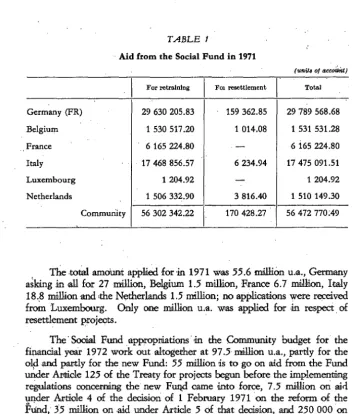
7. Refunds by the European Social Fund in 1971 totalled 56.5 million units of a.Cx:ount, broken down as shown in Table 1.
From 1 }anuary 1971, under the Counail's decision of 21 Aprhl ~970
that ·the Community shou:ld possess its .own finanairu resources ··insumd,Of being financed by contributions from the Member States, the old syr.tem whereby the charges represented by the Fund's disbursements were ann•Ially equaLized among the Member Smtes 1n ·accordance with .a special percentage ~able ceased
to
apply. The Member Stat~s now receive direct, as. and when the Commission takes the relevant decisions, the amounts granted to them · out of the Fund.1 Fourth General Report, sec. 126.
2 Ibid., sec. 127.
TABLE 1
Aid from the Social Fund in 1971
(unit.s of accoUnt)
For retraining
I
Fm resettlement1·
TotalGermany (FR) 29 630 205.83 159 362.85 29 789 568.68
Belgium 1 530 517.20 1 014.08 1 531 531.28
France 6 165 224.80
-
6 165 224.80Italy 17 468 856.57 6 234.94 17 475 091.51
Luxembourg 1 204.92 - 1 204.92
Netherlands 1 506 332.90 3 816.40 1 510 149.30
Commuruty 56 302 342.22 170 428.27 56 472 770:49
The
.total
amo'ulnt applied for ·in 1971 was 55.6millioo
u.a., Germooy a~lci.ng in rui for 27 million, Belgium 1.5 million, France 6.7 million, Italy18._8 mdilion a:nd the Netherl.a:n.ds 1.5 million; no applioartions were received from Luxembourg. Only one million u.-a. was app1ied for •in respect. of
resettlement projects. ·
The · SooiaJl. Fund appropl.'lia;tions · •in the CommUI:liLty budget for the
fi.p,ancial year 1972 work out altogether at 97 5 million u.a., paxdy for the olfl and par.tly for the new Fund: 55 mi:llion is to go on aid from the Fund under A.tJtiide 125 of the Treaty for projects begun before the implementing re~1lions conceming the new Ftl1lP oame into force, 7.5 million
on
aiel ~IJ.der &ciole 4 of the decision of 1 February 1971 on the reform of the FUnd, 35 million on .aid under Article 5 of that decision, a:nd 250 000 onpiJ.O): studies and e:x;periments effected under Article 7 of the implementing regulatJion pursua111t thereto.
As to the reform of the Fund, the Council, on 1 Februaiy 1971, forma.IJ.y ooopted the decision taken at its meeting on 26 November 19701
concernmg the genernl principles to govern the new Fund, and· on 19 October 1971, upon proposah from the COmmission, agreed a number.
1 Journal ojji&iel No, L 28, 4 February 1971, and Fourth General Report, sec. 129.
[image:18.429.34.386.42.456.2]· of implementing acts,! which are to effect upon the. adoption of a final regulation settLing certa<in .admi:nistmtive and financial details.
. . I
8. · ' As regards Community aid .for redundant Italian sclphur miners,2
the Commission made available to the IIJ3lian Government in 1971 a further 319
100
u.a., bringing the total so provided to 2.46 million out of the appropriacion of 4.2 million authorized by the Council to go towards theroorga:nization of
this
tndu&tty. The Commission's mrst report on the paying-over of this aid was submitted to the Counoil on 18 October.Re-employment and readaptation.
OJ
workers
9. . In the first half of 1971 only
a
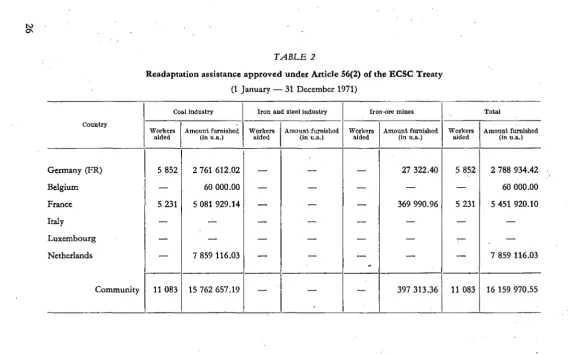
handful ~f applications were received' from Goverrunents for Cotnmumty contributions under Article 56(2 c) of the ECSC Treaty; the Gommr1ssion made available a total of one miJ!Jion u.a..for 1 500 workers affected by dosmes or part1aJ closures at three collieries. In the second half-year, however, the number of applicacions rose sharply, espeai.aUy £rom Germany a.OO Bel.~um, where programmes of pit closures have been ooopted. In ,the Nether-lands and in France the existling closure programmes are conninuing; foods have now been allocated foc the whole of the Dutch ,iOOJusury, while in Fra:n.ce they are being ·prov:ided lin yearly · ih:stalmoots as the shutdown scheme proceeds. The total amount thus earmarked in 1971 overnll was 16 159 970 u.a., for readaptation asSistance
to 11 083 workers.8 · · · ·.
This lis appreciably less tha:n
an
1970, ma,inJ.y by reason of a d~asein ·the. sums made avarlJable for the readaptacion of imners dn France. It shouJd be noted, however, that the very S'Ubsta:ntia:l. appropriacion for tll~
French mdustry in 1970 related to a. reconstruocion programme 'begun·~ 1967. In 1971,as before, ·the great bulk of the Commuruty's contributions went to the coal sector.
The 'levelLing-off in readaptation opera:tlions in the steei industry which
was observed lin 1970 was
a:gam
in evidence in 1~71.In kon"ore minri.ng there were again no apP-1imtions for ·aid ~,& Article 56(2) of the ECSC Treaty. As in 1970, such appropriacions as . were
ma!ie
were l:xJOs.ters toeacller
ones, necessitated by ~ in the~· cost of readaptation. . . ,:
1 .EC Bulletin 12-71, sec. 32.
2 Fourth General Report, sec. 130.
8 See Table 2.
N
"'
Country
Germany (FR)
I
Belgium
France
Italy
Luxembourg
Netherlands
Community
TABLE 2
Readaptation assistance approved under Article 56(2) of the ECSC Treaty
(1 January- 31 December 1971)
Coal industry Iron and steel industry Iron-ore mines
Workers
I
Amount furnishedaided (in u.a.) Workers aided
I
Amount furnished (in u.a.) Workers aidedI
Amount furnished (in u.a.)5 852 2 761 612.02
-
- - 27 322.40- 60 000.00 -
-
--5 231 5 081 929.14
-
-
-
369 990.96- - -
-- -
-
- ---
7 859116.03-
-
-
-.
11 083 15 762 657.19 - - - 397 313.36
Total
Workers
I
Amountf~lshed
aided (in u.a.)5 852 2 788 934.42
- 60 000.00 5 231 5 451 920.10
-
--
--
7 859 116.03 [image:20.648.43.613.40.395.2]10. The agreements on readaptation procedures underwent no major change, though they were· adapted on points . of detaiil to changes ·in the · state of the 1aw or •in soci.al conditions •in the member countries.
Redevelopment and re-employment
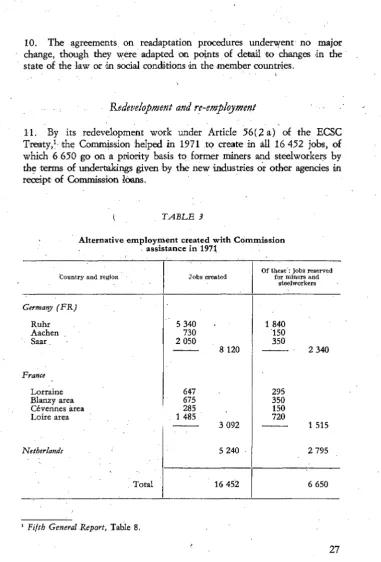
11. By its redevelopment work under Article 56(2 a) of the ECSC Treaty,1· tht; Co111Ll114ssion helped in 1971 .to create in all16 452 jobs, of
which 6 650 .go on a pl'liotity basis to. former miners and steelworker:s by the terms of underualcings given by the new industries
or
other agencies !inr~pt of Commdssion lOa:ns.
TABLE 3
Alternative employment created with Commission . assistance in 197~
Of these: jobs reserved
Country and region Jobs created for miners and
steelworkers
Germaf!Y (FR)
Ruhr 5 340 1 840
Aachen 730 '150
Saar. 2 050 350
- - 8 120 - - - · 2 340
France
Lorraine 647 295
Blanzy area 675 350
Cevennes area 285 150
Loire area 1 485 720
- -
3 092- -
1 515Netherlandr 5240 2 795
Total 16 452 6 650
' Fifth General.Report, Table 8.
[image:21.426.25.406.27.589.2]On-the-spot sooo.dings indicate tha:t; given the labour
reserve
remaining <in the cool and steel areas, the successor enterprises
are
~ to cover their m.anpower reqUirem.ents without any reaJ dilliculty, andgeneraJly spealcing
to
abide by -their uru:lertalcing to engage ex-ECSC workers.Predictably, the proportion of elderly and di.miniishedJperformooce ECSC workers among the redundant showed an appreciable
increase m
1971. The Commission hasbeeri.
malcing effoots to secure preferentiial treatment for these men in the matter of employment, over and above·the
. priority accorded to ECSC workers as such. · ·Reabsorption of workers leaving the land
12. As the absorption into other employment of workers leaving the agriculture! sector is an important part of the common agricultural policy · and of the social policy it is seelci.ng to promote, the Cpmmission some time ago ~arooched a •survey on the subject •i:n the six Commumty countries.1 The £itndings and proposals set forth .jn the comb1ned sununary report2 were
discussed toWiards the end of the year w1th the Governments and the two sides of mustry, for the purpose more parllitulwly of preparing the way for any n.ecessocy aid from the European Sooial Fund. Since lin ~ts view the problems the process .involves can only be properly tackled
·if
the necessary consistency .is achieved between agricud:tutal, regional and 'Social policy, .the Commission emp:hasdzed at the mscussions ( which are to contrl:nue funther) the wpot'ta:OOe of 1:ntegvated action.FREE MOVEMENT OF .WORKERS
1:3. Following the Commission's adoption of the regulation on the right of workers to remain in a Member State after having been employed there;3
itJs;aociv!Lties· :in regard to free movement of workers axe now proceeding brOad:Iy as follows: mrstly, it ·is making sure that the Commnnity arrange-ments are proper:ly carried ourt: (!the meecings of the Technioal Committee on .Freedom of Movement for Workers have been largely devoted to ·this), .
I Second General Report, sec. 397.
1 Fourth General Report, sec. 134.
8 Journal officie/ No. L 142, 30 June 1970 .
and secondl.y, ~tis endeavOUl'lin.g to round them. off by makiing provd:s:i.on for the dimimcion of certain im~ents ~ Jnequa.Hties. still remaillling.
~ • • . • ) • ; ~ j, ' ' i . . . .
: H: ·Iri thi~ coriried:ion, 'it has preparbd,. aftet· consulting- the Advisory ~tee,
a
draft regulation on provisliohs as to conflicts of laws on labour. relations within the Community.1 In addition, on 6 June; it submitted tothe
Cou:nci:l
a draft di.rectlive e~tending the field of application of the EEC ~COO~ directive of 25 February 1964ou
the ooOrdinallion ofmeasures
of pub1ic. order:, pub1ic .safety and public health to .include persons exercisingthe
dght to remainan
a Member State after having been employed there; the Efuopean ParLiament . and the Economicarid
Social Commhtee, COIIl.-menting respectively on 16 Deioember and 28 October 1971; erid~ this proposaL!In view of the inorease tin the actli.v1ties of "temporary work" ooter-prises in CO'Illltcies other than that of. their head office; the Advisory Com.mittee is currencl.y preparing, on the hasd.s of a study by the Commis-sion, a draft opiirlon on possible acllion at CO:tnmumty level to ensure that . these enrer.prJses are not ·able, by reason of· differences ·in legislation, 'to .evade their obligation vis-a-vis work~rs.· · :
To es:tab1ish a common employment market and
to
keep. it as f~·~ possible tin badooce, whlle duly observing the pvinoi.ple of . "Commoo:ity · ·nationals £ir:st", .ffit tis necessary .to· have ·the mtm-Cornrrnmity vac,ancyclearance machinery operatling efficiently. The Technical Committee, in
an
opmion rendered ·to· the Gonlmission· on 1 December, expressed the view · :that the stJa.ndardized al'mllgetnents drawn up by its Working Party on the Reg[ster of Occupacions were ca:lcu:lated . :to facilitate the exchange .1o£
particulars of wcanoies and arpplicallion for internationaJ. clearance·p~. Meantime, the Techniioa:l Committee is examrl:nJng information on conditions at and -away.from work in ·the Member States, which ~t is considered should be regularly exChanged between the di£ferenrt: employment authovities and ex:tJensively oirculate1 among the wOrkers coricemed.
The Colll.m1ssi0tt1 is ·also devoting attention to the problems posed :by . large niunbers of non:.Gommund.ty nationals employed in the .Member States:· it tis necessary on .the one hand that thcir presence shouJd ·not illrerfere with .the empoloyme:Illt of Commoo:ity nallionals, and on the other that .-they ·should recetive equaJ tteatment with the 1aroter in regw-d to wages and .terms of employment. To achieve both these a:ims it i:s essenciail -to secure coor-dination of the Member States' policies on mig:root labour. The Com:mi:s- ·
1 FoiiT'th General Report, sec. 135 ..
slion has aa::Ol"dangly heen
~g
apreli~~ ·~tudy
of the laws a:nd rules concerning the admissJon, residence and. employment of these workers ·a:nd the main bilateral rec:t1Uitment agreemeihts, and ·is i:n ad.clinion planning to conduct •a survey ori the terms of emptl.oyment of the different ~asses ofworket'S occupied lin the Member States.
HARMONIZATION OF SOCIAL SECURITY ARRANGEMENTS
Social security: general
14. The Commission's work on generai. social security matters has been marked in •the last year or ·two by a somewhat different approach, which was in .evJdence lin 1971 when preparatory studies were begun with a view to the drawling-up of a European soahil budget. The Commission was instructed to submit a ,programme to •the Council for the prepa11anion o~ . · such a social budget which will :be based on •the soo1al .aocoUti:Lts e-Stablished
for severail year:s now by the SilacistrioaJ 0££ice of the European COm-mufllinies.
'
The Commission some time .ago conducted a strudy on .the financial
pOCiblems .of socia:l security; which included projeccions of social secuvity revenues and expenddtures for 1965-70, ®IJ.d a seeond ,1nstialment now lin
hand, entlill1ed "Trends in Social Se.cu:city Revenues and Expenditures", will give srnilar projectlions· for 1970-75. Having .rega,rd to the value of this work, the Council, on 26 November 1970, requested the Comrmssion to continue with d.t.
15. The Commission's various studies on aspects of social security are to proceed as usual ruongside these ·twO main assignments. They include
in par.cirulax the study on soaial security indicators, the fivst edition of which ha:s just been d.ssued and which wU:lJ be brought up to date at regular intervaJs. In addi:trion there are four sectoral studies, on the £inanaing of
sooial ·samrity .run •ag.ri.CUI1ture, the effect of colliery personnel cutbacks on social secwity in rt:he .IIJ:i.mng ~industry (approaching completion) , and social secu:rity for self-employed persons. The Commi:ssion is also preparing a repor:t on the personal £ie1d of appld.cation of social securrl:ty.
1::.
ceuticals ,under sooiaJ. security (both these studies are now almost com-pleted), and the cost of hospital treatment under social security.
Aolli.VIity also conlli.nued in the field of stra1ght documoomlli.on. The e:lci.stJing semes of compamlli.ve ·tables on social se:c:unity ammgements, for the' gemmal scheme, the agl'icuJturaJ. scheme and -the mines scheme in each country, is to be supplemented by tables on the arrangements for self-employed perlions · (now partly £j.nailized ) and on the schemes !in the applicant countri.es. A general recapitulatlion of sociaJI security
develop-ments over the past twelve years is in preparation, and in addition there has b~ the work designed to promote pooling of experience among
Mem-ber States, notably the compiling of bl'iefs {currently pl'inting) on occupa-'
tJion~ di:seases, and replies to questions from Member States ooncerning the position under other countries' laws as to particular complaints thought . to be of 6ccupatJionaJ. oruglln..
16. As in p~evious years, 1 the financial aids furnished by Member States
to help meet the clarims on ·the social security schemes in the mining indus1lty. were scrutinized for conformity with the Commission's requirements, -this . time ~def' .Ar:ticle 4 of DeciSiion No. 3/7 U· The steady shrinkage in the number Of ootri.vely employed mim.eworkers continued, as before, to WJuence the extent to which Member States were called upon ro part-fiinanee the payment of benefits.
'
'
Social secttrity for migrant workers
17. The general revisi~n of the regulations on social security arrange-ments for mi.gva:nt workers, uridertaken at the instance of the CommisSiion, culminated, as regards the basic instrument, revised Regulation No. 3, in its definitive adoption by the Council on 14 June (EEC 140.8/71 )8 and
unarnmous agreement on the annexes. ·
As regards the .j,mplementJing regulation ( revrised RegulatJion No. 4 ) , a draft4-which had in fact been prepared in 1968 but had had to be
remodelled ill1 tine Wlith the provisions and forniulatJion £ina1ly adopted by the Counail for the hasic Regulation No. 1408/71-was submitted to the · Counail by ·the Commission on 20 July 1971. The Ecoriomic and SooiaJ
1 Fourth General Report, sec. 139.
2 Decision No. 3/65 of the High Authority of ECSC, revised in 1971 : ]ournaf
ojficiel No. L 3, 5 January 1971. See Fourth General Report, sec. 267. ·
3 Fourth Genera/Report, sec. 140 and Journal officiel No. L 149, 5 July 1971.
4 Journal officiel No. C 102, 14 October 1971. .
Comlll!i!ttee and the European Parliament pronounced lin favour of this drafit implemenning ·regulation on 27 October ruJ.d 19 November ,respeolli.vely, subjeot to certaiin -suggeSted amendments concerning which the Commission will deliberate and deakle whether to amend U.ts proposal to the CounoiJ ·acoordingly.
As instructed, ·the Conunissli.on considered •the ·technrl.oal adjustments which the applioant countries had asked should be made 'to the teVIised . basic regu1alli.on by reason of .special features in their own sociaJ. security legisialli.on, which
wti:1l
JJi.kewise have to be coordinated in the CommUlll!ityregulalli.ons. Lt duly
reported
to the Counail on 25 November.18. Before the revised regulations can come into force, however, there is still a good deal of preliminary work to be done, including more particularly the preparation of the Community printed forms, and of such versions of them ·as may be neoessa.ry ooder biJ.ate.ml arrangements, to enable workers to assert thcir cianms as effectiively as possible
m
regard to the different risks covered by the regulalli.ons. In adrulli.on, the decisli.ons and recom-mendacions of •the Ad.mimstraltli.ve Comma.ttee on Socia1 Securi.ty for Mi.g:mnt Worket!S wmll need to be revised, and the rn.formatlion handbooks fur ·bene£ioiJaries •in the different Member Stares completely reWJ.1i.tten. For this latter purpose the Commission plans to request the cooperation either of qua:lliiied representJacives of the two sides of industry or of the tripartdte advisory committee which is to be set up.1 .
It should be. added that the Colll1Illission's purpose in·the draft revised ReguLation No. 4 was to make for quicker oolcuJacion and prompter pay~ ment of benefu.ts to migmnt workers. A number of ptov'islions to that effect are contalined •in the draft, but steps waJl need :to be taken to ensure ·that they do
·Ln
fact operate w.i!thin the cime intended. However, it will be difficu1tto
,achieve ~ .that couJ.d be Wlished lin this direotion throughout the Comin'l.tlllity, given •the ma:ny and VTaried sets of social seouni.ty laws tobe coordinated.
19. The Administrative Committee on Social Security for Migrant Workers was obliged to concentrate principally on the consequential adjust-. ments to the draft implementing regulation, which were entailed by the
Council's amendments to the basic Reguiation No. 1408/71.
G •
20. The Administrative Committee's Audit Board, which, in regard to the
revised
regulatOOns, was more speaificaJJy concerned with ways •to expedtte1 Fourth General Report, sec. 140.
the clearing ·and payment of henefiits to migrant worloovs and their families, has been ex:plonin.g the subject w~th ex;per:ts from the Member States. Wli:th the same end
m
VJiew, a J1mited exchange of officials from the social security services of·cevtarln Member States has been arranged W!ith.the Commission's assistance.21. The Court of Justice in 1971 delivered four judgments on the inter-pretacion of CommUIIllity provisions concer.Illing sociaJ. sec:uri:ty for ffiigroot
workers. 1 ·
-Industrial relations
22. The Com~ssion. continued its dialogue with representatives of the .
Europea:n-~I.evel .trn:de union and employers' fedeootions.
One"notahle meeting among many was that held on 30 ApriJ to COnsider a paper providing a general review of trends 1i.n soo1al poLicy fu
the Com.munity from 1968 to 1971, and recording the actli.vi1ies engaged
in hy the Commission in this connection in accotdance with the priority objecnives whkh all coru::emed had helped it to work out. This was fol-lowed on 15 and 16 July by a broader"based :initial discussion on the Preliminary Guidet1ines for a CommunJ:ty Social Poligr Programme.
As a result of the Gorrumssion's persevering work to encourage, broaden and intensify relanions between trade unions end employers'. as:s~ oiacions, there took place the £i.rst-ever European-level meetlilng of workers' and emPloyers' representatives from the bUilding industry.
The re1anioos estabLished with ·the European Tme Union Committee .. _____ _
of Teachers were further .ex:tended, and contact was conninued witir· the Intemanional Confederation of Executive Staffs.
Wages and terms
of
employment
23. As concerns wages, a progress report to 30 June 197i on equal pay for equal work
as
between men and women is in preparation. Its termsof ·reference have been exte.nd.{,d for the first time to include the supple-mentary .sOcial security schemes. In order to take account ofthe fi.il!ldtings 1 Cases 23-71, 26-71. 27-71 and 28-71.
in dts last ·repott as to possibiJinie:S for indirect discl'li.ffiina.tri.on ag21inst women through job classd.f.ication systems, •the Commission has· been going mto this subjoot with the help of outside experts·.
The stiudy on incomes and assets in the Community coootnies is about to be :issued; it was discussed lin detail in Mardt w:it:h representatives of
the two sides of industry, who gave their backmg to the Commission's proposals to the Coundl for obtaining a fuller statistical picture of incomes not classed as wages. The account of incentives to asset formation by workers has been completed and may be expected to appear in 1972. On this subject the Commission organized meetings with Government experts and with experts from the empioyers' ·and workers' associations in order to compare and ·assess the main features, motivations, problems and iJ:'esults of the different types of incentive <provided
m
lthe d:ndividual countries.Ort 15 A<pvll the Commission adopted .the report on the experimental.
collation and evaluation of collective-bargaining agreemenl!s
m
the mechan-ical-engineering and electrica-l-engineering industries. As the obtainingand sifting of the data had been found to present no serious diffirul.ty, the
j
Commission proposed to the Council ·that the same work should be done · systematicaMy lin ,a:ltJ. :sectors of 1:ndustry.1I
24. In recognition of the fact that cross-frontier mergers and concentra-tions pose ,soaiJall. prol:>lems which ought preferably
·tO
,be s·ettl:ed at the ·same tip1e as. the Jega:l problems, the Comm1ssJ.on ~s ex.a.mi:ni:n:g •the ma:in groups of questions .aristing before and a£ter merger or concentration.In the £ield of Ja:~ law; .the Commission drew up ~ts~al conclu-sions for the Counci!l concerning, firstly, proviconclu-sions
·for
the benefit· of workers in the event of dismissal, and secondly, provisions for the preven-tion .and settlement of group labour disputes.2The Joint Advisory Committee on Social Problems of Paid
Ag.ni.cul.-tural Workers continued ·its examli:nation of the ·implkations of the reform of agriouJtUlre. It conoentmted lin par.vci.cillar on pmcticall. means for ensu:ning that the necessary changes coukl take pLace smoothly, <in a sociaLly acceptable manner, and sought the support of the employers' and workers' orga:niza-tions represented at regional level. D.ireot coopemtion between the·
Com-mis~on, the Government departments ·responsible and 'the employers and.
1 Fourth General Report, sec. 142.
11 Ibid. sec. 143.
work~s on ·accident prevention in agr.icultJUre was ·initiated, as the
Com-mittee had urged in the Opinion rendeted the previous year.::t
An agreement
on
:barmontization of the working hours of pad.d workers in regular employment in the stock-farming sector was negotiated between the two sides an~ signed on}8
May.The Jomt Advisory Commietee on Social Problems tin the Sea-Fiishlng Industry rendered t\Yo Opinions, one on the general subject of trai:ni:ng and rimproved -concLi!tions, and the other on welfare at sea, medioal atJtentJion and ocrupallioool safety on .fd.s:hing vessels. The CommittJee also began work on harmonization of terms of employment, basing ~~tseH on tabull!Jted .information prepared by ·its ad hoc working paDty.
The Cornmilssion completed its consultation of the Joint AdVlisory CommJ,r:t.ee on Social Problems lin Road Haulage in connection with the prepara,tion of a drnft regulatJion (the "second reguLation") to harmonire social provisions other than .those -covered by Council Regulation ( EEC)
543/69, which ·~t hopes to submit to the Counoilm the near future. The
Committee ~.s meantime con~>ideting prob1ems in regard to the carl1iage of ' dangerous goods, and to the equipment of cabs and bunks on heavy .Jorries~
The Commission completed 1ts consultation of the Joiilt Advisory
Cornm~ttee on Social Problems ii1. InJ,and Water Transport
m
connection with the preparation of a regulation ·to harmonize 'a number of social .prow-sions in this sector, which it also expects to submit to .the Council ·before long.·The Joint Committee on Harmonization of Terms of Employment ( Coal) at .its meering ,ffi May. 19 71 adopted a comparative conspectus of the s:tattittory ·and contractual proV'isions concerning the welfare ·of juveniles in ·the CommUlni.ty coaJ industries.
The Jotint Commitlt:Jee on HarmonizaJci.on of Terms of Employment ( Sreel) is considering a proposal by the workers' group concerning the possibility of a European skeleron coHective agreement fot the. steel industry. Two other mavters which have been reoehning its at:Jtention .are, firstly, the scale and nature of ·absenteeism, and secondly, how to tackle the sooiaJ problems •iilvolved by the emp~oyment of handicapped workers. The two committees on •the ·t~rns of employmerut of non.rnanual workers in the coal and •Steel sectors continued their work, and a.re currentJ.y prepar.ing a report on ·the pnincipru sooi·al problems in these •industv.ies.
1 Fourth General Report, sec. 144.
Agreement was reached between the two sides of the bw.lding industry that they shcruld jointly oatalogue ,those hbour-relations problems which ex:tend beyond the naciona1 framework, as a basis for settl,ing which ques¢ons ·requilre to be dea1t with at naci.o1;1aJ. and which a,t Community
level.
HOUSING
25. A recapitulation of the assistance given over. the years down to
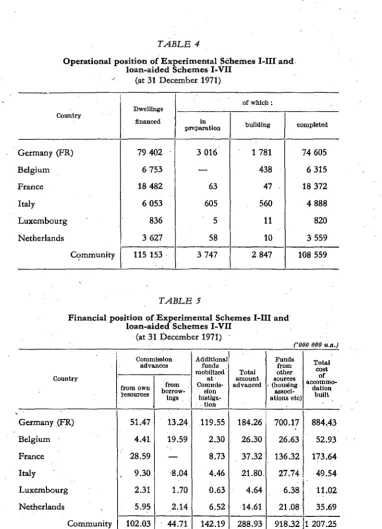
31 Deoember 1971 1to the building of houses for workers in the ECSC industries shows that in aJl 115 153 dwellings had. boon part-financed by that date under the three expevimental schemes and the seven major loan-aided schemes, 60% of them for renting and 40% for owner-occupation. Dwellings completed totalled 108 550.1
Scheme VII is now under way, w:i:th a £irst tranche of 10 miilion u.a.. from the speoial. .reserve of the 1971-72 budgets.2 After consulting the ·Ministries and !industries concerned, the Commission decided on the
appor-tionment of this appropniation, namely 1.6 million u.a. for the experimental and 8 .4 miJ.Lion for the reguLar scheme. The latter is intended to aid the residenti.all burlJd:ing necessiJta.ted by the :installation of new coastal . Slteel plants at Fos and Dunkirk in F.rance, IJmui.den in the Netherlands md Taranto in Italy, ·a:tid to help meet the housing requirements resulting from the restructuring of the steel industry in Germany, Belgium and Luxem-bourg and the ·coal industry in Germany. The experimental scheme is for the purpose of 1:esearch on modernization of e~sting accoffim.odaot:ion.'<~ In response to repeated urgings lin the European P.avLiarnent to step up funds for .the ECSC hOUISiing dl'ive, the Com:mission revriewed 'the matter ·a,t the end of the ffi:rst half-year, and as a result a fur<ther two million u.a. was earma.rked for the purpose, bringing ·the total appropr1acion for the budgeting yeat~s 1971/72 to 12 rm11ion u.a. The e~tra s~_.w!i!U be used for .the .benefiit of lllligt-oot workers ood of steehvorke!:;§ at coastru plants, by part-financing the buildirig of hostels, wdth a comhlned total of approxi-mately 1 300 beds, for unmarried migrant workers lin Fmnce, Germany
and
the Netherl.an:ds, atnd of some 350 dwellings in Southern haly.
1 See Tables 4 and 5 and Graph. . 1
Third General Report, sec. 347, and Fourth General Report, sec. 148.
1 Fourth General Report, sec. 148.
TABLE 4
Operational position of Experimental ~chemes I-III and. loan-aided Schemes I-VII
(at 31 December 1971)
of which: Dwell!ngs
Country
I
I
financed in .building completed
preparation
Germany (FR) 79 402 3 016 1 781 74 605
Belgium 6 753
-
438 6 315France 18 482 63 47 18 372
Italy 6 053 605 560 4 888
Luxembourg 836 5 11 820
Netherlands 3 627 58 10 3 559
C«?mmunity 115 153. 3 747 2 847 108 559
TABLE 5
Financial position of.Experimental Schemes I-lli and· loan-aided Schemes I-VII
·(at 31 December 1971) ·
('OOO ooo u .. a )
Commlsslon Additional Funds Total
advances funds from
mobilized Total other cost
Country at· amount sources of
from Commis· advanced · (housing
accommo-from own borrow· sian associ- dation
resources ings. iristlga- atlons etc) bullt
I . tion
Germany (FR.) 51.47 13.24 119.55 184.26 700.17 884.43
Belgium 4.41 19.59 2.30 26.30 26.63 52.93
France 28.59
-
8.73 37.32 136.32 173.64Italy 9.30 ·8.04 4.46 21.80. 27.74 49.54
Luxembourg 2.31 1.70 0.63 4.64 6.38 11.02
Netherlands 5.95 2.14 6.52 ·14.61 21.08 35.69
Community 102.03 44.71 142.19 288.93 918.32 1 207.25
[image:31.429.25.408.18.548.2]