White Rose Research Online URL for this paper:
http://eprints.whiterose.ac.uk/116735/
Version: Accepted Version
Article:
Lagkas, T. orcid.org/0000-0002-0749-9794, Papadimitriou, G.I., Nicopolitidis, P. et al. (1
more author) (2008) A Novel Method of Serving Multimedia and Background Traffic in
Wireless LANs. IEEE Transactions on Vehicular Technology, 57 (5). pp. 3263-3267. ISSN
0018-9545
https://doi.org/10.1109/TVT.2007.912341
© 2008 IEEE. Personal use of this material is permitted. Permission from IEEE must be
obtained for all other users, including reprinting/ republishing this material for advertising or
promotional purposes, creating new collective works for resale or redistribution to servers
or lists, or reuse of any copyrighted components of this work in other works.
[email protected] https://eprints.whiterose.ac.uk/ Reuse
Unless indicated otherwise, fulltext items are protected by copyright with all rights reserved. The copyright exception in section 29 of the Copyright, Designs and Patents Act 1988 allows the making of a single copy solely for the purpose of non-commercial research or private study within the limits of fair dealing. The publisher or other rights-holder may allow further reproduction and re-use of this version - refer to the White Rose Research Online record for this item. Where records identify the publisher as the copyright holder, users can verify any specific terms of use on the publisher’s website.
Takedown
If you consider content in White Rose Research Online to be in breach of UK law, please notify us by
Abstract— Wireless LANs require efficient integration of multimedia and traditional data traffic. This work proposes the Priority Oriented Adaptive Polling (POAP) protocol which could be used in place of the Enhanced Distributed Channel Access (EDCA), part of the IEEE 802.11e access scheme. EDCA seems capable of differentiating traffic, however, it exhibits great overhead that limits available bandwidth and degrades performance. POAP is collision free, it prioritizes the different kinds of traffic, and it is able to provide QoS for all types of multimedia network applications, while efficiently supporting background data traffic. POAP compared to EDCA, provides higher channel utilization, distributes resources to the stations adapting to their real needs, and generally exhibits superior performance.
Index Terms— adaptive polling, MAC, QoS, wireless LAN
I. INTRODUCTION
OWADAYS, voice, audio and video have to be efficiently transmitted along with the traditional data traffic. Real-time applications require QoS, because they are time-bounded, while slightly unreliable connections are allowed. On the other hand, data traffic does not demand particularly low delay, but reliability is essential. Thus, modern networks should be able to meet all types of traffic requirements. The IEEE 802.11e [1] workgroup has enhanced the Distributed Coordination Function (DCF), with QoS support, proposing EDCA, which is the essential part of the 802.11e MAC protocol. However, it causes high overhead, which degrades the network performance, thus, efficiently serving multiple sources of different types of traffic is a challenge.
There are various MAC protocols proposed for different kinds of network conditions [2]-[8]. This work proposes the Priority Oriented Adaptive Polling which is able to be built into IEEE 802.11e. It belongs to the centralized access protocols, however, no bandwidth reservation is required. It
Manuscript initially received April 16, 2007. Revised June 28, 2007. T. D. Lagkas, is with the Department of Informatics, Aristotle University, 54124 Thessaloniki, Greece ([email protected]).
G. I. Papadimitriou, is with the Department of Informatics, Aristotle University, Box 888, 54124 Thessaloniki, Greece ([email protected]).
P. Nicopolitidis, is with the Department of Informatics, Aristotle University, 54124 Thessaloniki, Greece ([email protected]).
A. S. Pomportsis, is with the Department of Informatics, Aristotle University, 54124 Thessaloniki, Greece ([email protected]).
efficiently supports simultaneous real-time and background traffic, by taking into account traffic priorities and the current status of the stations. It should be mentioned that despite the fact that EDCA is a distributed scheme, most network scenarios that consider real-time traffic assume infrastructure topology with the use of an Access Point (AP) for packet relay and interconnection to the backbone network. POAP tries to exploit this common topology by using the AP for access control. Notice that 802.11e also proposes a polling protocol called HCCA (Hybrid Control Channel Access) [1], however, it does not adopt packet priorities and it reserves resources in order to serve exclusively real-time traffic. It is a specialized protocol that cannot operate independently. Thus, POAP is only compared with EDCA, since they have the same role. This paper assumes that stations can communicate directly when in range, however the AP could be also used as a packet forwarder. 802.11e also provides a Direct Link Protocol (DLP).
This paper is organized as follows. Section II presents the 802.11e Medium Access Control. In Section III, POAP is analyzed, focusing on the polling scheme, the priority model and the station choice algorithm. Section IV presents our simulator, the network scenario, and the results, which prove the efficiency of POAP by comparing it with EDCA. Section V concludes the paper.
II. IEEE802.11E MEDIUM ACCESS CONTROL
The legacy IEEE 802.11 MAC does not support QoS. However, some modifications that enhance partial QoS support have been proposed [8]. The need for QoS has led to IEEE 802.11e. The provided medium access control mechanism is the Hybrid Coordination Function (HCF). The latter is consisted of two parts: EDCA, which is the mandatory access scheme for 802.11e and is contention based, and HCCA, which is centralized and based on resource reservation.
EDCA is the QoS enhanced version of DCF employed by the legacy 802.11 MAC. When a station needs to transmit and the channel is busy, it waits until the medium becomes idle and then defers for an extra interval, called Arbitrary Distributed Interframe Space (AIFS). If the channel stays idle for the AIFS interval, the station then starts backoff by selecting a random number of slots from a contention window (CW). The backoff counter is decreased only when the
A Novel Method of Serving Multimedia and
Background Traffic in Wireless LANs
T. D. Lagkas, G. I. Papadimitriou, Senior Member, IEEE, P. Nicopolitidis, and A. S. Pomportsis
transmitted and the station waits for an acknowledgement (ACK). If the ACK is not received within a specific period, the station will invoke backoff and retransmission procedure using a larger window. An additional RTS/CTS (Request To Send/Clear To Send) handshake scheme is defined to deal with hidden stations.
In EDCA, the QoS support is realized with the introduction of Access Categories (ACs). The packets are delivered through multiple backoff instances within one station, each backoff instance parameterized with AC-specific parameters. In every station, there are four packet buffers corresponding to the four ACs. The eight possible User Priorities (UPs) assigned to the generated traffic are mapped to the four ACs. This makes traffic differentiation possible. Each AC within the stations contends for access independently and starts backoff after detecting the channel idle for an AIFS. In order to favor higher priority traffic, higher ACs are assigned lower AIFS values. Furthermore, the higher the AC the smaller its contention window. Thus, a high priority packet will probably choose a smaller backoff, increasing its chances to “win” the channel contention.
This model provides only minimal QoS. The backoff procedure leads to waste of bandwidth and the hidden stations cause collisions despite of the backoff mechanism. The RTS/CTS handshake limits this problem, however, it increases the overhead. Some approaches that enhance EDCA can be found in [9-11]. An analysis on the performance limits caused by EDCA overhead can be found in [12]. EDCA definitely enhances DCF with QoS, however, it is shown that it can actually serve only limited traffic of low QoS demands. Thus, we propose POAP, which greatly reduces overhead and optimizes the priority model, providing stricter QoS and higher performance.
When HCCA is also implemented in HCF, the 802.11e super-frame is divided into HCCA and EDCA periods. The stations that want to transmit real-time data with guaranteed QoS ask the Hybrid Coordinator (HC) for resource reservation. The HC schedules transmissions during the HCCA periods and grants the stations with channel access accordingly. HCCA is a complementary protocol in the HCF scheme. It is not a standalone access method and according to the 802.11e standard it is only supposed to operate combined with EDCA. Thus, the direct comparison of HCCA with POAP has no meaning and is actually not feasible. POAP and HCCA are different kinds of protocols. POAP tries to serve effectively mixed-type traffic, while HCCA cannot even participate in such a simulation scenario, since it can only handle real-time traffic. For these reasons, HCCA is not taken into account when evaluating the POAP protocol.
III. THE POAPPROTOCOL
According to POAP, the AP polls the stations to give them permission to transmit. The polling scheme eliminates
adopted, Tx-Rx data rates are assumed to be identical, and channel access is based on a Time Division Multiple Access (TDMA) scheme described below. The protocol uses the POLL, NO_DATA, and STATUS control packets, with transmission duration tPOLL, tNO_DATA, and tSTATUS, respectively.
A STATUS packet is marked as ACK or NACK according to the specific case. The transmission duration of a DATA packet is tDATA and the propagation delay is tPROP_DELAY. The
possible polling events are:
- The AP polls an inactive station: The AP sends POLL to the station at time t. The station responds with a NO_DATA
packet, which is received by the AP at
PROP_DELAY NO_DATA
POLL
t
2t
t
t
. Then, a new poll isinitiated.
- The AP polls an active station: The AP sends POLL to the station at time t. The station replies with a STATUS packet marked as ACK, which carries the destination address and the size of the following DATA packet. Then, the polled station starts transmitting the DATA packet directly to the destination. Upon reception, the destination broadcasts a STATUS packet marked as ACK. Otherwise, if the reception
fails, but the station had successfully identified the source’s
STATUS packet whereby it realized that the following DATA packet was destined to it, it responds with a STATUS packet marked as NACK. The transmission of a NACK is not wasted time, since either way the stations had to wait for a possible
ACK. A new poll is initiated at
PROP_DELAY STATUS
DATA
POLL
t
2t
4t
t
t
. We considervariable DATA packet size, thus, tDATA is not static.
Specifically, tDATA depends on the size of the currently
transmitted packet.
- The communication fails: In case the station does not receive the POLL packet, the polling fails. The AP has to wait for the maximum polling cycle before proceeding to a new poll, since it has to be certain that it will not collide with a possible transmission. When the POLL packet is received by the polled station, but then the AP fails to receive any feedback, it waits for the maximum polling cycle similarly to the previous case. The duration of the maximum polling cycle is
t
POLL
t
MAX_DATA
2t
STATUS
4t
PROP_DELAY, wheretMAX_DATA is the duration of the largest allowed DATA packet.
At the end of this cycle, it is certain that the medium is idle. When such a communication failure occurs, the AP lowers the probability to choose this station in the new polling procedure assuming a bad link between them. However, it is most likely that the AP will receive some feedback either from the polled or the destination station.
of the polling cycle. In order to gain this knowledge, the AP just has to detect the NO_DATA packet or the STATUS ACK packet, which contains the duration of the following data transmission, or the DATA packet from the polled station or the STATUS ACK-NACK packet from the destination station. Actually, when POLL is successfully received, then it is most likely that the AP will obtain the necessary feedback. Moreover, it should be mentioned that despite the fact that each station is supposed to send a single DATA packet per transmission, it is possible to have multiple successive data packets destined to the same station with total duration no longer than tMAX_DATA and a single block acknowledgement for
all these packets. This way, bursty traffic with strict requirements could be more effectively supported.
The POAP packet choice mechanism firstly considers the priority (access category) of each buffer, so that high priority traffic is favored. Also, in order to provide low packet delays, low packet drops and fairness among the ACs, the number of packets in each buffer is taken into account. Specifically, heavy loaded buffers should have higher probabilities of transmitting. Lastly, the earlier generated packets are favored.
A polled station initially examines if it has any buffered packets, otherwise, it replies with NO_DATA. Then, each buffer is examined in order to calculate its normalized priority PPR and normalized number of buffered packets PB. Assuming
that the priority of buffer i is
p
[
i
]
i
1
, so that it is notnull for AC[0], then it holds:
[
]
[
]
30[
]
k
PR
i
p
i
p
k
P
.Also, if b[i] is the number of packets carried by buffer i, then
it holds:
30
[
]
]
[
]
[
k
B
i
b
i
b
k
P
. The buffer priority andthe number of buffered packets should have different contribution to the final buffer choice probability P. Thus, we use the weights WPR (default value 6) and WB (default value 2)
for PPR and PB, respectively. Obviously, when in the network
configuration the purpose is to extendedly favor high priority traffic, then WPR is set to a high value compared to WB,
otherwise, if the configuration should be able to efficiently serve highly loaded stations, then the value of WB is raised.
The default values have resulted from the actual meaning of the parameters and tests which have shown that when the priority weight is three times higher than the buffer load weight, then the buffer choice probability ensures combination of efficient traffic differentiation and relatively low packet delays for all buffers in most network conditions. We use the values 6 and 2 rather than 3 and 1, because value 1 is assigned to the weight WT which is introduced later. The
non-normalized choice probability for buffer i is:
]
[
]
[
i
B Bi
PR
PR
P
W
P
W
i
P
[
]
. As it was mentionedabove, when WPR is high compared to WB, it is most probable
that a high priority buffer will be chosen for transmission. On the other hand, if WB is increased, it is more probable to
choose a packet from a highly loaded buffer. The normalized
choice probability equals to:
[
]
30[
]
kP
k
i
P
. After thebuffer selection, the station chooses to send the earliest generated packet in it.
Before the AP decides which station to poll, it has to be well informed of their buffers' status. Thus, we exploit the ACK and NACK messages, which are already useful. Specifically, the STATUS packet apart from acknowledging receptions, it also carries its source's priority score, which is an indication of the status of the station's buffered traffic. The priority score depends on the priority and the load of each buffer. For station j, the priority score is:
30
[
]
[
]
k
p
k
b
k
]
[ j
P
S . So, the AP examines everybroadcasted STATUS packet in order to update the stored priority scores. This way, the model provides efficient feedback with minimum overhead. At this point, it should be mentioned that the AP lowers the probability to poll a station after a communication failure by halving its stored priority score.
The first factor considered by the algorithm that chooses the polled station is the priority score. The second factor is the time elapsed since the last poll of each station ( ). Specifically, in order to provide fairness and avoid total exclusion of stations that are inactive for quite long, the stations that have not been polled for a long time are favored to some degree. The AP, which also participates in the contention, is assigned a higher access probability, because of its central role.
Here we present the operation of the algorithm that returns the station to be polled. Initially, we check if the AP has any buffered packets. If it has not, then it is not included in this procedure. Then, the priority score of each considered station j
is normalized:
10
[
]
]
[
]
[
Ml S
S
P
j
P
j
P
l
P
, where M is thenumber of stations considered by the algorithm. The time elapsed since its last polling is also normalized:
10
[
]
]
[
]
[
Ml
T
j
j
l
P
. The non-normalized finalprobability of polling station j is:
]
[
]
[
]
[
PR Pj
T Tj
POLL
j
W
P
W
P
P
, where WT (default1) is the weight of the contribution of the PT factor.
Obviously, a station that has not been polled for a long time has a high PT value, so its polling probability increases. A
high WT value provides extended fairness among stations,
however, this way traffic differentiation fades. If the examined station j is the AP, then its non-normalized final access probability is multiplied by the factor WAP (default 10), so that
it has clearly higher access chances. Lastly, the AP chooses a station to be polled according to each one's normalized polling
probability, which is for station j:
1
0
[
]
]
[
Ml POLL
POLL
j
P
l
P
.2000 4000 6000
800010000 12000
0 0.1 0.2 0.3 0.4 20 40 60 80 100 120
POAP EDCA
Vid e o
P a cke t Los s Ra te
Ave ra ge P a cke t De la y (ms )
Vide o Throughput (kbps )
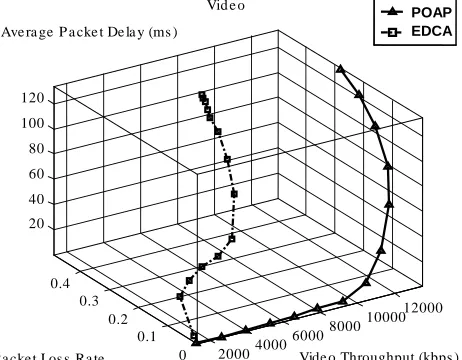
Fig. 2. Video: Average packet delay and loss rate versus video throughput
200 400
600 800
0 0.02 0.04 0.06 0.08
5 10 15
Voice Throughput (kbps ) P a cke t Los s Ra te
EDCA
[image:5.612.319.555.51.233.2]Ave ra ge P a cke t De la y (ms )
Fig. 1. Voice: Average packet delay and loss rate versus voice throughput
duration, RTS size, CTS size, ACK size), assuming that this is the first transmission attempt and that data rate is 36 Mbps. Concerning POAP, the POLL packet size is 80 bits plus physical header and the STATUS packet size is 160 bits plus physical header. In such a case, the time interval while no real data is transmitted during an EDCA communication is on the average equal to 168 s for the lowest priority traffic and 69
s for the highest priority traffic, while for POAP it is 27.5 s. Obviously, POAP causes significantly lower overhead than EDCA, even when no collisions and retransmission attempts are considered for the EDCA scheme.
IV. SIMULATION RESULTS
We developed a C++ simulator employing the IEEE 802.11g physical layer and the 802.11e super-frame. The condition of any link was modeled using a three-state machine (Good, Bad, Hidden). The propagation delay is assumed to be 0.5 s, which corresponds to 150 m distances. We consider one bidirectional voice-video communication between the AP and each mobile station. Also, there is a bidirectional TCP flow between any two adjacent mobile stations. The traffic has realistic characteristics derived by the analysis of traces. We use TCP flows with features typical for file transfers. Voice communication is based on the G.726 codec. The new H.264 codec is employed for live video. Specifically, the characteristics of the considered traffic are presented in Table I. We simulated 14 WLAN topologies, starting with 2 mobile stations and finally reaching 28 mobile stations with a step of 2. Regarding the EDCA configuration, the default parameters’ values for all access categories were used. No tuned configuration for real-time nor background traffic was adopted, because the simulation scenario involves integration of different types of traffic. Our objective was to evaluate the capability of POAP and EDCA of handling voice, video, and background traffic simultaneously.
Regarding voice, in Fig. 1, it can be seen that POAP exhibits lower packet delays and loss rates when the voice throughput is lower than 550 kbps, while EDCA performs better for higher values. However, both protocols achieve similar maximum throughput. Despite the fact that POAP
eventually causes higher packet delays, it keeps them below 18 ms which is very satisfactory for voice communications. The conclusion is that both schemes are able to provide QoS in voice transmissions. The above behavior is due to the fact that POAP conserves resources in order to serve video and TCP traffic as well, while EDCA favors the voice packets to such a degree that seems unable to simultaneously serve video and TCP flows.
Fig. 2 shows that EDCA suffers from so many packet losses that it cannot support live video when its throughput is over 3 Mbps. POAP exhibits particularly low packet delays and loss rates when the video throughput is lower than 12 Mbps, while it achieves notably high throughput.
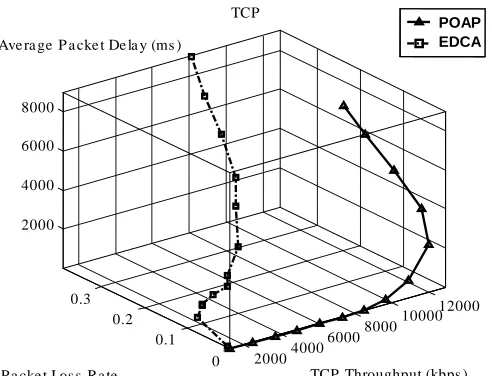
According to Fig. 3, POAP can efficiently support background traffic the same time it provides QoS for voice and video. It guarantees significantly lower packet delays and loss rates, while it achieves higher throughput than EDCA.
In our effort to examine the overall network performance for both protocols, we have plotted in the same 3D graph the average bit delay and the bit loss rate versus the total throughput, for the whole offered traffic. In Fig. 4, it can be
Traffic
Type Coding
Packet Data
Size (bytes)
Packet Inter- arrival Time
(ms)
On/Off Periods (sec)
Data Bit Rate
Packet Delay Bound
(ms) User Priority
TCP
Flow - 1500
Expo. 10 (mean)
Always On
~1200 Kbps (VBR)
60000 1
Voice G.726
(ADPCM) 80 20
Expo. (mean) On: 1.5 Off: 1.8
32 Kbps (CBR)
75 6 Live
Video
H.264
[CIF-20fps] 750 10
Always On
600 Kbps (CBR)
[image:5.612.323.554.271.451.2]20004000
60008000
1000012000 0
0.1 0.2 0.3 2000 4000 6000 8000
POAP EDCA
P a cke t Los s Ra te TCP Throughput (kbps ) TCP
[image:6.612.48.294.49.237.2]Ave ra ge P a cke t De la y (ms )
Fig. 3. TCP: Average packet delay and loss rate versus TCP throughput
5000 10000
1500020000 25000 0
0.1 0.2 0.3 0.05
0.1 0.15 0.2 0.25 0.3
Tota l Throughput (kbps ) To ta l
Bit Los s Ra te Ave ra ge Bit De la y (ms )
[image:6.612.317.560.50.237.2]POAP EDCA
Fig. 4. Total Traffic: Average bit delay and loss rate versus total throughput
seen that POAP exhibits quite steady performance, while achieving clearly higher total throughput and lower loss rate than EDCA.
Notice that the packet loss rate results from the number of packet drops occurred due to expiration of the packet lifetime or buffer overflow. Since the adopted buffer size is 1 MByte, the overwhelming majority of voice and video packet drops are caused by expiration of their lifetime, while the TCP packet drops are due to buffer overflow. Obviously, as the offered traffic load increases, it becomes particularly difficult to perfectly serve all flows. Generally, the fact is that POAP exhibits higher channel utilization than EDCA. The latter favors the voice traffic to such an extent that it is not capable of simultaneously supporting video and TCP traffic. In POAP, the polling scheme provides minimum overhead with optimized feedback and zero collisions. Since the AP is aware of the traffic status, it adapts the resources granted to the stations accordingly. Furthermore, POAP ensures that no flow or station can dominate the medium.
V. CONCLUSION
The proposed Priority Oriented Adaptive Polling protocol can be adapted into the IEEE 802.11e MAC in place of EDCA. It employs station polling, resulting in zero collisions. Notice that despite the distributed nature of EDCA, its most common topology when serving integrated data is also an infrastructure one. POAP efficiently provides QoS to integrated time-bounded and background traffic. Traffic differentiation is based on packet priorities. In order to provide the AP with valuable feedback, POAP efficiently exploits the use of the control packets. This information allows the AP to optimize its decisions about the access grants. It is shown that POAP exhibits higher channel utilization, since it eliminates the overhead caused by contention and collisions. Furthermore, it provides significantly lower packet delays, lower loss rates, and higher throughput. As future work, the network parameters could be
further tuned. Also, POAP could be combined with a resource reservation scheme to provide guaranteed QoS.
REFERENCES
[1] IEEE 802.11e WG, IEEE Standard for Information Technology--Telecommunications and Information Exchange Between Systems--LAN/MAN Specific Requirements--Part 11 Wireless Medium Access Control and Physical Layer specifications, Amendment 8: Medium Access Control Quality of Service Enhancements, Nov. 2005.
[2] T. D. Lagkas, G. I. Papadimitriou, and A. S. Pomportsis, “QAP: A QoS
supportive Adaptive Polling Protocol for Wireless LANs,” Computer Communications, Elsevier, Vol.29, Iss.5, pp.618-633, 2006.
[3] T. D. Lagkas, G. I. Papadimitriou, P. Nicopolitidis, and A. S.
Pomportsis, “Priority Oriented Adaptive Control with QoS Guarantee for Wireless LANs,” IEEE Transactions on Vehicular Technology, Vol.56, Iss.4, pp.1761-1772, Jul. 2007.
[4] P. Nicopolitidis, M. S. Obaidat, G. I. Papadimitriou and A. S.
Pomportsis, “Wireless Networks,” Wiley, Jan. 2003.
[5] I. Chlamtac, M. Conti, J. Liu, “Mobile ad hoc networking: imperatives
and challenges,” ELSEVIER Ad Hoc Networks 1, pp.13-64, 2003. [6] A. Chandra, V. Gumalla, and J. O. Limb, “Wireless Medium Access
Control Protocols,” IEEE Communication Surveys, pp.2-15, 2000. [7] I. F. Akyildiz, J. McNair, L. Carrasco, R. Puigjaner, “Medium Access
Control Protocols for Multimedia Traffic in Wireless Networks,” IEEE Network Magazine, Vol.13, Iss.4, pp.39-47, Jul/Aug 1999.
[8] Q. Ni, L. Romdhani, and T. Turletti, “A Survey of QoS Enhancements
for IEEE 802.11 Wireless LAN,” Wiley Journal of Wireless Communication and Mobile Computing (JWCMC), John Wiley and Sons Ltd., Vol.4, Iss.5, pp.547-566, 2004.
[9] A. Hamidian and U. Korner, “An Enhancement to the IEEE 802.11e EDCA Providing QoS Guarantees,” Telecommunication Systems, Springer, Vol.31, Iss.2-3, pp.195-212, Mar. 2006.
[10] Y. Ge, J. C. Hou, and S. Choi, “An analytic study of tuning systems parameters in IEEE 802.11e enhanced distributed channel access,” Computer Networks, Elsevier, Vol.51, Iss.8, pp.1955-1980, 2007. [11] S. Shankar and M. van der Schaar, “Performance analysis of video
transmission over IEEE 802.11a/e WLANs,” IEEE Transactions on Vehicular Technology, Vol.56, Iss.4, pp.2346-2362, Jul. 2007.