This is a repository copy of
The effect of quality scalable image compression on robust
watermarking
.
White Rose Research Online URL for this paper:
http://eprints.whiterose.ac.uk/76013/
Conference or Workshop Item:
Bhowmik, D. and Abhayaratne, C. (2009) The effect of quality scalable image compression
on robust watermarking. In: Digital Signal Processing, 2009 16th International Conference
on , 5-7 July 2009 , Santorini-Hellas.
https://doi.org/10.1109/ICDSP.2009.5201225
[email protected] https://eprints.whiterose.ac.uk/
Reuse
Unless indicated otherwise, fulltext items are protected by copyright with all rights reserved. The copyright exception in section 29 of the Copyright, Designs and Patents Act 1988 allows the making of a single copy solely for the purpose of non-commercial research or private study within the limits of fair dealing. The publisher or other rights-holder may allow further reproduction and re-use of this version - refer to the White Rose Research Online record for this item. Where records identify the publisher as the copyright holder, users can verify any specific terms of use on the publisher’s website.
Takedown
If you consider content in White Rose Research Online to be in breach of UK law, please notify us by
THE EFFECT OF QUALITY SCALABLE IMAGE COMPRESSION ON ROBUST
WATERMARKING
Deepayan Bhowmik and Charith Abhayaratne
Department of Electronic and Electrical Engineering
The University of Sheffield
Sheffield S1 3JD, United Kingdom.
{
d.bhowmik, c.abhayaratne
}
@sheffield.ac.uk
ABSTRACT
The effect of quantization based compression in quality scal-able image coding on the robustness of wavelet based water-marking is presented. The non-blind direct modification type watermarking is considered for the analysis presented in this paper. First we present the analysis considering any quanti-zation parameter and then restrict it to the integer powers of two to model the bit-plane discarding based quantization used in quality scalable coding, such as JPEG2000. This work as-sumes that the watermark embedding and compression uses the same wavelet filters. The derived model shows the rela-tionship between the modified coefficients and the quantiza-tion factor, which is then used to obtain the condiquantiza-tions for the correct watermark extraction under compression. Based on this analysis, one can select wavelet coefficients for embed-ding the watermark in a manner that the correct watermark extraction is possible for a given quantization level. The re-sults show higher robustness when this model is used for em-bedding the watermark. The paper also evaluates the perfor-mance of the model when the watermark embedding and the compression wavelet filters are not the same.
Index Terms— Wavelet based Watermarking,
Robust-ness, Compression, JPEG2000, Quality scalability.
1. INTRODUCTION
Watermarking is commonly used as an important technique in multimedia security and digital rights management. Re-cent years have seen a rapid advancement in wavelet domain watermarking [1]-[9]. In watermarking algorithms, imper-ceptibility and robustness are widely regarded as two of the main desired features. Usually it is vital that the watermark-ing scheme is robust to known attacks, such as image codwatermark-ing and scaling. In modern multimedia usage frameworks, mul-timedia content is encoded at higher quality and resolution formats using scalable coding algorithms and then adapted
This work is supported by BP-EPSRC Dorothy Hodgkin postgraduate award.
to lower quality and resolution bitstreams in order to address the transmission bandwidth, display devices and other usage requirements [10]. In such a multimedia usage scenario, the watermarking robustness against the quality and spatial scala-bility are considered as very important. Therefore, the emerg-ing watermarkemerg-ing algorithms attempt to improve the robust-ness against scalable coding, such as JPEG2000 [11], either by incorporating the watermarking into the compression al-gorithm as in JPSec [12] or employing other wavelet domain embedding schemes. For example, in [13], a secure signature scheme is presented based on JPEG2000 image authentica-tion. However, most algorithms do not provide an insight into how these algorithms behave under quantization driven qual-ity scalabilqual-ity or scaling driven resolution scalabilqual-ity. Formal modeling of their robustness behavior is usually restricted to common image processing attacks [14].
In this paper, we analyze the effect of quantization in wavelet based scalable image coding to model the robust-ness of wavelet based watermarking to quantization driven quality scalability in scalable image coding applications. In the present work, we have considered wavelet domain non-blind watermarking and its robustness to wavelet domain bit plane wise quantization that emulates the quantization in JPEG2000, the scalable image coding standard. The de-rived model shows the relationship between the modified coefficients and the quantization factor, which is then used to obtain the conditions for the correct watermark extrac-tion under quality scalability. We aim to specify criteria for choosing coefficients for watermark embedding, that can en-sure robustness under various quality scalability adaptations of JPEG2000 encoded bitstreams. Since the imperceptibil-ity is reciprocally related to the robustness, we can use our previous work on the imperceptibility model [15] to find the right balance between these two properties for selecting coefficients for watermark embedding.
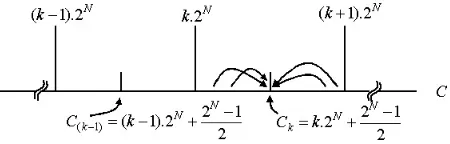
Fig. 1. Quantisation compression scheme considering N level bit-plane discarding.
In Sec. 4, we discuss the conditions for ensuring robustness for watermark embedding taking into account the quantiza-tion error in a scalable coding framework. Simulaquantiza-tions and experimental results supporting the derived model are shown in Sec. 5, followed by the concluding remarks and future work in Sec. 6.
2. WAVELET BASED IMAGE COMPRESSION
The latest image compression standard, JPEG2000, uses wavelet as its core technology and offers scalable decoding with quality scalability and resolution scalability. Modern scalable image coders use wavelet transforms followed by embedded quantizing and entropy coding. The coefficient quantization, in its simplest form, can be formulated as fol-lows:
Cq =
¹
C Q
º
, (1)
whereCq is the quantized coefficient,Cis the original
coef-ficient andQis the quantization factor. Embedded quantizers often useQ= 2N, whereN is a non-negative integer. Such
a quantization parameter within downward rounding (i.e.,
us-ingfloor), can also be interpreted as bit plane discarding as
commonly known within the image coding community. At the decoder side, a reverse process of the encoding is followed to reconstruct the image,i.e.,the entropy decoding is followed by dequantization and inverse wavelet transfor-mation. The dequantization process is formulated as follows:
ˆ
C=Q.Cq+
µ
Q−1 2

, (2)
whereCˆ is the dequantized coefficient. In such a quanti-zation scheme, the original coefficient values in the range k.Q≤C <(k+ 1).Q, wherek∈ ±1,±2±3..., are mapped to( ˆC) = Ck, which is the center value of the concerned
re-gion. Similarly, for bit plane wise coding, we can express the original coefficient vales range ask.2N ≤C <(k+ 1).2N
. as shown in Fig. 1. This relationship is further exploited in Sec. 4 in terms of watermark embedding to model the robust-ness to bit plane discarding based quantization driven quality scalability in scalable image coding.
3. WAVELET BASED WATERMARKING
There are many wavelet based watermarking algorithms present in the literature. In an attempt to generalization of such schemes, we have accommodated popular algorithms into a common framework [16] by dissecting the algorithms into common functional modules and deriving a basic em-bedding form as follows:
C′
m,n=Cm,n+ ∆m,n, (3)
whereC′
m,n is the modified coefficient at (m, n) position,
Cm,nis the coefficient to be modified and∆m,nis the
mod-ification due to watermark embedding. Based on the modifi-cation algorithms we have broadly categorized the algorithms into two groups: direct modification [1, 2, 6, 8, 9] and quan-tization based modification [4, 5, 7, 3].
3.1. Direct modification
Direct modification algorithms are generalized in the follow-ing modification value∆m,nat(m, n)position:
∆m,n= (a1)α(Cm,n)bWm,n+ (a2)vm,nWm,n
+(a3)βCw+ (a4)Sm,n, (4)
wherea1, ..., a4are boolean variables to identify the presence
of each of the components for a given methodology,Cm,nis
the coefficient to be modified,αis the watermark weighting factor,b= 1,2...is the watermark strength parameter,Wm,n
is the watermark value,vm,nis the weighting parameter based
on pixel masking in a human visual system model,β is the weighting parameter in the case of fusion based scheme,Cw
is the watermark wavelet coefficient andSm,n is any other
value which is normally a function ofCm,n.
3.2. Quantization based modification
In this case, the modification (∆m,n) is performed based on a ranked order quantization update. The median value of a local area (typically a3x1coefficient window) is usually modified to a quantized step and the quantization stepδ(−δ ≤∆ ≤
δ) is decided upon a local minima (Cmin) and local maxima
(Cmax) of the selected window coefficients. The expression
to determineδvaries in different algorithms.
In this paper we considered non-blind direct modification based method as the example case for the quantization error modeling work.
4. QUANTIZATION ERROR ANALYSIS
In this section we shall derive a robustness analysis model against quantisation based compression schemes. A modified non-blind direct modification based algorithm [2] has been used as an example case:
[image:3.595.64.289.72.144.2]where C′ is the modified coefficient, α is the watermark
strength parameter andw is the watermark information and assigned to w0 to embed a ′0′ and w1 to embed ′1′. To
extract the watermark we need to refer the original host im-age. The watermark detection can be done by extracting the modification value∆:
∆ =C′−C,
wext= C
′−C
αC , (6)
wherewextis the extracted watermark value. During the
wa-termark extraction, the value of wext is used to decide the
watermark information bit. Often a threshold T is used to decide the extracted watermark bit, i.e. ifwext > T the
ex-tracted bit is said to be′1′and else′0′. Keeping the generality,
first we establish a robustness relationship with the modifica-tion value∆and then use the specific example case. Due to the quantisation Eq. (6) can be rewritten as:
∆q =C′
q−C, (7)
whereC′
q is the quantised value of the watermarked
coef-ficient and∆q is the corresponding quantised modification. Due to the quantisation operation as discussed in Sec. 2, all C′
q values are re-mapped to the center pointsCk of the
cor-responding clusters and the modification values changes ac-cordingly. At this point we shall refer the example case where
∆ =Cαw. We shall use different cases for embedding of′1′
and′0′ and finally combined them to find the relationships
and necessary conditions for correct detection. We have con-sidered same wavelet kernel used for embedding and com-pression.
4.1. Embed′1′
Based on the watermark algorithm, the extracted watermark information is said to be′1′ ifwext > T. At this point we
considered two different cases: 1)C andC′ are in the
dif-ferent cluster and 2)C andC′ are in the same cluster. We
shall discuss these two cases separately in the following sub-sections.
4.1.1. C & C’ are in different cluster
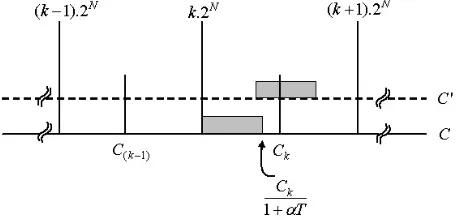
Due to the embedding and positive modification, the modified coefficientC′ can be in the different cluster to the original
coefficientC. The range ofC, for such case can be defined as (refer Fig. 2):
k.2N
1 +αw1
≤C≤k.2N.
(8)
Due to quantisation anyC′value is re-mapped to
correspond-ing center pointCk of clusterkand correct detection of′1′s
[image:4.595.324.551.72.184.2]are guaranteed ifk.2N ≤C′≤C k.
Fig. 2. Range ofC(shaded region) to be modified by embedding ′1′ and correspondingC′ is in the next cluster with a guaranteed detection.
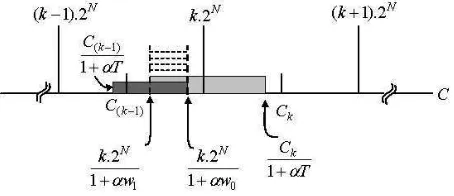
Fig. 3. Range ofC(shaded region) to be modified by embedding ′1′and correspondingC′ is in the same cluster with a guaranteed detection.
4.1.2. C & C’ are in same cluster
We assumeCandC′are in the same cluster after watermark
embedding. In the case ofC′s in the range fromk.2N
toCk
are re-mapped toCkandC′value is increased. Hence∆q is
also increased and correct watermark detection is guaranteed. On the other hand ifC′is in the range fromC
kto(k+ 1).2N,
allC′value will be re-mapped toCkand a decrease in∆qwill
be observed. In this case∆q =Ck−Cshould be greater than
threshold valueT for a correct detection. Hence the range of Cto reatin watermark′1′is defined as below (refer Fig. 3):
k.2N ≤C≤ Ck
1 +αT. (9)
Now with reference to Fig. 4, combining Eq. (8) and Eq. (9) we can define the range ofCto retain the watermark
′1′as below:
k.2N
1 +αw1
≤C≤ Ck
1 +αT. (10)
4.2. Embed′0′
Using Eq. (6) and the watermark extraction algorithms, the extracted watermark bit is considered to be′0′ ifwext < T.
[image:4.595.323.551.240.350.2]Fig. 4.The complete range ofCto be modified to embed′1′with a correct detection atNlevel bit-plane discarding.
Fig. 5.Range ofC(shaded region) to be modified by embedding′0′ and correspondingC′is in the next cluster. Detection performance not guaranteed.
4.2.1. C & C’ are in different cluster
Due to the positive modification, the original coefficient and the modified coefficient can be in different cluster. Using Eq. (2) and Eq. (5), the range of original coefficient valueC for the same can be defined as follows:
k.2N
1 +αw0
≤C≤k.2N. (11)
Due to the quantisation, the modified coefficient C′ in the
other cluster is re-mapped to the corresponding center point Ck of the clusterkand as a result allC′ values in the range
k.2N
toCk (Fig. 5) increased after quantisation operation.
Hence the false detection is possible for the coefficients in range as specified in Eq. (11) and for a correct detection of
′0′s the original coefficients and the corresponding modified
coefficients must be in the same cluster.
4.2.2. C & C’ are in same cluster
The primary condition forC andC′ are in the same cluster
is the modification value∆ should be less than the cluster size. Due to the quantisation the modified coefficients (C′)
in the range from(k−1).2N
toC(k−1), are re-mapped to C(k−1) and there is an effective increase in ∆q during the
watermark extraction. Therefore a false detection is possible. On the other hand, allC′s in the range fromC
[image:5.595.63.290.231.342.2](k−1)tok.2N
Fig. 6. Range ofC(shaded region) to be modified by embedding ′0′and correspondingC′is in the same cluster with guaranteed de-tection.
Fig. 7.Range ofC(overlapping region) to retain the watermark bit ′1′or′0′correctly after the quantisation ofNbit-plane discarding.
are re-mapped toC(k−1)and there is an effective decrement in ∆q and all watermark information can be extracted correctly. Also any value less than the thresholdT is considered as′0′
and therefore to detect a′0′ correctly,C andC′ must be in
the same cluster andCmust be within the following range as shown in Fig. 6.
C(k−1)
1 +αT ≤C≤
k.2N
1 +αw0
. (12)
4.3. Embed′1′or′0′
Combining all the possible cases presented before we can state the conditions and the range ofC for a correct water-mark detection (′1′ or′0′) at a given quantisation level.
Ref-ereing Fig. 7, it is clearly understandable that the overlapping range of the ofCvalues can retain the correct watermark in-formation after the modification with givenN bit-plane dis-carding. Thus the range forC can be defined as below con-sideringw1> w0:
k.2N
1 +αw1
≤C≤ k.2
N
1 +αw0
. (13)
[image:5.595.324.551.241.339.2]4.4. Conditions for optimisation
Based on this robustness analysis, we can choose the coef-ficients efficiently so that correct watermark extraction at a given compression level is possible. At the same time one can decide the minimum modification value for a given coefficient to be modified due to the fact that a greater modification value results in poor imperceptibility and the impact of modification on imperceptibility has been shown in an embedding distor-tion model in [15]. With the help of this robustness analysis model, it is possible to offer an adaptive watermark weight-ing parameter which can control the modification value lo-cally along with an effective coefficient selection, so that the guaranteed watermark detection is possible for a given com-pression ratio with a better imperceptibility.
5. EXPERIMENTAL SIMULATIONS
We have simulated the example case mentioned before with quantisation based compression including JPEG2000. Two different sets of results are obtained to verify the derived model. The experimental arrangements are shown below:
5.1. Experiment Set 1:
Using the direct modification scheme as described in Sec. 4, we applied the quantisation based compression by discarding the bit-planes to verify the robustness. As an experimental parameter set we choseα = 0.5,w1 = 0.8,w0 = 0.3, the
thresholdT = 0.5 and a data set from 1 to 512 which is considered as coefficientsCin all the cases.
Now to emulate the robustness effect on embedding′1′,
we embedded ′1′ in all Cs and the resultant watermarked
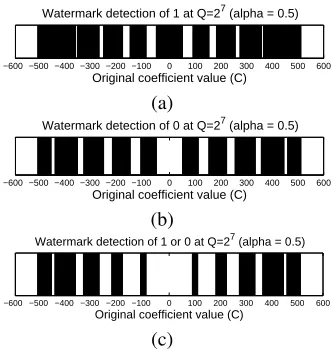
data set is quantised with discarding lowerN = 7bit planes. The watermark extraction is done on quantised data set. In Fig. 8(a) the original un-watermarked coefficients which retained the watermark information after compression are shown. In order to embed′0′ and analyse its robustness, we
performed the same experiments as with embedding′1′ with
the same data set and the results are shown in Fig. 8(b) con-sideringα= 0.5. For a combined detection region for either
′1′or′0′thus can be identified and shown in Fig. 8(c).
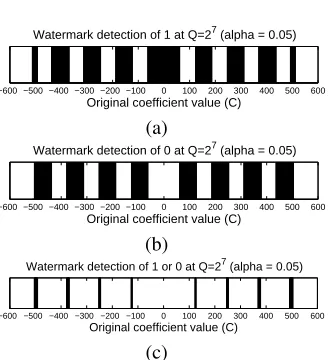
A similar simulations are carried out with a different wa-termarking weighting parameter (α = 0.05). The results of robustness effect on embedding′1′,′0′ and combined′1′ or ′0′are shown in Fig. 9(a), Fig. 9(b) and Fig. 9(c), respectively.
5.2. Experiment Set 2:
In this case, an JPEG2000 based quality scalability compres-sion is applied. In stead of only′1′s or only′0′s, a general
random combination of′1′s and′0′s are chosen as watermark
information. With the parameter set of 3 level wavelet de-composition,α= 0.05, four different quantisation bit planes (atN = 0,N = 5,N = 7andN = 9) are assumed and ac-cordingly the coefficients of the low frequency subbands are
−600 −500 −400 −300 −200 −100 0 100 200 300 400 500 600
Watermark detection of 1 at Q=27 (alpha = 0.5)
Original coefficient value (C)
(a)
−600 −500 −400 −300 −200 −100 0 100 200 300 400 500 600
Watermark detection of 0 at Q=27 (alpha = 0.5)
Original coefficient value (C)
(b)
−600 −500 −400 −300 −200 −100 0 100 200 300 400 500 600
Watermark detection of 1 or 0 at Q=27 (alpha = 0.5)
Original coefficient value (C)
[image:6.595.356.522.71.247.2](c)
Fig. 8. Map of original coefficient (C) values which can retain: (a)′1′, (b)′0′ and (c) combinations of′1′ or′0′atQ = 27
with
α = 0.5. Black region represents correct detection where white
region represents incorrect detection.
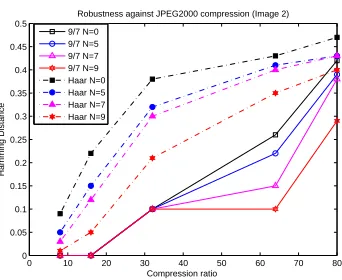
estimated to embed the watermark. Other parameters are kept same as in experiment set 1. In case ofN = 0all the co-efficient are selected for the embedding. A JPEG2000 qual-ity scaling is then performed to the watermarked image and Hamming distance is calculated between the original water-mark and the extracted waterwater-mark in each of the four cases. We have considered the cases for same and different wavelet kernels at embedding and compression as shown in Fig. 10. In the case of same wavelet, W v1 = W v2 where W v1 is
the embedding wavelet andW v2is the compression wavelet,
biorthogoanl9/7 as in JPEG2000 is considered for embed-ding and compression. For W v1 6= W v2, we considered
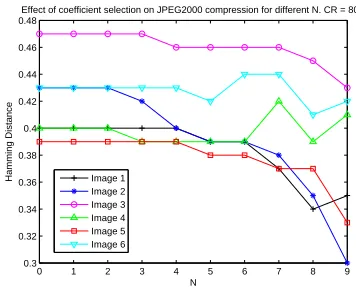
Haar as the embedding wavelet, keeping9/7as compression wavelet in JPEG2000. For a set of different images (refer Fig. 11), the results for JPEG200 quality scaling at different compression ratios are shown in Fig. 12, Fig. 13, Fig. 14, Fig. 15, Fig. 16 and Fig. 17. The effect of bit-plane based robustness at a given JPEG2000 compression ratio such as
64 : 1or80 : 1are shown in Fig. 18 and Fig. 19, and same
embedding and compression wavelet i.e. bi-orthogonal 9/7 is considered here.
Now as an example using the experimental parameters we shall calculate different model parameters and then compare these with the experimental results.
Embed′1′:From Eq. (10), to embed′1′, we can calculate the
range of original coefficients which can retain the watermark correctly by discardingN = 7lower bit-planes. For different k values we can estimate the range for the experimental data set as shown in Table 1. The experimental simulations sup-port the the same as shown in Fig. 8 and Fig. 9.
Embed′0′: Using Eq. (12) and the experimental parameter
set following the range for theC to retain′0′ can be
Table 1. Data set range to retain watermark′1′and′0′atQ= 27
quantisation level. (a)α= 0.5
k→ -5 -4 -3 -2 -1 1 2 3 4 5
′1′ min -512 -460 -358 -256 -153 -51 91 183 274 366 457
max -457 -366 -274 -183 -91 51 153 256 358 460 512
′0′ min -512 -445 -334 -223 -111 51 153 256 358 460
max -460 -358 -256 -153 -51 111 223 334 445 512
(b)α= 0.05
k→ -4 -3 -2 -1 1 2 3 4
′1′ min -512 -437 -312 -187 -62 123 246 369 492
max -492 -369 -246 -123 62 187 312 437 512
′0′ min -504 -378 -252 -126 62 187 312 437
max -437 -312 -187 -62 126 252 378 504
−600 −500 −400 −300 −200 −100 0 100 200 300 400 500 600
Watermark detection of 1 at Q=27 (alpha = 0.05)
Original coefficient value (C)
(a)
−600 −500 −400 −300 −200 −100 0 100 200 300 400 500 600
Watermark detection of 0 at Q=27 (alpha = 0.05)
Original coefficient value (C)
(b)
−600 −500 −400 −300 −200 −100 0 100 200 300 400 500 600
Watermark detection of 1 or 0 at Q=27 (alpha = 0.05)
Original coefficient value (C)
[image:7.595.115.554.76.392.2](c)
Fig. 9. Map of original coefficient (C) values which can retain: (a)′1′, (b)′0′ and (c) combinations of′1′ or′0′ atQ = 27
with
α = 0.05. Black region represents correct detection where white region represents incorrect detection.
shown in Fig. 8 and Fig. 9.
Hence from the above derived range of the coefficients Cfor embedding′1′ and′0′ can be combined and the using
Eq. (13) the range for this example is calculated and shown in Table 2.
A combined random′1′ and′0′, watermark information
is embedded and compressed against JPEG2000 quality scal-ability and the results are shown in Fig. 12, Fig. 13, Fig. 14, Fig. 15, Fig. 16 and Fig. 17. In case of same embedding and compression wavelet, the simulations strongly supports our derived model for various host images. Whereas, using a dif-ferent embedding wavelet does not follow the derived model due to the fact that the coefficient values varies in transform domain for different wavelet. From Fig. 18 and Fig. 19, the trend at a given compression ratio is observed. The coefficient selection are based on assumed bit plane discarding. Consid-eration of more bit-plane discarding, results in more robust-ness at a given compression ratio. But at the same time, wa-termark capacity is reduced. Thus using this study a trade off can be done based on the application requirement.
Watermark embedding. Embedding wavelet kernel = Wv1.
Quantisation based compression. Compression wavelet kernel = Wv2. Host
Image (I) Watermark information
Watermarked image (I’)
Watermark extraction. Wavelet kernel
= Wv1. Compressed
test image (Iq’)
Extracted watermark
Fig. 10. Experiment set schematic with wavelet based watermark embedding and compression.
Image 1 Image 2 Image 3
Image1 (512x512) Image2 (704x576) Image3 (704x576)
Image 4 Image 5 Image6
[image:7.595.98.262.235.415.2]Image4 (704x576) Image5 (768x512) Image6 (704x576)
Fig. 11.Image test set (Image5 is from Kodak test set).
6. CONCLUSIONS
[image:7.595.327.549.358.476.2]Table 2.Data set range to retain watermark′1′or′0′atQ= 27
quantisation level.
(a)α= 0.5
min -512 -445 -334 -223 -111 91 183 274 366 460
max -460 -366 -274 -183 -91 111 223 334 445 512
(b)α= 0.05
min -504 -378 -252 -126 123 246 369 492
max -492 -369 -246 -123 126 252 378 504
0 10 20 30 40 50 60 70 80 0
0.05 0.1 0.15 0.2 0.25 0.3 0.35 0.4 0.45 0.5
Robustness against JPEG2000 compression (Image 1)
Compression ratio
Hamming Distance
[image:8.595.88.262.183.339.2]9/7 N=0 9/7 N=5 9/7 N=7 9/7 N=9 Haar N=0 Haar N=5 Haar N=7 Haar N=9
Fig. 12. Effect of bit-plane based coefficient selection procedure against JPEG2000 quality scaling for image 1. Quantisation steps:
Q= 20 ,Q= 25
,Q= 27
andQ= 29
. Two sets of results displayed for same embedding wavelet: 9/7 and different embedding wavelet: Haar.
7. REFERENCES
[1] X. Xia, C. G. Boncelet, and G. R. Arce, “Wavelet transform based watermark for digital images,”Optic Express, vol. 3, no. 12, pp. 497–511, 1998.
[2] J. R. Kim and Y. S. Moon, “A robust wavelet-based digital wa-termarking using level-adaptive thresholding,” inProc. IEEE ICIP, 1999, vol. 2, pp. 226–230.
[3] F. Huo and X. Gao, “A wavelet based image watermarking
scheme,” inProc. IEEE ICIP, 2006, pp. 2573–2576.
[4] D. Kundur and D. Hatzinakos, “Digital watermarking
us-ing multiresolution wavelet decomposition,” inProc. IEEE
ICASSP, 1998, vol. 5, pp. 2969–2972.
[5] L. Xie and G. R. Arce, “Joint wavelet compression and authen-tication watermarking,” inProc. IEEE ICIP, 1998, vol. 2, pp. 427–431.
[6] M. Barni, F. Bartolini, and A. Piva, “Improved wavelet-based
watermarking through pixel-wise masking,” IEEE Trans.
Im-age Processing, vol. 10, no. 5, pp. 783–791, May 2001.
[7] C. Jin and J. Peng, “A robust wavelet-based blind digital wa-termarking algorithm,” Information Technology Journal, vol. 5, no. 2, pp. 358–363, 2006.
[8] X. C. Feng and Y. Yang, “A new watermarking method based on DWT,”Lect Notes in Comp. Sc., vol. 3802, pp. 1122–1126, 2005.
0 10 20 30 40 50 60 70 80 0
0.05 0.1 0.15 0.2 0.25 0.3 0.35 0.4 0.45 0.5
Robustness against JPEG2000 compression (Image 2)
Compression ratio
Hamming Distance
[image:8.595.349.520.199.339.2]9/7 N=0 9/7 N=5 9/7 N=7 9/7 N=9 Haar N=0 Haar N=5 Haar N=7 Haar N=9
Fig. 13. Effect of bit-plane based coefficient selection procedure against JPEG2000 quality scaling for image 2. Quantisation steps:
Q= 20,Q= 25,Q= 27andQ= 29. Two sets of results displayed for same embedding wavelet: 9/7 and different embedding wavelet: Haar.
[9] D. Kundur and D. Hatzinakos, “Toward robust logo water-marking using multiresolution image fusion principles,”IEEE
Trans. Multimedia, vol. 6, no. 1, pp. 185–198, Feb. 2004.
[10] I. Burnett, R. Van de Walle, K. Hill, J. Bormans, and F. Pereira,
“MPEG-21: goals and achievements,”Multimedia, IEEE, vol.
10, no. 4, pp. 60–70, Oct-Dec 2003.
[11] D. S. Taubman and M. W. Marcellin, JPEG2000 Image
Com-pression Fundamentals, Standards and Practice, Springer,
USA, 2002.
[12] T. Ebrahimi and R. Grosbois, “Secure JPEG 2000-JPSEC,” 2003, vol. 4, pp. 716–19.
[13] Q. Sun and S. Chang, “A secure and robust digital
signa-ture scheme for JPEG2000 image authentication,”IEEE Trans.
Multimedia, vol. 7, no. 3, pp. 480–494, June 2005.
[14] M. Ejima and A. Miyazaki, “On the evaluation of performance
of digital watermarking in the frequency domain,” inProc.
IEEE ICIP, 2001, vol. 2, pp. 546–549.
[15] D. Bhowmik and C. Abhayaratne, “A generalised model for distortion performance analysis of wavelet based
watermark-ing,” inProc. 7th Int’l Workshop on Digital Watermarking
(IWDW ’08), Lect. Notes in Comp. Sc., 2008.
[16] D. Bhowmik and C. Abhayaratne, “A framework for evaluat-ing wavelet based watermarkevaluat-ing for scalable coded digital item adaptation attacks,” inProc. SPIE Wavelet Applications in
0 10 20 30 40 50 60 70 80 0 0.1 0.2 0.3 0.4 0.5 0.6 0.7
Robustness against JPEG2000 compression (Image 3)
[image:9.595.91.259.77.213.2]Compression ratio Hamming Distance 9/7 N=0 9/7 N=5 9/7 N=7 9/7 N=9 Haar N=0 Haar N=5 Haar N=7 Haar N=9
Fig. 14. Effect of bit-plane based coefficient selection procedure against JPEG2000 quality scaling for image 3. Quantisation steps:
Q= 20,Q= 25,Q= 27andQ= 29. Two sets of results displayed for same embedding wavelet: 9/7 and different embedding wavelet: Haar.
0 10 20 30 40 50 60 70 80 0 0.05 0.1 0.15 0.2 0.25 0.3 0.35 0.4 0.45 0.5
Robustness against JPEG2000 compression (Image 4)
[image:9.595.348.520.78.223.2]Compression ratio Hamming Distance 9/7 N=0 9/7 N=5 9/7 N=7 9/7 N=9 Haar N=0 Haar N=5 Haar N=7 Haar N=9
Fig. 15. Effect of bit-plane based coefficient selection procedure against JPEG2000 quality scaling for image 4. Quantisation steps:
Q= 20,Q= 25,Q= 27andQ= 29. Two sets of results displayed for same embedding wavelet: 9/7 and different embedding wavelet: Haar.
0 10 20 30 40 50 60 70 80 0 0.05 0.1 0.15 0.2 0.25 0.3 0.35 0.4 0.45
Robustness against JPEG2000 compression (Image 5)
Compression ratio Hamming Distance 9/7 N=0 9/7 N=5 9/7 N=7 9/7 N=9 Haar N=0 Haar N=5 Haar N=7 Haar N=9
Fig. 16. Effect of bit-plane based coefficient selection procedure against JPEG2000 quality scaling for image 5. Quantisation steps:
Q= 20 ,Q= 25
,Q= 27
andQ= 29
. Two sets of results displayed for same embedding wavelet: 9/7 and different embedding wavelet: Haar.
0 10 20 30 40 50 60 70 80 0 0.05 0.1 0.15 0.2 0.25 0.3 0.35 0.4 0.45 0.5
Robustness against JPEG2000 compression (Image 6)
[image:9.595.87.260.297.435.2]Compression ratio Hamming Distance 9/7 N=0 9/7 N=5 9/7 N=7 9/7 N=9 Haar N=0 Haar N=5 Haar N=7 Haar N=9
Fig. 17. Effect of bit-plane based coefficient selection procedure against JPEG2000 quality scaling for image 6. Quantisation steps:
Q= 20,Q= 25,Q= 27andQ= 29. Two sets of results displayed for same embedding wavelet: 9/7 and different embedding wavelet: Haar.
0 1 2 3 4 5 6 7 8 9 0.1 0.15 0.2 0.25 0.3 0.35
Effect of coefficient selection on JPEG2000 compression for different N. CR = 64:1
N
Hamming Distance Image 1
[image:9.595.347.523.311.456.2]Image 2 Image 3 Image 4 Image 5 Image 6
Fig. 18. Effect of bit-plane based coefficient selection procedure against JPEG2000 quality scaling considering 64:1 compression ra-tio. Quantisation steps:Q= 20toQ= 29.
0 1 2 3 4 5 6 7 8 9 0.3 0.32 0.34 0.36 0.38 0.4 0.42 0.44 0.46 0.48
Effect of coefficient selection on JPEG2000 compression for different N. CR = 80:1
N
Hamming Distance Image 1 Image 2 Image 3 Image 4 Image 5 Image 6
[image:9.595.87.261.518.651.2] [image:9.595.344.522.523.668.2]