Theses Thesis/Dissertation Collections
6-29-1992
Light scattering study of attractive interactions in a
model microemulsion system
Dawn M. Campbell
Follow this and additional works at:http://scholarworks.rit.edu/theses
This Thesis is brought to you for free and open access by the Thesis/Dissertation Collections at RIT Scholar Works. It has been accepted for inclusion in Theses by an authorized administrator of RIT Scholar Works. For more information, please [email protected].
Recommended Citation
Dawn M. Campbell
Submitted to the Center for Materials Science and Engineering, Rochester Institute of Technology,
Rochester, New York 14623
IN PARTIAL FULFILLMENT OF THE REQUIREMENTS FOR THE DEGREE OF
MASTER OF SCIENCE
Signature of Author
D
__a_w_n_M
__
.~C-a-m~p-b-e-I-I---Center for Materials Science and EngineeringJune 29, 1992
Certified by _
Dr. Michael Kotlarchyk Thesis Supervisor
Accepted by _
Dr. Andreas Langner Thesis Committee
Accepted by _
Dr. Surendra Gupta Thesis Committee
Accepted by ___
LIGHT SCA'rl'ERING STUDY OF ATTRACTIVE INTERACTIONS IN A MODEL MICROEMULSION SYSTEM
I, Dawn M. Campbell, hereby grant permission to the
Wallace Memorial Library of RIT to reproduce my thesis in
whole or in part. Any reproductions will not be for
Dawn M. Campbell
Center for Materials Science and Engineering,
Rochester Institute of Technology, Rochester, New York
14623
Abstract
Static and dynamic (photon correlation spectroscopy)
light scattering studies were conducted on
AOT/WATER/n-DECANE microemulsions near room temperature. The molar
ratio of water to AOT was varied from W = 20 to 30. The
volume fractions of the studied microemulsions ranged
from $ = 0.03 to 0.45. Static light
scattering data was
modeled by a theory based on attractive perturbations to
hard spheres. From the model, values for A, the
attractive perturbation to the second virial coefficient,
were determined. It was found that A is an increasing
function of W. Photon correlation spectra were analyzed
in terms of an adhesive sphere model to produce
corresponding values of A, which were compared to the
statically determined A-values. The two methods produced
A values that were not in agreement within experimental
error, however the methods independently had reasonable
PAGE
ABSTRACT 3
TABLE OF CONTENTS 4
LIST OF FIGURES 6
LIST OF TABLES 7
ACKNOWLEDGMENTS 8
Chapter 1. INTRODUCTION
1.1 Introduction to field 10
1. 2 The problem and method 18
Chapter 2. LIGHT SCATTERING TECHNIQUES
2.1 Essentials of instrument setup 20
2.2 Static light scattering 25
2.3 Photon Correlation Spectroscopy 28
Chapter 3. THEORETICAL BACKGROUND
3.1 Interpretation of Static Light 34
Scattering
3.2 Interpretation of PCS 45
Measurements
Chapter 4. THE EXPERIMENT
4.1 Sample preparation and 51
compositions
4.2 Experimental results 57
4.3 Interpretation of results 61
Chapter 5. CONCLUSION AND SUGGESTIONS FOR FUTURE 73
WORK
APPENDIX A. Start up procedure 76
APPENDIX E. Intensity curve fitting instructions 82
APPENDIX F. Derivation of A vs. a equation 83
Reversed Micelle 1.2 15
Swollen Micelle 1.3 16
Reversed Swollen Micelle 1.4 17
Experimental Set-up 2.1 21
Osmotic Pressure 3.1 37
Hard Sphere Potential 3.2 40
Micellar Interaction Potential 3.3 41
Square Well Potential 3.4 41
Adhesive Sphere Model 3.5 42
Rayleigh Ratio vs. (J) , W = 24.7 3.6 44
Autocorrelation Function 3.7 47-48
Dc vs. (J) , W
= 27.5
3.8 49
AOT Structure 4.1 51
Aot/Water/n-Decane Microemulsion 4.2 53
Static Light Scattering Experimental Results 4.3 58
PCS Experimental Results 4.4 60
Overlap Volume of Micelles 4.5 61
A vs. a 4.6 63
A vs. (1 - a1/3)-1
4.6.1 64
Rayleigh ratio vs. <$> for W = 18
4.6.5 65
Rayleigh ratio vs. (J) for W = 30 4.7 66
X vs. a for C = .65 and 1.1 4.8 69
Static Light Scattering: W and Aperture 2.1 24
I would like to express my thanks to Dr. Michael
Kotlarchyk. His guidance, support and encouragement
provided the motivational framework for this work. He
always had time for discussions and his patience was
limitless.
Through grants, scholarship and assistantships supplied,
in part, by the Materials Science and Engineering
department at the Rochester Institute of Technology, it
was possible for me to continue my education. To Dr. P.
Cardegna I extend my thanks for his role in securing this
aid and also for his continued help and input.
I would like to thank Dr. V- Gupta and Dr. A. Langner for
lending their time in the role of thesis committee
members.
I greatly appreciate the generosity exhibited by Dr. M
Illingsworth and his students in the Inorganic chemistry
laboratory at R.I.T for their time and use of the rotary
his assistance in the laboratory, to Mike Chen and Shawn
Amershak for their intriguing conversation and
encouragement and to Bill VanDerveer for his technical
assistance.
I am deeply grateful for the support of my parents and
brother, their encouragement is superseded only by their
understanding.
In addition, I would like to thank Kathy Plec and Patty
Chapter 1. INTRODUCTION
1.1 Introduction to the field
There have been previous studies on colloidal
systems that predict the basic interaction potential due
to interparticle forces. Micellar and microemulsion
suspensions have been appropriate systems for these
studies.1/2'3/4/5/6 Current belief is that
microemulsions
which contain reversed swollen micelles have a strong
short range attractive force due to the interpenetration
of the surfactant tails residing on the surface of the
interacting particles.4
The AOT/Water/n-Decane
microemulsion system is considered to be a model system
because it achieves thermodynamic stability with only
three components near room temperature. This
microemulsion system has been studied using various
techniques including small angle neutron scattering
(SANS)3, small angle x-ray scattering (SAXS)6 and light
scattering4, to name a few. The present study employs
static light scattering and photon correlation
spectroscopy (PCS), also called dynamic light scattering
(DLS), to study the interaction between particles in the
Light scattering is a particularly appealing way to
study microemulsion systems because it is non-destructive
and requires small sample volumes (approximately 3 ml).
The following section briefly discusses colloidal
systems. Then the subgroup of microemulsions, and
micellar microemulsions, in particular, are discussed.
COLLOIDAL SYSTEMS:
"A colloidal system consists of a finely dispersed
phase (or discontinuous phase) distributed uniformly in a
finely divided state in a dispersion medium (or
continuous phase)-"7
There are colloidal systems all
around us, for instance, fog is a discontinuous water
droplet phase in a continuous air phase and milk is a
discontinuous fat droplet phase in a continuous aqueous
phase. The dispersed phase in these colloidal systems
usually has dimensions in the range of 1
-1000 nm, and
is finely divided throughout the continuous phase. In
some colloidal systems, however, the dispersed phase
particles are much larger than 1000 nm, hence the limits
One type of a colloidal system is an emulsion. An
emulsion consists of a fluid dispersed phase in a fluid
dispersion medium. In most instances, emulsions either
consist of aqueous droplets in oil, a water-in-oil (W/0)
emulsion, or an oil-in-water (0/W) emulsion. Milk is an
example of a 0/W emulsion with fat droplets in an aqueous
medium whereas mayonnaise is an example of an W/0
emulsion with aqueous droplets in an oil medium.7
One factor that determines whether or not an 0/W or
W/0 emulsion forms is the ratio of the amounts of the two
phases present (the ratio of the phase volumes). In most
cases the dispersed phase is the phase which is present
in the lower amount. When an emulsion forms, there is an
increase in free energy in the system as well as an
increase in interfacial area between the two phases
present. The amount of work required for the emulsion
formation is determined by the interfacial tension. As
the interfacial tension decreases, so does the amount of
work needed to form the emulsion, so emulsions form more
readily as the interfacial tension decreases. In
addition, the attainable droplet size decreases as the interfacial tension decreases. In fact, if the
interfacial tension of a system approaches zero,
in these spontaneously formed systems is very small (< 10
nm diameter) and so the droplets scatter little light
which makes the dispersions clear. These systems that
are formed
spontaneously are called microemulsions, they
consist of at least three components (e.g., oil, water
and surfactant) and are thermodynamically stable. Some
microemulsions need a fourth component (cosurfactant) in
order to achieve stability. One of the major driving
forces for the intense study of microemulsions in recent
years is their possible use in tertiary oil recovery-7 In
addition there is a general academic interest in learning
about the particle interactions in complex fluid systems.
The microemulsion structure may be that of random or
very ordered lamellar sheets, bicontinuous, or micellar,
to name a few. The experimental system chosen in the
present study was a micellar microemulsion, hence the
following text will give a brief introduction to the
structure and types of micelles.
A micelle can be formed with water and a surface
active molecule (surfactant). The surfactant is an
amphiphile which means it is a molecule consisting of two
parts, "one portion is a hydrophobic hydrocarbon chain
existence of these opposing properties in the same
molecule, when dissolved in a solvent, is the origin of
the thermodynamic driving force for micellar formation."8
For instance, when a surfactant, which has this polar
head group, is added to water it maximizes the polar
head groups contact with water and minimizes the
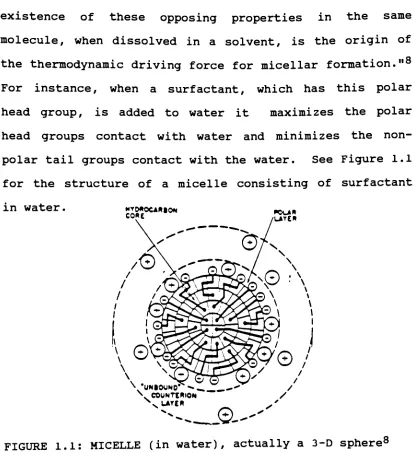
non-polar tail groups contact with the water. See Figure 1.1
for the structure of a micelle consisting of surfactant
in water. td#o<UMc* COKE
^ "UNIOUNO*
".___"
N. COUNTXHION
XNLATCH
/
FIGURE 1.1: MICELLE (in water), actually a 3-D sphere8
On the other hand, if the surfactant is added to a
hydrocarbon fluid (oil), the lower free energy state is
obtained when the tail groups have maximum contact with
the hydrocarbon fluid and the polar head groups minimize
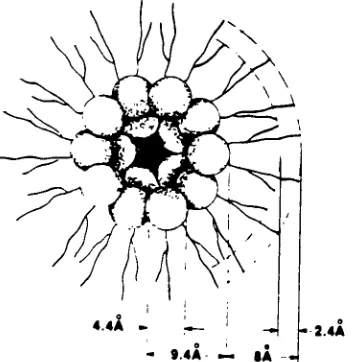
[image:15.537.62.480.79.537.2]is called a reversed micelle. This structure is shown in the following figure.
H --S.4A
FIGURE 1.2: REVERSED MICELLE (in hydrocarbon fluid),
actually a 3-D sphere18
Not only are there micelles and reversed micelles,
there are swollen micelles and reversed swollen micelles.
A swollen micelle can be formed if another component is
added to the system. For example, by adding a small
amount of oil to the micelle in water system, a swollen
micelle is formed. Whether it is a swollen micelle or a
reversed swollen micelle is generally dependent upon the
volume fractions of the components in the system. For instance, if a small amount of oil is added to the
micelle in water system, the oil situates itself such that it has maximum contact with the non-polar tail
[image:16.537.213.389.142.323.2]maximum contact with the water. See Figure 1.3 for the
swollen micelle structure.
FIGURE 1.3: SWOLLEN MICELLE, actually a 3-D sphere
Likewise, if a small amount of water is added to the
reversed micelle in hydrocarbon fluid system, the water
pools up in the center of the surfactant molecules due to
steric and electrostatic repulsive forces of the polar
heads as well as the hydrophobic effect. This is called
[image:17.537.200.330.180.319.2]FIGURE 1.4: REVERSED SWOLLEN MICELLE, actually a 3-D
1.2: Problem and Method
The adhesive hard sphere model has been shown to
accurately describe the short range attractive
interaction observed in some colloidal suspensions.5
Microemulsions comprising of AOT, water and oil have been
shown to exhibit a short range interaction potential due
to the overlapping of the surfactant tails.2/3 The
effect of changing the micelle dimension on the strength
of this interaction has not been previously examined in
detail.
The present study employs a model that assumes an
attractive interaction between particles to analyze the
static light scattering data. Photon correlation
spectroscopy data is analyzed using the adhesive sphere
model. This adhesive sphere model has previously been
applied to the AOT/Water/Oil microemulsion system in SAXS
studies.19/20/21 A major finding in these studies is
that the interaction potential changes with the droplet
concentration. In fact, the stickiness was found to
decrease significantly with increasing water volume
fraction.20 In the present study, the relationship
water to AOT molar ratio, which is related to the
size of
Chapter 2. LIGHT SCATTERING TECHNIQUES
2.1 Essentials of Instrument Setup:
A model SP127-35 35 mW Helium-Neon laser with
wavelength = 632.8
nm was used with a Brookhaven
Instruments BI-200SM Goniometer version 2.0. The
goniometer houses a high quality glass vat in which there
is decahydronapthalene (decalin), an index matching
fluid. The decalin was supplied by Aldrich Chemical Co.
Inc. with > 99% purity- In the center of the vat is a
holder for a 12mm nominal diameter round sample cell. An
EMI-9863 photomultiplier tube (PMT) with a reported dark
count of 20 counts/sec was used to detect the scattered
light. The PMT is powered by a 0
-3000 volt EG&G ORTEC
high voltage power supply set at 2050 volts. The signal
is then sent to a BI-2030AT Digital Correlator, with 136
real time data channels and 6 real time delay channels,
and a BI computer for processing. The index matching
fluid and the samples are kept at constant temperature
using a Fisher Scientific Isotemp Refrigerated circulator
Model 9000 with
0.1
C accuracy. In addition, a BI
filtration system was used for filtering the index
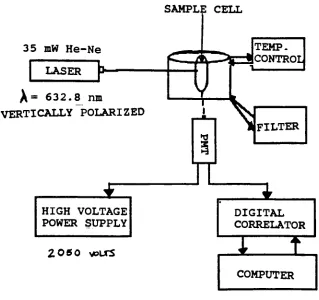
matching fluid in the vat. See Figure 2.1 for an
35 mW He-Ne
LASER
>
SAMPLE CELL
^= 632.8 nm
VERTICALLY POLARIZED
HIGH VOLTAGE POWER SUPPLY
2050 volXS
TEMP.
PZSCONTROL
N
FILTERDIGITAL CORRELATOR
1
T"
COMPUTER
FIGURE 2.1: EXPERIMENTAL SETUP USED FOR STATIC LIGHT
SCATTERING AND PHOTON CORRELATION SPECTROSCOPY STUDIES.
The alignment of the system should be checked
[image:22.537.115.434.184.484.2]alignment was checked at least once a month, when no
significant variances were observed at the scattering
angle of 90 , the alignment was checked approximately
once every three months. Also, in the summer months when
the weather proves to be increasingly detrimental, the
alignment was checked more frequently, on the order of
once or twice a week. The procedure for checking the
alignment is outlined in the Light scattering manual
provided by Brookhaven Instruments Corporation10, in the
alignment section, page 7-4 through 7-8. It should be
noted that at 90 no significant effects were observed
when the sample cell was positioned so that a scratch was
in the region where the beam enters the cell as opposed
to a region where there were no scratches (no bright
spots observed) on the sample cell. It is believed that
scratches on the sample cell will have an effect on
experimental results if the experiment employs small
scattering angles.
The index matching fluid (decalin) has an index of
refraction that is approximately equal to that of the
glass vat and the glass sample cell. The purpose of this
fluid is to keep the incoming laser beam from scattering
when it encounters the vat-liquid and liquid-sample cell
experimental period was the original fluid put in the
system. The decalin was filtered approximately once a
month for the first four months then once every four
months thereafter. Filtering the decalin reduces the
amount of impurities in the system however it introduces
bubbles. This presents a problem as decalin is a rather
viscous fluid and it was found that it took at least one
week for the bubbles to either settle on the floor of the
vat or rise to the surface where they would not be in the
path of the beam (heating the fluid in the vat using the
temperature controller accelerates the elimination of
bubbles to a certain degree). Thus the index matching
fluid was only filtered when it was absolutely necessary.
It is the opinion of this student that the decalin
should be replaced no less than once a year. This
procedure should be done with all appropriate protective
equipment and in the company of another in case of an
accident.
The temperature was kept constant at 23.1 C and
the PMT was positioned at 90
for both PCS and static
light scattering experiments. An aperture setting of
200 yfm was used for all photon correlation spectroscopy
autosample time selection (press ALT START). For the
static light scattering experiments the sample time was
fixed at l jusec and the aperture was adjusted as shown in
table 2.1.
TABLE 2.1: STATIC LIGHT SCATTERING
w APERTURE (Jim)
20.0 400
24.7 400
27.5 400
29.0 200
29.5 200
NOTE: The duration was adjusted for each sample so that
IO5
counts accumulated over the total duration
period. On the average, the duration was 200
[image:25.537.56.471.78.433.2]2.2 STATIC LIGHT SCATTERING:
Static light scattering has been used extensively in
the study of micellar and microemulsion systems.2/4
Static light scattering provides a non-destructive way to
extract information about interparticle interactions. In
the present study, static light scattering experiments
were performed on AOT/Water/n-Decane microemulsions in an
effort to learn about the attractive interactions
exhibited by the reversed swollen micelles.
Essentials of Static Light Scattering:
A laser is focused such that it illuminates the
sample under study. Each particle in the sample scatters
light. The photomultiplier tube (PMT), is positioned at
a particular angle (90 for the present study) in order
to detect the number of photons emitted at the detector
angle. This photon count is updated for a prescribed
time period.
Ultimately, it is the total photon count or actual
number of photons being scattered from the particles for
measure. The scattering angle and temperature were kept
constant for this study.
However, the measured photon count rate is dependent
upon the geometry of the system, (how far the detector is
from the sample, for example). In order to compare
results from different systems it is desirable to obtain
a value from the measured photon count rate of the sample
that only depends on the scatterer itself, and not on the
source or the detector optics. By calculating the so
called Rayleigh factor, geometry considerations are
eliminated. The Rayleigh factor is defined as follows:10
i?C9) =^2 rl (2.1)
/. V iw vob
!(-&-) = scattered radiance
r = distance from the detector
vobs = illuminated volume !inc = incident irradiance
The Rayleigh factor has units of cm~1steradian~1
.
This represents "the fraction of light scattered per unit
length per unit solid angle."10
Typically this Rayleigh
factor is called a Rayleigh ratio, but since it does have
units, it is not strictly correct to call it a ratio.
this paper will continue using it to avoid unnecessary
confusion.
The Rayleigh ratio is not directly measured, the
photon count/sec, (or count rate), is measured, therefore
corrections must be made to the measured count rate.
Also the photometer is not an absolute photometer so it
must be adjusted for inherent dark counts. See
reference #10 for details. The light scattering
equipment had vertically polarized light. The index
matching fluid-to-vat refractive indices ratio was
sufficiently close to 1 and the ratio of the refractive
indices of the solvent and calibration liquid (toluene)
was also close to 1. The system was non-aqueous, and the
solution to cell interface produced no significant
reflection. With all the above conditions the Rayleigh
ratio is calculated using the following formula:
m
=Rai
(90) sin6 '-f ?" '
frf"
"" (2"2>** 1calL*3J
~JDCR
where: R(-. ) = Rayleigh ratio of sample at -O-. Rcal(90
) = absolute Rayleigh ratio of
calibration liquid at 90
Toluene = 14.0 * 10~6 cm"1
Isample( "^"
) = count rate of the sample at the detector angle -O*
.
2.3 PHOTON CORRELATION SPECTROSCOPY:
Photon correlation spectroscopy (PCS), or dynamic
light scattering (DLS), has become a useful tool in
determining the diffusion coefficient and the particle
size distribution of materials having particles with
dimension of a few nanometers to several micrometers.
Some advantages of using PCS over other methods that
determine the diffusion coefficient are that the
measurement does not require calibration and it is easy
to operate the equipment and perform the experiment. In
fact, as long as the suspension is sufficiently dilute
(negligible interparticle interactions or multiple
scattering) , determination of the diffusion coefficient
is independent of particle composition and
concentration.11 In this particular
study, the samples
were not of such low concentrations that the particles
did not interact, so this interaction contributes to the
particle motion. There are also hydrodynamic
considerations; the movement of the molecules in the
fluid creates a perturbation in the fluid which, in turn,
Essentials of PCS:
A laser is focused such that it illuminates a
relatively dilute suspension. Each particle in the
solution scatters light. These light waves interfere
with each other and produce a net scattering intensity,
I(t), which is detected by the photomultiplier tube
(PMT). Each particle's position in the suspension
fluctuates randomly due to Brownian motion (diffusion) ,
interparticle interactions and hydrodynamic
contributions. This random fluctuation in position
produces a random fluctuation in the phases of each
scattered wave as they arrive at the PMT. This means
that as the particles diffuse in the suspension, the
intensity, I(t), fluctuates in a way that is related to
the particle motion.
An efficient way to analyze this fluctuating
intensity signal is to use correlation. Most people are
familiar with the idea of correlation. "If two variables
or two signals are highly correlated, then a change in
one can be used to predict, with confidence, the change
in the other. Mathematically, correlation is defined
quantities."10 if
you multiply the
intensity function by
a delayed
version of itself and average the quantity,
it is called an autocorrelation
function, C(t).
CCO = -t^/GO
+ICr+Oy
(2.3)Here I(*r ) is the count rate at time T , and I(f +t) is
the intensity at some later time, n plus delay time t.
For small time intervals the correlation between I(T )
and I(T+t) is high but as the
delay time (t) increases,
the correlation decreases. In fact, the correlation
function decays exponentially for a suspension of rigid,
globular particles and is given by:10 *
CCO = e(-2ZW0
, (2.4)
where q is the scattering wave vector defined as follows:
- *
4-ffJ
(2.5)
* For a more rigorous explanation of the autocorrelation
In Eq. 2.5, n is the index of refraction of the solvent, is the wavelength of light in vacuum and is the
scattering angle. Therefore, by
analyzing the intensity autocorrelation function, the collective diffusion coefficient can be determined.
The autocorrelation function described in Eq. 2.4 is based on the system having monodisperse particles.
However, most systems are significantly polydisperse and
this means that each particle size contributes its own exponential term. Therefore the autocorrelation function
for a polydisperse system contains an integral of the
exponential in Eq. 2.4. This, of course, increases the
complexity of solving the autocorrelation for the diffusion coefficient.10/12/13 For a system of
polydisperse particles, the autocorrelation function now
looks like:10
00
t
CCO = GCl) e"rt
dT . (2.5.5)
0
Here G is a distribution function, and V = Dq2. This Laplace transform equation has a nontrivial solution. Experimental data is hindered by the effect of
dust, real measurement noise and real baseline drifts.
the exponential makes this a difficult problem to solve.
The system used for this study uses the method of
cumulants to analyze the integral and extract the desired
distribution information.
The method of cumulants makes no assumption about
the form of the distribution function. A Taylor series
is used to expand the exponential about the mean value.
The series is integrated yielding a general result.
"This result shows that the logarithm of the
autocorrelation function can be expressed as a polynomial
in the sample time, t. The coefficients of the powers of
t are called the cumulants of the distribution. In
practice, only the first couple of cumulants are obtained
reliably, and these are identical to the moments of the
distribution. (In general, the first moment of any
distribution is the average and the second is the
variance.)" 10
From the first and second moments of the
distribution, the diffusion coefficient is calculated. It
may be calculated using either a calculated or measured
baseline subtraction. The calculated baseline is the
infinite time value of the correlation function, whereas
channels. If the difference between the two baselines is
less that 0.02%, the measured baseline may be used,
otherwise use the calculated baseline. In this study the
Chapter 3. THEORETICAL BACKGROUND
3.1 Interpretation of static light scattering
measurements
The properties of a dilute colloidal system are
similar to those of an ideal gas. Hence, an analogy can
be made between the two systems. The Ideal Gas Law
states :
P
kg
P (3.1)where: P =
pressure
kB = Boltzmann
constant
T = absolute temperature P = #
density of gas molecules.
For non-ideal gases, however, there are particle
interactions which add terms to Eq. 3.1 as shown below:
j- =
p ?
[B2cn
*
+ B9cnt
+...] .
<3-2> B
If however, a very dilute system of gases is considered,
Eq. 3.2 can be truncated after the first interaction
term:
= p
[i
,B2cnp] .
(3.3)
To make the analogy between a very dilute gaseous
system and a dilute colloidal system, specifically a
micellar colloidal system, the pressure (P) is analogous
to the osmotic pressure,
TT
/ and^
(the number of gasmolecules per unit volume of container) is analogous to
the number of micelles per volume of solution. This
equals the volume fraction of the dispersed phase ( <J) )
per volume of one micelle (Vm)), i.e.,
kBT Vml 2
"J
where B is called the second virial coefficient.
If the micelles are assumed to be a constant size
then it is known that the intensity of vertically
polarized light scattered by particles in a continuous
phase is4
/C9) = KVm<t>Stq) PC?)
. (3.5)
JC9}= intensity at the scattering angle
Vm = volume of micelle
<p = micellar volume fraction
S(q)= structure factor
K is defined as
*-.*.'[]'(V)
d<j>) L J(3-6)
The particles used in the present study have radius
under 10 nm, so the intraparticle form factor, P(q) , is
essentially equal to l.4
Also, in the limit as q
approaches zero, the structure factor S(q) is related to
the osmotic pressure by the compressibility relation4
k T
SCO) = --|-^ I (3.7)
TO
m*
Where:
[~
<9IlT = compressibility of system (isothermal
!:
]
a,J osmotic compressibility) .
In order to evaluate Eq. 3.7, the osmotic pressure
must be known. To understand osmotic pressure it is
useful to see Figure 3.1 which exhibits a container that
is divided by a semipermeable membrane, (permeable only
to solvent) . On one side of the membrane there is pure
solvent, and on the other side is a microemulsion.
Closing the microemulsion side is a piston which can
is the applied pressure required to stop the solvent from
going through the membrane.
Soi_vc/JT
/ftid^oe/ijit-S/ih PiStoa.
FIGURE 3.1: The osmotic pressure ( II) is the pressure
required to stop solvent from going through the membrane.
Now returning to Eq. 3.4, which relates the osmotic
pressure to the second virial coefficient and the volume
fraction, it is known that this second virial coefficient
is related to the interaction potential as follows:4
00
B=--f\
[eC-*M/V0
-l]
r* dr
(3.8)
[image:38.537.123.440.234.299.2]One of the main conclusions of the modern fluid
theories used to explain microemulsion experimental
results is that steric repulsions between close particles
is a large determining factor in the spatial structure.
Using a perturbation to the hard sphere potential is one
technique used to deal with attractive or repulsive
interactions. In fact, Calje et al.9
proposed that the
hard sphere potential (UHS) added to the attractive
potential (UA) , describes the interaction potential
between micelles. Carnahan and Starling14 proposed an
equation of state that describes the hard sphere
contribution to the osmotic pressure. The total osmotic
pressure is defined as2
n= nHS+
^
<3-9)The Carnahan-Starling expression states that for a hard
sphere gas the equation of state is14
^S
= /*2r[[l +*+*2V)/Cl-^3]
(3'10)Now, using the analogy presented above for a
non-ideal gas compared to a hard sphere fluid, Eq. 3.10 can
nHS
=*HS
VHS
, (3.11)
where (&= volume
fraction of hard spheres
Vj,s= volume
of a hard sphere.
The attractive osmotic pressure must also be considered.
If it is treated as a perturbation, it is 4
kDT n. = VB
4
*> 'm where 00 (3.12) (3.13) A = 4* 1f
kQT Vm
J
UA
^ r* dr mUA(r) is the attractive portion of the interaction
potential. The hard sphere volume fraction, ,^HS , is
related to the total volume fraction, $
, by
(3.14)
Using the total osmotic pressure, the second virial
coefficient is calculated to be B = 8a +
A, where A is as
defined in Eq. 3.13 and is the attractive perturbation to
the second virial coefficient. In this model the photon
count rate is4
/ce) =
KVm
{l+4a<>
+ 4 aV
- 4 aV
? *4<>Cl +a*)
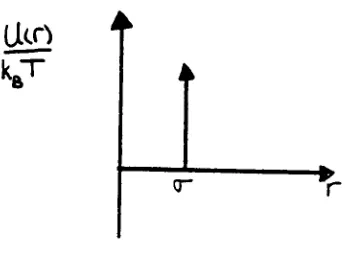
Pictorially the hard sphere interaction is as shown
in Figure 3.2.
(Jko
*a
FIGURE 3.2: HARD SPHERE POTENTIAL, there is infinite
repulsion when the spheres are in contact
(the distance between the center of the
spheres is <r ) and zero interaction potential when o~ < r < oo .
In the hard sphere model the interaction potential is
infinitely repulsive when the spheres are touching and as
soon as their contact breaks (moving apart) , there is
zero interaction potential. However, there are micelles
in the microemulsion, not hard spheres, and
experimentally the interaction has been shown to be of
[image:41.537.158.333.237.364.2]kJ~
FIGURE 3.3: Micellar interaction potential
One may consider modelling this micellar system with
a square well attractive interaction potential as shown
in the following figure.
UcO
kBT . i
1"
H WlOTH Or
WfcH-FIGURE 3.4: Square well potential
The square well potential requires a range parameter to
describe the width of the well in addition to knowing the
diameter of the particles the depth of the well and a
constant. This presents a rather complex problem
involving four fitting parameters. The adhesive sphere
[image:42.537.130.309.83.203.2]The adhesive sphere model has been shown to
effectively describe the microemulsion interaction
potential throughout a large range of volume fractions in
SAXS experiments.19/20/21 This model is shown in Figure
3.5.
T
FIGURE 3.5: Adhesive sphere model for the interaction potential. The attractive well is
infinitely narrow (let d approach <T ).
The range parameter is eliminated by letting the
width of the attractive potential, (d - 0"
), approach
zero. This makes the attractive range infinitely narrow.
Baxter15 has defined the interaction potential for the
ILLrJ = kBT JLirfx.
r < (f
J^Ll2tM-o-)/^(]
ff"< r < d
O r > d
This model has been successfully used in previous
experiments.1/21
Robertus, et. al.19
have used the
adhesive sphere model and considered the effects of
polydispersity. The potential shown above has a
singularity when d = fl"
, however the second virial
coefficient, (Eq. 3.8), remains finite due to the
exponential term.16 The parameter
*C
. is called thestickiness parameter. It is positive, dimensionless and
is is equal to 2/A. Since A is a measure of the
stickiness of the particles, the inverse of t. is also
a measure of the stickiness between particles.
By fitting an experimental photon count rate
vs. <f> curve with Eq. 15, the attractive perturbation to
the second virial coefficient (A), and (a), the ratio of
the hard sphere volume fraction to the total volume
fraction, can be determined. Remember that the measured
photon count rate is not independent of the geometry of
the experimental setup, therefore the measured photon
plotted against the volume fraction. See Figure 3.6 for
an example of a typical Rayleigh ratio vs. (J) curve.
(B).
a.ooe-s
2
U
^>s.ooe-5
-*^
o
I
x4.00C-S
-o
?
i
.2.0OE-5
i
W - 24.7
A = 6.004
a
O.OOC+0 ]iii nm iiiiiiiiiiiiii iimiiii
0.00 0.05 0.10 0.1S
0
nii|iiimiimini
0.20 0.25 olo
FIGURE 3.6: Rayleigh ratio vs. volume fraction for an H20/AOT/Decane microemulsion with
[image:45.537.158.378.269.506.2]3.2 Interpretation of PCS
measurements
At relatively low concentrations the collective
diffusion coefficient is described as follows:16/17
Dc = DQ[ 1 +
kf) , (3.17)
where Dc is the collective diffusion coefficient, D0 is
the Brownian or single particle diffusion coefficient
and lp is the volume fraction of particles in the
suspension. k is a numerical coefficient that depends on
particle interactions. Using the adhesive sphere model,
k is dependent on the stickiness parameter ( L describes
the adhesion between interacting surfactant tails) as
shown below:1
k = 1.454
-[yp)
(3.18)The single particle diffusion coefficient D0 is
described by the Stokes-Einstein relation which states
that as the particle diameter decreases, the diffusivity
increases:
Dn =
kBT
0 =
i7r7r-.
Here, +} is the shear viscosity of the solvent, and rn is
the hydrodynamic radius of the
particles, which are
assumed to be spherical in shape.11
When the diffusion
coefficient is known, equations 3.17 and 3.19, are used
to calculate the effective diameter.
Throughout the relatively low range of volume
fractions prepared, the diffusion coefficient was
calculated for each sample batch of particular micelle
size. The diffusion coefficient is calculated using the
method of cumulants from the intensity autocorrelation
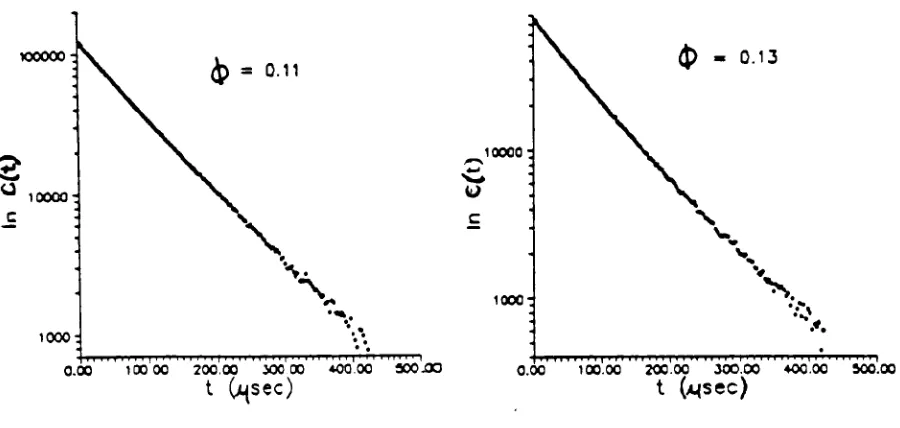
data. Typical autocorrelation functions are shown on the
following pages (Figure 3.8) These are plotted on a semi
10000
u
c
1000
10000
-u
c
1000
III II111II1 1 I IIIIII 1 11 1II
0.00 100.00 200.00 30000 40000 500.00 t (t\sec)
100:
0.00
I III I IIIIII 100.00 20000 200.00 4O0.0C
t (i^sec)
o
c
4>
- 0.0710000:
/
1000:
\fa
o.cA 100.00 W0.00 300.00 400.
-1000000:
$
- 0.09t (i{sec)
cr 100000:
(i(sec)
WOOOO
= 0.11
3
o 10000
1000
(J> - 0.13
10000:
U
c
looo:
I|I|IIII IIIlI|IIIIII III|llI IIIIII|'I II I M I' 0.00 100 00 200.00 300CO 400.00 500jOO
t (^sec)
I|| | |I I I I|IMII I I I I|II III I I I II'II I I I I'I1I'II I I I I I(
0.00 100.00 200.00 300.00 400.00 500.00
t (>qsec)
FIGURE 3.7: The natural logarithm of the
intensity autocorrelation function.
This data is used to calculate
the collective diffusion coefficient,
[image:49.537.37.487.110.324.2]At a given W, the diffusion coefficient was plotted
against the volume fraction. A best straight line fit
was drawn using
only the low volume fraction data (this
is because higher order terms were dropped in the
theoretical development) . The resulting curve was
extrapolated to zero concentration to find D0. A typical
example is shown in the following figure.
(B).
XCC-7
W - 27.5 A - 7.11
+-.08
O.CC+0
o o o 0 o 0
FIGURE 3.8: Batch 10, W = 27.5, Using photon
correlation spectroscopy the diffusion
coefficient was obtained for each volume
fraction. Only one trial was performed.
From Eq. 3.17, the slope of the curve is equal to
kD0. Knowing the slope and D0, the value for k can be
determined. Knowing k and Eq. 3.18, the stickiness
parameter, C , can be determined. From the stickiness
virial coefficient) can be calculated. The value for A
determined using PCS can be compared to the value
Chapter 4. THE EXPERIMENT
4. 1 Sample preparation and
compositions
A swollen reversed micelle system was chosen for
this study. The three component microemulsion consisted
of H20, AOT which is Bis(2-ethylhexyl)sulfosuccinate
sodium salt, and n-decane (a ten carbon chain oil). The
surfactant (AOT) has a branched tail configuration.
Figure 4.1 shows two AOT molecules with their tails
overlapping. Sample compositions were specified by
choosing the water to AOT molar ratio, (W) , as well as
the AOT-plus-water volume fraction of the solution ( <J) ) .
[image:52.537.62.478.209.420.2] [image:52.537.93.437.441.642.2]The chemical formula for AOT is C2oH37Na07S. The water
to AOT molar ratio was determined as follows:
V.waterPvtter
W -I"
water]
= MMwatef
I AOT] Aot
MMAOT
vwater = volume
of water
r}water = density of water = 1 g/cc
^water =
molecular mass of water = 18 g/mole
mAOT = mass
of AOT
^AOT =
molecular mass of AOT = 444.5 g/mole.
The size of the reversed swollen micelles linearly
increases with W. The surface area is determined by the
amount of AOT present and the size of the reversed
swollen micelle is directly related to the surface area.
In addition, as W changes the density of micellar
droplets changes. The other factor determining the
composition of the microemulsion is
tp
, the volumefraction of micelles (water + AOT) :
Vwater
+mAOT
[j^\
. (4>2)Vwater
+ mAOT\J~^\ +
VDtcane
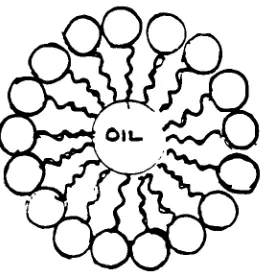
An oversimplified illustration of the particular
microemulsion used is shown in the following figure.
FIGURE 4.2: AOT/water/decane microemulsion: Contains
swollen reversed micelles
Sample preparation is decidedly the most difficult
portion of the experiment. Accuracy is critical, however
even with accurately made samples, the results can be
obscured by impurities. It is critical that impurities
be minimized, as they scatter light and make it
difficult, if not impossible, to distinguish scattering
from the particles in solution.
It was found that significantly different results
[image:54.537.178.361.200.345.2]purified AOT. The unpurified results were erratic and
drifted over time. Thus for all reported results,
samples were made with purified AOT. See APPENDIX D for
the AOT purification procedure.
We used 18 M -TL deionized water supplied by the
R.I.T. A-level science stockroom. The AOT was supplied
by Fluka with > 99% purity. The decane was supplied by
Aldrich with >99% purity. In addition, the samples were
each filtered using Gelman Sciences ACRODISC LC PVDF 0.2
jum pore size syringe filters. They were filtered twice
through the same filter.
All samples were made by diluting a stock solution
to the desired volume fractions. The diluted samples were
put in glass containers. Each sample was poured into a
sample cell cleaned according to cleaning procedure #1
(see APPENDIX C). The cap was placed on the sample cell,
the cell was lightly shaken and the microemulsion poured
into a disposable 10 ml syringe fitted with a 0.2 j^m
filter. The solution was filtered into the sample cell,
shaken and poured back into the syringe to be filtered
for the second time. The sample was visually inspected
for impurities, and if present the solution was filtered
to equilibrate thermally to 23.1
C and stabilize. This
takes about 24 hours.
The sample batches were prepared according to W,
which is related to particle size. For a particular
batch the W value was kept constant and the volume
fraction ranged anywhere from
$
= 0.03 to 0.45. Table4.1 shows the composition of the original stock solution
for each sample batch. Doped decane was added to
calculated amounts of the stock solution to achieve the
desired volume fraction. The decane was doped to 0.02
weight percent in order to stay above the critical
micelle concentration (the concentration of surfactant
TABLE 4.1: SAMPLE COMPOSITIONS
BATCH # H20
cc
AOT
g
DECANE
CC
W
Of
STOCK
B5 10.000 9.9950 56.500 24.7 0.25
B6 14.600 12.0003 46.800 30.0 0.35
B7 8.910 11.0046 34.620 20.0 0.35
B8 7.300 10.0120 30.000 18.0 0.35
B8.1 6.850 9.4024 18.540 18.0 0.45
B9 9.110 15.0002 41.570 15.0 0.35
BIO 16.870 15.1446 56.220 27.5 0.35
Bll 17.617 15.0012 57.370 29.0 0.35
[image:57.537.64.457.123.333.2]4.2 Experimental results
From static light scattering, experimental results
for the Rayleigh ratio vs. volume fraction were obtained.
See Figure 4.3 for the static light scattering
experimental results. Notice that A is an increasing
function of W. The error bars shown in graphs A and B
represent the reproducibility between two trials, which
is approximately 15%. The circles in these two graphs
represent the average of the trials and the error bars
show the maximum and minimum values. Graphs C-E were
constructed on the basis of a single trial.
This data was put into a fitting program (See
APPENDIX E) which fits the data to Eq. 3.16 using a chi
square minimization routine to get the best fit. From
the best fit curve, values for A, (the attractive
perturbation to the second virial coefficient), and a,
(the ratio of the hard sphere volume fraction to the
(A).
ue-s, W - 20 A - 4.795
, a - 0.454 31.0C-9 .B.0C-CI
i
o CLOE-4: :4.0E-8 :2.0E-0.OE+O llllllllllllll o.do o.io ' o'io ' 0 (c). 1.6E-4-: 3 1.4E-4-W A a = 27.5 8.095 0.785 o C-1JE-4 -gK 8.0E-9
-0
m i
52 <4.0E-3
-1
2.0E-S
-0.DO 0.
1 1 1 1 1 1 1 1 1 II M 1
io o.io oJo 0.40 0 (E). 2.0E-4 U ^1J-4 O
I
X CJ 1.0E-4 .5.0E-9i
W - 29.5
A = 9.081
a - 0.724
O.OE+O
-jiniliihi1 1 ni J "I"' ""''1,
0.00 0.05 0.10 0.13 oiO 0.23 OJO 0
(B).
s.oe-5-, W = 24.7
A - 6.004
a = 0.701 o ^.OE-5 o
I
x 4.0E-5 C9 .10E-5i
0.0E+O u^V^I II I 1 1 1 1 111 1 1 1 1 1 1 1 111 1 1 1 I M I 1 1 1 1 1 1 II11 111 1 1 1 111 1II1 1 " ' ""I 0.00 0.09 0.10 0.13 0.
0 (D). y2-0E-4: g X g y 1.0E-4-c$ C9S.0E-S 5 O.OE+O
W - 29
A = 10.134
a = 0.783
j thi mimtm nn iniMTTMTtn hiiiiiiiiiihhiiiiiii.iiiim
0.00 0.05 0.10 0.15 0-20 0.25 OJO
0
FIGURE 4.3:
Graphs A-E show the dependence of the Rayleigh ratio on thevolume fraction.
They are displayed in order of increasing W. Experimental data are represented
with circles. Graphs A and B have error
bars which show the reproducibility
between two trials. Graphs C-E were
constructed on the basis of a single trial. The theoretical fit to the data,
[image:59.537.27.447.66.688.2]From PCS experiments, data for the relationship
between the diffusion coefficient and volume fraction of
AOT/WATER/n-DECANE microemulsions were obtained. This
data is graphically presented in Figure 4.4. The fit was
done manually to low volume fractions. From the slope
and intercept, k and D0 are determined respectively.
Knowing k, the stickiness parameter is calculated (see
Equations 3.17, 3.18 and 3.19). From the stickiness
(A). (B).
iOE-7n
W - 24.7
A - 7.1 S +-J0
(C).
3.0E-7
W - 29.0
A - 7.44 +- .08
0.OE+O"
1 1 ii 1 1 iiiii1 11 11 1 i111i i1 1 1 > 1 1ii > 1 1 1 1 1 i 11
0.00 0.10 oio OJO 0.40
l-7
W - 27.5
A - 7.11 +- .08
O 0 0
0 0 0
O.OE+O-M ITT HTI
T|IT 1 II.I I I I I 11I I ITT III TI I II I f I1
0.00 0.10 0.20 OJO 0.40
0
W - 30.0
A - 7.01 +- .08
0
FIGURE 4.4: From PCS, the relationship between the diffusion coefficient and was
determined. Experimental data is
shown with circles and the theoretical
[image:61.537.31.452.83.492.2]4.3: Interpretation of results
Huang et.al.3
suggest that as two micelles approach
one another the surfactant tails are able to penetrate to
a certain extent, this is the cause of the adhesiveness
or attractive portion of the interaction potential. See
Figure 4.5.
OVERLAP voi-umiT
WKjh)
o^-miu
FIGURE 4.5: The assumption is that there is a maximum penetration depth (h) due to the
branching structure of the AOT tails. It
is also assumed that A, the attractive
perturbation to the second virial coefficient, is proportional to the
overlap volume V(R,h). The total radius
is equal to R and the surfactant tails
[image:62.537.71.453.243.532.2]It can be determined that the attractive
perturbation to the second virial coefficient equals
A= C ZL
H
h
2 (4.3)
where C is a constant. See Appendix F for a derivation
of this equation.
The values for A and a obtained from the theoretical
fit to the static light scattering data (Rayleigh
ratio vs. <f> ) were plotted to see if
they obeyed the
relationship described in Eq. 4.3. To do this a data
point was picked at low a, the a-value and it's
corresponding A-value were put into Eq. 4.3 where the
(-h/2) term was omitted as it has a negligible affect on
the outcome of the A value. Also, the (3L) and the
proportionality were incorporated into the constant C
which makes the fitting equation of the form
A =
1
-a2
(4.4)
With the data point (a, A) put in the equation, it
was solved for C. For this low "a"
was also picked, and solving for C, a value of 1.1 was
calculated.
Using these two C values, curves were generated
according
to Eq. 4.4. These curves are displayed along with the
data in Figure 4.6.
100.00 n
80.00
60.00
-40.00
-20.00 :
0.00 1 1 1 1 i 1 1 1 1 1 1 1 1 1 1 1 1 1 11 1 1 1 1 1 1 1 1 1 11 i 1 1 1 i i i1 1 1 1 1 1 1 1 1 1 i)
0.00 0.20 0.40 0.60 0.80 1.00
FIGURE 4.6: The attractive perturbation to the second virial coefficient as a function of the
ratio of the hard sphere volume fraction
to the total volume fraction.
Experimental data are displayed with
circles and the generated "theoretical"
[image:64.537.105.439.254.579.2]The actual C value is believed to lie within the range of
0.65 < C < 1.1 . It was realized later that a better
way to find the constant C would be to plot A vs.
(1 - a1/3)"1
. Using Eq. 4.4, a straight line fit to the
points yields a slope that equals C. This is shown in
Figure 4.6.1.
12.00 -a
10.00 -.
8.00
'-< 6.00
'-4.00 -.
2.00 -.
(2=0.1?
000 : i i i i i i ii i| i i i iir i i i| i i i ir i i i i | ii i i i i i i i l 066 4.00 8.00 .,12.0016.00
( 1
-a*)
FIGURE 4.6.1: A best straight line was drawn to yield
C = 0.78. This falls well within the
[image:65.537.66.451.168.607.2]previously-Due to time limitations, the actual critical points for a
and <P were not found from Figure 4.6.1. However, the
constant C is definitely within the range of C-values
obtained earlier.
The range of W values from which data was obtainable
was limited. With W < 18 , the intensity was so low it
was difficult to get a photon count and the curve did not
have a bending over trend observed with the other light
scattering data. See Figure 4.6.5.
1.0E-5
P8.0E-6
<
a: 6.0E-6
X
LiJ 4.0E-6
CH O 2.CE-6
<
W = 18
O.OE+O
o o
, i ,i |mimiiii|"i 111 1 n 111 1 1111i 11 0.00 O.io 0.20 0.30 0.40 0.50
<t>
[image:66.537.61.464.201.597.2]On the other hand, when running a sample batch with W =
30, the static light scattering data was highly erratic
and it was not possible to fit the data using Eq. 3.15.
This data is shown in the following figure.
J.OC-4, W = 30
o
\2.5-4
-22-0C-4A
< 0.
-j-1.3-4:
g
jf1.0E-4 :
s.oe-3-.
0.0C-H3 : '
I J II III IIII11
000 0.10 o.io o.io oio
*
FIGURE 4.7: Static light scattering data unable to be fit using Eq. 3.15.
It is believed that there is a phase change occuring
somewhere between W = 29.5 and W = 30 that is
causing the
eratic trends observed in the W = 30 data.
Thus, W's
were chosen to fall in the range of 20 to 29.5. As
displayed in Figure 4.3, the static light scattering data
for W = 29.5 follows the trend of the theory. This leads
one to believe that there may be a critical point
[image:67.537.144.357.209.415.2]The critical points are defined by the conditions:
La
0J
= o
(4.5)
and
d2
n
d
f
J= 0
(4.6)
Using Eq. 3.9, 3.11, and 3.12 it can be shown that first
derivative of the osmotic pressure with respect to the
volume fraction is
an _ 1+ Aa<j>
+
Aa2<j>2 - 4
qfy3
+ a
V
+ A<j> C 1 - a<j>)4
(4.7)
3 + Cl-ac*)4 *
The second derivative of the osmotic pressure with
respect to the volume fraction is
32n_ Aa
*Sa2<fi
-UaH2
+Aa
V
+ACl-a& *- AA<j>aCl
-a<j>^ 3
d<t>2 Cl-o^)4
[l+
Aa4> +AaV
- 4afy3+aV
+^Cl
-a^D
4]
C4a}Using the constraint in Eq. 4.4, the first and
second derivatives were set equal to zero. The constant
C was set equal to 0.65 and 1.1. A range of a-values were also chosen. The vertical coordinate in these graphs (x)
represents a<p . These curves are shown in Figure 4.8.
The curves indicated that the critical a-value lies
within the range 0.82 < a <0.90 .
From the critical X and a-values,
(J)c
and&<-.
were calculated. The critical values are:0.144 <
d>c
< 0.155 and17.39 <
he
< 19.03.Huang2, through an analysis that excluded the factor of
"a", found Ac = 21.2 and (J)t = 0.13. We believe the
values above to be better representations of the actual values because the theory used accounts for the ratio of the hard sphere volume to the total volume of a
0.33
0.3
0.23
0.2
x 0.15
0.1
0.05 4. *
r-r.
!*.?
4 4) 4 i_ T 1 1 I
0.9 0.82 0.84 0.86 0.88 0.9 0.92 0.94 0.96 0.98 1
<K
C = 1.1
0.9 0.82 0.84 0.86 0.88 0.9 0.92 0.94 0.96 0.98 1
[image:70.537.82.428.61.575.2]a,
Figure 4.8
X =
a$
Squares and pluses denote setting the first derivative .ofIT with respect to
< equal to zero
Diamonds represent setting the second derivative ofIT with respect to
fy
equal to zero Thecritical point is where the first derivative curve crosses the second derivative curve. This is only an approximation due to the constant C,which was obtained from fitting the experimental
The critical values for A are plotted on the
following A vs. W graphs for both static light scattering
and PCS. The critical values seem to follow in the trend of the static light scattering data. The PCS data
however, do not have any noticeable relationship to the
5CO -I
< 10.00
-OOCOOSL3 EXPERIMENTAL VALUES
00000A 'CPITiCAL) FOR (t = 65
aaaaaa (critical; for c = 1 1
0 o o :o J 1 1 0 CO
0.00 CO 2O00
w
30 00
(>-)
20 CO
-i
- COCOCPCS EXPERIMENTAL VALUES
1500 ] 00000 A (CRITICAL) FOR =
.65
j aaaaaa (CRITICAL) FOR C= 1.1
< 10.CO
-5.C0 -I
0.00 iii
C CO 10 00
o oo
I | I I III i M II Tl 1
2000 30.00 *000
w
FIGURE 4.9: Static light scattering and photon
correlation spectroscopy calculated
values for the attractive perturbation
to the second virial coefficient as a
[image:72.537.106.370.55.587.2]The values for A that were obtained from static
light scattering ranged from A = 4.795 to 10.134 and
seemed to correspond with the critical point analysis.
The values from PCS data ranged from A = 7.01 to 7.44 and
did not exhibit any particular trend. Although the A
values from the independent studies did not have exact
correspondence, they were certainly in the same range.
The photon correlation spectroscopy experiments were all
performed on a single trial basis. More trials would be
beneficial in the sense that any erratic values would
have a diminished effect. In this experiment, PCS data
Chapter 5. CONCLUSIONS AND SUGGESTIONS FOR FUTURE WORK
From static and dynamic (PCS) light scattering
results, it has been determined that the attractive
perturbation to a hard sphere model is capable of
describing the AOT/WATER/n-DECANE microemulsion. The
agreement of the static light scattering data with the
theory is quite good within the range of volume fractions
and W values that were experimentally accessible. The
independently determined values for A using PCS, although
not as outstanding as the static light scattering,
confirmed that the values obtained are in reasonable
agreement.
I must question results that Huang reports in
reference #2. He claimed to fit static light scattering
data with a function that was dependent on only three
parameters (A, 4> , constant) . I tried to fit my
experimental data with his function and was unsuccessful.
However, the four parameter fit which includes the
parameter, a, closely fit the data.
One of the limitations of the data analysis
presented in previous sections of this paper is that the
not seem to affect the conclusions. Experimental errors,
which were within 15%, are comparable to the effects of
the polydispersity on the photon count at the volume
fractions examined.
Another possibility is that there are many
assumptions, including some about the hydrodynamic
aspects of the particle diffusion, in the formulation of
Eq. 3.18 that predicts the value for k, the numerical
coefficient affecting the collective diffusion
coefficient. The hydrodynamic aspects in particular are
difficult to calculate theoretically. Or, it may be as
simple as the way the best line was fit to the PCS data.
The fit was done manually to low volume fractions. There
is a lot of room for error in deciding what constitutes
low volume fractions. Additionally, the fact that only
one trial was performed made it difficult to draw a best
fit line because error bars were not present.
The results presented above are consistent with SANS
results3 which suggest that the overlapping of the
surfactant tails is the source of the short range
interaction potential observed. The strength of this
interaction is believed to be related to the overlap
suggest that there may be other contributors to the
strength of the interaction.
An exceptional area for future research would be to
s