Executive summar y
Developing an
effective process for
securing learning
support for participants
in work-based learning
Sylvia Gentleman
Published by the Learning and Skills Development Agency
www.lsda.org.uk
LSDA is committed to providing publications that are accessible to all. To request additional copies of this publication or a different format, please contact:
Information Services
Learning and Skills Development Agency Regent Arcade House
19-25 Argyll Street London W1F 7LS Tel 020 7297 9144 Fax 020 7297 9242
Registered with the Charity Commissioners
Copyeditor: Nick Sweeney Designer: Joel Quartey
Printer: Blackmore Ltd, Shaftsbury, Dorset
052309SU/01/06
1-84572-395-3
©Learning and Skills Development Agency
You are welcome to copy this publication for internal use within your organisation. Otherwise, no part of this publication may be reproduced, stored in a retrieval system or transmitted in any for or by any means, electronic, electric, chemical, optical,
photocopying, recording or otherwise, without prior written permission of the copyright owner.
Further information
For further information about the Learning and Skills Council, visit: www.LSC.gov.uk
Contents
Introduction
... 3
Context and Background
... 3
Methodology
... 3
Research findings
... 3
Propositions arising from the research
... 6
Recommendations
... 8
Annex 1: Proposed revised Annex E to WBL funding requirements
... 10
Annex 2: Outline of E2E passport
... 19
Introduction
The project investigated what would need to be in place to secure an effective process for identifying and supporting learning needs in work-based learning (WBL) programmes. An initial feasibility study was followed by the development of recommendations of an enhanced process concentrating on supporting learners’ needs. The research has resulted in the development of revised guidance to support funding criteria for work-based learning, along with a practical guide for providers to support this process. This supplementary executive summary is a record of the research outlining the proposed new process and recommendations presented to the LSC.
Context and Background
The current system for assessing support needs within WBL is historic and bureaucratic. The system for additional learning needs (ALN) is fairly simple, in that it is based on the Basic Skills Agency (BSA) materials Initial Assessment: an assessment test for Reading, Writing and Maths (2002), or other tests based on the Adult Literacy and Numeracy standards. For additional social needs (ASN) it is more complex, and the LSC has
continued with the categories inherited from the DFES in 2001. The issue is that neither match the system now used by Connexions, which is the Assessment, Planning,
Implementation and Review system (APIR), using a different range of criteria. The LSC is looking to rebuild the system in a way which will:
reduce bureaucracy
enhance the relevance to the learner
promote best practice in identifying and meeting additional learning needs align the criteria with those used in the APIR
facilitate ease of progression from Connexions case loads to WBL be applicable in other LSC sectors.
Methodology
To assess the current system for determining support needs within WBL, a review of providers, Connexions services and local LSCs was undertaken. Telephone interviews were carried out over a six-week period to consult with this audience. The providers were identified through self-selection, recommendation from local LSCs and a review of the Adult Learning Inspectorate (ALI) Excalibur database. These interviews were later followed up with a series of visits to selected providers to collate examples of practice and, where possible, to review documentation used with learners.
To support the developments of the research an expert group was formed, comprising representatives from the same audience. This group was convened following the
telephone interviews to endorse the findings and to comment on the proposed principles for a new system. They were later convened to review this new system and endorse the recommendations.
Research findings
Telephone interviews
Questions asked of providers
What process is currently in place within your organisation for ALN/ASN endorsement for learners on WBL programmes?
How effective is the process?
What information do Connexions provide to support the endorsement process, and in what format? (Is there evidence of the use of individual development plans and APIR?)
What information do you gather from learners during your own initial assessment
process, in relation to their additional learning and support needs, and what methods do you use to do this?
For learners who join programmes directly from E2E what use is made of their E2E Passport?
How are plans developed to support learners’ additional learning and support needs? (Is there evidence of a specialised plan in place or is the LSC individual learning plan (ILP) used?)
How are these plans monitored and reviewed with learners during the course of their programme?
Do you have any suggestions as to how the LSC’s assessment form could be improved, and in particular how it might be used as a learner-centred working document?
Questions asked of local Connexions staff
In addition to the questions asked of providers, the following were asked:
To what extent do you use the APIR process to support the ALN/ASN endorsement process? If this is not being used, how could this best be made use of?
What information do you require from providers before endorsing a learner with either, or both, additional learning or support needs?
Questions asked of local LSCs
What process is currently in place with your local Connexions Service and WBL providers for ALN/ASN endorsement for learners on WBL programmes?
How effective is the process?
Do you have any examples of good practice of this within your LSC area?
The following were concluded from the responses:
Endorsement
• The process for endorsing learners identified as having ALN/ASN needs is fairly
common in practice, whereby WBL providers carry out initial assessment with learners, document their needs on an LSC Assessment Form1 and in turn ask Connexions to sign the document to agree to the endorsement. The practice advocated at this stage by the LSC – holding a case conference between Connexions, the provider and the
learner – appears to be rare. Following endorsement, the provider plans appropriate support for the learner and reviews progress in accordance with the plan.
• The stage of the process which involves Connexions staff is regarded as a ‘paper-chase’ exercise by both providers and Connexions staff, carried out to gain additional funding by the provider, with no real value-added for learners. It appears to be extremely rare for forms to be rejected and returned to providers.
• Many Connexions staff do not understand why they need to endorse learners after the provider has carried out initial assessment with them and do not feel that they have sufficient knowledge to comment on basic skills assessments.
• The APIR framework is rarely used by Connexions staff to assist the endorsement process, and is typically used with those categorised as requiring intensive support, and most likely to be referred to E2E.
Initial Assessment
• Providers use a variety of methods to carry out initial assessment, with formal assessments being used to screen and diagnose basic skills levels and dyslexia, and interviews and references for social needs.
• Where learners progress from E2E to Apprenticeships there is some evidence of the E2E Passport2 being used to assist the process of initial assessment and
endorsement, but this is not widespread at this stage.
Individual Learning Plans
• Learners’ identified needs and the mechanisms for addressing these are documented in a number of different types of plans by providers, including the LSC assessment form, the LSC individual learning plan (ILP) or bespoke versions of this document, basic skills plans and learning support plans. Some providers who delivered both E2E and Apprenticeships advocated the use of an E2E Passport-style document, which captures learners’ journeys through the whole learning cycle.
Reviews
• The frequency of reviews for those with ALN/ASN needs varies greatly between providers, ranging from 1–12 weeks. Connexions officers typically tend to be involved in major reviews with learners at the week 26 stage.
Expert group
An invited group of experts from work-based learning providers, local Connexions Services and local LSCs met to discuss the findings of the research and to agree key principles of an effective process for securing learning support for participants in work-based learning. The findings of the research were generally agreed on, and the following key principles accepted:
2A Passport for E2E learners, Guidance on documentation to support the process of referral, assessment
• The process should be learner-focused and not solely funding-driven.
• The process should be agreed by all partners, with clearly defined roles and responsibilities.
• Thorough initial assessment should be carried out to clearly identify learners’ support needs.
• Initial assessment should inform the planning of learning for each learner.
• Reviews of learners’ progress should be carried out in accordance with their individual needs.
• Any new documentation designed to support the process should be simple and fit for the purpose.
Propositions arising from the research
In determining the way forward for developing an effective process for securing learning support for participants in work-based learning, the following propositions were agreed by the expert group:
1. The two separate categories of ALN and ASN should no longer be recognised by the LSC and instead should be replaced with one category: additional learner support needs (ALSN).
2. LSC National Office and the government’s Supporting Children and Young People Group (SCYPG) should agree the role of Connexions in endorsing young people with ALSN who are under the age of 19. It was suggested that the role of Connexions staff might differ according to which level of support the young person was deemed to require:
Intensive Support Group/Tier 1
Connexions guidance states that for those young people who are judged by a Personal Adviser as requiring intensive support, the APIR framework will be used to carry out an assessment of their needs. This will involve the completion of a profiling kit and the production of an assessment profile. All young people within this group will be assigned a personal adviser. The PA should attend learner reviews and retain an interest until the young people reach 19 years of age or have completed their Apprenticeships.
Due to the involvement of PAs with such young people, therefore, it would be deemed appropriate for them to officially endorse them as requiring ALS. This process should take place in the same way that it does now, at the end of the provider’s initial assessment phase.
Enhanced Support Group/Tier 2 and Minimum Intervention Group/Tier 3
It is therefore proposed that for young people falling into either the enhanced support or minimum intervention group, that the provider will carry out an assessment against the criteria in the APIR framework and endorse those identified as having ALS needs. Connexions therefore would not be involved in the endorsement process for this group of young people, releasing its staff from unnecessary paperwork and allowing them to concentrate resources on those in the intensive support group.
3. For those young people who are direct referrals to work-based learning and under the age of 18, the same assessment process should be followed as that identified in 2 above. If a provider is unsure as to which group a young person falls into they should consult their local Connexions Office.
4. For those young people who progress from E2E to an Apprenticeship and continue to require ALS the APIR framework should be reviewed with them by the PA to determine their starting point to their Apprenticeship.
5. For those young people over 19, assessment to determine ALS needs should be similarly carried out against the criteria identified in the APIR framework. Connexions staff are not involved in the endorsement of young people over 19 years of age.
6. WBL providers are required to maintain appropriate and sufficient evidence to show that they have carried out a thorough initial assessment of each learner in
accordance with the assessment frameworks identified above. The evidence must justify clearly why learners have been identified as having ALS needs.
7. It is the provider’s responsibility to be able to demonstrate how the outcomes of initial assessment have informed the development of an appropriate additional learning support plan for each learner. The LSC does not intend to produce a standard format for this, as providers may prefer to produce a dedicated ALS plan, integrate the plan with other learning plans or develop a ‘learning journey’-type document similar to the E2E Passport. As a minimum requirement, however, plans will need to detail the nature of support to be provided, when it will be provided and by whom, the time period covered by the plan and the learner’s confirmation of the plan. Plans will also need to clearly show how allocated funds have been used to support the learner above and beyond what would be provided for a non-endorsed learner in terms of both learning and support.
8. All learners require a review at least once every 12 weeks, and ALS needs should be integrated into this process. The frequency by which learners with ALS needs are formally reviewed will depend on the needs of individual learners. It is envisaged that for many learners the interval will be less than 12 weeks. Learners’ progress will be reviewed in accordance with their plan, the effectiveness of the support will be evaluated and a forward plan developed.
Recommendations
We recommend that the LSC adopt the propositions put forward by the expert group. The result would be a redrafting of the guidance accompanying the WBL funding criteria. The key principles are given below. The proposed new guidance information is presented in Annex 1.
• Any new system for securing ALN and ASN for work-based learners should take account of the recent bureaucracy review and should, where possible, reduce unnecessary paperwork.
• The new system should work towards the Learners with Learning Difficulties and/or Disabilities (LLDD) review and respond to the agenda for change.
• The terms used for describing ALN and ASN should be carefully considered. The expert group recommended that these were combined into a single term, ALSN. Other alternatives suggested are, Additional Literacy and Numeracy, and Personal and Social Development needs. Whatever term is used should accurately reflect what needs are being addressed in order for learners to achieve on their selected
programme. It is recommended that a change in the terminology be disseminated to all providers and other relevant parties with a clear explanation of what this has replaced.
• We strongly recommend that the process for endorsing additional funding be considered by LSC. Current practice highlights a ‘paper chase’ exercise, which can result in a delay in support being provided to learners. The expert group
recommended that the role of Connexions PAs be reviewed. In light of the recently published Green Paper ‘Every Child Matters’, it is essential that these
recommendations be considered.
•
The role of the individual learning plan and any subsequent support plans is a key factor in delivering learning support. There was some evidence during the research of providers using both the LSC standard ILP along with locally devised plans for support needs. Although it is good practice that additional support is planned and reviewed, we are strongly recommending that support plans are combined into learners’ ILPs. These plans should be learner-focused, and emphasise what the learner will do, how and when. We are not recommending that LSC prepare a standard ILP to record this, but encourage providers to develop their own. These plans could also record the reviews of learning in a similar way that the E2E Passport records the learners’ journeys through E2E. Many examples offered to the researcher during the project reflected this approach. An outline of the E2E Passport is given in Annex 2.•
Wherever possible, naturally occurring evidence should be used to demonstrate where additional learning support is being delivered. Locally devised learning plans can highlight where support is being offered to individuals, and learner reviews can demonstrate progress. It is recommended that additional paperwork and record keeping be kept to a minimum.research supports providers aspiring to a new system rather than disseminates existing practice. Other professional development activities could include:
o local network events, including local LSC staff and providers, to outline the
proposed new system for securing learner support, when agreed by LSC
o provider workshops to present the key principles for effective delivery of learner
support and to share examples of locally developed learning and support plans
o dissemination to all relevant parties of any change of terminology using existing
networks and communication channels. A briefing from LSC would also be advisable.
A full staff development plan is recommended in Annex 3.
The following process is being recommended as the structure of the guide, which is being published as a result of the research. Examples of plans and records will be used to highlight this process.
Stage 1
Identify learners’ additional needs.
• Use a range of recognised assessment methods to identify issues facing learners.
• Consider the ways in which the issues identified are likely to pose barriers within the learners’ training programme.
• Decide whether learners have additional needs which will require extra learning and support during the course of their training programme.
Stage 2
Identify objectives for learner to address.
• Identify and agree appropriate objectives for learners to achieve during the course of their programme which will help them overcome their identified barriers.
Express objectives in a way in which they can be measured and their achievement celebrated with learners.
Stage 3
Plan appropriate additional learning and support for the learner.
• Decide what types of additional learning and support learners might benefit from to help them overcome their barriers and achieve their objectives
• Agree this with learners and set this out in a simple learning plan which learners and trainers can follow.
• During learners’ reviews agree short-term targets which support the achievement of their objectives and show how they can be achieved.
Stage 4
Review learner progress and the effectiveness of the additional learning and support provided.
• During learners’ reviews assess the progress which they are making towards their identified targets and
objectives.
• Celebrate appropriate progress and achievement of targets and objectives.
• If the planned additional learning and support is not helping learners make progress, review the chosen methods and agree a new course of action.
Annex 1: Proposed revised Annex E to WBL funding requirements
The following extract from Annex E, which forms supplementary information to the LSC’s ‘Requirements for Funding Work-Based Learning for Young People (2005)includes recommended changes following the research. These were presented to the LSC but were not incorporated into the 2005/06 funding guidelines. It is understood that some of these changes may be incorporated into the 2006/07 guidelines.
Annex E: Identifying, meeting and funding additional learning and social needs (ALSN)
1 2005/06 sees the next stage of the post-16 sector review of additional learning support. This overall approach is detailed in the LSC policy statement on ALS available at:
http://www.lsc.gov.uk/National/Documents/SubjectListing/FundingLearning/Addit ionalLearningSupport/default.htm. (accessed 14/11/05)
2 Funding and assessments for additional learning and social needs (ALSN) are again substantially unchanged for 2005/06.
3 In 2005/06 a change is introduced, in that WBL providers will from 1st January 2006 take full responsibility for determining whether a learner has ALSN, and there will no longer be the requirement to seek ‘endorsement’ as such from the
Connexions Service. From 2005/06 greater emphasis will be placed on ensuring that appropriate support is being given to young people to meet their identified additional learning and support needs. Where a young person is receiving support from a personal adviser during the course of a learning programme, the additional learning and support plan designed to address the learner’s needs should be shared with them. ALSN funding is provided to meet the costs of additional support provided as a result of the assessment of the learner.
Definitions
4 Under the Learning and Skills Act 2000 (the 2000 Act), the LSC has a duty to meet the needs of young people with learning difficulties and/or disabilities. In Chapter 21, paragraph 13 of the 2000 Act, a person is defined as having learning
difficulties if:
• he or she has a significantly greater difficulty in learning than the majority of persons of his or her age
• he or she has a disability which prevents or hinders him or her from making use of facilities of a kind generally provided by institutions providing post-16
education or training.
5 In WBL there are three categories of ALSN that are funded by the LSC. For 2005/06, these are identified as:
• additional learning needs (ALN) – a literacy, numeracy or language need which is below level 1 of the Adult Literacy and Numeracy Standards
• additional social needs (ASN) – needs related to emotional, behavioural or motivational difficulties. These are expanded upon further within sections 20 - 29 of this annexe.
• Both ALN and ASN.
support and equipment for disabled learners will also be met from exceptional learning support (ELS).
7 Young people with ALSN will enter different WBL programmes depending on their needs and abilities. The programmes they can enter and within which they can receive ALSN support are as follows:
• NVQ learning at Level 1 – Only young people assessed as having ALSN and who are 19 or over may enter WBL on an NVQ learning programme at Level 1. Young people aged 16-18 who have ALSN and who wish to undertake a Level 1
programme should join E2E.
• Apprenticeships – This applies to young people who wish to undertake Apprenticeships, by either the programme-led or employer-led pathway. ALSN may be advised for those assessed as being capable, with appropriate support, of working towards an Apprenticeship.
• Advanced Apprenticeships – This applies to young people who wish to undertake an Advanced Apprenticeship and are assessed as being capable, with appropriate support, of working towards one. It is anticipated that this group will be limited to those with formally identified learning difficulties or physical disabilities.
• Learners on E2E – These learners are not eligible for ALSN status. They can, however, access exceptional learning support (ELS), including support for learners with disabilities.
Assessment process
8 It is the WBL provider’s responsibility to ensure that a young person who may have ALN or ASN is comprehensively assessed using recognised methods. This includes interviews, formal assessments, observation, reviewing written information and self-assessment activities. Further guidance is available in the Good Practice Guide:
Raising Standards: Initial assessment of learning and support needs and planning learning to meet those needs (Quality and Performance Improvement
Dissemination (QPID), DfES, 2001).
9 On referral to WBL it is anticipated that the referral agency will have already gathered relevant information which can support the provider in carrying out an initial assessment of a young person. Connexions personal advisers for example, may have used the APIR framework for this purpose. With a young person’s agreement, this information can be shared and should help ensure that they are not subjected to repeated initial assessment activities by those professionals working with them.
10 Assessment for additional learning needs involves identification of a young
person’s level of literacy, numeracy and language skills and whether these are likely to have a significant impact on their ability to progress on their learning
programme.
the allocation of ALN funding, it is the provider’s responsibility to demonstrate that despite the initial assessment not indicating a need, they have other evidence that confirms that there is a need for ALN.
Learners who enter WBL with a Level 2 proxy qualification, eg a GCSE in English or Maths at grade C or above, will not qualify for ALN support unless there were special circumstances, such as severe dyslexia. Where learners enter WBL with a Level 1 proxy, eg a GCSE in English or Maths at grades G to D (although technically a Level 1 proxy) a judgement will need to be made as to whether or not he or she receives substantial additional support. If substantial additional support is deemed to be required, ALN funding can be accessed. Details of proxy qualifications are posted on the QCA website at www.qca.org.uk (accessed 14/11/05.)
11 Assessment of additional social needs involves identification of whether the young person has needs relating to two of the ten barriers listed below, which are likely to impact on their learning programme:
• recent or current offending behaviour
• poor or erratic attendance during the last year of education, exclusion from school or no record of school
• an unsupportive or unsupported home environment (including care leavers and carers)
• significant problems with confidence or self-esteem
• significant problems with motivation or attendance (on a programme)
• attitudinal or behavioural problems (including losing a placement because of this)
• drug or alcohol-related problems
• health problems which affect their programme (including mental health and phobias)
• significant problems with communicating with and relating to others
• single parents with particular difficulties finding time to learn.
In special circumstances, where it is clear that one of these barriers is great enough to be a major obstacle to learning, this will be enough to trigger the ASN support. Further guidance on the above criteria can be found in sections 20 to 29. 12 Where young people are deemed to have a critical or significant need in literacy,
numeracy of language, ie blow Level 1, they will be granted ALN status.
Where they have significant or specific needs in relation to any two of the criteria identified in section 11 above, or where it can be demonstrated that one of these barriers is great enough to be a major obstacle to learning, they will be granted ASN status.
Where both cases above are identified, they will be granted both ALN and ASN status.
13 WBL providers are required to maintain appropriate and sufficient evidence to show that they have carried out a thorough assessment against the appropriate criteria specified above. The evidence must justify why the learner has been granted ALN or ASN status.
learning support (ALS) plan for each learner. The LSC does not intend to produce a standard format for this, as providers may prefer to produce a dedicated ALS plan, integrate the plan with other learning plans or develop a learning journey-type document similar to the E2E Passport. As a minimum requirement, however, plans will need to detail:
• the nature of support to be provided to meet the identified needs
• when support will be provided and by whom
• the time period covered by the plan
• the learner’s confirmation of the plan
• how allocated funds have been used to support the learner above and beyond what would be provided for a learner without additional learning or social needs. Examples of effective practice will be published during the summer of 2005. 15 Where a young people are identified as having ALN or ALS status and are being
supported by a personal adviser during the course of a learning programme, their ALS plan as a matter of effective practice should be shared with them. Effective practice is also likely to include a three-way discussion at this stage involving the learner, the personal adviser and a member of the provider staff.
16 All learners require a review at least once every 12 weeks, and ALSN should be integrated into this process. The frequency by which learners with ALSN are formally reviewed will be dependent on individual needs. It is envisaged that for many learners the interval will be less than 12 weeks. Learners’ progress will be reviewed in accordance with their plans, the effectiveness of the support will be evaluated and a forward support plan developed at each review. Where a learner is being supported by a personal adviser during their learning programme, they may wish to attend learner reviews. This should be determined with the personal adviser.
17 Providers are required to document their arrangements for the identification of those with ALSN, the planning of learning and support to meet needs and progress review arrangements. These arrangements are to be available on request.
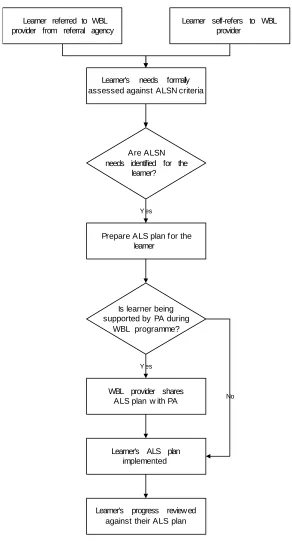
Figure 1 The ALSN Process
Learner's needs formally assessed against ALSN criteria
Prepare ALS plan for the learner
Learner self-refers to WBL provider
WBL provider shares ALS plan w ith PA
No
Y es Learner referred to WBL
provider from referral agency
Are ALSN needs identified for the
learner?
Is learner being supported by PA during
WBL programme?
Y es
No
Learner's ALS plan implemented
Learner's progress reviewed against their ALS plan
Additional Social Needs criteria
used as a rigid tool defining ASN so tightly that it rules out those young people who should receive additional support from the LSC.
20 Recent or recurrent offending behaviour
The young person should be known to the criminal justice system and considered by others or themselves to be at risk of re-offending, or still offending. Where offending behaviour appears to have come to an end and there is no record of further problems, these criteria should apply only if the original offence is still impacting on the young person’s life – this could include serious offences which make it more difficult for them to gain employment, or to access training without additional supervision and support.
21 Poor or erratic attendance during last year of education or excluded from school or no record of school
This may be evidenced from the school records held by Connexions, or by the young person themselves, when school records are incomplete or unavailable. It includes all those who missed regular full-time schooling, whether this was as a result of behavioural problems such as bullying, moving around the country or truancy and so on. In the case of a conflict between school records and the evidence of the young person, greater weight should be given to the testimony of the young person. Evidence from parents, guardians or professionals may be used as required. Young people who have been tutored at home or who have attended alternative education programmes, which are often part time, and have reduced attendance
requirements, may also be included.
22 Unsupportive or unsupported home environment (including care leavers or carers)
The following should be considered:
• all young people who are living independently (whether they are care leavers or have left home for other reasons)
• automatic inclusion of those living in temporary accommodation or who are of no fixed abode
• those who are carers who have no other substantial support
• those living away from the family home with other members of the family, as this may indicate conflict or other problems.
For young people who have been in care for short periods of time, their home circumstances and the impact that this has had upon them should be evaluated. Evidence may be available from support workers, but information from the young person should also be acceptable where substantial problems have been
identified. Examples of this may include families in crisis or unable to cope, where there are dependency problems within the family, where changes to the family composition have brought young people into conflict with a new partner, where the young person is used to care for siblings to the detriment of their programme, or where the young person comes from a culture of entrenched unemployment that impacts on their commitment to training.
23 Significant problems with confidence or self-esteem
Young people with low self-esteem may show extremes of behaviour, such as aggression and bullying, or in avoiding contact with others.
Further indicators may be in the way that young people with low self-esteem present themselves. For example, they may have poor personal hygiene, be unkempt or even threatening in their appearance. Young people with low self-esteem are likely to feel rejected, and will therefore be unable to feel positive about themselves, or accept themselves for who they are. Low confidence and self-esteem will prevent young people from taking risks and trying new things. Young people demonstrating either or both of these beyond normal levels will require high levels of support and encouragement to hold them on a programme.
24 Significant problems with motivation or attendance
Young people who can be shown to have received a thorough initial assessment and to have received support to identify and address any underlying problems, but who still demonstrate significant problems with motivation and attendance should be considered. This may be a continuation of school patterns. The provider shall also consider and address any difference in patterns emerging from attendance at the workplace and in-house learning. The work that the provider undertakes to address the problems may reveal the need for a structured and more intensive programme of support to help address the problems.
25 Attitudinal or behavioural problems (including loss of placement due to poor attitude or behaviour)
This includes young people whose attitudinal or behavioural problems mean that they are likely to need a high level of supervision and additional support to make the transition to the workplace, or a high level of support and supervision in the workplace. Evidence for this may be available from those supporting the young person when he or she joins the programme, or from school records, but young people must also be given the opportunity to make a fresh start where this does not endanger themselves or others. Those who might be considered to be at risk may be expected to have undergone a risk assessment, and this will be acceptable evidence for this criterion. Alternatively, the provider must have evidence, which is generated during the programme. Evidence should show the involvement of more than one member of staff, and that the young person has been fully involved in addressing the problems. Where a learner has lost a placement, this must be shown to be as a result of their poor attitude or behaviour. Evidence may include records of the support the provider has given the young person, corroborated by the employer. It will be important to show that the problems were not caused as a result of inappropriate placing or a personality clash.
26 Drug or alcohol-related problems
This does not include those who could be considered to be recreational users, where their use of drugs, alcohol or other substances does not impact upon their programme in any way. These issues should be addressed in the normal course of training. Evidence for drug or alcohol-related problems will usually come from the young person, staff observation and problems with timekeeping, concentration, behaviour and so on. While some young people may be accessing support, the majority will not, and may not even have accepted that they have a problem. It will be important to build trust to facilitate these discussions. In the most severe cases where young people need and are prepared to undertake rehabilitation, it may mean that a more flexible programme should be considered.
Some health issues faced by young people may necessitate the provision of
specialist equipment while others may require other types of support to ensure that they can get the most out of their learning programme. This might mean, for
example, that intensive additional one-to-one support is needed or a more flexible programme is arranged for a young person who regularly misses periods of their training because of ongoing health issues.
Some people may suffer mental health problems and may be reluctant to admit these because of the stigma attached to them. A young person with a phobia will have intense symptoms of anxiety, but these fears will only arise in the particular situations that frighten them. A phobia is likely to lead to the young person avoiding situations in which they know they will be anxious. In the worst cases, their life will be dominated by the precautions they have to take to avoid the situation they fear. Support may be required to help them to face any issues that impact on their programme and to seek medical help where appropriate.
Evidence of health issues might come from young people themselves, medical records (only with the young person’s permission), school records, Connexions or their employer.
Physical health does not include identification of support for a learner to address the needs directly resulting from their learning difficulties and/or disabilities. However, there may be health issues associated with the learner’s disability which should be considered when identifying support arrangements. Where a learner has learning difficulties and/or disabilities, which require direct support exceeding £3000 over the full length of the programme, additional funding should be claimed under exceptional learning support (ELS).
28 Significant problems with communication and interaction
A young person having significant problems with communication and interaction will usually be identifiable from the first interview. Individuals may have problems communicating with all age groups, or with specific groups. For example, some young people have particular difficulty in communicating with adults, or those who may be perceived as being in authority. Interaction may also be inappropriate to the situation. These young people may have difficulty in listening to what others are saying and reading other people’s facial cues and body language. Some young people will talk very quietly, avoid eye contact, and display an inability to hold a normal conversation and a reluctance or inability to ask questions. These young people are often termed as being extremely shy. Others may be unable to hold a normal conversation without shouting or being overly demanding. They may tend to invade other people’s personal space, and appear to be aggressive. In group situations, young people meeting these criteria may be at either end of the
continuum, being either extremely withdrawn or disruptive. In the workplace, young people with communication problems will find it hard to build working relationships and to develop the support that they need in order to learn. In some cases, this may affect their ability to work safely. This may also apply to young people with language difficulties, or those who speak English as a second language.
29 Single parents with particular difficulties in engaging with learning
Funding additional learning and social needs
30 Where a learner is assessed as having ALSN status, the LSC will pay a premium on top of the monthly payment for each month the learner stays in learning, attracts a monthly payment for any qualification and requires support, provided the following conditions are met:
• The assessment should have been conducted in line with this guidance and the provider’s written arrangements.
• An appropriate learning and support plan has been prepared to address the learner’s needs.
• The programme of additional learning and support is being delivered.
• Reviews of learners’ progress are carried out at least every 12 weeks, and are in line with the providers’ written arrangements.
31 Calculations will be automatic, and the amount paid for the full length of the time spent on the qualification to which the status is attached. Where ALSN status is awarded after the start date, or ceases before the end date, providers are required to reduce the claim through the Training Provider Statement. The provider will be required to profile its cash allocation for ALSN for the funding year. Once agreed, the LSC will pay this amount on profile, and reconcile it as necessary, based on actual delivery. The current rates for ALSN are:
• learners with ALN or ASN status: (£134) a month
• learners with both ALN and ASN status: (£202) a month.
32 While a provider will claim the same amount for each learner per month, depending on the category in which they are placed, it is recognised that in meeting the
individual needs of young people this will necessitate the need for providers to spend higher amounts on providing support for some learners and less on others. It is also recognised that support may need to be provided in intensive periods, although funding will be claimed over the duration of the course. ALSN funding can continue to be claimed by a provider after the NVQ funding has ceased.
Annex 2: Outline of E2E passport
The following outline of the E2E Passport is an extract from the document. The full Passport can be found on the LSC website:
http://www.lsc.gov.uk/National/Partners/PolicyandDevelopment/EntrytoEmployment/de fault.htm (accessed 28/11/05)
Introduction
This document replaces earlier guidance on the E2E Passport issued in July 2003. It provides guidance on the use of the E2E Passport within the Entry to Employment (E2E) programme, and has been developed by the Learning and Skills Council National Office (LSC NO) in consultation with the Connexions Service National Unit (CSNU), the Adult Learning Inspectorate (ALI), local LSCs and providers. This document has been amended and developed following a review of the implementation of the Passport during the first phase of E2E national establishment.
During November and December 2003 all E2E providers and local Connexions Services were invited to respond to a questionnaire designed to gather feedback on the use of the Passport and to participate in a series of focus groups. Over 160 responses were
received from a wide range of organisations, including local and national work-based learning providers, FE colleges and local Connexions services. Many organisations had consulted learners as part of their own internal review arrangements, and these views were positively welcomed.
The updated Passport documentation attempts to capture common suggestions made in terms of how it could be enhanced and further developed. Many respondents requested examples of completed Passport documents. These will be published on the E2E area of the LSC website as they are developed. A checklist will also be published shortly by Skillcom, which providers can use within their own organisations to quality assure learners’ Passports.
The updated Passport includes only one new document, a referral form for support agencies. The Review Record and Activity Plan have been separated into two documents at the request of many providers. The documents together aim to:
• facilitate seamless transition for young people from the Connexions service and other referral agencies and ensure the sharing of information with E2E providers
• integrate and provide a record of the key learner processes of initial assessment, planning and implementation of individual learning programmes, including the setting of learner objectives and targets, the monitoring and review of progress and the planning and managing of transition beyond E2E.
The seven documents are:
• Connexions personal adviser referral form
• referral agency form (new)
• iInitial assessment summary
• E2E programme
• review record
• E2E activity plan
• moving on plan.
The Passport documentation does not replace the need to maintain awarding body documentation, including assessment plans, where young people are working towards accredited qualifications. Providers offering externally accredited qualifications must be aware of the quality assurance guidelines and requirements accompanying the use of those qualifications. For further guidance in respect of the use of qualifications within E2E programmes, providers and local LSCs should refer to the E2E Entitlement Curriculum (which is being disseminated alongside this documentation).
Young people should receive copies of their E2E programme, review records, E2E activity plans and moving on plan. Providers should ensure there are folders for young people to keep these safe in, which will be called their E2E Passport. The PA/referral agency referral forms and the initial assessment summary should be retained by the provider, along with copies of other documents. When young people leave their E2E provider, they should be encouraged to take their Passports with them so that they can share them with other work-based learning providers, FE colleges and/or employers. Providers can pass on copies of completed Passports to other providers with the agreement of the young person.
The E2E Passport has been cross-mapped with the DfES Progress File Widening Horizons
to show how these materials can support the completion of the Passport. Further details can be found on the DfES website www.dfes.gov.uk/progfile (accessed 14/11/05) and on the E2E area of the LSC website www.lsc.gov.uk (accessed 14/11/05).
Use of the Passport and local modifications
Through the E2E Advisory Group, LSC National Office and the Connexions Service National Unit have agreed that the Passport will be mandatory for all E2E providers and local Connexions Services from 1 June 2004.
To ensure that the E2E Passport gains currency nationally, the LSC and CSNU wish to discourage local modifications. The following, however, are acceptable:
• The Passport documents can be formatted to meet the needs of the provider or local Connexions service. This means that logos can be introduced, types and sizes of fonts can be altered, text boxes can be enlarged or reduced as required, appropriate colour graphics can be added and documents can be professionally printed.
• Additional information boxes/questions cannot be inserted into the Passport documents and no questions can be removed. Providers may, however, add an extra sheet with other information on if they require any.
• Where the E2E Passport is used and held electronically or Progress Map is used instead, the original version of the following documents must be printed, signed and held on file:
o initial assessment summary
o E2E programme
o moving on plan.
Annex 3: Recommended staff development plan
Changes to the funding of ALSN will not occur in this current contract year, but may for subsequent years. The project has highlighted a need to improve the process for securing and monitoring ALSN in preparation for any changes in funding requirements.
Proposed staff development plan
3 sub-national events to be held in early 2006 in preparation for any changes to funding requirements April 2006.
Theme/title
Awareness raising of project and LSDA guide incorporating a development aspect supported by workshop materials and trainers notes.
Aims
For providers to share:
• current practice in identifying and addressing ALSN needs
• ideas about how to improve current practice and identify a development plan.
Content
Overview of funding requirements and possible changes: delivered or prepared by LSC. Introduction to the guide: delivered by author/LSDA.
Workshop sessions covering:
• developing a process for identifying and addressing ALSN
• quality assurance of the process
• documenting the learning plans and reviews.
Each workshop will present current good practice by a provider followed by development activities led by a facilitator.