making
work-based
learning
work
identifying
effective practice
in the
delivery of
Apprenticeships
Maria Hughes
Helen Monteiro
PHOTO REDACTED DUE TO THIRD PARTY RIGHTS OR OTHER LEGAL ISSUES
PHOTO REDACTED DUE TO THIRD PARTY RIGHTS OR OTHER LEGAL ISSUES
identifying
effective practice
in the
delivery of
Apprenticeships
making
work-based
learning
work
Published by the Learning and Skills Development Agency
www.LSDA.org.uk
Registered with the Charity Commissioners
LSDA is committed to providing publications that are accessible to all. To request additional copies of this publication or a dif ferent format please contact:
Information Ser vices
Learning and Skills Development Agency Regent Arcade House
19–25 Argyll Street London W1F 7LS. Tel 020 7297 9144 Fax 020 7297 9242 [email protected]
Copyeditor: Nick Sweeney
Designer: David Shaw and associates Photographs: © educationphotos.co.uk Printer: Blackmore Ltd, Shaftesbur y, Dorset
051991RS/06/05/
ISBN 1-84572-174-8
© Learning and Skills Development Agency 2005
You are welcome to copy this publication for internal use within your organisation. Other wise, no par t of this publication may be reproduced, stored in a retrieval system, or transmitted in any form or by any means, electronic, electrical, chemical, optical, photocopying, recording or other wise, without prior written permission of the copyright owner.
Further information
For fur ther information about the issues discussed in this publication please contact:
Maria Hughes Research Manager
Learning and Skills Development Agency. Tel 020 7297 9118
This publication results from the Learning and Skills Development Agency’s strategic programme of research and development funded by the Learning and Skills Council, the organisation that exists to make England better skilled and more competitive. For further information about the Learning and Skills Council visit www.LSC.gov.uk.
Contents
Executive summar y
Introduction 1
Method 2
Findings 2
Conclusions and recommendations 4
Criteria for good practice 5
Programme planning 6
Recruitment and pre-recruitment 10
Induction 14
Initial assessments 16
Managing individual learning plans 20
Suppor ting the learner 22
Reviewing progress and target-setting 30
Deliver y of key skills requirements 33
Of f-the-job learning 38
On-the-job learning 44
Additionality and enrichment 50
On-programme assessment 53
Recording evidence and building por tfolios 58
Progression and employability 61
Management of training programmes 64
Appendix 1 Sources for literature review 69
Appendix 2 Sur vey findings 70
Appendix 3 Sample of providers 72
Executive summary
This repor t identifies characteristics of good practice in relation to the deliver y of Apprenticeship programmes, provides a commentar y on the extent to which these are currently in place and provides examples of good practice and barriers to fur ther development of good practice.
The repor t should be of interest to work-based learning (WBL) practitioners and the Learning and Skills Council (LSC), who may find it a useful guide in fur ther developing the quality of Apprenticeships.
Good practice criteria
A review of authoritative sources of information on the deliver y of apprenticeships and work-based learning identified characteristics of ef fective practice and informed the development of criteria for good practice. The criteria suggest what would constitute good practice in relation to dif ferent stages in the deliver y of Apprenticeships.
Survey of good practice
The criteria for good practice were used as the basis of a sur vey of providers, which enquired about the match between the criteria and their current practice.
The sur vey found that where there has been attention to issues such as initial assessment, individual learning plans and on-the-job assessment, providers repor t that good practice is largely in place. These findings indicate that:
some inter ventions have made a dif ference in improving quality
targeted suppor t for a fur ther set of good practice characteristics is required.
Further development needs
Attention may now need to be move to areas such as the implementation of Technical Cer tificates and developing capacity to customise
learning programmes to meet individual needs and circumstances, such as:
enabling recruits who already hold some of the framework requirements to pursue higher qualifications
designing programmes to meet needs and limitations of the small and medium-sized enterprises (SME) workplace
improving recruitment processes to attract under-represented groups.
Examples of good practice
Respondents to the sur vey were invited to take par t in a series of site visits, where they elaborated on practice referred to in their
Identifying ef fective practice in the deliver y of Apprenticeships 1
Introduction
The Learning and Skills Development Agency (LSDA) has been examining critical issues concerning the development of Apprenticeships, par ticularly in the light of the proposals in the DfES Skills Strategy.1 The Skills Strategy
notably sets out proposals to raise the quality and ef fectiveness of Apprenticeships as the primar y vocational option for young people, and to lift the age cap so that more adults can benefit from these ‘earn and learn’ oppor tunities.
This repor t identifies current practice in the deliver y of Apprenticeships with a view to determining characteristics of good practice and producing guidance on these for work-based learning (WBL) practitioners and the Learning and Skills Council (LSC).
Rationale
Apprenticeships potentially provide an ideal oppor tunity for the development of a sound theoretical base alongside awareness of practical application in the workplace. Conver ting this ideal into practice requires a considerable amount of coordination and par tnership working between the various par ties who have a par t to play in the learning process. Awareness and agreement on the par t of these players of their
respective roles in the learning process, and of the overall aims of the par ticular Apprenticeship framework is vital. However, the contexts in which Apprenticeships are delivered are extremely variable, which militates against a single preferred model and points instead to the development of
agreed criteria for good practice, which may be interpreted dif ferently, but with equal rigour, in specific contexts.
The National Skills Taskforce expressed concerns over the lack of an adequate base of underpinning knowledge through the NVQ alone in some Apprenticeship frameworks. This call was later repeated in the Cassels Repor t on Modern Apprenticeships,2 and the development of
Technical Cer tificates has since been under way. The LSDA research therefore sought examples of good practice in the deliver y of Technical Cer tificates, and on their overall impact on learning deliver y. It also considered ways in which key skills are being developed, delivered and assessed.
Research aims
The research aimed to:
review views on what constitutes good practice in the deliver y of Apprenticeships from authoritative sources such as DfES and the Modern Apprenticeship (MA) advisor y committee
draft criteria for good practice based on the above and consult with interested par ties on its appropriateness
sur vey providers about the relationship between their practice and the good practice criteria
compare the learning experience of Apprenticeships with the ideal suggested by the criteria to identify examples of good practice in action and barriers to this.
1
DfES (2003)
21st centur y skills: realising our potential
2
DfES (2001)
2 Identifying ef fective practice in the deliver y of Apprenticeships
Method
The research involved a range of methods of enquir y, as follows:
Literature review
Authoritative sources on what constitutes best practice in MA deliver y were reviewed. The outcomes of the review were used to develop
criteria for good practice which embodied the features of ef fective deliver y identified in the literature.
Survey of WBL providers’ views on good practice
The criteria of good practice informed the production of a sur vey of
WBL providers, which asked providers about the match between the criteria and their practice.
Site visits
Site visits to 24 providers were under taken to identify good practice and barriers to its development as a basis for fur ther investigation.
Expert seminar
Emerging findings for the research were discussed at an exper t seminar attended by a cross-section of representatives from WBL including employers, providers, the Sector Skills Development Agency, the Adult Learning Inspectorate and the Learning and Skills Council. The purpose of the seminar was to explore the emerging findings and to enable them to be tested and verified.
Findings
Literature review findings
A review of more than 20 authoritative sources3 relating to apprenticeships
and/or work-based learning was carried out to identify ef fective practice in the deliver y of apprenticeships. A large degree of consensus emerged from the material concerning what constituted ef fective practice in this area.
The review informed the development of draft criteria for good practice in the deliver y of apprenticeships. The criteria were arranged in order to relate to dif ferent stages of the deliver y of Apprenticeships, although there is some crossover between sections. The draft criteria of good practice in the deliver y of Modern Apprenticeships are shown in Appendix 4, in the form of a checklist for providers. Providers and LSC may find this list of desirable processes a useful guide in assessing the quality of the deliver y of Apprenticeships, while bearing in mind that even excellent provision may not include them all.
3
Identifying ef fective practice in the deliver y of Apprenticeships 3
Survey of good practice
The criteria for good practice in the deliver y were incorporated into a sur vey investigating how current provision matched the ideals illustrated by the criteria. This was conducted by means of a postal questionnaire to providers. The questionnaire asked questions about the match between the criteria and providers’ practice, and respondents asked to indicate whether a given practice was fully in place, par tially in place or not in place.
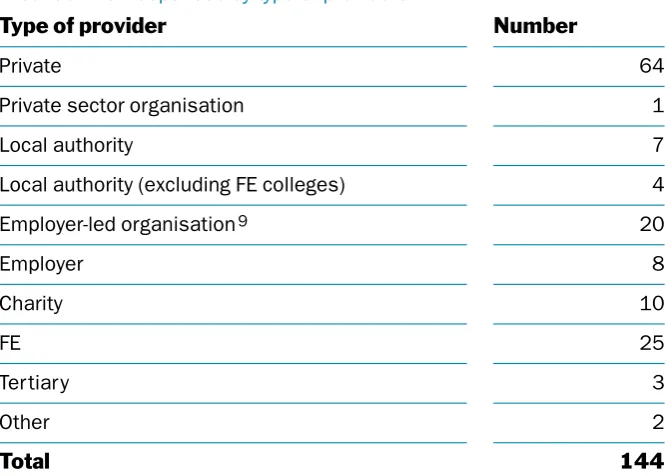
The questionnaire was circulated to 783 providers. 144 replies were received giving a response rate of 18%. Responses came from across a wide range of provider types.
The analysis of the questionnaire returns indicated that providers repor t that good practice is largely in place where there has been attention to issues such as initial assessment, individual learning plans and on-the-job assessment. Less well developed aspects of good practice tend to be found in areas where development activity or inter ventions have not been put in place, or are new elements of programmes – such as progression routes to higher level study, the provision of extension studies or assessment in relation to Technical Cer tificates.
These findings suggest that there is a need for attention to be given to developing good practice which relates to individualising learning programmes, as opposed to things which most candidates routinely need. This is illustrated in responses to criteria for good practice related to, for example:4
provision for recruits who satisfy some of the framework requirements to pursue higher qualifications
designing programmes to meet needs and limitations of the workplace in SMEs
attention to under-represented groups in the recruitment process.
It may also indicate that:
some inter ventions have made a dif ference in improving quality
targeting suppor t for a fur ther set of good practice characteristics is required.
Site visits
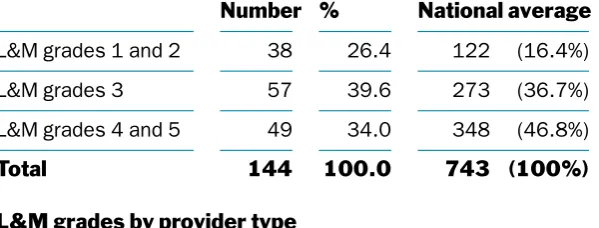
Respondents to the sur vey were invited to host site visits from LSDA. During the visits, providers elaborated on practice referred to in their questionnaire returns and provided examples of good practice in action and barriers to improving practice. Twenty-four providers were visited. The providers included those who had received grade 1 in ALI inspections, and some who had received grade 4s, but all had an overall grade profile which was above the national average.
The specific findings from the site visits are described on pages 5–68, along with the criteria for good practice and the sur vey results.
4
4 Identifying ef fective practice in the deliver y of Apprenticeships
Conclusions and recommendations
Examples of ef fective practice are to be found in relation to many of the criteria identified by the literature review. There is also considerable evidence of practitioners making attempts to remove barriers to good practice where these are within their control. There appears to be some embedding of good practice that has resulted from development activities and initiatives that have addressed many aspects of the criteria. A distinction is sometimes made between practice which is the norm and good practice. However, this may be de-motivating to practitioners whose practice lags behind even ‘the norm’, and make the task of developing to and beyond what would be expected as satisfactor y even more daunting. Ambitions need to be high, but an appreciation of distance travelled could promote a culture of continuous improvement and encourage more providers to make ef for ts to improve to higher standards.
The sur vey results give policy makers and planners some insight into what needs fur ther suppor t for development. They may also indicate where suppor t has succeeded. We recommend that this be taken into account when future suppor t programmes are being considered.
Identifying ef fective practice in the deliver y of Apprenticeships 5
This section repor ts on
the outcomes of the sur vey
and provides a commentar y on
issues arising from the site visits.
Examples of good practice are
given, and gaps in good practice
are highlighted.
Practitioners may find it useful
to assess their practice against
the criteria. They may wish to
do this across all areas of their
provision, or for selected areas.
Appendix 4 provides a blank version
of the checklist, which may be
used for this purpose. Practitioners
may also find it useful to consider
the commentar y on the criteria,
and the good practice examples
when planning to improve
the quality of their provision.
6
Criteria for good practice
Programme planning
Commentary
The criteria for good practice place great emphasis on thorough planning for the deliver y of the Apprenticeship framework to ensure that all par tners in the training have a full understanding of the framework and its components, and their roles and responsibilities within them. This increases the
likelihood of a positive experience and outcome for all concerned.
From a consideration of the literature and in consultation with LSC, good practice in this area was said to include the elements displayed opposite. From the results of the sur vey with providers, it was possible to determine which aspects were fully in place, par tially in place or not in operation.
Percentage of providers indicating practice is: Criteria for good practice
and current state of play
fully in place
par tially in place
not in place
All par tners in the training have a full understanding of the framework and its components,
and roles and responsibilities within this.
60 38 1.4
All par tners are aware at the planning stage of the learning oppor tunities of fered by the workplace, and of any limitations in these.
62 36 0.7
Planning for training programmes takes full account of learners’ prior experience and knowledge and identifies learning needs.
76 21 2
Oppor tunities exist for recruits to apprenticeships who already satisfy some requirements to pursue higher technical or professional qualifications.
55 29 12
Programmes are designed par ticularly to match the needs and limitations of SMEs.
41 30 17
Programmes are designed to deliver the framework and its components to best match the needs of learners and employers.
75 21 2
Long programmes have ‘staging posts’ to motivate learners to continue.
43 39 16
Programme-led apprenticeships (PLAs) are of fered when employer-led pathway options are not available.
Criteria for good practice: Programme planning 7
Aspects of good practice said to be fully in place by over 60% of respondents include:
awareness of the framework, and respective role across all par tners, learning oppor tunities and their limitations
the need to identify prior experience and learning needs is taken into account during programme planning and the need to match these to the framework and its components.
Less well-developed aspects of good practice include:
provision for recruits who satisfy some of the framework requirements to pursue higher qualifications
designing programmes to meet needs and limitations of the workplace in SMEs
‘staging posts’ in long programmes
programme-led pathways of fered as alternatives to employer-led pathways.
The inter views explored the match between criteria and practice with examples given by providers of practice that was working well, what needed to be developed, any barriers to the development of good practice and how these can be overcome.
Well-developed practice
Awareness of the framework, and respective roles across all partners, learning opportunities and their limitations
A series of measures had been put in place by those visited to ensure that the training team, learners and employers were fully aware of the framework commitments. These included:
whole team meetings to discuss how to deliver the framework
involving the whole training team in the design of assignments
regular staf f meetings at the provider to review workload, learner assignments and the coverage of units
production of an employer induction/information pack describing the qualifications available, the employers’ role in the apprenticeship and the suppor t they are expected to provide to the trainee
regular feedback to the employers on the trainees’ progress to raise awareness of the framework and to engender a sense of pride in the employer that ‘their trainee’ has achieved something wor thwhile; this also encourages the feeling among employers that they have contributed directly to their trainee’s success
feedback on learner progress provided to parents to involve them with their son or daughters’ apprenticeship.
Providers recognised dif ficulties in ensuring that all par tners had a
8 Identifying ef fective practice in the deliver y of Apprenticeships
Prior learner experience and learning needs are taken into account during programme planning and these matched to the framework and its components
Some of the providers inter viewed carried out this aspect of ef fective practice during the selection process within the initial diagnostic tests used to assess the level of programme for which the trainee was best suited. One of the providers inter viewed repor ted that where aspects of one NVQ (eg nail care) overlapped with those of another (eg customer ser vice) which the trainee had already completed or par tially completed, the specifications were cross-referenced and existing evidence produced by the trainee used to save duplication of work.
Good practice in this area is hindered by the lack of systematic accreditation of prior experiential learning (APEL) and as a result trainees were repeating in their AMA aspects which they had previously covered in their FMA. Some apprentices also commented to providers that they carried out more sophisticated work on site than they did of f-the-job. Action necessar y to overcome these issues included the following:
better coordination of on-the-job and of f-the-job training
trainers to be more aware of what apprentices are doing on site
there needs to be a careful review on the par t of the providers of the comments and repor ts produced by the employers
there needs to be more evidence from the trainees’ on site work so that this can be better matched to the of f-the-job training.
Less well established practice
Provision for recruits who satisfy some of the
framework requirements to pursue higher qualifications
Although few providers said that this aspect of practice was in place, some of the providers inter viewed suggested a number of ways in which it could be developed:
trainees with the potential to pursue fur ther qualifications are
encouraged to go beyond the requirements of the apprenticeship framework both in their technical skills development and key skills
learners’ career aims should be discussed with employers. In accountancy, for example, there is a natural progression route from NVQ2 to NVQ3 to NVQ4. While trainees cannot be funded as apprentices beyond this point, they can progress to Association of Char tered Cer tified Accountants (ACCA) training
for some trainees their best route lies in progressing to a dif ferent but related NVQ. Information and guidance should be given to raise awareness of these options
providers should liaise with colleges to ensure previous learning is recognised and any exemptions applicable obtained.
Designing programmes to meet needs and limitations of the workplace in SMEs
Programmes designed to meet the needs and address the limitations of training with SMEs involved the following actions:
the apprentices’ training needs, the range of skills/competencies
Criteria for good practice: Programme planning 9
employers receive advice on the content of the training programme and the level of training which the employer is currently equipped to of fer. This might dif fer from what the employer originally had in mind, and the apprentice/employer might be advised to of fer Level 2 training first and to reassess the situation in 12 months
if an employer cannot of fer training which meets all the specification, the provider negotiates with the employer how the trainee’s needs might be met. This might include finding an alternative employer who can fill the gaps in training.
Good practice
P1, a large private provider covering a range of sectors, has
dedicated staf f (suppor ted by assessors) who work with the employers to determine their needs and to ensure that the employers are
fully informed about the framework requirements. The provider receives no funding for this activity but sees it as essential and contributing to improved retention rates.
The providers inter viewed identified barriers to good practice. These included the dif ficulty that some SMEs experienced in releasing the trainee from the workplace. To address this, employers had requested that provision be made within evening classes; unfor tunately some providers were unable to accommodate this request. An ef fective strategy to overcoming this barrier had been found by some providers within the sample, whose apprentices often have access to Learndirect and have access to assessors
by telephone or e-mail. In some cases the provider could also take of f-the-job training into the workplace. This had the additional advantage that other employees could par ticipate in the training.
Long programmes have ‘staging posts’ to motivate learners to continue
Good practice among the providers inter viewed had often arisen out of the need to find a solution to a problem. A provider inter viewed had found that assessment was being under taken too late in the programme and that units were not being achieved until the last stages. The provider had taken steps to plan the programmes at the element level and set medium-term targets for the completion of specific por tions. However, the par ticular elements to be achieved could not always be fixed in advance because of the variable nature of the on-the-job experiences of the learners.
Programme-led apprenticeships are offered when employer-led pathway options are not available
The inter viewed providers had little understanding of programme-led apprenticeships (PLA) as a concept.
10
Criteria for good practice
Recruitment and pre-recruitment
Commentary
While final selection and recruitment is the prerogative of employers, there is ample scope for providers to demonstrate good practice from the first interaction with the potential trainee. Successful pre-recruitment and recruitment practices can ensure that trainees are placed upon the right level of programme with a suitable employer with potential to complete their framework, meeting both their learning and career objectives, fulfilling the employer’s needs and ensuring a healthy success rate for the
learning provider. Recruitment practices can also help widen par ticipation among minority or non-traditional post-16 learning groups.
Percentage of providers indicating practice is: Criteria for good practice
and current state of play
fully in place
par tially in place
not in place
Recruitment materials provide clear, factual information about the content and
likely experiences of the apprenticeship.
53 40 5
Providers maintain productive links with local Connexions or careers ser vices.
70 25 5
Recruitment materials describe possible career paths in the occupational area.
39 41 16
Recruitment and pre-recruitment activity pays attention to under-represented groups.
48 44 4
MAs are promoted to employers as a means of developing existing staf f as well as recruiting new staf f.
65 23 4
Recruits who lack entr y requirements are placed on pre-apprenticeship programmes.
45 20 28
Par tners in the MA programmes actively suppor t local student apprenticeships.
32 31 25
Oppor tunities exist to sample programmes through work experience or trial periods.
33 33 29
Learners are always recruited to the programme that best suits their needs.
Criteria for good practice: Recruitment and pre-recruitment 11
Aspects of good practice said to be fully in place by over 60% of respondents include:
productive links with Connexions/careers ser vices
promotion of MAs to employers as a means of developing existing staf f
always recruiting learners to the programme to which they are best suited (but see below for apparent contradiction of this).
Less well-developed aspects of good practice include:
recruitment materials – in terms of clear and factual information, adaptation to suit dif ferent audiences, description of careers paths, attention to under-represented groups
attention to under-represented groups in the recruitment process
suppor t for local student apprenticeships
placement on pre-entr y programmes for recruits who lack entr y requirements, oppor tunities for sampling and or tasters.
Well-developed practice
Productive links with Connexions/careers services
The majority of providers had established productive links with Connexions. One method for maintaining productive links included formal monthly meeting between the provider and Connexions. This had the benefit of ensuring that learners at risk of dropping out could be included in a mentoring ser vice provided by Connexions to receive any extra suppor t necessar y to help them continue their programme.
Some providers complained that they occasionally had to work with and be responsive to four or five Connexions ser vices operating in their region and this was time consuming. Although Connexions were generally well informed about MA programmes, they were still not familiar with the Entr y to Employment (E2E) programme.
Always recruiting learners to the programme to which they are best suited
The vast majority of providers stated that measures were fully in place to ensure that learners were recruited to the programme that best suited their needs. Most providers thought they could of fer a wide range of training oppor tunities at an appropriate level for individual learners and a good range of progression oppor tunities.
Barriers to ensuring that this practice occurred smoothly on ever y occasion were still evident. Discrepancies could occur between the employers’ desire for their trainees to enter their training at Level 3 and the trainees’ ability. Providers suggested that by making employers more aware of the range of training programmes available and their respective demands this problem could be overcome.
Promotion of MAs to employers to develop existing staff
12 Identifying ef fective practice in the deliver y of Apprenticeships
Less well established practice
Quality of recruitment material
The sur vey found that a number of measures that are fundamental to good practice in recruitment to MAs were not fully in place. Some good practice was found however, within the providers inter viewed. Information was provided in attractive and clear recruitment materials that contained simple outlines of possible career paths. Providers also published
prospectuses and flyers and ran ‘awareness days’ in schools. A step fur ther was found in a couple of providers who, following the learners’ initial assessment and inter view, of fered ‘apprenticeship suppor t sessions’ in which advisers set out for the trainees the vocational areas, their dif ferent pathways and the various careers to which they can lead. This included what the trainees must do to reach their goals and ambitions. Sometimes this meant the trainee had to be transferred to another provider if the original provider could not meet the trainee’s requirements.
Attempts were being made by a number of the providers inter viewed to attract learners from under-represented groups. This was done through a variety of methods including of fering provision that may prove attractive to the target population, such as MA programmes in barbering in an attempt to attract more young men into hairdressing. One college employed a member of staf f whose function was to liaise with groups and organisations which were not well represented on the courses of fered. Providers were also working closely with Connexions. Some providers set aside specific days when trainees with severe learning disabilities and dif ficulties who had not yet made career choices came into the provider for assessment and training. These sessions could lead to learners being successfully placed on apprenticeship programmes.
One provider noted that although they were working hard to promote WBL in schools, few trainees from minority groups were recruited. This was attributed to a strong preference in some cultures for sons and daughters to follow a professional route. Some NVQs were also labelled as too restrictive. Vegetarians and some religious or cultural groups will not handle meat, yet all the units in NVQ Food Preparation and Hospitality are mandator y, including meat handling. The providers’ response to overcoming this last barrier was a suggestion for the need for optional units within NVQs which make it possible for strong, grounded preferences to be accommodated.
Support for local student apprenticeships
A minority of par tners in the MA programme was thought to actively suppor t local Student Apprenticeships. Student Apprenticeships are aimed at enabling young people in full-time pre-16 education to under take structured work-based training in approved training centres and carr y out activities within local companies to gain the knowledge, skills and experience necessar y to enter the vocational area of their choice though an FMA. One provider among the 24 visited was associated with the
Criteria for good practice: Recruitment and pre-recruitment 13
Placement on pre-entry programmes for recruits who lack entry requirements
Good practice was found within a number of the inter viewed providers regarding the appropriate placement of recruits. In one college-based provider trainees lacking entr y requirements are placed in the open learning centre to update their skills and develop fundamental skills before being enrolled on an apprenticeship. Such skills usually include basic skills/ key skills, book-keeping or computing skills, for example. Trainees can attend on a daily basis and such preparation usually lasts a couple of months. Some of these skills are internally cer tificated by the college, eg food hygiene.
Opportunities exist to sample programmes through work experience or trial periods
The need to highlight and disseminate good practice in this area is all the more per tinent following the reform of Apprenticeships that have introduced an eight-week probationar y period requirement to the framework to formalise the trial period.
Some of the providers visited demonstrated ef fective practice in this area.
Good practice
P23, a ter tiar y college covering a range of sectors
Trainees are not of ficially enrolled on their programme until they have been visited by the assessor (usually after two weeks) and all par ties are happy that the trainee is on the right programme.
Good practice
P13, a small private provider, specialising in
the health and social care sector
14
Criteria for good practice
Induction
Commentary
The learners’ induction to their apprenticeship should provide a familiarisation with their employer’s organisation, the requirements and expectations of their framework and the roles and responsibilities of key players within this. A clear explanation covering these points at the beginning of the learners’ apprenticeship can ef fectively ‘ground’ their knowledge and expectations and ensure that all information requirements are met regarding oppor tunities for progression and sources for fur ther advice and guidance. It can also help learners settle into their place of work and star t their framework with a clear understanding of their commitments.
All the aspects of good practice listed in the questionnaire were said to be fully in place by over 60% of respondents, these being:
a comprehensive introduction to the workplace and work roles
description of roles and responsibilities of all players involved in the programme
a clear description of the content of the programme and expectations of learners
induction activities provided at major milestones.
However, 11% of respondents repor ted that induction at major milestones was not in place, which may indicate the need for fur ther development.
Percentage of providers indicating practice is: Criteria for good practice
and current state of play
fully in place
par tially in place
not in place
Induction includes a comprehensive induction to the workplace and work roles.
84 13 0.7
Induction includes a description of roles, responsibilities, ser vices and facilities of the training provider, employer, of f-the-job learning providers.
88 9 1.4
Induction includes a clear explanation of the programme content, requirements for successful completion, and expectations of the learner.
86 6 0
Additional induction activities take place at major milestones in the programme.
Criteria for good practice: Induction 15
Well-developed practice
There was considerable variation between providers in the length of the formal induction period. At one provider, where the MA programme is extensively roll-on/roll-of f, a four-day intensive induction programme is held each month for new entrants. It includes a:
generic introduction to WBL
‘fun’ initial assessment, involving paired work
basic skills/key skills initial assessment
full day introduction to key skills requirements
sector-specific introduction to the Technical Cer tificates and NVQ
sector-specific assessment or sector-specific inter views
gradual completion of the ILP through the four days.
At another provider the induction period was three weeks. It covered similar ground but also included several 2–3 day sampling experiences at dif ferent employers.
The thought given to induction varied from employer to employer and not all employers provided the trainees with a detailed and carefully explained job description. In response to this some providers were producing a glossy booklet containing an employers’ guide to the MA programme, setting out precisely what is required of them. Employers were also given a formal induction. Where employers were reluctant to release trainees to the provider for their full induction, inductions could be delivered on-site.
In one provider based within an FE college, each depar tment had booklets tailored to provide induction activities at major programme milestones and additional requirements of higher levels of training were discussed with learners at the appropriate time. However, it was repor ted that not all depar tments consistently applied this measure and the WBL manager had little influence over what the individual depar tments were doing to ensure that this occurred.
16
Criteria for good practice
Initial assessments
Commentary
Initial assessment is vital to enable the provider to match learners to the programme and level that best suits their interests and abilities. It can also ensure that any learning needs are identified and appropriate suppor t of fered during the learner’s apprenticeship.
Aspects of good practice said to be fully in place by over 60% of respondents include:
diagnostic assessment of basic and key skills
exploration of learners’ ambitions and match with oppor tunities of fered by the programme
assessment of prior, related learning
use of initial assessment outcomes to match learners to employers or providers.
Less well-developed aspects of practice include:
appraisal of learners’ abilities in relation to demands of the Technical Cer tificate
occupational/aptitudinal assessment.
This has been a par ticular area of interest within recent years with emphasis placed on the ef fective diagnosis of learners’ abilities and suppor t needs in basic and key skills. This is reflected in the good match between the criteria and practice within the providers sur veyed. However, practice tends to focus on basic/key skills assessment with less activity occurring around occupational/aptitudinal competence. Development was also required in the relatively new area of Technical Cer tificates.
Percentage of providers indicating practice is: Criteria for good practice
and current state of play
fully in place
par tially in place
not in place
Diagnosis of learners’ abilities and suppor t needs in basic/key skills.
91 6 0.7
Assessment of abilities and suppor t needs in relation to Technical Cer tificate requirements.
50 31 14
Occupational/aptitudinal assessment. 54 28 12
Discussion about learners’ ambitions and the match with oppor tunities of fered by the apprenticeship.
82 15 0
Assessment of the relevance and usefulness of prior experience and qualifications.
70 22 3
Initial assessment outcomes are used to match learner to employer, or learner to provider.
Criteria for good practice: Initial assessments 17
Well-developed practice
Diagnostic assessment of learners’ abilities and support needs in basic and key skills
Good practice
P21, a large private provider in the engineering sector, provides an initial assessment lasting about half a day. It comprises five elements:
1an assessor/trainer informing the applicants of the training programme, its elements and the requirements of the NVQ; of the suppor t structures available and of the time to be devoted to the training; an aim of this session is to inform and motivate the trainees
2a mechanical competence test, comprising multiple choice questions and pictures to test the applicants’ mechanical comprehension
3a basic numeracy test
4a literacy test
5a final inter view.
A number of staf f members take par t in order to give the applicants variety and in order for the staf f to form an agreed decision.
On the basis of the assessment trainees are either accepted directly onto the programme, are put on the provider’s Jobsearch programme or are rejected. The provider’s Jobsearch programme was initially designed for those trainees on the waiting list (P21 have more applicants than employers with which to place trainees). This programme lasts half a day and helps applicants set out a 10-year personal development plan.
Exploration of learners’ ambitions and match with opportunities offered by the programme
Initial induction within the inter viewed providers generally included a consideration of learning preferences, needs, ambitions and motivation allowing learners ambitions to be matched with available oppor tunities. The trainees’ records of learning and achievement (ROA) were also considered, as were their interests and hobbies, all of which ensured that the apprenticeship matched the learners’ ambitions and needs where possible. During a one-to-one inter view trainees were informed about the training programme and its requirements and these discussions ser ved to outline alternative career paths; help maximise the trainees’ potential and to help realise (or moderate) their ambitions.
18 Identifying ef fective practice in the deliver y of Apprenticeships
Assessment of the relevance and usefulness of prior experience and qualifications
Providers repor ted that they used prior experience and qualifications to assess which components of the frameworks the learners may have previously covered and to place them on an appropriate programme. Examples included providing exemptions from key skills if they had previously obtained a GNVQ or GCSE A–C in Maths, English or IT in the last three years (although por tfolios still needed to be completed).
A number of the providers visited were operating or piloting ‘fast-track’ schemes to recognise and accredit their apprentices’ previous informal learning. Within the hairdressing sector, learners sometimes have considerable experience in salons assisting a relative’s business or as Saturday/holiday workers. Based on this, one provider in this sector had restructured its training programme to give more oppor tunities for early assessment.
Use of initial assessment outcomes to match learners to employers or providers
Providers recognised the impor tance of not only tr ying to match learners to employers but vice versa to ensure that stakeholders’ needs were met. Some employers set high standards of entr y to training and set their own entr y test. Providers may send only the best trainees for inter view with such employers. Other employers may be more interested in having a trainee who is punctual and reliable.
One provider noted that in the furniture trades, the initial assessments can steer learners to one trade or another (for example one trade places more emphasis on numeracy) and these results are always included in discussions with employers when matching learners to employers needs. The provider also knows that some employers will give more suppor t than others, and may place students with par ticular learning dif ficulties or social needs with them.
Good practice
Criteria for good practice: Initial assessments 19
Less well established practice
Many of the visited providers stated that their initial assessment included an assessment of trainees’ abilities in relation to the Technical Cer tificate and key skills requirements at Level 2 or 3. Other providers repor ted that they did not separately assess abilities and/or suppor t needs related to their Technical Cer tificates. They had no plans to extend diagnostic testing beyond the initial basic skills/key skills assessment. One provider had as yet made no provision for delivering the Technical Cer tificate that was known to be par t of the new framework.
During the initial assessment many inter viewed providers examined the trainees’ strengths and weaknesses in relation to their occupational competence and aptitude and identified where the emphasis should be placed within the training programme. Some providers used a ‘skill scan’ to identify weak areas, and also employed a ‘learning style questionnaire’ to determine how the trainee liked to learn. Training could then be tailored to these needs and preferences.
In some of the providers visited, the results of the initial assessment were used to construct a training plan. This was accompanied by an action plan mapping out unit-by-unit how the learning plan was to be achieved, with accompanying targets and dates. Although this provided an increased workload for the assessors, they thought it was of benefit in allowing them to get to know the trainees and enabling them to tailor the learning plan to suit the individual learner. The training plan and the trainee’s progress against it were then closely monitored. Trainees following this process were achieving their qualifications more quickly and the accompanying providers’ achievement rates were improving.
Some providers did not think occupational or aptitudinal assessments were helpful. One suggested that it was more impor tant to assess attitude rather than aptitude.
Barriers to good practice
20
Criteria for good practice
Managing individual learning plans
Commentary
The ILP outlines the programme of learning agreed between the employer, provider and learner. It enables appropriate targets to be set and the learners’ progress to be monitored against these to ensure their motivation remains high and that framework components are achieved. It can also ensure that learners are receiving the suppor t to help them achieve these objectives.
Within recent years the ILP has received increased attention by providers as a means to achieve success for their learners.
All the aspects of good practice listed in the questionnaire were said to be fully in place by over 60% of respondents, these being:
full involvement of learners in developing their ILP
needs of employers and abilities of learners taken into account
ILP seen as a live document, regularly reviewed to take account of progress and changing needs
the inclusion in the plan of a learning suppor t plan, based on outcomes of assessment and linked to all aspects of the programme
the format and design of the plan being accessible.
The majority of providers indicated in the questionnaire that learners were fully engaged with developing their ILP. However, some providers remarked that few FMA learners had the ability to be properly involved in these discussions, ie to challenge or contribute positive suggestions.
Percentage of providers indicating practice is: Criteria for good practice
and current state of play
fully in place par tially in place not in place
Learners are fully involved in developing their individual learning plans.
67 31 1
Plans take into account abilities of
individual learners and needs of employers.
70 25 2
The ILP is a live working document for the
learner, provider, trainer (employer) and assessor.
70 25 2
The ILP includes a learning suppor t plan, based on initial assessment and diagnostic testing, clearly linked to both on- and of f-the-job aspects of the programme.
67 27 4
The ILP is regularly reviewed, taking into account progress in training and assessment.
77 20 2
The ILP is regularly reviewed, taking into account changing needs for additional suppor t.
68 27 2
The ILP is regularly reviewed, taking into account changing learner expectations of progression and job role.
61 28 6
The format and design of ILP accommodates review and change.
72 20 5
The format and design of the ILP is easily understood by the employer and the learner.
Criteria for good practice: Managing individual learning plans 21
Well-developed practice
Providers said they adapted initial ILPs to take account of the outcomes of diagnostic assessment and learners’ previous experiences. Some providers integrated the needs of employers into the plans, but a few thought that as employers’ needs were considered at the assessment stage there was no need to consult them on the ILP. Employers were given a copy of the plan.
One provider from the hairdressing sector said many of their employers did not take par t directly in discussions about the ILP at review meetings as time away from the salon meant they lost income. Review appointments were always made sensitively and well in advance, to tr y to fit in with less busy salon times.
Innovative practice
P22, a voluntar y organisation in the health and social care sector
Each learner has a weekly review to discuss progress towards targets. A major review with the placement of ficer is held at least ever y eight weeks and targets are set for the next 6–8 weeks. The placement and learning oppor tunities are discussed when setting these targets. A traf fic light system is used to signal concerns. Green signifies progress is satisfactor y and no action is needed before the next review. Amber means this target will be monitored more closely (perhaps ever y 2–3 weeks). Red means learners will be closely monitored – perhaps ever y 2–3 days, or at least weekly. Learners and employers were said to understand this system.
The majority of inter viewed providers thought that the format and design of the ILP was accessible. Some providers were revising the ILP and review formats to take into account the increasing complexity of the framework and expectations of suppor t arrangements.
Innovative practice
P22, a voluntar y organisation in health and social care is developing a paperless version of their ILP. Its structure will be similar to the ‘progress map’ used for E2E learners. All those involved with a learner will be able to access the ILP online and (within constraints) add to or modify it. It will be accessible online to learners as a read-only document. The provider believes this will improve understanding and access, but is doubtful that learners’ views on the relevance of the ILP will improve. Currently they ‘rarely think about their ILP between reviews’ and this is unlikely to change.
Barriers to good practice
Some providers thought that senior managers may fail to impress upon staf f the impor tance of completing the ILP. As a result the ILP was not regularly updated nor paper work completed after each visit. Providers and employers may also fail to cooperate in the completion of the ILP.
22
Criteria for good practice
Supporting the learner
Percentage of providers indicating practice is: Criteria for good practice
and current state of play
fully in place par tially in place not in place
Systems are in place to identify and suppor t learning needs throughout the programme.
81 18 0
Suppor t needs are revisited regularly and revised as necessar y.
75 23 0.7
Peer suppor t is provided, eg through buddy, or twinning arrangements.
20 45 32
Super visors move learners to more appropriate situations in the workplace, to secure better learning experiences.
45 47 4
Training is provided for workplace staf f to enable them to act as mentors, super visors and assessors.
28 45 25
Experienced staf f, who provide a good role model, act as mentors for learners.
38 46 11
Training provider visits: are to both on- and of f-the-job learning situations.
91 6 2
Training provider visits: include both formal
progress review visits and other less formal occasions.
90 7 0
Training provider visits: can be arranged at shor t notice to include on-the-job assessment oppor tunities.
82 14 0.7
Learners are included in the employer’s appraisal system.
43 39 13
Employers provide incentives for learners to progress on their programme.
20 56 19
Providers and employers have established links with a wide range of external suppor t agencies.
45 45 9
Learners are encouraged to continue with their learning programmes even if they decide to change employment par t-way through.
80 10 3
Employers of fer financial suppor t for essential expenses.
29 50 18
Employers have well-established policies for equal oppor tunities, harassment etc, and these are clearly conveyed to the learner.
45 53 0.7
Employers provide alternative learning experiences for learners who feel that a par ticular
company placement is unsuited to them.
21 42 30
Suppor t arrangements known to each par tner. 61 35 1
Strategies to encourage and suppor t trainees with disabilities, gender or other social barriers exist across the learning experience.
Criteria for good practice: Suppor ting the learner 23
Commentary
It is necessar y to ensure that learners’ individual learning suppor t needs are met but also that they are provided with peers and rewards to encourage them to progress through their programme. This can contribute towards the completion of the framework and progression to another learning aim. Good practice criteria can be identified from the literature on a number of aspects under the banner of ‘suppor ting the learner’.
Interestingly in this categor y the match between criteria and practice varied from ver y strong, for example in the identification of learning needs throughout the programme, to needing fur ther development in the case of provision of incentives and the provision of alternative learning experiences.
Aspects of good practice said to be fully in place by over 60% of respondents include the following:
systems are in place to identify and suppor t learning needs throughout the programme
suppor t needs are regularly revisited and revised
suppor t needs are known to all par tners
training provider visits are to both on- and of f-the-job locations, are both formal and informal, and can accommodate on-the-job assessment at shor t notice
learners are encouraged to continue with their programmes if they change employment par t-way through.
Less well-developed aspects of good practice include:
provision of peer suppor t
movement of learners to dif ferent situations in the workplace to secure better learning experiences, or provision of alternative learning experiences for those who find a par ticular placement unsuitable
provision of training to enable workplace staf f to act as mentors, super visors or assessors
use of experienced staf f as role models and mentors
inclusion of MA learners in the company appraisal system
provision of incentives by employers for learner progression, financial suppor t from employers for essential expenses
establishment of links by providers and employers to external suppor t agencies
policies and suppor t for equal oppor tunities.
24 Identifying ef fective practice in the deliver y of Apprenticeships
Well-developed practice
Systems are in place to identify and support learning needs throughout the programme and these are regularly revisited and revised
Almost all inter viewed providers addressed suppor t needs during regular progress review meetings. Subsequent actions could include contacting parents, bringing in external suppor t agencies (drug awareness,
pregnancy advice etc), or the provision of counselling through the providers’ own counselling ser vice. Sometimes learners would be assigned a member of staf f as a mentor to provide ver y close suppor t. In some providers managers operated an ‘open door’ policy for trainees seeking advice, guidance and suppor t.
Providers had taken additional steps to ensure that learners’ suppor t needs were being fully met throughout the duration of their programme.
Good practice
P7, a private provider in hairdressing, has recently employed two graduates to look at how student per formance can be improved through better learner suppor t. The graduates are closely monitoring the ‘learners’ journey’ through the assessment programme to see where pressures and tensions arise. They are being trained as assessors as par t of this initiative.
Good practice
P15, a private business and engineering sector provider, employ a full-time pastoral tutor. The tutor has good links with a number of suppor t agencies and these are drawn in as necessar y. She manages the initial assessment and induction programme and pays an initial visit to all MAs in their place of work about four weeks after the star t of their programme. Copies of all subsequent reviews also go to the pastoral tutor. Learners are encouraged to contact this tutor at any time.
Criteria for good practice: Suppor ting the learner 25
Support needs are known to all partners
Suppor t needs and resulting arrangements were generally discussed at progress review meetings between the provider and the learner.
Employers were either a full par t of these meetings or were fully informed of the outcomes.
Good practice
P7, a large private hairdressing provider
Employers are given an ‘employer pack’ relating to each apprentice. The pack includes the ILP, personal development plan, and suppor t details. The employer is expected to have this to hand at each review, when updates can be included.
Training provider visits are to both on- and off-the-job locations, are both formal and informal, and can accommodate
on-the-job assessment at short notice
All the providers visited conducted site visits for regular (usually 6–8 week) reviews, and more frequently for assessments. Some had additional pastoral visits by a pastoral tutor. Shor t-notice visits, occasionally on the same day, were common.
Good practice
P13, a small private provider in the health and social care sector
For the last five years a Care provider has carried out all on- and of f-the-job training in-house. The nurser y and all the training are self-contained within one well-organised building. The unit managers and room leaders, overseen by the training manager who is responsible for the of f-the-job learning, carr y out on-the-job training. Assessment is responsive to the needs and progress of the trainee and takes place as and when the trainee and super visors feel the trainee is ready.
Learners are encouraged to continue with their programmes if they change employment partway through
According to the providers who were inter viewed, such changes were fairly common and could be more frequent within cer tain sectors such as hairdressing, where apprentices can become frustrated by the limitations of small salons.
Good practice
P24, a private provider in the engineering sector
An apprentice on an FMA wished to progress to AMA, but his employer would not suppor t him. The provider found an alternative employer willing to employ the learner through AMA. Another learner doing an NVQ in woodworking was finding it hard and was about to drop out.
26 Identifying ef fective practice in the deliver y of Apprenticeships
Less well established practice
Provision of peer support
Some providers visited agreed there might be advantages to peer suppor t and that there were no real barriers to it taking place. Within at least four of the providers inter viewed there had been a movement towards the provision of peer suppor t.
Innovative practice
P24, a private provider in engineering
A furniture-manufacturing provider was setting assignments that require learners from two trades (eg wood machining and upholster y) to work together to gain joint working skills and promote mutual suppor t. They are also considering how their AMAs can be used to buddy their FMAs.
Good practice
P5, a large voluntar y organisation in land-based provision
The young trainees live at the provider’s premises for the nine weeks of training, after which they live for the duration of the on-the-job training with the horse race trainer. Within the accommodation all the trainees occupy twin rooms: beginners are matched with a more experienced trainee from the previous intake. The ‘buddy’ helps show the novice the tasks to be per formed and provides suppor t in addition to the tutors and staf f. The suppor t systems have to be good, as P5 is acting
in loco parentis. This sector has a specialist minister providing pastoral care, who visits the provider once each week.
Movement of learners to different situations in the workplace to secure better learning experiences, or provision of
alternative learning experiences for those who find a particular placement unsuitable
This was found to occur more frequently in the larger employers where there is suf ficient flexibility. If at the learner review it is recognised that a trainee cannot cope with or is not benefiting from the placement, some providers discuss the situation with the manager/super visor within the workplace and arrange for the trainee to move to a more appropriate job/depar tment in the firm.
Where there is less flexibility, examples were given of employers cooperating to transfer learners to another employer to get the most appropriate
Criteria for good practice: Suppor ting the learner 27
Good practice
P24, a large private engineering provider
One employer has volunteered the use of a par ticular machine that is under-used as a training machine for apprentices based at other employers.
The providers inter viewed repor ted that not all employers took the review process seriously and put of f their contribution to it. The providers’ response to this was to work with employers to convince them that the trainee is key to their business and that the training needs to be taken seriously.
Provision of training to enable workplace staff to act as mentors, supervisors or assessors
Within the inter views there were examples of good and innovative practice regarding training staf f to suppor t learners and an indication of what the barriers may be to other providers following suit.
Some of the providers in the inter viewed sample had an active training programme for employers. For one provider, once an employer has agreed to take an apprenticeship, they of fer free training to achieve an assessor award, free training as a mentor, and free training in areas such as health and safety.
Good practice
P5, a large voluntar y organisation in the land-based provision sector
P5 is funded by the racing industr y to run courses for staf f from the horse training yards who are super vising trainees and other personnel during their on-the-job training. The courses include outside exper ts on HR matters, on employment law, how to communicate with staf f, how to handle troublesome staf f, etc.
The take-up of training was said to depend on the size of the firm, with SMEs having more dif ficulty releasing staf f for training. It was remarked that the situation had not been improved by the introduction of ‘A Units’ which are harder to acquire than the previous D32, requiring more
attendance and more paper work. Added to this obstacle, not all workplace super visors readily accept the requirement to be trained and qualified as assessors and mentors.
Use of experienced staff as role models and mentors
28 Identifying ef fective practice in the deliver y of Apprenticeships
Inclusion of MA learners in the company appraisal system
According to the providers inter viewed it was often only the larger employers that had formal appraisal systems and AMAs were usually included as a matter of course due to their employed status. It was thought that FMAs with employed status should be included, but providers did not think it was appropriate for trainee-status FMAs to be included, as it expected too much of an employer who was not fully committed to that learner.
When formal company appraisal systems were not in place, providers encouraged employers to set targets for the trainees, to consider ways in which the trainee might develop within and beyond the training framework, and to consider where the trainee fits and might fit within the business.
Provision of incentives by employers for learner progression, financial support from employers for essential expenses
The provision of incentives by employers for learner progression was encouraged by providers, yet thought to be fully in place in just 20% of employers. Generally, incentives were in the form of pay rises following achievement of par ticular milestones. Some employers gave annual awards to encourage progress.
Employers did not always see it as necessar y or their responsibility to suppor t learner progression through the payment of incentives. A number of providers in the sample were counteracting this through their own award system including purchasing silver badges from the awarding body which were given to successful trainees.
Within the sample inter viewed, providers noted that many employers of fered to cover apprentices’ travel expenses and many paid for uniforms and some equipment and tools – although providers remarked that this seemed to be largely the case when apprentices were not being paid a reasonable salar y. Some providers in the sample did not consider that it was their place to encourage this practice and that once trainees had found a placement, employers usually provided good suppor t; the issue was with finding a placement in the first instance.
Establishment of links by providers and employers to external support agencies
Despite the poor response to this question within the sur vey, the providers inter viewed were ver y positive about their links to external agencies. It may be that the providers who responded to the questionnaire thought that their employers’ links to outside agencies were not as strong as their own.
Criteria for good practice: Suppor ting the learner 29
Policies and support for equal opportunities
Less than half of providers felt that employers have well-established policies for equal oppor tunities (EO) and dealing with harassment, and that these were clearly conveyed to the learner. This area was highlighted in the ALI Chief Inspector’s repor t for 2002/035as a cause for concern.
The repor t stated that among poor providers, 65% had poor arrangements to promote or secure equality of oppor tunity.
Many of the providers inter viewed checked that EO-related policies were in place before making a placement. Where policies were not in place, they of fered assistance or training to the employer.
Good practice
P24, a large private engineering provider
P24 have regular breakfast meetings with employers in which updating and training feature strongly. P24 checks all employers before they take on an MA to ensure that EO-related policies are in place. They then recheck annually. If they find that the policies are not there, or not suf ficiently robust, P24 suggest the employer adopt P24’s policies and of fers training. EO training has been a feature of some of the breakfast training events … ‘an eye-opener for some’. P24 have a well-constructed ‘questions to trainees’ booklet related to EO that they use in progress review sessions.
Several providers visited had an impressive pro-active stance towards encouraging learners from disadvantaged backgrounds, or with disabilities or social needs. Good quality posters were displayed in reception and other public areas showing a broad spectrum of learners. Similarly in the training environment, diverse role models were available and emphasis was placed on personal ambition and the will to succeed. Marketing literature stressed oppor tunities for young men in hairdressing and care professions, and for young women in computing and engineering.
One barrier that was recognised by providers was the general problem of providing appropriate role models from their own staf f. However, some providers were able to draw on case studies of past students to illustrate success.
With regard to specialist equipment necessar y to suppor t some learners with learning dif ficulties or disabilities, providers were aware that they could apply to LSC for additional funding.
5
Adult Learning Inspectorate (2003)
30
Criteria for good practice
Reviewing progress and target-setting
Commentary
Reviewing progress and setting targets with learners, provider and
employer can motivate learners to achieve and ensure adequate assistance is provided throughout the programme to address any dif ficulties.
By involving all par ties in this process it can increase engagement and ensure that learner, employer and framework needs are met.
The criteria suggest a number of areas where good practice could occur throughout the learners’ programmes.
Percentage of providers indicating practice is: Criteria for good practice
and current state of play
fully in place
par tially in place
not in place
Individual learning plans set clear and easily understood long-term and shor t-term targets for learners, based on initial assessment.
75 22 2
Progress is frequently reviewed and involves learner, provider, and employer.
91 8 0
Progress reviews are clearly dif ferentiated from meetings concerned with other issues.
84 12 2
Review and target-setting processes cover all aspects of the framework.
84 14 1
Each review sets revised shor t-term and long-term targets as appropriate, recorded in an updated ILP.
63 29 2
Shor t-term targets: set small steps in progress. 74 22 1
Shor t term targets: build on previous skills and competencies.
75 20 2
Shor t-term targets: are achievable in realistic time scale.
76 21 0.7
Constructive feedback is given to learners at the end of each review and recorded in the ILP.
72 20 5
Achievements are recorded to provide
evidence of overall progress towards framework, or NVQ, achievement to motivate both
learners and assessors.
81 18 0
Learners are encouraged to reflect on their progress and learning experiences.
79 20 0.7
All interested par ties receive a copy of the completed review form.
Criteria for good practice: Reviewing progress and target-setting 31
All the aspects of good practice listed in the questionnaire were said to be fully in place by over 60% of respondents, these being:
long- and shor t-term targets set in ILPS based on initial assessment
frequent and dedicated review of progress, involving learner, provider and employer, which covers all aspects of the framework and sets new and achievable targets
constructed feedback is given and recorded
learners encouraged to reflect on progress and achievements recorded both to provide evidence of completion and to motivate learners
all interested par ties receiving a copy of the completed review form.
(Note however, the apparent lack of review of key skills indicated below.)
The sur vey results suggest the match between criteria and practice is strong. Many of these criteria are involved within the ILP process. There were few examples of exceptional practice with the majority of
processes being carried out by t